A Playground Restraining Order Petitioned by a California Politician That Validates the Blog Author’s “Oracular Foresight”

I recall that some years ago I posed the question on this blog, Have we forgotten what restraining orders are for? I also postulated that men would learn to exploit them.

Well, here’s a little validation out of Moreno Valley, California, dated August 9, 2023, concerning, yessir, two dudes, one of them a politician.

He’s the accuser.

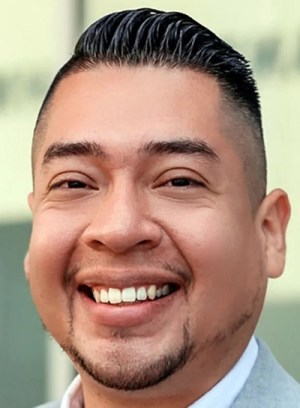
The mayor of Moreno Valley, Ulises Cabrera, obtained a restraining order against resident Elmer Thomas. Cabrera says Thomas shoved him and made rude comments and threatening gestures during an event commemorating the end of slavery. (Those who’ve felt the yoke of allegations to the court might find a certain irony in the latter detail.)

Moreno Valley Mayor Ulises Cabrera

Moreno Valley Mayor Ulises Cabrera

Thomas, the defendant, says that Cabrera brushed inches past his daughter then followed her to the toilet, while “smirking” at him.

Cabrera says that never happened and alleges Thomas bumped his shoulder.

A witness for Cabrera, a friend or relative, presumably, told the court that Thomas (at some point) stepped in front of a pickup Cabrera was in and flipped him the bird. The witness says Thomas then reached for his waistband, as if going for a gun, and made gestures urging Cabrera to get off the truck and duke it out.

The story does not indicate that there were any disinterested bystanders who saw the alleged “threatening” hand motions nor does it report that any actual gun was seen or drawn.

Thomas said he raised his middle finger at Cabrera after he threw candy at Thomas’s face.

Cabrera countered that he “absolutely did not throw candy.”

Thomas, who says he doesn’t even own a gun, denied that he “reached for his waistband.”

Background detail: The story reports that Thomas had criticized Cabrera while Cabrera was a city council member. Cabrera was censured by other council members for allegedly mistreating a former city employee.

Responding to the allegations brought against him last November, Cabrera said they were “essentially hearsay.”

Review the sketchy “witness” testimony above and see if the characterization isn’t equally applicable to it.

This infantile bullshit will be tried in a court of law later this month on the taxpayer’s dime.

Copyright © 2023 RestrainingOrderAbuse.com

*The right to criticize those in government is what the First Amendment is in place to protect foremost. Rude hand gestures are also protected expressions.

Irreverend: How to Fight Lies, Even by Institutions like the Court and the Church, When Your Only Tool Is Words, Part 1

Jeremy Cheezum, who for the purposes of this post will serve the role of straw man to demonstrate how hypocrisy and corruption manifest and how they can be combatted, is or was the pastor of Trinity Reformed Presbyterian Church in Montrose, Colorado. Years ago the author asked Cheezum to help terminate a pattern of abuse and lies by members of his family that had already raged for years and would go on to derail over a decade of the author’s life. Cheezum responded to the author’s appeals by spreading and reinforcing the lies in violation of his professed beliefs. Emails of his and of other faith leaders of the Presbyterian Church in America were instrumental in inducing a crooked judge to unlawfully silence the writer for five years, during which he helplessly watched loved ones diminish and die while he tried to recover the life he had meant to have with them. The bent judge resigned amid a public furor two years later, and his ruling was eventually tossed out, but Jeremy Cheezum and his confederates continue to enjoy the public trust, a source of peace the writer has been denied for close to a third of his life and counting.


Imagine allowing a single precious day of a person’s life to be despoiled by your family’s failings, transgressions, lies, and filth. Then imagine going on with your life with resolute indifference for not merely a week or a month but for 10 years: pursuing your vocation, rearing children, furnishing your house à la Martha Stewart, decorating Christmas trees, and going on picnics and vacations.

Jeremy Cheezum, Pastor Jeremy Cheezum, Rev Jeremy Cheezum, Trinity Reformed Presbyterian Church Montrose, Trinity Montrose, Presbyterian Church in America, PCA, Montrose High School, Olathe High School, Peak Academy, Ruth Bredfeldt, Ray Bredfeldt, Ruth and Ray Bredfeldt, Ray and Ruth Bredfeldt, Kim Cheezum, Kimberly Cheezum

Rev. Jeremy Cheezum, who, like other officials of the sect he subscribes to, has seemingly responded to revelations of serial lying and false swearing by trying to disassociate himself from their context.

I emailed Rev. Jeremy Cheezum in 2012, after I’d been already been subjected to six years of false accusation and defamatory lies by his sister- and brother-in-law, Tiffany and Phil Bredfeldt, which would go on for twice that long. The emails I sent to Cheezum (two, I think) were lucid, earnest, and civil. Cheezum never answered, and I’m persuaded by correspondence between his fellow faith leaders and him that I was likely a topic of gossip among the brethren. Their emails were dumped in my lap—in a lawsuit filed less than a year after I had asked Cheezum to please intervene.

That was nine years ago.

Cheezum has four kids. I don’t have children, and I don’t anticipate that I ever will. Cheezum’s father-in-law, Ray Bredfeldt, who has probably been Cheezum’s go-to babysitter and who has also likely contributed to Cheezum’s financial security, is also an official of the Presbyterian Church in America.

A few years—that’s years—after I appealed to Cheezum, Ray Bredfeldt would join in on another lawsuit, this time to have me imprisoned. The motive? To conceal that a woman had grown up on the end of leash, was apparently married off to a candidate with the right pedigree and faith orientation, was probably discontented, and then played around and lied to hide the fact. This is what the influence of stifling religious morals engenders. (I would be told by a friend of the woman’s that she sometimes stayed out all night, which would pretty much have to mean that the husband, Ray Bredfeldt’s son, consented.)

People of means like these people can and do hire attorneys without great sacrifice. But they don’t hire them to rectify the evil they’ve done or defended; they hire attorneys to make their violations invisible.

Then they wade into church on Sunday to be washed squeaky clean.

When the court put a stop to the accusations in 2018, I listened to a couple of Cheezum’s sermons online expecting to hear a quasi-literate bible-beater with a backwater drawl. He turned out to be exactly what I thought he was when I wrote to him for help: seemingly warm, earnest, and charismatic.

The impression I’m left with is that social institutions like the church are no different from government institutions like the court. Both are neck-deep in political role-playing: What’s right is what suits them.

Everything else is the glossy veneer that preserves their authority.


PASTOR CHEEZUM STROKES HIS FLOCK

“Then I looked and behold on Mt. Zion stood the lamb, and with him 144,000 who had his name and his father’s name written on their foreheads,” Jeremy Cheezum quoted to his congregation in a sermon on Revelation 14:1-5 he gave a few years ago. “These have been redeemed from mankind as first fruits for God and the lamb, and in their mouth, no lie was found.”

Then Cheezum, cementer of lies, thanked God for his words.

According to Cheezum’s citation, 144,000 souls are to be redeemed in Christ’s triumphal return.

Wikipedia reports that members of Cheezum’s sect, the Presbyterian Church in America (PCA), number over 380,000.

Even if Christ drew from this pool exclusively, well over half of the PCA’s followers wouldn’t make the cut.

“Isn’t that encouraging?” Cheezum asked his congregation.

Then he pointed out that 144 is the square of 12 and 12 are the tribes of Israel, which, he said, means that all of those faithful to Christ are good to go, apparently whether they’re liars or not.


TUTORIAL AND COMMENTARY

What precedes is basic bit of public criticism, presented from a few different angles, that’s fully protected by this nation’s First Amendment laws. If you’re the victim of a bad rap, absorb how this works. See how you can make both logical and emotional appeals—and even throw in some wit.

Satire, hyperbole, metaphor, opinion, facts, mockery, sarcasm, “bad words,” slurs, epithets, and innuendo are all protected speech. Exceptions to freedom of expression are very few, and they’re narrowly defined. Commit them to memory so that if you choose to relate your experiences to others, you know how to do it within the letter of the law.

You may not (thou shalt not?) lie about someone or misrepresent a fact. If you say someone is a “psycho,” that’s defensible as hyperbole (exaggeration). We say this all the time. If you say someone is a clinically diagnosed psychopath, and no such diagnosis exists, then you’re treading on thin ice. Lying about someone is a no-no and qualifies as libel, for which you may be justly sued. Remember: Almost anything can be couched in terms like, “I believe, “I would surmise,” “I feel confident,” “I suppose,” “If I’m right,” etc., to immediately make a categorical statement a conditional one. You’re just offering your perspective, which is, whether right or wrong, protected speech.

You may not threaten. Pronouncing, “I think X deserves to die,” might be defensible as an opinion but it’s ill-advised. That said, saying “people like X don’t deserve the air they breath” doesn’t actually refer to X at all. There are always workarounds. But this writer’s recommendation is that you steer clear of anything that sounds like you mean to do anyone physical harm or induce others to.

You may not address writing TO any specific person (to avoid running afoul of a harassment injunction). The First Amendment protects this: “X can fuck himself.” The First Amendment doesn’t protect this: “Fuck you, X.” It’s all in how you say it. You’ve probably seen bumper stickers that read, “Fuck Biden.” This is protected speech…even though it’s speech ABOUT the President. (Joltin’ Joe, incidentally, is the author of the Violence Against Women Act, which represents a host of laws that have nearly facilitated false accusation and bullshit to a level rarely seen outside of Communist states, Shariah law courts, and witch trials.) Speech ABOUT anyone or anything (save, perhaps, state secrets) is protected speech.

While it’s also true that you may not invade a person’s privacy, what privacy exists these days is debatable. Home addresses may be public records available from a search engine with a few key strokes. Do not publish someone’s medical records. But don’t qualm about citing a medical condition you have certain knowledge of that, for example, might incline him or her to act irrationally or lie pathologically. (One of the writer’s own accusers, for instance, is reportedly diagnosed with bipolar disorder and another owned to the court that she was undergoing psychiatric treatment…for PTSD. Maintaining lies you’ve told to everyone you know is apparently hard on the nerves.)

Excepting the forbidden territory surveyed above, you are free to say what you want to say. Court documents are public documents. They are payed for and owned by the taxpaying citizen. Your experiences in court, excepting those from rare “closed-session” proceedings (like settlement hearings), are your experiences to share with anyone, and it’s unlawful for a judge to say otherwise.

Future posts will continue the Cheezum commentary and relate strategies for attaining readership for those who may wish to embrace their rights and engage in public criticism.

Copyright © 2022 RestrainingOrderAbuse.com

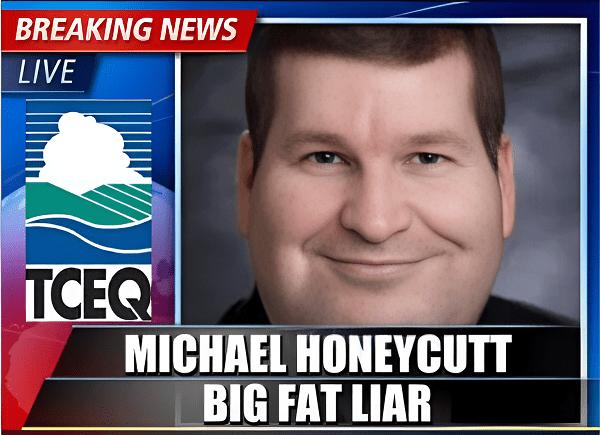
Michael Honeycutt, TCEQ Tox Director, Lies under Oath

Michael Honeycutt, Ph.D., whom this post tersely exposes, is the director of toxicology of the Texas Commission on Environmental Quality (TCEQ). He is also the current chairman of the Environmental Protection Agency’s Science Advisory Boards but, amid some controversy concerning his ethics, reportedly will not be seeking reappointment when his term ends next month.

Readers may consult “What TCEQ Exec L’Oreal Stepney Would Ask Michael Honeycutt if She Cared Whether the Directors Her Agency Employed Were Unscrupulous Stooges” and its attendant links for specifics concerning this post.

Note: The writer’s publication of satirical images like the one below is not meant to suggest to the reader who has been victimized by court process that people who lie in court or abet liars in court deserve to be lampooned merely. It is the writer’s conviction, rather, that they deserve to be harshly censured in court, like those who are lied about, threatened in court, like those who are lied about, and sent to jail, like those who are lied about too often are. The deplorable fact is that liars like Honeycutt are almost always rewarded for their misconduct with the court’s thanks. Criticism and satiric commentary are thus victims’ only lawful recourse.


Michael Honeycutt, Michael Honeycutt PhD, Michael Honeycutt TCEQ, Michael Honeycutt EPA, false testimony, L'Oreal Stepney, L'Oreal Stepney TCEQ, Toby Baker, Greg Abbott, Tiffany Bredfeldt, Tiffany Bredfeldt PhD, Tiffany Bredfeldt TCEQ, Bredfeldt TG

Michael Honeycutt, Ph.D., director of toxicology of the Texas Commission on Environmental Quality (TCEQ), represented as an even fatter big fat liar


WHAT MICHAEL HONEYCUTT DID:

Lied under oath in a lawsuit in which he phoned in an appearance to help a colleague who had lied under oath deprive the writer of his First Amendment liberty to report their lies.

WHAT MICHAEL HONEYCUTT COUNTED ON:

That his and his colleague’s testimony could never be published.

HOW MICHAEL HONEYCUTT DID IT:

By testifying that I had called his colleague a “fraudulent scientist” because I told him she was a liar.

Honeycutt also reported secondhand fictive tales of sexual harassment/aggression that he acknowledged under oath he had made no attempt to clarify let alone verify.

WHY MICHAEL HONEYCUTT DID IT:

Because he had an inappropriate relationship with his colleague, who was and continues to be his employee. Whether that inappropriate relationship went beyond willing service to her as an agent in an enterprise that was later deemed unlawful, the writer can’t say. (Honeycutt did, however, testify that he had provided his colleague with a private office with a door that locked, and the woman was nominated to a post at the EPA coincident with Honeycutt’s nomination.)

WHAT THE CONSEQUENCES WERE:

An unconstitutional censorship order prohibiting the writer from reporting years of false testimony by Honeycutt’s colleague, a married woman who had indulged an infatuation at the writer’s home in 2005. The writer lived under the order for five years, sustaining himself by manual labor, before it was dissolved in 2018, when the woman’s accusations were dismissed, and a mutual order was entered by the court prohibiting her from ever revisiting them publicly (though the writer is certain they continue to circulate privately). While the writer lived hand-to-mouth, Honeycutt was paid a generous six-figure salary for performing in an air-conditioned facility what is reportedly held by many to be suspect science for the Texas Commission on Environmental Quality (TCEQ).

The illegal order Honeycutt was instrumental in coercing from a since disgraced judge was only dissolved after a protracted two-year contest following his colleague’s seeking to have the writer imprisoned, which Honeycutt apparently supported, and her false allegations continue to be preserved as public documents that can only serve to impede the writer and that have galled and gnawed at him, to the diminishment of his and others’ lives, for nearly 15 years.

WHAT MICHAEL HONEYCUTT HAS DONE SINCE 2018:

Relished his moment in the spotlight as the EPA’s chief science advisor by all appearances.

Copyright © 2020 RestrainingOrderAbuse.com

What TCEQ Exec L’Oreal Stepney Would Ask Michael Honeycutt if She Cared Whether the Directors Her Agency Employed Were Unscrupulous Stooges

The author of this post, Todd Greene, was baselessly sued in 2013 (not for the first time) by a scientist in the employ of the Texas Commission on Environmental Quality (TCEQ) named Tiffany Bredfeldt, who called upon her boss, Michael Honeycutt, TCEQ director of toxicology and today head of the Environmental Protection Agency’s Science Advisory Boards, to witness on her behalf.

Both of them are Ph.D.’s, which is the sort of fact judges are more apt to find compelling than, say, the truth.

Bredfeldt, a married woman, had targeted Greene at his home in 2005, indulged an infatuation, and then hoaxed the police and the courts to whitewash her conduct by claiming she was afraid and had been sexually accosted or assaulted (the details of her narrative and their specificity varied broadly with each retelling).

Greene would be in and out of court with Bredfeldt, based largely on allegations of hers stemming from their three-month acquaintance in 2005, for no less than a dozen years.

The upshot of Bredfeldt and Honeycutt’s tag-team effort was an unlawful injunction imposed upon Greene that forbid him from speaking about Bredfeldt’s conduct or his own travails in the “justice system,” even “by word of mouth.”

The illegal injunction, which violated Greene’s First Amendment rights (and concealed lies), was dissolved in 2018 (five years later) after Bredfeldt sued to have Greene wrongly imprisoned for allegedly violating the censorship order.

Recent posts on this blog have criticized administrators at the TCEQ for their claims and conduct and provided a brief series of statements culled from the hours and reams of “evidence” that show so plainly that Bredfeldt is a liar that even a bureaucrat or a judge couldn’t fail to discern the fact.

Following in the tracks of the most recent post of this kind, “What L’Oreal Stepney, Newly Named TCEQ Exec, Would Ask Tiffany Bredfeldt if She Cared Whether the Scientists Her Agency Employed Were Fucking Liars,” this post imagines questions that TCEQ executive administrators might pose to Dr. Honeycutt to clarify conclusively whether he carelessly involved their agency in a vicious hoax that would lead to a wronged man’s nearly being imprisoned.


Michael Honeycutt TCEQ, Michael Honeycutt PhD, Michael Honeycutt, Michael Honeycutt EPA, L'Oreal Stepney, L'Oreal Stepney TCEQ, TCEQ, Texas Commission on Environmental Quality, Environmental Protection Agency, Toby Baker TCEQ, TCEQ executive director, false testimony, lying, liar

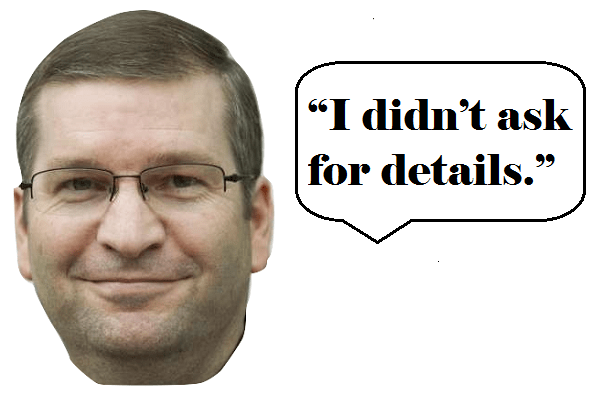
Michael Honeycutt, Ph.D., the EPA’s “top scientist” and toxicology director of the Texas Commission on Environmental Quality (TCEQ)


In a letter sent to you at the TCEQ in 2011, Mr. Greene informed you that one of your married employees, Tiffany Bredfeldt, had falsely testified against him and continued to make defamatory claims about his character and behavior despite, apparently, having been offered a chance to simply and quietly recant years before.

Discounting any ethical obligation a government scientist who’s called upon to give expert witness testimony might have to represent facts accurately, one would expect you to feel some burden to ascertain the truth of these allegations prior to participating in a lawsuit in another state that you must have known was intended to have Mr. Greene judicially censored on pain of incarceration.

When asked by Mr. Greene what your familiarity was with the underlying matter that led you to witness for Dr. Bredfeldt, you testified that you “didn’t ask for details” or “clarify” them because as her employer “it would not be appropriate.”

QUESTION: How do you justify your involvement in a matter that by your own admission you hadn’t made any effort to fathom?

You testified that Dr. Bredfeldt had told you Mr. Greene “propositioned her,” and opined that this meant Mr. Greene had sought to have sex with her. This obviously contrasted with what Mr. Greene had told you.

QUESTIONS: What was the basis for your giving preferential treatment to Dr. Bredfeldt’s account, one that you admitted you had accepted at face value and made no attempt to clarify? Do you consider this choice ethically conscionable?

You also testified that Mr. Greene accused her of being a “fraudulent scientist.”

QUESTION: Was this what Mr. Greene said to you, or were you urged to make a false statement to satisfy the expectation of your employee’s attorney?

You said that Mr. Greene told you Dr. Bredfeldt was a liar who lacked “good morals,” and you acknowledged under oath that these were “pretty significant allegations,” the implication being that they were allegations that diminished her trustworthiness and value as a scientist.

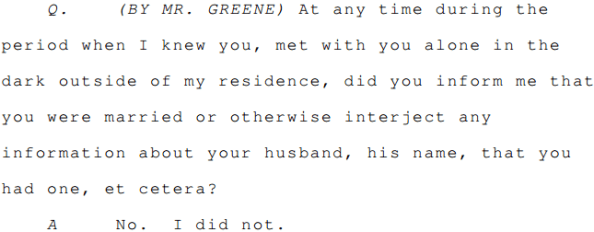
You also said that Dr. Bredfeldt told you Mr. Greene “wouldn’t take no for an answer.” Yet she told the police that Mr. Greene had taken no for an answer, and she told Mr. Greene himself that he had been “nice” to her and that she had “never felt the need” to tell him she was married.

Dr. Bredfeldt’s account to you is plainly contradicted by her own statements, ones she entered into evidence voluntarily.

QUESTION: If you considered the allegation of lying significant, what if any actions have you taken since Dr. Bredfeldt’s allegations were dismissed in 2018?

Not long prior to the 2013 lawsuit, TCEQ Director L’Oreal Stepney had answered charges of censorship leveled at this agency by declaring that it is “wrong” and not representative of TCEQ policy.

QUESTION: Did this public repudiation of censorship cause you any misgivings about assisting Dr. Bredfeldt to obtain a censorship order against Mr. Greene, one that was notably thrown out five years later for being wrong?

Finally, Mr. Greene has alleged that in 2016 Dr. Bredfeldt said in court that you considered her latest lawsuit “good experience” for occasions when she might be called upon to give expert witness testimony as a TCEQ scientist.

QUESTION: Did you wish Dr. Bredfeldt success at having Mr. Greene jailed?

Copyright © 2020 RestrainingOrderAbuse.com

*Readers may wonder why questions like those in this post and the post “What L’Oreal Stepney, Newly Named TCEQ Exec, Would Ask Tiffany Bredfeldt if She Cared Whether the Scientists Her Agency Employed Were Fucking Liars” couldn’t have been raised in court. The simple answer is that judges will flatly deny defendants the opportunity to ask questions whose answers aren’t likely to support the conclusions the judges have already formed.

**TCEQ administrators have seemed to respond to this writer’s posts by using search engine manipulation to suppress the posts and images associated with them in Google’s returns. Readers who are curious to see verification of this need only Google the name Michael Honeycutt, for example. He’s a prominent political figure these days. Yet Google’s image strip for him will rarely appear on the first page of its returns for his name, and when it does, it’s at the bottom.

L’Oreal Stepney, TCEQ Director, Falsely Denies Agency’s Censorship Practices

L'Oreal Stepney, Loreal Stepney, Loreal Stepney TCEQ, L'Oreal Stepney TCEQ, L'Oreal Stepney PE, Loreal Stepney PE, TCEQ, Texas Commission on Environmental Quality, Toby Baker, Greg Abbott, Governor Greg Abbott
“Let me say this clearly. We are not an agency that is about censorship. It is not what we do, it is wrong, it is not who we are.”

L’Oreal Stepney (2011)

That’s how the Texas Commission on Environmental Quality’s deputy director of the Office of Water responded to allegations by scientists that their conclusions had been censored by her agency, which considers climate change to be “unsettled science.” The TCEQ was accused of censoring facts that appeared to support the contrary.

L’Oreal Stepney countered the criticism by flatly stating that censorship was wrong and was not representative of TCEQ practices.

Less than 24 months after Stepney’s public protestation, a censorship order against this writer was unlawfully coerced from an Arizona judge by TCEQ senior toxicologist Tiffany Bredfeldt with the help of TCEQ Toxicology Director Michael Honeycutt to conceal facts that were potentially embarrassing to them and to the agency that apparently still provides them with paychecks seven years later.

A detailed account of Bredfeldt’s and Honeycutt’s statements to the court, including contradictory testimony, is here.

The 2013 injunction that they succeeded in securing against the writer, which made reporting his experiences with Bredfeldt both in and out of court, even “by word of mouth,” a criminal offense was itself in violation of the law, specifically, the Constitution. It was furthermore issued without a trial, which was also illegal.

According to testimony given by Honeycutt in 2013 (linked to above), the TCEQ had, besides, censored the writer within its agency before any court judgment was issued, in 2011 or 12, in other words, almost exactly concurrent with Stepney’s denial that the agency engaged in censorship, and it seems unlikely that Honeycutt would have or could have acted without other TCEQ administrators’ knowledge. Either Stepney knew, or she arguably should have known. Her 2011 public pronouncement that “censorship…is wrong” should have placed the entire agency on notice.

[A]s a general matter, the First Amendment means that government has no power to restrict expression because of its message, its ideas, its subject matter, or its content” unless the speech falls within one of the “well-defined and narrowly limited” exceptions, like defamation or obscenity. United States v. Stevens, 559 U.S. 460, 468-69 (2010) (citations omitted). Here, the injunction restricts Greene’s speech based on its subject matter and content—but covers speech that does not fit within any First Amendment exceptions [Greene v. Bredfeldt, Brief of Amicus Curiae, 2017].

The unlawful speech injunction (or “prior restraint”) that was imposed on the writer in 2013, and whose intent was to conceal a vicious hoax, stood for five years and was only dissolved after Bredfeldt attempted to have the writer imprisoned for its alleged violation, a threat that loomed over the writer’s head for two years, during which his father died, alone, while the writer was preoccupied with defending himself from accusations founded on lies.

The writer was rewarded with nothing but sore joints and muscles in contrast to the six-figure annual salary Stepney enjoyed during the same period. His ambition, corrupted by a dozen years of false, filthy, and/or frivolous allegations (which remain unrectified to this day), had been to publish humor for kids.

The loss of First Amendment freedoms, for even minimal periods of time, unquestionably constitutes [an] irreparable injury [Elrod v. Burns, 427 U.S. 347 (1976)].

I’m pretty sure the TCEQ was implicated in information suppression recently, moreover, and there’s no question that some critics of the agency consider suppression and/or distortion of facts typical of TCEQ “science.”

L’Oreal Stepney, a consummate bureaucrat whose claims of disdaining censorship are ones this writer considers expedient falsehoods, has reportedly sought to hold the TCEQ’s top administrative position. She apparently feels she should run the agency.

The writer wouldn’t trust someone so willing to sweep dirt under the rug with a job on its janitorial staff.

Stepney has the last laugh, though. At the expense of the Texas working class, she’s lavishly paid $165,000 a year.

Copyright © 2020 RestrainingOrderAbuse.com

Michael Honeycutt, Hack Ph.D., Grooms Chronic Liar to Give Expert Witness Testimony as TCEQ Rep; Both Named to Trump EPA

Michael Honeycutt, Dr. Michael Honeycutt PhD, Michael Honeycutt PhD, TCEQ, Texas Commission on Environmental Quality, Gov Greg Abbott, TCEQ, L'Oreal Stepney, Loreal Stepney
“Almost every time there’s a public concern about pollution, [Michael Honeycutt] says there’s nothing to worry about. Almost every time industry takes a position against stronger health protections, he takes their side and contorts the science to advocate for doing nothing. He just doesn’t have any credibility anymore.”

Luke Metzger, director of Environment Texas

The subject of this post, Michael Honeycutt, Ph.D., is the toxicology director for the Texas Commission on Environmental Quality (TCEQ) and the Pruitt-appointed chairman of the EPA’s Science Advisory Boards.

I can corroborate that he has a knack for pollution, a knack, that is, for producing it.

Here is a bio possibly written by Michael Honeycutt about himself, in which either he or one of his TCEQ subordinates identifies Dr. Michael E. Honeycutt as a “dedicated, distinguished scientist.” That alone would be a sufficient commentary on the man’s ethics, besides a testament to his vanity, arrogance, and professional ridiculousness. But I have more.


Michael Honeycutt indiscriminately helped further tatter my life at a time when I might still have been able to patch the rents, and he did that by supporting a hoax, which is something that apparently comes naturally to him.

Greg Abbott, Texas Governor Greg Abbott, TCEQ, Texas Commission on Environmental Quality

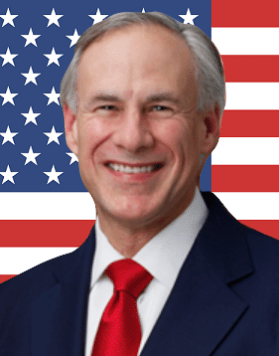
Governor Greg Abbott, who says he supports “faith, family, and freedom,” but whose agency, the Texas Commission on Environmental Quality, has been repeatedly implicated in censorship, including censorship of the author of this post to cover up public mischief

A guy I had never met and still haven’t, Honeycutt “witnessed” against me in 2013 before the Arizona Superior Court—by phone from the comfort of his office in Texas, where I can’t help but imagine he was talking around a jelly donut and taking care not to dribble its contents on his shirt.

Some of his testimony appears below, along with that of the person on whose behalf he testified, a liar in his employ. Texas Governor Greg Abbott and TCEQ directors Toby Baker, Stephanie Bergeron Perdue, L’Oreal Stepney, and Beth West should be ashamed. Both my best friend and my father died while this mischief was ongoing. And its residue doesn’t simply evaporate as the TCEQ seems to believe chemical pollutants do. The only one who can undo lies is the liar.

Thanks in no small part, I’m certain, to Honeycutt’s flash credentials and suave delivery, which I have no doubt was coached, I would be denied my constitutionally guaranteed First Amendment freedoms for the next five years by an unlawful speech injunction that was imposed without a trial (which is, of course, also illegal). The TCEQ has been repeatedly implicated in censorship and information suppression, so in that regard there’s nothing exceptional about this instance.

During the five years I was silenced, I might have racked up a couple of Ph.D.’s of my own or published a book or two, as I had intended, had a case initiated by a protégée of Honeycutt’s at the TCEQ, senior toxicologist Tiffany Bredfeldt, been settled instead of unlawfully hushed.


Tiffany Bredfeldt, who represented the TCEQ on the news while seeking the writer’s imprisonment, was apparently dumped by her husband around the time the case concluded against her. That case stemmed from a 2013 censorship order validated by Michael Honeycutt, who might have averted manifold damages to all parties concerned had he demonstrated a molecule of discernment.


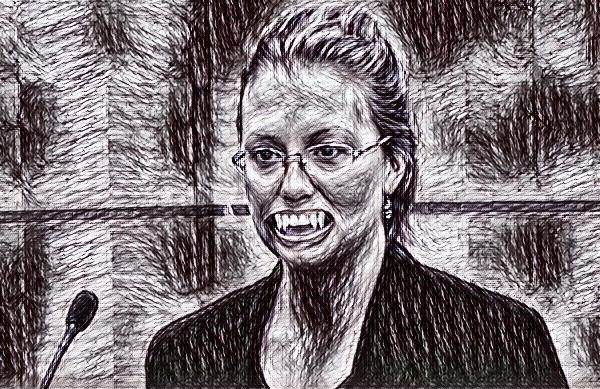
Tiffany Bredfeldt is a developmentally arrested, chronic, documented liar. She’s also a liar who has ridden her mentor’s coattails straight into the federal government—which, I grant, is where many of society’s least scrupulous succeed in turning their ethical disinhibition to profit.

I imagine Mike and Tiffany are flourishing there. I’d be surprised, really, if they weren’t already conspiring to occupy the office of EPA Administrator Andrew Wheeler.

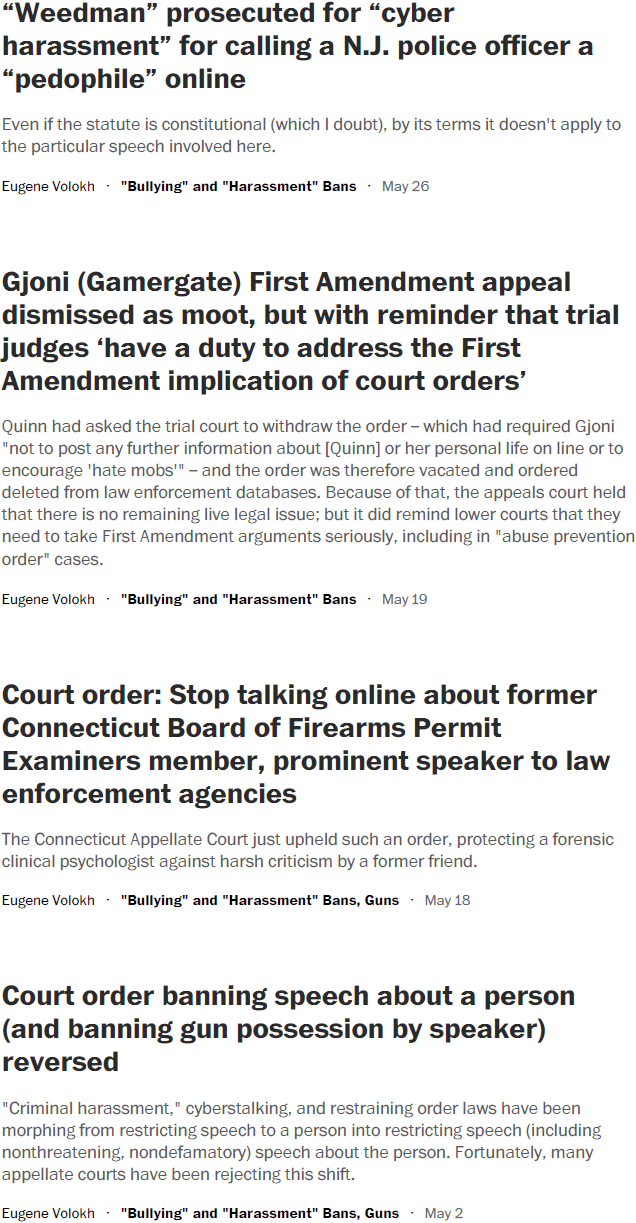
Eugene Volokh, UCLA School of Law, UCLA Law Prof. Eugene Volokh, First Amendment

Constitutional scholar Eugene Volokh, who blogs on Reason.com, among other things about faith, family, and freedom, addressing the U.S. Senate Judiciary Committee

I was first in court with Bredfeldt in 2006, when I was granted a 20-minute self-defense against cooked allegations, and I was last in court with her in 2016, accused of having violated the illegal speech injunction Honeycutt had helped her illegally secure three years prior. Discounting many pretrial conferences, the entire 2016 “trial” again amounted to a single hearing, during which the proceedings were indefinitely suspended. Then they were dismissed…two years later. That’s 12 years of lying and legal abuse, including lawbreaking. What made the difference in 2016 was that I had public defenders and the support of UCLA professor of law and eminent First Amendment scholar Eugene Volokh; it wasn’t just a backroom lynching as it had been in 2013 when Honeycutt glibly voiced an appearance.

At the end of the 2016 hearing, after the mics had been turned off, Honeycutt’s apprentice could be heard exclaiming, “God damn it!” She then remarked for her courtroom entourage that Honeycutt had joked that her prosecution would be “good experience” for when she gave expert witness testimony as a TCEQ rep. That was Honeycutt’s alleged commentary on a prosecution meant to have a man wrongfully imprisoned. And Honeycutt’s a guy who identifies himself as a stalwart Christian and a devotee of the Boy Scouts.

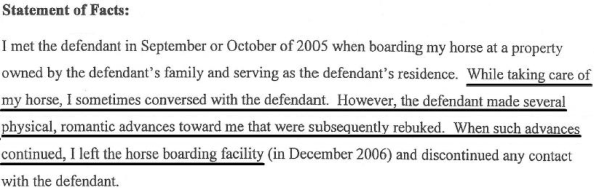
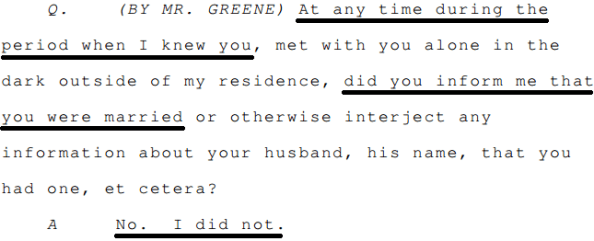
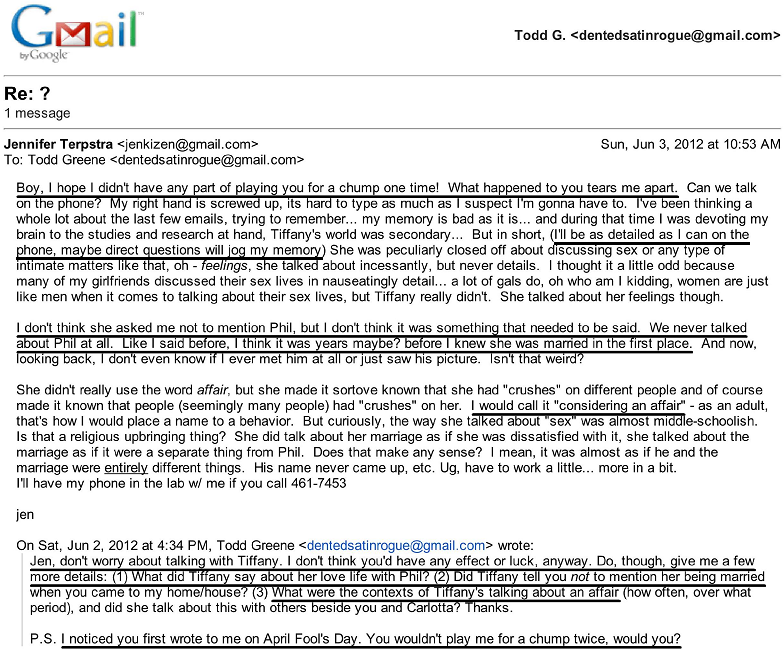
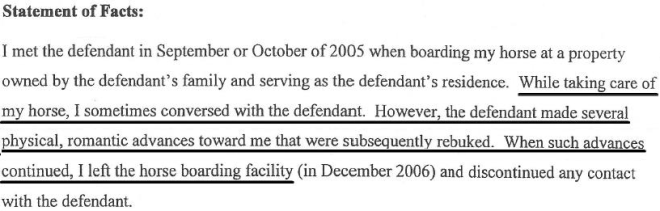
Here’s a synopsis of statements Texas state official and EPA adviser Tiffany Bredfeldt gave in evidence to the court or, in one instance, to the police only between the years 2006 and 2017. The story they tell isn’t the half of it, but it’s succinct, and its contradictions are palpable. The statements provide all the background the reader will require. Honeycutt’s contribution to this list is the third from the top. His apprentice, a stranger who had routinely hung around outside of my house at night, alone, has lied impulsively and randomly to whitewash what might be called an extramarital infatuation, and she has lied without qualm and to anyone who would listen. Like her mentor Honeycutt, she’s fond of attention.


The crackpot who made the preceding statements was, the last I knew, entrusted with a role in determining U.S. public health policy besides that of Texas.

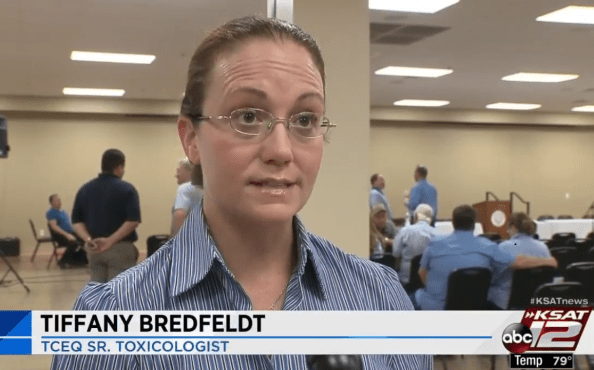
And she’s a virtual phantom. Anyone with a grievance toward the TCEQ who’s curious to learn if a Tiffany Bredfeldt is employed there will be disappointed. Thanks to Mike Honeycutt, she hasn’t appeared on its employee roster since 2011 or 12, though she represented the TCEQ on the TV news less than three years ago (see the image above) and still draws an agency paycheck (annual salary: $73,608).

Here’s Mike’s 2013 explanation to the court:

Even the reader with no courtroom experience can appreciate how steered testimony like that could drive some coffin nails home.

I encountered Honeycutt’s protégée in 2005, a few feet from my house, which is the only place I’ve ever seen her outside of a courtroom, and I’ve never been to Texas.

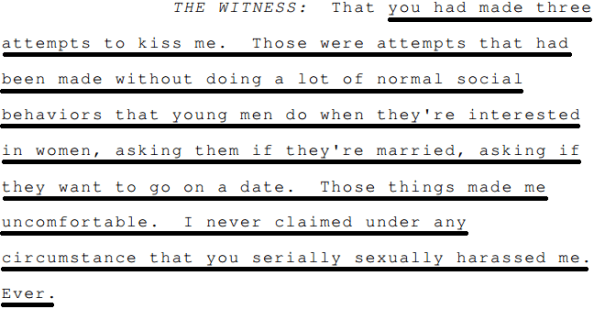
A woman who was scheduled to testify in the 2016 lawsuit that was meant to have me jailed had characterized Bredfeldt’s behavior toward me this way:

Michael Honeycutt, TCEQ, Texas Commission on Environmental Quality, hoax, Tiffany Bredfeldt PhD, Dr. Tiffany Bredfeldt, Governor Greg Abbott, Beth West TCEQ, TCEQ Human Resources Director Beth West, TCEQ Executive Director Toby Baker, Toby Baker TCEQ, TCEQ Deputy Executive Director Stephanie Bergeron Perdue

The email containing the woman’s remarks has been online for two years and is presumably known to Honeycutt, who, as far I can tell, has only sought to keep the matter from interfering with his moment in the limelight and his activities in church and with the Boy Scouts.

The exclusive basis for Michael Honeycutt’s involvement in the case at all was that I had contacted him in 2011 to tell him he was employing a scientist who had no compunction about lying.

It wouldn’t have occurred to me then that a willingness to lie, including under oath, might be a qualification the TCEQ prized.

Copyright © 2020 RestrainingOrderAbuse.com

*Michael Honeycutt told the court in 2013 that I had accused his apprentice Bredfeldt of engaging in scientific fraud, which is something I’ve never done. In fact I was careful to clarify that I knew nothing about her professional conduct. Honeycutt’s testimony, given under oath, was false. It was, however, effective, and I’m convinced that effectiveness was his priority, not accuracy. Misrepresenting a material fact in a sworn court proceeding, that is, stating a fact under oath that is likely to influence the judge but is untrue, is called perjury, and it’s a felony crime.

**Liberal detractors of Michael Honeycutt’s favor PC characterizations like this one by Honeycutt’s peer Elena Craft, Ph.D., senior health scientist for the Environmental Defense Fund in Texas: “[Honeycutt’s] positions generally are totally inconsistent with mainstream thinking.” To someone who distrusts conventional perspectives, as I do, this sounds like a compliment. Moreover, the conduct this post criticizes accords with mainstream thinking, which is something people like Ms. Craft might broaden themselves by considering. Archly feminist views, I’ve noted, are endemic in the hard sciences (and in a good many of the soft ones). A scientist is someone who confronts the truth in whatever unsettling form it comes. Otherwise, s/he’s misappropriating the title.

Emails by PCA Pastors Kevin Hale, Daren Dietmeier, and Jeremy Cheezum Used to Support Lies, Lawbreaking, and Abuse

Kevin Hale, Jeremy Cheezum, DietmeierDaren, USAF, Daren Dietmeier, Rev. Kevin Hale, revkevinhale, ozarkdogmatics, Christ Church, Christ Church Conway, ozarkdogmatics.com, Ozark Dogmatics, Conway Arkansas, Pastor Kevin Hale, Jeremy Cheezum, Rev. Jeremy Cheezum, Pastor Jeremy Cheezum, Trinity Reformed Presbyterian Church, Montrose Colorado, Rev. Daren Dietmeier, Pastor Daren Dietmeier, Trinity Presbyterian Church, Aledo Illinois

From left to right, Rev. Kevin Hale of Christ Church in Conway, Arkansas; Rev. Jeremy Cheezum of Trinity Reformed Presbyterian Church in Montrose, Colorado; and Rev. Daren Dietmeier of Trinity Presbyterian Church in Aledo, Illinois

Emails authored by pastors Kevin Hale and Daren Dietmeier of the Presbyterian Church in America (PCA) and displayed in this post were submitted in evidence to the Arizona Superior Court in 2013 to procure what has since been recognized as an illegal speech injunction—the intention of which was to conceal false testimony to the court and false reporting to law enforcement officials—and the pastors’ emails are accordingly public documents.

The unlawful injunction they were used to obtain, which was imposed without a trial and which deprived the writer of his constitutionally protected freedom of speech for five years, was dissolved in 2018, and a family that had endeavored to have the writer imprisoned based on filthy and/or frivolous allegations spanning 12 years is today prohibited by mandate of the court from harassing him further.

Note to the reader: When the writer appealed to the ministers named in this post for help in gaining relief from persistent false accusations by church insiders, he had already existed in the shadow cast by those lies for six years.


Probably the Presbyterian ministers pictured above wouldnt be grinning so broadly if members of their congregations had accused them, for example, of inappropriately touching their children. Whispered nicknames like Creepy Kevin, Germy Jeremy, and Dirty Dietmeier are punishing, especially on the job security of men in professions like theirs. The tolls are far worse when the innuendo and gossip are the products of lies.

Many who’ve been lied about to the courts feel the acid burn of such labels even if they’re never put into words. I’ve been lied about a lot and for a long time, and I have felt the actual words.


This message was communicated to me by email on the first day of what would become 12 years of legal abuse by a woman named Tiffany Bredfeldt and her husband, Phil Bredfeldt, sister- and brother-in-law of Rev. Jeremy Cheezum.

To relate the background as briefly as possible, Tiffany Bredfeldt had nightly lingered outside of my house for months in 2005 and taunted me with references to her body and underwear, apparently relishing the attention. Then she lied to the police and the court to conceal her misconduct when I learned she was married and demanded an explanation—and she has lied over and over since, as the testimony I’ve included below shows plainly.

Tiffany Bredfeldt in 2005

The message above was sent after Tiffany and Phil Bredfeldt had obtained a court injunction forbidding me from responding to it. Sort of like a four-letter nyah-nyah. The couple thought it would be cute to send a copy of the message to the police, apparently to reinforce the idea that they were afraid for their lives (because why wouldn’t you provoke someone you were afraid of?). The restraining order, which was petitioned by Tiffany Bredfeldt, particularly emphasized that I was a danger to her husband, a guy I had never met, and shouldn’t be allowed to talk to him.

I was an aspirant kids’ writer with a puppy and a parent in chemotherapy. Maybe the spoiled brats, both of whom were reared in the church, thought that was funny also.

Certainly evident is that everyone I appealed to for relief from lies that would continue for 11 years (and may be repeated and embellished upon today) couldn’t have cared less.

Here’s a synopsis of statements Tiffany Bredfeldt gave in evidence to the court or, in one instance, to the police only between the years 2006 and 2017. The story they tell isn’t the half of it, but it’s succinct, and its contradictions are palpable. The woman has lied impulsively, randomly, and wickedly and then lied to conceal the lying—and gotten by with a little help from her friends. Her husband, Phil, after whom one of Rev. Cheezum’s kids may be named, was incidentally privy to all of these statements and has supported them fully, including under oath.


Jeremy Cheezum, Kevin Hale, Daren Dietmeier, Dr. L. Roy Taylor, Pastor Kevin Hale, Pastor Daren Dietmeier, Pastor Jeremy Cheezum, Tiffany Bredfeldt, Phil Bredfeldt, Rev. Kevin Hale, Rev. Jeremy Cheezum, Rev. Daren Dietmeier, Rev. Paul Sagan, Dr. Roy Taylor, Roy Taylor PCA, Kevin Hale PCA, Jeremy Cheezum PCA, Daren Dietmeier PCA, Presbyterian Church in America, PCA, Christ Church Conway, Trinity Aledo, Trinity Presbyterian Church, Trinity Montrose, Trinity Reformed Presbyterian Church, TRPC, Covenant Church Fayetteville, Dr. Ray Bredfeldt, Raymond Bredfeldt, Ray Bredfeldt MD, Tiffany Hargis


Jeremy Cheezum, Kevin Hale, Dr. L. Roy Taylor, Daren Dietmeier, Pastor Kevin Hale, Pastor Daren Dietmeier, Pastor Jeremy Cheezum, Tiffany Bredfeldt, Phil Bredfeldt, Rev. Kevin Hale, Rev. Jeremy Cheezum, Rev. Daren Dietmeier, Rev. Paul Sagan, Dr. Roy Taylor, Roy Taylor PCA, Kevin Hale PCA, Jeremy Cheezum PCA, Daren Dietmeier PCA, Presbyterian Church in America, PCA, Christ Church Conway, Trinity Aledo, Trinity Presbyterian Church, Trinity Montrose, Trinity Reformed Presbyterian Church, TRPC, Covenant Church Fayetteville, Dr. Ray Bredfeldt, Raymond Bredfeldt, Ray Bredfeldt MD, Tiffany Hargis


People of moral character might call the woman psycho, or they might call her evil.

Here are a couple of alternative interpretations by men I appealed to for help seven years ago whose profession it is to conscientiously listen.


Rev. Kevin Hale, Pastor Kevin Hale, Christ Church, Christ Church Conway, Conway AR, Presbyterian Church in America, PCA


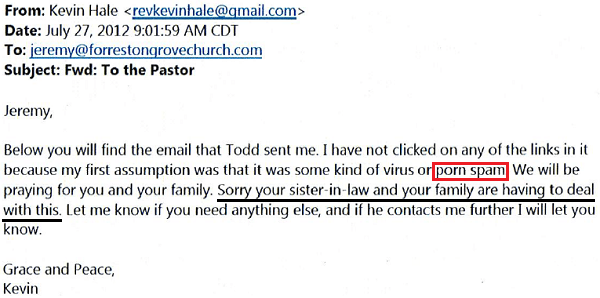
In the email above, Rev. Kevin Hale offhandedly dismisses an appeal for help I sent him (unread) as “porn spam,” and the person he says he pities is the woman whose lies are glossed above. Rev. Hale’s addressee in the email is Rev. Jeremy Cheezum, to whom I had also appealed. Rev. Cheezum played middleman during this interlude, snatching up my appeals for help, which he also disregarded, and funneling them to my accuser’s husband, Phil Bredfeldt, his brother-in-law. Phil Bredfeldt would then use the appeals to coerce an illegal speech injunction in 2013 (putting me at risk of incarceration for exposing his wife’s lies even by “word of mouth”) and later (2016) to accuse me of felony extortion. The extortion ploy was ditched when it failed to scare me into abandoning my defense and agreeing to shut up, and the unconstitutional court order was eventually dissolved. Had it not been, this publication would have been grounds for my imprisonment.


Daren Dietmeier, Rev. Daren Dietmeier, Pastor Daren Dietmeier, Trinity Presbyterian Church, Aledo IL, Presbyterian Church in America, PCA, Trinity Aledo


In response to the appeal I sent him, Rev. Daren Dietmeier concluded I should invest in a book of sudoku puzzles, perhaps, or take up crochet.

A woman who was scheduled to testify when I was most recently prosecuted (2016) had characterized Tiffany Bredfeldt’s behavior toward me this way:

Jeremy Cheezum, Kevin Hale, Daren Dietmeier, L. Roy Taylor, Dr. L. Roy Taylor, Pastor Kevin Hale, Pastor Daren Dietmeier, Pastor Jeremy Cheezum, Tiffany Bredfeldt, Phil Bredfeldt, Rev. Kevin Hale, Rev. Jeremy Cheezum, Rev. Daren Dietmeier, Rev. Paul Sagan, Dr. Roy Taylor, Roy Taylor PCA, Kevin Hale PCA, Jeremy Cheezum PCA, Daren Dietmeier PCA, Presbyterian Church in America, PCA, Christ Church Conway, Trinity Aledo, Trinity Presbyterian Church, Trinity Montrose, Trinity Reformed Presbyterian Church, TRPC, Covenant Church Fayetteville, Dr. Ray Bredfeldt, Raymond Bredfeldt, Ray Bredfeldt MD, Tiffany Hargis

The email containing the woman’s remarks has been online since the beginning of last year and is presumably known to Rev. Cheezum, though I suppose it’s unlikely he has brought it to the attention of his fraternity brothers Kevin and Daren, whose denomination, the Presbyterian Church in America, asserts, “Godliness is founded on truth.” (Besides Pastors Hale, Cheezum, and Dietmeier, I had apparently appealed to a Pastor Paul Sagan of Covenant Church in Fayetteville, Arkansas, and an L. Roy Taylor, whose title is stated clerk of the Presbyterian Church in America and who’s seemingly the church’s top administrator. Needless to say, they also turned a blind eye.)

Rev. Hale, who is married, expressed his sympathies for a liar who had violated the bounds of the marriage covenant, a subject he probably has occasion to speak of often.

Rev. Dietmeier, a married former serviceman who would unwittingly be made an accomplice to a violation of the liberties this country’s flag stands for, simply scoffs. Worthy of note is that that flag is the banner image on his Facebook page and that that page is plastered with those pithy digital posters, one of which quotes Mark Twain on the importance of reading and another of which claims something like, “Everyone sins. Christians repent.” If Rev. Dietmeier is sincere about that, there’s a comment section below.

God sees everything; we grieve Him when we claim His name in Christ, and act as if we’ve never had a saving experience with Him at all. Our actions, public and private, must meet the words we utter [Rev. Daren Dietmeier, “The Fear of the LORD,” Aug. 4, 2019].

My father starved to death in 2016, alone in a cramped room in a cut-rate nursing home, while the latest series of prosecutions brought or motivated by the family this post concerns was raging. I spent the last night of my dad’s life preoccupied with another family’s sins, sins that have now been allowed to fester for almost 14 years. One of that family’s members who was slated to testify against me, moreover, was Dr. Ray Bredfeldt, M.D., a Presbyterian deacon.

In the early hours of the Sunday morning when my father stopped breathing, while I was poring over legal jabberwocky, the pastors mentioned in this post were probably dreaming of the inspirational sermons they would deliver on the importance of truth, love, and charity.

Copyright © 2019 RestrainingOrderAbuse.com

*For those who might wonder what I could have said in my appeals that would have urged seasoned clergymen to dismiss them as the ramblings of a stalker, here are a couple of examples.


Jeremy Cheezum, Pastor Jeremy Cheezum, Rev. Jeremy Cheezum


I wish I could say I haven’t had cause to revise my impressions.

Jeremy Cheezum, Pastor Jeremy Cheezum, Rev Jeremy Cheezum, Daren Dietmeier, Rev Daren Dietmeier, Pastor Daren Dietmeier, Rev Kevin Hale, Pastor Kevin Hale, Presbyterian Church in America, Presbyterian Church in America PCA, PCA Jeremy Cheezum, Pastor Jeremy Cheezum, Rev Jeremy Cheezum, Daren Dietmeier, Rev Daren Dietmeier, Pastor Daren Dietmeier, Rev Kevin Hale, Pastor Kevin Hale, Presbyterian Church in America, Presbyterian Church in America PCA, PCA Jeremy Cheezum, Pastor Jeremy Cheezum, Rev Jeremy Cheezum, Daren Dietmeier, Rev Daren Dietmeier, Pastor Daren Dietmeier, Rev Kevin Hale, Pastor Kevin Hale, Presbyterian Church in America, Presbyterian Church in America PCA, PCA Jeremy Cheezum, Pastor Jeremy Cheezum, Rev Jeremy Cheezum, Daren Dietmeier, Rev Daren Dietmeier, Pastor Daren Dietmeier, Rev Kevin Hale, Pastor Kevin Hale, Presbyterian Church in America, Presbyterian Church in America PCA, PCA Jeremy Cheezum, Pastor Jeremy Cheezum, Rev Jeremy Cheezum, Daren Dietmeier, Rev Daren Dietmeier, Pastor Daren Dietmeier, Rev Kevin Hale, Pastor Kevin Hale, Presbyterian Church in America, Presbyterian Church in America PCA, PCA

Tim Hargis, Father of My False Accuser of over 11 Years, Retires from Banking to “Spend More Time on His Cattle Farms”

“I’m an old cowhand, from the Rio Grande, but my legs ain’t bowed, and my cheeks ain’t tanned….”


Tim Hargis, Cattleman Tim Hargis, Rancher Tim Hargis, Timothy Hargis, Galyn Hargis, Tim and GaLyn Hargis, GaLyn and Tim Hargis, Gay Hargis, Hargis 4GN Ranch, Jon Hargis, Hargis Ranch, First Security Bank, FSB, Tiffany Hargis, Arkansas, First Security Bancorp, Arkansas Cattlemen’s Association, First Security Bank Springdale Emma, North American Corriente Association

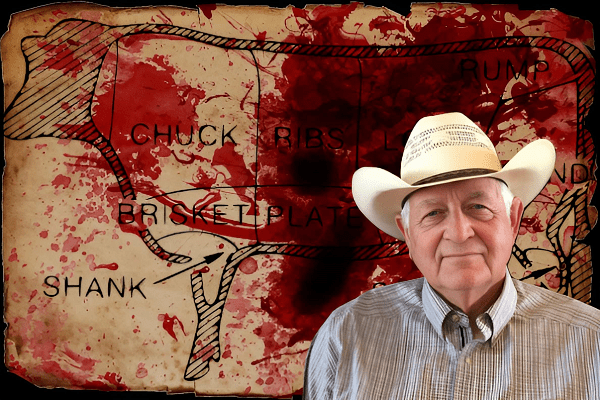
Tim Hargis reportedly “runs” 200 beef cattle on his “fourth-generation family ranch” in Hindsville, Arkansas. The writer, who has been falsely accused by Hargis’s immediate and extended family of sexual aggression, stalking, and posing a violent threat; temporarily denied possession of firearms (of which he has never owned any); sued while one parent was in chemotherapy; sued again while the other starved to death; sued to be imprisoned (twice), etc., was an aspirant children’s humorist who has been a vegetarian since he was 16. Allegations against the writer by Tiffany Hargis, who testified in 2013 that she was in psychiatric care, were dismissed in 2018 in their entirety.


Timothy Hargis, father of my false accuser of over a decade, apparently retired from his post as a Springdale, Arkansas First Security Bank vice president in July. My attention was otherwise occupied, which would probably disappoint Tim to learn.

Tim Hargis has determinedly ensured that his family’s stockyard smell has tainted every breath I’ve drawn for almost 14 years.

Tim Hargis’s married daughter, Tiffany Hargis (Bredfeldt), who has been in psychiatric care, formed what for brevity’s sake I’ll call an infatuation upon our meeting about this time in 2005. She hung around outside of my residence up to and past midnight for months and engaged in antics she would not have had her absentee husband or her scolding mom been present. Tiffany told me her fundamentalist parents had constantly made her “feel like a whore” growing up, which I would contend is the motive of all that I’ll disclose below; monsters like her are the products of nurture, not nature. Suffice it to further say that Tiffany Hargis, who had been married for four years, represented herself as a single woman living alone with a dog.

Since I learned she had a husband and demanded an explanation from her, she has lied profusely to law enforcement officials and judges to whitewash her conduct and retool herself a victim. I expect she’s still lying today. She has interests to protect, like inheritance of her father’s “cattle farms in Hindsville and Huntsville,” for instance. Her husband’s family is well-to-do, too.


Tim Hargis, Timothy Hargis, Tim and GaLyn Hargis, GaLyn and Tim Hargis, Gay Hargis, Hargis 4GN Ranch, banker Tim Hargis


Based on what I’ve been told over the years, that’s how Tiffany was reared: to marry well, that is, wealthy, which is why I think she was catting around my doorstep. The husband, Philip, who has apparently dumped her, was an obsequious twerp.

I could report that the woman was cloistered as a child (that is, kept indoors with mom while her father and brother, Jon Hargis, “shot shit”), that her friends and boyfriends were screened and rejected if deemed unsuitable, that she showed me a choker she had fashioned to remind herself of what it was to be “kept on a leash,” that she told me her grandfather (Tim Hargis’s dad, I guess) had killed himself and left a gory mess she resented having to mop up, etc., but I no longer value the force of narrative. Others who may find themselves in similar situations with inveterate liars in today’s political climate are advised to take the cue: People will discredit or ignore what you say. That especially includes cops and judges. Optics will always be against you.


Instead of defending yourself with a narrative, get the liar to talk on record as much as you can and then quote her (or him, as the case may be).

That’s what I’ve done since an illegal speech injunction that was imposed on me in 2013 was lifted last year and the court put this family on notice that legal process isn’t a playground regardless of how much money you have to burn.

Here’s a synopsis of statements Tiffany Hargis (Bredfeldt) gave in evidence to the court or, in one instance, to the police only between 2006 and 2017. The story they tell isn’t the half of it, but it’s short, and its contradictions are palpable. The woman has lied impulsively and viciously and then lied to conceal the lying. Phil Bredfeldt, her “husband,” has followed his wife’s lead, nodding when expected to and signing beside the X’s.


Tim and his wife, Galyn Hargis, who have watched this happen, were informed their daughter was a liar at least as far back as 2007, and I more than suspect they already knew that. (Tiffany Hargis’s allegations were dismissed in 2018.)

Maybe the four people who didn’t miss Tim Hargis’s retirement announcement on First Security Bank’s Facebook page and offered their congratulations—Ron Harrison, Brenda S. Rascoe, DeLane Johnson McCoy, and James Bradley—would also care to congratulate him on his success as a parent.

If I were to congratulate him, it would be for what was likely an unguarded moment of honesty. Tim Hargis reportedly isn’t retiring from a 40-year career in finance to spend more time with his family but to “spend more time on his cattle farms.”

Copyright © 2019 RestrainingOrderAbuse.com

*Tim Hargis’s sister, Jamie Hargis Witmer, who presumably shares in the profits of the “fourth-generation family ranch,” is a licensed professional counselor (LPC) in Tulsa, Oklahoma. I dimly recall writing to her many, many years ago to ask for help gaining relief from abuse by her niece. A therapist, she bills herself as a “behavioral health” specialist. Jamie Witmer’s son—her own son—Daniel Witmer, Tim and GaLyn Hargis’s nephew, is a plainly troubled guy who is reported to be a convicted felon, which may lead the reader to ask, what kind of people are these? It’s a question this writer has asked himself for over a dozen years.

Jamie Hargis Witmer, Ron Witmer

Is the Policy of Arizona’s Courts under Chief Justice Scott Bales Taught at UCLA as an Example of State Judges’ Contempt for the Constitution (and Bad Practice Generally)?

The author of this post recently chipped off a bit more of his dilapidated front teeth on the brim of the coffee mug that’s virtually wedded to his hands. After years of demoralization in the courts, he depends on external energy sources to triumph over inertia and earn a living. The occasion of the damage was his running to give a stylist-in-training a $5 tip for an $8 haircut. This is where one can easily find himself after 12 years of abuse in the court and by the court, whose handsomely paid judges almost invariably excuse themselves for their arrogance, their misperceptions, their shortsightedness, and their professional failings. The exercise of dominance over the lives of others should at the very least demand scrupulous care. This post is inspired by its utter absence.


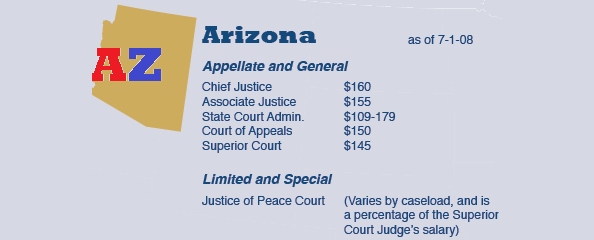
The number of thousands of dollars paid to Arizona judges and judicial administrators each year

I occasionally corresponded with UCLA Law Prof. Eugene Volokh in 2016 and 2017 when he consulted with my attorneys in advance of an appeal of numerous unlawful “prior restraints” imposed upon my freedom of speech in 2013 (by a judge who has since been shamed off the bench), and Prof. Volokh was very charitable with his time.

UCLA Law Prof. Eugene Volokh before the U.S. Senate Judiciary Committee in 2017

I don’t know him well enough to bother him with inquiries about his classroom curricula, though. So I don’t really know the answer to the question posed in this post’s title.

I can, however, surmise.

Prof. Volokh, aided by a gifted law student, Alison Boaz, invested more than a little time in preparing an amicus brief to the Arizona Court of Appeals on my behalf. This is a very big deal. I know, too, that Prof. Volokh is a brilliant jurist, that his arguments to the court were unassailable, and that the court’s disregard for those arguments (which weren’t even mentioned) is a symptom of crap practice that I believe to be pandemic to the point of institutionalization.

(I have no doubt Prof. Volokh would express qualms he had more circumspectly—neutrality comes harder for those who’ve been in the defendant’s seat—but I don’t think he would find much fault with my characterization insofar as it concerns respect for liberties guaranteed by the First Amendment.)

Arizona Chief Justice Scott Bales, who has beautiful teeth, a state that a $160,000 salary and a $130,000/year pension should guarantee he always enjoys

Certainly one way Prof. Volokh could recover on his investment in my case would be to use the ruling returned by Arizona Court of Appeals judges Philip Espinosa, Sean Brearcliffe, and Christopher Staring to show his First Amendment students what they’re up against, namely, recalcitrantly erroneous (i.e., crap) practice by state courts.

In the last post, I shared some informed impressions of some of the judges who’ve weighed in against me over the past 13 years. It’s mostly been crap practice all the way up the ladder, and I know from years of correspondence with others all over the country (and abroad) that my experience is unexceptional.

In 2017, much more knowledgeable after a decade of legal abuse, I succeeded in having two Tucson municipal court judges verbally spanked for abuse of discretion (which roughly translates to judicial abuse of authority), and one of them, Judge Wendy Million, could be said to have literally written the book on protective order law (which will only seem ironic to those who’ve never found themselves in its crosshairs). Judges in this arena can’t even be relied upon to observe statutory requirements let alone comport themselves with anything approaching rigor, impartiality, or politeness.

People like Arizona Supreme Court Chief Justice W. Scott Bales, who has backed a proposal to raise judicial salaries by $15,000, shouldn’t be concerned, in this writer’s opinion, about whether judges are getting paid lavishly enough (already $100,000 to $160,000 per plus lifetime pensions that alone exceed the yearly incomes of most of those whose lives they impact and whose labor provides for their salaries).

What people like Scott Bales should be concerned about is whether judges are actually earning anywhere near their purported value.

Copyright © 2019 RestrainingOrderAbuse.com

*The professor referenced in this post, Eugene Volokh, is a renowned constitutional scholar, and his blog, The Volokh Conspiracy, which is listed by the ABA Journal in its “Blawg 100 Hall of Fame,” appears on the website of The Washington Post. I discerned no hint that the Arizona Court of Appeals judges also referenced in this post had ever heard his name. Prof. Volokh addressed the U.S. Senate Judiciary Committee the same year he addressed them.

Terse Reviews of Arizona Judges I’ve Been Disappointed with So Far (with Critiques of a Couple of Arizona Attorneys and a Police Task Force Tacked On)

What follow are brief reviews of judges the writer had during 12 years of prosecutions (2006–2018) prompted by a vindictive liar (see this post’s third endnote), her husband, and a cohort of theirs. All allegations introduced against the writer during the previous decade by the three—and some that reach back over a dozen years—were discredited and/or dismissed in the past 24 months, no thanks to any but one of the judges referenced below. (Besides to the court, allegations were made to municipal, state, and federal police, among others.) The writer was awarded no compensation by the court, which has, with rare exception, never formally acknowledged error.


Judge Christopher Staring, Judge Sean Brearcliffe, Judge Philip Espinosa, Judge Paul Tang, Judge Carmine Cornelio, Arizona Courts, Judge Richard Gordon, Judge Roger Duncan, Judge Jack Peyton, Judge Jay Cranshaw, Judge Antonio Riojas, Judge Wendy Million


ARIZONA COURT OF APPEALS (DIVISION 2)

Judge Christopher Staring (2017):

Distinctly polite and affable, Judge Staring would make a superlative Walmart greeter. What qualifications he may possess as a negotiator of facts and interpreter of law were indiscernible.

Judge Sean Brearcliffe (2017):

A pedant who seemed to consider freedom of speech a nonessential civil liberty that could be casually revoked by a court.

Judge Philip Espinosa (2017):

Profoundly limited.


ARIZONA SUPERIOR COURT (PIMA COUNTY)

Judge Charles Harrington (2006):

Pedestrian and unworthy of note.

Judge Paul Tang (2010):

Like several of the judges critiqued here, Judge Tang is distinguished only for adding ethnic diversity to the court. (In a 2010 case, Judge Tang servilely parroted back what he was told by opposing counsel almost verbatim—at least in this writer’s opinion—and the writer believes he may have documents from the court not inaptly stamped “P. Tang.” See UrbanDictionary.com.)

Judge Carmine Cornelio (2013):

A disgrace who was twice censured by the Arizona Supreme Court for abusive conduct, in 2010 and 2013, and shamed off the bench in 2016 by a no-confidence vote returned by the Arizona Judicial Performance Review. Judge Cornelio unlawfully denied the writer a trial in 2013 and imposed an unconstitutional speech injunction that denied the writer core civil liberties for five years, including the right to speak about his experiences in court even “by word of mouth.” (The amoral attorney who coerced the illegal injunction from Judge Cornelio has also served as a judge of the Arizona Superior Court.)

Judge Richard Gordon (2016–2018):

Faultlessly civil, a too rare quality among judges, but from this writer’s perspective not above placing personal/political motives before the law. Judge Gordon ruled against the writer in 2016, a couple of months before a retention election, only to mandate a settlement of the case two years later after an eminent constitutional scholar, UCLA Law Prof. Eugene Volokh, tweezed apart the court’s rationale.


PIMA COUNTY JUSTICE COURT

Judge Roger Duncan (2006):

As a judge pro tem the year he intruded upon the writer’s life, thoroughly incompetent.

Judge Jack Peyton (2006):

A bombastic bully whose neck must have strained under the weight of his inflated head.


TUCSON CITY COURT

Judge (Timothy) Jay Cranshaw (2016):

Recommended only by the quality of his grooming and manners, which are somehow meant to justify a $100,000 salary.

Judge Wendy Million (2016–2017):

A scold who was more civil on a second encounter but whose derelictions necessitated reprimand by the superior court for abuse of discretion.

Presiding Magistrate Antonio Riojas (2017):

Genial and conscientious after rebuke by the superior court for abuse of discretion, which translated to seven months of added stress to this writer’s life. To his credit, Judge Riojas acknowledged to the writer that he knew court process was routinely abused…with impunity.

Copyright © 2019 RestrainingOrderAbuse.com

*TUCSON ATTORNEYS

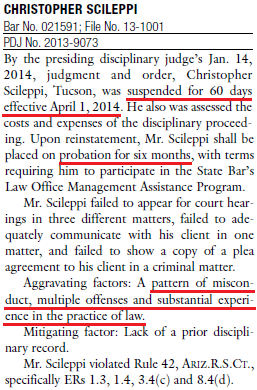
Jeffrey Marks (2010, 2013, 2016) and Chris Scileppi (2016–2018):

This writer would categorically characterize these officers of the court, both of whom frivolously attempted to have him jailed on multiple grounds, as an aggregate of used latex condoms recycled into matching douchebags.

**TUCSON POLICE TASK FORCE

Tucson Police Mental Health Support Team (2016):

The Tucson Police Mental Health Support Team is a clown car. A detective of this task force issued the writer two criminal citations based on statements made by a woman who is herself reportedly diagnosed mentally ill (bipolar disorder). Both charges were subsequently dismissed.

***WHAT STARTED IT ALL


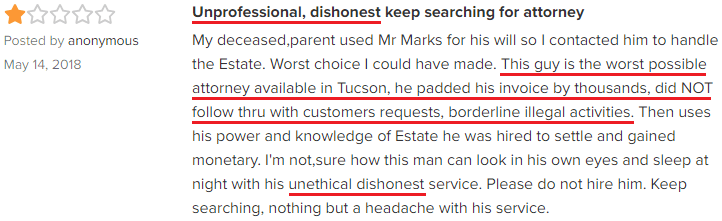
“An Asshole”: A Review of Jeffrey Marks, Tucson Attorney at Law (Who’s Disliked Even by His Heart Doctor)


Tucson attorney Jeffrey Marks, attorney Jeff Marks, Jeffrey A. Marks, Southwest Legal

This client review of Tucson attorney Jeffrey Marks appears on Avvo.com, which notes that the number of times Marks has been endorsed by other lawyers is none.


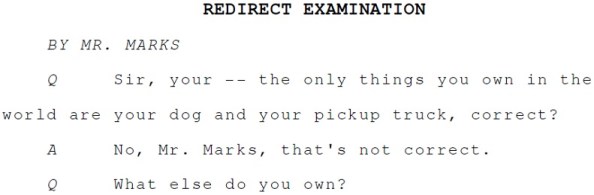
In 2013, I told a cardiologist I knew, Lee Goldberg, M.D., that I was in court with some monsters and that they were represented by a degenerate attorney. Goldberg, who had a business relationship with my father at the time, guessed the attorney was probably one of his patients. Sure enough he said he’d seen Jeffrey Marks (whose heart I already knew was rotten). Goldberg described how Marks would commandeer his waiting room and set up shop there like the lord of the manor.

He’s an asshole,” Goldberg agreed.

My opinion had been cemented years earlier. I’d been in court with Marks in 2010, when he represented the same client he did in 2013, Tiffany Bredfeldt, a woman who has accused me serially since 2006 and whom Marks would go on to represent in 2016, too. But only briefly. Marks insisted I be jailed in that prosecution, I moved the court to appoint me counsel, it did…and Marks hastily took his leave of the matter.

It’s not as jolly squaring off against a fellow attorney as it is taunting a self-represented defendant (as Marks had delighted in doing repeatedly).

Here’s Marks cross-examining me in 2013:

Tucson attorney Jeffrey Marks, attorney Jeff Marks, Jeffrey A. Marks, Southwest Legal

And that’s nothing next to how Marks mocked the court. His first witness, Michael Honeycutt (who today chairs the EPA’s Science Advisory Board) testified:

Then Marks’s client, the prosecuting witness, who told her boss that I had “propositioned” her, told the court this:

Then Marks submitted a brief to the court a couple months later acknowledging this:

And Marks had already provided the court an email by his client to me that said I’d been “nice to [her]” and that she had “never felt the need” to tell me she was married.

Marks didn’t even try to hide obvious contradictions, which any disinterested onlooker might reasonably consider evidence of lying (of a grave nature) to whitewash hanky-panky. I think Marks enjoyed showing me just how stage-manageable judges of the Pima County Superior Court were.

Marks succeeded in coercing an illegal speech injunction against me that year from a judge who has since been shamed off the bench, Carmine Cornelio. It was indicted as unconstitutional in 2017 in an amicus brief to the Arizona Court of Appeals by UCLA law professor and distinguished First Amendment scholar Eugene Volokh (who blogs about such violations of citizens’ civil liberties in The Washington Post). The injunction unlawfully prohibited me from disclosing facts about my own case like those I just have.

By trying to enforce the order in 2016, Marks made himself vulnerable to a lawsuit, but I had to relinquish my damage claims for constitutional injury this month in order to permanently arrest false or frivolous claims to the police by his client—who would face punishment were she to engage in this conduct in future.

The unlawful injunction Marks finessed was gutted (at a cost to the Arizona taxpayer of tens of thousands).

A low-rent opportunist, Marks has an advertisement on his Facebook page that says everything a prospective client should need to know about his character: “Don’t forget about our incredible October surprise: 25% OFF ALL MONTH LONG[—]Wills, Personal Injury Cases, Divorces, and More!!

His Twitter subscriptions include several about pets, including Baby Animals (@BabyAnimalPics), Cats (@Cats), Cute Emergency (@CuteEmergency), and Emergency Kittens (@EmrgencyKittens).

His Twitter subscriptions also include this (fourth among 40 when this screenshot was taken):


Tucson attorney Jeffrey Marks, attorney Jeff Marks, Jeffrey A. Marks, Southwest Legal


At least Marks doesn’t try to conceal he’s an asshole.

Copyright © 2018 RestrainingOrderAbuse.com

“Fuck the Court”: A Brief Lesson on American Civil Liberties for Those Who’ve Been Given Every Reason to Believe They’re a Mirage

“I am ashamed to think how easily we capitulate to badges and names, to large societies and dead institutions. […] I ought to go upright and vital, and speak the rude truth in all ways.”

—Emerson

I thought about using, “F*ck the Court,” in the title to this post to spare the sensibilities of the prudish. But that would have defeated the point.

“Fuck the court” is a sentiment untold multitudes feel. You’ll nevertheless find few returns for the phrase on Google—and no wonder: Citizens who have experience with the court know it’s pretty good at fucking with them.

So, “can” you say, “Fuck the court”? Sure. The freedom to express any opinion or conviction you have, especially a political one, is guaranteed by the First Amendment, no matter how objectionable that opinion or conviction may be to others, including representatives of our public institutions (whose kids’ college tuitions we subsidize). As long as you’re not exciting violence—namely by advocating or threatening it—you enjoy the freedom to say your piece. Expressions of disgust are not only constitutionally protected; they’re more than warranted in this case.

(Consider that anarchists advocate for the complete abolishment of government. Are they “allowed” to do that? Of course.)

Context alone matters. What you say to the world at large, in a blog like this one, for example, is protected speech. If someone doesn’t want to hear it, s/he doesn’t have to listen.

Important distinctions: If you, as a party to a proceeding, wore a t-shirt emblazoned with “Fuck the Court!” to court, the judge might (would) order you turn it inside out. Or if you were just a looker-on, the bailiff could (would) ask you to leave and only come back when/if you were “respectfully” attired. If you pronounced, “Fuck the court!” aloud in court, you could be held in contempt for causing a disruption.

Got it? Good. And fuck the court. You have every right to register your disapproval.

Copyright © 2018 RestrainingOrderAbuse.com

*If you’re wondering whether this means you can criticize the conduct of judges and attorneys (by name), the conduct of plaintiffs (by name), and how a case or cases you’ve been involved in were conducted, the answer is YES. Just qualify your opinions as such, restrict their expression to the world at large, that is, never direct them to the object of your scorn, and represent facts accurately.

Hoax Prosecutions by Psych Patient Tiffany Bredfeldt & Co. against the Author of this Site Terminate: ILLEGAL SPEECH INJUNCTION COERCED FROM DISGRACED JUDGE IN 2013 IS GUTTED

Tiffany Bredfeldt, a toxicologist employed by the Texas Commission on Environmental Quality (TCEQ) and the EPA who testified before the Arizona Superior Court in 2013 that she was in psychiatric care, has accused the writer to, in her own words, “the Court multiple times [and] to multiple police departments, detectives, federal agencies, and other officials in several states,” including the Arizona Dept. of Public Safety and the FBI. The writer knew Bredfeldt for three months in 2005, in and around his own home, where she “would not wear a wedding ring,” and he has had no contact with her since March 2006. All of her post-2006 allegations, which have included charges of sexual trespass/assault and which have corroded more than a decade of the writer’s life, were this month invalidated. Coincident with the conclusion of the case, Tiffany Bredfeldt was apparently dumped by her husband.


Tiffany Bredfeldt, Tiffany Bredfeldt PhD, Tiffany Bredfeldt TCEQ, Tiffany Bredfeldt EPA, Tiffany Hargis, Bredfeldt TG, Dr. Tiffany Bredfeldt, Texas Commission on Environmental Quality, TCEQ, Michael Honeycutt PhD, Loreal Stepney, Phil Bredfeldt, Ray and Ruth Bredfeldt, Jeremy and Kim Cheezum, Jeremy Cheezum, Kim Cheezum, Ray Bredfeldt, Ruth Bredfeldt, Governor Greg Abbott, GaLyn Hargis

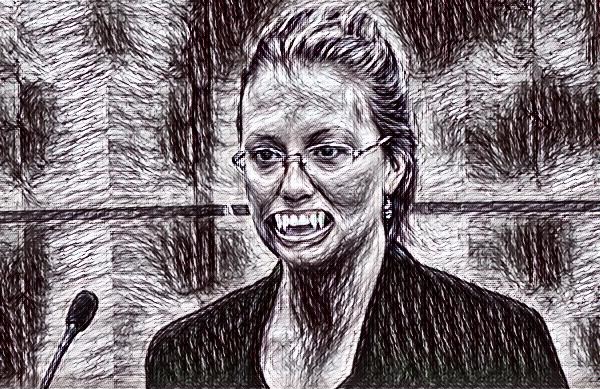
TCEQ senior toxicologist Tiffany Bredfeldt, who lied to the court and law enforcement for over a decade, represented as the monster I believe her to be


“Defendant Greene agrees not to use the following terms and/or phrases in reference to Plaintiff [Tiffany] Bredfeldt, unless and until these words become true: perjurer, felon, felonious conduct, criminal, fraud or fraudulent within her profession, narcissistic personality disorder, [or] adulteress….”

Bredfeldt v. Greene, June 26, 2018 settlement agreement

Consenting to the foregoing clause in a “voluntary” settlement with a woman who has accused me broadly since 2006—and twice attempted to have me jailed in recent years for exercising my First Amendment liberties—was a compromise I had to make to gain the substantive dissolution of an illegal speech injunction, or “prior restraint,” that she coerced in 2013 from a since disgraced superior court judge, Carmine Cornelio, that literally prohibited me from speaking…at all.

(Cornelio was shamed off the bench in 2016. Put politely, he declined to face voters after being roundly panned by the Arizona Commission on Judicial Performance Review. Put plainly, he abused the power entrusted to him and, what’s far more extraordinary, was held to account for it.)

When judges violate the Constitution—and other judges affirm the violation despite, for example, contrary arguments by a renowned constitutional scholar—a settlement agreement like that quoted above is the recourse of last resort.

In contrast to my concessions, which were relatively minor, my accuser of over a decade had to consent to this:

Plaintiff agrees not to pursue any criminal charges against Defendant for any conduct by Defendant before the date of this Settlement Agreement.

And:

Plaintiff agrees that her execution of this Settlement Agreement constitutes a release of any and all claims which she may have or claim against the Defendant, whether known or unknown, which in any way arise out of or are connected to Defendant’s actions occurring before the date of this Settlement Agreement.

This doesn’t of course mean her accusations, which exist in at least four different police agencies’ and at least three different courts’ public records, will be shredded; it just means the gag is now on the other face.

My accuser is expressly prohibited from making false or frivolous accusations to law enforcement officials, and any further allegations she wishes to bring at court must pass muster with “a single arbitrator who shall be a practicing attorney, retired judge, or law school professor with at least ten years of total working experience as such and with experience in First Amendment law.”

She’s also obligated to schlep herself from Texas to Tucson where her mendacious accusations began 12 years ago.

Copyright © 2018 RestrainingOrderAbuse.com

*I was granted the services of a public defender in 2016, because my accuser demanded that I be jailed. Otherwise the cost to me of realizing an equitable revision of an injunction grounded on judicial abuse of power would easily have exceeded $50,000. Who footed the actual bill, including expenses incurred by law enforcement and the courts? If you’re an Arizona taxpayer, you did. (Also to thank for that is Michael Honeycutt, Ph.D., toxicology director of the Texas Commission on Environmental Quality (TCEQ) and Scott Pruitt’s selection for chairman of the EPA’s Science Advisory Board. Honeycutt presented misleading testimony to the court in 2013 on my accuser’s behalf.) Good thing Arizona didn’t need those tens of thousands of dollars for education or low-income housing or the legal representation of immigrant children taken from their families and confined in cages. Rock on, #MeToo. You go, “social justice crusaders.”

**What follows is a synopsis of statements Texas state official and EPA adviser Tiffany Bredfeldt gave in evidence to the court or, in one instance, to the police only between the years 2006 and 2017.


Michael Honeycutt, TCEQ, Texas Commission on Environmental Quality, EPA, Environmental Protection Agency, Tiffany Bredfeldt, Governor Greg Abbott, Beth West TCEQ, TCEQ Human Resources Director Beth West, TCEQ Executive Director Toby Baker, Toby Baker TCEQ, TCEQ Deputy Executive Director Stephanie Bergeron Perdue


Michael Honeycutt, TCEQ, Texas Commission on Environmental Quality, EPA, Environmental Protection Agency, Tiffany Bredfeldt, Governor Greg Abbott, Beth West TCEQ, TCEQ Human Resources Director Beth West, TCEQ Executive Director Toby Baker, Toby Baker TCEQ, TCEQ Deputy Executive Director Stephanie Bergeron Perdue


Michael Honeycutt, TCEQ, Texas Commission on Environmental Quality, EPA, Environmental Protection Agency, Tiffany Bredfeldt, Governor Greg Abbott, Beth West TCEQ, TCEQ Human Resources Director Beth West, TCEQ Executive Director Toby Baker, Toby Baker TCEQ, TCEQ Deputy Executive Director Stephanie Bergeron Perdue


Tiffany Bredfeldt, Tiffany Bredfeldt TCEQ, Tiffany Bredfeldt Phd

Tiffany Bredfeldt, Tiffany Bredfeldt TCEQ, Tiffany Bredfeldt Phd

Tiffany Bredfeldt, Tiffany Bredfeldt TCEQ, Tiffany Bredfeldt Phd

Letter to the Editor Notes How Claims of “Abuse” Are Used to Exert Control

Some recent critical scrutiny by the author of this blog was inspired by a restraining order petitioned by Warrenton, Virginia Vice Mayor Sunny Reynolds against a constituent and political rival of hers.

Since the March prosecution, Ms. Reynolds has been voted out of office (reportedly by a margin of 2 to 1) and replaced by a male candidate whose campaign stressed change.

What follows quotes former Warrenton town council member Yakir Lubowsky, who reminds readers of the Fauquier Times how being a citizen of the United States is supposed to be different from being a citizen of China (see First Amendment). What Mr. Lubowsky highlights is an emergent social trend that is hardly new but has newly been brought to the fore by social media: assuming the victim pose to silence unfavorable opinions (which has notably been remarked elsewhere in recent months).

The quotation below appeared in a letter to the editor last week and is in response to critical remarks by Ms. Reynolds concerning an earlier letter by Mr. Lubowsky (who writes that he composed two). Ms. Reynolds reports on her campaign website that she has filed a formal complaint with the State Board of Elections, apparently on this basis: “Mr. Lubowsky’s letter…presents nothing more than an accusatory opinion.” The last this writer heard, opinions were protected under our Constitution’s free speech clause.

Mr. Lubowsky (stresses added):

I wrote two letters, a short one that appeared in Fauquier Now [and] was also faithfully reproduced on approximately 1,200 leaflets (distributed lawfully in the spirit of the founding of our Republic); and a longer one which went viral through emails, and appears to have been read by hundreds more.

Both letters only criticize [politician Sunny Reynolds’] conduct, not her personality, and by points detailed and supported in each case by examples. Readers of both my letter(s) and Sunny’s will notice that hers does not respond meaningfully to any of these censures.

Sunny dismisses my criticisms as simple animosity. Yet she points out herself that I worked with her at the town council and voted for her to be vice mayor. (Moreover, as many know, Sunny and I had cordial relations during most of our time as colleagues.) No, my letters are neither angry nor personal, as is evident from even a casual reading. The letters are substantive indictments of Sunny’s injudicious behavior.

Finally, as to style, Sunny characterizes her own energetic engagement as “fervent” or “spirited”; while that of others, especially men, as “bullying.” She plays this card whenever useful, for example forcing our colleague Sean Polster into an absurd “mediation” and bringing specious charges against candidate Keith MacDonald in court.

What Mr. Yubowsky observes is an isolated point on the fringe of a very long shadow that has been steadily eclipsing citizens’ civil rights for decades.

Copyright © 2018 RestrainingOrderAbuse.com

*Had Mr. Lubowsky’s critical opinions been ad hominem attacks, had they been rude, hurtful, ill-supported, or even off-the-wall, they would still be protected speech in this country.

Previously Paddled Attorney Chris Scileppi Tells an Arizona Superior Court Judge That This Blog’s Author Has “Terrorized” and “Demonized” His Clients with Computer Code—and Isn’t Jeered out of the Room

What this post relates is typical of prosecutorial conduct in restraining order cases, besides generally. The imperative, which is both profligate and malicious, is simply to win. Neither merit nor justice has anything to do with it. The post revisits a 2016 hearing whose object was to have the writer jailed. To remind those who need reminding, namely, liberal proponents of wasteful litigation whose advocacy is based on sensationalized abstractions, jailed means locked in an iron-and-concrete kennel.

lizard

“See attached Exhibit A—wherein Defendant, via letter to one of Dr. Bredfeldt’s then supervisors [at the Texas Commission on Environmental Quality], explains that the intent of his blog is not to speak on restraining order abuse, as would be implied by its name, but rather to expose ‘Tiffany’s conduct and frauds…the ploys Tiffany used to camouflage her hanky-panky…so long as I’m burdened with Tiffany’s frauds, however, I intend nevertheless to keep lighting candles where I can as my time and energies allow.’”

—Tucson attorney Christopher Scileppi

Quick note: Excepting my bracketed interpolation, the quotation above is unaltered. That’s exactly how it appears, ellipses and all, in a brief to the court. Short addendum: Speech about misconduct that includes the abuse of restraining orders is speech “on restraining order abuse.” Superfluous postscript: Obviously.

This is one of several posts that enlarge on aspects of the writer’s most recent cases, which have concerned citizens’ constitutional right to freedom of expression. Procedures forerunning the July 15, 2016 hearing encapsulated here have been numerous and all of them related to the conduct described in the letter to Roberta Grant, Ph.D., quoted in the epigraph. That conduct is what inspired this blog. To conceal that conduct, I’ve been serially accused and prosecuted for 12 years.

A synopsis of the backstory, with links to corroborating statements given in evidence to the court by my accusers, Tiffany and Phil Bredfeldt, can be found in the preface here.

(In short, Tiffany Bredfeldt, a married stranger who hung around my house up to and past midnight for three months in 2005, told various courts over a seven-year period that I had been “nice” to her and a “friend,” that she “would not wear a wedding ring” while she was there, and that she had “never felt the need” to tell me she was married; but that I had made “several physical, romantic advances toward her,” “propositioned her,” and “ask[ed] for” or “offered her sex”; and that I was a “danger” to her husband and shouldn’t be allowed to talk to him. Readers without Ph.D.’s in science, at least, might detect some inconsistencies in these statements and wonder about the reason for them. Such readers might even think the reason is self-evident.)

The syntactic goulash quoted at the top of this post is the work product of the Law Office of Christopher Scileppi, the Tucson-based attorney employed by the Bredfeldts. Mr. Scileppi is distinguished for having been given a little squeeze by the mayor of Nogales in front of jurors at a rape trial, in which he represented one of the alleged assailants of a 15-year-old girl. The mayor who hugged him was later sent to prison for public corruption. Mr. Scileppi represented him, too. In 2014, Mr. Scileppi was suspended for 60 days and placed on six months’ probation for violating various ethical rules (ERs).

Christopher Scileppi, Chris Scileppi, Phil Bredfeldt, Philip Bredfeldt, Tiffany Bredfeldt

Dr. Roberta Grant—to whom the letter quoted in the epigraph was addressed and from whom I never got a reply—keeps classy company.

I was represented a specialist in constitutional law who has never been embraced by a politician in court—during a rape trial or otherwise.

The epigraph is a statement of Mr. Scileppi’s excerpted from a supplemental briefing to the court on a motion to dissolve a 2013 “prior restraint” that violated my First Amendment rights with shameless gusto (and that was issued by an Arizona Superior Court judge, Carmine Cornelio, who has since been shamed off the bench). It was the reason I’ve previously been circumspect about how I talk about my own case history on this site (pointlessly: The court’s order forbade me from publishing anything, ever, including by “word of mouth”). A prior restraint prohibits publications before they’ve been made; it extorts silence and conformity. The unlawful order of the court was the handicraft of Jeffrey Marks, another unscrupulous Tucson lawyer who represented the Bredfeldts in the most recent action…right up until the judge consented to appoint me counsel, whereupon Mr. Marks discovered he had more pressing concerns to attend to. Noteworthy is that Mr. Scileppi, Mr. Marks’s replacement, is a criminal lawyer (he represents, for example, alleged rapists).

The trial strategy of the plaintiffs has been a study in workarounds: If the law isn’t on your side, find ways to persuade the court otherwise.

In this instance, the plaintiffs alleged that the court shouldn’t consider my words on this site as “speech” but rather as “conduct.” Speech is protected by the First Amendment; conduct may not be.

Relative to this case, there is a clear difference between posting a blog entry to the Internet about the very real debate about whether restraining orders can be abused—which is what the Defendant claims to have been doing—and utilizing one’s blog to terrorize, demonize, harass, and defame another—which is what the Defendant has actually been doing since 2008. While this case involves Defendant’s use of the Internet broadly and tags specifically to make contact with and harass the Plaintiffs and their family, it is not the first time this issue has arisen in the law.

Mr. Scileppi’s argument was that “tags,” the keywords at the bottoms of posts that identify its topics, serve to “contact” anyone whose name appears among them. Tags don’t actually link to anything external to the website, so Mr. Scileppi directed the court’s attention to a case about a woman against whom a restraining order was issued who subsequently tagged comments she made on Facebook with the plaintiff’s name. In the comments, she called the plaintiff “sad” and “stupid.” Mr. Scileppi:

In People v. Gonzalez (New York Supreme Court 15-6081M) the victim had been granted an order of protection against his ex-girlfriend Maria Gonzalez, which ordered the defendant to “refrain from communication or any other contact, directly or indirectly through third parties, by mail, telephone, e-mail, voicemail, or other electronic or any other means.”

The plaintiff, in fact, was a woman, Gonzalez’s former sister-in-law. Either Mr. Scileppi was careless (for which he has previously been spanked), or he just adapted the details of the case to suit his purposes.

Facebook: “Tags in photos and posts from people you aren’t friends with may appear in Timeline review where you can decide if you want to allow them on your Timeline.” The woman who prosecuted her former sister-in-law for calling her and her family “sad” could instead have requested of Facebook that comments tagged by her not be included on her Timeline. One can’t but conclude that she wanted her to be punished by the criminal justice system…for calling her “sad.”

Ignoring the questions of what a miscreant someone has to be to want a woman jailed for calling her “stupid,” and whether such an allegation is worthy of the court’s time—which questions say a lot about both the value of restraining orders and why they’re sought—tagging on Facebook does cause a contact with the person tagged. That’s its purpose.

Tagging in blogs is in no way related (and even tagging on Facebook is defensible as protected speech; the court has held that “where comments are made on an electronic medium to be read by others, they cannot be said to be directed to a particular person,” that is, they cannot be called “contact” and therefore cannot be called “harassment”). Mr. Scileppi, whose law firm is on Facebook, knew that what’s called “tagging” on Facebook is distinct from what’s called “tagging” on a blog. Mr. Scileppi again:

While tags on Facebook may differ from the tags employed by the Defendant—the former are primarily understood to be direct contact while the latter are likely indirect contact—the fact remains that they are contact nonetheless.

You see how Mr. Scileppi’s style of lawyering works: You tell the judge what you want him or her to conclude. You sketch a false correspondence and only let on that the two things you’ve represented as analogous “may differ”…but not significantly.

They differ entirely. A section of my attorney’s competitive briefing to the court was titled, “Plaintiffs Misunderstand the Meaning of the Verb ‘Contact.’” I like this explanation from Chan v. Ellis (2015):

“To ‘contact’ is readily understood by people of ordinary intelligence as meaning ‘to get in touch with; communicate with’” (citation and punctuation omitted)). Although one may “contact” another…by communicating with the other person through any medium, it nevertheless is essential that the communication be directed specifically to that other person, as opposed to a communication that is only directed generally to the public.

Also readily understood by people of ordinary intelligence is that a tag isn’t even a “communication”; tags just identify keywords in a communication to the general public, and a communication to the general public is protected speech.

Mr. Scileppi’s case to the court relied almost entirely on these words and brief phrases at the bottoms of posts that summarize their topics. He even loosely equated the use of HTML metatags with harassing person-to-person telephone calls. The “operator” said to place the calls was Google. The explanation ran something like this: Tags used on this blog were detected by Google, whose algorithm allegedly made posts more prominent among search engine returns for queries that included the terms in their tags. This in turn hijacked the plaintiffs’ public images and “created” a contact…or whatever.

In fact, Google doesn’t use lexical tags at all, whether to determine webpage hierarchies or for any other purpose, nor has it done for almost 10 years.

Based on the foregoing science fiction, given the veneer of credibility by an expert witness and garnished with protestations of terror and trauma, it was argued that I should be incarcerated while my father was dying. (Contrast the robotic feminist refrain, which should be heard in the voice of a sententious child and is summarized thus: False allegations are extremely rare and seldom have serious consequences.)

Horrific is that BS like this can actually snooker trial judges who don’t know better. Almost as horrific is that it’s meant to.

Copyright © 2018 RestrainingOrderAbuse.com

*I was an aspiring author of children’s humor when my seclusion was invaded by my accuser and some equally disturbed girlfriends of hers 12 years ago. My initials, which I had considered using as a pen name, are T. A. G.

BABY ON BOARD: Restraining Order by Virginia Vice Mayor Sunny Reynolds Kneecaps Town Council Election Rival Who “Pointed His Finger at Her”; Letter to the Editor Criticizes Conduct

The administration of restraining orders is a frequent target of censure by First Amendment scholar and UCLA law professor Eugene Volokh in his blog, The Volokh Conspiracy. That’s because restraining orders may be exploited, besides as gag orders generally, as SLAPPs to suppress political speech, which the First Amendment is there to protect above all other kinds.

This post shares a letter to the editor of the Fauquier Times that was recently submitted by Virginian Nathan Larson and that concerns an injunction sought by Warrenton Vice Mayor Linda “Sunny” Reynolds, whose nickname and whose evident hypersensitivity are strikingly incongruous. “Misty” Reynolds would seem to suit her better—or maybe “Runny.”

According to the Fauquier Times, Ms. Reynolds petitioned and was granted an obviously spiteful restraining order against Warrenton real estate investor Keith Macdonald based on the allegation that he “appeared to be ‘very angry’” and “pointed his finger at her” during a public exchange about a proposed municipal development project (a library) that occurred in a restaurant where both were dining with others. Ms. Reynolds testified that Mr. Macdonald “invaded her personal space, preventing her from leaving the table.”

Not clarified in the story is whether she ever asked to be excused or made a move to rise.

One of Ms. Reynolds two female witnesses in court worked for the newspaper that reported the story. The other, Ms. Reynold’s dinner companion, Crystal McKinsey, “testified that she could tell Reynolds ‘felt very threatened by the situation and was very fearful.’” What was characterized as a harrowing confrontation transpired in a populated eatery, and there was no report that voices had even been raised.

Mr. MacDonald represented himself in court; Ms. Reynolds had an attorney.

The judge, J. Gregory Ashwell, “decided in favor of Reynolds’ petition, saying he believed Reynolds’ testimony and that of her dinner companion met the legal requirement to issue a protective order.” He offered the explanation that it was “clearly an ‘awkward interaction.’”

Mr. MacDonald, who says he intends to appeal, opposes Ms. Reynolds in an upcoming town council election.

The Fauquier Times reports “[i]t’s not clear if the final order, which will be issued by the court, will…bar Macdonald from town council meetings or town hall.”

Ms. Reynolds’ reelection campaign is titled, “Sunny, for a Voice.” Her bio identifies her as the mother of two daughters but contains no reference to a father.


LETTER TO THE EDITOR

By Nathan Larson

The recent article, “Judge grants Warrenton vice mayor protective order against council opponent,” shows why we need to reform Virginia’s laws concerning restraining orders.

Warrenton Vice Mayor Sunny Reynolds was able to obtain a restraining order under a statute, Code of Virginia § 19.2-152.9, that required only that she prove she had been “subjected to an act of violence, force, or threat by a preponderance of the evidence.”

This is a much lower standard than the “beyond a reasonable doubt” standard which is used in criminal court. That higher standard exists because of the principle that a person’s liberty should not be taken away without strong evidence that he broke a law. Yet without having been convicted of any crime, Reynolds’ challenger in the May election, Keith Macdonald, has been deprived of his First Amendment right to petition his government (specifically, his vice mayor) for a redress of grievances. He also has been deprived of his Second Amendment right to possess a gun.

The article says, “Reynolds also said she felt taken advantage of as the only woman member of the Warrenton Town Council.” But it will have a chilling effect on free speech if men feel they could easily be deprived of their liberty just for confronting a female elected official about her public policies and threatening to run for office against her. The voters lose out too, because now any prospect of these two candidates’ appearing together in a forum to debate issues of public interest is gone.


Mr. Larson retracted his statement about Mr. McDonald’s being denied the right to own a firearm. In Virginia, he explains, a citizen may be slapped with a restraining order for an unwanted gesture, like pointing a finger, but to be denied gun ownership, Mr. McDonald would have to have been in an “intimate” relationship with Ms. Reynolds.

Copyright © 2018 RestrainingOrderAbuse.com

*Probably unsurprising to a reader here, Ms. Reynolds, the plaintiff in the case, called applying for a protective order, which requires filling out some forms and appearing in court for a brief hearing, “very difficult, both timewise and emotionally.” In contrast, proponents of the process argue that being publicly accused (and having one’s name indefinitely registered in local and federal police databases) is no big deal at all.

Sexual Solicitation, Assault Alleged by Texas Officials Michael Honeycutt and Tiffany Bredfeldt in Contradictory Testimony to the Arizona Superior Court, Implicating a Tucson Man Who’s Been Falsely Accused for 11 Years: ILLEGAL GAG ORDER GUTTED; “WOMEN’S LAW,” TCEQ DISCREDITED

This post, published on the first day of the year, was updated on July 9, 2018 (reflected in the new title), and content that had been unlawfully censored by the court has been restored. A recent respondent to this blog commented, “I think these injunctions violate the Constitution.” Despite the baggy parameters dictated by the law, it’s certain that many are impeachable as unconstitutional. The saga that follows relates the story of such an injunction. Readers merely interested in learning what unscrupulous plaintiffs can get away with (again and again for years) may skip the preamble and gain a clear picture by contrasting various sworn and unsworn statements by two such plaintiffs, who are quoted verbatim. Other quotations show how a witness, Michael Honeycutt, was induced to give misleading testimony, besides how willing attorneys may be to steer the court amiss…for the right price.
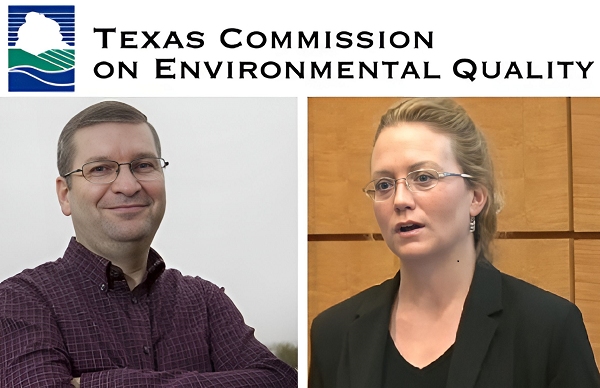

Michael Honeycutt TCEQ, Michael Honeycutt PhD, Michael Honeycutt EPA, Tiffany Bredfeldt TCEQ, Tiffany Bredfeldt PhD, Tiffany Bredfeldt EPA, Bredfeldt TG, Texas Commission on Environmental Quality, TCEQ, EPA, Environmental Protection Agency, EPA Science Advisory Board, SAB, EPA Chemical Assessment Advisory Committee

Texas state toxicologists and newly appointed EPA reps Michael Honeycutt and Tiffany Bredfeldt gave testimony before an Arizona Superior Court judge in 2013 that succeeded in persuading the judge to issue an unconstitutional speech injunction against the writer. The court was told the writer had “propositioned” Bredfeldt (a married woman) in 2005, “wouldn’t take no for an answer,” and “had been harassing her ever since.” Honeycutt, who has never met the writer, recited this secondhand story with the same smug complacency that marks his expression above. Based on the fiction’s effectiveness, four additional legal actions were brought against the writer in 2016, two of which menaced him with the threat of incarceration for exercising his freedom of speech. One of the actions was aborted; two were dismissed. Despite an appeal in 2017, the 2013 gag order, which the writer was alleged in 2016 to have “continuously and contemptuously violated,” remained in effect until July 2018, when it was gutted. All charges brought against the writer in the past decade have been invalidated.

Numerous accounts related on this blog since its launch six years ago have contrasted what he said with what she said in testimony given under penalty of perjury. The account this post relates doesn’t have to. It contrasts what she said here with what she said there—and with what her statured witness said she said. Statements that should harmonize, conflict.

A lesson of what this post unfolds, valuable for anybody to learn who has been wronged by a judge and isn’t sure if s/he’s “allowed” to talk about it, is that when people get away with something in a courtroom, which is a public forum, that in no way immunizes them from being exposed for it in a different public forum (for example, Facebook, Twitter, a personal blog, or one sponsored by The Washington Post). The only legal surety against criticism in this country is square conduct. While a court can lawfully issue a restraining order that prohibits unwanted speech to someone (like phone calls or emails), it cannot lawfully prohibit unwanted speech about anyone. Critical speech directed to the world at large, however objectionable it may be to those it names, whether private individuals, public officials, or judges, is protected speech as long as it isn’t false or threatening (and opinions are sacrosanct); the Constitution doesn’t favor any citizen over another, nor does it distinguish between bloggers, pamphleteers, or picketers and the institutional press. The aegis of the First Amendment doesn’t even require that criticism be deserved. In this instance, however, blamelessness is a nonissue.
Eugene Volokh, First Amendment, freedom of speech, The Volokh ConspiracyThis post discredits a widely championed arena of law, as well as how it’s administered. Linked audio clips of one trial judge will make a seasoned courtroom veteran flinch; those of another, a presiding municipal court magistrate, acknowledge frankly that restraining orders “are abused,” no question, and that “people come in and…say things that are just blatantly false” but are “never…charge[d],” let alone prosecuted.

The post also discredits accusations made by a woman (women, in fact) against a man. To some, this will be its most compelling virtue. Men have traditionally been the butt of abused and abusive procedures, and by far continue to be their most populous feedstock. Assertions that men are “presumed guilty” and unfairly “demonized” are not exaggerations and never have been, contrary to the pajama punditry of demagogues like David Futrelle, Mari Brighe, Amanda Marcotte, and Lindy West, who would smother even the most righteous motives for male contempt beneath the blanket label “misogynist.”

Fixation on gender politics, though, has obscured from view that injustice has been legislated into the law and fortified by decades of accustomed application (albeit that politics is the reason why). Today women—straight, gay, or otherwise—enjoy no greater safety from accusation and arbitrary violations of their civil rights than men do (in drive-thru procedures promoted as “female-empowering”), and women too may be accused by women (including their own mothers, sisters, daughters, and neighbors—which is a predictable consequence when accusation is tolerated as a recreational sport). Law that mocks due process and facilitates and rewards its own abuse is iniquitous, period. What this post reveals, importantly and inescapably, is that how many people choose to understand accusation, court process, and their repercussions is deplorably simplistic. Among these many are most politicians, academics, journalists, and social justice activists.
Eugene Volokh, First Amendment, freedom of speech, The Volokh ConspiracyThe Tucson man in the title of the post is also its author, and there was a time, within his memory, when to allege sexual impropriety without urgent grounds would have stirred outrage, because such an accusation is always damaging. In the climate that has prevailed since the advent of the Violence Against Women Act, however, the female plaintiff who doesn’t allege sexual violation, or at least trespass, squanders invaluable leverage. To a potently shrill sector of the community, this represents social progress. It has made pollution de rigueur.

Inaugurating the task of restoring a site inspired by the tenacity of false accusations like those exposed below, this post breaks a year-and-a-half-long silence coerced from the site’s owner by a series of lawsuits, which included two that demanded that he be jailed for exercising his First Amendment rights. The principal complainant, Tiffany Bredfeldt, an official at the Texas Commission on Environmental Quality (TCEQ), has repeatedly alleged to the Arizona Superior Court that the writer’s criticisms of her honesty, ethics, and character are untrue. Bredfeldt told the court in 2016 that the “ongoing fear, stress, and associated physical impacts” the writer’s criticisms had caused her “have been a decision factor as to whether or not [she has] children.” She also reported she has “talked to more people at police departments, sheriffs’ departments, and federal and state agencies than [she] can count,” and urged the court to impose “significant consequences” to bring her relief from a “continual rollercoaster of fear.”
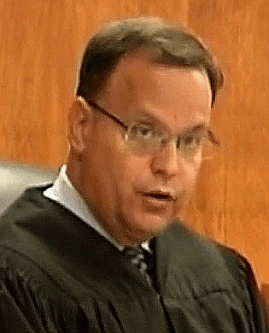
Judge Richard Gordon, Pima County Superior Court

I am not going to hold him in contempt for talking about his case,” Pima County Superior Court Judge Richard Gordon pronounced in response to a 2016 complaint that demanded the writer be jailed for doing exactly that. Also commendably, the judge granted the writer a court-appointed attorney without reservation. Disagreeing, however, that the law authorized him to revise or dissolve an illegal prior restraint entered against the writer in 2013, the judge instead delimited its vague and overbroad proscriptions. The writer continued to be (1) forbidden from publishing images of the plaintiffs on this site; (2) forbidden from using “[meta] tags” with their names to label images or contents of posts, supposedly elevating them in Google’s returns for certain search terms thereby; (3) forbidden from “repeating” three “specific statements” that, absent a jury opinion, the 2013 court deemed “defamatory”—only two of which the writer may have made, both concerning honesty; and (4) forbidden from contacting the plaintiffs, Tiffany and Phil Bredfeldt, the former’s employers at the Texas Commission on Environmental Quality, or “their friends, their acquaintances, or their family.” The writer’s own friends and family are among Tiffany Bredfeldt’s acquaintances, and who else may be is impossible for the writer to know, which underscores the recklessness of the 2013 order Judge Gordon construed rather than vacated. That order’s prohibitions, which were substantially narrowed in July of this year, could have been interpreted very differently by another judge at any time for the rest of the writer’s life.

Bredfeldt sued the writer in 2013, neither for the first time nor the last. Michael Honeycutt, to whom the writer had communicated his criticisms of Bredfeldt’s conduct by letter two years before, served her as a witness—telephonically, from the comfort of his desk chair in Texas. Honeycutt is Bredfeldt’s boss at the TCEQ and an old hand at testifying; his bio [deleted from the Internet since this publication] boasts that he has testified before Congress. His role in accusing the writer, who in 2013 had already grappled with crippling allegations for seven years, was to ensure that he would live with them indefinitely—and it’s unlikely that Honeycutt acted without the full approval and support of the TCEQ’s administration.

The upshot of the 2013 prosecution, in which the writer represented himself, was that Bredfeldt was granted an unconstitutional restraining order that prohibited the writer from publishing anything about her “to anybody, in any way, oral, written or web-based” by the judge whose words appear a few times in the transcript excerpts that follow. That Pima County Superior Court judge, Carmine Cornelio, is a judge no longer. In June of 2016, 84% of an Arizona Commission on Judicial Performance Review panel concluded he did not meet standards. The judge declined to face voters that fall, and his tenure on the bench terminated two months later.

(The no-confidence rating returned against Judge Cornelio in 2016 followed reprimands by the Arizona Supreme Court in 2010 and 2013 for the judge’s saying “fuck you” to an attorney during a settlement conference, causing a 19-year-old girl to cry during a different one, and gesturing accusatorily at a female court employee in public, among other alleged acts of “abusive conduct.” In a guest column in the Arizona Daily Star, Judge Cornelio wrote, “I leave with head held high….” He told the same paper in an interview that he “intends to go into private practice in alternative dispute resolution.” Judges of the Arizona Superior Court are paid $145,000 a year, and a proposal has been tabled to raise their salaries to $160,000.)

The speech injunction Judge Cornelio imposed on this writer in 2013, which the judge made permanent without bothering with a trial, was affirmed in 2016 by a second Pima County Superior Court judge, Richard Gordon, despite Judge Gordon’s having acknowledged in open court that the conduct of the 2013 proceedings was “not legal” and that the prior restraint that issued from them offended the Constitution. “There are obviously some parts that are just too broad and then don’t make a whole lot of sense,” Judge Gordon conceded in court in July. In his subsequent Sept. 2016 ruling, little trace of this acknowledgment survives. The writer’s father died a month after the ruling was returned. More than a year has transpired since (and, as the U.S. Supreme Court has held, “[t]he loss of First Amendment freedoms, for even minimal periods of time, unquestionably constitutes irreparable injury”).

An appeal of the 2016 ruling to the Arizona Court of Appeals’ Second Division was denied in December (five months after it was filed). The court—consisting of Judge Philip Espinosa, Judge Christopher Staring, and Judge Sean Brearcliffedeclined to address the prior restraint’s unconstitutionality and sidestepped use of the phrase prior restraint entirely:

[T]he issue before us is not whether the injunction is constitutionally permissible, but whether the [2016] trial court properly refused to modify or dissolve it.

The appeals court, whose decision may have been influenced by a case narrative that this post will show is false, did acknowledge that “[a]t least one provision of the [2013] injunction would appear clearly unconstitutional, ordering that ‘[t]he defendant…immediately cease and desist all future publications on his website or otherwise.’” The word publication means any act of public speech. This provision, which was dissolved in July of this year, accordingly prohibited the writer from, for example, finishing a Ph.D., addressing the city council, marketing a book, or defending himself in a courtroom, all of which require publication. Also accordingly, courts have consistently found prior restraints facially invalid, even ones far less vague and overbroad than the one issued against the writer, and such orders have been vacated as much as 30 years later, which the writer’s attorney informed the appellate judges by brief and in oral argument. This was unremarked in their Dec. 18, 2017 ruling.
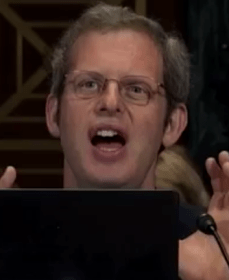
Eugene Volokh, free speech, First Amendment

UCLA Law Prof. Eugene Volokh, addressing the U.S. Senate Judiciary Committee on June 20

Unlike in 2013 (and previously), the writer wasn’t alone in court in 2016 or 2017. His defense was aided by two gifted lawyers representing the Pima County Legal Defender: Kristine Alger, who drafted and orally augmented a faultless appeal, and Kent F. Davis, whose zealous advocacy made an appeal possible in the first place. Their arguments were what’s more reinforced by no lesser light than Eugene Volokh, who’s distinguished as one of the country’s foremost authorities on First Amendment law and who, in conjunction with the Electronic Frontier Foundation (EFF) and Phoenix attorney Eric M. Fraser, graciously submitted an amicus brief to the court on the writer’s behalf. Alison Boaz of the UCLA School of Law, who assisted Prof. Volokh, is also due credit. A win in the appellate court would have been much more theirs than this writer’s, and they have the writer’s thanks for their Herculean exertions.

(It’s conceivable that a legal critique of the matter may one day appear on The Volokh Conspiracy, which is listed by the ABA Journal in its “Blawg 100 Hall of Fame.”)

Exemplifying the importance of the First Amendment, this post will illuminate how trial courts are manipulated into forming bad conclusions by lowering its beam into the crevices to rest on those who do the manipulating.

A byproduct of the writer’s representation in 2016 and 2017 was access to courtroom transcripts, so the post won’t offer much in the way of opinion. Commentary can be denied. Testimony given under oath…cannot be.
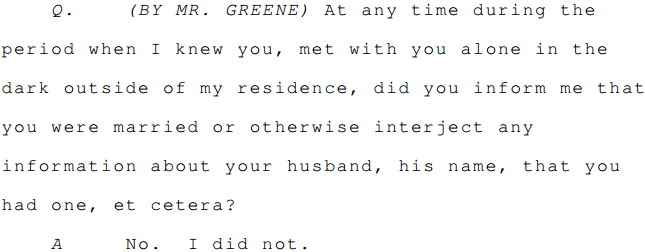

Dr. Tiffany Bredfeldt, on cross-examination by the writer in 2013

Dr. Michael Honeycutt, on cross-examination by the writer in 2013

Based on nothing more than the two statements quoted above, a precocious child would wrinkle her nose. Yet such obvious contradictions have inspired no judge to arch an eyebrow nor any Ph.D. to scruple. In over 11 years.

Calling someone a liar risks being sued, and trial judges interpret whatever they want however they want. They’re acutely aware, moreover, of which direction their criteria are supposed to skew when abuse is alleged. This remark cannot be called defamatory: Although this post isn’t about air or water pollution, as would befit one that quotes environmental scientists, it does concern filth.
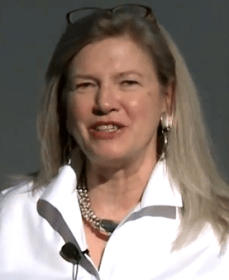
Cheryl Lyn Walker PhD, Cheryl Walker PhD, MD Anderson Cancer Center, Texas A&M University Health Science Center, TAMHSC, Institute of Biosciences and Technology

Director of the Texas A&M Health Science Center Institute of Biosciences and Technology Cheryl Lyn Walker, remarks by whom were used in evidence against the writer in 2013 and 2016

It relates sworn testimony to the Arizona Superior Court by two representatives of the Texas Commission on Environmental Quality (TCEQ), reportedly the second largest agency of its kind after the EPA. Those public sector scientists are Michael Honeycutt, Ph.D., the TCEQ’s toxicology director and an adjunct professor at Texas A&M University, who was recently entrusted with a role in forming national health policy, and one of Honeycutt’s protégés, senior toxicologist Tiffany Bredfeldt, who’s also a Ph.D. and who had already been entrusted with a role in forming national health policy. On April 4, 2017, the TCEQ tweeted its congratulations to Bredfeldt for her being selected to serve on the Chemical Assessment Advisory Committee of the EPA’s Science Advisory Board, which her boss now chairs. The bio of Bredfeldt’s associated with her appointment highlights her experience as an “expert witness.” This merits note, as does Honeycutt’s superior claim to the same distinction.

A second Texas A&M professor, Dr. Cheryl Lyn Walker, Ph.D., who was Bredfeldt’s postdoc adviser at M. D. Anderson Cancer Center, has been aware of the conduct of Bredfeldt’s detailed in this post for a decade. Appeals by this writer to Walker’s conscience and integrity only inspired her to tell Bredfeldt in a 2008 email: “I am very concerned about your safety.” Bredfeldt entered Walker’s email in evidence against the writer in 2013 and also quoted it to the court in 2016.

Authorial intrusions in the survey of statements to follow will be terse. Bredfeldt and her witnesses will do the preponderant storytelling.
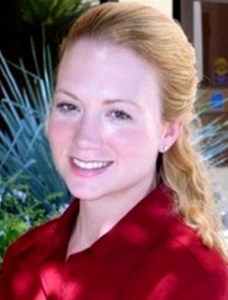
Tiffany Bredfeldt, romancing the camera in 2005

Some orienting details are required. The writer encountered Bredfeldt, then a doctoral student in the University of Arizona College of Pharmacy, at his home in late summer 2005 and met with her there routinely over the ensuing months, mostly after dark. Bredfeldt, otherwise a stranger, declined to mention to the writer that she was married while, for example, taunting him for not inviting her in at midnight: “Where I come from, it’s considered rude not to at least invite a person onto your porch.” Then she disappeared, providing no explanation. A few months after that, when the writer sought one, Bredfeldt variously reported to the police and numerous courts—in statements that remain public in perpetuity and that are not deemed defamatory—that the writer had made unwelcome sexual advances toward her, despite being repeatedly “rebuff[ed]” and “rebuked”; that he posed a violent danger to her and to assorted others she was concerned the writer would talk to about her conduct at his home (among them her mother, who lived 1,200 miles away); that he should be prohibited from possessing firearms; and that he had stalked her, a woman the writer had only ever met hanging around his yard like a stray cat.

Here’s Bredfeldt’s account in her own words to Judge Jack Peyton on April 10, 2006:

Okay, I’ll begin by defining my relationship, um, with Mr. Greene. I met Mr. Greene in about September or October of 2005 when I was boarding a horse that I own at a boarding facility owned by his family. At that time, uh, we were acquaintances, and we spent time talking and — at his family barn. And that’s about the nature of our — our interaction. During that time, I think, um, he developed maybe romantic feelings for me that — that made me uncomfortable, and I generally would rebuff his advances, asking him to stop.

Mrs. Bredfeldt, whom the writer knew for three months and with whom he has had no contact since March 2006, has along with one of two or three girlfriends of hers who were also routinely around the writer’s residence in 2005 sued the writer some six times. Four legal actions were brought against the writer in 2016 alone, two of which sought his incarceration and all of which endeavored to suppress what this post relates. In a “Victim’s Impact Statement” Bredfeldt submitted to the court in 2016, she owned that she had accused the writer “to the Court multiple times [and] to multiple police departments, detectives, federal agencies, and other officials in several states”—including the Arizona Dept. of Public Safety and the FBI—and it’s this writer’s belief that only with the blind support of loyalists like Mike Honeycutt would Bredfeldt have been so emboldened.
attorney Beth E. Maultsby, attorney Kathryn Flowers Samler, high-conflict litigants, high-conflict people, high-conflict litigation, false testimony, lying in courtThe legal onslaught has spanned (and consumed) almost 12 years, despite the writer’s appealing to dozens of people to look between the lines, including Honeycutt, who’s notably a husband with two college-aged sons. Honeycutt is besides a distinguished scientist, cited for his rigorous investigative standards, whose testimony quoted immediately below includes the statements, “I didn’t ask for details” and “I didn’t clarify that.” As a departmental director of the TCEQ, Honeycutt is paid $137,000 per. The writer, in contrast, has for the past decade earned a subsistence wage doing manual jobs that allow him to keep an insomniac’s hours and be left alone—formerly in the company of his dog, his dearest friend, who died suddenly in 2015 while the writer was still daily distracted with trying to clear his name and recover time and opportunities that had been stolen from them. (Here is a letter the writer hired an attorney to prepare in 2009. Bredfeldt represented it to the court in 2013 as evidence of harassment, and testified she believed her “psychiatric prognosis” would improve if such speech were restrained. “One of the most difficult parts of dealing with something, since this is profoundly stressful,” she told the court, “is that the stress doesn’t go away.”) The writer had aspired to be a commercial author of humor for kids, as Bredfeldt knew, and had labored toward realizing his ambition for many years before encountering her and her cronies on his doorstep. His manuscripts have since only gathered dust.

(A further counterpoint: The first public official the writer notified of Bredfeldt’s conduct, who also took no heed, was University of Arizona Dean of Pharmacy J. Lyle Bootman, Ph.D. A decade later, Bootman was charged with raping and beating an unconscious woman in his home. For almost two years following his indictment in 2015, while free on his own recognizance, Bootman faced trial—a fundamental due process right this writer was denied in 2013. Despite having been placed on administrative leave, Bootman continued to draw a faculty salary of over $250,000 from the U of A, the writer’s alma mater and former place of employ. As a graduate teaching assistant in the English Dept. in the late ’90s, the writer cleared about $200 a week. While he awaited a ruling in Greene v. Bredfeldt, the appeal of the last of the lawsuits brought against him during the same period of time by Bredfeldt and a cohort of hers, the five felony charges against Bootman were dropped. A tort case based on the same facts continues. Bootman’s attorneys filed for a protective order in December to bar public access to records.)
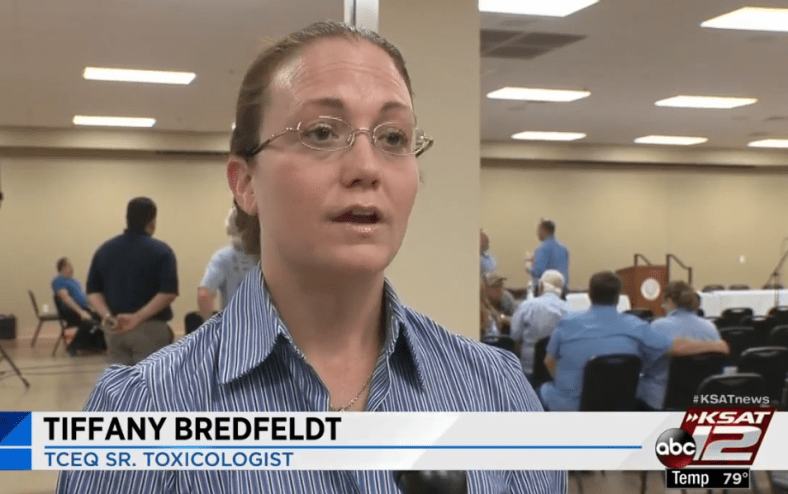
In an interview that aired in 2017, Tiffany Bredfeldt, the writer’s accuser, reassured the audience of ABC News that it could place its trust in the TCEQ. Bredfeldt made a similar pitch before the National Research Council of the National Academies of Sciences, Engineering, and Medicine in 2013. Bredfeldt, who the court was told in 2013 and 2016 is not a public official, has repeatedly appeared as the face of the Texas Commission on Environmental Quality. Her attorneys have argued that since she isn’t a public official, she isn’t obligated by law to prove her allegation that objectionable statements by this writer are false and therefore unprotected speech. Her boss, Michael Honeycutt, told the court in 2013: “Tiffany is just like the other 14 employees that I have.” If no other assertions by the TCEQ cause Texans concern, that one should.

This post’s presentation is simple: It juxtaposes contradictory statements that span seven years (2006–2013), most of them made under oath and all of them made by state scientists. (Those in small print may be enlarged in a new tab by clicking on them, or magnification of the entire post may be increased by pressing [CTRL] or [COMMAND, the cloverleaf-shaped key on Macs] + [+]. Zoom may be reversed similarly: [CTRL] or [COMMAND] + [-].) Scrutiny of the quotations below may lead the reader to conclude they’re evidence of false reporting, perjury, subornation of perjury, stalking, harassment, mobbing (including attorney-complicit abuse of process and civil conspiracy), defamation, bureaucratic negligence, professional incompetence, mental derangement, and/or general depravity.

The writer will let the facts speak for themselves.

MICHAEL HONEYCUTT, on cross-examination by the writer on May 20, 2013:
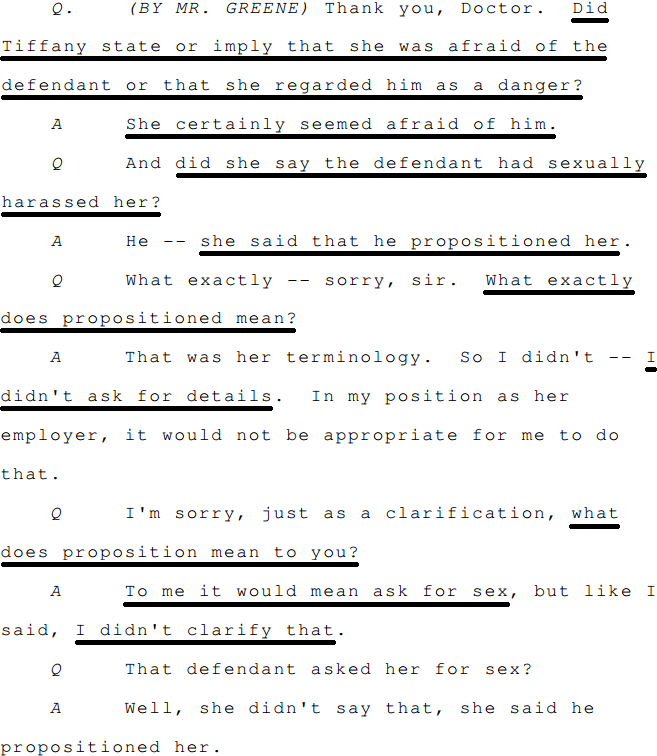
Honeycutt testifies in 2013 that Bredfeldt told him the writer “propositioned” her in 2005, which to him, he says, “would mean ask[ed] for sex.”

Bredfeldt’s attorney, Jeffrey Marks, would follow up on Honeycutt’s testimony by beginning his cross-examination of the writer with a jab instead of a question: “She says you propositioned her.” The writer replied, “What does that mean?” Marks chirped, “That you offered her sex.” Bredfeldt, while gazing around the room at her audience, nodded solemnly.

TIFFANY BREDFELDT, in an email to the writer sent Friday, March 17, 2006, that she entered into evidence three days later (Monday, March 20, 2006) along with her petition for restraining order number one:
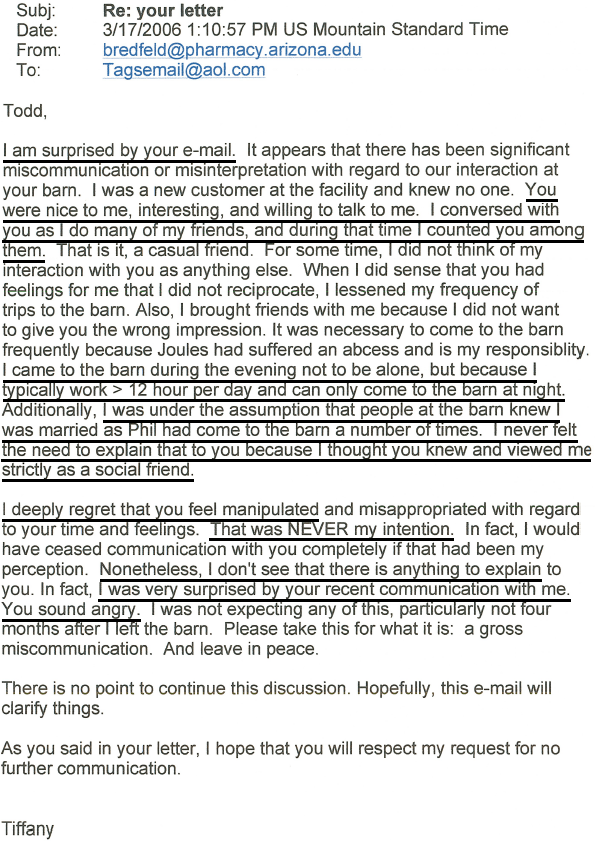
Bredfeldt states in this self-contradictory email, which she would submit days later in evidence to the court in the 2006 procedure that began the controversy, that the writer had been “nice” to her and that she had never felt the need” to “explain” to him she was married, because her husband had come to the writer’s place of residence “a number of times,” and she thought the writer already knew and besidesviewed [her] strictly as a social friend.” Contrast Honeycutt’s 2013 testimony: “[S]he said that he propositioned her.

On April 10, 2006, not a month after Bredfeldt sent this email, she would testify before a judge (in her husband’s presence) that she had had to repeatedly “rebuff…advances” by the writer in 2005. The writer was identified to the court not as a considerate “friend” but as an “acquaintance” with whom Bredfeldt had “interact[ed].” Ten years later, the husband the writer was supposed to have known about, a geoscientist today employed by Weston Solutions as a project manager, would be asked in court on direct examination by his lawyer, “Do you know the defendant, Todd Greene?” Philip Bredfeldt’s answer: “I never met him….” Then Mr. Bredfeldt would clarify to the 2016 court that he “first came to know about the [writer] in early 2006,” that is, the same week his wife sent this email, during which the writer was alleged to have sent her a “series of disturbing emails” and “packages,” a fiction that by itself would take another entire post to unweave. Significantly, Phil Bredfeldt had no idea the writer existed until 2006 and, according to his 2016 testimony, was not informed by his wife of any sexual aggression toward her in 2005—nor was anybody else, for example, the writer’s mother, who was daily at the property where the writer lives from morning till dusk, and whom Bredfeldt knew and spoke with routinely. (The writer’s mother was then in treatment for cancer, a fact Bredfeldt exploited to flaunt her knowledge of the disease, which was a subject of her dissertation research.) Where Phil Bredfeldt was while his wife was outside of the writer’s residence at 1 a.m.—and with whom—has never been clarified.

Honeycutt, in a 2013 quotation below, will testify in further contrast to Bredfeldt’s statements in this email that he was told the writer’s behavior in 2005 was “erratic and bizarre” and that he “wouldn’t take no for an answer.”

TIFFANY BREDFELDT, in a statement to the University of Arizona Police Dept. given on March 18, 2006 (the next day):
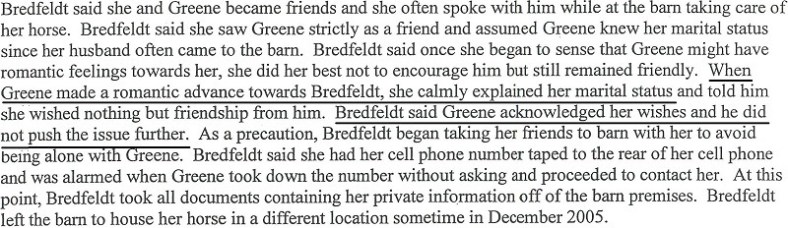
Bredfeldt, in contrast to her emailed statements to the writer 24 hours prior (and in contrast to her subsequent testimony to the court in 2006 and both hers and Honeycutt’s in 2013), reports to the police that the writer had made “a romantic advance” toward her in 2005, inspiring her to admit to him she was married, after which he desisted. Bredfeldt then says the writer seized her cell phone, copied down her number, and contacted her. Bredfeldt’s work and home addresses and telephone numbers were publicly listed, and the writer never spoke with Bredfeldt on the phone. There was no need; she could be found outside of his residence most nights, as often as not in a red tank top.

On the single occasion the writer had handled Bredfeldt’s cell phone, borrowing it because his phone had been destroyed by a power surge, Bredfeldt had insisted on typing the numbers for him before sliding the phone into his palm and caressing his fingers (repeatedly). That was in late Nov. 2005 after she and a friend of hers had invited themselves into the writer’s house. Bredfeldt’s “chaperone,” a stranger then calling herself Jenn Oas, began conversation by telling the writer she had just returned from India where she “mostly” hadn’t worn a bra. Bredfeldt chimed in with a quip about “granny panties” (after having excused herself and returned wearing freshly applied eye makeup, complaining that she had “misplaced” her glasses). A couple of weeks later, Bredfeldt would vanish.

(Flash-forward: The policewoman who instructed Bredfeldt how to obtain a court-ordered injunction, Bethany Wilson, is today a librarian in charge of kid lit—what the writer had aspired in 2006 to make his profession.)

TIFFANY (AND PHIL) BREDFELDT, in a sworn affidavit to Judge Roger Duncan (then a pro tem) filed on March 20, 2006 (two days later):
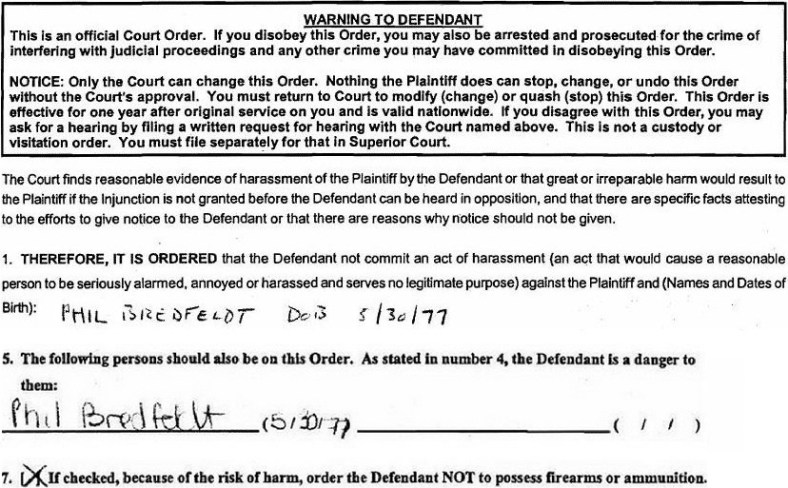
Bredfeldt urgently petitions a protective order tailored to prohibit the writer (three days earlier called a “friend” who had been “nice” to her) from having any contact with her husband, Phil, a stranger, who is alleged to be in violent “danger.”

Later the same day, the writer would be sent an email, ostensibly by Phil Bredfeldt, that begins, “STAY THE HELL AWAY FROM MY WIFE, YOU SICK FUCK,” and ends, “THIS IS THE LAST TIME YOU WILL BE TOLD.

(The Bredfeldts simultaneously sent the email to UAPD Officer Bethany Wilson, with whom she later told the writer they had been on the phone at the time. Officer Wilson, who had met both of them, opined during a 2006 interview with the writer that Mrs. Bredfeldt “wore the pants.”)

Judge Jack Peyton, JP, Justice of the Peace, Pima County Justice Court

Judge Jack Peyton

The evidence of harassment Tiffany Bredfeldt presented to the court was five emails she and the writer had exchanged over a weekend (March 16–20): two from her, three from him in reply. The March 17 email of hers shown above was shuffled to the back of the sheaf, out of chronological order, causing the judge who presided over the writer’s April 10, 2006 hearing, Pima County Justice of the Peace Jack Peyton, to remark, “I don’t think I have a copy,” and then to ask, “Am I missing one [of the emails]?” Bredfeldt had to include the contradictory email among her evidence, which was never anyhow scrutinized, because it contained one of the only two requests she had ever made to the writer not to contact her: “I hope that you will respect my request for no further communication.” The other request was in an email she had sent him 20 hours earlier, in which Bredfeldt had represented the writer to himself as a stalker after he had gently tried to learn the motives for her behaviors at his home and her concealment from him that she was married. Judge Peyton confirmed with Bredfeldt that the minimum qualification demanded by the law, namely, two requests for no contact, had been met. The writer need not have been present.

Alleged on March 20 to be in danger of violent assault, Phil Bredfeldt had to be repeatedly reprimanded for displays of temper in open court three weeks later. Judge Peyton finally told him, after ordering his name stricken from his wife’s protective order:

I won’t think twice about asking you to leave the courtroom, because you’re not a party. You are welcome to be here. This is a public forum. But I won’t have you interrupting, and I will not have you making me uncomfortable about what your next action might be.

The judge, reputed to be the go-to JP for women alleging abuse by men, nevertheless cemented the protective order against the writer, explaining: “I do not get the impression that [Mr. Bredfeldt] was placed on that order by design.

(The following year, Judge Peyton was appointed to head a county domestic violence specialty court, which was financed by a $350,000 gubernatorial grant that included no budgetary allowance for defense attorneys. The judge, a onetime Maryland labor lawyer d/b/a J. Craig Peyton, underwent a “five-day domestic violence training session” in preparation. Reportedly operating only two days a week, his court has since processed well upwards of 25,000 cases.)

TIFFANY BREDFELDT, on cross-examination by the writer on May 20, 2013 (seven years later):
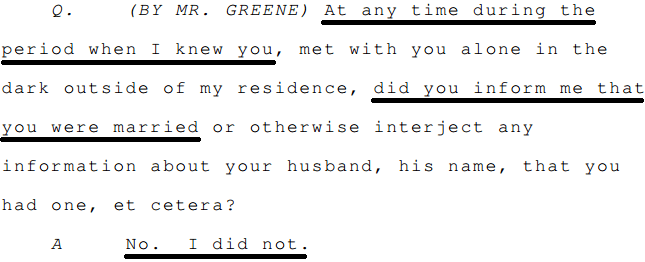
In contrast to her statements to the police in 2006, Bredfeldt testifies in 2013 that she never told the writer she was married. What Bredfeldt told the writer in 2005 was that she lived with a dog. The writer asked if it was alone at night while she was with him. Bredfeldt answered, “Yes.” The writer urged her to bring the dog with her so it wasn’t by itself and gave her a toy to take home.

TIFFANY BREDFELDT, on cross-examination by the writer on May 20, 2013 (the same afternoon):
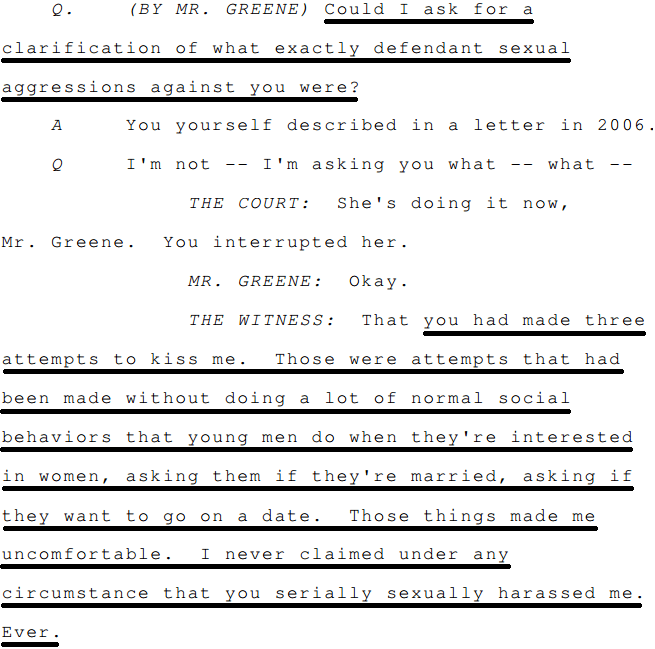
Also contradicting her statements to the police in 2006 (besides controverting what her first witness, Honeycutt, told the court in 2013 that she had told him), Bredfeldt testifies (in the presence of her husband) that the writer made “three attempts to kiss [her]” in 2005—which made her “uncomfortable” but not so uncomfortable as to prompt her to tell the writer she was married (or to tell her husband that another man had repeatedly tried to kiss her). Then Bredfeldt denies she has “ever” accused the writer of sexual harassment.

TIFFANY BREDFELDT, in a memorandum to Superior Court Judge Charles Harrington filed July 30, 2006:

In a “Statement of Factsto the court, contradicting her statements to the police (besides to the writer himself, which emailed statements she submitted to the court in 2006, 2013, and 2016), Bredfeldt alleges the writer made “several physical, romantic advances toward [her],” despite being “rebuked,” and that she was forced to flee[w]hen such advances continued.”

There were no physical advances. Bredfeldt was invited to have Thanksgiving dinner with the writer’s family in 2005. Instead of telling the writer she had a husband to get home to, she said she was suffering from a migraine. The writer put his hand on her shoulder and said he hoped she felt better. All other physical contacts between Bredfeldt and the writer, clasps and caresses, were initiated by her, typically during conversations in which she pointedly referred to breasts, bras, or panties, her naked body, striptease, or the like. At the conclusion of an earlier meeting in November, Bredfeldt had thrust her face in the writer’s and wagged it back and forth as if to tease a kiss. The writer didn’t respond, because there was nothing romantic about it. That was on the night Bredfeldt returned after attending an out-of-state wedding—her sister-in-law’s (Sara Bredfeldt’s), a detail she omitted mentioning.

A month later, on the evening before Bredfeldt “left the horse boarding facility” (in 2005 not 2006), the writer encountered her loitering in the dark outside of his house—alone. Bredfeldt returned a coffeemaker she had borrowed from him to prepare poultices for her horse’s abscessed leg. During the transfer, Bredfeldt tried to brush the writer’s hands with hers. Bredfeldt and the writer spoke as usual—he remembers talking to her about shooting stars—and the writer’s mother briefly joined them and invited Bredfeldt to a Christmas party. Bredfeldt removed her horse the next day while the writer was at work.

TIFFANY BREDFELDT, during cross-examination by the writer on May 20, 2013:
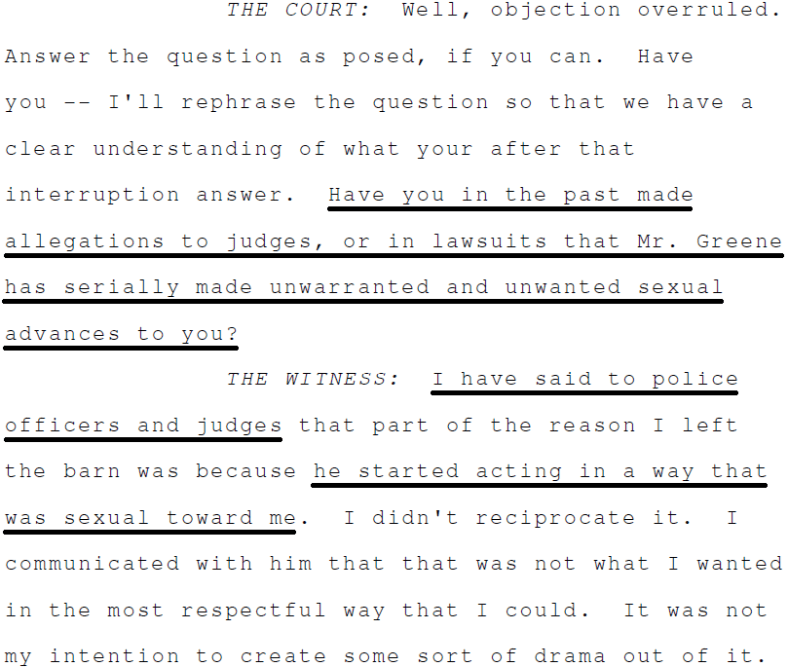
Bredfeldt testifies on examination by the judge that she has only ever told police officers and judges that the writer “act[ed] in a way that was sexual toward [her].” She “communicated with him that that was not what [she] wanted in the most respectful way that [she] could,” she says, which did not include either informing the writer she was married or wearing her wedding ring.

JENNIFER (OAS-)TERPSTRA, Bredfeldt’s other witness in 2013, a former colleague of hers from her University of Arizona days who went by Jenn Oas when the writer was introduced to her in 2005, in an email to the writer sent April 2, 2012 (a year earlier):
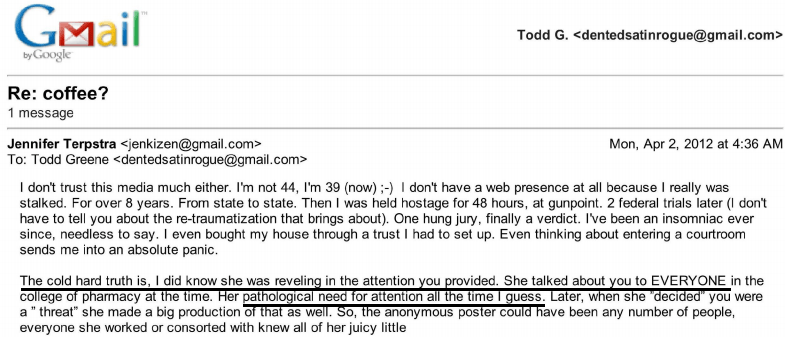
Jennifer Terpstra, Jen J. Terpstra, Terpstra JJ, Jennifer Oas-Terpstra, Jenn Oas, South Texas College, STC

This and the rest of Terpstra’s some two dozen emails to the writer in 2012 have been submitted to the court in multiple cases and are public documents accessible to anyone. Whether the emails have ever been scrutinized by a judge is uncertain. No trial has been conducted since the writer was granted a 20-minute audience before a judge in 2006. The 2013 proceeding from which the focal testimony in this post is drawn was a two-hour “preliminary” hearing. Judge Carmine Cornelio, though he drew the case out for half a year and returned several scalding rulings, found a two-hour hearing to be a sufficient basis for indefinitely depriving the writer of his First Amendment privileges. (When the writer had begun to object in open court to an order that was flagrantly unlawful, the judge threatened to summon security. Among the Arizona Court of Appeals’ stated reasons for denying the writer’s 2017 appeal of the order was that the writer had not “challenged” the judge’s ruling at the time.)

In this email, Terpstra tells the writer she was “stalked [f]or over 8 years [f]rom state to state.” Both Bredfeldt and Terpstra have claimed to be victims of multiple stalkers—including this writer. Bredfeldt, who the writer would be informed four years later has held a black belt in tae kwon do since her teens, came to the writer’s door in 2005 seeking his protection from some “men in a van” who she said had been “stalking” her while she was alone in the dark outside of his residence. Narratives of the “event,” which was unwitnessed and may have had no basis in reality, were circulated by Bredfeldt among other horse boarders on the property where the writer lives. The writer bought a wireless doorbell and installed it by the gate to his yard so that Bredfeldt could summon him quickly in case of a “recurrence.” When he showed it to her, she smiled.

A few months subsequent, when Bredfeldt’s accusations against the writer began, she was reported to have told colleagues that she thought she had seen him around her residence—and at workday’s end would ask to be escorted to her car. In testimony to the court quoted in a postscript to this exposé, Honeycutt, Bredfeldt’s first witness in 2013, says the TCEQ rewarded similar expressions of fear from her by providing her with a private office (“with hard walls and with a door that has a lock on it” in Texas).

JENNIFER TERPSTRA, in an email to the writer sent April 2, 2012:
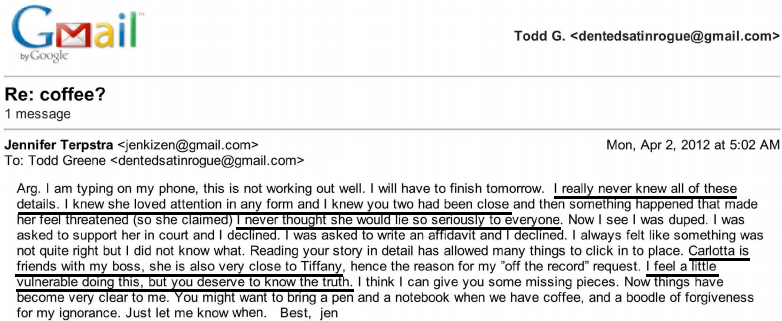
Jennifer Terpstra, Jen J. Terpstra, Terpstra JJ, Jennifer Oas-Terpstra, Jenn Oas, South Texas College, STC, Carlotta Groves PhD, Carlotta Groves DVM

In this email, sent a year before Terpstra would join Bredfeldt in testifying against the writer, Terpstra says that she “never thought [Bredfeldt] would lie so seriously to everyone” and that she knew Bredfeldt and the writer had been “close,” which remark alone contradicts everything Bredfeldt has told the court in the past decade. Terpstra also says she feels professionally “vulnerable” confiding in the writer but that he “deserve[s] to know the truth.” She suggests the writer “bring a pen and a notebook” to a meeting she proposed so that he doesn’t forget anything.

JENNIFER TERPSTRA, in an email to the writer sent June 3, 2012 (a month and a half after the two met for coffee):

Jennifer Terpstra, Jen J. Terpstra, Terpstra JJ, Jennifer Oas-Terpstra, Jenn Oas, South Texas College, STC

Terpstra told the writer over coffee in mid-April 2012 (when his father and his best friend were still alive, and a settlement could have reversed their decline) that Bredfeldt’s spouse, Phil, was known in their circle as “the phantom husband” and that Bredfeldt had urged her friends to go to the writer’s home to “check [him] out”—besides routinely talked about the writer to an audience of “25 or 30 people” at the University of Arizona College of Pharmacy.

Terpstra says in this email that Bredfeldt never talked about her husband and that she (Terpstra) wasn’t sure she had ever seen the man in person or only seen what she had described to the writer over coffee as a laminated newspaper clipping with a picture of him that was tacked to Bredfeldt’s refrigerator. Terpstra says that based on Bredfeldt’s behaviors in 2005, she judged she had been “considering an affair” with the writer, which wildly contradicts any account Bredfeldt has ever related to anybody.

In the first of the emails Terpstra sent him in 2012, she explained her six-year delay in confiding this to the writer by saying, “I don’t lie or bend the truth [but] I do avoid conflict.”

JENNIFER TERPSTRA, on direct examination by Bredfeldt’s attorney, Jeffrey Marks, on May 20, 2013 (less than a year later):
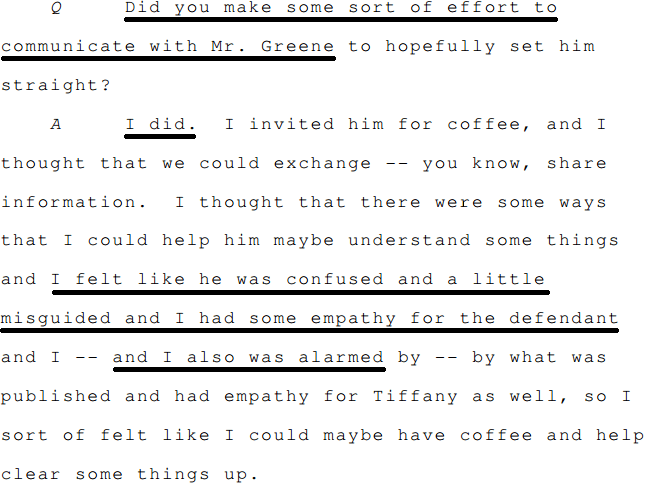
JENNIFER TERPSTRA, in an email to the writer sent April 1, 2012:
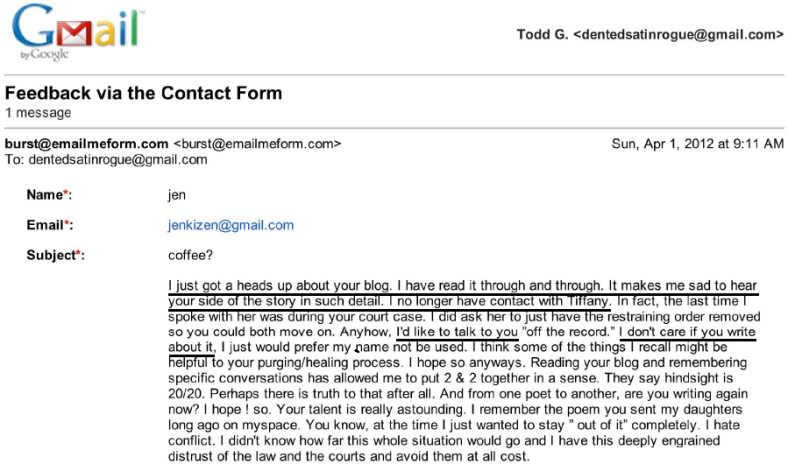
Jennifer Terpstra, Jen J. Terpstra, Terpstra JJ, Jennifer Oas-Terpstra, Jenn Oas, South Texas College, STC

In this email, Terpstra tells the writer she had asked Bredfeldt “to just have the restraining order removed” in 2006. (Terpstra would tell the writer the same thing over coffee a couple of weeks later, saying Bredfeldt had answered, “‘No.’ Just…‘no.’”) In contrast to Terpstra’s statements in this email and the others she sent him in 2012, besides in contrast to an email she sent him in 2007, Terpstra would report to Officer Nicole Britt of the Tucson Police Dept. in 2015 that “in 2005 she and her friend [Tiffany Bredfeldt] met [Todd Greene]. He then became fixated on the two of them and began stalking them.” (According to the same interview notes, Terpstra said this blog was “set up in honor” of her and “dedicated” to her.) A couple of months later (early 2016), Terpstra would report to TPD Det. Todd Schladweiler, who is assigned to the Tucson Police Mental Health Support Team, that she “now carries a handgun due to her concern that [Greene] is a threat to her safety.” Det. Schladweiler also recorded that Terpstra “said she communicated with [Greene] a few times [in 2012] and then he became very sexual in nature” and that Terpstra denied contacting the writer after they met for coffee in mid-April 2012, following which meeting she had insisted the writer give her a hug and then emailed and phoned him for a quarter of a year.
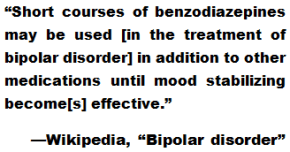
Then students in the University of Arizona College of Pharmacy, Terpstra and Bredfeldt told the writer in 2005, after inviting themselves into his house, that they took “benzos” to relieve stress. The writer asked where they got the drugs. Terpstra (who would marry a former bartender with a cocaine conviction not long afterwards and be charged with DUI in 2011) answered, “From work.” Bredfeldt echoed, “From work.”

Terpstra, who is reportedly diagnosed with bipolar disorder, told Det. Schladweiler she believed the writer was mentally ill. Although Det. Schladweiler was provided with Terpstra’s emails when he arrested the writer on Jan. 5, 2016, the subsequent synopsis of their interview gives no indication the detective spared the emails a glance.

Less than four months after her second police report, in which Terpstra alleged she feared for her safety and was carrying a gun, she would have her home address forwarded to the writer by email in the first of a spate of “copyright infringement” claims that represented her third legal action against him in 2016 and that succeeded in having this blog temporarily suspended by its host. The writer contested the claims, alleging perjury and fraud, and Terpstra declined to litigate them in court.

Terpstra, who has coauthored with Dr. Michael J. Frank, Ph.D., professor of cognitive, linguistic, and psychological sciences at Brown University, is the daughter of feminist painter Joan Bemel Iron Moccasin (Oas) and was employed as a research specialist in the University of Arizona College of Medicine under psychiatrist Francisco Moreno until 2016, when, after making her sundry false allegations, she left the jurisdiction.

JENNIFER TERPSTRA, on cross-examination by the writer on May 20, 2013:
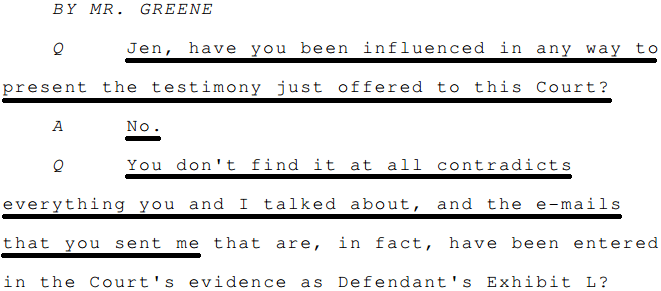
Jennifer Terpstra, Jen J. Terpstra, Terpstra JJ, Jennifer Oas-Terpstra, Jenn Oas, South Texas College, STC

Over coffee with the writer in 2012, Terpstra complained of financial problems. She also remarked, “Tiffany’s dad has a lot of money.” Tiffany and Phil Bredfeldt’s was a mutually prosperous union of two wealthy, fundamentalist Christian families. Phil Bredfeldt’s father was his best man in 2001; his sister Sara was a bridesmaid; and Tiffany Bredfeldt’s brother, Jon Hargis, was a groomsman. Four years later, Sara Bredfeldt was married to a medical student, Roberto “Bobby” Rojas, who is today an M.D. (Aurora St. Luke’s Medical Center in Milwaukee).

Ray Bredfeldt MD, Raymond Bredfeldt MD, Dr. Ray Bredfeldt, Arkansas Blue Cross and Blue Shield, ABCBSTiffany Bredfeldt’s father, Timothy “Tim” Hargis, is or was a bank vice president (First Security of Arkansas), as was his father before him. Phil Bredfeldt’s father, Raymond “Ray” Bredfeldt, is a family physician who practiced privately and besides rented his credentials to Arkansas Blue Cross and Blue Shield for some dozen years. The starting salary for an ABCBS regional medical director is today around $180,000. Dr. Ray Bredfeldt, M.D., had volunteered to join Terpstra in giving witness testimony in 2016 that was meant to induce the court to jail the writer while the writer’s own father, who didn’t graduate from high school, lay dying—in a home in foreclosure. Ray and Ruth Bredfeldt and Tim and GaLyn Hargis have known of what this post details from the start and have temporized for over a decade rather than acknowledge any liability for their families’ ways. “It’s what people like that do,” Terpstra commented to the writer in 2012. (Testifying in 2016, while his father was nearby, Phil Bredfeldt acknowledged on the stand that he was very aware of Terpstra’s 2012 emails. He quoted a post about them. Construing his statements to the court, the only thing that disturbed him about the emails was their contents’ being public.)

The court was told on Dec. 21, 2016, that Terpstra, who was sued to have her evicted from her house the year before, had moved from Arizona to Texas, where Tiffany and Phil Bredfeldt have resided since 2006 (in a house Terpstra told the writer that Tiffany Bredfeldt’s father had bought for them)—and the writer would be surprised if Terpstra’s legal representation in 2016 and 2017 cost her a penny.

JENNIFER TERPSTRA, on cross-examination by the writer on May 20, 2013:
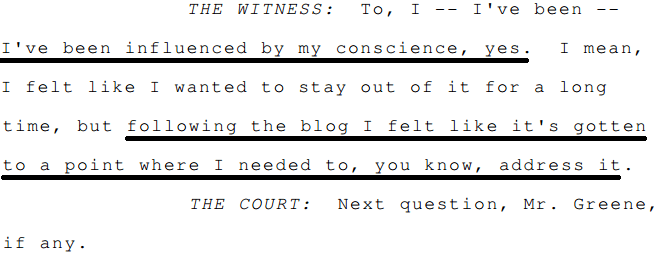
JENNIFER TERPSTRA, in an email to the writer sent June 7, 2012:
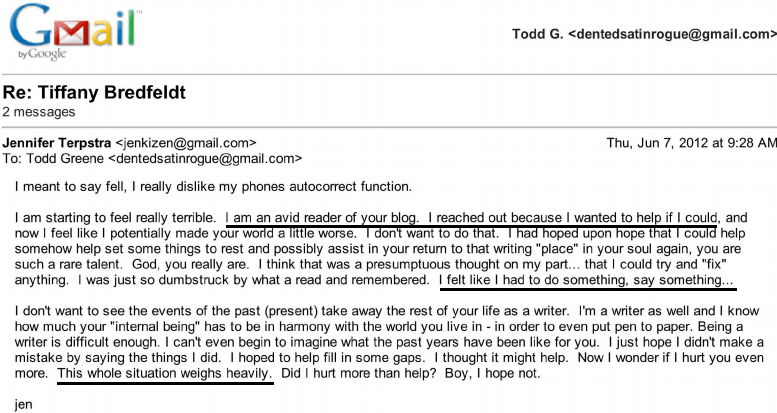
Jennifer Terpstra, Jen J. Terpstra, Terpstra JJ, Jennifer Oas-Terpstra, Jenn Oas, South Texas College, STC

JENNIFER TERPSTRA, on cross-examination by the writer on May 20, 2013:
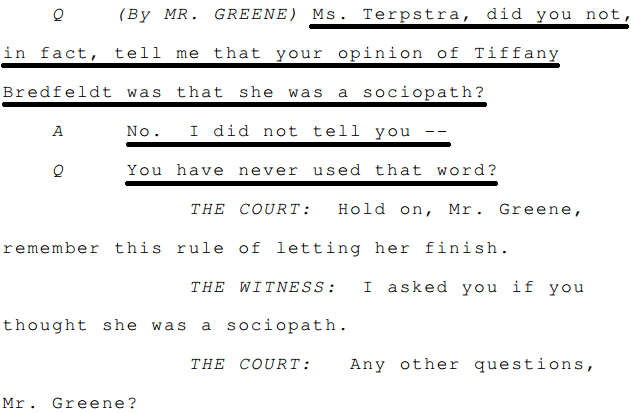
Jennifer Terpstra, Jen J. Terpstra, Terpstra JJ, Jennifer Oas-Terpstra, Jenn Oas, South Texas College, STC

JENNIFER TERPSTRA, in an email to the writer sent June 3, 2012:
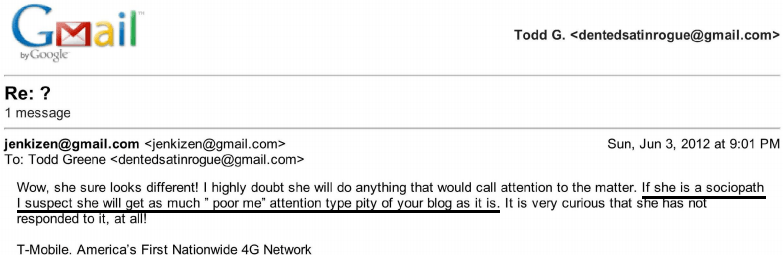
Jennifer Terpstra, Jen J. Terpstra, Terpstra JJ, Jennifer Oas-Terpstra, Jenn Oas, South Texas College, STC

Jennifer Oas-Terpstra, whom the writer has met three times in his life and only once in the past decade (and with whom he has had no contact since 2012), brought three legal actions against him in 2016 that each sought to suppress the emails quoted above—emails that today implicate both Bredfeldt and her (and criminal statutes of limitation, like those for false reporting and forswearing, stop running when perpetrators are outside of the state’s boundaries). Terpstra’s actions included a criminal prosecution, dismissed seven months later, in which Bredfeldt was also named a plaintiff, and a restraining order identical to the one Bredfeldt petitioned in 2006, which had inspired this blog and inspired Terpstra to tell the writer in 2012: “I can’t even begin to imagine what the past years have been like for you.” Terpstra’s restraining order was dismissed 20 months later.

Here are the allegations Terpstra made in her affidavit. These ex parte allegations remain a public record indefinitely. Here, in contrast, is how “vindication” from them appears. The writer was told that this handwritten dismissal, which required eight months of appeals to obtain, exists as a piece of paper only and won’t be reflected in the digitized record. Judge Antonio Riojas, who granted the Aug. 25, 2017 dismissal, accordingly recommended that the writer “carry [it] with [him].” His clerk provided the writer with the yellow copy of the triplicate form, the one meant for the plaintiff, who never appeared in court and will never be criminally accountable for her false allegations to the police in 2015 and 2016.

I’ve been doing this for 20 years,” Judge Riojas told the writer, “and I’ve never known a police [officer] or a prosecutor to charge someone for…false reports, no matter how blatant….” He added: “I wish they would, because I think people come in, and they say things that are just blatantly false—and lying.” A false or vexatious complainant “can keep filing as much as [s/he] wants,” Judge Riojas said (costing an attorney-represented defendant thousands of dollars a pop and his or her accuser nothing; application is free to all comers). “There is no mechanism to stop someone from filing these orders.” What may be worse, even a dismissed order, the judge explained, “can’t be expunged” (and anything may be alleged on a fill-in-the-blank civil injunction form, for example, rape, conspiracy to commit murder, or cross-dressing; whether heinous or merely humiliating, allegations that may be irrelevant to the approval of a keep-away order and/or that may never be litigated in court, let alone substantiated, will still be preserved indefinitely in the public record above a judge’s signature). Significantly, Judge Riojas, who is the presiding magistrate of the Tucson municipal court (and a member of the Arizona Judicial Council and the Task Force on Fair Justice for All), agreed that restraining orders were “abused”. Of that, he said, “[t]here’s no doubt.”

(In a given year, there are reportedly 5,000 active restraining orders in Tucson City Court, which recently added an annex dedicated to their administration exclusively—and the municipal court is just one of three courts in Tucson that issue such orders.)
Judge Wendy Million, Tucson City Court

Judge Wendy Million

The reason Judge Riojas had to dismiss the order against the writer, nine months after he requested his day in court, was that the writer had been denied his statutory right to a hearing by Judge Wendy Million, necessitating a lengthy appeal and her admonishment by Superior Court Judge Catherine Woods for abuse of discretion. (Among approximately 15 judges to have been exposed to some aspect of this matter, Judge Woods was the first to return a ruling clearly untainted by political motives, for which she has this defendant’s highest respect.) Judge Million, who twice continued the writer’s hearing until the injunction expired and then nominated the case a “dead file,” notably coordinates Tucson’s domestic violence court and is acknowledged as an editor of Arizona’s Domestic Violence and Protective Order Bench Book. Dismissal of the case was further delayed by Judge Cynthia Kuhn, who was first assigned to the writer’s superior court appeal. Judge Kuhn sua sponte (that is, without being asked) granted Terpstra’s attorney additional time to respond to the writer’s appellate memorandum—and then abruptly recused herself, citing an unspecified “conflict of interest” as the reason.

Terpstra, in the first of the 22 emails she sent him in 2012, had told the writer: “I have this deeply engrained distrust of the law and the courts and avoid them at all cost.” Besides witnessing against him in May 2013, accusing him to the police in Nov. 2015, petitioning a civil injunction and instigating a criminal prosecution a month after that, filing a second police report in Jan. 2016, and threatening to sue him in federal court for copyright infringement 14 weeks later, Terpstra was poised to witness against the writer all over again that summer in the lawsuit brought by Bredfeldt and her husband that demanded the writer be jailed for contempt of the 2013 prior restraint. In between, in 2014, Terpstra prosecuted her husband, alleging domestic violence. A relative of his, who afterwards wept, told the writer in 2016 that she believed the man was relentlessly provoked, which the writer finds more than credible. In a voicemail Terpstra left him in 2012 (in which she tacitly identifies Bredfeldt as a “crazy person” from the writer’s “life book”), Terpstra told the writer someone had “threatened to call the police on [her].” Later, by phone, she clarified that this was another man she had been corresponding with that year—who blamed her for a woman’s suicide.
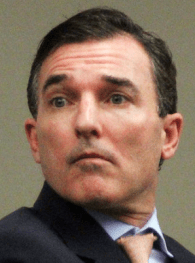
Tucson attorney Chris Scileppi, attorney Christopher Scileppi

Attorney Christopher Scileppi

Bredfeldt and Terpstra, (carrion) birds of a feather, were represented by the same (criminal) attorney in 2016 and 2017, Christopher “Chris” Scileppi, whose plumage is no different from theirs. Scileppi attained minor notoriety in 2008 for having been given a hug by his “very close friend” the mayor in front of jurors at a rape trial in which Scileppi represented one of the alleged rapists of a 15-year-old girl. Scileppi remarked to the outraged judge: “Courtrooms are open to the public, and I don’t think it is inappropriate when high-profile people come in and show support for somebody who is on trial.” Scileppi’s client was cut free, but the mayor later did a stint in prison for public corruption despite Scileppi’s representation.

Showing the same unscrupulousness during hearings in the 2016 civil case, Bredfeldt v. Greene, Scileppi threatened in open court to prosecute the writer for purported felony crimes (“extortion” and “aggravated harassment,” specifically) to intimidate him into capitulating to Bredfeldt’s censorship demands, then offered to drop the lawsuit if the writer agreed to leave this site invisible to the public and accessible by request only (apparently because his clients’ fear would be eased if they didn’t know what was on the writer’s mind), and finally, as a Parthian shot, directed the judge to jail the writer for the nonpayment of a $350 sanction from 2013 (explained below): “Put him in contempt,” Scileppi said, “and somebody can post a bond and pay that and then he will be released as soon as that bond is posted….

Tucson attorney Chris Scileppi, attorney Christopher ScileppiScileppi, who was suspended for 60 days and placed on six months’ probation in 2014 for violating various ethical rules (ERs), endeavored to convince the 2016 court that the writer had “terrorize[d], demonize[d], harass[ed], and defame[d]” the Bredfeldts, in particular through the use of “[meta] tags” on this blog, that is, keywords that describe its contents. These terms, which haven’t been used by any major search engine in eight years, were alleged to have hijacked the Bredfeldts’ public images on Google and to have “contact[ed]” anyone whose name appeared among them. Because a Google Alert Phil Bredfeldt had “set up” had allegedly been triggered by tags on the blog (in publications to the world at large), that was said to represent illicit “communication [and] contactby the writer with Mr. Bredfeldt and his wife. Scileppi enlisted an information technology expert, “part-time professor” and (criminal) attorney Brian Chase, to loosely substantiate this theory on the stand. Lamely objecting to an eminent constitutional scholar’s weighing in as an amicus curiae (Latin for “friend of the court”), Scileppi also defended the 2013 prior restraint last year before the Arizona Court of Appeals. He told the court that the writer was the liar.

Jeffrey “25% OFF ALL MONTH LONG” Marks, the low-rent opportunist who represented Tiffany Bredfeldt in 2010 and 2013, and is quoted below, represented her in 2016, also, but was hastily replaced after the writer was granted a court-appointed lawyer of his own. Marks, like his replacement, Scileppi, attempted to induce the court to stifle even third-party criticism of Bredfeldt, for example, that of Georgia entrepreneur Matthew Chan, who (aided by Prof. Eugene Volokh) successfully appealed a prior restraint in 2015 in his state’s supreme court and who introduced the writer to the finer points of First Amendment law.

To explain away Terpstra’s emails to the writer in 2012 and the contradictory testimony she gave a year later, Scileppi told Judge Catherine Woods in 2017 that “[i]n the midst of Greene’s harassment of Dr. Bredfeldt, [Terpstra] reached out to Greene and met with him. Through meeting with Greene, Terpstra became privy to his harassment of Dr. Bredfeldt.” In contrast to Scileppi’s claims, which Judge Woods shrewdly disregarded, Terpstra had offered to help the writer settle the conflict with Bredfeldt in 2012 (three months after Terpstra “reached out to [the writer] and met with him”). In an email Terpstra sent the writer on July 18 of that year (the first of four she sent that day), she wrote: “Maybe I can be a go between if the pastor [Jeremy Cheezum, a brother-in-law of Phil Bredfeldt’s] will not. I told Tiffany we met for coffee.” The email ended, “Hoping for the best.” That was the last day the writer heard from Terpstra, who is notably the mother of two college-aged daughters. Desperate to raise money to secure a surgery for his dog to enable her to run and jump again—something else Terpstra had said she was eager to help him accomplish—the writer scarcely gave Terpstra another thought until she appeared as a surprise witness 10 months later and deceived the court for Bredfeldt.

The other friend of Bredfeldt’s the writer met at his home in 2005, Dr. Carlotta Groves, a reported recipient of $740,000 in scientific research grants who uses the alias “Jahchannah” and identifies herself as a “Black Hebrew Israelite” and “servant of Yah,” lives in Arizona but apparently couldn’t be persuaded to give witness testimony for Bredfeldt in either 2013 or 2016. Like Terpstra did in the first of her emails to the writer in 2012, Groves told him in a blog comment around the same time that her own brother had been falsely accused. Terpstra said her brother had been falsely accused of rape and that it had “truly ruined his life.” For 12 years, Groves has done what Terpstra did for six: spectate. Groves, a DVM and a Ph.D. (who “love[s] to read and support aspiring authors!”), works at a low-cost veterinary clinic in Tucson.
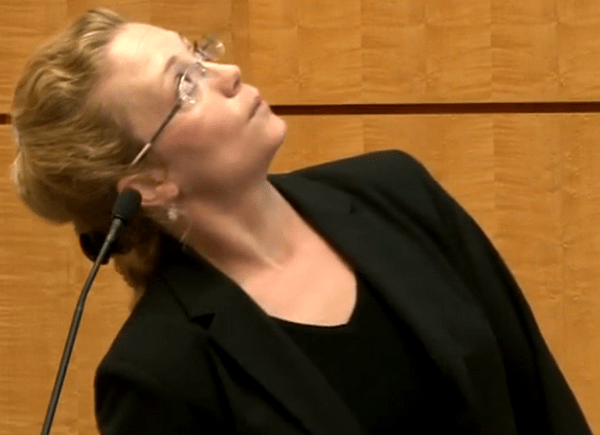

Tiffany Bredfeldt TCEQ, Tiffany Bredfeldt PhD, Tiffany Bredfeldt EPA, TCEQ, Texas Commission on Environmental Quality, EPA, Environmental Protection Agency, EPA Chemical Assessment Advisory Committee


TIFFANY BREDFELDT, on cross-examination by the writer on May 20, 2013:

TIFFANY BREDFELDT, on cross-examination by the writer on May 20, 2013:
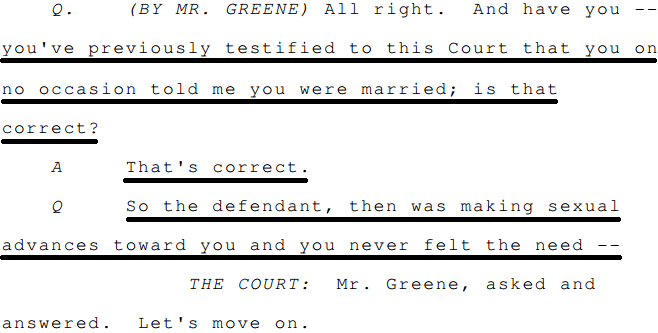
JEFFREY MARKS, Bredfeldt’s attorney, speaking for her in a memorandum to the court filed July 10, 2013:

The difference between Bredfeldt’s attorney’s offhand estimation, “2005 or 2006,” was a year of this writer’s life (and his friends’ and his family’s). The year after the “genesis of this case” was one the writer spent every waking moment conscious he could be arrested without a warrant based on a further contrived allegation by Bredfeldt (in which case the writer’s dog, who was part Rottweiler and vigorously barked at any approaching stranger, could easily have been shot and killed).

Contrary to Marks’s claim, Bredfeldt employed others to tend to her horse’s daily hygiene in 2005. Within six or seven weeks of her installing her horse 30′ from the writer’s residence, it became lame and could not even be ridden, after which Bredfeldt increased the frequency of her nighttime visits.
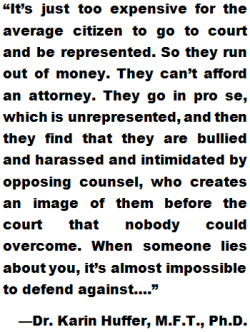
Karin Huffer PhD, Legal Abuse Syndrome, legal abuse, LASMarks, who boasts of having served as a superior court judge himself, also tells the court in this memorandum, which was captioned, “Plaintiffs’ Response to Defendant’s ‘Chronology of Tiffany Bredfeldt’s 2006 Frauds,’” that “[e]ven assuming arguendo that Plaintiff Tiffany Bredfeldt is a chronic liar, her veracity is totally irrelevant to the necessity to restrain Defendant’s [speech] conduct.” Marks moved the 2013 court to strike the writer’s “scandalous” chronology from the record so that it couldn’t be accessed by the public. The judge, Carmine Cornelio, complied, rebuked the writer, and sanctioned him $350 for filing the brief, despite having invited him to: “Mr. Greene,” the judge had said in open court, “you can file anything you want.” Then the judge permanently prohibited the writer from telling anyone else what that chronology related—including by word of mouth. Bredfeldt’s handmaidens, Honeycutt and Terpstra, said exactly what they knew they should to inspire the illegal injunction. The judge permanently prohibited the writer from talking about them, also, including by reporting the testimony they gave in a public proceeding in the United States of America.

(Last year, two days before the writer’s attorney would file an appeal reminding an American court that citizens of this country enjoy freedom of speech, The New York Times published an editorial on censorship in China adapted from an essay by iconic artist and agitator Ai Weiwei. In it, Ai argues that censorship, an essential tool of oppression, does the opposite of pacify: It stimulates “behavior [that] can become wild, abnormal and violent.” Having to live with lies, as Ai told NPR in an interview in 2013, “is suffocating. It’s like bad air all the time.”)

MICHAEL HONEYCUTT, on cross-examination by the writer on May 20, 2013:
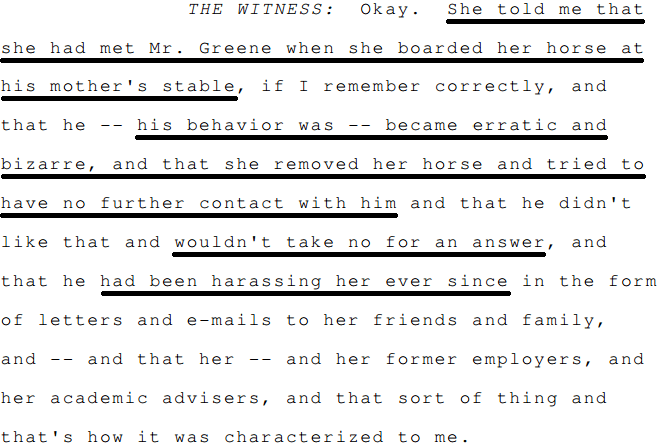
MICHAEL HONEYCUTT, on direct examination by Bredfeldt’s attorney, Jeffrey Marks, on May 20, 2013:

The testimony of “Where’s my mike?” Honeycutt exemplifies how the Texas Commission on Environmental Quality responds to “pretty significant allegations” of ethical misconduct by its scientists: It ignores the allegations…and abets the misconduct.

Under Arizona law, a “false sworn statement in regard to a material issue” is perjury, a felony crime. Honeycutt influentially testified in 2013 that the writer had called Bredfeldt a “fraudulent scientist.” Here, in contrast, is what the writer told Honeycutt in 2011, in a letter that is today a public document.
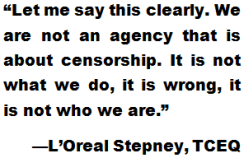
L'Oreal Stepney, TCEQ, Texas Commission on Environmental Quality, censorshipIn the Texas Observer the summer before last, Naveena Sadasivam reported that “Honeycutt sent at least 100 emails to state air pollution regulators, university professors and industry representatives and lawyers asking them to send the EPA a letter supporting his nomination to the Clean Air Science Advisory Committee….” Probably none of them sought to have him silenced on pain of imprisonment for requesting support. In a further instance of incandescent hypocrisy, Honeycutt is quoted in the story as pronouncing: “Ideology is different from science and data.” The reader is invited to consider which master Honeycutt was serving when he testified against this writer four and a half years ago.

After a hearing held on July 15, 2016, during which her husband had testified he was “frighten[ed],” Tiffany Bredfeldt swore in court, “God damn it,” because instead of ordering that the writer be jailed, the judge had stayed the proceedings pending further briefings from the attorneys on the First Amendment. Then, less than a year after the writer had buried his best friend and a few months before the writer’s father would succumb to cancer by starving to death, Bredfeldt laughed. She said Honeycutt had joked that her prosecution of the writer was “good experience” for when she gave expert witness testimony. “That’s something we have to do,” Bredfeldt explained to her entourage.

Copyright © 2018 RestrainingOrderAbuse.com

DR. MICHAEL HONEYCUTT, PH.D.:
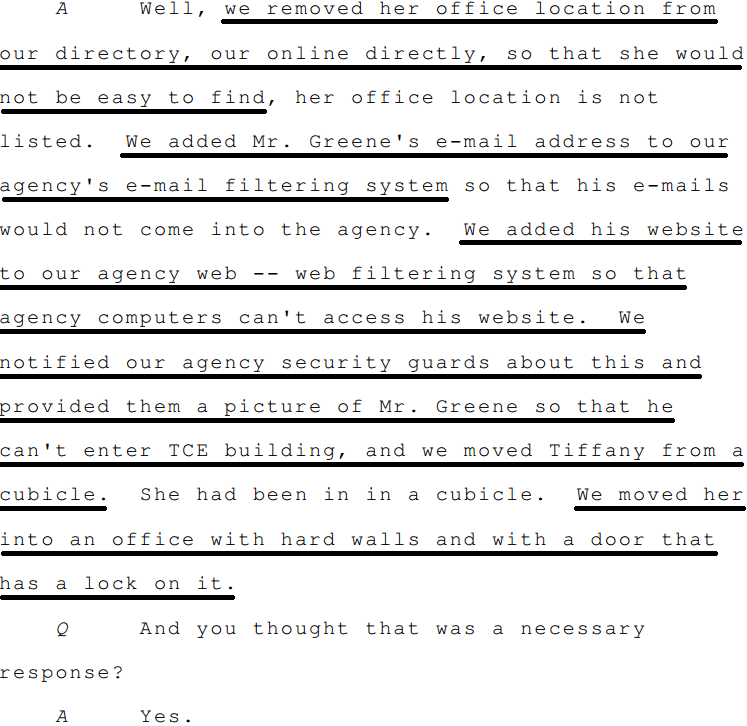
DR. TIFFANY BREDFELDT, PH.D.:
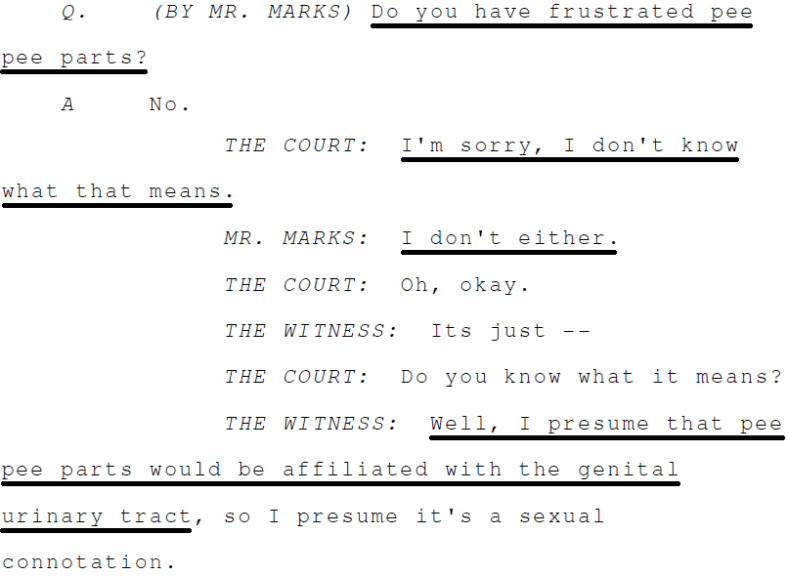
What Defamation Is and Isn’t: On Writing about Abuses of Process


“Defamation is the general term for a legal claim involving injury to one’s reputation caused by a false statement of fact and includes both libel (defamation in written or fixed form) and slander (spoken defamation). The crux of a defamation claim is falsity. Truthful statements that harm another’s reputation will not create liability for defamation (although they may open you up to other forms of liability if the information you publish is of a personal or highly private nature).”

Digital Media Law Project

No honest lawyer would deny that a whole lot of lying goes on in court—though there are more than a few jaded veterans of legal process who would deny there’s such a thing as an honest lawyer.

Either way: a whole lot of lying.

A purpose of the First Amendment is to protect the citizen’s right to register disapproval of anyone or anything, for example, rampant lying in court. If a plaintiff lies in court and prevails because of it, a defendant may have no means to reverse the court’s opinion after the fact. The plaintiff will, for legal purposes, have gotten away with it.

That doesn’t, of course, mean s/he didn’t lie.

It also doesn’t mean the defendant is prohibited from bringing the truth to light in the court of public opinion. What transpires in a courtroom is public property, and the right of a witness to talk about that (and his or her life) is sacrosanct. There’s an obvious public interest, besides, in knowing lying occurs in court, which makes speech about lying in court political, and political speech is what the First Amendment is preeminently there to safeguard.

Journalism is the true court of last resort, and bloggers enjoy the same privileges as the institutional press. A trial judge may not recognize that, but the law does.

A purpose of a plaintiff’s lying to the court to procure an injunction (a “restraining order”) is always to shut the defendant up (possibly to conceal unethical or unlawful acts s/he has committed). The same plaintiff who thought it was perfectly fine to lie up and down about the defendant under oath will be livid if s/he’s then exposed for it in a public medium that could be read by friends, family, and coworkers. Bottling the truth to maintain appearances was the point of misleading the court in the first place.

The plaintiff’s immediate turn-to recourse will be to claim the defendant violated the injunction by writing about him or her. This is invalidated by the First Amendment, but a trial judge may not know that (talking or writing to someone may be properly prohibited by the court; not so talking or writing about someone, which is protected speech). Additional to alleging harassment, a plaintiff will likely claim s/he has been “defamed.

Defamation is a word that’s applied casually to any negative speech about a person. As the epigraph shows, the significance of the word in the law is very narrow, however: to qualify as defamatory, speech must be false. Speech that’s merely critical, offensive, upsetting, or coercive (i.e., meant to urge someone to change his or her ways) is protected by the First Amendment.

To ground this discussion, let’s say a man cheats on his wife, and let’s say the unknowing mistress finds out and threatens to tell her—and his friends, his boss, etc.—unless he apologizes and comes clean. The man gets a restraining order to silence the woman, maybe alleging harassment or stalking…or threats against his pet bunny. (He can make up anything he wants—and if there are a few angry emails or texts, easy-peasy.)

This disarms the woman (who is the actual wronged party), robs her of credibility—“She’s just some crazy person who’s obsessed with me; I had to get a restraining order”—and besides humiliates and terrifies her: She is instantly the creep.

Now what if instead of contacting the man’s wife (boss, friends, etc.), the deceived woman subsequently writes about the ordeal in a blog? Contrary to what most may think, including lawyers and judges, this is protected one-to-many speech—like orating on a campus quad or in the town square, or wearing a sandwich board and marching up and down the sidewalk. Willing listeners can attend; everyone else can turn away.

Negative speech about a person usually will qualify, by the dictionary definition of the word, as defamatory. Certainly if I call someone a “scumbag,” it’s not likely to enhance his or her image and popularity. Is calling someone a name actionable? No.

So speech can defame and still be defensible. Liability for defamation requires that unwanted speech be false.

If I think someone’s a scumbag, that’s not false speech; it’s my opinion. So it isn’t defamatory according to the law…even if a judge might believe otherwise.

Let’s help him or her out: Is pronouncing that someone is a criminal defamatory? Certainly. But judges do it all the time. Defaming people is their business. Generally speaking, judges’ defamatory speech is the most harmful kind.

The distinction is, if someone is sentenced for the commission of a criminal act, s/he is ipso facto a “convicted criminal” (and maybe even a “felon”). Saying so is defamatory, but it isn’t “defamation” by the standard recognized by the law. It isn’t false.

Similarly, if someone committed a crime (like perjury) and wasn’t caught, that doesn’t mean s/he didn’t lie under oath. (Parenthetically, there is no one who has never told a lie so just calling someone a liar can never be defamatory by the legal standard.)

In a courtroom, a person’s allowed to make any defamatory allegation against someone else, whether true or not. Judges (and everybody else) get hung up on the question of what you can say outside of one. It’s as if they imagine what happens in court isn’t public or “doesn’t count.”

An irony lost on judges is that lies uttered with impunity in court procedures can carry grave and permanent consequences. A judge will just stonily sit there and listen. (The author, for example, was accused in 2013 of “propositioning” a woman he’s been in and out of court with for almost 12 years. It never happened, but the judge didn’t bat an eyelash.) “Objectionable” opinions and truths spoken outside of court may well arouse a judge’s ire, though. This is a prejudice, and it’s more than a little backwards.

Critical speech cannot help but defame. That doesn’t mean it’s unjust, and it doesn’t mean it’s punishable.

We don’t say the truth hurts for nothing.

Copyright © 2017 RestrainingOrderAbuse.com

*An Arizona Superior Court judge in 2013 ruled speech of mine to be “defamatory on its face.” Defamation is a jury question (as any superior court judge should know…and I wasn’t even afforded a bench trial). The law doesn’t recognize the instant conclusion “defamatory on its face” (i.e., at first glance). Many of the conclusions drawn by the judge who declared my speech “defamatory on its face” were flagrantly unlawful. His administration of the 2013 case, Bredfeldt v. Greene, violated both the state constitution and the Constitution. Judges can do that, you ask? They can and they do—all the time.

Weston Solutions Dirt Engineer Phil Bredfeldt Complains to the Court That He’s Been Stalked

UPDATE: Allegations by psychiatric patient Tiffany Bredfeldt, wife of Phil Bredfeldt, the subject of this post, were invalidated in July of 2018, and Phil’s wife is expressly prohibited by order of the court from making false or frivolous accusations to law enforcement officials in the future. Phil Bredfeldt’s own claims to the court were dismissed entirely.


Philip (“Phil”) Bredfeldt is a geoscientist employed by Weston Solutions in Austin, Texas. The writer babysat Mr. Bredfeldt’s wife for three months in 2005 (September through early December). During the 2016 court procedure this post describes, the latest of many initiated or inspired by this couple over a 10-year period, Mr. Bredfeldt testified he “never met” the writer, which is true. No one the writer knows ever so much as glimpsed or heard a word about a “Phil” when his wife was a regular presence on the property where the writer lives, and Mrs. Bredfeldt took care never to use her last name at all.

In 2012, one of Phil Bredfeldt and his wife’s witnesses (in both 2013 and this year) told the writer that Mr. Bredfeldt had been known as “the phantom husband” in 2005, because none of his wife’s pals had ever seen him either, and his wife “never talked about Phil at all” (but did complain of marital dissatisfaction and did talk about the writer to “EVERYONE…at the time”). The same witness (their witness) said Phil Bredfeldt’s wife, Tiffany, had been “considering an affair” with the writer and that she had known Tiffany Bredfeldt for “years maybe?” before learning the woman was married herself.

Ray Bredfeldt MD, Raymond Bredfeldt MD, Dr Ray Bredfeldt, Arkansas Blue Cross and Blue Shield, ABCBS, Ruth Bredfeldt

Among Phil Bredfeldt’s slated witnesses in 2016 was his daddy, who was also Phil’s best man in 2001. Over the years the writer’s family has been sickened by Tiffany and Phil Bredfeldt’s effluvia, Dr. Ray Bredfeldt, an M.D.—but no less a political creature for that—rented his credentials to Arkansas Blue Cross and Blue Shield. The starting salary for a regional medical director approaches $200,000, and Dr. Bredfeldt held the position for some dozen years. Above is his mugshot from Blue and You, the corporation’s quarterly magazine. It conveys the correct impression of caring and trustworthy professionalism. When Dr. Bredfeldt’s family’s invasive violations began in 2006, the writer’s mother was in chemotherapy for breast cancer, and his father was hospitalized and died, skeletal and too weak to move, while the Bredfeldts’ latest attack was in full swing. Dr. Bredfeldt, who has been a deacon of the Presbyterian Church in America (PCA) and lauded “Arkansas Family Doctor of the Year,” has shown nothing but indifference. To avoid paying any damages caused by his family’s conduct, he has temporized for over 10 years and was last summer prepared to testify in court to have the writer incarcerated to conceal what this preface bares.

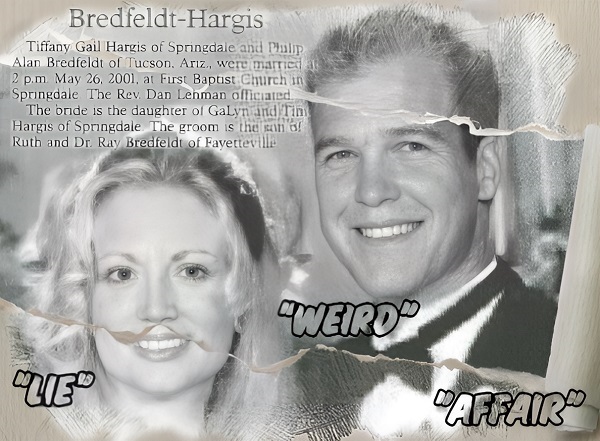
These facts are undisputed: Phil Bredfeldt’s wife was frequently outside of the writer’s residence at night (alone) in 2005, never wore a wedding ring, and never identified herself as married or made any reference to a spouse. She gave in evidence to the court months later (March 2006) the statement that the writer had been “nice” to her and that she had “never felt the need to explain” to him that she was married. Then Mrs. Bredfeldt testified to multiple judges (including in her husband’s presence) that the writer had serially sexually harassed her. Fully seven years later, in 2013, the court was told the writer had “propositioned” Mrs. Bredfeldt and “ask[ed] for” or “offered her sex.” During the same procedure—a two-hour hearing with a six-month coda that violated both the state and federal constitutions—the court was informed Mrs. Bredfeldt “would not wear a wedding ring” while she was outside of the writer’s residence at night.

A normal mind might wonder why a woman’s husband wouldn’t have intervened if she said she was being sexually harassed. Most (non-phantom) husbands would.

Mr. Bredfeldt testified to the court in the procedure this post introduces that he only heard the writer’s name for the first time months after the alleged sexual harassment…right about the time the writer demanded (in three emails sent over a weekend) that Mrs. Bredfeldt explain her behaviors at his home—which behaviors shouldn’t be difficult for the reader to imagine (“Where I come from, it’s considered rude not to at least invite a person onto your porch”/“Breasts aren’t shaped that way”/“Are you cold?”).

Mr. Bredfeldt compensated for his absenteeism in 2005 by emailing the writer and calling him a “SICK FUCK.” The Bredfeldts sent the email and cc’ed it to the University of Arizona Police Department the same day they got a restraining order, which prohibited the writer from responding. The officer the email was cc’ed to, who said the couple had been on the phone with her when the email was sent, told the writer she believed Mrs. Bredfeldt “wore the pants.” The court injunction Mrs. Bredfeldt secured emphatically forbade the writer from speaking to her husband, a total stranger whose name twice appears on the form—including in a section demarcated for little kids at risk.

No allegations of sexual harassment were ever made to the police, whom Mr. Bredfeldt’s wife provided with a completely different narrative from the one she would present to the court two days later (and then three weeks after that, three months after that, and seven years after that). Mrs. Bredfeldt told the police that she had admitted to the writer she was married and that he’d subsequently left her alone…but did seize her phone, copy her number from its back against her wishes, and “[proceed] to contact her.” The writer never spoke to Mrs. Bredfeldt on the phone. There was no need: He could find her outside of his house most nights.

Phil Bredfeldt identifies himself as a victim and recently testified to the court that he’s “frighten[ed].” The relief from “fear” the Bredfeldts have sought is punishment of the writer for reporting what he has in this preface. That’s supposed to make them feel “safer.” During his testimony, Mr. Bredfeldt avoided meeting the writer’s gaze. The Bredfeldts’ game has gone on for over a decade…and it has eroded lives.


It’s a novel argument—and impressive as much for its preposterousness as for its ability to influence a judge.

In the latest of a series of abusive prosecutions initiated or inspired by Tiffany and Phil Bredfeldt against the author of this site, it was alleged on July 15, 2016, by the couple’s attorney, Christopher Scileppi, that I had “contacted” the Bredfeldts by repeatedly setting off Google alerts that one of them had followed the above steps to activate.

Any time a specific word or phrase Phil Bredfeldt had asked Google to be alerted about appeared in anything I published online (like “red herring,” say), an email was automatically generated by Google and transmitted to Mr. Bredfeldt.

This, attorney Christopher Scileppi told Pima County Superior Court Judge Richard Gordon, represented a communication FROM me TO Mr. Bredfeldt.

Why the ridiculous stretch? I’ve had no contact whatever with Tiffany Bredfeldt, a woman who was routinely to be found outside of my residence at night in 2005, since her accusations against me began in the spring of 2006, and I’ve never met the husband Mrs. Bredfeldt denied having. Tiffany—and I only knew her as “Tiffany”; she was careful to hide her last name—presented a cover story to the police and courts in 2006 that she has repeatedly sued me to maintain for over 10 years. She says I stalked and sexually harassed her. Never mind that I have never been to her house (at midnight or any other hour)…or eagerly told her about my body or my underwear.

Role reversal by false complainants is standard operating procedure.

Because no-contact-in-over-10-years more than lames the allegation that I have “stalked” and “harassed” the couple, they had to get creative. Satisfaction of stalking and harassment statutes requires that some conduct be directed AT the so-called victim (e.g., phone calls TO him or her, or emails or texts sent TO him or her). In the past decade, I’ve only ever written ABOUT the couple, who live in a different state, and speech ABOUT people is protected by the First Amendment. So the Bredfeldts concocted a workaround: They set up an automated service to contact them and then alleged that contact from Google equated to contact from me.


Phil Bredfeldt, Philip Bredfeldt

In testimony to the court, Phil Bredfeldt explains how he “set up” the Google Alert he claimed represented “contact” by the author of this blog.


What should have elicited a derisive scoff from the judge instead inspired his rapt attention.

Judge Gordon made no effort to conceal he knew little about computers or the Internet, and Mr. Scileppi, the plaintiffs’ attorney (a criminal attorney), produced an expert witness on computers and “cybercrimes” to testify (also a criminal attorney). The expert, Brian Chase, a scrupulous man, did not propose to the court that a Google alert represented a communication from me to the plaintiffs. But the effectiveness of nonsense arguments isn’t determined by their legitimacy; it’s determined by the air of legitimacy that the right theatrical elements confer.

What distracts, works.

Here’s an analogous argument: I ask someone to monitor my neighbor and tell me every time she says good morning; she says good morning every day; thus I’m harassed every day. My spy’s bulletins to me about my neighbor’s activities are “the same” as if my neighbor contacted me.

Why absurd arguments work like magic spells in cases like this is that what should be obvious becomes muddied by prejudicial associations: “court order,” “Internet,” “cyberstalking,” etc. Such arguments also exploit judicial credulity. They’re conceived to manipulate the court.

Mr. Scileppi concluded his remarks during the hearing by asserting I was manipulating the court.

Get it?

Copyright © 2016 RestrainingOrderAbuse.com

*I was represented by a talented lawyer, Kent F. Davis, whose appointment was only permitted because the plaintiffs insisted that I be jailed. Mr. Davis objected to the “entire line of questioning” during the July 15 hearing, because it was irrelevant. A good half of the day was consumed by testimony about “tags,” the keywords at the bottoms of posts that catalog their topics (and that haven’t been used by any major search engine in forever). There are very few conceivable ways that tags could be used that wouldn’t be constitutionally protected. Mr. Davis’s objection was offhandedly overruled. Had he not been there to demand a stay of the proceedings, what do you suppose the outcome would have been? And had he not been there, who in the system do you suppose would have cared?

If You’re Determined to Write about an Unjust Restraining Order (or Other Procedural Violation), There’s No Point in NOT Naming Names


The title of this post requires qualification. There is a reason not to name names in critical speech, especially speech that’s published: It’s safer, because you’re less likely to provoke the subject’s wrath. The catch is that if you write so innocuously (i.e., so generally and anonymously) that the subject doesn’t care, then your speech will have exerted no coercive effect. Coercive speech (speech intended to make someone reconsider his or her conduct) is protected by the First Amendment…which does not mean a trial judge will know it is. The only “safe” speech is no speech. Similarly, though, speech that fails to have any resonance may as well have been unexpressed.


Critical speech ABOUT a person, including speech intended to exert a coercive influence, is protected by the First Amendment. Putting someone on a dunking stool by holding up his or her conduct to public scrutiny in a one-to-many medium (like a blog or other online forum) is NOT “stalking” or “harassment” (because it doesn’t “contact” any unwilling listeners)—nor is it “defamation” if it only expresses facts and opinions, irrespective of whether those facts and opinions are emotionally upsetting or objectionable to the person criticized.

Matthew Chan, the author of ExtortionLetterInfo.com (ELI) and Defiantly.net, is an object lesson in the risks and rewards of coercive speech. Mr. Chan’s odyssey into what First Amendment authority Eugene Volokh has called the “wild world of ‘civil protective order[s]’” began when Mr. Chan publicly criticized the practices of poet Linda Ellis, who threatened to sue anyone who published a creative work of hers without permission unless the “copyright infringer” ponied up a good chunk of money.

Mr. Chan’s untamed criticisms (and those of his forum members) were labeled harassment (and “stalking”), and a trial judge issued him a restraining order that prohibited him from speaking about Ms. Ellis on his website…ever again.

He appealed the order to the Georgia Supreme Court on constitutional grounds and prevailed: The injunction was reversed. That’s because publicly criticizing someone to a willing one-to-many audience (e.g., in a blog or other online forum) is protected speech—even if its intent is coercive, that is, even if it’s intended to “shame” someone for his or her behaviors and actions.

Excerpt from a letter to Matthew Chan from Greg Troy, a copyright “extortion letter” victim

Consult any of Mr. Chan’s posts on Defiantly, which is largely concerned with court injunctions and free speech, and you’re going to find names in it. Mr. Chan, a businessman, would probably tell you that anything less “aggressive” would be a waste of his time—besides timid and shallow reporting.

Like Mr. Chan, the author of this site was censored by the court in 2013.

The attorney who opposed the dissolution of the order alleged, among many other things, that I was a fraud, because I represent this blog, he said, as talking about the abuse of restraining orders, while my true motive is to out my accusers’ misconduct.

There’s no contradiction there (attorneys are often poor logicians—and often on purpose).

If I hadn’t been misrepresented to the police and the courts, I would hardly have been inspired to pour thousands of hours of my time into what would otherwise have been a randomly conceived boondoggle. People who do this are responding to an injury, which should be obvious to anyone. The attorney’s basic claim to the court was that any speech that did more that innocuously “debate the issues” should be prohibited and punished.

The claim was emotionally based and had no legal footing at all. We don’t enjoy freedom of speech in this country just so we can flatter people or criticize them obliquely. Quoting from a brief prepared by one of my attorneys, Kent F. Davis, a talented civil rights specialist (who cites law applicable in any state in the nation):

Most of what we say to one another lacks ‘religious, political, scientific, educational, journalistic, historical, or artistic value’ (let alone serious value), but it is still sheltered from government regulation,” United States v. Stevens, 559 U.S. 460, 479 (2010), and the “guarantee of free speech does not extend only to categories…that survive an ad hoc balancing of relative social costs and benefits,” id. at 470. There are only a few categories of speech that are not protected in all circumstances: obscenity, defamation, fraud, incitement, speech integral to criminality, id. at 468, and true threats, Virginia v. Black, 538 U.S. 343, 359 (2003). Speech that does not fall into one of these categories is protected, including: coercive speech, NAACP v. Claiborne Hardware Co., 458 U.S. 886, 910 (1982); emotionally upsetting speech, Boos v. Barry, 485 U.S. 312, 322 (1988); and offensive speech, FCC v. Pacifica Foundation, 438 U.S. 726, 745-46 (1978); Street v. New York, 394 U.S. 576, 592 (1969).

Speech about my accusers, what’s more, represented but a tiny fraction of this site’s content. Generously estimated, five percent. So saying this blog was “dedicated” to them, as one of them claimed to the police in 2015, was ridiculous (though if the blog did exclusively concern my personal experiences, it would still be fully protected). Also, you can’t “terrorize” with a blog, as my accusers’ lawyer claimed I had. A blog can only be read by consent: A person has to seek it out. The same lawyer alleged that I “demonized” and “defamed” his clients.

Such claims exemplify what anyone who engages in criticism of another, especially if it’s valid, can expect to face. Trial judges are easily swayed by emotional appeals like those of the attorney I’ve characterized, and many rulings of the court are issued in violation of the constitutional right to freedom of speech.

Attorneys like the guy I opposed charge in the neighborhood of $300/hr. (sometimes more) to tell judges that people like me should be content to speak about “the larger picture” (to no effect) and receive no value on their investment of time.

If you believe someone has behaved unethically, you’re entitled to say so, and there is scant point in speaking about anything BUT your experiences and the impact they’ve had on your life.

Education is great; so, too, trying to rouse public outrage against illogic and unfairness. The truth is, though, that writing about actual instances of procedural abuse is at least as edifying and eye-opening. We’re animals that respond to stories. It’s in our DNA.

A passion for justice is, also, and nothing outrages our sense of justice more than stories of violation. They’re relatable. We can feel the experience and identify.

It is important for people to understand the politics and perversions that have engendered a corrupt system that eagerly facilitates its own abuse. What makes that corruption and abuse palpable, though, is the effect on the lives that are violated by it.

Victims should name names.

Copyright © 2016 RestrainingOrderAbuse.com

NoEthics.Net Holds Judges and Lawyers Accountable to the Laws They Ply

David Palmer’s website NoEthics.net provides a service that may not be its author’s first priority but is certainly a valuable one: It puts the shoe on the other foot. Mr. Palmer outs officers of the court who’ve been publicly censured for misconduct—and more than a few of them have felt the pinch.

Here’s how one website (now defunct) characterized his commentary:

David Palmer is taking data off the Bar Association of any infraction, which is public information, and then adding misleading insults to injury and pouring salt on people’s wounds to make it sound 10 times worse than what the incident really was.

Any veteran of court process who’s been characterized by a member of a state bar association would probably describe the experience exactly the same way—and the consequence may have left him or her destitute, with allegations on his or her record that reside in police and/or court databases indefinitely, whether true or not.

This writer’s response to Mr. Palmer’s critic is too bad, so sad. The real objection of the anonymous critic, furthermore, is that Mr. Palmer is making public information more publicly accessible.

Good for Mr. Palmer.

Anyone who has had his or her character impugned in a courtroom, especially falsely—and there will always be an element of “falsely” in any set of charges—carries that weight every day. Lawyers may disgorge any bilious slime they can concoct about the opposing litigant. Judges drop the hammer and go shoot a round of golf. Impacts to a defendant (or a plaintiff) can be much graver than some unfavorable publicity. People’s lives can be extinguished by courthouse games.

If Mr. Palmer succeeds in coercing some empathy from political creatures with (possibly high) six-figure salaries, cool. Coercive speech is fully protected by the First Amendment, as are factual reportage and name-calling. The likes of “ethical leprechaun” and “screwball” are, besides, hardly scathing criticisms.

We’re talking here about actual things that actual lawyers and judges were actually paddled for, not accusations and innuendo, which lawyers spew and judges act on in the practice of their professions as a matter of course. It’s a lot easier to implicate someone as a batterer or a stalker, including falsely, than it is to have a judge or a lawyer censured.

A citizen falsely implicated in a quickie restraining order procedure, for example, can end up sleeping in his or her car after being deprived of everything that made his or her life meaningful, and his or her name will be fed into a number of police databases permanently. Attorneys and judges, in contrast, are rarely meted stern punishments even for misdeeds they’ve actually committed.

Yet marvel at the histrionics when they’re merely criticized. Attorney Patrick Rocchio has a dedicated page on his website denouncing Mr. Palmer’s comments about him as “defamatory”…because Mr. Palmer riffed on his name and referred to him as “Roach.” Mr. Rocchio was also termed an “ambulance chaser.”

Anyone can publish anything he or she desires today on the internet regardless of whether it is scandalous, libelous, dishonest, or untruthful and David Palmer is proof of that fact. Unfortunately, Google and other high powered search engines disclaim any responsibility for what their mysterious trade secret algorithms produce in response to a natural word search. And, practically speaking, there is no way to silence weird people like Mr. Palmer and his malicious words about those he judges to be unworthy of his approval. I have no explanation for why his untruthful and unflattering words about me are produced as a page one listing in response to a Google search which includes my name.

Coming off a trial in which the plaintiffs’ attorney, Chris Scileppi (who has a dedicated page on NoEthics.net), made the identical argument about my speech, I’m freshly struck by how remarkably sensitive plaintiffs and attorneys, who may blacken others’ reputations just because, are to any negative speech about them…at all. Are we to imagine lawyers and judges scruple about the consequences to defendants’ “names” when they prosecute their clients’ claims or render their verdicts?

Lawyers never exaggerate and make things “sound 10 times worse” then they were? They never allege anything “scandalous” or “untruthful”? Judges never force-fit conclusions? They’re above petty motives? Yeah.

There are no innocents among practitioners of law.

Copyright © 2016 RestrainingOrderAbuse.com

*I’ve never heard an attorney or a judge apologize for his or her misconduct, only deny that it’s blameworthy. A judge this year insisted that I pay a sanction ordered during a 2013 case that should have been dismissed, in which I had been denied a trial (in violation of multiple provisions of the state and federal constitutions). The administration of the 2013 case was a flagrant mockery of civil procedure. The 2016 judge who ordered me to pay the sanction even concluded that actions of the prior judge, Carmine Cornelio (who also has a dedicated page on NoEthics.net), were “not legal.” Judge Cornelio faced no comeuppance (though he was shamed off the bench for other reasons in 2016), and his $350 sanction was used to ransom a civil liberty of mine of which he had no jurisdiction to deprive me in the first place.

Why Judicial Process Is Corrupt: The “Customer” Is Always Right

Everyone angered by procedural abuse has a different grievance: false allegations of domestic violence, civil rights violations, wrongful claims of child abuse, exploitation of process to silence critics, and even lying about rape, to name a few. Typically, it’s what sort of procedural abuse a person has experienced—or someone close to that person has experienced—that determines the particular subject of his or her outrage. (Restraining order abuse—the abuse of court injunctions—is associated with all of them, and is often discounted as merely incidental to a “bigger problem.”)

There are some broader categories of offense, for example, hyped claims of abuse by women (of whatever nature). Prominent female advocates against procedural abuse, like Wendy McElroy, Christina Hoff Sommers, and Cathy Young, often take aim at social science that’s negatively skewed against men and blame prevailing prejudices promulgated and reinforced by what’s loosely called “mainstream feminism.” These prejudices have conditioned how accusations of abuse are treated by employers, university administrators, the police, and judges—and how they’re reflexively perceived by the public at large. Then there are First Amendment advocates who catalog and decry a plethora of misapplications of law to speech, which may be silenced by wrongful accusations of “abuse” (including violence), “harassment,” “(cyber)stalking,” “defamation,” “copyright infringement,” “trademark infringement,” etc. There’s a dominant tendency among trial court judges to pay heed to anyone who alleges something “unwanted” has been said about him or her or his or her business, especially on the Internet, which to many judges is still a suspect medium.

The success of procedural abuse boils down to a basic corruption of ethics and perception: The customer (the complainant) is always right; s/he is a “victim,” not an “accuser” or even just a “plaintiff”: a “victim.”

This characterization is inscribed in state statutes and, as a matter of form, used by prosecutors and judges in court. Even the “free press” may use it instead of “alleged victim,” and that says everything. It means there are no objective influential voices. Both judges’ and journalists’ determinations conform to a script.

People who falsely accuse seldom or never risk punishment; accountability is almost nil. The only party in jeopardy is the accused. For that reason alone, skepticism by arbiters of fact is mandated by morality.

A judge once told this writer that he considered his court the “last bastion of civilization.” Consider the implications if that supposed bulwark against societal anomie is just a puppet stage where players are issued halos and black waxed mustaches depending on which of them was first up the courthouse steps.

Copyright © 2016 RestrainingOrderAbuse.com

Eugene Volokh Is a Name Restraining Order Defendants Should Know

Eugene Volokh

Above, Prof. Eugene Volokh argues before the Georgia Supreme Court in Chan v. Ellis (2014). Prof. Volokh teaches free speech law, religious freedom law, church-state relations law, a First Amendment Amicus Brief Clinic, and tort law at UCLA School of Law.

“If you post on social media about your life, is that going against a restraining order if you don’t mention the petitioner’s name?”

—Search term that led someone here last week

As UCLA Law Prof. Eugene Volokh has doggedly emphasized in his blog, The Volokh Conspiracy (formerly hosted by The Washington Post), the answer to this question is no, it isn’t going against a restraining order if you write ABOUT the order, ABOUT the person who petitioned it, or ABOUT the impact it’s had on your life. Your right to express your opinions and talk about your life to the public at large is protected by the First Amendment.

A person may legitimately be prohibited by a judge from communicating something TO someone (by phone or text, say, or by email or in a letter, or in person), but a judge “can’t order someone to just stop saying anything about a person.”

The citizen’s right to talk about him- or herself, about someone else (including by name), or about anything (excepting state secrets) is sacrosanct. It’s protected by the First Amendment, and a trial judge has no rightful authority to contradict the Constitution.

Note that the key phrase here is rightful authority. A judge can act in ignorance, and s/he can even act in willful contravention of the law.

Why Eugene Volokh’s is a name to know is that Prof. Volokh has endeavored to make the distinction between speech that may be prohibited and speech that may not be prohibited everyday knowledge. He’s done that by writing in a medium accessible to everybody, a blog, rather than exclusively in law journals, as well as by framing in simplest terms the difference between speech that may be censored and speech that may not be.

He’s building steam, too. These posts are from last month alone:

VC_May 2016

It’s important to observe that nothing in the restraining order arena is hard-and-fast, because judges can rule however they want. When what they do clashes with the law, an abused defendant’s only recourse is to appeal, and the intrepid writer should be prepared to do that…right on up the ladder. (S/he should also know that s/he has the right to request reimbursement for lost time, for costs, etc.)

A blogger wrote last month to report that an ex-boyfriend’s claims of “domestic violence” were laughed out of court and that the motive for the accusations was that she had criticized him in a blog. The guy went back to the courthouse a couple of weeks later, petitioned another order from a different judge, and that one stuck. His abuse of process had recent precedent, and it didn’t matter.

Such manipulations of the justice system by false complainants and spongy decision-making by judges owe to 20 years of mainstream feminist rhetoric decrying “epidemic” violence. Judges have been trained according to tailored social science and had it impressed upon them what their priorities should be. Too, they’ve traditionally been given no cause to second-guess themselves.

Eugene Volokh is changing that.

A steady stream of cogent arguments against the due process violations (and statutory and conditioned inequities) that make the restraining order process contemptible has been voiced by influential critics since the ’90s…to little effect.

Rather than appeals to reason and social conscience, what may finally turn the tide against a corrupt procedure of law is an indirect attack on its legitimacy. Once it’s commonly known that speech about its victims’ experiences cannot lawfully be squelched, and that both the issuers of orders and their petitioners can be exposed, warts and all, what has been an unaccountable process no longer will be. Shadowy (and shady) proceedings that have enjoyed invisibility will have to tolerate the glare of spotlights.

And bullies don’t like reading about themselves.

Copyright © 2016 RestrainingOrderAbuse.com

*The motives of a goodly proportion of false complainants are to cause pain and have the party they’ve injured gagged. Restraining orders are the perfect tool for this. But what people say on public record (e.g., in a courtroom) is public property. It’s supposed to be the opposite of hush-hush.

“PERMANENTLY PROHIBITED”: Camden County, New Jersey’s Idea of a Just Order of the Court

NOTE TO THE COURT: Facts in this post were gleaned by its author and do not originate from its subject, Bruce Aristeo, who had no influence on its composition. Commentary, likewise, is solely that of its writer.


Camden County, NJ, New Jersey, unlawful orders of the court, civil rights violations, constitutional rights violations, prior restraint, indefinite temporary restraining order

A recent post on this blog highlighted the case of Raines v. Aristeo, out of Camden County, New Jersey.

You can find the post on Google. You won’t, however, find an association between that post and the name of the plaintiff, Jody Raines, if you use that name as your search term (or the name of her business, WebMarCom). That’s because the judge returned a verdict on April 26, 2016, against defendant Bruce Aristeo requiring that any such association be severed.

I got a chance to look at the judge’s order this week. To call it an offense against free speech (and some other constitutional guarantees) would be like calling public defecation impolite.

Bear in mind that Mr. Aristeo was prosecuted for posting satirical videos ABOUT Ms. Raines on YouTube. That’s the basis for his being nominated a “criminal stalker”—also that he’d previously been issued something called an “indefinite temporary restraining order” (unique to Camden County, New Jersey). Mr. Aristeo’s videos purportedly violated this “indefinite temporary” whatchamacallit and were represented as “harassing” and therefore evidence of “stalking” and “domestic violence.” (Don’t strain to find logical connections. You’ll give yourself a nosebleed.)

This is actually how the order, issued by Judge Frederick J. Schuck, reads:

  1. The Defendant shall be PERMANENTLY PROHIBITED from entering the residence or place of employment of Jody Raines and shall be further prohibited from being present upon the grounds or property surrounding said locations whether in the State of New Jersey or another jurisdiction as specified below.
  2. The Defendant shall be PERMANENTLY PROHIBITED from any future acts of domestic violence against Jody Raines enumerated in J.S. 2C:25-19a and specifically from following, monitoring, surveilling, stalking, harassing and/or threatening Jody Raines.
  3. The Defendant shall be PERMANENTLY PROHIBITED from any and all personal contact with Jody Raines.
  4. The Defendant shall be PERMANENTLY PROHIBITED from any and all communication to or about Jody Raines and her business (see paragraph 8).
  5. The Defendant shall be PERMANENTLY PROHIBITED from causing any communication to or about Jody Raines and her business and any contact to be made with Jody Raines directly or indirectly, or through any third parties, mediums or agents.
  6. The Defendant shall be PERMANENTLY PROHIBITED from any and all communication or personal contact with any family members, friends, employers and co-workers of Jody Raines or other persons with whom communication would be likely to cause annoyance or alarm to Jody Raines.
  7. The Defendant shall be PERMANENTLY PROHIBITED from utilizing any internet and/or social media postings, directly or indirectly, or through any third parties, mediums, or agents regarding, referring to, or simulating, characterizing or alluding to Jody Raines, her family, her friends, her business, or her pets in any form, including but not limited to YouTube, Facebook, LinkedIn, and Twitter.
  8. Prohibited contact or communication in Paragraphs 3, 4, 5, 6, and 7 above shall include any form of communication made by any means, including but not limited to, any verbal or written communication, communications conveyed by any electronic communication device or medium, including but not limited to, a telephone, including a cordless, cellular or digital telephone, computer, or any other means of transmitting voice or data, including but not limited to text message, email, social media, social networking sites, internet or other communication via computer or electronic device, including but not limited to the posting or publication of images or audio recordings of Jody Raines, and communication made by sign or gesture and the physical presence of the Defendant in proximity to Jody Raines or at the specified prohibited locations.
  9. The Defendant shall further be PERMANENTLY PROHIBITED from communicating, sharing, disclosing, or disseminating to any third party, medium or agent any information referencing Jody Raines, her business, her family, or her pets via any method described [above].
  10. The Defendant shall cause to take down and remove from the Internet any and all publications or postings over which he has control that mention the name of Jody Raines or any business owned or operated by her, exhibit her image, or contain audio recordings of her voice.
  11. A violation of this Order shall be governed by J.S. 29-9a; however, nothing in this paragraph shall preclude the filing of additional criminal complaints based upon the act(s) constituting a violation of this Order.

Remember that Mr. Aristeo, a former schoolteacher, was found guilty of “stalking” (in contempt of a “temporary indefinite” restraining order) for publishing some one-to-many satirical videos.

(Ironic of that is how the judge’s order reads like satire: “including but not limited to, any verbal or written communication, communications conveyed by any electronic communication device or medium, including but not limited to, a telephone, including a cordless, cellular or digital telephone, computer, or any other means of transmitting voice or data, including but not limited to text message, email, social media, social networking sites, internet or other communication via computer or electronic device, including but not limited to….” How can you not hear that in the voice of John Cleese?)

Mr. Aristeo is now PERMANENTLY PROHIBITED from publicly referencing (“including but not limited to”) a goldfish Ms. Raines might own—and congratulations to county prosecutor Tracy Cogan for that snot blob on the Constitution.

Mr. Aristeo, whom Ms. Raines has had jailed before, was sentenced to 364 days behind bars (less 190 previously served). There’s more, too:

  • Four (4) years’ probation, subject to standard conditions.
  • Defendant shall undergo a psychological evaluation and treatment if necessary.
  • Defendant shall abide by all of the terms of the Permanent Restraining Order entered separately this date.
  • Defendant shall provide a DNA sample.
  • The Court separately shall enter a permanent stalking restraining order pursuant to N.J.S.A. 2C:12-10.01.
  • The State’s request for forfeiture of the Defendant’s Mac Pro Laptop Computer, and Apple Desktop Computer is denied. The State shall return to the Defendant any property seized from him immediately upon his release from incarceration, unless the State otherwise has initiated an appropriate civil action pursuant to N.J.S.A. 2C 64-3.

He was also fined: VCCA Assessment, $50; Law Enforcement Officers Training and Equipment Fund Penalty, $30; Safe Neighborhood Services Fund, $75; Probation Supervision Fee, $5; Domestic Violence Offender Surcharge, $100.

VAWA_order

Fittingly, the judge’s name, Schuck, is just one letter shy of an earthy Yiddish slang word that means dick.

Copyright © 2016 RestrainingOrderAbuse.com

*The arrests and prosecutions of Bruce Aristeo have cost taxpayers tens of thousands of dollars, for which they stand to be refunded $260 (if the judge corrects his math) by a man the state has left indigent (with a corrupted public record). If Mr. Aristeo now has grounds to sue the state for obscene abuses of power and false imprisonment, that may mean tens of thousands of dollars more drained from the public till, from which the costs of Mr. Aristeo’s housing, as well as the filing fees for his appeal, will also be drawn—all because he published some satirical material online representing his accuser as a toy monkey.

Jody Raines, Bruce Aristeo, WebMarCom

The Female of the Species Is More Deadly than the Male: A Restraining Order Plot Twist That Fans of Novelist Gillian Flynn Will Appreciate

cattymaliceThe previous post concerned the interpersonal and legal travails of a blogger who brought her story to my attention last week.

Jenny has twice been served (this month) with restraining orders alleging “domestic violence” that were petitioned by an ex-boyfriend with whose son she had formed a parental attachment.

The “man” resents her talking about him online and has sought to hurt her by falsely representing her as violent. After his first complaint was dismissed, he promptly petitioned a second order alleging Jenny had a gun and mandating that she attend a 52-week “Batterer Intervention Program.”

Because he could.

Intermediately, Jenny has been attacked online by an anonymous heckler-cum-terrorist:

My suspicion was that her ex was playing ventriloquist and writing in different idioms to give the effect that more than one person was outraged by Jenny’s blog (like anyone else could care).

I believe the speaker who identifies “themselves” as “Active Reader” likely is her accuser. He tries to rationally justify her ex’s being an ungallant sniveler.

Jenny says she knows who the second voice belongs to, though, and it’s not who you’d guess. “Anonymous” is the guy’s sister (the little boy’s auntie).

As Jenny’s case shows—and as I’ve presaged in posts past—men are hopping on the passive-aggressive bandwagon and abusing process to satisfy spiteful impulses. It’s there, it’s easy to exploit, and there are no consequences for lying…so why not?

As Jenny’s case also shows, however, when it comes to catty malice…men are still the lightweights.

Copyright © 2016 RestrainingOrderAbuse.com

*Gillian Flynn, mentioned in the title of this post, is the writer of Gone Girl, Dark Places, and Sharp Objects, novels in which women are the villains (and all of them stellar tales). As any genuine feminist would appreciate, none of Flynn’s female characters is passive anything.