The Most Important Things to Know When Defending against Restraining Order Lies

The following represents the advice of a man who was persecuted in the courts for over 12 years by a soulless liar. It is the advice of a defendant who has been in the hot seat many times. It is not, however, nor does it purport to be, the advice of a qualified practitioner of law.

For answers to specific questions regarding the civil injunction process, the reader is directed to this site’s Q&A page. The same caveat applies to all information and opinions found there.


  1. The truth doesn’t matter.
  2. The truth DOES NOT matter. You may have been lied about egregiously. The lies may multiply and intensify when you appear in court. Reconcile yourself to this reality and soldier on with your head erect.
  3. You may not think of yourself as a criminal, but everyone else will. Legal experts even refer to civil injunctions as “quasi-criminal.” Accordingly, you must think like a criminal defense attorney. A legal defense is a narrative tailored to place a defendant in the best possible light and to cast doubt and suspicion on his or her accuser. A criminal defense team doesn’t rack their brains trying to figure out how to most effectively tell the truth (“Well, Your Honor, that’s true but…”). A criminal defense team formulates a strategy to win.
  4. Your story must be wholly yours and not merely a rebuttal of the plaintiff’s accusations. Simply answering what the court has already accepted as true will not make you look innocent. It may just reinforce the position the court assumed before you ever showed up.
  5. Citizens are often warned: Never talk to cops. The same reasoning applies to judges. Resist admitting anything that it isn’t going to serve you to admit. The objective is not to satisfy a judge’s preconceived expectations; the objective is to confound them.
  6. You have a brief window of minutes in which to present your defense. You may recite it, submit evidence (bring extra copies), and ask the judge to allow you to question the prosecuting witness (the person pointing a finger at you). You may have to insist upon your right under the basic rules of adversarial process to examine your accuser. Don’t hesitate to assert that right. (And if you’re denied that right or any other, obtain a recording of the hearing, and promptly file an appeal. Retain this information: your case number, the time and date of your hearing, the location, and the name of the judge.)
  7. Know what you’re going to say. Know what you’re going to ask. But come as prepared as you can so that you can adapt and improvise as needed.
  8. You may opt to flatly deny the allegations against you. You may opt to deny the validity or the factuality of whatever evidence the prosecuting witness has presented. These are choices you must make bearing in mind that your aim is to win and not to make an indifferent judge who won’t remember your name like you better. You occupy the same status in his or her eyes as a cockroach.
  9. The phrase, “Yes, but…,” is one you should strive to avoid pronouncing. The only thing the judge will hear is your agreement that you did something s/he may condemn you for.
  10. Use basic, straightforward language. Judges are never the discerning jurists they’re represented to be on TV. Your judge may be a nitwit. Nevertheless, s/he won’t like feeling condescended to: Judicial egos are epic. Be clear not smart. (The relevant lawyer’s acronym is KISS: Keep it simple, stupid.)
  11. Never take it for granted that a judge will perceive your meaning. Tell the judge what you want him or her to know in no uncertain terms. You may preface your account this way: “This is the truth, Your Honor.” Or you might begin by saying, “The plaintiff’s representations to the court are completely false.” (These terms are interchangeable and refer to your accuser: plaintiff, complainant, prosecuting witness.)
  12. Be calm, cool, and collected but not meek. You must believe in yourself and your story, which is your defense. Address the judge as “judge” or “Your Honor.” Do not show anger or spite. Do not whine, snivel, or plead. You are a rational person dealing with the wrongful accusations of an irrational one. Remember: calm, cool, and collected but not meek or resigned. (A judge is not God; s/he’s a government employee whose salary is paid with your tax dollars: You accordingly have the right to expect civil treatment.)
  13. Your goal is to tell and support an effective narrative, choosing what facts you present and what questions you ask to suit that end.
  14. The truth doesn’t matter. If you’ve been accused by a liar, and you’ve been summoned to court because of lies, then this has already been proven to you. If the law were genuinely concerned with ascertaining the “whole truth” (whatever that means), you would be granted more than a few days to prepare a defense, and the process would be allotted more than 30 minutes on a judge’s docket.
  15. You’re in a contest. Prevail.

Copyright © 2023 RestrainingOrderAbuse.com

*When the writer was first trying to come to terms with being serially accused in and out of court, he consulted a nonprofit that was dedicated to exposing the inequities of so-called “women’s law.” The writer sought advice by email. The man who agreed to speak with him insisted that the writer call him, presumably so that there would be no paper trail. Fear and intimidation taint every aspect of this arena of law. They must be confronted and ignored. The reason psychopaths are the most credible witnesses is that they’re not emotionally inhibited; they’re machines that don’t qualm about slanting the truth or outright lying.


If Restraining Order Cases Are Only about Narrative, How Do You Beat a Liar in Court?

pawn-triumphs

The next to last post stressed the importance of narrative in restraining order cases.

Stories complainants tell pursuant to obtaining a restraining order don’t particularly matter. “I’m afraid” may suffice.

In contrast, defendants’ narratives are critical.

Strategic defense is not about “telling the truth.” It’s about telling the better story. Competing narratives are universally regarded as “he-said/she-said” (so to speak: Restraining orders are not strictly procured by women against men). The only thing that counts is whose story a judge favors when the end-of-the-round bell dings. (Significantly, there’s only one round, and it’s often only a few minutes long.)

Fraudulent claims in restraining order affidavits are commonplace—and what restraining orders do, especially ones whose grounds include false allegations, is inspire those who’ve been accused to register betrayal, indignation, and outrage. Since opportunities to defend may come and go in a few days’ time, those emotions aren’t likely to settle (and may be compounded by many others: fear, bewilderment, uncertainty, vulnerability, etc.).

The urge of defendants will be to stress in court how they’ve been wronged: “It’s really [him or her] who’s the bad guy, Judge.” This urge must be resisted.

The judge couldn’t care any less if s/he were paid to—and s/he is paid to.

Defendants need to defuse whatever has been alleged against them. Merely relating a meandering history (or “history”) of mistreatment can work great for plaintiffs; it does nothing for defendants.

This may seem unfair. It is, and that doesn’t matter—and that’s what a defendant must focus on: what matters.

Sometimes what matters is the law. For example, many recent posts here concern allegations that writing about someone online is “harassment” or “stalking.” One-to-many speech (online or otherwise) is neither, and it’s protected by the First Amendment. To qualify as “harassment” or “stalking,” someone has to contact someone else, repeatedly, after being told not to. Contact must be one-to-one or through a middleman. No confrontation, emails, texts, phone calls, letters, or relayed messages means no contact, and that means no grounds for court interference. Cases in which a constitutional defense is strictly applicable, however, are rare.

(The author of this post is in such a case right now with a woman who he has been told has been diagnosed with a mental illness. The law is clear: The woman has admitted I’ve had no contact with her in years; therefore there were no grounds to authorize an injunction. Making the law clear to a municipal trial judge is a different story. Do I start by playing a voicemailU that this woman, who claims I’ve stalked her since I met her in 2005, left me in 2012, in which she urges me to call her? Maybe. That kind of evidence makes a good first impression. It says—without saying it—that she’s lying. It upsets her narrative. Do I start by saying, “She’s crazy”? No. That’s aggressive and makes a poor impression. It would only get the judge’s hackles up.)

What makes a good narrative? First, follow the creative writer’s maxim: Show, don’t tell. Sometimes defendants have contradictory evidence to present; sometimes there is none. If there is evidence, it must be framed with care (and defendants are recommended to read it aloud in court and not to depend upon a judge to “get it.”) Legal method proceeds from evidence to conclusion. Defendants shouldn’t start with the conclusion, for example, “He’s lying.” They should present a story that gives a convincing impression. Then they can say, “He’s lying.” Attorney Gregory Hession, a specialist in restraining order defense, would call this highlighting plaintiffs’ “ulterior motives” (their real reasons) for petitioning a restraining order. These may include malice, for example, or cover-up.

Defendants shouldn’t rile the judge. What riles a judge is defending by accusing the other guy. Defendants’ narratives should do that. Judges actually think it’s incomprehensible that defendants should be irate, even defendants who’ve been lied about. Expressions of anger by defendants inspire theirs. Misrepresented defendants must seem misrepresented. (No normal human reactions should be expected from judges, furthermore, and normal human reactions from judges should not be relied upon. Judges will often be very civil even as they insert the knife. Defendants should never be lulled into thinking judges are on their side until after the gavel falls in their favor.)

Narratives must be organized, coherent, and taut: no jangly pockets to upset the seams.

Obviously, they should be rehearsed.

Narratives, too, shouldn’t be one-sided. Defendants should cross-examine (ask questions of) their accusers with the aim of tripping them up, and they should anticipate accusers’ answers. If an accuser has made contradictory claims to the police, for example, a way to obviate an outright denial is to phrase a question like this: “Would it surprise you to know that Officer [A] recorded that you said [X] on [date], and Officer [B] recorded that you said [Y] on [later/earlier date]?” (Any defendant who has been accused to the police should obtain the complete file and scour it. It’s there for the asking.) The objective is not to show that plaintiffs are capable of lying but that they have lied about something material (that is, about something that would tend to influence the judge’s understanding and verdict). Exposed details or contradictions should be relevant and significant details or contradictions.

Defendants with documents that corroborate their narratives and contradict their accusers’ should bring them to court in triplicate. Trial judges are seldom sage; they’re just people doing a job. Anything that appears to be “evidence” should be exploited.

Restraining order trials are storytelling competitions. Whether or how defendants embellish the facts is a question for their consciences. In a criminal trial, a defense attorney will flatly deny anything that can’t be proved by the plaintiff, even if the attorney knows the denial isn’t “the truth.” The attorney’s job is to exculpate his or her client: “Can you prove my client even knows you?”

Being storytelling competitions, restraining order trials are not won by telling “truer” stories. They’re won by telling stories that are more appealing to the listener.

Copyright © 2016 RestrainingOrderAbuse.com

Restraining Order Cases Are about One Thing: NARRATIVE

narrative

The universal conviction is that the court involves itself in a citizen’s life because the citizen did something wrong. Even judges are inclined to believe this.

It’s wrong, and they’re wrong—and it’s very wrong of them to be wrong about something so important.

The court involves itself in a citizen’s life because someone (automatically designated a “victim”) told it a narrative, one that characterized the citizen as a miscreant. Someone told it a story.

That’s it. It would accordingly be swell if administrators, legislators, the judiciary, the general public, and the press recognized this.

If a story the court is told is true, there are consequences. If a story the court is told is untrue, there are consequences. The consequences, however, are always borne by the accused, that is, the person the story is about, irrespective of whether the story is true.

The accuser may be rewarded, or s/he may not be rewarded: “No harm, no foul.

This goes a long way toward explaining why the universal conviction is that the court involves itself in a citizen’s life because the citizen did something wrong: S/he’s the only one who’s ever implicated in wrongdoing (and, whatever the circumstances, s/he is never called a “victim”).

The inequity is obvious. This inequity is magnified in restraining order cases, because stories are subject to minimal or no scrutiny in procedures that may be mere minutes long.

The “standard of proof” is how trial judges feel, and that may actually be reflected in states’ statutes, which in cases explicitly authorize judges to do as they “deem appropriate.” (Who determines whether they actually do what they think is right? They do.)

This is why it’s impossible to answer questions like this: “Can someone get a restraining order on you for calling her a bitch?” The law says one thing (no); a judge may feel otherwise.

“Justice” in this arena is freewheeling, as First Amendment authority Aaron Caplan has remarked.

In other sorts of cases, defendants may appeal a judge’s decision. Not only are few able or inclined to do so in restraining order cases (which can cost a defendant $5,000 based on a three-minute fish tale that’s swallowed hook, line, and sinker—or force him or her to cross the country to answer charges in a 10-minute hearing); there may be no point. The standard applied by appellate judges, barring arguments like violation of civil rights, is “clear abuse of discretion.” Since trial judges’ discretion is without limit, satisfying the “clear abuse of discretion” standard isn’t strictly possible. Post-trial defense is almost always an exercise in futility.

A narrative that works…works. It doesn’t matter if it was false. That had to have been proved at trial, and it had to have made an impression on the judge, who isn’t obligated to dismiss a complaint that’s fraudulent. S/he doesn’t have to justify his or her decision. It’s indisputable.

A narrative that works…works.

Copyright © 2016 RestrainingOrderAbuse.com

*The process is derisible for many more reasons than this. Significant to take from this post is that restraining order cases are storytelling competitions. There is no justice or accountability. All a defendant can do is endeavor to tell the better story. To be continued….

The Female of the Species Is More Deadly than the Male: A Restraining Order Plot Twist That Fans of Novelist Gillian Flynn Will Appreciate

cattymaliceThe previous post concerned the interpersonal and legal travails of a blogger who brought her story to my attention last week.

Jenny has twice been served (this month) with restraining orders alleging “domestic violence” that were petitioned by an ex-boyfriend with whose son she had formed a parental attachment.

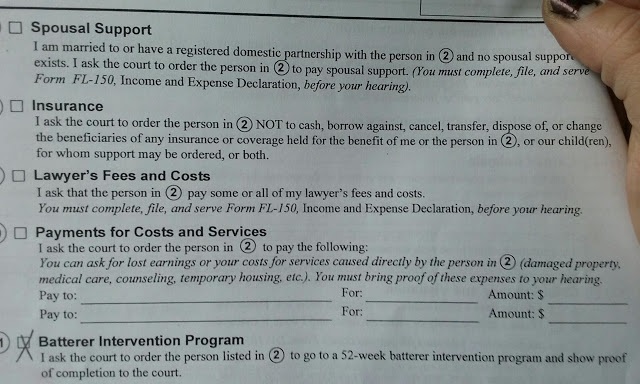
The “man” resents her talking about him online and has sought to hurt her by falsely representing her as violent. After his first complaint was dismissed, he promptly petitioned a second order alleging Jenny had a gun and mandating that she attend a 52-week “Batterer Intervention Program.”

Because he could.

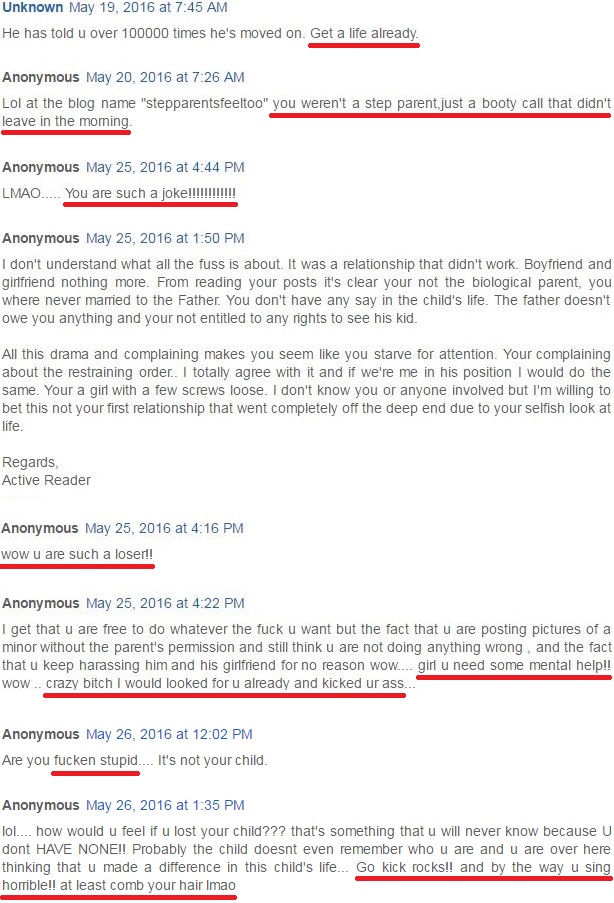
Intermediately, Jenny has been attacked online by an anonymous heckler-cum-terrorist:

My suspicion was that her ex was playing ventriloquist and writing in different idioms to give the effect that more than one person was outraged by Jenny’s blog (like anyone else could care).

I believe the speaker who identifies “themselves” as “Active Reader” likely is her accuser. He tries to rationally justify her ex’s being an ungallant sniveler.

Jenny says she knows who the second voice belongs to, though, and it’s not who you’d guess. “Anonymous” is the guy’s sister (the little boy’s auntie).

As Jenny’s case shows—and as I’ve presaged in posts past—men are hopping on the passive-aggressive bandwagon and abusing process to satisfy spiteful impulses. It’s there, it’s easy to exploit, and there are no consequences for lying…so why not?

As Jenny’s case also shows, however, when it comes to catty malice…men are still the lightweights.

Copyright © 2016 RestrainingOrderAbuse.com

*Gillian Flynn, mentioned in the title of this post, is the writer of Gone Girl, Dark Places, and Sharp Objects, novels in which women are the villains (and all of them stellar tales). As any genuine feminist would appreciate, none of Flynn’s female characters is passive anything.

Evidence of Perjury Cannot Be Used to Appeal a Fraudulently Obtained Restraining Order

Someone once told me that the only value of a lock is to keep an honest man honest.

The value of perjury statutes is exactly the same: They make an honest person extra careful about what s/he tells the court.

To a liar (the person they’re supposed to thwart), they’re just “blah-blah-blah.” Perjury (often recognized as a felony crime) isn’t prosecuted—and for that reason, judges seldom even use the word. If a plaintiff is caught lying, and the lying is significant enough to urge dismissal of the case, s/he may get a stern talking to post-trial. That’s about it.

Restraining order judges make a liberal determination about whether sufficient merit exists in a plaintiff’s claims to warrant upholding a temporary order. Lies irrelevant to that determination may be ignored even if a judge detects them.

Judicial disposition is to credit plaintiffs and suspect defendants, and that’s a high hurdle for a defendant to clear. The defendant also enters the courtroom having been prejudged “guilty.” (Some respondents to this blog report never having been allowed to address the court at all—or being silenced after a few minutes.) Besides their being prejudiced, hearings to finalize restraining orders are, putting it generously, “highly accelerated” trials. Putting it accurately, they’re superficial.

But no allowance for that is made after they’re over.

The only way to have a restraining order that’s based on fraud vacated is to expose lies during the “highly accelerated” trial. That’s why attorney Greg Hession, a strenuous critic of restraining orders (his blog is MassOutrage.com), emphasizes the importance of exposing a plaintiff’s lies and “ulterior motives” during trial: There is no “second chance.”

From Easterling v. Ameristate Bancorp., Inc. (2012):

[I]t is well settled that “[p]erjury in a prior case cannot support a cause of action in a subsequent civil case.” Elliott v. Brown, 2d Dist. Miami No. 10-CA-19, 2010-Ohio-5749, ¶12; see also Costell v. Toledo Hosp., 38 Ohio St.3d 221, 223-24, 527 N.E.2d 858 (1988) (“[A]ppellants have essentially set forth allegations constituting perjury, subornation of perjury, and conspiracy to commit perjury, all of which are punishable under the criminal statutes but which, for public policy reasons, may not be the basis of a civil lawsuit.”).

You can’t appeal a restraining order that succeeded on false evidence on the grounds that it succeeded on false evidence (unless new proof is discovered that you couldn’t have previously brought to the court’s attention). You can’t sue for perjury, either.

Similarly, unless you prevailed at trial, the odds of winning a lawsuit brought for fraud or intentional infliction of emotional distress, for instance, are very low.

You have one window of time in which to expose false accusations (and ulterior motives), and that window is very narrow.

Other countries follow the same policy ours does (in the interest of economy), for example, Canada:

[T]he claim to vacate a judgment on the grounds of perjury cannot succeed unless by new evidence and shewing that the aggrieved party could not by reasonable diligence have been able to discover and bring forward at the trial such new evidence as desired to be presented in the action….

That opinion (in MacDonald v. Pier) was entered almost 100 years ago (hence the antique spelling of showing). It’s etched in stone.

Everyone who’s been fraudulently misrepresented to a judge and railroaded in court is excited to learn the word perjury, because s/he just knew lying under oath had to be a crime.

What s/he might have expected, though, is that perjury, like telling the truth, doesn’t matter.

Copyright © 2016 RestrainingOrderAbuse.com

*To expose false accusations and ulterior motives at trial, it’s essential that defendants insist upon the right to cross-examine (question) their accusers. It’s one thing to say the plaintiff is lying or to try to show that s/he has lied with evidence; it’s another to actually have the plaintiff admit lies (or contradict him- or herself) on the stand in the presence of the judge.

Why the Restraining Order Is the Perfect White Trash Instrument of Malice

People who exploit restraining orders are not necessarily victims, and they’re not necessarily the “good guys.”

This post will be brief. Its only ambition is to show why restraining orders present trashy people with the chance to commit malicious acts with far-reaching and permanent consequences—and to do it hands-free using our justice system as their bully agent.

  1. Restraining orders are cheap or totally free of charge (as the Office on Violence Against Women requires).
  2. They’re available to anyone and require no bona fides at all. Felons can obtain restraining orders just like anyone else. It has been reported on this site that restraining orders can even be procured under assumed names. No i.d. is necessarily required, because accusers are automatically “victims,” and the pretense is that victims never lie.
  3. Restraining orders are issued ex parte, which means “respondents” (defendants) don’t actually get to be “respondents” until after they’ve been judged and found guilty.
  4. Restraining orders can be petitioned from other counties or even other states…against total strangers.
  5. They’re often issued more or less automatically: Ask and you shall receive.
  6. Lies that aren’t successfully exposed in what may be a 10-minute follow-up hearing cannot be attacked in a collateral action. In other words, if lies work once, they work forever. Defendants cannot sue for perjury, and they cannot base an appeal to a higher court on allegations of perjury or fraud.
  7. Restraining orders, even if dismissed, remain public records, and the mere title of a restraining order is prejudicial if not damning. They blacken citizens’ names and cost them relationships, jobs, and even employability in some fields (which of course affects them psychologically and physically).
  8. Restraining orders, because they represent civil not criminal trespasses, can rarely be expunged. Their traces linger even if judges determined they were unfounded or petitioned fraudulently.
  9. People who lie to obtain restraining orders, including egregiously, are never prosecuted.

Now appreciate that on top of all of this, even if a defendant successfully has a fraudulent order that was petitioned by some lowlife dismissed, that lowlife is likely to be judgment-proof. That means even if the defendant sues him or her for malicious prosecution/abuse of process—a stressful six-month ordeal all by itself—s/he has no chance of realizing any compensation, because the lowlife has no money.

The restraining order is the ideal white trash tool of malice.

Copyright © 2016 RestrainingOrderAbuse.com

*The author of this post attended a criminal arraignment this week. That’s where people who have been accused of crimes plead guilty or not guilty. The city prosecutor, in every instance, referred to accusers as “victims.”

The So-Called Dialogue about Restraining Order Injustice and How It Might Be Redirected with Smarter Words…Like FRAUD

wall

Okay, first, there is no “dialogue” (or “debate”) about restraining orders. That’s a misnomer. There are uninfluential people speaking truth to influential people (occasionally) and influential people calling uninfluential people crazy (typically). That’s not communication, so it’s not a conversation. The only dialogues are between influential people talking to influential people (e.g., politicians with anti-domestic-violence advocates) and uninfluential people talking to uninfluential people (e.g., fellow victims of procedural abuse commiserating on Reddit). Uninfluential people who try to get the ears of politicians or journalists (the influential people) are spurned. (Uninfluential people who try to get the ears of anti-domestic-violence advocates are lambasted.)

There’s no inter-group exchange (except insults and sniping), so there is no “dialogue.” (One side, moreover, is consolidated, organized, and flush with cash, and the other is fragmentary.)

Case in point: I tuned in to an interview on NPR a few months ago with a man who had allegedly been falsely accused of some kind of abuse of a serious nature. I knew long before the interviewer said as much that the man being interviewed was gay and in a position of prominence. The man didn’t “sound gay.” I just knew he would be, because I know what victims liberal-oriented media are interested in and what victims they aren’t. False allegations against women and gay men of “social importance” rate attention; false allegations against hetero men and “little people” don’t.

No one of the influential party is comfortable saying people who allege abuse lie. It’s taboo. It’s “victim-blaming” (because, as you know, to claim to be a victim is to be a “victim,” ipso facto.)

Consider the first paragraph of a news story that was excerpted in the last post:

A man who was shot in a work dispute learned a few days later that a judge granted a protection order against him—requested by the man who shot him.

The journalist observes an ironic circumstance. It isn’t her place to comment, though, on whether the plaintiff of the protection order lied. The fact she cites casts suspicion on the process, but what the truth is isn’t for the writer to conclude.

No one in a position of influence ever uses the word lied. Judges don’t, journalists don’t, politicians don’t, and certainly no one with a political interest in maintaining the status quo (i.e., “anti-abuse advocates”) does.

Journalists and politicians can only say “lied” if a judge does. Judges don’t. If they dismiss abuse allegations, they call them “unfounded” or “baseless.” Use of the word lied would begin to cast suspicion on the legitimacy of the whole shebang (and someone influential might wonder aloud why “liars” aren’t being prosecuted). Judges and others are perfectly comfortable with the moral judgment “victim,” but the moral judgment “lied” is one they avoid. It’s a hot potato. It’s also a judgment that would require more investigation than some 10- to 30-minute drive-thru procedure allows (one might suggest the same is true of the judgment “victim,” but that one’s written into the law itself—which tells you the law itself is ethically compromised).

People who’ve been lied about who use the word lied, what’s more, are typically (dis)regarded as sore losers. (Even if these “sore losers” actually “won” in court, their accusers are still called “victims,” and the record of the accusations against them is indefinitely and publicly preserved, so whether they prevailed at all is an open question.) People who’ve been lied about who use the word lied publicly, what’s more than that, face being prosecuted for it.

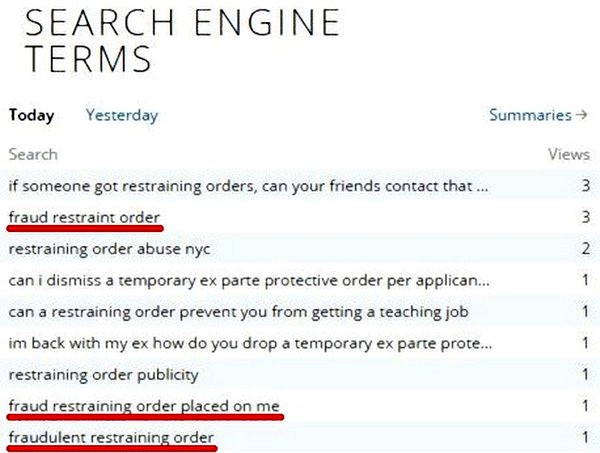
This post is to report a trend the author of this blog has noted of late. Observe for yourself:

People who’ve been lied about are using a different and savvier word, one that has more pointed legal implications. Fraud is knowingly lying with the intent to cheat people and to cheat the system.

Fraud in the restraining order process is epidemic, and the process itself promotes fraud, because accusers, even when their allegations have a basis in fact, are motivated to sensationalize their claims to make them seem more urgent and be more effective.

Allegations spiked to mislead are fraudulent, because they intend to induce a false conclusion.

Words count, and it may be small changes like this in how people characterize how they’ve been abused that obliquely enter the stream of conversation and consciousness.

Copyright © 2016 RestrainingOrderAbuse.com

How Restraining Order Fraud is Motivated and Concealed by VAWA and Its Advocates

The previous post, which highlights how fraudulent abuse of process is promoted and disguised, contains a link to a PDF prepared by the National Coalition Against Domestic Violence (NCADV) called “Comparison of VAWA 1994, VAWA 2000 and VAWA 2005 Reauthorization Bill.”

The acronym VAWA stands for the federal Violence Against Women Act, which was ratified over 20 years ago (and has been repeatedly renewed). State police and judicial bias toward allegations of abuse has accordingly been conditioned with billions of dollars over decades and is today well-cemented.

Even a non-cynical critic would call the “justice system” owned.

Parsing the entirety of the NCADV’s PDF would be overkill. This post will examine a few quotations that illustrate how police, judicial, and prosecutorial conduct have been bought with inducements that are called “grants.

Grants from the Office on Violence Against Women for “Court Training and Improvements” (i.e., “training” or “educating” judges and court staff) have been discontinued under current legislation, possibly because it occurred to someone that “instructing” the court how it should rule sounds very like coercing verdicts. Procedural bias, however, has already been firmly rooted, and money to influence court process has merely been relabeled Grants to Support Families in the Justice System.

High school civics teachers tell us our government was set up so that its administrative, legislative, and judicial branches act independently to ensure that “checks and balances” prevent any one branch from acting tyrannically, and that state governments enjoy autonomy from the central government. What the quotations below show is how checks and balances can be worked around with cash.

 (VAWA 2000): “Amends Pro-arrest grants to expressly include enforcement of protection orders, and is designed to help state and tribal courts improve interstate enforcement of protection orders.”

This quotation means that money from the federal government is issued to state police departments to urge them to arrest people, including anyone who has purportedly violated a restraining order. If the petitioner of a restraining order reports a violation (real or not)—including a violation s/he has “arranged” (“Susie, I’ve reconsidered. Please come over so we can talk about this!”)—officers have been “incentivized” to haul the defendant in (according to their “judgment,” which has been influenced and can hardly be called fair and objective).

 (VAWA 2000): “Clarifies that as a condition of funding, recipients of STOP and Pro-Arrest grants must ensure filing and service of protection orders at no extra cost to the victim.”

This quotation “clarifies” that unless states allow restraining order petitioners to accuse people for free, they won’t get any money.

(VAWA 2005): “Requires law enforcement agencies and courts to enforce these orders.”

(VAWA 2005): “Prevents courts from publishing survivor information on the internet.”

These quotations explicitly say that state police and court policy has been dictated (i.e., cops and courts have been told how they’re “required” to act). Either they comply, or the money tap gets shut off. This may reasonably be called extortion or coercion.

(VAWA 2005): “Encourages protocols and training to avoid dual arrest.”

This quotation means if there are two complainants in a domestic spat, for example, only one should be arrested (and since this stipulation is eagerly reported by the National Coalition Against Domestic Violence, guess which member of a hetero couple the police are supposed to arrest).

(VAWA 2005): “Criminalizes stalking by surveillance.”

(VAWA 2005): “Expands the accountable harm to include substantial emotional harm to the victim.”

(VAWA 2005): “Expands minimum penalties of stalking if it occurs in violation of a protection order.”

These quotations mean that pretty much any alleged misconduct is punishable and dictates how it should be punished (at a minimum) if it reportedly occurs while a restraining order is in effect.

(VAWA 2005): “Permits LAV-funded attorneys to support victims’ dealings with the criminal justice system; but, does not permit funding to pay for prosecutorial or defense functions.”

This quotation says accusers (“victims”) may be provided with free legal services but that the accused must not be.

The themes in these few quotations indicate the pattern of the web:

  • Punishable conduct has been broadened to include almost anything that can be described as offensive by a plaintiff and/or a judge. In practice, this means any alleged conduct that allegedly causes a complainant to feel afraid.
  • Police and judges have been urged to act and to act without deliberation and bigotedly.
  • Accusers’ accountability has been minimized (and accusers are nominated “victims” or even “survivors” on no more ascertainable grounds than that they accused someone of violating them), while the accused’s accountability has been maximized to include permanent registration in public/police databases, ones that may specifically label them “stalkers” or “violent abusers.”
  • Free attorney services are granted to accusers but must be denied to the accused.

This web has been constructed methodically with billions of taxpayer dollars, and this money has gone not only to the police and the courts but to law schools and nonprofits (like the NCADV), and the latter may reciprocate by producing research papers; websites; and pamphlets, brochures, and posters that further bias the system as well as the public and their representatives, for example, journalists. (Grants from the National Institute of Justice may also be awarded to generate feminist “social science that’s used to “train” judges.) The federal government’s investment in favored nonprofits furthermore legitimates and empowers those nonprofits and thereby increases the donations they receive from the public. The Kayden Jayce Foundation (KJF), a nonprofit that acknowledged false accusation and focused on providing legal aid to low-income (non-white) families, applied for grant monies, was denied, and has since had to shutter its windows. So, too, have nonprofits that defend men’s rights—i.e., equal rights—been spurned. They’re on their own. Consequently, they can’t pay for teams of professional writers and web designers, etc., and receive little or no public assistance. They don’t have the cachet that only money can buy.

If all of this weren’t enough, rulings that nominate people “stalkers,” “batterers,” “child abusers,” or even “rapists” can legally be formed in 10 minutes or even by “default” (i.e., without ever having heard from a defendant at all). In some states (Arizona and Indiana are examples), three-minute ex parte rulings are final unless defendants apply to the court for the opportunity to be heard. Men and women may be accused from another state and never afforded a practicable chance to defend themselves against allegations that may be arrant lies and exercise dire effects on their lives (including loss of employment).

When complainants of procedural abuses speak of “conspiracy,” this is what they’re talking about…and they’re not wrong.

Copyright © 2015 RestrainingOrderAbuse.com

*For further insight, see “‘You have bullsh*t; we have research’: The National Coalition Against Domestic Violence v. Daddy Justice (Or, Why False Allegations Are a Serious Problem).”

Restraining Order Rulings Aren’t about Justice but about Justification, and Lies to the Court Only Work because Judges Also Lie

What this post predicts in its postscript occurred exactly a year after its publication.—Editor, 2018


Here’s a formula for fraud:

  1. You lavish police departments with hefty federal grants to urge their officers to steer complainants of abuse to the courthouse to apply for restraining orders.
  2. You have legislation in place that rewards impulsive or malicious accusation with quickie ex parte rulings from judges.
  3. You instruct judges how they should form those and subsequent rulings and threaten to withdraw funding from states whose courts don’t play ball and comply with federal dictates (see VAWA).
  4. You give this farce a gloss of credibility by requiring that the accused be granted the opportunity to be heard in their defense.
  5. You ensure that the appellate process is also cursory and that the accused have no further recourse to the law to expose what may be false allegations.
  6. With rhetoric and obfuscation, you further ensure that journalistic investigation and criticism are minimal and that the public is kept in the dark.

Accusers are encouraged to beef up their claims to justify themselves to the court and appear duly afraid (and that’s the ones who aren’t outright lying). Judges, whose motives have been coerced, are encouraged to skew their findings (in hearings that may span all of 10 minutes) to meet social and political expectations and justify their intrusions into the lives of the accused (intrusions that deprive the accused of rights and property), as well as to justify themselves to other judges and the public should their performance come under scrutiny.

Other judges who weigh in on accusations that may spawn multiple prosecutions or appeals are encouraged to skew their findings for the same motives and to preserve the veneer of judicial propriety. They are justified in this course by the original ruling or rulings in a case, which may have been formed in moments.

Frauds may start with hyped or false claims from plaintiffs, but that isn’t where they stop.

Copyright © 2015 RestrainingOrderAbuse.com

*The writer of this post was sued for harassment and libel in 2013 (based on his writing about false accusations against him that began seven years prior). To justify the court’s ruling against me, the judge asserted on record that statements of mine on this site were “false.” The judge didn’t say what statements were false, because he didn’t have to. No statements were false. The judge took liberties with the truth. Based on his characterization, I could be sued again. (The next judge would just cite the former judge’s statement as fact.) This conduct isn’t extraordinary; it’s how things are done (and how the court guarantees things stay done).

What False Accusation and Rape Have in Common

Rape is a crime that has become a totem for many. Its invocation impoverishes all other violations of significance and accordingly authorizes violations that would not otherwise be tolerated, like lying about abuse to authorities and the courts. That rape occurs and that it’s an ineffably vicious act aren’t questions but facts. They are urgent facts, but their denial of other urgent facts is wrong. Those who zealously defend the criminal primacy of violence against women, to the exclusion of all other considerations, eagerly discover callousness in any who question the consequences of unchecked violence rhetoric, and the selfsame “advocates of sensitivity” dictate how victims of false accusation are “allowed” to feel.

wrong_fish

These fish, caught in nets intended to trap shrimp, are called “bycatch.” For every shrimp that’s caught, there are as many as 20 casualties. The unintended victims are not released; they’re left to suffocate and rot (in the interest of economy).

There’s a reflex that’s triggered in a lot of people’s minds when you juxtapose the word rape with the phrase false accusation. The reason is basic.

Violence rhetoric has spawned laws that are like fishing nets: They snare anything that blunders into them, whether it’s what they were meant to catch or not. The intended and unintended targets of those laws are clubbed and gutted with the same zealous vigor and dispassion, and this conditions people who are railroaded through the system and stripped of everything on false, skewed, or exaggerated grounds to hate.

These people are predominately men, and they know they have decades of rampant violence rhetoric to thank for their loss of home, family, livelihood, and dignity. What’s more, civil complaints of legal abuses garner no attention except ridicule—and that, typically, from feminist quarters, which are also the source of the violence rhetoric that has engendered restraining order, domestic violence, family court, and child protection laws and policies that are billowy, careless, hyper-reactive, and easily exploited by the unscrupulous (and to dire effect).

This spurs aggressive counter-rhetoric, which is conveniently labeledmisogyny” and “rape denial,” particularly by the liberally biased, who accordingly react hysterically if rape and false accusation are compared. If you’re among those who decry “misogyny” and “rape denial,” look up the word etiology.

I’m not a misogynist, a rape-denier, or a liberal; I’m an analyst with no doctrinal loyalties. Rape and false accusation are not dissimilar, and I’ll tell you why.

  1. Most victims of false accusation, like most rape victims, are known to their attackers, often intimately; so the act of false accusation, like the act of rape, is a particularly treacherous and personal assault.
  2. Victims of false accusation, like victims of rape, are objectified; they’re denied their personhood and typecast according to a set of representations.
  3. The false accuser, like the rapist, is guided by the will to dominate and subjugate; his or her motive is control (as is the court’s).
  4. The falsely accused, like the rape victim, is denied his or her personal agency: S/he’s held down and forced to tolerate what’s inflicted upon him or her under threat of receiving worse.
  5. The falsely accused, like the rape victim, consequently suffers distrust, insecurity, and the mental trauma (PTSD) that comes of having it confirmed that s/he has no control over his or her circumstances.
  6. Like rapists, false accusers violate people because they can.
  7. Finally, like rape victims, the falsely accused enjoy no expectation of justice.

How false accusation and rape differ is that the false accuser uses a proxy terrorist (the awesome power of the state), his or her crime is public (with all the humiliation that implies), its toll may be extravagant (the victim may be left with nothing), and besides enjoying no expectation of justice, the falsely accused enjoys no expectation of recognition or sympathy, either (and may be harried relentlessly and then expunged).

Copyright © 2015 RestrainingOrderAbuse.com

*Yes, false accusation is bloodless (discounting suicides and the rare murder), but so, too, can what we call “rape” be bloodless. If the significant distinction between rape and false accusation is that victims of the former are predominately female and victims of the latter predominately male, then we’re overdue for a reevaluation of what we call “equality” and “equity,” both of which are feminist watchwords.

Legal Abuse and “Learned Helplessness” (Including Commentary on the Mythical Value of “Taking the High Road”)

“Learned helplessness is behavior typical of an organism (human or animal) that has endured repeated painful or otherwise aversive stimuli which it was unable to escape or avoid. After such experience, the organism often fails to learn escape or avoidance in new situations where such behavior would be effective. In other words, the organism seems to have learned that it is helpless in aversive situations, that it has lost control, and so it gives up trying. Such an organism is said to have acquired learned helplessness. Learned helplessness theory is the view that clinical depression and related mental illnesses may result from such real or perceived absence of control over the outcome of a situation.”

Wikipedia

I introduced this psychological theory to a judge in 2010 when I filed a lawsuit against a woman who falsely accused me to the police and multiple courts in 2006. The accusations began in March, and before the close of July, she had defrauded at least four judges.

To be falsely accused is bewildering; it savages the mind. To then learn that efforts to expose the truth are met by judges not with keen interest and probing questions but variably with mute indifference, scornful derision, and offhand dismissal—that’s to have it firmly impressed upon you that resistance is futile. Worse, it’s to learn that resistance compounds the frustration and pain.

The system isn’t on your side, and bucking it for many is just an invitation to be scourged afresh.

After attempting some direct appeals to people who, I reasoned, might care more about the truth than the court did (2007), then writing about the business online (2008), then employing an attorney to mediate a resolution (2009), all of which efforts were met with stony silence, I filed a lawsuit (on my own).

That was in 2010. By then, unknown to me, the statutes of limitation on the civil torts I alleged—fraud, false light, defamation, and intentional infliction of emotional distress—had flown. My accuser’s attorney, with mock ingenuousness, wondered to the court why I hadn’t filed my suit in 2006, right after having had the court twice swat down my appeals.

learned_helplessnessI offered the explanation to the judge that people who go through this become conditioned to helplessness (or hopelessness), because process militates against the proposition that a claimant of abuse has engaged in deception. The righteous indignation and outrage of the wronged defendant gradually succumb to the inevitable conclusion that facts, truth, and reason are impotent against fraud and judicial bias. (The defendant lives besides under the constant menace of unwarranted arrest.)

I didn’t know I could prosecute a lawsuit on my own until a legal assistant told me so in 2009, which I also told the judge. I might have been motivated to find out sooner if I’d had the least faith that a judge would heed my testimony.

My accuser’s attorney disdained the explanation for my tardy filing as “self-diagnosis,” and the judge eagerly echoed his assessment and dismissed the case (the court’s interest is in economy, not truth or justice). What was another six months of my life? (Letters from a physician and a therapist, along with witness affidavits, including one from a former cop, made no difference.)

I wasn’t wrong, though. People who defy a rigged system—whether restraining order defendants, domestic violence defendants, or family court defendants—can be conditioned to helplessness, and many accordingly report experiencing posttraumatic stress (which fortifies their distrust and their aversion to further rude scrutiny and contemptuous treatment from the court).

A lesson to take from this is that the “high road” (i.e., trusting in facts, truth, and reason) is a detour to hell. If I had known in 2006 what I know today, I could have extricated myself from my accuser’s false accusations in five minutes by playing the game according to her rules, which were “whatever works.”

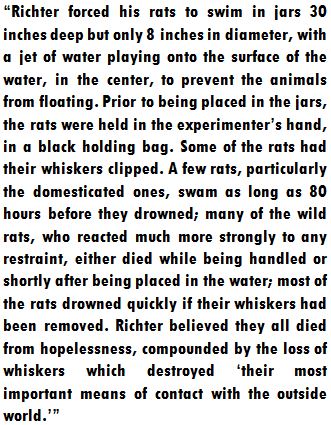
The studies from which the term “learned helplessness” emerged were studies of drowned rats and tortured dogs. Playing fair (or aspiring to saintliness by never uttering an ill word against your accuser) is noble, but nobly drowned is still drowned. If an accuser lies about you, denounce him or her as a liar. Similarly, if a process of law is bullshit, call it what it is.

Some respondents to this blog, even after they’ve been through the courthouse ringer, retain a beleaguered faith in ethics. They believe that if injustice is laid bare to a discerning audience by rhetorical appeals to reason and decency, this will spur change. “Our objective is to fix the problem, not the blame” was quoted in a recent comment.

The abstract and impersonal may be informative, but they don’t arouse curiosity, because they don’t inflame the passions; controversy does. Advocates of the “high road” eschew naming names, for example, because it’s aggressive. Avoidance of confrontation, however, accomplishes little and exemplifies “learned helplessness.” The “high road” is safe and tame, and it leads to a dead-end.

The reason restraining order abuse endures is that the abused are paralyzed by indecisiveness. They won’t knuckle down and demand that a flawed process be repealed.

Among people who’ve been damaged by fraudulent abuse of restraining orders and related civil court procedures that are supposed to protect the defenseless, you’ve got, for instance, your liberals who’ll defend the process on principle, because they insist it must be preserved to protect the vulnerable, and they’ll fence-sit just to spite conservatives who flatly denounce the process as a governmental intrusion that undermines family.

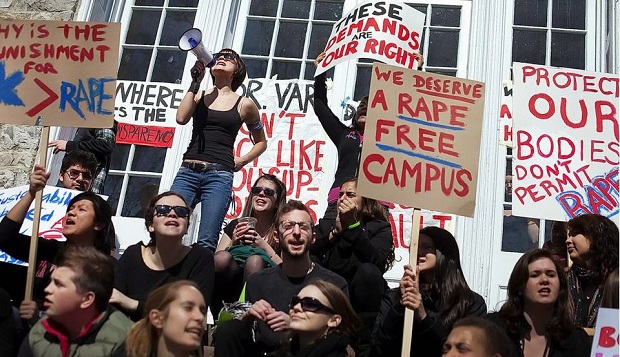
Liberals and women who identify with legitimately victimized women feel obligated to “negotiate the gray space” and acknowledge the pros and cons of “women’s law.”

Then you have people (of whatever political allegiance or none) who believe that if you eliminated procedural inequities and ensured that defendants’ due process rights were observed, the system would work fine.

Maybe they believe a process that allows a person in Nevada to mosey into a courthouse, fill out some forms, and accuse a person in Wyoming of “stalking” or “domestic violence,” necessitating that the person in Wyoming hustle him- or herself to Nevada to present a defense within the week, can be made fair, and maybe they don’t know that the same Nevadan can prosecute the same claim over and over against the same Wyomingite (three times, six times, a dozen times, or more).

Maybe they believe that appeals to public conscience will urge the passage of laws that require free legal counsel be provided to defendants.

This would mean that if, say, a million restraining orders are petitioned a year, and legal representation for each defendant in each case could be capped at $2,000 (which might translate to a feeble defense, anyway), state governments would be required to shell out $2,000,000,000 to make everything “fair and square.” But that’s not all. If government gave free representation to “abusers,” advocates for “victims” would demand the same for them. So your $2,000,000,000 would become $4,000,000,000.

That’s per annum. (Also, the hypothetical Wyomingite would still need to travel to Nevada, and who’s paying for that?)

Others believe that if lying (perjury) were prosecuted, that would straighten things out. The costs to prosecute what may be hundreds of thousands of liars a year might be less than $4,000,000,000…or it might not be. Too, how do you prove someone is lying about an emotional state, like “fear”? How do you prove an alleged event didn’t happen?

You can’t, not conclusively, which is what a criminal prosecution requires.

More say appeal to your senator, to the president, to the press…nicely and cogently. They follow a utopian faith that basic decency will prevail if “the problem” is exposed.

As a rhetorical stance, the position has its merits. It suggests calmness and rationality, and calmness and rationality should recommend attention from others. “We’re calm and rational,” proponents of the position imply, “so when we say there’s a problem in need of fixing, it’s calmness and rationality speaking, not anger.”

The limitation is that no one who needs to be convinced has a motive to listen. No one can be made to care about abstractions like equity and due process when in the other ear they’re being cited statistics about epidemic violence.

Everything to do with the law is adversarial. If you seek to revise it without being personal or confrontational, the soonest you can expect a just reward is in the afterlife.

Protesters march on a SlutWalk in Newcastle

Copyright © 2015 RestrainingOrderAbuse.com

*Splendid writers, particularly Cathy Young, have responsibly and lucidly exposed “the problem” for 20 years in major news outlets. The system has responded with statutes that are broader, laxer, and more punishing.

Court-Abetted Trespassing, Burglary, Larceny, and Embezzlement:  A Terminally Ill Man’s Story of Restraining Order Abuse

“I know the purpose of the site is to decry the injustice of being falsely accused. Just have some sense of proportion, please. It’s terrible to be falsely accused. It can have many horrible consequences. It’s still light years away from being raped.”

—Comment submitted Friday

I believe the man who gives the account that follows would agree with the commenter quoted above. The blog’s author, however, rejects the commenter’s absolutist stance, because the categorical privilege granted to female claimants of violence is what enables wanton violations like the one detailed below, a violation that is denied its due by a dismissive word like “terrible.” The man whose story ensues is living what may be his final days in penury, alone in an empty house. The responses he’s received from the court, from the police, and from attorneys have been conditioned by the conviction expressed above, namely, that psychological violation and vicious privation are “light years away” from physical violation.

The man has, in short, been stripped of everything based on a false allegation of violence, and he’s been told, “That’s tough.” Because of the prejudicial nature of the court order that was fraudulently obtained against him, his bank has refused his request for reimbursement of his savings. Although he was fully exonerated, he has no credibility and no recourse except to quietly die.

William Batson, who says he has been informed by his doctors that he may have only months to live, was barred from his home and then robbed of all of his money and personal property consequent to the issuance of an ex parte restraining order against him petitioned by a person he had never met who represented him to be a batterer.

All the court required to legally authorize the theft of all he owned was a fake narrative of violence.

William’s story (edited for readability):

The difference between other crimes that people are falsely accused of and false DV [domestic violence] accusations is this: All of your rights—to be heard, to face your accuser, and others—are completely circumvented, and the mob that is Rome will get its loaf of bread and its quart of blood whether it’s right or wrong.

I never even met the person who accused me. My DV charge had a special attachment: ex parte election order with all property and financials given to the accuser instantly with nothing more than an accusation.

By the time I made bond, I was not allowed in my own home. I finally convinced the magistrate with witnesses that I lived alone, etc., and upon entry into my home 15 days later all the contents were gone, all bank accounts were drained, and $13,800-plus in forged checks is still owed.

I got an immediate dismissal with prejudice from the court and a too-bad and angry attitude from law enforcement. They helped this person rob me. I can’t sue the police, and no lawyer will even get near it. Before, I had a 814 credit score, $49,000-plus in possessions, $25,000-plus in savings and checking, and they would not even write a letter to the bank so I could get the money returned.

[…]

I will never recover financially or physically. I had cancer that was in a nine-year remission. The last time I bothered to listen, I was told I was stage four and might make it to Christmas. I’m not bitter, and I wish no ill upon any. There was a reason our country was founded and its constitution was written the way they were. This is merely one example of why. There will always be someone who changes something for a stated good cause merely to devour others with its use.

Amen, good luck, and I wish you all well.

Copyright © 2015 RestrainingOrderAbuse.com

Litigation Privilege: Why Restraining Order Fraud Is Pandered to and Why the Falsely Accused Are Denied Recourse to the Law for Vindication, Relief, and Recovery of Damages

“Fraud is deliberately deceiving someone else [including a judge] with the intent of causing damage.”

Cornell Legal Information Institute

“Generally, lying during trial (or any other part of litigation) is expected to come out at the time of trial. This means an action against someone for lying during a prior proceeding would fail because even lies are protected by the litigation privilege. You have to catch them at the time; you cannot attack them collaterally (in a different proceeding).”

Attorney Catherine Elizabeth Bennett

Here are examples of restraining order fraud and repeated abuse of process (others are here and here, and comments and posts on this site are replete with them).

Here is the obstacle to obtaining relief from fraud committed by restraining order petitioners that the falsely accused face no matter how high up the judicial chain they muster the fortitude to climb:

  1. So-called protective orders were designed to allow battered women to apply directly to a judge for relief from household violence and intimidation. Their origin harks back to the late ’70s/early ’80s. When these orders were conceived 30 or 40 years ago, domestic violence was hush-hush, and (actual) victims faced alienation from their families for airing dirty laundry in public and rocking the boat. They faced, as well, the possibility of their claims’ being discounted by police or even ridiculed (compounding their misery and humiliation). So the middlemen (i.e., cops and prosecutors) were cut out of the process. Thus could allegations be made and ruled upon in the absence of any investigation. It seemed a reasonable stopgap at the time. Over the decades since, despite radical changes in how claims of domestic violence are received by the public and law enforcement (due in no small part to the investment of billions of federal tax dollars), the standards for substantiating an assertion of victimhood remain lenient, while what qualifies as grounds for a court injunction has steadily broadened. People now get orders against their friends, lovers, neighbors, moms, dads, kids, etc., and violence need not even be alleged; some claim of apprehension usually suffices. The process has morphed from a life-preserver for battered women with no other way out of a hellish situation to a sop to satisfy any complainant who fills out an application. Court policy pretends that anybody who walks into a courthouse with a beef (real or not) deserves a private audience with a judge to shield him or her from the terrors of public scorn or disapproval from the cops. Anyone with an ax to grind, that is, is treated like a battered woman circa 1979. So institutionalized has the process become, and so profitable to so many (both financially and politically), that no one questions whether this is ethical. So the restraining order process has become a game, a game played according to anachronistic rules. Maximum latitude is given to anyone (no fee or i.d. required) to litigate any claims s/he wants in a backroom conference with a judge, and rulings are issued ex parte, which means the person who’s accused is prejudged sight unseen. The due process rights of the accused are scotched. Grants under the Violence Against Women Act will explicitly forbid the use of lie detectors. The dictate is purely rhetorical; it’s meant to stress that what a complainant alleges shouldn’t be doubted. This expectation extends to any petitioner. Hence judicial scrutiny is minimal, and judges may actually bristle when the falsely accused allege that petitioners are lying. This is called fair and just.
  2. The idea behind “litigation privilege,” which basically ensures that whatever a litigant or his or her attorney alleges is protected from liability (from charges of defamation, for example), is the same: Accusers need to feel secure to air “the facts” without fear of prosecution.

The protections sketched above were not put in place to defend the right of any fraudster to falsely allege anything off the top of his or her head against a target of malice in a court of law. Perjury, after all, is a statutory crime. Lying isn’t condoned by the law, but it is swallowed by cops and defended by judges.

They’ve had their priorities impressed upon them in no uncertain terms.

So emphatic is the priority to give accusers the benefit of the doubt that people who’ve been wrongly accused have little or no credibility with judges and absolutely no recourse to sue for damages caused by false allegations (to reputation, employment, enjoyment of life, and health). The court doesn’t recognize there are any damages to being falsely accused of stalking, for instance, or violent threat, sexual harassment, assault, or even rape. False accusations that are dismissed as baseless are harmful enough (the stresses they cause are beyond quantification). When false allegations stick, the guilt of the accused is presumed, and subsequent legal actions they may venture to undertake (lawsuits and appeals) may be summarily tossed for lacking merit. In contrast, the merit of rulings that are typically the products of procedures lasting mere minutes isn’t questioned. Some judges will even hold that accusations litigated in court can’t constitute perjury because of the “litigation privilege” (i.e., because they were uttered in court instead of on, say, Facebook or the radio, they can’t be lies).

Accusers (all of them identified with battered women of 1979) must be free to claim whatever they want without fear of risk or blame—that’s the overriding precept. Translated, this means the court’s position is that people must be allowed to lie and snooker the court as they choose…and anyone who’s lied about be damned.

Copyright © 2015 RestrainingOrderAbuse.com

*From “‘Out of Left Field’: The Litigation Privilege Defense to Adverse Party Suits” by attorney Keith A. Call (emphases added):

Despite some authority characterizing the litigation privilege as “absolute,” it is certainly not without limits. There are some claims for which the litigation privilege is usually not a defense. Such claims may include malicious prosecution, fraud, criminal perjury, suborning perjury, and professional discipline. See, e.g., Hagberg v. Cal. Fed. Bank FSB, 81 P.3d 244, 259 (Cal. 2004) (the litigation privilege “operates to bar civil liability for any tort claim based upon a privileged communication, with the exception of malicious prosecution”); Bushell v. Caterpillar, Inc., 683 N.E.2d 1286, 1289 (Ill. Ct. App. 1997) (litigation privilege does not provide immunity from criminal perjury); Hawkins v. Harris, 661 A.2d 284, 288 (N.J. 1995) (litigation privilege is not bar to professional discipline or criminal perjury); Dello Russo v. Nagel, 817 A.2d 426, 433 (N.J. Super. Ct. App. Div. 2003) (litigation privilege does not insulate against malicious prosecution or professional discipline); N.Y. Cooling Towers, Inc. v. Goidel, 805 N.Y.S.2d 779, 783 (N.Y. Sup. Ct. 2005) (refusing to dismiss claims against adverse party’s attorney based on fraud and collusion); Clark v. Druckman, 624 S.E.2d 864, 870-72 (W. Va. Ct. App. 2005) (litigation privilege does not immunize attorney from claims of fraud or malicious conduct).

The Words Get in the Way: Reconceiving Arguments against Restraining Order Fraud

block
Traffickers of this blog will sometimes advise that complainants of abuse of so-called “protective orders” consider “the bigger picture.” They feel the matter is less about personal loss than about statutory and procedural derelictions (bad law and judicial bias, carelessness, and tyranny). They emphasize principle over individual privation.

For some, the bigger picture that’s stressed is denial of constitutional rights to due process (for example, the right to be heard before a judgment is entered, the right to court-appointed legal counsel, or the right to a trial by jury); for others, the bigger picture is the right to freedom of speech. Some underscore gender and race inequities; some the undermining of the family.

The obstacle to making whatever “bigger picture” is emphasized perceptible to the public at large is the phrase “restraining order” or “protection order,” which comes with a host of conditioned prejudices. It arouses images of violence against those helpless to defend themselves. Accordingly, even many who acknowledge the process is flawed nevertheless say they recognize it to be necessary…in cases.

So even those against the process may not actually be against the process. This has created a disjointed community of complainants, namely, a marginalized extreme labeled “misogynist cranks,” “angry white men,” or “restraining-order-Americans” and a fence-sitting majority who against all evidence and experience retains the faith that reason will prevail against unreason if we just talk it out long enough: “All around the mulberry bush, the monkey chased the weasel….”

The monkey never catches the weasel, so there’s nothing to recommend monkeying around.

What needs to be stressed and comprehended, to this writer’s way of thinking, is that civil court is no place for the litigation of accusations that explicitly or implicitly allege violence, violent threat, or other criminal acts, and that in civil court, which applies no standard of evidence, fraud is too easily perpetrated. The exposure of falsehood or exaggerated claims of fear will not necessarily discredit a plaintiff’s claims, and findings in favor of a plaintiff who’s a proven liar are possible and acceptable to the court.

Therefore the procedure is vexed; it’s wrongly engineered. The concept is corrupt.

Instead of denouncing “restraining order fraud,” it’s civil court rulings that exact an unconscionable toll that should be denounced. It’s all about the words. Civil procedures should not result, ever, in people’s being placed in police databases. Civil rulings should not criminalize people or make them vulnerable to warrantless arrest (for alleged behavior that may not violate any laws). It should not be possible to have a person evicted from a residence he or she owns by a civil ex parte decision, nor should such a decision predispose a court to find against that person when s/he’s permitted to address the court in his or her defense (if such an opportunity is even practicable to the accused, who may preposterously be required to travel to another county or state to be heard).

Against policies of law and process so manifestly unjust, even improved due process rights would promise to be a shabby deterrent against abuse and miscarriages.

Not only have we become habituated to the reality of “restraining orders” to the extent that we believe they must be here to stay; procedural process has become rote (adjudication by rubber stamp). Yes, new “safety catches” could be installed, but what guarantee would there be that the conditioned habits of those who administrate the process would change? Economy would require that there continue to be minimal oversight and accountability, and the trial judge would still have the final (and absolute) discretion to make a determination, according to his or her own personal lights. So long as the process were conducted in civil court, rulings could still be arbitrary (anything goes), because the standard of evidence would remain whatever the trial judge chose.

Social and judicial impression cannot be overhauled—what’s etched on the brain stays there—and the preconceptions attached to the phrase restraining order will never be dispelled. Judgment by a single man or woman who has had his or her priorities conditioned by rhetoric and social and political expectations (possibly for decades) cannot be impartial. The implications of the process and dictates about how it’s supposed to be administered are too deeply ingrained. The phrase restraining order is by itself damning (right from the get-go). It stirs presuppositions of guilt, and this is inimical to fair and just process. Accordingly, the phrase must be abolished and the process reconceived from the ground up.

Copyright © 2015 RestrainingOrderAbuse.com

“There’s No Justice System; There’s Just a System”: A California Paralegal’s Advice on Defending Yourself against a Restraining Order Based on Fraud

The commentary and advice that follow are from a “paralegal at a top-tier criminal defense firm in Southern California.”

I will go on record saying we have some clients that were slapped with permanent restraining orders and some were also on probation for prior convictions while the restraining order injunction was issued. A number of our clients were arrested and put in jail multiple times by vindictive exes who used the RO in an abusive manner such as asking the restrained person to come over so they could reconcile and then calling the police as soon as the restrained person arrived. Another “protected person” in particular called the restrained person and claimed she was going to commit suicide. When the restrained person (our client) came over, she immediately called the cops, and he got hauled off to jail. We have another client who got locked up for responding to his ex via text message! Those are classic examples of “RO set-ups,” and it happens too often. Evil!

This topic hits close to home, because I too was the victim of a false/frivolous DV restraining order (or at least a failed attempt to get one placed on me) not too long ago. My ex-fiancée used a few e-mails I had written, admittedly in poor taste, of course, as evidence against me. The e-mails, though rather offensive, did not have any indications or inclinations of imminent danger towards my ex. No threats of physical harm towards my ex or her family at all. She even amended the protective order a couple of days after she originally filed it to include her brother, her mother, and the family dog!

I was shocked a temporary restraining order (TRO) was granted but later came to realize the courts tend to grant TROs quite easily with minimal evidence as a “safe measure” in case the petitioner is truly in immediate danger. Fortunately for me, my ex and her bro lacked basic legal knowledge and were not well-prepared for the hearing when the day came. I hired an attorney who specialized in domestic violence/criminal defense, and she was able to discredit/impeach my ex’s bro’s testimony and pretty much shoot down much of what my ex had to say with regard to my being a threat to her and her family. My ex did tell the judge she was fearful of me, and the judge did sympathize with her in that area. Long story short, the petition for a permanent restraining order was denied, and I hope I never see my ex or any members of her family ever again.

I’m sure this site has this info already, but I’d like to reiterate:

  1. When you get served with a temporary restraining order, regardless of how frivolous, OBEY THE TEMPORARY RESTRAINING ORDER. Make no effort in any way, shape, or form to communicate with the petitioner/protected person(s).
  2. If you have firearms, turn them in to a local firearms dealer for storage.
  3. Get an attorney who is reputable and skilled in domestic violence as well as criminal defense.
  4. If the hearing date is less than a week away, have your attorney request a continuance so you can better prepare for the hearing.
  5. Have your attorney file a formal response to the petition before the actual hearing, and make sure it gets served to the court and the petitioner.
  6. You and your attorney must go over your strategy in defending against the petitioner prior to the hearing.

I never lived with my ex nor did I have any history of domestic violence, but I still had to deal with the bullshit that came with a TRO. Even so, I stood my ground and fought the bogus petition.

Innocent people fight when they are wrongly accused rather than submit. Those who blatantly lie and lack reasonable evidence to support the lies will get shot down by competent defense counsel (as well as a confident and competent respondent/defendant).

  1. Maintain your composure at all times, especially during the hearing—dress nice, speak well, and discredit your accuser(s) in a cordial and professional manner, and you will prevail.
  2. If the judge feels the petition for the restraining order was completely unmerited, you can request that the judge order the petitioner to pay your attorney’s fees as well as any other expenses such as reimbursement for firearm storage fees.

The sad thing, though, is nine out of 10 times if the petitioner simply says s/he was truly in fear, the judge will say the TRO did have “some” merit.

Anyhow, my heart truly goes out to those of you falsely restrained and subjected to all the headaches that come along with it. Sometimes the system does truly suck.

Copyright © 2015 RestrainingOrderAbuse.com

Who Lies about Whom on Restraining Order Petitions?

Feminists would have the public believe that complaints of procedural abuse and courthouse fraud come from a single source: ex-husbands who’ve been left high and dry after a contentious divorce. The impression they promote is that criticism of feminist-inspired procedures of law is nothing more than the misogynistic ravings of bitter men who got what they deserved.

(The Southern Poverty Law Center and some leftist dweeb collective styling itself “RationalWiki” maintain lists of what they pejoratively term “MRA” websites, which they lavish with contempt, and the blog We Hunted the Mammoth is dedicated to mocking the men’s rights movement.)

No allowance is made that the claims of husbands and fathers could be true or even understated, claims, for example, of vicious frauds by false accusers and institutionalized discrimination. Obviously, no allowance can be made by the profiteers of the that discrimination; it would discredit their “cause.” Accordingly, the array of relationships accusers and the accused have is also concealed. That array is ugly to contemplate, and it ridicules the restraining order and domestic violence processes themselves.

Here are some of the scenarios the author of this blog has heard firsthand, all of them reportedly based on false or hyped allegations to the court:

This list is by no means comprehensive. Asterisks indicate how repeatedly the scenario has been reported here.

Copyright © 2015 RestrainingOrderAbuse.com

Courtroom Fraud and Smear Campaigns: The Full Machiavelli

Cheryl Lyn Walker PhD, Dr. Cheryl Lyn Walker, Dr. Cheryl L. Walker PhD, M.D. Anderson Cancer Center, Michael Honeycutt PhD, Michael Honeycutt TCEQ

“False Accusations, Distortion Campaigns, and Smear Campaigns can all be used with or without a grain of truth, and have the potential to cause enormous emotional hurt to the victim or even impact [his or her] professional or personal reputation and character.”

—“False Accusations and Distortion Campaigns

There are several fine explications on the Internet about the smear campaigns of false accusers. Some sketch method and motive generally; some catalog specific damages that ensue when lies are fed to the police and courts.

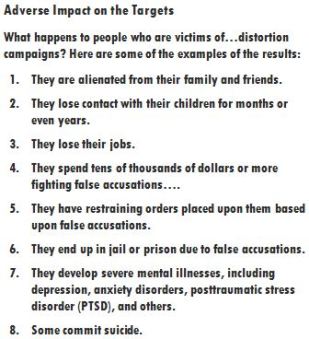
This survey of “adverse impacts” is credited to lies told by people with borderline personality disorder. Conducting “distortion campaigns” isn’t exclusive to BPDs, however, and the “adverse impacts” are the same, irrespective of campaigners’ particular cognitive kinks.

The valuable role of the police and courts in the prosecution of campaigns to slander, libel, and otherwise bully and defame can’t be overstated. They’re instrumental to a well-orchestrated character assassination.

Lies can be told to anyone, of course, and lies told to anyone can have toxic effects. The right lie told in a workplace, for example, can cost someone a job and impair or imperil a career.

Lies told to police and judges—especially judges—they’re the real wrecking balls, though. False allegations of threat or abuse are handily put over in restraining order or domestic violence procedures, and they endure indefinitely (and embolden accusers to tell further lies, which are that much more persuasive).

Among the motives of false accusation are blame-shifting (cover-up), attention, profit, and revenge (all corroborated by the FBI). Lying, however, may become its own motive, particularly when the target of lies resists. The appetite for malice, once rewarded, may persist long after an initial (possibly impulsive) goal is realized. Smear campaigns that employ legal abuse may go on for years, or indefinitely (usually depending on the stamina of the falsely accused to fight back).

Legitimation of lies by the court both encourages lying and reinforces lies told to others. Consider the implications of this pronouncement: “I had to take out a restraining order on her.” Who’s going to question whether the grounds were real or the testimony was true? Moreover, who’s going to question anything said about the accused once that claim has been made? It’s open season.

In the accuser’s circle, at least—which may be broad and influential—no one may even entertain a doubt, and the falsely accused can’t know who’s been told what and often can’t safely inquire.

Judgments enable smear and distortion campaigners to slander, libel, and otherwise bully with impunity, because their targets have been discredited and left defenseless (judges may even punish them for lawfully exercising their First Amendment rights and effectively gag them). The courts, besides, may rule that specific lies are “true,” target_of_blamethereby making the slanders and libels impervious to legal relief. Statements that are “true” aren’t defamatory. The man or woman, for instance, who’s wrongly found guilty of domestic violence (and entered into a police database) may be called a domestic abuser completely on the up and up (to friends, family, or neighbors, for example, or to staff at a child’s school).

Lies become facts that may be shared with anybody and publicly (court rulings are public records). Smear campaigners don’t limit themselves to court-validated lies, either, but it seldom comes back to bite them once a solid foundation has been laid.

Some so-called high-conflict people, the sorts described in the epigraph, conduct their smear or distortion campaigns brazenly and confrontationally. Some poison insidiously, spreading rumors behind closed doors, in conversation and private correspondence. As Dr. Tara Palmatier has remarked, social media also present them with attractive and potent platforms (and many respondents to this blog report being tarred on Facebook or even mobbed, i.e., bullied by multiple parties, including strangers).

Even when false accusers’ claims are outlandish and over the top, like these posted on Facebook by North Carolinian Marty Tackitt-Grist, they’re rarely viewed with suspicion—and almost never if a court ruling (or rulings) in the accusers’ favor can be asserted. The man accused in this comment to ABC’s 20/20 is a retiree with three toy poodles and a passion for aviation who couldn’t “hack” firewood without pain, because his spine is deformed. He is a retired lawyer, but he wasn’t “disbarred” and hasn’t “embezzled” (or, for that matter, “mooned” anyone). He has, however, been jailed consequent to insistent and serial falsehoods from his patently disturbed neighbor…who’s a schoolteacher.

For Crazy, social media websites are an endless source of attention, self-promotion, self-aggrandizement, and a sophisticated weapon. Many narcissists, histrionics, borderlines, and other self-obsessed, abusive personality types use Facebook, Twitter, and the like to run smear campaigns, to make false allegations, to perpetrate parental alienation, and to stalk and harass their targets while simultaneously portraying themselves as the much maligned victim, superwoman, and/or mother of the year.

(A respondent to this blog who’s been relentlessly harried by lies for two years, who’s consequently homeless and penniless, and who’s taken flight to another state, recently reported that a woman who’d offered her aid suddenly and inexplicably defriended her on Facebook and shut her out without a word. Her “friend” had evidently been gotten to.)

(An advocate for legal reform who was falsely accused in court last year by her husband and succeeded in having the allegations against her dismissed reports that he afterwards circulated it around town that she tried to kill him.)

I was falsely accused in 2006 by a woman who had nightly hung around outside of my house for a season. She was married and concealed the fact. Then she lied to conceal the concealment and the behavior that motivated the concealment. She has sustained her fictions (and honed them) for nearly 10 years. People like this build tissues of lies, aptly and commonly called webs.

Their infrastructures are visible, but many strands may not be…and the spinners never stop spinning.

The personality types associated with chronic lying are often represented as serpentine, arachnoid, or vampiric. This ironically feeds into some false accusers’ delusions of potency. Instead of shaming them, it turns them on.

I know from corresponding with many others who’ve endured the same traumas I have that they’ve been induced to do the same thing I did: write to others to defend the truth and hope to gain an advocate to help them unsnarl a skein of falsehoods that propelled them face-first into a slough of despond. (Why people write, if clarification is needed, is because there is no other way to articulate what are often layered and “bizarre” frauds.)

I know with heart-wrenching certainty, also, that these others’ honest and plaintive missives have probably been received with exactly the same suspicion, contempt, and apprehension that mine were. It’s a hideous irony that attempts to dispel false accusations are typically perceived as confirmations of them, including by the court. To complain of being called a stalker, for example, is interpreted as an act of stalking. There’s a kind of awful beauty to the synergy of procedural abuse and lies. (Judges pat bullies on the head and send them home with smiles on their faces.)

Smear campaigns wrap up false accusations authorized by the court with a ribbon and a bow.

Copyright © 2015 RestrainingOrderAbuse.com

*The name Machiavelli, referenced in the title of this post, is associated with the use of any means necessary to obtain political dominion (i.e., power and control). Psychologists have adapted the name to characterize one aspect of a syzygy of virulent character traits called “The Dark Triad.”

What “the Law” Means in the Restraining Order Arena and Why All Reasonable Expectations Defendants Have Are Wrong, Wrong, Wrong

  • “I put a restraining order on my ex-husband. Now he’s depressed and staying in his truck.”
  • “Can a restraining order result in suicide?”
  • “Get [a] restraining order lifted for job.”
  • “Can a restraining order be appealed if there isn’t evidence?”
  • “How will it affect my child custody if I filed a false order for protection?”
  • “What if my abuser files [a] restraining order against me?”
  • “My daughter falsely accused her stepmother of civil stalking.”
  • “Falsely accused of breaking a protection order.”
  • “A crazy person filed a restraining order on me.”
  • “Teacher falsely accused [in] Ohio.”
  • “Girlfriend filed a frivolous, retaliatory protection order against me.”
  • “I’m falsely accused. I need help. My ex has [a] protective order on me. I’m the victim, not him.”
  • “Suicide [and] false accusations.”
  • “I was served a domestic violence restraining order, but I don’t see any evidence.”

—Some recent search terms that led visitors here (punctuation added)

Victims of restraining order fraud often voice the conviction that restraining orders require evidence, because trials, we’ve been led to believe, must have an ascertainable basis; you can’t just summon a person to court for whatever. They also express the conviction that plaintiffs “can’t” lie. After all, accusers are made to swear an oath to tell “nothing but the truth.” They should be in trouble if they lie. They should go to jail.

These expectations are all reasonable ones…but they’re wrong.

Q: To get a restraining order, you have to have proof, right?

A: No. “Proof” is not the standard by which civil restraining order allegations are judged. Also, a person can’t “prove” s/he’s afraid; all s/he can do is say so, and his or her say-so is all that’s required.

Q: But if you have proof your accuser is lying, the restraining order has to be dismissed…doesn’t it?

A: No. This is the expectation of everyone summoned before a judge, for obvious reasons: Allegations aren’t facts, and only facts can mean someone is “guilty” of something. Restraining orders, however, don’t require evidence of anything or a determination of “guilt” of anything. What “provable” facts may exist are only as relevant as a judge elects to make them.

Q: A restraining order can be finalized even if a judge knows the plaintiff is lying?

A: Yes. Oath-swearing is just a ritual; lying doesn’t invalidate a petition. Restraining order statutes don’t have a “truth” standard. A person files a petition. If the alleged grounds satisfy the law according to a judge’s personal standards—and a judge’s personal standards are the legal standard—s/he’s authorized to approve the petition. In a subsequent hearing, even if the veracity of the plaintiff is controverted, the law doesn’t require that the order be dismissed. That’s up to the judge. Often if a judge can find a reason to “believe” the plaintiff has a reason to feel harassed or afraid, based on nothing but what the plaintiff says s/he feels, that’s sufficient (even if s/he has given false testimony). Glaringly false allegations may rile a judge, but the law doesn’t require him or her to dismiss a petition on those grounds (or on any others).

Q: So a judge can do whatever s/he wants on no grounds or even on bad ones?

A: Right (a judge who may not be a lawyer or even have a college degree). The only grounds necessary are that someone submitted an application.

Q: And if a plaintiff lies to get a restraining order, s/he can also lie to have someone arrested?

A: S/he can call the police every day if s/he wants to, and allege anything. There’s also no statutory ceiling on the number of restraining orders someone can petition (for free, usually), and subsequent allegations are that much more easily put over, and subsequent orders that much more easily obtained, once one has been approved. Some people are dragged into court relentlessly.

Q: So it’s like that story by Kafka?

A: Exactly like it (with some Lewis Carroll mixed in).

Copyright © 2015 RestrainingOrderAbuse.com

*On this basis, people are removed from their homes, stripped of all possessions, denied a role in their children’s lives, incarcerated, and left broke(n) and homeless. Some kill themselves.

Women Are Bigmouths: Why This Has Been Bad for People Who’ve Been Abused by the Court…but COULD Be Good

I grudgingly constructed a page this week on Facebook, which confirmed to me two things I already knew: (1) I really hate Facebook, and (2) women are more socially networked than men.
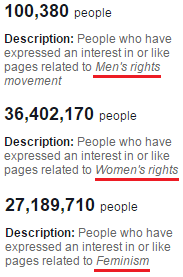
Calling women “bigmouths” isn’t strictly right, and people affronted by the assertion will insist women and men talk about the same amount, or that men talk more than women do.

Uh-huh.

Not impolite to observe is that women “collaborate” more than men do, that is, they sooner work in tandem, which is what statistics I gleaned from Facebook corroborate.

“Tell us about the people you’d most like to connect with,” Facebook urges when you piece together a page on its site. My entries under “Interests” brought up terms like Men’s rights movement, Feminism, and Women’s rights. Accompanying these topics were figures about how many others had expressed an interest in connecting with people who shared those interests.

See for yourself.

Notice that 200 to 400 times greater interest in bonding with people concerned with women’s rights has been shown than interest in bonding with people concerned with men’s rights. That’s a lot…A LOT a lot.


I don’t think there’s anyone who would deny that the fruits of feminism owe to social networking. Some of these fruits have been great; some really horrible. This blog concerns the rotten ones: a culture of victimhood and false accusation combined with the legislation of accelerated and derelict legal procedures presided over by judges bigoted by politics, bad practices (including engineered social science), and money.

Men have been the majority of victims, and they’ve been the only source of concentrated complaint, concentrated complaint that’s been mocked and muted. If we can assume the 200 to 400 times greater interest shown in women’s rights translates more or less proportionally to the number of people disinterested in or opposed to men’s beefs, then no wonder. Female influence, which is significantly feminist influence, is vastly predominant. The sympathy market has been cornered.

Men aren’t the only victims of procedural abuse, however.

Many if not most of the victims who comment on this blog are women, and they’re often desolate. Some live like hermits, some like refugees. They feel exiled and isolated.

The irony is this is exactly how women felt before the rise of feminism, and there’s a lesson to be taken from that.

Men’s struggles for a market share of sympathy face a phalanx of resistance and the priority of conditioned sentiment (prejudice); they’re also troubled by men’s lesser inclination to work collaboratively (the maverick mentality is a losing one). Women, however, can work from behind the lines. They can tap into the women’s rights network and harness its power.

And they should.

Copyright © 2015 RestrainingOrderAbuse.com

You Don’t Want to “Be a Part of It”: Commentary on New York’s Protection Order Biz

I corresponded with a man last year, a man in a homosexual relationship, who was assaulted by his partner severely enough to require the ministrations of a surgeon. His boyfriend was issued a restraining order coincident to his being charged with assault. That’s how it typically works in New York: A protection order is issued following a criminal complaint.

The man who wrote reported that he contacted the violent partner while the order was in effect to impress upon him how badly he had been hurt. The boyfriend used the contact to have the assault charge reduced and to obtain a protection order of his own, which he then abused serially to drive the man he had assaulted from his job and eventually from the state. This only required that he repeatedly claim he felt threatened, which is what he did. (According to the man, “The DA did not even try to substantiate my ex’s allegations and pursued the case to the utmost of his ability.”) The law licenses “mandatory arrest” under such circumstances. Arresting officers told the man all they needed was his accuser’s statement. (It didn’t matter who the actual victim was.)

The man was badly traumatized, at least as much by the lies and legal abuse as by the violence. Though he can’t look in the mirror without being reminded of it—one of its mementos is a scar under his eye—the effects of the violence subsided; the lies and legal abuse eventuated in his public disgrace, alienation from his friends, his being arrested at his place of work, and his being asked to leave by his employer after his business dried up and he had accrued massive debts, including from legal fees and medical treatment for PTSD and depression. He says he developed “terrible agoraphobia” (“afraid I would inadvertently run into my ex and have him accuse me of anything just to have me arrested yet again”) and continues to suffer nightmares (“that cause great daily despair”) even now—in another state where he fled to the safety of his family and where he gets by on disability insurance while he plots a reemergence secure from the risk of further legal assaults.

His story, which has here been stripped of detail to preserve his confidentiality, should serve to inject some color into the black-and-white tutorial on New York protection orders that’s examined below.


I digested a page on protection orders recently that was prepped for the New York Court System by the very earnest Judge Penelope D. Clute. It obliquely highlights absurdities in the system that merit some remark.

According to the judge, there are two types of protection orders: “stay away” orders and “refrain from” orders.

The former are pretty straightforward in their prohibitions:

  • No physical contact of any kind.
  • Stay away from the home, school, business or place of employment of the person named in the Order.
  • No phone calls.
  • No letters, emails, or faxes.
  • No messages through other people.
  • No presents.
  • No contacting the person in any way at all, even if you are invited to talk or meet by that person.

Note the last line—and note that it is the last line.

It acknowledges that people who are nominated “victims” on protection orders may entice their “abusers” to contact them. The quotation marks around the words victims and abusers in the previous sentence are there to stress that the language used by the courts and inscribed in the law is suspect. The court itself recognizes that there are cases when “victims” invite “abusers” to chat or hang out (or move in). As the story that introduces this post shows, besides, there are instances when actual victims seek the understanding of abusers, and this may come with its own host of complications and horrors.

Attorneys like these know very well that allegations of abuse may be hyped or fraudulent.

Unstated in Judge Clute’s bullet list is that the burden of blame falls on the accused even if s/he’s invited to violate the court’s order. Unstated but implicit is that “victims” may not be victims, and “abusers” may not be abusers. Entirely unconscious is that telling people whom they are or are not “permitted” to send a message or gift to contravenes the basic principles of liberty we define ourselves by and pride ourselves on. Restraining orders obviate the chance of reconciliation between parties in conflict by criminalizing contact and making what may be strained relations wholly and possibly virulently antagonistic.

(But, I hear you counter, you sacrifice your freedom when you violate the law. The issuance of a restraining order may be in conjunction with a criminal case, as it commonly is in New York, or it may not bedoesn’t necessarily require proof conclusive of anything; isn’t itself a criminal judgment but an admonitory one; and may be grounded on cranky interpretations of perfectly lawful acts, on lies constituting fraud, or on mere finger-pointing and a few moments of the court’s attention only. The issuance of a restraining order is, however, regarded as a criminal judgment, even in the absence of a criminal charge, and a finding that the order was violated is a criminal judgment. Appreciate that a violation could be the “abuser’s” calling the “victim” and reporting, “Your dad phoned and says your mom’s been in an accident.” A restraining order makes that act criminal, and the court’s prohibitions aren’t negotiable. Restraining orders make perfectly lawful acts, even morally imperative acts, criminal ones, ones you may be arrested for, denied jobs and housing for, and/or deported for.)

These contradictions will likely be familiar to the repeat reader.

Fascinating to learn of was New York’s “refrain from” order. Its contradictions are less likely to be familiar. According to Judge Clute, if you’re issued a “refrain from” order, “you can live together and have contact, but you’re prohibited from harassing, intimidating, threatening, or otherwise interfering with the person protected by the Order.”

This means, evidently and bizarrely, that there are people dwelling under the same roof as their accusers who may be cited for criminal contempt if an accuser calls and reports them for “harassment” that occurred, for example, in the hallway or the kitchen. The implications, which are fairly stunning, bring to mind the phrase “sleeping with the enemy.” The law invests its complete faith in the virtuousness of accusers’ motives. What will be plain to anyone who’s been falsely accused is that an accuser who’s been granted a “refrain from” order and resides with his or her “abuser” holds the life of the accused in the palm of his or her hand.
A writer for the feminist house organ Jezebel might ask, “Why would anyone make a false accusation of harassment, intimidation, or threat? What could be gained by that?”

Since feminists aren’t actually obtuse, the question doesn’t require an answer. Pretending, though, that they are obtuse, here is one: A residence could be gained by making a false accusation. Property could be. Children could be. Revenge could be (see the introduction above). Attention could be. The list goes on.

Judge Clute wraps up her tutorial on protection orders with this advice on “How Defendants Can Avoid Problems,” which reinforces the earlier observations that “victims” may call their “abusers” or otherwise attempt to reconcile, and which notes, besides, how a court order may stir conflict and confrontation with “family or friends.”

  • Do not go to places where you know the other person goes.
  • Leave a building, restaurant, store, or other place if you realize that the other person is there.
  • Hang up the phone immediately if the person calls you. Record the call on your answering machine, if possible. Tell your lawyer about the call.
  • Do not send letters, emails, or faxes to the other person and do not respond if that person sends one to you. Give your lawyer any message you receive from the other person.
  • Do not get into arguments or confrontations with the person’s family or friends. Walk away. Try to avoid them completely.
  • Do not get together with the other person, even to apologize or to try to work things out unless the Judge has dropped the Order of Protection.

Everything that makes these bureaucratic intrusions and impositions ridiculous is right there on the page.

Remember: If you spot your accuser, run away and hide! If s/he calls, hang up immediately (and call your lawyer posthaste)! Alsono sending presents!

Should such a debasing and debased statutory process really be one embraced by an enlightened citizenry?

Copyright © 2015 RestrainingOrderAbuse.com

*The author of this post has listened to National Public Radio for about 20 years (and done The New York Times crossword for at least as long). If a cosmopolitan New York doyen(ne) of the art world, someone with the right background and the right associations, were saddled with a protection order based on false accusations (which are easily staged or concocted and may be heinous or a foot in the door for the commission of years of legal abuse), it might be treated on an NPR program (or in The Times) like a rare and inexplicable bird sighting, and the torments, indignities, and privations of the sensitive, cultivated victim of this “anomalous” miscarriage of justice likened to those suffered by a detainee in a Siberian gulag. It’s estimated that millions of restraining orders are issued in this country each year, and it’s posited that a majority are based on hyped or false claims. It’s further speculated by this author that only a tiny minority of the country’s privileged class are victims of such frauds.

In Perspective: How to Look at Restraining Order Judges Neutrally

It’s hard not to hate judges who issue rulings that may be based on misrepresentations or outright fraud when those rulings (indefinitely) impute criminal behavior or intentions to defendants, may set defendants up for further (or serial) malicious prosecutions by the same false accuser (and possibly land them in jail), and may finally inflict severe privations, including loss of income, employment, and/or access to children, pets, home, and property.

It’s especially hard not to hate judges when you’ve told them the truth, pronounced it politely and respectfully, and nevertheless been scorned, humiliated, and demeaned…with gusto.

Judges tend to be hubristic, condescending, and willfully menacing (even when they’re smiling at you).

To compound the outrage, it’s only their station that licenses their haughtiness. More often than not, their authority doesn’t come from learnedness in the law but is simply a perk of the job.

Though there have been some motions in recent years to amend this situation, most bottom-rung judges who issue restraining orders aren’t qualified lawyers, that is, they don’t have law degrees. They were just elected or appointed to the position and sent to “judicial boot camp.” Judges are trained to execute specific duties; they’re not necessarily educated in jurisprudence.

Some have no education beyond high school.

This may either be a reason to resent them all the more for their audacity or a reason to see them as mere tools of a system that conditions their bigoted behavior. Restraining order judges are told—possibly quite explicitly—how they’re expected to rule. That’s a significant part of their “training.”

This hardly excuses conduct that obviously contravenes judicial ethics. It does, though, make that conduct understandable.

Certainly judges aren’t to blame for the state of things, including the shambles they unjustly make of people’s lives. They don’t level the allegations, nor do they formulate the rules, draft the laws, or influence the political and public opinions that do determine rules and laws.

Sure, judges of conscience could vocalize qualms or defy the system. They could martyr themselves for principle. Whether this would effectively alter the status quo, however, is debatable.

Remember, they’re not legal scholars, by and large; they’re just referees who’ve had certain priorities impressed upon them. It’s not theirs to comment on the laws—and being unqualified to do so, they may genuinely believe they’re acting righteously.

There’s no particular reason not to hate judges if one or more have wronged you. If you step back, though, you’ll see that they’re more like ants that bite because they’ve been tasked with defending the colony according to certain marching orders than they are like people we should reasonably expect to treat us with dignity and charity.

Judges are often power-corrupt—it comes of sitting above others who must kowtow to them—but they’re basically people doing a job they may be scarcely better equipped to do than you or I.

Copyright © 2015 RestrainingOrderAbuse.com

“She Said That I Had Been Burning Him Intentionally and That I Had Kidnapped Him”: Aaron’s Story of Restraining Order Abuse

The account below was recently submitted as a comment to BuncyBlawg.com, a site I’ve mentioned in several recent posts. Its administrator, Larry Smith, a former attorney, has been waging a one-man war on corruption excited by his relentless persecution through and by the legal system since 2011.

Aaron’s story is one of a spiteful ex-partner whose false allegations orbit popular themes: fear, emotional torment, stalking, and other (unprovable) crimes and misdemeanors that become more sensational and incriminating over time.

What makes Aaron’s story exceptional is that it has a reasonably happy ending, because the court saw through the lies.

In Aaron’s own words (lightly edited):

In my accuser’s affidavit, she repeatedly used “deathly afraid” and spoke of the medications she was on due to three years of stalking by me, vicious verbal abuse of herself and her family by me, and my stalking her where she works, shops, and lives. She claimed to have video surveillance of me following her into a grocery store. She even claimed to have a police report where I was “caught” sitting behind her home at 10 at night, etc.

She was granted an ex parte restraining order lasting two years.

Of course, none of it was true, none of her evidence existed, and the family that I had supposedly verbally abused didn’t even come to court. There was no police report, nor was there a surveillance video, because I didn’t have time to subpoena it; and had she brought the video, it would’ve shown her following me into the store she knew I was going to be at because I told her I was going to get groceries there at an exchange of our son. Had this video been brought to court, it would’ve conflicted with her affidavit.

On top of all of that, I brought in three copies of 40 pages that had every text message we had sent to each other for the previous two years in chronological conversation format. In these texts, two months prior she was inviting me into her home for “dessert” and asking to borrow money from me. Six months prior, she offered to loan or sell me her other car because I was having mechanical problems with my Jeep. These and other very common things. The texts also contained many instances of very immature ranting and attempts to create animosity and intensify disagreements into arguments, which I never fell for and always just said what needed to be said for our son’s sake. I never cursed or belittled her, though to someone like this the truth hurts.

After several hours, the judge shut the whole thing down, dismissed the order, and gave her a stern lecture. All this and no charge of perjury against her! One week later, she was granted an ex parte OFP on behalf of our then three-year-old son by a different judge in the same county! Same style of affidavit.

She said that I had been burning him intentionally and that I had kidnapped him.

He did have a burn about half the size of a pea on his finger, because he had touched a hot pot on the stove. I didn’t kidnap our son. She didn’t show up to pick him up! Since she was issued an OFP on behalf of our son, she was then afforded the services of a battered women’s and children’s center. She signed me up for psych evals and supervised visitation only with our son. Her instructions to law enforcement in her application were to arrest me for kidnapping and return her son to her.

Once again I proved the entire thing to be a lie. It was dismissed entirely. STILL NO CHARGES FILED AGAINST HER FOR PERJURY! Just stern words from a judge toward her and even a bit directed my way in that the two of us needed “to learn each other’s triggers and steer clear of conflict that needed to be sorted out by the courts”! I had to share custody with her for two more years and attempt to co-parent with her.

Our son is six now, and he lives with me and goes to her every other weekend. I had to use kindergarten as a guise to change our custody agreement. Although I am very thankful the courts named my home as our son’s primary residence, the court’s impotence to prosecute liars and the horrifying parenting that has to take place before they’ll change rights are despicable! I do think it is far worse to be a self-consumed person than to be a target of one, though. Karma is on our side.

This blog definitely gave me great insight into other people’s struggles outside of my own and opened my eyes to some of the types of people who abuse the system. I never could’ve imagined how easy and common it is until it happened.

Copyright © 2015 RestrainingOrderAbuse.com

Inciting Violence: If Lawmakers Require a Compelling Motive for Restraining Order Reform, How about This One?

I examined a case, recently, of a man’s committing murder hours after being accused to the police. My familiarity with the case was, admittedly, shallow; I only had what was reported to go on (and that from a single, “raw” source). I have, however, heard from scores of people who’ve been accused—or scorned for telling the truth—in drive-thru restraining order proceedings, and expressions of fury have been more than a few.

This week, I shared an email by a highly educated, professional woman and mother of three young children that expresses an “almost homicidal enmity” catalyzed by procedural abuses. Note the elevated diction she uses to describe an impulse to bash, throttle, and gouge. Does her vaulted language indicate she “doesn’t really mean it”? No, it indicates how alien rage is to her character. It indicates she’s someone who shouldn’t have cause to feel this way.

Consider: How is it the police and the courts recognize the propensity for violence that interpersonal conflicts mediated by the “justice system” may arouse, but lawmakers don’t? Are they that “in the dark”?

Yeah, pretty much.

If you get into a spat with your neighbor, and the police intervene, parties are separated into corners. In court, complainants even merely of “fear” may be shielded by law officers in anticipation of a judicial ruling. It’s understood that emotions run hot in this theater.

Why, then, is it not appreciated that when the basis for rulings is false, the risk of violence is not only higher but infinite?

We like our games, and we like our fictions about how people should be and should feel and should react even if you trash their lives maliciously. Hey, we’re disposed to remind, it’s the law.

All well and good until somebody gets an ax in the ear—an edgy remark, maybe; honesty often strikes us that way (i.e., like an ax in the ear).

The wonder is that more people who lie to the courts don’t meet premature ends—or at least sustain some anatomical remodeling. False accusations, which have inspired a great deal of sententious deliberation in recent months, don’t just “discomfort” people or make them “justifiably [and transiently] angry.” At the risk of being edgy again: People who haven’t been falsely accused in a legal procedure don’t know what the fuck they’re talking about. I was collegiately trained as a literary analyst—I’ve studied and taught Victorian literature—and I’m normally more disciplined in my remarks, but this subject rebukes gentility.

Liars maim. That they do it with words in no way mitigates the brutality of the act or its consequences.

One would think that as people mature and progress through life, that they would stop behaviors of their youth. Unfortunately, this is not always the case. Sadly, adults can be bullies, just as children and teenagers can be bullies. While adults are more likely to use verbal bullying as opposed to physical bullying, the fact of the matter is that adult bullying exists. The goal of an adult bully is to gain power over another person, and make himself or herself the dominant adult. They try to humiliate victims, and “show them who is boss” (BullyingStatistics.org, “Adult Bullying”).

StopBullying.gov defines bullying as including name-calling, taunting, threatening, spreading rumors about someone, and embarrassing someone in public. Falsely labeling someone a stalker, child abuser, violent danger, or sexual deviant in one or more public trials whose findings are impressed on the target’s permanent record and are accompanied by menacing threats (if not immediate punishment) plainly qualifies. Among identified effects of bullying are suicide (“bullycide”) and violence, including murder. “Extreme emotional disturbance” is a defense for murder in some states (a finding that doesn’t excuse the act but does lighten the sentence), and a related murder defense is “provocation.”

Sure, character assassination is bloodless. What of it? If I circulate lies about someone and s/he snaps, I’m a bully, and I had it coming. Few people would say otherwise.

Ah, but if I lie and use the law as my medium to insult, demean, badger, intimidate, or otherwise persecute—hey, that’s different. I’m the “good guy.”

So suck it. And keep on sucking it, because the public record says my lies are the truth. Neener-neener.

A system that represents its purpose to be the curtailment of violence shouldn’t be promoting it by pandering to bullies, even “unofficially,” and its officers shouldn’t be serving as those bullies’ lieutenants and enforcers. If the system makes it easy to lie about and humiliate people, doesn’t hold liars accountable, and furthermore punishes the falsely accused based on lies, then it’s promoting violence.

This shouldn’t require social science research to corroborate. It shouldn’t even require this analyst’s observation.

Copyright © 2015 RestrainingOrderAbuse.com

“On the Receiving End of a Sociopath’s Lies”: A Professional Mom’s Story of Restraining Order Abuse

The following account is reproduced almost verbatim from an email of recent vintage. Its writer is a professional woman and single mother of three with whom I corresponded last year while she was embroiled in strife—legal, medical, and emotional (a synergy of torments that’s been reported here before). The capsule version of her story is that she was in an abusive relationship (including violently abusive), sought a restraining order, which was dismissed on appeal, and then was issued an order petitioned by her abuser, which she reports was based on fraud, and which was nevertheless upheld despite her appealing it. She brought criminal charges, also. Her abuser smoothly extricated himself from those, too. The victim of assault is the one with the “restraining order” on her permanent record. She asked that I not use her name because she’s “terrified of  the possibility of repercussions.”

In her own words, which more poignantly express the psychic trauma of procedural abuses than any I’ve ever read:

My active involvement with my sociopath has, mercifully, ended.

[H]e refused to accept a plea deal, he took his assault case to a jury trial, and he was found not guilty by a jury of his peers. His lies were, apparently, more believable than my truth, or, best case, the jurors didn’t really believe him but couldn’t find him guilty beyond a reasonable doubt. Either way, it doesn’t matter. I’ve seen enough of the court system to learn that the truth is completely immaterial, and that the officers of the court will consistently choose the “easy” ruling over the one that is true. If the matter before them requires some thought, some extrapolation, some reading between the lines, and/or some backbone, forget it. The truth will be jettisoned faster than a grenade with its pin pulled.

I don’t really know how to describe how profoundly my brushes with domestic abuse/restraining order abuse/generalized legal abuse have affected me. In a few short months, a year will have passed since the criminal trial against my abuser took place. Four years will have passed since the whole odyssey began on Easter of 2011, when I walked into the police station and reported my abuser’s attack after agonizing overnight about whether or not I should do so. Imagine that—agonizing overnight about whether or not to report a crime! On some level, I must have known even then how very awry it all could go.

Let me just attempt to put this into perspective: I have lived through my parents’ divorce. I have boarded an Amtrak train headed for New Orleans at 16 years old in an effort to escape a miserable childhood. I have been scarred by the shame of being a high school dropout and then gone on to receive a college education. I have experimented with more drugs than I can count on two hands. I have traveled all over Europe with little more than a backpack and a few pfennigs. I have been robbed at gunpoint while working third shift in a Shell-Mart in Anniston, Alabama. I have scuba-dived off the coast of Honduras. I have watched my stepmother fight to regain pulmonary function after she was stabbed by a purse-snatching punk in the alley behind her home in Washington, D.C., only to watch her die an agonizing death from lung cancer fifteen years later. I have held a lion cub in my arms. I have lain helplessly in a hospital bed as not one, not two, but three premature babies were whisked from my body and transferred straight into the NICU. I have survived breast cancer, and then my mother’s untimely death from a hospital-acquired infection four months after my diagnosis. I have been sliced and diced and blasted by radiation. I have been exposed to, and treated for, tuberculosis. I have lived through bacterial meningitis and undergone a blood patch procedure after a botched spinal tap. I have been resuscitated with Narcan after being given too much IV narcotic during an acute episode of kidney stones. I have skydived over the Newport, Rhode Island coastline. I have loved multiple dogs and cats and then held them in my arms when it was their time to leave this earth. I have fought for my children and for myself against a relentlessly bitter spouse during a contentious, protracted divorce.

Not one of those things has affected me as deeply as being on the receiving end of a sociopath’s lies, and the legal system’s subsequent validation of those lies. There is no “coming out the other side” of a public, on-the-legal-record character assassination. It gnaws at me on a near-daily basis like one of those worms that lives inside those Mexican jumping beans for sale to tourists on the counters of countless cheesy gift shops in Tijuana.

I have sort of moved on; I mean, what else can one do, particularly when one has young children? But the horror, outrage, shame, and, yes, fury engendered by being wrongly accused by a perpetrator, and then having that perpetrator be believed, chafes at me constantly. Some things born of irritation and pressure are ones of beauty, like a pearl, or a diamond, but not this. This is a stoma on one’s soul—it never heals, it’s always chapped and raw, and if you’re not careful, it can leak and soil everything around it.

These days, when sleep escapes me, which seems to be fairly frequently, I often relive the various court hearings associated with this shit show. One is the court hearing for the restraining order that my abuser sought against me (and which was granted) based on his completely vague, bullshit story that he felt “afraid” of me—this from the beast that had assaulted me on numerous occasions, slashed my tires, and had a documented history of abusing previous girlfriends. Another is his trial for assault and battery, during which I was forced to undergo a hostile, nasty, and innuendo-laced cross-examination by his scumbag defense attorney in front of a courtroom full of strangers. But the hearing that really gnaws at me and fills me with an almost homicidal enmity for the judge overseeing it is the one where I was requesting a restraining order against my abuser, this after a particularly heinous assault in the days following my cancer diagnosis and my partial mastectomy.

That judge apparently believed my abuser’s bald-faced, self-serving, and absurdly improbable lies over my detailed, accurate, and horrific account of his behavior immediately following my surgery. That judge believed that a well-dressed, employed, and reasonably intelligent woman would drag her ass to court a week after a life-threatening diagnosis and major surgery just to harass her blameless ex. My memory of the surreal, humiliating, and completely unexpected ruling that day, made even more galling by the judge’s proclamation that he found the defendant to be “more credible” than me, is as grievously harrowing today as it was then.

To say that I feel indignant about it would be an understatement. Take indignation, add a dollop of pain, some hefty pinches of fear, embarrassment, and hopelessness, and a heaping dose of fury, and you’ve got a toxic mix of emotions that, if I don’t actively squelch them whenever they surface, could blow the top of my skull clean off. No amount of therapy can mitigate this particular affront; I’ve learned that the best I can hope for is some measure of containment. Kind of like radioactive waste.

foreverI will have that prick’s bogus restraining order on my record today, tomorrow, next week, and on and on into perpetuity. I am a licensed professional whose employers require a full background check prior to being hired. I honestly don’t know how that restraining order was missed by the company that my most recent employer contracted to perform my pre-employment vetting. I live with the ever-present dread that someday, someone will unearth the perverse landmine that my abusive ex planted in my legal record, and that dread hasn’t lessened one whit since the day the restraining order was granted.

I understand that the existence of a past restraining order can be a valuable red flag for the police when dealing with domestic abusers and stalkers. Most domestic abusers are repeat offenders, so prior bad acts can help to establish a pattern that law enforcement should be aware of (though, confoundingly, these same bad acts are not admissible during any trial). Even though I’m not necessarily comfortable with the existence of a permanent registry of all restraining orders—both those that are sought and those that are actually granted (which, as you know, is what currently exists)—what I’m not comfortable with is that this information is available not just to the police, not just to other governmental agencies, but to the public at large! My height and weight taken while at the doctor’s office are protected by law. A hospital cannot disclose if I was treated there for a sore throat. But an inflammatory, defamatory, embarrassing, unsubstantiated, and oftentimes false restraining order affidavit can be obtained by whoever strolls into a courthouse and requests a copy from the clerk.

I don’t believe this registry will ever be abolished, because restraining order abuse isn’t “sexy” and no one thinks it could ever happen to her, but can we at least limit who can access this information and the circumstances under which they can access it? It’s mind-boggling to me. It’s just so goddamn devastating to the people who are unfairly stigmatized, and, call me pessimistic, but I don’t think these casualties will ever have a voice.


[Today] I’m working full-time at a job that I basically enjoy, and my three children are flourishing. I no longer feel that I am defined by my intensely negative experiences with my abuser and with the legal system, or that my life is being hijacked on a daily basis. I go days at a time without any of this crossing my mind. To say that I have “gotten over it,” though, would be a lie. A piece of me was lost because of this, and an emotional fissure was left behind, that, from what I can tell, simply cannot be fixed or ignored. My only succor is my halfhearted hope that karma is, indeed, a bitch.

Copyright © 2015 RestrainingOrderAbuse.com

“Trapped”: Betty’s Story of Restraining Order Abuse

Betty Krachey says she only wishes she had superpowers. She has, nevertheless, been flexing her muscles pretty impressively for a former drugstore clerk.

Betty launched an e-petition not long ago to bring flaws in the administration of restraining orders and the need to hold false accusers accountable to the attention of lawmakers in her home state of Tennessee (and beyond). Betty emphasizes that restraining orders can be “taken out on innocent people based on false allegations so a vindictive person can gain control with the help of authorities.” She stresses, too, that “false accusers are being allowed to walk away and pay NO consequences for swearing to lies to get these orders.”

Betty’s charges shouldn’t be revelations; opponents of restraining order laws (and related laws inspired by violence against women) have been saying what Betty is for years. What makes her denunciations eye-opening is that they’re coming from an injured woman who refuses to take her licks and silently retreat into the shadows like she’s supposed to do. Besides that, the typical rebuttals to complaints like Betty’s, rebuttals that play to our sympathies for abused women, don’t apply.

Betty is an abused woman. She was nearly deprived of her home and consigned to the curb, for no reason, like yesterday’s trash (a situation others find themselves in every day). Betty’s story, as she tells it, corresponds moreover to those of women who are considered victims of emotional abuse (which state statutes may classify as “domestic violence”).

I used to be a very private person—till all this crap—and told very few people my business, so everyone thought everything was going good with me and [him]. They had no idea I was living with someone I felt trapped with. I could NEVER talk to him or even ask him a question without him blowing up. That’s not a very happy life to live with someone. Even though I never told others how bad things were at home, I NEVER made it a secret to [him] that I wanted to leave…! I never posted lies on Facebook or emailed my friends telling them lies about [him] like he did me to try to get people to feel sorry for me and think [he] was such a bad person. Now that I think about it, he’s always played the victim….

The counterclaim feminists inevitably reach for to bat away complaints of restraining order abuse like Betty has made is that invisible, voiceless legions of battered women never receive justice, so tough luck, Charlie Brown, if you’re not treated fairly. The argument appeals to pathos, but its influence on our laws and justice system is plainly corrupt. Remarking that there are starving children in India has never made and never will make broccoli taste like cheesecake. It’s not the place of our justice system to punish people for things they haven’t done, let alone to blame them for the imagined crimes of strangers.

The posited pains and privations of unnamed others don’t justify running an innocent person through the wringer, female or male. Publicly implicating people as batterers and creeps based on superficial claims scrawled on forms and mouthed in five-minute meetings with judges shouldn’t be possible in a developed society. On these grounds, citizens are cast out of their homes by agents of the state, as Betty almost was.

Our courts take no interest in the lives they invade and often derail or devastate. The people restraining order judges summarily condemn are just names on forms; judges may never even know what the owners of those names look like—forget about who they are.

Let’s meet one.

Betty’s story begins in 1992 when she moved from Florida to Tennessee with her boyfriend, and the two built a house and life together there.

The circumstances that led to Betty’s being falsely accused by her boyfriend decades later are cliché. He slimmed down in midlife, she says, and began “cheating on me with younger girls…. So he had to figure out a way to get my half of our house from me.”

A protection order fit the bill perfectly: no muss, no fuss, and no division of assets. The boyfriend would be granted sole entitlement to the house that Jack and Jill built. Jill, with a little shove, would tumble down the hill alone, and an empty bucket to collect handouts in is all she’d end up with.

His first plan was to bully and threaten me into signing over my half of the house by signing a quitclaim deed. He had told me he would give me $50K, which…I knew I’d never see, and he promised me this would be my best deal. And if I did not sign the house over to him, he let me know I would lose everything I had worked my ass off for. “You watch and see, I promise you that,” he would tell me over and over.

Betty says she was tempted to sign. One of her dearest companions, her Doberman Dragon, had died, and Betty reckoned she could provide for her remaining dog, Lacy, by herself. “One reason I stayed was for my dogs,” she admits. “I had been wanting to leave…for years.” She and her boyfriend had effectively separated, and Betty intuited her boyfriend “knew he wasn’t going to be able to trick me into staying and paying half the bills much longer,” and she planned to call it quits. But he beat her to the punch.

His next plan, with the advice from his awesome friend, was to get the police involved and then to file the order of protection on me to get me kicked out of the house! If it weren’t for my lawyer, I would have had to leave my home from Aug. 29th to the court date Sept. 12th! [He, the ex] knew and did NOT care one teeny tiny bit that I had NOWHERE TO GO! Plus I had Lacy to worry about. [He] had moved out of our house August 6th and wasn’t even living in the home at the time he did this. [He] has another house to live in that has everything he needs. I had NOTHING else and nowhere else to go!

Betty’s situation mirrors that of many others who are falsely accused by domestic partners. Those not so lucky to have (or to be able to afford) effective legal representation may find themselves abruptly homeless (besides jobless and penniless, in cases), sleeping in their cars, sheltering with strangers, or living on the street. These are people who the day before may have been living normal, comfortable middleclass or even upper-middleclass lives.

On our court date—Sept 12th—the order of protection was dropped. My lawyer told me I was right: “This is all about the house and YOUR money you have coming from your business you sold.” I knew it!! And [he, the ex] wanted ME to pay the court costs for this!

The best laid plans of lice and men go oft astray. Betty quips, “All I can say is [he] had a lot more to be concerned about than me causing him ‘bodily harm’!”

Betty’s been in touch with a Tennessee state representative who’s indicated to her that she has “a good chance at getting [the] law changed. But he said the soonest it will go into effect is July 2015, and he let me know that means it will NOT help me with what my ex did to me, because he filed his false report on me in August!”

Besides singlehandedly pressing for reform of one of the most intransigent legal mockeries ever conceived, she’s considering a lawsuit.

Happy New Year, Betty.

Copyright © 2015 RestrainingOrderAbuse.com