 I’ve recently tried to debunk some of the myths that surround the administration of restraining orders. This post is about what it’s like to actually be the recipient of one, particularly a fraudulent one.
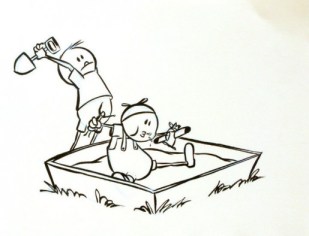
Among the uninitiated, there’s a belief that there’s some kind of prelude to the moment a constable shows up at your door. There isn’t. Restraining orders are as foreseeable as a shovel to the back of the head.
Constables, incidentally, are nice guys. Like process servers, they’re quick to assert that they’re just the messengers—and they are, of course: they otherwise have nothing to do with anything.
The motive forces behind the issuance of a restraining order are two people: the plaintiff (the person who drops by the courthouse to allege that you’re a fiend) and the judge who interviews him or her for a few minutes before validating his or her allegations with a signature.
Application for a restraining order is a fast-food process designed so that a plaintiff legitimately in need of urgent relief from a stressful situation can obtain that relief quickly and easily. The humor of this is only appreciated by recipients of fraudulent restraining orders petitioned by plaintiffs who are willful manipulators of a system primed to take them at their word.
Restraining orders are issued ex parte: a judge never sees or knows a thing about the person s/he approves a restraining order against. What this means in practical terms is that whatever a plaintiff alleges against you, no matter how damningly untrue, is all a judge has to go on. In other words, you’re guilty until proven innocent. And there’s really no ceiling on what a plaintiff can allege: battery, sexual violations, stalking, theft—you name it. (Plaintiffs who can’t squeeze all of their allegations into the blanks on the restraining order form are allowed to use a separate piece of paper.)
The plaintiff doesn’t have to actually prove anything. The burden is entirely upon you to discredit whatever the plaintiff alleges, and what s/he alleges is only limited by his or her ethics if s/he has any. Otherwise what s/he alleges is only limited by his or her imagination and malice.
Consider what your worst enemy might relish having permanently stamped on your public record. At the moment a restraining order is applied for against you, it’s a fair bet its plaintiff is your worst enemy.
Judges, who should know better than anyone the lengths people will go to to injure one another, have been instructed to react mechanically in the presence of certain criteria like claims of threat or danger. They don’t know the plaintiff. They don’t know the defendant. They’re often just responding to cues without letting much deliberation interfere. They don’t have to worry about professional censure, because this is established practice.
So. A plaintiff waltzes into a courthouse, takes a number and fills out a form, waits to see a judge, makes his or her plea, and more than likely leaves the courthouse feeling validated by the judge’s approval of his or her restraining order, regardless of whether the allegations on that order bear any correspondence to the truth. S/he’s feeling high and righteous (and possibly wickedly gratified).
The defendant is greeted the next day by an officer—at his or her home and possibly in front of friends, family, and/or neighbors—and served with an order from the court that may accuse him or her of violence, stalking, or other perversions and that warns him or her in no uncertain terms that s/he’ll be arrested for any perceived violations of that order. (S/he may alternatively be forcibly removed from that home on the same basis with nothing but the clothes on his or her back and denied access to children, pets, property, money, and transportation—for a year, a number of years, or indefinitely.)
It’s estimated, based on statistics extrapolated from government studies, that one in five recipients of restraining orders is pretty much the person his or her accuser has represented him or her to be, has pretty much done what s/he’s been accused of doing, and that whatever that is is bad enough that s/he shouldn’t be much surprised by a knock on the door from a person in uniform.
For the other 80% of restraining order defendants—recipients of orders that were either dubiously necessary or based on false allegations—their lives may well come to an abrupt halt. Recipients of fraudulent restraining orders, especially, may be traumatized by feelings of gnawing outrage, betrayal, mortification, and impending doom. The rhetoric of restraining orders is calculated to inspire dread—maybe so most recipients simply slink away into a gloomy corner. It reflects better on the court and its statistics if restraining orders stick.
Insomnia, persistent feelings of vulnerability and distrust, anxiety, depression, retreat—the stress responses people report are predictable and are ones, obviously, that can lead to physical and psychological illness, sidetracked careers, and neglected, scarred, or broken relationships. In most cases, restraining orders that do stick—and that’s most of them—never come unstuck. The stink follows you wherever you go.
Even the rare few who manage to extricate themselves from trumped-up allegations, usually with the help of a competent attorney, are never the same. What may have been an attention-seeking stunt performed by some pathetic schemer over a lunch break leaves a permanent impression.
Like a shovel to the back of the head.
Copyright © 2013 RestrainingOrderAbuse.com
 TALKING BACK to restraining orders
Apparently, the 80/20 Rule applies across the board. Being in the 20% (those that truly require an RO), this Petitioner had the TRO rubberstamped. It was an arduous process. Initially, the court clerk veteran (“I’ve been doing this for 25 years!!”) said that it would not be granted, unilaterally deciding to not present to the Judge for review. Since when do court clerks run the courtroom? Upon being forced to the RO clinic, the facilitators realized that divulging private detail to for abuse description onto public record was not in anyone’s best interest. The clinic’s Esq. was surprised that this Petitioner was denied appearing before the Judge. Upon returning to the courtroom, the Order was simply handed to Petitioner as granted. Petitioner asked to appear before the Judge due to other issues. Petitioner was aghast as: (1) assigned date was impossible for witnesses, (2) no way means to get a subpoena and (3) ADA access. With the date being critical, this Petitioner requested the Presiding Judge. The date was immediately revised. What a bizarre experience. Win, lose or draw, should this Petitioner end up injured or dead, at least there is a record. Now the concern is whether asserting these basics will prejudice the outcome for the RO? Numbers 2 and 3 are still required. Any thoughts?
LikeLike
Your article pretty much sums it up. I was served with a restraining order that like many I suppose was a falsified record used strictly to damage me. Once the fiasco ended I went to the courts, DA and Sheriffs department. I assumed they would want to know how the system was abused and they were made complicit. That was the second rude awakening. They do not care. I could not believe that civil rights mattered so little. Finally I read about the law enacted by Bill Clinton. This insane process has only served to create more abuse and made a lot of trashy attorneys money. Prior to this I thought the repeal of glass Steagel was the dumbest decision made by Clinton. Clinton created Too big to fail and then took away our rights. My guess the former came to him while not inhaling and the latter occurred after he did not have sex with that woman. I did not realize the financial incentives included for the courts and police to violate human rights. We need laws to protect all citizens male, female, young and old. I love this country and what the founding fathers tried to create. That country has long ceased to exist.
LikeLike
Once upon a time a dollar wasn’t just a piece of paper; it was backed by its value in gold. Respecting the subject we’re talking about, at least, law is correspondent: it’s designed to look legit, and unless you’re given cause to scrutinize it, you’ll never detect that it isn’t. Restraining order legislation and policy have been ingeniously engineered so that basic protections (“due process,” etc.) against misrepresentation, fraud, and railroading are circumvented entirely. And there’s no accountability. What I’ve found even worse than the indifference you’re talking about—and you’re exactly right that no one cares—is what pretty much amounts to complicity. Judges and police officers aren’t out to get people, per se. But they will effectively hush up or turn a blind eye to fraud in protection of interests that should never infect their judgment, like job security, maintenance of the status quo, and preserving the appearance of moral rectitude. Fundamental ethical protocols have taken a backseat to political exigencies. So, too, have equality, fairness, and truth been subordinated to outward impressions and appeasement of dominant social priorities. The more systemic the fitting of pretty masks over inconvenient facts becomes, the more gangrenous our body of legal canons grows. Officers of the court know the system is corrupt, but it’s not in their personal interests to call anyone’s attention to the smell.
LikeLike