A Victory for Free Speech: Matthew Chan Prevails in His First Amendment Appeal of a Lifetime Restraining Order

Several posts on this blog in the past year have concerned the case of Matthew Chan, a Georgia entrepreneur who blogs and administers a forum for victims of “copyright extortion” (i.e., people who’ve been threatened with lawsuits for unsanctioned use of a copyright holder’s original material and may be intimidated into paying thousands to avoid being taken to court—this for posting a photo online, for example, or using a snippet of text without proper acknowledgment or without having paid a fee or otherwise obtained the author’s consent).

Matthew S. Chan

The blog has also featured a guest post by Mr. Chan.

This post reports that the Georgia Supreme Court returned a virtually unanimous ruling in his favor Friday, after many months of deliberation, that lifted a lifetime protection order prohibiting Mr. Chan from criticizing a woman he characterized as a “copyright troll.”

The basis of Mr. Chan’s appeal, prosecuted by New York attorney Oscar Michelen, was that the trial court that issued the order misconstrued and misapplied the law. Forcing a procrustean interpretation onto the facts, it determined Mr. Chan had harassed, intimidated, and “stalked” the plaintiff in the case, Linda Ellis. Accordingly, it imposed a “prior restraint” on Mr. Chan’s freedom of expression, barring him indefinitely from writing about her.

First Amendment authorities, Profs. Eugene Volokh and Aaron Caplan, submitted an amicus brief to the court in Mr. Chan’s favor, arguing that the First Amendment—with some exceptions—authorizes speech about a person, even if that speech isn’t polite or flattering.

Justice Keith Blackwell, writing for the Georgia Supreme Court, summarized the case in the court’s March 27 ruling:

Matthew Chan has a website on which he and others publish commentary critical of copyright enforcement practices that they consider predatory. Linda Ellis is a poet, and her efforts to enforce the copyright in her poetry have drawn the ire of Chan and his fellow commentators. On his website, they have published nearly 2,000 posts about Ellis, many of which are mean-spirited, some of which are distasteful and crude, and some of which publicize information about Ellis that she would prefer not to be so public. […] It is undisputed that Chan never caused any of these posts to be delivered to Ellis or otherwise brought to her attention. But it also is undisputed that Chan anticipated that Ellis might see the commentary on his website, and he may have even intended that she see certain of the posts, including the open letter to her.

Ellis eventually did learn of the posts, and she sued Chan for injunctive relief under the Georgia stalking law, OCGA § 16-5-90 et seq., alleging that the electronic publication of the posts was a violation of OCGA § 16-5-90 (a) (1), which forbids one to “contact” another for certain purposes without the consent of the other. Following an evidentiary hearing, the trial court agreed that the electronic publication of posts about Ellis amounted to stalking, and it entered a permanent injunction against Chan, directing him to, among other things, delete “all posts relating to Ms. Ellis” from his website. Chan appeals, contending that the evidence simply does not show that the publication of posts about Ellis on his website amounts to the sort of “contact” that is forbidden by OCGA § 16-5-90 (a) (1). With that contention, we agree, and we reverse the judgment of the trial court.

New York entertainment and intellectual property attorney Oscar Michelen, who represented Matthew Chan before the Georgia Supreme Court

To summarize the summary, Mr. Chan and members of his forum ventilated outrage toward what they perceived as legal terrorism (letters from Ms. Ellis’s attorney threatening civil prosecution for “copyright infringement” and reportedly offering to settle out of court for $7,500), and Ms. Ellis successfully represented the online remarks to the trial judge as tantamount to “stalking.” The statute, however, requires that an alleged “stalker” have actually contacted the “victim,” and no such contact was ever made.

For purposes of the statute, one “contacts another person” when he “communicates with another person” through any medium, including an electronic medium. See OCGA § 16-5-90 (a) (1).4 See also Johnson v. State, 264 Ga. 590, 591 (1) (449 SE2d 94) (1994) (as used in OCGA § 16-5-90, “[t]o ‘contact’ is readily understood by people of ordinary intelligence as meaning ‘to get in touch with; communicate with” (citation and punctuation omitted)). Although one may “contact” another for the purposes of the statute by communicating with the other person through any medium, it nevertheless is essential that the communication be directed specifically to that other person, as opposed to a communication that is only directed generally to the public.

There was no contact to satisfy the statutory definition of stalking.

Similarly, allegations of harassment and intimidation were deemed insufficient in the Georgia Supreme Court’s ruling, because no contact had been made with the plaintiff, so no contact had been made against her wishes.

The evidence shows that Ellis visited the website herself—it appears, in fact, that she registered herself as an authorized commentator on the website—and that she had others visit the website and report back to her about the commentary published there. Generally speaking, our stalking law forbids speech only to the extent that it is directed to an unwilling listener, and even if Ellis did not like what she heard, she cannot be fairly characterized as an unwilling listener. Ellis failed to prove that Chan “contacted” her without her consent, and the trial court erred when it concluded that Chan had stalked Ellis. See OCGA § 16-5-90 (a)(1).

Other commenters on this blog, who hadn’t the wherewithal to appeal their cases to the high courts, report having had similar judgments entered against them, typically subsequent to an earlier restraining order. This blog’s author is among them. He was issued a restraining order based on false claims in 2006 and was sued for libel and harassment fully seven years later by its petitioner, who had since moved to another state, after he criticized her publicly, this despite his having had no contact with the woman in the intervening period. The court imposed a lifetime restraining order upon him barring him from exposing the woman (a professional scientist) in anything he publishes.

Mr. Chan’s case highlights that lower-tier judges, presiding over abbreviated procedures spanning mere minutes and according to their personal lights, arbitrarily exercise the broad latitude they’ve been granted by lawmakers. It’s the rare restraining order case like Mr. Chan’s, one that ascends through the courts, that exposes the degree to which bottom-rung judges do what they want without regard to the letter of the law.

Mr. Chan’s victory is shared by all of those who’ve been wronged by the court—and if I know my friend Matthew, his advocacy is going to be all the louder for it.

Copyright © 2015 RestrainingOrderAbuse.com

STINKIEST: Most Restraining Orders Are Sought Impulsively, if Not Maliciously

stinkiest“The first question for a legislature is whether to enact a civil harassment law at all. One thing is certain: If a civil harassment statute is enacted, it will be used—a lot. In 2003, Oklahoma reimposed a relationship requirement on its civil harassment statute because metropolitan counties were ‘being overrun with requests for protective orders.’”

—Prof. Aaron Caplan, “Free Speech and Civil Harassment Orders” (2013)

“The measure [House Bill 1667]:

  • Limits VPOs [“victim protective orders”] for harassment to situations in which the victim is being harassed by a family or household member or a person with whom the victim has been involved in a dating relationship. This provision is meant to reduce the number of frivolous applications for VPOs;
  • Requires victims of stalking who are not family or household members or in a dating relationship with the alleged stalker to file a complaint against the defendant with the proper law enforcement agency prior to filing for a VPO. The victim must provide a copy of the complaint with the petition for the VPO. This is also being done in an effort to reduce the number of frivolous applications for VPOs […].”

Highlights of Legislation (49th Oklahoma Legislature, 2003)

As law professor and former ACLU staff attorney Aaron Caplan all but says, restraining orders are exploited. The 49th Oklahoma Legislature cited in Mr. Caplan’s law monograph explicitly implies the same thing. The purpose of its 2003 HB 1667 was to “reduce the number of frivolous applications.” This clearly wouldn’t have been a concern if there weren’t a great number of frivolous applications.

Frivolous means “having no sound basis.” Its vernacular synonym is bullshit.

The preceding two posts on this blog examine how many restraining orders are either rejected by the court (“tossed”) or withdrawn by petitioners after they succeed in securing them. Available news reports indicate most restraining orders are rejected outright or dismissed upon a “full hearing.” Most. Indications, too, are that a lot that aren’t rejected are later withdrawn by the people who petitioned them. A lot.

This alone is reason to suspect the motives of complainants and the merits of their complaints. Certainly it says judges do. As the epigraph reveals, legislators do, too.

Consternating to people whose lives have been derailed by false accusations is that the problem has been vigorously exposed and criticized for decades, and judges, lawmakers, and attorneys know those criticisms are more than hot air.

Yet little changes…including rhetoric that legislators know is misleading (stinky).

Look at the second quotation in the epigraph. First, note that the civil harassment orders that were repealed by HB 1667 were called “victim protective orders” (i.e., reflect on the absurdity of the phrase victim protective orders for harassment). Also note the acknowledgment that a significant proportion of petitions for “victim protective orders” are “frivolous.” Orders that may have nothing to do with violence are called “victim protective orders” and—and—they’re acknowledged to be used falsely, or at least wrongly (and to such an extent that legislative revision was urged).

stink6Applicants for orders that are acknowledged to be used frivolously, however, are nevertheless called “victims.” (As the previous post shows, journalists collude in this misrepresentation.)

Recognized non-victims who clog court dockets with illegitimate claims are still called victims. Cases recognized as non-violent are still characterized as violent. When bias is this manifestly rooted, is it really that hard to believe that many or most orders that are approved and finalized may be malicious? The “fix” is obvious—it’s obvious—so how hard can “frames” or “set-ups” be to pull off?

Much ink has been spilled by opponents of the restraining order process desperate to arouse awareness to false allegations and prejudiced practices. People are issued restraining orders with fraudulent accusations that stick. They lose their jobs, homes, money, property, and good names. They lose access to their kids, who may come to hate them based on lies. Some may end up on the streets; some may even kill themselves in despair after being bullied and ground down, possibly for years.

False allegations that are rejected by the courts aren’t called false, yet false accusations that aren’t rejected by the courts are invariably called true (or “true enough”). The entire system reeks to high heaven.

How often false allegations succeed can’t be statistically established. Victims are left with having to lay out their cases in blogs and YouTube vids, or voicing four-letter epithets in Internet forums—or just quietly going mad.

This has inspired a great deal of rage and arguably more than a few deaths (suicides and murders), and that rage has inspired vehement denunciations from legions of special interest groups.

What all of this distracts from, though, is that explicitly manifest in judicial rulings and legislative reforms is that the court itself recognizes that false—or at least “frivolous” or “baseless”—claims are made more often than not.

Most restraining order petitions are rejected. Put more emphatically, theirs are considered to be bullshit claims.

What must be appreciated, finally, is that the restraining order process is a highly “accelerated” one (as Prof. Caplan, quoted in the epigraph, notes in his study). The conceptual justifications are that (1) applicants are “in danger” and need immediate relief, and (2) restraining orders are “no big deal.” The latter is refuted by rates of depression and suicide (or would be if they were they known), and the former is refuted by a preponderance of court rulings.

Unanticipated by lawmakers (apparently though inexplicably) is that an accelerated process rewards impulse, including malicious impulse. It’s exploited in heat, completed in moments, and usually free (and there’s no statutory limit imposed upon the number of times a single petitioner may exploit it).

Why do judges determine most restraining order petitioners’ claims are bullshit? That’s why.

Copyright © 2015 RestrainingOrderAbuse.com

STINKIER: Not Only Do the Courts Toss Most Restraining Order Petitions, a Lot of the Ones That Are Finalized Are Later Withdrawn by Their Petitioners

stinkier
A couple available rejection rates for restraining order petitions filed with the courts were scrutinized in the last post. Those rates, based on news reports out of Colorado (1998) and Connecticut (2014) were high: roughly 82% (lowball calculation) and 72%, respectively. That’s how many restraining order petitions may be denied or dismissed by our courts. They’re either rejected at first glance, or they’re preliminarily approved and then vacated on review.

They’re judged to be stinky.

Yesterday, I came across this: “Many abuse victims request protection orders then have them dismissed” (March 26, 2015). How many? Almost half (in the cited county, anyhow).

The headline and slant of the story pain me, and I’m compelled to comment on them before broaching the meat of the article.

Note that the typical journalistic bias is in evidence: accusers are termed “abuse victims.” This bias accounts significantly for why the bad odor of the restraining order process is obscured. It stinks, too—of Glade aerosol.

My criticism may seem cold—many accusers assuredly are abuse victims—but a journalist’s brief is to report what he’s investigated, and it’s a safe bet that the “many abuse victims” referenced in the headline aren’t people whose cases the writer looked into. At all. He assumes they’re “abuse victims,” apparently because why else would they have claimed to be?

This is smelly news reporting, and Journalism 101 urges a revision: “Many who are granted protection orders then have them dismissed.” There’s a difference, and the journalist who doesn’t discern that difference is in the wrong line of work.

The writer also begins his story with an account of a woman who’d obtained a protection order against her husband only to be subsequently shot to death by that husband. Then the reader is informed:

Though [the homicide victim] had not asked for her protection order to be dismissed, many other victims do and some of them end up coming back and asking for additional protection orders.

In other words, the reported tragedy has absolutely nothing to do with people who “request protection orders then have them dismissed.” I studied journalism in high school under the tutelage of a man who was the real deal, so lurid and careless journalism offends me.

What do we know from what’s related by Matt Elofson, the crime and courts reporter for Alabama’s Dothan Eagle? We know people apply for restraining orders, get them, and then reconsider (and sometimes re-reconsider). And we know that one person, who never reconsidered the restraining order she was granted, was fatally shot (possibly as a consequence of seeking the state’s protection). These are facts; the rest is rhetoric and specious connections, which are journalistic no-nos.

The reportage of Mr. Elofson’s that isn’t corrupt, however, is telling.

Roughly 40 percent of the petitions for protection from abuse filed in Houston County over the past year were dismissed upon request of the victim.

Houston County Circuit Clerk Carla Woodall said 223 petitions for protection from abuse were filed in Houston County from March 2014 to March of this year. She said 90 of the 223 petitions were later dismissed upon request by the victim.

For “victim,” substitute “petitioner” (pretend, in other words, that it’s a news story that’s been quoted) and then note that it says nearly half of orders that are approved and finalized are afterwards withdrawn by their petitioners.

Nearly half.

Here’s what a journalist (somewhere, someday) should observe: Most restraining orders are denied or dismissed by our courts, and an arresting proportion of those that aren’t denied or dismissed are withdrawn. That’s a whole lot of “sound and fury signifying nothing” except a whole lot of misery for a whole lot of accused people.

This, furthermore, ignores that a majority of orders that are approved and not withdrawn may be false.

We’re not allowed to call the restraining order process a farce, because—as Mr. Elofson reminds us—sometimes people who procure restraining orders are legitimately at risk.

How, though, does Mr. Elofson remind us that restraining orders are necessary and vital to the protection of women? He reminds us by citing an instance in which a restraining order may have gotten its petitioner killed.

Copyright © 2015 RestrainingOrderAbuse.com

Invoking the Fifth Amendment Protection against Self-Incrimination in “Domestic Violence” Cases

In “How the Fifth Amendment Impacts Family Court in Domestic Violence Cases” (2013), family attorney Tracy Duell-Cazes offers the following counsel against self-incrimination (it’s directed to Californians but may be applicable generally):

To make this easier to read, I will use Respondent when referring to the person who is accused of committing a domestic violence offense and Petitioner for the person against whom the violence was alleged to have been committed.

The Respondent has the right not to make [self-]incriminating statements in any proceeding. This includes discovery, hearings, and any other place where statements may be made. The general rule is that the Respondent cannot be required to testify at the restraining order hearing. The Respondent does not have to produce any discovery regarding the domestic violence issue if the Respondent timely claims the privilege against self-incrimination in response to the discovery request.

Courts usually grant a continuance until the criminal action is concluded. The temporary restraining orders stay in effect. Once the criminal action is concluded, then the hearing in Family Court can go forward. Usually the criminal case is dispositive of whether or not permanent restraining orders in Family Court are issued. If there is a conviction, the permanent restraining orders will almost always be ordered.

The Respondent must make sure that s/he doesn’t say anything to anyone but his/her attorney. (It is usually a good idea in these kinds of cases to have an attorney who practices family law and knows something about criminal law.) If any discovery is sent to you to answer, you need to assert your privilege against self-incrimination in a timely fashion. If you do not, you will lose this right and be required to testify against yourself and be required to respond to the discovery request. This means that the court can compel you to answer the questions, or sanctions will be imposed. Sanctions can be anything from your paying money to the other side to the issue being decided with only the other person’s information.

In order for [the] Respondent to give up his/her right to remain silent, s/he must knowingly and intelligently waive that right. This means that s/he has to know the consequences if s/he talks about the facts and that s/he understands that whatever s/he says can (read will) be used against her/him in the criminal case. If you are ever unsure of whether or not you have a “right to remain silent,” you should immediately consult with an attorney. It is best to consult with an attorney who practices both family law and criminal law or who handles domestic violence cases.

Copyright © 2013, 2015 Tracy Duell-Cazes and RestrainingOrderAbuse.com

*The Fifth Amendment guarantees you don’t have to say anything against yourself. To enjoy this privilege, however, you have to say you don’t intend to say anything against yourself (e.g., “I decline to answer on the grounds that it may tend to incriminate me”). You can’t, in other words, be completely silent. (See Ms. Duell-Cazes’s next to last paragraph above.)

A Word on Restraining Order Statistics and the Rate of False Restraining Orders

I responded to a paper published last year by law professor Kelly Behre, who took umbrage that so-called FRGs (father’s rights groups) were promulgating the statistic that 80% of restraining orders were frivolous or false. This conjectural statistic (60 to 80%) was, I believe, postulated by Save Services based on its studying available information, which is scant. I don’t know that the estimate is unimpeachable, but I don’t believe its authors ever asserted it was conclusive.

Speaking conclusively about figures like this is impossible. Even estimates of how many restraining orders are issued every year in the United States is speculative (and informed guesses I’ve read range from 900,000 to two or three million).

The posited “80%” statistic was seized upon by critics of the restraining order process and bruited broadly on the Internet. I published it myself, and this blog, accordingly, was cited in Prof. Behre’s paper as the product of an “FRG.” It’s actually the product of a single tired and uninspired man who knows that false accusations are made.

Is the statistic wrong? Who knows. Who can say, even, what such a statistic purports to refer to? Does it mean most restraining order petitions are false? Does it mean most temporary restraining orders are dismissed as insufficiently founded? Or does it mean most restraining orders that are finalized have bogus grounds?

There are three phases to the process. A petitioner files an application, which may be approved by a judge or may not be. If it’s approved (ex parte), a temporary order is issued. This order is then supposed to be subjected to review by another judge before being affirmed and made “permanent.” (The word permanent is misleading. A “permanent” order typically has a duration of one year—though, to compound the confusion, some orders may actually be permanent and never expire. What isn’t misleading is that the public record of a restraining order is permanent.)

Three phases: application, temporary order, “permanent” order—got that?

What people invested in exposing this travesty of justice must understand is that it’s possible an unknown (and significant) number of applications for restraining orders are rejected at the outset. Their petitioners are refused. Is this number recorded someplace? Maybe, maybe not. We’re a federation of states, and every one of those states has its own budget, recordkeeping practices, and priorities.

Perhaps even its individual courthouses do.

Putting aside the fact that the number of applications that are rejected may not be recorded, there’s also the question of how many orders are preliminarily approved by the court and then dismissed on review.

I recently quoted a statistic reported in The Denver Post: “In fiscal 1998, about 18,000 temporary and 3,300 permanent domestic-violence-related restraining orders were issued in Colorado counties.” This statistic itself suggests that over 80% of restraining orders are determined to be frivolous, flimsy, or false. It says that of some 18,000 initially approved (i.e., temporary) restraining orders, only a fractional 3,300 were found meritorious on review.

It says the “80%” statistic is, in one sense at least, right on the money, if not conservative.

If comprehensive statistics for all courts were available that showed how many restraining orders were petitioned, how many of those petitions were rejected outright, and how many of those petitions were rejected on review, the proper statistic for restraining orders determined to be unfounded or indefensible by the court might prove to be in the 90th-percentile range.

And that’s ignoring that a goodly number (and maybe a majority) of the restraining order petitions that “pass muster” and are affirmed by judges may themselves be based partly or wholly on BS claims.

Even what “false” may mean in respect to restraining order allegations is ambiguous. Does “false” mean misrepresentative of the truth, i.e., misleading? Does it mean inclusive of true and falsified allegations? Or does it mean fabricated wholesale, i.e., purely and maliciously untrue?

James Thurber: “It is better to know some of the questions than all of the answers.”

Copyright © 2015 RestrainingOrderAbuse.com

Judicial Incompetence and the Consequences of Restraining Order Rulings (Using South Carolina to Illustrate Why the Restraining Order Process is Pernicious)

“Most magistrate judges in both Beaufort County and the state are not lawyers, and the county’s chief magistrate lacks a college degree, state records show.

[…]

“In Beaufort County, four of 11 magistrates are lawyers, according to Terry Leverette of S.C. Court Administration.

“Seven of the county’s judges were required to have a four-year college degree, because they were first appointed after the state changed the education requirement in 2005. Beaufort County’s chief magistrate, Darlene Smith, appointed in 1994, finished high school but does not have a college degree.”

—Luke Thompson, The Beaufort Gazette (Sept. 20, 2010)

In his article “Most county magistrates aren’t lawyers, but education standards are changing,” Luke Thompson reports that in 2010 “only about 13 percent of [South Carolina’s] 311 magistrates” were certified to practice law.

Standards are changing, he relates. The state’s Supreme Court requires that magistrate judges who rule on “check cases” be licensed attorneys (because decisions may levy significant fines).

This degree of legal competency isn’t, however, required to rule on restraining order cases.

“Are lawyers kind of presumptively better qualified to judge cases than somebody who has never had that background? Yes, sure they are,” said John Freeman, a retired University of South Carolina law school professor who sits on a panel that screens state judges. “Would the public be better off? I think probably the public would be better off, and I say that without meaning to disparage or degrade some of our fine magistrates who don’t have full legal educations.”

[…]

It’s not clear if magistrates without legal training are more likely to make bad rulings. Leverette said the state does not keep statistics regarding how many magistrate cases are overturned on appeal. [Note: few restraining order cases are ever appealed to the state courts in the first place.]

Freeman…said magistrates account for a disproportionate number of disciplinary actions. Requiring law degrees might reduce that number, he said.

(Ya think?)

The “check cases” referenced in Mr. Thompson’s story presumably have to do with fraud or nonpayment, i.e., money. In law, a great deal of emphasis is placed on money. Disregarded, however, is that “disciplinary actions” undertaken carelessly, like the casual issuance of restraining orders, can exact a far graver toll than some kited checks.

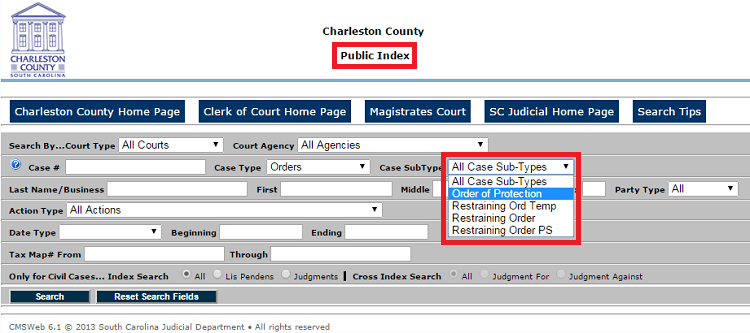
Restraining orders, what’s more, are no less permanent public records than charges of “check fraud,” and these records may be conveniently accessed by the Internet. The “public index” for Charleston County, South Carolina, shows just how conveniently:

Appreciate that the (mere) implications of the (mere) phrase restraining order or protection order include stalking, “terroristic behavior,” battery, child abuse, and sexual assault.

Finally, consider that petitions for restraining orders—which may cost men and women their jobs, security, and access to children, pets, home, and property—may be ruled upon by people whose educational credentials are nothing more than a high school diploma or a degree in library science, and that highly prejudicial and prejudiced restraining order rulings are available for public consumption (by defendants’ friends, associates, students, patients, employers or employees, loan officer, landlord, etc., etc., etc.).

Anytime and for all time.

Copyright © 2015 RestrainingOrderAbuse.com

*The story cited above was killed after it was quoted in this post. Here is a story about magistrates in Pennsylvania. Its reportage is similar.

In Perspective: How to Look at Restraining Order Judges Neutrally

It’s hard not to hate judges who issue rulings that may be based on misrepresentations or outright fraud when those rulings (indefinitely) impute criminal behavior or intentions to defendants, may set defendants up for further (or serial) malicious prosecutions by the same false accuser (and possibly land them in jail), and may finally inflict severe privations, including loss of income, employment, and/or access to children, pets, home, and property.

It’s especially hard not to hate judges when you’ve told them the truth, pronounced it politely and respectfully, and nevertheless been scorned, humiliated, and demeaned…with gusto.

Judges tend to be hubristic, condescending, and willfully menacing (even when they’re smiling at you).

To compound the outrage, it’s only their station that licenses their haughtiness. More often than not, their authority doesn’t come from learnedness in the law but is simply a perk of the job.

Though there have been some motions in recent years to amend this situation, most bottom-rung judges who issue restraining orders aren’t qualified lawyers, that is, they don’t have law degrees. They were just elected or appointed to the position and sent to “judicial boot camp.” Judges are trained to execute specific duties; they’re not necessarily educated in jurisprudence.

Some have no education beyond high school.

This may either be a reason to resent them all the more for their audacity or a reason to see them as mere tools of a system that conditions their bigoted behavior. Restraining order judges are told—possibly quite explicitly—how they’re expected to rule. That’s a significant part of their “training.”

This hardly excuses conduct that obviously contravenes judicial ethics. It does, though, make that conduct understandable.

Certainly judges aren’t to blame for the state of things, including the shambles they unjustly make of people’s lives. They don’t level the allegations, nor do they formulate the rules, draft the laws, or influence the political and public opinions that do determine rules and laws.

Sure, judges of conscience could vocalize qualms or defy the system. They could martyr themselves for principle. Whether this would effectively alter the status quo, however, is debatable.

Remember, they’re not legal scholars, by and large; they’re just referees who’ve had certain priorities impressed upon them. It’s not theirs to comment on the laws—and being unqualified to do so, they may genuinely believe they’re acting righteously.

There’s no particular reason not to hate judges if one or more have wronged you. If you step back, though, you’ll see that they’re more like ants that bite because they’ve been tasked with defending the colony according to certain marching orders than they are like people we should reasonably expect to treat us with dignity and charity.

Judges are often power-corrupt—it comes of sitting above others who must kowtow to them—but they’re basically people doing a job they may be scarcely better equipped to do than you or I.

Copyright © 2015 RestrainingOrderAbuse.com

On “Restraining Order Conspiracy”: Why Judge-Plaintiff and Judge-Attorney Collusion May Have More to Do with Judicial Ignorance than Complicity

The last post posited that the snarky zinger often aimed at teachers applies at least as aptly to the court: Those who can’t do, judge.

Conclusions in that post were inspired by conversations I had this week with a client, a former criminal defense attorney who began his legal career in the county prosecutor’s office. He impressed upon me that lower-court judges’ legal credentials ranged from inexperience to no education in the law whatever.

He told me that judges often called him to get clarifications of legal niceties.

I’ve been in procedures in both my county’s “justice court” and superior court. In each, I represented myself. If you’ve been the defendant in a restraining order trial (and possibly one or more trials that devolved from allegations on a restraining order petition), see if your experience didn’t correspond with mine.

My impression of the judge’s conduct in the restraining order hearing I was granted was that he grasped at whatever he could to justify the court’s preliminary findings. He didn’t “negotiate” the facts; he chose ones that could support the conclusion he preferred.

Similarly, in cases before the superior court in 2010 and 2013, in which I was self-represented and my accuser had an attorney speak for her, the judges basically did whatever her attorney told them they should: monkey see, monkey do. In each trial, it was like watching a puppet show. The judges, in instances, even parroted back the attorney’s language in their rulings.

At the time, I just assumed the whole process was fixed (i.e., bent as a papier-mâché flagpole), and I know from hearing many other people’s stories of similar travesties that they left the courtroom feeling the same.

What I realize now, though, is that the reason judges acquiesce to attorneys and seem to echo whatever they say like ventriloquists’ dummies is that they’re glad to be told what to conclude and how to justify that conclusion. The record doesn’t have to withstand much scrutiny—few people actually take such cases to the high courts; its “findings” just have to be persuasively plausible.

Instead of having a healthy skepticism and suspicion of attorneys’ (and plaintiffs’) motives, arguments, and testimony, judges aren’t confident enough in their own knowledge and powers of discernment to challenge them.

As my client, the former attorney, derisively says of judges, “They’re umpires” (spectators). They don’t “find” anything but what’s handed to them.

If bottom-rung judges only ruled on traffic citations and officiated over marriages—which is all some of them possess the proper qualifications to do—this wouldn’t be a big deal. When, however, they indefinitely impact futures (or void them) because their “civil” rulings impute criminal behavior to defendants (possibly based on nothing or on lies), this is playing fast-and-loose with people’s lives.

Copyright © 2015 RestrainingOrderAbuse.com

Diddly: What Judges Who Issue Restraining Orders May Know about the Law

I should go back and edit out whatever grudging credit I’ve given to judges for their knowledge of the law in posts past. It turns out that if you’ve been calling the guy or gal who issued you a restraining order—and then scorned and humiliated you when you tried to defend yourself—a “clown,” a “petty tyrant,” or a “mouth-breathing wannabe,” you may have better grounds for your assessment of his or her character and qualifications than you imagine.

A client I talked with this week, a retired criminal defense attorney who started out as a county prosecutor, set me straight about what legal credentials are required to ascend to a seat on the court’s lowest tier in my home state of Arizona.

None. At all. These “judges” don’t have to know jack about the law.

Arizona isn’t known for progressivism, of course. We still have “justices of the peace.” On the other hand, so, too, do New York and the United Kingdom.

The majority of JPs (or “magistrates,” as they’re sometimes called) aren’t qualified lawyers, that is, they don’t have law degrees. It may be the case, what’s more, that bottom-rung municipal and county judges in many or most places are laypeople whose only grounding in the law may be a bit of mandated “judicial training.”

(When I was a graduate teaching assistant, I was required to meet with a panel of professors once a week for a “colloquium.” The point was to familiarize up-and-coming professors with what the business of professorship entailed. I’ve witnessed no evidence that “judicial training” is any more intensive than this was.)

Restraining orders, it should be noted, may issue from a diversity of courts. Their typical sources, however, are judges at the dirt end of the totem pole, the same people who hear traffic cases and officiate over marriages for tips (they can make, incidentally, $100–$200K, depending on the size of the jurisdiction they preside in and the docket it generates). All that may distinguish JPs or their equivalents from anybody else (excepting their lavish salaries) is that they got elected or appointed to office. In Arizona and places elsewhere, they’re minor politicians, like schoolboard members and city councilmen and -women.

(In 2014, nearly 50 JPs elected in my state of Arizona ran unopposed; they didn’t even have to be good politicians to “earn” their judicial posts. Amusing story: In 2011 or 12, after I’d just started writing about procedural abuses, I chanced to bump into a friend from the University of Arizona English Department. She hollered at me across the parking lot of a public library. It happened that she was dating a judge and wanted me to sign her boyfriend’s petition for reelection. He seemed like a nice guy—I’d never met him before—and I didn’t think twice about lending my support and shaking his hand. I only realized as I was driving away that he’d been one of the four judges involved in my own case in 2006. I made the connection because his promotional gimmick was a chip bag clip with his name embossed on it. It’s probably still in my truck somewhere under the string cheese wrappers.)

All this is to say that the “reverend pontiffs” we’re required to bow and scrape to when we appear in court (“Yes, Your Honor!”) may have been former McDonald’s shift managers. These are the same guys, mind you, whose offhand judgments may spur protracted domestic wars whose financial tolls can run to the five or six digits (and ruin families)—and that’s besides the thousands or tens of thousands that serial litigations (from one couple) may cost the taxpaying public.

(“Can I interest you in a large drink to go with your order?”)

Rulings by these men and women, who may have no collegiate training in the law, may moreover drive some defendants to commit suicide or to do violence to others.

(“You wanna supersize that?”)

Several people who’ve registered complaints about restraining order decisions on this site have J.D.’s—law degrees—and are or were licensed attorneys. (Larry Smith is a former lawyer who’s been subject to and who blogs about restraining order and other procedural abuses.) As if the restraining order process weren’t already a sham owing to the slack standards authorized by lawmakers, the mere minutes-long (“drive-thru”) hearings, and the preferential treatment shown to plaintiffs, the process is also administered by folks who may have less background in the law than the people they pronounce judgment upon.

This isn’t to say these guys don’t know “the rules” and what the statutes say. There’s more, though, to the law than laws. You or I could learn those with a few nights of study. The point is they may have no footing in the principles of jurisprudence or have ever taken a freshman level course in legal ethics. All they may know is what they’re “supposed” to do.

(“Does everything look right on your screen?”)

Judges higher up the ladder, like superior court justices, do have to have degrees and must have passed the bar, according to the former lawyer I talked with this week (for whom I removed an aged tree with hands I’d meant to do other things with—I did also offer to help him with a book he’s writing). But even superior court judges need not necessarily have practiced the law significantly before assuming a position on the bench. It’s sort of like naming a greenhorn architecture professor to be the foreman of a construction site.

The snarky zinger often aimed at teachers applies at least as aptly to the court: Those who can’t do, judge.

Not only did my client (the former lawyer) opine that some judges were “complete idiots”; he felt some of them weren’t even sane (and he named names, which I have to be cautious about doing). “God,” I said, “it’s like the Wild West.” He agreed.

Copyright © 2015 RestrainingOrderAbuse.com

*To make matters more shameful yet, restraining orders may be issued by judges pro tem—temporary help hired by the court to cover for JPs or their ilk. These courthouse temps may have no judicial experience (and no particular investment in doing their jobs well). The restraining order this writer was issued in 2006, which had been petitioned by a married woman who hung around his house at night in 2005 (minus both her husband and her wedding ring), was approved by a judge pro tem. On appeal, the order was determined by a JP to have been “incorrectly issued,” because the woman had included her husband on the order (her motive for the order was plainly to have me prohibited from speaking to him). The judge, who had a black cowboy mustache that screamed dye, ruled to affirm the order despite its sketchiness after he “allowed” me to testify for 15 minutes. What a guy. (In conversation with the client I’ve mentioned in this post, I was told he’d ironically helped to get this particular judge elected. He shared some gossip with me, too. He said the man liked to tell people he was a former member of Special Forces. My client quipped he was probably the cook. Not long after I stood before him in 2006, “Judge Commando”—who had declared during my hearing that he considered his courtroom the “last bastion of civilization”—was nominated to head up my county’s domestic violence court. Who better to sensitively negotiate disputes that fracture families than a fella who fancies himself Rambo? As you might guess, he’s very popular with female plaintiffs.)

Talking Back to Restraining Orders Online: What the First Amendment Says Is Okay

“If someone puts a restraining order on you, can you write about it online?”

—Google query that brought a visitor here recently

Here are some other search terms that led people to this site last week: “lying to obtain a restraining order,” “false cps reports perjury,” “fake rape restraining order,” “restraining order lie,” “falsely accused of molestation […],” “ex lied on order of protection,” “what happens when a bogus pfa is filed on a police officer[?],” “protection order fraud,” “old restraining order keeping me from coaching,” “ex-girlfriend lied about domestic violence and i lost my career.”

You see why people might be inspired to talk back.

I was introduced last year to how the constitutionally guaranteed right to free speech is qualified. In Chan v. Ellis, an appeal before the Georgia Supreme Court that was brought to my attention, First Amendment privileges are spelled out by two prominent authorities who offered opinions on the case, Profs. Eugene Volokh and Aaron Caplan (the latter a former staff attorney for the American Civil Liberties Union). Their amicus brief opposed the trial court’s issuance of a permanent protection order against Matthew Chan (the appellant) on the grounds that the order exerted an unconstitutional “prior restraint” on Mr. Chan’s lawfully writing about his accuser, Linda Ellis, a self-styled motivational speaker/writer whom Mr. Chan had criticized as a “copyright troll” (someone who threatens to sue people for unsanctioned use of his or her original material).

The First Amendment protects the right to speak about people, so long as the speech does not fall into an established First Amendment exception (such as those for defamation or for true threats). This includes the right to speak about private figures, especially when they do something that others see—rightly or wrongly—as unethical.

Succinctly, the First Amendment licenses a person to write about another, including critically, but not necessarily to write to him or her. In other words, you can say things about a person that s/he doesn’t necessarily want to hear; if you say those things to the person, you could be lawfully restrained by the court from continuing.

About a person is okay; to a person may not be.

Qualifiers are that what you say about someone publicly must be true (you can’t lie about someone, i.e., defame him or her), you must not infringe upon his or her privacy (e.g., by revealing his or her medical history), and you must not threaten him or her (i.e., don’t say, “I’m coming to kill you”).

Otherwise, the Constitution says you’re good.

Can a trial court judge, though, blow off the Constitution and come down on you for criticizing someone who obtained a restraining order against you (even by fraud)? Yes, s/he can. Rightly or wrongly, it happens, and lawful has nothing to do with it. Restraining order rulings and those peripheral to them are largely about spin.

(What do I mean by spin? Literally, words—actually expressed or merely alleged—can be represented to and by the court as “harassment,” which may satisfy a state’s statutory definition of “stalking,” which definition may imply sexual molestation. Alleged statements, then, may effectively implicate someone as a sex offender on public record. I wish I were kidding, but I emphatically am not. In a case I recently reviewed, the defendant was said to have committed harassment by “facial gestures.” This exemplifies spin.)

This writer’s thoughts are these:

  1. If you’re presently under a restraining order, exercise informed caution, because anything you say publicly that can be construed as “harassing” may well be interpreted that way by a lower tier judge (these guys are answerable to no one; they do what they want). These posts are about people who were issued restraining orders or show cause orders simply because they wrote about someone: “Restraining Orders and the First Amendment: A Female Blogger’s Successful Appeal of a Restraining Order That Labeled Her a ‘Cyber-Stalker’” and “The Use of Restraining Orders to Bully Women: Jenny’s Story.” Is a judge likely to throw you in jail for merely speaking about someone? No, but there’s no surefire guarantee. What’s strictly lawful and what’s possible are two different things.
  2. There are constitutional grounds to appeal a judgment against you for simply writing about someone. The questions to ask yourself are: How committed are you? Are you up for more court drama? The Constitution is on your side, but reversing a bad judgment requires appealing it to a higher court.
  3. If a restraining order against you has expired, and what you write isn’t false, invasive, or threatening, then you have a strong basis for opposing any further legal action taken against you so long as what you write is about your former accuser and not to him or her (or anyone associated with him or her).

I was sued for writing about someone, and I wasn’t trying to “tell my side”; I wanted to terminate a nasty hoax that had already consumed years of my life. I speculated about my accuser’s motives, and I used a lot of names. I also reported what I knew to be misconduct and applied to a distant family member of my accuser’s (a pastor) to help me effect a resolution. Had I only written in a blog and had I confined what I wrote to facts that couldn’t be represented as invasive or libelous, the court may not have found for my accuser, particularly if I’d had a lawyer to speak for me.

The point of this post is to inform you of your legal rights, and to assert that purveyors of the truth should never have to hide or censor themselves. This is the United States of America, not North Korea. It is not the point of this post, however, to downplay the eagerness of the American court system to deny citizens their rights. If judges weren’t ready and willing to violate citizens’ constitutional entitlements, this blog wouldn’t exist in the first place.

Copyright © 2015 RestrainingOrderAbuse.com

“She Said That I Had Been Burning Him Intentionally and That I Had Kidnapped Him”: Aaron’s Story of Restraining Order Abuse

The account below was recently submitted as a comment to BuncyBlawg.com, a site I’ve mentioned in several recent posts. Its administrator, Larry Smith, a former attorney, has been waging a one-man war on corruption excited by his relentless persecution through and by the legal system since 2011.

Aaron’s story is one of a spiteful ex-partner whose false allegations orbit popular themes: fear, emotional torment, stalking, and other (unprovable) crimes and misdemeanors that become more sensational and incriminating over time.

What makes Aaron’s story exceptional is that it has a reasonably happy ending, because the court saw through the lies.

In Aaron’s own words (lightly edited):

In my accuser’s affidavit, she repeatedly used “deathly afraid” and spoke of the medications she was on due to three years of stalking by me, vicious verbal abuse of herself and her family by me, and my stalking her where she works, shops, and lives. She claimed to have video surveillance of me following her into a grocery store. She even claimed to have a police report where I was “caught” sitting behind her home at 10 at night, etc.

She was granted an ex parte restraining order lasting two years.

Of course, none of it was true, none of her evidence existed, and the family that I had supposedly verbally abused didn’t even come to court. There was no police report, nor was there a surveillance video, because I didn’t have time to subpoena it; and had she brought the video, it would’ve shown her following me into the store she knew I was going to be at because I told her I was going to get groceries there at an exchange of our son. Had this video been brought to court, it would’ve conflicted with her affidavit.

On top of all of that, I brought in three copies of 40 pages that had every text message we had sent to each other for the previous two years in chronological conversation format. In these texts, two months prior she was inviting me into her home for “dessert” and asking to borrow money from me. Six months prior, she offered to loan or sell me her other car because I was having mechanical problems with my Jeep. These and other very common things. The texts also contained many instances of very immature ranting and attempts to create animosity and intensify disagreements into arguments, which I never fell for and always just said what needed to be said for our son’s sake. I never cursed or belittled her, though to someone like this the truth hurts.

After several hours, the judge shut the whole thing down, dismissed the order, and gave her a stern lecture. All this and no charge of perjury against her! One week later, she was granted an ex parte OFP on behalf of our then three-year-old son by a different judge in the same county! Same style of affidavit.

She said that I had been burning him intentionally and that I had kidnapped him.

He did have a burn about half the size of a pea on his finger, because he had touched a hot pot on the stove. I didn’t kidnap our son. She didn’t show up to pick him up! Since she was issued an OFP on behalf of our son, she was then afforded the services of a battered women’s and children’s center. She signed me up for psych evals and supervised visitation only with our son. Her instructions to law enforcement in her application were to arrest me for kidnapping and return her son to her.

Once again I proved the entire thing to be a lie. It was dismissed entirely. STILL NO CHARGES FILED AGAINST HER FOR PERJURY! Just stern words from a judge toward her and even a bit directed my way in that the two of us needed “to learn each other’s triggers and steer clear of conflict that needed to be sorted out by the courts”! I had to share custody with her for two more years and attempt to co-parent with her.

Our son is six now, and he lives with me and goes to her every other weekend. I had to use kindergarten as a guise to change our custody agreement. Although I am very thankful the courts named my home as our son’s primary residence, the court’s impotence to prosecute liars and the horrifying parenting that has to take place before they’ll change rights are despicable! I do think it is far worse to be a self-consumed person than to be a target of one, though. Karma is on our side.

This blog definitely gave me great insight into other people’s struggles outside of my own and opened my eyes to some of the types of people who abuse the system. I never could’ve imagined how easy and common it is until it happened.

Copyright © 2015 RestrainingOrderAbuse.com

Cross-Examination: Yet Another Way the Deck Is Stacked against Restraining Order Defendants

Perusing the trial transcript of a North Carolina man, former attorney Larry Smith, forcefully brought something to my attention last week, namely, that cross-examination can make or break a defense.

Larry extricated himself last summer from the latest of an endless series of fraudulent complaints and prosecutions brought against him by a vexatious litigant—this trial revolved around his criticizing her in his blog (besides allegedly “cyberstalking” his “victim” by tapping her phone and hacking her computer)—and how he exonerated himself was by probing her fictions while she was on the stand, and exposing them for what they were (this despite being tag-teamed by multiple county prosecutors and being hustled along by the judge).

Prior to Larry’s being given the chance to cross-examine the prosecuting witness, the smell of cooked goose pervaded the proceeding. What his example shows is that having the chance to question the witness against you may make the difference between victory and the coffin—or at least the curb.

The opportunity to question the plaintiff in a drive-thru restraining order trial in which it’s presumed s/he’s deathly afraid of you is all but stifled (and in some instances, a plaintiff doesn’t even have to show for court, because the accused is represented as an “imminent danger”). Putting questions to the plaintiff may be permitted by asking them of the judge who in turn asks them of the witness. Judicial patience being none, the impediment this protocol presents is obvious—as are the railroad tracks.

Copyright © 2015 RestrainingOrderAbuse.com

*Of his own restraining order case (the petition of his accuser’s that stuck—she filed two), former lawyer Larry Smith, who’s mentioned in the introductory paragraph, says: “I was not allowed to cross-examine [my accuser] in the RO hearing. I got kangarooed every step of the way. Every time I tried to ask a leading question, the judge would interrupt me and yell out, ‘Ask a question.’ It was a bit of a nightmare, a madhouse, and even when I managed to get in a jab, the witnesses all huddled with the judge and would refuse (with her blessing) to answer them. The rules of evidence, honesty, fairness, confrontation, the right to probe the witness on her contention of ‘substantial emotional distress,’ the presumptions of innocence, equal protections of the law, and burden of proof—all were tossed out the window like trash.”

If You’re Silent, You’re Guilty: Take a Page from the Feminist Playbook and Register Your Complaint

It was impressed upon me by a new mentor—who possesses a much more practical mind than mine—that I don’t want to still be writing about this stuff when I’m old and gray (and that, besides, if I keep trying to “make a difference” by myself, “old and gray” will be just around the corner).

What these statistics reflect is that (1) confusion about restraining orders, if not fraudulent abuse of restraining orders, is epidemic; and (2) complainants of procedural abuses are intimidated into silence. No one wants to own humiliating or demonizing accusations against him or her, even if they’re false. This is, perhaps ironically, why fraudulent abuse of process continues unabated: Too few people talk back, so no one in a position to reform the status quo realizes there’s a problem in need of urgent remedy.

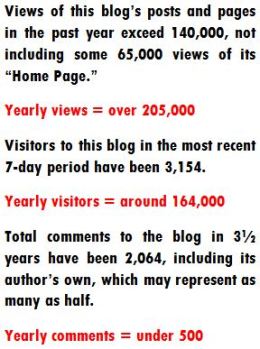
In the week leading up to Friday the 13th, 2015, WordPress reports that over 3,000 people visited this site (a few of them probably the same people on different days, but nevertheless…). Of that 3,000-plus, maybe 20 left comments or responded to petitions this site links to.

Maybe.

To one of the people who did submit a comment, a woman who was charged with assaulting her husband because she inadvertently scratched his arm while she was appealing to him to be nicer to her (during a verbal attack), I remarked that more people need to speak up about what they’ve been put through.

This woman, Izabella, has a restraining order against her, based on “all sorts of allegations,” that she reports her husband got to dominate and control her (to bully her, plain and simple). She says he’s never been an “involved dad” but uses their children now to “blackmail” her, because she had the temerity to “stand up to him.” The kids are pawns in a petty power game.

This is the kind of thing feminists deny happens (and adamantly deny happens to men). They insist restraining orders are there to protect women like Izabella.

Feminists are often wrong but never uncertain.

Their rigid advocacy is actually what makes scenarios like this possible, and for that reason, among others, I seldom find cause to sing their praises (though I’m not closed to the idea). One of their constant refrains, however, that victims will only speak up if they feel confident they’ll be believed, is right (and it’s why restraining orders exist to begin with).

Victims of procedural abuses need to speak up so that others will.

Respondents to this blog don’t need to identify themselves; they don’t even have to provide their email addresses if they don’t want to, though that information isn’t made public and allows them to be notified of others’ responses to their comments. It also lets them have dialogues among themselves.

Provided everyone plays nice, this writer is glad to take a backseat. (He’s been informed that nothing anyone else says is his responsibility, anyway.)

“Outing” yourself isn’t necessary, per se, to motivate change. But the public only understands what it sees and hears. If it sees and hears nothing, then that’s exactly what it will understand.

Copyright © 2015 RestrainingOrderAbuse.com

Inciting Violence: If Lawmakers Require a Compelling Motive for Restraining Order Reform, How about This One?

I examined a case, recently, of a man’s committing murder hours after being accused to the police. My familiarity with the case was, admittedly, shallow; I only had what was reported to go on (and that from a single, “raw” source). I have, however, heard from scores of people who’ve been accused—or scorned for telling the truth—in drive-thru restraining order proceedings, and expressions of fury have been more than a few.

This week, I shared an email by a highly educated, professional woman and mother of three young children that expresses an “almost homicidal enmity” catalyzed by procedural abuses. Note the elevated diction she uses to describe an impulse to bash, throttle, and gouge. Does her vaulted language indicate she “doesn’t really mean it”? No, it indicates how alien rage is to her character. It indicates she’s someone who shouldn’t have cause to feel this way.

Consider: How is it the police and the courts recognize the propensity for violence that interpersonal conflicts mediated by the “justice system” may arouse, but lawmakers don’t? Are they that “in the dark”?

Yeah, pretty much.

If you get into a spat with your neighbor, and the police intervene, parties are separated into corners. In court, complainants even merely of “fear” may be shielded by law officers in anticipation of a judicial ruling. It’s understood that emotions run hot in this theater.

Why, then, is it not appreciated that when the basis for rulings is false, the risk of violence is not only higher but infinite?

We like our games, and we like our fictions about how people should be and should feel and should react even if you trash their lives maliciously. Hey, we’re disposed to remind, it’s the law.

All well and good until somebody gets an ax in the ear—an edgy remark, maybe; honesty often strikes us that way (i.e., like an ax in the ear).

The wonder is that more people who lie to the courts don’t meet premature ends—or at least sustain some anatomical remodeling. False accusations, which have inspired a great deal of sententious deliberation in recent months, don’t just “discomfort” people or make them “justifiably [and transiently] angry.” At the risk of being edgy again: People who haven’t been falsely accused in a legal procedure don’t know what the fuck they’re talking about. I was collegiately trained as a literary analyst—I’ve studied and taught Victorian literature—and I’m normally more disciplined in my remarks, but this subject rebukes gentility.

Liars maim. That they do it with words in no way mitigates the brutality of the act or its consequences.

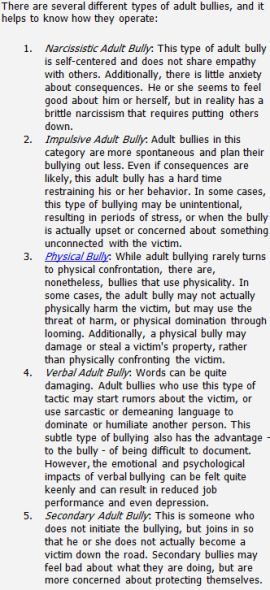
One would think that as people mature and progress through life, that they would stop behaviors of their youth. Unfortunately, this is not always the case. Sadly, adults can be bullies, just as children and teenagers can be bullies. While adults are more likely to use verbal bullying as opposed to physical bullying, the fact of the matter is that adult bullying exists. The goal of an adult bully is to gain power over another person, and make himself or herself the dominant adult. They try to humiliate victims, and “show them who is boss” (BullyingStatistics.org, “Adult Bullying”).

StopBullying.gov defines bullying as including name-calling, taunting, threatening, spreading rumors about someone, and embarrassing someone in public. Falsely labeling someone a stalker, child abuser, violent danger, or sexual deviant in one or more public trials whose findings are impressed on the target’s permanent record and are accompanied by menacing threats (if not immediate punishment) plainly qualifies. Among identified effects of bullying are suicide (“bullycide”) and violence, including murder. “Extreme emotional disturbance” is a defense for murder in some states (a finding that doesn’t excuse the act but does lighten the sentence), and a related murder defense is “provocation.”

Sure, character assassination is bloodless. What of it? If I circulate lies about someone and s/he snaps, I’m a bully, and I had it coming. Few people would say otherwise.

Ah, but if I lie and use the law as my medium to insult, demean, badger, intimidate, or otherwise persecute—hey, that’s different. I’m the “good guy.”

So suck it. And keep on sucking it, because the public record says my lies are the truth. Neener-neener.

A system that represents its purpose to be the curtailment of violence shouldn’t be promoting it by pandering to bullies, even “unofficially,” and its officers shouldn’t be serving as those bullies’ lieutenants and enforcers. If the system makes it easy to lie about and humiliate people, doesn’t hold liars accountable, and furthermore punishes the falsely accused based on lies, then it’s promoting violence.

This shouldn’t require social science research to corroborate. It shouldn’t even require this analyst’s observation.

Copyright © 2015 RestrainingOrderAbuse.com

“On the Receiving End of a Sociopath’s Lies”: A Professional Mom’s Story of Restraining Order Abuse

The following account is reproduced almost verbatim from an email of recent vintage. Its writer is a professional woman and single mother of three with whom I corresponded last year while she was embroiled in strife—legal, medical, and emotional (a synergy of torments that’s been reported here before). The capsule version of her story is that she was in an abusive relationship (including violently abusive), sought a restraining order, which was dismissed on appeal, and then was issued an order petitioned by her abuser, which she reports was based on fraud, and which was nevertheless upheld despite her appealing it. She brought criminal charges, also. Her abuser smoothly extricated himself from those, too. The victim of assault is the one with the “restraining order” on her permanent record. She asked that I not use her name because she’s “terrified of  the possibility of repercussions.”

In her own words, which more poignantly express the psychic trauma of procedural abuses than any I’ve ever read:

My active involvement with my sociopath has, mercifully, ended.

[H]e refused to accept a plea deal, he took his assault case to a jury trial, and he was found not guilty by a jury of his peers. His lies were, apparently, more believable than my truth, or, best case, the jurors didn’t really believe him but couldn’t find him guilty beyond a reasonable doubt. Either way, it doesn’t matter. I’ve seen enough of the court system to learn that the truth is completely immaterial, and that the officers of the court will consistently choose the “easy” ruling over the one that is true. If the matter before them requires some thought, some extrapolation, some reading between the lines, and/or some backbone, forget it. The truth will be jettisoned faster than a grenade with its pin pulled.

I don’t really know how to describe how profoundly my brushes with domestic abuse/restraining order abuse/generalized legal abuse have affected me. In a few short months, a year will have passed since the criminal trial against my abuser took place. Four years will have passed since the whole odyssey began on Easter of 2011, when I walked into the police station and reported my abuser’s attack after agonizing overnight about whether or not I should do so. Imagine that—agonizing overnight about whether or not to report a crime! On some level, I must have known even then how very awry it all could go.

Let me just attempt to put this into perspective: I have lived through my parents’ divorce. I have boarded an Amtrak train headed for New Orleans at 16 years old in an effort to escape a miserable childhood. I have been scarred by the shame of being a high school dropout and then gone on to receive a college education. I have experimented with more drugs than I can count on two hands. I have traveled all over Europe with little more than a backpack and a few pfennigs. I have been robbed at gunpoint while working third shift in a Shell-Mart in Anniston, Alabama. I have scuba-dived off the coast of Honduras. I have watched my stepmother fight to regain pulmonary function after she was stabbed by a purse-snatching punk in the alley behind her home in Washington, D.C., only to watch her die an agonizing death from lung cancer fifteen years later. I have held a lion cub in my arms. I have lain helplessly in a hospital bed as not one, not two, but three premature babies were whisked from my body and transferred straight into the NICU. I have survived breast cancer, and then my mother’s untimely death from a hospital-acquired infection four months after my diagnosis. I have been sliced and diced and blasted by radiation. I have been exposed to, and treated for, tuberculosis. I have lived through bacterial meningitis and undergone a blood patch procedure after a botched spinal tap. I have been resuscitated with Narcan after being given too much IV narcotic during an acute episode of kidney stones. I have skydived over the Newport, Rhode Island coastline. I have loved multiple dogs and cats and then held them in my arms when it was their time to leave this earth. I have fought for my children and for myself against a relentlessly bitter spouse during a contentious, protracted divorce.

Not one of those things has affected me as deeply as being on the receiving end of a sociopath’s lies, and the legal system’s subsequent validation of those lies. There is no “coming out the other side” of a public, on-the-legal-record character assassination. It gnaws at me on a near-daily basis like one of those worms that lives inside those Mexican jumping beans for sale to tourists on the counters of countless cheesy gift shops in Tijuana.

I have sort of moved on; I mean, what else can one do, particularly when one has young children? But the horror, outrage, shame, and, yes, fury engendered by being wrongly accused by a perpetrator, and then having that perpetrator be believed, chafes at me constantly. Some things born of irritation and pressure are ones of beauty, like a pearl, or a diamond, but not this. This is a stoma on one’s soul—it never heals, it’s always chapped and raw, and if you’re not careful, it can leak and soil everything around it.

These days, when sleep escapes me, which seems to be fairly frequently, I often relive the various court hearings associated with this shit show. One is the court hearing for the restraining order that my abuser sought against me (and which was granted) based on his completely vague, bullshit story that he felt “afraid” of me—this from the beast that had assaulted me on numerous occasions, slashed my tires, and had a documented history of abusing previous girlfriends. Another is his trial for assault and battery, during which I was forced to undergo a hostile, nasty, and innuendo-laced cross-examination by his scumbag defense attorney in front of a courtroom full of strangers. But the hearing that really gnaws at me and fills me with an almost homicidal enmity for the judge overseeing it is the one where I was requesting a restraining order against my abuser, this after a particularly heinous assault in the days following my cancer diagnosis and my partial mastectomy.

That judge apparently believed my abuser’s bald-faced, self-serving, and absurdly improbable lies over my detailed, accurate, and horrific account of his behavior immediately following my surgery. That judge believed that a well-dressed, employed, and reasonably intelligent woman would drag her ass to court a week after a life-threatening diagnosis and major surgery just to harass her blameless ex. My memory of the surreal, humiliating, and completely unexpected ruling that day, made even more galling by the judge’s proclamation that he found the defendant to be “more credible” than me, is as grievously harrowing today as it was then.

To say that I feel indignant about it would be an understatement. Take indignation, add a dollop of pain, some hefty pinches of fear, embarrassment, and hopelessness, and a heaping dose of fury, and you’ve got a toxic mix of emotions that, if I don’t actively squelch them whenever they surface, could blow the top of my skull clean off. No amount of therapy can mitigate this particular affront; I’ve learned that the best I can hope for is some measure of containment. Kind of like radioactive waste.

foreverI will have that prick’s bogus restraining order on my record today, tomorrow, next week, and on and on into perpetuity. I am a licensed professional whose employers require a full background check prior to being hired. I honestly don’t know how that restraining order was missed by the company that my most recent employer contracted to perform my pre-employment vetting. I live with the ever-present dread that someday, someone will unearth the perverse landmine that my abusive ex planted in my legal record, and that dread hasn’t lessened one whit since the day the restraining order was granted.

I understand that the existence of a past restraining order can be a valuable red flag for the police when dealing with domestic abusers and stalkers. Most domestic abusers are repeat offenders, so prior bad acts can help to establish a pattern that law enforcement should be aware of (though, confoundingly, these same bad acts are not admissible during any trial). Even though I’m not necessarily comfortable with the existence of a permanent registry of all restraining orders—both those that are sought and those that are actually granted (which, as you know, is what currently exists)—what I’m not comfortable with is that this information is available not just to the police, not just to other governmental agencies, but to the public at large! My height and weight taken while at the doctor’s office are protected by law. A hospital cannot disclose if I was treated there for a sore throat. But an inflammatory, defamatory, embarrassing, unsubstantiated, and oftentimes false restraining order affidavit can be obtained by whoever strolls into a courthouse and requests a copy from the clerk.

I don’t believe this registry will ever be abolished, because restraining order abuse isn’t “sexy” and no one thinks it could ever happen to her, but can we at least limit who can access this information and the circumstances under which they can access it? It’s mind-boggling to me. It’s just so goddamn devastating to the people who are unfairly stigmatized, and, call me pessimistic, but I don’t think these casualties will ever have a voice.

[Today] I’m working full-time at a job that I basically enjoy, and my three children are flourishing. I no longer feel that I am defined by my intensely negative experiences with my abuser and with the legal system, or that my life is being hijacked on a daily basis. I go days at a time without any of this crossing my mind. To say that I have “gotten over it,” though, would be a lie. A piece of me was lost because of this, and an emotional fissure was left behind, that, from what I can tell, simply cannot be fixed or ignored. My only succor is my halfhearted hope that karma is, indeed, a bitch.

Copyright © 2015 RestrainingOrderAbuse.com

Games That Kill: Sex, the “Justice System,” Accusal, Restraining Orders, and “the News”

“‘She likes playing the little mind games too,’ he remarked. ‘She’s not quite as innocent as she makes it out to be.’”

—A Texas man to the police, 16 hours before he killed his girlfriend and himself

The headline reads, “Texas man threatens girlfriend 7 times in a month, then kills her hours after she begs police for help.” The story, however, isn’t so cut-and-dried.

According to Raw Story reporter David Edwards,

33-year-old Heather Coglaiti went to the Corpus Christi Police Department (CCPD) to report that her on-again-off-again boyfriend, José Calderon, had threatened to hurt her, and had slashed her car tires.

While Coglaiti was speaking with officers, Calderon called her cellphone, and he agreed to come in to the station to give his side of the story.

That was February 2, 2015. Coglaiti and Calderon were dead less than a day later. Evidence confirms Calderon shot her, then himself.

“CCPD records showed incidents between the couple going back to January of 2014—including seven death threats and other incidents last month,” Raw Story reports.

It also reports these statements made by Mr. Calderon to the police on the 2nd:

“We’ve done this a lot through the whole two years. We go back and forth, we’ll fight like this and she knows I won’t punch her but she punches the hell out of me in the face and she’ll bite, do whatever,” he said.

“She said, ‘I’m so scared you’re gonna kill me,’” Calderon admitted during the interview. “I’ve never said that out of my mouth.”

“Never do I ever threaten this lady. Never,” he insisted. “I don’t know why she says this and that.”

Raw Story relates the facts, and it relates them almost as a news source should: objectively. Mr. Edwards, the reporter, might properly have said, however, of the “seven death threats and other incidents” (and earlier “incidents”) that they were “alleged” or “reported.” Plainly from Mr. Calderon’s statements to the police, he didn’t put any death threats on paper and sign them; he says he never made any at all. So “alleged death threats and other incidents” is what the journalist should have written (even at the risk of the story’s sounding less “raw”). The headline reports a “Texas man threatens girlfriend 7 times in a month, then kills her.” That the Texas man’s girlfriend is dead by his hand is forensically ascertainable, more or less; that the Texas man threatened his girlfriend seven times in a month is not.

This isn’t pettifoggery. Distinctions like this aren’t minor, and they betray how we interpret allegations: We believe they must be true. Objectivity, if not skepticism, though, is the journalist’s brief, not credulity.

Credulity is especially prone to kick in if it seems warranted by later circumstances, for example, a homicide. Nevertheless, there’s no tweezing out whether Ms. Coglaiti’s reports to the police were accurate, and there’s no knowing what influence they may have had on Mr. Calderon’s actions.

A murderer isn’t given the benefit of the doubt. Significantly, however, neither is anyone else. Accusations are taken at face value (particularly accusations of threats or violence made by women against men).

We discount the effect that allegation and scrutiny have on the mind, and discounting that effect may have cost a woman her life. Not only must it be acknowledged that “the system” failed to protect a complainant of fear; it must be owned that use and abuse of “the system” affects the mental state of the accused, as it may well have in this case.

It may be harsh to ask why a woman who had alleged she’d been threatened with death seven times in a month and who had reported other incidents to the police over the course of a year hadn’t relocated and changed her phone number. But the scrupulous thinker must wonder.

Dogma has it that it’s wrong to second-guess “the victim.” Who was or wasn’t a victim of what in this case, however, is probably something no one will ever conclusively know.

The scrupulous thinker must ask himself why a man who intended to commit murder would voluntarily submit to police questioning, and what might it suggest that he committed murder less than a day later?

Did he avert suspicion just long enough to carry out his fell plot, or was he pushed further than he could tolerate? One interpretation certainly jibes better with PC dogma. Is the former, though, really likelier than the latter?

Raw Story’s reportage ends:

At a press conference on Tuesday, CCPD officials said that they did all that they could do to protect Coglaiti under state and federal laws.

CCPD Criminal Investigative Division Captain Hollis Bowers explained that victims were often frustrated by the legal system.

“The law not only gives us authority, but it restricts our authority so the system works in a very methodical way,” Bowers said. “Victims need to understand that when [we] start to suggest that you leave your home or your job, it’s for immediate safety, not because the legal system needs that.”

He pointed out that an emergency protective order requires “a certain level of violence.”

“So a protective order can’t be—criminal mischief, for instance, will not reach a level where somebody can get a protective order,” Bowers noted. “It requires violence at a certain level. It is issued by a judge.”

Two things, finally, are worthy of remark. First, those who induce people to trust that “the system” may be relied upon to protect them from threat mislead them and may be to blame for harm they subsequently, if not consequently, come to. Second, if Mr. Calderon’s intentions were what they’ve been represented to be, the issuance of a “protective order” against him would probably have led to the same tragic end.

“The system” fails not because it isn’t stringent enough; it fails because the premises for its reasoning are bad.

Casualties like Ms. Coglaiti are eagerly offered up by advocates as corroborations that stiffer laws are required. The facts of her death and the value of her life are conveniently exploited, even as they’re conveniently forgotten.

Copyright © 2015 RestrainingOrderAbuse.com

Accusation of “Whatever”: How We’ve Forgotten What Restraining Orders Were For

In an offhand response to a comment yesterday, I remarked that restraining orders weren’t meant to provide people with a sense of security; they were meant to secure people from danger.

There’s a distinction, as I also remarked, and it’s been forgotten.

So entrenched an institution of law and so commonplace has the “restraining order” become that people assume that a foreboding or a feeling of unease or apprehension is grounds to petition one (and judicial performance in no way discourages this assumption and may reward it).

I’m even asked, earnestly, “Can I get a restraining order if she called me a bitch?”

My response, though it inclines toward skepticism, is nevertheless, “Who knows?” If a judge says, “Sure,” then the answer is, “Sure.” Whatever the judge says goes. Judicial latitude in these matters is boundless. Statutes may explicitly license the trial court to do “as it sees fit” or “as it deems appropriate.”

By this standard, people are removed from their homes. By this standard, people are denied jobs. By this standard, people are entered into public registries and prohibited from working with or around children and ever seeing their own.

This is how I lost my day-to-day stability to be a normal, reasonable, and gainfully employed person in the community’s eyes [comment submitted four hours ago].

What’s been forgotten is that the motive justification for an unarguably tendentious, superficial, and baggy procedure was real and immediate danger. Restraining orders were conceived as a quick fix to a problem that was both rampant and, more urgently, ignored 35 years ago. That problem was domestic battery.

Today, restraining orders are a quick fix to a new rampant problem: accusation of “whatever.”

Allegations of domestic violence are not today discounted by authorities, as they might have been in the 1970s and 80s, nor is making them scorned by the public as “talking out of church.” Sympathy is all but universal.

Not only, then, is the motive justification for an unarguably tendentious, superficial, and baggy procedure a relic of the past, but violence may not even be alleged in a majority of petitions.

I’ve been in close correspondence with a man who’s challenging the constitutionality of a restraining order against him that exerts “prior restraint.” He’s forbidden to talk about someone online—not temporarily but for all time. He’s been restrained, in other words, for speech acts he hasn’t committed.

In First Amendment law, a prior restraint is government action that prohibits speech or other expression before it can take place. There are two common forms of prior restraints. The first is a statute or regulation that requires a speaker to acquire a permit or license before speaking, and the second is a judicial injunction that prohibits certain speech. Both types of prior restraint are strongly disfavored, and, with some exceptions, generally unconstitutional [Cornell University Law School Legal Information Institute].

He’s appealing the trial court’s injunction on First Amendment grounds, and constitutional law is on his side.

Consider, though, that any number of restraining orders are issued on a similar basis. People are restrained not for acts that injured someone but for acts that possibly, perhaps, conceivably could indicate a potential intention to injure someone.

In criminal cases, judges have no reluctance about sternly pronouncing: “Speculation has no place in a courtroom.” Speculation, however, is the heart and soul of civil restraining order cases. Judges may “infer fear” based on the alleged actions of a defendant, and on this tenuously speculative basis, form a ruling whose consequences may exercise a profoundly negative influence on that person’s life.

In other words, people are punished not for things they’ve done, per se, but for things someone feels (or intimates) they might do.

The purpose of restraining orders was not to provide complainants of fear with a sense of security; the purpose of restraining orders was to secure complainants of injury from further harm.

Harm isn’t speculative. It leaves very visible traces.

Copyright © 2015 RestrainingOrderAbuse.com

*Since this post was published it has reportedly become possible for Minnesotans to apply for restraining orders online to prohibit, among other things, “repeated incidents of unwanted…gestures” (cf. the First Amendment).

RestrainingOrderAbuse.com Guest Post by Matthew S. Chan, the Appellant in a Restraining Order Case before Georgia’s Highest Court

Matthew S. Chan is the creator and administrator of ExtortionLetterInfo.com (ELI) and the appellant in the Georgia Supreme Court case Chan v. Ellis.

In my desire to give something back to RestrainingOrderAbuse.com (ROA) for the enormous help, contribution, and insights into my own protective order appeal case with the Georgia Supreme Court that it provided, I found myself a bit stumped as to what to write about that might be helpful and perhaps a bit different from the articles and commentaries I have read on ROA so far. So, if I make some wrong assumptions about ROA, please forgive me as I am a relative newcomer. As a disclaimer, I do not feel qualified to speak specifically on matters of domestic protective/restraining orders as they relate to divorces, custody fights, or other family disputes.  I feel those issues are highly volatile, and I don’t have the background to properly discuss them.

What I do feel qualified to speak on, however, are matters that pertain to the First Amendment, free speech, and that speech as it relates to online speech. Whether disputing parties are related or not, the First Amendment, backed by many significant rulings from the U.S. Supreme Court, makes it clear that everyone in the U.S. (including murderers, rapists, robbers, embezzlers, and any other type of criminal you can name) enjoys the right to free speech. That free speech comes with certain exceptions and restrictions as defined by the U.S. Supreme Court.

Some of them are:

  • Incitement
  • Defamation (including libel and slander)
  • Obscenities, such as child pornography
  • Fighting words

It is almost always legal to engage in speech about someone publicly or privately, unflattering or not. But it is not always acceptable to engage in speech to a person, especially if it is unwanted. In the context of the Internet, you should have the right to speak freely about anything or anyone as long as your speech doesn’t fall within the list of exceptions and restrictions.

And yet, I am hearing more about these underground restraining orders that instruct people to be absolutely silent regarding a certain person or party, i.e., that dictate you cannot speak publicly about that person or party to anyone. That is clearly unconstitutional.

This is an abuse of the protective/restraining order system that frequently happens in courts of local and smaller jurisdictions. It is no surprise that many of these cases involve “pro se” (self-represented) parties, who are more likely to be taken advantage of by an overzealous and overstepping judge. Up to this point, I have stated what most ROA readers already know.
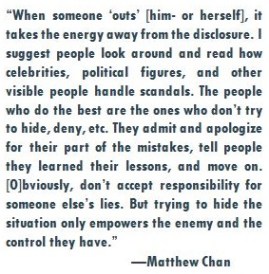
But what then can you do about it? The easy, copout answer is hire a good lawyer. But we all know “pro se” parties represent themselves because they either can’t find a good lawyer or they can’t afford a good lawyer.

Having lived with a protective order for nearly two years, I have found that it largely doesn’t impact my day-to-day existence. I have very little emotional baggage about it. Although my protective order is a matter of public record, it is not easily found, nor is it advertised. However, my accuser chooses to make mine public as a way to get revenge/payback and to embarrass and humiliate me.  I don’t feel embarrassed or humiliated at all anymore. I’ve had two years to let it sink in. She went to her local newspaper as well as a photography blog site to publicize my protective order. I am very certain she approached several other media sources, but she only managed to succeed in getting two to write her story. When she went public, I also went public, and I got way more coverage than she did because of the First Amendment issue.

It goes without saying that I became angry about her actions because the “facts” as told by her were incorrect. I was faced with one of two decisions:  either slink away silently and live in fear, shame, and embarrassment of the protective order…or speak out and fight back, and tell my story.

An issue I see is that people let little pieces of paper define them, such as high school diplomas, college degrees, technical and professional certifications, their financial statements, their marriage certificate, etc. A basic protective/restraining order is simply a piece of paper that formally instructs someone to stay away and not bother someone. It is a civil issue, not a criminal one.  But accusers like to try to criminalize the matter. My accuser loves to do the “stalkie-talkie” routine and likes to refer to me as her “stalker.” I have called her a copyright extortionist even longer. And yet, we have never met, spoken, emailed, text-messaged, snail-mailed, or even faxed. There has never been any contact. Still, she wants to say I am a “stalker” because she currently has a little piece of paper that says “stalking protective order.”

She is attempting to define who I am to whomever will listen. The problem she has is that I don’t buy into it; I have no guilt or shame over it, and I don’t hide from it.  And because I am pretty good at explaining the facts of my case and position, only the most gullible or uninformed believe her.

Too many people take things too literally. Too many people are legally ignorant. Too many people do not understand how the judicial system works. Too many people do not understand the realities of the judicial system.

For example, I live in a city where there are overcrowded jails. I don’t think that is unique to the city I live in. I also live in a city where the district attorney and prosecutor’s office has many cases to pursue and a tight budget to do it with. I live in a city where there is an abundance of physical and “harder” crimes such as burglaries, robberies, murders, drug crimes, rapes, etc. In that context, I see the matter of a protective/restraining order (a civil matter) as ranking low in the prosecutorial pecking order.

Generally speaking, protective/restraining orders are designed to prohibit unwanted physical contact and unwanted communications.  In my view, unless you have some huge emotional issues or obsessive tendencies towards your accuser, most orders are easy to follow, and they are not unconstitutional.

However, what if you have a restriction on your free speech where you can’t breathe a word about your accuser to anyone?  It is certainly problematic on the local level, but it is even more problematic at a state or national level. It is simply unconstitutional, which is my way of saying that it is, in a sense, “illegal.”  But some of you might say, what the order says goes. I don’t necessarily agree with that, because illegal contracts are not enforceable. For example, two people agree to do a drug deal. If one person decides to break the rules of the deal, it is unenforceable, because the deal was illegal to begin with. Likewise, an agreement broken by a John to pay a prostitute is unenforceable because it was illegal from the start. I similarly view it as illegal for my accuser to try to have me arrested or fined because I spoke or wrote about her (not to her) on my own website, and I think it would be embarrassing for any public official to dare to find me in violation of the law. That is my truth because I know what I know, but it may not be enough for you.

The sense of right and wrong has to be weighed against the costs of being a silent victim. The ability to overcome fear and ignorance, personal resourcefulness, the urgency to right a wrong, the fortitude to face conflict and risk—these are factors, and they are ones each person must self-assess.

It all begins with introspection and evaluation of whether the fight is “worth it.” In my case, if I had received a “stay away” order for one year, I would have been angry and unhappy, but I probably would never have appealed the order placed upon me. To me, it would have been an easy order to comply with, and I would not have seen it as devastating to my reputation, even if it were made public. The reason is that I know how to tell my story (and I have many times) in an open and authentic way.  Certainly, there are some less than flattering reports about me but none worse than what I have seen about others.

I have a larger view of myself in this world. I am not famous, and most people don’t care about me or what I do. I am largely unimportant (to them). I am not a celebrity; I am one of many. But for many, because it happens to them, they think the whole world is actually looking at them and their restraining orders. The truth of the matter is that most people simply don’t care.

In the larger view, famous people have committed all kinds of indiscretions, including having affairs, divorcing, getting into fights, committing DUI’s, doing drugs, getting arrested, soliciting prostitutes, etc. There is a huge list of all the embarrassing things people get themselves into. But the fact of the matter is most of that is small potatoes in the big scheme of things. You think people will shun and hate you, but the reality is, to most, it is trivial. You are just another person who allegedly committed an indiscretion.

You may ask, if I believe it is all small potatoes, why am I fighting so hard against my protective order?  There are actually multiple reasons for my current course of action.

My accuser inflamed me. For a woman who is so allegedly afraid of me and my alleged “stalking,” her actions betrayed that she really wasn’t that frightened of me or about whether I would actually cause her any physical harm or endanger her personal safety. She chose to flaunt, brag, and gloat over her “win,” and there was no good purpose in that.

The lawyer who represented her, Elizabeth W. McBride, engaged in unethical tactics like not providing me with a copy of her exhibits so I could examine them closely, while I, a non-lawyer, gave her the professional courtesy of providing an extra copy of mine. When the hearing was over, I both called and emailed the lawyer about getting a preview copy of the protective order. I also wanted to coordinate with her about both of us getting a copy of the courtroom transcript, because it was a shared resource that was agreed upon at the beginning of my hearing. I realized she treated me the way she did because I was not a lawyer and she was trying to cheat me. Because I was opposing counsel, she was required to interact with me on certain matters as she would with another lawyer. She chose not to, and I have remembered this the last two years. One day, I am confident it will come back to bite her.

But the biggest reason I fought back was the outrage that I and others felt that there was a flagrant disregard of the First Amendment as it related to online speech, a total disregard of the actual context of my speech, and a total disregard for Section 230 of the Communications Decency Act, which states that website owners are not responsible for content other users post. These were all points I clearly argued but the judge seemingly ignored.

I saw this as serious misbehavior by the judge and the local court system that could potentially have wide-ranging and long-term consequences to me and any other Georgia website owner. As a matter of disclosure, I do place a great importance on my Internet presence and online activities to my business and reputation. I am a self-employed entrepreneur and business owner who regards the Internet as a hugely important resource to both his personal and business life—probably much more so than the average person who works at a job 40 hours per week for an employer.

For all those reasons, I fought back. But I would be lying if I said there weren’t moments when I wavered. I had moments of weakness, but I also had my anger to prop me up. A lot of my impetus owes to the actions of my adversary and her lawyers.  By their actions, they practically taunted and drove me into appealing the case. Because of my anger and sense of injustice, I was galvanized into action.

I want to take the time to point out an important element of my fight-back. It is very helpful to find friends and supporters who understand you, your character, and the type of person you are. Getting moral support from people who will empower and encourage you is motivating.  Having “support” from people who are fearful, bashful, risk-averse, cynical, and unwilling is not.

In my life, I believe “like attracts like” and “birds of a feather flock together.” In my case, I have many people around me, people who are independent-minded, self-determined, believe in fighting for a cause (such as free speech) and not letting your enemies get the best of you. And believe it or not, most of my best support actually comes from those I have never met in “real life.”  My best support came from “strangers” I have met on the Internet. I have never met or spoken to Todd of ROA and yet, unbeknownst to him, his work on ROA has had a huge influence on my fight.

There are so many layers to the conversation of how to fight back against a wrongful restraining order restricting your right to free speech. There is no way I could get into all the stories, tactics, and strategies, or the mindset involved in my own journey. I will one day write a book on the subject. However, as a guest blogger on ROA, I thought I would share some insights into how my mind works and the mindset that drives me.

I consider myself a victim of protective/restraining order abuse, but I have also chosen to publicly fight back against my accuser and the lower court that allowed the unconstitutional order. Win, lose, or draw, I have no regrets, because my voice is loud and travels far. And I will never let my accuser, a judge, a court, or a piece of paper define who I am. Not as long as I live.

It is that attitude, which has resonated outwards, that I believe helped attract many supporters to my side, including the lawyers who have worked on my (and my position’s) behalf.

Matthew S. Chan is the creator and administrator of ExtortionLetterInfo.com (ELI) and the appellant in Chan v. Ellis, an appeal of a lifetime protection order presently under deliberation by the Georgia Supreme Court.

Copyright © 2015 RestrainingOrderAbuse.com and Matthew S. Chan

*Update: The Georgia Supreme Court returned a verdict in favor of Matthew Chan on March 27, 2015.

(Straw) Hats off to Tennessee, the One State in the Nation That Has a Provision for Expunging a Bogus Restraining Order

“TCA 40-32-101(a)(5) All public records concerning an order of protection [ex-parte, exparte] authorized by title 36, chapter 3, part 6, which was successfully defended and denied by the court following a hearing conducted pursuant to § 36-3-605, shall, upon petition by that person to the court denying the order, be removed and destroyed without cost to the person.”

 —Wikpedia, “Expungement in the United States” (Tennessee)

A woman wrote this week desperate to learn how to seal or expunge the record of a temporary restraining order petitioned against her in California. The order was rejected by the judge, but she’s concerned about the potential ramifications of a lingering record to both her and her children.

Not unduly.

In trying to discover what recourse might be available to her to have the record zapped, I chanced upon the Tennessee statute highlighted in the epigraph. It appears to be the only one of its kind in the country.

Ironically, I’ve also been in correspondence with a gutsy Tennessee woman, Betty Krachey, who was issued a protection order by her boyfriend a few months ago that was dismissed by the court but whose reported fraudulence so outraged Betty that she’s been vigorously petitioning her state to “hold false accusers accountable.”

I wrote to Betty about the Tennessee provision for expunging the record yesterday. I told her I only hoped knowledge of it wouldn’t dull her fervor to inspire change. She says no way.

The order of protection that was served on me was dropped when we went to court. BUT I know a lot of people (all men but me) that this has happened to whose were not dropped and are still on their records. I want something done to my ex for filing this false report against me, and I want to get the law changed to hold anyone who does this accountable for trying to ruin someone’s life. (I know it’s mostly women who file these false reports!) A friend of mine’s ex-wife did this to him, and I remember when the police came to serve him (at my store, while he was having breakfast). He was telling everyone it wasn’t true and he never laid a hand on her.  No one believed him. I remember thinking he must have done something or the cops wouldn’t be serving him papers to leave his home. I know better now, and I know how people think of the ones this is done to.

For its being more legally evolved than the rest of the nation, hats off to Tennessee—and, as I quipped to Betty, I didn’t think people there even wore shoes.

Copyright © 2015 RestrainingOrderAbuse.com

*Betty quipped back, “And most of the people out here DON’T wear shoes…or teeth!!!!”

Restraining Orders Are Public Records

It’s hard to tell whether this is a goad or a guarantee: “Find Restraining Order Records For Anyone Instantly!” Either way, it’s enticing.
If you’re dating someone and you’ve noticed how their temper gets out of control, before things go any further, check their record on Restraining Order Records. They might not have ever committed a crime, but if their name shows up on Restraining Order Records, you might think twice about pursuing this relationship.

Lawyers discount restraining orders as he said/she said matters: no biggie. Judges may also consider objections to them to be overstated—simply because they’ve been stated at all. These dismissals stand in stark contrast to the admonition: “Restraining Orders aren’t pleasant to think about, but the consequences can be worse. Check Restraining Order Records.”

Which appraisal of the significance of restraining orders do you think more closely corresponds to the public’s? (That is a rhetorical question, yes.)

The quoted material above is featured on the site PublicRecordsReview.com, which advertises the “Top Restraining Order Records Sites”: Instant Checkmate, United States Background Checks, Been Verified, U.S. People Records, and SpyFly.

Whether the returns from such sites can be relied upon is something the reader may investigate if s/he chooses; the writer doesn’t want to know. Whatever the case, however, the issuance of a civil restraining order represents a judicial ruling, and judicial rulings are public records. Here’s “why”:

Essential to the rule of law is the public performance of the judicial function. The public resolution of court cases and controversies affords accountability, fosters public confidence, and provides notice of the legal consequences of behaviors and choices.

[…]

The public in general and news media in particular have a qualified right of access to court proceedings and records. This right is rooted in the common law. The First Amendment also confers on the public a qualified right of access. In 1980, the Supreme Court held that the First Amendment right of access to court proceedings includes the public’s right to attend criminal trials. The Court suggested that a similar right extends to civil trials…. Some courts of appeals have held that the public’s First Amendment right of access to court proceedings includes both criminal and civil cases (Timothy Reagan, “Sealing Court Records and Proceedings: A Pocket Guide”).

Although they’re civil instruments, restraining orders are associated with violent or otherwise criminally deviant behavior, so they’re recorded and preserved in statewide police databases and the FBI’s National Crime Information Center (NCIC) database, which private investigator Brian Willingham calls the “closest thing to a nationwide criminal records check in the United States today” (italics added). They’re also recorded (virtually in perpetuity) at their courthouses of origin. Defendants named on domestic violence restraining orders may furthermore be entered into a domestic violence (specific) registry, possibly even if a temporary order against them is dismissed. The potential consequences to employment and even employability in certain fields could hardly be more obvious.

A profession as mundane as “substitute teacher” requires that its applicants undergo an FBI background check, and any interviewer may, of course, simply ask if a prospective employee has “ever been the subject of a restraining order.”

Ease of access to restraining order records by the general public differs from state to state. In Indiana, for example, it just takes an Internet connection. In other states, records aren’t as conveniently scrutinized.

That doesn’t, however, mean they’re inaccessible.

The animus behind advocacy for restraining orders is the animus behind all law related to violence against women. Whether advocates are anti-rape or anti-domestic-violence, the argument is the same: that the accused must be exposed so that (female) victims of violence will be encouraged to come forward. Publicity isn’t just incidental; it’s demanded.

Superficially, the demand isn’t without sympathy.

Restraining orders, however, are adjudicated in civil court. That means they’re matters instigated by private citizens whose allegations aren’t (necessarily) vetted by the authorities or by government prosecutors. They are, very literally, he said/she said prosecutions. Temporary restraining orders may be obtained in minutes based only on finger-pointing and feelings (“I’m afraid”), or on testimony that’s significantly or totally false (or even maliciously fabricated). The evidentiary bar is so low as to be skipped over—tra-la-la—and judicial bias is endemic and may even be mandated.

Elaine Epstein, former president of the Massachusetts Bar Association, famously observed decades ago, “Everyone knows restraining orders…are granted to virtually all who apply.”

The situation that obtains then is one of damning documents’ being generated on the basis of one or two protestations of fear or danger made to prejudiced judges in mere minutes-long procedures whose rulings are recorded indefinitely in public databases that any teen with a laptop and Daddy’s credit card can poke a zitty nose into from McDonald’s.

Copyright © 2015 RestrainingOrderAbuse.com

Not All Feminists Are Women, but All Feminists Are Responsible for Why False Accusations Are Rampant and Why They Work

Feminist lobbying is to blame for the injustice of restraining order and related laws and policies. There are no ifs, ands, or buts about it.

False accusations shouldn’t work, but they do—commonly, and not uncommonly to devastating effect.

That’s thanks to feminist crusaders, who may or may not represent Women, and who may or may not be women. This clarification isn’t intended for men who’ve been abused by court process; they don’t have any problem criticizing feminists, whatever form they come in.

Women, however, do—even women who’ve been abused by court process themselves. The clarification is for them.

Consider:

(1994) “Hi, Senator. This is Polly Wannacracker of COMA, the Consortium Opposing Male Aggression. I’m calling to share some startling statistics about violence, violence, and more violence. May I forward our research findings to your office?”

(1998) “Hi, Senator. This is Polly Wannacracker of COMA, the Consortium Opposing Male Aggression. I’m calling to share some more startling statistics about violence, violence, and more violence—also to tell you about the exciting progress we’ve made toward alerting the public to  the horrors of domestic abuse. Of course, nothing is ever enough when the stakes are this high!”

(2005) “Hi, Senator. This is Polly Wannacracker of COMA, the Consortium Opposing Male Aggression. How are you? How’s your wife? Oh, Bob, you kidder! We’ve so appreciated the support you’ve shown our cause over the years. Ha, you know me too well! Yes, I was of course calling to share some further startling statistics about violence, which, as you know, is epidemic, epidemic, epidemic….”

The allegory may be corny, but you get the point. This is how legislation is prompted, and support for it solidified and maintained. Names change; the message doesn’t.

Money has steadily aggregated to representatives of feminist causes over the decades, and this money has been used to secure public opinion through “information campaigns.” Too, it has inspired grant allocations to agencies of the justice system amounting to billions under the feminist motivated Violence Against Women Act (VAWA). Federal grants are also issued to promote and fund social science that validates these expenditures and laws related to violence against women, including restraining order laws. Both money and this tailored research are used to influence police policy and condition judicial priorities.

Women, defensively, may deny that members of their sex instigate malicious prosecutions more often than men or to greater effect. Who lies and why doesn’t matter, though. Judges should be vigilant against false claims, which should be detected, dismissed, and punished. Judges aren’t vigilant, false claims aren’t detected, and their claimants aren’t sanctioned. Why?

Thanks to dogged and vehement feminist politicking for the past 30 years or more, standards for substantiating claims of abuse made by restraining order petitioners are none, and penalties for lying are none. That’s because (women, please note) if the law made the standards too demanding or it threatened penalties for iffy testimony—so the dated argument runs—abused women might be afraid to come forward. They would just “suffer in silence” instead.

To ensure abused women aren’t afraid to come forward—again, so the dated argument runs—allegations must be taken on faith, and judges must have complete latitude to rule as they “think best” to protect the interests of people who can’t protect themselves.

If all this wiggle room means some people (or a lot of people) get falsely implicated…so what?

Law follows politics, and the political fix has been in for a long time. It stays in, because the architecture of laws has been concrete-reinforced. Feminist advocates continue to “monitor public policy” and to maintain their painstakingly erected social webwork. They have the money to do it. Oppositional voices are neither bankrolled nor have any political cachet. They’re not just the underdogs; they’re the usual suspects.

The above makes the below possible (comment submitted to this blog a few days ago by “Rhonda Lynn”):

I’m going to court in a few hours. I haven’t slept or eaten, and I’m a wreck. My life is over. Today.

I fled a [domestic violence] situation in another state and moved back to Washington. I bounced around a bit and finally ended up renting a room. (I’m disabled, on Social Security.) Yes, Craigslist.

I felt I asked all the right questions: Are you married? Do you live on the property? Do you own the home? Who else lives there? Both [man and woman] were surprised to learn [I was disabled, because] the other tenants renting the room across from me were disabled, as well. The man of the [tenant] couple was deaf, and I know American Sign Language.

Upon moving in, I began noticing the lies being told. The disabled couple was made to turn over their food cards. They tried with me when I signed the month-to-month agreement. I, of course, declined.

I helped with the deaf man and his developmentally disabled woman, because the female “owner” (also a lie) was overwhelmed and claimed she was sick. I cooked and cleaned (28 loads of laundry, using the washer and dryer I brought from my previous residence). I paid for Thanksgiving dinner.

Then Hell came. A friend of the female claimed the “husband” had been coming on to her…long story. The next day, it was me! […] First she tells me to move out; then she’s my friend.

The exploitation of the couple continues. The sister of the deaf man calls me [and] then calls Adult Protective Services. I make a call as well. There is an active investigation.

Ready?

sign-languageThe police knock on my bedroom door and give me 10 minutes to get some clothes. The “husband-owner” filed a restraining order on me!

I had a couple stay overnight for a movie marathon the night before, so I had a bit of help. The female officer verified I had a lock for my room. She advised the petitioner no one was to enter my room. She had me turn over the house key. I was in shock, crying.

As we pull away, the “husband” sends me a voice recording…saying, “See…who got [who] out of whose house? I got you out of my house! Neener Neener.”

I called the police. No good. I am not the victim. I’m the perpetrator. While on the phone…two more [messages] telling me I’m not getting any more of my stuff back, can’t come back to the house…even with an officer. “You’re burnt bitch! If the police ask where’s your stuff, I’m gonna say I don’t know.”

Then, there’s the “order.” A Domestic Violence Protection Order!

The allegations, all false…and very damning: stealing his mail, opening it and not giving it to him, going in his wallet, taking his [Social Security] card and old i.d., shoving him into a wall, causing a bruise on his back, yelling at all hours of the day and night, causing such stress on the disabled couple that they can’t eat or sleep and have PTSD episodes, calling members of the house vulgar names, texting and calling everyone while they sleep, [threatening] to burn the house down, [warning] him not to sleep, because I’d kill him. [He alleges] he is in fear of his life, afraid to take a shower or come home.

Then, lastly, the night before (when I had company), [he says] I came at him with a kitchen knife as he was getting ready for work [and that] he tried to call the cops, and I took his cell phone away. Then gave it back that morning.

Oh, my lord!

They both went on my Facebook [page]. He called me a hooker, said I would sleep with any man, and called me a horrible name. I didn’t respond, of course. Then he said I do meth, [which] he knows because I lived with him and he cleaned my room and found pipes and bags. Then she responds and says…and rigs and baggies. Now we know [they say] why she cleaned, and it explains her treatment of us. He [wrote] in another post: “I just want everyone to know she does methamphetamines.” (He is in outpatient treatment.)

[…]

I call the police…to get my stuff. I left my daughter’s ashes and pictures.

They say, “How can you prove you live there? If he doesn’t say you live there, we won’t bust down the door.”

I’M GOING TO JUMP OFF A BRIDGE.
(BUT DON’T DRIVE AND NO BUS FARE)
PLEASE. HELP ME.
RHONDA

The reader may choose to indict the male accuser in Rhonda’s story instead of the apparatus he exploited because he could, or the reader may choose to indict the apparatus itself and those who inspired it, defend it, keep it well lubricated, profit from it, and convincingly deny it’s abused.

Neither position will help Rhonda, who may be broken forever (or until she finds a bridge), but one of them may eventually make it illegal for a life to be so viciously demeaned as hers has been.

Copyright © 2015 RestrainingOrderAbuse.com

“You have bullsh*t; we have research”: The National Coalition Against Domestic Violence v. Daddy Justice (Or, Why False Allegations Are a Serious Problem)

A correspondent, friend, and fellow blogger who’s been relentlessly attacked through the courts by a disturbed neighbor (over a period now spanning years) sent a link to the YouTube vid “The Grand Poobah” last week. It’s a 2011 “interview” between men’s rights activist Ben Vonderheide (a.k.a. “Daddy Justice”) and Rita Smith, former executive director of the National Coalition Against Domestic Violence (NCADV), an influential Colorado-based nonprofit.

(Note: The word in the video’s title should be spelled “poohbah,” after a comic opera character whose name was probably formed from the interjections pooh + bah. Mr. Vonderheide’s spelling it “poobah” might have been an accident—or it might have been on purpose.)

The setting of the interview, which would more aptly be called an exchange of words, isn’t clear, but it seems to be a post-conference mix-and-mingle. Mr. Vonderheide takes issue with the NCADV’s feminine bias and the propagandist tenor of the factsheets it publishes, which aren’t uncommonly cited by feminist advocates.

As the quotation in this post’s title suggests, the questions he poses to Ms. Smith aren’t favorably received. Those questions regard the NCADV’s disinclination to acknowledge maternal child abuse (Ms. Smith: “It’s not our focus of work”), as well as its denial that false accusations of domestic violence are a serious problem, false accusations that Mr. Vonderheide alleges are “promoted by [the NCADV’s] budget.”

Daddy Justice’s interview style (à la Michael Moore) is obtrusive—he’s plainly crashed the party—but while Mr. Vonderheide is necessarily assertive, the worst you could say of his questions is that they’re confrontational. They’re nevertheless called “abusive” and “aggressive,” and he’s prodded to leave.

The grudging answers his questions prompt before he’s rebuffed don’t provide much informational grist for the mill, but to his allegation that more than 80% of restraining orders are based on false accusations, Ms. Smith significantly counters that her facts say it’s only “2% of the time” (and she urges Mr. Vonderheide to “stop lying”). Later she revises her estimate of the number of false accusations from 2% to “2 to 5%,” dismissively, despite the fact that if, say, 2,000,000 restraining orders are petitioned a year (and the total may be much higher), the extra 3% translates to the invasion, disruption, and possible dismantling of 60,000 innocent defendants’ lives, besides those of their children and others peripheral to the mischief.

A mere 5% false allegation rate means the victimization of 100,000 (or many more) innocent people per year (again, not including ambient casualties). Anecdotal reports, of course—including from judges and attorneys—put the false allegation rate 6 to 18 times higher than 5% (30 to 90%). It just depends who you’re asking.

Even a ridiculously conservative false allegation rate like the posited 5% plainly recommends legislative reform, because there’s absolutely no accountability in the restraining order process. False accusers aren’t punished, and damages from false allegations aren’t remediable by lawsuit. Additional false claims can what’s more be lodged almost immediately by the same accusers using the same process. There’s no statutory ceiling on the number of orders a single complainant may apply for. (Some victims of procedural abuse report spending tens of thousands of dollars to fend off one petition only to throw up their hands—and in cases forfeit their custody entitlements—when a second comes down the pike a few months later. See here for an example.)

It should be appreciated, too, that any audit-derived estimate of the number of false allegations can only be based on allegations that are recorded as false (by “somebody”). No official false allegation rate accounts for the number of times false allegations succeed or the number of times cases based on them are simply “dismissed” without comment.

In other words, false allegations may well be rampant or “epidemic” (a word favored by anti-domestic-violence advocates), and there would be no record that says so.

The nyah-nyah from the title—“We have research; you have bullshit”—deserves reflection, also. (It doesn’t come from Ms. Smith, incidentally, but from an unidentified confederate who can’t resist a Parthian shot at Mr. Vonderheide before she and the “Grand Poobah” turn their backs to him). The “research” that advocacy groups posit is survey-based, that is, it amounts to responses to questionnaires that are administered to sample groups and then extrapolated to the population as a whole. Even this survey data we must take on faith.

Appreciate that conducting “research” of this sort depends on means, which depend on money, which is only allocated to groups like the NCADV. Consider:

The NCADV’s reported income for 2011 was $643,797, down about $70,000 from the previous year. Ms. Smith’s salary was $74,586.

Among the programs toward which the NCADV’s 2011 budget was dedicated were “General Program – provides information to educate and inform the general public about domestic violence” ($240,991), “Public Policy – works in collaboration with other national organizations to affect societal response to domestic violence through public education and coalition building, monitors federal legislation, and contacts legislators regarding domestic violence issues” ($88,808), “Membership – publishes a newsletter and provides networking opportunities for individuals and organizations interested in the work to empower battered women and their children” ($67,607), “Child custody – provides resources, referrals and support to advocates working with victims of domestic violence involved in family court cases with their abusers also provides resources to victims, attorney, and family members when family court issues are present” ($97,402).

In contrast to the social largesse enjoyed by groups like the NCADV, no money is allocated for the administration of surveys to determine, for example, incident rates of depression, drug or alcohol abuse, stress-related injuries, or suicide proximal to being falsely accused; no surveys appraise the resulting lost earnings and assets; and no surveys attempt to measure the hits taken by health insurance providers as a result. Prognosis of the long-term consequences to the welfare and life prospects of injured children is, moreover, impossible. Worse, it’s not even considered, which casts rather a long shadow on the purported “mission” of groups like the NCADV to protect kids.

Clearly, that motive is context-specific.

Daddy Justice makes up for the lack of information his “interview” questions elicit with quotations interposed between snippets of footage. Here are some of them:

  • “Everyone knows restraining orders…are granted to virtually all who apply.” […] “In many cases, allegations of abuse are used for tactical advantage” (Elaine Epstein, former president of the Massachusetts Bar Association).
  • “Restraining orders are now considered part of the ‘gamesmanship of divorce’” (Illinois Bar Journal, 2005).
  • “In nonreciprocally violent relationships, women were the perpetrators in more than 70% of the cases” (American Journal of Public Health, May 2007).
  • “Women were slightly more likely than men to use one or more acts of physical aggression and to use such acts more frequently” (Psychological Bulletin, 26, No. 5, pp. 651-680).
  • “Leading sociologists have repeatedly found that men and women commit violence at similar rates” (Law Professor Linda Kelly, 2003).
  • “More women than men engage in controlling behavior in their current marriages” (Violence and Victims, 22, Issue 4, 2007).
  • “Of all persons who suffer injuries from partner aggression, 38% are male” (Dr. John Archer, Psychological Bulletin).
  • “There is no doubt that this law [Ohio’s domestic violence statute] has been abused” (Judge Nadine Allen of Hamilton County, Ohio).
  • “Standards for proving abuse have been so relaxed that any man who stands accused is considered guilty” (Cheryl Hanna, William and Mary Law Review).
  • “Women are nine times more likely to report domestic violence than male victims” (National Family Violence Survey).
  • “85% of temporary restraining orders are filed against men” (Cathy Young, “Domestic Violence: An In-Depth Analysis,” 2005).
  • “Many judges view restraining orders as ‘a rubber-stamping exercise,’ and subsequently hearings are ‘usually a sham’” (Attorney Arnold Rutkin, Family Advocate, Winter 1996).
  • “The mere allegation of domestic violence may shift the burden of proof to the defendant” (Massachusetts Law Weekly, 1995).

Notable is that cited remarks from legal experts that categorically define the restraining order process as prejudiced, if not an outright abomination against rudimentary civil rights and principles of law, may be a decade or decades old. Rhetorical stances like the NCADV’s aren’t fooling anybody in the know, and they haven’t for a long time. But they continue to dominate political debate. They’re heeded because they’re supposed to be. Not coincidentally, women’s advocates hold the keys to the treasury.

The value of Mr. Vonderheide’s video, finally, isn’t in the information it educes or even the information it asserts but the psychological study it offers of the women behind the dogma and the sway they exercise on public perception. His questions, only impeachable as indelicate, inspire predictable reactions: antagonism, levity, or disdain.

According to tried and true method (a method both practiced and preached), the “self-reliant” feminist women who are the targets of Mr. Vonderheide’s questions register alarm. These deniers of false allegations and undue hysteria…call the police.

Copyright © 2015 RestrainingOrderAbuse.com

*Daddy Justice’s videos can be found here.

Dust It Off: This Isn’t 1979, and It’s Time Restraining Order Laws Were Reconsidered

I remarked to a commenter the other day that when I became a vegetarian in the ’80s, I was still a kid, and my family took it as an affront, which was a common reaction then. Today, everyone’s a vegetarian or “tried vegetarianism” or has “thought about becoming a vegetarian.” Other subjects that were outré or taboo in my childhood like atheism, cross-dressing, and depression—they’re no longer stigmatized, either (in the main). Gay people, who were only whispered about then, can marry in a majority of states. When I was a kid, it was shaming for bra straps or underpants bands to be visible. Today they’re exposed on purpose.

It’s a brave new world.

While domestic violence is no more comfortable a topic of conversation now than it was then, it’s also hardly hush-hush. When restraining orders were conceived, it was unmentionable, and that was the problem. It was impossible for battered women to reliably get help. They faced alienation from their families and even ridicule from the police if they summoned the courage to ask for it. They were trapped.

Restraining orders cut through all of the red tape and made it possible for battered women to go straight to the courthouse to talk one-on-one with a judge and get immediate relief. The intention, at least, was good.

It’s probable, too, that when restraining orders were enacted way back when, their exploitation was minimal. It wouldn’t have occurred to many people to abuse them, just as it wouldn’t have occurred to lawmakers that anyone would take advantage.

This isn’t 1979. Times have changed and with them social perceptions and ethics. Reporting domestic violence isn’t an act of moral apostasy. It’s widely encouraged.

No one has gone back, however, and reconsidered the justice of a procedure of law that omits all safeguards against misuse. Restraining orders circumvent investigation by police and the vetting of accusations by district attorneys. They allow individuals to prosecute allegations all on their own, trusting that those individuals won’t lie about fear or abuse, despite the fact that there are any number of compelling motives to do so, including greed/profit, spite, victim-playing, revenge, mental illness, personality disorder, bullying, blame-shifting, cover-up, infidelity/adultery, blackmail, coercion, citizenship, stalking, and the mere desire for attention.

Restraining orders laws have steadily accreted even as the original (problematic) blueprint has remained unchanged. Claims no longer need to be of domestic violence (though its legal definition has grown so broad as to be virtually all-inclusive, anyway). They can be of harassment, “stalking,” threat, or just inspiring vague unease.

These aren’t claims that are hard to manufacture, and they don’t have to be proved (and there’s no ascertaining the truth of alleged “feelings” or “beliefs,” anyway, just as there’s no defense against them). Due to decades of feminist lobbying, moreover, judges are predisposed to issue restraining orders on little or no more basis than a petitioner’s saying s/he needs one.

What once upon a time made this a worthy compromise of defendants’ constitutionally guaranteed expectation of due process and equitable treatment under the law no longer does. The anticipation of rejection or ridicule that women who reported domestic violence in the ’70s and ’80s faced from police, and which recommended a workaround like the restraining order, is now anachronistic.

Prevailing reflex from authorities has swiveled 180 degrees. If anything, the conditioned reaction to claims of abuse is their eager investigation; it’s compulsory policy.

Laws that authorize restraining order judges, based exclusively on their discretion, to impose sanctions on defendants like registry in public databases that can permanently foul employment prospects, removal from their homes, and denial of access to their kids and property are out of date. Their license has expired.

Besides material privations, defendants against allegations made in brief trips to the courthouse are subjected to humiliation and abuse that’s lastingly traumatic. Making false claims is a simple matter, and offering damning misrepresentations that don’t even depend on lies is simpler yet.

What shouldn’t be possible happens. A lot. Almost as bad is that we make believe it doesn’t.

Just as it was wrong to avert our eyes from domestic violence 30 years ago, it’s wrong to pretend that attempts to curb it since haven’t fostered new forms of taunting, terrorism, and torment that use the state as their agent.

Copyright © 2015 RestrainingOrderAbuse.com

“Trapped”: Betty’s Story of Restraining Order Abuse

Betty Krachey says she only wishes she had superpowers. She has, nevertheless, been flexing her muscles pretty impressively for a former drugstore clerk.

Betty launched an e-petition not long ago to bring flaws in the administration of restraining orders and the need to hold false accusers accountable to the attention of lawmakers in her home state of Tennessee (and beyond). Betty emphasizes that restraining orders can be “taken out on innocent people based on false allegations so a vindictive person can gain control with the help of authorities.” She stresses, too, that “false accusers are being allowed to walk away and pay NO consequences for swearing to lies to get these orders.”

Betty’s charges shouldn’t be revelations; opponents of restraining order laws (and related laws inspired by violence against women) have been saying what Betty is for years. What makes her denunciations eye-opening is that they’re coming from an injured woman who refuses to take her licks and silently retreat into the shadows like she’s supposed to do. Besides that, the typical rebuttals to complaints like Betty’s, rebuttals that play to our sympathies for abused women, don’t apply.

Betty is an abused woman. She was nearly deprived of her home and consigned to the curb, for no reason, like yesterday’s trash (a situation others find themselves in every day). Betty’s story, as she tells it, corresponds moreover to those of women who are considered victims of emotional abuse (which state statutes may classify as “domestic violence”).

I used to be a very private person—till all this crap—and told very few people my business, so everyone thought everything was going good with me and [him]. They had no idea I was living with someone I felt trapped with. I could NEVER talk to him or even ask him a question without him blowing up. That’s not a very happy life to live with someone. Even though I never told others how bad things were at home, I NEVER made it a secret to [him] that I wanted to leave…! I never posted lies on Facebook or emailed my friends telling them lies about [him] like he did me to try to get people to feel sorry for me and think [he] was such a bad person. Now that I think about it, he’s always played the victim….

The counterclaim feminists inevitably reach for to bat away complaints of restraining order abuse like Betty has made is that invisible, voiceless legions of battered women never receive justice, so tough luck, Charlie Brown, if you’re not treated fairly. The argument appeals to pathos, but its influence on our laws and justice system is plainly corrupt. Remarking that there are starving children in India has never made and never will make broccoli taste like cheesecake. It’s not the place of our justice system to punish people for things they haven’t done, let alone to blame them for the imagined crimes of strangers.

The posited pains and privations of unnamed others don’t justify running an innocent person through the wringer, female or male. Publicly implicating people as batterers and creeps based on superficial claims scrawled on forms and mouthed in five-minute meetings with judges shouldn’t be possible in a developed society. On these grounds, citizens are cast out of their homes by agents of the state, as Betty almost was.

Our courts take no interest in the lives they invade and often derail or devastate. The people restraining order judges summarily condemn are just names on forms; judges may never even know what the owners of those names look like—forget about who they are.

Let’s meet one.

Betty’s story begins in 1992 when she moved from Florida to Tennessee with her boyfriend, and the two built a house and life together there.

The circumstances that led to Betty’s being falsely accused by her boyfriend decades later are cliché. He slimmed down in midlife, she says, and began “cheating on me with younger girls…. So he had to figure out a way to get my half of our house from me.”

A protection order fit the bill perfectly: no muss, no fuss, and no division of assets. The boyfriend would be granted sole entitlement to the house that Jack and Jill built. Jill, with a little shove, would tumble down the hill alone, and an empty bucket to collect handouts in is all she’d end up with.


His first plan was to bully and threaten me into signing over my half of the house by signing a quitclaim deed. He had told me he would give me $50K, which…I knew I’d never see, and he promised me this would be my best deal. And if I did not sign the house over to him, he let me know I would lose everything I had worked my ass off for. “You watch and see, I promise you that,” he would tell me over and over.

Betty says she was tempted to sign. One of her dearest companions, her Doberman Dragon, had died, and Betty reckoned she could provide for her remaining dog, Lacy, by herself. “One reason I stayed was for my dogs,” she admits. “I had been wanting to leave…for years.” She and her boyfriend had effectively separated, and Betty intuited her boyfriend “knew he wasn’t going to be able to trick me into staying and paying half the bills much longer,” and she planned to call it quits. But he beat her to the punch.

His next plan, with the advice from his awesome friend, was to get the police involved and then to file the order of protection on me to get me kicked out of the house! If it weren’t for my lawyer, I would have had to leave my home from Aug. 29th to the court date Sept. 12th! [He, the ex] knew and did NOT care one teeny tiny bit that I had NOWHERE TO GO! Plus I had Lacy to worry about. [He] had moved out of our house August 6th and wasn’t even living in the home at the time he did this. [He] has another house to live in that has everything he needs. I had NOTHING else and nowhere else to go!

Betty’s situation mirrors that of many others who are falsely accused by domestic partners. Those not so lucky to have (or to be able to afford) effective legal representation may find themselves abruptly homeless (besides jobless and penniless, in cases), sleeping in their cars, sheltering with strangers, or living on the street. These are people who the day before may have been living normal, comfortable middleclass or even upper-middleclass lives.

On our court date—Sept 12th—the order of protection was dropped. My lawyer told me I was right: “This is all about the house and YOUR money you have coming from your business you sold.” I knew it!! And [he, the ex] wanted ME to pay the court costs for this!

The best laid plans of lice and men go oft astray. Betty quips, “All I can say is [he] had a lot more to be concerned about than me causing him ‘bodily harm’!”

Betty’s been in touch with a Tennessee state representative who’s indicated to her that she has “a good chance at getting [the] law changed. But he said the soonest it will go into effect is July 2015, and he let me know that means it will NOT help me with what my ex did to me, because he filed his false report on me in August!”

Besides singlehandedly pressing for reform of one of the most intransigent legal mockeries ever conceived, she’s considering a lawsuit.

Happy New Year, Betty.

Copyright © 2015 RestrainingOrderAbuse.com

The Southern Poverty Law Center v. Betty Krachey: Why the Only Honest Voices in Discussions of Restraining Order and Related Procedural Abuses Are the Little Ones

This blog was inspired by firsthand experience with judicial iniquity.

Its author has never been accused of violence, doesn’t sanction violence except in self-defense or the defense of others, and has been a practicing vegetarian since adolescence. I have, what’s more, hazarded my life going to the aid of non-human animals. In one instance, I lost the use of my hand for a year; in another, I had various of my bones fractured or crushed, and that damage is permanent.

Although I’ve never been accused of violence (only its threat: “Will I be attacked?”), I know very well I might have been accused of violence, and I know with absolute certainty that the false accusation could have stuck—and easily—regardless of my ethical scruples and what my commitment to them has cost me.

Who people are, what they stand for, and what they have or haven’t done—these make no difference when they’re falsely fingered by a dedicated accuser who alleges abuse or fear.

This is wrong, categorically wrong, and the only arguments for maintenance of the status quo are ones that favor a particular interest group or political persuasion, which means those arguments contravene the rule of constitutional law.

Justice that isn’t equitable isn’t justice. Arguments for the perpetuation of the same ol’ same ol’, then, are nonstarters. Dogma continues to prevail, however, by distraction: “a majority of rapes go unreported,” “most battered women suffer in silence,” “domestic violence is epidemic” (men have it coming to them). Invocation of social ills that have no bearing on individual cases has determined public policy and conditioned judicial impulse.

Injustice, no surprise, arouses animosity; injustice that confounds lives, moreover, provokes rage, predictably and justly. This post looks at how that rage is severed from its roots—injustice—and held aloft like a monster’s decapitated head to be scorned and reviled.

I first learned of the Southern Poverty Law Center (SPLC) from a research paper published by Law Professor Kelly Behre this year that equates men’s rights activism with hatemongering. I later heard this position of the SPLC’s reiterated in an NPR piece about the first International Conference on Men’s Issues.

Injustice, it should be noted preliminarily, is of no lesser interest to women than to men. Both men and women are abused by laws and practices purportedly established to protect women, laws and practices that inform civil, criminal, and family court proceedings.

Groups like the SPLC, however, represent opposition to these laws and practices as originating strictly from MRAs, or men’s rights activists, whom they dismiss as senseless haters. This lumping is characteristic of the smoke-and-mirrors tactics favored by those allied to various women’s causes. They limn the divide as being between irrationally irate men and battered women’s advocates (or between “abusers” and “victims”).

They don’t necessarily deny there’s a middle ground; they just ignore it. Consequently, they situate themselves external to it. There are no women’s rights activists (“WRAs”?) who mediate between extremes. They’re one of the extremes.

I’m a free agent, and this blog isn’t associated with any group, though the above-mentioned law professor, Dr. Behre, identifies the blog in her paper as authored by an “FRG” (father’s rights group), based on my early on citing the speculative statistic that as many as 80% of restraining orders are said to be “unnecessary” or based on false claims, which may in fact be true even if Dr. Behre finds the estimate unscientific. (Survey statistics cited by women’s advocates and represented as fact are no more ascertainably conclusive; they’re only perceived as more “legitimate.”)

SAVE Services, one of the nonprofits to cite a 2008 West Virginia study from which the roughly 80% or 4-out-of-5 statistic is derived, is characterized by the SPLC and consequently Dr. Behre as being on a par with a “hate group,” like white supremacists. It isn’t, and the accusation is silly, besides nasty. This kind of facile association, though, has proven to be very effective at neutering opposing perspectives, even moderate and disciplined ones. Journalists, the propagators of information, may more readily credit a nonprofit like the SPLC, which identifies itself as a law center and has a longer and more illustrious history, than it may SAVE, which is also a nonprofit. The SPLC’s motto, “Fighting Hate • Teaching Tolerance • Seeking Justice,” could just as aptly be applied to SAVE’s basic endeavor.

On the left is a symbol for the Ku Klux Klan; on the right, the symbol for feminist solidarity. The images have common features, and their juxtaposition suggests the two groups are linked. This little gimmick exemplifies how guilt by association works.

The SPLC’s rhetorical strategy, an m.o. typical of those with the same political orientation, is as follows: (1) scour websites and forums in the “manosphere” for soundbites that include heated denunciations and misogynistic epithets, (2) assemble a catalog of websites and forums that espouse or can be said to sympathize with extremist convictions or positions, and (3) lump all websites and forums speaking to discrimination against men together and collectively label them misogynistic. Thus reports like these: “Misogyny: The Sites” and “Men’s Rights Movement Spreads False Claims about Women.”

Cherry-picked posts, positions, and quotations are highlighted; arguments are desiccated into ideological blurbs punctuated with indelicate words; and all voices are mashed up into a uniform, sinister hiss.

The SPLC’s explicit criticism may not be unwarranted, but coming as it does from a “law center” whose emblem is a set of balanced scales, that criticism is fairly reproached for its carelessness and chauvinism. There are no qualifications to suggest there’s any merit to the complaints that the SPLC criticizes.

The SPLC’s criticism, rather, invites its audience to conclude that complaints of feminist-motivated iniquities in the justice system are merely hate rhetoric, which makes the SPLC’s criticism a PC version of hate rhetoric. The bias is just reversed.

Complaints from the “[mad]manosphere” that are uncivil (or even rabid) aren’t necessarily invalid. The knee-jerk urge to denounce angry rhetoric betrays how conditioned we’ve been by the prevailing dogma. No one is outraged that people may be falsely implicated as stalkers, batterers, and child molesters in public trials. Nor is anyone outraged that the falsely accused may consequently be forbidden access to their children, jackbooted from their homes, denied employment, and left stranded and stigmatized. This isn’t considered abusive, let alone acknowledged for the social obscenity that it is. “Abusive” is when the falsely implicated who’ve been typified as brutes and sex offenders and who’ve been deprived of everything that meant anything to them complain about it.

Impolitely. (What would Mrs. Grundy say?)

There’s no question the system is corrupt, and the SPLC doesn’t say it isn’t. It reinforces the corruption by caricaturing the opposition as a horde of frothing woman-haters.

Enter Betty Krachey, a Tennessee woman who knows court corruption intimately. Betty launched a website and e-petition this year to urge her state to prosecute false accusers after being issued an injunction that labeled her a domestic abuser and that she alleges was based on fraud and motivated by spite and greed. Ask her if she’s angry about that, and she’ll probably say you’re damn right. (Her life has nothing to do with whether “most battered women suffer in silence” or “a majority of rapes go unreported,” and those facts in no way justify her being railroaded and menaced by the state.)

I made this website to make people aware of Order of Protections & restraining orders being taken out on innocent people based on false allegations so a vindictive person can gain control with the help of authorities. The false accusers are being allowed to walk away and pay NO consequences for swearing to lies to get these orders!  […]

I know that, in my case, the judge didn’t know me. Even though I talked to the magistrate the day BEFORE the order of protection was taken out on me & I told him what I heard [he] had planned for me. They didn’t know that I might have superpowers where I could cause him bodily harm 4 1/2 miles away. SO they had no choice but to protect [him] from me. BUT when they found out this order of protection was based on lies that he swore to, and he used the county in a cunning and vindictive way to get me kicked out of the house – HE SHOULD HAVE HAD TO PAY SOME CONSEQUENCES INSTEAD OF BEING ALLOWED TO WALK AWAY LIKE NOTHING HAPPENED!!!!

Seems like a fair point, and it’s fair points like Betty’s that get talked around and over. There are no legal advocates with the SPLC’s clout looking out for people like Betty; they’re busy making claims like hers seem anomalous, trivial, or crackpot.

Copyright © 2014 RestrainingOrderAbuse.com

*Betty reports she’s been in conference with one of her state’s representatives and has been told she has “a good chance at getting this law changed,” albeit too belatedly to affect her own circumstances. Says Betty, “I still want the law changed to hold false accusers accountable!” Amen to that.