How an Innocent Woman May Be Accused of Molestation, Rape, or Murder and Have to Live with It

Consider the following allegations:

“She has repeatedly exposed herself to me.”

“She told me on multiple occasions that if I wouldn’t have sex with her again she would tell the police I raped her.”

“She has stalked me since I met her. I’ve kept a dated log of all of the instances when she appeared someplace where I was. I’ve told her to leave me alone but she won’t. She says I’m her ‘destiny.’”

“She grabbed my crotch. When I pushed her hand away and ran, she laughed and called me a ‘pussy.’”

“I loaned her money. She told me if I asked for it back one more time, she and a friend of hers would hurt me. She bragged that they had killed someone before.”

“She has sent me panties covered with blood, urine, and feces. I threw them away because they were disgusting.”

“She showed me a knife and said that if I didn’t leave my girlfriend she would ‘cut her good.’”

“She said she wanted to drink my blood.”

An affidavit on a protective order application could include any or all of these statements and any number of others, including, say, alleged confessions of any act conceivable by the imagination of the accuser.

An affidavit, that is, a statement of facts alleged and sworn to be true, can usually be of any length and could include detailed descriptions of the accused’s anatomy, commentaries on his or her hygiene, and judgments of any variety, besides including an account of “what happened.”

There are no rules, and the court cannot retroactively censor what is effectively a complainant’s testimony.

Note that none of the accusations listed above could ever be ascertained as true or false, and a judge, accordingly, has no particular investment in “the truth.” His or her job, as prescribed by the law, is to decide whether the accuser is convincing.

An even cruder fact is that a judge may never read a complainant’s affidavit at all but simply ask for a verbal accounting, that’s if s/he does anything more than make sure the paperwork is filled out correctly. Once validated by a judge’s signature, unless contested and successfully quashed during a hearing that may be afforded 30 minutes on a judge’s docket, the order is a binding instrument of law and an indefinitely preserved public document that can be quoted or published.

Restraining orders are typically issued ex parte. That means based on the accuser’s say-so only. The accused may know nothing about it until a law enforcement officer or agent of the court appears at his or her door, possibly in the presence of friends, family, and/or neighbors.

The whole application and approval process may take from a few minutes to a few hours.

The latitude granted to judges in this arena of law is virtually boundless, as the politicking behind so-called “women’s law” intended it to be. A single statement from the list that heads this post, delivered persuasively enough, could suffice to make any number of allegations “stick” (whether relevant or not). Or repeated emphatic claims of terror and violation could. Or the testimony of a crony witness. Or a real or faked series of text messages or emails. Or a real or spoofed series of calls on a phone (which, if real, could have been about anything).

As Ralph Nader said, “Power has to be insecure to be responsive.” To judges, this business is just quotidian paper-shuffling, and they have no liability for their rulings, which are issued without oversight (including by judges who aren’t even judges but merely seasonal temps). Grounds for appeal, furthermore, are almost none (and “lying” is not among the few).

A reasonable person would conclude that anyone who supported laws that would allow a woman to be falsely accused of molestation, rape, or murder would have to be a monster.

The left-leaning feminist humanists and self-styled social justice advocates who do militantly support these laws emphasize their virtue: bringing relief to women in abusive relationships. This is somewhat like explaining communism’s goal is the protection of the working class citizen—while ignoring that tens of millions of working class citizens have been killed in the name of an idealistic social experiment.

Perhaps social justice crusaders who promote “women’s law” would say they’ve only ever meant for it to treat men monstrously.

Copyright © 2022 RestrainingOrderAbuse.com

*In civil lawsuits that aren’t filed for free, as restraining order applications usually are, a defendant could move the court to strike inflammatory statements that weren’t relevant and that could only serve to damage (his or) her reputation and, for example, professional standing (and health, security, interpersonal relationships, etc.). Whether this would fare any chance of success in drive-thru procedures conceived to permanently document misdeeds is less than iffy. (It would require redacting, or “blacking out,” parts of the original order, which is contrary to its purpose.)

About Liberalism and Its Deterioration of Civil Rights…and Its Own Credibility

Liberals are curiously less than rapturous about a political victory only they could have accomplished: the election of Donald Trump, a living caricature straight from the pages of a satirical novel, to the country’s highest office. Liberals do count as a victory, and have for a long time, laws that authorize the wholesale removal of citizens from their homes by armed agents of the state based on what may amount to nothing more substantive than finger-pointing.

In this writer’s opinion, they’re the same victory.

Since the advent of the restraining order in the 1970s, and particularly since the enactment of the Violence Against Women Act in 1994—under the auspices of which billions of federal tax dollars have been poured into state courts and police precincts to condition how judges and law enforcement officials respond to complaints of abuse—the priority in the U.S. has been to curtail evidentiary requirements and due process rights to expediently meet political expectations, expectations inspired by liberal feminist politicking.

With typical dramatic irony, liberals today vehemently denounce immigration policies that divide family members who have entered the country illegally, that is, in plain violation of the law. Meanwhile the separation of accused citizens from their families, citizens who have not, in a majority of cases, been proven to have violated any laws, continues to quietly transpire, as it has for decades. Attorney Liz Mandarano posits that “[t]here are between 2 and 3 million temporary restraining orders issued in the United States annually,” and attorney Gregory Hession, a vocal critic of protective order laws, observes that “500,000 children are right now in the custody of the state” (“an astounding number”).

Liberals consider conservatives “dumb” yet fail to perceive that alienation of such a broad swathe of the populace could inspire contempt for their values if not a raw animal loathing for everything they represent. Liberals adduce (and Twitter-reinforce) preposterous and hackneyed theories to explain disenchantment with their positions like resistance to progress and a longing to return to the days of “patriarchy.”

The author of this post has recently examined criticisms by NYU Journalism Prof. Katie Roiphe of #MeToo feminists’ disregard for due process (for which she has been excoriated almost everywhere but in the National Review, which called her criticisms courageously commonsensical). Prof. Roiphe has similarly qualmed about the extrajudicial “rape trials” of male college students. Even she, however, seems to assume that if the merits of “abuse” complaints are decided in a courtroom, then defendants have been afforded due process of law.

The assumption is understandable but ignorant of the legal standards and the practical ones that have come to inform how civil claims of abuse are adjudicated, claims that affect the lives of millions of American citizens every year.

It’s a truism of language that the meanings of words follow usage. Applied poorly, language degrades. Rights are no different, which is something our “educated” class should already know.

On a scale our government disdains to even calculate, citizens are denied both rights and dignity, besides in many cases family, property, and liberty, in the absence of determinate evidence, which is not, in any case, heard by a jury. Liberals, who often “identify” as humanist, say they simply deplore insensitivity.

The only thing more hateful to voters than a hypocrite is a party of hypocrites who support arbitrary attacks on citizens in their own homes.

Copyright © 2018 RestrainingOrderAbuse.com

No One Is a VICTIM Just because S/he Says S/he Is: A Reminder for Reporters…and Other People Who Shouldn’t Need Reminding

I looked at a form I was handed a couple of weeks ago at a criminal arraignment I was ordered to attend. The form gives the impression I was supposed to sign it, which no one asked me to do. This would be disturbing if I were still capable of registering disturbance. I noticed with dim approval, though, that it said this:

alleged_victim

When accusations are made on “protective orders” or are of the type “protective orders” typically purport to concern (e.g., harassment, stalking, or domestic violence), journalists routinely call accusers “victims” automatically. They reason, apparently, that a person can’t be awarded a restraining order unless s/he has demonstrably been victimized. (More accurately, “reporters” don’t scruple overmuch about the facts or how the process works, because they know where their loyalties are supposed to lie.) Probably a majority of injunctions are awarded based on their petitioners’ say-so alone. To understand what that means, a “reporter” would have to investigate (instead of, say, quoting a pamphlet authored by the National Coalition Against Domestic Violence).

Prosecutors? They seem to call all accusers “victims” on reflex. Their job, after all, is to “prevail” in court. If they think they can win, they try to; it’s not about justice. That’s rosy rhetoric for the rubes…like journalists.

Whether intentionally or not, both journalists and prosecutors get it wrong. Legislators do, too. The statutes they enact may explicitly call accusers “victims” (due process be damned).

The (criminal) court at least got this much right: Allegations aren’t facts, and until some semblance of due process has been staged, an accuser is an “alleged victim,” not a “victim.”

Judges don’t always get this right, either, however.

I couldn’t say with complete assurance whether lapses in objectivity, ethics, and procedural propriety like this have always existed or whether they’re testaments to systemic bigotry conditioned since the mid-’90s by the Violence Against Women Act (VAWA)—whose megabuck grant contracts stipulate that alleged victims should be treated as victims in every instance.

I feel pretty confident, though, in my suspicions of corruption.

The lines can’t help but have become blurry since the advent of the restraining order, which authorizes the court to draw conclusions prior to a trial, based on a few minutes of testimony and what may be no ascertainable facts at all.

If “verdicts” can be formed without proof and possibly without any adversarial contest in which controverting evidence could be adduced, that would seem to make the distinction between “victim” and “alleged victim” merely academic.

Restraining order judgments aren’t uncommonly “default” judgments, because defendants either don’t show up in court or can’t. An “emergency” injunction can require a defendant to appear in court mere days after service, possibly after having been booted to the curb (and left without resource or a vehicle), and even a non-emergency injunction may require a defendant to appear in court within a week. There’s no time to secure legal representation, even if the means are available and even if the respondent appreciates the significance of the paperwork that’s been thrust in his or her hand, and injunctions can be issued against defendants in other counties or states. (Some defendants, moreover, may not be first-timers, and they may simply conclude: “F— it. What’s the point?”)

(What defendants are told: “Here’s your restraining order. Don’t violate it, or we’ll arrest you.” What they’re not told: “You have six days to learn enough law to extricate yourself from allegations of which you’ve already been found guilty.” At the time they’re told anything, chances are they won’t know what the word defendant means.)

When procedure is engineered to find anyone who has alleged victimhood to be a “victim,” maybe calling every accuser a victim to begin with is just economical. Maybe it’s also the closest thing to honest a person can expect from a manifestly crooked business.

Copyright © 2016 RestrainingOrderAbuse.com

*And make no mistake: It is a business.

“There’s No Justice System; There’s Just a System”: A California Paralegal’s Advice on Defending Yourself against a Restraining Order Based on Fraud

The commentary and advice that follow are from a “paralegal at a top-tier criminal defense firm in Southern California.”

I will go on record saying we have some clients that were slapped with permanent restraining orders and some were also on probation for prior convictions while the restraining order injunction was issued. A number of our clients were arrested and put in jail multiple times by vindictive exes who used the RO in an abusive manner such as asking the restrained person to come over so they could reconcile and then calling the police as soon as the restrained person arrived. Another “protected person” in particular called the restrained person and claimed she was going to commit suicide. When the restrained person (our client) came over, she immediately called the cops, and he got hauled off to jail. We have another client who got locked up for responding to his ex via text message! Those are classic examples of “RO set-ups,” and it happens too often. Evil!

This topic hits close to home, because I too was the victim of a false/frivolous DV restraining order (or at least a failed attempt to get one placed on me) not too long ago. My ex-fiancée used a few e-mails I had written, admittedly in poor taste, of course, as evidence against me. The e-mails, though rather offensive, did not have any indications or inclinations of imminent danger towards my ex. No threats of physical harm towards my ex or her family at all. She even amended the protective order a couple of days after she originally filed it to include her brother, her mother, and the family dog!

I was shocked a temporary restraining order (TRO) was granted but later came to realize the courts tend to grant TROs quite easily with minimal evidence as a “safe measure” in case the petitioner is truly in immediate danger. Fortunately for me, my ex and her bro lacked basic legal knowledge and were not well-prepared for the hearing when the day came. I hired an attorney who specialized in domestic violence/criminal defense, and she was able to discredit/impeach my ex’s bro’s testimony and pretty much shoot down much of what my ex had to say with regard to my being a threat to her and her family. My ex did tell the judge she was fearful of me, and the judge did sympathize with her in that area. Long story short, the petition for a permanent restraining order was denied, and I hope I never see my ex or any members of her family ever again.

I’m sure this site has this info already, but I’d like to reiterate:

  1. When you get served with a temporary restraining order, regardless of how frivolous, OBEY THE TEMPORARY RESTRAINING ORDER. Make no effort in any way, shape, or form to communicate with the petitioner/protected person(s).
  2. If you have firearms, turn them in to a local firearms dealer for storage.
  3. Get an attorney who is reputable and skilled in domestic violence as well as criminal defense.
  4. If the hearing date is less than a week away, have your attorney request a continuance so you can better prepare for the hearing.
  5. Have your attorney file a formal response to the petition before the actual hearing, and make sure it gets served to the court and the petitioner.
  6. You and your attorney must go over your strategy in defending against the petitioner prior to the hearing.

I never lived with my ex nor did I have any history of domestic violence, but I still had to deal with the bullshit that came with a TRO. Even so, I stood my ground and fought the bogus petition.

Innocent people fight when they are wrongly accused rather than submit. Those who blatantly lie and lack reasonable evidence to support the lies will get shot down by competent defense counsel (as well as a confident and competent respondent/defendant).

  1. Maintain your composure at all times, especially during the hearing—dress nice, speak well, and discredit your accuser(s) in a cordial and professional manner, and you will prevail.
  2. If the judge feels the petition for the restraining order was completely unmerited, you can request that the judge order the petitioner to pay your attorney’s fees as well as any other expenses such as reimbursement for firearm storage fees.

The sad thing, though, is nine out of 10 times if the petitioner simply says s/he was truly in fear, the judge will say the TRO did have “some” merit.

Anyhow, my heart truly goes out to those of you falsely restrained and subjected to all the headaches that come along with it. Sometimes the system does truly suck.

Copyright © 2015 RestrainingOrderAbuse.com

Law Professor Brooke Coleman Explains Why the Civil Defendant Is Denied Legal Counsel, and Why This Is Unjust


From “Prison Is Prison” by Seattle Law School Prof. Brooke Coleman (Notre Dame Law Review, 2013):

Two indigent men stand before two separate judges. Both will be sent to prison if they lose their cases. One receives appointed counsel, but the other does not. This discrepancy seems terribly unjust, yet the Supreme Court has no problem with it. It recently affirmed in Turner v. Rogers that where an indigent individual is subject to criminal charges that can result in incarceration, he has a right to appointed counsel, but where an indigent individual is subject to civil proceedings where incarceration is a consequence, he does not. In other words, criminal and civil proceedings have different rules, and the right to appointed counsel is no exception. This Article argues that because the consequence of these proceedings is exactly the same, the right to appointed counsel should be the same. Prison is prison. This consequence, and not just doctrinal distinctions, should guide the Court’s analysis in deciding whether an indigent individual receives appointed counsel. By systematically examining the Court’s narratives in both criminal and civil right-to-counsel cases, this Article seeks to determine why the Court continues to treat the same situation so differently. The Court states that it is driven solely by doctrine, but it uses radically different language to discuss the individuals, attorneys, and nature of the proceedings in the criminal versus civil setting. This Article argues that the Court’s different goals in the criminal and civil context better explain the Court’s approach than doctrinal distinctions alone. With criminal cases, its goal is legitimacy, while with civil cases, its primary goal is efficiency.

Copyright © 2015 RestrainingOrderAbuse.com

*Restraining order prosecutions are civil procedures. Arguable synonyms for efficiency are short shrift and railroading (also travesty).

“Defend Our Constitutional Rights”: Anne’s Proposal to Redress Restraining Order Injustice

Below is a proposition by a 74-year-old California woman, Anne Copeland, who’s earning a degree in criminal justice administration. Anne alleges that accusations against her made in a restraining order petition were trumped up, and has reported being taunted and terrorized by her accusers, who were her neighbors. She also reports she’s been prohibited from performing volunteer work as a consequence of the court’s order and that it has necessitated that she pack up and move away from her accusers to gain relief from their abuse, which the order against her in essence authorized.

She urges a course of remedial action.

Some prefatory remarks from the blog’s author: Restraining orders were enacted into law pre-Internet. No one considered in the ’80s that they could be abused. No one considered that “obscure court records” would soon be talked about from one end of the planet to the other; that they could be “scanned,” “uploaded,” and conveniently distributed by “email”; or that they would be accessed by employers. No one considered that there would be “public registries” (in cases that anyone with an “Internet connection” could consult). No one imagined that the very phrase restraining order would come to be associated with the savage imagery that “the Internet” is awash with. “Restraining orders” were supposed to stop wife-batterers. Today, they may be approved to quiet any complaint, however actually innocuous the alleged behavior is. Though reported figures are few, all indications are that the vast majority of restraining order petitions are rejected right off the bat. That means even the courts regard most complaints to be stinky. So if “plenty of cases ARE actually justified,” as Anne allows below, it’s only plenty of a small fraction of those the court doesn’t already summarily toss out. Since respondents to this site like Anne are typically people who’ve had  orders sworn against them that were grounded on hyped or false accusations but even so passed muster with a judge or two, the process is pretty much just stinky.


Hi, my name is Anne Copeland, and I have written before about the abuse of restraining orders, which I too have experienced. I am a 74-year-old senior studying criminal justice at a university online, and will receive my degree this coming year and go on to get my master’s so that I can work with juvenile delinquents.

Concerns about the decay in our government are not without foundation. I just read a wonderful article written by the Honorable Judge Harvie Wilkinson III, who serves as a judge for the U.S. Fourth Circuit Court of Appeals: “In Defense of American Criminal Justice.” It was an eye-opener for me, as I too have come to believe that our justice system is going to hell in a hay basket. I would say that it is very worthwhile reading; it was definitely pivotal in changing my thinking on the subject.

There is a particular case of a man named Clarence Earl Gideon of Bay Harbor, Florida, who in 1964 changed the acknowledgment of our rights under the Constitution. Previously, only cases that were pretty major in nature would enable a person to have a defense attorney provided by a particular state. In this case, the man was indigent, and his alleged “crimes” were mostly minor in nature. But he insisted on his right to have an attorney, and it was a turning point for indigent people facing criminal charges. There is a lot more that is well-discussed in the essay. I think every person who is interested in where our government is going needs to read this.

After reading this article, my next step in thinking was, “Why doesn’t someone who is facing a restraining order, which does have disastrous effects on human lives, request to have an attorney represent him or her and let it be known that his or her constitutional rights are being denied?” I am thinking of doing something along these lines in trying to appeal my case. The “witness” in the case was definitely not credible, nor were the charges that were brought against me. And the judge did not allow me to really defend myself at all but actually charged me, showing me that he considered me guilty before even hearing the case.

I have thought out all the issues, and I feel that each person who can do it needs to appeal the case against him or her on the grounds that his or her constitutional rights have been denied. If enough of us do this, one will get heard finally, and we can put a stop to this devastating and unlawful practice. Just because someone says it is the law doesn’t make it so. We do have the right to challenge the law as it exists now, just as women did to get it changed in their favor in the first place.

I am not saying there is no place for justified restraining orders. In today’s confused and conflicted world, I am quite sure there are plenty of actual cases that are justified, but we need to have the process reexamined and re-aligned with the principle of civil rights for all citizens, not just for those who file falsified restraining orders. The process has to allow the determination that there has been a true injustice done to a person, and then perhaps there needs to be a period of counseling on both sides, as well as a look at the behavioral histories of both sides. I honestly don’t know what, in the long run, would truly be the best procedure to work to the benefit of both parties fairly and for the courts as well, but this issue needs to be addressed so that there is something to recommend.

Remember that as citizens of the United States, we still do have rights guaranteed us by the Constitution, and while they might be tiresome to fight for and very unrewarding in the short distance, we need to exercise our rights the best we can. If we don’t do this, we have nothing to blame but our apathy and feelings of victimhood. Sometimes we need to get therapy to help us overcome the PTSD and stress, etc. from the events that were forced upon us, but then as soon as we can, we need to pull ourselves back up and instead of trying to fight the person or persons who are petitioning the falsified restraining orders (which is always going to be a losing battle), we need to stop thinking about them and not give them power by doing that. Instead we need to deal with the government itself, making our voices heard where we can potentially make an actual difference. Yes, just one person might not be able to do it, but if enough of us petition the government in the higher courts using constitutional grounds, I believe we can get things done. Clarence Earl Gideon was a common street person, not highly educated, and definitely not with any funds to help him. But he believed his rights were being denied, and he took it to the courts and would not give up. And Gideon forever changed the rights of indigent people to have equal representation in court.

I believe most visitors to this site have been injured emotionally, spiritually, and otherwise by falsified cases. So it is time for us to gather together as a body of people and stop wasting our time trying to get justice against those who act against us. Rather, let’s think of a way to get our voices heard in the higher courts to defend our constitutional rights. It is true that our justice system is very unjust at times, but if we do nothing about it, we have nothing to speak for us.

Just because these are civil cases doesn’t mean that we have no rights anymore. The fact is that they can be turned into criminal cases, and frequently are. So our rights are being abused, and we need to come together and form a strong voice to go to the higher courts to defend our constitutional rights.

Thank you most kindly.

Copyright © 2015 RestrainingOrderAbuse.com

No Paper Trail: How Restraining Order Injustice Has Stayed under the Radar

Whether according with careless procedural design or cunning, the details of restraining order decisions aren’t recorded anywhere. What go into the case file at the courthouse are some accusations and a petition with a judge’s signature on it. The rulings accompanying it may simply be “approved” or “denied” and then “affirmed” or “dismissed.”

Rulings in other court matters are articulated. They recapitulate what litigants have claimed and explain how the judge formed his or her ruling. They have, like, paragraphs and stuff. Restraining order trials and rulings may be preserved on audio, but published materials reveal nothing except what was claimed by the plaintiff. (In other words, even the record of a dismissed order is pretty much damning because there’s no worded rejection of individual accusations.)

Not publishing the verdicts of lower court judges, who may never have graduated from college, is savvy. It limits the court’s accountability for those rulings (because they can’t be scrutinized), and it precludes their being mined for quotations that other litigants could cite in court. Judgments are basically yea or nay.

Since relatively few restraining order verdicts are appealed to the higher courts, very little is published about the conduct of restraining order trials at all, a fact Prof. Aaron Caplan, former staff attorney for the American Civil Liberties Union (ACLU), has noted in his law journal monograph, “Free Speech and Civil Harassment Orders.”

The parties are rarely represented by counsel, and ex parte orders are encouraged, which means courts may not hear the necessary facts and legal arguments. Very few civil harassment cases lead to appeals, let alone appeals with published opinions. As a result, civil harassment law tends to operate with a shortage of two things we ordinarily rely upon to ensure accurate decision-making by trial courts: the adversary system and appellate review.

Restraining order law operates with immunity from exterior (e.g., journalistic) scrutiny, as well: Nobody don’t know nothin’.

So-called “creditworthy” commentary on the process largely conforms with feminist positions. Reports of abuse, discrimination, and injustice in general emerge almost exclusively in marginalized media like blogs and forum threads, so those reports are handily discounted.

It isn’t just that the free flow of information is staunched; no formal remarks are committed to paper for scrutiny in the first place.

Nobody don’t know nothin’…and that’s the way (uh-huh, uh-huh) we like it.

Copyright © 2015 RestrainingOrderAbuse.com

*The absence of judicial commentary licenses proponents of the restraining order process (e.g., feminists) to say of it whatever they prefer. There’s nothing in the record to contradict free interpretation, which may be represented as “fact” or even “science.”

Who Lies about Whom on Restraining Order Petitions?

Feminists would have the public believe that complaints of procedural abuse and courthouse fraud come from a single source: ex-husbands who’ve been left high and dry after a contentious divorce. The impression they promote is that criticism of feminist-inspired procedures of law is nothing more than the misogynistic ravings of bitter men who got what they deserved.

(The Southern Poverty Law Center and some leftist dweeb collective styling itself “RationalWiki” maintain lists of what they pejoratively term “MRA” websites, which they lavish with contempt, and the blog We Hunted the Mammoth is dedicated to mocking the men’s rights movement.)

No allowance is made that the claims of husbands and fathers could be true or even understated, claims, for example, of vicious frauds by false accusers and institutionalized discrimination. Obviously, no allowance can be made by the profiteers of the that discrimination; it would discredit their “cause.” Accordingly, the array of relationships accusers and the accused have is also concealed. That array is ugly to contemplate, and it ridicules the restraining order and domestic violence processes themselves.

Here are some of the scenarios the author of this blog has heard firsthand, all of them reportedly based on false or hyped allegations to the court:

This list is by no means comprehensive. Asterisks indicate how repeatedly the scenario has been reported here.

Copyright © 2015 RestrainingOrderAbuse.com

Ungoverned: Restraining Order Laws in Arkansas

not-governed

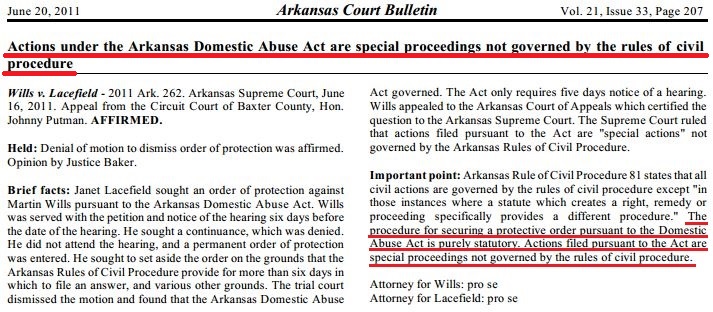
I’ve combed the Internet in recent weeks for motion-to-dismiss forms applicable to restraining orders issued in the 50 states. For Arkansas, there’s nothing to be found. Zip. If that weren’t suggestive enough that the process is a lock, consider the above entry excerpted from a 2011 Arkansas Court Bulletin.

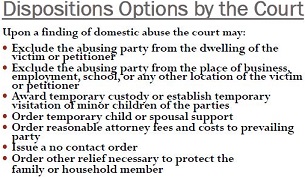
This means an accuser may be awarded exclusive entitlement to the family residence; sole custody of children; a monthly stipend from the former breadwinner, who may find himself out of a job subsequent to being issued a “domestic abuse” restraining order; and reimbursement of costs. Filing for a protection order, in other words, may gain a plaintiff everything and cost her (or sometimes him) nothing—whether the allegations it’s based on are true, hyped, or lies.

The case commentary (which you’ll observe publicly discloses the names of the parties to the action) concerns a man who was served with a notice to appear in court to answer allegations of “domestic abuse” six days thence.

Rough translation: “Dear sir, you’re expected in a courtroom next week to respond to allegations that you beat your wife.”

For people who know nothing about restraining order processes, appreciate that this man was given less than a week’s time to prepare a defense against obviously serious charges with obviously serious repercussions. In six days, he was supposed to come to grips with public allegations that may have horrified him, procure an attorney’s services, gather relevant evidence and testimony, etc.

Six days.

The bulletin reports that the man “sought a continuance [postponement], which was denied.” He didn’t attend the hearing. The commentary doesn’t indicate a reason. His request to have the order set aside, because the expectation of an immediate response didn’t conform to the Arkansas Rules of Civil Procedure, was also denied. Why? Because the Arkansas Domestic Abuse Act trumps the rules of civil procedure.

This case exemplifies why restraining order adjudications strike so many people as Kafkaesque: “I move—.” “No.” “Then—.” “No.” “But—.” “The rules don’t apply in your case, sir, and we don’t negotiate our decisions.”

Defendants’ being railroaded, of course, is nothing extraordinary. “Emergency” restraining orders may allow respondents only a weekend to prepare before having to appear in court to answer allegations—very possibly false allegations—that have the potential to permanently alter the course of their lives.

Extraordinary is the Arkansas courts’ openly and nonchalantly recognizing in a bulletin that their protective order process is “not governed by the rules.”

Its proceedings are “special.”

Copyright © 2014 RestrainingOrderAbuse.com

“A Nightmare That Won’t End”: Dealing with False Allegations

A person who obtains a fraudulent restraining order or otherwise abuses the system to bring you down with false allegations does so because you didn’t bend to his or her will like you were supposed to do.

To contest the restraining order (or whatever other state process was abused) is to once more defy the will of your accuser.

No surprise then that such an accuser will up the stakes on you. Defy subsequent allegations, and your accuser will escalate them further. This is especially the case when your accuser is female. It’s not for nothing that the (mis)quotation, “Hell hath no fury like a woman scorned,” has become immortal. (And it’s not only men who have to fear this wrath; women can be at least as vehemently and doggedly brutal to other women.)

It’s rare for a false accuser to relent.

This is partly due to psychology and partly due to how easily the processes we’re talking about are abused. Restraining order issuance, for example, pretty much follows a revolving-door policy: plaintiffs are in and out in minutes.

Once a foothold is attained, and the paperwork starts mounting in the plaintiff’s favor, she’s committed and feels ten feet tall, and the snowball begins rolling downhill on its way to becoming an avalanche.

One success (that first rubber-stamped round of allegations) assures that a repeat performance will be that much easier. And it is. Both police officers and judges have been “educated” to react paternally to allegations leveled by women, and the worse those allegations are, the more hastily they’re swallowed. Initial allegations once validated by a judge’s signature, moreover, make future allegations that much more credible and future judges’ eyes that much narrower.

Each added strand strengthens and sustains the web of lies and makes it that much more lethal a snare.

Any number of men and women have written to this blog reporting that they never had a run-in with the law in their lives, and now, in the span of a few months, they’ve been transmogrified into Attila the Hun.

And no one gazing down the tunnel from the far end—whether an employer, a neighbor, or a judge—can perceive that it originates with some calculated lies scrawled on a bureaucratic form: “Hey, can I borrow your pen for a sec? I’ll give it right back.”

Lies like these, upon multiplying like cancer cells and having as they do the full force of public policy behind them, can take over lives.

And, relentlessly chewing, chewing, chewing like the parasitic agents they are, destroy them.

Processes that are supposed to defend people from abuse provide liars with the perfect media to make their wildest vengeance fantasies come true.

Copyright © 2013 RestrainingOrderAbuse.com

Ordure in the Court: On False Restraining Orders and What It Means to Get One

I’ve recently tried to debunk some of the myths that surround the administration of restraining orders. This post is about what it’s like to actually be the recipient of one, particularly a fraudulent one.

Among the uninitiated, there’s a belief that there’s some kind of prelude to the moment a constable shows up at your door. There isn’t. Restraining orders are as foreseeable as a shovel to the back of the head.

Constables, incidentally, are nice guys. Like process servers, they’re quick to assert that they’re just the messengers—and they are, of course: they otherwise have nothing to do with anything.

The motive forces behind the issuance of a restraining order are two people: the plaintiff (the person who drops by the courthouse to allege that you’re a fiend) and the judge who interviews him or her for a few minutes before validating his or her allegations with a signature.

Application for a restraining order is a fast-food process designed so that a plaintiff legitimately in need of urgent relief from a stressful situation can obtain that relief quickly and easily. The humor of this is only appreciated by recipients of fraudulent restraining orders petitioned by plaintiffs who are willful manipulators of a system primed to take them at their word.

Restraining orders are issued ex parte: a judge never sees or knows a thing about the person s/he approves a restraining order against. What this means in practical terms is that whatever a plaintiff alleges against you, no matter how damningly untrue, is all a judge has to go on. In other words, you’re guilty until proven innocent. And there’s really no ceiling on what a plaintiff can allege: battery, sexual violations, stalking, theft—you name it. (Plaintiffs who can’t squeeze all of their allegations into the blanks on the restraining order form are allowed to use a separate piece of paper.)

The plaintiff doesn’t have to actually prove anything. The burden is entirely upon you to discredit whatever the plaintiff alleges, and what s/he alleges is only limited by his or her ethics if s/he has any. Otherwise what s/he alleges is only limited by his or her imagination and malice.

Consider what your worst enemy might relish having permanently stamped on your public record. At the moment a restraining order is applied for against you, it’s a fair bet its plaintiff is your worst enemy.

Judges, who should know better than anyone the lengths people will go to to injure one another, have been instructed to react mechanically in the presence of certain criteria like claims of threat or danger. They don’t know the plaintiff. They don’t know the defendant. They’re often just responding to cues without letting much deliberation interfere. They don’t have to worry about professional censure, because this is established practice.

So. A plaintiff waltzes into a courthouse, takes a number and fills out a form, waits to see a judge, makes his or her plea, and more than likely leaves the courthouse feeling validated by the judge’s approval of his or her restraining order, regardless of whether the allegations on that order bear any correspondence to the truth. S/he’s feeling high and righteous (and possibly wickedly gratified).

The defendant is greeted the next day by an officer—at his or her home and possibly in front of friends, family, and/or neighbors—and served with an order from the court that may accuse him or her of violence, stalking, or other perversions and that warns him or her in no uncertain terms that s/he’ll be arrested for any perceived violations of that order. (S/he may alternatively be forcibly removed from that home on the same basis with nothing but the clothes on his or her back and denied access to children, pets, property, money, and transportation—for a year, a number of years, or indefinitely.)

It’s estimated, based on statistics extrapolated from government studies, that one in five recipients of restraining orders is pretty much the person his or her accuser has represented him or her to be, has pretty much done what s/he’s been accused of doing, and that whatever that is is bad enough that s/he shouldn’t be much surprised by a knock on the door from a person in uniform.

For the other 80% of restraining order defendants—recipients of orders that were either dubiously necessary or based on false allegations—their lives may well come to an abrupt halt. Recipients of fraudulent restraining orders, especially, may be traumatized by feelings of gnawing outrage, betrayal, mortification, and impending doom. The rhetoric of restraining orders is calculated to inspire dread—maybe so most recipients simply slink away into a gloomy corner. It reflects better on the court and its statistics if restraining orders stick.

Insomnia, persistent feelings of vulnerability and distrust, anxiety, depression, retreat—the stress responses people report are predictable and are ones, obviously, that can lead to physical and psychological illness, sidetracked careers, and neglected, scarred, or broken relationships. In most cases, restraining orders that do stick—and that’s most of them—never come unstuck. The stink follows you wherever you go.

Even the rare few who manage to extricate themselves from trumped-up allegations, usually with the help of a competent attorney, are never the same. What may have been an attention-seeking stunt performed by some pathetic schemer over a lunch break leaves a permanent impression.

Like a shovel to the back of the head.

Copyright © 2013 RestrainingOrderAbuse.com

The Real Obstacle to Exposing Restraining Order Fraud: Blind, Gullible Faith

What most people don’t get about restraining orders is how much they have in common with Mad Libs. You know, that party game where you fill in random nouns, verbs, and modifiers to concoct a zany story? What petitioners fill in the blanks on restraining order applications with is typically more deliberate but may be no less farcical.

Consult any online exposition about restraining orders or a similar legal remedy for harassment or threat like the law against telephone (or “telephonic”) harassment, and you’ll find it’s taken on faith that someone seeking such a remedy has a legitimate need.

And it’s not just taken on faith by expository writers but by cops and judges, too, who’ve been trained to react paternally, especially to allegations of threat made by women—as, in the age of feminist ascendency, we all have to some extent by dint of cultural osmosis and conformity.

I mention the law against telephone harassment, because its ease of abuse was recently brought to my attention by a respondent to this blog. What this law is meant to do is provide relief from harassing callers like cranks, heavy breathers, or hangup pranksters—or to get people off your back who are threatening you.

How, you might ask, does someone prove what was said or exchanged during certain telephone calls? S/he doesn’t. Unless the calls were recorded, there’s no way a third party can know what transpired. It’s presumed that someone who complains is telling the truth (and what’s supposed to be presumed, of course, is that the person who stands accused is innocent).

The insurmountable unh-duh factor here is that someone with an ax to grind and no scruples about lying to cops and judges can make up any story s/he wants: “He said he was going to burn my house down!”

Now, let’s say you have to defend yourself against an allegation like this and what you really said was, “Hey, Sally. I just called to say thanks. That fondue you sent over was delicious!” And maybe you called back later to get the recipe. And maybe you really thought the fondue—or whatever it was—was revolting, and you think Sally is certifiably bats, but your sister said to be nice to her. And maybe Sally asked you over to see her collection of porcelain ballerinas, and you politely declined and inadvertently hurt her feelings, and now Sally feels spurned and hates your guts.

How do you prove you didn’t threaten to burn Sally’s house down? Or to eat her cat with some fava beans and a nice Chianti?

You can’t. The burden of proof that should be your accuser’s is yours. Justice, which is supposed to be blind, is instead blindly credulous: “Yeah, yeah, and then what happened?”

Restraining orders work the same way and are just as easily abused by wanton frauds (in fact, they too can be based on telephone calls). Police officers and judges have very literally been trained to accept the stories they’re told like baby birds awaiting a regurgitated meal.

Any number of people have written in to this blog whose lives have been highjacked by vengeful liars, attention-seekers, embittered (ex-)spouses or (ex-)lovers, psychopaths, or flat out predators. Many, targeted by the particularly and devotedly malicious, have even been jailed on false allegations. Their personal and professional lives have been scarred if not derailed or demolished.

They plan to sue. They plan to seek media attention. They plan to write a book (or, um, start a blog). Being vindicated from obscene lies validated by a complacent judge or earnest cop becomes their mission in life.

Sound mad? If it does, that’s because the same thing hasn’t happened to you.

Copyright © 2013 RestrainingOrderAbuse.com

Restraining Order Administration and Money, Money, Money, Money, Money

“The restraining order law is perhaps the second most unconstitutional abomination in our legal system, after our so-called child protection (DSS) laws. The restraining order process is designed to allow an order to be issued very easily, and to be appealed, stopped, or vacated only with the utmost difficulty….

“The motives for this law are legion. First, it makes the Commonwealth a bunch of money by allowing it to leverage massive Federal grants. It makes feminist victim groups a lot of money by providing millions in state and federal grants to stop ‘domestic violence.’ It makes lawyers and court personnel a lot money as they administer the Godzilla-sized system they have built to deal with these orders. It makes police a lot of money, as they are able to leverage huge grants for arrests of violators. It makes mental health professionals a lot of money dealing with the mandatory therapy always required in these situations. It makes thousands of social workers a lot of money providing social services for all the families that the law destroys. It makes dozens of men’s batterers programs a lot of money providing anger management treatment ordered by courts in these proceedings.”

Attorney Gregory Hession

The aggregation of money is not only the dirty little secret behind the perpetuation of constitutionally insupportable restraining order laws that are a firmly rooted institution in this country and in many others across the globe; money is also what ensures that very few mainstream public figures ever voice dissenting views on the legitimacy and justice of restraining orders.

Lawyers and judges I’ve talked to readily own their disenchantment with restraining order policy and don’t hesitate to acknowledge its malodor. It’s very rare, though, to find a quotation in print from an officer of the court that says as much. Job security is as important to them as it is to the next guy, and restraining orders are a political hot potato, because the feminist lobby is a powerful one and one that’s not distinguished for its temperateness or receptiveness to compromise or criticism.

I’m not employed as an investigative journalist. I’m a would-be kids’ humorist who earns his crust as a manual laborer and sometime editor of student essays and flier copy. My available research tools are a beater laptop and Google.

What a casual search engine query returned to me in terms of numbers and government rhetoric that substantiate the arguments made in this post’s epigraph is this (emphases in the excerpts below are added):

Grants to Encourage Arrest Policies and Enforcement of Protection Orders Program

Number: 16.590
Agency: Department of Justice
Office: Violence Against Women Office

Program Information

Authorization:

Violence Against Women and Department of Justice Reauthorization Act of 2005, Title I, Section 102, Public Law 109-162; Violence Against Women Act of 2000, Public Law 106-386; Violent Crime Control and Law Enforcement Act of 1994, 42 U.S.C. 3796hh, as amended.

Objectives:

To encourage States, Indian tribal governments, State and local courts (including juvenile courts), tribal courts, and units of local government to treat domestic violence, dating violence, sexual assault, and stalking as serious violations of criminal law.

Types of Assistance:

PROJECT GRANTS

Uses and Use Restrictions:

Grants may be used for the following statutory program purposes: (1) To implement proarrest programs and policies in police departments, including policies for protection order violations. (2) To develop policies, educational programs, protection order registries, and training in police departments to improve tracking of cases involving domestic violence, dating violence, sexual assault, and stalking. Policies, educational programs, protection order registries, and training described in this paragraph shall incorporate confidentiality, and privacy protections for victims of domestic violence, dating violence, sexual assault, and stalking. (3) To centralize and coordinate police enforcement, prosecution, or judicial responsibility for domestic violence, dating violence, sexual assault, and stalking cases in teams or units of police officers, prosecutors, parole and probation officers, or judges. (4) To coordinate computer tracking systems to ensure communication between police, prosecutors, parole and probation officers, and both criminal and family courts. (5) To strengthen legal advocacy service programs for victims of domestic violence, dating violence, sexual assault, and stalking, including strengthening assistance to such victims in immigration matters. (6) To educate judges in criminal and civil courts (including juvenile courts) about domestic violence, dating violence, sexual assault, and stalking and to improve judicial handling of such cases. (7) To provide technical assistance and computer and other equipment to police departments, prosecutors, courts, and tribal jurisdictions to facilitate the widespread enforcement of protection orders, including interstate enforcement, enforcement between States and tribal jurisdictions, and enforcement between tribal jurisdictions. (8) To develop or strengthen policies and training for police, prosecutors, and the judiciary in recognizing, investigating, and prosecuting instances of domestic violence and sexual assault against older individuals (as defined in section 3002 of this title) and individuals with disabilities (as defined in section 12102(2) of this title). (9) To develop State, tribal, territorial, or local policies, procedures, and protocols for preventing dual arrests and prosecutions in cases of domestic violence, dating violence, sexual assault, and stalking, and to develop effective methods for identifying the pattern and history of abuse that indicates which party is the actual perpetrator of abuse. (10) To plan, develop and establish comprehensive victim service and support centers, such as family justice centers, designed to bring together victim advocates from non-profit, non-governmental victim services organizations, law enforcement officers, prosecutors, probation officers, governmental victim assistants, forensic medical professionals, civil legal attorneys, chaplains, legal advocates, representatives from community-based organizations and other relevant public or private agencies or organizations into one centralized location, in order to improve safety, access to services, and confidentiality for victims and families. Although funds may be used to support the colocation of project partners under this paragraph, funds may not support construction or major renovation expenses or activities that fall outside of the scope of the other statutory purpose areas. (11) To develop and implement policies and training for police, prosecutors, probation and parole officers, and the judiciary in recognizing, investigating, and prosecuting instances of sexual assault, with an emphasis on recognizing the threat to the community for repeat crime perpetration by such individuals. (12) To develop, enhance, and maintain protection order registries. (13) To develop human immunodeficiency virus (HIV) testing programs for sexual assault perpetrators and notification and counseling protocols.

Applicant Eligibility:

Grants are available to States, Indian tribal governments, units of local government, and State, tribal, territorial, and local courts.

Beneficiary Eligibility:

Beneficiaries include criminal and tribal justice practitioners, domestic violence, dating violence, sexual assault and stalking victim advocates, and other service providers who respond to victims of domestic violence, dating violence, sexual assault, and stalking.

Credentials/Documentation:

According to 42 U.S.C. § 3796hh(c), to be eligible to receive funding through this Program, applicants must:
(1) certify that their laws or official policies
(A) encourage or mandate arrests of domestic violence offenders based on probable cause that an offense has been committed; and
(B) encourage or mandate arrest of domestic violence offenders who violate the terms of a valid and outstanding protection order;
(2) demonstrate that their laws, policies, or practices and their training programs
discourage dual arrests of offender and victim;
(3) certify that their laws, policies, or practices prohibit issuance of mutual restraining orders of protection except in cases where both spouses file a claim and the court makes detailed findings of fact indicating that both spouses acted primarily as aggressors and that neither spouse acted primarily in self-defense; and
(4) certify that their laws, policies, and practices do not require, in connection with the prosecution of any misdemeanor or felony domestic violence offense, or in connection with the filing, issuance, registration, or service of a protection order, or a petition for a protection order, to protect a victim of sexual assault, domestic violence, or stalking, that the victim bear the costs associated with the filing of criminal charges against the offender, or the costs associated with the filing, issuance, registration, or service of a warrant, protection order, petition for a protection order, or witness subpoena, whether issued inside or outside the State, Tribal or local jurisdiction; and
(5) certify that their laws, policies, or practices ensure that
(A) no law enforcement officer, prosecuting officer or other government official shall ask or require an adult, youth, or child victim of a sex offense as defined under Federal, Tribal, State, Territorial, or local law to submit to a polygraph examination or other truth telling device as a condition for proceeding with the investigation of such an offense; and
(B) the refusal of a victim to submit to an examination described in subparagraph (A) shall not prevent the investigation of the offense.

Range and Average of Financial Assistance:

Range: $176,735–$1,167,713
Average: $571,816.

That’s a pretty fair lump of dough, and what it’s for—among other things as you’ll notice if you read between the lines—is to “educate” our police officers and judges about what their priorities should be.

Note that eligibility requirements for receiving grants through this program include (1) the prohibition of counter-injunctions, that is, restraining orders counter-filed by people who have had restraining orders issued against them; (2) the issuance of restraining orders at no cost to their applicants; and (3) the acceptance of plaintiffs’ allegations on faith. Note, also, that one of the objectives of this program is to promote the establishment of registries that make the names of restraining order recipients conveniently available to the general public.

The legitimacy of these grants (“grants” having a more benevolent resonance to it than “inducements”) goes largely uncontested, because who’s going to say they’re “for” crimes against women and children?

The rhetorical design of all things related to the administration of restraining orders and the laws that authorize them is ingenious and, on its surface, unimpeachable.

By everyone, that is, except the victims of a process that is as manifestly and multifariously crooked as a papier-mâché flagpole.

Paying authorities and the judiciary to assume a preferential disposition toward restraining order applicants completely undermines the principles of impartiality and fair and equal treatment that our system of laws was established upon.

It isn’t cash this process needs. It’s change.

Copyright © 2013 RestrainingOrderAbuse.com

Some Myths about Restraining Orders

FALSE: Restraining orders are mostly sought against batterers.

Redress of domestic violence was the original impetus behind the conception of restraining orders 30 years ago. Today, however, violence is seldom a factor in restraining order cases. This isn’t because violence has been stamped out—far from it—but because relative to the vast number of restraining orders petitioned from our courts each year in which violence plays no part at all, those involving violence or allegations of violence are few. As many restraining orders may now be based on Facebook annoyances as on domestic assault.

FALSE: Restraining order fraud happens only occasionally.

Fraud of a greater or lesser kind is probably more the rule than the exception. Allegations made on restraining orders are rarely without a subjective element: I feel harassed, I feel afraid, I feel in danger. Judges are responding more like advice columnists when they sign off on restraining orders than they are like criminal scientists, that is, they’re responding to alleged emotional states more than anything concrete. “I feel afraid” may in fact be the only allegation needed for an applicant to have a restraining order approved. Disregarding whether this assertion should be sufficient grounds for a restraining order’s being issued, allegations of fear can be falsified, obviously, or greatly exaggerated to mask any number of ulterior motives. Maybe someone is really just peeved and feeling spiteful. Maybe one domestic partner has designs on the other’s property or wants to gain sole custody of the kids. Maybe a dissatisfied boyfriend or girlfriend doesn’t want to make a difficult break-up call. Maybe an adulterer doesn’t want news of an affair getting back to his or her spouse. Maybe someone has a pathological need for attention (“Save me!”). Or maybe someone just wants to trash someone else’s life for the sheer wicked satisfaction of it. Neither restraining order applications nor their applicants receive any special scrutiny. An applicant is in and out of the courthouse door in less than an hour. And most of that time is spent filling out the form(s) and hanging around to rap with a judge for five or 10 minutes.

FALSE: Only residents of trailer parks receive restraining orders.

Restraining orders are issued to people in all economic brackets and fields of employ and who have achieved any level of scholastic or professional success. Those who’ve responded to this blog over the past two years are people with advanced degrees (and students seeking them), teachers, police officers, attorneys, public officials, and businessmen and -women, among others. In fact most respondents who allege they’re victims of false restraining orders are both highly sensitive and highly literate.

FALSE: Only guttersnipes defraud the courts to obtain restraining orders.

Casual lying or sensationalizing of allegations cuts across all economic and social divides. Truly committal and calculated lying, though, seems more common among the intelligent, educated, and socially successful—whose credentials, moreover, make a fraud that much more plausible in the eyes of a judge. Remember we’re talking here about a five- or 10-minute screen test. A successful performance in a restraining order interview doesn’t have to be Oscar-worthy. With intelligence, education, and social success, also, come a surer faith in one’s personal value and entitlement to special treatment. The greater someone’s sense of entitlement, the greater his or her sense of being above the law. Movers and shakers are accustomed to viewing others as competitors who either need to be wooed, subdued, or eliminated. Cut-throat comes easier and more naturally to them than it does to soccer moms. The politically oriented are more practiced at, adept at, and indifferent to lying to achieve their desired ends. They perceive life and the manipulation of others as a game.

FALSE: The issuance of restraining orders is fact/evidence-based.

Though they invariably criminalize their recipients by mere implication, restraining orders are civil not criminal instruments. Consequently no standard of proof is applied to them at all. Because they’re issued ex parte, furthermore, their sole basis is the word of their applicants and those applicants’ representations/interpretations of whatever evidence they may provide to the judge during a few-minute interview. Restraining order recipients are completely in the dark until a constable shows up on the lawn, and if they don’t immediately appeal, no contradictory testimony or evidence is so much as heard by the court, let alone considered. A judge doesn’t even know what the person looks like whom s/he’s issued a restraining order against.

FALSE: Having a restraining order on your record is no biggie.

Restraining orders routinely implicate their recipients as serial harassers, violent threats, sexual deviants, and stalkers (in sum, sickos). Allegations of this sort don’t have to be made explicitly; there are little tick boxes on the forms that allow them to be made implicitly. And just the phrase restraining order conveys these connotations, irrespective of what’s alleged. Not only are restraining orders public record and subject to discovery by employers or would-be employers, significant others, authorities, and officers of the court; there are also movements afoot to have restraining order recipients cataloged in registries like sex offenders, and some such registries already exist. These registries don’t just make the names of restraining order recipients conveniently available to the public; they make finding them out enticing. Those falsely accused on restraining orders of the behaviors identified above are psychologically traumatized and may be indefinitely tormented by fraudulent allegations that endure on public record to corrupt all aspects of their lives, in extreme cases causing social isolation tantamount to false imprisonment. Respondents to this blog have wondered if they’re allowed to relocate, to travel, to do volunteer work, to become police officers, to adopt, or even to talk to other people.

I’ll debunk other misconceptions concerning restraining orders in time, possibly by making additions to this post. One of the most common of these is manifested in the question, “Why would someone lie to get a restraining order?” Below is a brief response to this question lifted from this blog’s Q & A page (see also here):

There are many [reasons]. Here are some: to spitefully subject the defendant to public humiliation and/or to ruin him or her personally or professionally (petty revenge), to gain custody of children or possession of property from a domestic partner, to terminate an illicit relationship (or gag an extramarital friend or lover so s/he feels intimidated and can’t speak to your spouse), to lame or discredit a romantic or business rival (exes’ new spouses or love interests are popular targets), to gain power or leverage over someone (stalkers have obtained restraining orders against their victims), or simply to get attention.

In short, there are no limits on the ways people can suck when they’re handed a golden ticket to.

Copyright © 2013 RestrainingOrderAbuse.com
“Do I Need a Lawyer?”: On Combating Restraining Orders

nutcracker
“Do I need a lawyer?” is a question that commonly brings restraining order defendants to this blog and other sites like it.

No one wants to shell out thousands for an attorney to bat away allegations made on a restraining order that may have been concocted in a fit of pique by an embittered friend, a jealous ex, or a crazy neighbor. Too, it’s often the case that allegations leveled by restraining order plaintiffs are of a kind no one wants to advertise to strangers, let alone friends and family. Just the implications of the phrase restraining order are enough to make most people recoil.

I know someone who applied to the mayor for a character reference after she was falsely accused of domestic violence—on a restraining order—by a married friend she’d briefly renewed an association with. Sounds insane, right? The judge ultimately tossed the case after observing that the allegation wasn’t even applicable, because the plaintiff and the defendant weren’t in a domestic relationship. But that didn’t cause a judge any hesitation in approving the restraining order in the first place, and imagine what it cost this woman emotionally to have to explain the matter and ask for help. Imagine further if she had been a he, and you can appreciate the horror of fighting these kinds of allegations, which are validated by judges on a modicum of evidence, if any, and which neither cost nor risk their plaintiffs anything to make. Restraining orders are cheap or free to get, and no one is ever actually jailed for lying to get them.

I did a quick scan today of top Google returns for the term “lying to the court.” Most commenters weighed in that lying = perjury, which is a crime, so beware. It’s true that lying about a material fact in court (a fact, that is, that’s likely to influence a judge’s opinion) is a statutory crime. A felony, no less. Equally true, though, and much more pertinent is that lying isn’t prosecuted. So there’s nothing really for a fraudulent plaintiff to have to be wary of except maybe a little embarrassment if actually caught in a lie (and most plaintiffs, of course, aren’t aware that lying to a judge is a crime, so it’s not even on their minds).

Someone who’s morally bankrupt enough to lie to a judge in the first place isn’t going to hesitate because of the risk of shame if s/he’s caught. Shame is an emotion to which s/he’s obviously immune, anyway.

In the administration of restraining orders, the ideal of justice isn’t given priority. Restraining orders are issued ex parte, which means they’re approved without the judge’s having the faintest idea who s/he’s issuing a restraining order against. The only person the judge hears from is the plaintiff, and hearings to obtain restraining orders are typically 10-minute affairs.

Talk show host David Letterman was famously issued a restraining order petitioned by a stranger who lived in another part of the country. The judge didn’t think twice about rubber-stamping the thing and moving on to the next applicant.

Defendants don’t need attorneys; it’s perfectly lawful for them to defend themselves in an appeals hearing. Whether defendants need attorneys to better their chances of a favorable verdict is a different question entirely. David Letterman, it should go without saying, had a team of them. And it should come as no surprise that they shredded the restraining order to confetti.

A cynical answer to the question of whether defendants need attorneys to improve their odds of beating a bum rap is that defendants who can afford attorneys are perceived as deserving greater consideration than ones who can’t (or who don’t know enough to seek counsel—or who are hoping they can just quietly make the whole thing go away on their own). This answer doesn’t jibe with the judicial canon that everyone should be treated the same, but that doesn’t mean it isn’t true. Because restraining orders are issued ex parte, the idea that fairness obtains at any stage of the process is clearly dubious.

Truth and falsehood in judicial proceedings are, besides, very relative things. For truth to even exercise its power to dispel lies depends on how effectively a defendant can make it plain to the judge. As straightforward as a naïve defendant might believe this to be, it’s not as simple as stating facts that contradict fraudulent testimony or producing some evidence that’s expected to be conclusive. The judge might decide that that evidence is irrelevant or that the lie it exposes is immaterial to the case. Or s/he might decide s/he doesn’t like the defendant period. Can you lose a case because the judge doesn’t like you or likes the plaintiff better? Sure. Does that have anything to do with the truth of the plaintiff’s allegations against you? No.

Representation by an attorney isn’t a guarantee of success. The mere presence of one, though, will give you a degree of credibility you wouldn’t otherwise have. An attorney with courtroom experience, furthermore, has presentational skills that you lack. Restraining order appeals hearings are very brief, judges tend to be skeptical of defendants (particularly men), and even a self-styled Perry Mason may find him- or herself stammering and squirming once s/he’s in the hot seat under the glare of the judge.

There’s the possibility, too, that the plaintiff will have an attorney, and attorneys aren’t known either for playing fair or for showing mercy to their opponents. Some attorneys—gasp—are even professional liars. Several respondents to this blog, in fact, have had false restraining orders petitioned against them by attorneys who were ex-lovers or -spouses or—in one case—a parent. The restraining order process, more than any other, brings out the worst in human nature.

If you’re the defendant in a restraining order case, especially one grounded on fraud, get an attorney.

Now.

Copyright © 2013 RestrainingOrderAbuse.com

Addressing the Judge: What to Expect at a Restraining Order Appeals Hearing…and What Not To

Judges famously tend to be an inscrutable lot.

Defendants who expect a judge to leap from the bench with indignation upon being shown evidence of lies by the plaintiff are bound to be disappointed.

Far more likely the judge will evince bemused or stoic indifference. You may even wonder if s/he registered what you said at all.

Don’t be nonplussed. This is how s/he’s supposed to act. Keep on trucking until s/he interrupts or redirects your presentation.

What you want to focus on is triage. Triage means presenting the points of your defense in order of importance (triage is a wartime medical term that means privileging patients with the best chance of recovery over those who are sure goners). What will positively doom you in a hearing is rambling, speaking off the point, or carefully qualifying everything to the extent that the judge completely misses what you’re driving at.

Don’t waffle or be mealymouthed.

Bullets. Present your case in brief staccato bursts. Everything should be short and sweet (so to speak). Time is always a limited commodity, and a restraining order hearing may be granted no more than a handful of minutes. People—and judges are people like anyone else—tend to remember best what they hear first and last and/or what’s stated to them emphatically.

Like bullets, everything you say should be pointed and intended to inflict damage. Pare down everything you want to say to its most elemental, and state facts in the light that most favorably represents you.

And absolutely speak to your conduct (or the conduct you’ve been accused of, anyway), because that’s what’s being ruled upon. In other words, don’t try to defend your own actions (or “actions”) by merely speaking to misconduct by the plaintiff like a little kid would: “She started it!” or “She’s a liar!”

It’s often if not usually the case that restraining order plaintiffs and defendants are lovers, spouses or ex-spouses, friends, or family members: people, in other words, who are or have been close. There’s a temptation, therefore, for defendants to explain the context of their statements or even to show sympathy or generosity toward their accusers. There’s also, of course, a tendency to feel betrayed, ashamed at being exposed to public censure, or humiliated by allegations that may be beastly misrepresentations of the truth.

Don’t yield to these impulses and emotions.

What you learn after you’ve been put through this ringer is that your opponent is going to show you no mercy and may very well lie heinously to ensure that you’re “defeated.” Even people you considered friends may turn out to be rats and side with your accuser and lie for him or her.

Combat analogies are very aptly applied to this process: the courtroom is an arena. “Bloodsport” isn’t a bad metaphor.

The judge is there to ensure that no one actually brawls, but his or her role otherwise is less as an arbiter or referee than as a spectator (who, like a Roman emperor at the Colosseum, gives a thumbs up or down when the dust settles).

Your goal isn’t to appeal to his or her sympathies; it’s to make a decisive impression. The judge’s impression will be based on your manner, composure, confidence, directness, and the cogency of your presentation, that is, how well it sticks together and how well it conveys your points (and, of course, how good those points are). The standard in civil cases is a “preponderance of evidence.” You want your evidence and testimony to have more heft and credibility than the plaintiff’s.

If the plaintiff’s allegations are a fraud, start by saying, “The plaintiff’s allegations, Judge, are a fraud.” Triage. Get the big points in—the general—then move to the specifics in short order. Directly address and contradict the allegations you can. The more evidence (“proof”) you can support your points with the better.

What attorneys do is this: they present their clients’ cases in the light most favorable to them (and most damning to their opponents), not balking at distorting the truth or outright lying, and ignore everything material that they can’t spin doctor.

I can’t advocate lying. Otherwise, though, thinking like an attorney isn’t a bad idea.

Translated into practical terms, this means a shove is an “assault,” a shout is “verbal abuse,” a demand is “harassment,” something that happened twice is “serial misconduct,” a touch is a “grope,” etc.: cold, cruel, categorical, and coarse.

Male judges have a chivalrous bent—and most judges are male—which is among the reasons why so many restraining orders sought by women against men are approved even on evidence or testimony that’s tenuous at best. If you’re a man defending yourself against a woman, bear this in mind. A woman can spout the most incendiary evil she can muster, and it’s not going to be held against her, because she’s a “girl.” Whatever a man counter-alleges against a woman needs to be presented reasonably and decently. He should choose his words carefully, avoid vigorous gestures, and keep cool.

If you’re a man defending yourself against a woman, you start with your hands tied and two strikes against you. That’s in the nature of this travesty of justice.

Bat with your head. There’s no surviving this process without some fractures.

Copyright © 2013 RestrainingOrderAbuse.com
*Unrepresented restraining order defendants, incidentally, should pour everything they’ve got into their appeals hearings, because the rules and expectations that obtain in Superior Court—should the case progress up the judicial ladder—are much more exacting and only capably negotiated by veteran attorneys (or shysters, a word that means unethical lawyers and fittingly derives from the German for “defecators,” because much of what comes out of their mouths is feces).

Crying Wolf: On Attention-Seeking Personality Disorders and Restraining Order Abuse

I this week came across an online monograph with the unwieldy (and very British) title, “Drama Queens, Saviours, Rescuers, Feigners, and Attention-Seekers: Attention-Seeking Personality Disorders, Victim Syndrome, Insecurity, and Centre of Attention Behavior,” which pointedly speaks to a number of behaviors identified by victims of restraining orders who have written in to this blog or alternatively contacted its author concerning the plaintiffs in their cases.

What caught my eye, especially, is that this monograph appears on a site titled, BullyOnline.org (now defunct).

The popular perception of restraining orders is that they’re sought by plaintiffs to remedy bullying. The monograph I’ve referenced doesn’t speak to restraining orders, per se, but its revelations about attention-seeking personality disorders are very applicable to abuses of restraining orders and are interesting because they turn the popular perception of restraining order plaintiffs’ motives on its head.

Victims of false restraining orders are urged to consult this monograph for language that may be of assistance both in defining the motives of fraudulent plaintiffs and in cementing an understanding of the psychological exigencies that underlie those motives. Of particular relevance to the subject of this blog are the following personality types sketched by the monograph’s author:

The manipulator: she may exploit family relationships, manipulating others with guilt and distorting perceptions; although she may not harm people physically, she causes everyone to suffer emotional injury. Vulnerable family members are favourite targets. A common attention-seeking ploy is to claim she is being persecuted, victimised, excluded, isolated, or ignored by another family member or group, perhaps insisting she is the target of a campaign of exclusion or harassment.

The mind-poisoner: adept at poisoning people’s minds by manipulating their perceptions of others, especially against the current target.

The drama queen: every incident or opportunity, no matter how insignificant, is exploited, exaggerated, and if necessary distorted to become an event of dramatic proportions. Everything is elevated to crisis proportions. Histrionics may be present where the person feels she is not the centre of attention but should be. Inappropriate flirtatious behaviour may also be present.

The feigner: when called to account and outwitted, the person instinctively uses the denial-counterattack-feigning victimhood strategy to manipulate everyone present, especially bystanders and those in authority. The most effective method of feigning victimhood is to burst into tears, for most people’s instinct is to feel sorry for them, to put their arm round them or offer them a tissue. There’s little more plausible than real tears, although as actresses know, it’s possible to turn these on at will. Feigners are adept at using crocodile tears. From years of practice, attention-seekers often give an Oscar-winning performance in this respect. Feigning victimhood is a favourite tactic of bullies and harassers to evade accountability and sanction. When accused of bullying and harassment, the person immediately turns on the waterworks and claims they are the one being bullied and harassed—even though there’s been no prior mention of being bullied or harassed. It’s the fact that this claim appears after and in response to having been called to account that is revealing. Mature adults do not burst into tears when held accountable for their actions.

The abused: a person claims they are the victim of abuse, sexual abuse, rape, etc. as a way of gaining attention for themselves. Crimes like abuse and rape are difficult to prove at the best of times, and their incidence is so common that it is easy to make a plausible claim as a way of gaining attention.

The victim: she may intentionally create acts of harassment against herself, e.g., send herself hate mail or damage her own possessions in an attempt to incriminate a fellow employee, a family member, neighbour, etc. Scheming, cunning, devious, deceptive, and manipulative, she will identify her “harasser” and produce circumstantial evidence in support of her claim. She will revel in the attention she gains and use her glib charm to plausibly dismiss any suggestion that she herself may be responsible. However, a background check may reveal that this is not the first time she has had this happen to her.

Many respondents to this blog—victims of lovers, spouses or ex-spouses, friends, coworkers, neighbors, or family members—have reported serial behaviors of the aforementioned sorts, and some have discovered that plaintiffs who have sought restraining orders against them are not first-time applicants. One or more of these personality types (or a merger of them) is likely recognizable to most victims of restraining order abuse.

Separate profiles on the “serial bully,” the “attention-seeker,” “narcissistic personality disorder,” and “bullies in the family” appear on the referenced site, and its author estimates that 1/30 people fit its profiles.

Hold this statistic up beside the one propounded by psychologist Martha Stout in her book, The Sociopath Next Door, that an estimated 1/25 people fit the clinical definition of “sociopath”—someone, that is, who’s devoid of moral compunction/empathic identification altogether—and it’s a reasonable proposition that an abundance of allegations made to officers of our courts derive from calculated hokum and that a goodly percentage of restraining orders, far from being sought out of a need for remedial relief, are in fact exploited as instruments of abuse or employed to gratify their plaintiffs’ need to have all eyes focused on them.

Copyright © 2013 RestrainingOrderAbuse.com