“Could the number be between 3 and 8 percent? Absolutely. But it could be substantially higher than 8 percent; it could even be that 40 percent of rape accusations or more are false, though I’d bet against that. It’s possible that less than 3 percent of rape accusations are false, though again, I would offer good odds against that. The point is that we don’t know, and the groups that claim to know are wrong together.”
—Columnist Megan McArdle (June 4, 2015)
Megan McArdle is one of a handful of professional journalists (preeminent among them Cathy Young) who objectively negotiate the chasmal discrepancy between statistics that say false claims of rape are almost none and those that say they’re abundant.
In her Bloomberg View column “What We Don’t Know about False Claims of Rape,” Ms. McArdle surveys complications that foil attempts to arrive at a hard-and-fast figure. Issues like consent, culpability, what qualifies as rape and what doesn’t, and who gets to adjudicate and how—these muddy estimations that are already suspect, because purveyors and proponents of statistics are typically biased by one ideological or political perspective or another. They promote numbers that support their views; they opine.
This writer agrees with Ms. McArdle’s conclusions quoted above, and he finds especially agreeable her honest assessment of the ambiguities and her willingness to acknowledge them in the first place, because this willingness is rare.

False claims of rape made in civil court are not registered anywhere or by anyone.
I’m not a journalist; I’m an analyst. I don’t know what the truth is. I can criticize interpretations that betray flaws, but I don’t find anything in Ms. McArdle’s “findings” to fault. I do, though, detect a blind spot, and it’s a blind spot that’s universal.
What no one appears to know about false claims of rape is that they can be made in civil court. There are no incidence rates for how often this occurs…and there can’t be. Civil rulings, e.g., in restraining order cases, are based on a “preponderance of the evidence” and not on the certainty of individual accusations. The dismissal of a restraining order petition that alleges rape is not recorded anywhere as a “false rape claim”—it’s just rejected—and a verdict in favor of a plaintiff who alleges rape signifies only that a judge was convinced that the heft of his or her claims, possibly numerous, more likely than not indicated a sound basis for the award of a restraining order—and it may not signify that. Orders are also granted if defendants simply default by not appearing to contest the accusations.
False rape claims in civil court may never be accompanied by criminal investigations nor ever conclusively adjudicated. They’re invisible. They are, however, made, and though they may be completely unsubstantiated, they exert a material influence on judicial rulings that have binding legal consequences, consequences that can be extreme.
My wife moved out of my Virginia home in June 2014, and then about a week later announced that she’d had a miscarriage. In August 2014, I got a visit from police detectives wanting to question me about a rape report she’d filed against me, but I declined to speak with them, and was never charged. Beginning in November 2014, she obtained three temporary restraining orders against me, and finally got a permanent restraining order imposed against me in Colorado in January 2015, based on a claim of domestic abuse, stalking, sexual assault, and physical assault. Not wanting to invest money and emotional energy in fighting it, and knowing it would be hard for me to successfully contest it, I didn’t show up to the hearing.
The man quoted above obtained a divorce from his wife, who he alleges had a history of mental illness, in April 2015. Two months later, he learned she had given birth to a daughter in February, who was “presumptively” his. His ex-wife had apparently lied about having a miscarriage.
The information that he was a father reached the man when he was told his ex-wife had killed herself following her commitment for “suicidal depression, and because someone had reported that she had been hearing voices telling her to hurt or kill the child.”
The man was also told there was a “dependency and neglect petition pending” against him for his abandonment of a child he hadn’t known existed.
In the petition, the county attorney notes, “Respondent […] and Father have a history of domestic violence that includes, but may not be limited to, the issuance of temporary restraining orders in cases […], and the issuance of a permanent restraining order in case […], which was entered by default on January 16, 2015, placing the welfare of the child at risk.” The Colorado Children’s Code says that the court shall consider a parent’s “History of violent behavior” in determining whether he’s an unfit parent.
The purported “history of domestic violence” was not established in court and was based solely on his late ex-wife’s restraining order allegations, which started five months after she had moved out, which were made in minutes in another state, which the man denies, and which he never traveled cross-country to attempt to controvert. He hadn’t known his (then) wife was pregnant with his child when her serial accusations to the court began and despaired of his chances of successfully challenging them. He had ignorantly opted to “move on.”
Now his daughter is in the custody of her maternal grandparents, and the likelihood of her father’s ever realizing a role in her life is scant.
This man’s case is highlighted because it was brought to my attention only last week and is still fresh in my mind. Instances of false claims of rape accompanying restraining order petitions, however—including claims against women—have been reported repeatedly here, in comments and in search terms that draw visitors to the blog.
Not even a tentative estimate could be formulated on how often false rape claims are asserted in civil court, but this source of false claims should at least be recognized as inclusive among the unnavigable uncertainties.
Copyright © 2015 RestrainingOrderAbuse.com
*An alternative means of falsely alleging rape in civil court is exemplified here. An extreme case of a fraudulent rape claim’s being alleged on a restraining order petition is here.

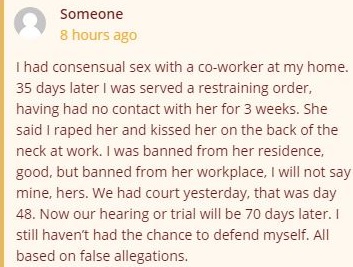
 I am a little league, travel ball, and high school umpire. I umpire because I love the game and to make some additional money on the side. I have been umpiring baseball for close to 25 years without any incident whatsoever, and most reviews of my performance have been complimentary.
 parenting and considers herself an expert in child-rearing. I had even caught her entering my house and administering medication to my daughter without our consent, which I firmly put a stop to.
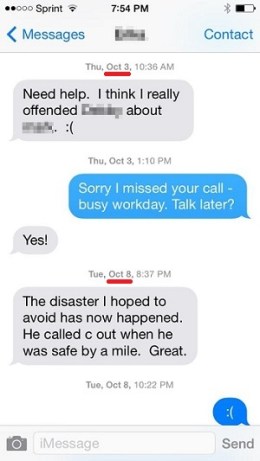 Well, because there was no good reason for my sister-in-law to be upset, and because the umpire company needed me to cover the game, I did. There was no issue with the game, and I received many compliments afterwards. I ended up working another one of my nephew’s games a couple of weeks later, again with no issues. The next week, I got a call from my umpire assignor reporting that my sister-in-law filed a complaint with the league saying her son was “uncomfortable” with my working behind the plate.
 After about a two-hour hearing, the judge ruled against me. He stated that because my wife informed me that her younger sister had told her to keep me away from her kid that I was put on notice…yet persisted in showing up at the fields to work. Never mind that I was told two months after their conversation (my wife didn’t tell me right away because she thought it was just her sister acting crazy). The judge then went on to say that a mother had the right to determine who got to be around her kids and didn’t need a good reason.
 We have filed a motion for a new trial with compelling evidence. It was denied by the same judge. We have also filed a motion to modify the order to allow me to attend my daughter’s school events since I am her primary caregiver while my wife is at work (I own my own business), and this too was denied, because the judge thought it would be too hard for the school and the police to enforce.







 A: Right (
 I corresponded with a man last year, a man in a homosexual relationship, who was assaulted by his partner severely enough to require the ministrations of a surgeon. His boyfriend was issued a restraining order coincident to his being charged with assault. That’s how it typically works in New York: A protection order is issued following a criminal complaint.
 This means, evidently and bizarrely, that there are people dwelling under the same roof as their accusers who may be cited for criminal contempt if an accuser calls and reports them for “harassment” that occurred, for example, in the hallway or the kitchen. The implications, which are fairly stunning, bring to mind the phrase “sleeping with the enemy.” The law invests its
  A woman I’m in correspondence with and have written about was accused of abuse on a petition for a protection order last year by a scheming long-term domestic partner, a man who’d seemingly been thrilled by the prospect of publicly ruining her and having her tossed to the curb with nothing but the clothes on her back. He probably woke up each morning to find his pillow saturated with drool.
 Now her former boyfriend complains that the stir she’s caused by expressing her outrage in public media is affecting his business, and he reportedly wants to obtain a restraining order to shut her up…for exposing his last attempt to get a restraining order…which was based on fraud.
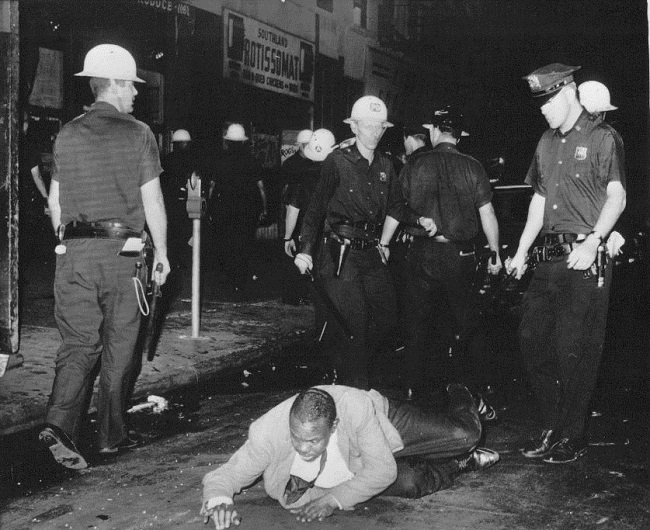
 I hope the outraged title of this piece reaches its attention, because the story below exemplifies a modern manifestation of racial bigotry and violence, and it’s one the Southern Poverty Law Center
  The following account is reported by North Carolinian Neil Shelton, a father denied access to his son and daughter for “three years now and counting.”
 Mr. Shelton’s allegations are abhorrent yet all too believable. Significantly, none of the criminal allegations introduced against him have held up in court.
 On May 29, 2012, which was shortly after I was kicked out of my house by my now ex-wife, I was arrested three times in one day.
 When my now ex-wife was made aware of my impending release, she took her sister-in-law, who was the director of Surry’s Stop Child Abuse Now (SCAN), and they went to the Surry County Sheriff’s Dept. and had me charged with criminal trespassing.
 “I’m dangerous broke, as y’all have shut down all my businesses, but I’m not dangerous with $5,000 and no restraining order against me?” With that, I told her I was finished. She said, “Yes, you are,” and we proceeded into the courtroom. I called her a few choice words, and her reply was, “Boy, am I gonna have fun playing with you.”
 Upon my release, I showed the judge the two failed commitment attempts, the six not-guilty verdicts for allegedly violating the restraining order, the dismissal of the letter charges, the phone number of the FBI agent who told me the FBI had never been involved and had never investigated the letter—which supposed investigation the other side had used to hold me in jail—and the handwriting analysis proving the lawyer, Zach Brintle, wrote the letter. But the judge still extended the restraining order for yet another year.


 This absurdly says that even if a person is repeatedly found to abuse process, the worst consequence s/he should face is having to ask special permission before doing it again. What makes the commission’s comments significant, however, is that they actually own that there are people who exploit court process to hurt others and that they may do it over and over.


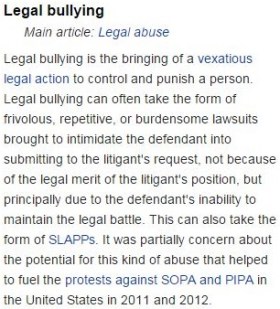
 “The first question for a legislature is whether to enact a civil harassment law at all. One thing is certain: If a civil harassment statute is enacted, it will be used—a lot. In 2003, Oklahoma reimposed a relationship requirement on its civil harassment statute because metropolitan counties were ‘being overrun with requests for protective orders.’”
 Applicants for orders that are acknowledged to be used frivolously, however, are nevertheless called “victims.” (As the previous post shows, journalists collude in this misrepresentation.)

 The Respondent has the right not to make [self-]incriminating statements in any proceeding. This includes discovery, hearings, and any other place where statements may be made. The general rule is that the Respondent cannot be required to testify at the restraining order hearing. The Respondent does not have to produce any discovery regarding the domestic violence issue if the Respondent timely claims the privilege against self-incrimination in response to the discovery request.
 The posited “80%” statistic was seized upon by critics of the restraining order process and bruited broadly on the Internet. I published it myself, and this blog, accordingly, was cited in Prof. Behre’s paper as the product of an “FRG.” It’s actually the product of a single tired and uninspired man who knows that false accusations are made.
 It’s hard not to hate judges who issue rulings that may be based on misrepresentations or outright fraud when those rulings (indefinitely) impute criminal behavior or intentions to defendants, may set defendants up for


 About a person is okay; to a person may not be.
 The account below was recently submitted as a comment to
  Perusing the trial transcript of a North Carolina man, former attorney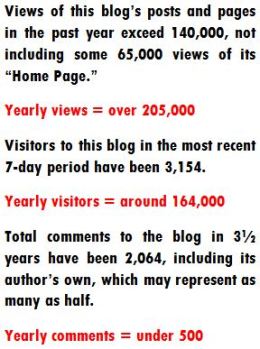




 Not one of those things has affected me as deeply as being on the receiving end of a sociopath’s lies, and the legal system’s subsequent validation of those lies. There is no “coming out the other side” of a public, on-the-legal-record character assassination. It gnaws at me on a near-daily basis like one of those worms that lives inside those Mexican jumping beans for sale to tourists on the counters of countless cheesy gift shops in Tijuana.
 These days, when sleep escapes me, which seems to be fairly frequently, I often relive the various court hearings associated with this shit show. One is the court hearing for the restraining order that my abuser sought against me (and which was granted) based on his completely vague, bullshit story that he felt “afraid” of me—this from the beast that had assaulted me on numerous occasions, slashed my tires, and had a documented history of abusing previous girlfriends. Another is his trial for assault and battery, during which I was forced to undergo a hostile, nasty, and innuendo-laced cross-examination by his scumbag defense attorney in front of a courtroom full of strangers. But the hearing that really gnaws at me and fills me with an almost homicidal enmity for the judge overseeing it is the one where I was requesting a restraining order against my abuser, this after a particularly heinous assault in the days following my cancer diagnosis and my partial mastectomy.
 I will have that prick’s bogus restraining order on my record today, tomorrow, next week, and on and on into perpetuity. I am a licensed professional whose employers require a full background check prior to being hired. I honestly don’t know how that restraining order was missed by the company that my most recent employer contracted to perform my pre-employment vetting. I live with the ever-present dread that someday, someone will unearth the perverse landmine that my abusive ex planted in my legal record, and that dread hasn’t lessened one whit since the day the restraining order was granted.
 I don’t believe this registry will ever be abolished, because restraining order abuse isn’t “sexy” and no one thinks it could ever happen to her, but can we at least limit who can access this information and the circumstances under which they can access it? It’s mind-boggling to me. It’s just so goddamn devastating to the people who are unfairly stigmatized, and, call me pessimistic, but I don’t think these casualties will ever have a voice.
 TALKING BACK to restraining orders