Why Are Pro Se Defendants More Suspect in the Eyes of Judges than Lying Accusers?


Showing candor that was as unexpected as it was refreshing, a judge I stood before in August acknowledged that he knew restraining orders were “abused” by litigants who made “blatantly false” statements to the police and the court.

Doing the former is a misdemeanor crime; the latter, a felony.

The judge, Tony Riojas, besides being the presiding magistrate of the Tucson City Court, is a member of the Task Force on Fair Justice for All. Much of what he told me I already knew: Neither false reporting nor perjury is ever prosecuted, there are no “mechanisms” to stop false litigants, and there’s no statutory limit on the number of times they can file fictive complaints with the court.

(For the curious or indignant: This status quo owes to feminist politicking. See also VAWA. No act by government, women’s advocates insist, should be seen to discourage “true victims” from coming forward. It’s a sentiment whose use-by date expired at least 20 years ago.)

After my brief dialogue with the judge, he tossed out allegations brought against me 20 months earlier by a woman I’d only met once in the previous decade and who is reportedly diagnosed with a mental illness (bipolar disorder). I lived with her allegations, made in one of three legal actions she brought back-to-back in 2016, every day for most of two years. All of the actions were frauds, and all have been dismissed. (In 2014, she had initiated or instigated multiple prosecutions against her own husband, from whom she’s now divorced.)

This post formerly featured my accuser, Jennifer Terpstra, in a selfie she published on a website cataloging her professional accomplishments. A generous critic might call her countenance “forbidding.” This person, whom I first encountered hanging around my residence in late 2005 and who insisted I meet with her and give her a hug in 2012 (when she called herself my “avid reader”), told officers in multiple police departments in 2015 and 2016 that I had been stalking her since she invited herself into my house 11 years earlier.

When all of her and a friend’s legal actions began to unravel in 2016, Terpstra, who also uses the names Jenn Oas and Jen Oas-Terpstra, fled the jurisdiction.

(She had been employed for over a decade as a researcher in the University of Arizona College of Medicine. Today she has apparently returned to my home town and possibly to her old job but has assumed a new last name.)

I was a “pro se” defendant in the restraining order case Terpstra initiated, and after 11 years of false accusations, it was the first case I’d won—despite having been denied my lawful right to a hearing and having had my first notice of appeal dismissed by the judge quoted above, possibly because I was a pro se defendant.

Pro se is Latin for “for oneself” or “on one’s own behalf.” It means I was my own lawyer.

In court, where no phrase is used more pejoratively, pro se connotes unqualified, unworthy, or off-the-wall, and lawyers use it to remind judges that they shouldn’t trust anything their unschooled adversaries say. Pro se, in other words, means easily blown off.

It’s yet another excuse to deny the credibility of the accused in restraining order cases, which can be initiated by any scrofulous degenerate entirely for free. (See again VAWA.)

No one, of course, applies the phrase pro se derogatorily to plaintiffs who breeze into courthouses, fill out some forms, and recite narratives that may be arrant lies during a five-minute interview with a judge—which is all procurement of restraining orders demands. Accusers, who are largely pro se, are called “victims.” They don’t have to be competent to represent anything but their “torment.”

To prevail, in contrast, the falsely accused

  1. MUST appear in court to defend themselves already prejudged guilty;
  2. MUST defuse lies that may be incapable of disproof like “I’m afraid”; and
  3. MUST do it within rigid time constraints (usually minutes).

They may what’s more be prohibited from cross-examining the prosecuting witness, who may not even be required to show up. (In the prosecution against me referenced above, in which there were three hearings, the plaintiff never appeared a single time.)

On top of this, defendants may be treated dismissively based on their inability or unwillingness to shell out $5,000 to hire an attorney…to troubleshoot the court’s defective garbage disposal.

Copyright © 2018 RestrainingOrderAbuse.com

*As the reader might have predicted, remedying inequities like those sketched above is not the brief of Arizona’s “Task Force on Fair Justice for All.”

Sexual Solicitation, Assault Alleged by Texas Officials Michael Honeycutt and Tiffany Bredfeldt in Contradictory Testimony to the Arizona Superior Court, Implicating a Tucson Man Who’s Been Falsely Accused for 11 Years: ILLEGAL GAG ORDER GUTTED; “WOMEN’S LAW,” TCEQ DISCREDITED

This post, published on the first day of the year, was updated on July 9, 2018 (reflected in the new title), and content that had been unlawfully censored by the court has been restored. A recent respondent to this blog commented, “I think these injunctions violate the Constitution.” Despite the baggy parameters dictated by the law, it’s certain that many are impeachable as unconstitutional. The saga that follows relates the story of such an injunction. Readers merely interested in learning what unscrupulous plaintiffs can get away with (again and again for years) may skip the preamble and gain a clear picture by contrasting various sworn and unsworn statements by two such plaintiffs, who are quoted verbatim. Other quotations show how a witness, Michael Honeycutt, was induced to give misleading testimony, besides how willing attorneys may be to steer the court amiss…for the right price.

Michael Honeycutt TCEQ, Michael Honeycutt PhD, Michael Honeycutt EPA, Tiffany Bredfeldt TCEQ, Tiffany Bredfeldt PhD, Tiffany Bredfeldt EPA, Bredfeldt TG, Texas Commission on Environmental Quality, TCEQ, EPA, Environmental Protection Agency, EPA Science Advisory Board, SAB, EPA Chemical Assessment Advisory Committee

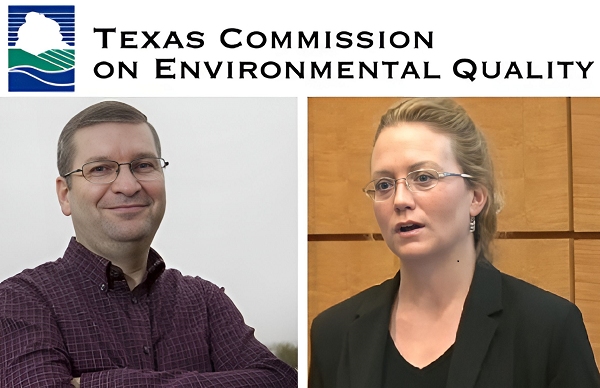
Texas state toxicologists and newly appointed EPA reps Michael Honeycutt and Tiffany Bredfeldt gave testimony before an Arizona Superior Court judge in 2013 that succeeded in persuading the judge to issue an unconstitutional speech injunction against the writer. The court was told the writer had “propositioned” Bredfeldt (a married woman) in 2005, “wouldn’t take no for an answer,” and “had been harassing her ever since.” Honeycutt, who has never met the writer, recited this secondhand story with the same smug complacency that marks his expression above. Based on the fiction’s effectiveness, four additional legal actions were brought against the writer in 2016, two of which menaced him with the threat of incarceration for exercising his freedom of speech. One of the actions was aborted; two were dismissed. Despite an appeal in 2017, the 2013 gag order, which the writer was alleged in 2016 to have “continuously and contemptuously violated,” remained in effect until July 2018, when it was gutted. All charges brought against the writer in the past decade have been invalidated.

Numerous accounts related on this blog since its launch six years ago have contrasted what he said with what she said in testimony given under penalty of perjury. The account this post relates doesn’t have to. It contrasts what she said here with what she said there—and with what her statured witness said she said. Statements that should harmonize, conflict.

A lesson of what this post unfolds, valuable for anybody to learn who has been wronged by a judge and isn’t sure if s/he’s “allowed” to talk about it, is that when people get away with something in a courtroom, which is a public forum, that in no way immunizes them from being exposed for it in a different public forum (for example, Facebook, Twitter, a personal blog, or one sponsored by The Washington Post). The only legal surety against criticism in this country is square conduct. While a court can lawfully issue a restraining order that prohibits unwanted speech to someone (like phone calls or emails), it cannot lawfully prohibit unwanted speech about anyone. Critical speech directed to the world at large, however objectionable it may be to those it names, whether private individuals, public officials, or judges, is protected speech as long as it isn’t false or threatening (and opinions are sacrosanct); the Constitution doesn’t favor any citizen over another, nor does it distinguish between bloggers, pamphleteers, or picketers and the institutional press. The aegis of the First Amendment doesn’t even require that criticism be deserved. In this instance, however, blamelessness is a nonissue.
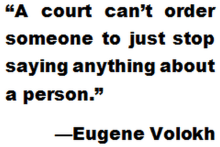
Eugene Volokh, First Amendment, freedom of speech, The Volokh ConspiracyThis post discredits a widely championed arena of law, as well as how it’s administered. Linked audio clips of one trial judge will make a seasoned courtroom veteran flinch; those of another, a presiding municipal court magistrate, acknowledge frankly that restraining orders “are abused,” no question, and that “people come in and…say things that are just blatantly false” but are “never…charge[d],” let alone prosecuted.

The post also discredits accusations made by a woman (women, in fact) against a man. To some, this will be its most compelling virtue. Men have traditionally been the butt of abused and abusive procedures, and by far continue to be their most populous feedstock. Assertions that men are “presumed guilty” and unfairly “demonized” are not exaggerations and never have been, contrary to the pajama punditry of demagogues like David Futrelle, Mari Brighe, Amanda Marcotte, and Lindy West, who would smother even the most righteous motives for male contempt beneath the blanket label “misogynist.”

Fixation on gender politics, though, has obscured from view that injustice has been legislated into the law and fortified by decades of accustomed application (albeit that politics is the reason why). Today women—straight, gay, or otherwise—enjoy no greater safety from accusation and arbitrary violations of their civil rights than men do (in drive-thru procedures promoted as “female-empowering”), and women too may be accused by women (including their own mothers, sisters, daughters, and neighbors—which is a predictable consequence when accusation is tolerated as a recreational sport). Law that mocks due process and facilitates and rewards its own abuse is iniquitous, period. What this post reveals, importantly and inescapably, is that how many people choose to understand accusation, court process, and their repercussions is deplorably simplistic. Among these many are most politicians, academics, journalists, and social justice activists.
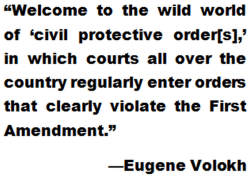
Eugene Volokh, First Amendment, freedom of speech, The Volokh ConspiracyThe Tucson man in the title of the post is also its author, and there was a time, within his memory, when to allege sexual impropriety without urgent grounds would have stirred outrage, because such an accusation is always damaging. In the climate that has prevailed since the advent of the Violence Against Women Act, however, the female plaintiff who doesn’t allege sexual violation, or at least trespass, squanders invaluable leverage. To a potently shrill sector of the community, this represents social progress. It has made pollution de rigueur.

Inaugurating the task of restoring a site inspired by the tenacity of false accusations like those exposed below, this post breaks a year-and-a-half-long silence coerced from the site’s owner by a series of lawsuits, which included two that demanded that he be jailed for exercising his First Amendment rights. The principal complainant, Tiffany Bredfeldt, an official at the Texas Commission on Environmental Quality (TCEQ), has repeatedly alleged to the Arizona Superior Court that the writer’s criticisms of her honesty, ethics, and character are untrue. Bredfeldt told the court in 2016 that the “ongoing fear, stress, and associated physical impacts” the writer’s criticisms had caused her “have been a decision factor as to whether or not [she has] children.” She also reported she has “talked to more people at police departments, sheriffs’ departments, and federal and state agencies than [she] can count,” and urged the court to impose “significant consequences” to bring her relief from a “continual rollercoaster of fear.”

Judge Richard Gordon, Pima County Superior Court

I am not going to hold him in contempt for talking about his case,” Pima County Superior Court Judge Richard Gordon pronounced in response to a 2016 complaint that demanded the writer be jailed for doing exactly that. Also commendably, the judge granted the writer a court-appointed attorney without reservation. Disagreeing, however, that the law authorized him to revise or dissolve an illegal prior restraint entered against the writer in 2013, the judge instead delimited its vague and overbroad proscriptions. The writer continued to be (1) forbidden from publishing images of the plaintiffs on this site; (2) forbidden from using “[meta] tags” with their names to label images or contents of posts, supposedly elevating them in Google’s returns for certain search terms thereby; (3) forbidden from “repeating” three “specific statements” that, absent a jury opinion, the 2013 court deemed “defamatory”—only two of which the writer may have made, both concerning honesty; and (4) forbidden from contacting the plaintiffs, Tiffany and Phil Bredfeldt, the former’s employers at the Texas Commission on Environmental Quality, or “their friends, their acquaintances, or their family.” The writer’s own friends and family are among Tiffany Bredfeldt’s acquaintances, and who else may be is impossible for the writer to know, which underscores the recklessness of the 2013 order Judge Gordon construed rather than vacated. That order’s prohibitions, which were substantially narrowed in July of this year, could have been interpreted very differently by another judge at any time for the rest of the writer’s life.

Bredfeldt sued the writer in 2013, neither for the first time nor the last. Michael Honeycutt, to whom the writer had communicated his criticisms of Bredfeldt’s conduct by letter two years before, served her as a witness—telephonically, from the comfort of his desk chair in Texas. Honeycutt is Bredfeldt’s boss at the TCEQ and an old hand at testifying; his bio [deleted from the Internet since this publication] boasts that he has testified before Congress. His role in accusing the writer, who in 2013 had already grappled with crippling allegations for seven years, was to ensure that he would live with them indefinitely—and it’s unlikely that Honeycutt acted without the full approval and support of the TCEQ’s administration.

The upshot of the 2013 prosecution, in which the writer represented himself, was that Bredfeldt was granted an unconstitutional restraining order that prohibited the writer from publishing anything about her “to anybody, in any way, oral, written or web-based” by the judge whose words appear a few times in the transcript excerpts that follow. That Pima County Superior Court judge, Carmine Cornelio, is a judge no longer. In June of 2016, 84% of an Arizona Commission on Judicial Performance Review panel concluded he did not meet standards. The judge declined to face voters that fall, and his tenure on the bench terminated two months later.

(The no-confidence rating returned against Judge Cornelio in 2016 followed reprimands by the Arizona Supreme Court in 2010 and 2013 for the judge’s saying “fuck you” to an attorney during a settlement conference, causing a 19-year-old girl to cry during a different one, and gesturing accusatorily at a female court employee in public, among other alleged acts of “abusive conduct.” In a guest column in the Arizona Daily Star, Judge Cornelio wrote, “I leave with head held high….” He told the same paper in an interview that he “intends to go into private practice in alternative dispute resolution.” Judges of the Arizona Superior Court are paid $145,000 a year, and a proposal has been tabled to raise their salaries to $160,000.)

The speech injunction Judge Cornelio imposed on this writer in 2013, which the judge made permanent without bothering with a trial, was affirmed in 2016 by a second Pima County Superior Court judge, Richard Gordon, despite Judge Gordon’s having acknowledged in open court that the conduct of the 2013 proceedings was “not legal” and that the prior restraint that issued from them offended the Constitution. “There are obviously some parts that are just too broad and then don’t make a whole lot of sense,” Judge Gordon conceded in court in July. In his subsequent Sept. 2016 ruling, little trace of this acknowledgment survives. The writer’s father died a month after the ruling was returned. More than a year has transpired since (and, as the U.S. Supreme Court has held, “[t]he loss of First Amendment freedoms, for even minimal periods of time, unquestionably constitutes irreparable injury”).

An appeal of the 2016 ruling to the Arizona Court of Appeals’ Second Division was denied in December (five months after it was filed). The court—consisting of Judge Philip Espinosa, Judge Christopher Staring, and Judge Sean Brearcliffedeclined to address the prior restraint’s unconstitutionality and sidestepped use of the phrase prior restraint entirely:

[T]he issue before us is not whether the injunction is constitutionally permissible, but whether the [2016] trial court properly refused to modify or dissolve it.

The appeals court, whose decision may have been influenced by a case narrative that this post will show is false, did acknowledge that “[a]t least one provision of the [2013] injunction would appear clearly unconstitutional, ordering that ‘[t]he defendant…immediately cease and desist all future publications on his website or otherwise.’” The word publication means any act of public speech. This provision, which was dissolved in July of this year, accordingly prohibited the writer from, for example, finishing a Ph.D., addressing the city council, marketing a book, or defending himself in a courtroom, all of which require publication. Also accordingly, courts have consistently found prior restraints facially invalid, even ones far less vague and overbroad than the one issued against the writer, and such orders have been vacated as much as 30 years later, which the writer’s attorney informed the appellate judges by brief and in oral argument. This was unremarked in their Dec. 18, 2017 ruling.

Eugene Volokh, free speech, First Amendment

UCLA Law Prof. Eugene Volokh, addressing the U.S. Senate Judiciary Committee on June 20

Unlike in 2013 (and previously), the writer wasn’t alone in court in 2016 or 2017. His defense was aided by two gifted lawyers representing the Pima County Legal Defender: Kristine Alger, who drafted and orally augmented a faultless appeal, and Kent F. Davis, whose zealous advocacy made an appeal possible in the first place. Their arguments were what’s more reinforced by no lesser light than Eugene Volokh, who’s distinguished as one of the country’s foremost authorities on First Amendment law and who, in conjunction with the Electronic Frontier Foundation (EFF) and Phoenix attorney Eric M. Fraser, graciously submitted an amicus brief to the court on the writer’s behalf. Alison Boaz of the UCLA School of Law, who assisted Prof. Volokh, is also due credit. A win in the appellate court would have been much more theirs than this writer’s, and they have the writer’s thanks for their Herculean exertions.

(It’s conceivable that a legal critique of the matter may one day appear on The Volokh Conspiracy, which is listed by the ABA Journal in its “Blawg 100 Hall of Fame.”)

Exemplifying the importance of the First Amendment, this post will illuminate how trial courts are manipulated into forming bad conclusions by lowering its beam into the crevices to rest on those who do the manipulating.

A byproduct of the writer’s representation in 2016 and 2017 was access to courtroom transcripts, so the post won’t offer much in the way of opinion. Commentary can be denied. Testimony given under oath…cannot be.
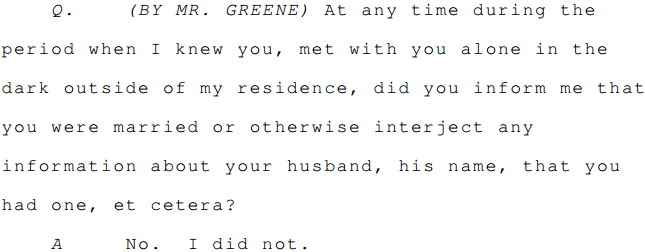

Dr. Tiffany Bredfeldt, on cross-examination by the writer in 2013

Dr. Michael Honeycutt, on cross-examination by the writer in 2013

Based on nothing more than the two statements quoted above, a precocious child would wrinkle her nose. Yet such obvious contradictions have inspired no judge to arch an eyebrow nor any Ph.D. to scruple. In over 11 years.

Calling someone a liar risks being sued, and trial judges interpret whatever they want however they want. They’re acutely aware, moreover, of which direction their criteria are supposed to skew when abuse is alleged. This remark cannot be called defamatory: Although this post isn’t about air or water pollution, as would befit one that quotes environmental scientists, it does concern filth.

Cheryl Lyn Walker PhD, Cheryl Walker PhD, MD Anderson Cancer Center, Texas A&M University Health Science Center, TAMHSC, Institute of Biosciences and Technology

Director of the Texas A&M Health Science Center Institute of Biosciences and Technology Cheryl Lyn Walker, remarks by whom were used in evidence against the writer in 2013 and 2016

It relates sworn testimony to the Arizona Superior Court by two representatives of the Texas Commission on Environmental Quality (TCEQ), reportedly the second largest agency of its kind after the EPA. Those public sector scientists are Michael Honeycutt, Ph.D., the TCEQ’s toxicology director and an adjunct professor at Texas A&M University, who was recently entrusted with a role in forming national health policy, and one of Honeycutt’s protégés, senior toxicologist Tiffany Bredfeldt, who’s also a Ph.D. and who had already been entrusted with a role in forming national health policy. On April 4, 2017, the TCEQ tweeted its congratulations to Bredfeldt for her being selected to serve on the Chemical Assessment Advisory Committee of the EPA’s Science Advisory Board, which her boss now chairs. The bio of Bredfeldt’s associated with her appointment highlights her experience as an “expert witness.” This merits note, as does Honeycutt’s superior claim to the same distinction.

A second Texas A&M professor, Dr. Cheryl Lyn Walker, Ph.D., who was Bredfeldt’s postdoc adviser at M. D. Anderson Cancer Center, has been aware of the conduct of Bredfeldt’s detailed in this post for a decade. Appeals by this writer to Walker’s conscience and integrity only inspired her to tell Bredfeldt in a 2008 email: “I am very concerned about your safety.” Bredfeldt entered Walker’s email in evidence against the writer in 2013 and also quoted it to the court in 2016.

Authorial intrusions in the survey of statements to follow will be terse. Bredfeldt and her witnesses will do the preponderant storytelling.

Tiffany Bredfeldt, romancing the camera in 2005

Some orienting details are required. The writer encountered Bredfeldt, then a doctoral student in the University of Arizona College of Pharmacy, at his home in late summer 2005 and met with her there routinely over the ensuing months, mostly after dark. Bredfeldt, otherwise a stranger, declined to mention to the writer that she was married while, for example, taunting him for not inviting her in at midnight: “Where I come from, it’s considered rude not to at least invite a person onto your porch.” Then she disappeared, providing no explanation. A few months after that, when the writer sought one, Bredfeldt variously reported to the police and numerous courts—in statements that remain public in perpetuity and that are not deemed defamatory—that the writer had made unwelcome sexual advances toward her, despite being repeatedly “rebuff[ed]” and “rebuked”; that he posed a violent danger to her and to assorted others she was concerned the writer would talk to about her conduct at his home (among them her mother, who lived 1,200 miles away); that he should be prohibited from possessing firearms; and that he had stalked her, a woman the writer had only ever met hanging around his yard like a stray cat.

Here’s Bredfeldt’s account in her own words to Judge Jack Peyton on April 10, 2006:

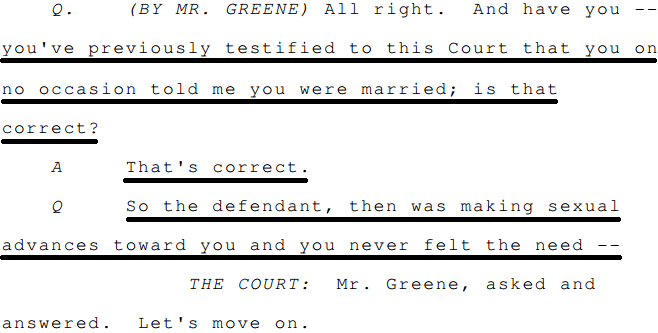
Okay, I’ll begin by defining my relationship, um, with Mr. Greene. I met Mr. Greene in about September or October of 2005 when I was boarding a horse that I own at a boarding facility owned by his family. At that time, uh, we were acquaintances, and we spent time talking and — at his family barn. And that’s about the nature of our — our interaction. During that time, I think, um, he developed maybe romantic feelings for me that — that made me uncomfortable, and I generally would rebuff his advances, asking him to stop.

Mrs. Bredfeldt, whom the writer knew for three months and with whom he has had no contact since March 2006, has along with one of two or three girlfriends of hers who were also routinely around the writer’s residence in 2005 sued the writer some six times. Four legal actions were brought against the writer in 2016 alone, two of which sought his incarceration and all of which endeavored to suppress what this post relates. In a “Victim’s Impact Statement” Bredfeldt submitted to the court in 2016, she owned that she had accused the writer “to the Court multiple times [and] to multiple police departments, detectives, federal agencies, and other officials in several states”—including the Arizona Dept. of Public Safety and the FBI—and it’s this writer’s belief that only with the blind support of loyalists like Mike Honeycutt would Bredfeldt have been so emboldened.
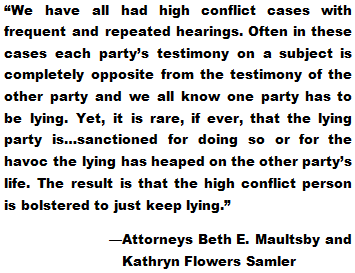
attorney Beth E. Maultsby, attorney Kathryn Flowers Samler, high-conflict litigants, high-conflict people, high-conflict litigation, false testimony, lying in courtThe legal onslaught has spanned (and consumed) almost 12 years, despite the writer’s appealing to dozens of people to look between the lines, including Honeycutt, who’s notably a husband with two college-aged sons. Honeycutt is besides a distinguished scientist, cited for his rigorous investigative standards, whose testimony quoted immediately below includes the statements, “I didn’t ask for details” and “I didn’t clarify that.” As a departmental director of the TCEQ, Honeycutt is paid $137,000 per. The writer, in contrast, has for the past decade earned a subsistence wage doing manual jobs that allow him to keep an insomniac’s hours and be left alone—formerly in the company of his dog, his dearest friend, who died suddenly in 2015 while the writer was still daily distracted with trying to clear his name and recover time and opportunities that had been stolen from them. (Here is a letter the writer hired an attorney to prepare in 2009. Bredfeldt represented it to the court in 2013 as evidence of harassment, and testified she believed her “psychiatric prognosis” would improve if such speech were restrained. “One of the most difficult parts of dealing with something, since this is profoundly stressful,” she told the court, “is that the stress doesn’t go away.”) The writer had aspired to be a commercial author of humor for kids, as Bredfeldt knew, and had labored toward realizing his ambition for many years before encountering her and her cronies on his doorstep. His manuscripts have since only gathered dust.

(A further counterpoint: The first public official the writer notified of Bredfeldt’s conduct, who also took no heed, was University of Arizona Dean of Pharmacy J. Lyle Bootman, Ph.D. A decade later, Bootman was charged with raping and beating an unconscious woman in his home. For almost two years following his indictment in 2015, while free on his own recognizance, Bootman faced trial—a fundamental due process right this writer was denied in 2013. Despite having been placed on administrative leave, Bootman continued to draw a faculty salary of over $250,000 from the U of A, the writer’s alma mater and former place of employ. As a graduate teaching assistant in the English Dept. in the late ’90s, the writer cleared about $200 a week. While he awaited a ruling in Greene v. Bredfeldt, the appeal of the last of the lawsuits brought against him during the same period of time by Bredfeldt and a cohort of hers, the five felony charges against Bootman were dropped. A tort case based on the same facts continues. Bootman’s attorneys filed for a protective order in December to bar public access to records.)
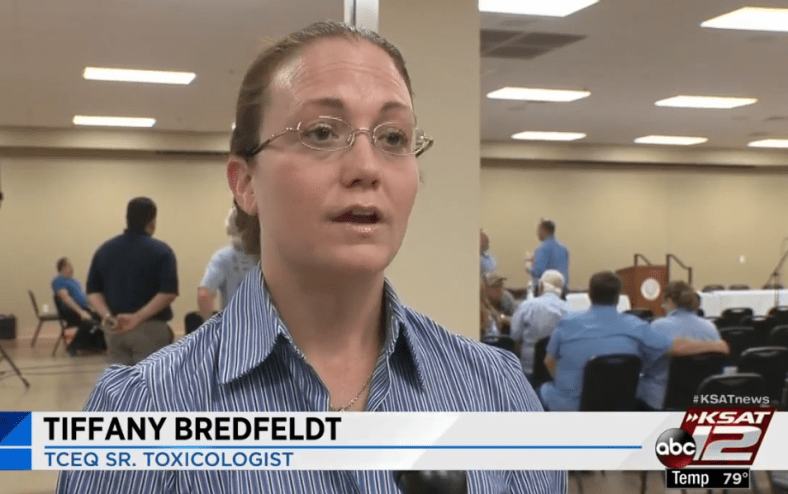
In an interview that aired in 2017, Tiffany Bredfeldt, the writer’s accuser, reassured the audience of ABC News that it could place its trust in the TCEQ. Bredfeldt made a similar pitch before the National Research Council of the National Academies of Sciences, Engineering, and Medicine in 2013. Bredfeldt, who the court was told in 2013 and 2016 is not a public official, has repeatedly appeared as the face of the Texas Commission on Environmental Quality. Her attorneys have argued that since she isn’t a public official, she isn’t obligated by law to prove her allegation that objectionable statements by this writer are false and therefore unprotected speech. Her boss, Michael Honeycutt, told the court in 2013: “Tiffany is just like the other 14 employees that I have.” If no other assertions by the TCEQ cause Texans concern, that one should.

This post’s presentation is simple: It juxtaposes contradictory statements that span seven years (2006–2013), most of them made under oath and all of them made by state scientists. (Those in small print may be enlarged in a new tab by clicking on them, or magnification of the entire post may be increased by pressing [CTRL] or [COMMAND, the cloverleaf-shaped key on Macs] + [+]. Zoom may be reversed similarly: [CTRL] or [COMMAND] + [-].) Scrutiny of the quotations below may lead the reader to conclude they’re evidence of false reporting, perjury, subornation of perjury, stalking, harassment, mobbing (including attorney-complicit abuse of process and civil conspiracy), defamation, bureaucratic negligence, professional incompetence, mental derangement, and/or general depravity.

The writer will let the facts speak for themselves.

MICHAEL HONEYCUTT, on cross-examination by the writer on May 20, 2013:
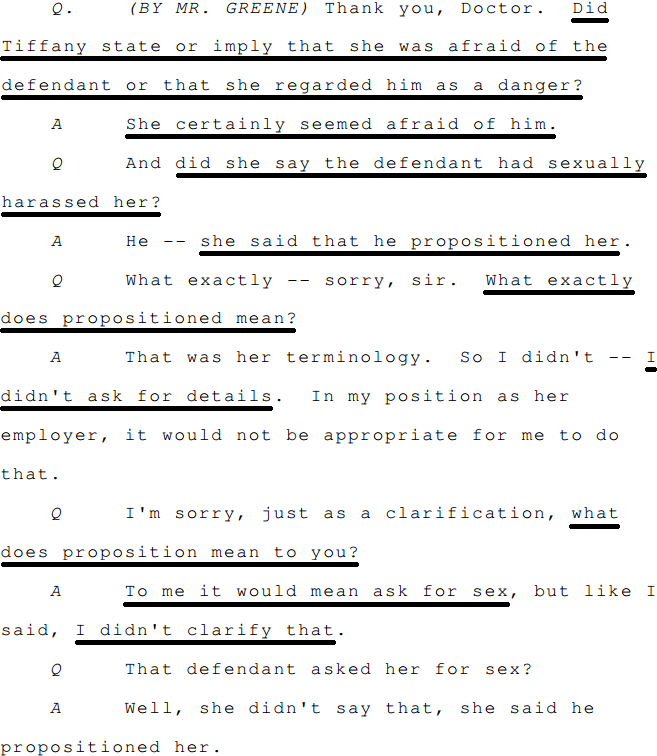
Honeycutt testifies in 2013 that Bredfeldt told him the writer “propositioned” her in 2005, which to him, he says, “would mean ask[ed] for sex.”

Bredfeldt’s attorney, Jeffrey Marks, would follow up on Honeycutt’s testimony by beginning his cross-examination of the writer with a jab instead of a question: “She says you propositioned her.” The writer replied, “What does that mean?” Marks chirped, “That you offered her sex.” Bredfeldt, while gazing around the room at her audience, nodded solemnly.

TIFFANY BREDFELDT, in an email to the writer sent Friday, March 17, 2006, that she entered into evidence three days later (Monday, March 20, 2006) along with her petition for restraining order number one:
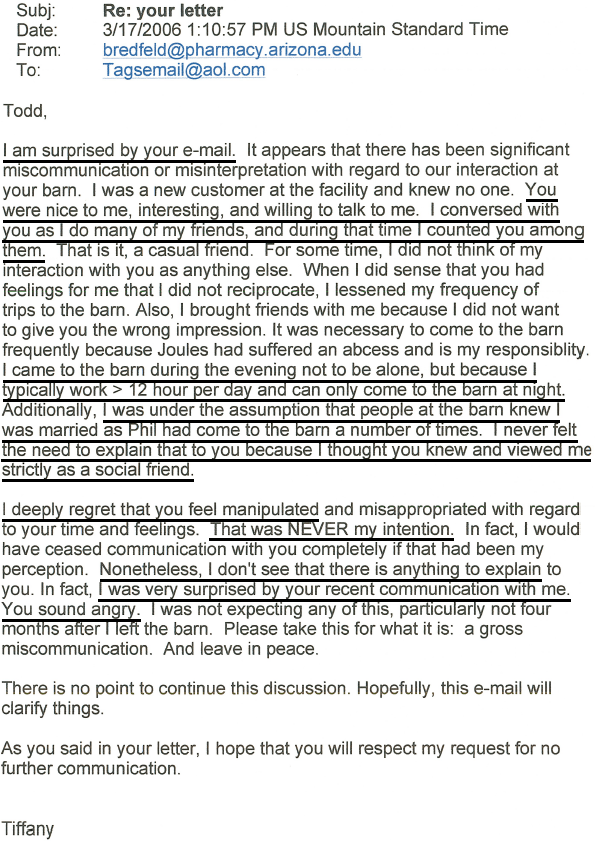
Bredfeldt states in this self-contradictory email, which she would submit days later in evidence to the court in the 2006 procedure that began the controversy, that the writer had been “nice” to her and that she had never felt the need” to “explain” to him she was married, because her husband had come to the writer’s place of residence “a number of times,” and she thought the writer already knew and besidesviewed [her] strictly as a social friend.” Contrast Honeycutt’s 2013 testimony: “[S]he said that he propositioned her.

On April 10, 2006, not a month after Bredfeldt sent this email, she would testify before a judge (in her husband’s presence) that she had had to repeatedly “rebuff…advances” by the writer in 2005. The writer was identified to the court not as a considerate “friend” but as an “acquaintance” with whom Bredfeldt had “interact[ed].” Ten years later, the husband the writer was supposed to have known about, a geoscientist today employed by Weston Solutions as a project manager, would be asked in court on direct examination by his lawyer, “Do you know the defendant, Todd Greene?” Philip Bredfeldt’s answer: “I never met him….” Then Mr. Bredfeldt would clarify to the 2016 court that he “first came to know about the [writer] in early 2006,” that is, the same week his wife sent this email, during which the writer was alleged to have sent her a “series of disturbing emails” and “packages,” a fiction that by itself would take another entire post to unweave. Significantly, Phil Bredfeldt had no idea the writer existed until 2006 and, according to his 2016 testimony, was not informed by his wife of any sexual aggression toward her in 2005—nor was anybody else, for example, the writer’s mother, who was daily at the property where the writer lives from morning till dusk, and whom Bredfeldt knew and spoke with routinely. (The writer’s mother was then in treatment for cancer, a fact Bredfeldt exploited to flaunt her knowledge of the disease, which was a subject of her dissertation research.) Where Phil Bredfeldt was while his wife was outside of the writer’s residence at 1 a.m.—and with whom—has never been clarified.

Honeycutt, in a 2013 quotation below, will testify in further contrast to Bredfeldt’s statements in this email that he was told the writer’s behavior in 2005 was “erratic and bizarre” and that he “wouldn’t take no for an answer.”

TIFFANY BREDFELDT, in a statement to the University of Arizona Police Dept. given on March 18, 2006 (the next day):
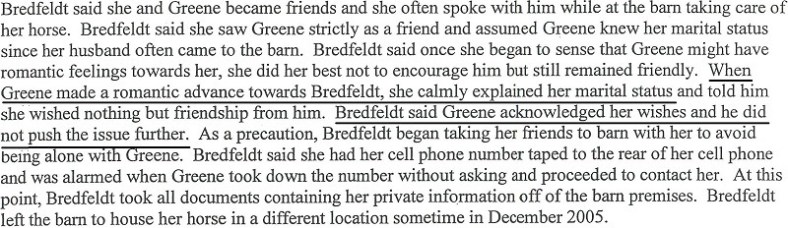
Bredfeldt, in contrast to her emailed statements to the writer 24 hours prior (and in contrast to her subsequent testimony to the court in 2006 and both hers and Honeycutt’s in 2013), reports to the police that the writer had made “a romantic advance” toward her in 2005, inspiring her to admit to him she was married, after which he desisted. Bredfeldt then says the writer seized her cell phone, copied down her number, and contacted her. Bredfeldt’s work and home addresses and telephone numbers were publicly listed, and the writer never spoke with Bredfeldt on the phone. There was no need; she could be found outside of his residence most nights, as often as not in a red tank top.

On the single occasion the writer had handled Bredfeldt’s cell phone, borrowing it because his phone had been destroyed by a power surge, Bredfeldt had insisted on typing the numbers for him before sliding the phone into his palm and caressing his fingers (repeatedly). That was in late Nov. 2005 after she and a friend of hers had invited themselves into the writer’s house. Bredfeldt’s “chaperone,” a stranger then calling herself Jenn Oas, began conversation by telling the writer she had just returned from India where she “mostly” hadn’t worn a bra. Bredfeldt chimed in with a quip about “granny panties” (after having excused herself and returned wearing freshly applied eye makeup, complaining that she had “misplaced” her glasses). A couple of weeks later, Bredfeldt would vanish.

(Flash-forward: The policewoman who instructed Bredfeldt how to obtain a court-ordered injunction, Bethany Wilson, is today a librarian in charge of kid lit—what the writer had aspired in 2006 to make his profession.)

TIFFANY (AND PHIL) BREDFELDT, in a sworn affidavit to Judge Roger Duncan (then a pro tem) filed on March 20, 2006 (two days later):
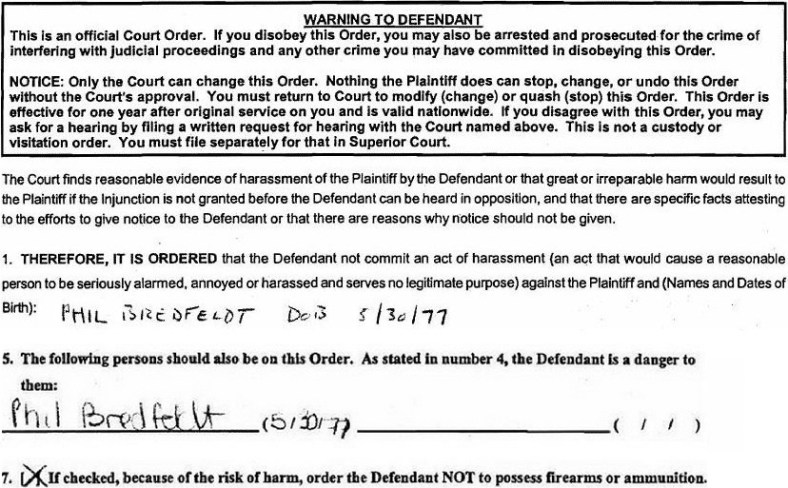
Bredfeldt urgently petitions a protective order tailored to prohibit the writer (three days earlier called a “friend” who had been “nice” to her) from having any contact with her husband, Phil, a stranger, who is alleged to be in violent “danger.”

Later the same day, the writer would be sent an email, ostensibly by Phil Bredfeldt, that begins, “STAY THE HELL AWAY FROM MY WIFE, YOU SICK FUCK,” and ends, “THIS IS THE LAST TIME YOU WILL BE TOLD.

(The Bredfeldts simultaneously sent the email to UAPD Officer Bethany Wilson, with whom she later told the writer they had been on the phone at the time. Officer Wilson, who had met both of them, opined during a 2006 interview with the writer that Mrs. Bredfeldt “wore the pants.”)

Judge Jack Peyton, JP, Justice of the Peace, Pima County Justice Court

Judge Jack Peyton

The evidence of harassment Tiffany Bredfeldt presented to the court was five emails she and the writer had exchanged over a weekend (March 16–20): two from her, three from him in reply. The March 17 email of hers shown above was shuffled to the back of the sheaf, out of chronological order, causing the judge who presided over the writer’s April 10, 2006 hearing, Pima County Justice of the Peace Jack Peyton, to remark, “I don’t think I have a copy,” and then to ask, “Am I missing one [of the emails]?” Bredfeldt had to include the contradictory email among her evidence, which was never anyhow scrutinized, because it contained one of the only two requests she had ever made to the writer not to contact her: “I hope that you will respect my request for no further communication.” The other request was in an email she had sent him 20 hours earlier, in which Bredfeldt had represented the writer to himself as a stalker after he had gently tried to learn the motives for her behaviors at his home and her concealment from him that she was married. Judge Peyton confirmed with Bredfeldt that the minimum qualification demanded by the law, namely, two requests for no contact, had been met. The writer need not have been present.

Alleged on March 20 to be in danger of violent assault, Phil Bredfeldt had to be repeatedly reprimanded for displays of temper in open court three weeks later. Judge Peyton finally told him, after ordering his name stricken from his wife’s protective order:

I won’t think twice about asking you to leave the courtroom, because you’re not a party. You are welcome to be here. This is a public forum. But I won’t have you interrupting, and I will not have you making me uncomfortable about what your next action might be.

The judge, reputed to be the go-to JP for women alleging abuse by men, nevertheless cemented the protective order against the writer, explaining: “I do not get the impression that [Mr. Bredfeldt] was placed on that order by design.

(The following year, Judge Peyton was appointed to head a county domestic violence specialty court, which was financed by a $350,000 gubernatorial grant that included no budgetary allowance for defense attorneys. The judge, a onetime Maryland labor lawyer d/b/a J. Craig Peyton, underwent a “five-day domestic violence training session” in preparation. Reportedly operating only two days a week, his court has since processed well upwards of 25,000 cases.)

TIFFANY BREDFELDT, on cross-examination by the writer on May 20, 2013 (seven years later):
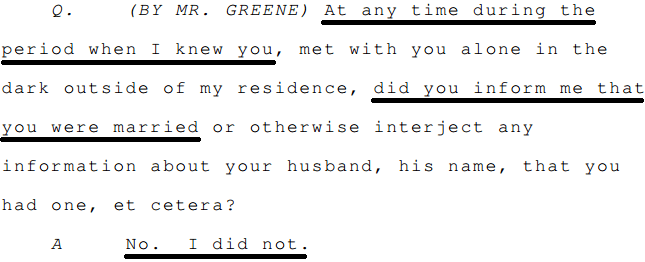
In contrast to her statements to the police in 2006, Bredfeldt testifies in 2013 that she never told the writer she was married. What Bredfeldt told the writer in 2005 was that she lived with a dog. The writer asked if it was alone at night while she was with him. Bredfeldt answered, “Yes.” The writer urged her to bring the dog with her so it wasn’t by itself and gave her a toy to take home.

TIFFANY BREDFELDT, on cross-examination by the writer on May 20, 2013 (the same afternoon):
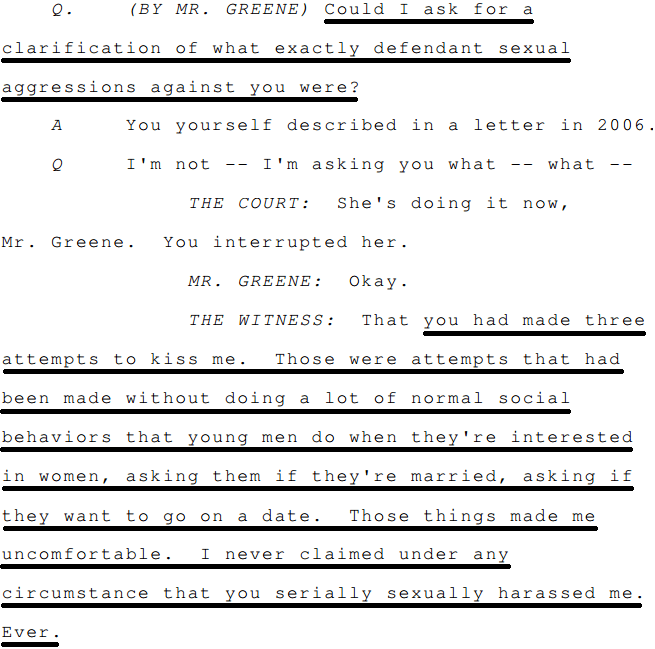
Also contradicting her statements to the police in 2006 (besides controverting what her first witness, Honeycutt, told the court in 2013 that she had told him), Bredfeldt testifies (in the presence of her husband) that the writer made “three attempts to kiss [her]” in 2005—which made her “uncomfortable” but not so uncomfortable as to prompt her to tell the writer she was married (or to tell her husband that another man had repeatedly tried to kiss her). Then Bredfeldt denies she has “ever” accused the writer of sexual harassment.

TIFFANY BREDFELDT, in a memorandum to Superior Court Judge Charles Harrington filed July 30, 2006:

In a “Statement of Factsto the court, contradicting her statements to the police (besides to the writer himself, which emailed statements she submitted to the court in 2006, 2013, and 2016), Bredfeldt alleges the writer made “several physical, romantic advances toward [her],” despite being “rebuked,” and that she was forced to flee[w]hen such advances continued.”

There were no physical advances. Bredfeldt was invited to have Thanksgiving dinner with the writer’s family in 2005. Instead of telling the writer she had a husband to get home to, she said she was suffering from a migraine. The writer put his hand on her shoulder and said he hoped she felt better. All other physical contacts between Bredfeldt and the writer, clasps and caresses, were initiated by her, typically during conversations in which she pointedly referred to breasts, bras, or panties, her naked body, striptease, or the like. At the conclusion of an earlier meeting in November, Bredfeldt had thrust her face in the writer’s and wagged it back and forth as if to tease a kiss. The writer didn’t respond, because there was nothing romantic about it. That was on the night Bredfeldt returned after attending an out-of-state wedding—her sister-in-law’s (Sara Bredfeldt’s), a detail she omitted mentioning.

A month later, on the evening before Bredfeldt “left the horse boarding facility” (in 2005 not 2006), the writer encountered her loitering in the dark outside of his house—alone. Bredfeldt returned a coffeemaker she had borrowed from him to prepare poultices for her horse’s abscessed leg. During the transfer, Bredfeldt tried to brush the writer’s hands with hers. Bredfeldt and the writer spoke as usual—he remembers talking to her about shooting stars—and the writer’s mother briefly joined them and invited Bredfeldt to a Christmas party. Bredfeldt removed her horse the next day while the writer was at work.

TIFFANY BREDFELDT, during cross-examination by the writer on May 20, 2013:
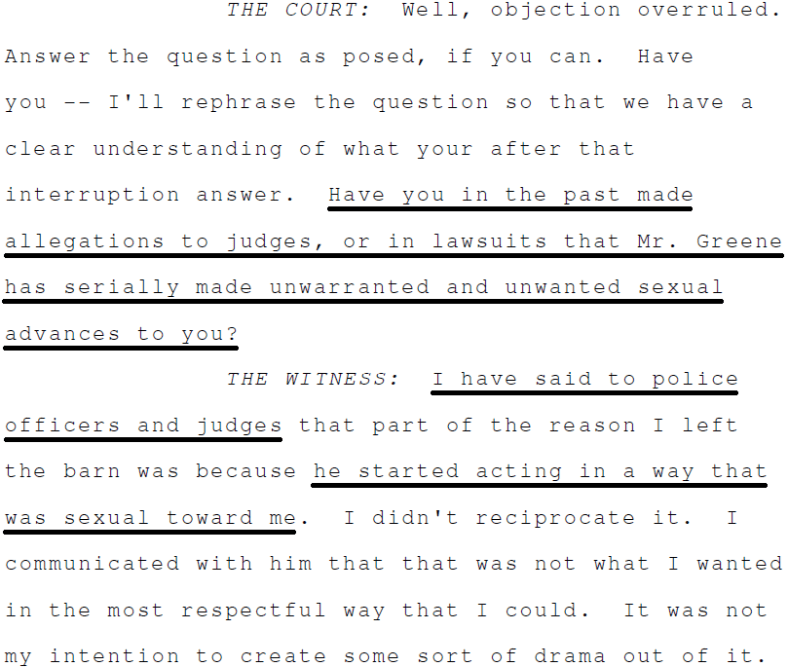
Bredfeldt testifies on examination by the judge that she has only ever told police officers and judges that the writer “act[ed] in a way that was sexual toward [her].” She “communicated with him that that was not what [she] wanted in the most respectful way that [she] could,” she says, which did not include either informing the writer she was married or wearing her wedding ring.

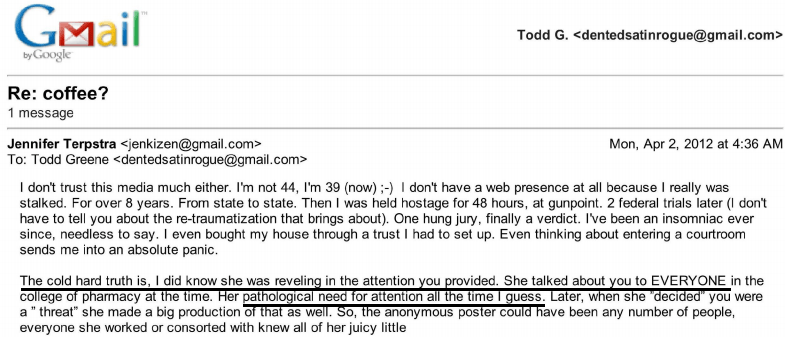
JENNIFER (OAS-)TERPSTRA, Bredfeldt’s other witness in 2013, a former colleague of hers from her University of Arizona days who went by Jenn Oas when the writer was introduced to her in 2005, in an email to the writer sent April 2, 2012 (a year earlier):
Jennifer Terpstra, Jen J. Terpstra, Terpstra JJ, Jennifer Oas-Terpstra, Jenn Oas, South Texas College, STC

This and the rest of Terpstra’s some two dozen emails to the writer in 2012 have been submitted to the court in multiple cases and are public documents accessible to anyone. Whether the emails have ever been scrutinized by a judge is uncertain. No trial has been conducted since the writer was granted a 20-minute audience before a judge in 2006. The 2013 proceeding from which the focal testimony in this post is drawn was a two-hour “preliminary” hearing. Judge Carmine Cornelio, though he drew the case out for half a year and returned several scalding rulings, found a two-hour hearing to be a sufficient basis for indefinitely depriving the writer of his First Amendment privileges. (When the writer had begun to object in open court to an order that was flagrantly unlawful, the judge threatened to summon security. Among the Arizona Court of Appeals’ stated reasons for denying the writer’s 2017 appeal of the order was that the writer had not “challenged” the judge’s ruling at the time.)

In this email, Terpstra tells the writer she was “stalked [f]or over 8 years [f]rom state to state.” Both Bredfeldt and Terpstra have claimed to be victims of multiple stalkers—including this writer. Bredfeldt, who the writer would be informed four years later has held a black belt in tae kwon do since her teens, came to the writer’s door in 2005 seeking his protection from some “men in a van” who she said had been “stalking” her while she was alone in the dark outside of his residence. Narratives of the “event,” which was unwitnessed and may have had no basis in reality, were circulated by Bredfeldt among other horse boarders on the property where the writer lives. The writer bought a wireless doorbell and installed it by the gate to his yard so that Bredfeldt could summon him quickly in case of a “recurrence.” When he showed it to her, she smiled.

A few months subsequent, when Bredfeldt’s accusations against the writer began, she was reported to have told colleagues that she thought she had seen him around her residence—and at workday’s end would ask to be escorted to her car. In testimony to the court quoted in a postscript to this exposé, Honeycutt, Bredfeldt’s first witness in 2013, says the TCEQ rewarded similar expressions of fear from her by providing her with a private office (“with hard walls and with a door that has a lock on it” in Texas).

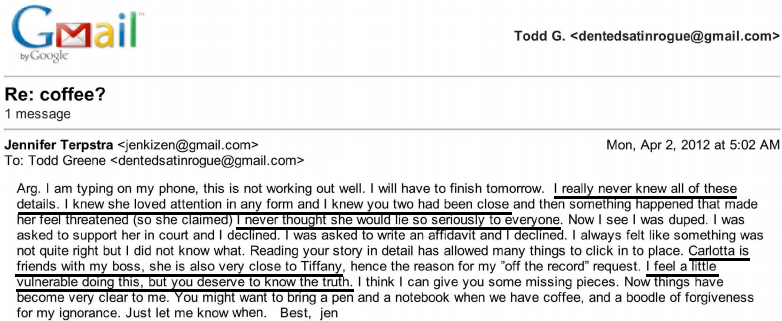
JENNIFER TERPSTRA, in an email to the writer sent April 2, 2012:
Jennifer Terpstra, Jen J. Terpstra, Terpstra JJ, Jennifer Oas-Terpstra, Jenn Oas, South Texas College, STC, Carlotta Groves PhD, Carlotta Groves DVM

In this email, sent a year before Terpstra would join Bredfeldt in testifying against the writer, Terpstra says that she “never thought [Bredfeldt] would lie so seriously to everyone” and that she knew Bredfeldt and the writer had been “close,” which remark alone contradicts everything Bredfeldt has told the court in the past decade. Terpstra also says she feels professionally “vulnerable” confiding in the writer but that he “deserve[s] to know the truth.” She suggests the writer “bring a pen and a notebook” to a meeting she proposed so that he doesn’t forget anything.

JENNIFER TERPSTRA, in an email to the writer sent June 3, 2012 (a month and a half after the two met for coffee):

Jennifer Terpstra, Jen J. Terpstra, Terpstra JJ, Jennifer Oas-Terpstra, Jenn Oas, South Texas College, STC

Terpstra told the writer over coffee in mid-April 2012 (when his father and his best friend were still alive, and a settlement could have reversed their decline) that Bredfeldt’s spouse, Phil, was known in their circle as “the phantom husband” and that Bredfeldt had urged her friends to go to the writer’s home to “check [him] out”—besides routinely talked about the writer to an audience of “25 or 30 people” at the University of Arizona College of Pharmacy.

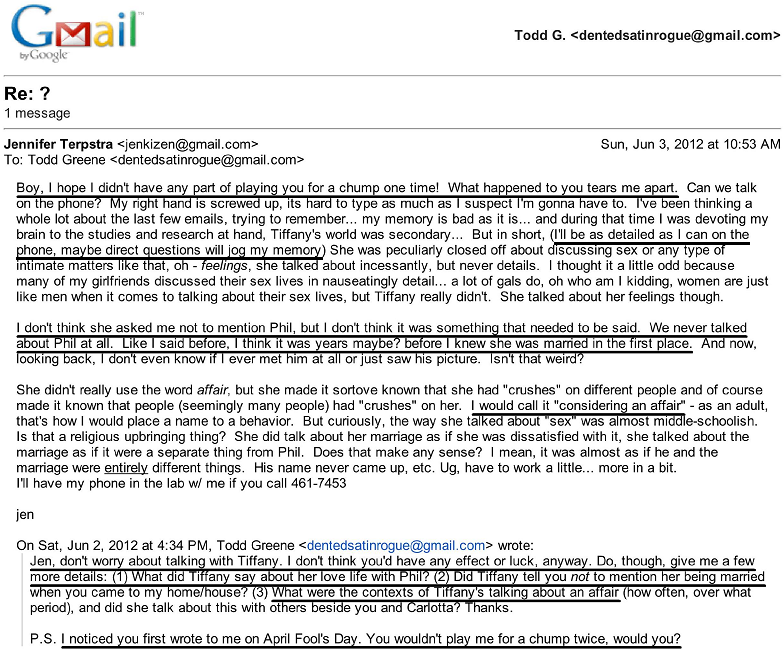
Terpstra says in this email that Bredfeldt never talked about her husband and that she (Terpstra) wasn’t sure she had ever seen the man in person or only seen what she had described to the writer over coffee as a laminated newspaper clipping with a picture of him that was tacked to Bredfeldt’s refrigerator. Terpstra says that based on Bredfeldt’s behaviors in 2005, she judged she had been “considering an affair” with the writer, which wildly contradicts any account Bredfeldt has ever related to anybody.

In the first of the emails Terpstra sent him in 2012, she explained her six-year delay in confiding this to the writer by saying, “I don’t lie or bend the truth [but] I do avoid conflict.”

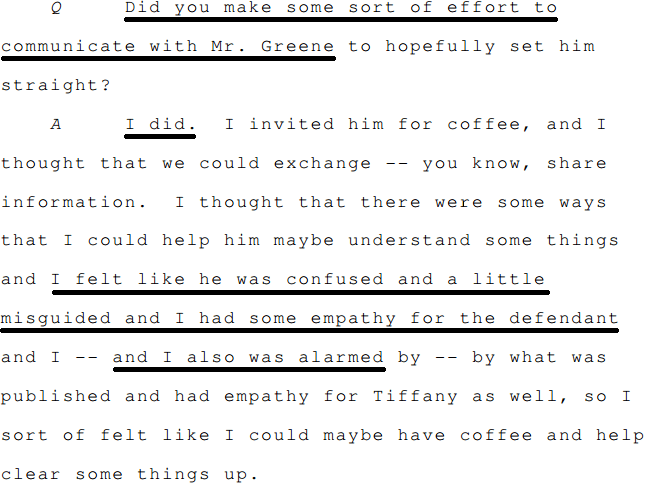
JENNIFER TERPSTRA, on direct examination by Bredfeldt’s attorney, Jeffrey Marks, on May 20, 2013 (less than a year later):
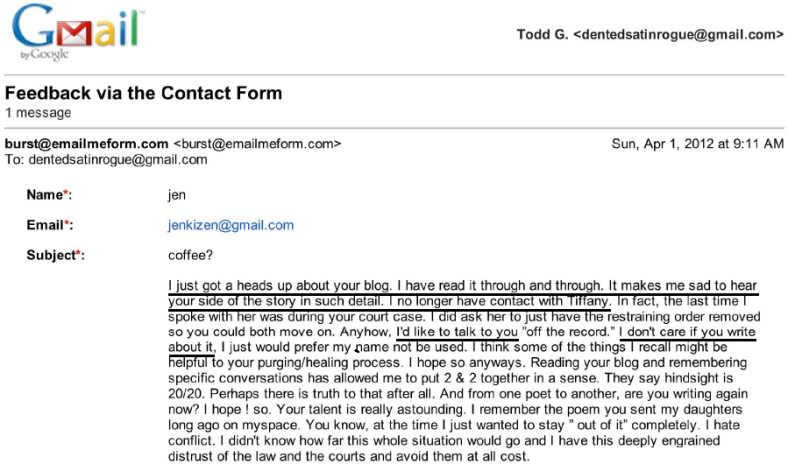
JENNIFER TERPSTRA, in an email to the writer sent April 1, 2012:
Jennifer Terpstra, Jen J. Terpstra, Terpstra JJ, Jennifer Oas-Terpstra, Jenn Oas, South Texas College, STC

In this email, Terpstra tells the writer she had asked Bredfeldt “to just have the restraining order removed” in 2006. (Terpstra would tell the writer the same thing over coffee a couple of weeks later, saying Bredfeldt had answered, “‘No.’ Just…‘no.’”) In contrast to Terpstra’s statements in this email and the others she sent him in 2012, besides in contrast to an email she sent him in 2007, Terpstra would report to Officer Nicole Britt of the Tucson Police Dept. in 2015 that “in 2005 she and her friend [Tiffany Bredfeldt] met [Todd Greene]. He then became fixated on the two of them and began stalking them.” (According to the same interview notes, Terpstra said this blog was “set up in honor” of her and “dedicated” to her.) A couple of months later (early 2016), Terpstra would report to TPD Det. Todd Schladweiler, who is assigned to the Tucson Police Mental Health Support Team, that she “now carries a handgun due to her concern that [Greene] is a threat to her safety.” Det. Schladweiler also recorded that Terpstra “said she communicated with [Greene] a few times [in 2012] and then he became very sexual in nature” and that Terpstra denied contacting the writer after they met for coffee in mid-April 2012, following which meeting she had insisted the writer give her a hug and then emailed and phoned him for a quarter of a year.
Then students in the University of Arizona College of Pharmacy, Terpstra and Bredfeldt told the writer in 2005, after inviting themselves into his house, that they took “benzos” to relieve stress. The writer asked where they got the drugs. Terpstra (who would marry a former bartender with a cocaine conviction not long afterwards and be charged with DUI in 2011) answered, “From work.” Bredfeldt echoed, “From work.”

Terpstra, who is reportedly diagnosed with bipolar disorder, told Det. Schladweiler she believed the writer was mentally ill. Although Det. Schladweiler was provided with Terpstra’s emails when he arrested the writer on Jan. 5, 2016, the subsequent synopsis of their interview gives no indication the detective spared the emails a glance.

Less than four months after her second police report, in which Terpstra alleged she feared for her safety and was carrying a gun, she would have her home address forwarded to the writer by email in the first of a spate of “copyright infringement” claims that represented her third legal action against him in 2016 and that succeeded in having this blog temporarily suspended by its host. The writer contested the claims, alleging perjury and fraud, and Terpstra declined to litigate them in court.

Terpstra, who has coauthored with Dr. Michael J. Frank, Ph.D., professor of cognitive, linguistic, and psychological sciences at Brown University, is the daughter of feminist painter Joan Bemel Iron Moccasin (Oas) and was employed as a research specialist in the University of Arizona College of Medicine under psychiatrist Francisco Moreno until 2016, when, after making her sundry false allegations, she left the jurisdiction.

JENNIFER TERPSTRA, on cross-examination by the writer on May 20, 2013:
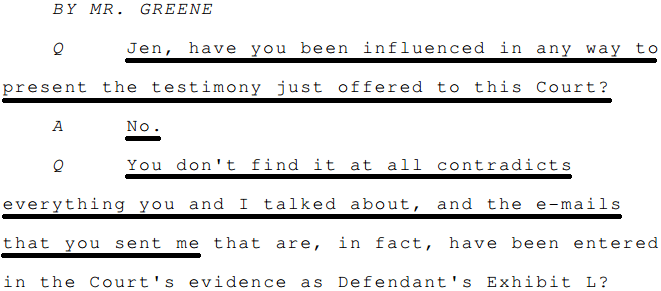
Jennifer Terpstra, Jen J. Terpstra, Terpstra JJ, Jennifer Oas-Terpstra, Jenn Oas, South Texas College, STC

Over coffee with the writer in 2012, Terpstra complained of financial problems. She also remarked, “Tiffany’s dad has a lot of money.” Tiffany and Phil Bredfeldt’s was a mutually prosperous union of two wealthy, fundamentalist Christian families. Phil Bredfeldt’s father was his best man in 2001; his sister Sara was a bridesmaid; and Tiffany Bredfeldt’s brother, Jon Hargis, was a groomsman. Four years later, Sara Bredfeldt was married to a medical student, Roberto “Bobby” Rojas, who is today an M.D. (Aurora St. Luke’s Medical Center in Milwaukee).

Ray Bredfeldt MD, Raymond Bredfeldt MD, Dr. Ray Bredfeldt, Arkansas Blue Cross and Blue Shield, ABCBSTiffany Bredfeldt’s father, Timothy “Tim” Hargis, is or was a bank vice president (First Security of Arkansas), as was his father before him. Phil Bredfeldt’s father, Raymond “Ray” Bredfeldt, is a family physician who practiced privately and besides rented his credentials to Arkansas Blue Cross and Blue Shield for some dozen years. The starting salary for an ABCBS regional medical director is today around $180,000. Dr. Ray Bredfeldt, M.D., had volunteered to join Terpstra in giving witness testimony in 2016 that was meant to induce the court to jail the writer while the writer’s own father, who didn’t graduate from high school, lay dying—in a home in foreclosure. Ray and Ruth Bredfeldt and Tim and GaLyn Hargis have known of what this post details from the start and have temporized for over a decade rather than acknowledge any liability for their families’ ways. “It’s what people like that do,” Terpstra commented to the writer in 2012. (Testifying in 2016, while his father was nearby, Phil Bredfeldt acknowledged on the stand that he was very aware of Terpstra’s 2012 emails. He quoted a post about them. Construing his statements to the court, the only thing that disturbed him about the emails was their contents’ being public.)

The court was told on Dec. 21, 2016, that Terpstra, who was sued to have her evicted from her house the year before, had moved from Arizona to Texas, where Tiffany and Phil Bredfeldt have resided since 2006 (in a house Terpstra told the writer that Tiffany Bredfeldt’s father had bought for them)—and the writer would be surprised if Terpstra’s legal representation in 2016 and 2017 cost her a penny.

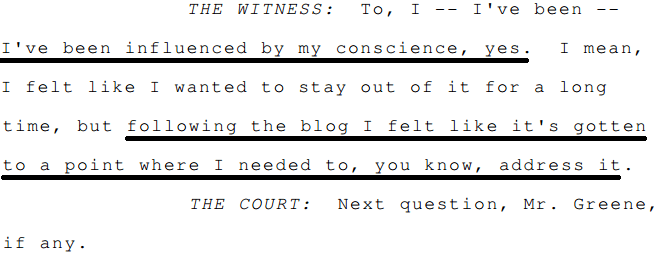
JENNIFER TERPSTRA, on cross-examination by the writer on May 20, 2013:
JENNIFER TERPSTRA, in an email to the writer sent June 7, 2012:
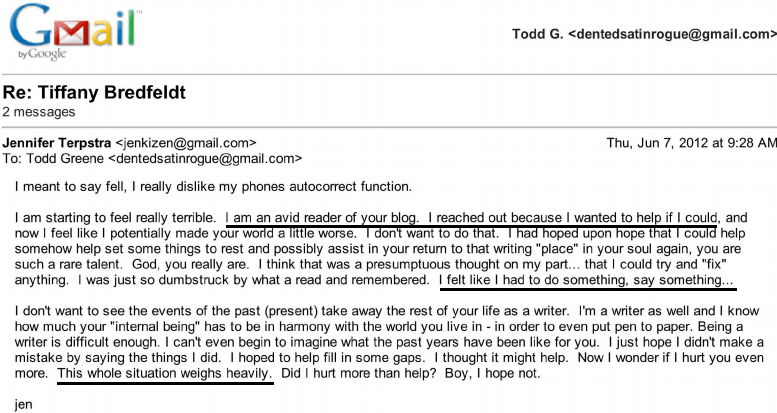
Jennifer Terpstra, Jen J. Terpstra, Terpstra JJ, Jennifer Oas-Terpstra, Jenn Oas, South Texas College, STC

JENNIFER TERPSTRA, on cross-examination by the writer on May 20, 2013:
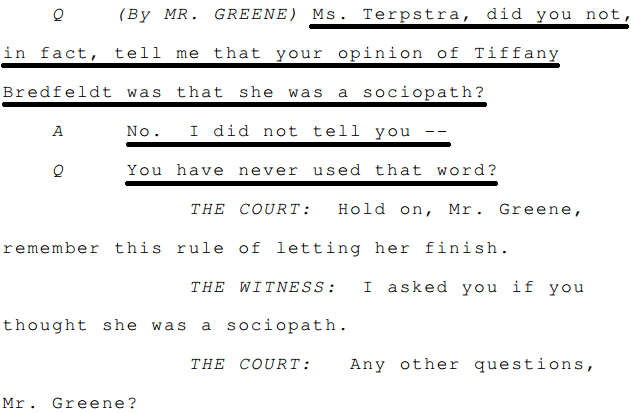
Jennifer Terpstra, Jen J. Terpstra, Terpstra JJ, Jennifer Oas-Terpstra, Jenn Oas, South Texas College, STC

JENNIFER TERPSTRA, in an email to the writer sent June 3, 2012:
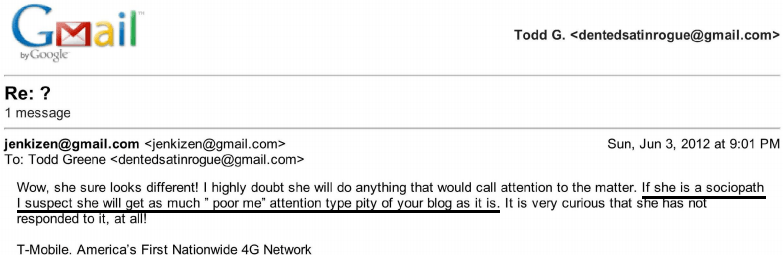
Jennifer Terpstra, Jen J. Terpstra, Terpstra JJ, Jennifer Oas-Terpstra, Jenn Oas, South Texas College, STC

Jennifer Oas-Terpstra, whom the writer has met three times in his life and only once in the past decade (and with whom he has had no contact since 2012), brought three legal actions against him in 2016 that each sought to suppress the emails quoted above—emails that today implicate both Bredfeldt and her (and criminal statutes of limitation, like those for false reporting and forswearing, stop running when perpetrators are outside of the state’s boundaries). Terpstra’s actions included a criminal prosecution, dismissed seven months later, in which Bredfeldt was also named a plaintiff, and a restraining order identical to the one Bredfeldt petitioned in 2006, which had inspired this blog and inspired Terpstra to tell the writer in 2012: “I can’t even begin to imagine what the past years have been like for you.” Terpstra’s restraining order was dismissed 20 months later.

Here are the allegations Terpstra made in her affidavit. These ex parte allegations remain a public record indefinitely. Here, in contrast, is how “vindication” from them appears. The writer was told that this handwritten dismissal, which required eight months of appeals to obtain, exists as a piece of paper only and won’t be reflected in the digitized record. Judge Antonio Riojas, who granted the Aug. 25, 2017 dismissal, accordingly recommended that the writer “carry [it] with [him].” His clerk provided the writer with the yellow copy of the triplicate form, the one meant for the plaintiff, who never appeared in court and will never be criminally accountable for her false allegations to the police in 2015 and 2016.

I’ve been doing this for 20 years,” Judge Riojas told the writer, “and I’ve never known a police [officer] or a prosecutor to charge someone for…false reports, no matter how blatant….” He added: “I wish they would, because I think people come in, and they say things that are just blatantly false—and lying.” A false or vexatious complainant “can keep filing as much as [s/he] wants,” Judge Riojas said (costing an attorney-represented defendant thousands of dollars a pop and his or her accuser nothing; application is free to all comers). “There is no mechanism to stop someone from filing these orders.” What may be worse, even a dismissed order, the judge explained, “can’t be expunged” (and anything may be alleged on a fill-in-the-blank civil injunction form, for example, rape, conspiracy to commit murder, or cross-dressing; whether heinous or merely humiliating, allegations that may be irrelevant to the approval of a keep-away order and/or that may never be litigated in court, let alone substantiated, will still be preserved indefinitely in the public record above a judge’s signature). Significantly, Judge Riojas, who is the presiding magistrate of the Tucson municipal court (and a member of the Arizona Judicial Council and the Task Force on Fair Justice for All), agreed that restraining orders were “abused”. Of that, he said, “[t]here’s no doubt.”

(In a given year, there are reportedly 5,000 active restraining orders in Tucson City Court, which recently added an annex dedicated to their administration exclusively—and the municipal court is just one of three courts in Tucson that issue such orders.)
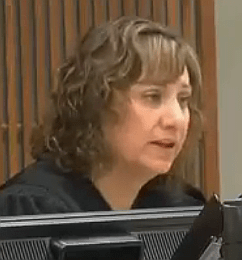
Judge Wendy Million, Tucson City Court

Judge Wendy Million

The reason Judge Riojas had to dismiss the order against the writer, nine months after he requested his day in court, was that the writer had been denied his statutory right to a hearing by Judge Wendy Million, necessitating a lengthy appeal and her admonishment by Superior Court Judge Catherine Woods for abuse of discretion. (Among approximately 15 judges to have been exposed to some aspect of this matter, Judge Woods was the first to return a ruling clearly untainted by political motives, for which she has this defendant’s highest respect.) Judge Million, who twice continued the writer’s hearing until the injunction expired and then nominated the case a “dead file,” notably coordinates Tucson’s domestic violence court and is acknowledged as an editor of Arizona’s Domestic Violence and Protective Order Bench Book. Dismissal of the case was further delayed by Judge Cynthia Kuhn, who was first assigned to the writer’s superior court appeal. Judge Kuhn sua sponte (that is, without being asked) granted Terpstra’s attorney additional time to respond to the writer’s appellate memorandum—and then abruptly recused herself, citing an unspecified “conflict of interest” as the reason.

Terpstra, in the first of the 22 emails she sent him in 2012, had told the writer: “I have this deeply engrained distrust of the law and the courts and avoid them at all cost.” Besides witnessing against him in May 2013, accusing him to the police in Nov. 2015, petitioning a civil injunction and instigating a criminal prosecution a month after that, filing a second police report in Jan. 2016, and threatening to sue him in federal court for copyright infringement 14 weeks later, Terpstra was poised to witness against the writer all over again that summer in the lawsuit brought by Bredfeldt and her husband that demanded the writer be jailed for contempt of the 2013 prior restraint. In between, in 2014, Terpstra prosecuted her husband, alleging domestic violence. A relative of his, who afterwards wept, told the writer in 2016 that she believed the man was relentlessly provoked, which the writer finds more than credible. In a voicemail Terpstra left him in 2012 (in which she tacitly identifies Bredfeldt as a “crazy person” from the writer’s “life book”), Terpstra told the writer someone had “threatened to call the police on [her].” Later, by phone, she clarified that this was another man she had been corresponding with that year—who blamed her for a woman’s suicide.

Tucson attorney Chris Scileppi, attorney Christopher Scileppi

Attorney Christopher Scileppi

Bredfeldt and Terpstra, (carrion) birds of a feather, were represented by the same (criminal) attorney in 2016 and 2017, Christopher “Chris” Scileppi, whose plumage is no different from theirs. Scileppi attained minor notoriety in 2008 for having been given a hug by his “very close friend” the mayor in front of jurors at a rape trial in which Scileppi represented one of the alleged rapists of a 15-year-old girl. Scileppi remarked to the outraged judge: “Courtrooms are open to the public, and I don’t think it is inappropriate when high-profile people come in and show support for somebody who is on trial.” Scileppi’s client was cut free, but the mayor later did a stint in prison for public corruption despite Scileppi’s representation.

Showing the same unscrupulousness during hearings in the 2016 civil case, Bredfeldt v. Greene, Scileppi threatened in open court to prosecute the writer for purported felony crimes (“extortion” and “aggravated harassment,” specifically) to intimidate him into capitulating to Bredfeldt’s censorship demands, then offered to drop the lawsuit if the writer agreed to leave this site invisible to the public and accessible by request only (apparently because his clients’ fear would be eased if they didn’t know what was on the writer’s mind), and finally, as a Parthian shot, directed the judge to jail the writer for the nonpayment of a $350 sanction from 2013 (explained below): “Put him in contempt,” Scileppi said, “and somebody can post a bond and pay that and then he will be released as soon as that bond is posted….

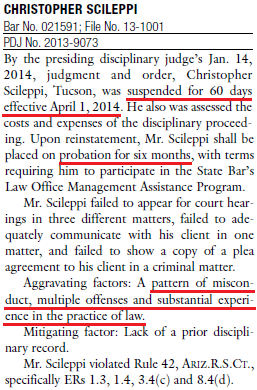
Tucson attorney Chris Scileppi, attorney Christopher ScileppiScileppi, who was suspended for 60 days and placed on six months’ probation in 2014 for violating various ethical rules (ERs), endeavored to convince the 2016 court that the writer had “terrorize[d], demonize[d], harass[ed], and defame[d]” the Bredfeldts, in particular through the use of “[meta] tags” on this blog, that is, keywords that describe its contents. These terms, which haven’t been used by any major search engine in eight years, were alleged to have hijacked the Bredfeldts’ public images on Google and to have “contact[ed]” anyone whose name appeared among them. Because a Google Alert Phil Bredfeldt had “set up” had allegedly been triggered by tags on the blog (in publications to the world at large), that was said to represent illicit “communication [and] contactby the writer with Mr. Bredfeldt and his wife. Scileppi enlisted an information technology expert, “part-time professor” and (criminal) attorney Brian Chase, to loosely substantiate this theory on the stand. Lamely objecting to an eminent constitutional scholar’s weighing in as an amicus curiae (Latin for “friend of the court”), Scileppi also defended the 2013 prior restraint last year before the Arizona Court of Appeals. He told the court that the writer was the liar.

Jeffrey “25% OFF ALL MONTH LONG” Marks, the low-rent opportunist who represented Tiffany Bredfeldt in 2010 and 2013, and is quoted below, represented her in 2016, also, but was hastily replaced after the writer was granted a court-appointed lawyer of his own. Marks, like his replacement, Scileppi, attempted to induce the court to stifle even third-party criticism of Bredfeldt, for example, that of Georgia entrepreneur Matthew Chan, who (aided by Prof. Eugene Volokh) successfully appealed a prior restraint in 2015 in his state’s supreme court and who introduced the writer to the finer points of First Amendment law.

To explain away Terpstra’s emails to the writer in 2012 and the contradictory testimony she gave a year later, Scileppi told Judge Catherine Woods in 2017 that “[i]n the midst of Greene’s harassment of Dr. Bredfeldt, [Terpstra] reached out to Greene and met with him. Through meeting with Greene, Terpstra became privy to his harassment of Dr. Bredfeldt.” In contrast to Scileppi’s claims, which Judge Woods shrewdly disregarded, Terpstra had offered to help the writer settle the conflict with Bredfeldt in 2012 (three months after Terpstra “reached out to [the writer] and met with him”). In an email Terpstra sent the writer on July 18 of that year (the first of four she sent that day), she wrote: “Maybe I can be a go between if the pastor [Jeremy Cheezum, a brother-in-law of Phil Bredfeldt’s] will not. I told Tiffany we met for coffee.” The email ended, “Hoping for the best.” That was the last day the writer heard from Terpstra, who is notably the mother of two college-aged daughters. Desperate to raise money to secure a surgery for his dog to enable her to run and jump again—something else Terpstra had said she was eager to help him accomplish—the writer scarcely gave Terpstra another thought until she appeared as a surprise witness 10 months later and deceived the court for Bredfeldt.

The other friend of Bredfeldt’s the writer met at his home in 2005, Dr. Carlotta Groves, a reported recipient of $740,000 in scientific research grants who uses the alias “Jahchannah” and identifies herself as a “Black Hebrew Israelite” and “servant of Yah,” lives in Arizona but apparently couldn’t be persuaded to give witness testimony for Bredfeldt in either 2013 or 2016. Like Terpstra did in the first of her emails to the writer in 2012, Groves told him in a blog comment around the same time that her own brother had been falsely accused. Terpstra said her brother had been falsely accused of rape and that it had “truly ruined his life.” For 12 years, Groves has done what Terpstra did for six: spectate. Groves, a DVM and a Ph.D. (who “love[s] to read and support aspiring authors!”), works at a low-cost veterinary clinic in Tucson.
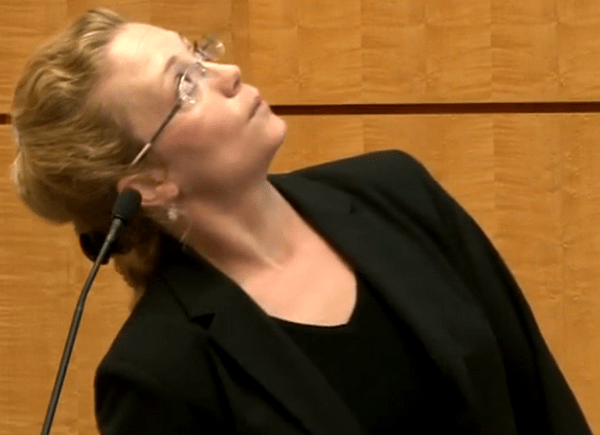

Tiffany Bredfeldt TCEQ, Tiffany Bredfeldt PhD, Tiffany Bredfeldt EPA, TCEQ, Texas Commission on Environmental Quality, EPA, Environmental Protection Agency, EPA Chemical Assessment Advisory Committee


TIFFANY BREDFELDT, on cross-examination by the writer on May 20, 2013:

TIFFANY BREDFELDT, on cross-examination by the writer on May 20, 2013:
JEFFREY MARKS, Bredfeldt’s attorney, speaking for her in a memorandum to the court filed July 10, 2013:

The difference between Bredfeldt’s attorney’s offhand estimation, “2005 or 2006,” was a year of this writer’s life (and his friends’ and his family’s). The year after the “genesis of this case” was one the writer spent every waking moment conscious he could be arrested without a warrant based on a further contrived allegation by Bredfeldt (in which case the writer’s dog, who was part Rottweiler and vigorously barked at any approaching stranger, could easily have been shot and killed).

Contrary to Marks’s claim, Bredfeldt employed others to tend to her horse’s daily hygiene in 2005. Within six or seven weeks of her installing her horse 30′ from the writer’s residence, it became lame and could not even be ridden, after which Bredfeldt increased the frequency of her nighttime visits.
Karin Huffer PhD, Legal Abuse Syndrome, legal abuse, LASMarks, who boasts of having served as a superior court judge himself, also tells the court in this memorandum, which was captioned, “Plaintiffs’ Response to Defendant’s ‘Chronology of Tiffany Bredfeldt’s 2006 Frauds,’” that “[e]ven assuming arguendo that Plaintiff Tiffany Bredfeldt is a chronic liar, her veracity is totally irrelevant to the necessity to restrain Defendant’s [speech] conduct.” Marks moved the 2013 court to strike the writer’s “scandalous” chronology from the record so that it couldn’t be accessed by the public. The judge, Carmine Cornelio, complied, rebuked the writer, and sanctioned him $350 for filing the brief, despite having invited him to: “Mr. Greene,” the judge had said in open court, “you can file anything you want.” Then the judge permanently prohibited the writer from telling anyone else what that chronology related—including by word of mouth. Bredfeldt’s handmaidens, Honeycutt and Terpstra, said exactly what they knew they should to inspire the illegal injunction. The judge permanently prohibited the writer from talking about them, also, including by reporting the testimony they gave in a public proceeding in the United States of America.

(Last year, two days before the writer’s attorney would file an appeal reminding an American court that citizens of this country enjoy freedom of speech, The New York Times published an editorial on censorship in China adapted from an essay by iconic artist and agitator Ai Weiwei. In it, Ai argues that censorship, an essential tool of oppression, does the opposite of pacify: It stimulates “behavior [that] can become wild, abnormal and violent.” Having to live with lies, as Ai told NPR in an interview in 2013, “is suffocating. It’s like bad air all the time.”)

MICHAEL HONEYCUTT, on cross-examination by the writer on May 20, 2013:
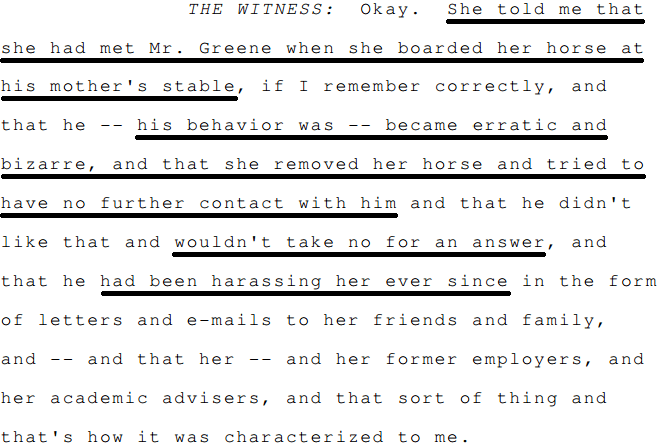
MICHAEL HONEYCUTT, on direct examination by Bredfeldt’s attorney, Jeffrey Marks, on May 20, 2013:

The testimony of “Where’s my mike?” Honeycutt exemplifies how the Texas Commission on Environmental Quality responds to “pretty significant allegations” of ethical misconduct by its scientists: It ignores the allegations…and abets the misconduct.

Under Arizona law, a “false sworn statement in regard to a material issue” is perjury, a felony crime. Honeycutt influentially testified in 2013 that the writer had called Bredfeldt a “fraudulent scientist.” Here, in contrast, is what the writer told Honeycutt in 2011, in a letter that is today a public document.
L'Oreal Stepney, TCEQ, Texas Commission on Environmental Quality, censorshipIn the Texas Observer the summer before last, Naveena Sadasivam reported that “Honeycutt sent at least 100 emails to state air pollution regulators, university professors and industry representatives and lawyers asking them to send the EPA a letter supporting his nomination to the Clean Air Science Advisory Committee….” Probably none of them sought to have him silenced on pain of imprisonment for requesting support. In a further instance of incandescent hypocrisy, Honeycutt is quoted in the story as pronouncing: “Ideology is different from science and data.” The reader is invited to consider which master Honeycutt was serving when he testified against this writer four and a half years ago.

After a hearing held on July 15, 2016, during which her husband had testified he was “frighten[ed],” Tiffany Bredfeldt swore in court, “God damn it,” because instead of ordering that the writer be jailed, the judge had stayed the proceedings pending further briefings from the attorneys on the First Amendment. Then, less than a year after the writer had buried his best friend and a few months before the writer’s father would succumb to cancer by starving to death, Bredfeldt laughed. She said Honeycutt had joked that her prosecution of the writer was “good experience” for when she gave expert witness testimony. “That’s something we have to do,” Bredfeldt explained to her entourage.

Copyright © 2018 RestrainingOrderAbuse.com

DR. MICHAEL HONEYCUTT, PH.D.:
DR. TIFFANY BREDFELDT, PH.D.:

What Do People Accused in Civil Court Have to Complain About?: Civil Prosecutions and PTSD

“Contemplating, undergoing, or having undergone a lawsuit is disruptive. The experience saps energy and distracts the litigant from the normal daily preoccupations that we call ‘life.’ Litigants, who commonly feel alone, isolated, and helpless, are challenged to confront and manage the emotional burden of the legal process. The distress of litigation can be expressed in multiple symptoms: sleeplessness, anger, frustration, humiliation, headaches, difficulty concentrating, loss of self-confidence, indecision, anxiety, despondency: the picture has much in common with the symptoms of posttraumatic stress disorder (PTSD).”

—Dr. Larry H. Strasburger (1999)

Prior posts on this blog have considered Legal Abuse Syndrome (LAS), a concept proposed by marriage and family therapist Karin Huffer that has been discounted by the courts as a “novel theory.” This post spotlights a journal monograph published almost 20 years ago by psychiatrist Larry H. Strasburger that unequivocally states Dr. Huffer isn’t wrong and the courts are.

Dr. Strasburger’s comments in “The Litigant-Patient: Mental Health Consequences of Civil Litigation” are based on his having treated the legally abused (who may include anyone who’s been exposed to litigation).

The therapist of a litigant will encounter not only the trauma that produced the lawsuit, but the distress and disruption of litigation as well, including the delays, rehashing and reliving the original trauma, and challenges to honesty and integrity. The patient may come after years of feeling frustrated and thwarted by a system that moves at a snail’s pace, preventing the litigant from putting the issue of the litigation behind him [or her] and “moving on” with life. Gutheil et al. have recently coined the term “critogenic harm” to describe these emotional harms resulting from the legal process itself.

The term “critogenic harm,” by its etymology, refers to the psychic damages that arise from judgment, i.e., the pain and humiliation of being verbally attacked and publicly disparaged.

This, the reader will note, is a blaring clinical denunciation of those self-appointed, armchair authorities who would deny the damages of false prosecution. Nearly two decades after the publication of the journal article this post examines, such deniers are everywhere, including in the mainstream press.

The deniers, according to the experts, are talking out of their blowholes. Mere accusation, ignoring the effects of protracted legal battles, drives some to suicide and multitudes more into agoraphobic withdrawal.

The adversarial system is also a threat to the maintenance of personal boundaries. Formal complaints, interrogatories, depositions, public testimony, and cross-examination are intrusive procedures that aggravate feelings previously caused by trauma. Such procedures amplify feelings that the world is an unsafe place, redoubling the litigant’s need to regain a sense of control—often in any way he or she can, including exhibiting characteristic symptoms or defenses. It is not unusual to find entries such as the following in the medical records of litigants: “Janet is hearing voices to cut herself again after talking to her lawyer today.” Similarly, a male plaintiff in a sexual harassment suit threatened violence when he was informed that he was to be deposed, and he required hospitalization.

Exposure to civil process can very literally drive people nuts, and inspire in them urges to commit violence, whether to themselves or others.

Consider Dr. Strasburger’s remarks in the context of restraining order abuse and appreciate that the strains they describe can be compounded by loss of residence (some defendants are left homeless), loss of family, loss of income, loss of employment/career, loss of property, etc. Those so deprived may accordingly become estranged from friends and relations, if not socially ostracized. (They must also live with the consciousness that they’re vulnerable to warrantless arrest at any time.)

Litigants are often further distressed as various members of their support systems “burn out.” Their need for human connection and their need to talk about their experience often exceed the tolerance of family members and friends. Embarrassment and humiliation shrink their social world.

That’s besides the discord and isolation caused by a damning accusation, which may be accepted as fact even by kith and kin. Loyalties may become divided, and the accused may be spurned based on allegations that aren’t true. The sources of outrage to the mind and emotions multiply like cancer cells.

It should come as no surprise then that many who complain of procedural abuse report they’re in therapy. If the costs weren’t prohibitive to most, they might all be. Desolating, as Dr. Strasburger points out, is that even if this were the case, the promise of “healing” isn’t necessarily good. The therapist’s role may be little more than cheerleader.

Psychotherapy for a patient involved in ongoing litigation can take on the aspects of managing a continuing crisis. The therapist, facing this need for crisis management, may be providing support more than insight.

Litigation (or its aftermath) may become consuming; normal, healthy activities are suspended. (One woman this author has corresponded with laments she hasn’t known intimate contact in years; a recent female commenter, alienated from her child, refers to herself as a living homicide.) People may become stuck in a tape loop perpetuated by interminable indeterminacy, insurmountable loss, and a galling sense of injustice.

The legal battle enables people to put their lives on “hold,” thereby avoiding other aspects of their lives (e.g., “How can I be intimate with you when I’m involved in this lawsuit?”). The patient may be so attuned to psycholegal issues and hypotheses that she focuses thereupon in resistance to dealing with significant personal conflict. As a result, she is continually “pleading her case” in the therapy hour.

This cognitive rut exemplifies Legal Abuse Syndrome, and the state may be unending.

Copyright © 2015 RestrainingOrderAbuse.com

*The journal article cited in this post may be introduced to the court by litigants in need of an authoritative voice to validate complaints of pain and suffering induced by fraudulent or vexatious prosecution.

Borderline Personality Disorder, Procedural Abuse, and Feminism: A Victim’s Reckoning of Their Tolls

YY_mural

“I hate this world and almost everybody in it. People use each other. I find most of you disgusting. My brothers are disgusting. The people I used to work with are disgusting. You’re shallow, you’re two-faced and hypocritical, you’re judgmental, you cause me more pain than you could ever possibly know. You don’t want me around? Guess what? I don’t want to be around you ugly motherf[—]ers, either. You cause all of your own problems, heap them onto other people, and then blame those people for your problems. You bitch about the amount of pain you’re in, then tell other people to get over their pain.

“I am done with all of you. I am done with your lies and your shitty society, and most of all, I am done kissing your ass.”

—Mrs. Nathan Larson (May 9, 2014)

Virginian Nathan Larson has had a tumultuous year.

He married a woman he met online (April 23, 2014); then she moved out (June 21, 2014) and accused him, among other things, of rape (August 2014 through January 2015); then they divorced; then he learned he was a father when the news reached him that his ex-wife had committed suicide.

The quotation above is from an online post of his former wife’s published between their marriage and their separation. Below is an excerpt from a digital diary entry of hers written when she was a teen (which included a “hit list”):

I hate the students at […]. They are arrogant and foolish. My one dream, my passion is to achieve a machine gun or something and shoot every f[—]er in the school. I want to pump them full of metal, their blood splattered on the tiles. I want to make a massacre that becomes the worst in American history. There are only a few people who I would spare. Everyone else…I would love to see them writhing on the ground in pain, blood oozing out of a million holes in their body.

Nathan’s wife, who was an arguably troubled woman, abruptly terminated their relationship of “75 days total” and then informed him she had miscarried their child. In August 2014, she accused him of rape to the police, but he declined to talk with them and was never charged. In November 2014, she began to accuse him to the courts.

This wasn’t a trial run, either. The accusations brought against Nathan by his wife mirrored charges she had made against a previous partner, also to damning effect.

She petitioned three ex parte (temporary) restraining orders before successfully obtaining a permanent order against Nathan in January of this year (by default). Its alleged bases were “domestic abuse, stalking, sexual assault, and physical assault.” The order was petitioned in Colorado, and Nathan would have had to travel a significant distance to be heard in his defense. “Not wanting to invest money and emotional energy in fighting it, and knowing it would be hard for me to successfully contest it, I didn’t show up to the hearing,” he says. He elected to “move on.”

The two were divorced in April 2015, and that seemed to be an end on it.

Two months later, Nathan was told his (then) wife had given birth to a child in February, presumably the one she had told him she had miscarried. This information reached him along with the news that his former wife had killed herself following her commitment for “suicidal depression” and allegedly hearing voices compelling her “to hurt or kill the Child.”

Nathan must now contest a “dependency and neglect petition” in Colorado asserting he’s an unfit parent.

What follows are his reflections on his marriage to a woman who he alleges had untreated borderline personality disorder, on feminism, and on “abuse culture” and its damages.

Nathan Larson (with his new fiancée’s infant cousin)

Having the benefit of distance from the situation and more calmness about it (especially now that she’s dead), I would say that we both made a lot of mistakes during and after the relationship. There are some people who say that it’s a mistake to enter into a relationship with someone with untreated borderline personality, because it simply won’t work, no matter what you do. Unfortunately, once you get into a relationship like that, your sense of reality can get distorted because you’re so in love, and they’re so convincing, and they get so many other people to agree with them, that you too start to believe it if you don’t have enough of an understanding of BPD to realize what’s happening and why.

For example, suppose you used to argue with your BPD partner, and occasionally lost your temper and had to apologize for saying something unkind. Because they’re so sensitive to minor betrayals, they might claim that you horribly emotionally abused and bullied them to get your way, and then tried to be sweet to them and make up, just like in the classic model we’ve been taught of the cycle of abuse. If you’re still thinking this person is the most wonderful person in the world, then logically you might think that you really did emotionally abuse them, because why would such a wonderful person say it if it weren’t true? Plus, they are clearly very upset over how you treated them, and they broke up the relationship over it, and now they’ve told everyone in your circle of friends and family about it, and many of them are telling you they agree that the breakup was your fault because of your emotional abuse.

These are people you respect and trust, and therefore this could not possibly be happening unless you really were abusive!

You start to blame yourself and even tell people, “She left me because I was emotionally abusive” (which of course attracts more criticism, because who would admit that if it weren’t true?). Eventually, you run into someone who hears your account of what was actually said and done, and challenges your interpretation, saying you’re being too hard on yourself, and that this chick is not as great as you seem to think she is. (To which, of course, you may think, “He just doesn’t know and understand her and our deep and beautiful relationship! We were soulmates! What are the chances I will ever find another woman like that? I searched my whole life, and she was the only one like that I’ve ever met who loved and appreciated me so much.”)

If you have good friends, they’ll awaken you to the fact that someone who truly loved you that much would be willing to forgive and come back to you, or at least treat you decently, rather than holding a grudge and trying to make you suffer.

Also, there’s the fact to consider that people with borderline personality disorder idealize and devalue, and they view people as either completely good or completely bad. This means that once they’re faced with the inescapable reality that you’re not perfect, they have to view you as completely evil. They also have to deny any blame at all for the end of the relationship, lest they have to conclude that they too are flawed, which would cause them to view themselves as completely evil. They can’t handle any feelings of guilt; they have to deflect all blame, including the blame for their own emotionality.

Feminists, of course, are not thinking about all this psychology going on behind the scenes.


They’re busy calculating whether being skeptical of the claims of someone like that will make the public more likely to be skeptical of the claims of someone with legitimate, serious complaints, and make those victims more reluctant to come forward. So the innocent who was accused gets sacrificed for the greater good.

Some women with borderline personality disorder are attracted to the feminist movement and voraciously read all of their materials about abuse, patriarchy, rape culture, etc. because it helps them view themselves as a helpless victim of powerful sociopaths, and thus deflect blame.

They can find a community of people who will give them the benefit of the doubt by believing their stories, and confirm their interpretation of what happened. Borderlines also sometimes struggle to find a sense of identity, and the feminist movement can provide that as well. Their victimhood actually makes them useful to someone, since it’s a story they can tell and retell to those who need to be persuaded that political change is necessary to stop these abuses. (Feminists, like advocates for most other political movements, would bristle at any suggestion that their ideology attracts mentally ill people, since that would tend to discredit them.)

Yet what the feminist movement can never satisfactorily explain to them is why, despite all this training in recognizing red flags of abusers, and despite all the tools the system has provided for punishing abusers (e.g., restraining orders, prison sentences, etc.), they keep getting “abused” by partner after partner, while many other women seem to have successful, happy relationships.

The only possible answer is that it’s a combination of sociopaths’ finding them particularly attractive for some reason (maybe they sense they’ve been abused and think it’ll be easy to re-victimize them) combined with the fact that the patriarchy is still strong, abused women are still not being believed, and therefore we need to punish abusers more harshly and give the accusers even more benefit of the doubt.

Then, finally, when we have a world where all you need to do to get a man locked away for life is cry rape without any supporting evidence, rational men will finally stop raping. Except, even if such a system were put in place, these insecure women would still feel victimized by their partners, and they would attribute the “abuse” to these guys’ acting impulsively without regard to the certain punishment.

Copyright © 2015 RestrainingOrderAbuse.com

*An excellent explication of procedural abuse by “high-conflict” people (who are associated with personality disorders like BPD) and why court procedure is attractive to them is here.

Dust It Off: This Isn’t 1979, and It’s Time Restraining Order Laws Were Reconsidered

I remarked to a commenter the other day that when I became a vegetarian in the ’80s, I was still a kid, and my family took it as an affront, which was a common reaction then. Today, everyone’s a vegetarian or “tried vegetarianism” or has “thought about becoming a vegetarian.” Other subjects that were outré or taboo in my childhood like atheism, cross-dressing, and depression—they’re no longer stigmatized, either (in the main). Gay people, who were only whispered about then, can marry in a majority of states. When I was a kid, it was shaming for bra straps or underpants bands to be visible. Today they’re exposed on purpose.

It’s a brave new world.

While domestic violence is no more comfortable a topic of conversation now than it was then, it’s also hardly hush-hush. When restraining orders were conceived, it was unmentionable, and that was the problem. It was impossible for battered women to reliably get help. They faced alienation from their families and even ridicule from the police if they summoned the courage to ask for it. They were trapped.

Restraining orders cut through all of the red tape and made it possible for battered women to go straight to the courthouse to talk one-on-one with a judge and get immediate relief. The intention, at least, was good.

It’s probable, too, that when restraining orders were enacted way back when, their exploitation was minimal. It wouldn’t have occurred to many people to abuse them, just as it wouldn’t have occurred to lawmakers that anyone would take advantage.

This isn’t 1979. Times have changed and with them social perceptions and ethics. Reporting domestic violence isn’t an act of moral apostasy. It’s widely encouraged.

No one has gone back, however, and reconsidered the justice of a procedure of law that omits all safeguards against misuse. Restraining orders circumvent investigation by police and the vetting of accusations by district attorneys. They allow individuals to prosecute allegations all on their own, trusting that those individuals won’t lie about fear or abuse, despite the fact that there are any number of compelling motives to do so, including greed/profit, spite, victim-playing, revenge, mental illness, personality disorder, bullying, blame-shifting, cover-up, infidelity/adultery, blackmail, coercion, citizenship, stalking, and the mere desire for attention.

Restraining orders laws have steadily accreted even as the original (problematic) blueprint has remained unchanged. Claims no longer need to be of domestic violence (though its legal definition has grown so broad as to be virtually all-inclusive, anyway). They can be of harassment, “stalking,” threat, or just inspiring vague unease.

These aren’t claims that are hard to manufacture, and they don’t have to be proved (and there’s no ascertaining the truth of alleged “feelings” or “beliefs,” anyway, just as there’s no defense against them). Due to decades of feminist lobbying, moreover, judges are predisposed to issue restraining orders on little or no more basis than a petitioner’s saying s/he needs one.

What once upon a time made this a worthy compromise of defendants’ constitutionally guaranteed expectation of due process and equitable treatment under the law no longer does. The anticipation of rejection or ridicule that women who reported domestic violence in the ’70s and ’80s faced from police, and which recommended a workaround like the restraining order, is now anachronistic.

Prevailing reflex from authorities has swiveled 180 degrees. If anything, the conditioned reaction to claims of abuse is their eager investigation; it’s compulsory policy.

Laws that authorize restraining order judges, based exclusively on their discretion, to impose sanctions on defendants like registry in public databases that can permanently foul employment prospects, removal from their homes, and denial of access to their kids and property are out of date. Their license has expired.

Besides material privations, defendants against allegations made in brief trips to the courthouse are subjected to humiliation and abuse that’s lastingly traumatic. Making false claims is a simple matter, and offering damning misrepresentations that don’t even depend on lies is simpler yet.

What shouldn’t be possible happens. A lot. Almost as bad is that we make believe it doesn’t.

Just as it was wrong to avert our eyes from domestic violence 30 years ago, it’s wrong to pretend that attempts to curb it since haven’t fostered new forms of taunting, terrorism, and torment that use the state as their agent.

Copyright © 2015 RestrainingOrderAbuse.com

Restraining Orders Based on Fraud Falsely Imprison Defendants Whether They’re Incarcerated or Not

“Forensic psychiatrists and other mental health professionals must remember that although allegations are often genuine, there is an almost equal number of cases…in which they are not. Complete and objective assessment is always required, and especially so when accusations emerge in contexts such as the following:

  • Certain kinds of mental illness and character traits (particularly in allegations against clinicians). One should note poor doctor-patient relationships, whether real or perceived, patients with psychotic or delusional symptoms, certain hysterical and factitious disorders, some fragmenting or dissociative disorders, and those with substantial borderline, inadequate, and/or passive personality traits
  • Divorce proceedings
  • Child custody proceedings
  • Situations with the potential for substantial financial reward
  • Situations in which the accuser has an emotional or characterological reason to avoid discovery, prosecution, or confrontation with legal (or parental) authority (e.g., those with antisocial personality traits, some substance abusers)
  • A history of repeated past allegations, particularly if they have not been fully investigated
  • Unusual timing of the accusation or alleged event (e.g., alleged ‘date rape’ within an otherwise close and stable relationship, or accusations made only when some sort of secondary purpose or reward is evident).”

—“False Allegations: The Role of the Forensic Psychiatrist

The previous post called attention to an excerpt from a story featured in The Times of Malta this month that concluded that incidences of false allegations weren’t “one-offs,” meaning they’re not singular occurrences but more common than the public imagines.

The lawyers quoted by reporter, what’s more, refer to criminal cases in which sexual abuse is alleged and, consequently, in which the accused are afforded attorney representation.
By contrast, civil restraining order hearings are mere minutes long, defendants aren’t afforded counsel, and fraud is typically ignored by the court even if it’s perceived. There is, therefore, no accurately determining the pervasiveness or degree of lying in such adjudications.

Many authoritative sources conclude it’s rampant, and anecdotal reports concur.

The application process for restraining orders is typically free, it’s concluded in an afternoon if not within minutes, and there are no consequences for lying. Why, then, shouldn’t the process be broadly and routinely abused?

To believe that such a process wouldn’t be abused would depend on an unshakably naïve conviction in the inherent goodness of people, and such a belief would determine the process unnecessary. Anyone who believes people are capable of beastly behavior and that restraining orders are necessary—take, for example, feminists—must believe people are capable of lying hurtfully to get them.

Exposing the flaws in the belief that anyone who points a finger must necessarily be telling the truth doesn’t take a professor of philosophy.

Consider, then, that allegations made in civil court may be identical to those introduced against defendants in criminal court—and can include rape, child molestation, or even murder. The only difference between civil and criminal rulings is legal consequence.

This is the source of the cognitive disconnect exemplified by judges and, largely, everyone else. Because civil restraining orders only threaten incarceration rather than mandate it, they’re considered “no biggie.”

The conceit is that though falsely accused restraining order defendants may be denied access to their homes, money, property, and children—besides facing other privations—they aren’t denied their freedom; it’s only curtailed somewhat (“Here are your shoes—you’re free to leave”).

Faith in the conceit that restraining orders are minor impingements on defendants’ lives depends on accepting that being falsely, publically, and permanently labeled a stalker or batterer, for example, shouldn’t interfere with a person’s comfort, equanimity, or ability to realize his or her dreams. Such faith is founded, in other words, on the fantastical belief that wrongful vilification won’t exercise a detrimental influence on a person’s mental state, won’t affect his or her familial and social relationships, won’t negatively impact his or her employment and employability, etc.

Clearly such faith is beyond unreasonable; it’s inane. Being forced to live with false allegations can be crippling—for painfully obvious reasons. Whether a person is forced to agonize in a cell or is permitted to agonize in his or her place of choice is of scant significance to the psycho-emotional well-being of the sufferer. Prison isn’t just an environment, and arresting someone doesn’t require handcuffs.

Copyright © 2014 RestrainingOrderAbuse.com

A Legislated License to Lie: Nothing CAN’T Be Falsely Alleged on a Restraining Order

OK

Battery, rape, child molestation—any heinous allegation imaginable can be made in a petition for a restraining order, and it can be made falsely without consequence to the accuser.

Victims of false allegations often ask incredulously, “Can somebody say that?”

There’s nothing that can’t be alleged to the courts (or, for that matter, to the police). There’s no such thing as “can’t allege.” A judge might view allegations of genocide or conspiracy with aliens to achieve global domination as suspect—or s/he might not. Certainly there’s nothing to stop a restraining order applicant from making these allegations, and there’s nothing to stop a judge from crediting them. Neither accusers nor judges are answerable to a literal burden of proof.

As the infamous David Letterman case shows, even the most outlandish allegations easily duck judicial radar. For anyone unfamiliar with the case, here’s Massachusetts attorney Gregory Hession’s synopsis and commentary (quoted from “Restraining Orders Out of Control”):

One day in December of 2005, Colleen Nestler came to Santa Fe County District Court in New Mexico with a bizarre seven-page typed statement and requested a domestic-abuse restraining order against late-night TV host David Letterman.

She stated, under oath, that Letterman seriously abused her by causing her bankruptcy, mental cruelty, and sleep deprivation since 1994. Nestler also alleged that he sent her secret signals “in code words” through his television program for many years and that he “responded to my thoughts of love” by expressing that he wanted to marry her.

Judge Daniel Sanchez issued a restraining order against Letterman based on those allegations. By doing so, it put Letterman on a national list of domestic abusers, gave him a criminal record, took away several of his constitutionally protected rights, and subjected him to criminal prosecution if he contacted Nestler directly or indirectly, or possessed a firearm.

Letterman had never met Colleen Nestler, and this all happened without his knowledge. Nonetheless, she requested that the order include an injunction requiring him not to “think of me, and release me from his mental harassment and hammering.” Asked to explain why he had issued a restraining order on the basis of such an unusual complaint, Judge Sanchez answered that Nestler had filled out the restraining-order request form correctly. After much national ridicule, the judge finally dismissed the order against Letterman. Those who don’t have a TV program and deep pockets are rarely so fortunate.

If allegations like these don’t trip any alarms, consider how much easier putting across plausible allegations is, plausible allegations that may be egregiously false and may include battery, rape, child molestation, or the commission of any other felony crimes.

What recent posts to this blog have endeavored to expose is that false allegations on restraining orders are very effective, because the “standard of evidence” applied to restraining order allegations both tolerates and rewards lying. The only thing that keeps false allegations reasonably in check is the fear that malicious litigants may have of their lies’ being detected. Normal people at least understand that lying is “bad” and that you don’t want to get caught doing it.

To some degree at least, this understanding restricts all but the mentally ill, who may be delusional, and high-conflict litigants, who may have personality disorders and have no conscience, or whose thinking, like that of personality-disordered people’s, is overruled by intense emotions, self-identification as victims, and an urgent will to blame. Normal people may lie cunningly or viciously; high-conflict people may lie cunningly, viciously, compulsively, outrageously, and constantly.
The fear of getting caught in a lie is in fact baseless, because perjury (lying to the court) is prosecuted so rarely as to qualify as never. Most false litigants, however, don’t know that, so their lies are seldom as extravagant as they could be.

Often, though, their lies are extravagant enough to unhinge or trash the lives of those they’ve accused.

Appreciate that false allegations on restraining orders of battery, rape, child molestation, or their like don’t have to be proved. Restraining orders aren’t criminal prosecutions. Allegations just have to persuade a judge that the defendant is a sick puppy who should be kenneled. An allegation of battery, rape, or child molestation is just a contributing influence—except to the people who have to bear its stigma.

More typical than utterly heinous lies are devious misrepresentations. Accusations of stalking and untoward contact or conduct, which may simply be implied, are a common variety. The alleged use merely of cruel language may be very effective by itself. Consider how prejudicial a female plaintiff’s accusing someone (male or female) of forever calling her a “worthless bitch” could be. Substantiation isn’t necessary. Restraining order judges are already vigilantly poised to whiff danger and foul misconduct everywhere. In processes that are concluded in minutes, false or malicious accusers just have to toss judges a few red herrings.

Irrespective of the severity of allegations, the consequences to the fraudulently accused are the same: impediment to or loss of employment and employability, humiliation, distrust, gnawing outrage, depression, and despondency, along with possibly being menacingly barred access to home, children, property, and financial resource. This is all besides being forced to live under the ever-looming threat of further state interference, including arrest and incarceration, should additional false allegations be brought forth.

Even if no further allegations are made, restraining orders, which are public records accessible by anyone, are recorded in the databases of state and federal police…indefinitely.

This “advice,” which urges restraining order applicants to rehearse, comes from the California court system and is offered on a page titled, “Ask for a Restraining Order.” The page’s title is not only invitational but can be read as an order itself: Do it. Note, also, that finalization of a restraining order may be based on less than “3 minutes” of testimony and that the court prefers it to be.

Recourses available to the falsely accused are few, and even lawsuits that allege abuse of process may face hurdles like claim preclusion (res judicata), which prohibits previously adjudicated facts from being reexamined. Never mind that the prior rulings may have been formulated in mere minutes based on fantasy and/or cooked allegations. Victims of defamation, fraud on the police and courts, and intentional infliction of emotional distress may moreover face stony indifference from judges, even if their lives have been entirely dismantled. And it should be stressed that attempting to rectify and purge their records of fraudulent allegations, which are established in minutes, can consume years of falsely accused defendants’ lives.

Recognizing that there are no bounds placed upon what false accusers may claim and that there are no consequences to false accusers for lying, the wonder is that more victims of lies aren’t alleged to be “batterers,” “rapists,” and “child molesters.”

Copyright © 2014 RestrainingOrderAbuse.com

Motives of the False Accuser According to the FBI: Mental Illness, Attention-Seeking, Profit, Blame-Shifting, and Revenge

“At 7:30 a.m., an unknown male abducted Pamela at knifepoint while she fueled her car at a convenience store. The offender then forced her to drive to a bridge, where they crossed into a neighboring state. During the long ride, he choked her with a bicycle security chain and slashed her with a knife.

“Next, the assailant ordered Pamela to park the vehicle in a secluded rural area and led her into the woods. He bound her to a tree, placing the bicycle chain around her neck. The subject then assaulted her vaginally with a box cutter and lacerated her breasts and right nipple.

“Then, he ordered Pamela back into her car and had her drive them to a nearby ferry. The subject exited the vehicle and disappeared while heading toward the ferry at about 3 p.m. Pamela drove herself to the nearest hospital for treatment, and staff members notified the police. After receiving medical attention, she was released.

“State and local police investigators conducted the initial interview of Pamela at the hospital. Although initially cooperative, she stopped answering questions. Pamela agreed to meet investigators at a later date at the state police barracks to discuss the abduction and sexual assault, but she never arrived.

“A review of hospital medical records showed that Pamela received treatment for superficial lacerations to her right hand, left breast, right breast and nipple, and neck. She also had several superficial abrasions in her pubic region. The doctor described her as tired but in no acute discomfort.

“Officers found no forensic evidence from Pamela or her vehicle. They contacted the FBI’s National Center for the Analysis of Violent Crime (NCAVC) for assistance in developing an interview strategy. Investigators determined that Pamela suffered from depression and anxiety and had a prescription for an antidepressant. Working with NCAVC, officers developed a successful interview strategy, and Pamela finally admitted that she fabricated the abduction and sexual assault.

“Her false allegation tied up the resources of several state and local police departments, as well as the area FBI office. Significant media attention focused on the case prior to her confession. An artist’s sketch of the imaginary offender circulated. The media quoted a spokesperson for a local women’s rape crisis center as saying, ‘What I see is a community that is scared….’”

Federal Bureau of Investigation (FBI)

Does this sort of thing happen frequently? No. What’s often and deplorably discounted by those hostile to exposure of false allegations, however, is that it does happen. And typically the alleged offender isn’t a phantom but a real person (victim).

The likelihood of false allegations to withstand critical scrutiny by multiple police agencies is remote. What the cited case highlights, however, is that false accusers can be extremely convincing and deliberate in their frauds; and what this blog seeks to expose is that false accusers can very easily abuse civil procedure, specifically the restraining order process, according to the same motives that false criminal accusers exhibit, which according to the FBI are these:

  • Mental illness/depression
  • Attention/sympathy
  • Financial/profit
  • Alibi
  • Revenge

It’s no coincidence that this catalog exactly corresponds to the motives of false restraining order applicants, whose allegations are made in brief, five- or 10-minute interviews with judges, and are subject to no particular scrutiny whatever. Any number of the posts on and comments made to this blog concern abuses motivated by mental illness or personality disorders, attention-seeking, financial gain (including wresting money, property, and home from the falsely accused), blame-shifting (establishing an alibi for misconduct and shifting the blame for that misconduct onto its victim), and/or good old-fashioned vengeance.

These motives for legal attacks are moreover readily corroborated by psychologists.

The FBI Law Enforcement Bulletin I’ve quoted goes on at some length to detail the difficulties and complexities that unraveling false claims entails for agents of the FBI. Appreciate then how absurd is the state’s faith that a single judge—or a couple of them—can ascertain the truth of civil restraining order allegations by auditing claims in a hearing or hearings arrived at with no prior information, that last mere minutes, and that are furthermore biased by the preconception that the accused is guilty.


The only reasonable conclusion to be drawn is that the state believes judges can discern what teams of crack FBI specialists working around the clock may not or that the truth doesn’t matter.

What makes this conclusion outrageous is that though false criminal allegations may result in a false conviction for a crime, the consequences of false civil allegations may be no less severe.

At the very least, those falsely accused in civil court are subject to threats, menace, curtailment of freedom, humiliation, and the contamination of their public records, which can permanently interfere with or exclude employment prospects and options—all of this topped off by the psychological trauma that necessarily ensues. The falsely accused may further be subject to incarceration resulting from further false allegations by malicious and/or mentally ill or personality-disordered plaintiffs (possibly for terms as lengthy as sentences based on false criminal allegations might impose), as well as loss of entitlement to home and property. Some false restraining order defendants are left homeless and bereft of everything that made their lives meaningful. As one advocate puts it, the falsely accused may be “erased.”

These consequences, recall, stem from cursory auditions of allegations that are answerable to no standard of proof. Allegations in civil court are judged largely according to impressions. Civil rulings, contrasted with criminal investigations, are no more conclusive than coin tosses.

The restraining order process is a tidy workaround that allows false accusers to realize the same objectives fraudulent criminal allegations might gratify, possibly to a much greater extremity, while requiring no lengthy interrogation and threatening no risk of criminal consequences to the false accuser who’s caught out. False allegations made in civil court are more often than not slyly ignored even when detected, and they’re certainly not recorded in any statistical database. They’re typically unremarked, typically unremarked on when discerned, and duck public awareness and scrutiny entirely.

The reason why this is so lies in the last line of the epigraph: “The media quoted a spokesperson for a local women’s rape crisis center as saying, ‘What I see is a community that is scared….’”

Copyright © 2014 RestrainingOrderAbuse.com

Because Perjury Occurs a Lot, It’s Ignored: On the Absurdity and Toll of Domestic Violence and Restraining Order Policies’ Disregarding False Allegations

“My 87-year-old father has been arrested and jailed three times by my mentally ill mother, who is using domestic violence laws to her advantage in a divorce. This is a man who served in the military for 20 years, the federal government for 25 years, and the Department of Social Services for five years before retiring. My dad has never even had so much as a speeding ticket in his entire life, but now, at the end of his life, he has been humiliated, placed on supervised probation, and will probably lose everything due to the abuse of domestic violence laws. Nobody in law enforcement will listen to what is really going on here. Even though I had prior knowledge that my dad was being set up, I have actually been told by the District Attorney…and I quote, ‘I have convicted your father of assault on a female, and I will convict him of everything else I can.’ The justice system has gone off the rails, and the truth means nothing. My father fought in World War II and in Korea to keep this country free, and this is how he is repaid.”

—E-petition respondent

How did you spend the yuletide? With friends and family, listening to Nat King Cole and Bing Crosby, mussing kids’ hair and congratulating them on their Christmas spoils?

Read the epigraph above, and you’ll have a pretty clear idea of what Todd L. of Wilmington, North Carolina had on his mind. Not much to raise a cup of cheer to, is it?

This distinguished service veteran’s age approximates that of the cited victim of false allegations.

Two hours after Todd shared his story on the e-petition “Stop False Allegations of Domestic Violence,” a fellow North Carolinian opined, “There should be a legal penalty for false accusations!”

Lawmakers have agreed, actually, and statutes making lying to the court a felony crime are universal. What this commenter should have said is that legal penalties for false accusations should be enforced.

Perjury is never prosecuted. District attorneys will tell you that if they did prosecute perjurers, there’d be no resources left for putting “dangerous people” behind bars.

Let’s parse that logic.

First, it actually recognizes that lying occurs a lot. If it only occurred now and then, prosecutions would be few and hardly a budgetary strain.

Second, recognizing that lying occurs a lot also recognizes that the so-called dangerous people the state prefers to prosecute may simply be victims of false allegations. Preferring to prosecute alleged domestic assailants, therefore—take, for example, the 87-year-old man cited in this post’s epigraph—may mean preferring to prosecute the falsely accused (the innocent) over the genuinely criminal (the false accusers).

Ask yourself which would look better on the books: “We’ve successfully prosecuted [x number of] wife-beaters” or “We’ve successfully prosecuted [x number of] perjurers”? Everyone knows what wife-beater means. How many people even know what a perjurer is?

“If we did prosecute perjurers, there’d be no resources left for putting dangerous people behind bars…so we’ll prosecute the people perjurers falsely accuse of being dangerous”—as analysis of most of the arguments made in defense of domestic violence and restraining order policies reveals, the reasoning is circular and smells foul. It’s in fact unreasoned “reasoning” that’s really just something to say to distract attention from unflattering truths that don’t win elections, federal grants, popular esteem, or political favor. So entrenched are these policies and so megalithic (and lucrative) that rhetoric like this actually passes for satisfactory when it’s used by someone in a crisp suit with a crisper title.

Obviously it wouldn’t be necessary to prosecute all perjurers to arrest epidemic lying. Ensuring that false allegations were made less frequently would only entail putting a few frauds in cages for a year or two where they belong, making examples of them, and revising policy so that the consequences of lying were impressed upon other would-be frauds. As it is, policy (including menacing rhetoric on court documents like restraining orders) is to impress upon defendants how serious the consequences of being lied about are: “For being publicly lied about, you may be subject to arrest and incarceration for being publicly lied about some more.”

The absurdity is patent, as is the wanton cruelty. Applying the word justice to any aspect of this policy should itself be criminal.

The 87-year-old man referenced in the epigraph above may be at the end of his life, and it’s a reasonable surmise that whatever remaining time he could have hoped for will be shortened by the treatment he’s received from the country in whose service he’s dedicated over half of that life.

If a YouTube video were posted of state agents bludgeoning an 87-year-old veteran, it would shortly go viral, reporters would elbow their way onto the man’s front stoop, lawyers would scrap and scrabble to represent him, and cable commentators would decry the outrage of the abuse.

Heads would roll.

Since state agents have instead subjected this man to public denigration and dehumanizing psychic torments under the guise of propriety, the odds are strong that he’ll slip away erelong, invisibly, his final days having been poisoned by anguish, disgrace, and the unrelenting consciousness that 50 years of public service were callously invalidated: “I have convicted your father of assault on a female, and I will convict him of everything else I can.”

Copyright © 2013 RestrainingOrderAbuse.com

Cognitive Distortions and Restraining Orders: On How Judicial Method Corresponds with Automatic Thinking

My previous post concerned distortion, specifically by those with narcissistic personality disorder (one of a number of personality disorders that may lead a person to make false allegations, that is, to distort the truth). Restraining order fraud, whether committed by pathological liars or the garden variety, tends to go over smashingly, because judges’ biases (perceptual and otherwise) predispose them to credit and reward fraud.

Below is a list of cognitive distortions (categories of automatic thinking) drawn from Wikipedia interspersed with commentaries. Many if not most of these cognitive distortions are applicable to restraining order decisions and clarify how it is that slanted, hyperbolic, or false allegations made through the medium of the restraining order stick.

(Cognitive distortion or automatic thinking is pathological thinking associated with neurological disorders.)

All-or-nothing thinking: seeing things in black or white as opposed to shades of gray; thinking in terms of false dilemmas. Splitting involves using terms like “always,” “every,” or “never” when this is neither true, nor equivalent to the truth.

Restraining order rulings are categorical. They don’t acknowledge gradations of culpability, nor do they address the veracity of individual allegations. Rulings are “yea” or “nay,” with “yea” predominating. That some, most, or all of what a plaintiff alleges is unsubstantiated makes no difference, nor does it matter if some or most of his or her allegations are contradictory or patently false. Restraining order adjudications are zero-sum games.

Overgeneralization: making hasty generalizations from insufficient experiences and evidence.

Restraining order applications are approved upon five or 10 minutes of “deliberation” and in the absence of any controverting testimony from their defendants (who aren’t invited to the party). All rulings, therefore, are arguably hasty and necessarily generic. (They may in fact be mechanical: a groundless restraining order was famously approved against celebrity talk show host David Letterman because its applicant filled out the form correctly.)

Filtering: focusing entirely on negative elements of a situation, to the exclusion of the positive. Also, the brain’s tendency to filter out information which does not conform to already held beliefs.

Judicial attention is only paid to negative representations, and plaintiffs’ representations are likely to be exclusively negative. Judges seek reasons to approve restraining orders sooner than reasons to reject them, and it’s assumed that plaintiffs’ allegations are valid. In fact, it’s commonly mandated that judges presume plaintiffs are telling the truth (despite their possibly having any of several motives to lie).

Disqualifying the positive: discounting positive events.

Mitigating circumstances are typically discounted. Plaintiffs’ perceptions, which may be hysterical, pathologically influenced, or falsely represented, are usually all judges concern themselves with, even after defendants have been given the “opportunity” to contest allegations against them (which opportunity may be afforded no more than 10 to 20 minutes).

Jumping to conclusions: reaching preliminary conclusions (usually negative) from little (if any) evidence.

All conclusions in restraining order cases are jumped-to conclusions. Allegations, which are leveled during brief interviews and against defendants whom judges may never meet, need be no more substantial than “I’m afraid” (a representation that’s easily falsified).

Magnification and minimization: giving proportionally greater weight to a perceived failure, weakness or threat, or lesser weight to a perceived success, strength or opportunity, so the weight differs from that assigned to the event or thing by others.

Judicial inclination is toward approving/upholding restraining orders. In keeping with this imperative, a judge will pick and choose allegations or facts that can be emphatically represented as weighty or “preponderant.” (One recent respondent to this blog shared that a fraudulent restraining order against him was upheld because the judge perceived that he “appear[ed] to be controlling” and that the plaintiff “seem[ed] to have some apprehension toward [him].” While superficial, airy-fairy standards like “appeared” and “seemed” would carry little weight in a criminal procedure, they’re sufficient qualifications to satisfy and sustain a civil restraining order judgment, which is based on judicial discretion.)

Emotional reasoning: presuming that negative feelings expose the true nature of things, and experiencing reality as a reflection of emotionally linked thoughts. Thinking something is true, solely based on a feeling.

The grounds for most restraining orders are alleged emotional states (“I’m afraid,” for example), which judges typically presume to be both honestly represented and valid (that is, reality-based). Consequently, judges may treat defendants cruelly according with their own emotional motives.

Should statements: doing, or expecting others to do, what they morally should or ought to do irrespective of the particular case the person is faced with. This involves conforming strenuously to ethical categorical imperatives which, by definition, “always apply,” or to hypothetical imperatives which apply in that general type of case. Albert Ellis termed this “musturbation.”

All restraining order judgments are essentially generic (and all restraining order defendants are correspondingly treated generically = badly). Particulars are discounted and may well be ignored.

Labeling and mislabeling: a more severe type of overgeneralization; attributing a person’s actions to their character instead of some accidental attribute. Rather than assuming the behavior to be accidental or extrinsic, the person assigns a label to someone or something that implies the character of that person or thing. Mislabeling involves describing an event with language that has a strong connotation of a person’s evaluation of the event.

The basis of a defendant’s “guilt” may be nothing more than a plaintiff’s misperception.

Personalization: attributing personal responsibility, including the resulting praise or blame, for events over which a person has no control.

The restraining order process is entirely geared toward assigning blame to its defendant, regardless of the actual circumstances, of which a judge has only a plaintiff’s representation, a representation that may be false or fantastical. A circumstance a defendant may be blamed for that s/he has no control over, for example, is a plaintiff’s being neurotic, delusional, or deranged.

Blaming: the opposite of personalization; holding other people responsible for the harm they cause, and especially for their intentional or negligent infliction of emotional distress on us.

  • Fallacy of change: Relying on social control to obtain cooperative actions from another person.
  • Always being right: Prioritizing self-interest over the feelings of another person.

This last category of automatic thinking sums up a judge’s role and m.o. to a T. And, at least in the latter instance (“Always being right”), shouldn’t. If, to the contrary, judges always assumed their first impressions and impulses were wrong, any number of miscarriages of justice might be avoided.

Copyright © 2013 RestrainingOrderAbuse.com

Narcissism: A Study in Distortion

The narcissist is a study in distortion.

You’d think someone as intently preoccupied with mirrors as the narcissist is would be brutally self-critical. You’d be mistaken, though. The narcissist exalts him- or herself, very possibly in defiance of a host of reasons not to. This isn’t to say the narcissist is immune to negative judgments; it’s to say that instead of responding to reproaches as normal people do and adapting or modifying his or her behavior and perspectives accordingly, the narcissist resents and would have others adapt their perspectives to match his or hers instead.

The narcissist has a distorted sense of his or her own self-worth, distorts perceived slights or criticisms into monstrous proportions, and endeavors to distort others’ perceptions of those who dared to “criticize.”


The temptation is to say that narcissists are masters of both deception and self-deception. “Mastery,” however, implies skill. Narcissists can’t help lying. It’s a propensity to which they’re enslaved. It can therefore hardly be called a talent.

Increasing numbers of visitors to this blog are brought here because they’ve had a brush with one of these piteous people, and it’s damaged them badly.

There’s an attractiveness to detecting mental illness or personality disorders in people who’ve injured us, because it provides us with a label, a way to quantify and qualify misconduct that’s otherwise inexplicable to a normal mind. Typically visitors to this blog have been victims of false allegations leveled publicly, often through the courts, and they’ve discovered the difficulty of exposing the motives of frauds committed by the mentally aberrant: they don’t make sense.

Distortion is very effective at poisoning the minds of others, particularly authorities and judges, because they in particular have no reason to suspect and have been trained to chasten any suspicions they might naturally have of accusers. Suspicion is what they’re supposed to reserve for the accused.

If this sounds backwards, that’s because it is.

Everything to do with narcissists distills to distortion. Narcissists evince all outward signs of plausibility, and outward signs are all most people attend to. Hence narcissists readily induce others to join them in their altered perspectives.

Scrutinize a photograph of a narcissist, and what you may detect in his or her eyes is not only a consciousness of being looked at but a degree of excitement approaching sexual thrill. Those eyes are hotly relishing the attention and may almost seem prehensile, as if they’re not just trying to make an impression but trying to grab the viewer by the collar. A significant measure of what’s called a narcissist’s “magnetism” borders on coercion.

Narcissists have the power of utter faith in their convictions, and they’re no less convinced of falsehoods than normal people are of truths. Their faith in their own frauds is contagious, because most people only perceive lies that are told abashedly, and narcissists are immune to shame and self-rebuke. The mentally ill (i.e., crazy people) are correspondently convincing, because to them illusions of the mind are real. The parallel is telling.

I once read a biography of Ayn Rand that cited an instance of the philosopher’s being thrown into a fit of pique, because someone had caused her to doubt her perceptions (she called her method Objectivism, a word based on objectivity, which means perception of the world honestly and without preconceived notions). Had she ever fallen prey to a narcissist, she’d have probably throttled the mendacious wretch purple.

Copyright © 2013 RestrainingOrderAbuse.com

Objections to Restraining Orders AREN’T about Restraining Orders

Let’s get something clear: protests against restraining orders aren’t about restraining orders.

Granted, it’s a violation against decency and all things American for the government to casually curtail citizens’ freedoms without even consulting them first. But, seriously, who cares if a judge says one adult can’t talk to some other adult?

Objections to restraining orders are never about not being allowed to talk to the plaintiffs who were treacherous enough seek them. I would imagine (and I don’t strictly have to imagine) that most restraining order defendants’ feelings toward the people they’re prohibited from talking to are considerably less than friendly, anyway.

Here’s what objections to restraining orders are about:

  • On a modicum of evidence of “threat” or none at all, a spouse or boy- or girlfriend can be ejected from his or her home (even if s/he holds the deed) and forbidden access to his or her children, pets, money, and property on pain of police arrest.
  • Allegations ranging from harassment to domestic violence can be permanently stamped on defendants’ (that is, recipients’) records, again based on a modicum of evidence (very possibly misrepresented) or none at all. An allegation amounting to nothing more than “I’m afraid” is sufficient to obtain an “order of protection,” the implications of which phrase alone signify stalking, violence, or violent intent.
  • Restraining orders are public documents that may be accessible to anyone, including employers and would-be employers. Records of their issuance remain on public view even after their expiration and may be entered into public registries.
  • The truth or falsity of allegations that may be as extreme as assault with a deadly weapon, child molestation, or rape is determined according to the same civil standard of evidence as contract and insurance disputes: “preponderance of the evidence.” Regardless of the extremity of allegations on restraining orders, neither a trial by jury nor “proof beyond a reasonable doubt” is ever required for their validation. If a judge feels there’s a better than 50/50 probability that allegations are true, “preponderance of the evidence” is satisfied.
  • Allegations on restraining orders, which may be either criminal or criminal in nature and may besides be entirely false, indefinitely remain on defendants’ public records whether they’re found meritorious or not, that is, even baseless allegations that a judge ignores are never stricken from the record but remain on public view and may reasonably be interpreted as true or valid by anyone who consults those records.
  • The restraining order process is conducted ex parte, which means orders are issued based on one party’s claims alone, and these may be both damning and egregiously false.
  • Statutory penalties for lying to police officers and judges (false reporting and perjury) are never enforced, and allegations of lying are furthermore discounted by the courts.
  • Federal grant monies (average grants being in the neighborhood of $500,000) are awarded to police districts and courts in return for their consenting to have their officers “educated” about how they should respond to allegations of fear and violence. Mandated responses include accepting allegations of violence by women at face value (that is, they’re not to be questioned). This mandated response roughly translates to allegations by anyone being recognized as legitimate.
  • Irrespective of the nature of allegations entered against a defendant, which may be innocuous or false, that defendant is subjected to traumatizing menace, intimidation, and public disparagement by the state. S/he is treated generically like a fiend, the paradigmatic basis for which treatment is the domestic batterer whose conduct restraining orders were originally conceived to check, despite allegations of violence being rare today relative to the vast number of restraining orders issued (estimated at two to three million per annum).
  • Restraining orders, which circumvent due process entirely and which originate in civil court and are therefore subject to no standard of proof, may implicate defendants as criminals and may have criminal consequences if “violated.” Alleged violations, also, may be subject to no standard of proof. In other words, a defendant can find him- or herself locked up, never having been granted his or her constitutional right to a trial and very possibly on maliciously false grounds (based on a decision formed by the court prior to even knowing what that defendant looked like).
  • Opportunities to contest allegations on restraining orders, which defendants may literally have to ask for within a brief window of time, may be assigned no more than a few minutes, and defendants are never provided counsel. An innocent defendant forced to contest utterly malicious allegations may face the quandary of living with them permanently stamped on his or her public record or shelling out $2,500 to $5,000 for an attorney’s representation, which measure is no guarantee of vindication and which measure few can afford even if they’re conscious of the need (which few are).
  • Restraining orders are usually free for the asking and may be petitioned serially or multiply by a single applicant, making them marvelous instruments of harassment and torment. There’s no statutory limit on the number of restraining orders a single applicant may apply for, no penalties for having false or groundless restraining orders dismissed, and of course no penalties for lying.
  • Restraining orders impose no limitations on the actions of plaintiffs (that is, applicants), leaving them free to taunt or stalk defendants, or bait them into violating orders of the court.
  • Courts pander to and reward even those guided by spite, jealousy, malice, and/or personality disorders or mental illnessThe interchange between a judge and a plaintiff is no more than five or 10 minutes in duration and is more procedural and perfunctory than probative. A judge authorizes a restraining order, which may permanently alter many lives for the worse (including those of children), based on knowing nothing whatever about its defendant, who’s just a name on a form, and almost nothing about its petitioner, who may be disturbed or even insane.
  • Upon plaintiffs’ successfully making false allegations stick once (or baiting defendants into violating false restraining orders), they now have a foundation upon which to make further falsehoods entirely plausible. Thus can innocent defendants’ lives be scarred or fractured irreparably by chronic abuse (a single potent lie, or a series of them, can be nursed for years). And these defendants may have been the actual victims in the first place.

Most people (including authorities and officers of the court) aren’t conscious that restraining orders are abused, let alone conscious of how they’re abused, why they’re abused, or how extremely they can be abused.

It’s hoped that this synopsis makes the means and motive for restraining order abuse clearer to those in the dark, at sea, or on the ropes. Whether you’re a legislator, a judge, a police officer, an attorney, a counselor, a feminist or feminist partisan, a victim of restraining order fraud, or just someone with reasonable expectations about how the justice system operates, whatever your perceptions were about restraining orders and their administration, those perceptions were probably either naïve or wrong.

The ease and convenience with which restraining orders may be obtained make their attractiveness as instruments of passive-aggressive castigation, spite, and vengeance irresistible.

You’ve seen that game carnival-goers are invited to take a crack at that gives them three tries to drop a seated person into a pool of water? Restraining orders are sort of the same thing, only the cost of a ticket is free, a player doesn’t need to be able to hit the broadside of a barn, and the water beneath the target is scalding.

Copyright © 2013 RestrainingOrderAbuse.com

Turnabout is Fair Play: Scrutinizing the Character and Conduct of Officers of the Court

Fair is a word that appears prominently in ethical canons drafted to define the methodologies and behaviors expected of judges (which canons are consolidated into states’ codes of judicial conduct, compendia of rules and principles that in the administration of restraining orders are more often paid lip service than scrupulous attention). An obligation of using the word fair is tolerating having done to you what you do to others.

Among the unfair aspects of how restraining orders are administered is the judicial application of a generic standard to defendants (that is, recipients of restraining orders). Positive matches are facilely constructed (sight unseen) between any John or Jane Doe who’s had a finger pointed at him or her—very possibly by a malicious accuser—and some paradigmatic caricature bad guy, the “Grim Creeper,” the original template for whose debauched and demonic dimensions was the much-hyped domestic batterer of 30 years ago.

Anyone targeted by this process, based on real allegations as innocuous as texting too much or on completely false allegations, is treated like the Grim Creeper.

By this standard, the scorn and ignominy earned by some judges should be borne by all of them, that is, if judicial logic is that because some restraining order defendants are bad eggs, all restraining order defendants should be regarded as bad eggs and publicly vilified, it only follows that if some judges are rotten egg omelets, all judges should be suspect. Fair is fair.

This is all a very circumspect introduction to my sharing that in randomly Googling “crazy judge,” I stumbled upon a page on “5 Shockingly Crazy Judges Who Presided Over Modern Courts.” It answered my query with the following case studies:

  • A Michigan judge, who reportedly handled sexual misconduct cases and was married, is distinguished for having texted a shirtless photo of himself to one of his female bailiffs and later responding to the alleged impropriety, “Yep, that’s me. No shame in my game.” He went on to sleep with a defendant who appeared before him to settle a child support dispute (and, she says, knock her up), allegedly repaying her sexual favors with preferential treatment.
  • An Oklahoma judge attained infamy by repeatedly exposing himself in his courtroom over a period of years and using a penis pump on a number of occasions during jury trials. Semen stains were turned up not only on his robes but on the carpet and the chair behind his bench.
  • A Florida judge responded to a threatening comment made by a defendant by producing a .38-caliber revolver and declaring, “There’s one bullet in the cylinder. Do you want to take your best shot? If you’re going to take a shot, you had better score, because I don’t miss.” He then rested the gun on his bench for the remainder of the proceeding.
  • A Georgia judge pulled a firearm during a trial and prompted a witness, the alleged victim of a sexual assault whose attacker had held a gun to her head, to shoot her attorney.
  • An Illinois judge whose tenure on the bench had already spanned 18 years, 18 years marked by allegations of mental illness, was reelected in 2012 despite being found “legally insane” by a psychiatrist. She was in court the next day on charges of shoving a court deputy (following her being ejected from her courtroom for engaging in a 45-minute rant and followed by her throwing a set of keys at a security checkpoint). Her annual salary: $182,000.

And the list goes on.

Consider that all restraining order defendants may feel treated like sex offenders, violent menaces, and nuts irrespective of what they have or haven’t done, and consider it in light of these judges’ actual conduct.

Two of these judges were suspended (only one without pay), one was transferred, and one resigned. Only one of these judges was sentenced to prison. And none were issued restraining orders, which make millions of people vulnerable to incarceration every year based merely on finger-pointing.

Aside from this quibble, do these cases really signify anything but that no occupation is immune from attracting the odd screwball?

Yes, in fact they do. Significant is that in more than one of these cases, the behaviors that eventually drew censure were allowed to continue for a period of many years (and were obviously known to members of their staff). This fact highlights the laxity of judicial oversight. A more significant implication of these cases is that only extreme judicial misconduct really gets zeroed in on. Practitioners of rhetoric (essay writers, for example) will use extreme or even wildly fictional scenarios (hyperbole) to emphasize implications, because we perceive best what’s writ large and luridly, and seeing the big implications allows us to grasp the smaller ones. If judges are capable of engaging in and getting away with the extreme misbehaviors exemplified in the cases enumerated above, possibly for years, it follows that less sensational infractions and lapses occur all the time and are winked at. This is not only significant but significant to hundreds or thousands of peoples’ lives every day.

Get it?

Having now concluded this excursion, let us return, shall we, to that never-never land we’re supposed to occupy where defendants have black mustachios they twist between their fingers, and judges, properly tasked with corralling the bad guys, have gleaming teeth, flaxen motives, and minds as white and wide as the Lone Ranger’s Stetson.

Copyright © 2013 RestrainingOrderAbuse.com

Not Evil Geniuses but Brats in Slacks: On Narcissists and Restraining Order Abuse

Pathological narcissism is apparently a titillating topic.

A growing number of visitors to this blog are brought here by search terms that include words and phrases like narcissism, narcissistic personality disorder, and NPD. More commenters, too, have lately reported abuses by narcissists through the courts, typically restraining order abuse. This surge is less likely due to an uptick in abuses by narcissists than to a dawning awareness of the psychological motives that underlie many vicious legal assaults. More Internet support groups and websites devoted exclusively to exposing abuses by narcissists are emerging, and the same words and phrases glossed above are now appearing in headlines, such as those on The Huffington Post and Salon.com.

My own opinion, on reflection, is that narcissists are banal. Evil, as Hannah Arendt famously noted, usually is (Arendt was a teacher and writer who fled Nazi Germany). The truth is the sorts of legal mischief narcissists get up to only work because our courts are accustomed to crediting lies (however painfully transparent they might be to a disinterested party). Narcissists assuredly congratulate themselves on their courtroom triumphs (congratulating themselves is among narcissists’ principal preoccupations). Yet any precocious child would see through their counterfeit dramatics.

Narcissists aren’t, in fact, epic anything; they’re pathetic. You may perceive narcissists’ pathological lies as devious; you’d more usefully perceive them as compulsive. (A compulsion is an irresistible urge.) What gives their frauds that aura of grandeur is the astonishing ease with which they’re committed, particularly on authorities and judges, and the facility with which narcissists enlist others in those frauds or convince others that they’re true. (Narcissists’ allies and pawns are more often than not morally normal people, that is, “neurotypicals.” Sometimes they’re even seemingly intelligent and discerning ones.)

Casual charlatanism, though, is hardly an accomplishment for people without consciences to answer to. And rubes and tools are ten cents a dozen.



There probably are some narcissistic masterminds out there. None of the narcissists whose conduct I know of, however—and I’ve had dozens of stories shared with me and read scores of other accounts, besides—has ever impressed me as more than a child in big-boy pants or a big-girl skirt. Narcissists succeed by virtue of soulless inveiglement and outward plausibility, neither of which bears up under close scrutiny. (Courtroom decisions made in restraining order cases are the products of a few minutes.)

I’ve read many people differentiate between narcissism and “mental illness.” Narcissists aren’t crazy, they’ll write. I’m unconvinced. I think it’s more accurately pronounced that narcissists don’t seem crazy and that most people are taken in by narcissists not because there isn’t something about them that alerts the antennae of others that there’s something off about them than that what’s off about them doesn’t match any of the familiar paradigms of craziness.

I’m not a psychologist, but my personal opinion is that narcissists are mentally ill and, when their frauds and ploys are resisted to any significant extent, that that mental illness becomes more prominent and perceptible, particularly to those whom they’ve abused. Normal people won’t run themselves ragged defending such frauds and ploys. A narcissist will.

Narcissism is about surface. And surface, despite the warning of that adage about book covers, is what we judge by. Narcissists are good with audiences. They’re also good with stress. They don’t slide into that state of neglected personal hygiene that we associate with “madness” even when pushed to an extremity. This isn’t a reflection of their interior hygiene, however.

Scratch beneath the surface, and you will find disorder.

Contrary to what many online writers counsel, people in legal contests with narcissists shouldn’t think of their opponents as reasoning beings in possession of highly developed albeit wicked minds; they should reckon themselves to be in struggles against recalcitrant children. Much ado is made of the cunning of narcissists. That apparent cunning is really just a manifestation of obsessive-compulsive self-justification combined with infantile rage provoked by the narcissist’s not getting his or her way.

Narcissists aren’t Hannibal Lecters; they’re brats in permanent temper tantrums who recognize no moral boundaries or authority.

Copyright © 2013 RestrainingOrderAbuse.com

“A Nightmare That Won’t End”: Dealing with False Allegations

A person who obtains a fraudulent restraining order or otherwise abuses the system to bring you down with false allegations does so because you didn’t bend to his or her will like you were supposed to do.
To contest the restraining order (or whatever other state process was abused) is to once more defy the will of your accuser.

No surprise then that such an accuser will up the stakes on you. Defy subsequent allegations, and your accuser will escalate them further. This is especially the case when your accuser is female. It’s not for nothing that the (mis)quotation, “Hell hath no fury like a woman scorned,” has become immortal. (And it’s not only men who have to fear this wrath; women can be at least as vehemently and doggedly brutal to other women.)

It’s rare for a false accuser to relent.

This is partly due to psychology and partly due to how easily the processes we’re talking about are abused. Restraining order issuance, for example, pretty much follows a revolving-door policy: plaintiffs are in and out in minutes.

Once a foothold is attained, and the paperwork starts mounting in the plaintiff’s favor, she’s committed and feels ten feet tall, and the snowball begins rolling downhill on its way to becoming an avalanche.

One success (that first rubber-stamped round of allegations) assures that a repeat performance will be that much easier. And it is. Both police officers and judges have been “educated” to react paternally to allegations leveled by women, and the worse those allegations are, the more hastily they’re swallowed. Initial allegations once validated by a judge’s signature, moreover, make future allegations that much more credible and future judges’ eyes that much narrower.

Each added strand strengthens and sustains the web of lies and makes it that much more lethal a snare.

Any number of men and women have written to this blog reporting that they never had a run-in with the law in their lives, and now, in the span of a few months, they’ve been transmogrified into Attila the Hun.

And no one gazing down the tunnel from the far end—whether an employer, a neighbor, or a judge—can perceive that it originates with some calculated lies scrawled on a bureaucratic form: “Hey, can I borrow your pen for a sec? I’ll give it right back.”

Lies like these, upon multiplying like cancer cells and having as they do the full force of public policy behind them, can take over lives.

And, relentlessly chewing, chewing, chewing like the parasitic agents they are, destroy them.

Processes that are supposed to defend people from abuse provide liars with the perfect media to make their wildest vengeance fantasies come true.

Copyright © 2013 RestrainingOrderAbuse.com

Ordure in the Court: On False Restraining Orders and What It Means to Get One

I’ve recently tried to debunk some of the myths that surround the administration of restraining orders. This post is about what it’s like to actually be the recipient of one, particularly a fraudulent one.

Among the uninitiated, there’s a belief that there’s some kind of prelude to the moment a constable shows up at your door. There isn’t. Restraining orders are as foreseeable as a shovel to the back of the head.

Constables, incidentally, are nice guys. Like process servers, they’re quick to assert that they’re just the messengers—and they are, of course: they otherwise have nothing to do with anything.

The motive forces behind the issuance of a restraining order are two people: the plaintiff (the person who drops by the courthouse to allege that you’re a fiend) and the judge who interviews him or her for a few minutes before validating his or her allegations with a signature.

Application for a restraining order is a fast-food process designed so that a plaintiff legitimately in need of urgent relief from a stressful situation can obtain that relief quickly and easily. The humor of this is only appreciated by recipients of fraudulent restraining orders petitioned by plaintiffs who are willful manipulators of a system primed to take them at their word.

Restraining orders are issued ex parte: a judge never sees or knows a thing about the person s/he approves a restraining order against. What this means in practical terms is that whatever a plaintiff alleges against you, no matter how damningly untrue, is all a judge has to go on. In other words, you’re guilty until proven innocent. And there’s really no ceiling on what a plaintiff can allege: battery, sexual violations, stalking, theft—you name it. (Plaintiffs who can’t squeeze all of their allegations into the blanks on the restraining order form are allowed to use a separate piece of paper.)

The plaintiff doesn’t have to actually prove anything. The burden is entirely upon you to discredit whatever the plaintiff alleges, and what s/he alleges is only limited by his or her ethics if s/he has any. Otherwise what s/he alleges is only limited by his or her imagination and malice.

Consider what your worst enemy might relish having permanently stamped on your public record. At the moment a restraining order is applied for against you, it’s a fair bet its plaintiff is your worst enemy.

Judges, who should know better than anyone the lengths people will go to to injure one another, have been instructed to react mechanically in the presence of certain criteria like claims of threat or danger. They don’t know the plaintiff. They don’t know the defendant. They’re often just responding to cues without letting much deliberation interfere. They don’t have to worry about professional censure, because this is established practice.

So. A plaintiff waltzes into a courthouse, takes a number and fills out a form, waits to see a judge, makes his or her plea, and more than likely leaves the courthouse feeling validated by the judge’s approval of his or her restraining order, regardless of whether the allegations on that order bear any correspondence to the truth. S/he’s feeling high and righteous (and possibly wickedly gratified).

The defendant is greeted the next day by an officer—at his or her home and possibly in front of friends, family, and/or neighbors—and served with an order from the court that may accuse him or her of violence, stalking, or other perversions and that warns him or her in no uncertain terms that s/he’ll be arrested for any perceived violations of that order. (S/he may alternatively be forcibly removed from that home on the same basis with nothing but the clothes on his or her back and denied access to children, pets, property, money, and transportation—for a year, a number of years, or indefinitely.)

It’s estimated, based on statistics extrapolated from government studies, that one in five recipients of restraining orders is pretty much the person his or her accuser has represented him or her to be, has pretty much done what s/he’s been accused of doing, and that whatever that is is bad enough that s/he shouldn’t be much surprised by a knock on the door from a person in uniform.

For the other 80% of restraining order defendants—recipients of orders that were either dubiously necessary or based on false allegations—their lives may well come to an abrupt halt. Recipients of fraudulent restraining orders, especially, may be traumatized by feelings of gnawing outrage, betrayal, mortification, and impending doom. The rhetoric of restraining orders is calculated to inspire dread—maybe so most recipients simply slink away into a gloomy corner. It reflects better on the court and its statistics if restraining orders stick.

Insomnia, persistent feelings of vulnerability and distrust, anxiety, depression, retreat—the stress responses people report are predictable and are ones, obviously, that can lead to physical and psychological illness, sidetracked careers, and neglected, scarred, or broken relationships. In most cases, restraining orders that do stick—and that’s most of them—never come unstuck. The stink follows you wherever you go.

Even the rare few who manage to extricate themselves from trumped-up allegations, usually with the help of a competent attorney, are never the same. What may have been an attention-seeking stunt performed by some pathetic schemer over a lunch break leaves a permanent impression.

Like a shovel to the back of the head.

Copyright © 2013 RestrainingOrderAbuse.com

The Real Obstacle to Exposing Restraining Order Fraud: Blind, Gullible Faith

What most people don’t get about restraining orders is how much they have in common with Mad Libs. You know, that party game where you fill in random nouns, verbs, and modifiers to concoct a zany story? What petitioners fill in the blanks on restraining order applications with is typically more deliberate but may be no less farcical.

Consult any online exposition about restraining orders or a similar legal remedy for harassment or threat like the law against telephone (or “telephonic”) harassment, and you’ll find it’s taken on faith that someone seeking such a remedy has a legitimate need.

And it’s not just taken on faith by expository writers but by cops and judges, too, who’ve been trained to react paternally, especially to allegations of threat made by women—as, in the age of feminist ascendency, we all have to some extent by dint of cultural osmosis and conformity.

I mention the law against telephone harassment, because its ease of abuse was recently brought to my attention by a respondent to this blog. What this law is meant to do is provide relief from harassing callers like cranks, heavy breathers, or hangup pranksters—or to get people off your back who are threatening you.

How, you might ask, does someone prove what was said or exchanged during certain telephone calls? S/he doesn’t. Unless the calls were recorded, there’s no way a third party can know what transpired. It’s presumed that someone who complains is telling the truth (and what’s supposed to be presumed, of course, is that the person who stands accused is innocent).

The insurmountable unh-duh factor here is that someone with an ax to grind and no scruples about lying to cops and judges can make up any story s/he wants: “He said he was going to burn my house down!”

Now, let’s say you have to defend yourself against an allegation like this and what you really said was, “Hey, Sally. I just called to say thanks. That fondue you sent over was delicious!” And maybe you called back later to get the recipe. And maybe you really thought the fondue—or whatever it was—was revolting, and you think Sally is certifiably bats, but your sister said to be nice to her. And maybe Sally asked you over to see her collection of porcelain ballerinas, and you politely declined and inadvertently hurt her feelings, and now Sally feels spurned and hates your guts.

How do you prove you didn’t threaten to burn Sally’s house down? Or to eat her cat with some fava beans and a nice Chianti?

You can’t. The burden of proof that should be your accuser’s is yours. Justice, which is supposed to be blind, is instead blindly credulous: “Yeah, yeah, and then what happened?”

Restraining orders work the same way and are just as easily abused by wanton frauds (in fact, they too can be based on telephone calls). Police officers and judges have very literally been trained to accept the stories they’re told like baby birds awaiting a regurgitated meal.

Any number of people have written in to this blog whose lives have been highjacked by vengeful liars, attention-seekers, embittered (ex-)spouses or (ex-)lovers, psychopaths, or flat out predators. Many, targeted by the particularly and devotedly malicious, have even been jailed on false allegations. Their personal and professional lives have been scarred if not derailed or demolished.

They plan to sue. They plan to seek media attention. They plan to write a book (or, um, start a blog). Being vindicated from obscene lies validated by a complacent judge or earnest cop becomes their mission in life.

Sound mad? If it does, that’s because the same thing hasn’t happened to you.

Copyright © 2013 RestrainingOrderAbuse.com

“perjury and sociopaths”: On the Challenges of Contesting Restraining Orders Sought by the Mentally Aberrant, Deranged, or Ill

A recent respondent to this blog detailed his restraining order ordeal at the hands of a woman who he persuasively alleges is a sociopath. He says this label is generally scoffed at by people he explains the matter to and wonders how he could convince a judge of its accuracy.

Since this blog was published nearly two years ago, hundreds have been led to it by search terms that include words and phrases like “sociopath,” “mental illness,” “narcissist,” and “personality disorder” or “borderline personality disorder” (“bpd”).

This should hardly be a source of surprise.

Restraining order applicants aren’t screened based on their psychiatric histories. Sociopaths and narcissists, who are seldom clinically diagnosed in the first place, are moreover cunning liars and manipulators. Obtaining restraining orders—which are issued solely on the basis of brief interviews between petitioners and judges—is not only a simple matter for them but rewards their pathological drives for dominance and revenge.

Characterized generously, the restraining order process is fast-food justice. The ability and opportunity of most defendants to qualify allegations of sociopathy or insanity against their accusers—assuming these defendants even recognize these conditions—is effectively none at all. And unless a restraining order applicant is completely off the wall, his or her allegations won’t even cause a judge to arch an eyebrow. Applicants are in and out of restraining order interviews in a matter of minutes. Sociopaths are the smoothest liars you’ll ever meet, and the insane may be more convincing yet if they wholeheartedly believe their allegations in spite of those allegations’ possibly having no relationship to reality at all.

The imperceptibility of mental disorders is what makes them so difficult to expose (on this subject, see also these related posts).

I could go on about how easily the restraining order process is abused by sociopaths or the otherwise mentally aberrant. And I could describe to you the devastating effects their false allegations have on the lives of those they abuse. Instead I’ll close with some of the relevant search terms that have brought readers here since this blog’s inception. Identical search terms have been eliminated (“beating a narcissistic sociopath,” for example, rolls in regularly).

  • “beating a narcissistic sociopath”
  • “emotional crimes” “sociopathy”
  • #beating a narcissistic sociopath
  • a crazy person filed a restraining order on me
  • a mentally ill sister files false charges in virginia
  • a narcissist filing pfa
  • a narcissist that plays the victim role
  • abuse by a nsrcisistic sociopath restraining order
  • abusice narcissist ruined my life erased
  • antisocial personality disorder and self-victimizing statements
  • antisocial personality mom filed abuse charges against
  • are narcissists con artists?” for order of protection
  • attention seeker false abuse
  • attorneys lawyer in san jose for emotionally abused men by bpd wife
  • attribute mental illness false allegations
  • bdp, false charges,revenge
  • beating a narcissistic sociopath in court false accusations
  • beating a narcissistic sociopath restraining order
  • bi polar ex gets restraining order
  • bipolar and getting a protection order against me
  • borderline ex got ppo
  • borderline ex ruining my reputation
  • borderline false restraining orders
  • borderline mother making false accusations
  • borderline personality and false restraining order
  • borderline personality and restraining order
  • borderline personality boyfriend call the cops with false alligations
  • borderline personality disorder and denied restraining orders
  • borderline personality disorder and false accusations and restraining orders
  • borderline personality disorder and restrainig orders
  • borderline personality disorder and restraining order police
  • borderline personality disorder false accusations
  • borderline personality disorder false allegations restraining order
  • borderline personality disorder false harrassment claims
  • borderline personality disorder false pfa
  • borderline personality disorder getting a restraining order against me
  • borderline personality disorder restraining order
  • borderline personality false domestic violence
  • borderline personality perjury custody
  • borderline personality restraining order
  • borderline personality wife how to stop her ruining my reputation?
  • borderline restraining order
  • borderline teen making false accusations
  • borderline trying to ruin reputation
  • borderline woman and restraining order
  • borderline woman out to ruin my reputation
  • borderline women false accusations of violence
  • borderlines and protection orders
  • borderlines and restrainging orders
  • bpd “false accusations” police
  • bpd and false accusations
  • bpd and restraining order
  • bpd and restraining orders
  • bpd and slander
  • bpd destroying other peoples false allegations, police, court, arrested, crazy
  • bpd ex boyfriend wanting revenge
  • bpd ex filed restraining order
  • bpd ex got ppo
  • bpd ex ruined my reputation
  • bpd false accusations and jealousy
  • bpd false accusations legal process
  • bpd false harassment claims
  • bpd false protective orders
  • bpd false stalking
  • bpd filing protection of abuse order to spouse
  • bpd gf abused me
  • bpd how to deal with false allegations california
  • bpd protective order children
  • bpd restraining order dropped
  • bpd restraining orders
  • bpd restraining orders fraudulent
  • bpd spouse ruined my life
  • bpd threatening to call cops
  • bpd why do they make false accusations
  • bpd wife filing for restraining order based on false accusations
  • bpd wife put restraining order on husband
  • bpd wife ruined my life
  • bpd woman and restraining order
  • california domestic violence false allegations borderline disorder
  • can you secretly videotape a narcissist for proof of perjury
  • civil harassment and narcissistic personality disorder in california
  • crazy ex girlfriend filing fake assault charges on me
  • crazy girlfriend filing fake domestic violence charges
  • crazy girlfriend pfa
  • crazy girlfriend who makes false police reports
  • crazy neighbor got a restraining order on me
  • darvo + bpd
  • darvo and the bpd
  • dealing with sociopaths in court
  • defeating a sociopath
  • defense of false allegations and maryland and personality disorder
  • defense says plaintiff is sociopath
  • destroyed by a narcissis sociopath
  • destroyed by a narcissist sociopath
  • do abusive narcassists like reatraining orders
  • does the bpd woman return after making false allegations
  • ex wife is a bpd and keeps filing bogus restraining orders how to stop this
  • exposing a sociopath narcissist in court
  • false accusations police borderline personality
  • false charges of child sexual abuse and narcissistic personality
  • false police report made in missouri due to mental illness
  • false report by mentallt ill girlfriend az
  • false restraining orders and personality disorders
  • female narcissist revenge
  • female sociopaths family court
  • fighting a sociopath ex husband in court
  • fighting back against false claims made by borderline personality disordered women
  • fighting tro placed on you by a person with bpd
  • fraud narcissist
  • god’s plan for me after bpd wife restraining order
  • harrassment sociopath courts
  • help me, i got punished at work psychopath due incapable work and fraud
  • how can i beat my bpd wife in court
  • how can my narcassist husband that said loved me file and go through with false exparte now all i had is gone
  • how to beat a narcissistic in court
  • how to beat a narcissistic sociopath
  • how to beat a narcissitic sociopath
  • how to beat my sociopath ex gf in court pfa
  • how to beat narcissistic mother in court
  • how to deal with sociopath in court
  • how to deal with mentally ill making false reports against you to the police
  • how to expose a sociopath
  • how to expose a sociopath in court
  • how to fight a psychopath in court protection order
  • how to get rid of a sociopath ex wife + filing false restraining orders
  • how to outsmart a sociolpath in divorce fraud
  • how to protect yourself against false allegations by bpd ex wife
  • how to stop a sociopath from filing false restraining orders + family court
  • how to win against a narcissistic sociopath in court
  • how to win against a sociopath in court
  • husband refusal to submit to bpd false accusations
  • is wise to take back a bipolar daughter that put on me a restraint order but the judge exonerate me?
  • lies and false accusations sociopath ex husband custody
  • malicious sociopathic sister
  • mental and personality disorders
  • mental help dealing with sociopath restraining order
  • mental history restraining order
  • mental illness gets restaining order
  • mental illness protective order
  • mental illness restraining order
  • mental illness took out false ppo against me
  • mental illness, extended family, and restraining order
  • mental+illness+&+no+contact+orders
  • mentally disabled wife files false restraining order
  • mentally ill and restraining order
  • mentally ill daughter filed restraining order
  • mentally ill exwife harassing
  • mentally ill false protective order
  • mentally ill filing false ppo michigan
  • mentally ill keeps makng false allegations
  • mentally ill spouse filed false orders of protection
  • mentally ill stalker filing false police reports
  • michigan ppo put on me by crazy sister
  • my bipolar gf filed a restraining order
  • my bpd ex girlfriend had me served with a tro
  • my mentally unstable daughter mad a false police report what should she do
  • my narcissistic ex put a restraining order on me
  • my wife has mental illness lied on restraing order
  • narcassist and restraining order
  • narcisist court orders
  • narcisist puts restraining order on me , will he come back?
  • narcissism and criminal fraud
  • narcissism and restrainig orders
  • narcissism and restraining order
  • narcissism restraining order
  • narcississ threatens restraining order
  • narcississtic man filing false police reports
  • narcissist above the law
  • narcissist abuse of legal system
  • narcissist an drestraining order
  • narcissist and a civil protection order
  • narcissist and false police reports
  • narcissist and falsifying police reports
  • narcissist and final restraining orders
  • narcissist and lying fabricating lies
  • narcissist and personal protective order
  • narcissist and protective order
  • narcissist and restraining orders
  • narcissist convincing
  • narcissist darvo
  • narcissist ex boyfriend falsely accused me of domestic violence
  • narcissist ex finally got what she want filed restraning order against me
  • narcissist ex girlfriend filed sexual harassment
  • narcissist ex girlfriend puts a restraining violent order on me
  • narcissist exwife put restraining order on me
  • narcissist false allegations
  • narcissist false allegations of stalking
  • narcissist filed a false pfa on me
  • narcissist filed bogus pfa against me
  • narcissist filed bogus pfa against me and it was denied
  • narcissist filed pfa agains me
  • narcissist files for order of protection for revenge
  • narcissist files restraining order
  • narcissist got a restraining order against me
  • narcissist got restraining order against me
  • narcissist has filed restraning order
  • narcissist has restraining order
  • narcissist husband filed fake restrainig order on me
  • narcissist husband filed for divorce and served me a restraining order
  • narcissistic in the civil courts how to beat
  • narcissist lied and got restraining order
  • narcissist lied to police and had me arrested
  • narcissist lies
  • narcissist lying on court affidavit
  • narcissist playing the victim
  • narcissist plays the victim
  • narcissist put restraining order on me
  • narcissist restraining order
  • narcissist restraining order child custody
  • narcissist restraining order on me
  • narcissist restraining order still talking to me
  • narcissist seeking sole custody filed tro
  • narcissist spouse discards
  • narcissist threatened me with a restraining order
  • narcissist wife files assault charge
  • narcissist’s false accusers
  • narcissistic abuse order of protection
  • narcissistic abusive sociopath
  • narcissistic borderline restraining order
  • narcissist domestic abuse
  • narcissistic ex filed restraining order against me for finding out her lies
  • narcissistic mother restraining order
  • narcissistic personality disorder and restraining order
  • narcissistic personality disorder in the family court system
  • narcissistic personality disorder injunction for harassment
  • narcissistic personality disorder restraining order
  • narcissistic revenge
  • narcissistic revenge tactics
  • narcissistic sociopath
  • narcissistic sociopath false accusations
  • narcissistic sociopath in court
  • narcissistic sociopath restraining order
  • narcissistic sociopath women restraining orders
  • narcissistic sociopaths
  • narcissistic spouse accused you of domestic abuse
  • narcissistic threatens restraining order
  • narcissistic woman false domestic violence
  • narcissistic women and false accusations of “stalking”
  • narcissistic women making false statement
  • narcissists accuse me of harsment
  • narcissists and misuse of restraining orders
  • narcissists and restraining orders
  • narcissists are evil
  • narcissists breaking protective orders
  • narcissists make their children lie
  • narcissists restraining order
  • narcissists restraining orders
  • narcissists ruin lives
  • narcissists who try to get protective orders
  • narcissit grudge
  • narcissitic bastard filed a false restraining order on me
  • narcissitic ex husband slandering new husband
  • narcisstic men and restraining orders
  • narcisstic personality disorder and restraining order
  • narcisstists restraining order abuse
  • narrcassist use restraini.comg orders
  • narrcissist and false restraining orders
  • narrsim and not letting go even with a restraining otder
  • neighbor harassment mental illness maryland
  • new petition for change of custody based on false accuasations by exhusband with bpd
  • npd and protection orders
  • npd and restraining order
  • npd disordered people will they threaten to have you arrested on false charges
  • npd restraining order
  • npd sister “restraining order”
  • obssive vindictive narcissist and a restraining order
  • pathological liar and restrainig orders
  • perjury & narcissist
  • perjury and sociopaths
  • personality disorder order protection illinois
  • personality disorders and restraining orders
  • physcopath husband filed false dv
  • protective order mental illness
  • psychopath free restraining order
  • psychopath lied to get restraining order
  • psychopath manipulating a woman to make a false allegations against me
  • psychopath narcissist abuse
  • psychopath put restraining order against me took my house
  • psychopath restraining order pennsylvania
  • psychopath targets roomate for false arrest
  • psychopathic husband had me arrested for dv
  • psychopaths and restraining orders
  • psychopaths entrap their victims
  • psychopaths: what attorneys and judges should know.
  • psyphopath and perjury
  • recourse mental ill ex-spouse slandering
  • restraining order and mental illness
  • restraining order and narcissist
  • restraining order appeal personality disorder
  • restraining order mental illness
  • restraing orders and sociopaths
  • restraining orders borderline personality disorder
  • restraining orders from sociopaths
  • restraining orders in ma for mentally ill
  • restraining orders sociopath and narcissist
  • restrasingn ordre and psycopath
  • revenge of a narcissist after divorce
  • self exaltation and lying by bpd
  • signs of mental illness false accusations against people
  • sociapathic narcissistic ex boyfriend filed restraining order, how do i fight it
  • sociopath & restrainig order
  • sociopath accusing me of harassment
  • sociopath and court orders
  • sociopath and false abuse
  • sociopath and perjury
  • sociopath and restraining order
  • sociopath and restraining orders
  • sociopath as vexatious litigant
  • sociopath behavior perjury
  • sociopath civil perjury
  • sociopath daughter put a restraining order on me
  • sociopath fake police report
  • sociopath false domestic abuse charges
  • sociopath game restraing order
  • sociopath made vile false accusations about me
  • sociopath makes false allegation and forgets
  • sociopath mom files restraining order on her child
  • sociopath narcissist bogus protective order
  • sociopath order protection
  • sociopath perjury
  • sociopath restraining order
  • sociopath restraining order abuse
  • sociopath tricks restraining orders
  • sociopath with a restraining order
  • sociopath narcissist bogus protective order
  • sociopath women restraining orders
  • sociopathic boyfriend threatens with restraining order
  • sociopathic narcissist violence domestic and he had me falsely arrested for self defense
  • sociopaths and orders of protections
  • sociopaths and protective orders
  • sociopaths and restraining orders
  • sociopaths restraining orders
  • socipath protective orders
  • son’s psychopath ex girlfriend keeps harassing him
  • stop narcissist filing motions
  • the narcissist and false accusations of stalking
  • the narcissistic wife and false accusations of abuse
  • the sociopath is making me the victim mentally sick
  • the teenage sociopath and false accusations of abuse
  • type of personality disorder restraining order
  • uk divorce “narcissistic spouse” “false accusations”
  • victims rights and narcissist
  • what do i do about mother of my grandchild having me investigated .she is one with persnality disorder lying to dept of childrens services
  • what to do against falst accusations from a borderline personality disorder
  • what type of person does a sociopathic narcissist target?
  • when a crazy person tries to put a restraining order on you
  • when a narcissist files a restraining order on you
  • when a narcissist files false charges against someone
  • when a narcissist puts a restraining order against you
  • when a wife leaves a husband and then claims false tro bpd
  • who can help with narcissist exhusband knowing everyrhing i do calling filing bogus xharges on me
  • why do bpd women ruin lives
  • why do narcissists play the victim
  • why do sociopaths file restraining orders
  • why has the narcissist put a restrianing order on me
  • win court against narcissist
  • winning an epo hearing against mentally ill wife
  • woman narcissistic sociopath no contact orders abuse
  • women with mental illness that file pfa’s
  • youtube when a narcissist call police with false statment

Copyright © 2013 RestrainingOrderAbuse.com

“I Felt Like a Sex Offender”: More Stories of Restraining Order Abuse

“I’ve never been treated like that in my life! I felt like a sex offender.”

That was the reaction of a Georgia man, a former English teacher and aspiring songwriter who speaks with a gentle drawl, after his appeals hearing for a restraining order spitefully filed by his on-again, off-again girlfriend (whose mental stability was also on-again, off-again: he had turned to find her pointing a gun at him not long before). “We were like a married couple,” he told me. He was reeling from being publicly berated by the judge, a complete stranger, whose condemnation was based on an evidentiary review as lengthy and thoughtful as a trip to the men’s room.

“It was all over in about 10 minutes,” he said. He was rattled and still riding a wave of adrenaline. Barely out of the courthouse, he was concerned that the restraining order would pop up every time he was stopped for a routine traffic violation and that it would cling to his record forever and foul his ambitions.

Rightly.

All of those who’ve contacted me in the past year about their own cases have been identically tormented. They’re chafed and gnawed at not only by the injustice of this karaoke process—scripted score, add voice—but by the implications of having a restraining order on their permanent records, which implications are exactly as this man characterizes them: aggression, violence, sexual deviancy, etc.

In recent weeks and months, I’ve been contacted by an entrepreneur and Ph.D. whose entire life has been dismantled by assaults made through the courts both on him and his business—along with maliciously anonymous peripheral attacks like phony Craigslist ads and a webpage pornographically parodying a site crafted by his children. He says there have even been attempts on his life, compelling his wife and him to separate from their kids and relocate them to another part of the country for their safety. These assaults—including falsified restraining orders and bogus legal motions by a corrupt attorney (a phrase that may be redundant)—dominate his every waking moment. “I fight for my life every day,” he writes.

Another man, the victim of his ex-wife, a serial restraining order abuser intent to deny him access to his children, writes that he’s tempted to forfeit his visitation rights just to protect them from the fallout. “Recently she called me and asked if she could change some things on our parenting plan. I didn’t agree with the changes,” he writes, “and she told me I would regret it if I didn’t. Two weeks later I was being served with a restraining order. I didn’t show up to court, because this was the third time she had done this, and I was just tired of fighting.”

One woman, a young attorney barely out of law school who was seduced by an older, married peer (also an attorney), was issued an emergency restraining order petitioned on fraudulent grounds, the motive for which was no doubt to discard her and hastily shut her up. She aspires to work in federal law enforcement, a career ambition that stands to be permanently derailed by this man’s viciously selfish manipulations. “Please help,” she closes.

Yet another man, whose ex-wife is an attorney whose new husband is also attorney, has been hit with two restraining orders (the first dismissed as groundless; the second in effect pending appeal) since his ex-wife heard four months ago that he planned to remarry. “They are trying to ruin my wedding and my relationship with my fiancée,” he writes. “They thrive on using the kids as pawns. How do I protect myself from this?” He and his ex-wife have been divorced for 10 years.

Most recently a woman reports she’s been cattily threatened with a restraining order by her neighbor, a disturbed woman who monitors her every move and had physically assaulted her years before. She’s waiting apprehensively for the other shoe to drop.

The themes that run through these accounts are common ones: abuses by attorneys who know how to bend the system to their own self-serving ends, abuses by vindictive lovers and ex-lovers, abuses by the deranged, abuses by the parasitic.

The victims in these stories are the casualties who get whisked under the rug, purportedly in the interest of serving the greater public good.

Many more stories of restraining order abuses can found among the comments on various posts in this blog, and hundreds if not thousands more on this e-petition (the number of respondents to which has nearly trebled since the summer of 2011 when this blog was conceived and published).

Not surprisingly, most of the fraction of fraudulent restraining order victims who do summon the courage to share their stories withhold their names.

The restraining order process remains a crude, unprincipled, and stigmatizing one. Abuse is rampant and largely abetted by the courts, and the tide shows few signs of turning—though one recent visitor indicates that judges in his or her district have imposed a moratorium on issuing protection orders (no reason was given).

If the momentum of this runaway steamroller is finally arrested, it won’t be the result of studies, statistics, or reasoned appeals to social conscience. This debauched institution is all but immune to facts, as any of its victims can well attest. Change will only occur, because victims who refuse to quietly tolerate unjust punishments and public excoriation defiantly talk back.

Copyright © 2012 RestrainingOrderAbuse.com

Narcissistic Sociopaths and Restraining Orders: When the System Is Primed to Abet the Criminally Deviant

“Narcissistic sociopaths leave very few people with whom they form relationships—intact. I am speaking here about the sociopath who does not commit physically violent crimes but perpetrates psychological and emotional crimes that destroy the lives of others…. The [narcissistic sociopath] is without conscience of any kind. [He or she] is very clever at not getting caught. It is very rare that these individuals serve any time in jail or prison.”

 —Linda Martinez-Lewi, Ph.D.

Restraining orders, requiring little or nothing in the way of concrete substantiation to obtain, are ripe for abuse by anyone with a flair for lying and a malicious will; but they are especially easy to exploit for sociopaths, being as they are uninhibited by the moral boundaries that constrain most people from engaging in outright deception—and particularly from engaging in outright deception of authorities. Narcissistic sociopaths, who lie adeptly and are always keen for a rapt audience, are unreluctant to commit criminal frauds on the police and courts provided that the risk of their being punished for it is marginal. In the abuse of restraining orders, that risk is zero.

Narcissists feed on attention. Married narcissists may stray to satisfy their appetite (the added thrills of “danger” and transgression only intensifying the reward).  Narcissists are known to marry for convenience, specifically for financial security, social elevation, and material gain. So infidelity to their spouses—whether social, emotional, or carnal—is common. For an unmarried narcissist, “romance” always has gratification of his or her need to dominate and be desired (to own the other person) as its objective. S/he may even keep trophies of his or her conquests (and a restraining order may represent such a trophy to him or her).

Discovering the narcissist’s true nature is bad enough if you’ve sworn vows of fidelity to him or her before a clergyman or justice of the peace; it’s devastating if you’re simply cast off after your value as an ego-pump has been exhausted.

Narcissists make no apologies, and romantic entanglements based on deception seldom end cleanly, especially when the deceiver is unwilling to acknowledge his or her misconduct. Unsurprisingly, visitors and respondents to this blog are brought here regularly by complaints of restraining order abuse by narcissistic sociopaths.

Restraining orders are not only peerless tools for severing inconvenient relationships; obtaining them is a simple matter for those who lie without compunction and simultaneously gratifies narcissists’ cravings for vengeance and attention. Someone a narcissist has abused for sex or sexual interest can be punished for his or her perceived criticism of the narcissist (“How could you?”), and the narcissist can exploit the restraining order indefinitely to gain the attention and sympathy of others by representing his or her victim as a stalker. Years later, narcissists who’ve obtained fraudulent restraining orders can claim to be in danger from people they in fact targeted for abuse, exciting the concern and protective impulses of those around them and thereby receiving the special treatment they believe they’re entitled to and which their egos depend upon for sustenance.

As Dr. Martinez-Lewi (the author of this post’s epigraph) points out, narcissistic sociopaths are “often very bright intellectually and exceedingly quick in scouting out and discovering people whom they can dominate completely.” They’re exceptionally canny predators, in other words. The obvious irony is that narcissistic sociopaths who abuse the restraining order process by alleging fear and danger to put distance between themselves and their casualties do so against those they originally targeted for having dependably even temperaments and tolerance (that is, for being easily manipulated).

Narcissists’ being consummate charlatans allows them to facilely exploit the system to doubly victimize those they selected for abuse. And if that weren’t enough, they can thereby represent themselves as victims and bask in the attention their “victimhood” arouses.

Gaming strangers in uniforms and robes who are already poised to credit everything they say is a junket to the candy shop for narcissistic sociopaths, and their being awarded restraining orders presents them with gifts that keep on giving.

Copyright © 2012 RestrainingOrderAbuse.com