Tell Us a Story: Using Pennsylvania’s Laws to Expose Restraining Order Lawlessness

“The court determines a witness’s credibility and may infer fear based on the witness’s testimony describing the defendant’s actions.”

Karch v. Karch, 885 A.2d 535 (Pa. Super. 2005)

Complainants of false allegations and judicial bias in restraining order prosecutions express disbelief that lying in court or forming rulings based on lies can be legal. Some exclaim that their judges “didn’t know the law.”

There are a lot of things judges don’t know, but the law isn’t one of them. Restraining orders are a lawless arena, anyway, so there’s not much to know.

The quotation at the top of this post is law, and what it says is there is no law. It says the court can make up whatever it wants. That’s not a cynical interpretation; it’s a literal one.

The quotation is lifted from case law in Pennsylvania, birthplace of the Constitution, and it informs how judges rule on restraining orders in that state (called PFAs).

It says the court may choose whether an accuser is honest, and that it may “infer” from this choice that the accuser’s fear is real and valid. Some citizen tells a story “describing [another citizen’s alleged] actions,” and that’s the only basis the court requires to deny that other citizen basic civil liberties.

The court must be provided with a narrative to act upon, which the storyteller may make up. Everything else the court is authorized to make up itself.

Copyright © 2018 RestrainingOrderAbuse.com

What “the Law” Means in the Restraining Order Arena and Why All Reasonable Expectations Defendants Have Are Wrong, Wrong, Wrong

  • “I put a restraining order on my ex-husband. Now he’s depressed and staying in his truck.”
  • “Can a restraining order result in suicide?”
  • “Get [a] restraining order lifted for job.”
  • “Can a restraining order be appealed if there isn’t evidence?”
  • “How will it affect my child custody if I filed a false order for protection?”
  • “What if my abuser files [a] restraining order against me?”
  • “My daughter falsely accused her stepmother of civil stalking.”
  • “Falsely accused of breaking a protection order.”
  • “A crazy person filed a restraining order on me.”
  • “Teacher falsely accused [in] Ohio.”
  • “Girlfriend filed a frivolous, retaliatory protection order against me.”
  • “I’m falsely accused. I need help. My ex has [a] protective order on me. I’m the victim, not him.”
  • “Suicide [and] false accusations.”
  • “I was served a domestic violence restraining order, but I don’t see any evidence.”

—Some recent search terms that led visitors here (punctuation added)

Victims of restraining order fraud often voice the conviction that restraining orders require evidence, because trials, we’ve been led to believe, must have an ascertainable basis; you can’t just summon a person to court for whatever. They also express the conviction that plaintiffs “can’t” lie. After all, accusers are made to swear an oath to tell “nothing but the truth.” They should be in trouble if they lie. They should go to jail.

These expectations are all reasonable ones…but they’re wrong.

Q: To get a restraining order, you have to have proof, right?

A: No. “Proof” is not the standard by which civil restraining order allegations are judged. Also, a person can’t “prove” s/he’s afraid; all s/he can do is say so, and his or her say-so is all that’s required.

Q: But if you have proof your accuser is lying, the restraining order has to be dismissed…doesn’t it?

A: No. This is the expectation of everyone summoned before a judge, for obvious reasons: Allegations aren’t facts, and only facts can mean someone is “guilty” of something. Restraining orders, however, don’t require evidence of anything or a determination of “guilt” of anything. What “provable” facts may exist are only as relevant as a judge elects to make them.

Q: A restraining order can be finalized even if a judge knows the plaintiff is lying?

A: Yes. Oath-swearing is just a ritual; lying doesn’t invalidate a petition. Restraining order statutes don’t have a “truth” standard. A person files a petition. If the alleged grounds satisfy the law according to a judge’s personal standards—and a judge’s personal standards are the legal standard—s/he’s authorized to approve the petition. In a subsequent hearing, even if the veracity of the plaintiff is controverted, the law doesn’t require that the order be dismissed. That’s up to the judge. Often if a judge can find a reason to “believe” the plaintiff has a reason to feel harassed or afraid, based on nothing but what the plaintiff says s/he feels, that’s sufficient (even if s/he has given false testimony). Glaringly false allegations may rile a judge, but the law doesn’t require him or her to dismiss a petition on those grounds (or on any others).

Q: So a judge can do whatever s/he wants on no grounds or even on bad ones?

A: Right (a judge who may not be a lawyer or even have a college degree). The only grounds necessary are that someone submitted an application.

Q: And if a plaintiff lies to get a restraining order, s/he can also lie to have someone arrested?

A: S/he can call the police every day if s/he wants to, and allege anything. There’s also no statutory ceiling on the number of restraining orders someone can petition (for free, usually), and subsequent allegations are that much more easily put over, and subsequent orders that much more easily obtained, once one has been approved. Some people are dragged into court relentlessly.

Q: So it’s like that story by Kafka?

A: Exactly like it (with some Lewis Carroll mixed in).

Copyright © 2015 RestrainingOrderAbuse.com

*On this basis, people are removed from their homes, stripped of all possessions, denied a role in their children’s lives, incarcerated, and left broke(n) and homeless. Some kill themselves.

If You’re Silent, You’re Guilty: Take a Page from the Feminist Playbook and Register Your Complaint

It was impressed upon me by a new mentor—who possesses a much more practical mind than mine—that I don’t want to still be writing about this stuff when I’m old and gray (and that, besides, if I keep trying to “make a difference” by myself, “old and gray” will be just around the corner).

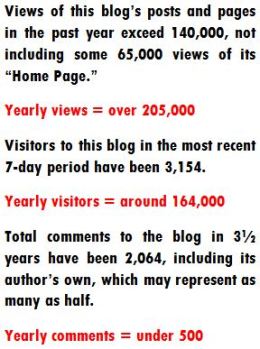
What these statistics reflect is that (1) confusion about restraining orders, if not fraudulent abuse of restraining orders, is epidemic; and (2) complainants of procedural abuses are intimidated into silence. No one wants to own humiliating or demonizing accusations against him or her, even if they’re false. This is, perhaps ironically, why fraudulent abuse of process continues unabated: Too few people talk back, so no one in a position to reform the status quo realizes there’s a problem in need of urgent remedy.

In the week leading up to Friday the 13th, 2015, WordPress reports that over 3,000 people visited this site (a few of them probably the same people on different days, but nevertheless…). Of that 3,000-plus, maybe 20 left comments or responded to petitions this site links to.

Maybe.

To one of the people who did submit a comment, a woman who was charged with assaulting her husband because she inadvertently scratched his arm while she was appealing to him to be nicer to her (during a verbal attack), I remarked that more people need to speak up about what they’ve been put through.

This woman, Izabella, has a restraining order against her, based on “all sorts of allegations,” that she reports her husband got to dominate and control her (to bully her, plain and simple). She says he’s never been an “involved dad” but uses their children now to “blackmail” her, because she had the temerity to “stand up to him.” The kids are pawns in a petty power game.

This is the kind of thing feminists deny happens (and adamantly deny happens to men). They insist restraining orders are there to protect women like Izabella.

Feminists are often wrong but never uncertain.

Their rigid advocacy is actually what makes scenarios like this possible, and for that reason, among others, I seldom find cause to sing their praises (though I’m not closed to the idea). One of their constant refrains, however, that victims will only speak up if they feel confident they’ll be believed, is right (and it’s why restraining orders exist to begin with).

Victims of procedural abuses need to speak up so that others will.

Respondents to this blog don’t need to identify themselves; they don’t even have to provide their email addresses if they don’t want to, though that information isn’t made public and allows them to be notified of others’ responses to their comments. It also lets them have dialogues among themselves.

Provided everyone plays nice, this writer is glad to take a backseat. (He’s been informed that nothing anyone else says is his responsibility, anyway.)

“Outing” yourself isn’t necessary, per se, to motivate change. But the public only understands what it sees and hears. If it sees and hears nothing, then that’s exactly what it will understand.

Copyright © 2015 RestrainingOrderAbuse.com

Inciting Violence: If Lawmakers Require a Compelling Motive for Restraining Order Reform, How about This One?

I examined a case, recently, of a man’s committing murder hours after being accused to the police. My familiarity with the case was, admittedly, shallow; I only had what was reported to go on (and that from a single, “raw” source). I have, however, heard from scores of people who’ve been accused—or scorned for telling the truth—in drive-thru restraining order proceedings, and expressions of fury have been more than a few.

This week, I shared an email by a highly educated, professional woman and mother of three young children that expresses an “almost homicidal enmity” catalyzed by procedural abuses. Note the elevated diction she uses to describe an impulse to bash, throttle, and gouge. Does her vaulted language indicate she “doesn’t really mean it”? No, it indicates how alien rage is to her character. It indicates she’s someone who shouldn’t have cause to feel this way.

Consider: How is it the police and the courts recognize the propensity for violence that interpersonal conflicts mediated by the “justice system” may arouse, but lawmakers don’t? Are they that “in the dark”?

Yeah, pretty much.

If you get into a spat with your neighbor, and the police intervene, parties are separated into corners. In court, complainants even merely of “fear” may be shielded by law officers in anticipation of a judicial ruling. It’s understood that emotions run hot in this theater.

Why, then, is it not appreciated that when the basis for rulings is false, the risk of violence is not only higher but infinite?

We like our games, and we like our fictions about how people should be and should feel and should react even if you trash their lives maliciously. Hey, we’re disposed to remind, it’s the law.

All well and good until somebody gets an ax in the ear—an edgy remark, maybe; honesty often strikes us that way (i.e., like an ax in the ear).

The wonder is that more people who lie to the courts don’t meet premature ends—or at least sustain some anatomical remodeling. False accusations, which have inspired a great deal of sententious deliberation in recent months, don’t just “discomfort” people or make them “justifiably [and transiently] angry.” At the risk of being edgy again: People who haven’t been falsely accused in a legal procedure don’t know what the fuck they’re talking about. I was collegiately trained as a literary analyst—I’ve studied and taught Victorian literature—and I’m normally more disciplined in my remarks, but this subject rebukes gentility.

Liars maim. That they do it with words in no way mitigates the brutality of the act or its consequences.

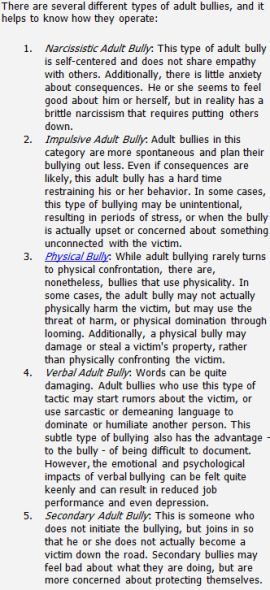
One would think that as people mature and progress through life, that they would stop behaviors of their youth. Unfortunately, this is not always the case. Sadly, adults can be bullies, just as children and teenagers can be bullies. While adults are more likely to use verbal bullying as opposed to physical bullying, the fact of the matter is that adult bullying exists. The goal of an adult bully is to gain power over another person, and make himself or herself the dominant adult. They try to humiliate victims, and “show them who is boss” (BullyingStatistics.org, “Adult Bullying”).

StopBullying.gov defines bullying as including name-calling, taunting, threatening, spreading rumors about someone, and embarrassing someone in public. Falsely labeling someone a stalker, child abuser, violent danger, or sexual deviant in one or more public trials whose findings are impressed on the target’s permanent record and are accompanied by menacing threats (if not immediate punishment) plainly qualifies. Among identified effects of bullying are suicide (“bullycide”) and violence, including murder. “Extreme emotional disturbance” is a defense for murder in some states (a finding that doesn’t excuse the act but does lighten the sentence), and a related murder defense is “provocation.”

Sure, character assassination is bloodless. What of it? If I circulate lies about someone and s/he snaps, I’m a bully, and I had it coming. Few people would say otherwise.

Ah, but if I lie and use the law as my medium to insult, demean, badger, intimidate, or otherwise persecute—hey, that’s different. I’m the “good guy.”

So suck it. And keep on sucking it, because the public record says my lies are the truth. Neener-neener.

A system that represents its purpose to be the curtailment of violence shouldn’t be promoting it by pandering to bullies, even “unofficially,” and its officers shouldn’t be serving as those bullies’ lieutenants and enforcers. If the system makes it easy to lie about and humiliate people, doesn’t hold liars accountable, and furthermore punishes the falsely accused based on lies, then it’s promoting violence.

This shouldn’t require social science research to corroborate. It shouldn’t even require this analyst’s observation.

Copyright © 2015 RestrainingOrderAbuse.com

You Can’t Sue for Perjury: Why Targets of Restraining Order Fraud and Other Procedural Abuses Based on Lies Get Screwed and Stay Screwed

The postscript (P.S.) to a series of comments left on the blog this week by the stepmother of a man who was falsely accused of violence asks whether he could sue his ex-girlfriend for lying.

The details, as the stepmother reports them, are these:

  1. Man and woman, who aren’t married, were together for four years and have a one-year-old daughter.
  2. During the term of their relationship, no reports of any kind of domestic conflict were made to authorities.
  3. The woman has heart disease (diagnosed as “congestive heart failure”) and can only perform minimally stressful activities, so this had typified the couple’s daily life: The man “gets up [at] 5 a.m., feeds [the] daughter, changes [her] diaper, makes his lunch, and heads to work. [He] gets home around 4­–4:30, and she is still in bed [and the] baby is still in [the] same diaper from that morning. […] He cleans, cooks, [does the] dishes [and] laundry, bathes [the] child, and heads to bed—and [the woman] bitches ‘cause he rolls over and goes to sleep.”
  4. On or about December 13, 2014, the couple “got in an argument, and she moved out, taking [their] child with her. She then texted [the child’s father] saying she was taking [the] child and moving to Oregon and he [would] never see [his] daughter again.”
  5. The woman then returned home to retrieve her belongings, “and when she went downstairs, he went out [the] door with [the] child. She freaked out. [Two] days later she filed a protection order saying all these lies about him…and he had to give [the] daughter back.”
  6. The woman, with her dad’s help, then relocated to Oregon with the child.

Among the woman’s allegedly false statements, apparently made to the police before she prepared to abscond with the child, was that the man pushed her into a fish tank, which it’s reported she actually slammed with her fist in a fit of rage while the man’s back was turned. Since the woman’s knuckles were plainly lacerated from punching glass, no arrest ensued. According to the man’s stepmother, the woman lied similarly to procure a protection order a couple of days later.

The stepmom wants to know if her stepson can sue his girlfriend for lying under oath. The answer, which is no, exposes why lying to the court is so effective, besides being easy.

Quoting “The Rule against Civil Actions for Perjury in Administrative Agency Proceedings: A Hobgoblin of Little Minds” (University of Pennsylvania Law Review, 1983):

“No action lies to recover damages caused by perjury.” If A is injured by the false or misleading testimony of B in a judicial proceeding, A cannot maintain an action for damages against B; A can obtain relief only by a direct attack on the judgment. So it was at common law, and although some observers have called for its abandonment, courts today are unanimous in following that ancient rule.

Tennessean and fraud victim Betty Krachey has launched a petition to urge her state to punish lying.

Appreciate that a corollary of that “ancient rule” is that if someone who’s lied about in a judicial proceeding lapses into suicidal despondency and kills him- or herself, his or her loved ones have no legal recourse. If you publicly mislabel someone a stalker, child molester, or batterer, for instance, outside of court, and that person kills him- or herself, you can be sued. But if the same end results from false allegations you make in court, you get away scot free.

Perjury—that is, knowingly lying to the court about influential facts—is a “serious criminal offense,” as a law student from South Africa recently remarked in a comment about a case of restraining order fraud that emerged in her country’s popular press. In many if not most jurisdictions in the U.S., perjury is a felony.

Punishment for it, however, can only follow its prosecution by the district attorney’s office, which rarely initiates perjury proceedings and only does so in slam-dunk cases of prominent interest like misconduct by public officials. Private litigants can sue for damages caused by the commission of other crimes—murder, for example—and they can sue for slanders and libels made outside of court. They can’t, though, sue for damages caused by lies told in judicial proceedings, no matter how injurious those lies might be.

The reason why, basically, is that the system likes closure. Once it rules on something, it doesn’t want to think about it again.

Consider what would happen if Person A lied about Person B, and Person B were authorized to sue Person A for lying. This would open the door for Person A to turn around and claim Person B lied in the second proceeding and sue Person B back. Person B could then pursue another action that alleged Person A lied about Person B in the third proceeding, and on and on ad infinitum.

While this would force the court to pay more than a lick of attention to the facts and also motivate it to drop the hammer on liars, it’s messy and time-consuming. So it’s rejected in the name of economy—and damn the consequences to people who are lied about.

This policy is among the reasons why restraining orders should be repealed.

Temporary orders are issued upon a few minutes’ prejudicial deliberation (really none at all). A petitioner goes to the courthouse, fills out some paperwork, and has a chitty-chat. If the accused doesn’t appeal, the court’s entire application to the case will have been those few minutes (sandwiched between stifled yawns). Even when a defendant does appear in court to contest allegations against him or her, judicial “review” of the matter may be less than 30 minutes.

On the basis of this brief “review” (which is often merely theater), a person like the man in the story above can be branded a “domestic abuser,” have his or her name entered into state and national police databases (permanently), and be denied contact with his or her child (besides potentially being denied credit, leases, and jobs, and having to indefinitely endure the agony and humiliation of being re-judged for something s/he didn’t do). S/he can also be made to pay court costs for having his or her life torn apart by lies.

A person like him, who can be male or female, can attack the false judgment in a further appeal—provided s/he has the emotional and financial resource—but s/he can’t seek redress for fraudulent testimony given in evidence against him or her.

That would inconvenience the court.

Copyright © 2014 RestrainingOrderAbuse.com

Smile, You’re on Candid Camera: Bringing a Measure of Accountability to Restraining Order Trials

Many if not most of the posts on this blog concern the absence of accountability in the restraining order process. Accusers lie, and so may judges.

State law often designates lying in court a felony offense punishable by a term in prison, and there are ethical canons that prescribe how judges should behave.

With regard to the honest representation of facts in court, however, both accusers and judges fudge (and that’s putting it mildly). Each may frame facts to produce a favored impression.

Lying in court, even if it’s discerned, is never called “lying”—which isn’t to say judges never tacitly express disdain or disgust. Frowns, scoffs, and scowls, though, aren’t picked up by microphones or preserved in trial transcripts.

Judges know the system would fall apart if they began acknowledging in the record that accusers lie, so lies are generally talked around if they’re remarked at all. No one, furthermore, reviews testimony afterwards to detect lies or material contradictions (which constitute “perjury by inconsistent statements”).

Consider how different things might be if courtroom procedures were recorded on video. Just consciousness of scrutiny puts people on notice. It triggers a primal alarm.

The knowledge or fear that we’re being watched exerts a disciplining influence on how we behave. Park an empty cop car on a street corner, and suddenly people are mindful of traffic signs. Rules are obeyed without anyone’s having to tell us to obey them.

Park a camera in a courtroom, and count on it that judges would be a lot more conscious of their performance and how their acumen stood to be perceived by others. Liars, too, would likely be a good deal warier of being caught out.

Making frauds visible, what’s more, and available for airplay would pressure district attorneys to treat lying like the serious crime it is. The concern wouldn’t be that some shaming video soundbite would appear; the concern would be what if.

Exceptions to video-recording testimony could be made in criminal trials when a witness might be inhibited or endangered by it. Since civil restraining order trials are regarded as no big deal, anyway, however, there’s much to recommend this simple, inexpensive measure to enhance accountability without having to do anything at all.

True, a possible negative consequence of cameras in court might be that the bench would only attract hams and blowhards.

Would anyone, though, notice a difference?

Copyright © 2014 RestrainingOrderAbuse.com

Beating up Disabled Girls: False Allegations and Judicial Dishonor

“There is no normal. The rational has been torn away from your ability to grasp it.”

Cartoonist Scott Stantis (on growing up in an abusive household)

This is the sentiment shared by everyone who’s been wrongly blamed—and abused and condemned for it.

Consider that current restraining order and domestic violence legislation and policy are defended as protecting battered women and children. Consider further that honor is not only represented as the guiding principle of judicial conduct but that it’s the title that judges are expected to ceremoniously be addressed by.

Now consider this appeal posted three weeks ago (September 30, 2014) to the e-petition “Stop False Allegations of Domestic Violence” by Phoenicia W. of Springfield, Missouri:

Hi im disabled 28 year old women. And just. Because. I was sick of being. Beat by my exboyfrend I kicked him out and he put fales charges on my cost me 10.000 dollars and I lost. Alot. How can his lies be taken. Off my record. Please. IV never. Even. Could. Hurt a fly please. I cry every. Nite. Help me.im incident I swere.

I’ve edited copy since I was teenager. Here’s what Phoenicia means:

Hi, I’m a disabled 28-year-old woman, and just because I was sick of being beaten by my ex-boyfriend [and] kicked him out…he put false charges on me that cost me $10,000—and I lost. A lot. How can his lies be taken off my record? Please. I’ve never even (and couldn’t) hurt a fly. Please. I cry every night. Help me. I’m innocent, I swear.

The gist of Mr. Stantis’s cartoon essay is that when you’re punished for something you didn’t do, and there’s no way to make sense of your situation or escape it, it “mangles the soul.”

My tidied version makes Phoenicia sound very able and together. Look again at the unedited script, though, which is a poem of pain.

Does it look and sound like it was authored by someone who could capably represent herself in court? For that matter, does it look and sound like it was authored by someone dangerous? Finally, how honorable is beating up (or beating down, if you prefer) a disabled girl and leaving her crying herself to sleep each night—a disabled girl, what’s more, who says she was beaten by the man who accused her of violence?

Feminists are urged to ask themselves which they think will have a more lasting consequence on this woman’s psyche: having been hit by an ex-boyfriend or living day and night with the court’s judgment? Which obviously haunts her? Which has healed, and which can’t heal? (When the court acts on lies by abusers, it compounds the abuse many times and makes it gnawing and constant: “There is no normal.” Ever. Again.)

You can’t relate pain like Phoenicia’s with a lurid picture of a black eye. Her pain and its source are invisible—and count on it that all traces of either have been carefully concealed beneath layers of judicial impression management.

If you’re not familiar with the phrase impression management, here’s an example: “She’ll be okay. She just ran into a door.”

Copyright © 2014 RestrainingOrderAbuse.com

Representatives of the Israeli Bar Association Report False Accusations of Domestic Violence Have “Reached Epidemic Proportions”

Unlike the American Bar Association, the Israeli Bar Association has a Committee on False Accusations and Parental Alienation. Also unlike its American counterpart, its representatives have chutzpah.

The lawyers who chair the Committee on False Accusations and Parental Alienation in the Tel Aviv district last month told the Israeli parliament (the Knesset) that false allegations of domestic violence are “a daily occurrence” (“Female Lawyers Decry False Accusations in Divorce”).

In fact, they reported (“with complete confidence”) that “false accusations of violence filed against spouses in divorce proceedings have reached epidemic proportions.”

Feminists don’t shout “shame!” at women who lie to the court; they shout “shame!” at women who report women lie to the court.

Advocates for women’s groups predictably countered with hollered scoldings and denials.

The chairperson of the Committee for Advancement of the Status of Women (which represents the interests of women’s groups) said her figures showed “the annual total of false accusations filed by women is about 11, and the number for men is similar.”

To this, one of the attorneys on the Committee on False Accusations and Parental Alienation answered she personally knew “more than 11 people who have suffered false accusations, and promised to bring the [Committee for Advancement of the Status of Women] more detailed information.”

(She might, too, have pointed out that more than 11 false accusations can be made by a single false accuser in a single false prosecution.)

Childish is what it’s tempting to comment about the faith of women’s advocates that false accusations filed by Israeli women each year are “about 11.” It’s also tempting to say the same of their need to assert that false accusations from men are equally low but about the same in number.

Criticizing feminists, however, never seems to inspire self-reflection.

Allowing for argument’s sake that the Israeli Bar Association is right that false allegations are a daily occurrence, a question Americans might ask themselves is this: Is the reason why the American Bar Association hasn’t reported the same thing that Israelis are bigger liars than we are, or is the reason that Israel’s legal critics are braver and more principled than ours?

Copyright © 2014 RestrainingOrderAbuse.com

Class Action Lawsuits: Suing Uncle Sam for Rights Violations Arising from Restraining Order and Domestic Violence Prosecutions

“I think action would be better than just mere words. How do you think same-sex marriages were passed? We all need to come together and file a class action lawsuit. These laws plainly violate our constitutional rights as U.S. citizens. There is no due process of law for these allegations, and the cause-and-effect deprives an individual of life, liberty, and property.”

—Michael K. from Alamogordo, New Mexico

The man makes a good point.

Cursory reading on class actions suggests, too, that a lawsuit like the one he proposes is feasible. According to Wikipedia, “Nationwide plaintiff classes are possible [if] such suits…have a commonality of issues across state lines.”

Controlling statutes and procedures concerning domestic violence and restraining order prosecutions, as well as “child welfare” interventions, vary state to state, but a “commonality of issues” vis-à-vis civil rights violations and unjust privations definitely does exist—and certainly class actions within states’ lines are at least as worthy of consideration.

Wikipedia again: “The procedure for filing a class action is to file suit with one or several named plaintiffs on behalf of a proposed class. The proposed class must consist of a group of individuals [who] have suffered a common injury or injuries.”

The most sympathetic candidates for a class action are probably those who’ve unjustly been deprived of property, employment, and/or access to children.

A recent NPR story reports that dozens of students who’ve been accused of rape are suing their universities. They allege they were denied due process and fair treatment by college investigative committees, that is, that they were “railroaded” (and publicly humiliated and reviled). The basis for a suit alleging civil rights violations, then, might also exist (that is, independent of claims of material privation). Certainly most or all restraining order defendants and many domestic violence defendants are “railroaded” and subjected to public shaming and social rejection unjustly.

How to Start a Class Action Lawsuit,” a primer authored by Linda Jo Martin, creator of FightCPS.com, explains the basics of the procedure. (Ms. Martin advocates for the filing of class actions against Child Protective Services in all 50 states.)

Getting a class action going of the sort this post concerns requires self-starters with good networking skills and a great deal of perseverance, because inducing people who’ve been abused by state process to come forward with complaints is tough. They’re scathed, distrustful, and afraid.

Names of willing participants have to be gathered and a law firm enlisted. Attorney fees aren’t a hindrance, because they’re collected from the reward. But a law firm would have to be confident of a win.

A firm that represent class actions is Lieff, Cabraser, Heimann, and Bernstein. Its website offer further information about class actions. Alternatively or additionally, see Stanford Law Professor Janet Cooper Alexander’s “An Introduction to Class Action Procedure in the United States.”

Undertaking a venture like coordinating a class action is beyond the resources of this writer, but anyone with the gumption to try and transform words into action is welcome to post a notice here.

Placing a notice on an e-petition like “Stop False Allegations of Domestic Violence” would be of limited value, because it would recede into the archives in a couple of days. Mining the petition for names, however, could be rewarding, because some respondents include their telephone numbers and email addresses along with their stories. Using Facebook and Twitter would be the most potentially profitable tacks.

The intrepid social activist would besides do well to contact the likes of A Voice for Men, and put out the word. Any group or hub that represents the interests of people with similar complaints should be notified.

Professors who’ve written about the particular rights abuses a class action would seek to redress, particularly law professors, might also be recruited to provide amicus briefs to the court (authoritative opinions that lend support).

Abuses of the sorts this blog and related sites concern have persisted without check for decades. Even prompts for others to take action are still just words.

Someone has to step forward and attempt to translate thought into action. Is that person you?

Copyright © 2014 RestrainingOrderAbuse.com

What Journalists Need to Understand about What Restraining Orders Are: A Tutorial for Investigators, Part 2

“Orders for protection represent a legislative attempt to incorporate distinct features from both civil law and criminal law. On the one hand, a private litigant can initiate judicial proceedings to seek redress against another private individual. On the other hand, criminal penalties, such as fines and incarceration, will attach if a protection order is violated. Unlike both civil and criminal proceedings, protection order actions involve a great deal of informality, with the end result being an order for protection that is often issued on an ex parte basis without the benefit of a full evidentiary hearing.

“Many aspects of Nevada law in this area can best be described as ‘murky,’ with virtually no critical or scholarly study available to assist Nevada’s courts. Moreover, statistical information about protection orders in Nevada is almost non-existent.”

—Staff attorney Joe Tommasino, Las Vegas Justice Court

The first thing reporters need to grasp about restraining orders is that they’re a kluge (a Frankenstein’s monster crudely stitched together from dubiously compatible parts). For plaintiffs (accusers), they merge the most favorable aspects of civil and criminal prosecutions; for defendants, the least favorable.

The scales of justice are tipped from the start.

Restraining orders allow a “private litigant [to] initiate judicial proceedings to seek redress against another private individual” just as civil lawsuits do (though restraining order applications by contrast are typically processed free of charge). They’re also adjudicated according to the lowest civil standard of proof (“preponderance of the evidence”). State standards vary rhetorically, but the criterion for rulings is basically the same: whatever judges fancy is just (and there are only two choices—thumbs up or thumbs down).

On this basis, citizens can be rousted from their homes and kicked to the curb (and some are left destitute). On this basis, also, they may be entered into domestic violence registries (indefinitely), besides state and federal law enforcement databases (indefinitely), and denied security clearances, loans, leases, and even employment in certain fields (just like convicted felons).

Notwithstanding that restraining order allegations are introduced in civil court and aren’t subject to the criminal standard of evidence (“proof beyond a reasonable doubt”), “criminal penalties, such as fines and incarceration, will attach if a protection order is violated”—or is simply alleged to have been violated: arresting officers need only have a reasonable suspicion that a violation occurred, which they need not have witnessed.

The savvy observer will note that suspicion is the motive determiner of liability at all levels. Suspicion informs judicial disposition, subsequent police response to claims of violation, and of course interpretation by third parties, including employers (judges trust accusers, and everyone else trusts judges). Emphatically worthy of remark is that billions of dollars of federal monies have been invested over the past 20 years toward conditioning judicial and police suspicion.

This may incline the savvy observer to suspect the fix is in.

He or she should appreciate further that restraining orders are most commonly issued ex parte, which means accusers simply fill out a form and very briefly interview with a judge without defendants’ being present to contest the allegations and without their even being aware that they’ve been made. (Some courts even explicitly advise plaintiffs to rehearse their allegations so they can recite them as quickly as they would an order at a drive-thru.) Although most states mandate that a follow-up hearing be slated to give the accused an opportunity to controvert the allegations against them and receive an “unbiased” second opinion, follow-up hearings are held in the same court that prejudicially ruled against them in the first place: “We found you guilty. Go ahead and tell us why we screwed up. You have 15 minutes.” Because restraining order trials are civil proceedings, defendants aren’t provided with legal counsel. They’re nevertheless afforded only a few days (or a couple of weeks at the outside) to prepare a defense.

Returning to this post’s epigraph, here’s its author’s elaboration of the points it introduces (which apply irrespective of what a restraining order is called):

The concept of a “protection order” or a “TPO” is a curious one under the law. Unlike a criminal case, where the awesome power of the State is wielded against a private citizen, an action for a protection order allows one private citizen to invoke judicial authority directly against another private citizen.

The implications are staggering when one considers that a protection order allows individuals to trigger invisible force fields affecting the conduct, movement, speech, and legal rights of others.

Even more significant is the fact that Nevada law allows a person to obtain a protection order based upon only a brief ex parte application [as do most or all states’ laws].

From these concepts, questions immediately present themselves. Are protection orders being utilized in oppressive or unexpected ways? Are the factual scenarios involved similar to what the [legislature] envisioned them to be? Are courts utilizing protection order tools correctly? Are judges issuing ex parte orders that trample upon the rights of innocent people before a hearing is held to determine the validity of specific allegations? Is this area of the law an insufficiently regulated “wild frontier”?

Loyola Law School Prof. Aaron Caplan, in a 2013 law review article that cites the 2008 paper of Mr. Tommasino’s quoted in this post, says yes.

Many structural factors of civil harassment litigation lead to higher-than-usual risk of constitutional error. As with family law, civil harassment law has a way of encouraging some judges to dispense freewheeling, Solomonic justice according to their visions of proper behavior and the best interests of the parties. Judges’ legal instincts are not helped by the accelerated and abbreviated procedures required by the statutes. The parties are rarely represented by counsel, and ex parte orders are encouraged, which means courts may not hear the necessary facts and legal arguments. Very few civil harassment cases lead to appeals, let alone appeals with published opinions. As a result, civil harassment law tends to operate with a shortage of two things we ordinarily rely upon to ensure accurate decision-making by trial courts: the adversary system and appellate review.

The process essentially operates “in a vacuum”:

Harassment orders, when granted, are very rarely appealed. In the Justice Courts of Las Vegas in 2008, only three out of 2034 non-domestic violence petitions resulted in an appeal. No appellate court opinions interpret the Nevada statute—even though it was enacted in 1989 [that’s zero appellate court opinions in 20 years]. As a result, “the limited jurisdiction courts [of Nevada] have been operating in a vacuum and creating ad hoc, reactive solutions” to recurring problems.

The stagecoach, in other words, is steered without reins. The laxity of the statutes means judges of the lowest-tier courts call the shots, and there are no big brothers looking over their shoulders. They’re licensed to do what they want. (The quotations above refer to different types of restraining order, but the two types aren’t necessarily treated any differently. Whether a petitioned injunction is a protection order or a harassment order may only depend on which box was ticked on the application form. In most jurisdictions, what distinguishes one from the other is the nature of the relationship between the accuser and the accused. The allegations may be identical.)

The legislative insensitivity to constitutional principles and protections as well as the lack of judicial housekeeping in this area of law are beneath the perceptual threshold of the public. To the uninitiated, the absence of controversy originating from “legitimate” sectors suggests that everything’s working as it should: restraining orders are issued to dangerous people who need to be tethered.

While how commonly the process is exploited for ulterior motives is a matter of heated dispute, its availability for abuse is plain. The prevailing attitude toward allegations of rampant abuse is that if statistics can’t be adduced to support them, the complaint is irrelevant and should exercise no influence on policy reform. The absurdity of this attitude is likewise plain. The process is designed to favor accusers, judges are predisposed to credit accuser’s accounts (in part according to explicit instruction), those accounts need not be substantiated, the process is initiated and completed in hearings spanning minutes only, and (as the court attorney who wrote the epigraph notes) comprehensive statistical information about restraining orders is virtually non-existent.

The restraining order process is conducted in a black hole. There’s not only no transparency; there’s no light.

Copyright © 2014 RestrainingOrderAbuse.com

What Journalists Need to Understand about Restraining Orders and Their Abuse: A Tutorial for Investigators, Part 1

“Restraining orders give victims of domestic violence a tool to keep their abusers away or at least have them arrested if they come close. Anyone in a relationship with recent history of abuse can apply, and the order can be signed the same day.

“It gives victims the right to stay in the home and keep the kids. But the civil document relies on their abusers to respect the law.”

—“Are Restraining Orders False Security?(USA Today)

Reporters are often keen and eager detectives when there are two sides to a story, and they want to get to the bottom of things. When there aren’t clearly defined contestants with competing narratives, however, reporters are as prone as anyone else to swallow what they’re told.

The news story the epigraph was excerpted from was prompted by a recent murder in Oregon and explores the impotence of restraining orders, in particular to “stop bullets.” Just as shooting sprees inspire reporters to investigate gun legislation, murder victims who had applied for restraining orders that proved worthless inspire reporters to investigate restraining order policies. The presumption, always, is that the law failed.

The solution suggested by the story—the same solution that’s always suggested by such stories—is to beef up protocols and give the statutes more teeth.

What’s inevitably lost in considerations like this is that for every person who’s attacked or killed in spite of a restraining order, thousands, tens of thousands, or even hundreds of thousands of people face grave indignities and privations consequent to orders’ being used exploitatively (including public revilement, chronic harassment, criminal profiling, social alienation, and loss of employment, health, and access to kids, home, and property). This is a fact it seems journalists would only be given cause to confront if more victims of procedural abuse killed themselves.

Preferable, certainly, would be if reporters could be depended on to sniff out and censure injustice without anyone’s having to die.

Toward this end, this post encourages reporters to recognize what the quoted paragraphs that introduce it actually say. This is revealed by removing the obfuscating rhetoric. Replace the phrase victims of domestic violence with accusers, and replace their abusers with the accused.

Now consider the implications of the same paragraphs, slightly revised:

“Restraining orders give accusers a tool to keep the accused away or at least have them arrested if they come close. Anyone in a relationship…can apply, and the order can be signed the same day.

“It gives accusers the right to stay in the home and keep the kids….”

The mere substitution of factually accurate, unbiased labels changes the meaning of these paragraphs significantly, and brings their implications to the fore.

Now dare to think the unthinkable (as every factual analyst should) and replace the word accusers with the word liars and the phrase the accused with the phrase those lied about, and pare away a few more words.

“Restraining orders give liars a tool to keep those lied about away or have them arrested. Anyone in a relationship can apply, and the order can be signed the same day.

“It gives liars the right to stay in the home and keep the kids.”

The same two paragraphs, reconceived, say that a restraining order can be got by lying to the court, can be used to have someone arrested without warrant based on the report of the liar, can be had in a single day (without the accused’s even being given prior notice of the proceedings), and can be used to gain immediate and sole entitlement to a place of residence and immediate and sole custody of children.

Appreciate that there are no (enforced) penalties for lying, and suddenly the motives and opportunity for fraud—particularly against a target of malice—become plain.

Appreciate further that allegations made by restraining order petitioners aren’t subject to the criminal standard (“proof beyond a reasonable doubt”). Restraining order trials are civil adjudications, not criminal ones. The “standard of proof” applied is “preponderance of the evidence,” which means no certain substantiation of allegations ranging from nuisance to sexual assault is required. Approval of a restraining order isn’t a (literal) finding of guilt, per se. No proof of anything must be established.

People, including journalists, only see what they hear.

The truth of how conveniently and urgently restraining orders avail themselves as tools of abuse is right under the noses of everyone who writes about them. It just gets obscured by loaded words (victims and abusers, for example) and the images they excite. Blindness to these words’ unexamined assumptions is further reinforced by the hysteria aroused by a (single) sensational act of violence.

Principal among these unexamined assumptions is that everyone who claims to be a victim is a victim (according to which belief everyone who claims to be a victim is treated as a victim by the court—which every false claimant dependably anticipates).

Observing this by using a story about a tragedy shouldn’t seem callous, because (1) it’s in the wake of tragedies like the one reported in the referenced story that hysteria runs highest and completely eclipses critical scrutiny, and (2) it’s tragedies like the one reported in the referenced story that show that restraining orders, besides being excellent tools to realize spiteful or avaricious intentions, aren’t any good at doing the one thing that’s said to justify them: averting violence.

On the contrary, the story reports:

“For some people it’s more dangerous [to get a restraining order],” said Kim Larson, director for Marion County District Attorney Victim Assistance Division. “Sometimes it makes people really angry, getting served with a restraining order.”

This is especially true if the order is false. (Besides inspiring violent people to commit further violence, restraining orders may drive nonviolent people to lash out or even kill in desperation, particularly if they’ve been falsely accused, publicly excoriated, and deprived of all that gave their lives meaning.)

This isn’t rocket science. People lie, and when people lie about abuse, they do egregious and often irrevocable harm to those they falsely blame—who only very rarely kill themselves. No one looks beneath the surface, because they faithfully cleave to popular conceptions and reasonably assume that there are safeguards in place (due process and such) to ensure that allegations of abuse are properly vetted and substantiated.

Investigators shouldn’t assume.

Copyright © 2014 RestrainingOrderAbuse.com

A Brief Look at Perjury Prosecutions: Who and What Counts and Who and What Doesn’t

Here are two recent headlines that caught my eye: “Former Judge Charged with Perjury for Allegedly ‘Fixing’ DUI Case” and “State [Senator] Resigns over Perjury Conviction.”

Here are the facts:

A former Pennsylvania judge is facing criminal charges for allegedly improperly dropping a DUI case brought against a prosecutor’s nephew.

And:

[A California state senator] submitted his resignation Monday after he was sentenced last week to three months in jail for lying about where he lived when he ran for office.

The judge charged with perjury was a 25-year veteran. His defense against accusations of ticket-fixing were determined “not credible” by a grand jury. The prosecutor whose nephew he’s alleged to have fixed the ticket for has since become a judge herself.

The senator, called a “career politician” by the judge who determined him no longer eligible to hold office, was suspended with pay (and jailed for three months). A petition has been filed by the Judicial Conduct Board of Pennsylvania against the judge who was charged with perjury seeking his suspension from “any future judicial assignments and to bar him from being granted senior status through the Administrative Office of Pennsylvania Courts.”

Recognize that in these rare instances when perjury statutes are enforced, the motive is political impression management (government face-saving). Everyday claimants who lie to judges are never charged at all, because the victims of their lies (moms, dads, retirees, veterans, engineers, stockbrokers, cops, therapists, teachers, etc.) don’t rate.

They’re nameless and isolated, so they don’t signify.

It’s worthy of remark that the above-referenced senator was reelected even after he was charged with defrauding the public by lying about his residency status. It didn’t affect anyone; no one cared. In contrast, lies that may trash citizen’s lives—for example, false allegations of abuse made on restraining orders or in domestic violence prosecutions—are never acknowledged by judges, let alone punished.

The justice system would seem to have a very arbitrary definition of what justice is—or a very convenient one.

It errs, besides, in believing that only the actions of judges and politicians like those cited in the stories that inspired this post “affect everyone.” The referenced judge and senator may have acted improperly, but their actions didn’t negatively impact anyone; they just made government look bad.

They tarnished its appearance of uprightness and propriety.

The court’s making the standard of justice no certain standard at all is what actually impacts everyone…and makes government look a whole lot worse in the eyes of a whole lot more people.

Copyright © 2014 RestrainingOrderAbuse.com

Larry’s Story: Restraining Order Abuse and the Neighbor from Hell

“She habitually engages in psychological projection. She has caused me to be compelled under threat of arrest and prosecution for failure to appear to attend court on her frivolous lawsuits 25 times. Yes! Twenty-five times. The frivolous prosecutions started in 2011, and they are still raging. I have been cited back to court on her application for a new restraining order on the 12th and a criminal warrant for cyberstalking on the 17th of this month. She has tried so many times to have me jailed I have lost count.”

—Larry Smith, author of BuncyBlawg.com (2014)

The quotation above is an excerpt from an email sent to the creator of “Neighbors from Hell” on ABC’s 20/20. The Feb. 8 email was a sorely persecuted man’s response to being fingered on Facebook as a candidate for the series by his neighbor, Marty Tackitt-Grist, who has forced him to appear before judges nearly 30 times in the span of a few years to answer “two restraining orders, three show-cause orders, two cyberstalking arrests, and a failure-to-appear arrest and jailing despite faxes from two doctors that I was too crippled, disabled, and suffering from herniated discs to be able to attend court.”

Here’s the reply the email elicited from ABC’s Bob Borzotta: “Hi Larry, I don’t seem to have heard further from her.  Sounds like quite a situation….” Cursory validations like this one are the closest thing to solace that victims of chronic legal abuses can expect.

Concern shown by the police and courts to complaints from attention-seekers can make them feel like celebrities. Random wild accusations are all it takes for the perennial extra in life to realize his or her name in lights.

Not unpredictably, the thrill is addictive.

I think I first heard from Larry, the author of BuncyBlawg.com, in 2013—or maybe it was 2012. In the artificial limbo created by “high-conflict” people like the one he describes in the epigraph, temporal guideposts are few and far between. A target like Larry can find him- or herself living the same day over and over for years, because s/he’s unable to plan, look forward to anything, or even enjoy a moment’s tranquility.

The target of a high-conflict person is perpetually on the defensive, trying to recover his or her former life from the unrelenting grasp of a crank with an extreme (and often pathological) investment in eroding that life for self-aggrandizement and -gratification.

Among Larry’s neighbor’s published allegations are that he’s a disbarred attorney who “embezzled from his clients” and a textbook psychopath, that he has “barked like a dog for hours” to provoke another neighbor’s (imaginary) dog to howl at her, that he has called her names, that he has enlisted “mentally challenged adults” to harass her while shopping, that he has cyberstalked her, that he has “hacked into phones” and computers, that he has tried to cause her (and “many others”) to lose their jobs by “reporting false information,” that he has made false complaints about her “to every city, state, and county service,” that he sends her mail “constantly,” and that he has “mooned” her neighbors and friends.

The ease with which a restraining order is obtained encourages outrageous defamations like these (Larry’s neighbor has sworn out two). Once a high-conflict person sees how readily any fantastical allegation can be put over on the police and courts, s/he’s inspired to unleash his or her imagination. That piece of paper not only licenses lies; it motivates them.

Larry’s a quiet guy with a degenerative spinal disorder who’s been progressively going deaf for 25 years. He lives for his three toy poodles and watches birds. “I grew up,” he says, “in a little Arcadian valley here in western North Carolina with the nicest people, mostly farmers; and I guess my youth just left me naïve about some people. I always saw the good in them.” Larry began practicing law in 1973 in Asheville but voluntarily withdrew from the profession in 1986, because he was disgusted by the corruption—and the irony of having his retirement years fouled by that corruption isn’t lost on him.

You might guess his accuser’s motive to be that of a woman scorned, but Larry’s association with her has never exceeded that of the usual neighborly sort. He reports, however, that she has alleged in court that he covets her and nurses unrequited longings and desires.

Compare the details of the infamous David Letterman case, and see if you don’t note the same correspondence Larry has.
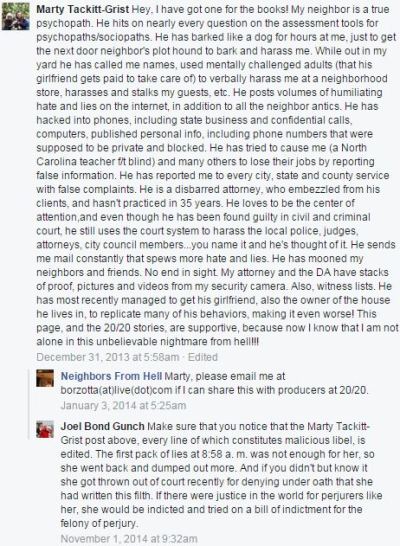
Marty Tackitt-Grist, Martha Tackitt-Grist, Larry Smith, North Carolina, ABC’s 20/20, Nasty Neighbors, Neighbors from HellThat’s the horror that only the objects of high-conflict people’s fixations understand. Stalkers and “secret admirers” procure restraining orders to get attention and embed themselves in other’s lives—like shrapnel.

This writer has been in and out of court for eight years subsequent to encountering a stranger standing outside of his residence one day…and naïvely welcoming her. One respondent to this blog reported having had a restraining order issued against her by a man she sometimes encountered by her home who always made a point of noticing her but with whom she’d never exchanged a single word.

It isn’t only intimates and exes who lie to subject targets to public humiliation and punishment. Sometimes it’s lurkers and passers-by, covert observers who peer between fence slats and entertain fantasies—or, as in Larry’s case, a neighbor who feels s/he’s been slighted or wronged according to metrics that only make sense to him or her.

Larry thinks the unilateral feud that has exploded the last several years of his life originates with his complaining about cats his neighbor housed, after they savaged the fledgling birds that have always been his springtime joy to watch.

For 25 years I have lived on this street with lovely people. We always got along, although one or two you had to watch. During most of that 25 years, there have been three different owners of the house across the street. The other two we dearly loved. The last one, the incarnation of purest evil, moved here in 2005. She was a divorcée who volunteered that her divorce was especially nasty, the first red flag which I foolishly disregarded: She constantly badmouthed her ex. For the first few years, we were friends, but as time went by she became an almost insufferable mooch and just way too friendly, expecting more attention from her neighbors, and from us, than we wanted to give. Sometime in early 2011, I left her a voicemail and told her I didn’t want to be close friends with her anymore. She was a hoverer, she manipulated, she was a narcissist. And the message meant that I did not want to be called on to mow her lawn anymore, or help her trim her trees, or lend her tools, or watch her pet while she was gone, or help her move heavy loads like furniture, or listen to her constant whining. I just wanted to cool it with her.

In the spring of 2011, she had been converting her home to a sort of boarding house and brought in tenants, and [between] them they had two cats that constantly prowled, especially the tenant’s. What became very irksome to me was the tenant’s cat creeping into our yard and killing our baby birds, which we always looked forward to in the spring. And the minute I brought it up with her, she pitched a fit, and so did the tenant. So for the first two months of baby bird season, [their] cats killed all our fledglings and the mother songbirds—wrens, cardinals, robins, mockingbirds, towhees, mourning doves, even the hummingbirds, just wiped them out. I finally got in touch with our Animal Services officers, but by that time bird season was over with, and you know something, [she] began going about telling neighbors that I was a disbarred lawyer (a particularly nasty slander). One thing led to another, and finally the tenant with the marauding cat moved away, but the irreparable damage was done, and all through the summer I had been warned by other neighbors that the neighbor from hell was plotting revenge.

I went to her one day and asked her if there was anything I could do to make it so we could at least drop all the nasty hostilities. She exploded. Next thing I knew, she had three police cruisers here with a false tale that I was “harassing” her and calling her names. This was no surprise, because early on I learned not to believe a thing she said because she just made up the most unbelievable tales about her personal crises. One of the five cops who came spoke with me in the yard, and I thought this would all blow over, but in a few days a process server was banging on the door with papers to serve me. I met him in a commercial parking lot nearby and accepted the lawsuit, an application for a restraining order, a TRO, and, well, a great big wad of lies. It was a shocker. And little did I know that the very day I received this horse-choking wad of papers, at around 10:15 a.m., [she] was back in the courthouse filing another affidavit to have me ordered to show cause why I should not be jailed for contempt. In other words, before I even had notice of the TRO, she was trying to have me jailed for violating it. That’s just how damn mean that woman is.

High-conflict people are driven by a lust to punish—any slight is a provocation to go to war—and their craving for attention can be boundless. Judicial process rewards both.
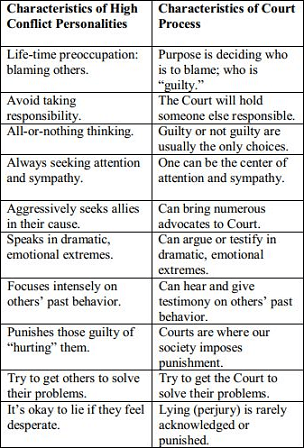
This table, prepared by attorneys Beth E. Maultsby and Kathryn Flowers Samler for the 2013 State Bar of Texas Annual Advanced Family Law Course, shows how high-conflict people and court process are an exquisitely infernal fit. Its authors’ characterization of high-conflict people’s willingness to lie (“if they feel desperate”) is generous. Many lie both on impulse or reflex and with deliberate cunning, though their chain of reasoning may be utterly bizarre.

Restraining orders are easily obtained, particularly by histrionic women. Once petitioners—especially high-conflict petitioners—realize how readily the state’s prepared to credit any evil nonsense they sputter or spew, and once they realize, too, the social hay they can make out of reporting to others that they “had to get a restraining order” (a five-minute affair), they can become accusation junkies.

Larry has responded in the most reasonable way he can to his situation. He’s voiced his outrage and continues to in a blog, and the vehemence of his criticisms might lead some who don’t know Larry to dismiss him as a crank. If you consulted his blog, you’d see it’s fairly rawboned and hardly suggests the craftsmanship of a technical wizard who can hack email accounts and remotely eavesdrop on telephone conversations. What the commentaries there suggest, rather, is the moral umbrage of an intelligent man who’s been acutely, even traumatically sensitized to injustice.

Here’s the diabolical beauty of our restraining order process. Judges accept allegations of abuse at face value and don’t scruple about incising them on the public records of those accused. They furthermore expect those who are defamed to pacifically tolerate public allegations that may have no relationship with reality whatever or may be the opposite of the truth, may be scandalous, and may destroy them socially, professionally, and psychologically. Judges, besides, make the accused vulnerable to any further allegations their accusers may hanker to concoct, which can land them in jail and give them criminal records. And finally judges react with disgust and contempt when the accused ventilate anger, which they may even be punished for doing.

Judicial reasoning apparently runs something like this: If you’re angry about false allegations, then they weren’t false; if you’re not angry about false allegations, then they weren’t false.

Larry’s been jailed, Larry’s been reported to the police a dozen times or more, an officer has rested the laser sight of her sidearm on him through the window of his residence, and the number of times he’s been summoned to court is closing on 30.

The allegations against him have been false. How angry should he be?

Copyright © 2014 RestrainingOrderAbuse.com
Reporting Restraining Order Abuse to Elected Officials

“I am suffering from the effects of a fraudulent protection order in Colorado, which was filed by my female roommate and had me and my young daughter kicked out of our home.

“There appears to be no recourse for me, but I did contact 10 state representatives and senators, and I heard back from three of them. If more people report this abuse to their elected officials, maybe something will actually be done about this awful system.”

—Respondent to this blog

Writing to district and state representatives can be a lot like trying to communicate with judges. Expecting a human response isn’t unreasonable, but it’s often disappointed.

There’s nevertheless value in bringing systemic injustices to the attention of legislators (senators and congressmen and -women), because (1) they make, reform, and repeal laws, and (2) if they hear the same complaints over and over—and especially if they know other people of influence are hearing the same complaints and looking to them for action—there’s a chance some of them might step up.

The voices of women who’ve been abused by court process, particularly, need to be heard, because the procedures that are most often and easily abused are ones it’s presumed are protecting them.

Consult this site for the names and addresses/websites of elected officials with whom to register a complaint (state legislators should be first in order of importance):

Find Your Representatives

See also these tutorials:

Writing to Your Legislator

“How to Write a Letter to Your United States Senator

How to Write Letters to Congress

A petition that automatically forwards stories of abuses of domestic violence laws and restraining orders to legislators/administrators is here.

Copyright © 2014 RestrainingOrderAbuse.com

*See also: What to Do if You’ve Been Abused by a Judge

Restraining Orders Based on Fraud Falsely Imprison Defendants Whether They’re Incarcerated or Not

“Forensic psychiatrists and other mental health professionals must remember that although allegations are often genuine, there is an almost equal number of cases…in which they are not. Complete and objective assessment is always required, and especially so when accusations emerge in contexts such as the following:

  • Certain kinds of mental illness and character traits (particularly in allegations against clinicians). One should note poor doctor-patient relationships, whether real or perceived, patients with psychotic or delusional symptoms, certain hysterical and factitious disorders, some fragmenting or dissociative disorders, and those with substantial borderline, inadequate, and/or passive personality traits
  • Divorce proceedings
  • Child custody proceedings
  • Situations with the potential for substantial financial reward
  • Situations in which the accuser has an emotional or characterological reason to avoid discovery, prosecution, or confrontation with legal (or parental) authority (e.g., those with antisocial personality traits, some substance abusers)
  • A history of repeated past allegations, particularly if they have not been fully investigated
  • Unusual timing of the accusation or alleged event (e.g., alleged ‘date rape’ within an otherwise close and stable relationship, or accusations made only when some sort of secondary purpose or reward is evident).”

—“False Allegations: The Role of the Forensic Psychiatrist

The previous post called attention to an excerpt from a story featured in The Times of Malta this month that concluded that incidences of false allegations weren’t “one-offs,” meaning they’re not singular occurrences but more common than the public imagines.

The lawyers quoted by reporter, what’s more, refer to criminal cases in which sexual abuse is alleged and, consequently, in which the accused are afforded attorney representation.
By contrast, civil restraining order hearings are mere minutes long, defendants aren’t afforded counsel, and fraud is typically ignored by the court even if it’s perceived. There is, therefore, no accurately determining the pervasiveness or degree of lying in such adjudications.

Many authoritative sources conclude it’s rampant, and anecdotal reports concur.

The application process for restraining orders is typically free, it’s concluded in an afternoon if not within minutes, and there are no consequences for lying. Why, then, shouldn’t the process be broadly and routinely abused?

To believe that such a process wouldn’t be abused would depend on an unshakably naïve conviction in the inherent goodness of people, and such a belief would determine the process unnecessary. Anyone who believes people are capable of beastly behavior and that restraining orders are necessary—take, for example, feminists—must believe people are capable of lying hurtfully to get them.

Exposing the flaws in the belief that anyone who points a finger must necessarily be telling the truth doesn’t take a professor of philosophy.

Consider, then, that allegations made in civil court may be identical to those introduced against defendants in criminal court—and can include rape, child molestation, or even murder. The only difference between civil and criminal rulings is legal consequence.

This is the source of the cognitive disconnect exemplified by judges and, largely, everyone else. Because civil restraining orders only threaten incarceration rather than mandate it, they’re considered “no biggie.”

The conceit is that though falsely accused restraining order defendants may be denied access to their homes, money, property, and children—besides facing other privations—they aren’t denied their freedom; it’s only curtailed somewhat (“Here are your shoes—you’re free to leave”).

Faith in the conceit that restraining orders are minor impingements on defendants’ lives depends on accepting that being falsely, publically, and permanently labeled a stalker or batterer, for example, shouldn’t interfere with a person’s comfort, equanimity, or ability to realize his or her dreams. Such faith is founded, in other words, on the fantastical belief that wrongful vilification won’t exercise a detrimental influence on a person’s mental state, won’t affect his or her familial and social relationships, won’t negatively impact his or her employment and employability, etc.

Clearly such faith is beyond unreasonable; it’s inane. Being forced to live with false allegations can be crippling—for painfully obvious reasons. Whether a person is forced to agonize in a cell or is permitted to agonize in his or her place of choice is of scant significance to the psycho-emotional well-being of the sufferer. Prison isn’t just an environment, and arresting someone doesn’t require handcuffs.

Copyright © 2014 RestrainingOrderAbuse.com

How Men Lie on Restraining Orders: A Tutorial for Feminists

The topic of this discussion is vicious men—not real men but the kind who’d make false allegations against a woman and ruin her for self-gratification or -gain.

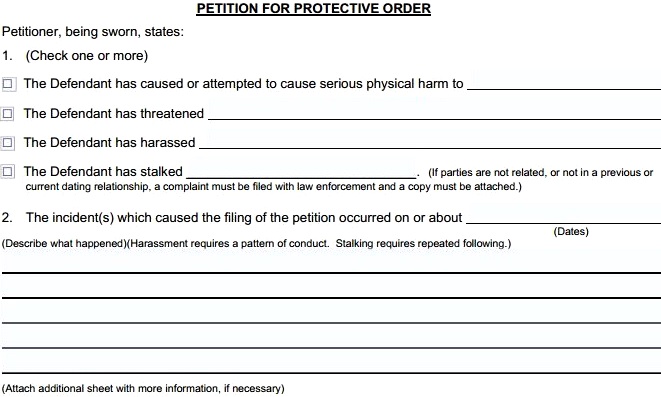
Below is an excerpt from a standard restraining order form. Apply your imagination and consider how a man might exploit the opportunity it affords to trash a woman’s life. I’ll guide you. See the tick boxes and blanks? What he’d do is flick the cap off his Bic and write lies in the spaces provided. It only takes a few minutes.

A false complainant might allege, for example, that his girlfriend stalked him, coerced him into having sex, threatened to kill him, beat his daughter or made her smoke crack, etc. His motive might be revenge, or his motive might be to deflect blame from himself for actually engaging in the same or worse activities. Restraining order petitioners may be the real offenders, and the courts graciously provide them with the chance to compound their victims’ torment and walk away scot free. The first one up the courthouse steps is the “good guy.”

Besides a pen and a few minutes to kill, the only requisite for upending a woman’s life this way is a malicious will. For men to apply for false restraining orders against women is usually free (that is, the cost is covered by the taxpayer), as the Violence Against Women Act (VAWA) mandates it be.

All there is to making allegations on restraining orders is tick boxes and blanks, and there are no bounds imposed upon what allegations can be made. A false applicant merely writes whatever he wants in the spaces provided—and he can use additional pages if he’s feeling inspired. The basis for a woman’s being alleged to be a domestic abuser or even “armed and dangerous” is the unsubstantiated say-so of the petitioner. Can the defendant be a vegetarian single mom or an arthritic, 80-year-old great-grandmother? Sure. The judge who rules on the application won’t have met her and may never even learn what she looks like. She’s just a name.

The worst that happens is a fraudulently accused woman appears for a hearing after a week or two of sleepless nights (possibly spent living out of her car) and manages to persuade a judge that she’s not a stalker, child-beater, or whatever. Although even this won’t ensure the judge finds in her favor and dismisses the order, let’s say the judge does dismiss the order.

The false accuser is subject to no sanctions from the court and is at no risk of prosecution from the state, and it isn’t guaranteed that the dismissed restraining order will be expunged from the woman’s public record, which may be the public record of a kindergarten teacher, a therapist, or a police officer (even dismissed orders are stigmatizing and cost people jobs).

The man’s just out a little time and may still have cause to smirk.

And, anyway, he can always file for another restraining order later on. There’s no statutory ceiling on how many times he’s authorized by the state to do this. The sky’s the limit. He could even reapply for multiple restraining orders from different jurisdictions to up the fun.

High-conflict litigants can consume years of their targets’ lives like this. Between rounds of false allegations, their targets may languish in a personal hell, unable to reconcile themselves to betrayals and lies, unable to work in chosen professions because unable to rinse those lies from their public faces, and never knowing what to expect next or when. Whatever familial and social infrastructures depend on them may obviously crumble, besides.

How men lie on restraining orders and make wrecks of women’s lives—and how easily—should be clearer now.

How women lie on restraining orders and make wrecks of men’s and other women’s lives is exactly the same way.

Copyright © 2014 RestrainingOrderAbuse.com

A Legislated License to Lie: Nothing CAN’T Be Falsely Alleged on a Restraining Order

OK

Battery, rape, child molestation—any heinous allegation imaginable can be made in a petition for a restraining order, and it can be made falsely without consequence to the accuser.

Victims of false allegations often ask incredulously, “Can somebody say that?”

There’s nothing that can’t be alleged to the courts (or, for that matter, to the police). There’s no such thing as “can’t allege.” A judge might view allegations of genocide or conspiracy with aliens to achieve global domination as suspect—or s/he might not. Certainly there’s nothing to stop a restraining order applicant from making these allegations, and there’s nothing to stop a judge from crediting them. Neither accusers nor judges are answerable to a literal burden of proof.

As the infamous David Letterman case shows, even the most outlandish allegations easily duck judicial radar. For anyone unfamiliar with the case, here’s Massachusetts attorney Gregory Hession’s synopsis and commentary (quoted from “Restraining Orders Out of Control”):

One day in December of 2005, Colleen Nestler came to Santa Fe County District Court in New Mexico with a bizarre seven-page typed statement and requested a domestic-abuse restraining order against late-night TV host David Letterman.

She stated, under oath, that Letterman seriously abused her by causing her bankruptcy, mental cruelty, and sleep deprivation since 1994. Nestler also alleged that he sent her secret signals “in code words” through his television program for many years and that he “responded to my thoughts of love” by expressing that he wanted to marry her.

Judge Daniel Sanchez issued a restraining order against Letterman based on those allegations. By doing so, it put Letterman on a national list of domestic abusers, gave him a criminal record, took away several of his constitutionally protected rights, and subjected him to criminal prosecution if he contacted Nestler directly or indirectly, or possessed a firearm.

Letterman had never met Colleen Nestler, and this all happened without his knowledge. Nonetheless, she requested that the order include an injunction requiring him not to “think of me, and release me from his mental harassment and hammering.” Asked to explain why he had issued a restraining order on the basis of such an unusual complaint, Judge Sanchez answered that Nestler had filled out the restraining-order request form correctly. After much national ridicule, the judge finally dismissed the order against Letterman. Those who don’t have a TV program and deep pockets are rarely so fortunate.

If allegations like these don’t trip any alarms, consider how much easier putting across plausible allegations is, plausible allegations that may be egregiously false and may include battery, rape, child molestation, or the commission of any other felony crimes.

What recent posts to this blog have endeavored to expose is that false allegations on restraining orders are very effective, because the “standard of evidence” applied to restraining order allegations both tolerates and rewards lying. The only thing that keeps false allegations reasonably in check is the fear that malicious litigants may have of their lies’ being detected. Normal people at least understand that lying is “bad” and that you don’t want to get caught doing it.

To some degree at least, this understanding restricts all but the mentally ill, who may be delusional, and high-conflict litigants, who may have personality disorders and have no conscience, or whose thinking, like that of personality-disordered people’s, is overruled by intense emotions, self-identification as victims, and an urgent will to blame. Normal people may lie cunningly or viciously; high-conflict people may lie cunningly, viciously, compulsively, outrageously, and constantly.
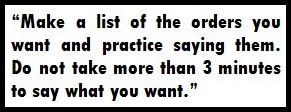
The fear of getting caught in a lie is in fact baseless, because perjury (lying to the court) is prosecuted so rarely as to qualify as never. Most false litigants, however, don’t know that, so their lies are seldom as extravagant as they could be.

Often, though, their lies are extravagant enough to unhinge or trash the lives of those they’ve accused.

Appreciate that false allegations on restraining orders of battery, rape, child molestation, or their like don’t have to be proved. Restraining orders aren’t criminal prosecutions. Allegations just have to persuade a judge that the defendant is a sick puppy who should be kenneled. An allegation of battery, rape, or child molestation is just a contributing influence—except to the people who have to bear its stigma.

More typical than utterly heinous lies are devious misrepresentations. Accusations of stalking and untoward contact or conduct, which may simply be implied, are a common variety. The alleged use merely of cruel language may be very effective by itself. Consider how prejudicial a female plaintiff’s accusing someone (male or female) of forever calling her a “worthless bitch” could be. Substantiation isn’t necessary. Restraining order judges are already vigilantly poised to whiff danger and foul misconduct everywhere. In processes that are concluded in minutes, false or malicious accusers just have to toss judges a few red herrings.

Irrespective of the severity of allegations, the consequences to the fraudulently accused are the same: impediment to or loss of employment and employability, humiliation, distrust, gnawing outrage, depression, and despondency, along with possibly being menacingly barred access to home, children, property, and financial resource. This is all besides being forced to live under the ever-looming threat of further state interference, including arrest and incarceration, should additional false allegations be brought forth.

Even if no further allegations are made, restraining orders, which are public records accessible by anyone, are recorded in the databases of state and federal police…indefinitely.

This “advice,” which urges restraining order applicants to rehearse, comes from the California court system and is offered on a page titled, “Ask for a Restraining Order.” The page’s title is not only invitational but can be read as an order itself: Do it. Note, also, that finalization of a restraining order may be based on less than “3 minutes” of testimony and that the court prefers it to be.

Recourses available to the falsely accused are few, and even lawsuits that allege abuse of process may face hurdles like claim preclusion (res judicata), which prohibits previously adjudicated facts from being reexamined. Never mind that the prior rulings may have been formulated in mere minutes based on fantasy and/or cooked allegations. Victims of defamation, fraud on the police and courts, and intentional infliction of emotional distress may moreover face stony indifference from judges, even if their lives have been entirely dismantled. And it should be stressed that attempting to rectify and purge their records of fraudulent allegations, which are established in minutes, can consume years of falsely accused defendants’ lives.

Recognizing that there are no bounds placed upon what false accusers may claim and that there are no consequences to false accusers for lying, the wonder is that more victims of lies aren’t alleged to be “batterers,” “rapists,” and “child molesters.”

Copyright © 2014 RestrainingOrderAbuse.com

How “Preponderance of the Evidence” Rewards Restraining Order Fraud and Why Bigger Lies Work Better than Smaller Ones

Recent posts to this blog have discussed American evidentiary standards and stressed that the standard applied to civil restraining orders, “preponderance of the evidence,” has nothing to do with proof. According to this standard, a judge should find in favor of a restraining order plaintiff if s/he figures there’s a greater probability that the plaintiff’s claims are true than that they’re totally false.

The word to bear in mind here is probability.

I’ll give you a for-instance. Let’s say Person A applies for a protection order and claims Person B threatened to rape her and then kill her with a butcher knife.

Along with the allegation of the rape/death threat, Person A tells Judge A that she and Person B dated for six months, that she dumped Person B, that he refuses to leave her alone and insists that she’s the love of his life and that if he can’t have her no one will, and that she’s terrified of him. Person A shows Judge A a text message from Person B that says, “I want what’s mine.” She also tells Judge A that Person B insisted that she engage in sexual role-playing during their relationship and that he liked to spank her. “Sometimes he was very rough and scared me,” Person A says. Too, she says she thinks Person B jealously monitored her email correspondence and adds that he frequently accused her of seeing other men behind his back (“He would just suddenly go off sometimes for no reason”).

Judge A doesn’t know Person A, and all he knows of Person B is what Person A has just told him. How does Judge A determine that there’s a greater probability Person A is telling the truth than that she’s lying? With no certain facts other than a text message, he can’t. He issues a protection order anyway, because Person A might be telling the truth, and he doesn’t want to be answerable to his conscience or the public if she were to come to harm.

Person B, who didn’t actually threaten to rape or kill Person A, is more than unsettled by the allegations against him and appears in court to deny them. He tells Judge B that he and Person A dated for six months after she hit on him at a party, and that they had discussed moving in together but that he discovered Person A had been cheating on him and angrily demanded that she return expensive gifts she had asked him to buy for her during their relationship. He tells the judge that Person A laughed at him and called him “a fool,” and that he’s never been abused this way before. “She was horrible to me,” he says, “and I was only ever nice to her.” Person B also tells the judge that Person A was sexually withholding, and would often, he realizes now, use the promise of sex to manipulate him, and that he had never hit her, even in fun. “There was no role-playing,” he says indignantly. “That’s a complete lie!” Person B admits that he may have heatedly called Person A “a sick bitch” when he last saw her and slammed her apartment door behind him. Person B also admits to sending the text message, but testifies that he’s never struck or even threatened another person in his life.

Judge B has no more ascertainable grounds for determining whether Person B threatened to rape and kill Person A than Judge A did previously. On the basis of Person B’s admitted rage and reason for feeling vengeful, however, he rules in favor of Person A and affirms the protection order. The alleged rape/death threat, which may have been influential but was otherwise irrelevant, is preserved on public record along with allegations of “constant temper tantrums,” “violent sex games,” and stalking.  The protection order is also recorded in the databases of state and federal police.

Person A circulates the details she shared with the court, which are embellished and further honed with repetition, among her friends and colleagues over the ensuing days, months, and years.

Person B, a widowed engineer, is fired from the position he’d occupied for over a decade with a national defense contractor. Consequent to his being terminated, Person B’s daughter, whose tuition at an Ivy League university he’d been paying, is forced to drop out of school 12 months shy of graduation with honors.

This scenario, though purely allegorical, is mirrored to a greater or lesser extent by thousands, tens of thousands, or hundreds of thousands of restraining order cases adjudicated in this country every year (false allegations, including false criminal allegations, may moreover be made to the police, besides the courts). Its gender reversal (Person A = male; Person B = female), while less probable, is also entirely possible. Women, too, are falsely accused of threats, violence, stalking, and other crimes on restraining orders, including felonies. Feminist advocates of restraining orders, consciously or not, defend the daily dismemberment of women’s lives across the map.

(Besides facing loss of employment and employability, victims of false allegations and distortions of the truth may be forcibly removed from their homes and prohibited access to their children, money, and property. Legal derelictions, besides, make such victims vulnerable to further state interference, including arrest and incarceration, upon additional false reports’ being filed by malicious accusers.)

The point of the above hypothetical is neither to deny that real rape or death threats are made nor to characterize complainants of such abuse as liars. Unquestionably many complainants, particularly of extreme abuse, honestly and reasonably fear for their safety. Its point, rather, is to illustrate that the truth of any allegation made pursuant to the procurement of a restraining order is literally irrelevant (except to the accused). It’s not the brief of judges of restraining order cases to determine whether individual facts are truthfully reported, nor is ascertainment of the truth or falsity of individual allegations required by the standard of “preponderance of the evidence.”

This standard is satisfied by probability, which is gauged according to a judge’s personal lights. It doesn’t depend on certainty of anything.

Emphatically noteworthy of a standard that’s satisfied by probability is that it acknowledges from the start that truth doesn’t matter. A standard that relied on proof wouldn’t contain the word probability or its derivatives at all.

Consider further that lying is rarely if ever prosecuted or even acknowledged by the courts.

Consider finally this question: If the object of a restraining order applicant is to win—and it always is—what tactics will most assuredly be effective in persuading a judge that his or her allegations (on balance) are probably true? The answer is lying, lying luridly and sensationally, and lying copiously, particularly about facts that are impossible to verify (facts that in a criminal case would be discounted or dismissed).

Because “preponderance of the evidence” is based on the overall forcefulness of allegations rather than the truth or falsity of one, two, or a few of them, the most effective way to win a restraining order case is to lie hugely.

As should be obvious, “preponderance of the evidence” is seldom if ever actually satisfied in cases where restraining orders are awarded, because specific claims on restraining order applications are often impossible to accurately assess as even 51% likely to be true. “Satisfaction” of this standard is based, instead, on the acceptance that the sum total of allegations (their tenor or essence), which collectively support an overarching allegation of “fear” or “distress,” can together be called “preponderant” (which means more potent, convincing, or influential).

In other words, there’s no point in malicious litigants’ lying small.

Copyright © 2014 RestrainingOrderAbuse.com

Who BS-es the Police and Court? Who Doesn’t.

“Everyone lies to me.”

—University of Arizona police officer

The willingness of false accusers to lie to authorities and the courts—and of some authorities and officers of the court to lie—is a tough pill to swallow, especially for those who learn about it the hard way, as have many of those who visit or have responded to this blog.

Scholars, members of the clergy, and practitioners of disciplines like medicine, science, and the law, among others from whom we expect scrupulous truthfulness and a contempt for deception, are furthermore no more above lying (or actively or passively abetting fraud) than anyone else.

The false accusers from whom I’ve seen and been informed the most devious and unmitigated frauds originate, in fact, are the self-entitled, those who imagine they’re distinguished from the crowd and therefore exempt from its rules. They lie smoothly, righteously, and with an air of affronted dignity. That such people typically enjoy the security and reassuring presence of an attorney by their sides no doubt factors largely into their confidence.

M.D., Ph.D., Th.D., LL.D.—no one is above lying, and the fact is the better a liar’s credentials are, the more ably s/he expects to and can pull the wool over the eyes of judges, because in the political arena judges occupy, titles carry weight: might makes right.

Like most of us are prone to, judges presume a superior standard of integrity from people with advanced degrees or other tokens of accomplishment who practice in areas of influence. The court takes the ethics of such people on faith. It’s a prejudice as old as human hierarchies. Those who have power or its semblance aren’t to be held accountable for abuses of power.

The court shouldn’t presume integrity from these people; it should demand it and hold such people accountable to the high standards to which it presently and wrongly presumes such people hold themselves.

Copyright © 2014 RestrainingOrderAbuse.com

Motives of the False Accuser According to the FBI: Mental Illness, Attention-Seeking, Profit, Blame-Shifting, and Revenge

“At 7:30 a.m., an unknown male abducted Pamela at knifepoint while she fueled her car at a convenience store. The offender then forced her to drive to a bridge, where they crossed into a neighboring state. During the long ride, he choked her with a bicycle security chain and slashed her with a knife.

“Next, the assailant ordered Pamela to park the vehicle in a secluded rural area and led her into the woods. He bound her to a tree, placing the bicycle chain around her neck. The subject then assaulted her vaginally with a box cutter and lacerated her breasts and right nipple.

“Then, he ordered Pamela back into her car and had her drive them to a nearby ferry. The subject exited the vehicle and disappeared while heading toward the ferry at about 3 p.m. Pamela drove herself to the nearest hospital for treatment, and staff members notified the police. After receiving medical attention, she was released.

“State and local police investigators conducted the initial interview of Pamela at the hospital. Although initially cooperative, she stopped answering questions. Pamela agreed to meet investigators at a later date at the state police barracks to discuss the abduction and sexual assault, but she never arrived.

“A review of hospital medical records showed that Pamela received treatment for superficial lacerations to her right hand, left breast, right breast and nipple, and neck. She also had several superficial abrasions in her pubic region. The doctor described her as tired but in no acute discomfort.

“Officers found no forensic evidence from Pamela or her vehicle. They contacted the FBI’s National Center for the Analysis of Violent Crime (NCAVC) for assistance in developing an interview strategy. Investigators determined that Pamela suffered from depression and anxiety and had a prescription for an antidepressant. Working with NCAVC, officers developed a successful interview strategy, and Pamela finally admitted that she fabricated the abduction and sexual assault.

“Her false allegation tied up the resources of several state and local police departments, as well as the area FBI office. Significant media attention focused on the case prior to her confession. An artist’s sketch of the imaginary offender circulated. The media quoted a spokesperson for a local women’s rape crisis center as saying, ‘What I see is a community that is scared….’”

Federal Bureau of Investigation (FBI)

Does this sort of thing happen frequently? No. What’s often and deplorably discounted by those hostile to exposure of false allegations, however, is that it does happen. And typically the alleged offender isn’t a phantom but a real person (victim).

The likelihood of false allegations to withstand critical scrutiny by multiple police agencies is remote. What the cited case highlights, however, is that false accusers can be extremely convincing and deliberate in their frauds; and what this blog seeks to expose is that false accusers can very easily abuse civil procedure, specifically the restraining order process, according to the same motives that false criminal accusers exhibit, which according to the FBI are these:

  • Mental illness/depression
  • Attention/sympathy
  • Financial/profit
  • Alibi
  • Revenge

It’s no coincidence that this catalog exactly corresponds to the motives of false restraining order applicants, whose allegations are made in brief, five- or 10-minute interviews with judges, and are subject to no particular scrutiny whatever. Any number of the posts on and comments made to this blog concern abuses motivated by mental illness or personality disorders, attention-seeking, financial gain (including wresting money, property, and home from the falsely accused), blame-shifting (establishing an alibi for misconduct and shifting the blame for that misconduct onto its victim), and/or good old-fashioned vengeance.

These motives for legal attacks are moreover readily corroborated by psychologists.

The FBI Law Enforcement Bulletin I’ve quoted goes on at some length to detail the difficulties and complexities that unraveling false claims entails for agents of the FBI. Appreciate then how absurd is the state’s faith that a single judge—or a couple of them—can ascertain the truth of civil restraining order allegations by auditing claims in a hearing or hearings arrived at with no prior information, that last mere minutes, and that are furthermore biased by the preconception that the accused is guilty.
The only reasonable conclusion to be drawn is that the state believes judges can discern what teams of crack FBI specialists working around the clock may not or that the truth doesn’t matter.

What makes this conclusion outrageous is that though false criminal allegations may result in a false conviction for a crime, the consequences of false civil allegations may be no less severe.

At the very least, those falsely accused in civil court are subject to threats, menace, curtailment of freedom, humiliation, and the contamination of their public records, which can permanently interfere with or exclude employment prospects and options—all of this topped off by the psychological trauma that necessarily ensues. The falsely accused may further be subject to incarceration resulting from further false allegations by malicious and/or mentally ill or personality-disordered plaintiffs (possibly for terms as lengthy as sentences based on false criminal allegations might impose), as well as loss of entitlement to home and property. Some false restraining order defendants are left homeless and bereft of everything that made their lives meaningful. As one advocate puts it, the falsely accused may be “erased.”

These consequences, recall, stem from cursory auditions of allegations that are answerable to no standard of proof. Allegations in civil court are judged largely according to impressions. Civil rulings, contrasted with criminal investigations, are no more conclusive than coin tosses.

The restraining order process is a tidy workaround that allows false accusers to realize the same objectives fraudulent criminal allegations might gratify, possibly to a much greater extremity, while requiring no lengthy interrogation and threatening no risk of criminal consequences to the false accuser who’s caught out. False allegations made in civil court are more often than not slyly ignored even when detected, and they’re certainly not recorded in any statistical database. They’re typically unremarked, typically unremarked on when discerned, and duck public awareness and scrutiny entirely.

The reason why this is so lies in the last line of the epigraph: “The media quoted a spokesperson for a local women’s rape crisis center as saying, ‘What I see is a community that is scared….’”

Copyright © 2014 RestrainingOrderAbuse.com

PERJURY: BS-ing the Court, the Frequency of False Allegations, and the Fraudulent Abuse of the Civil Restraining Order

In the last post, I discussed how lying is generally gotten away with beneath the radar. What people who’ve blessedly had no personal experience with fraudulent abuse of legal process fail to grasp is (1) there’s no incentive to expose untruths except (perhaps) when they’re used to frame people for crimes for which they stand to be convicted, (2) lies are much more commonly used to re-frame the truth into one favorable to the image or malicious intentions of fraudsters than they are to send people to prison, (3) lies don’t have to succeed in false criminal convictions to be damning or ruinous, and (4) lies may be of sorts that are impossible to discredit yet may permanently corrupt the public records and lives of the falsely accused.

Writers, for instance, who confront false allegations of domestic violence don’t actually invite their imaginations to conceive what such false allegations might be. Perhaps they vaguely suppose they’re of this nature: “He beats me with a belt buckle” or “She locks me in the pantry.” False allegations like these may certainly be made, but lies may be much more subtle or vaporous: “I live in a constant state of fear” or “She said she was going to kill me while I sleep.” Is the truth or falsity of these latter claims possible to ascertain? No. Police reports and restraining orders may be based on allegations like these, however, and anyone who imagines maliciously motivated people are incapable of making false statements to this effect have lived enviably sheltered lives.

False claims of stalking are as easily manufactured: “He creeps around my neighborhood late at night” or “She cut me off in traffic, almost running me off the road.” Allegations like these may not only be the substance of false police reports (which may—and do—gnaw at the sanity of their victims) but may be grounds for false restraining orders (which are far more nightmarish). In fact, the latter allegation was the basis of an emergency restraining order reported to this blog, which was petitioned against a college girl, in or just out of her teens, by her female counselor. The girl and her mom had a weekend to prepare her defense, and she wasn’t fully exonerated of her accuser’s litany of “terror-inspiring misconduct” (which included the girl’s greeting her accuser a few times in chance public encounters in a town of 2,000 residents and seeing her at church).

False allegations of sexual harassment? “He‘s repeatedly told me he wants me to [X] him” or “She keeps propositioning me”—try disproving allegations like these, which may be much more explicit and include claims of physical molestation. The consequences, if it’s necessary to enumerate them, could include termination of employment, marital dissolution, peer or social isolation, and the emotional and thus physical decay that accompany each or all. False claims like these, which take mere seconds to articulate, may never be recovered from.

For making such false allegations to the authorities and courts, there are no consequences, except to their victims. There are statutory penalties on the books for making false claims (committing perjury), but they’re rarely if ever enforced and couldn’t be enforced consistently within governmental budgetary constraints, so commonplace is lying. Are such false claims going to end up in some statistical database? Of course not. Ask an honest district attorney, though, why lying isn’t prosecuted, and s/he’ll tell you it’s because lying is an everyday occurrence.

This is the invisible irony that escapes everyone who tackles consideration of rates of false allegations: the fact that lying isn’t prosecuted is the indicator of its rampancy (prosecution of frauds on the police and courts would overwhelm the system). And because lying isn’t prosecuted, it’s in the interest of maintaining the dignity of the legal system and the semblance of just and orderly process that judges not acknowledge even flagrant lies as such. To acknowledge them in all their plenitude, yet not punish them, would be to call into question the legitimacy of the system itself. Restraining order frauds, moreover, may be rewarded with favorable verdicts in spite of lies, making the concealment of those lies by judges that much more urgent.

Society has been conditioned, in the decades since the advent of the restraining order, to be hyper-vigilant and -reactive toward allegations of domestic violence, stalking, and sexual harassment—behaviors associated with male abuse of women, which the restraining order was conceived to curb, if not remedy. These offenses are ones to which the population has been vigorously, even coercively, sensitized. The justice system is consequently poised to descend upon those accused of such behaviors (including women), as is the public poised to believe allegations of such behaviors to be true, especially when validated by the courts.

False accusers are certainly aware of these prejudices and may easily exploit them—and should hardly be expected not to. Agents of the system may, in fact, goad them on, even while salting the wounds of those who report that they’re victims of false allegations by telling them they have no legal recourse (which, practically speaking, they don’t). Judges, furthermore, may scourge such victims in the courtroom based on allegations that their accusers leveled in one-sided, five- or 10-minute auditions.

To recap: Liars aren’t prosecuted, so lies aren’t acknowledged as lies, but the civil procedure that’s most eagerly and impulsively abused by liars, the restraining order process,  is supremely lax, instantly gratifying, and universally promoted. This procedure, what’s more, indelibly fouls a falsely accused defendant’s public record; may deny him or her entitlement to home, children, and property; and may cost him or her, besides, employment and employability in his or her chosen field of endeavor.

If this weren’t infernal enough, the outrage and misery expressed by victims who’ve found themselves in the eye of this perfect storm of unreason, some of whom are left impoverished of everything that gave their lives meaning, are credibly denounced or even mocked as crackpot.

Copyright © 2014 RestrainingOrderAbuse.com

Restraining Order Fraud Needs to Be Recognized for What It Is: CRIME

“Emotional distress as the result of crime is a recurring theme for all victims of crime. The most common problem[s], affecting three quarters of victims, [include] fear, anxiety, nervousness, self-blame, anger, shame, and difficulty sleeping. These problems often result in the development of chronic post-traumatic stress disorder (PTSD).”

—Wikipedia, “Victimology

Restraining orders are governmentally advertised and popularly perceived as deterrents to crime, particularly stalking/harassment and domestic violence. In other words, they’re supposed to do good.

It’s no wonder, then, that the idea that restraining orders may be used to commit crime and do grievous harm is regarded with indifference if not hostility.

The very real if inconvenient truth remains that victims of false allegations made to authorities and the courts present with the same symptoms highlighted in the epigraph: “fear, anxiety, nervousness, self-blame, anger, shame, and difficulty sleeping”—among a host of others. And that’s just the ones who aren’t robbed of everything that made their lives meaningful, including home, property, and family. In the latter case, post-traumatic stress disorder may be the least of their torments. They may be left homeless, penniless, childless, and emotionally scarred.
It’s time for a much overdue reality check: victims are victims, and it doesn’t matter one iota whether a victim is injured by a recognized crime or one that society prefers to pretend doesn’t occur because it’s complicit in its commission. Treating victims like fiends, in fact, compounds victimization manifold, as any zealous bandier of the phrase victim-blaming should eagerly corroborate.

The quoted Wikipedia entry observes that we (among other countries) have a National Crime Victimization Survey (“a tool to measure the existence of actual, rather than reported, crimes”) to determine our country’s victimization rate. “This survey enables the government to estimate the likelihood of victimization by rape, sexual assault, robbery, assault, theft, household burglary, and motor vehicle theft for the population as a whole as well as for segments of the population such as women….”

False allegations, predictably, aren’t recognized as criminal, which of course both false reporting to the police (a statutory misdemeanor) and perjury (a statutory felony) most certainly are. Moreover, and significantly, all of the crimes enumerated in the quotation immediately above may be abetted or excused by the state’s endorsement of restraining order fraud—and at the same time. Victims of restraining order abuse may not only be victims of assault (or even conceivably rape) by their false accusers; by virtue of the state’s validating false accusers’ allegations, the accused may literally be stripped (robbed) of their belongings (i.e., property, vehicles, and money), and ousted from their homes, besides, and forced to forfeit entitlement to them (along with access to their own children): grand theft everything.

E-v-e-r-y-t-h-i-n-g. We’re talking not only about trivializing suffering or “blaming the victim” but of punishing the victim to a cruel and unusual extreme—and congratulating ourselves for doing it. (Feminist) rights advocates make much ado about society’s discounting or trivializing the suffering of victims, ignoring that the state may, for example, yank victims of domestic violence from their homes and kick them sobbing to the curb if their abusers finger them on restraining orders first.

Blaming victims of false allegations made on restraining orders IS “blaming victims of terror for not wearing bulletproof armour,” and why false allegations on restraining orders are so effective (and devastating) is because of the basic message of posters like this: When victimhood is asserted, it’s not to be questioned.

The perceptual blind that preserves these crimes from being exposed and redressed is the “unspoken, politically correct rule that the role of the victim…is NOT to be explored” acknowledged by Dr. Ofer Zur in “Rethinking ‘Don’t Blame the Victim’: The Psychology of Victimhood.” The presiding prejudice that procurers of restraining orders are victims not only enables false accusers to commit theft and abuse on a grand scale (in cases effacing the lives of their male and female victims entirely); it enables them to do so with authorization and impunity, and on top of it all to be rewarded with sympathy. This is victim-blaming with a megaphone.

Victims—victims—may be incarcerated (locked in cages) and serially persecuted (in cases, for years) after having been tossed in the street and having had everything they owned and cared about taken from them. A survey of the accounts on the e-petition “Stop False Allegations of Domestic Violence” will make the horror plain to any reader with a soul (or even just an ounce of honesty).

Denial of this horror by agents of the abuse industry underscores that rights advocacy has become corrupted by dogma, politics, and cash. If it was ever truly about justice, any claim that its mainstream manifestations still are is beyond disingenuous. It’s criminal.

Copyright © 2014 RestrainingOrderAbuse.com

Restraining Orders Are Heroin: On Feminists, “Rape Culture,” and Affliction Addiction

“I have known my ex since 2007, and our relationship was never easy. I stood with him during the affairs, the lies, whatever…. We had a child in 2009, and then the violence started…. After the last failed mediation in Nov[ember] 2012, he again wanted to get back together, [and] I was hit with a new motion to change the parenting time for our child, and he stated that I was harming or endangering our child.

“In Jan[uary] 2013, he again wanted us to work [things] out, and I again agreed…. I began to assist with bills, his house, [and] accommodating his requests with our child. Fast forward to Oct[ober] 2013…after learning once again there were other women involved and accepting his apology at dinner one night, the next day I was served with a temp[orary] restraining order. It was filled with a whole lot of false allegations and a report that he filed with the police. The report with the police came back unfounded, and shortly after that report was put into evidence, he filed an addendum to his original…restraining order in Nov[ember] 2013, adding on 38 more individual allegations dating back to 2007 from when we first met.

“In mid-Nov[ember] 2013, he then filed an additional complaint against [me] through military channels…. He has also filled more in [on] our parenting-time case against me.

“He is now stating that since 2007, he feels I have been forcing him into sex, and he may now need to seek therapy after learning how often he has been raped.

“Since the restraining order has been in effect, my ex has contacted my family, has [had] his new [girlfriend] file complaints with me at my job, has filed additional allegations with my job, and is now saying I am an unfit parent.

“I just am unsure where to turn…or what to do. If this restraining order is found to go permanently against me, I have more to lose with my career and way of providing for my children, and though he is aware of this, he is also not backing down. And now with his new allegations in court about the forced sexual encounters for years, his feelings of being afraid, and his claim that he will need to seek therapy, I am not sure how all of this will play out against me.”

 Blog respondent

I recently acquainted myself with rape culture,” a term used ubiquitously in feminist screeds, and observed that there’s a contrary case to be made for its being applied to the defenders of court-mediated villainies that emotionally scourge innocents and cripple their lives.

The woman whose story serves as epigraph to this discussion is one such victim. Here’s a woman, a mother, moreover, who has endured beastly treatment with the patience of Job only to be labeled a rapist, terrorist, unfit mother, etc., etc. and who now faces the prospect of having her entire existence tweezed apart.

With regard to so-called rape culture, consider that this woman’s story shows that not only may false allegations of rape be readily put over on the courts through restraining order abuse; it isn’t just men who can be falsely accused.

Maybe feminist readers of this woman’s saga of pain would only conclude that it wasn’t impressed upon her early enough that women need men like fish need bicycles. Or maybe they’d conclude that it just goes to show how awful men can be, disregarding that the woman has also been persecuted by her ex’s new girlfriend.

In fact, what it and any number of others’ ordeals show is that when you offer people an easy means to excite drama and conflict, they’ll exploit it.

There’s a reason why opiates are carefully controlled substances that aren’t freely handed out to everyone who claims to need them for pain relief. If they were, a lot of people would welcome a cheap high.

Process abusers need to be recognized for what they are: substance abusers. Restraining orders, whose injustices persist because they’re vehemently championed by ideologues, are dispensed gratuitously and used gratuitously. For too many users, what’s more, they’re gateway drugs that whet an insatiable, predatory appetite.

Drama and attention junkies are no different from any other kind. Offer them a free narcotic, and they’ll take it and jones for more.

Defenders of restraining orders, who think of them as fixes, don’t realize how right they are.

Copyright © 2014 RestrainingOrderAbuse.com

DARVO and the Diva: A Hypothetical Case in Point of Restraining Order Abuse to Reverse the Roles of Victim and Offender

“False allegations and bogus calls to the police are an extremely sick form of abuse.”

Tara J. Palmatier, Psy.D.

I introduced a useful term in my previous post coined by psychologist Jennifer Freyd and adapted by psychologist Tara Palmatier to her own practice and professional writing: DARVO, an acronym of Deny, Attack, and Reverse Victim and Offender.

In sum, the abuser in a relationship denies a behavior s/he’s called on, attacks his or her confronter (the victim of the behavior), and by social manipulation (including false allegations, hysterical protestations, smear tactics, etc.) reverses roles with him or her: the batterer becomes the beaten, the stalker becomes the stalked, the sexual harasser becomes the sexually harassed, etc.

The restraining order process and DARVO are a jigsaw-puzzle fit, because the first party up the courthouse steps is recognized as the victim, that party’s representations are accepted as “the truth,” a restraining order is easily got with a little dramatic legerdemain, and procurement of a restraining order instantly qualifies its plaintiff as the victim and its defendant as the villain in the eyes of nearly everybody. In one fell swoop, the exploiter dodges accountability for his or her misconduct and punishes his or her victim for being intolerant of that misconduct.

To illustrate, a conjectural case in point:

Imagine that a solitary, bookish man, a starving but striving artist working on a project for children, haplessly attracts a group of overeducated and neglected women keen for recognition and attention. Their leader, a brassy, charismatic, married woman, works her wiles on the man to indulge an infatuation, contriving reasons to hang around his house up to and past midnight. He lives remotely, and the secluding darkness and intimacy are delicious and allow the woman to step out of the strictures of her daytime life as easily as she slips off her wedding ring and mutes her cellphone.

Her coterie of girlfriends is transposed straight from the halls of high school. They’re less physically favored than the leader of their pack and content to warm themselves in her aura. The adolescent intrigue injects some color into their treadmill lives, and they savor the vicarious thrill of the hunt. The man is a topic of their daily conversation. The women feel young again for a few months, like conspirators in an unconsummated teen crush.

Eventually, however, the creeping finger of consequence insinuates itself between the pages of the women’s Harlequin-novel holiday, and the game is a lark no more. Realizing the ruse can’t be maintained indefinitely, the married woman abruptly vanishes, and her cronies return where they came from like shadows retreating from the noonday sun.

What no one knows can’t hurt them.

The man, though, nevertheless learns of the deception and confronts the woman in a letter, asking her to meet with him so he can understand her motives and gain some closure. The woman denies understanding the source of his perplexity and represents him (to himself) as a stalker. She then proceeds to represent him as such to her peers at his former place of work and then to her husband, the police, and the court over a period of days and weeks. She publicly alleges the man sexually harassed her, is dangerous, and poses a threat to her and her spouse, and to her friends and family.

Her co-conspirators passively play along. It’s easy: out of sight, out of mind.

The life of the man who’d hospitably welcomed the strangers, shaking hands in good faith and doling out mugs of cheer, is trashed: multiple trips to the police precinct to answer false charges and appeals to the court that only invite censure and further abuse. His record, formerly that of an invisible man, becomes hopelessly corrupted. His artistic endeavor, a labor of love that he’d plied himself at for years and on which he’d banked his future joy and financial comfort, is predictably derailed.

The women blithely return to realizing their ambitions while the man’s life frays and tatters.

Sleepless years go by, the economy tanks, and the man flails to simply keep afloat. The paint flakes on his house and his hopes. His health deteriorates to the extent that he’s daily in physical pain. He finally employs an attorney to craft a letter, pointlessly, undertakes a lawsuit on his own, too late, and maunders on like this, alternately despairing and taking one stab or another at recovering his life and resuscitating his dreams.

The married woman monitors him meanwhile, continuing to represent him as a stalker, both strategically and randomly to titillate and arouse attention, while accruing evidence for a further prosecution, and bides her time until the statute of limitation for her frauds on the court lapses to ensure that she’s immune from the risk of punishment. A little over seven years to the day of her making her original allegations, she takes the man to court all over again, enlisting the ready cooperation of one of her former confederates, to nail the coffin shut.

This is DARVO at its most dedicated and devotional, and it’s pure deviltry and exemplifies the dire effects and havoc potentially wrought by a court process that’s easily and freely exploited and indifferently administered.

In her explication of DARVO, Dr. Palmatier introduces this quotation from attorney and mediator William (Bill) Eddy: “It’s only the Persuasive Blamers of Cluster B [see footnote] who keep high-conflict disputes going. They are persuasive, and to keep the focus off their own behavior (the major source of the problem), they get others to join in the blaming.”  As a scenario like the one I’ve posited above illustrates, persuasive blame-shifters may keep high-conflict clashes going for years, clashes that in their enlistment of others verge on lynch-mobbing that includes viral and virulent name-calling and public denigration.

Consider the origins of consequences that cripple lives and can potentially lead to physical violence, including suicide or even homicide, and then consider whether our courts should be the convenient tools of such ends. Absent our courts’ availability as media of malice, the appetite of the practitioner of DARVO would starvo.

Copyright © 2014 RestrainingOrderAbuse.com

Dr. Tara Palmatier: “Cluster B disorders include histrionic personality disorder, borderline personality disorder, narcissistic personality disorder, and antisocial personality disorder. At their core, I believe all Cluster B disorders stem from sociopathy (i.e., lack of empathy for others, refusal to hold themselves accountable for their behaviors, and exploitation of others). Bleiberg (2001) refers to these characterological disorders as ‘severe,’ because they chronically engage in extreme conflict [and] drama, and cause the most problems in society.”

“Truth,” Ms. Magazine, and Restraining Order Allegations

In a recent post, I commented on a 2010 entry on the Ms. Magazine Blog whose writer evinced no awareness either of how false allegations work or how damaging they can be, and that advocated for laxer restraining order laws in Maryland. Even if this writer were capable of conceding that false allegations are made, it’s unlikely that she could intuit a subtlety like this: allegations don’t even have to be lies to be frauds. It’s for this reason, not least of all, that higher standards and expectations of verification, equity, and deliberation must be applied to the civil restraining order process.

Consider this scenario:

A man eyes a younger, attractive woman at work every day. She’s impressed by him, also, and reciprocates his interest. They have a brief sexual relationship that, unknown to her, is actually an extramarital affair, because the man is married. The younger woman, having naïvely trusted him, is crushed when the man abruptly drops her, possibly cruelly, and she then discovers he has a wife. Maybe she openly confronts him at work. Maybe she calls or texts him. Maybe repeatedly. The man, concerned to preserve appearances and his marriage, applies for a restraining order alleging the woman is harassing him, has become fixated on him, is unhinged. As evidence, he provides phone records, possibly dating from the beginning of the affair—or pre-dating it—besides intimate texts and emails. He may also provide tokens of affection she’d given him, like a birthday card the woman signed and other romantic trifles, and represent them as unwanted or even (implicitly) disturbing. “I’m a married man, Your Honor,” he testifies, admitting nothing, “and this woman’s conduct is threatening my marriage, besides my status at work.”

Question: Where’s the lie?

The woman, who had fallen for this man, may have been desperate for an explanation for his betrayal, reasonably expecting the man who had courted her with flowers and sweet nothings to reemerge. Maybe she becomes incensed by his disowning his deception, and angrily takes him to task. He may genuinely feel harassed and alarmed by her not simply going away after giving him what he wanted from the relationship, because his marriage and reputation are at stake. His evidence is real. He doesn’t explicitly use the word “stalker”; he just lets the facts speak for him. In a literal sense, he’s telling the truth.

Not so cut-and-dried, is it?

This scenario isn’t fantasy. It roughly corresponds to a story that was shared with me by a woman who had just begun a promising career in law and had bright and lofty ambitions she’d toiled many years to realize. The job she aspired to have is one from which she’s been permanently disqualified by the man’s having (very easily) obtained a restraining order against her to mask his own misconduct and punish her for not minding her place.

In 10 years, the woman, a 20-something attorney who had set her sights on working for the FBI, may instead be a recovering alcoholic working for Legal Aid. Her lover, by contrast, may have made partner at her former law firm. The seniors there may sometimes jokingly speculate, sipping from lowballs and puffing on stogies, about what became of “that crazy stalker who used to work here.”

If this is the justice Ms. Magazine advocates for, it needs a new name.

Copyright © 2014 RestrainingOrderAbuse.com