Alison Friedman and Karen Mallard: A Consideration of Two Congressional Candidates from Virginia Who Could Move for Reform of Corrupt Abuse Laws if Elected But Who Probably Wouldn’t

Two recent posts here have commented on a restraining order petitioned by Warrenton, Virginia Vice Mayor Sunny Reynolds. The order was grounded on an exchange of words in a restaurant that lasted “three or four minutes.” To critics of feminist-inspired civil court processes that reek of kangaroo, the absurdity of Ms. Reynolds’ complaint, for which a man is now registered in the FBI’s National Crime Information Center (NCIC) database, isn’t necessary to remark.

Misapprehended, though, almost by everyone, is that what makes such travesties endlessly possible are laws, laws made by the legislators who we vote into office (and can vote out of office).

This post rhetorically analyzes the campaign videos of two congressional candidates from Sunny Reynolds’ state. The women in the videos may be tomorrow’s lawmakers.

One message is by an activist mom and former State Dept. official, Alison Friedman (“Alison for Virginia”):

The other is by a schoolteacher, Karen Mallard (“Teacher for Congress”):

Both advertisements conspicuously center around children, and their appeals are emotional. Her voice trembles as Ms. Friedman narrates a series of stills. She describes her grade school daughter’s fear that the President would “[bring] his guns to [their] house” if news of a letter she wrote to him were leaked. Mrs. Mallard, who’s on camera throughout her ad, gets teary-eyed as she recalls learning that her father was illiterate and teaching him to read.

Adult male presences in the ads are tame or mute. Ms. Friedman seems to be a single mom. Mrs. Mallard’s husband, David, appears in her video, but how he appears is positively morose:
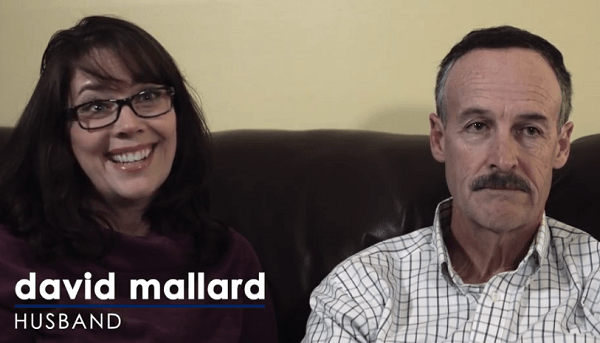
Mr. Mallard becomes animated later on—after he cooks dinner, which he’s filmed doing. Two young men, who seem to be Mrs. Mallard’s sons, are seen on the beach in her company but never speak.

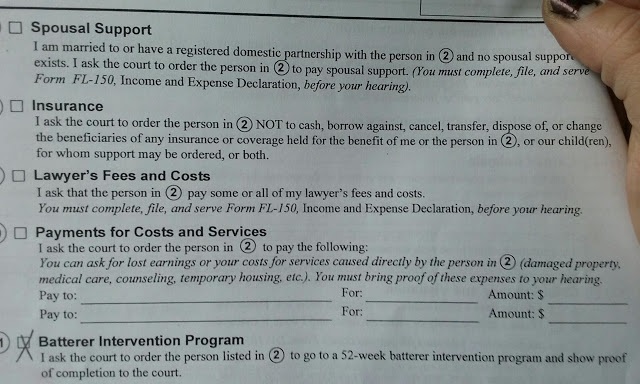
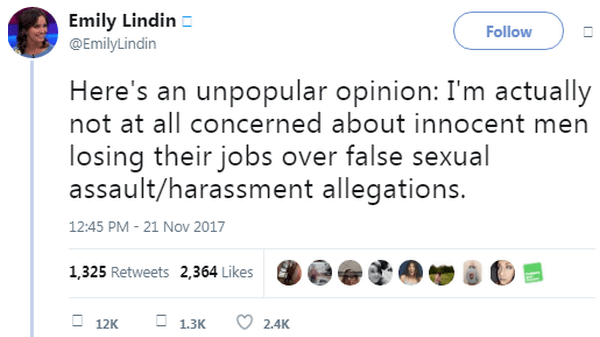
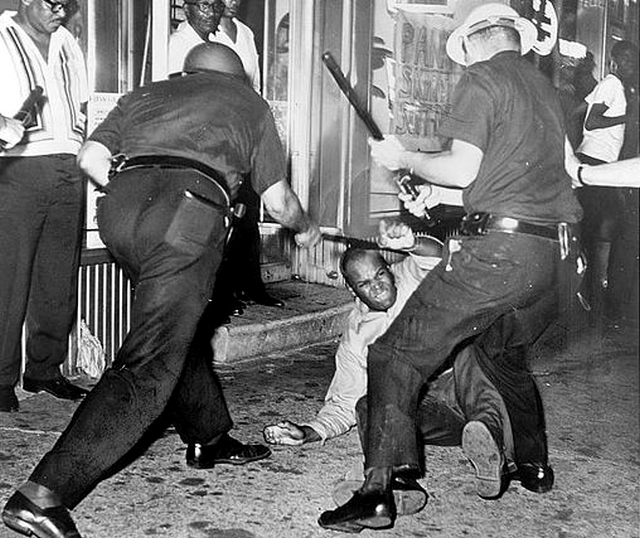
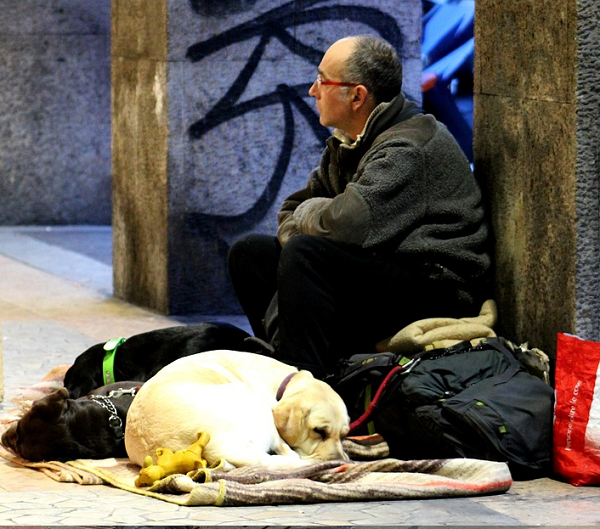
The structure of Ms. Friedman’s video is provided by a homework assignment given to her daughter, Olivia, “to write a letter to the President.” Below are some of Olivia’s appeals to “Trump,” juxtaposed with images that will resonate with citizens who’ve been injured or crippled by false allegations of abuse.


Make sure everyone has freedom.


Love instead of hate.


No violence; only words.


Please remember everyone matters.


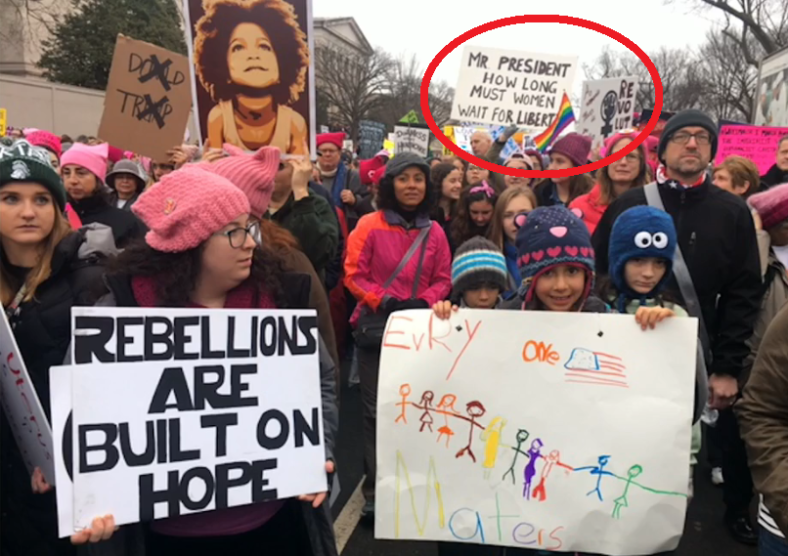
In this still from Ms. Friedman’s campaign video, her daughter, Olivia (in the foreground), is flanked by predominately female protesters in pink, some holding up feminist signs, one with a clenched fist. Olivia’s sign reads, “EV[E]RY ONE Mat[t]ers,” and features a daisy chain of unified male and female stick figures.


Mrs. Mallard is endorsed by the People’s House Project:

We recruit and support excellent candidates in Republican-held congressional districts in Midwestern and Appalachian states. Our candidates are classically Progressive, true to their working- and middle-class roots, and focused on issues of consequence to those who work not for personal fulfillment but for a living.

It purports to be looking out for the interests of “working- and middle-class” America.

The president of the People’s House Project is described as “an author, activist, [and] social media innovator” who’s “central to Glamour magazine’s political coverage, where she concentrates on issues important to women.”

Her name is Krystal Ball…which is something no one should need to predict the future if the present course isn’t corrected.

Copyright © 2018 RestrainingOrderAbuse.com

STINKIEST: Most Restraining Orders Are Sought Impulsively, if Not Maliciously

stinkiest“The first question for a legislature is whether to enact a civil harassment law at all. One thing is certain: If a civil harassment statute is enacted, it will be used—a lot. In 2003, Oklahoma reimposed a relationship requirement on its civil harassment statute because metropolitan counties were ‘being overrun with requests for protective orders.’”

—Prof. Aaron Caplan, “Free Speech and Civil Harassment Orders” (2013)

“The measure [House Bill 1667]:

  • Limits VPOs [“victim protective orders”] for harassment to situations in which the victim is being harassed by a family or household member or a person with whom the victim has been involved in a dating relationship. This provision is meant to reduce the number of frivolous applications for VPOs;
  • Requires victims of stalking who are not family or household members or in a dating relationship with the alleged stalker to file a complaint against the defendant with the proper law enforcement agency prior to filing for a VPO. The victim must provide a copy of the complaint with the petition for the VPO. This is also being done in an effort to reduce the number of frivolous applications for VPOs […].”

Highlights of Legislation (49th Oklahoma Legislature, 2003)

As law professor and former ACLU staff attorney Aaron Caplan all but says, restraining orders are exploited. The 49th Oklahoma Legislature cited in Mr. Caplan’s law monograph explicitly implies the same thing. The purpose of its 2003 HB 1667 was to “reduce the number of frivolous applications.” This clearly wouldn’t have been a concern if there weren’t a great number of frivolous applications.

Frivolous means “having no sound basis.” Its vernacular synonym is bullshit.

The preceding two posts on this blog examine how many restraining orders are either rejected by the court (“tossed”) or withdrawn by petitioners after they succeed in securing them. Available news reports indicate most restraining orders are rejected outright or dismissed upon a “full hearing.” Most. Indications, too, are that a lot that aren’t rejected are later withdrawn by the people who petitioned them. A lot.

This alone is reason to suspect the motives of complainants and the merits of their complaints. Certainly it says judges do. As the epigraph reveals, legislators do, too.

Consternating to people whose lives have been derailed by false accusations is that the problem has been vigorously exposed and criticized for decades, and judges, lawmakers, and attorneys know those criticisms are more than hot air.

Yet little changes…including rhetoric that legislators know is misleading (stinky).

Look at the second quotation in the epigraph. First, note that the civil harassment orders that were repealed by HB 1667 were called “victim protective orders” (i.e., reflect on the absurdity of the phrase victim protective orders for harassment). Also note the acknowledgment that a significant proportion of petitions for “victim protective orders” are “frivolous.” Orders that may have nothing to do with violence are called “victim protective orders” and—and—they’re acknowledged to be used falsely, or at least wrongly (and to such an extent that legislative revision was urged).

stink6Applicants for orders that are acknowledged to be used frivolously, however, are nevertheless called “victims.” (As the previous post shows, journalists collude in this misrepresentation.)


Recognized non-victims who clog court dockets with illegitimate claims are still called victims. Cases recognized as non-violent are still characterized as violent. When bias is this manifestly rooted, is it really that hard to believe that many or most orders that are approved and finalized may be malicious? The “fix” is obvious—it’s obvious—so how hard can “frames” or “set-ups” be to pull off?

Much ink has been spilled by opponents of the restraining order process desperate to arouse awareness to false allegations and prejudiced practices. People are issued restraining orders with fraudulent accusations that stick. They lose their jobs, homes, money, property, and good names. They lose access to their kids, who may come to hate them based on lies. Some may end up on the streets; some may even kill themselves in despair after being bullied and ground down, possibly for years.

False allegations that are rejected by the courts aren’t called false, yet false accusations that aren’t rejected by the courts are invariably called true (or “true enough”). The entire system reeks to high heaven.

How often false allegations succeed can’t be statistically established. Victims are left with having to lay out their cases in blogs and YouTube vids, or voicing four-letter epithets in Internet forums—or just quietly going mad.

This has inspired a great deal of rage and arguably more than a few deaths (suicides and murders), and that rage has inspired vehement denunciations from legions of special interest groups.

What all of this distracts from, though, is that explicitly manifest in judicial rulings and legislative reforms is that the court itself recognizes that false—or at least “frivolous” or “baseless”—claims are made more often than not.

Most restraining order petitions are rejected. Put more emphatically, theirs are considered to be bullshit claims.

What must be appreciated, finally, is that the restraining order process is a highly “accelerated” one (as Prof. Caplan, quoted in the epigraph, notes in his study). The conceptual justifications are that (1) applicants are “in danger” and need immediate relief, and (2) restraining orders are “no big deal.” The latter is refuted by rates of depression and suicide (or would be if they were they known), and the former is refuted by a preponderance of court rulings.

Unanticipated by lawmakers (apparently though inexplicably) is that an accelerated process rewards impulse, including malicious impulse. It’s exploited in heat, completed in moments, and usually free (and there’s no statutory limit imposed upon the number of times a single petitioner may exploit it).

Why do judges determine most restraining order petitioners’ claims are bullshit? That’s why.

Copyright © 2015 RestrainingOrderAbuse.com

Inciting Violence: If Lawmakers Require a Compelling Motive for Restraining Order Reform, How about This One?

I examined a case, recently, of a man’s committing murder hours after being accused to the police. My familiarity with the case was, admittedly, shallow; I only had what was reported to go on (and that from a single, “raw” source). I have, however, heard from scores of people who’ve been accused—or scorned for telling the truth—in drive-thru restraining order proceedings, and expressions of fury have been more than a few.

This week, I shared an email by a highly educated, professional woman and mother of three young children that expresses an “almost homicidal enmity” catalyzed by procedural abuses. Note the elevated diction she uses to describe an impulse to bash, throttle, and gouge. Does her vaulted language indicate she “doesn’t really mean it”? No, it indicates how alien rage is to her character. It indicates she’s someone who shouldn’t have cause to feel this way.

Consider: How is it the police and the courts recognize the propensity for violence that interpersonal conflicts mediated by the “justice system” may arouse, but lawmakers don’t? Are they that “in the dark”?

Yeah, pretty much.

If you get into a spat with your neighbor, and the police intervene, parties are separated into corners. In court, complainants even merely of “fear” may be shielded by law officers in anticipation of a judicial ruling. It’s understood that emotions run hot in this theater.

Why, then, is it not appreciated that when the basis for rulings is false, the risk of violence is not only higher but infinite?

We like our games, and we like our fictions about how people should be and should feel and should react even if you trash their lives maliciously. Hey, we’re disposed to remind, it’s the law.

All well and good until somebody gets an ax in the ear—an edgy remark, maybe; honesty often strikes us that way (i.e., like an ax in the ear).

The wonder is that more people who lie to the courts don’t meet premature ends—or at least sustain some anatomical remodeling. False accusations, which have inspired a great deal of sententious deliberation in recent months, don’t just “discomfort” people or make them “justifiably [and transiently] angry.” At the risk of being edgy again: People who haven’t been falsely accused in a legal procedure don’t know what the fuck they’re talking about. I was collegiately trained as a literary analyst—I’ve studied and taught Victorian literature—and I’m normally more disciplined in my remarks, but this subject rebukes gentility.

Liars maim. That they do it with words in no way mitigates the brutality of the act or its consequences.

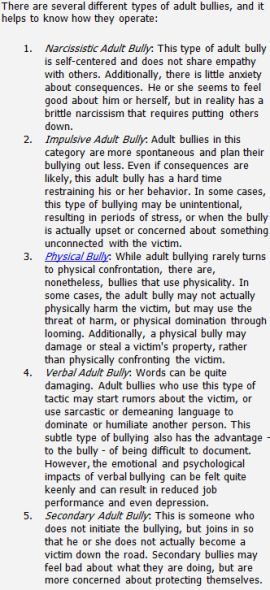
One would think that as people mature and progress through life, that they would stop behaviors of their youth. Unfortunately, this is not always the case. Sadly, adults can be bullies, just as children and teenagers can be bullies. While adults are more likely to use verbal bullying as opposed to physical bullying, the fact of the matter is that adult bullying exists. The goal of an adult bully is to gain power over another person, and make himself or herself the dominant adult. They try to humiliate victims, and “show them who is boss” (BullyingStatistics.org, “Adult Bullying”).

StopBullying.gov defines bullying as including name-calling, taunting, threatening, spreading rumors about someone, and embarrassing someone in public. Falsely labeling someone a stalker, child abuser, violent danger, or sexual deviant in one or more public trials whose findings are impressed on the target’s permanent record and are accompanied by menacing threats (if not immediate punishment) plainly qualifies. Among identified effects of bullying are suicide (“bullycide”) and violence, including murder. “Extreme emotional disturbance” is a defense for murder in some states (a finding that doesn’t excuse the act but does lighten the sentence), and a related murder defense is “provocation.”

Sure, character assassination is bloodless. What of it? If I circulate lies about someone and s/he snaps, I’m a bully, and I had it coming. Few people would say otherwise.

Ah, but if I lie and use the law as my medium to insult, demean, badger, intimidate, or otherwise persecute—hey, that’s different. I’m the “good guy.”

So suck it. And keep on sucking it, because the public record says my lies are the truth. Neener-neener.

A system that represents its purpose to be the curtailment of violence shouldn’t be promoting it by pandering to bullies, even “unofficially,” and its officers shouldn’t be serving as those bullies’ lieutenants and enforcers. If the system makes it easy to lie about and humiliate people, doesn’t hold liars accountable, and furthermore punishes the falsely accused based on lies, then it’s promoting violence.

This shouldn’t require social science research to corroborate. It shouldn’t even require this analyst’s observation.

Copyright © 2015 RestrainingOrderAbuse.com

Reporting Restraining Order Abuse to Elected Officials

“I am suffering from the effects of a fraudulent protection order in Colorado, which was filed by my female roommate and had me and my young daughter kicked out of our home.

“There appears to be no recourse for me, but I did contact 10 state representatives and senators, and I heard back from three of them. If more people report this abuse to their elected officials, maybe something will actually be done about this awful system.”

—Respondent to this blog

Writing to district and state representatives can be a lot like trying to communicate with judges. Expecting a human response isn’t unreasonable, but it’s often disappointed.

There’s nevertheless value in bringing systemic injustices to the attention of legislators (senators and congressmen and -women), because (1) they make, reform, and repeal laws, and (2) if they hear the same complaints over and over—and especially if they know other people of influence are hearing the same complaints and looking to them for action—there’s a chance some of them might step up.

The voices of women who’ve been abused by court process, particularly, need to be heard, because the procedures that are most often and easily abused are ones it’s presumed are protecting them.

Consult this site for the names and addresses/websites of elected officials with whom to register a complaint (state legislators should be first in order of importance):

Find Your Representatives

See also these tutorials:

Writing to Your Legislator

“How to Write a Letter to Your United States Senator

How to Write Letters to Congress

A petition that automatically forwards stories of abuses of domestic violence laws and restraining orders to legislators/administrators is here.

Copyright © 2014 RestrainingOrderAbuse.com

*See also: What to Do if You’ve Been Abused by a Judge