Laying the Blame for Epidemic Bullying where It Belongs: At the Feet of Feminist Liberalism

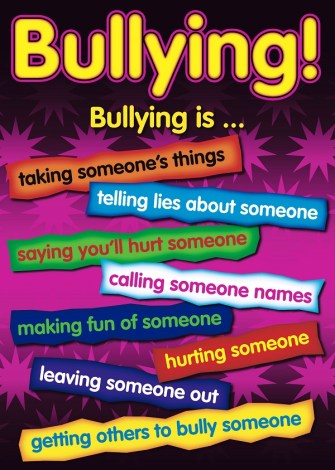
The phrases in this poster that define bullying (for little kids) also precisely identify the motives and consequences of false accusation and malicious prosecution (by grownup little kids): material privation (i.e., loss of home and property), mischaracterization, threat (by the state), name-calling, public belittlement and humiliation, infliction of pain, social isolation/marginalization, and mobbing.

I mentioned in the last post that a teenage girl I know, an AP student, told me she was called a “whore” through a website called Snapchat. She also told me classmates of hers—girl classmates—had accused her of prostituting herself for money to buy cocaine…which is pretty specific.

It’s true the social media that the Internet Age has spawned make bullying a lot easier than it was when I was a kid (and you had to face your victim), and I’m sure the Liberal Establishment blames it for a wealth of abuses. (I think a valid observation would be that social media make female passive-aggression a lot easier to exercise…just like restraining orders do: You don’t have to look the target of your malice in the eye.)

What, though, has made calling a high school junior a “cocaine whore” okay?

Zero accountability—that’s one thing. Kids know adults can’t do anything but civilly ask that they “behave more considerately.” Anything sterner would be “child abuse,” and kids know they can sink any adult shoulder-deep in it if they finger him or her (especially him) as an abuser. Easy-peasy. (If I were a school administrator in charge of reprimanding kids, I’d never close my office door.)

It’s not just the kids, though, is it?

Feminist liberalism, in the name of “progressive reform,” has encouraged accusation and demanded knee-jerk responsiveness to it from the system for a long time. It was horrible when abused women faced social stigma for complaining of mistreatment in their homes, no question, but that was 40 years ago.

Today, someone has to ask what we lost when we abandoned shame and made accusation not merely acceptable and sympathetic but virtuous and rewarding. Accusation garners attention, and it’s potent. People in power rush to our defense at the drop of a name (cf. McCarthyism). And if we fudge the facts a little, there’s no risk anyone in power is going to back-peddle and turn the glare of blame our way. It’s not an exaggeration to say accusation has become a sport, and it’s certainly no exaggeration to say it has become a weapon, as well as a way to whitewash your own misconduct and make bank.

Kids don’t just “get this stuff off the Internet,” and they’re not just inherently cruel. Kids absorb from their social environment like the sponges they are, and today’s social environment says finger-pointing is cool.

Kids know what they can get away with, and they know there are no reprisals. Adults sling dirt with impunity, so why shouldn’t they?

Accusation and bullying are flipsides of the same coin. The feminist liberal who says it’s okay to accuse your husband (father, teacher, etc.) if you feel like it is the same person who made it okay to call a 16-year-old girl a “cocaine whore.”

Copyright © 2016 RestrainingOrderAbuse.com

What Restraining Order Defendants Need to Know That No One Ever Tells Them: The Truth Doesn’t Matter

The ambition of this post, an intermission between considerations of graver subjects, is to dispel restraining order defendants’ faith in the value of “truth.” Defendants are led to believe that if they’re truthful in the defiance of lies or hyped allegations, all will turn out as it should. But truth is a false idol that answers no prayers.


If you haven’t yet had to swear this oath, you’ve heard it before on TV: “Do you swear to tell the truth, the whole truth, and nothing but the truth?” (Sometimes God and the word solemnly are thrown in for emphasis…maybe to suggest you’ll be struck by lightning if you distort the facts or omit any.)

The significance of this courtroom ritual is none, and taking it literally is for chumps.

Civil trials, especially the kind this blog concerns, do not weigh “truth”; they weigh testimony, along with evidence as it’s represented (in procedures that may span minutes only). The savvy defendant will think in terms of economics and marketing. “Truth” has no inherent value to a defense. Unless it conclusively proves something you want to prove, it’s totally worthless. Worse, it may distract and dilute the potency of what you’re trying to sell. Facts, besides, may not tell the truth. The word truth is a trap for the naïve.

What wins cases are successful representations, ones that work the desired effect (i.e., what wins is salesmanship not scrupulous reporting).

While the court asks for honesty, it doesn’t reward it. It’s what you say and how you say it that counts, not “the truth.” God isn’t the judge; a man or woman is, and his or her favor goes to the person who gives the most compelling presentation (i.e., sales pitch).

Why do lying plaintiffs win? They win because their representations were persuasive. Did they tell “the whole truth and nothing but”? They may have told none at all. (Restraining orders have reportedly been obtained by people using assumed names; they didn’t even tell the truth of who they were.)

What do cunning attorneys who represent lying clients (or any clients) do? They tell only those truths that support their stories…and no others. (They may lie, also—and vigorously.)

The fastidious defendant who finicks over every detail, who backpedals and carefully qualifies his statements (in the interest of complete and accurate disclosure), and who otherwise invests his or her trust in “the truth” grossly misperceives the nature of process.

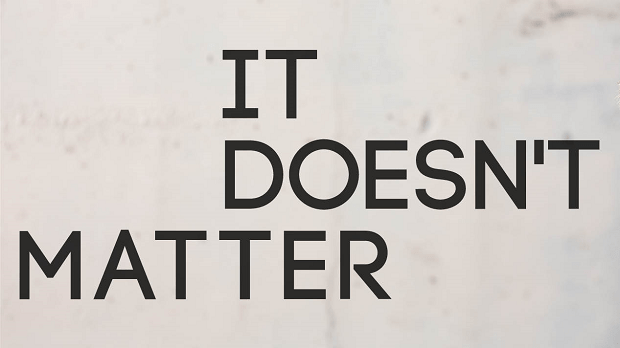
Representations win court contests, not “the truth.” The truth doesn’t matter.

~ EPILOG ~

A few months ago, the writer spoke for an hour or so with a 30-something man who said he was an obsessive-compulsive. He had written that he was “starting to go downhill really fast” and needed help. “I will try to eventually explain,” he began, “but there’s such a long history of what happened.”

What he explained was that he’d been bullied by a woman many years prior, while they were in high school, and had been haunted and galled by the abuse ever since. He said she had tried to coerce him to have sex with a friend of hers, that he had refused, and that she had spitefully urged some guys to rough him up (one of them would later be convicted of murder, so this wasn’t bush league bullying). She had also greeted him with a sneer whenever they met after that, and flipped him the bird and yelled “Fuck you!” at him as he passed by. He had tried to reach an accord but had only been mocked. He said he never used to stand up for himself and was sick of turning the other cheek.

He impulsively ventilated rage that he had bottled for 20 years by calling the cell of the woman’s husband and leaving her a voicemail that called her a “rude, mean bitch” and that ended with a string of “Fuck you!”s. That was pretty much the extent of it, but he was handily represented as a stalker.

He wanted to know what pointers I could offer that might aid him in his defense against a restraining order petitioned by a woman who claimed to have no memory of the events he described and whose stepmother, he said, was a former lawyer who had prosecuted cases before the state supreme court and was, besides, the director of a “domestic abuse and physical violence organization.”

Yeah.

I repeatedly impressed upon him that reciting a history that spanned decades wasn’t likely to move a judge to anything but a yawn (or a rebuke) and that he should consider how to frame his story to put himself in the most favorable light, for example, by updating the context (and abandoning a rigidly chronological narrative).

Each time I interrupted, he said he understood and then recommenced his story, which stretched back to his anguished childhood. He was very earnest and conscientious, and continually paused and qualified his remarks with “Granted, I….” It was important to him, he said, to tell his “heart’s truth” (i.e., the “whole truth”). He wanted someone to sympathize, and I did. But I knew a judge would not.

I never heard from him again.

Copyright © 2015 RestrainingOrderAbuse.com

It All Starts with the “Rape Question”: Before Society Can Be Expected to Redress the Harms of False Accusation, It Must First Be Led to Acknowledge That False Accusation Destroys

“Having demonstrated that the percentage of false sexual assault reports is not as high as many people think, this does not deny their terrible reality. We all know that false reports do really exist, and they are incredibly damaging both to criminal justice personnel and to the countless victims of sexual assault whose credibility they undermine.”

Dr. Kimberly A. Lonsway, et al. (2009)

Everyone “thinks” that male invocations and criticisms of false rape claims are really the misogynist yowls of the disentitled patriarchy…or something like that. They aren’t. Rape is the tinderbox issue. If complainants of false accusation and unjust demonization, who are typically men, seem to focus on false rape claims, it’s because that’s where everyone else’s focus is directed.

Rape overrules all other concerns and trivializes them.

Read the epigraph by Dr. Lonsway again and ask yourself what’s missing from her brief catalog of “incredibly damaging” consequences of false rape reports.

Her statement owns that “false reports [of rape] do really exist.” It also owns that they’re “incredibly damaging.” But it completely discounts the damage to the people falsely accused by those reports.

They’re not even mentioned as victims; they don’t count at all.

If victims of false rape claims aren’t acknowledged to be victims of anything, then how can victims of false accusations of other sorts expect to be afforded a sympathetic ear? Societal regard has been coerced to the extent that acknowledgment of false accusation (any act of false accusation) is equated with rape denial. To own false accusation is a significant problem is to commit an act of moral treason.

What those who haven’t been abused by process will never appreciate, so long as false accusation is dismissed as inconsequential, is that any foothold a false accuser can obtain can spell the end of someone’s life as s/he knew it.

People can be hounded to the end of time, particularly through civil procedures (like restraining orders), which generate records that gnaw, humiliate, and limit life options, and that open the door (gapingly wide) for further false accusations. The falsely accused can lose everything. They can find themselves felons and exiles, homeless and jobless, and possibly suicidal or homicidal…based on nothing real or true: a layered sandwich of lies.

What’s more, the dismissal of false accusation as an urgent societal concern is contagious. It influences judicial policy and practice; it influences the law. Thus is the problem compounded: False accusation is encouraged, because it’s effective. There are no risks, so there’s no downside.

Denial of the problem worsens it.

Our civil rights advocates vociferously decry violations of women’s rights, children’s rights, minority rights, gay and lesbian (GLBTQ) rights, animal rights, and on and on, and there aren’t any of these rights that aren’t violated by false accusers. None. Children are scarred (voicelessly); women are stigmatized and stripped of all resource; minorities, who may have the least access to legal representation, are railroaded or sidelined; gays and lesbians are handily represented as “creepy queers”; and pets are abandoned (possibly to be killed).

They might as well be living in 1956…and that’s significantly because of the “rape question.”

Look, how widespread false accusations of rape are is irrelevant. It’s irrelevant. What’s relevant is that they hurt and they kill, as do false accusations of all varieties. Rape also hurts and kills…but only also. What hurts and kills must be censured categorically, not selectively.

Dogma must be rebuked. Those who haven’t been falsely accused have no place at the table. They’re due to listen for a change.

The reason so many energies are concentrated on the “rape question” is that until the harm of being falsely accused of society’s “worst” crime is acknowledged, there can be no expectation that the harm of being falsely accused of any other will even register.

Copyright © 2015 RestrainingOrderAbuse.com

*Rape has been used to chasten society’s conscience, which means anti-rape advocates have determined society’s conscience. Their priorities have become “our” priorities and to gainsay them is to be ridiculed and vilified. A reason news stories of false rape claims are bruited by those denounced as “MRAs” (men’s rights activists) is because they often reveal deeply warped motives and methods, and these deeply warped motives and methods aren’t exclusive to false rape claimants.

Courtroom Fraud and Smear Campaigns: The Full Machiavelli

Cheryl Lyn Walker PhD, Dr. Cheryl Lyn Walker, Dr. Cheryl L. Walker PhD, M.D. Anderson Cancer Center, Michael Honeycutt PhD, Michael Honeycutt TCEQ

“False Accusations, Distortion Campaigns, and Smear Campaigns can all be used with or without a grain of truth, and have the potential to cause enormous emotional hurt to the victim or even impact [his or her] professional or personal reputation and character.”

—“False Accusations and Distortion Campaigns

There are several fine explications on the Internet about the smear campaigns of false accusers. Some sketch method and motive generally; some catalog specific damages that ensue when lies are fed to the police and courts.

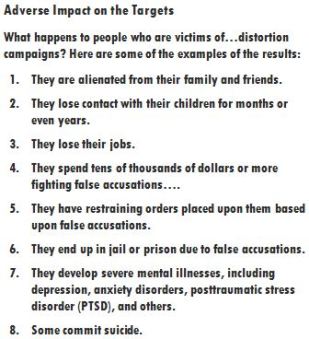
This survey of “adverse impacts” is credited to lies told by people with borderline personality disorder. Conducting “distortion campaigns” isn’t exclusive to BPDs, however, and the “adverse impacts” are the same, irrespective of campaigners’ particular cognitive kinks.

The valuable role of the police and courts in the prosecution of campaigns to slander, libel, and otherwise bully and defame can’t be overstated. They’re instrumental to a well-orchestrated character assassination.

Lies can be told to anyone, of course, and lies told to anyone can have toxic effects. The right lie told in a workplace, for example, can cost someone a job and impair or imperil a career.

Lies told to police and judges—especially judges—they’re the real wrecking balls, though. False allegations of threat or abuse are handily put over in restraining order or domestic violence procedures, and they endure indefinitely (and embolden accusers to tell further lies, which are that much more persuasive).

Among the motives of false accusation are blame-shifting (cover-up), attention, profit, and revenge (all corroborated by the FBI). Lying, however, may become its own motive, particularly when the target of lies resists. The appetite for malice, once rewarded, may persist long after an initial (possibly impulsive) goal is realized. Smear campaigns that employ legal abuse may go on for years, or indefinitely (usually depending on the stamina of the falsely accused to fight back).

Legitimation of lies by the court both encourages lying and reinforces lies told to others. Consider the implications of this pronouncement: “I had to take out a restraining order on her.” Who’s going to question whether the grounds were real or the testimony was true? Moreover, who’s going to question anything said about the accused once that claim has been made? It’s open season.

In the accuser’s circle, at least—which may be broad and influential—no one may even entertain a doubt, and the falsely accused can’t know who’s been told what and often can’t safely inquire.

Judgments enable smear and distortion campaigners to slander, libel, and otherwise bully with impunity, because their targets have been discredited and left defenseless (judges may even punish them for lawfully exercising their First Amendment rights and effectively gag them). The courts, besides, may rule that specific lies are “true,” target_of_blamethereby making the slanders and libels impervious to legal relief. Statements that are “true” aren’t defamatory. The man or woman, for instance, who’s wrongly found guilty of domestic violence (and entered into a police database) may be called a domestic abuser completely on the up and up (to friends, family, or neighbors, for example, or to staff at a child’s school).

Lies become facts that may be shared with anybody and publicly (court rulings are public records). Smear campaigners don’t limit themselves to court-validated lies, either, but it seldom comes back to bite them once a solid foundation has been laid.

Some so-called high-conflict people, the sorts described in the epigraph, conduct their smear or distortion campaigns brazenly and confrontationally. Some poison insidiously, spreading rumors behind closed doors, in conversation and private correspondence. As Dr. Tara Palmatier has remarked, social media also present them with attractive and potent platforms (and many respondents to this blog report being tarred on Facebook or even mobbed, i.e., bullied by multiple parties, including strangers).

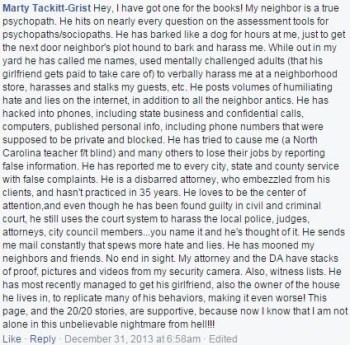
Even when false accusers’ claims are outlandish and over the top, like these posted on Facebook by North Carolinian Marty Tackitt-Grist, they’re rarely viewed with suspicion—and almost never if a court ruling (or rulings) in the accusers’ favor can be asserted. The man accused in this comment to ABC’s 20/20 is a retiree with three toy poodles and a passion for aviation who couldn’t “hack” firewood without pain, because his spine is deformed. He is a retired lawyer, but he wasn’t “disbarred” and hasn’t “embezzled” (or, for that matter, “mooned” anyone). He has, however, been jailed consequent to insistent and serial falsehoods from his patently disturbed neighbor…who’s a schoolteacher.

For Crazy, social media websites are an endless source of attention, self-promotion, self-aggrandizement, and a sophisticated weapon. Many narcissists, histrionics, borderlines, and other self-obsessed, abusive personality types use Facebook, Twitter, and the like to run smear campaigns, to make false allegations, to perpetrate parental alienation, and to stalk and harass their targets while simultaneously portraying themselves as the much maligned victim, superwoman, and/or mother of the year.

(A respondent to this blog who’s been relentlessly harried by lies for two years, who’s consequently homeless and penniless, and who’s taken flight to another state, recently reported that a woman who’d offered her aid suddenly and inexplicably defriended her on Facebook and shut her out without a word. Her “friend” had evidently been gotten to.)

(An advocate for legal reform who was falsely accused in court last year by her husband and succeeded in having the allegations against her dismissed reports that he afterwards circulated it around town that she tried to kill him.)

I was falsely accused in 2006 by a woman who had nightly hung around outside of my house for a season. She was married and concealed the fact. Then she lied to conceal the concealment and the behavior that motivated the concealment. She has sustained her fictions (and honed them) for nearly 10 years. People like this build tissues of lies, aptly and commonly called webs.

Their infrastructures are visible, but many strands may not be…and the spinners never stop spinning.

The personality types associated with chronic lying are often represented as serpentine, arachnoid, or vampiric. This ironically feeds into some false accusers’ delusions of potency. Instead of shaming them, it turns them on.

I know from corresponding with many others who’ve endured the same traumas I have that they’ve been induced to do the same thing I did: write to others to defend the truth and hope to gain an advocate to help them unsnarl a skein of falsehoods that propelled them face-first into a slough of despond. (Why people write, if clarification is needed, is because there is no other way to articulate what are often layered and “bizarre” frauds.)

I know with heart-wrenching certainty, also, that these others’ honest and plaintive missives have probably been received with exactly the same suspicion, contempt, and apprehension that mine were. It’s a hideous irony that attempts to dispel false accusations are typically perceived as confirmations of them, including by the court. To complain of being called a stalker, for example, is interpreted as an act of stalking. There’s a kind of awful beauty to the synergy of procedural abuse and lies. (Judges pat bullies on the head and send them home with smiles on their faces.)

Smear campaigns wrap up false accusations authorized by the court with a ribbon and a bow.

Copyright © 2015 RestrainingOrderAbuse.com

*The name Machiavelli, referenced in the title of this post, is associated with the use of any means necessary to obtain political dominion (i.e., power and control). Psychologists have adapted the name to characterize one aspect of a syzygy of virulent character traits called “The Dark Triad.”

The “Nightmare” Neil Shelton Has Lived for Three Years and Is Still Living: A Father’s Story of Restraining Order Abuse

The following account is reported by North Carolinian Neil Shelton, a father denied access to his son and daughter for “three years now and counting.”

In his account, Mr. Shelton alleges that his sister, in collusion with his ex-wife, lied to have him involuntarily committed, and that one or more partners in the law firm of his ex-wife’s attorney fabricated evidence to have him incarcerated. He alleges, in short, some very dirty divorce tactics.

Mr. Shelton’s allegations are abhorrent yet all too believable. Significantly, none of the criminal allegations introduced against him have held up in court.

Because, however, its author has no means of corroborating Mr. Shelton’s allegations of fraud, it is not the position of this blog that Mr. Shelton’s sister lied to the court or that either the attorney in question or his associates engaged in forgery. The blog author’s investigative wherewithal is limited, and he has no way of determining the allegations’ accuracy. Rebuttal responses from the accused are accordingly welcomed.

Neil’s story, then, as he tells it:

I am the victim of false allegations and restraining order abuse resulting from my divorce.

I’ve been wrongfully incarcerated for almost a year and falsely arrested numerous times for nothing I’ve done. To get a better idea, look at my page on Facebook, Growing UP Mayberry, and that will give you most of the full story. For this website, I want to share the restraining order abuse, as well as the ex parte abuse, and several things resulting from the restraining order and false allegations.

On May 29, 2012, which was shortly after I was kicked out of my house by my now ex-wife, I was arrested three times in one day.

This was the start of a campaign by my ex-wife’s divorce attorney, who is also my state representative, Sarah Stevens of Surry County and Mayberry (Mt. Airy), North Carolina. Yes, Mayberry, home of Andy Griffith and the inspiration for The Andy Griffith Show. My only reason for pointing that out is that no matter where you live, you are not immune to this unnecessary attack and, ultimately, bullying.

My ex-wife had my sister, Joan Shelton Phillips, a family nurse practitioner and my primary care physician, lie on two Involuntary Commitment forms saying I was bipolar, refused medication, and was riding around in a limousine threatening myself and others. At the top of the commitment papers, it says clearly: “wife wants husband committed.” The interviewing physicians were able to get my medical records, which showed I had never been seen or medicated for bipolar disorder. After some questioning, I was released from the first commitment attempt.

The Surry County Sheriff’s Dept. had arrested me at 10 a.m. the first time. I was released at 2:30 p.m. and rearrested by the MAPD at 3 p.m. for the second commitment attempt. When I arrived back at the hospital, the head physician asked, “What the hell are you doing back? I just released you!” Again, after a shorter session with the doctors, my ex-wife was made aware they were going to release me. On the commitment forms, the doctor even wrote that the one needing commitment was my soon-to-be ex-wife, not me.

When my now ex-wife was made aware of my impending release, she took her sister-in-law, who was the director of Surry’s Stop Child Abuse Now (SCAN), and they went to the Surry County Sheriff’s Dept. and had me charged with criminal trespassing.

I went straight from the hospital into police custody. Even though I was charged with criminal trespassing, my now ex-wife would later admit that I’d never been physically violent toward her. Using the criminal trespassing charge, of which I would later be found not guilty, my soon-to-be ex-wife was able to get a restraining order against me. Because I was never physically violent toward her, her divorce lawyer got creative. I had called my ex-wife a bitch and said, “You are not going to keep me from my kids.” This was used as the reason for the restraining order. Three years later, I’m still subject to the same restraining order.

The first day I met the divorce lawyer, Sarah Stevens, she asked to talk with me out in the hallway before the trial, saying maybe we could reach an agreement before being heard. I turned on my audio recorder and placed it in my shirt pocket, and proceeded to go speak with her. Once in the hallway, she said: “Now two things can happen today. One, you can be found guilty, which I promise you will be, and leave here with a restraining order against you from not only your ex-wife but your kids. Two, you can take a $5,000 settlement with no child support and agree to supervised visitation with your children, and the restraining order will disappear.”

I told her my children were not mentioned on the restraining order, and all I did was call my wife a bitch and tell her she wasn’t going to keep my kids from me, and that’s not domestic violence. She said yes your kids are mentioned in it, at which point I said then if you believe that, you need to go back to law school, because I haven’t been and know better than that.

“I’m dangerous broke, as y’all have shut down all my businesses, but I’m not dangerous with $5,000 and no restraining order against me?” With that, I told her I was finished. She said, “Yes, you are,” and we proceeded into the courtroom. I called her a few choice words, and her reply was, “Boy, am I gonna have fun playing with you.”

This is the nightmare I’ve lived for three years and am still living. I was arrested every time I turned down a settlement offer for an alleged restraining order violation. I began trashing Sarah Stevens on Facebook by posting what she was doing to me in court. I got warned to shut up and stop, but I didn’t and, again, everything I was doing was legal.

A total of five restraining order violations were alleged, leading up to a sixth, before they got tired of my winning in court without representation and got tired, also, of my political Facebook posts, and did something borderline genius, instead…only they executed it wrong.

They sat down with Zach Brintle, Stevens’s law partner, and penned a letter posing as me. In it, “I” threatened to kill all the lawyers, including him and his law partner/aunt, Sarah Stevens. It also threatened that all the district attorneys, the police, my entire family, and others would be killed, and ended, “Boston is nothing compared to what I’m planning.” This letter was purportedly mailed to my now ex-wife, and I was arrested for making terroristic threats.

During my almost yearlong incarceration, I was found not guilty on all counts of violating the restraining order, but I lost everything in my divorce. That’s because I was only allowed to work on my criminal trial while in jail, and my incarceration just happened to end two days after the deadline to appeal my divorce decree passed, and the decree gave my now ex-wife everything. The incarceration continued, because the district attorney claimed the FBI was doing an analysis of the letter. But after I was released, the FBI told me it had never received this letter for analysis. When I took the letter to my own handwriting expert, he concluded it was 98% likely that Brintle, not I, wrote it.

Upon my release, I showed the judge the two failed commitment attempts, the six not-guilty verdicts for allegedly violating the restraining order, the dismissal of the letter charges, the phone number of the FBI agent who told me the FBI had never been involved and had never investigated the letter—which supposed investigation the other side had used to hold me in jail—and the handwriting analysis proving the lawyer, Zach Brintle, wrote the letter. But the judge still extended the restraining order for yet another year.

I met Michael Volpe, the author of the upcoming book Bullied to Death: The Chris Mackney Story, who told me that these tactics are quite common in family court. I also met Raquel Okyay, who knows a lot and has helped raise my awareness that there are others going through this, too. She has also helped me tremendously in getting my story out.

My story is bizarre and extreme, but there are a many with stories like mine out there. I have not been allowed to see or speak with my children for three years now and counting. I’m sure I’ve left some things out, but there’s not enough room to tell my tale in this forum.

Since you’re reading this, chances are you’ve either experienced the same or are experiencing it, as most people don’t care until it happens to them. Honestly, I didn’t either, but that has changed. When reading this and all articles like it, remember you are not alone.

GOD BLESS.

Copyright © 2015 RestrainingOrderAbuse.com
If It’s Okay to Tell the Falsely Accused How They Should Feel, Then It’s Cool to Tell Victims of Rape How They Should Feel, Right?

That’s a rhetorical question.

Plainly it’s not cool to tell victims of rape how they should feel, particularly if you’re not one yourself. I don’t say that because it’s un-PC to criticize rape victims; I say that because it’s wrong.

Yet goddamn if there’s no shortage of people who have no context to relate either to rape victims or victims of false accusations who presume to defend the former’s right to be basket cases and deny the latter any right to complain.

The previous post examined the vehement rhetoric of one of these self-appointed arbiters of anguish (whose argument seems to run: “I’ll tell you how you’re entitled to feel”).

Pause here for a point of clarification: False accusations can be of a great many acts besides sexual assault, and the phrase false accusation in this post refers to any false accusation.

There’s nothing, of course, to reproach about someone’s sympathizing with victims of sexual assault, as the writer scrutinized in the last post does; it’s compassionate. Presuming to “relate” to the pain of women who’ve been raped, however, is presuming a lot.

Presuming to deny others’ pain, furthermore, because you believe you can quantify it or “imagine” what it “should” be like—that’s stepping way over the line.

Look at enough feminist rhetoric, though, and something becomes starkly clear: The basic contention is that “our” pain is worse than yours. (One gets the distinct impression that all feminist writers consider themselves rape victims by association or genital identification.)

I don’t discount rape victims’ torment, but I do believe this pain “rating scale” is due to be dispassionately tested.

The approach of those who presume to criticize complainants of false accusation is to reduce their trials to something like this: generally speaking, (1) you’re accused, and (2) maybe you lose some friends and your job. Also, (3) if you’re exonerated, you don’t have anything to bitch about, so shut up and go away.

Now here’s what you get when you apply to rape victims the same obscenely reductive analysis: generally speaking, (1) your body is penetrated without your consent or against your express objection, and (2) you’re possibly, if not probably, left with some tissue damage.

Both of these sketchy assessments are about equivalent in their insensitivity (and according to them, the privations of the falsely accused may well be more enduring than the injuries of the victim of rape).

So why is the former assessment popularly conceived to be “fair” while the latter would be denounced as “cruel”?

Is it because false accusation inflicts a psychic trauma and that rape has a physical component? I’ve been run down in the road by a 4 x 4 while on foot. Bones were splintered and crushed. I spent five days in an intensive care ward, and my skeleton and joints will never be the same. I almost lost an eye, and the hemorrhaging came with its own host of consequences. Entire swaths of my body were without sensation. Some months later, I had a cerebral episode and was aphasic for a day (I couldn’t remember, for example, the word October or repeat “no ifs, ands, or buts”). I’d wager the physical trauma I sustained exceeds that of an overwhelming majority of rape victims. Does that make me “more worthy” of sympathy?

Apples and oranges, right? Why? Because the affront to my body was impersonal.

It makes a difference, then, when our dignity and humanity are violated, and we’re treated with intimate disregard.

I don’t know what it is to be raped. I do know, though, what complainants of rape report, and reported sources of pain are shame, outrage, fear, betrayal, a lingering and possibly insurmountable distrust, and ambivalence about reporting the violation based on the expectation of suspicion and reproach from authorities (as well as others) and having to relive the horror, possibly without hope of realizing any form of justice.

gavels-gavelsI do know what it is to be falsely accused, and the sources of pain are the same, only the suspicion and reproach aren’t an “expectation.” When you’re the target of damning fingers, suspicion and reproach inevitably ensue; they’re a given.

There’s a misconception about accusation that isn’t really a misconception at all; it’s an empathic dereliction. Facile commentators say people are “accused” as if that’s all there is to it. (I’ve been falsely accused by the same person in multiple court procedures spanning seven years, and I’ve lived with the accusations daily for nine. A man I know has been summoned to court dozens of times; a woman I recently heard from, over 100 times—in both cases, by a single vexatious litigant.)

To be accused is to have the state knocking on your door. It’s to be sent menacing notices in the mail or to have them tacked to your residence (endure this long enough, and you stop looking in the mailbox or even answering the phone). It’s to be hauled into a police precinct—if not arrested and jailed—and to be subjected to invasive questioning, if not physically invasive, involuntary examinations. It’s to be treated with hostility and contempt, like a thing of disgust. It’s to become the fodder of gossip and the target of threats. Judgment is a palpable thing, and it’s far worse than a body blow (or even being steamrolled by an onrushing vehicle).

The outrage, moreover, of being blamed falsely isn’t something that can be “intuited.” Here’s how one woman I’ve corresponded with puts it, a woman who was accused by a man who had abused her both physically and otherwise (yes, sometimes the accuser simply reverses roles with his or her victim—and, yes, if you missed it in the parenthetical remark above, sometimes the falsely accused isn’t a man):

There is no “coming out the other side” of a public, on-the-legal-record character assassination. It gnaws at me on a near-daily basis like one of those worms that lives inside those Mexican jumping beans for sale to tourists on the counters of countless cheesy gift shops in Tijuana.

I have sort of moved on; I mean, what else can one do, particularly when one has young children? But the horror, outrage, shame, and, yes, fury engendered by being wrongly accused by a perpetrator, and then having that perpetrator be believed, chafes at me constantly. Some things born of irritation and pressure are ones of beauty, like a pearl, or a diamond, but not this. This is a stoma on one’s soul—it never heals, it’s always chapped and raw, and if you’re not careful, it can leak and soil everything around it.

Would a feminist sympathize with this person? Probably…grudgingly and without making a to-do about it.

Why? If the answer is because she’s a woman, then we’re getting somewhere. The blindness to the damages of legal abuse has a great deal to do with sex. Most of the vehement objectors to legal violations are men—they being the majority of the victims—and they’ve been demonized…because they’re men. This has led to the dim formulation that “falsely accused” equals “male” equals f* ’em.

Absurd, besides, is that arguments like those scrutinized in the last post on the one hand posit that men shouldn’t feel their own pain but on the other hand should show sympathy to women’s. Men are oxymoronically supposed to be stoic and insensitive, er, “empaths.”

Yeah, but not really. Really the conclusion is their pain doesn’t matter. It’s “insignificant” because (tum-tum-tum-TUMMM)…

To whom? Society? It certainly isn’t a bigger problem to its falsely accused constituents. This is a democracy, not an ant colony, and pain isn’t a competition or a zero-sum game. No one’s pain is more “valid” or “virtuous” than the next’s. What the sentiment in headlines like this really means is that the lives of the falsely accused are (politically) insignificant—and the sentiment is a sick one.

Abuse of people is abuse of people, and life-wrecking torment is life-wrecking torment.

Copyright © 2015 RestrainingOrderAbuse.com
*Though its psychic fallout may be indelible, rape ends. False accusation and legal abuse may be continually renewed. People report being in legal contests for years, even many, many years. They report running through tens or hundreds of thousands of dollars. They report being left penniless and in cases homeless. They report living “like a hamster.” They report being in therapy, on meds, and sometimes being unable to work even if their careers haven’t been ruined, and often they have been. They report losing their children, and they report losing the right to work with or be around children. Accusation isn’t an “inconvenience.”

Misperception of the Damages of False Accusation Isn’t a Girls-Only Fault

“What the fuck is wrong with these people? I keep seeing the same argument again and again and again and again—the idea that being accused of rape is not simply as bad as being raped but often worse. I honestly can’t believe how people can be so fucking dense so as to think this is true.

“Note that I am not saying that being falsely accused of rape is not bad and can utterly damage your life, but it just does not even compare to the experience of being raped. […]

“A person falsely accused of rape (and convicted, of course) may, at the worst case scenario, lose friends and family and have their career ruined, but given time they can find new friends who will believe them and repair their social circle, even while hindered by the state. Many times they even clear their names eventually (otherwise we wouldn’t have such a nice influx of False Rape Accusation news stories for the Men’s Right crowd to cheer around). But apparently for some, even the short-term damage of a false rape accusation that a male was eventually cleared from, compares to being actually raped.”

A Division by Zer0

No, the blog A Division by Zer0 isn’t authored by Zerlina Maxwell, the attorney and social critic who gained notoriety a few months ago for voicing identical sentiments in The Washington Post (and being widely panned for it).

The post the epigraph is drawn from was authored by a man. He doesn’t identify himself…and I don’t blame him.

The quoted post is emphatically titled, “For fuck’s sake, No! Being falsely accused of rape is not not NOT as bad as being actually raped!”

People’s gender and political allegiances don’t interest me. People are people, and to each his own. Ill-reasoning, however, offends me regardless of the contours of the body that emits it, especially when it’s emitted loudly. Ill-reasoning is particularly offensive when it mocks human suffering, as this man’s perspectives do.

His sympathy for victims of sexual violation would be commendable if only it weren’t countervailed by callousness.

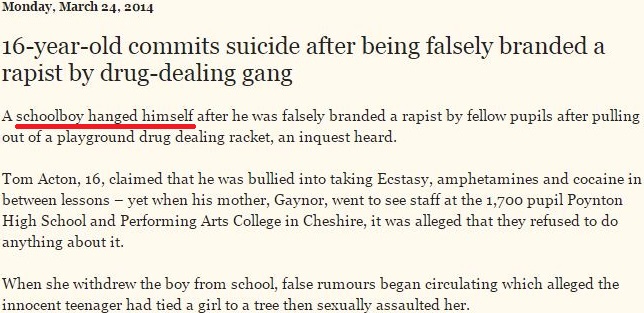
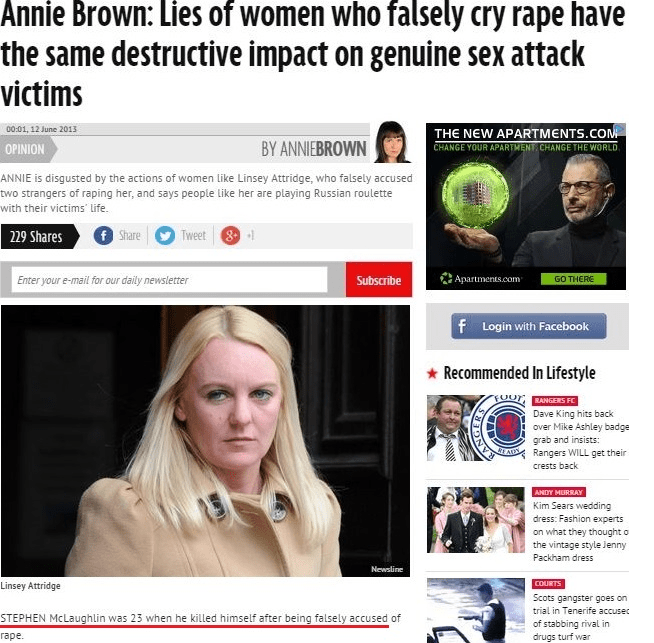
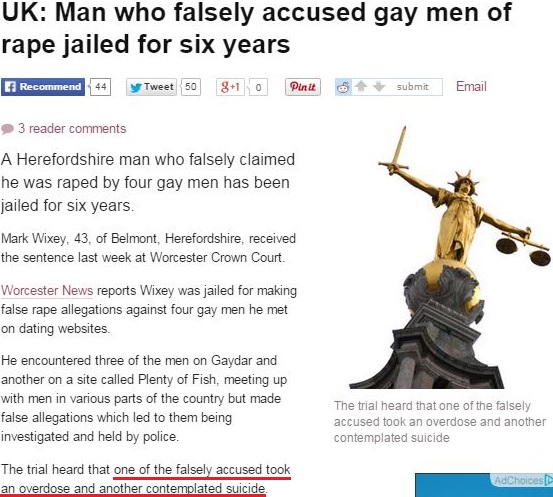
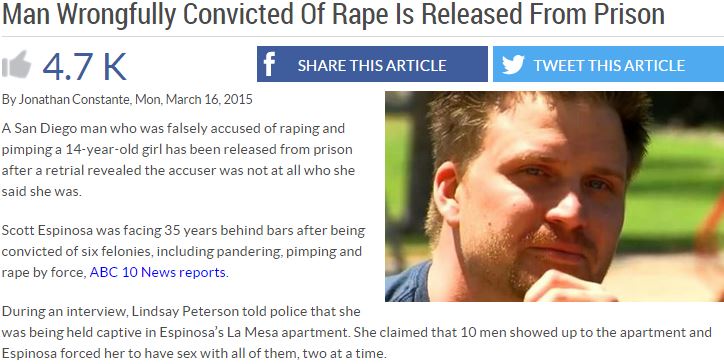
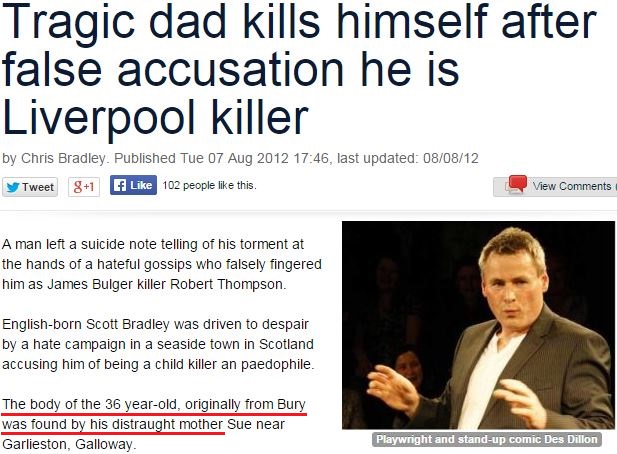
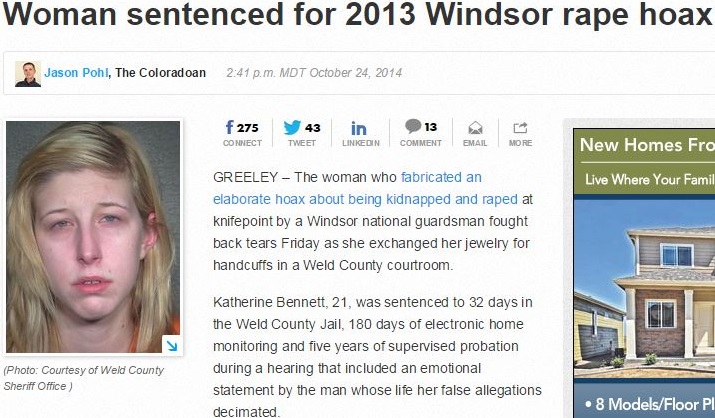
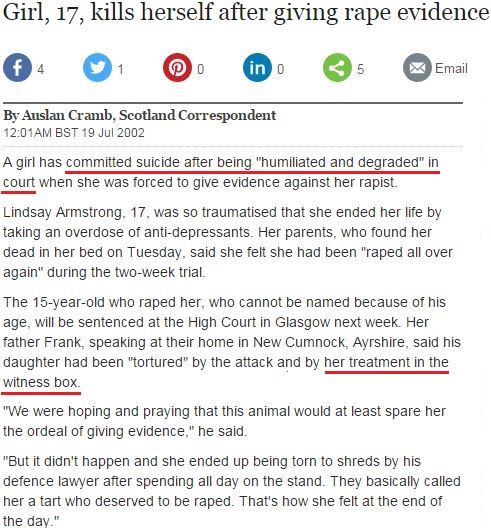
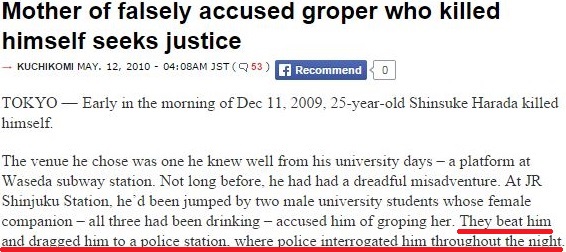
A recent post on the blog you’re reading highlighted the case of a young British man who was detained by authorities for two days, based on a false accusation of rape. Then the charges were thrown out, that is, they were almost immediately dismissed. He nevertheless killed himself after struggling with depression pursuant to the violation. He was 23. Another featured case concerned an adolescent who was falsely accused of rape by some hoodlums at school. He hanged himself. He was 16. A third was about a man who was falsely convicted for rape (and five other felonies) and served a year and a half of a 35-year sentence. He was exonerated when it was belatedly discovered that his “14-year-old” accuser was an adult in her 20s and that her identity wasn’t all she’d lied about. While the man was in prison, his mother committed suicide. She died believing her son was a pimp and a rapist.

Introducing cases of false accusation that have consequences of this magnitude is illustrative, but it shouldn’t be necessary. The author of A Division by Zer0, like most feminist writers, betrays he understands the aftermath of trauma very well.

Here’s the difference though, a rape victim most likely will never escape the damage of the event. Once the deed has been done, the scar will stay forever, no matter if the perpetrator is punished. You cannot undo the [violation]. You cannot restore the lost trust. You cannot wipe the memory triggers.

In a moment of dramatic irony, the writer acknowledges the root of his own indifference: “Much of it, I believe, comes from lack of empathy.”

The man behind A Division by Zer0 is a member of the “Men’s Rights crowd”—or more aptly the People’s Rights crowd. He just doesn’t know it.

Copyright © 2015 RestrainingOrderAbuse.com
False Accusations and Murder: More Headlines about the Effects of Finger-Pointing and Legal Abuse

“[W]hy would someone lie about being sexually assaulted? What could be gained from that? Nothing, really.”

Tracie Egan Morrissey, Jezebel (Feb. 28, 2014)

The quotation above derives from a piece titled, “Rape, Lies and the Internet: The Story of Conor Oberst and His Accuser.” It’s spotlighted because it echoes the sentiment expressed by the writer of the prior post’s epigraph, who’s also a feminist and who betrays the same blindness.

What’s disturbing to the author of the blog you’re reading is that feminists who ask questions like Ms. Morrissey’s make a strong case for rape denial, because it might just as unreasonably be asked, “Why would someone sexually assault anyone? What could be gained from that?”

What could be “gained” from raping someone is the same thing that could be “gained” from lying about being raped—or lying about any number of other offenses: the exultation of control (i.e., power, dominance).

Other reasons for lying suggested by Ms. Morrisey’s own reportage are attention-seeking, self-aggrandizement, and mythomania. There have also been a number of publicized cases about false rape accusations’ being used for concealment of sexual infidelity. Two hyperlinks in this post lead to stories exemplifying this motive. Of course (and significantly), none of these motives applies exclusively to false rape claims. Besides avarice and malice, they’re common motives among false accusers (of all types). People hurt people…to hurt people. Appetites, least of all vicious ones, don’t answer to sense.

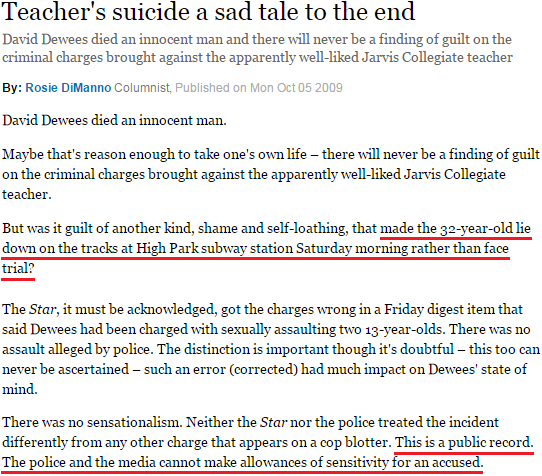
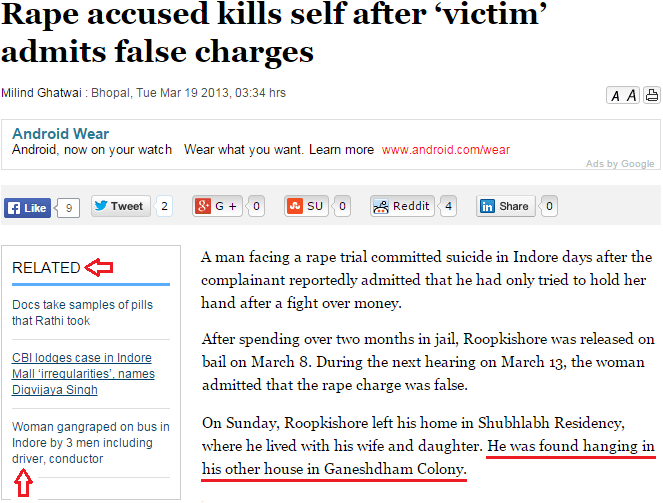
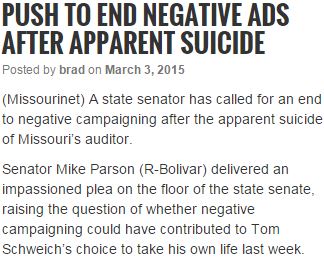
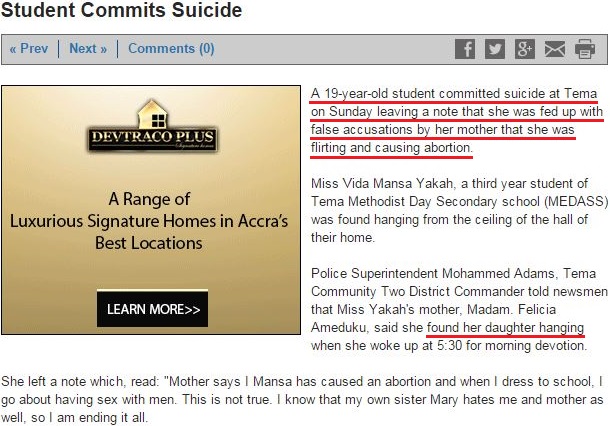
The previous post emphasized the emotional trauma of accusation, particularly false accusation, by highlighting a number of suicides reported in the news.

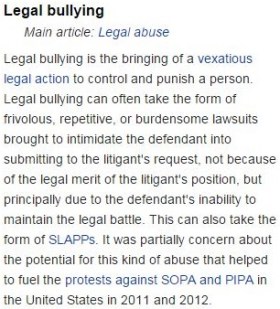
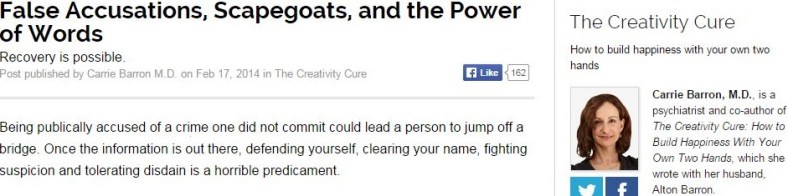
Suicide is a recognized consequence of bullying; name-calling and public humiliation are recognized as among the forms that bullying takes; and falsely branding someone a stalker, rapist, child abuser, or killer, for example, certainly qualifies as publicly humiliating name-calling.

Whether someone is disparaged on the playground, on Facebook, in a courtroom, or in the headlines makes absolutely no difference; the effect is the same, and it may be unbearable.

This stuff shouldn’t need to be pointed out to grown-ups. But since the fatal consequences of false accusation don’t support any dominant political agendas—and may undermine them—they’re ignored. That people are harried and hectored by lies, sometimes to death, is an inconvenient truth.

At least it is here. Many of the news clippings featured in the last post notably originate from the U.K., as do two of the clippings below. Journalism is far more balanced there, and it’s less taboo to call a jade a jade. A Jezebel reporter might denounce this as “misogynistic,”  but truth isn’t misogynistic; it’s just the truth, and it doesn’t play favorites (nor should its purveyors).

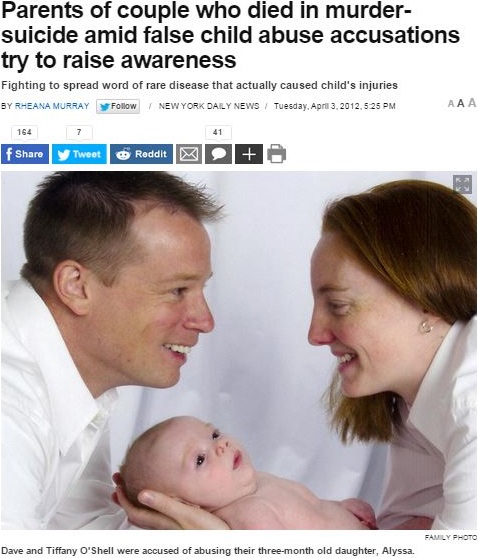
This post looks at the other lethal upshot of false accusation: murder. The stories that follow are about people who existed and now do not.

The point of introducing these stories isn’t to assert incidents like these are common; the point is to reveal the emotions that are inspired by false accusations, whether by women, by men, or by mobs. It’s also to reveal their consequences…writ large and lurid. These same emotions are aroused in cops and judges no less than they are in anyone else. False accusers know what reactions they can expect, and they know how to manipulate their audience—and bending others to do their will is thrilling.

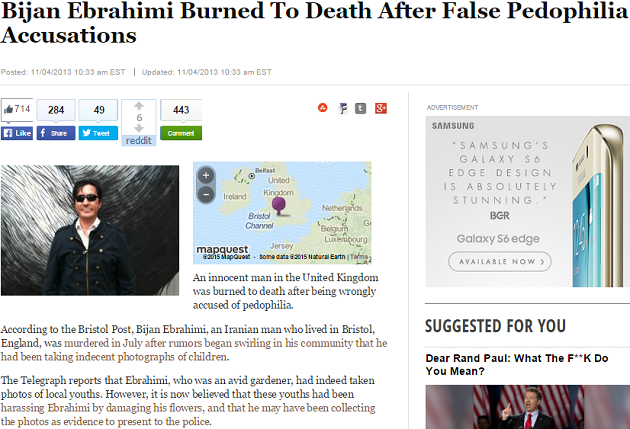
Nothing makes the emotions provoked by accusation more manifest than when accusation inspires others to beat someone to death—or set him ablaze.

This is nevertheless typically lost on reporters and their viewers and readers. The details that are stressed and eagerly sought are who got it, and how. Why, which is always the more speculative aspect, is in its broader implications the most important one, however.

Gore is sexy. It’s what gets airplay and column space. It’s an attention-grabber and a ratings booster. Nothing draws the eye like the color red.

What sensation eclipses, though, is that for every false accusation that ends in red, thousands or hundreds of thousands end in gray, an interminable state of disquiet, disease, and dolor.

Copyright © 2015 RestrainingOrderAbuse.com

*Jezebel, if I’m remembering my Bible stories right, was a mass murderer who was condemned for promoting a false dogma. (Among her victims was a man she had judicially executed.)

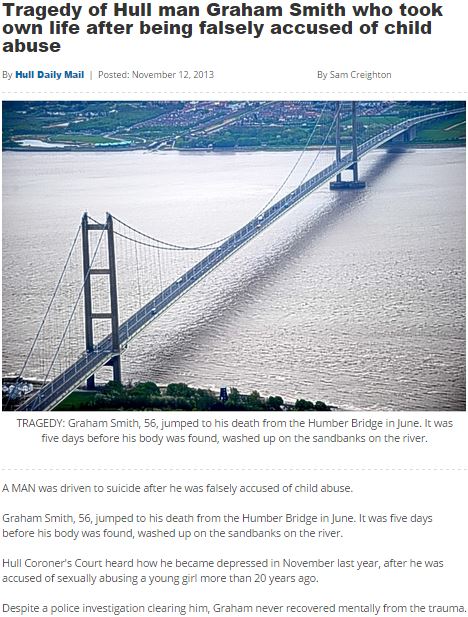
False Accusations and Suicide: Some Headlines about the Effects of Finger-Pointing and Legal Abuse (Culled for the Empathically Challenged)

Since the publication of this post, the one quoted above has been deleted.

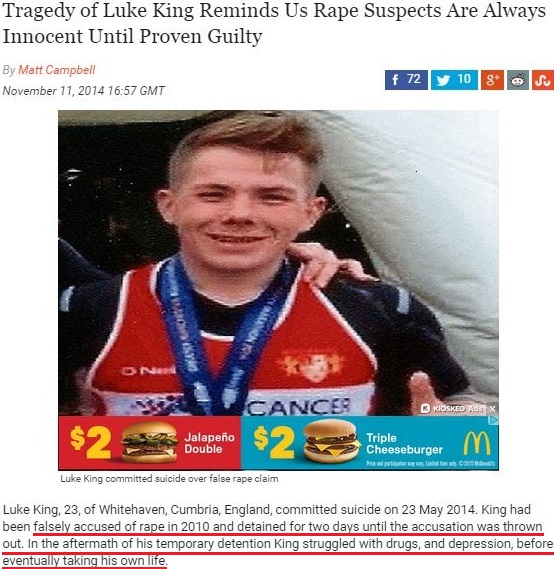
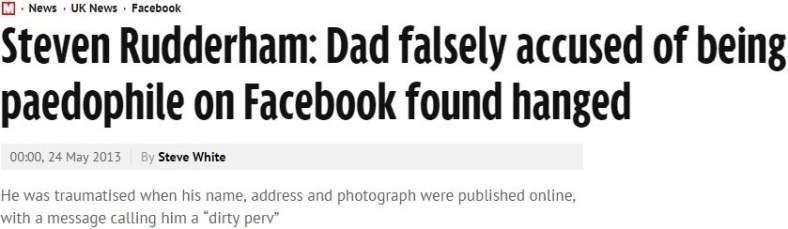
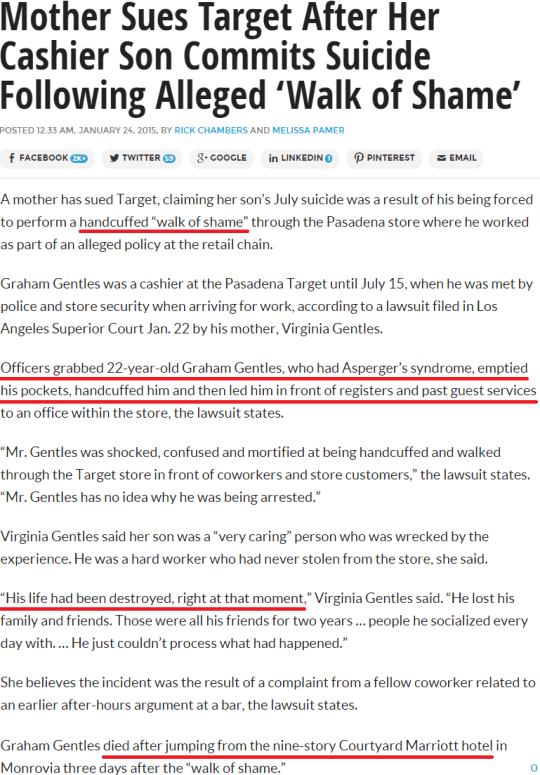
One of the stories highlighted below concerns a young man who was falsely labeled a rapist by some bullies at school. He hanged himself. He was 16. Another concerns a man who spent a year and a half in prison based on a false accusation of sexual assault (among other false accusations). While the man was behind bars, his mother killed herself, believing her son was a pimp and a rapist.

A word to the wise: Only ask a rhetorical question if you know the answer…and it favors your position.

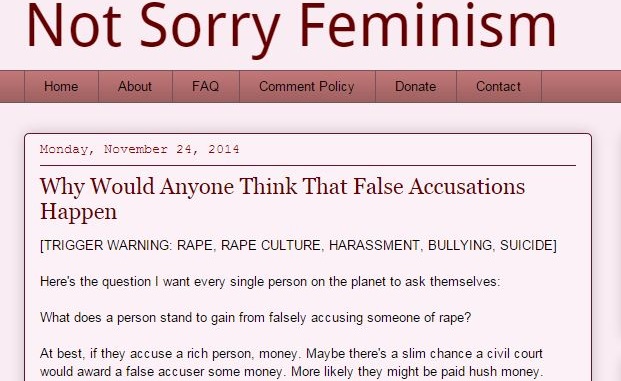
The question posed above by the zealous, young author of Not Sorry Feminism isn’t, of course, a question at all; it’s an indictment. She means how dare anyone think false accusations happen. What problematizes the writer’s rhetorical-question-cum-admonition is that it has a very obvious answer: The reason people think false accusations “happen” (so to speak) is that they do.
(It might alternatively be asserted that no one does believe false accusations “happen,” the same way no one believes rapes “happen.” Both are acts, and both have agents. If rape happens isn’t a construction a feminist could get behind, false accusations happen shouldn’t be, either. You’re a proponent of accountability, or you’re not.)

Worse than her question’s being problematic, because answerable, is that its answer isn’t one the writer wants to hear. Motives for false accusations, including of rape, are greed, malice, bullying, vengeance, jealousy, possessiveness, attention-seeking, mental illness, and cover-up, to name a few. They’re ugly, often petty, always destructive…and they can kill.

This post surveys examples of false allegations or deadly allegations or false and deadly allegations drawn from news stories. Here’s one such:

Unlike most of the rest, the first story glossed in this hastily cobbled digital scrapbook doesn’t include a suicide or references to suicide. It’s nevertheless a good starting point, because it’s old news.

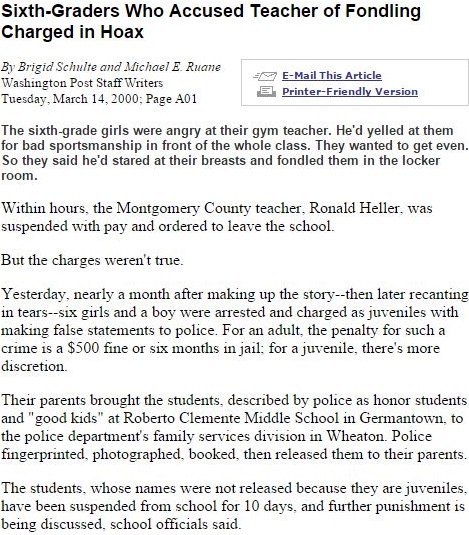
The article’s from 15 years ago. Fifteen. Significantly, though, no half-hearted sleuth would find it a challenge today to turn up commentaries on the Internet, mostly from feminist writers like the one who introduces this post, that either (1) deny such a thing ever happens or (2) deny it’s a big deal when it does happen—and deny it’s a sign that a culture of false accusation exists and has for some time. (A story so uncannily similar as to be almost identical can be found here. It appeared in The Huffington Post less than 24 months ago.)
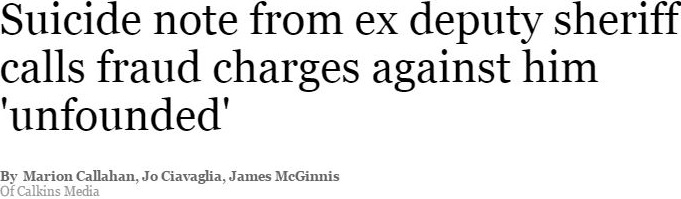
Consider: Where would six elementary school girls and a boy get the idea of framing their gym teacher as a molester, and where would they get the impression this conduct was okay (or “cool”) or that they’d get away with it and not face dire consequences? Should we believe the notion had no cultural influences and was purely a product of these honors students’ collective wicked imagination?

For accusing their teacher of groping them, the kids were suspended for 10 days. It’s likely the most traumatic part of their punishment was being detained by police and “fingerprinted, photographed, [and] booked.” Keep this thought in mind.

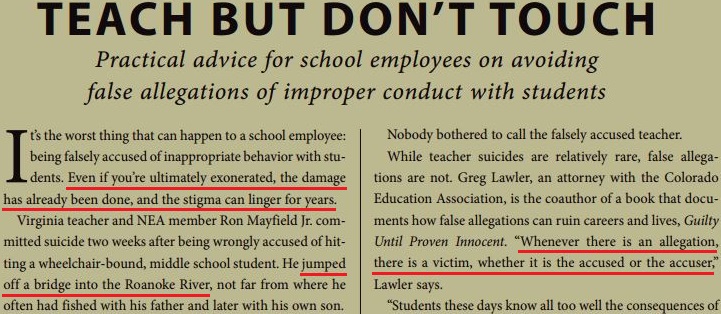
Keep this quotation in mind, too: “‘When they made the charge, that’s about 80 percent of the damage to your reputation right there,’ [attorney Paul F.] Kemp said. ‘Because even if you’re found innocent, people will assume you got off on a technicality. Or that there’s something there when there’s not.’”

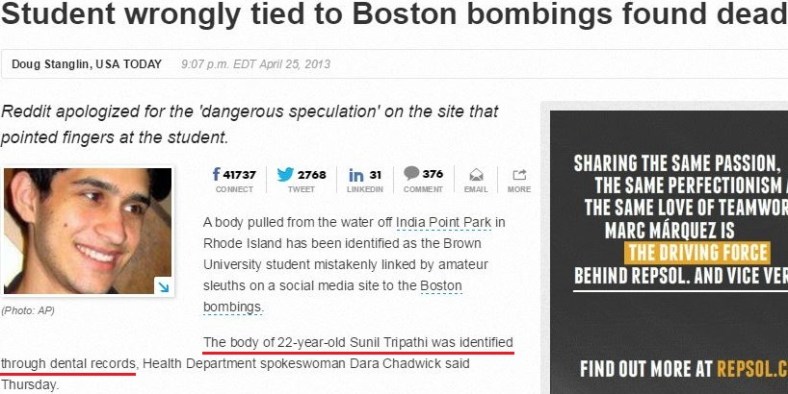
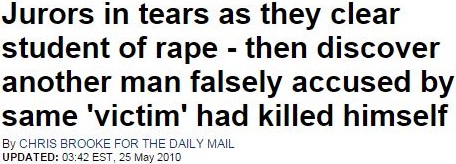
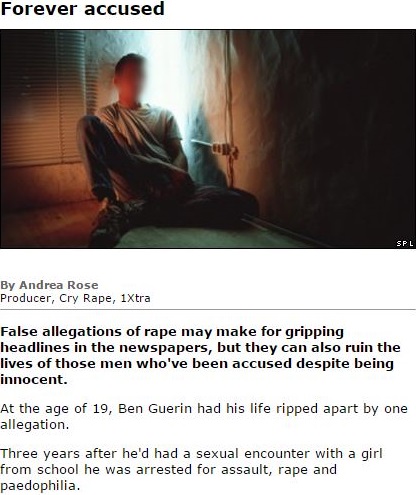
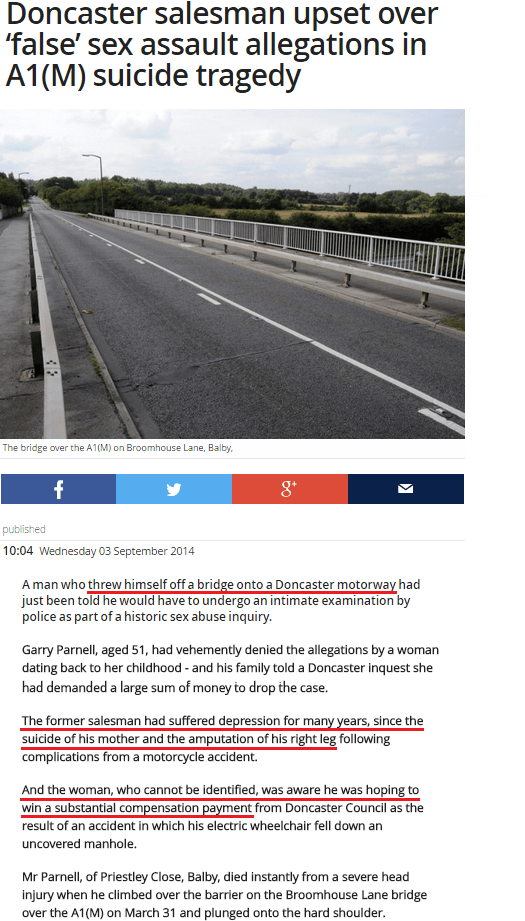
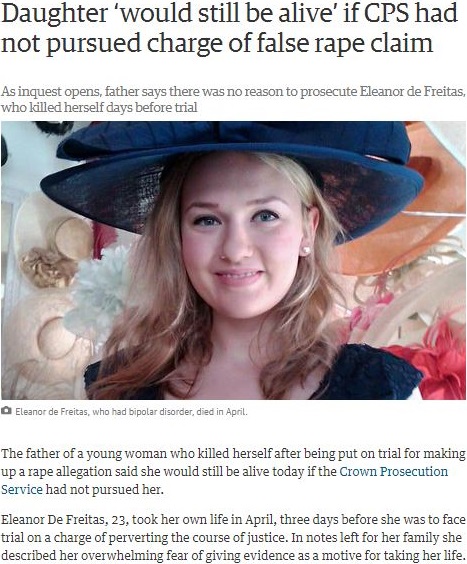
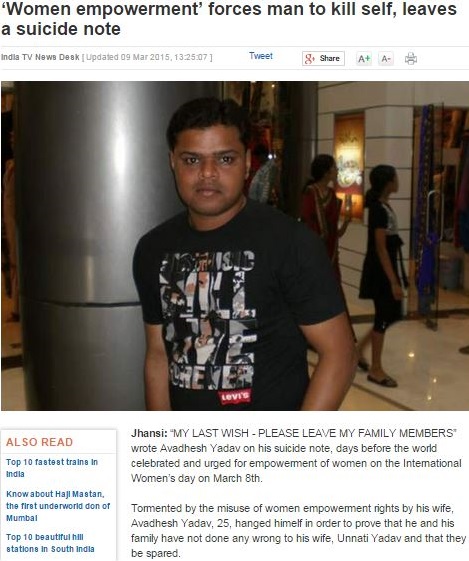
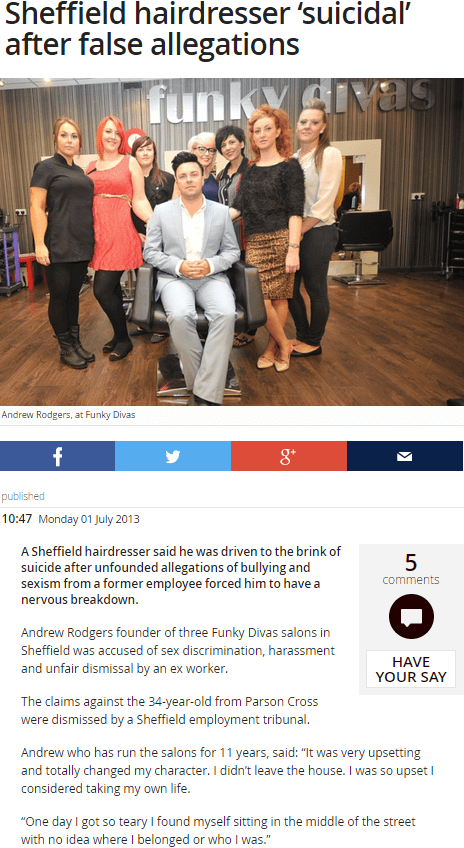
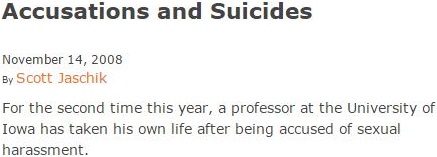
Editorial intrusions end here; the remainder of this post is a series of Internet clippings (linked to the “complete stories”) from which readers may draw their own conclusions about the motives and effects of accusation, bullying, and legal abuse. The author of this post would only point out before absenting himself that an accusation that may induce someone to kill him- or herself need not be of rape and that one of the suicides chronicled below is of a woman who faced being tried for falsely alleging she was sexually assaulted (“In notes left for her family, she described her overwhelming fear of giving evidence…”).

The common denominator is accusation and public scrutiny and judgment, not being accused of a particular act, per se. Zerlina Maxwell and her ilk are categorically wrong.

fale_accusations_destroy

nancy_grace_suit

dad_falsely_accused

murder_suicide

jurors_in_tears_full

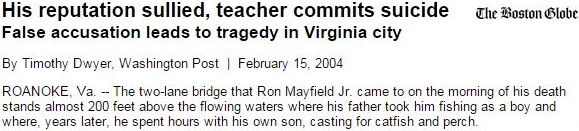
reputation_sullied_full

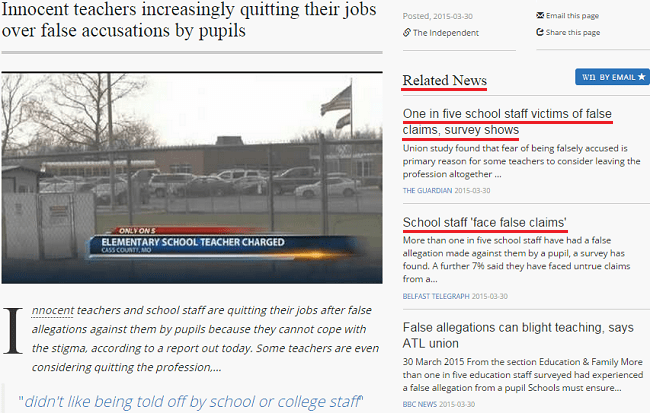
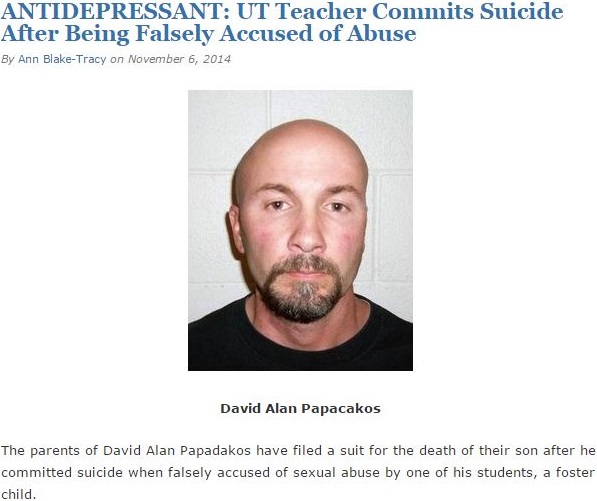
suicidality

forever_accused

Sheffield_hairdresser

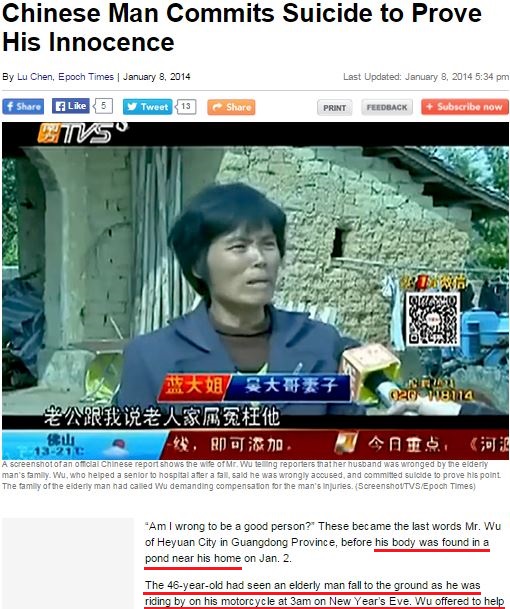
Chinese_man_commits_suicide

Copyright © 2015 RestrainingOrderAbuse.com

Inciting Violence: If Lawmakers Require a Compelling Motive for Restraining Order Reform, How about This One?

I examined a case, recently, of a man’s committing murder hours after being accused to the police. My familiarity with the case was, admittedly, shallow; I only had what was reported to go on (and that from a single, “raw” source). I have, however, heard from scores of people who’ve been accused—or scorned for telling the truth—in drive-thru restraining order proceedings, and expressions of fury have been more than a few.

This week, I shared an email by a highly educated, professional woman and mother of three young children that expresses an “almost homicidal enmity” catalyzed by procedural abuses. Note the elevated diction she uses to describe an impulse to bash, throttle, and gouge. Does her vaulted language indicate she “doesn’t really mean it”? No, it indicates how alien rage is to her character. It indicates she’s someone who shouldn’t have cause to feel this way.

Consider: How is it the police and the courts recognize the propensity for violence that interpersonal conflicts mediated by the “justice system” may arouse, but lawmakers don’t? Are they that “in the dark”?

Yeah, pretty much.

If you get into a spat with your neighbor, and the police intervene, parties are separated into corners. In court, complainants even merely of “fear” may be shielded by law officers in anticipation of a judicial ruling. It’s understood that emotions run hot in this theater.

Why, then, is it not appreciated that when the basis for rulings is false, the risk of violence is not only higher but infinite?

We like our games, and we like our fictions about how people should be and should feel and should react even if you trash their lives maliciously. Hey, we’re disposed to remind, it’s the law.

All well and good until somebody gets an ax in the ear—an edgy remark, maybe; honesty often strikes us that way (i.e., like an ax in the ear).

The wonder is that more people who lie to the courts don’t meet premature ends—or at least sustain some anatomical remodeling. False accusations, which have inspired a great deal of sententious deliberation in recent months, don’t just “discomfort” people or make them “justifiably [and transiently] angry.” At the risk of being edgy again: People who haven’t been falsely accused in a legal procedure don’t know what the fuck they’re talking about. I was collegiately trained as a literary analyst—I’ve studied and taught Victorian literature—and I’m normally more disciplined in my remarks, but this subject rebukes gentility.

Liars maim. That they do it with words in no way mitigates the brutality of the act or its consequences.

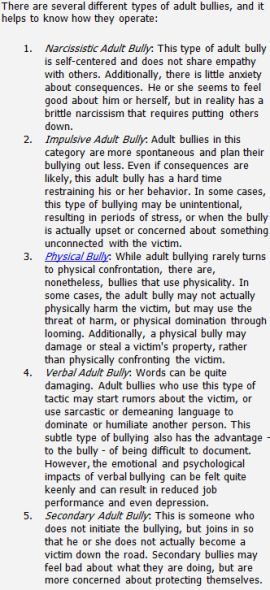
One would think that as people mature and progress through life, that they would stop behaviors of their youth. Unfortunately, this is not always the case. Sadly, adults can be bullies, just as children and teenagers can be bullies. While adults are more likely to use verbal bullying as opposed to physical bullying, the fact of the matter is that adult bullying exists. The goal of an adult bully is to gain power over another person, and make himself or herself the dominant adult. They try to humiliate victims, and “show them who is boss” (BullyingStatistics.org, “Adult Bullying”).

StopBullying.gov defines bullying as including name-calling, taunting, threatening, spreading rumors about someone, and embarrassing someone in public. Falsely labeling someone a stalker, child abuser, violent danger, or sexual deviant in one or more public trials whose findings are impressed on the target’s permanent record and are accompanied by menacing threats (if not immediate punishment) plainly qualifies. Among identified effects of bullying are suicide (“bullycide”) and violence, including murder. “Extreme emotional disturbance” is a defense for murder in some states (a finding that doesn’t excuse the act but does lighten the sentence), and a related murder defense is “provocation.”

Sure, character assassination is bloodless. What of it? If I circulate lies about someone and s/he snaps, I’m a bully, and I had it coming. Few people would say otherwise.

Ah, but if I lie and use the law as my medium to insult, demean, badger, intimidate, or otherwise persecute—hey, that’s different. I’m the “good guy.”

So suck it. And keep on sucking it, because the public record says my lies are the truth. Neener-neener.

A system that represents its purpose to be the curtailment of violence shouldn’t be promoting it by pandering to bullies, even “unofficially,” and its officers shouldn’t be serving as those bullies’ lieutenants and enforcers. If the system makes it easy to lie about and humiliate people, doesn’t hold liars accountable, and furthermore punishes the falsely accused based on lies, then it’s promoting violence.

This shouldn’t require social science research to corroborate. It shouldn’t even require this analyst’s observation.

Copyright © 2015 RestrainingOrderAbuse.com

Dust It Off: This Isn’t 1979, and It’s Time Restraining Order Laws Were Reconsidered

I remarked to a commenter the other day that when I became a vegetarian in the ’80s, I was still a kid, and my family took it as an affront, which was a common reaction then. Today, everyone’s a vegetarian or “tried vegetarianism” or has “thought about becoming a vegetarian.” Other subjects that were outré or taboo in my childhood like atheism, cross-dressing, and depression—they’re no longer stigmatized, either (in the main). Gay people, who were only whispered about then, can marry in a majority of states. When I was a kid, it was shaming for bra straps or underpants bands to be visible. Today they’re exposed on purpose.

It’s a brave new world.

While domestic violence is no more comfortable a topic of conversation now than it was then, it’s also hardly hush-hush. When restraining orders were conceived, it was unmentionable, and that was the problem. It was impossible for battered women to reliably get help. They faced alienation from their families and even ridicule from the police if they summoned the courage to ask for it. They were trapped.

Restraining orders cut through all of the red tape and made it possible for battered women to go straight to the courthouse to talk one-on-one with a judge and get immediate relief. The intention, at least, was good.

It’s probable, too, that when restraining orders were enacted way back when, their exploitation was minimal. It wouldn’t have occurred to many people to abuse them, just as it wouldn’t have occurred to lawmakers that anyone would take advantage.

This isn’t 1979. Times have changed and with them social perceptions and ethics. Reporting domestic violence isn’t an act of moral apostasy. It’s widely encouraged.

No one has gone back, however, and reconsidered the justice of a procedure of law that omits all safeguards against misuse. Restraining orders circumvent investigation by police and the vetting of accusations by district attorneys. They allow individuals to prosecute allegations all on their own, trusting that those individuals won’t lie about fear or abuse, despite the fact that there are any number of compelling motives to do so, including greed/profit, spite, victim-playing, revenge, mental illness, personality disorder, bullying, blame-shifting, cover-up, infidelity/adultery, blackmail, coercion, citizenship, stalking, and the mere desire for attention.

Restraining orders laws have steadily accreted even as the original (problematic) blueprint has remained unchanged. Claims no longer need to be of domestic violence (though its legal definition has grown so broad as to be virtually all-inclusive, anyway). They can be of harassment, “stalking,” threat, or just inspiring vague unease.

These aren’t claims that are hard to manufacture, and they don’t have to be proved (and there’s no ascertaining the truth of alleged “feelings” or “beliefs,” anyway, just as there’s no defense against them). Due to decades of feminist lobbying, moreover, judges are predisposed to issue restraining orders on little or no more basis than a petitioner’s saying s/he needs one.

What once upon a time made this a worthy compromise of defendants’ constitutionally guaranteed expectation of due process and equitable treatment under the law no longer does. The anticipation of rejection or ridicule that women who reported domestic violence in the ’70s and ’80s faced from police, and which recommended a workaround like the restraining order, is now anachronistic.

Prevailing reflex from authorities has swiveled 180 degrees. If anything, the conditioned reaction to claims of abuse is their eager investigation; it’s compulsory policy.

Laws that authorize restraining order judges, based exclusively on their discretion, to impose sanctions on defendants like registry in public databases that can permanently foul employment prospects, removal from their homes, and denial of access to their kids and property are out of date. Their license has expired.

Besides material privations, defendants against allegations made in brief trips to the courthouse are subjected to humiliation and abuse that’s lastingly traumatic. Making false claims is a simple matter, and offering damning misrepresentations that don’t even depend on lies is simpler yet.

What shouldn’t be possible happens. A lot. Almost as bad is that we make believe it doesn’t.

Just as it was wrong to avert our eyes from domestic violence 30 years ago, it’s wrong to pretend that attempts to curb it since haven’t fostered new forms of taunting, terrorism, and torment that use the state as their agent.

Copyright © 2015 RestrainingOrderAbuse.com

(Female) Stalkers, False Allegations, and Restraining Order Abuse

Restraining orders are maliciously abused—not sometimes, but often. Typically this is done in heat to hurt or hurt back, to shift blame for abusive misconduct, or to gain the upper hand in a conflict that may have far-reaching consequences.

There’s a cooler, more methodical style of abuse practiced by people who aren’t in intimate daily proximity to their victims, however, that’s alternatively called stalkingbullying, or mobbing. These words have distinct meanings but are nevertheless porous, because motives for the behaviors they represent are the same: coercion, punishment, domination, and control.

There’s a lot of crossover between them—as is there crossover between the various high-conflict personality types who engage in these behaviors, who contrary to popular perception may be women.

Journalists’, psychologists’, and bloggers’ representations of those with personality disorders that stem from sociopathy tend to use gendered language that implies most abusers (or the worst abusers) are male.  Possibly this is because many who write about sociopaths and narcissists are female, and their experiences are of abuse by men. Or possibly this is because making women out to be villains is ungallant. Or possibly it’s assumed that men can’t be victims of women, even sociopaths, because men have nerves of steel or because their general physical advantage carries over into all contexts. Neither of the latter beliefs is true, and when the context is abuse of legal process, it’s usually the case that the bigger you are, the harder you fall.

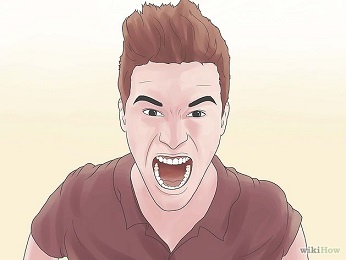
Consider these illustrated WikiHow tutorials on “How to Spot a Sociopath” and “How to Identify a Psychopath,” which are pretty good, except that the reader is likely to get the impression from the cartoons that all sociopaths are men.

They aren’t.

These “tips” from “How to Spot a Sociopath” are at least as applicable to women as men, and suggest why abuse of legal process, including restraining order abuse, is so attractive to the sociopathic mind—and why it comes easily to sociopaths or to those who manifest sociopathic traits.

  • “Most sociopaths can commit vile actions and not feel the least bit of remorse. Such actions may include physical abuse or public humiliation of others. If the person is a true sociopath, then he or she will feel no remorse about hurting others, lying, manipulating people, or just generally acting in an unacceptable way.”

    Sociopaths often know how to make others believe they are the victim while actually being the aggressor.

  • Sociopaths tend to blame the victim for their shortcomings. They can never admit to fault and instead attack the victim. Key factor in any DSM diagnosis.
  • This type of person will tell you things to get you to forgive them and then say they never told you. This is a tactic to play mind games.
  • If a person is “too good to be true,” they probably are. This is the case for any DSM diagnosis, including sociopathy, borderline [personality], and narcissism.
  • Most are aware of their need to hide cold traits, and are good actors (have adapted to being different)….
  • Some scientists believe that sociopaths suffer from damage to the prefrontal cortex which regulates emotions and morality, etc.
  • Sociopathic behavior is strongly inherited, so look at problems in the family as a clue to a person’s real personality.
  • Some experts say that a great number of sociopaths were also child abuse sufferers.

The same tutorial, despite its gendered cartoons, references a book published last year titled, Confessions of a Sociopath, which is by a female sociopath who uses the penname M. E. Thomas—and who’s an attorney and law professor, which shouldn’t be particularly surprising to anyone who’s been exposed to legal practitioners.

It may be that not all sociopaths are fairly typified as stalkers and bullies, but if you read this review of Confessions of a Sociopath, you’ll appreciate that motives for abusive conduct come readily enough to the sociopathic psyche.

Thinking of women as stalkers or bullies is just something we’re unaccustomed to or something we treat lightly.

In a series of hers titled, “Female Stalkers,” psychologist Tara Palmatier notes that “female stalking behaviors are portrayed as ‘funny’ or ‘cute.’” We’ve been conditioned—and “we” includes the police and judges—to think of women as both harmless and helpless. Women don’t hurt people.

They do, though.

Popular perceptions of “stalking,” domestic violence, and other abuses tend inordinately to inculpate men. The object of observing that women also act hurtfully isn’t to suggest that women more often act hurtfully than men but to controvert the popular notion that they don’t or can’t, which is both false and largely to blame for the absurd ease with which legal process is maliciously abused.

Accounts submitted to this blog by both men and women indicate that individuals of either gender may and do abuse legal process to torment others, horribly and sometimes for years on end. Either sex may engage in cyclic mind games, as well: manipulating another into trust and then punishing that trust (“It’s okay, I’m sorry, come here”…WHACK!). Repeatedly. One woman’s (mother’s) account of this, shared a few months ago, is numbing: affairs by her (probably borderline personality-disordered) boyfriend followed by apologies followed by recriminations (rinse, repeat) followed by false allegations to the police, to the court, to child protective services, to the military, and on and on.

Most group-stalking or -bullying (mobbing) acts reported to this blog, though, are orchestrated by women. These include combinations of behaviors like making false allegations, spreading false and ruinous rumors with the help of negative advocates (accomplices), using social media to taunt and intimidate from multiple directions, etc. These passive-aggressive forms of abuse to punish, frighten, and dominate—which, depending on the context, may alternatively be called bullying, harassment, or stalking—are usually viewed as less harmful than physical assault. This perception is facile, however, and wrong.

A recent male respondent to this blog, for example, reports encountering an ex while out with his kids and being lured over, complimented, etc. (“Here, boy! Come!”), following which the woman reported to the police that she was terribly alarmed by the encounter and, while brandishing a restraining order application she’d filled out, had the man charged with stalking. Though the meeting was recorded on store surveillance video and was unremarkable, the woman had no difficulty persuading a male officer that she responded to the man in a friendly manner because she was afraid of him (a single father out with his two little kids). The man also reports (desperately and apologetic for being a “bother”) that he and his children have been baited and threatened on Facebook, including by a female friend of his ex’s and by strangers.
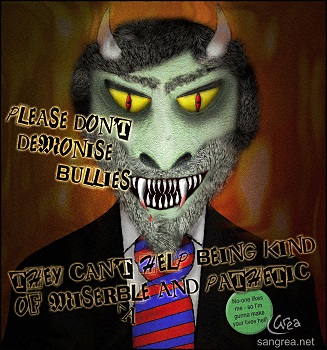
Harassment by these means, which tends to be unrelenting but is just as bad when sporadic, creates anxiety and insecurity in its victims, and may well undo them not only psychologically but professionally, financially, and in every other possible way. False allegations (which alone gnaw and corrode) may lead to criminal charges, which may lead to incarceration, from which ensues traumatization of children and possibly loss of employment (from which ensues further traumatization of children…). Same thing with restraining orders, which may easily be obtained in an afternoon by spiteful fraud and which don’t go away—and may also lead not only to loss of employment but loss of employability in a given field.

When a restraining order is issued, it’s entered into state law enforcement databases as well as the FBI’s National Crime Information Center (NCIC) database. The pretense is that restraining orders are civil misdemeanors of no particular significance. Repeat: National Crime Information Center.

Records of restraining orders are public, besides, and accessible by anyone, and may moreover be recorded in public registries for easy access. Allegations on those records, no matter how scandalous and even if found to be exaggerated or maliciously false, aren’t censored.

Our perceptions of the consequences of public allegations, as well as the justice system’s perceptions of them, are completely schizoid. They’re neither actually “no big deal” nor actually treated as though they’re “no big deal.” And they’re certainly not “no big deal” to those falsely accused and everyone who depends on them. False allegations may range from stalking to sexual harassment to battery or worse.

The actuality is that allegations made on restraining orders, which may be utterly malicious fabrications, are presumed to be legitimate by everyone. Just the phrase restraining order instantly establishes the credibility of an accuser who may be a bully or stalker.

Applicants for restraining orders, it’s again presumed, are afraid of the people they’ve accused and want nothing to do with them. Accordingly, there are no limitations placed on the conduct of petitioners and no repercussions to them for their harassing the people they’ve alleged they’re afraid of. Restraining orders license abusers—bullies, stalkers, and their confederates—to act with impunity. Even when abuses are reported, the tendency of cops and court staff is to shrug.

Restraining orders, because they establish credibility with judges and police officers (based on no standard of evidence and on mere minutes-long “trials” that never approach conclusiveness), make further claims that bullies or stalkers allege, whether proximally or later on (even years later on), entirely plausible. Conflict can be rekindled and stoked endlessly and whimsically.

Lives are derailed this way: sanity compromised, careers sabotaged or sundered, savings exhausted, and on and on. Trials may lead to further trials without end.

And all of this may originate with sick games whose motives are dismissed as “harmless”—or even “cute.”

Copyright © 2014 RestrainingOrderAbuse.com

Blame, No Shame: Restraining Order Abuse by High-Conflict, Personality-Disordered Plaintiffs

“Court is perfectly suited to the fantasies of someone with a personality disorder: There is an all-powerful person (the judge) who will punish or control the other [person]. The focus of the court process is perceived as fixing blame—and many with personality disorders are experts at blame. There is a professional ally who will champion their cause (their attorney—or if no attorney, the judge) […]. Generally, those with personality disorders are highly skilled at—and invested in—the adversarial process.

“Those with personality disorders often have an intensity that convinces inexperienced professionals—counselors and attorneys—that what they say is true. Their charm, desperation, and drive can reach a high level in this very emotional bonding process with the professional. Yet this intensity is a characteristic of a personality disorder, and is completely independent from the accuracy of their claims.”

—William (Bill) Eddy (1999)

Contemplating these statements by therapist, attorney, and mediator Bill Eddy should make it clear how perfectly the disordered personality and the restraining order click. Realization of the high-conflict person’s fantasies of punishment and control is accomplished as easily as making some false or histrionically hyped allegations in a few-minute interview with a judge.

Contemplating these statements should also make clear the all-but-impossible task that counteracting the fraudulent allegations of high-conflict people can pose, both because disordered personalities lie without compunction and because they’re intensely invested in domination, blaming, and punishment.

Lying may be justified in their eyes—possibly to bring a reconciliation. (This can be quite convoluted, like the former wife who alleged child sexual abuse so that her ex-husband’s new wife would divorce him and he would return to her—or so she seemed to believe.) Or lying may be justified as a punishment in their eyes.

As Mr. Eddy explains in a related article (2008):

Courts rely heavily on “he said, she said” declarations, signed “under penalty of perjury.” However, a computer search of family law cases published by the appellate courts shows only one appellate case in California involving a penalty for perjury: People v. Berry (1991) 230 Cal. App. 3d 1449. The penalty? Probation.

Perjury is a criminal offense, punishable by fine or jail time, but it must be prosecuted by the District Attorney, who does not have the time. [J]udges have the ability to sanction (fine) parties but no time to truly determine that one party is lying. Instead, they may assume both parties are lying or just weigh their credibility. With no specific consequence, the risks of lying are low.

High-conflict fraudsters, in other words, get away with murder—or at least character assassination (victims of which eat themselves alive). Lying is a compulsion of personality disorders and is typical of high-conflict disordered personalities: borderlines, antisocials, narcissists, and histrionics.

When my own life was derailed eight years ago, I’d never heard the phrase personality disorder. Five years later, when I started this blog, I still hadn’t. My interest wasn’t in comprehension; it was to recover my sanity and cheer so I could return to doing what was dear to me. I’m sure most victims are led to do the same and never begin to comprehend the motives of high-conflict abusers.

slanderI’ve read Freud, Lacan, and some other abstruse psychology texts, because I was trained as a literary analyst, and psychological theories are sometimes used by textual critics as interpretive prisms. None of these equipped me, though, to understand the kind of person who would wantonly lie to police officers and judges, enlist others in smear campaigns, and/or otherwise engage in dedicatedly vicious misconduct.
What my collegiate training did provide me with, though, is a faculty for discerning patterns and themes, and it has detected patterns and themes that have been the topics of much of the grudging writing I’ve done in this blog.

Absorbing the explications of psychologists and dispute mediators after having absorbed the stories of many victims of abuse of court process, I’ve repeatedly noticed that the two sources mutually corroborate each other.

Not long ago, I approached the topic of what I called “group-bullying,” because it’s something I’ve been subject to and because many others had reported to me (and continue to report) being subject to the same: sniping by multiple parties, conspiratorial harassment, derision on social media, false reports to employers and rumor-milling, fantastical protestations of fear and apprehension, etc.

The other day, I encountered the word mobbing applied by a psychologist to the same behavior, a word that says the same thing much more crisply.

Quoting Dr. Tara Palmatier (see also the embedded hyperlinks, which I’ve left in):

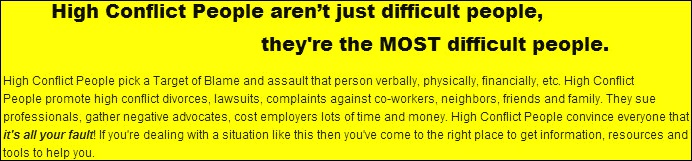
If you’re reading this, perhaps you’ve been or currently are the Target of Blame of a high-conflict spouse, girlfriend, boyfriend, ex, colleague, boss, or stranger(s). Perhaps you’ve been on the receiving end of mobbing (bullying by a group instigated by one or two ringleaders) and/or a smear campaign or distortion campaign of a high-conflict person who has decided you’re to blame for her or his unhappiness. It’s a horrible position to be in, particularly because high-conflict individuals don’t seem to ever stop their blaming and malicious behaviors.

A perfect correspondence. And what more aptly describes the victim of restraining order abuse than “Target of Blame”?

This phrase in turn is found foremost on the website of the High Conflict Institute, founded by Bill Eddy, whom I opened this post by quoting:

high_conflict_yellow

Restraining orders are seldom singled out or fully appreciated for the torture devices they are by those who haven’t been intensively made aware of their unique potential to upturn or trash lives, but the victims who comment on this and other blogs, petitions, and online forums are saying the same things the psychologists and mediators are, and they’re talking about the same perpetrators.

Judges understand blaming. That’s their bailiwick and raison d’être. They may even understand false blaming much better than they let on. What they don’t understand, however, is false blaming as a pathological motive.

Quoting “Strategies and Methods in Mediation and Communication with High Conflict People” by Duncan McLean, which I highlighted in the last post:

Emotionally healthy people base their feelings on facts, whereas people with high conflict personalities tend to bend the facts to fit what they are feeling. This is known as “emotional reasoning.” The facts are not actually true, but they feel true to the individual. The consequence of this is that they exhibit an enduring pattern of blaming others and a need to control and/or manipulate.

There are no more convenient expedients for realizing the compulsions of disordered personalities’ emotional reasoning and will to divert blame from themselves and exert it on others than restraining orders, which assign blame before the targets of that blame even know what hit them.

Returning to the concept of “mobbing” (and citing Dr. Palmatier), consider:

The group victimization of a single target has several goals, including demeaning, discrediting, alienating, excluding, humiliating, scapegoating, isolating and, ultimately, eliminating the targeted individual.

Group victimization can be the product of a frenzied horde. But it can also be accomplished by one pathologically manipulative individual…and a judge.

Copyright © 2014 RestrainingOrderAbuse.com

Bullying: A Proposition for Psychological Study Inspired by Accounts of Restraining Order Abuse and Fraud

I’ve just corresponded with another victim of tag-teaming involving false allegations made to authorities and the court that were augmented and exacerbated by false rumors and group threats made on Facebook, hyped protestations of fear and danger circulated among friends and family, etc.

This moved me to investigate whether there’s a label for this kind of misconduct and if group-bullying is a recognized social phenomenon.

What I discovered was that group-bullying certainly is a recognized social phenomenon among kids, and it’s one that’s given rise to the coinage cyberbullying and been credited with inspiring teen suicide. The clinical term for this conduct is relational aggression, and one of the forms it takes is defamation by spreading rumors and gossiping about its victim, or publicly humiliating him or her. We’re talking about the vulgar mischief most of us thought we’d escaped when we graduated from high school.

The restraining order process is paternal and infantilizing, and its use mirrors children’s running to adults to adjudicate a perceived or claimed injustice (which is among the reasons why such processes are objected to and derogated as demeaning to women by equity feminists like Camille Paglia). Among the consequences of the availability of restraining orders is the promotion of developmental reversion, a regression into adolescent or even pre-adolescent modes of behavior.

Explications of group-bullying don’t identify one gender or the other as the likelier abuser, though relational aggression is said (by Wikipedia) to have been primarily observed and studied among girls.

Bullies, despite being quite morally competent, tend to engage in morally wrong behaviors because of several reasons, including a lack of moral compassion. In general, bullies seem to engage in a kind of cold cognition and have a good theory of mind. They also have an average to good social intelligence. These skills seem to be especially important in order to use relational aggression in an instrumental manner—for achieving specific social goals. As mentioned previously, male and female bullies usually score differently on sociometric measures. Male bullies often fall in the socially rejected category while female bullies tend to fall in the controversial category. They can be popular yet not liked.

According to the group-bullying paradigm, you have the bully, or ringleader, and a number of orbital “bully-reinforcers and assistants,” besides peripheral outsiders who are less committal but may nevertheless participate.

Bully-reinforcers and assistants do not normally initiate aggressive actions themselves, but they support, reinforce, and/or assist the bully. They often have rather large friendship networks when compared to outsiders, victims, and their defenders. These individuals are similar to bullies in regards of their personal characteristics. Female bully-reinforcers and assistants usually score low on social acceptance and high on rejection by their peers while male bully assistants have average scores on both, and bully-reinforcers are often quite popular among their peers. The characteristic that is common among all these individuals across both genders is low level of empathy.

(I’ve been subject to this misconduct, including by two women who claim their own brothers were victims of false allegations by other women. Interestingly, this didn’t deter these “bully-reinforcers” from participating in the identical misconduct. I’m curious now to learn whether it’s the case that morally diminished or vacuous people tend to gravitate toward one another.)

It’s noteworthy, of course, that upon consideration of the personality-disordered, sociopaths, and bullies (in this context vis-à-vis restraining order abuse), the underlying character qualification that’s repeatedly echoed is “low level of empathy” (and clearly there may be overlap between these types, that is, an offender may be all three in one—in fact, I just learned a single person can have multiple personality disorders). It’s disturbingly noteworthy, what’s more, that though the quoted typologies in this discussion are meant to apply to children, adults will have no difficulty in recognizing other “adults” to whom they’re equally applicable. Deplorably, the “social goals” that motivate bullying by adults may be little different from those that inspire teens: revenge, self-exaltation or -advancement by alienation of another, dominance, attention-seeking, and/or sport.

The restraining order merits special inquiry by psychological researchers, because it (1) allows a bully or false accuser to make allegations outside of normal channels to judges who are, effectively, parental strangers (nullifying any potential for in-group contradiction or negative social fallout, including in work settings); (2) authorizes the bully or false accuser (and his or her minions) to then spread false rumors within normal channels that have received external and official validation; and (3) enables the bully or false accuser to many times more effectively arouse attention and third-party (outsider) participation, because his or her allegations have been officially (parentally) legitimated.

Because of its innate procedural prejudices and low evidentiary threshold (in cases, zero), the restraining order as a medium of lying is uniquely disinhibiting even while promising exorbitant rewards to a bully or false accuser. Incidence rates of false allegations derived from other contexts are therefore wrongfully expected to cross-apply to this medium and are extravagantly low by contrast.

That the recognized by-products of adolescent bullying, furthermore, including depression, difficulties in academic performance, and undermined feelings of competence may likewise manifest in adult victims of bullying but with the additional consequences of loss of employment or employability and familial disruption or dissolution makes the need for critical scrutiny of adult bullying facilitated and authorized by restraining order abuse that much more urgent.

Copyright © 2014 RestrainingOrderAbuse.com

“Fag,” “Stalker,” “Sicko,” “Brute,” “Creep”: On Labeling and the Psychic Effects of Public Revilement in and out of Court

One of my favorite puzzles when I was a boy directed the solver to figure out what was different between almost identical pictures. I think it appeared in Highlights for Children. I have a collection of Highlights someplace, because I meant to write for kids and used to study and practice children’s writing daily, but I haven’t looked at them in years.

I’m reminded of this, because, as you might have discerned, one among the epithets in this post’s title is distinct from the others: fag.

When I was growing up, I knew a very simple boy who was singled out at an early age—nine or thereabouts—and routinely ridiculed by the “cool” boys at school. Some girls occasionally joined in, too, albeit half-heartedly, to curry favor with boys they wanted to like them. “Fag!” or “Faggot!” was a favored insult among schoolboys. No other had anything close to its heft as a term of contempt to pierce a man-child to the bone.

The boy I’m recalling happened to be Polish, and Polack was a competing term of derision that might have conveniently been used to hurt him. It didn’t rouse nearly as much pack frenzy, though. His name started with F, besides, so its pairing with fag was poetic kismet. “Fag!” followed this boy from grade to grade like a toxic echo. It was how he was greeted, and he would sometimes mince, affect limp wrists, and swipe at the other boys, because it amused them and won him attention and the closest thing to membership he could hope for.

The boy wasn’t gay; he was just easy meat to sate the bloodlust of cruel kids.

The last time I saw him was when I was a young adult. He was panhandling outside of a drugstore for diaper money. He’d apparently gotten a girl pregnant right out of high school to prove his virility. The abuses to which he’d been relentlessly subjected determined the arc of his life.

I relate this story in the context of restraining order abuse to highlight the grave effects of public humiliation and revilement. Labeling of this sort isn’t just tormenting and alienating but destructive. It corrupts the mind, silently and sinuously. It confounds ambitions, erodes trust, and hobbles lives.

Victims of false allegations made on restraining orders may be labeled “stalker,” “batterer,” “sicko,” “sexual harasser,” “child-abuser,” “whore,” or even “rapist”—publicly and permanently—by accusers whose sole motive is to brutalize. And agents of these victims’ own government(s) arbitrarily authorize this bullying and may baselessly and basely participate in it, compounding the injury exponentially.

I’ve been contacted by people who’ve either been explicitly or implicitly branded with one or several of these labels. Falsely and maliciously. I’ve been branded with more than one myself, and these epithets have been repeatedly used with and among people I don’t even know. For many years. Even at one of my former places of work. And there’s f* all I can do about it, legally.

Labels like these, even when perceived as false by judges, aren’t scrupulously scrubbed away. Resisting them, furthermore, simply invites the application of more of the same. Judges’ turning a blind eye to them, what’s more than that, authorizes their continuously being used with impunity, as the boys in the story I shared used the word fag. Victims of false allegations report being in therapy, being on meds for psychological disturbances like depression and insomnia, leaving or losing jobs—sometimes serially—and entertaining homicidal thoughts and even acting on suicidal ones.

No standard of proof is applied to labels scribbled or check-marked on restraining orders, which to malicious accusers are the documentary equivalents of toilet stalls begging for graffiti.

That the courts may only enable bullying, taunting, and humiliation is no defense, nor is “policy.” Adding muscle to malice is hardly blameless. Anyone occupying a position of public trust who abets this kind of brutality, actively or passively, knowingly or carelessly, should be removed, whether a judge, a police officer, or other government official, agent, or employee.

This hateful misconduct is bad enough when it originates on the playground.

Copyright © 2014 RestrainingOrderAbuse.com

Crying Wolf: On Attention-Seeking Personality Disorders and Restraining Order Abuse

I this week came across an online monograph with the unwieldy (and very British) title, “Drama Queens, Saviours, Rescuers, Feigners, and Attention-Seekers: Attention-Seeking Personality Disorders, Victim Syndrome, Insecurity, and Centre of Attention Behavior,” which pointedly speaks to a number of behaviors identified by victims of restraining orders who have written in to this blog or alternatively contacted its author concerning the plaintiffs in their cases.

What caught my eye, especially, is that this monograph appears on a site titled, BullyOnline.org (now defunct).

The popular perception of restraining orders is that they’re sought by plaintiffs to remedy bullying. The monograph I’ve referenced doesn’t speak to restraining orders, per se, but its revelations about attention-seeking personality disorders are very applicable to abuses of restraining orders and are interesting because they turn the popular perception of restraining order plaintiffs’ motives on its head.

Victims of false restraining orders are urged to consult this monograph for language that may be of assistance both in defining the motives of fraudulent plaintiffs and in cementing an understanding of the psychological exigencies that underlie those motives. Of particular relevance to the subject of this blog are the following personality types sketched by the monograph’s author:

The manipulator: she may exploit family relationships, manipulating others with guilt and distorting perceptions; although she may not harm people physically, she causes everyone to suffer emotional injury. Vulnerable family members are favourite targets. A common attention-seeking ploy is to claim she is being persecuted, victimised, excluded, isolated, or ignored by another family member or group, perhaps insisting she is the target of a campaign of exclusion or harassment.

The mind-poisoner: adept at poisoning people’s minds by manipulating their perceptions of others, especially against the current target.

The drama queen: every incident or opportunity, no matter how insignificant, is exploited, exaggerated, and if necessary distorted to become an event of dramatic proportions. Everything is elevated to crisis proportions. Histrionics may be present where the person feels she is not the centre of attention but should be. Inappropriate flirtatious behaviour may also be present.

The feigner: when called to account and outwitted, the person instinctively uses the denial-counterattack-feigning victimhood strategy to manipulate everyone present, especially bystanders and those in authority. The most effective method of feigning victimhood is to burst into tears, for most people’s instinct is to feel sorry for them, to put their arm round them or offer them a tissue. There’s little more plausible than real tears, although as actresses know, it’s possible to turn these on at will. Feigners are adept at using crocodile tears. From years of practice, attention-seekers often give an Oscar-winning performance in this respect. Feigning victimhood is a favourite tactic of bullies and harassers to evade accountability and sanction. When accused of bullying and harassment, the person immediately turns on the waterworks and claims they are the one being bullied and harassed—even though there’s been no prior mention of being bullied or harassed. It’s the fact that this claim appears after and in response to having been called to account that is revealing. Mature adults do not burst into tears when held accountable for their actions.

The abused: a person claims they are the victim of abuse, sexual abuse, rape, etc. as a way of gaining attention for themselves. Crimes like abuse and rape are difficult to prove at the best of times, and their incidence is so common that it is easy to make a plausible claim as a way of gaining attention.

The victim: she may intentionally create acts of harassment against herself, e.g., send herself hate mail or damage her own possessions in an attempt to incriminate a fellow employee, a family member, neighbour, etc. Scheming, cunning, devious, deceptive, and manipulative, she will identify her “harasser” and produce circumstantial evidence in support of her claim. She will revel in the attention she gains and use her glib charm to plausibly dismiss any suggestion that she herself may be responsible. However, a background check may reveal that this is not the first time she has had this happen to her.

Many respondents to this blog—victims of lovers, spouses or ex-spouses, friends, coworkers, neighbors, or family members—have reported serial behaviors of the aforementioned sorts, and some have discovered that plaintiffs who have sought restraining orders against them are not first-time applicants. One or more of these personality types (or a merger of them) is likely recognizable to most victims of restraining order abuse.

Separate profiles on the “serial bully,” the “attention-seeker,” “narcissistic personality disorder,” and “bullies in the family” appear on the referenced site, and its author estimates that 1/30 people fit its profiles.

Hold this statistic up beside the one propounded by psychologist Martha Stout in her book, The Sociopath Next Door, that an estimated 1/25 people fit the clinical definition of “sociopath”—someone, that is, who’s devoid of moral compunction/empathic identification altogether—and it’s a reasonable proposition that an abundance of allegations made to officers of our courts derive from calculated hokum and that a goodly percentage of restraining orders, far from being sought out of a need for remedial relief, are in fact exploited as instruments of abuse or employed to gratify their plaintiffs’ need to have all eyes focused on them.

Copyright © 2013 RestrainingOrderAbuse.com