An Introduction to Process for Anyone Who’s Been Falsely Accused on a Restraining Order Petition and Doesn’t Know Anything about the Law

Representations of legal process on TV and in the movies are misleading. Judges are not sage, and they don’t care about you or your rights any more than they have to. People are falsely accused on restraining order petitions who may never have seen the inside of a courtroom before. They may enter with the expectations that they will be granted a judge’s compassionate and deliberate attention, and that if they tell the truth, they will be exonerated. These expectations are wrong.

  1. Law is about rules; it is not about truth, evidence, or morality.
  2. Judges don’t make the rules, but laws license judges to act independently as they “deem appropriate.”
  3. Judges can do whatever they want, which includes ignoring truth, evidence, and morality; ignoring truth, evidence, and morality isn’t against the rules.
  4. Judges aren’t accountable for anything they do unless it violates the law, which extends them broad discretionary powers (discretion is the right to freely choose, according to any standard or arbitrarily).
  5. Judges have been trained to be judges; they have not necessarily been trained to be lawyers (and neither lawmakers nor the court recognizes this to be a contradiction). The judge you appear before may not even have a college degree.
  6. Part of judges’ training is being told how to respond to certain allegations. In other words, bias is intrinsic to the process.
  7. Judges are guided in forming restraining order rulings by the principle of economy (i.e., efficiency), not by the principle of justice.
  8. Restraining order rulings are based on a “preponderance of the evidence,” which means judges favor the side whose presentation is more forceful, not more truthful. Restraining order rulings are not based on ascertainable proof, and the exposure of lies can count for nothing. (“Proof beyond a reasonable doubt” is a criminal standard and has nothing to do with restraining order judgments, which are based on claims, not facts.)
  9. In contrast to a lurid falsehood (e.g., “I’m afraid for my life!”), the truth is often weak, feeble, or ridiculous (i.e., less influential).
  10. The truth only has value if a judge finds it more compelling than a lie.
  11. Judges decide “the truth”; the truth doesn’t decide anything.
  12. Once judges bang their gavels, the truth is of no consequence and cannot be reasserted. (Its reintroduction in court is barred by the doctrines of res judicata and collateral estoppel.) Lies cannot be attacked in a collateral action (i.e., another legal proceeding, including an appeal). After a restraining order hearing is concluded, the allegations litigated in the case cannot be retried (except under extraordinary circumstances).
  13. Lies to the court are not recognized as libels or slanders, and the falsely accused cannot sue for criminal perjury.

~SUMMARY~

The truth only counts if it works, and it can only work in a restraining order hearing, which may be afforded all of 10 minutes of the court’s time. The truth may be of value if it controverts or refutes false accusations (and the judge is paying attention or cares). Merely establishing that a false accuser is a liar, however, is no guarantee of a dismissal.

In preparing a defense, the accused should consider what will work, not what is true, decent, or honest.

Copyright © 2015 RestrainingOrderAbuse.com

*If all of this sounds like a recommendation to get a lawyer, that’s because it is. One false accusation, successfully put over on the court, is a foot in the door that a false accuser may exploit indefinitely. The record is public and permanent…and may be only the first of many.

What False Accusation and Rape Have in Common

Rape is a crime that has become a totem for many. Its invocation impoverishes all other violations of significance and accordingly authorizes violations that would not otherwise be tolerated, like lying about abuse to authorities and the courts. That rape occurs and that it’s an ineffably vicious act aren’t questions but facts. They are urgent facts, but their denial of other urgent facts is wrong. Those who zealously defend the criminal primacy of violence against women, to the exclusion of all other considerations, eagerly discover callousness in any who question the consequences of unchecked violence rhetoric, and the selfsame “advocates of sensitivity” dictate how victims of false accusation are “allowed” to feel.

wrong_fish

These fish, caught in nets intended to trap shrimp, are called “bycatch.” For every shrimp that’s caught, there are as many as 20 casualties. The unintended victims are not released; they’re left to suffocate and rot (in the interest of economy).

There’s a reflex that’s triggered in a lot of people’s minds when you juxtapose the word rape with the phrase false accusation. The reason is basic.

Violence rhetoric has spawned laws that are like fishing nets: They snare anything that blunders into them, whether it’s what they were meant to catch or not. The intended and unintended targets of those laws are clubbed and gutted with the same zealous vigor and dispassion, and this conditions people who are railroaded through the system and stripped of everything on false, skewed, or exaggerated grounds to hate.

These people are predominately men, and they know they have decades of rampant violence rhetoric to thank for their loss of home, family, livelihood, and dignity. What’s more, civil complaints of legal abuses garner no attention except ridicule—and that, typically, from feminist quarters, which are also the source of the violence rhetoric that has engendered restraining order, domestic violence, family court, and child protection laws and policies that are billowy, careless, hyper-reactive, and easily exploited by the unscrupulous (and to dire effect).

This spurs aggressive counter-rhetoric, which is conveniently labeledmisogyny” and “rape denial,” particularly by the liberally biased, who accordingly react hysterically if rape and false accusation are compared. If you’re among those who decry “misogyny” and “rape denial,” look up the word etiology.

I’m not a misogynist, a rape-denier, or a liberal; I’m an analyst with no doctrinal loyalties. Rape and false accusation are not dissimilar, and I’ll tell you why.

  1. Most victims of false accusation, like most rape victims, are known to their attackers, often intimately; so the act of false accusation, like the act of rape, is a particularly treacherous and personal assault.
  2. Victims of false accusation, like victims of rape, are objectified; they’re denied their personhood and typecast according to a set of representations.
  3. The false accuser, like the rapist, is guided by the will to dominate and subjugate; his or her motive is control (as is the court’s).
  4. The falsely accused, like the rape victim, is denied his or her personal agency: S/he’s held down and forced to tolerate what’s inflicted upon him or her under threat of receiving worse.
  5. The falsely accused, like the rape victim, consequently suffers distrust, insecurity, and the mental trauma (PTSD) that comes of having it confirmed that s/he has no control over his or her circumstances.
  6. Like rapists, false accusers violate people because they can.
  7. Finally, like rape victims, the falsely accused enjoy no expectation of justice.

How false accusation and rape differ is that the false accuser uses a proxy terrorist (the awesome power of the state), his or her crime is public (with all the humiliation that implies), its toll may be extravagant (the victim may be left with nothing), and besides enjoying no expectation of justice, the falsely accused enjoys no expectation of recognition or sympathy, either (and may be harried relentlessly and then expunged).

Copyright © 2015 RestrainingOrderAbuse.com

*Yes, false accusation is bloodless (discounting suicides and the rare murder), but so, too, can what we call “rape” be bloodless. If the significant distinction between rape and false accusation is that victims of the former are predominately female and victims of the latter predominately male, then we’re overdue for a reevaluation of what we call “equality” and “equity,” both of which are feminist watchwords.

“Some Results Have Been Removed”: Search Engine Censorship of Bloggers Who Write about Legal Abuse

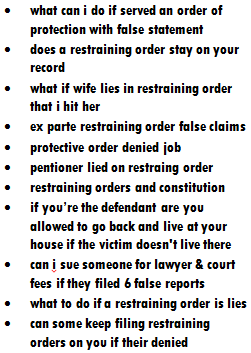
These are some search terms that recently drew readers to this site:

  • how can a person just make stuff up in a personal protection order
  • female stalkers and false allegations
  • lie to get restraining order
  • indiana cps false reporting
  • the consequences of lying to obtain a tro in nj
  • permanent restraining orders based on lies
  • if someone threatens you with a pfa and is lying is it libel

What they imply are personal attacks and procedural abuses, kinds of them that daily confound lives yet seldom reach the public’s awareness, whether because victims are ashamed to discuss them or afraid to.

As prior posts have noted, the court tends to view criticism of legal abuses as abusive, so engaging in it is dicey. Appreciate that it’s next to impossible—and virtually pointless—to air grievances about courthouse misconduct without identifying whose behavior is being complained of, what s/he or they have done, and why.

Criticism of people who’ve falsely testified in a public forum and on public record is protected speech, so long as that speech is about them and not to them, and doesn’t contain falsehoods, threats, or sensitive information that might qualify as invasive to privacy. What someone has aired in court under oath is not private, particularly if the testimony is criminally perjured.

Restraining orders, though, are prejudicial instruments that explicitly or implicitly identify defendants as “stalkers” or “harassers.” So those who criticize their issuance are vulnerable to having their criticism interpreted as “further” harassment, despite authorization by the First Amendment…and despite the fact that the original claims against them may have been false to begin with. (Such claims may be established in minutes and on no ascertainable basis other than some finger-pointer’s say-so.)

Adding to the obstacles that critics of process face is that search engines may censor them, particularly if an order of the court can be provided that states or suggests writers are prohibited from speaking about a particular person or persons. Such an order is called a prior restraint, and it’s unlawful. Trial judges aren’t First Amendment experts, however, and orders aren’t hard to obtain, and can even be issued ex parte (i.e., without a trial).

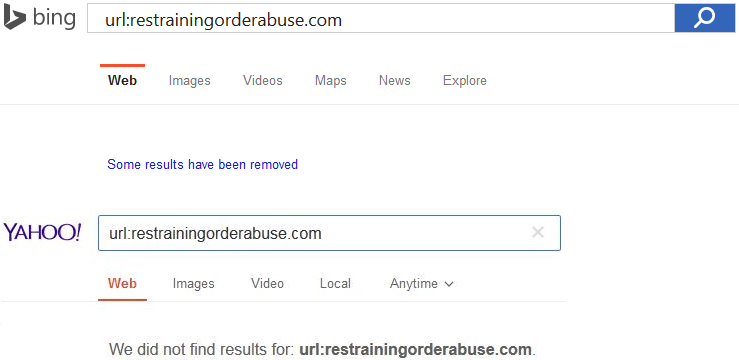
censorship by Bing, censorship by Yahoo, search engine censorship

While this blog has existed for over four years and has been viewed more than 300,000 times this year, it isn’t cataloged on Microsoft’s Bing or on Yahoo (though it was prior to its author’s being sued by his false accuser in 2013 for “libel and harassment”). Whether administrators of these search sites unilaterally opted to “delist” the blog from their returns, or whether the blog author’s accuser(s) insisted that they do, I don’t know. It may be that the blog was determined to be “misogynist,” “defamatory,” or to otherwise traffic in or host “hate speech.” They’re easy allegations to put over.

Eugene Volokh, eminent First Amendment scholar and UCLA professor, would clarify that censorship can only be committed by the government.

Nevertheless, Wikipedia has a page titled, “Censorship by Google,” and Bing has been censured for “censoring” returns according to certain search criteria. ElephantJournal.com, for instance, explains “Why We Should Boycott Bing”:

[C]onduct the search with the simplified characters used in mainland China, then you get sanitized pro-Communist results. This is especially true of image searches. Magic! No Tiananmen Square massacre. The Dalai Lama becomes an oppressor. Falun Gong believers are villains, not victims.

Elephant Journal links to a New York Times editorial by Nicholas Kristof (similarly titled) that inspired its condemnation.

Application, then, of the word censorship to “selective revision” of or the delisting of websites from search engines’ returns isn’t without strong precedence. See also:

Search engine “censorship” is brought to the attention of this audience to emphasize the importance of airing stories of court injustice. Policies and perceptions have been prejudiced for decades by violence rhetoric, and vital to motivating a reassessment of politically biased positions is challenging them and contradicting them with evidence and personal narratives of abuse.

Today, it’s an act of subversion and nonconformity even to voice misgivings.

When complaints of courtroom travesties become “normal and everyday” instead of “suspect,” then process itself will come under scrutiny instead of the people whose lives have been trashed by it.

Copyright © 2015 RestrainingOrderAbuse.com

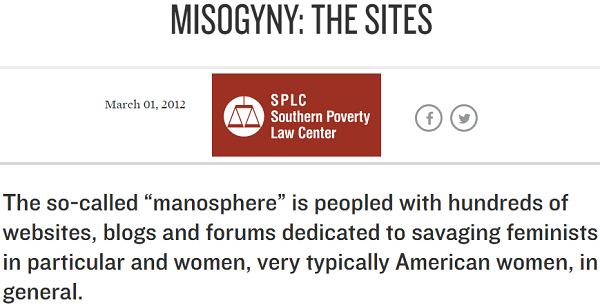
*The Southern Poverty Law Center (SPLC) has identified sites that vehemently criticize legal abuses as sources of “hate speech.” Consider, then, what consequences a proposal like this, meant to disrupt terrorists, could have over time: “‘Spell-check for hate’ needed, says Google’s Schmidt” (BBC).

God Can’t Change or Put a Time Limit on Truth, but the Court Can: “Solid Evidence” of Fraudulent Allegations Doesn’t Matter

“I have solid evidence that my wife filed a false restraining order against me, and I can’t get anyone to even consider looking at it. In fact, and I kid you not, I was told if I don’t let it go, I might be charged with harassment!

“America is such a bullshit nation! I’m moving back to China. At least Chinese are upfront with their bullshit.”

—Blog respondent

It’s hardly uncommon to hear it remarked that judges like to play God. Their power within the shoebox theater called the courtroom is absolute. If judges violate the law, they may face consequences later…but only later and only maybe.

There’s a notorious case of a judge’s actually masturbating in his courtroom for years before anyone nerved up and called him on it…and that was only because he was using a device to pleasure himself that was audible to members of the gallery. His staff had witnessed him stimulating himself and said nothing.

Beyond lording it over everyone while possibly considering themselves above the law, though, judges arrogate to themselves superpowers even God doesn’t possess. For example, they place a time limit on the truth.

Appreciate that a preliminary ruling in a restraining order case may be determined in three minutes; a final ruling in 10. Both rulings, what’s more, may be determined without a judge’s even having heard a word from the accused. A final ruling can be formed by “default” if a defendant, who may reside in another county or state, misses his or her court date. Some states (Arizona, for instance) don’t even require a final ruling. Unless the accused formally requests an audience before a judge, the preliminary (three-minute) ruling stands. (In New Jersey, there’s a precedent on the books that allows a judge to enter an “indefinite temporary” restraining order without anyone’s showing up to court at all.)

Defendants are afforded a few moments, if they take advantage of them, to try to convince a judge of truths that may contradict the allegations against them, and that’s it. After that, the truth not only ceases to matter; it ceases to be the truth. The court’s rules supersede those of natural science.

An appeal to a higher court may be filed, but that court doesn’t concern itself with the facts of the case; it just determines whether the lower court clearly abused its discretion. The appellate judge determines, that is, whether the trial judge violated ethical rules or the law.

In “courtland,” ignoring the truth isn’t unethical or illegal; it’s protocol. Finicking about what’s true and what isn’t, and whether what’s true is more important than what might be true—that isn’t an economical use of the court’s time.

Nonresidents of courtland—those spoilsports—may be resistant to the notion that truth is irrelevant, that it has an expiration date, or that it can be transmuted to untruth by the fall of a wooden mallet. Because there’s no procedure to exploit to reassert truths that have been discounted or denied, however (or any audience who would care), and since the regents of courtland can’t permit the legitimacy of their sorcery to be questioned, it’s necessary for them to threaten or punish the unruly (see the quotation above).

~SUMMARY~

A perfectly normal, upstanding, productive person can be falsely accused (of anything: threats, sexual deviancy, battery, rape…anything) in a three-minute audience with a judge. If, in the subsequent few minutes s/he may be afforded to defend him- or herself, s/he’ s unable to persuade the court that the truth is more urgent than a liar’s lies, then the truth becomes the lie, and the liar’s lies become the truth, which is mechanically entered into various databases to “safeguard the public interest.”

According with this act of alchemy, the perfectly normal, upstanding, productive person is punished and may consequently become abnormal and socially apathetic. S/he may also be deprived of the livelihood, family, etc. that had formerly motivated his or her productivity.

If s/he publicly objects to this result, which can’t help but gnaw, by daring to call it “unfair,” “unjust,” or “wicked,” for instance, s/he risks punishment, too, for this act of nonconformity. Laws are invoked to label him or her a “stalker” or “harasser,” and s/he may be jailed.

This is why a person like the speaker of the epigraph may express greater faith in a Communist country’s “rule of law” than in our own…and be right to.

Copyright © 2015 RestrainingOrderAbuse.com

*It’s also “Why People Who’ve Been Falsely Accused ‘Blog’.”

Why People Who’ve Been Falsely Accused “Blog”: A Tutorial for Judges

An absurd notion seems to prevail in the minds of men and women of the court—many of whose familiarity with the Internet begins and ends with shopping for bargains on eBay or Skyping their grandkids—that people who “blog” about being abused in court have nothing better to do.

No, they do it because they’ve been screwed, blued, and tattooed, and the peace of mind needed to do what they’d rather be doing has been denied them.

Their sanity, dignity, and good names, if not their children, have been sacrificed to the false idol of justice. They’ve been railroaded through one or more gimmicky, derelict procedures that confounded their lives for nothing…excepting politics, that is, and cash.

(Seriously, what pinnacle of pretense does a person need to surmount to entertain the idea that someone would expend dozens, hundreds, or thousands of hours decrying inept, lopsided policies of law merely because s/he was “miffed” or “disappointed”? )

Demonstrating the ability to write isn’t proof of anything but the attainment of a third-grade education.

Wake up and smell the Folgers: Not everyone knows to or has the means to enlist a lawyer to swat down some false or hyped allegations whose only ascertainable basis is that they were scrawled on a bureaucratic form in 10 minutes with a Bic Round Stic by someone displaying anxiety.

If you’re a veteran of process, you know very well the obstacles people face (even if they have representation) in disentangling themselves from accusations after a judge has once signed off on them. Tell yourself what you want, but this isn’t deliberative stuff (an order of the court can be delivered sooner than an order of waffles at Denny’s).

This stuff is, however, saprogenic. That’s a fancy word—and we know judges favor fancy words—that means producing decay and putrefaction.

What may be a few moments of your workday can profoundly influence years (or all) of a person’s life. It can hasten a body into the grave.

If this is news to you, that’s probably because you began your career before a medium existed in which the legally abused little guy could publicly air his or her grievances. That doesn’t mean you haven’t been arbitrarily trashing lives all along; it just means you didn’t have to hear about it before.

Probably you felt securer on your pontifical peak before casualties of slovenly adjudications could complain about them.

Probably, too, that’s why orders of the court are routinely issued that prohibit the exercise of free speech by complainants of procedural abuse, orders that have recently fallen under stern scrutiny.

The reason people “blog” or “video-blog” (“vlog”) is that the courts fail them, and the court’s miscarriages exact a grave toll that endures and compounds over the months and years. The victims of those miscarriages live in limbo, and speech is the only recourse left them to air truths the court disdained, ignored, edited, or quashed.

Copyright © 2015 RestrainingOrderAbuse.com

*Doctors may get to bury their mistakes; judges don’t. “Public record” doesn’t mean only as public as you want it to be.

Bruce Aristeo, NJ, New Jersey, indefinite temporary restraining order

New Jerseyite Bruce Aristeo was cited for violating an “indefinite temporary restraining order” for, among other things, using his accuser’s image and that of her “pet Belgian Malinois.” He has been arrested at least four times.

Legal Abuse and “Learned Helplessness” (Including Commentary on the Mythical Value of “Taking the High Road”)

“Learned helplessness is behavior typical of an organism (human or animal) that has endured repeated painful or otherwise aversive stimuli which it was unable to escape or avoid. After such experience, the organism often fails to learn escape or avoidance in new situations where such behavior would be effective. In other words, the organism seems to have learned that it is helpless in aversive situations, that it has lost control, and so it gives up trying. Such an organism is said to have acquired learned helplessness. Learned helplessness theory is the view that clinical depression and related mental illnesses may result from such real or perceived absence of control over the outcome of a situation.”

Wikipedia

I introduced this psychological theory to a judge in 2010 when I filed a lawsuit against a woman who falsely accused me to the police and multiple courts in 2006. The accusations began in March, and before the close of July, she had defrauded at least four judges.

To be falsely accused is bewildering; it savages the mind. To then learn that efforts to expose the truth are met by judges not with keen interest and probing questions but variably with mute indifference, scornful derision, and offhand dismissal—that’s to have it firmly impressed upon you that resistance is futile. Worse, it’s to learn that resistance compounds the frustration and pain.

The system isn’t on your side, and bucking it for many is just an invitation to be scourged afresh.

After attempting some direct appeals to people who, I reasoned, might care more about the truth than the court did (2007), then writing about the business online (2008), then employing an attorney to mediate a resolution (2009), all of which efforts were met with stony silence, I filed a lawsuit (on my own).

That was in 2010. By then, unknown to me, the statutes of limitation on the civil torts I alleged—fraud, false light, defamation, and intentional infliction of emotional distress—had flown. My accuser’s attorney, with mock ingenuousness, wondered to the court why I hadn’t filed my suit in 2006, right after having had the court twice swat down my appeals.
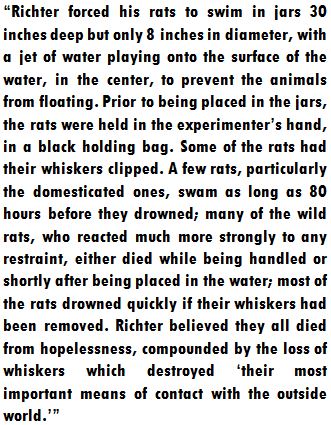
learned_helplessnessI offered the explanation to the judge that people who go through this become conditioned to helplessness (or hopelessness), because process militates against the proposition that a claimant of abuse has engaged in deception. The righteous indignation and outrage of the wronged defendant gradually succumb to the inevitable conclusion that facts, truth, and reason are impotent against fraud and judicial bias. (The defendant lives besides under the constant menace of unwarranted arrest.)

I didn’t know I could prosecute a lawsuit on my own until a legal assistant told me so in 2009, which I also told the judge. I might have been motivated to find out sooner if I’d had the least faith that a judge would heed my testimony.

My accuser’s attorney disdained the explanation for my tardy filing as “self-diagnosis,” and the judge eagerly echoed his assessment and dismissed the case (the court’s interest is in economy, not truth or justice). What was another six months of my life? (Letters from a physician and a therapist, along with witness affidavits, including one from a former cop, made no difference.)

I wasn’t wrong, though. People who defy a rigged system—whether restraining order defendants, domestic violence defendants, or family court defendants—can be conditioned to helplessness, and many accordingly report experiencing posttraumatic stress (which fortifies their distrust and their aversion to further rude scrutiny and contemptuous treatment from the court).

A lesson to take from this is that the “high road” (i.e., trusting in facts, truth, and reason) is a detour to hell. If I had known in 2006 what I know today, I could have extricated myself from my accuser’s false accusations in five minutes by playing the game according to her rules, which were “whatever works.”

The studies from which the term “learned helplessness” emerged were studies of drowned rats and tortured dogs. Playing fair (or aspiring to saintliness by never uttering an ill word against your accuser) is noble, but nobly drowned is still drowned. If an accuser lies about you, denounce him or her as a liar. Similarly, if a process of law is bullshit, call it what it is.

Some respondents to this blog, even after they’ve been through the courthouse ringer, retain a beleaguered faith in ethics. They believe that if injustice is laid bare to a discerning audience by rhetorical appeals to reason and decency, this will spur change. “Our objective is to fix the problem, not the blame” was quoted in a recent comment.
The abstract and impersonal may be informative, but they don’t arouse curiosity, because they don’t inflame the passions; controversy does. Advocates of the “high road” eschew naming names, for example, because it’s aggressive. Avoidance of confrontation, however, accomplishes little and exemplifies “learned helplessness.” The “high road” is safe and tame, and it leads to a dead-end.

The reason restraining order abuse endures is that the abused are paralyzed by indecisiveness. They won’t knuckle down and demand that a flawed process be repealed.
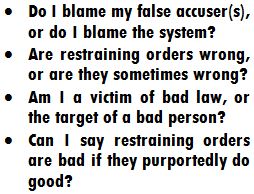
Among people who’ve been damaged by fraudulent abuse of restraining orders and related civil court procedures that are supposed to protect the defenseless, you’ve got, for instance, your liberals who’ll defend the process on principle, because they insist it must be preserved to protect the vulnerable, and they’ll fence-sit just to spite conservatives who flatly denounce the process as a governmental intrusion that undermines family.

Liberals and women who identify with legitimately victimized women feel obligated to “negotiate the gray space” and acknowledge the pros and cons of “women’s law.”

Then you have people (of whatever political allegiance or none) who believe that if you eliminated procedural inequities and ensured that defendants’ due process rights were observed, the system would work fine.

Maybe they believe a process that allows a person in Nevada to mosey into a courthouse, fill out some forms, and accuse a person in Wyoming of “stalking” or “domestic violence,” necessitating that the person in Wyoming hustle him- or herself to Nevada to present a defense within the week, can be made fair, and maybe they don’t know that the same Nevadan can prosecute the same claim over and over against the same Wyomingite (three times, six times, a dozen times, or more).

Maybe they believe that appeals to public conscience will urge the passage of laws that require free legal counsel be provided to defendants.

This would mean that if, say, a million restraining orders are petitioned a year, and legal representation for each defendant in each case could be capped at $2,000 (which might translate to a feeble defense, anyway), state governments would be required to shell out $2,000,000,000 to make everything “fair and square.” But that’s not all. If government gave free representation to “abusers,” advocates for “victims” would demand the same for them. So your $2,000,000,000 would become $4,000,000,000.

That’s per annum. (Also, the hypothetical Wyomingite would still need to travel to Nevada, and who’s paying for that?)

Others believe that if lying (perjury) were prosecuted, that would straighten things out. The costs to prosecute what may be hundreds of thousands of liars a year might be less than $4,000,000,000…or it might not be. Too, how do you prove someone is lying about an emotional state, like “fear”? How do you prove an alleged event didn’t happen?

You can’t, not conclusively, which is what a criminal prosecution requires.

More say appeal to your senator, to the president, to the press…nicely and cogently. They follow a utopian faith that basic decency will prevail if “the problem” is exposed.

As a rhetorical stance, the position has its merits. It suggests calmness and rationality, and calmness and rationality should recommend attention from others. “We’re calm and rational,” proponents of the position imply, “so when we say there’s a problem in need of fixing, it’s calmness and rationality speaking, not anger.”

The limitation is that no one who needs to be convinced has a motive to listen. No one can be made to care about abstractions like equity and due process when in the other ear they’re being cited statistics about epidemic violence.

Everything to do with the law is adversarial. If you seek to revise it without being personal or confrontational, the soonest you can expect a just reward is in the afterlife.

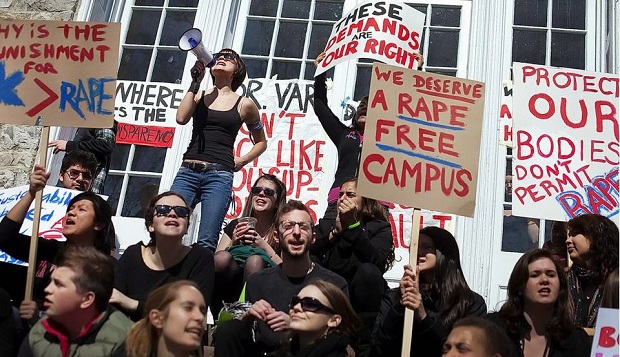
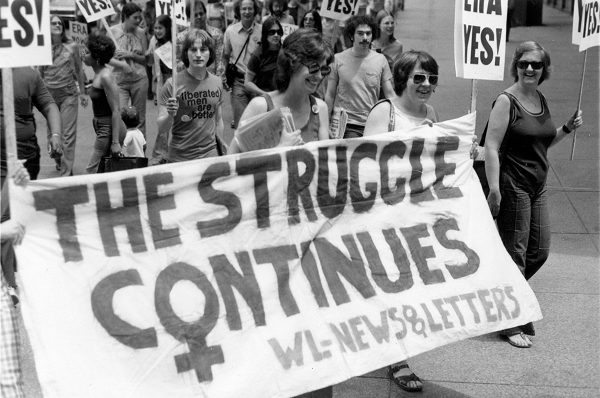
Protesters march on a SlutWalk in Newcastle

Copyright © 2015 RestrainingOrderAbuse.com

*Splendid writers, particularly Cathy Young, have responsibly and lucidly exposed “the problem” for 20 years in major news outlets. The system has responded with statutes that are broader, laxer, and more punishing.

Another Way False Testimony Is Concealed: The Unconstitutional “Prior Restraint”

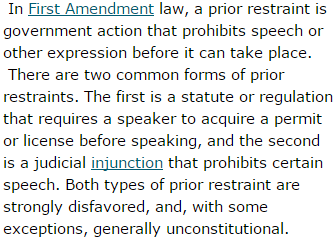
Courts are properly authorized to sanction acts of defamation—publicly lying about someone—but they’re not authorized to prohibit truthful speech or opinion (even if it’s negative), and they’re not authorized to prohibit speech acts before they’ve even been committed. An order of the court that prohibits future speech is called a prior restraint, and it’s unconstitutional (see the First Amendment).

With civil harassment orders, things get knotty. A prior restraint may not be expressed; it may be implicit.

Cornell, prior restraintWhen a “protective order” is in effect, it prohibits speech to someone but not speech about that person, per se, as law professors Aaron Caplan and Eugene Volokh have emphasized. A court, however, may conclude that speech about someone (any speech about that person) is “harassment,” and it may label that speech a violation of the “protective order,” and rule that a defendant be remanded to jail.

Several people have reported on this site that they were jailed or had orders of the court extended because of publications online or, in one case, for posting flyers about an accuser’s conduct. Many have reported, too, that the basis of the “protective order” against them was speech about a person (in one recently shared account, a woman complained on a county bulletin board about her neighbors’ shabby treatment of their dog).

So you have instances where people are issued restraining orders for lawfully exercising their First Amendment privilege to free speech, and you have instances where people who’ve been issued restraining orders are sanctioned for lawfully exercising their First Amendment privilege to free speech.

Trial judges aren’t First Amendment authorities and may not have graduated from college, let alone have law degrees. Furthermore, protecting the free speech of people they’ve labeled abusers is hardly an urgent concern of theirs.

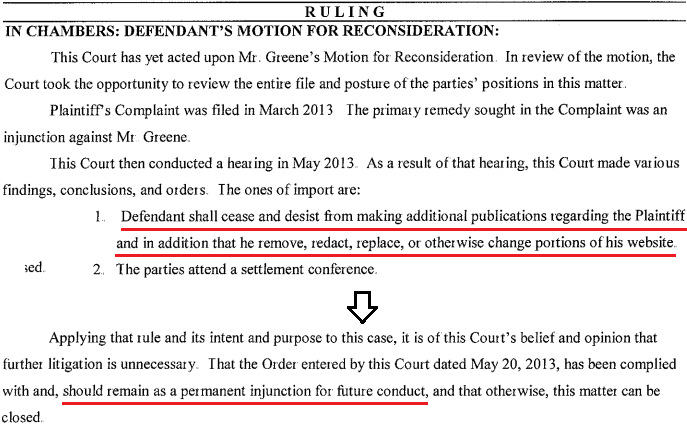
Here’s what a prior restraint looks like:

Arizona prior restraint order, First Amendment law

Orders like this don’t expressly forbid criticism of the government. They forbid criticism of people who exploited a process of government. This, by extension, forbids criticism of the government.

This order was issued against me in 2013 when I was sued for libel and harassment in the Superior Court of Arizona by a married woman who had falsely accused me to the police and several judges years prior. She was someone I scarcely knew who had hung around outside of my house at night (what that might suggest to you is what it should suggest to you). Her original claims to the court (2006) were to obtain an injunction to prohibit me from communicating her conduct to anyone, and her claims to the court in 2013 were to obtain an injunction to prohibit me from communicating her conduct to anyone.

The motive for both prosecutions was the same: cover-up. (Try to imagine what it is to fight false accusations for seven years, daily, while everything around you erodes, and then have some trial judge offhandedly tell you you’re lying and should be gagged. The judge had plainly made up his mind how he would rule before ever setting foot in court. The trial nevertheless dragged out from March to October. Today I avoid using the road where I rented the private mailbox to which the judge’s arbitrary conclusions and fiats were mailed, so nauseous is the association.)

Some of my accuser’s testimony is here, and the contradictoriness of her claims, as well as the motive for them, will be evident from no words other than her own. Does it matter that her misrepresentations are self-evident? No. Does it matter that they ridicule process of law and mock the court? No.

All that matters is that those who’ve been misrepresented are silenced to preserve the image of propriety.

Copyright © 2015 RestrainingOrderAbuse.com

Introducing the “Indefinite Temporary Restraining Order”

No, this isn’t satire, and Joseph Heller, author of Catch-22, didn’t coin the phrase “indefinite temporary.” It’s a capsular commentary on the state of our courts, however, that actual judges can actually use a phrase like this in actual rulings that affect actual people.

That these judges can actually get away with it says a lot about the state of our press, too.

The injunctive process is rife with oxymorons. Among this writer’s favorites is “speedy justice” (a phrase used by his own most recent judge to excuse carelessness). Restraining order courts are home to findings like “vegetarian stalker” and “handicapped batterer.” Trials in this arena operate in a vacuum (as law professor and former ACLU staff attorney Aaron Caplan observes); there is no oversight or accountability, and “meritorious” grounds for appeal are few, so judgments seldom receive scrutiny by the higher courts at all, and published rulings are scant. (Appellate courts don’t rehear cases; they only rule on the conduct of judges. Patent absurdities and abject fraud may be winked at…and legally.)
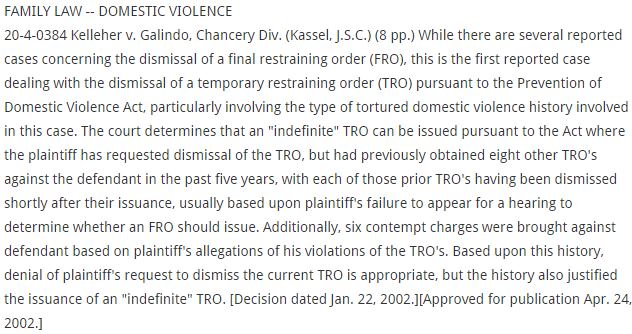
This post concerns a New Jersey family court ruling in the case of Kelleher v. Galindo. The case is 13 years old. That’s how asleep at the wheel our popular press is.

Follow the link to the case above, and the first sentence you’ll see in the ruling is this: “No appearance by Plaintiff. No appearance by Defendant.” That’s right, no one actually appeared in court, but a restraining order was issued anyway…an “indefinite temporary” one.

The plaintiff in the case petitioned nine restraining orders against the defendant between the years of 1996 and 2002, and in each and every instance, the order was dismissed, in most cases because “plaintiff [the person who petitioned the order] failed to appear at the hearing”; in a couple of cases, because she requested a dismissal.

The reasoning of the latest judge’s ruling runs thus (emphases added) and should be heard in the voice of a character from Alice in Wonderland:

This court has no doubt that if it were to grant plaintiff’s request to dismiss this most recent TRO [temporary restraining order], it would not be very long before plaintiff was back in the Cherry Hill Municipal Court seeking a tenth TRO against defendant.

[…]

It is this court’s opinion that, despite plaintiff’s telephonic request to dismiss this most recent TRO, the plaintiff’s past history of obtaining eight TROs against defendant in a five year period, all of which were dismissed prior to an FRO hearing [final restraining order hearing], along with six prior contempt charges filed against defendant based upon plaintiff’s allegation of violations of those TROs, all of which were likewise dismissed prior to an adjudication, justifies this court’s denial of plaintiff’s request to dismiss the TRO and instead justifies the issuance of an indefinite TRO.

There was no determined basis for an order and no basis for a ruling (in the absence of the litigants in the case). “Therefore” the judge, Michael J. Kassel, ruled that the latest temporary order be indefinitely sustained.

In the interest of economy, that is, the court determined itself justified in issuing an order contrary to the plaintiff’s express wishes and without any trial at all.

Copyright © 2015 RestrainingOrderAbuse.com

*The judge’s legal contortionism is illuminating. Because the judge couldn’t “justify” entering a “final ruling” in the absence of the parties but plainly wanted to, he circumvented the rules of civil procedure and made a “temporary” order permanent (instead of, for example, sanctioning the petitioner of the nine orders for “squandering judicial and law enforcement resources and diverting attention from urgent and meritorious domestic violence matters”). This provides other judges with a precedent to cite to justify violating other defendants’ due process rights, limited as they already are in this process.

Court-Abetted Trespassing, Burglary, Larceny, and Embezzlement:  A Terminally Ill Man’s Story of Restraining Order Abuse

“I know the purpose of the site is to decry the injustice of being falsely accused. Just have some sense of proportion, please. It’s terrible to be falsely accused. It can have many horrible consequences. It’s still light years away from being raped.”

—Comment submitted Friday

I believe the man who gives the account that follows would agree with the commenter quoted above. The blog’s author, however, rejects the commenter’s absolutist stance, because the categorical privilege granted to female claimants of violence is what enables wanton violations like the one detailed below, a violation that is denied its due by a dismissive word like “terrible.” The man whose story ensues is living what may be his final days in penury, alone in an empty house. The responses he’s received from the court, from the police, and from attorneys have been conditioned by the conviction expressed above, namely, that psychological violation and vicious privation are “light years away” from physical violation.

The man has, in short, been stripped of everything based on a false allegation of violence, and he’s been told, “That’s tough.” Because of the prejudicial nature of the court order that was fraudulently obtained against him, his bank has refused his request for reimbursement of his savings. Although he was fully exonerated, he has no credibility and no recourse except to quietly die.

William Batson, who says he has been informed by his doctors that he may have only months to live, was barred from his home and then robbed of all of his money and personal property consequent to the issuance of an ex parte restraining order against him petitioned by a person he had never met who represented him to be a batterer.

All the court required to legally authorize the theft of all he owned was a fake narrative of violence.

William’s story (edited for readability):

The difference between other crimes that people are falsely accused of and false DV [domestic violence] accusations is this: All of your rights—to be heard, to face your accuser, and others—are completely circumvented, and the mob that is Rome will get its loaf of bread and its quart of blood whether it’s right or wrong.

I never even met the person who accused me. My DV charge had a special attachment: ex parte election order with all property and financials given to the accuser instantly with nothing more than an accusation.

By the time I made bond, I was not allowed in my own home. I finally convinced the magistrate with witnesses that I lived alone, etc., and upon entry into my home 15 days later all the contents were gone, all bank accounts were drained, and $13,800-plus in forged checks is still owed.

I got an immediate dismissal with prejudice from the court and a too-bad and angry attitude from law enforcement. They helped this person rob me. I can’t sue the police, and no lawyer will even get near it. Before, I had a 814 credit score, $49,000-plus in possessions, $25,000-plus in savings and checking, and they would not even write a letter to the bank so I could get the money returned.

[…]

I will never recover financially or physically. I had cancer that was in a nine-year remission. The last time I bothered to listen, I was told I was stage four and might make it to Christmas. I’m not bitter, and I wish no ill upon any. There was a reason our country was founded and its constitution was written the way they were. This is merely one example of why. There will always be someone who changes something for a stated good cause merely to devour others with its use.

Amen, good luck, and I wish you all well.

Copyright © 2015 RestrainingOrderAbuse.com

The Rape Victim’s Trauma in Court Is the SAME Trauma Experienced by the Falsely Accused

“[Tina] Renton still has nightmares about her time in the witness box. ‘During the day I can cope with it. In my sleep…. You can’t control your subconscious.’ She dreams of ‘running and never being able to find anyone able to help you’ and of ‘standing in court, people laughing at you, but you don’t know why.’”

Amelia Gentleman, the Guardian (April 13, 2013)

Above are the words of a woman who was the prosecuting witness in the rape trial of her stepfather.

Below are the words of a man who was repeatedly accused by a prosecuting witness (his estranged wife and the mother of his children):

I couldn’t flee and I could not fight. I was never going to be allowed to heal or recover. I wish I were better at articulating the psychological and emotional trauma I experienced.

I could fill a book with all the lies and mysterious rulings of the Court. Never have I experienced this kind of pain. I asked for help, but good men did nothing and evil prevailed.

Correspondences between the man’s and woman’s statements are obvious, as are contrasts between the man’s and woman’s treatment under the law.

The woman prevailed in criminal court. She also authored a book. The man was hectored in family court until he killed himself, and his wife obtained a court order granting her the intellectual property rights to his final words, which she attempted to expunge from every nook and cranny of the Internet.

Tina Renton, quoted in the epigraph, accused her stepfather of “raping and assaulting her multiple times during her childhood,” and a jury found him guilty. The trauma Ms. Renton describes, however, isn’t the residue of being physically violated by a parental figure years before; it’s the aftereffect of being psychologically violated in court.

She defended herself and was taunted and denounced as a liar.

“It is hard being accused of being a liar,” she says. “I would never have put myself through the trauma of a court case if it wasn’t true.”

Her stepfather was sentenced to 14 years. Still Ms. Renton reports having nightmares about her experiences in court, and certainly no feminist is going to contradict her claim of trauma.

Why, then, are feminists the most adamant critics of those who allege they’ve been falsely vilified or persecuted in civil and family court (where there is no standard of proof)? Is it reasonable to argue that being falsely called a “liar” is more traumatic than being falsely called a “stalker,” “wife batterer,” “child abuser,” or worse? If feminists understand the trauma described by Tina Renton and sympathize with it, why are they the most unyielding obstacle to reform of restraining order and domestic violence laws that make false accusation easy and rewarding? Ms. Renton, a woman, very plausibly says she was caused lasting injury by being falsely accused of lying. Yet some feminists assert that a man’s being falsely accused of rape is insignificant. How is this not only hypocritical but heinous?

When it’s asserted that rape victims face “being raped all over again” in court, what’s meant is that they face being lied about, misrepresented, defamed, badgered, and shamed. They face, in sum, being falsely accused.

This is compared to being raped.

It must be appreciated that those falsely accused in civil or family court (women among them) are traumatized by exactly the same treatment (including by their judges), and many of them may also have been abused by their accusers, including violently. Moreover, the abuse they receive in and from the court may be aggravated (exorbitantly) by having their children taken from them, being cast out of their homes, and/or being forced to pay their false accusers’ living expenses.

Feminists seem to have no difficulty imagining the psychic scars caused to rape victims by being denounced and disparaged in criminal court.

For feminists to identify with complainants of false accusation in civil and family court, then, they need only imagine what it would feel like for those rape victims to be forced to surrender all they value to their abusers and pay them for the privilege of being lied about and publicly humiliated.

Copyright © 2015 RestrainingOrderAbuse.com

*The quoted Guardian story includes a case of a woman who prevailed in court but nevertheless committed suicide. “Her son, Oliver, told a newspaper how profoundly the cross-examination had affected her.”

How Restraining Orders Make American Civil Procedure Contemptible (Russian Teacake, Anyone?)

  1. Accusers are presumed to be truthful, so it falls to the accused to prove they’re innocent. Accusers are charged nothing to file a complaint, which requires only a few moments of time, and face no risk of prosecution if the complaint is false. Preliminary rulings are formed in backroom meetings between judges and accusers alone.
  2. If an accuser is represented by a lawyer, who is an “officer of the court,” the presumption that whatever is alleged is trustworthy doubles, because lawyers are honest, scrupulous, and would never represent a false claimant to turn a buck.
  3. Accusations may be filed in any jurisdiction in the country, and answering accusations made in a county or state other than the one s/he resides in requires that the accused appear in that county or state, possibly within days. If s/he fails to appear, a default judgment against him or her will be entered (possibly signifying, for example, that s/he’s a stalker or child molester).
  4. Once a ruling is formed, whether by default or in what may be a 10-minute hearing, it’s final and immune from collateral attack. Allegations are deemed “decided” (res judicata) and may not be controverted in a further prosecution, even if it can be plainly shown that they were criminally perjured.
  5. A judge is entitled to rule according to what s/he “deems best,” irrespective of the truth, is insulated him- or herself from prosecution, and may award to an accuser sole use of a residence and vehicle, permanent custody of children and pets, a monthly stipend, and complete remuneration of attorney fees (to be paid by the accused).
  6. This is deemed equitable and just, and further warrants the permanent entry of the accused’s name in state and federal police registries and, in cases, a publicly accessible database.

Copyright © 2015 RestrainingOrderAbuse.com

“Somebody Do Something to End This Madness!”: One Commenter’s Appeal for Restraining Order Reform

A comment Wednesday resonated with the author’s experiences of legal abuse and many others’. It said its writer’s life was trashed because he showed compassion for another. He exhausted his savings to help his ex-wife out of a fix, flying out to California from Colorado on a day’s notice. Five years later, having lived with the aftereffects of legal madness every day of the interim—which included appeals in another state, postponements, and a five-year restraining order extension—he says he feels his life is “over.” Of particular note is that the apparent instigator of the fraudulent restraining order petitioned against him was his ex-wife’s son; the son allegedly threatened to turn his back on his mother and evict her from his home if she didn’t comply with his wishes.

The commenter’s account:

[In] 2010, she calls me in Denver [Colorado], where I had a two-bedroom apartment, crying the blues that she had a big fight with her boyfriend, and requested to stay with me for a little while. I gave in as we were married for 23 years and had remained friends.

I fly out to San Jose [California] the next day, and we drive directly from the airport to U-Haul, pick up a truck, and are on the road in a couple of hours. Five days later, I move her into her own bedroom and put her furniture in storage.

Things went fine until she wanted this dog up in Wyoming that had some issues.

We drive up to get the dog and then after getting it home, I find out the issues—the dog would just pee on the carpet at random. I told her the dog had to go. She’s not happy, but we surrendered it to the local shelter.

Next thing I know, there is a knock on the door with her son ready to drive her back to San Jose.

Not a problem until two weeks later when the sheriff delivered the TRO [temporary restraining order] that stated I had to give up my guns and appear in San Jose at a hearing in seven days. “Why?” I asked. “Don’t we have laws in Colorado? Shouldn’t the case be tried in Denver?” Apparently not. I lost that argument.

I went to San Jose, had a 10-minute hearing in front of—what else?—a woman judge. My ex had a lawyer [thanks to] the good old folks at VAWA providing the funding. I [checked with] over 30 attorneys, and no one would touch the case pro bono (she took any spare money I had moving her).

Then we found out that she can talk to me; I just can’t talk to her (great system).

We found a way to communicate…through the Internet on one of those game shows. We would pass notes back and forth. She did not have a problem with that. The son found out and over his IPhone requested an extension on the court order.

Turns out, truth be told, that the son was the one who wanted her to get the RO. She never had any intention of doing such a thing. The son apparently was angry because he asked me what happened between his mother and me. I responded by asking him if he was sure that he really wanted to know the truth about his mom. Well, I told him the truth. I told him that his mother was screwing around on me every chance that she had.

That did not sit well with him. So here we are…RO. Every lie in that first and second complaint was written by him. He forced his mother to go along with it by threatening that he would not want her to be around him anymore and that she would have to move out of his house.

With all the postponements, when we finally got a ruling on the attempt to continue the first RO, which only had two weeks left on it, the judge, a new woman judge, ruled against me. She would not even let me speak.

So, long story short, after all the delays in between the appearances, I now received an additional five-year RO causing my total RO to be about 7 years.

I don’t give a shit whether I ever see her again, but I thought that this was a country of laws. There was never any violence between us. Yet this judge violated my Second Amendment rights once again.

So…lesson learned: Never even raise your voice to your significant (???) other. When she finds out how much money she can get out of all the federal funding, inclusive of cars, a place to stay, educational programs, etc., etc., she will come after you without a second thought.

The entire law is wrong. It violates [the First, Second, and Sixth Amendments, and probably others]. And the worse part of it is that any woman you want to date is going to plug your name into the Internet before she considers going out with you. Or her son or daughter or girlfriend will…just because they want to make sure she’s not going out with a “bum.”

My life is over. I have no social life [and] no place to turn. Not one lawyer will help. Not one congressman or senator will go against all the women who started all of this in 1994. And why? The only reason that I can come up with is that they don’t want to get “cut off.” They have no balls and couldn’t care less about what is right or wrong.

This is a bad law. I think if I remember the VAWA statute correctly, the phrase man or men is mentioned one time. I am for anyone who has any ideas on how to overturn this law and at least give us our “rights” back. I can understand it if you are a wife-beater or something like that, but the word harassment is so ambiguous. How can any judge make an honest decision?

Please, everyone, chime in. This could happen to you! If your wife gets an RO on you, you are in “the system.” You no longer will have a job, friends will shy away from you, and even your own family will distance themselves from you.

SOMEBODY DO SOMETHING TO END THIS MADNESS!

Please.

Copyright © 2015 RestrainingOrderAbuse.com

*The anonymous commenter’s remarks began: “I will be more than happy to pay any attorney to get my Santa Clara County, California RO taken off of the Internet!”

Litigation Privilege: Why Restraining Order Fraud Is Pandered to and Why the Falsely Accused Are Denied Recourse to the Law for Vindication, Relief, and Recovery of Damages

“Fraud is deliberately deceiving someone else [including a judge] with the intent of causing damage.”

Cornell Legal Information Institute

“Generally, lying during trial (or any other part of litigation) is expected to come out at the time of trial. This means an action against someone for lying during a prior proceeding would fail because even lies are protected by the litigation privilege. You have to catch them at the time; you cannot attack them collaterally (in a different proceeding).”

Attorney Catherine Elizabeth Bennett

Here are examples of restraining order fraud and repeated abuse of process (others are here and here, and comments and posts on this site are replete with them).

Here is the obstacle to obtaining relief from fraud committed by restraining order petitioners that the falsely accused face no matter how high up the judicial chain they muster the fortitude to climb:

  1. So-called protective orders were designed to allow battered women to apply directly to a judge for relief from household violence and intimidation. Their origin harks back to the late ’70s/early ’80s. When these orders were conceived 30 or 40 years ago, domestic violence was hush-hush, and (actual) victims faced alienation from their families for airing dirty laundry in public and rocking the boat. They faced, as well, the possibility of their claims’ being discounted by police or even ridiculed (compounding their misery and humiliation). So the middlemen (i.e., cops and prosecutors) were cut out of the process. Thus could allegations be made and ruled upon in the absence of any investigation. It seemed a reasonable stopgap at the time. Over the decades since, despite radical changes in how claims of domestic violence are received by the public and law enforcement (due in no small part to the investment of billions of federal tax dollars), the standards for substantiating an assertion of victimhood remain lenient, while what qualifies as grounds for a court injunction has steadily broadened. People now get orders against their friends, lovers, neighbors, moms, dads, kids, etc., and violence need not even be alleged; some claim of apprehension usually suffices. The process has morphed from a life-preserver for battered women with no other way out of a hellish situation to a sop to satisfy any complainant who fills out an application. Court policy pretends that anybody who walks into a courthouse with a beef (real or not) deserves a private audience with a judge to shield him or her from the terrors of public scorn or disapproval from the cops. Anyone with an ax to grind, that is, is treated like a battered woman circa 1979. So institutionalized has the process become, and so profitable to so many (both financially and politically), that no one questions whether this is ethical. So the restraining order process has become a game, a game played according to anachronistic rules. Maximum latitude is given to anyone (no fee or i.d. required) to litigate any claims s/he wants in a backroom conference with a judge, and rulings are issued ex parte, which means the person who’s accused is prejudged sight unseen. The due process rights of the accused are scotched. Grants under the Violence Against Women Act will explicitly forbid the use of lie detectors. The dictate is purely rhetorical; it’s meant to stress that what a complainant alleges shouldn’t be doubted. This expectation extends to any petitioner. Hence judicial scrutiny is minimal, and judges may actually bristle when the falsely accused allege that petitioners are lying. This is called fair and just.
  2. The idea behind “litigation privilege,” which basically ensures that whatever a litigant or his or her attorney alleges is protected from liability (from charges of defamation, for example), is the same: Accusers need to feel secure to air “the facts” without fear of prosecution.

The protections sketched above were not put in place to defend the right of any fraudster to falsely allege anything off the top of his or her head against a target of malice in a court of law. Perjury, after all, is a statutory crime. Lying isn’t condoned by the law, but it is swallowed by cops and defended by judges.

They’ve had their priorities impressed upon them in no uncertain terms.

So emphatic is the priority to give accusers the benefit of the doubt that people who’ve been wrongly accused have little or no credibility with judges and absolutely no recourse to sue for damages caused by false allegations (to reputation, employment, enjoyment of life, and health). The court doesn’t recognize there are any damages to being falsely accused of stalking, for instance, or violent threat, sexual harassment, assault, or even rape. False accusations that are dismissed as baseless are harmful enough (the stresses they cause are beyond quantification). When false allegations stick, the guilt of the accused is presumed, and subsequent legal actions they may venture to undertake (lawsuits and appeals) may be summarily tossed for lacking merit. In contrast, the merit of rulings that are typically the products of procedures lasting mere minutes isn’t questioned. Some judges will even hold that accusations litigated in court can’t constitute perjury because of the “litigation privilege” (i.e., because they were uttered in court instead of on, say, Facebook or the radio, they can’t be lies).

Accusers (all of them identified with battered women of 1979) must be free to claim whatever they want without fear of risk or blame—that’s the overriding precept. Translated, this means the court’s position is that people must be allowed to lie and snooker the court as they choose…and anyone who’s lied about be damned.

Copyright © 2015 RestrainingOrderAbuse.com

*From “‘Out of Left Field’: The Litigation Privilege Defense to Adverse Party Suits” by attorney Keith A. Call (emphases added):

Despite some authority characterizing the litigation privilege as “absolute,” it is certainly not without limits. There are some claims for which the litigation privilege is usually not a defense. Such claims may include malicious prosecution, fraud, criminal perjury, suborning perjury, and professional discipline. See, e.g., Hagberg v. Cal. Fed. Bank FSB, 81 P.3d 244, 259 (Cal. 2004) (the litigation privilege “operates to bar civil liability for any tort claim based upon a privileged communication, with the exception of malicious prosecution”); Bushell v. Caterpillar, Inc., 683 N.E.2d 1286, 1289 (Ill. Ct. App. 1997) (litigation privilege does not provide immunity from criminal perjury); Hawkins v. Harris, 661 A.2d 284, 288 (N.J. 1995) (litigation privilege is not bar to professional discipline or criminal perjury); Dello Russo v. Nagel, 817 A.2d 426, 433 (N.J. Super. Ct. App. Div. 2003) (litigation privilege does not insulate against malicious prosecution or professional discipline); N.Y. Cooling Towers, Inc. v. Goidel, 805 N.Y.S.2d 779, 783 (N.Y. Sup. Ct. 2005) (refusing to dismiss claims against adverse party’s attorney based on fraud and collusion); Clark v. Druckman, 624 S.E.2d 864, 870-72 (W. Va. Ct. App. 2005) (litigation privilege does not immunize attorney from claims of fraud or malicious conduct).

Naked Wrestling for a Cassette Recorder: What Does a Protection Order Affidavit Look Like?

“Finally, we asked the men about other behaviors that their women partners might have used that could be considered psychologically aggressive. Specifically, 67.2% reported that their partner falsely accused them of hitting or beating her; 38.7% reported that she filed a restraining order against him under false pretenses; 48.9% of the men with children reported that their partners falsely accused them of physically abusing the children, and 15.4% reported that they were falsely accused by their partners of sexually abusing the children.”

—“A Closer Look at Men Who Sustain Intimate Terrorism by Women” (2010)

Incident rates of false allegations of family violence, it’s often casually reported, are no higher than incident rates of false allegations of other types of crimes. Figures are put somewhere between 2 and 8%. These figures are promulgated by parties who deny that lying about violence in civil and family court is significant.

The claimed correspondence between the frequency of false allegations of family violence and the frequency of false allegations of other crimes isn’t just wrong; it’s make-believe. False allegations of other types of crimes are litigated in criminal court. Often accusations of family violence (besides harassment, stalking, sexual harassment, and violent threat, among others) are not, and there are no “false allegations” in civil court. Rulings aren’t based on the truth or non-truth of allegations. They’re based on what the judges believe is probable. Allegations may be determined “baseless,” but they’re not called “false.”

Whoever says the rate of false allegations in civil court is X has just invented a convenient statistic that can’t be confirmed or confuted. Accusers aren’t going to admit it if they’d lied, so they’re not a reliable source of data, and court rulings are never stamped FALSELY ACCUSED.

The only way to estimate how much lying goes on is to ask people who’ve been accused if they’ve were lied about.

That’s what the researchers in the cited National Institutes of Health (NIH) study, Denise A. Hines and Emily M. Douglas did: They asked, and the answers they received place the figure at 67.2%, dramatically higher than 2 to 8%.

Those interviewed for the study were men in heterosexual relationships who reported being battered (i.e., men whose female partners were reportedly violent), and science forbids application of this statistic to other contexts. But it’s certainly suggestive. It could be that women who are violent lie more readily than women who abuse in other ways, but to contend that only violent women lie about fear and violence would be to beggar (or bugger) credibility.

(Men also lie about fear and violence, of course, but among complainants to the court, women outnumber men by a factor of four—80% to 20%, roughly. Also, domestic violence acts—from which restraining order laws originate—are “women’s law,” not men’s, and women’s advocates and feminist sympathizers are the political force behind it.)

We’re told that protection orders rescue women and children from environments of chronic violence. We hear that allegations of chronic violence may be false. What do allegations actually look like, and how does the process for litigating them work?

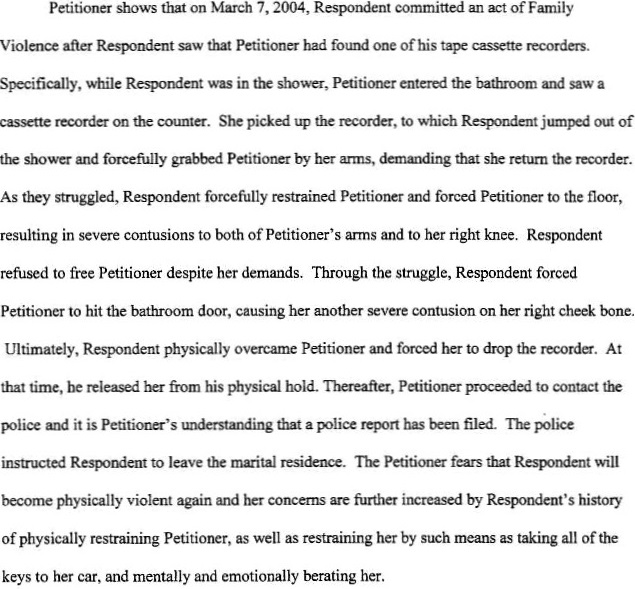
A commenter, Mark Shumate, recently reported that he was removed from his home based on this affidavit (i.e., narrative to the court), which he says was “perjured”:

protection order affidavit

According to this bizarre story, the man had “one of his cassette recorders” with him in the bathroom (maybe he was a collector of vintage tech and never went anywhere without it). His wife “found” the recorder—apparently by entering the bathroom while the man was showering. She then “picked up” the recorder her husband had in the bathroom with him. This inspired the husband to “jump” from the shower and wrestle her for it (rather than just pull it from her grasp), and the alleged tussle resulted in the wife’s sustaining “severe contusions” to both arms, her knee, and her cheek. In lay terms, that’s four bruises (contusions are bruises). What made them “severe” bruises isn’t clarified, nor is there an indication that the bruises were documented.

This is the wife’s account of something that may or may not have actually occurred.

The language is important: The wife is said to passively intrude on a private bathroom moment, while the actions of the man (who, according to the story, is presumably naked with shampoo in his eyes) are described in maximally inflammatory terms: “jumped,” “forcefully grabbed,” “struggled,” “forcefully restrained,” “forced,” “refused,” and finally “physically overcame.”

Naturally, none of what’s described was witnessed. The details are asserted; they’re not facts. The words are sufficiently gripping, however, to distract attention from the implausibility of the story they’re purported to recall (namely, that of a wrestling match in the john between a naked man and his wife over a tape recorder).

Based on this squidgy tale of an uncorroborated bathroom incident recounted in an ex parte petition for a family violence protection order prepared by a law firm, the wife was able to:

  1. have her husband removed from his home and ordered to not to come with 500 yards of it, his children, or his wife;
  2. gain “temporary and permanent” custody of the children;
  3. be granted “exclusive use and control of the marital residence”;
  4. be “awarded temporary sole possession” of the family car;
  5. request to have her husband ordered to pay alimony and child support; and
  6. request to have her husband ordered to pay her attorney fees (for having the protection order petition drafted).

On the basis of the same sketchy story, the wife was able to plausibly allege fear of “further violence,” as well as allege a “prior history” of physical restraint, withholding of car keys, and verbal abuse that caused her “mental and emotional” pain.

The number of people who know whether any of this is true are two: the woman with the house, the kids, the car, and the cash…and the man without them.

Copyright © 2015 RestrainingOrderAbuse.com

The Words Get in the Way: Reconceiving Arguments against Restraining Order Fraud

block
Traffickers of this blog will sometimes advise that complainants of abuse of so-called “protective orders” consider “the bigger picture.” They feel the matter is less about personal loss than about statutory and procedural derelictions (bad law and judicial bias, carelessness, and tyranny). They emphasize principle over individual privation.

For some, the bigger picture that’s stressed is denial of constitutional rights to due process (for example, the right to be heard before a judgment is entered, the right to court-appointed legal counsel, or the right to a trial by jury); for others, the bigger picture is the right to freedom of speech. Some underscore gender and race inequities; some the undermining of the family.

The obstacle to making whatever “bigger picture” is emphasized perceptible to the public at large is the phrase “restraining order” or “protection order,” which comes with a host of conditioned prejudices. It arouses images of violence against those helpless to defend themselves. Accordingly, even many who acknowledge the process is flawed nevertheless say they recognize it to be necessary…in cases.

So even those against the process may not actually be against the process. This has created a disjointed community of complainants, namely, a marginalized extreme labeled “misogynist cranks,” “angry white men,” or “restraining-order-Americans” and a fence-sitting majority who against all evidence and experience retains the faith that reason will prevail against unreason if we just talk it out long enough: “All around the mulberry bush, the monkey chased the weasel….”

The monkey never catches the weasel, so there’s nothing to recommend monkeying around.

What needs to be stressed and comprehended, to this writer’s way of thinking, is that civil court is no place for the litigation of accusations that explicitly or implicitly allege violence, violent threat, or other criminal acts, and that in civil court, which applies no standard of evidence, fraud is too easily perpetrated. The exposure of falsehood or exaggerated claims of fear will not necessarily discredit a plaintiff’s claims, and findings in favor of a plaintiff who’s a proven liar are possible and acceptable to the court.

Therefore the procedure is vexed; it’s wrongly engineered. The concept is corrupt.

Instead of denouncing “restraining order fraud,” it’s civil court rulings that exact an unconscionable toll that should be denounced. It’s all about the words. Civil procedures should not result, ever, in people’s being placed in police databases. Civil rulings should not criminalize people or make them vulnerable to warrantless arrest (for alleged behavior that may not violate any laws). It should not be possible to have a person evicted from a residence he or she owns by a civil ex parte decision, nor should such a decision predispose a court to find against that person when s/he’s permitted to address the court in his or her defense (if such an opportunity is even practicable to the accused, who may preposterously be required to travel to another county or state to be heard).

Against policies of law and process so manifestly unjust, even improved due process rights would promise to be a shabby deterrent against abuse and miscarriages.

Not only have we become habituated to the reality of “restraining orders” to the extent that we believe they must be here to stay; procedural process has become rote (adjudication by rubber stamp). Yes, new “safety catches” could be installed, but what guarantee would there be that the conditioned habits of those who administrate the process would change? Economy would require that there continue to be minimal oversight and accountability, and the trial judge would still have the final (and absolute) discretion to make a determination, according to his or her own personal lights. So long as the process were conducted in civil court, rulings could still be arbitrary (anything goes), because the standard of evidence would remain whatever the trial judge chose.

Social and judicial impression cannot be overhauled—what’s etched on the brain stays there—and the preconceptions attached to the phrase restraining order will never be dispelled. Judgment by a single man or woman who has had his or her priorities conditioned by rhetoric and social and political expectations (possibly for decades) cannot be impartial. The implications of the process and dictates about how it’s supposed to be administered are too deeply ingrained. The phrase restraining order is by itself damning (right from the get-go). It stirs presuppositions of guilt, and this is inimical to fair and just process. Accordingly, the phrase must be abolished and the process reconceived from the ground up.

Copyright © 2015 RestrainingOrderAbuse.com

Mixed Loyalties: Why the Only One Looking Out for the Victim of Restraining Order Abuse is the Victim of Restraining Order Abuse, or, Why You’re on Your Own

A recent commenter observed that the “abuse industry” is a goldmine that no one who benefits from it has any motive to oppose, including judges and lawyers.

There are exceptions—attorneys Gregory Hession and David Heleniak are examples—but in general the commenter is right. Civil rights groups like the ACLU and the Southern Poverty Law Center have a defining investment in women’s rights, and restraining orders are “women’s law.” So their sensitivity to procedural abuse is profoundly limited, also.

The Academy is feminist-dominated. You’ll find no open sympathy there. Feminists hold political sway, whatever their numbers actually are and regardless of whether theirs are majority positions or minority ones. Higher education is a political milieu. Professors who publicly voice qualms with feminist doctrine are few. (Not that long ago, a Harvard president was driven out of office for candidly proposing that men and women were different.) Mainstream media are pressured into conformity with the favored views of the “intelligentsia” (or what’s sometimes called the “East Coast establishment”), and these favored views are feminist views.

Outspoken female critics who represent your side—and there are several stellar ones—may have personal motives, like affiliation with a set of political/family values, cornering a market demographic to enhance sales of books they’ve authored or services they offer,  or carving out a literary niche for themselves in the popular press. Alternatively, they may be intellectually offended by the direction feminism has taken; they may feel betrayed by a cause they formerly championed. They oppose the source of your injury, and they’re to be esteemed for that, but they can’t afford to make an investment in you.

Finally, even forums on the Internet that address restraining order and other types of prosecutorial abuses may be jealous of “competing” voices; they have a brand that they’ve invested in and a particular ideology they espouse.

These are among the reasons why there is no common front.

None of this means that any or all of the aforementioned couldn’t be moved to take up your cause, but to attract their interest, you would need to make a splash. This requires loud action that attains a measure of legitimacy, and this is probably only possible if individuals unify—in a campaign, for example, or a class action.

The solitary complainant who can’t brandish a court judgment that exonerates him or her of foul accusations is an iffy investment. Nobody knows you. Too, the person who understands where you’re coming from but is mired in his or her own hell will only have a modicum of attention to spare you. Alliance toward a common goal that raises the hopes of all those involved could reward the individual, but to realize such an alliance requires action, and it requires action that aims to attract power to itself.

There is value in registering your complaint, anywhere and in any way, because more stories translate to greater awareness (which also encourages others to step forward and share their travails). To break the chokehold of ambivalence and resignation, though, requires the kind of action that grabs headlines, and that requires community and a concerted effort.

Only success attracts popular support.

Copyright © 2015 RestrainingOrderAbuse.com

*Here is an example of a campaign that resonated.

“There’s No Justice System; There’s Just a System”: A California Paralegal’s Advice on Defending Yourself against a Restraining Order Based on Fraud

The commentary and advice that follow are from a “paralegal at a top-tier criminal defense firm in Southern California.”

I will go on record saying we have some clients that were slapped with permanent restraining orders and some were also on probation for prior convictions while the restraining order injunction was issued. A number of our clients were arrested and put in jail multiple times by vindictive exes who used the RO in an abusive manner such as asking the restrained person to come over so they could reconcile and then calling the police as soon as the restrained person arrived. Another “protected person” in particular called the restrained person and claimed she was going to commit suicide. When the restrained person (our client) came over, she immediately called the cops, and he got hauled off to jail. We have another client who got locked up for responding to his ex via text message! Those are classic examples of “RO set-ups,” and it happens too often. Evil!

This topic hits close to home, because I too was the victim of a false/frivolous DV restraining order (or at least a failed attempt to get one placed on me) not too long ago. My ex-fiancée used a few e-mails I had written, admittedly in poor taste, of course, as evidence against me. The e-mails, though rather offensive, did not have any indications or inclinations of imminent danger towards my ex. No threats of physical harm towards my ex or her family at all. She even amended the protective order a couple of days after she originally filed it to include her brother, her mother, and the family dog!

I was shocked a temporary restraining order (TRO) was granted but later came to realize the courts tend to grant TROs quite easily with minimal evidence as a “safe measure” in case the petitioner is truly in immediate danger. Fortunately for me, my ex and her bro lacked basic legal knowledge and were not well-prepared for the hearing when the day came. I hired an attorney who specialized in domestic violence/criminal defense, and she was able to discredit/impeach my ex’s bro’s testimony and pretty much shoot down much of what my ex had to say with regard to my being a threat to her and her family. My ex did tell the judge she was fearful of me, and the judge did sympathize with her in that area. Long story short, the petition for a permanent restraining order was denied, and I hope I never see my ex or any members of her family ever again.

I’m sure this site has this info already, but I’d like to reiterate:

  1. When you get served with a temporary restraining order, regardless of how frivolous, OBEY THE TEMPORARY RESTRAINING ORDER. Make no effort in any way, shape, or form to communicate with the petitioner/protected person(s).
  2. If you have firearms, turn them in to a local firearms dealer for storage.
  3. Get an attorney who is reputable and skilled in domestic violence as well as criminal defense.
  4. If the hearing date is less than a week away, have your attorney request a continuance so you can better prepare for the hearing.
  5. Have your attorney file a formal response to the petition before the actual hearing, and make sure it gets served to the court and the petitioner.
  6. You and your attorney must go over your strategy in defending against the petitioner prior to the hearing.

I never lived with my ex nor did I have any history of domestic violence, but I still had to deal with the bullshit that came with a TRO. Even so, I stood my ground and fought the bogus petition.

Innocent people fight when they are wrongly accused rather than submit. Those who blatantly lie and lack reasonable evidence to support the lies will get shot down by competent defense counsel (as well as a confident and competent respondent/defendant).

  1. Maintain your composure at all times, especially during the hearing—dress nice, speak well, and discredit your accuser(s) in a cordial and professional manner, and you will prevail.
  2. If the judge feels the petition for the restraining order was completely unmerited, you can request that the judge order the petitioner to pay your attorney’s fees as well as any other expenses such as reimbursement for firearm storage fees.

The sad thing, though, is nine out of 10 times if the petitioner simply says s/he was truly in fear, the judge will say the TRO did have “some” merit.

Anyhow, my heart truly goes out to those of you falsely restrained and subjected to all the headaches that come along with it. Sometimes the system does truly suck.

Copyright © 2015 RestrainingOrderAbuse.com

Law Professor Brooke Coleman Explains Why the Civil Defendant Is Denied Legal Counsel, and Why This Is Unjust


From “Prison Is Prison” by Seattle Law School Prof. Brooke Coleman (Notre Dame Law Review, 2013):

Two indigent men stand before two separate judges. Both will be sent to prison if they lose their cases. One receives appointed counsel, but the other does not. This discrepancy seems terribly unjust, yet the Supreme Court has no problem with it. It recently affirmed in Turner v. Rogers that where an indigent individual is subject to criminal charges that can result in incarceration, he has a right to appointed counsel, but where an indigent individual is subject to civil proceedings where incarceration is a consequence, he does not. In other words, criminal and civil proceedings have different rules, and the right to appointed counsel is no exception. This Article argues that because the consequence of these proceedings is exactly the same, the right to appointed counsel should be the same. Prison is prison. This consequence, and not just doctrinal distinctions, should guide the Court’s analysis in deciding whether an indigent individual receives appointed counsel. By systematically examining the Court’s narratives in both criminal and civil right-to-counsel cases, this Article seeks to determine why the Court continues to treat the same situation so differently. The Court states that it is driven solely by doctrine, but it uses radically different language to discuss the individuals, attorneys, and nature of the proceedings in the criminal versus civil setting. This Article argues that the Court’s different goals in the criminal and civil context better explain the Court’s approach than doctrinal distinctions alone. With criminal cases, its goal is legitimacy, while with civil cases, its primary goal is efficiency.

Copyright © 2015 RestrainingOrderAbuse.com

*Restraining order prosecutions are civil procedures. Arguable synonyms for efficiency are short shrift and railroading (also travesty).

Understanding the Significance of False Accusations in Restraining Order and Related “Trials”

Misperception of the significance of false accusations is a topic that’s been considered in past posts on this blog, particularly false accusations of sexual assault, which are the only false accusations anyone seems to believe are deserving of mention.

It’s wrong to say that the nature of false accusations doesn’t matter. But more relevant to observing corruption than a consideration of what is alleged is a consideration of how it’s alleged and decided.

Imagine if special courts were convened to judge accused people of a certain type, and imagine if the normal standards of evidence applied to allegations that may impute criminal wrongdoing to them were suspended. Imagine if instead of having to prove they had done what they were accused of, it were enough for a single judge (absent a jury) to “determine” upon a few minutes’ deliberation that the allegations were probably true and sufficiently urgent to merit the court’s intrusion.

These are among recent search terms that brought readers to this site.

If the accused people of a certain type were Jews or African-Americans, for instance, we would denounce these special courts to be an abomination. This kind of discrimination would raise our hackles.

Yet such special courts exist. Restraining order allegations are decided exactly this way, as may be allegations of domestic violence or rape, allegations that can also be made on restraining order petitions. There is nothing that can’t be alleged on a restraining order petition. Yet nothing alleged must be verified.

Now the critic of complaints about the harm of false allegations will chime in at this point and say, yeah, but it’s not like the victim of false accusations decided in a kangaroo court will be served a felony conviction.

Yes…and no. The critic should ask him- or herself what kind of person would maliciously or self-servingly lie about stalking, sexual violation, or violence and then ask him- or herself whether it’s reasonable not to expect more and worse from such a person.

Subsequent false allegations can give people criminal records (possibly, again, without a jury’s ever having vetted the evidence). They can give people criminal records because of the prior lie. A person can find him- or herself deprived of everything, including liberty, based on a tissue of frauds.

My ex-husband used to batter me and then go crawling on his hands and knees through the neighborhood until he reached the hospital or police station, and he would claim I had attacked him. I’d be hysterical, and police would arrest me. This happened repeatedly. […] I was made homeless on multiple occasions. He would involve my family, his family, all of our friends, employers, and university professors, and I was always the bad guy and still am. […] They filed restraining orders against me and claimed I was a danger to everyone; kidnapped my son, my dogs; stole my car at one point; drained bank accounts, PayPal accounts; and sawed locks of my storage unit and took off with everything…and EVERY F[—]ING TIME, police just validated the abuse and continued to terrorize me.

To complicate matters, a ruling on a false accusation can criminalize lawful behavior. So a subsequent allegation against someone can be true, but the alleged behavior that lands him or her in jail might only have been unlawful because of the original false accusation.

She filed a PFA [protection from abuse order] against me in April of 2014. Several months later, I was charged [by the district attorney on two counts of] violating the PFA. (1) My wife read my private password-protected Facebook emails. I asked a friend to contact her ex-husband #2 and tell him what was going on between her and me (he lives in Mexico and was listed on the PFA as one of the people I could not contact). The friend I emailed didn’t contact her ex-husband. In fact, nobody contacted her ex-husband. (2) I drafted a letter to my wife and gave it to my lawyer. My lawyer in turn forwarded it to her lawyer. They claimed this was also a PFA violation. We went to court, and the judge agreed on both counts and sent me to jail for 30 days. [This commenter’s wife was a Mexican national whom he met in March 2013 (Match.com) and married a month later. The PFA was filed after he “got her and her children their immigration papers” and later told her he wanted to divorce her because the marriage was unsatisfactory.]

Appreciate that one false record can be invoked until the end of time. The superficial critic thinks that once a trial is concluded and the framed victim survives his or her licks, the matter is concluded.

Not so. Ignoring the psychological residue for the moment, if the victim of a false accusation is falsely accused a second time, it can now be alleged that s/he has a “history” or “pattern” of abusive behavior, which may influence a divorce or child custody proceeding, a lawsuit, or even a criminal prosecution.

Respondent [—] and Father have a history of domestic violence that includes, but may not be limited to, the issuance of temporary restraining orders in cases […] and the issuance of a permanent restraining order in case […] which was entered by default on January 16, 2015, placing the welfare of the Child at risk. [The “Father” in this case was married to his wife for a brief period before she left and then filed a number of allegations of violence, both with the police and the court, over the ensuing six months. She then committed suicide after being institutionalized. She gave birth to a daughter a couple of months prior whom she had told the father she had miscarried. The father was never heard by a court in his defense but has nevertheless been represented as a serial abuser by the district prosecutor, who has sought to deny him any role in his child’s life.]

Lies that stick…cling, and they can be recycled. Public records don’t expire, and court rulings that impute grave misdeeds, even if those rulings were formed in mere minutes, aren’t questioned. They’re as valid as any other ruling.

Lies that stick, moreover, are entered into public (police) databases, registries that throw up red flags…indefinitely. The person falsely accused of domestic violence, for instance, may be permanently barred from certain types of employment and even, say, from attending his or her daughter’s dance recitals at school.

Defendant was refused jobs, [is] not allowed to attend [or] volunteer [at] her daughter’s school events, [and has had] numerous other rights taken away due to Plaintiff’s Abuse of Process and Fraudulent Allegations and written Affidavit to the Court. This continues today. [This is an excerpt from the draft of a commenter’s “Motion to Expunge,” which she was preparing herself with no legal know-how.]

Again, privations endure permanently, for always, ad infinitum.

The liberal critic who declaims s/he’s for immigrant rights and for restraining orders should be aware that a non-citizen who’s falsely accused in a restraining order proceeding and then accused of violating an order obtained by fraud can be summarily booted from the country: Adios, muchachito (we don’t like your kind here).

Based on lies, people are deprived of their good names, their dignity, their children, their homes, their property, their livelihoods, and their security.

Finally, being lied about and then scorned by cops and lambasted by judges—these traumas last, and they last no less indefinitely than false records do. So on top of everything else, people may be driven out of their minds.

Copyright © 2015 RestrainingOrderAbuse.com

*Public records, besides being permanent, are also public records, and a lie that a judge legitimates is a lie that everyone else will regard as true (e.g., a neighbor, a boy- or girlfriend, a student, a patient, a client, an employer, a loan officer, a landlord….).

“Defend Our Constitutional Rights”: Anne’s Proposal to Redress Restraining Order Injustice

Below is a proposition by a 74-year-old California woman, Anne Copeland, who’s earning a degree in criminal justice administration. Anne alleges that accusations against her made in a restraining order petition were trumped up, and has reported being taunted and terrorized by her accusers, who were her neighbors. She also reports she’s been prohibited from performing volunteer work as a consequence of the court’s order and that it has necessitated that she pack up and move away from her accusers to gain relief from their abuse, which the order against her in essence authorized.

She urges a course of remedial action.

Some prefatory remarks from the blog’s author: Restraining orders were enacted into law pre-Internet. No one considered in the ’80s that they could be abused. No one considered that “obscure court records” would soon be talked about from one end of the planet to the other; that they could be “scanned,” “uploaded,” and conveniently distributed by “email”; or that they would be accessed by employers. No one considered that there would be “public registries” (in cases that anyone with an “Internet connection” could consult). No one imagined that the very phrase restraining order would come to be associated with the savage imagery that “the Internet” is awash with. “Restraining orders” were supposed to stop wife-batterers. Today, they may be approved to quiet any complaint, however actually innocuous the alleged behavior is. Though reported figures are few, all indications are that the vast majority of restraining order petitions are rejected right off the bat. That means even the courts regard most complaints to be stinky. So if “plenty of cases ARE actually justified,” as Anne allows below, it’s only plenty of a small fraction of those the court doesn’t already summarily toss out. Since respondents to this site like Anne are typically people who’ve had  orders sworn against them that were grounded on hyped or false accusations but even so passed muster with a judge or two, the process is pretty much just stinky.


Hi, my name is Anne Copeland, and I have written before about the abuse of restraining orders, which I too have experienced. I am a 74-year-old senior studying criminal justice at a university online, and will receive my degree this coming year and go on to get my master’s so that I can work with juvenile delinquents.

Concerns about the decay in our government are not without foundation. I just read a wonderful article written by the Honorable Judge Harvie Wilkinson III, who serves as a judge for the U.S. Fourth Circuit Court of Appeals: “In Defense of American Criminal Justice.” It was an eye-opener for me, as I too have come to believe that our justice system is going to hell in a hay basket. I would say that it is very worthwhile reading; it was definitely pivotal in changing my thinking on the subject.

There is a particular case of a man named Clarence Earl Gideon of Bay Harbor, Florida, who in 1964 changed the acknowledgment of our rights under the Constitution. Previously, only cases that were pretty major in nature would enable a person to have a defense attorney provided by a particular state. In this case, the man was indigent, and his alleged “crimes” were mostly minor in nature. But he insisted on his right to have an attorney, and it was a turning point for indigent people facing criminal charges. There is a lot more that is well-discussed in the essay. I think every person who is interested in where our government is going needs to read this.

After reading this article, my next step in thinking was, “Why doesn’t someone who is facing a restraining order, which does have disastrous effects on human lives, request to have an attorney represent him or her and let it be known that his or her constitutional rights are being denied?” I am thinking of doing something along these lines in trying to appeal my case. The “witness” in the case was definitely not credible, nor were the charges that were brought against me. And the judge did not allow me to really defend myself at all but actually charged me, showing me that he considered me guilty before even hearing the case.

I have thought out all the issues, and I feel that each person who can do it needs to appeal the case against him or her on the grounds that his or her constitutional rights have been denied. If enough of us do this, one will get heard finally, and we can put a stop to this devastating and unlawful practice. Just because someone says it is the law doesn’t make it so. We do have the right to challenge the law as it exists now, just as women did to get it changed in their favor in the first place.

I am not saying there is no place for justified restraining orders. In today’s confused and conflicted world, I am quite sure there are plenty of actual cases that are justified, but we need to have the process reexamined and re-aligned with the principle of civil rights for all citizens, not just for those who file falsified restraining orders. The process has to allow the determination that there has been a true injustice done to a person, and then perhaps there needs to be a period of counseling on both sides, as well as a look at the behavioral histories of both sides. I honestly don’t know what, in the long run, would truly be the best procedure to work to the benefit of both parties fairly and for the courts as well, but this issue needs to be addressed so that there is something to recommend.

Remember that as citizens of the United States, we still do have rights guaranteed us by the Constitution, and while they might be tiresome to fight for and very unrewarding in the short distance, we need to exercise our rights the best we can. If we don’t do this, we have nothing to blame but our apathy and feelings of victimhood. Sometimes we need to get therapy to help us overcome the PTSD and stress, etc. from the events that were forced upon us, but then as soon as we can, we need to pull ourselves back up and instead of trying to fight the person or persons who are petitioning the falsified restraining orders (which is always going to be a losing battle), we need to stop thinking about them and not give them power by doing that. Instead we need to deal with the government itself, making our voices heard where we can potentially make an actual difference. Yes, just one person might not be able to do it, but if enough of us petition the government in the higher courts using constitutional grounds, I believe we can get things done. Clarence Earl Gideon was a common street person, not highly educated, and definitely not with any funds to help him. But he believed his rights were being denied, and he took it to the courts and would not give up. And Gideon forever changed the rights of indigent people to have equal representation in court.

I believe most visitors to this site have been injured emotionally, spiritually, and otherwise by falsified cases. So it is time for us to gather together as a body of people and stop wasting our time trying to get justice against those who act against us. Rather, let’s think of a way to get our voices heard in the higher courts to defend our constitutional rights. It is true that our justice system is very unjust at times, but if we do nothing about it, we have nothing to speak for us.

Just because these are civil cases doesn’t mean that we have no rights anymore. The fact is that they can be turned into criminal cases, and frequently are. So our rights are being abused, and we need to come together and form a strong voice to go to the higher courts to defend our constitutional rights.

Thank you most kindly.

Copyright © 2015 RestrainingOrderAbuse.com

No Paper Trail: How Restraining Order Injustice Has Stayed under the Radar

Whether according with careless procedural design or cunning, the details of restraining order decisions aren’t recorded anywhere. What go into the case file at the courthouse are some accusations and a petition with a judge’s signature on it. The rulings accompanying it may simply be “approved” or “denied” and then “affirmed” or “dismissed.”

Rulings in other court matters are articulated. They recapitulate what litigants have claimed and explain how the judge formed his or her ruling. They have, like, paragraphs and stuff. Restraining order trials and rulings may be preserved on audio, but published materials reveal nothing except what was claimed by the plaintiff. (In other words, even the record of a dismissed order is pretty much damning because there’s no worded rejection of individual accusations.)

Not publishing the verdicts of lower court judges, who may never have graduated from college, is savvy. It limits the court’s accountability for those rulings (because they can’t be scrutinized), and it precludes their being mined for quotations that other litigants could cite in court. Judgments are basically yea or nay.

Since relatively few restraining order verdicts are appealed to the higher courts, very little is published about the conduct of restraining order trials at all, a fact Prof. Aaron Caplan, former staff attorney for the American Civil Liberties Union (ACLU), has noted in his law journal monograph, “Free Speech and Civil Harassment Orders.”

The parties are rarely represented by counsel, and ex parte orders are encouraged, which means courts may not hear the necessary facts and legal arguments. Very few civil harassment cases lead to appeals, let alone appeals with published opinions. As a result, civil harassment law tends to operate with a shortage of two things we ordinarily rely upon to ensure accurate decision-making by trial courts: the adversary system and appellate review.

Restraining order law operates with immunity from exterior (e.g., journalistic) scrutiny, as well: Nobody don’t know nothin’.

So-called “creditworthy” commentary on the process largely conforms with feminist positions. Reports of abuse, discrimination, and injustice in general emerge almost exclusively in marginalized media like blogs and forum threads, so those reports are handily discounted.

It isn’t just that the free flow of information is staunched; no formal remarks are committed to paper for scrutiny in the first place.

Nobody don’t know nothin’…and that’s the way (uh-huh, uh-huh) we like it.

Copyright © 2015 RestrainingOrderAbuse.com

*The absence of judicial commentary licenses proponents of the restraining order process (e.g., feminists) to say of it whatever they prefer. There’s nothing in the record to contradict free interpretation, which may be represented as “fact” or even “science.”

Constitutional Rights Are Only Real if They Can’t Be Denied: On the Price of Tolerating Bad Law

“Americans need to wake up to the sobering fact they are living in an ongoing Constitutional crisis in the U.S.A. Their Constitutional rights are being deep-sixed by the courts in bulk. And once they’re gone, they’re gone forever, [with] ‘precedent’ and ‘stare decisis’ standing in their place.”

—Former attorney Larry Smith, author of BuncyBlawg.com

Imagine if there were a process of law that allowed citizens’ constitutional rights to be circumvented. Imagine if someone—anyone, possibly a complete stranger—were authorized to take an accusation (any accusation) straight to a judge and receive a ruling on that accusation within hours or minutes. Imagine further if judicial tendencies in the formulation of a ruling in this process had been socially conditioned and monetarily influenced. Then imagine that the accused could be incriminated, absent any investigation, entered into multiple police registries, and deprived of property and livelihood…without ever being heard from at all.

Now imagine that such a process existed in the United States of America and a plurality of other countries, and was conducted millions of times a year, right out in the open and not only under the noses of journalists and other social critics but largely with their earnest approval.


You’ve seen the rhetorical ploy the introduction uses and won’t be surprised to be told such a process doesn’t need to be imagined; it exists and has for a long time.

The writer could enumerate the various civil rights violations licensed by the restraining order process (and has, as have many others), but is it really necessary? Read the first paragraph again.

Viewed in stark simplicity, minus propaganda and graphics and “social science” figures, the process is horrifying. Criticism of it is framed as a political debate, which is merely a distraction. Is a process like that limned in the first paragraph constitutionally, socially, or ethically conscionable? Plainly, it isn’t.

The argument against it is really that basic. Yet the process has not only persisted unchecked but magnified in its scope and severity since its advent nearly 40 years ago.

The epigraph, a quotation from a former trial lawyer with a personal investment in exposing the injustice of this process, highlights what the decades of social tolerance of it imply.

Rights may be called “inalienable” all day long, but if a judge can find a precedent—some snatch of text from a previously published ruling—s/he can lawfully deny those rights. That’s on top of the violations already allowed by statutory law.

The law accretes according to “stare decisis.” The phrase is Latin and means “to stand by decided matters.” A judgment that denied one person his or her constitutional rights (any time, even in the distant past) can be used to deny everyone else theirs.

This is how “inalienable rights” can be judicially obliterated. Citizens have those rights only until they actually depend on them for self-defense. Then they’re not there. The citation of a prior judgment or judgments in a related case or cases nullifies them.

In other words, those rights aren’t real; they’re just pretty words.

Copyright © 2015 RestrainingOrderAbuse.com

What Is “the Court,” and Who’s REALLY Looking Out for Its Honor?

Yes, sites like this one criticize judges. Judges aren’t the Court.

Yes, sites like this one criticize laws and procedures. Laws and procedures aren’t the Court.

Sites like this one criticize lawyers and law professors and writers and accusers and feminists (whose rhetoric emboldens false testimony). Lawyers, professors, writers, accusers, and feminists—they, also, are not the Court.

What is “the Court”? It’s an idea, and inclusive in that idea are principles like truth, justice, and the American way. More minutely, the idea entails fairness (equity) and observation of civil rights, like those to due process and freedom of speech. The idea is pretty straightforward: adversaries at law state their cases truthfully to a judge who impartially and honestly negotiates the facts with great deliberation and arrives at a just determination.

According to this idea, lies are censured (as “sturdy blows to the root of justice”), abuse isn’t tolerated, and never are people stripped of their dignity, family, property, and livelihood on a whim. “The Court” is a bulwark against moral anomie, and it’s never arbitrary or capricious in its decisions.

“The Court” isn’t real (it doesn’t exist); it’s an ideal. It’s something to be striven after.

Sites like this one don’t criticize the Court. They defend it.

Copyright © 2015 RestrainingOrderAbuse.com

*One of the most vigorous and vehement denouncers of corruption this writer knows, the author of BuncyBlawg.com, began his professional life as an earnest young attorney. He meant to do good. His faith in “the Court” was betrayed by reality. As if he needed a further reminder of why he abandoned his vocation decades ago, he has for the last several years been relentlessly hectored by procedural abuses (during a phase of his life when he should be savoring every moment).

A Consideration of Attorney Gregory Hession’s “How to Fight a False Allegation Restraining Order”

“In thousands of 10-minute hearings held all over the Commonwealth, judges are now able to do what the Marxists have only dreamed of doing before now, and could never hope to do before they were able to use the pretext of ‘domestic violence.’ However, the real violence is almost always to the rights of the defendant, and to the Constitution itself….”

—Attorney Gregory Hession

As a follow-up to the previous post, “Pointers for Contesting a Restraining Order,” this post analyzes (and recommends) attorney Gregory Hession’s tutorial “How to Fight a False Allegation Restraining Order.”

The title’s a little weird. An earlier version of the explication used the phrase “false restraining order.” Evidently Mr. Hession wanted to clarify that he means a restraining order that’s very real but based on an allegation that’s false—hence the phrase “false allegation restraining order.”

Massachusetts attorney Gregory Hession, who urges the wrongly implicated to expose their accusers’ false motives, identifies the above as “ulterior” reasons for the procurement of a restraining order.

The quotation of Mr. Hession’s that was lifted for the epigraph above highlights that violence is the pretext used to justify procedures that are constitutionally unconscionable. Often no violence is alleged. The word, however, emphatically appears everywhere in state statutes as a smokescreen. It makes any violation or abuse of the accused “okay.” The courts aren’t messing around with people’s lives for kicks; they’re protecting the vulnerable from “violence.”

Here, therefore, is what you, as the “defendant” or “respondent” (the accused), are up against:

In restraining order hearings, judges may ignore ALL traditional due process protections such as jury trials, the rules of evidence, the right to innocent until proven guilty, etc. They may also usurp several other dearly held rights, such as the right to be with one’s children, to occupy one’s own home and property, or travel where one pleases. No one has yet come up with so demonic a perversion of our legal system to match the breathtaking scope of the unconstitutional deprivations of this law.

What is the actual legal basis for getting an abuse restraining order? Many courts issue restraining orders without following the requirements of the law (which are already so flimsy as to be a mockery). If a person comes into court (called the “complainant” or “plaintiff”) and whines about feeling “fear,” a court will often issue an order, even though many times it is improper and illegal to do it.

Restraining orders—not just in Mr. Hession’s state of Massachusetts but in most if not all states—require that some intimation of “imminent physical harm” be suggested by the alleged conduct of the accused. Mr. Hession urges that this qualification be picked apart.

First the harm has to be “imminent,” [that is], immediate, right there, right now. Not a vague threat to do something someday. Not a phone call from a far location. Next, it has to be “serious.” The [Massachusetts] attorney general, on a ballot referendum to overturn some recent changes to the domestic violence laws, defined “serious bodily injury” as follows:

“Injury that results in a permanent disfigurement; long-term loss or impairment of a bodily function, arm, leg, or organ; or substantial risk of death.” [If you’re appealing an order in another state, you may investigate how your state defines “serious bodily injury.”]

Lastly, the fear has to be of “physical” harm, not emotional harm, psychic harm, hurt feelings, or any number of other non-physical issues that people commonly get orders for.

If courts went by this definition strictly, fewer frivolous orders would be issued. However, as you likely know, judges often issue an order if they feel it should be issued, regardless of the law’s requirements.

(Statutes are often mishmashes. Ridiculously, an injunction against harassment in the author’s state of Arizona reads, “The Court finds reasonable evidence of harassment of the Plaintiff by the Defendant or that great or irreparable harm would result….” There’s plainly a huge gulf between annoyance and “irreparable harm.” That’s how these statutes are designed: to apply to virtually any alleged conduct, however harmless, but to make it seem as though plaintiffs are being protected from violent assault…or murder. That’s how the laws are justified. The person who sends some angry text messages is equated with tomorrow’s serial killer.)

If you hope to appeal a restraining order, Mr. Hession stresses, you must appeal the initial order (which may issue from any of a number of courts). It is possible to contest an order through higher tiers of the court system if the first judge finds against you, but if you blow off your initial court appearance, “fuhgetaboutit.”

First, Mr. Hession says, get your “docket number” (your case number), go to the courthouse, and demand to see all of the allegations against you. (Sometimes the plaintiff’s affidavit, his or her sworn narrative statement, isn’t provided to the defendant when the order is served and must be requested.)

Second, he offers a number of strategies to attack the allegations against you, mainly by exposing falsehoods. For these, go to the source: “How to Fight a False Allegation Restraining Order.”

If you have no experience of court procedure, Mr. Hession’s tutorial is a challenging read. It’s also long, which can be off-putting. It is, however, definitely worthwhile, whatever state you may be in.

The point of this heads-up is to ensure that the substance of Mr. Hession’s advice isn’t discounted by the bewildered defendant who may think it only applies to the wrongfully accused in Massachusetts. Absorb the gist of the material, and it’s likely you’ll fare far better in an appeal than you would have otherwise.

Copyright © 2015 RestrainingOrderAbuse.com