These are some search terms that recently drew readers to this site:
- how can a person just make stuff up in a personal protection order
- female stalkers and false allegations
- lie to get restraining order
- indiana cps false reporting
- the consequences of lying to obtain a tro in nj
- permanent restraining orders based on lies
- if someone threatens you with a pfa and is lying is it libel
What they imply are personal attacks and procedural abuses, kinds of them that daily confound lives yet seldom reach the public’s awareness, whether because victims are ashamed to discuss them or afraid to.
As prior posts have noted, the court tends to view criticism of legal abuses as abusive, so engaging in it is dicey. Appreciate that it’s next to impossible—and virtually pointless—to air grievances about courthouse misconduct without identifying whose behavior is being complained of, what s/he or they have done, and why.
Criticism of people who’ve falsely testified in a public forum and on public record is protected speech, so long as that speech is about them and not to them, and doesn’t contain falsehoods, threats, or sensitive information that might qualify as invasive to privacy. What someone has aired in court under oath is not private, particularly if the testimony is criminally perjured.
Restraining orders, though, are prejudicial instruments that explicitly or implicitly identify defendants as “stalkers” or “harassers.” So those who criticize their issuance are vulnerable to having their criticism interpreted as “further” harassment, despite authorization by the First Amendment…and despite the fact that the original claims against them may have been false to begin with. (Such claims may be established in minutes and on no ascertainable basis other than some finger-pointer’s say-so.)
Adding to the obstacles that critics of process face is that search engines may censor them, particularly if an order of the court can be provided that states or suggests writers are prohibited from speaking about a particular person or persons. Such an order is called a prior restraint, and it’s unlawful. Trial judges aren’t First Amendment experts, however, and orders aren’t hard to obtain, and can even be issued ex parte (i.e., without a trial).
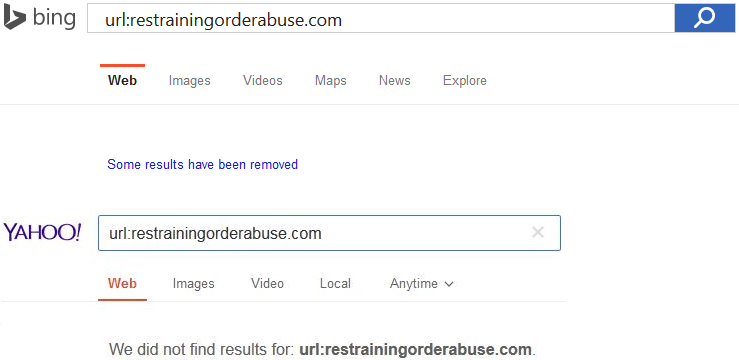
While this blog has existed for over four years and has been viewed more than 300,000 times this year, it isn’t cataloged on Microsoft’s Bing or on Yahoo (though it was prior to its author’s being sued by his false accuser in 2013 for “libel and harassment”). Whether administrators of these search sites unilaterally opted to “delist” the blog from their returns, or whether the blog author’s accuser(s) insisted that they do, I don’t know. It may be that the blog was determined to be “misogynist,” “defamatory,” or to otherwise traffic in or host “hate speech.” They’re easy allegations to put over.
Eugene Volokh, eminent First Amendment scholar and UCLA professor, would clarify that censorship can only be committed by the government.
Nevertheless, Wikipedia has a page titled, “Censorship by Google,” and Bing has been censured for “censoring” returns according to certain search criteria. ElephantJournal.com, for instance, explains “Why We Should Boycott Bing”:
[C]onduct the search with the simplified characters used in mainland China, then you get sanitized pro-Communist results. This is especially true of image searches. Magic! No Tiananmen Square massacre. The Dalai Lama becomes an oppressor. Falun Gong believers are villains, not victims.
Elephant Journal links to a New York Times editorial by Nicholas Kristof (similarly titled) that inspired its condemnation.
Application, then, of the word censorship to “selective revision” of or the delisting of websites from search engines’ returns isn’t without strong precedence. See also:
- “How Microsoft Bing Censors the Middle East” (Electronic Frontier Foundation)
- “Internet Censorship: Bing’s Chinese Enigma” (The Economist)
- “Google, Yahoo Criticized over Foreign Censorship” (Bloomberg)
Search engine “censorship” is brought to the attention of this audience to emphasize the importance of airing stories of court injustice. Policies and perceptions have been prejudiced for decades by violence rhetoric, and vital to motivating a reassessment of politically biased positions is challenging them and contradicting them with evidence and personal narratives of abuse.
Today, it’s an act of subversion and nonconformity even to voice misgivings.
When complaints of courtroom travesties become “normal and everyday” instead of “suspect,” then process itself will come under scrutiny instead of the people whose lives have been trashed by it.
Copyright © 2015 RestrainingOrderAbuse.com
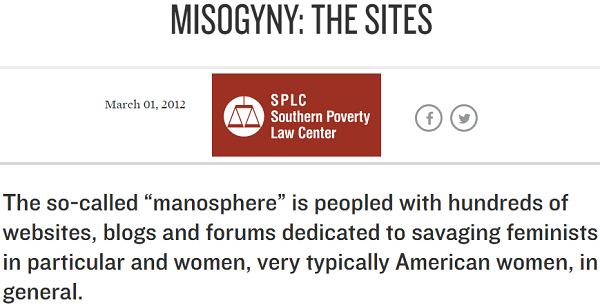
*The Southern Poverty Law Center (SPLC) has identified sites that vehemently criticize legal abuses as sources of “hate speech.” Consider, then, what consequences a proposal like this, meant to disrupt terrorists, could have over time: “‘Spell-check for hate’ needed, says Google’s Schmidt” (BBC).
 TALKING BACK to restraining orders
Well, I’ll be damned. I wouldn’t have thought Bing was into censorship. But it is. So, BING, into the toilet with you. I’ll never use you as a search engine again. A pox on you!
Thanks for the heads up, Todd.
LikeLike
Reblogged this on Falsely Accused.
LikeLike