“Accumulated forensic, clinical, and social research strongly suggests that the two most prominent emotions of most stalkers are anger and jealousy…. Such feelings are often consciously felt and acknowledged by the stalker. Nevertheless, these feelings often serve to defend the stalker against more vulnerable feelings that are outside of the stalker’s awareness. Anger can mask feelings of shame and humiliation, the result of rejection by the once idealized object, and/or feelings of loneliness, isolation, and social incompetency.
“Anger may also fuel the pursuit, motivated by envy to damage or destroy that which cannot be possessed…or triggered by a desire to inflict pain on the one who has inflicted pain, the primitive impulse of lex talionis, an eye for an eye.
“Angry pursuit can also repair narcissistic wounds through a fantasized sense of omnipotence and control of the victim. Victim surveys, in fact, have noted that the most common victim perception of the stalker’s motivations is to achieve control….”
—J. Reid Meloy, Ph.D., and Helen Fisher, Ph.D.
This discussion’s epigraph is drawn from “Some Thoughts on the Neurobiology of Stalking” and touches on a number of the motives of restraining order abuse both by stalkers generally and, in particular, by those stalkers who are most vulnerable to narcissistic wounds, namely, pathological narcissists.
The narcissist is a living emotional pendulum. If [s/he] gets too close to someone emotionally, if [s/he] becomes intimate with someone, [s/he] fears ultimate and inevitable abandonment. [S/he], thus, immediately distances [him- or herself], acts cruelly, and brings about the very abandonment that [s/he] feared in the first place. This is called the ‘approach-avoidance repetition complex’ [Sam Vaknin, Ph.D., “Coping with Various Types of Stalkers: The Narcissist”].
 While procurement of a restraining order is commonly perceived as the definitive act of rejection, possibly rejection of a stalker’s advances, it may in fact be an act of possession and control by a stalker (a perverse form of wish fulfillment). A restraining order indelibly stamps the presence of a stalker onto the public face of his or her target (“I own you”). It further disarms the target and mars his or her life, possibly to an extremity. Per Meloy and Fisher, a stalker achieves control and damages or destroys that which cannot be possessed. The “connection,” furthermore, can be repeatedly revisited and harm perpetually refreshed through exploitation of legal process.
The authors of the epigraph use the phrase attachment pathology. For a stalker who’s formed an unreciprocated attachment or an unauthorized one (as in the case of someone who’s married), a restraining order presents the treble satisfactions of counter-rejection (“I reject you back” or “I reject you back first”), revenge for not meeting the authoritarian expectations of the stalker, and possession/control. Procurement of a restraining order literally enables a false petitioner to revise the truth into one more favorable to his or her interests or wishes (cf. DARVO: Deny, Attack, and Reverse Victim and Offender). A judge is a rapt audience who only has the petitioner’s account on which to base his or her determination. The only “facts” that s/he’s privy to are the ones provided by the restraining order applicant.
In “Female Stalkers, Part 2: Checklist of Stalking and Harassment Behaviors,” psychologist Tara Palmatier identifies use of “the court and law enforcement to harass” as a female stalking tactic (“e.g., making false allegations, filing restraining orders, petitioning the court for frivolous changes in custody, etc.”), and this form of abuse likely is more typically employed by women against men (women tending “to be more ‘creatively aggressive’ in their stalking acts”). Anecdotal reports to this blog’s author, however, indicate that male stalkers (jilted or high-conflict exes and attention-seeking “admirers”) also engage in this form of punitive subversion against women. (Dr. Palmatier acknowledges as much but explains, “I tailor myself writing for a male audience.”)
Clinical terms for this kind of stalking—less stringent in their scope than legal definitions of stalking, which usually concern threat to personal safety—are “obsessive relational intrusion, intrusive contact, aberrant courtship behavior, obsessional pursuit, and unwanted pursuit behavior,” among others (Katherine S-L. Lau and Delroy L. Paulhus, “Profiling the Romantic Stalker”).
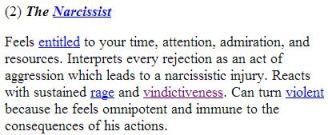 For someone with narcissistic personality disorder, someone, that is, who lives for attention (and is only capable of “aberrant courtship behavior”), a restraining order is a cornucopia, a source of infinitely renewing psychic nourishment, because it can’t fail to titillate an audience and excite drama.
(As noted in The Psychology of Stalking: Clinical and Forensic Perspectives, “Axis II personality disorders are…evident in a majority of stalkers, particularly Cluster B [which includes the narcissistic and borderline personality-disordered]”).
Per the DSM-IV, a narcissist evinces:
A. A pervasive pattern of grandiosity (in fantasy or behavior), need for admiration, and lack of empathy, beginning by early adulthood and present in a variety of contexts, as indicated by five (or more) of the following:
1. Has a grandiose sense of self-importance (e.g., exaggerates achievements and talents, expects to be recognized as superior without commensurate achievements).
2. Is preoccupied with fantasies of unlimited success, power, brilliance, beauty, or ideal love.
3. Believes that he or she is “special” and unique and can only be understood by, or should associate with, other special or high-status people (or institutions).
4. Requires excessive admiration.
5. Has a sense of entitlement, i.e., unreasonable expectations of especially favorable treatment or automatic compliance with his or her expectations.
6. Is interpersonally exploitative, i.e., takes advantage of others to achieve his or her own ends.
7. Lacks empathy: is unwilling to recognize or identify with the feelings and needs of others.
8. Is often envious of others or believes that others are envious of him or her.
9. Shows arrogant, haughty behaviors or attitudes.
Correspondences between this clinical definition and what might popularly be regarded as the traits of a stalker are uncanny (e.g., preoccupation with fantasies of “ideal love,” dependence on admiration not necessarily due, interpersonal exploitation, and an inability to identify with or a disregard for others’ feelings). It further suggests why a narcissist wouldn’t scruple about abusing legal process to realize malicious ends.
 In “Threatened Egotism, Narcissism, Self-Esteem, and Direct and Displaced Aggression: Does Self-Love or Self-Hate Lead to Violence?”, psychologists Brad Bushman and Roy Baumeister observe that aggressively hurtful behavior is more likely to originate from narcissistic arrogance than from insecurity:
[I]t has been widely asserted that low self-esteem is a cause of violence (e.g., Kirschner, 1992; Long, 1990; Oates & Forrest, 1985; Schoenfeld, 1988; Wiehe, 1991). According to this theory, certain people are prompted by their inner self-doubts and self-dislike to lash out against other people, possibly as a way of gaining esteem or simply because they have nothing to lose.
A contrary view was proposed by Baumeister, Smart, and Boden (1996). On the basis of an interdisciplinary review of research findings regarding violent, aggressive behavior, they proposed that violence tends to result from very positive views of self that are impugned or threatened by others. In this analysis, hostile aggression was an expression of the self’s rejection of esteem-threatening evaluations received from other people.
The DSM-5 notes that for the narcissist, “positive views of self” are everything (and others’ feelings nothing). Diagnostic criteria are:
A. Significant impairments in personality functioning manifest by:
1. Impairments in self functioning (a or b):
a. Identity: Excessive reference to others for self-definition and self-esteem regulation; exaggerated self-appraisal may be inflated or deflated, or vacillate between extremes; emotional regulation mirrors fluctuations in self-esteem.
b. Self-direction: Goal-setting is based on gaining approval from others; personal standards are unreasonably high in order to see oneself as exceptional, or too low based on a sense of entitlement; often unaware of own motivations.
AND
2. Impairments in interpersonal functions (a or b):
a. Empathy: Impaired ability to recognize or identify with the feelings and needs of others; excessively attuned to reactions of others, but only if perceived as relevant to self; over- or underestimate of own effect on others.
b. Intimacy: Relationships largely superficial and exist to serve self-esteem regulation; mutuality constrained by little genuine interest in others’ experiences and predominance of a need for personal gain.
B. Pathological personality traits in the following domain:
1. Antagonism, characterized by:
a. Grandiosity: Feelings of entitlement, either overt or covert; self-centeredness; firmly holding to the belief that one is better than others; condescending toward others.
b. Attention seeking: Excessive attempts to attract and be the focus of the attention of others; admiration seeking.
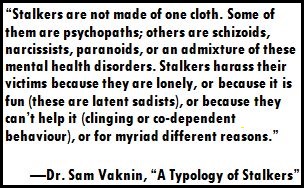 The picture that emerges from clinical observations of the narcissistic personality is one of a person who has no capacity to identify with others’ feelings, a fantastical conception of love, and unreasonable expectations of others and an irrational antagonism toward those who disappoint his or her wishes.
It’s further commonly observed that narcissists’ antagonism toward anyone whom they perceive as critical of them—that is, as a threat to their “positive views of self”—is boundless. The object, then, of a narcissist’s attachment pathology who rejects him or her (disappointing his or her “magical fantasies”), who challenges his or her entitlement, or who manifests disdain or condescension toward the narcissist (even in the form of sympathy) becomes instead the object of the narcissist’s wrath. As psychologist Linda Martinez-Lewi notes, “For the narcissist, revenge is sweet. It’s where they live in their delusional, treacherous minds.”
Narcissists adopt a predictable cycle of Use, Abuse, Dispose. This pathological repetition can last a few weeks or decades…. With a narcissist, there is never an authentic relationship. He/she is a grandiose false self without conscience, empathy, or compassion. Narcissists are ruthless and exploitive to the core [Linda Martinez-Lewi, Ph.D., “Narcissistic Relationship Cycle: Use, Abuse, Dispose”].
The restraining order process, because it enables a petitioner to present a false self and caters to fraudulent representation, is a medium of vengeance ideally suited to a narcissistic stalker. Its exploitation plays to a narcissist’s strengths: social savvy, cunning, and persuasiveness. Its value as an instrument of abuse, furthermore, is unmatched, offering for a minimal investment of time and energy the rewards of public disparagement and alienation of his or her victim, as well as impairment of that victim’s future prospects.
There are sociopathic narcissists who will not be satisfied until their ‘enemy’ is completely vanquished—emotionally, psychologically, financially. They seek revenge, not for what has been done to them but [for] what they perceive in a highly deluded way…has been done to them [Linda Martinez-Lewi, Ph.D., “Sociopathic Narcissists—Relentlessly Cruel”].
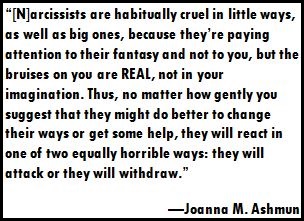 Fraudulent abuse of legal process elevates the narcissistic stalker to prime mover and puppet-master over his or her prey and compensates his or her disappointment of “ideal love” with the commensurate satisfactions of “unlimited power” over his or her victim and an infinitely renewable source of ego-fueling attention. By his or her false representations to the court, the narcissist’s fantasies become “the truth.” S/he’s literally able to refashion reality to conform to the false conception s/he favors.
In conclusion, an observation by psychologist Stanton Samenow:
The narcissist may not commit an act that is illegal, but the damage [s/he] does may be devastating. In fact, because the narcissist appears to be law-abiding, others may not be suspicious of him [or her] leaving him [or her] freer to pursue his [or her] objectives, no matter at whose expense. I have found that the main difference between the narcissist and antisocial individual, in most instances, is that the former has been shrewd or slick enough not to get caught…breaking the law.
Copyright © 2014 RestrainingOrderAbuse.com
 TALKING BACK to restraining orders
This articulates my exact feelings. I am shocked at the illogical process by a justice system lacking of any justice. I’ve been dealing with false allegations resulting in a TRO. When the plaintiff reached out to me via email saying they wanted to drop it etc and it was getting out of hand I, thinking a sociopathic narcissist had a change of heart, called to talk like adults. I was arrested the next day for violating a restraining order. I recently lost my job and have had to spend about 15,000 in lawyer fees as they are allowed to file for a restrsining order, have it become final and then drop it. It’s a kalfkaesque nightmare.
LikeLike
This site has been amazing. I have learn so much about who I was married to for 23 years. It’s almost to much to take in because of all the denial I’m coming out of. But I want to never have someone like my husband , come near me or my family or friends. I will educate myself and protect my family. I was so confused an scared to death when he kick me out. It floored me. But being away from him has given me time to heal my soul. He tried to kill my soul. I have so many feelings it’s hard to be in my own body. I have been in survive mood for a year an half since the Ro. Sorry if I’m rambling it’s been a hell of a ride.
Thanks Rhonda
I choose to be a survivor
Not a victim of DV RO ABUSE
LikeLike
I’m glad you’re standing strong, Rhonda. And I hope your perseverance pays off. Did you manage to secure an attorney?
LikeLike
Sorry sent my post accidentally. Wanted to say I would love for the judge to sit down with my beautiful daughter an great son, an tell them why he let us suffer so badly. They saw there mother thrown out on the street like a dog with bruises all over her. They don’t trust anyone now. Is this what we want to teach our children.
Thanks Rhonda
There’s so much to say I’m to exhausted
LikeLike
I understand. I’m just recovering from a bout with a virus, and I used never to get sick. Conserve your strength. I don’t know whether a judge can hear children’s testimony in chambers, but a lawyer would know. The toll on children of parental warfare is horrific. It’s something Terri Weiss (a family attorney) laments in her blog. I wish all of you the best with weathering this.
LikeLike