Even when They’re Right, They’re Wrong: A Female Author Agrees Domestic Violence Laws Are Exploited to “Set Up” Partners but Puts the Blame Squarely on Men

Since the publication of this post, the website it quotes has been deleted.


“Victims of these increasingly common set-ups face criminal charges alongside their emotionally depleting divorce and custody cases, which are, of course, by now stacked against them.”

—Former crime reporter Janie McQueen

The quotation above comes from the author of the book, Hanging on by My Fingernails: Surviving the New Divorce Gamesmanship, and How a Scratch Can Land You in Jail.

Perhaps you’re thinking: I can so identify with that—and perhaps you can identify with it. If you’re not a woman, though, you’re not supposed to. So stop it.

Yep, a female author (and journalist) acknowledges that lying to the court to gain the upper hand in divorce and custody cases occurs. In fact, she says it’s “increasingly common.” According to her, though, the culprits are violent men.

Ms. McQueen apparently aspires to upset the dogma while still keeping the faith: The system is abused, she emphasizes, but women are the victims, and men are the victimizers.

Evident without benefit of having read her book is that because Ms. McQueen alleges she was framed (and probably quotes other women who allege they were framed), “set-ups” of this sort are asserted to be “increasingly common.” They probably are—they’re reported here routinely—but never mind, apparently, that Ms. McQueen’s contention is exactly what men have been saying for, um, decades. Whether frame-ups are “increasingly” common or not, they are common, and they have been for a long time (and thanks to rhetoric that insists women are incapable of lying maliciously, the likelihood of their becoming increasingly “increasingly common” is strong).

Since I haven’t read Ms. McQueen’s book, fairness requires that I acknowledge her position may not be as chauvinistic as it sounds. Also, the book has apparently been in print for three years, and I just heard about it Monday, so I’d venture to guess that it hasn’t exerted a great deal of populist influence. For an audience sympathetic to feminism to concede that false allegations from men are rampant would be to invite speculation on how rampant false allegations from women are.

That, as they say, ain’t gonna happen.

I learned of Ms. McQueen’s book in an online column in Forbes by Jeff Landers, a “certified divorce financial analyst” and the founder of Bedrock Divorce Advisors, LLC, a “divorce financial advisory firm that works exclusively with women.” Mr. Landers is also the author of multiple books directed to a strictly female audience.

His representation of Ms. McQueen’s book, then, may be skewed to his marketing demographic. I can’t say. This, however, is a passage from Ms. McQueen’s book quoted in Mr. Landers’s column “How Some Men Are Upending Domestic Violence Laws to Scam an Advantage in Divorce” (the passage is from the book’s forward, which is penned by Chicago criminal defense attorney Tamara N. Holder):

Unfortunately, many abusive men have learned to reshape domestic violence laws into another weapon of abuse. They are turning police and court protections upside down: The abusers themselves call 9-1-1; they have the women arrested for domestic violence; and then they do everything they can to try to have the women prosecuted and sentenced. In this way, the true victim is painted as the abuser.

There is a deeper motivation in using this ploy; to show a pattern of “violent conduct” on the woman’s part so that the abuser can use it as evidence against her in a divorce or child custody battle. And this form of abuse is permanent. A bruise heals after a few days, but a conviction for a violent crime mars her record forever.

The set-up: A couple has a fight. Either the wife calls 9-1-1 in a desperate plea for police intervention, or the husband makes the call first in a preemptive attack. When the police arrive, the woman is visibly upset. The man, on the other hand, is extremely calm as he switches off his anger. The husband tells the police that his wife is delusional, crazy, and violent. Depending on how convincing the man’s story is to the police officer, and the state’s law on domestic violence, either both people are arrested or the woman is arrested.

In the case of a dual arrest, which some states discourage, the woman often tells prosecutors she doesn’t want to testify against her husband, so the case is dismissed. Meanwhile, the husband is determined that she be prosecuted. Instead of the prosecutors looking into the history of the relationship before proceeding with the criminal case, they move full speed ahead. The wife is usually cut off from her husband’s financial support so she cannot pay for defense against him. As a result, she is forced to take a plea to the charges because she cannot afford to defend herself. She fears taking the case to trial, losing, and going to jail.

Conclusory remarks will be brief. First, bravo to Ms. Holder (and Ms. McQueen) for a detailed articulation of a serious problem, one that founders lives. What’s described above certainly happens; don’t doubt it for a moment. Second, though, what impassioned subdual of the imagination is required for an intelligent person to believe this only happens to women? C’mon. (Not only does the same thing happen to men, but the presence of children in the relationship isn’t a necessary motivation.) Finally, mark this statement well: “And this form of abuse is permanent. A bruise heals after a few days, but a conviction for a violent crime mars [a] record forever.”

Copyright © 2015 RestrainingOrderAbuse.com

Dust It Off: This Isn’t 1979, and It’s Time Restraining Order Laws Were Reconsidered

I remarked to a commenter the other day that when I became a vegetarian in the ’80s, I was still a kid, and my family took it as an affront, which was a common reaction then. Today, everyone’s a vegetarian or “tried vegetarianism” or has “thought about becoming a vegetarian.” Other subjects that were outré or taboo in my childhood like atheism, cross-dressing, and depression—they’re no longer stigmatized, either (in the main). Gay people, who were only whispered about then, can marry in a majority of states. When I was a kid, it was shaming for bra straps or underpants bands to be visible. Today they’re exposed on purpose.

It’s a brave new world.

While domestic violence is no more comfortable a topic of conversation now than it was then, it’s also hardly hush-hush. When restraining orders were conceived, it was unmentionable, and that was the problem. It was impossible for battered women to reliably get help. They faced alienation from their families and even ridicule from the police if they summoned the courage to ask for it. They were trapped.

Restraining orders cut through all of the red tape and made it possible for battered women to go straight to the courthouse to talk one-on-one with a judge and get immediate relief. The intention, at least, was good.

It’s probable, too, that when restraining orders were enacted way back when, their exploitation was minimal. It wouldn’t have occurred to many people to abuse them, just as it wouldn’t have occurred to lawmakers that anyone would take advantage.

This isn’t 1979. Times have changed and with them social perceptions and ethics. Reporting domestic violence isn’t an act of moral apostasy. It’s widely encouraged.

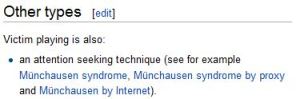
No one has gone back, however, and reconsidered the justice of a procedure of law that omits all safeguards against misuse. Restraining orders circumvent investigation by police and the vetting of accusations by district attorneys. They allow individuals to prosecute allegations all on their own, trusting that those individuals won’t lie about fear or abuse, despite the fact that there are any number of compelling motives to do so, including greed/profit, spite, victim-playing, revenge, mental illness, personality disorder, bullying, blame-shifting, cover-up, infidelity/adultery, blackmail, coercion, citizenship, stalking, and the mere desire for attention.

Restraining orders laws have steadily accreted even as the original (problematic) blueprint has remained unchanged. Claims no longer need to be of domestic violence (though its legal definition has grown so broad as to be virtually all-inclusive, anyway). They can be of harassment, “stalking,” threat, or just inspiring vague unease.

These aren’t claims that are hard to manufacture, and they don’t have to be proved (and there’s no ascertaining the truth of alleged “feelings” or “beliefs,” anyway, just as there’s no defense against them). Due to decades of feminist lobbying, moreover, judges are predisposed to issue restraining orders on little or no more basis than a petitioner’s saying s/he needs one.

What once upon a time made this a worthy compromise of defendants’ constitutionally guaranteed expectation of due process and equitable treatment under the law no longer does. The anticipation of rejection or ridicule that women who reported domestic violence in the ’70s and ’80s faced from police, and which recommended a workaround like the restraining order, is now anachronistic.

Prevailing reflex from authorities has swiveled 180 degrees. If anything, the conditioned reaction to claims of abuse is their eager investigation; it’s compulsory policy.

Laws that authorize restraining order judges, based exclusively on their discretion, to impose sanctions on defendants like registry in public databases that can permanently foul employment prospects, removal from their homes, and denial of access to their kids and property are out of date. Their license has expired.

Besides material privations, defendants against allegations made in brief trips to the courthouse are subjected to humiliation and abuse that’s lastingly traumatic. Making false claims is a simple matter, and offering damning misrepresentations that don’t even depend on lies is simpler yet.

What shouldn’t be possible happens. A lot. Almost as bad is that we make believe it doesn’t.

Just as it was wrong to avert our eyes from domestic violence 30 years ago, it’s wrong to pretend that attempts to curb it since haven’t fostered new forms of taunting, terrorism, and torment that use the state as their agent.

Copyright © 2015 RestrainingOrderAbuse.com

“Trapped”: Betty’s Story of Restraining Order Abuse

Betty Krachey says she only wishes she had superpowers. She has, nevertheless, been flexing her muscles pretty impressively for a former drugstore clerk.

Betty launched an e-petition not long ago to bring flaws in the administration of restraining orders and the need to hold false accusers accountable to the attention of lawmakers in her home state of Tennessee (and beyond). Betty emphasizes that restraining orders can be “taken out on innocent people based on false allegations so a vindictive person can gain control with the help of authorities.” She stresses, too, that “false accusers are being allowed to walk away and pay NO consequences for swearing to lies to get these orders.”

Betty’s charges shouldn’t be revelations; opponents of restraining order laws (and related laws inspired by violence against women) have been saying what Betty is for years. What makes her denunciations eye-opening is that they’re coming from an injured woman who refuses to take her licks and silently retreat into the shadows like she’s supposed to do. Besides that, the typical rebuttals to complaints like Betty’s, rebuttals that play to our sympathies for abused women, don’t apply.

Betty is an abused woman. She was nearly deprived of her home and consigned to the curb, for no reason, like yesterday’s trash (a situation others find themselves in every day). Betty’s story, as she tells it, corresponds moreover to those of women who are considered victims of emotional abuse (which state statutes may classify as “domestic violence”).

I used to be a very private person—till all this crap—and told very few people my business, so everyone thought everything was going good with me and [him]. They had no idea I was living with someone I felt trapped with. I could NEVER talk to him or even ask him a question without him blowing up. That’s not a very happy life to live with someone. Even though I never told others how bad things were at home, I NEVER made it a secret to [him] that I wanted to leave…! I never posted lies on Facebook or emailed my friends telling them lies about [him] like he did me to try to get people to feel sorry for me and think [he] was such a bad person. Now that I think about it, he’s always played the victim….

The counterclaim feminists inevitably reach for to bat away complaints of restraining order abuse like Betty has made is that invisible, voiceless legions of battered women never receive justice, so tough luck, Charlie Brown, if you’re not treated fairly. The argument appeals to pathos, but its influence on our laws and justice system is plainly corrupt. Remarking that there are starving children in India has never made and never will make broccoli taste like cheesecake. It’s not the place of our justice system to punish people for things they haven’t done, let alone to blame them for the imagined crimes of strangers.

The posited pains and privations of unnamed others don’t justify running an innocent person through the wringer, female or male. Publicly implicating people as batterers and creeps based on superficial claims scrawled on forms and mouthed in five-minute meetings with judges shouldn’t be possible in a developed society. On these grounds, citizens are cast out of their homes by agents of the state, as Betty almost was.

Our courts take no interest in the lives they invade and often derail or devastate. The people restraining order judges summarily condemn are just names on forms; judges may never even know what the owners of those names look like—forget about who they are.

Let’s meet one.

Betty’s story begins in 1992 when she moved from Florida to Tennessee with her boyfriend, and the two built a house and life together there.

The circumstances that led to Betty’s being falsely accused by her boyfriend decades later are cliché. He slimmed down in midlife, she says, and began “cheating on me with younger girls…. So he had to figure out a way to get my half of our house from me.”

A protection order fit the bill perfectly: no muss, no fuss, and no division of assets. The boyfriend would be granted sole entitlement to the house that Jack and Jill built. Jill, with a little shove, would tumble down the hill alone, and an empty bucket to collect handouts in is all she’d end up with.
His first plan was to bully and threaten me into signing over my half of the house by signing a quitclaim deed. He had told me he would give me $50K, which…I knew I’d never see, and he promised me this would be my best deal. And if I did not sign the house over to him, he let me know I would lose everything I had worked my ass off for. “You watch and see, I promise you that,” he would tell me over and over.

Betty says she was tempted to sign. One of her dearest companions, her Doberman Dragon, had died, and Betty reckoned she could provide for her remaining dog, Lacy, by herself. “One reason I stayed was for my dogs,” she admits. “I had been wanting to leave…for years.” She and her boyfriend had effectively separated, and Betty intuited her boyfriend “knew he wasn’t going to be able to trick me into staying and paying half the bills much longer,” and she planned to call it quits. But he beat her to the punch.

His next plan, with the advice from his awesome friend, was to get the police involved and then to file the order of protection on me to get me kicked out of the house! If it weren’t for my lawyer, I would have had to leave my home from Aug. 29th to the court date Sept. 12th! [He, the ex] knew and did NOT care one teeny tiny bit that I had NOWHERE TO GO! Plus I had Lacy to worry about. [He] had moved out of our house August 6th and wasn’t even living in the home at the time he did this. [He] has another house to live in that has everything he needs. I had NOTHING else and nowhere else to go!

Betty’s situation mirrors that of many others who are falsely accused by domestic partners. Those not so lucky to have (or to be able to afford) effective legal representation may find themselves abruptly homeless (besides jobless and penniless, in cases), sleeping in their cars, sheltering with strangers, or living on the street. These are people who the day before may have been living normal, comfortable middleclass or even upper-middleclass lives.

On our court date—Sept 12th—the order of protection was dropped. My lawyer told me I was right: “This is all about the house and YOUR money you have coming from your business you sold.” I knew it!! And [he, the ex] wanted ME to pay the court costs for this!

The best laid plans of lice and men go oft astray. Betty quips, “All I can say is [he] had a lot more to be concerned about than me causing him ‘bodily harm’!”

Betty’s been in touch with a Tennessee state representative who’s indicated to her that she has “a good chance at getting [the] law changed. But he said the soonest it will go into effect is July 2015, and he let me know that means it will NOT help me with what my ex did to me, because he filed his false report on me in August!”

Besides singlehandedly pressing for reform of one of the most intransigent legal mockeries ever conceived, she’s considering a lawsuit.

Happy New Year, Betty.

Copyright © 2015 RestrainingOrderAbuse.com

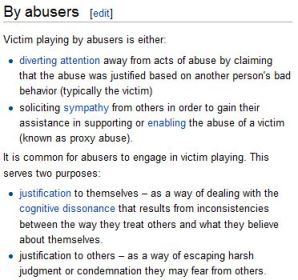
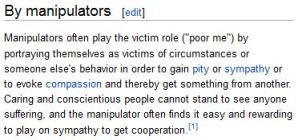
Victim-Playing and Restraining Order Fraud

“Victim playing (also known as playing the victim or self-victimization) is the fabrication of victimhood for a variety of reasons such as to justify abuse of others, to manipulate others, a coping strategy, or attention seeking.”

—Wikipedia, “Victim playing

Once again I’m prompted to note that Wikipedia is all over motives for restraining order abuse but squeamishly avoids confronting the subject directly.

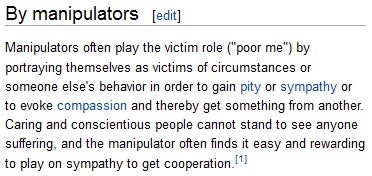
Restraining orders cater to and reward victim-playing like nothing else, because hyped or fabricated allegations made to judges aren’t subject to scrutiny or contradiction by anyone who knows the plaintiff (accuser) or defendant (accused). Procurement of a restraining order authorizes a victim-player (whether a bully, manipulator, or attention-seeker) to concoct any story s/he wants for third parties, including colleagues/coworkers, friends, and family. To the fraudster, it’s a golden ticket.

Allegations made on restraining orders are answerable to no standard of proof, are ruled on in the absence of any controverting evidence or testimony from the accused, and are made at no risk to a victim-player and at no cost beyond a few minutes of his or her time. Because lying to obtain a restraining order is child’s play for an unscrupulous accuser, and because this fact is known only to those who are lied about, a victim-player’s audience is easily convinced of his or her falsehoods, which may be extravagant. Gulled employers, for instance, may be induced to institute special security protocols to “protect” a victim-player from his or her victim. S/he doesn’t even have to be a particularly good actor. A restraining order sells itself.

In “Rethinking ‘Don’t Blame the Victim’: The Psychology of Victimhood,” psychologist Ofer Zur observes, “The victim stance is a powerful one. The victim is always morally right, neither responsible nor accountable, and forever entitled to sympathy.” The appeal, whether to a bully or attention-seeker (or attention-seeking bully), is transparent.

Excellent explications of victim-playing to “justify abuse of others” are presented by psychologist Tara Palmatier in her “Presto, Change-o, DARVO: Deny, Attack, and Reverse Victim and Offender” and “To the Victim Go the Spoils: False Allegations, Men as Default Scapegoats, and Why Some Women Get Away with Murder.”

Vis-à-vis victim-playing as a means of manipulation or as a coping strategy, this diagnosis by Dr. Palmatier is revealing: “People who abuse others maintain their power by keeping the truth of what they do secret. When you speak the truth, they begin to lose power and control. That’s what abusive personality types are after—power and control over you.” Restraining orders are unparalleled as tools for reengineering truth and dominating and silencing resistant victims. In fact, they may be the most effective instruments of coercion and revenge we’ve come up with yet. “Emotional abuse and bullying behaviors,” Dr. Palmatier elucidates, “are typical of those who have Borderline, Narcissistic, and/or Antisocial personality traits,” and victims of restraining order fraud by victim-players are urged to investigate the traits of the personality-disordered for correspondence with their own abusers and clues to their psychological motives.

The ambition of this post isn’t to say anything new but to connect a(nother) recognized human behavior to an unrecognized and commonly exploited method of abuse: restraining order fraud. As Dr. Zur observes, there’s an “unspoken, politically correct rule [in our culture] that the role of the victim…is NOT to be explored.” In other words—following the unexamined mantra, “Don’t blame the victim”—we’re not supposed to question “victimhood”; we’re supposed to sympathize and direct opprobrium toward the “offender.” The irony, of course, is that when victimhood is shammed, the actual victim is the mislabeled “offender.” And the unwillingness of society to acknowledge the sham is the agent of the victimization. Lies don’t victimize so much as our eagerness to credit them does. Victims of false allegations are victims of the state, not victims of liars. When restraining orders are abused, victims of that abuse may be stripped of home, children, property, career/livelihood, and (consequently) identity. And the beneficiaries of these losses, which are ones that may never be recovered from, are the victim-players. The “unspoken, politically correct rule” that Dr. Zur remarks not only rewards fraud and rapine; it ensures fraudsters are treated as objects of pity.

Copyright © 2014 RestrainingOrderAbuse.com