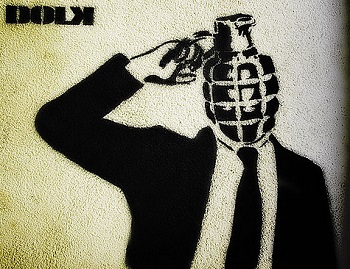
 I examined a case, recently, of a man’s committing murder hours after being accused to the police. My familiarity with the case was, admittedly, shallow; I only had what was reported to go on (and that from a single, “raw” source). I have, however, heard from scores of people who’ve been accused—or scorned for telling the truth—in drive-thru restraining order proceedings, and expressions of fury have been more than a few.
This week, I shared an email by a highly educated, professional woman and mother of three young children that expresses an “almost homicidal enmity” catalyzed by procedural abuses. Note the elevated diction she uses to describe an impulse to bash, throttle, and gouge. Does her vaulted language indicate she “doesn’t really mean it”? No, it indicates how alien rage is to her character. It indicates she’s someone who shouldn’t have cause to feel this way.
Consider: How is it the police and the courts recognize the propensity for violence that interpersonal conflicts mediated by the “justice system” may arouse, but lawmakers don’t? Are they that “in the dark”?
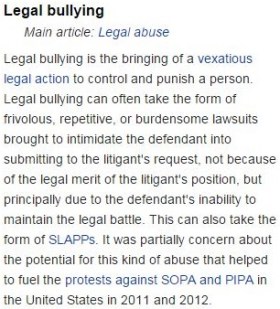 Yeah, pretty much.
If you get into a spat with your neighbor, and the police intervene, parties are separated into corners. In court, complainants even merely of “fear” may be shielded by law officers in anticipation of a judicial ruling. It’s understood that emotions run hot in this theater.
Why, then, is it not appreciated that when the basis for rulings is false, the risk of violence is not only higher but infinite?
We like our games, and we like our fictions about how people should be and should feel and should react even if you trash their lives maliciously. Hey, we’re disposed to remind, it’s the law.
All well and good until somebody gets an ax in the ear—an edgy remark, maybe; honesty often strikes us that way (i.e., like an ax in the ear).
The wonder is that more people who lie to the courts don’t meet premature ends—or at least sustain some anatomical remodeling. False accusations, which have inspired a great deal of sententious deliberation in recent months, don’t just “discomfort” people or make them “justifiably [and transiently] angry.” At the risk of being edgy again: People who haven’t been falsely accused in a legal procedure don’t know what the fuck they’re talking about. I was collegiately trained as a literary analyst—I’ve studied and taught Victorian literature—and I’m normally more disciplined in my remarks, but this subject rebukes gentility.
Liars maim. That they do it with words in no way mitigates the brutality of the act or its consequences.
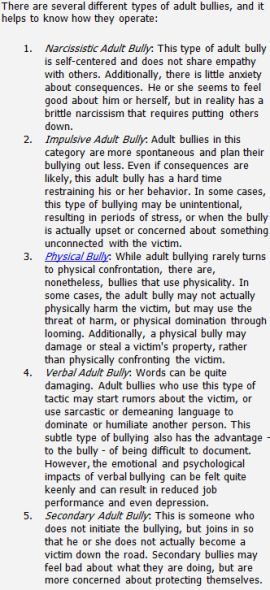 One would think that as people mature and progress through life, that they would stop behaviors of their youth. Unfortunately, this is not always the case. Sadly, adults can be bullies, just as children and teenagers can be bullies. While adults are more likely to use verbal bullying as opposed to physical bullying, the fact of the matter is that adult bullying exists. The goal of an adult bully is to gain power over another person, and make himself or herself the dominant adult. They try to humiliate victims, and “show them who is boss” (BullyingStatistics.org, “Adult Bullying”).
StopBullying.gov defines bullying as including name-calling, taunting, threatening, spreading rumors about someone, and embarrassing someone in public. Falsely labeling someone a stalker, child abuser, violent danger, or sexual deviant in one or more public trials whose findings are impressed on the target’s permanent record and are accompanied by menacing threats (if not immediate punishment) plainly qualifies. Among identified effects of bullying are suicide (“bullycide”) and violence, including murder. “Extreme emotional disturbance” is a defense for murder in some states (a finding that doesn’t excuse the act but does lighten the sentence), and a related murder defense is “provocation.”
Sure, character assassination is bloodless. What of it? If I circulate lies about someone and s/he snaps, I’m a bully, and I had it coming. Few people would say otherwise.
Ah, but if I lie and use the law as my medium to insult, demean, badger, intimidate, or otherwise persecute—hey, that’s different. I’m the “good guy.”
So suck it. And keep on sucking it, because the public record says my lies are the truth. Neener-neener.
A system that represents its purpose to be the curtailment of violence shouldn’t be promoting it by pandering to bullies, even “unofficially,” and its officers shouldn’t be serving as those bullies’ lieutenants and enforcers. If the system makes it easy to lie about and humiliate people, doesn’t hold liars accountable, and furthermore punishes the falsely accused based on lies, then it’s promoting violence.
This shouldn’t require social science research to corroborate. It shouldn’t even require this analyst’s observation.
Copyright © 2015 RestrainingOrderAbuse.com

 Victims of false allegations made on restraining orders may be labeled “stalker,” “batterer,” “sicko,” “sexual harasser,” “child-abuser,” “whore,” or even “rapist”—publicly and permanently—by accusers whose sole motive is to brutalize. And agents of these victims’ own government(s) arbitrarily authorize this bullying and may baselessly and basely participate in it, compounding the injury exponentially.
 TALKING BACK to restraining orders