Courtroom Fraud and Smear Campaigns: The Full Machiavelli

Cheryl Lyn Walker PhD, Dr. Cheryl Lyn Walker, Dr. Cheryl L. Walker PhD, M.D. Anderson Cancer Center, Michael Honeycutt PhD, Michael Honeycutt TCEQ

“False Accusations, Distortion Campaigns, and Smear Campaigns can all be used with or without a grain of truth, and have the potential to cause enormous emotional hurt to the victim or even impact [his or her] professional or personal reputation and character.”

—“False Accusations and Distortion Campaigns

There are several fine explications on the Internet about the smear campaigns of false accusers. Some sketch method and motive generally; some catalog specific damages that ensue when lies are fed to the police and courts.
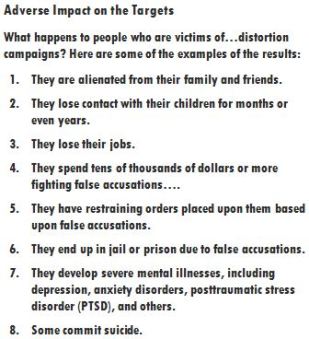
This survey of “adverse impacts” is credited to lies told by people with borderline personality disorder. Conducting “distortion campaigns” isn’t exclusive to BPDs, however, and the “adverse impacts” are the same, irrespective of campaigners’ particular cognitive kinks.

The valuable role of the police and courts in the prosecution of campaigns to slander, libel, and otherwise bully and defame can’t be overstated. They’re instrumental to a well-orchestrated character assassination.

Lies can be told to anyone, of course, and lies told to anyone can have toxic effects. The right lie told in a workplace, for example, can cost someone a job and impair or imperil a career.

Lies told to police and judges—especially judges—they’re the real wrecking balls, though. False allegations of threat or abuse are handily put over in restraining order or domestic violence procedures, and they endure indefinitely (and embolden accusers to tell further lies, which are that much more persuasive).

Among the motives of false accusation are blame-shifting (cover-up), attention, profit, and revenge (all corroborated by the FBI). Lying, however, may become its own motive, particularly when the target of lies resists. The appetite for malice, once rewarded, may persist long after an initial (possibly impulsive) goal is realized. Smear campaigns that employ legal abuse may go on for years, or indefinitely (usually depending on the stamina of the falsely accused to fight back).

Legitimation of lies by the court both encourages lying and reinforces lies told to others. Consider the implications of this pronouncement: “I had to take out a restraining order on her.” Who’s going to question whether the grounds were real or the testimony was true? Moreover, who’s going to question anything said about the accused once that claim has been made? It’s open season.

In the accuser’s circle, at least—which may be broad and influential—no one may even entertain a doubt, and the falsely accused can’t know who’s been told what and often can’t safely inquire.

Judgments enable smear and distortion campaigners to slander, libel, and otherwise bully with impunity, because their targets have been discredited and left defenseless (judges may even punish them for lawfully exercising their First Amendment rights and effectively gag them). The courts, besides, may rule that specific lies are “true,” target_of_blamethereby making the slanders and libels impervious to legal relief. Statements that are “true” aren’t defamatory. The man or woman, for instance, who’s wrongly found guilty of domestic violence (and entered into a police database) may be called a domestic abuser completely on the up and up (to friends, family, or neighbors, for example, or to staff at a child’s school).

Lies become facts that may be shared with anybody and publicly (court rulings are public records). Smear campaigners don’t limit themselves to court-validated lies, either, but it seldom comes back to bite them once a solid foundation has been laid.

Some so-called high-conflict people, the sorts described in the epigraph, conduct their smear or distortion campaigns brazenly and confrontationally. Some poison insidiously, spreading rumors behind closed doors, in conversation and private correspondence. As Dr. Tara Palmatier has remarked, social media also present them with attractive and potent platforms (and many respondents to this blog report being tarred on Facebook or even mobbed, i.e., bullied by multiple parties, including strangers).
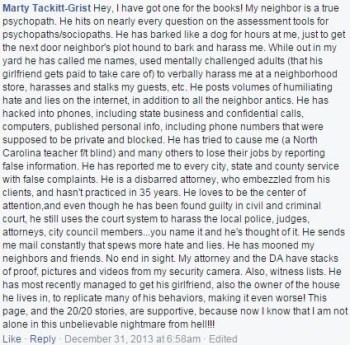
Even when false accusers’ claims are outlandish and over the top, like these posted on Facebook by North Carolinian Marty Tackitt-Grist, they’re rarely viewed with suspicion—and almost never if a court ruling (or rulings) in the accusers’ favor can be asserted. The man accused in this comment to ABC’s 20/20 is a retiree with three toy poodles and a passion for aviation who couldn’t “hack” firewood without pain, because his spine is deformed. He is a retired lawyer, but he wasn’t “disbarred” and hasn’t “embezzled” (or, for that matter, “mooned” anyone). He has, however, been jailed consequent to insistent and serial falsehoods from his patently disturbed neighbor…who’s a schoolteacher.

For Crazy, social media websites are an endless source of attention, self-promotion, self-aggrandizement, and a sophisticated weapon. Many narcissists, histrionics, borderlines, and other self-obsessed, abusive personality types use Facebook, Twitter, and the like to run smear campaigns, to make false allegations, to perpetrate parental alienation, and to stalk and harass their targets while simultaneously portraying themselves as the much maligned victim, superwoman, and/or mother of the year.

(A respondent to this blog who’s been relentlessly harried by lies for two years, who’s consequently homeless and penniless, and who’s taken flight to another state, recently reported that a woman who’d offered her aid suddenly and inexplicably defriended her on Facebook and shut her out without a word. Her “friend” had evidently been gotten to.)

(An advocate for legal reform who was falsely accused in court last year by her husband and succeeded in having the allegations against her dismissed reports that he afterwards circulated it around town that she tried to kill him.)

I was falsely accused in 2006 by a woman who had nightly hung around outside of my house for a season. She was married and concealed the fact. Then she lied to conceal the concealment and the behavior that motivated the concealment. She has sustained her fictions (and honed them) for nearly 10 years. People like this build tissues of lies, aptly and commonly called webs.

Their infrastructures are visible, but many strands may not be…and the spinners never stop spinning.

The personality types associated with chronic lying are often represented as serpentine, arachnoid, or vampiric. This ironically feeds into some false accusers’ delusions of potency. Instead of shaming them, it turns them on.

I know from corresponding with many others who’ve endured the same traumas I have that they’ve been induced to do the same thing I did: write to others to defend the truth and hope to gain an advocate to help them unsnarl a skein of falsehoods that propelled them face-first into a slough of despond. (Why people write, if clarification is needed, is because there is no other way to articulate what are often layered and “bizarre” frauds.)

I know with heart-wrenching certainty, also, that these others’ honest and plaintive missives have probably been received with exactly the same suspicion, contempt, and apprehension that mine were. It’s a hideous irony that attempts to dispel false accusations are typically perceived as confirmations of them, including by the court. To complain of being called a stalker, for example, is interpreted as an act of stalking. There’s a kind of awful beauty to the synergy of procedural abuse and lies. (Judges pat bullies on the head and send them home with smiles on their faces.)

Smear campaigns wrap up false accusations authorized by the court with a ribbon and a bow.

Copyright © 2015 RestrainingOrderAbuse.com

*The name Machiavelli, referenced in the title of this post, is associated with the use of any means necessary to obtain political dominion (i.e., power and control). Psychologists have adapted the name to characterize one aspect of a syzygy of virulent character traits called “The Dark Triad.”

Dust It Off: This Isn’t 1979, and It’s Time Restraining Order Laws Were Reconsidered

I remarked to a commenter the other day that when I became a vegetarian in the ’80s, I was still a kid, and my family took it as an affront, which was a common reaction then. Today, everyone’s a vegetarian or “tried vegetarianism” or has “thought about becoming a vegetarian.” Other subjects that were outré or taboo in my childhood like atheism, cross-dressing, and depression—they’re no longer stigmatized, either (in the main). Gay people, who were only whispered about then, can marry in a majority of states. When I was a kid, it was shaming for bra straps or underpants bands to be visible. Today they’re exposed on purpose.

It’s a brave new world.

While domestic violence is no more comfortable a topic of conversation now than it was then, it’s also hardly hush-hush. When restraining orders were conceived, it was unmentionable, and that was the problem. It was impossible for battered women to reliably get help. They faced alienation from their families and even ridicule from the police if they summoned the courage to ask for it. They were trapped.

Restraining orders cut through all of the red tape and made it possible for battered women to go straight to the courthouse to talk one-on-one with a judge and get immediate relief. The intention, at least, was good.

It’s probable, too, that when restraining orders were enacted way back when, their exploitation was minimal. It wouldn’t have occurred to many people to abuse them, just as it wouldn’t have occurred to lawmakers that anyone would take advantage.

This isn’t 1979. Times have changed and with them social perceptions and ethics. Reporting domestic violence isn’t an act of moral apostasy. It’s widely encouraged.

No one has gone back, however, and reconsidered the justice of a procedure of law that omits all safeguards against misuse. Restraining orders circumvent investigation by police and the vetting of accusations by district attorneys. They allow individuals to prosecute allegations all on their own, trusting that those individuals won’t lie about fear or abuse, despite the fact that there are any number of compelling motives to do so, including greed/profit, spite, victim-playing, revenge, mental illness, personality disorder, bullying, blame-shifting, cover-up, infidelity/adultery, blackmail, coercion, citizenship, stalking, and the mere desire for attention.

Restraining orders laws have steadily accreted even as the original (problematic) blueprint has remained unchanged. Claims no longer need to be of domestic violence (though its legal definition has grown so broad as to be virtually all-inclusive, anyway). They can be of harassment, “stalking,” threat, or just inspiring vague unease.

These aren’t claims that are hard to manufacture, and they don’t have to be proved (and there’s no ascertaining the truth of alleged “feelings” or “beliefs,” anyway, just as there’s no defense against them). Due to decades of feminist lobbying, moreover, judges are predisposed to issue restraining orders on little or no more basis than a petitioner’s saying s/he needs one.

What once upon a time made this a worthy compromise of defendants’ constitutionally guaranteed expectation of due process and equitable treatment under the law no longer does. The anticipation of rejection or ridicule that women who reported domestic violence in the ’70s and ’80s faced from police, and which recommended a workaround like the restraining order, is now anachronistic.

Prevailing reflex from authorities has swiveled 180 degrees. If anything, the conditioned reaction to claims of abuse is their eager investigation; it’s compulsory policy.

Laws that authorize restraining order judges, based exclusively on their discretion, to impose sanctions on defendants like registry in public databases that can permanently foul employment prospects, removal from their homes, and denial of access to their kids and property are out of date. Their license has expired.

Besides material privations, defendants against allegations made in brief trips to the courthouse are subjected to humiliation and abuse that’s lastingly traumatic. Making false claims is a simple matter, and offering damning misrepresentations that don’t even depend on lies is simpler yet.

What shouldn’t be possible happens. A lot. Almost as bad is that we make believe it doesn’t.

Just as it was wrong to avert our eyes from domestic violence 30 years ago, it’s wrong to pretend that attempts to curb it since haven’t fostered new forms of taunting, terrorism, and torment that use the state as their agent.

Copyright © 2015 RestrainingOrderAbuse.com

Restraining Orders as “Revenge Porn”

In the second season of HBO’s The Newsroom, a lead character is exposed on a website called Revenge Porn by a man with whom she’d had a brief fling.

After sitting huddled in a corner and pronouncing, “I want to die,” she rallies and confronts her former lover while he’s conducting a business meeting. Without much prelude, she kicks him in the testicles and bloodies his nose.

It makes for engaging TV.

If only an ex-intimate’s exploitation of the legal equivalent of Revenge Porn could be so briskly requited and resolved.

What I’m referring to, of course, is treacherously defamatory representations to the court on a civil restraining order, representations intended to publicly humiliate and satisfy a scorned lover’s urge to wound. The restraining order is an invitation for the system to poke its nose into the crevices, one it’s glad to accept.

The TV show character wasn’t able to sue the man who betrayed her, because she posed for the pictures. She even bought the camera for him.

Had the man surreptitiously shot the photos and aired them without her consent, she could have taken him to the cleaners. The courts do more than frown upon that kind of thing, especially when the photos are nudies.

Non-photographic representations that use the justice system as their porn site, though, are embraced as compelling causes of action.

Stalking, indecent exposure, assault, child molestation, bestiality, rape—no pubic allegation, however scandalous, is off the table, and there are no consequences for falsely portraying someone as a lewd and lascivious beast. It’s not defamation; it’s testimony. This distinction sublimates obscene slanders and libels into protected speech, and denies defendants any recourse for realizing compensation for the damage they inflict, psychological, physical, financial, and material.

The court hosts the site, and judges, the site’s administrators, are only answerable to the law, which licenses the site.

This revenge porn is legal—and has the feminist stamp of approval.

Copyright © 2014 RestrainingOrderAbuse.com

Larry’s Story: Restraining Order Abuse and the Neighbor from Hell

“She habitually engages in psychological projection. She has caused me to be compelled under threat of arrest and prosecution for failure to appear to attend court on her frivolous lawsuits 25 times. Yes! Twenty-five times. The frivolous prosecutions started in 2011, and they are still raging. I have been cited back to court on her application for a new restraining order on the 12th and a criminal warrant for cyberstalking on the 17th of this month. She has tried so many times to have me jailed I have lost count.”

—Larry Smith, author of BuncyBlawg.com (2014)

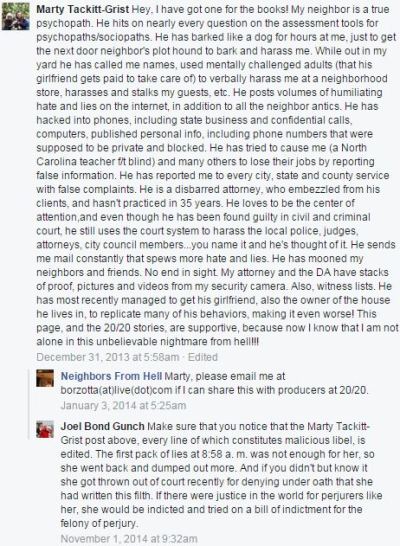
The quotation above is an excerpt from an email sent to the creator of “Neighbors from Hell” on ABC’s 20/20. The Feb. 8 email was a sorely persecuted man’s response to being fingered on Facebook as a candidate for the series by his neighbor, Marty Tackitt-Grist, who has forced him to appear before judges nearly 30 times in the span of a few years to answer “two restraining orders, three show-cause orders, two cyberstalking arrests, and a failure-to-appear arrest and jailing despite faxes from two doctors that I was too crippled, disabled, and suffering from herniated discs to be able to attend court.”

Here’s the reply the email elicited from ABC’s Bob Borzotta: “Hi Larry, I don’t seem to have heard further from her.  Sounds like quite a situation….” Cursory validations like this one are the closest thing to solace that victims of chronic legal abuses can expect.

Concern shown by the police and courts to complaints from attention-seekers can make them feel like celebrities. Random wild accusations are all it takes for the perennial extra in life to realize his or her name in lights.

Not unpredictably, the thrill is addictive.

I think I first heard from Larry, the author of BuncyBlawg.com, in 2013—or maybe it was 2012. In the artificial limbo created by “high-conflict” people like the one he describes in the epigraph, temporal guideposts are few and far between. A target like Larry can find him- or herself living the same day over and over for years, because s/he’s unable to plan, look forward to anything, or even enjoy a moment’s tranquility.

The target of a high-conflict person is perpetually on the defensive, trying to recover his or her former life from the unrelenting grasp of a crank with an extreme (and often pathological) investment in eroding that life for self-aggrandizement and -gratification.

Among Larry’s neighbor’s published allegations are that he’s a disbarred attorney who “embezzled from his clients” and a textbook psychopath, that he has “barked like a dog for hours” to provoke another neighbor’s (imaginary) dog to howl at her, that he has called her names, that he has enlisted “mentally challenged adults” to harass her while shopping, that he has cyberstalked her, that he has “hacked into phones” and computers, that he has tried to cause her (and “many others”) to lose their jobs by “reporting false information,” that he has made false complaints about her “to every city, state, and county service,” that he sends her mail “constantly,” and that he has “mooned” her neighbors and friends.

The ease with which a restraining order is obtained encourages outrageous defamations like these (Larry’s neighbor has sworn out two). Once a high-conflict person sees how readily any fantastical allegation can be put over on the police and courts, s/he’s inspired to unleash his or her imagination. That piece of paper not only licenses lies; it motivates them.
Larry’s a quiet guy with a degenerative spinal disorder who’s been progressively going deaf for 25 years. He lives for his three toy poodles and watches birds. “I grew up,” he says, “in a little Arcadian valley here in western North Carolina with the nicest people, mostly farmers; and I guess my youth just left me naïve about some people. I always saw the good in them.” Larry began practicing law in 1973 in Asheville but voluntarily withdrew from the profession in 1986, because he was disgusted by the corruption—and the irony of having his retirement years fouled by that corruption isn’t lost on him.

You might guess his accuser’s motive to be that of a woman scorned, but Larry’s association with her has never exceeded that of the usual neighborly sort. He reports, however, that she has alleged in court that he covets her and nurses unrequited longings and desires.

Compare the details of the infamous David Letterman case, and see if you don’t note the same correspondence Larry has.

Marty Tackitt-Grist, Martha Tackitt-Grist, Larry Smith, North Carolina, ABC’s 20/20, Nasty Neighbors, Neighbors from HellThat’s the horror that only the objects of high-conflict people’s fixations understand. Stalkers and “secret admirers” procure restraining orders to get attention and embed themselves in other’s lives—like shrapnel.

This writer has been in and out of court for eight years subsequent to encountering a stranger standing outside of his residence one day…and naïvely welcoming her. One respondent to this blog reported having had a restraining order issued against her by a man she sometimes encountered by her home who always made a point of noticing her but with whom she’d never exchanged a single word.

It isn’t only intimates and exes who lie to subject targets to public humiliation and punishment. Sometimes it’s lurkers and passers-by, covert observers who peer between fence slats and entertain fantasies—or, as in Larry’s case, a neighbor who feels s/he’s been slighted or wronged according to metrics that only make sense to him or her.

Larry thinks the unilateral feud that has exploded the last several years of his life originates with his complaining about cats his neighbor housed, after they savaged the fledgling birds that have always been his springtime joy to watch.

For 25 years I have lived on this street with lovely people. We always got along, although one or two you had to watch. During most of that 25 years, there have been three different owners of the house across the street. The other two we dearly loved. The last one, the incarnation of purest evil, moved here in 2005. She was a divorcée who volunteered that her divorce was especially nasty, the first red flag which I foolishly disregarded: She constantly badmouthed her ex. For the first few years, we were friends, but as time went by she became an almost insufferable mooch and just way too friendly, expecting more attention from her neighbors, and from us, than we wanted to give. Sometime in early 2011, I left her a voicemail and told her I didn’t want to be close friends with her anymore. She was a hoverer, she manipulated, she was a narcissist. And the message meant that I did not want to be called on to mow her lawn anymore, or help her trim her trees, or lend her tools, or watch her pet while she was gone, or help her move heavy loads like furniture, or listen to her constant whining. I just wanted to cool it with her.

In the spring of 2011, she had been converting her home to a sort of boarding house and brought in tenants, and [between] them they had two cats that constantly prowled, especially the tenant’s. What became very irksome to me was the tenant’s cat creeping into our yard and killing our baby birds, which we always looked forward to in the spring. And the minute I brought it up with her, she pitched a fit, and so did the tenant. So for the first two months of baby bird season, [their] cats killed all our fledglings and the mother songbirds—wrens, cardinals, robins, mockingbirds, towhees, mourning doves, even the hummingbirds, just wiped them out. I finally got in touch with our Animal Services officers, but by that time bird season was over with, and you know something, [she] began going about telling neighbors that I was a disbarred lawyer (a particularly nasty slander). One thing led to another, and finally the tenant with the marauding cat moved away, but the irreparable damage was done, and all through the summer I had been warned by other neighbors that the neighbor from hell was plotting revenge.
I went to her one day and asked her if there was anything I could do to make it so we could at least drop all the nasty hostilities. She exploded. Next thing I knew, she had three police cruisers here with a false tale that I was “harassing” her and calling her names. This was no surprise, because early on I learned not to believe a thing she said because she just made up the most unbelievable tales about her personal crises. One of the five cops who came spoke with me in the yard, and I thought this would all blow over, but in a few days a process server was banging on the door with papers to serve me. I met him in a commercial parking lot nearby and accepted the lawsuit, an application for a restraining order, a TRO, and, well, a great big wad of lies. It was a shocker. And little did I know that the very day I received this horse-choking wad of papers, at around 10:15 a.m., [she] was back in the courthouse filing another affidavit to have me ordered to show cause why I should not be jailed for contempt. In other words, before I even had notice of the TRO, she was trying to have me jailed for violating it. That’s just how damn mean that woman is.

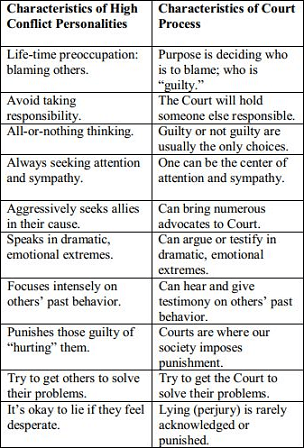
High-conflict people are driven by a lust to punish—any slight is a provocation to go to war—and their craving for attention can be boundless. Judicial process rewards both.

This table, prepared by attorneys Beth E. Maultsby and Kathryn Flowers Samler for the 2013 State Bar of Texas Annual Advanced Family Law Course, shows how high-conflict people and court process are an exquisitely infernal fit. Its authors’ characterization of high-conflict people’s willingness to lie (“if they feel desperate”) is generous. Many lie both on impulse or reflex and with deliberate cunning, though their chain of reasoning may be utterly bizarre.

Restraining orders are easily obtained, particularly by histrionic women. Once petitioners—especially high-conflict petitioners—realize how readily the state’s prepared to credit any evil nonsense they sputter or spew, and once they realize, too, the social hay they can make out of reporting to others that they “had to get a restraining order” (a five-minute affair), they can become accusation junkies.

Larry has responded in the most reasonable way he can to his situation. He’s voiced his outrage and continues to in a blog, and the vehemence of his criticisms might lead some who don’t know Larry to dismiss him as a crank. If you consulted his blog, you’d see it’s fairly rawboned and hardly suggests the craftsmanship of a technical wizard who can hack email accounts and remotely eavesdrop on telephone conversations. What the commentaries there suggest, rather, is the moral umbrage of an intelligent man who’s been acutely, even traumatically sensitized to injustice.

Here’s the diabolical beauty of our restraining order process. Judges accept allegations of abuse at face value and don’t scruple about incising them on the public records of those accused. They furthermore expect those who are defamed to pacifically tolerate public allegations that may have no relationship with reality whatever or may be the opposite of the truth, may be scandalous, and may destroy them socially, professionally, and psychologically. Judges, besides, make the accused vulnerable to any further allegations their accusers may hanker to concoct, which can land them in jail and give them criminal records. And finally judges react with disgust and contempt when the accused ventilate anger, which they may even be punished for doing.

Judicial reasoning apparently runs something like this: If you’re angry about false allegations, then they weren’t false; if you’re not angry about false allegations, then they weren’t false.

Larry’s been jailed, Larry’s been reported to the police a dozen times or more, an officer has rested the laser sight of her sidearm on him through the window of his residence, and the number of times he’s been summoned to court is closing on 30.

The allegations against him have been false. How angry should he be?

Copyright © 2014 RestrainingOrderAbuse.com

The Word for Restraining Order Abuse is FRAUD

So complacent toward lying have judges become that restraining order fraud goes over without raising an eyebrow. I’ve known one judge to scoff at the use of the word perjury on reflex, despite being ignorant of the facts he’d been called upon to adjudicate. And, though careless, he wasn’t a dim man.

Perjury, a felony crime, is the false (i.e., fraudulent) representation of a material fact to a judge (including on a sworn document like a restraining order application). A material fact is one that’s likely to influence a judicial decision. To falsely allege you’ve been sexually harassed or assaulted, for instance, is to commit perjury. Perjury is a word all defendants who’ve been falsely accused should know. Chances are they’re victims of more than one materially factual misrepresentation to the court.

The phrase restraining order fraud, too, needs to gain more popular currency, and I encourage anyone who’s been victimized by false allegations to employ it. Fraud in its most general sense is willful misrepresentation intended to mislead for the purpose of realizing some source of gratification. As fraud is generally understood in law, that gratification is monetary. It may, however, derive from any number of alternative sources, including attention and revenge, two common motives for restraining order abuse. The goal of fraud on the courts is success (toward gaining, for example, attention or revenge).
People who are victimized by the restraining order process are rarely students of law and often have had no prior exposure to legal procedure whatever. Words like perjury and fraud, while possibly familiar from having been heard in TV courtroom dramas or read in novels, are mostly alien concepts to the uninitiated. Restraining order recipients have mere days to prepare a defense—if they know they can contest an order of the court at all—and it’s unlikely that they’ll have concepts like these at their command. (I’m a student of words, and it took a lawyer’s familiarizing me with the significance of these two, among others, for me to gain a reasonably firm grasp of their meaning—and this was years after my own day in court. I was a practicing kids’ poet, and words like these weren’t ones I’d ever had call to use. And I’d prefer I were still ignorant of them today.)

Fraud isn’t commonly applied to restraining order abuse (itself an uncommonly used phrase), and it certainly should be, because the restraining order process is assuredly the most common motivator of frauds on the court. This process is usually employed impulsively, is free, and is completed in a matter of moments. Those motivated to use it maliciously—and they’re legion—typically do so in the throes of spiteful passion. They say whatever they believe they need to to achieve their desired ends.

However lacking their stories may be of scrupulous premeditation, though, they’re nevertheless frauds. And they nevertheless work.

The reason for the court’s failure to perceive restraining order fraud derives from its failure to perceive how damaging false allegations are to defendants. Judges aren’t likely to associate fraud with restraining order allegations, believing the term more aptly applied to cases that inflict “real” harm. Restraining order fraud, even when it doesn’t cost a defendant access to his or her home, property, and children, does real harm: anxiety, gnawing outrage, despondency, and depression, which may predictably lead to insomnia, deterioration of health, loss of productivity, and behavioral changes, and may conceivably induce drug or alcohol abuse and homicidal or suicidal ideation. Defendants may lose jobs or job opportunities. They may end up homeless. And these consequences ignore those inflicted on peripheral parties like children, who may also be lastingly traumatized.

The judicial disconnect between restraining order and harm is one defendants against false restraining orders must endeavor to bridge, because even a judge who’s nobody’s fool isn’t likely to get there on his or her own. The restraining order process is virtually automated. Judges know they don’t have to apply a great deal of diligent attention to particulars and consequently rarely do.

Use of the words perjury and fraud aren’t likely to avail restraining order defendants. Of probable value, though, is understanding them. And of definite value to arousing awareness of restraining order abuse and promoting reform of the restraining order process is leading others to understand them.

Copyright © 2013 RestrainingOrderAbuse.com

Egotists, Narcissists, and Other Self-Seeking Con Artists: On (Restraining Order) Fraud and Its Motives

I came upon a monograph recently that articulates various motives for the commission of fraud, including to bolster an offender’s ego or sense of personal agency, to dominate and/or humiliate his or her victim, to contain a threat to his or her continued goal attainment, or to otherwise exert control over a situation.

These motives will be familiar to anyone who’s been the victim of a fraudulent abuse of legal process and correspond with those of attention- and revenge-seeking restraining order plaintiffs, plaintiffs keen to avoid exposure of extramarital entanglements or otherwise compromising indiscretions or misconduct (such as stalking), and plaintiffs intent upon wresting possession of children and/or property from a partner (and, in one fell swoop, rubbing him or her out).

Excerpted from “The Psychology of Fraud” by Grace Duffield and Peter Grabosky (published by the Australian Institute of Criminology in its Trends and Issues in Crime and Criminal Justice):

“[An] aspect of motivation that may apply to some or all types of fraud is ego/power. This can relate to power over people as well as power over situations. In terms of the former, the sensation of power over another individual or individuals seems to be a strong motivating force for some fraud offenders to the point that it becomes an end in itself. As one confidence man put it:

“‘For myself, I love to make people do what I want them to, I love command. I love to rule people. That’s why I’m a con artist’ (quoted in Blum 1972, p. 46).

“In manipulating and making fools of their victims, some fraud perpetrators seem to take a contemptuous delight in the act itself rather than simply the outcome. As Stotland (1977) points out:

“‘[S]ometimes individuals’ motivation for crime may have originally been relative deprivation, greed, threat to continued goal attainment, and so forth. However, as they found themselves successful at this crime, they began to gain some secondary delight in the knowledge that they are fooling the world, that they are showing their superiority to others’ (pp. 186–7).

“Similar to the sense of superiority over others is the gratification obtained from mastery of a situation.”

Predictably the monograph also touches on narcissistic personality disorder (NPD), one of several personality disorders that lead people to commit frauds on the court, and sketches the dimensions of this cognitive aberration.

“Persons who harbour unrealistic impressions of their own capability, when reinforced by sycophants, lack a reality check and may be more likely to engage in risky behaviour than more grounded or ‘normal’ [types] (Janis 1982).

“This risk-taking would be exacerbated by the indifference to conventional rules of conduct that apply to narcissistic personalities. According to the Diagnostic and Statistical Manual of Mental Disorders, narcissistic personality disorder is a pervasive pattern of grandiosity, a need for admiration and a lack of empathy for others. Individuals with this disorder believe that they are superior, unique, and ‘chosen,’ and they are likely to have inflated views of their own accomplishments and abilities. They focus on how well they are doing in comparison with others, and this can take the form of an excessive need for attention and admiration. A sense of entitlement is evident, and they expect to be given whatever they want regardless of the imposition it places on others. In the workplace, these people tend to overwork others. They demand unquestioning loyalty and are incredulous or infuriated when it is not forthcoming. They are likely to respond angrily to criticism (DSM-IV Task Force 1994, pp. 658–9). Perhaps most relevant to fraud offences is the tendency of the narcissistic personality to usurp special privileges and extra resources that they feel they have an entitlement to, over and above ordinary people. This attitude is captured in the words of Leona Helmsley, a wealthy American subsequently convicted of tax evasion, when she said ‘only the little people pay taxes.’ Due to their ambition, confidence, and ruthlessness in dealing with others, the narcissistic personality may be a high achiever in their chosen field of endeavour.”

This definition bears obvious correspondences with that of the sociopath, another familiar abuser of legal process. Narcissists and sociopaths are statistically rare: 1/100 and 1/25, respectively. If you consider, however, that within a population the size of the United States’ that translates to over 3,000,000 narcissists and over 12,000,000 sociopaths, widespread complaints of fraudulent abuses by these human anomalies are easily credible. They become more credible yet if you further consider that such people, being devoid of moral inhibition, may be far more likely than others to engage in fraud for spiteful or self-serving ends.

Restraining order fraud, which often entails criminal acts like the commission of false reporting and perjury, is commonplace and commonly winked at by the courts. Possibly judges don’t appreciate how attractive and accommodating restraining orders are to frauds. Possibly they don’t appreciate how damaging the consequences of restraining order fraud are to the psyches and fortunes of defendants (among others, for example, defendants’ children). Possibly they don’t recognize how epidemic the problem is. Or possibly…they don’t care.

But should.

Copyright © 2013 RestrainingOrderAbuse.com

[Referenced works in the quoted excerpts above are Deceivers and Deceived by R. H. Blum, “White Collar Criminals” by E. Stotland (published in the Journal of Social Issues), and Groupthink: Psychological Studies of Policy Decisions and Fiascos by I. Janis.]

“Why Would a Narcissist Put a Restraining Order on You?”

Questions about the motives of the narcissistic brain like the one that titles this post bring visitors to this blog almost daily (related search terms that have drawn readers here can be found cataloged at the end of this post). Among the blog’s most clicked-on links are those to short essays on the subjects of narcissistic malice and vengeance by Dr. Linda Martinez-Lewi like those I’ve provided in the comments to this page. Dr. Martinez-Lewi is an expert on pathological narcissism (also called narcissistic personality disorder or NPD) who hosts the blog The Narcissist in Your Life. (Investigators into this subject may also find enlightening the writings of Stanton E. Samenow, Ph.D.; Sam Vaknin, Ph.D.; Paul J. Hannig, Ph.D.; and the late and very astute Joanna M. Ashmun.)

Below are some excerpted paragraphs from Dr. Martinez-Lewi’s essays that, contemplated as a series, will lead a person a long way toward an understanding of why malicious abuse of restraining orders to defame, discredit, and demolish targets of their wrath is so attractive to narcissists. (Italics are added.)

Narcissists expect everyone, through their words, gestures, and behaviors to mirror them perfectly. If you fail to do this in their eyes (and they are always looking for imperfection in others not themselves), it causes an unconscious bruise in their brittle egos. Even the smallest mistake or what the narcissist perceives as your mistake will result in the spewing of dark rage. If you do not go along to get along with them perfectly and buck them, you are bumping up against an inflexible, grandiose ego, and there will be hell to pay.

No one says “No” to the narcissist—unless they want to be the recipient of retribution. That is the narcissist’s mindset. These individuals have very rigid personality structures that do not change. They have unbending wills that insist they are always right, that their way is the only one, and…all of those who buck them will be discarded and punished severely. The narcissist plays dirty; [s/he] is a street fighter, a ninja. The narcissist picks the weak spots, the vulnerabilities in his [or her] opponent and knows exactly where and how to turn the screws. We become an opponent of the narcissist when we defy him [or her] and think for ourselves and let him or her know that they can no longer rule our lives. Most people are intimidated by the power and force of the narcissistic personality, especially if this is a person of high professional achievement, financial status, and powerful connections.

There are sociopathic narcissists who will not be satisfied until their “enemy” is completely vanquished—emotionally, psychologically, financially. They seek revenge, not for what has been done to them but what they perceive in a highly deluded way…has been done to them. Narcissists are never wrong—they are incapable of mistakes, because they truly believe that they are perfect. They are capable of persuading even intelligent people that they are the good guy, and their victim is the culprit. With the use of a fake charm, dynamism, [and] sexual wiles, they fool most individuals. A sociopathic narcissist will tear you to shreds….

[N]arcissists or their doubles contact your relatives, in-laws, friends, and anyone who will listen to broadcast blatant lies about your character. This doesn’t happen in all instances, but it is remarkable the lengths these malicious individuals exceed to trash you, putting you at fault and even leading others to believe that you are “crazy.” Even people whom you have trusted…can be flipped to the narcissist’s side, especially if [s/he] has influence where you have lived and deep pockets.

Narcissists never play fair. Narcissists are extreme competitors. Narcissists are very sore losers. When you cross a narcissist in business or your personal life, be prepared for some form of revenge.  Although the narcissist has a full-blown, grandiose ego, beneath the surface [s/he] is subject to narcissistic wounds. His [or her] ego bruises easily. If you beat him [or her] out of a business deal, it is likely that [s/he] will go after you in some way. If you choose to divorce a narcissist, it can go several ways. [S/he] may want to get rid of you and any children you have…and send you out of his [or her] life. In some cases, the narcissist is holding a deep grudge and is determined to collect on what [s/he] knows is his [or hers]. In divorce matters, [s/he] makes outlandish claims and tells outright lies about his [or her] spouse in order to win the battle.

The urge to take revenge runs deeply through the narcissist’s blood. Revenge is as prehistoric as life in the caves. Revenge is an act of retaliation for a perceived wrong or injury—payback time. I have been in contact with many spouses and ex-spouses of narcissists who were shocked by the unrelenting force of their former partner’s revenge tactics. During a divorce from a narcissistic partner, plans for revenge are hatched and played out. One classic ploy is the narcissist’s bullying tactics as [s/he] convincingly threatens to take you down financially and psychologically. Even after the divorce is final, the narcissist continues the Hundred Year War. Many narcissists cannot let go, not because they have ever loved their previous spouse, but for purposes of psychologically destroying the previous partner. Rumor campaigns are ignited to ruin the reputation and social standing of the previous spouse. Threats are made to change custodial agreements, not because the narcissist feels compelled to have more involvement in his [or her] children’s lives but to shake the cage of the ex-spouse. One of the most potent ploys of the narcissist is playing the victim role. When he or she has torn his [or her] ex-spouse’s life to bits for decades, [s/he] makes a quick switch, becoming the recipient of psychological and emotional pain not the narcissistic perpetrator.

Narcissists know how to manipulate their way out of trouble—even if there are serious ethical violations or illegal activities involved. Some narcissists finally tumble, and we watch them finally get their due and pay the consequences. This doesn’t happen often. If you are waiting for your ex-narcissistic husband or wife to be brought down due to his cruel, manipulative, and devastating behaviors toward his family, don’t hold your breath. We cannot put our faith even in the courts to obtain justice. Narcissists find clever ways around legal issues. If they have large sums of money at their disposal, there are situations in which they manipulate the outcome of legal proceedings. I know of cases in which a narcissistic spouse ended up wresting custody control from the other partner.

Dr. Martinez-Lewi’s therapeutic orientation is toward narcissists’ spouses and family members, but her revelations of basic narcissistic motives and tactics are applicable to the situation of anyone who runs afoul of a narcissist, irrespective of how intimate their relationship.

Though this advice of Dr. Martinez-Lewi’s is directed toward soon-to-be ex-spouses, its gist should be taken to heart by anyone in a legal contest with a narcissist: “[B]e sure you hire an attorney who is not only an expert in family law but who is exceedingly savvy about the ruses, tricks, and ploys of the narcissistic personality disorder. Your attorney needs to be highly professional but fearless in facing this relentless, cruel, and destructive individual. An excellent attorney in these situations must be like ultra-marathon runners. Regardless of any obstacle placed in front of them by the narcissist, they are undaunted. Their perseverance is golden.”

There are no depths to which a narcissist won’t stoop to injure the target of his or her wrath. A narcissist will lie to your face about things you did together, so expect him or her to have no compunction at all about lying to anyone else about you, including friends, associates, authorities, and officers of the court.

Because judges of restraining order applications are inclined to presume a plaintiff is telling the truth, they’re readily duped by narcissists, who not only lie glibly and persuasively but with a cold-bloodedness nothing shy of fiendish.

Copyright © 2013 RestrainingOrderAbuse.com

“Why Would Someone Get a False Restraining Order?”

This question pops up a lot.

Simply rephrasing it can dispel some of the wonderment: “What would someone have to gain by falsely accusing someone else of conduct society condemns?”

Satisfaction of a spiteful impulse might come to mind.

I remember looking at a book once by a guy named Hayduke. It was chock full of ingenious vengeance schemes—pretty much all of them criminal or bordering on it. Lying on a restraining order to sate a hurtful yen, while technically criminal, is never treated as such and may well succeed in criminalizing the target of that yen.

Common allegations on restraining orders are harassment, stalking, danger, and violence. Any of these—and especially the last—can doom a person’s employment or professional aspirations, tear relationships apart, and gnaw at and vex the innocently accused indefinitely (to his or her physical and psychological erosion). Allegations like this from a domestic partner can deprive the same victim of assets and access to loved ones. The use of fraudulent restraining orders to gain the upper hand in child custody battles is pretty much cliché.

And restraining orders don’t just vanish from public record when the expire. In some regions, there are even restraining order registries to make finding out who’s had a restraining order sworn out against him or her conveniently (and alluringly) accessible by the public. The political push is toward making such registries universal.

It’s possible that the question, “Why would someone get a false restraining order?” is prompted by a disbelief that a person could be so unethical. Such a disbelief betrays the questioner’s naivety.

People frame people for crimes or commit crimes to hurt others every day. Abusing restraining orders is just more fail-safe. Perjury (lying in court or on a sworn statement) is never prosecuted, and restraining orders are generally free for the asking. You get the state to exercise your malice for you, it costs you nothing, and everyone extends you their sympathies.

The worst that happens when someone lies to obtain a restraining order is that it’s overturned on appeal. And even if it’s quashed, the recipient of the fraudulent restraining order will have been put through hell (and possibly cost several thousands of dollars in attorney fees). In fact succeeding in having a restraining order vacated (canceled) doesn’t necessarily mean it disappears from public record. Even if a fraud loses, s/he wins.

Clearly then the answer to the question, “Why would someone get a false restraining order?” is “Why not?”

Copyright © 2013 RestrainingOrderAbuse.com