Restraining Orders Make Casual Interpretation of Superficial Facts Easy, Privative, and Enduringly Crippling

Most restraining orders are issued ex parte, that is, based exclusively on the testimony of the accuser. Making hyped, skewed, or false allegations against someone who’s not there to contradict them, and making those allegations persuasive, isn’t hard. Hearings to finalize orders based on ex parte rulings, furthermore, may begin and end in 10 minutes.

At no stage of the process do allegations meet with eagle-eyed scrutiny.

This shouldn’t be news to anyone, nor should it be news that the effects of picknose adjudications are far-reaching. Based on them, citizens are publicly humiliated and may be deprived of access to their children and property besides denied jobs. Proximal effects of these consequences are stress, emotional turmoil, depression, and disease. (Restraining orders are also a foot in the door from which vexatious litigants can persecute the accused relentlessly, aggravating these effects manifold.)

The accused expect these results to be obvious to judges, and they expect consciousness of them to influence judges’ decisions. They expect judges to care about the truth and to care equally about the lives of those who stand before them. Judges, however, aren’t boy scouts, philosophers, or social workers. They’re just people performing a job. They clock their eight and hit the gate like sanitation workers do—and they may not perceive their job very differently.

There is a difference, though. How judges are to perform their job is prescribed by the law. The indifference of the law is the problem.

Laws concerning restraining orders were hastily slapped together decades ago, and their evolution has been informed by very narrow priorities (mostly prescribed by feminist advocates and VAWA). None of these priorities considers the rights or welfare of the accused. Restraining order law is “women’s law,” and the only historical imperative has been to process, prohibit, punish, and permanently brand purported abusers in the name of protecting those who are “politically disadvantaged.”

As recent posts have stressed, restraining orders are public records that staunchly resist revision or expungement. While convicted felons may be able to have their criminal records erased, citizens accused on restraining order petitions, even ones that have been dismissed (“thrown out”), must wear their labels forever.

To be accused is to stay accused.

This injustice won a fresh objector recently whose story is telling. I won’t identify him, because he intends to tell the story himself sometime soon, and he hopes to report a happy conclusion. This man made headlines last year when he successfully appealed a restraining order against him in his state’s supreme court. The order was vacated, and that should have been an end on it.

Not long ago, he says, he and his girlfriend were detained by a customs and border official when they attempted to reenter the country after going on a cruise. The dismissed restraining order raised some kind of red flag (in the mind of the official, anyhow). The man wasn’t seriously inconvenienced, and as an American citizen, he faced no risk of being barred from the country.

What was forcibly brought to his attention, though, is that a very dead order of the court still hounded him months after it should have been laid to rest.

The man is an entrepreneur who works for himself, but he’s now cognizant of the potential harm a record like this could have on anyone who’s employed in the public or private sector who’s subject to a thorough background check. The record that got him detained didn’t say “vacated” or “void” or any such thing. It showed, in fact, as current.

That’s because tidy-up isn’t mandated by law; only this is: “Process, prohibit, punish, and permanently brand purported abusers.” Nobody in the system cares what happens afterwards, because no one in the system has to. It’s on to the next “abuser.”

This highlights a broader fact about restraining orders. They’re prejudicial, and because they’re pumped into statewide and national databases, they’re subject to free interpretation by anyone in the system—or anyone with access to the public record…which is anyone.

Summary:

  1. A judge interprets some superficial claims made by a complainant and enters a “preliminary” (ex parte) order. This is then permanently entered into the public record, including into state and federal registries.
  2. The order may be finalized, or it may be “tossed.” Either way, the initial judge’s (five-minute) impression is preserved.
  3. Any other cog in the system, whether a clerk of the court, police officer, or other public official, can see this record and freely interpret its significance.
  4. Any private party, what’s more (e.g., an employer, a loan officer, a landlord, a student, a client, a girl- or boyfriend, a child’s school administrator, etc.), is also invited to freely interpret the significance of an order that may bear a title as fatal to the accused’s popularity and prospects as “emergency protective order for stalking and sexual assault.” (Even if such an order is tossed after the defendant is afforded the chance to defend him- or herself—or because the plaintiff voluntarily had the order dismissed—the permanent record still says, “emergency protective order for stalking and sexual assault,” and it says it right next to the defendant’s name.)

What might be called cruel and unusual punishment isn’t acknowledged by our government as unjust or even unfair.

Copyright © 2016 RestrainingOrderAbuse.com

*When the writer of this post was first accused in 2006, he inquired with two clerks at the Pima County Superior Courthouse about where to file a brief to a judge. The male of the pair, upon hearing what the matter was about, fixed him with a knowing look and gratuitously remarked, “She wants you to stay away from her, right?” My accuser, a married woman who deceived multiple judges, was someone I had only ever encountered outside of my own house (where she nightly hung around in the dark). Pococurante orders of the court license any arrogant twit to form whatever conclusion s/he wants…and to pronounce that conclusion with righteous contempt.

An Aggressive Approach to Restraining Order Policy Reform: Threaten to Sue the State Courts Administrator in Federal Court

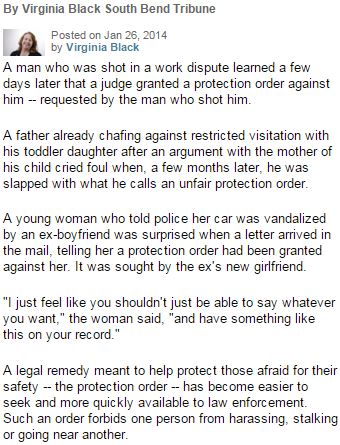
Restraining orders are public records, and recent posts have concerned or commented on their publicity and the unavailability of having their traces expunged even if orders are dismissed by their petitioners or otherwise vacated. This post highlights the pioneering efforts of one Missouri civil rights lawyer to upset the imbalance by threatening to file a federal lawsuit.


“Unless expunged, criminal case records remain online, even if prosecutors drop the charges. Civil lawsuits [which include restraining orders] stay on Case.net even if a judge dismisses the claims, [Kansas City media attorney Jean Maneke] noted.

“‘Openness is generally a better way to clean up concerns about inaccuracy than attempting to put everything back in a box,’ Maneke said.”

—“Pending Protection Orders Yanked from Public View

Everyone is entitled to his or her opinion. “Bullshit” is this writer’s opinion of the one quoted above. If you’ve been wrongly implicated in an abuse of process (or several), you probably disagree with views like Ms. Maneke’s, too, and believe that lies should never have been taken out of the box in the first place let alone engraved in databases and preserved indefinitely for public scrutiny.

Here are among what views like Ms. Maneke’s ignore:

  1. Restraining orders aren’t criminal cases, so they can never be expunged. Even if a judge dismisses (“tosses”) the allegations, only Tennessee has legislation that affords a wronged defendant the opportunity to have the case against him or her erased from the public record. Many orders, moreover, are finalized despite being grounded on fraud.
  2. Restraining orders aren’t criminal cases, but they’re not strictly civil cases, either. Acts imputed to defendants are often, if not typically, criminal (e.g., harassment, sexual harassment, stalking, terroristic threats, assault, battery, child abuse, sexual violence, or domestic violence).
  3. Unlike in other kinds of civil cases, a restraining order judgment may be wordless and formed in mere minutes, and the defendant may never be heard from at all. (An order can be obtained in a county or state other than the one a defendant resides in, so s/he may have no practicable opportunity to defend.) Also, an order may be awarded even though some of what may be many allegations are never considered by the court or are determined to be baseless. An approved order is an approved order. There aren’t necessarily any qualifications from the court on the recorded instrument to indicate which claims it regarded to be real and urgent, which suspect, or which baseless. To a third-party reader of the order, then, the accusations that appear on it are taken at face value.
  4. The mere title of an order may be prejudicial all by itself, regardless of the facts litigated in court.

The story the epigraph was excerpted from begins like this:

The client couldn’t stand it.

He typed his name into Case.net and up popped an ugly classification: “Protection Order: Adult Abuse Stalking.”

Who needs any more than those five words to form a conclusion about the person they were applied to? The case was dropped by the woman who made the accusation, but those five words nevertheless remained on the Internet.

The man was naturally concerned about the affect those words could have on his business and asked his lawyer to intervene.

[Bevis] Schock, a St. Louis attorney, [drafted] a federal equal protection lawsuit against the Office of State Courts Administrator. He never filed it, because four months later a Missouri Supreme Court committee decided privacy concerns trumped the public nature of this type of electronic court records.

Now pending orders of protection don’t appear on Case.net until judges grant full orders of protection.

The policy shift isn’t unopposed, but today “if the judge denies a petition or the filing party drops her request, it won’t ever appear online [and the] rule change is retroactive; OSCA scrubbed any previous ex parte orders from Case.net, including those involving Schock’s client.”

Schock said he spent 40 to 50 unpaid hours drafting an 18-page federal lawsuit against Greg Linhares, state courts administrator. Among other arguments, the lawsuit claimed the prior public records rule treats respondents differently than petitioners, because respondents are named online but petitioners are not.

The federal 2005 Violence Against Women Act prohibits states from publishing online any identifying information about people seeking protection.

Remarkable is that it takes the threat of a federal lawsuit to alert the courts to an obvious inequity. (Note, too, that finalized orders remain online, even though they may have been based on false allegations, and that even dismissed orders are preserved and can be accessed at the courthouse.)

The story is recommended reading. It notes in passing several facts about the process that are rarely observed, for example, that plaintiffs may file “seven or eight orders of protection” only to have them dismissed.

Under Missouri’s former policy, all of these dismissed petitions would have been visible online.

Unsurprisingly, a staff attorney with the Domestic Violence Unit at Legal Services of Southern Missouri is quoted as expressing the conviction that a “history” like this is indicative of true victimhood.

It can also be indicative of persecution by a venal and vindictive ex, vexatious neighbor, or fixated nutcase.

Copyright © 2016 RestrainingOrderAbuse.com

States that MAY Allow Records of “Protective Orders” to be Expunged…and Why They’re So Few

“The consequences that arise once a protective order is entered against a person (the respondent) are substantial. Though technically considered civil proceedings, protective orders have a close relationship to criminal law. The consequences of having a protective order entered often include restrictions on constitutional rights in addition to financial obligations. Violations of protective orders bring about serious criminal charges.”

Attorney Misha Lopez

“I have been fighting for 10 years to clear my son’s name from a false restraining order that [was] dismissed and vacated by the court. But to clear themselves, [officers of] the judicial system turn their heads to the wrongdoing and cause this young man to be [defamed], not able to continue his education, etc. His [access to] life has, it seems like, forever been barred.”

Blog respondent

The remark above by a criminal lawyer on the “consequences of protective orders” echoes those of many other attorneys (which may observe that restraining order records limit job opportunities and can interfere with the lease of a home, getting government housing, or obtaining credit). I could find you a quotation along the same lines from a law firm in any state of the Union. The woman whose remark follows the lawyer’s, Lena Bennett, identifies herself as a “concerned mother who needs to be heard,” and this post is dedicated to her and her son.

Black_debateA former trial attorney, Larry Smith, who knows the law in this arena better than he wishes he did, responded to Lena:  “I doubt that you can get an expired order expunged in most states because the restraining order, although it has may components of the criminal law, is said to be civil.”

As usual, Larry gets right to the heart of the matter. The fact is there are laws on the books that allow a person who’s been convicted in a criminal court of, say, harassment, stalking, terroristic threats, or assault to later have the charges expunged.

But if a person is baselessly accused of any or all of these acts on a civil restraining order, there’s no legislation in place (except in Tennessee) to enable him or her to have the accusations removed from his or her public record even if a judge determined them to be baseless and dismissed the order.

Note: People who have actually committed crimes can relieve themselves of the onus of a court record (that may hobble their employment opportunities), while people who’ve merely been accused on an ex parte order of the court (30 minutes in and out) are incriminated for life without ever having been tried for a crime, and that, again, is even if a judge formally decreed them innocent and tossed the accusations.

The paper trail, which may include multiple false reports to police officers and registration in police and publicly accessible state databases, is indefinitely preserved.

(Let’s say you’re an employer screening a male job applicant, and you see a restraining order record on which a woman has indicated that he stalked or sexually assaulted her. Let’s even say the court dismissed the case as lacking any foundation. Will you or won’t you be influenced by that record?)

Excuses for preserving restraining order records, which emerge from anti-domestic-violence dogmatists, are anachronistic. Typical of the law, statutes are about 20 years behind social trends.

Consider:

MD_bill

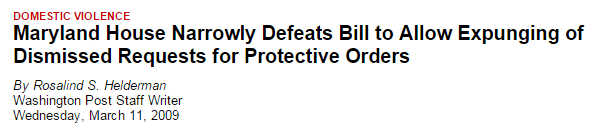
The bill whose defeat is reported in the headline above would have allowed citizens of Maryland who had been accused of domestic violence on a dismissed restraining order petition to have the allegations completely expunged (erased). It was shot down.

Supporters of the measure argued that abuse accusations carry such a stigma that allowing records to remain public in cases that have been deemed unfounded unfairly hurts innocent people as they seek employment or housing.

Opponents contended that requests for protective orders are often dismissed because battered victims, usually women, are too scared or intimidated to pursue the matter. They said records are not expunged in other kinds of civil cases, even when allegations are unproved.

Never mind that these opponents are well aware that restraining order cases are not like “other kinds of civil cases.” Their implications are plainly criminal and highly prejudicial. They’re recorded in police databases.

MD_bill2A year later, another bill is proposed to the same legislature. This one wouldn’t expunge anything, but it would “hide” restraining order records from public view.

“Shielding” is possible in Maryland today and only requires a clerk to sign off on it. It removes the record of a dismissed order from Maryland’s Judiciary Case Search. The record still exists, however, and can be easily accessed by anyone who swings by the courthouse.

In the whole of the nation, as revealed by a Google search performed yesterday, these are the only states in which there are reportedly means to have a restraining order expunged:

Of these, only Tennessee has an actual statute (law) enabling a person who’s been accused on a restraining order petition that was later dismissed to move the court to expunge the record.

And in only a handful of states (again, according to a casual Google search) has legislation been proposed that would offer the same opportunity to their citizens:

That’s it.

Copyright © 2016 RestrainingOrderAbuse.com

What Can Be Done with Public Records, Like Restraining Orders, Arrests, and Convictions: A Tutorial for Judges and Everyone Who’s Been Lied about to One

Court records are available for public consumption, freely or for a few dollars, besides people’s home addresses, telephone numbers, birth dates and ages, work histories, list of associates and family members, etc. Men and women falsely targeted for blame in drive-thru court procedures may be fined or jailed for airing information about their accusers’ conduct that’s far less sensitive than what anyone with an Internet connection and a credit card can glean in five minutes—which may include decisions against men and women falsely targeted for blame in drive-thru court procedures….

sniffing

Decisions of the court in public proceedings are public records.

Remarkably, not even judges grasp the significance of the word public. More astonishing than that many judges today don’t know the first thing about the Internet is that no one in government seems to think it’s important that they be instructed.

The conditioned imperative is blame…and the consequences be damned.

Billions of federal tax dollars have been dedicated over the past 20 years to biasing police and judicial responses to accusations of abuse, but not one has been earmarked to show judges how the Internet works and how the public records they generate may be used.

This post will attempt to amend the lapse.

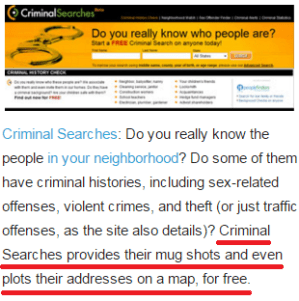
Here are a mere handful of websites that peddle so-called “private” information:

What follows is a demonstration of how they work.

In the most recent fiction-based prosecution against the author of this post, it was ruled by a superior court judge that I violated the privacy of my accuser by discussing her motives online, and I was unlawfully prohibited from publicly referencing her in future. My judge was Carmine Cornelio, and here is what is returned (at no charge) if I enter his first and last names into SwitchBoard.com:

  1. his middle initial,
  2. his approximate age,
  3. his phone number (a landline provided by Coxcom),
  4. his home address (and a map showing where his home is located),
  5. a tab that provides directions to his house,
  6. a tab that leads to information about his neighbors,
  7. the names of a couple of “people [he] may know,” and
  8. an invitation to “View [his] Background & Public Record Information.”

If I enter his name into Intelius.com (again for free), his age is confirmed to be 64, and I’m provided with the names of five of his relatives, as well as his address history, aliases, and prior jobs he’s held (he’s identified as an attorney but not a judge). All of this is right there on the surface. If I cared to know more, here’s what else I could learn for a trivial fee:


Matthew Chan of Defiantly.net has recently chronicled the case of a New Jersey man, Bruce Aristeo, who was jailed for six months for “vlogging” about a woman who accused him of abuse after he was issued something called an “indefinite temporary restraining order.” The judge didn’t even view the contents of the YouTube videos his ruling was based on. I’ve viewed some of their contents, which are mostly satire and fully protected under the First Amendment, and they’re a lot less invasive that an Intelius report. Mr. Aristeo has been arrested at least four times based on allegations he says are false, and those arrests are all public records that may be pulled from an Intelius report, by an employer, for instance, or a prospective girlfriend.

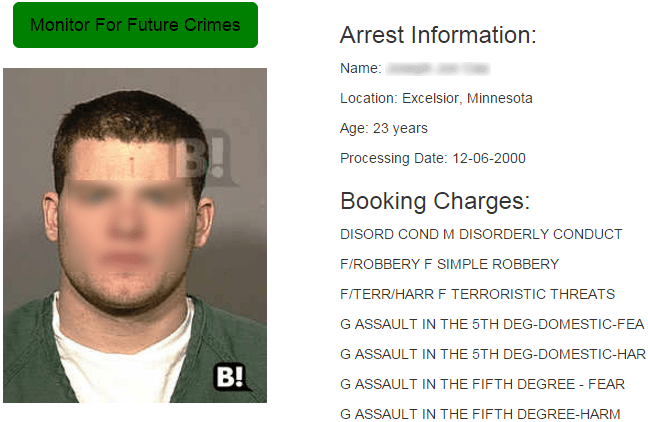
Below is a screenshot from a website called BustedMugshots.com (a product of U.S. Data Co. Ltd.).

blurred mugshot


I was told by this man’s sister that accusations against him were falsified:

It makes me wonder, how common is this? Because my own brother had his girlfriend and mother of his child accuse him of rape a few years ago. He went to prison for it even though she later recanted her lie, but the case was already in the court’s hands and they wouldn’t accept her testimony. She truly ruined his life.

This certainly isn’t something a viewer of this record (e.g., an employer, a neighbor, or a girlfriend) would conclude. Significantly, also, this record is 15 years old. Court records, besides being very public, are very permanent.

Twice on the same page featuring the above record appears this search bar:

It encourages the viewer to look up the public records of yet other people. A button under the mugshot offers the viewer the option to “Order Complete Background Report” from the same “National Database” (called “Instant Checkmate”). The viewer is also invited to enroll in a service that notifies him or her of future arrests of the same person (“Monitor For Future Crimes”).

People, possibly on arrantly false grounds, are set up as targets for constant and endless scrutiny…to which they can hardly be insensitive.

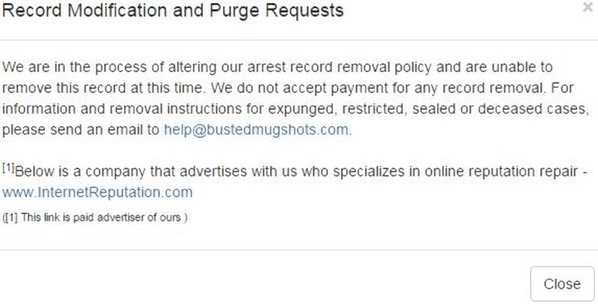
While a line of text under the mugshot suggests a person can “Request This Record to be Modified or Purged,” here’s what pops up when you click its hyperlink:


It’s a tease. The website will only remove the record if it’s been ordered sealed or vacated by the court, or if the person it identifies has died. The blurb hastily clarifies that BustedMugshots.com isn’t out to blackmail people. It doesn’t have to: It collects fees from its advertisers.

This titillating “warning” greets the visitor to InstantCheckmate.com.

Besides advertising the services of Instant Checkmate, BustedMugshots.com advertises for InternetReputation.com, with which the notice above tacitly urges someone with a mugshot published online to inquire (“Protect Your Online Privacy”).

Observe the squeeze: Damning information is published (legally) for the person it concerns to see. That person also sees that anyone can access this and other sensitive information, and is urged to exploit the services of a company that offers to protect his or her reputation…for a fee.

(Summary in media res: A person may be falsely accused in a farcical “trial” and emotionally and financially devastated. S/he may be arrested and imprisoned based on lies. The records may be used to further maim him or her in additional prosecutions. And—and—the records of all of these proceedings, based on a fraud or frauds, may be aired publicly. But the accused may not discuss them defensively without risk of court censure. No wonder, then, that some victims of procedural abuse never want to leave the house and flinch when the doorbell rings.)

This blog concerns restraining orders, which can be obtained easily on hyped or fraudulent grounds and make defendants vulnerable to arrest and conviction for “crimes” that only they can commit, for example, sending an email or placing a phone call.

Vigilant response to any claimed violation of an order has been vigorously conditioned for decades (by the Office on Violence Against Women), and it’s not uncommon for people to report that they’ve been arrested multiple times for falsified violations of restraining orders with falsified bases (see above).

On top of all of this, the records generated by this mischief can be legally published or sold, and the government, besides, has its own public databases that may be freely accessed by anyone with an Internet connection.

These are among the reasons why principle must be restored to process.

Copyright © 2016 RestrainingOrderAbuse.com

*BustedMugshots.com includes this contemptible sentence in its disclaimer: “The data may not reflect the status of current charges or convictions and all individuals are presumed innocent until proven guilty in a court of law.” Sure they are.