Victims Are Important, but They’re Not More Important than Anyone Else: Amending Priorities and Reconceiving Restraining Order Policy According to the Principle of Equality

“While some municipal court judges acknowledge that the domestic violence law can create injustices—one calls it ‘probably the most abused piece of legislation that comes to my mind’—there are counterpoints. Melanie Griffin, executive director of the Commission to Study Sex Discrimination in the Statutes, a legislative commission that drafted much of the 1991 law, says that for every individual who files a false report, ‘there are 100 women who don’t come in at all and stay there and get beaten.’”

—“N.J. Judges Told to Ignore Rights in Abuse TROs

This quotation comes from a nearly 20-year-old journalistic exposé, yet you’ll find the same starkly meretricious apology for restraining order abuse routinely voiced today.

This quotation from the proposed Equal Rights Amendment (ERA) means that all people should be treated equally under the law, not that women should be privileged. Anyone who’s for women’s being afforded special treatment by the authorities and the courts, as proponents of the Violence Against Women Act (VAWA) are, opposes the ERA.

This quotation from the proposed Equal Rights Amendment (ERA) means that all people should be treated equally under the law, not that women should be privileged. Anyone who’s for women’s being afforded special treatment by the authorities and the courts opposes the message of the ERA, as do proponents of the Violence Against Women Act (VAWA).

The argument, basically, is that it doesn’t matter if restraining order defendants’ rights are ignored, and it doesn’t matter if defendants are falsely accused, because there are many more victims of abuse who suffer in silence than there are false accusers.

The argument equates apples with orangutans. Its reasoning is partisan and purely emotion-based—and betrays ignorance of the fact that women, too, are falsely accused of domestic violence. Its thesis is that since there may be multitudes of unacknowledged victims of domestic violence, the state’s creating victims by abetting false prosecutions is of no statistical significance.

While everyone should feel for women who are “beaten” at home, no one should be forced by the state to endure “sympathy pains.” The falsely accused man or woman whose life is upturned or undone by hyped allegations or gross lies credited by careless judges is absolutely blameless for the suffering of strangers.

Life, liberty, and the pursuit of happiness are inalienable rights guaranteed to all citizens under the Constitution, and equality and fair treatment under the law are among its mandates that brook no compromise. Denying the latter to anyone, ever—even if the motive is a sympathetic one—is categorically wrong.

The statement in the epigraph says: It’s okay if you, Mr. or Ms. Doe, are falsely accused and battered by the system, and it’s okay if it deprives you of your kids and home and livelihood and dignity and sanity, because some people you don’t know and never will know are reportedly “beaten” by some other people you don’t know and never will know.

It says there are women who suffer unjustly, so never mind if we make you suffer unjustly, too.

Copyright © 2014 RestrainingOrderAbuse.com

Restraining Orders and Feminist Self-Sabotage: On the Error of Preferring the Stick to the Carrot

Consider: At least a couple more restraining orders will have been issued in the time it takes you to read this post.

I pointed out recently that after 30 years and the issuance of millions or tens of millions of restraining orders, feminists and others continue to report that the incidence rate of domestic violence, which is the go-to rationale for restraining orders, is unchanged.

They report, in fact, that it’s “epidemic.”

Plainly restraining orders have put no dent in the problem. What’s more, it’s possible they’ve made it worse.

How this may be possible is simple. By authorizing gross and large-scale (epidemic) civil rights abuses for decades, the system has jaded the sentiment of a significant sector of the public. The punitive nature of both biased legal policies and the feminist rhetoric that has inspired them does nothing to change minds. It inspires resentment, outrage, and distrust, if not contempt.

Male victims of false restraining orders, in particular, who may well be a majority of recipients and number in the millions, can hardly be expected to sympathize with the feminist agenda. Worse yet, a goodly proportion of them may be far from sensitive to the interests of women generally, because feminism has associated itself with those interests inextricably.

Feminism doesn’t appeal to or cultivate sympathy; it largely strives to chastise and dominate, which can only foster misogyny.

Resentment toward feminist-influenced legal processes conduces to resentment toward feminists and consequently resentment toward women. Feminism works against its own mission statement and the interests of its nominated beneficiaries.

It’s certain that restraining orders have provided peace of mind to some petitioners. It’s certain, also, that they’ve compromised or devastated the lives of a significantly greater number of falsely accused defendants, who receive no compassion from feminist quarters.

On balance, the curative value of restraining orders is null if not negative. Per capita, that is, they do more harm than good. And the impact of each instance of abuse of power is chain-reactive, because every victim has relatives and friends who may be jarred by its reverberations.

Although it doesn’t occur to feminists, because they’re the darlings of the government and the media, their zeal to blame and punish is alienating instead of unifying.

The feminist m.o. is to win not win over…and nobody doesn’t hate a bully.

Thanks to kangaroo legal processes that are effectively products of feminist authorship, feminists’ potential supporters may number several fewer now than when you started reading this post.

Copyright © 2014 RestrainingOrderAbuse.com

Feminist Reports Conclude Restraining Orders Don’t Work: Time to End the Experiment

The Internet is awash with images like these.

Restraining orders are defended on the basis that they protect female victims of domestic violence.

The most recent posts on this blog have stressed the constitutional violations that are necessarily entailed by the process. One of them reprints a 1995 New Jersey Law Journal exposé: “N.J. Judges Told to Ignore Rights in Abuse TROs” by Russ Bleemer. In various of the article’s quotations, the “epidemic” nature of domestic violence is emphasized. Almost 20 years later, you’ll discover by a casual Google search that domestic violence is still broadly termed “epidemic.”

If domestic violence was “epidemic” at the start of the restraining order boom, and it’s still “epidemic” two decades later after the issuance of millions or tens of millions of restraining orders, there are only a couple possible conclusions to be drawn: (1) restraining orders aren’t doing the job, or (2) restraining orders have exacerbated the problem.

Either of these conclusions leads to an inevitable third: the dividends of restraining orders are negligible if not negative. Juxtapose their negligible effectuality against the untold suffering they’ve wrought and continue to wreak, and legislators’ duty is clear: back to the drawing board.

The manifest unfairness of restraining order policy toward individual defendants is justified according to the belief that the overall benefit of restraining orders to society excuses large-scale civil rights’ violations and the abrogation of the most basic ethical tenets of law, like impartiality, diligent deliberation, and due process.

If the blanket benefit of restraining orders to the society as a whole is none, as feminists and others report—that is, if restraining orders haven’t actually downgraded the alert status of domestic violence from red after 30 years—then money is being flushed down the toilet along with the lives of restraining order defendants for no reasons but maintenance of appearances and appeasement of special interests.

No buts about it.

Copyright © 2014 RestrainingOrderAbuse.com

False Restraining Orders That Allege Emotional Abuse ARE Emotional Abuse

A theme that emerges upon consideration of restraining order abuse is lack of empathy—from impulsive or false accusers and from those who abet them. Plaintiffs who act either spitefully or viciously seldom appreciate the ramifications of their actions. They may possess what we call a normal conscience but either don’t think or, in the heat of the moment, don’t care.

The horror is that this same indifference extends not only to authorities and officers of the court but to feminist advocates for restraining orders and the public at large, who are persuaded that the gravity of violence against women trivializes all other considerations. Their indifference may in fact be unconsciousness, but when people’s livelihoods and lives are at stake, unconsciousness is no more pardonable.

It’s ironic that the focus of those who should be most sensitized to injustice is so narrow. Ironic, moreover, is that “emotional abuse” is frequently a component of state definitions of domestic violence. The state recognizes the harm of emotional violence done in the home but conveniently regards the same conduct as harmless when it uses the state as its instrument.

From “Are You a Victim of Emotional Abuse?” by Cathy Meyer:

Emotional abuse is used to control, degrade, humiliate, and punish a spouse. While emotional abuse differs from physical abuse, the end result is the same….

Note the writer’s conclusion that emotional abuse is equivalent to violence in its effects.

Her orientation, of course, is toward victims of domestic violence, but her judgment is just as applicable to false allegations, whose intent is to “control, degrade, humiliate, and punish.”

Plainly the motive of most reasonable feminist arguments and appeals, at least as that motive is understood by those making them, is to induce empathic understanding. They want people to care.

Here’s yet another irony. Too often the perspectives of those who decry injustices are partisan. Feminists themselves are liable to see only one side.

“But my side’s more important” isn’t a rebuttal but a confirmation of chauvinism.

In the explication quoted above, the writer compares the conduct of emotional abusers to that of prison guards toward prisoners of war, who use psychological torment to achieve compliance from their wards. Consider that victims of false allegations may literally be imprisoned.

Consider further some of the tactics that Ms. Meyer identifies as emotionally abusive:

  • Isolating a spouse from friends and family.
  • Discourag[ing] any independent activities such as work; taking classes or activities with friends.
  • If the spouse does not give into the control, they are threatened, harassed, punished, and intimidated by the abuser.
  • Us[ing] the children to gain control by undermining the other parent’s authority or threatening to leave and take the children.
  • Control[ling] all the financial decisions, refus[ing] to listen to their partner’s opinion, withhold[ing] important financial information and mak[ing] their spouse live on limited resources.
  • Mak[ing] all major decisions such as where to live, how to furnish the home, and what type of automobile to drive.

Now consider the motives of false allegations and their certain and potential effects: isolation, termination of employment and impediment to or negation of employability, inaccessibility to children (who are used as leverage), and being forced to live on limited means (while possibly being required under threat of punishment to provide spousal and child support) and perhaps being left with no home to furnish or automobile to drive at all.

The correspondence is obvious…if you’re looking for it. Opponents of emotional abuse need to recognize it in all of its manifestations, because the expectation of empathy is only justified if it’s reciprocated.

Copyright © 2014 RestrainingOrderAbuse.com

Impulse: How Restraining Orders Encourage and Reward Tantrum Behavior and Why Feminist Advocates Should Be the First to Push for Their Reform

It’s often fairly remarked that feminists tend not to acknowledge restraining order abuse, let alone express resentment toward female offenders. There are exceptional instances, however, as you’ll see below.

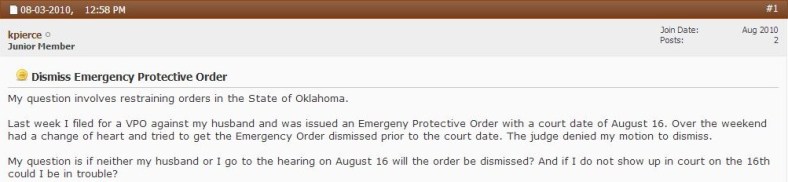
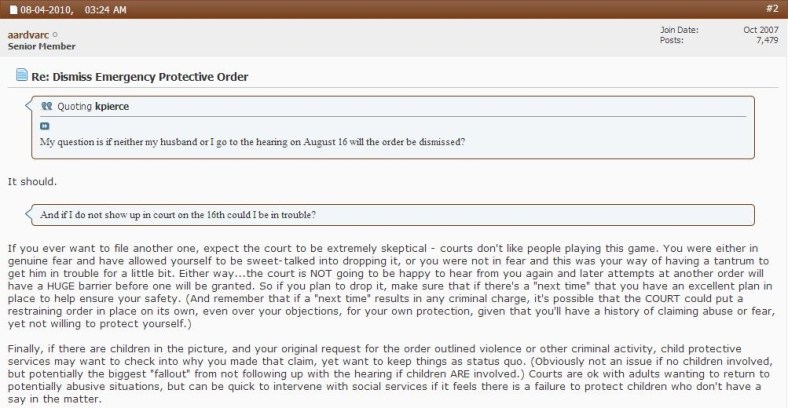
It’s also remarked that rash or false allegations mock and discredit the suffering of genuine victims. The respondent in the forum exchange that follows, though she doesn’t say as much, clearly agrees.

Notable about the response, whose tone is reproving, is that its writer recognizes that restraining orders may be sought impulsively to gratify a “tantrum” and get their defendants “in trouble” (which recognition fittingly uses the language of the playground).

Notable, contrariwise, however, is that the respondent discourages the petitioner of the restraining order, who’s admitted to proceeding impulsively, from following through with her expressed intention to rectify an act that may have been motivated by spite. The respondent is the executive director of AARDVARC (An Abuse, Rape, and Domestic Violence Aid and Resource Collection), and behaviors like those the questioner owns up to undermine her endeavor’s credibility.

Notable, finally, is the respondent’s observation that once the state machine is roused, it can be tough to quiet again—like a swarm of killer bees.

The slack standards applied to the restraining order process cut both ways. Not only do they make it easy to lynch defendants undeservedly based on a few brief statements rendered in minutes; the drive-thru, come-one-come-all policy they authorize urges plaintiffs to proceed full-steam ahead without consideration of consequence to themselves and their families.

Plaintiffs shouldn’t be able to incriminate others impulsively, and those who are baited into doing so have as much reason to fault the state as they do to fault themselves.

Representatives of victims of domestic violence and rape, furthermore, are at least as keenly aware as anyone that people follow vicious impulses when there are no checks on their behavior. Logically, then, feminist proponents should be the first to perceive that if state processes have no reins, they’ll be abused. These activists should, accordingly, recognize restraining orders’ potential for abuse and be at the forefront of advocacy for more rigorous and responsible policy.

Copyright © 2014 RestrainingOrderAbuse.com

WomensLaw: A Domain Name That Says All You Need to Know about Where Restraining Order Reform Needs to Start

The biggest challenge to sensitizing people to abusive restraining order policies that are readily and pervasively exploited by malicious litigants can be summed up in a single word: sex.

Women, who are often victims of abuse of court process, don’t want to implicate women in their injuries; they want to blame their false accusers, who are frequently men. Appreciate that this urge to blame men is the reason why restraining orders as processes of law exist in the first place.

Appreciate also that men aren’t the force behind the perpetuation of the status quo, and pointing fingers in their direction isn’t going to change that fact.

In the last month, I’ve sifted the Internet to discover what types of restraining order are available where and how to undo their misapplication. The most thorough source of information on restraining orders offered by the various states that I’ve found—and one I’ve repeatedly returned to—is WomensLaw.org.

It’ll tell you everything you ever wanted to know about restraining orders in your neck of the woods. Its domain name will also remind you why restraining orders exist and what they signify (there is no MensLaw.org).

After decades of rampant abuse’s being tolerated and with restraining orders’ having become a familiar institution, men have hopped onto the abuse industry bandwagon, and their malicious exploitation of restraining orders will probably continue to escalate with the passage of time.

The authorship of restraining orders, however, is by women, for women. Anyone with an interest in social justice or in reforming a handily abused process that fractures families and derails lives every day must acknowledge this fact and resist the reflex to divert blame from where it’s due.

The women who advocate for restraining orders don’t necessarily understand that they’re abused, why they’re abused, how they’re abused, or what the consequences of their abuse are. And they’re not going to take men’s word for it.

Copyright © 2014 RestrainingOrderAbuse.com

They Don’t Have to Be True, Just “Truthy”: Civil Restraining Order Allegations and the “Burden of Proof”

“Preponderance of the evidence, also known as balance of probabilities, is the standard required in most civil cases. […]

“The standard is met if the proposition is more likely to be true than not true. Effectively, the standard is satisfied if there is greater than 50 percent chance that the proposition is true.”

—Wikipedia, “Legal burden of proof

As the previous two posts have discussed, “preponderance of the evidence” is the standard according to which restraining order allegations are “tried.”

Note that the odds of its being accurate, assuming all conditions are equal, may be only slightly better than a coin flip’s.

Accusations on restraining orders that are adjudicated by this standard may include any of the following (along with any other allegation conceivable): simple or aggravated assault, simple or aggravated battery, stalking, cyberstalking, sexual abuse, false/unlawful/forced imprisonment, peeping, criminal coercion, reckless endangerment, child abuse/molestation, “menacing,” “terroristic threatening,” theft, arson, criminal mischief, extortion, burglary, criminal trespass, sexual harassment, incest, offensive touching/“lewd fondling,” kidnapping/abduction, malicious property damage, injury or killing of animals/pets, larceny, rape or statutory rape, or other felonies, including (in New Jersey and Alaska) homicide.

See for yourself: “Standards of Proof for Domestic Violence Civil Protection Orders (CPOs) by State.” And appreciate that accusations like these need not be made against domestic partners or other members of a shared household. They can be made against friends, lovers, work associates, neighbors, exes, exes’ new spouses or boy- or girlfriends, rivals of any other sort, nondomestic family members, former family members, strangers—you name it.

Accusations on restraining orders may alternatively amount to no more than “annoyance.” The same standard is applied to the allegation of rape as is applied to allegations of nuisance, and irrespective of a plaintiff’s actual claims, the implications of a restraining order, which is a publicly accessible record and one preserved in the databases of state and federal police, are threat, stalking, and/or violence.

Restraining orders are understood to be issued to “sickos.” Nobody hears “restraining order” and thinks “Little Rascal.”

Consider that the initial determination of the truth or falsity of a restraining order plaintiff’s allegations is grounded on a brief interview between the plaintiff and a judge. Consider further that the judge will likely have never met the plaintiff before; that the judge may therefore have no basis whatever for forming an opinion of the plaintiff’s honesty, soberness, or sanity; and that the defendant upon whom judgment is rendered is just a name on a form.

If the “legal burden of proof” defined in the epigraph didn’t already sound sketchy enough, observe that unless a defendant has a prior record of misconduct, no empirical grounds exist even for a judge to decide that there’s a 51% probability that the plaintiff’s telling the truth—other than, perhaps, whatever physical corroboration the plaintiff may provide, which may be none, may be forged, or may be misrepresented.

Restraining order allegations are essentially established (and essential establishment is all that’s required) on the forcefulness of a plaintiff’s claims. The truth or falsity of individual allegations is literally irrelevant (except, of course, to the defendant who has to live with them for the rest or his or her life). A judge isn’t a fact-finder in these cases; s/he’s a bookmaker.

It’s all about the probability that a plaintiff’s claims are more true than false, and the fixer of the odds is a single judge—or at most two.

In other words, the standard “preponderance of the evidence” is hokum. It’s basically an authorization for a judge to act according to his or her discretion, which is a lofty way of saying that it authorizes a judge to decide however s/he wants. Allegations, including of felony crimes, don’t have to be true, just “truthy.”

If, prior to forming a decision on a restraining order petition, a judge were required to at least meet the defendant; and if it weren’t the case that the judge had likely had it impressed upon him or her that s/he should prejudicially regard the plaintiff’s allegations as true; and if it weren’t the case that societally conditioned expectations urged the same prejudice…then there might be a reasonable hope that a judge could perform the computation required by “preponderance of the evidence” with some degree of accuracy, allowing that a “degree of accuracy” should be acceptably conclusive.

As the procedure exists today, there can be no such reasonable hope.

Copyright © 2014 RestrainingOrderAbuse.com

“American Law is Irresponsible”: The American Civil Standard of Evidence and Abuse of Restraining Orders

“On the European continent, for the court to hold against the defendant, the judge must be convinced that the facts brought forward by the plaintiff in support of the claim are indeed true. In principle, continental law does not make a difference between civil law and criminal law […]. By contrast, U.S. law has three different standards of proof […]. In criminal law, the charge must be established ‘beyond a reasonable doubt.’ In civil law, normally the plaintiff wins if only ‘the preponderance of the evidence’ is in [his or] her favour. Only in a limited number of civil law matters, of particular gravity for the defendant, the intermediate standard of ‘clear and convincing evidence’ must be met.”

—Dr. Cristoph Engel

The monograph from which this quotation is excerpted, which is by a professor of experimental law and economics, begins by candidly remarking that “American law is irresponsible.”

No argument here.

At the root of restraining order injustice is the lax evidentiary standard applied to plaintiffs’ allegations. Not only may allegations on restraining orders be false; a judge doesn’t have to be convinced that they’re not false to find in favor of their plaintiff.

Excepting in Maryland, which adjudicates the merits of civil restraining order allegations based on the intermediate standard of “clear and convincing evidence,” the standard applied to restraining orders is “preponderance of the evidence.”

If claims seem more likely true than false, “preponderance of the evidence” is satisfied.

In other words, the law is contented if a single judge (not a jury of independent thinkers) reckons the allegations against a defendant are “probably true” (or “maybe true” or “true enough”). To be effective, all allegations have to be is compelling.

Making allegations compelling isn’t a tall task for people in the throes of bitter animosity, as restraining order plaintiffs typically are, and it’s a cakewalk for unscrupulous liars, who are hardly rare among restraining order plaintiffs.

Officers of our courts have furthermore had it impressed upon them that they shouldn’t question allegations made pursuant to the procurement of restraining orders, which are presumed to be sought by those in need of protection.

The legal standard familiar from TV and the movies, “proof beyond a reasonable doubt,” is reserved for criminal prosecutions. For a judge to find in favor of a civil restraining order plaintiff, no proof of his or her allegations is necessary.

Why this is a big deal is that being publically accused is agonizing. Cops and constables serve restraining orders on people at their homes, and just the documents themselves terrorize and shame (as they’re meant to). Allegations on restraining orders, what’s more, are never harmless. Even alleged minor offenses like harassment are inevitably tinged with overtones of danger and/or sexual deviancy. Plaintiffs are inclined to make their allegations as sensational as possible to justify their applications to the courts, and the courts are inclined to find threat or perversion even where none may exist to justify their intrusions into defendants’ lives.

Defendants are met with damning fingers from all directions—and enduringly, because restraining orders (and the allegations on them) are public records, accessible by anyone, that never disappear.

What makes this an even bigger deal, especially when evidence is fraudulently represented or allegations are false, is that restraining order defendants further face loss of employment and employability, as well as loss of access to kids, home, and property in a majority of cases.

Revisiting a phrase used by the author of the epigraph, such losses easily qualify as “particularly grave” and should therefore require the application of a more conclusive standard of evidence by our courts than “close enough.”

Exacerbating the injustice of this tenuous standard is that restraining orders are issued based solely on the word of their plaintiffs (ex parte). Decisions that may result in the losses enumerated above proceed from testimony given in interviews rarely lasting longer than 10 minutes.

Such hearings are far more perfunctory than probative. Basically a judge is just looking for a few cue words to run with and may literally be satisfied by a plaintiff’s saying, “I’m afraid.” (Talk show host David Letterman was notoriously issued a restraining order based on the petition of a woman who accused him of mentally oppressing her through her TV.)

What you have, then, on top of the presupposition of guilt, is a wishy-washy protocol yoked to a wishy-washy evidentiary standard.

It’s true that defendants are afforded the opportunity to challenge allegations leveled against them and actually address the court, but these follow-up hearings, also mere minutes long, are necessarily biased by the court’s prior findings.

The issuance of a restraining order (based on a few-minute chitchat) already represents a ruling, and the court’s disposition isn’t to contradict itself. This bias, authorized by a low evidentiary bar, too often translates to follow-up hearings’ being little more than theater—and an opportunity to subject defendants to additional humiliation and scorn.

Judges coyly criticize their partiality as “paternal.” Considering, however, the steep toll that that partiality may exact from innocent defendants, this self-excuse is nothing shy of obscene (and underscores the cognitive disconnect to which judges are prone between their performances in the courtroom and the effects of those performances on people’s lives).

Clearly the motive for applying a diminished standard of evidence to any courtroom procedure is not to decrease the likelihood of error. The lower the standard of evidence is, that much greater is the probability that miscarriages of justice will occur. When such miscarriages equate to innocent defendants’ being subjected to public humiliation and defamation, loss of employment, and effacement from their former lives, besides their having to tolerate the ever-looming possibility of incarceration following further false allegations’ being made against them, nothing less than the highest standard of evidence is conscionable.

The criticism of the writer of this post’s epigraph that “American law is irresponsible” doesn’t even begin to say it.

Copyright © 2014 RestrainingOrderAbuse.com

If You’re not Part of the Solution, You’re Part of the Problem: On Why Restraining Order Abuses Have Persisted for So Long and How to Do Something about It

“Men are bastards!”

“Women are cun[ning]!”

I could end this editorial here, and I would have summed up the problem, which originates with hearts but owes its infinitude to different organs entirely.

Predictably, since most restraining orders are sought against a member of the opposite sex, online forums about dirty divorces, domestic abuse, treacherous lovers, vengeful exes, predatory or parasitic whackjobs, etc. often boil down to cross-gender sniping and “team camaraderie.” Women just want to be pissed with men and bitch about them with other women, and men just want to be pissed with women and bitch about them with other men.

Both genders have limitless potential to suck; sex is beside the point.

Those who profit politically and monetarily by the misery inflicted through court processes that are easily abused by the “morally unencumbered” love all this conflict and misdirected rage, which only ensure that these corrupt processes continue to thrive.

They’ve already hummed along without a hitch for over 30 years. In fact, they’ve gained momentum, despite reasoned and articulately critical pans from distinguished members of the legal, journalistic, academic/philosophic, and public policy communities.

Not only does cross-gender bitching by victims of state abuses distract from the actual source of the problem, which is bad laws; it makes those victims sound like the cranks and nuts everyone else is glad to assume they are.

True, the person who betrayed you and lied about you should be subjected to medieval punishment. True, the judge you got may be worthy of the same for his or her cruelty or carelessness or cluelessness. But…the reason either was entitled to abuse and humiliate, rob and defame you was THE LAW.

Except for the statutes that authorized your injuries, those injuries wouldn’t have been possible.

Passive aggression isn’t going to accomplish anything. I can’t imagine venting even makes anyone feel better for very long.

Aggressive aggression holds a lot more promise. If you’ve been wronged, tell your story, and tell it in a way that will count. Sign a petition and add a comment about your own circumstances. You don’t even have to expose your name. Sign several and tweet them, too (a few are below). Start a petition of your own. Tweet that also and post it here. Start a Facebook page. Connect and consolidate forces.

STOP FALSE ALLEGATIONS OF DOMESTIC VIOLENCE

THE SUPREME COURT: FEATHER FOR THE FALSELY ACCUSED

RESTRAINING ORDER LAWS ARE DANGEROUS AND UNFAIR TO MEN

This may seem unthinkable to you, especially if your wounds are fresh, but appreciate that the impulse to conceal shame only potentiates that shame. If you’ve been wronged, the shame isn’t yours. Re-channel your emotions in constructive ways. You’re not alone.

No one wants to do this. No one should have to. I wanted to write humor for kids. Though not a big dream, it contented me, and I think I would have been successful at it by now and that other doors would have opened. I was dragged from my interior world and away from the life I might have enjoyed. Not only am I not a political person; I don’t even like board games.

I do, though, hate bullies, especially ones with gangs behind them.

Recognize that the ringleader of the gang that assaulted you isn’t that petty lowlife you mistakenly invested your trust in; he’s an invisible man who’s represented in posters wearing red, white, and blue, and his gang is everybody.

The only way you can beat him and attain some satisfaction is by taking away his gang and making it yours.

Copyright © 2014 RestrainingOrderAbuse.com

Because Perjury Occurs a Lot, It’s Ignored: On the Absurdity and Toll of Domestic Violence and Restraining Order Policies’ Disregarding False Allegations

“My 87-year-old father has been arrested and jailed three times by my mentally ill mother, who is using domestic violence laws to her advantage in a divorce. This is a man who served in the military for 20 years, the federal government for 25 years, and the Department of Social Services for five years before retiring. My dad has never even had so much as a speeding ticket in his entire life, but now, at the end of his life, he has been humiliated, placed on supervised probation, and will probably lose everything due to the abuse of domestic violence laws. Nobody in law enforcement will listen to what is really going on here. Even though I had prior knowledge that my dad was being set up, I have actually been told by the District Attorney…and I quote, ‘I have convicted your father of assault on a female, and I will convict him of everything else I can.’ The justice system has gone off the rails, and the truth means nothing. My father fought in World War II and in Korea to keep this country free, and this is how he is repaid.”

—E-petition respondent

How did you spend the yuletide? With friends and family, listening to Nat King Cole and Bing Crosby, mussing kids’ hair and congratulating them on their Christmas spoils?

Read the epigraph above, and you’ll have a pretty clear idea of what Todd L. of Wilmington, North Carolina had on his mind. Not much to raise a cup of cheer to, is it?

This distinguished service veteran’s age approximates that of the cited victim of false allegations.

Two hours after Todd shared his story on the e-petition “Stop False Allegations of Domestic Violence,” a fellow North Carolinian opined, “There should be a legal penalty for false accusations!”

Lawmakers have agreed, actually, and statutes making lying to the court a felony crime are universal. What this commenter should have said is that legal penalties for false accusations should be enforced.

Perjury is never prosecuted. District attorneys will tell you that if they did prosecute perjurers, there’d be no resources left for putting “dangerous people” behind bars.

Let’s parse that logic.

First, it actually recognizes that lying occurs a lot. If it only occurred now and then, prosecutions would be few and hardly a budgetary strain.

Second, recognizing that lying occurs a lot also recognizes that the so-called dangerous people the state prefers to prosecute may simply be victims of false allegations. Preferring to prosecute alleged domestic assailants, therefore—take, for example, the 87-year-old man cited in this post’s epigraph—may mean preferring to prosecute the falsely accused (the innocent) over the genuinely criminal (the false accusers).

Ask yourself which would look better on the books: “We’ve successfully prosecuted [x number of] wife-beaters” or “We’ve successfully prosecuted [x number of] perjurers”? Everyone knows what wife-beater means. How many people even know what a perjurer is?

“If we did prosecute perjurers, there’d be no resources left for putting dangerous people behind bars…so we’ll prosecute the people perjurers falsely accuse of being dangerous”—as analysis of most of the arguments made in defense of domestic violence and restraining order policies reveals, the reasoning is circular and smells foul. It’s in fact unreasoned “reasoning” that’s really just something to say to distract attention from unflattering truths that don’t win elections, federal grants, popular esteem, or political favor. So entrenched are these policies and so megalithic (and lucrative) that rhetoric like this actually passes for satisfactory when it’s used by someone in a crisp suit with a crisper title.

Obviously it wouldn’t be necessary to prosecute all perjurers to arrest epidemic lying. Ensuring that false allegations were made less frequently would only entail putting a few frauds in cages for a year or two where they belong, making examples of them, and revising policy so that the consequences of lying were impressed upon other would-be frauds. As it is, policy (including menacing rhetoric on court documents like restraining orders) is to impress upon defendants how serious the consequences of being lied about are: “For being publicly lied about, you may be subject to arrest and incarceration for being publicly lied about some more.”

The absurdity is patent, as is the wanton cruelty. Applying the word justice to any aspect of this policy should itself be criminal.

The 87-year-old man referenced in the epigraph above may be at the end of his life, and it’s a reasonable surmise that whatever remaining time he could have hoped for will be shortened by the treatment he’s received from the country in whose service he’s dedicated over half of that life.

If a YouTube video were posted of state agents bludgeoning an 87-year-old veteran, it would shortly go viral, reporters would elbow their way onto the man’s front stoop, lawyers would scrap and scrabble to represent him, and cable commentators would decry the outrage of the abuse.

Heads would roll.

Since state agents have instead subjected this man to public denigration and dehumanizing psychic torments under the guise of propriety, the odds are strong that he’ll slip away erelong, invisibly, his final days having been poisoned by anguish, disgrace, and the unrelenting consciousness that 50 years of public service were callously invalidated: “I have convicted your father of assault on a female, and I will convict him of everything else I can.”

Copyright © 2013 RestrainingOrderAbuse.com

The New Domestic Violence: Restraining Order Abuse

Daughter: “He hits me, Ma.”

Mother: “Well…I can’t say I’m surprised. What’d ya do?”

Daughter: “Whaddya mean, what’d I do?”

Mother: “What’d ya do to make him angry? He didn’t just hit ya outta the blue.”

Daughter: “I guess I didn’t do what he wanted me to.”

This exchange is extracted from a recent Hollywood movie set in the 1970s immediately preceding the advent of the restraining order and illustrates the social mindset that ’70s-era feminists sought to counteract, namely, one that tolerated spousal abuse and placed the blame for it on its victims.

Living in an environment of insecurity and intimidation is a daily torment no one should have to bear, and no one can deny that the motives that led to restraining order legislation’s being drafted were very sympathetic ones.

What this blog and others like it seek to bring to light is that restraining orders have become the arbitrarily brutal hand that they were originally conceived to check—and they’ve put brass knuckles on it.

Restraining orders’ abuses arise from the same impulse: anger, jealousy, or control, for instance; but they’re much worse in many ways than slaps and threats, because their consequences are more exacting, enduring, and inescapable.

As in the exchange above, the answer to why someone had a restraining order petitioned against him or her is too often: “I guess I didn’t do what [s/he] wanted me to.”  The motive for the abuser’s action may be identical. Only the means of abuse are different.

Because those means may, and often do, include lying and lying publicly and savagely, abuses accomplished with restraining orders don’t fade like bruises do. A man falsely accused of domestic violence, for example, is publicly recognized as a batterer for the rest of his life, and that label may follow him from job to job or relationship to relationship. Years of his life may pass in agony before his ordeal in the courts has even concluded. A lie impulsively told to a judge in a few minutes may be something its victim has to continue to counteract forever, and though counseling may help him reconcile himself to the lie and its injuries, no amount of it will ever erase that lie, because it’s branded on his public face.

And while women alleged to be batterers may not be perceived as harshly as men accused of domestic violence, women, too, may be abused by restraining orders in exactly the same way, making a process that was designed to protect women a convenient means of brutalizing them that has the sanction of both the government and the feminist establishment.

Fraudulent allegations, furthermore, don’t need to be of domestic violence to lay victims low. Falsely characterizing them as stalkers or sources of sexual harassment or threat may be just as damning and damaging, both socially and psychologically. The implications of the phrase “protection order” or “restraining order” are alone sufficient enough, because their resonance never diminishes. It and its ramifications persist indefinitely.

The horror of the woman in the domestic situation suggested in the scene recited above was that she was stuck in an untenable situation, a situation she was powerless to correct or extricate herself from. Thirty years ago, a woman might have had nowhere to turn. Even mom and dad might turn her away and remind her that she swore a vow of fidelity she was obligated to honor (which is what the mother in this scene does).

Today, a (female) victim of spousal abuse has options. Public and familial reactions to her plaints are liable to be very different. She can move out and divorce without any stigma affixing itself to her, and if she lacks the wherewithal, there are shelters that may take her in until she’s able to provide for herself.

For the victim of restraining order abuse, there are no escapes. The stigma, which may be debilitating, is permanent and may be accompanied besides by his or her being denied access to home, kids, pets, property, and money. In other words, s/he may find him- or herself robbed by the state of all resources and values on top of having to bear a psychic wound there’s no staunching.

Restraining order frauds go over easily, because three decades later authorities and the courts are still responding to what they imagine are scenarios like the one sketched in the scene above. Irrespective of the actual circumstances, it’s what sparks and fuels the indignation that meets many defendants on the faces and in the conduct of judges they’re brought before, conduct that verges on retributive vigilantism.

It’s time to dust off the misperceptions and the process itself. Restraining order laws, which originated in the 1970s, have “evolved” retrospectively, seemingly aiming to amend injustices that occurred before many or most recipients of restraining orders today even drew breath.

The sins of our fathers and forefathers, however villainous (and they assuredly were), aren’t anyone’s but theirs.

Copyright © 2013 RestrainingOrderAbuse.com

Objections to Restraining Orders AREN’T about Restraining Orders

Let’s get something clear: protests against restraining orders aren’t about restraining orders.

Granted, it’s a violation against decency and all things American for the government to casually curtail citizens’ freedoms without even consulting them first. But, seriously, who cares if a judge says one adult can’t talk to some other adult?

Objections to restraining orders are never about not being allowed to talk to the plaintiffs who were treacherous enough seek them. I would imagine (and I don’t strictly have to imagine) that most restraining order defendants’ feelings toward the people they’re prohibited from talking to are considerably less than friendly, anyway.

Here’s what objections to restraining orders are about:

  • On a modicum of evidence of “threat” or none at all, a spouse or boy- or girlfriend can be ejected from his or her home (even if s/he holds the deed) and forbidden access to his or her children, pets, money, and property on pain of police arrest.
  • Allegations ranging from harassment to domestic violence can be permanently stamped on defendants’ (that is, recipients’) records, again based on a modicum of evidence (very possibly misrepresented) or none at all. An allegation amounting to nothing more than “I’m afraid” is sufficient to obtain an “order of protection,” the implications of which phrase alone signify stalking, violence, or violent intent.
  • Restraining orders are public documents that may be accessible to anyone, including employers and would-be employers. Records of their issuance remain on public view even after their expiration and may be entered into public registries.
  • The truth or falsity of allegations that may be as extreme as assault with a deadly weapon, child molestation, or rape is determined according to the same civil standard of evidence as contract and insurance disputes: “preponderance of the evidence.” Regardless of the extremity of allegations on restraining orders, neither a trial by jury nor “proof beyond a reasonable doubt” is ever required for their validation. If a judge feels there’s a better than 50/50 probability that allegations are true, “preponderance of the evidence” is satisfied.
  • Allegations on restraining orders, which may be either criminal or criminal in nature and may besides be entirely false, indefinitely remain on defendants’ public records whether they’re found meritorious or not, that is, even baseless allegations that a judge ignores are never stricken from the record but remain on public view and may reasonably be interpreted as true or valid by anyone who consults those records.
  • The restraining order process is conducted ex parte, which means orders are issued based on one party’s claims alone, and these may be both damning and egregiously false.
  • Statutory penalties for lying to police officers and judges (false reporting and perjury) are never enforced, and allegations of lying are furthermore discounted by the courts.
  • Federal grant monies (average grants being in the neighborhood of $500,000) are awarded to police districts and courts in return for their consenting to have their officers “educated” about how they should respond to allegations of fear and violence. Mandated responses include accepting allegations of violence by women at face value (that is, they’re not to be questioned). This mandated response roughly translates to allegations by anyone being recognized as legitimate.
  • Irrespective of the nature of allegations entered against a defendant, which may be innocuous or false, that defendant is subjected to traumatizing menace, intimidation, and public disparagement by the state. S/he is treated generically like a fiend, the paradigmatic basis for which treatment is the domestic batterer whose conduct restraining orders were originally conceived to check, despite allegations of violence being rare today relative to the vast number of restraining orders issued (estimated at two to three million per annum).
  • Restraining orders, which circumvent due process entirely and which originate in civil court and are therefore subject to no standard of proof, may implicate defendants as criminals and may have criminal consequences if “violated.” Alleged violations, also, may be subject to no standard of proof. In other words, a defendant can find him- or herself locked up, never having been granted his or her constitutional right to a trial and very possibly on maliciously false grounds (based on a decision formed by the court prior to even knowing what that defendant looked like).
  • Opportunities to contest allegations on restraining orders, which defendants may literally have to ask for within a brief window of time, may be assigned no more than a few minutes, and defendants are never provided counsel. An innocent defendant forced to contest utterly malicious allegations may face the quandary of living with them permanently stamped on his or her public record or shelling out $2,500 to $5,000 for an attorney’s representation, which measure is no guarantee of vindication and which measure few can afford even if they’re conscious of the need (which few are).
  • Restraining orders are usually free for the asking and may be petitioned serially or multiply by a single applicant, making them marvelous instruments of harassment and torment. There’s no statutory limit on the number of restraining orders a single applicant may apply for, no penalties for having false or groundless restraining orders dismissed, and of course no penalties for lying.
  • Restraining orders impose no limitations on the actions of plaintiffs (that is, applicants), leaving them free to taunt or stalk defendants, or bait them into violating orders of the court.
  • Courts pander to and reward even those guided by spite, jealousy, malice, and/or personality disorders or mental illnessThe interchange between a judge and a plaintiff is no more than five or 10 minutes in duration and is more procedural and perfunctory than probative. A judge authorizes a restraining order, which may permanently alter many lives for the worse (including those of children), based on knowing nothing whatever about its defendant, who’s just a name on a form, and almost nothing about its petitioner, who may be disturbed or even insane.
  • Upon plaintiffs’ successfully making false allegations stick once (or baiting defendants into violating false restraining orders), they now have a foundation upon which to make further falsehoods entirely plausible. Thus can innocent defendants’ lives be scarred or fractured irreparably by chronic abuse (a single potent lie, or a series of them, can be nursed for years). And these defendants may have been the actual victims in the first place.

Most people (including authorities and officers of the court) aren’t conscious that restraining orders are abused, let alone conscious of how they’re abused, why they’re abused, or how extremely they can be abused.

It’s hoped that this synopsis makes the means and motive for restraining order abuse clearer to those in the dark, at sea, or on the ropes. Whether you’re a legislator, a judge, a police officer, an attorney, a counselor, a feminist or feminist partisan, a victim of restraining order fraud, or just someone with reasonable expectations about how the justice system operates, whatever your perceptions were about restraining orders and their administration, those perceptions were probably either naïve or wrong.

The ease and convenience with which restraining orders may be obtained make their attractiveness as instruments of passive-aggressive castigation, spite, and vengeance irresistible.

You’ve seen that game carnival-goers are invited to take a crack at that gives them three tries to drop a seated person into a pool of water? Restraining orders are sort of the same thing, only the cost of a ticket is free, a player doesn’t need to be able to hit the broadside of a barn, and the water beneath the target is scalding.

Copyright © 2013 RestrainingOrderAbuse.com

Playing God: A Further Consideration of the Character and Conduct of Officers of the Court

My previous two posts have been directed at the character and conduct of officers of the court (that is, attorneys and judges), and the one immediately preceding this one looked specifically at a number of cases of extreme judicial misconduct.

I sketched some of the implications of this misconduct, which ranged from debauchery to violence, in the conclusion to that post. What I’d like to consider in this one is this: in what professional office that you can think of besides judge would it not only be possible to engage in these kinds of activities—for example, propositioning coworkers, masturbating in a roomful of people, or brandishing firearms (in buildings where they’re prohibited)—but possible for the kind of person who’s brazen enough to engage in them to occupy?

I can’t think of one in which such a person would be tolerated or one that such a perpetrator wouldn’t immediately be ousted and escorted to a cell from. Not one. Not that long ago, a President of the United States was impeached for privately dropping trou.

The obvious answer to how this is possible is that (1) courtrooms are insular spaces where judges literally reign, and (2) everyone, including members of their staff, is intimidated into (sycophantic) submissiveness. A judge can literally masturbate himself in front of a crowd of people, and no one will stand up and recognize the behavior openly, let alone challenge its seemliness (this is the phenomenon satirized in the story, “The Emperor’s New Clothes”).

I’ve recently observed that several jobs in the legal and government spheres are ones people with so-called psychopathic traits are said to gravitate toward: lawyer, police officer, and civil servant (judges are both lawyers and civil servants). Other “top jobs for psychopaths” are said to be CEO and surgeon. These are all occupations whose practitioners you have assuredly heard someone remark “think they’re God.”

What does it mean to think you’re God?

What’s usually meant is that people like this have been invested with authority and expect it to be recognized; presume to dictate to others what’s best for them (that is, they presume to know best); never doubt or second-guess themselves, their judgments, or their worthiness; relish being the center of others’ attention; and are resistant to stress and immune to shame.

They’re excellent survivors, clearly, which is what the title of Oxford professor Kevin Dutton’s book, The Wisdom of Psychopaths, implies. They’re rewarded by exerting their will on others and, despite whatever consequences may ensue as a result, sleep well.

Over the course of writing dozens of editorials on restraining order abuse and the issues around which it orbits and from which it devolves, I’ve found myself over and over coming back to psychology. Both wanton abusers of the law and practitioners of the law (who may likewise be wanton abusers of it) display qualities that are directly contradictory to the conceits of civil process. Civil, along with its cognates civilization and civility, implies sensitivity to others and the value of their feelings and lives. These words are meant to embody the values espoused by our Constitution, principal among them being the recognition that all people are created equal and are thus equally entitled to earnest regard by others.

The values espoused by our Constitution are social values. What you see in conflict here are competing social systems: the authoritarian and the democratic. The law is a system that has “evolved” from ancient times to feudal times (times when the citizenry was ruled by the dictates of a single person) to modern times, and it hasn’t really kept up (just consider the word court: what does a king preside over?). What keeps government and the courts honest is social scrutiny, mediated typically by the so-called fourth estate, journalism: word gets out, and people respond.

Change and reform begin with sensitization (that is, awareness).

The counteragent to corruption, in other words, is you and I (collectively). People are dominated by the law and intimidated into submissiveness, restraining order victims doubly so, because they’ve been traumatized. What being traumatized means is having had your power taken from you (not surprisingly, more than one female victim of restraining order abuse I’ve spoken with has referred to her treatment in court and by the court as “rape”: the ultimate trauma of rape is being disregarded, dominated, and left feeling impotent.)

Take your power back. Not a single one of the judges nominated “crazy” that I mentioned in my previous post went down without a fight.

And they probably still sleep like babies.

Copyright © 2013 RestrainingOrderAbuse.com

“Breaking the Glasses”: One Blog Writer’s Metaphor for Exposing Restraining Order Abuse

A highly intelligent and sensitive woman I’ve been in correspondence with in recent months, one who’s been put through the legal crucible and left badly scalded by it, remarked to me that despite what may be their best intentions, a lot of those on the Internet who protest abuses committed through the courts and by the courts sound like nut jobs. I’m personally in awe of anyone who’s weathered court travails and emerged even reasonably sane. I’m not sure I qualify myself. But I take her point.

That’s why I’m particularly impressed when I encounter writers whose literary protests are not only controlled but very lucid and balanced. One such writer maintains a blog titled Breaking the Glasses, and anyone with a stake in the issues this blog concerns may appreciate a female writer’s perspective on them. See her posts on “Restraining Order Abuse and Vexatious Litigation.” She really gets it. Her section on “Mantrapment” (marvelous for its title alone) is dead on in its analyses, and she does a stellar job breaking down how the restraining order game works by the sedimentary accretion of lies.

Here’s an excerpt from an article of this writer’s that chronicles one man’s “Seven years in hell” (published on AVoiceforMen.com). It summarizes the horrors of restraining order injustice and may resonate with the experiences of visitors to this blog:

“After these first accusations failed to get Amy what she wanted, she changed tactics. She would go to the county courthouse first, using false claims of stalking and assault to obtain another emergency Civil Protection Order. A hearing would be set for a date within 30 days to determine whether the order was merited. This hearing would carry two possibilities: either the order would be dropped, or it would be upheld. If the order was dropped, the charge of violating it would also be dropped. If upheld, it would be in effect for 5 years, and Rodger would face limitations and penalties, including the permanent loss of his legal right to keep and bear arms. Any contact he had with Amy after that, even if it was accidental, could result in his being sent to jail.

“After requesting the order, Amy would wait until she was informed that the order had been served, and within a day or two, she would accuse Rodger of violating it. Each time, officers would arrive at Rodger’s home and take him into custody without reading him his rights. They informed him that they could do this because he was not under arrest – merely ‘going in for questioning.’

“However, despite not being under arrest, he would be transported to the station in handcuffs, riding in the back of a cruiser rather than on his own. Officers would place him in a holding cell before and after questioning him. He would be held for hours. The department would not release him without bail. Officers told Rodger’s family that they were permitted to do all of this under a combination of the Patriot Act and the Violence Against Women Act, explaining that the Patriot Act allows police to detain citizens suspected of domestic terrorism, and VAWA treats domestic abuse as a form of terrorism. However, VAWA does not treat domestic abuse as a form of ‘domestic terrorism’ as described in the Patriot Act. That assertion was an incorrect interpretation of the two laws, one which is being fed to local departments by the advocacy group from which Amy was receiving assistance, but the fact that it’s incorrect has not stopped local police departments from acting on the advocacy group’s advice when detaining area men accused of domestic violence.”

It digests much of what’s most defective and destructive about the restraining order process and underscores how easily and extremely this process can be abused.

Besides this writer’s blog, I want to direct interested parties to Restraining Order Blog, maintained by Chris Tucker, whose own treatments are reasoned and conscientious. Many detailed and revealing firsthand accounts of restraining order abuse can be found here.

It’s said that knowledge is power. This isn’t particularly true when applied to the state legal apparatus, because all the know-how in the world can fall victim to base lies. In the legal arena, the only sure power is political pull (which usually equates to money). And the only virtue in knowing this is knowing to steer clear of the legal arena. There is much to be said for speaking truth to power, however, because information is influential. And the tides of change will only be roused by that information’s spreading.

And this finally is contingent upon those in the know feeling secure enough to pronounce what they know. This is how the power of knowledge is realized. Fortune doesn’t in fact always favor the brave, but in the fullness of time it may dependably respond to their summons.

Copyright © 2013 RestrainingOrderAbuse.com

Presumed Guilty: On How Restraining Order Laws Enable and Promote Abuse

I’ve had occasion in the last few months to scrutinize my own state’s (Arizona’s) restraining order statutes, which are a study in prejudice, civil rights compromises, and politically coerced naïvety. Their outdated perspective fails even to acknowledge the possibility of misuse let alone recognize the need for remedial actions to undo it.

Restraining orders are issued upon presumptive conclusions (conclusions made without judges ever even knowing who recipients are—to the judges, recipients are just names inked on boilerplate forms), and the laws that authorize these presumptive conclusions likewise presume that restraining order applicants’ motives and allegations are legitimate, that is, that they’re not lying or otherwise acting with malicious intent.

That, you might note, is a lot of presuming.

In criminal law, the state must presume that defendants are innocent; in civil law (restraining orders are civil instruments), defendants may be presumed guilty. What’s outrageous about this with respect to restraining orders is that public allegations made on them may be criminal or criminal in nature, and violations of restraining orders—real or falsely alleged—have criminal consequences. Due process and the presumption of innocence are circumvented entirely; and with these safeguards out of the way, a defendant may be jailed on no valid evidence or for doing something that’s only illegal because a judge issued a restraining order on false grounds that made it so. (A parent who’s under a court-ordered injunction may be jailed, for example, for sending his child a birthday present.)

One of my motives for consulting my state’s restraining order statutes is having absorbed a broad array of stories of restraining order abuse over the past two years. Common themes among these stories are judicial bias; lying and fraud by plaintiffs (applicants); restraining order plaintiffs’ calling, emailing, or texting the people they’ve petitioned restraining orders against (or showing up at their homes or places of work—or following them); and restraining orders’ being serially applied for by plaintiffs whose past orders have been repeatedly dismissed (that is, restraining orders’ being used to harass and torment with impunity).

Those who’ve shared their stories want to know how these abuses are possible and what, if anything, they can do to gain relief from them. The answer to the question of how lies within the laws themselves, which are flawed; the answer to the question of what to do about it may well lie outside of legal bounds entirely, which fact loudly declaims just how terribly flawed those laws are.

Arizona restraining orders are of two sorts, called respectively “injunctions against harassment” and “orders of protection.” They’re defined differently, but the same allegations may be used to obtain either. Most of the excerpted clauses below are drawn directly from Arizona’s protection order statute. Overlap with its sister statute is significant, however, and which order is entered simply depends on whether the plaintiff and defendant are relatives or cohabitants or not.

“[If a court issues an order of protection, the court may do any of the following:] Grant one party the use and exclusive possession of the parties’ residence on a showing that there is reasonable cause to believe that physical harm may otherwise result.”

This means that if your wife/husband or girlfriend/boyfriend alleges you’re dangerous, you may be forcibly evicted from your home (even if you’re the owner of that home). The latitude for satisfying the “reasonable cause” provision is broad and purely discretionary. “Reasonable cause” may be found on nothing more real than the plaintiff’s being persuasive (or having filled out the application right).

“If the other party is accompanied by a law enforcement officer, the other party may return to the residence on one occasion to retrieve belongings.”

This means you can slink back to your house once, with a police officer hovering over your shoulder, to collect a change of socks. Even this opportunity to recover some basic essentials may be denied defendants in other jurisdictions.

“[If a court issues an order of protection, the court may do any of the following:] Restrain the defendant from contacting the plaintiff or other specifically designated persons and from coming near the residence, place of employment or school of the plaintiff or other specifically designated locations or persons on a showing that there is reasonable cause to believe that physical harm may otherwise result.”

This means defendants can be denied access to their children (so-called “specifically designated persons”) based on allegations of danger that may be false.

“[If a court issues an order of protection, the court may do any of the following:] Grant the petitioner the exclusive care, custody or control of any animal that is owned, possessed, leased, kept or held by the petitioner, the respondent or a minor child residing in the residence or household of the petitioner or the respondent, and order the respondent to stay away from the animal and forbid the respondent from taking, transferring, encumbering, concealing, committing an act of cruelty or neglect in violation of section 13-2910 or otherwise disposing of the animal.”

This means defendants can be denied access to the family pet(s), besides.

Note that the linguistic presumption in all of these clauses is that recipients of restraining orders are wife-batterers, child-beaters, and torturers of puppies, and recall that restraining orders are issued without  judges’ even knowing what defendants look like. This is because restraining orders were originally conceived as a deterrent to domestic violence (which, relative to the vast numbers of restraining orders issued each year, is only rarely alleged on them today at all). It’s no wonder then that judicial presumption of defendants’ guilt may be correspondently harsh. Nor is it any wonder that in any number of jurisdictions, an order of protection can be had by a plaintiff’s alleging nothing more substantive than “I’m afraid” (on which basis a judge is authorized to conclude that a defendant is a “credible threat”).

“A peace officer, with or without a warrant, may arrest a person if the peace officer has probable cause to believe that the person has violated section 13-2810 by disobeying or resisting an order that is issued in any jurisdiction in this state pursuant to this section, whether or not such violation occurred in the presence of the officer.”

This means you can be arrested and jailed based on nothing more certain than the plaintiff’s word that a violation of a court order was committed. More than one respondent to this blog has reported being arrested and jailed for a lengthy period on fraudulent allegations. Some, unsurprisingly, have lost their jobs as a consequence (on top of being denied home, money, and property).

“There is no statutory limit on the number of petitions for protective orders that a plaintiff may file.”

This observation, drawn from Arizona’s Domestic Violence Civil Benchbook, means there’s no restriction on the number of restraining orders a single plaintiff may petition, which means a single plaintiff may continuously reapply for restraining orders even upon previous applications’ having been denied.

Renewing already granted orders (which may have been false to begin with) requires no new evidence at all. Reapplying after prior applications have been denied just requires that the grounds for the latest application be different, which is of course no impediment if those grounds are made up. As search terms like this one reveal, the same sort of harassment can be accomplished by false allegations to the police: “boyfriends ex keeps calling police with false allegations.” Unscrupulous plaintiffs can perpetually harass targets of their wrath this way—and do.

No restrictions whatever are placed upon plaintiffs’ actions, which means that they’re free to bait, taunt, entrap, or stalk defendants on restraining orders they’ve successfully petitioned with impunity. And neither false allegations to the police nor false allegations to the courts (felony perjury) are ever prosecuted.

“A fee shall not be charged for filing a petition under this section or for service of process.”

This means the process is entirely free of charge.

Copyright © 2013 RestrainingOrderAbuse.com

Statistics of Fraud and Misuse Are beside the Point: Restraining Orders Hurt People

Inconvenient statistics have been cited in support of restraining order reform for many years, statistics like 8 in 10 restraining orders are obtained either on dubious grounds or downright fraudulent ones. This stat, drawn from a West Virginia study, was formerly cited on Wikipedia but has since been quashed. Unnecessarily, probably. Restraining order injustice is hardly a topic of broad public concern. Statistics like this are mainly cited among its victims—and to little or no effect.

Bruiting stats of this kind is sort of like throwing rocks at a tank.

The restraining order process has, over the last three decades, spawned a behemoth institution that spans not only the United States but much of the globe. Entire cottage industries have evolved around it. Restraining order administration entails not only court officers and staff but police, social workers, employees of women’s shelters, attorneys and their retinues, therapists, and many others. Livelihoods have come to depend on its perpetuation. And the volume of restraining orders issued ensures that public funds (in the billions in this country alone) continue to be dedicated to raising social awareness and sensitizing authorities and judges to violence against women. These funds go to sustaining additional swathes of Justice Department employees and advocacy groups and further guarantee that the number of restraining orders issued continues to grow, despite the fact that violence is seldom alleged on restraining order applications at all.

Critics of restraining orders are ragtag revolutionaries, often with very divergent motives. Some oppose reverse discrimination, some advocate for fathers’ rights or preservation of the family, some denounce violations of civil liberties.

Those most dramatically impacted by restraining order abuse, its victims, are typically only heard to peep and grumble here and there.

It’s their stories, though, that speak most persuasively to the need for restraining order reform. Pointing out the inconsistency, illogic, unfairness, and indecency of how restraining orders are administered is of limited value, because no one who hasn’t been victimized by the process has any urgent cause to care. And legislative interest is only aroused when a majority of constituents recognize a need for change and clamor for it.

Since I began this blog in the summer of 2011, I’ve learned a good deal about the manifold ways people prey on and injure one another. And having been collegiately trained as an analyst, I’ve noted and could reveal to you any number of themes that run through abuses of restraining orders.

Far more compelling, though, are the individual stories that respondents to this blog have shared. Here are some of them in digest form:

  • a man whose ex-wife is an attorney is serially pelted with restraining orders, because hes remarrying, and his ex-wife jealously doesn’t want their kids to attend the ceremony and hopes, besides, to drive off the fiancée;
  • a young, female attorney’s career ambitions are derailed when she’s served an emergency restraining order by an older, male colleague who seduced her while concealing he was married and didn’t want the fact getting back to his missus;
  • a daughter is served a restraining order to deny her access to her paralyzed and dying mother by her father, an attorney, who verbally tormented her for decades and turned a blind eye to her brothers’ physically abusing her for the same period;
  • a former city official (a vegetarian single mom) is accused of domestic violence by a high school boyfriend she briefly renewed a Platonic friendship with decades later who had a very jealous wife;
  • a man is forced to dismantle his entire life, following his being charged with battery after he caught his wife texting her lover, and the two wrestled for possession of the phone for an hour;
  • a young woman is served with restraining orders petitioned from two separate jurisdictions by her ex-boyfriend in retaliation for her dumping him;
  • a grandma is served a restraining order by her former daughter-in-law because the latter is jealous of her sons’ affections for their nana;
  • a 20-year-old college student is served an emergency restraining order by her counselor, alleging stalking and danger, because the girl encountered her a few times in public (in a town of 2,000 residents) and said hi.

And that’s just a handful off the top of my head. (Browse this online petition for thousands more.)

What should be evident from these accounts is that the popular paradigm of restraining orders being issued to men who chronically beat their wives while in a drunken haze is a disco-era cardboard caricature badly warped with age that’s only rescued from crumpling by the vast number of people with an investment in preserving an outdated impression.

Beneath all the statistics and all legal and Constitutional arguments aside, the restraining order process cries for reform, because the lives of ordinary, decent people are being unjustly destroyed by it.

It’s really that simple.

Copyright © 2013 RestrainingOrderAbuse.com

A Safety Seal: What Restraining Orders and Tic Tacs Should Have in Common but Don’t

I’ve written recently about restraining orders’ circumvention of due process and remarked that at the time of their advent—the 1970s—this may have seemed to lawmakers like an urgently necessary evil.

The phrase due process, to recap, refers to granting defendants (like recipients of restraining orders) the opportunity to defend themselves before a judgment is entered on allegations made against them. Restraining orders deny defendants due process, because their guilt is conclusively presumed without judges’ knowing who they are (even so-called “appeals hearings” may afford a defendant no more than a 15-minute audience with a judge who already supposes him or her to be guilty).

To put it baldly, defendants are issued orders from the court that manifestly identify them as creeps and that may summarily (and indefinitely) deprive them access to home, children, money, and property based on the court’s knowing nothing more about them than their names and what someone alleged against them, which the Fourteenth Amendment was drafted to guarantee can’t happen.

The motive for denying restraining order defendants due process—for which legislators are to blame, not judges—was satisfying feminist outrage by ensuring female victims of domestic violence didn’t have to worry about their allegations being discounted or criticized by the police, as they well might have been in the ’70s (imagine being knocked around and terrorized at home then publicly ridiculed or excoriated by authorities—all men—for complaining about it). Restraining orders authorized battered women to take their allegations directly to a judge and thereby be granted immediate relief from unbearable circumstances.

Though social attitudes toward women’s rights and domestic abuse have shifted radically in 30 years (to a vulgar extreme, many might argue), no one, however, has looked back. Restraining orders continue to follow the same policies they did from the start (or laxer ones) and have only become more widely applied and sprouted more and sharper teeth.

The last commentary noted that at the time restraining orders were enacted, legislators assuredly never gave a thought to the possibility that they would be abused.

At that time, no one had considered that somebody might intentionally sabotage foodstuffs or over-the-counter medications, either. It never occurred to manufacturers or government overseers of product safety standards that somebody might poison others just for the fun of doing them harm—or just because they could.

Following Tylenol’s being tampered with in 1981, everything from diced onions to multivitamins requires a safety seal. Naive trust was violated, and legislators responded.

Legal lions, scholars, and journalists have denounced the injustice of restraining orders for 20 years now at least, and any number of lives fractured by wrongfully issued restraining orders have been publicly chronicled. Even government studies have concluded that a majority of restraining orders are sought unnecessarily or falsely and that only a small minority ever even allege violence.

How many more people have to be poisoned by a widely abused judicial process before the same cautionary measures applied to Tic Tacs are applied to it?

Time for a manufacturer recall.

Copyright © 2013 RestrainingOrderAbuse.com

Circumventing Due Process Isn’t Just What Restraining Orders Do—It’s What They Were Designed to Do

detour
“Due process of law implies the right of the person affected thereby to be present before the tribunal which pronounces judgment upon the question of life, liberty, or property, in its most comprehensive sense; to be heard, by testimony or otherwise, and to have the right of controverting, by proof, every material fact which bears on the question of right in the matter involved. If any question of fact or liability be conclusively presumed against him, this is not due process of law.”

Black’s Law Dictionary

The phrase due process (or due process of law) names those most fundamental legal entitlements that ensure an individual is provided the means and opportunity to defend him- or herself and his or her interests in court.

In the previous post, I observed that restraining orders skirt due process entirely—which I’m hardly the first person to remark.

As this post’s epigraph explains, whenever the court presumes that a person is liable for or guilty of some alleged transgression and enters a judgment against that person without first granting that person the opportunity to challenge the allegations against him or her, that person is denied due process.

Not kinda-sorta but flatly.

Since restraining orders (by legislative mandate) are issued ex parte, which means that the only parties judges hear from prior to entering rulings are restraining order applicants, every restraining order recipient is denied due process. Every one of them. Always. Restraining order defendants are just inked names on paper forms; judges have no idea whom they’re entering judgments against, and defendants have no idea judgments have been entered against them until a constable comes knocking.

Restated using legalese from this post’s epigraph, when a defendant’s guilt is “conclusively presumed,” as it is when a judge approves a restraining order, “this is not due process of law.” Restated simply, when rulings are made prior to defendants’ being given a chance to defend themselves, there’s no due process. Restated simplest, restraining orders = no due process = no adherence to the most basic principles of law = dirty pool.

This is an obvious and indisputable fact, and as I stated earlier, I’m hardly the first person to have noted it.

What’s more rarely observed is that denying defendants due process was the purpose of restraining orders’ being enacted. Restraining order legislation, by design, authorizes a plaintiff to communicate his or her allegations directly to a judge, without having to convince any legal authorities of the merits of those allegations, and requires that a judge enter a ruling on those allegations without a plaintiff’s having to face the person s/he’s accused. (Due process is a constitutional guarantee under the Fourteenth Amendment—except when lawmakers say otherwise.)

The motive for this circumvention of due process is now a very dusty one.

Restraining orders were born three decades ago in response to a pressing demand from female advocates for a process that allowed at-risk women, particularly victims of domestic violence, to avoid the pain and humiliation of having to take their claims to the police (who may have discounted those claims or even criticized women for making them) and go straight to a judge, that is, to have the opportunity to quickly and quietly explain their hardships in a situation of security and minimal scrutiny.

In the social climate that predominated in the 1970s, this made sense. Wives were still expected, by and large, to stay home, tend to their kids and kitchens, and mind their husbands. If husbands sometimes got a little free with their hands, that wasn’t something you broadcast to the world.

Restraining orders, which were legal finesses from the outset, were meant to arrest domestic violence and provide abused women with a discreet and minimally agonizing way to communicate abuse to the court and gain immediate relief from it. It certainly wasn’t on the minds of lawmakers at the time (or anyone else) that restraining orders would one day be applied to routine annoyances or that applicants might fabricate allegations or manipulate a free and convenient process for malicious or selfish ends.

Legislators bowed to social pressures for very sympathetic reasons. The problem is they’ve gone right on bowing for 30 years without consideration to how far restraining orders have drifted from their original intent or to whether their denial of due process to defendants is still justifiable.

Today, relative to the millions of restraining orders that are issued every year, it’s only seldom that allegations of violence are made on restraining orders at all.

Which doesn’t at all mean that the presumption of violence (stalking, sex offenses, etc.) isn’t applied to restraining order recipients universally.

Warrant for the continuation of a process whose nuclear cloud has gusted so far from its target demands a retrofit. This isn’t 1979, and there no longer exists any conscionable excuse for denying defendants due process of law. This is 2013, and violating defendants’ civil rights and burdening them thereby with criminal imputations for the rest of their lives is cruel and unusual punishment.

It’s vicious.

The restraining order process either needs to be dusted off and revisited or relegated to the dustbin of history.

Copyright © 2013 RestrainingOrderAbuse.com

Circumventing Due Process: On How Restraining Orders Personalize Law

A frequent commenter to this blog, one with philosophical leanings, pointed out recently that restraining orders personalize law.

His point is that where prior to the advent of restraining orders complaints of abuse would have been vetted and either rejected or acted upon by the police and district attorney based on the evident merits of those complaints’ allegations, today the middlemen whose scrutiny formerly provided a safeguard against false or frivolous allegations’ unjustly contaminating a defendant’s life have been removed from the equation.

A plaintiff now effectively determines what should merit the court’s intervention him- or herself merely by filling out a boilerplate form and leveling allegations in a brief interview with a judge, which allegations (especially if made by a woman) judges have been trained to all but accept unquestioningly.

A plaintiff, whose motives can hardly be expected to be free of bias and may be wholly malicious, preempts the roles of the police and district attorney and is furthermore entitled not only to communicate his or her allegations directly to a judge but to expect that the judge will accept those allegations at face value—in the complete absence, moreover, of any contradictory testimony or evidence from the defendant, who is also bypassed.

Due process, a constitutional guarantee, is skirted entirely: a person walks in off the street and says it; therefore it is so.

Loan officers at banks were as easily persuaded six years ago that anyone who strolled through the door should be given a loan. They observed the same turnstile policy commonly followed by the courts in the issuance of restraining orders. Applicants were happy, because they weren’t disappointed, and officers looked good, because they met their quotas.

The result of this policy was that one of the systems that hold together the fabric of our society was bankrupted.

Copyright © 2013 RestrainingOrderAbuse.com

“A Nightmare That Won’t End”: Dealing with False Allegations

A person who obtains a fraudulent restraining order or otherwise abuses the system to bring you down with false allegations does so because you didn’t bend to his or her will like you were supposed to do.

To contest the restraining order (or whatever other state process was abused) is to once more defy the will of your accuser.

No surprise then that such an accuser will up the stakes on you. Defy subsequent allegations, and your accuser will escalate them further. This is especially the case when your accuser is female. It’s not for nothing that the (mis)quotation, “Hell hath no fury like a woman scorned,” has become immortal. (And it’s not only men who have to fear this wrath; women can be at least as vehemently and doggedly brutal to other women.)

It’s rare for a false accuser to relent.

This is partly due to psychology and partly due to how easily the processes we’re talking about are abused. Restraining order issuance, for example, pretty much follows a revolving-door policy: plaintiffs are in and out in minutes.

Once a foothold is attained, and the paperwork starts mounting in the plaintiff’s favor, she’s committed and feels ten feet tall, and the snowball begins rolling downhill on its way to becoming an avalanche.

One success (that first rubber-stamped round of allegations) assures that a repeat performance will be that much easier. And it is. Both police officers and judges have been “educated” to react paternally to allegations leveled by women, and the worse those allegations are, the more hastily they’re swallowed. Initial allegations once validated by a judge’s signature, moreover, make future allegations that much more credible and future judges’ eyes that much narrower.

Each added strand strengthens and sustains the web of lies and makes it that much more lethal a snare.

Any number of men and women have written to this blog reporting that they never had a run-in with the law in their lives, and now, in the span of a few months, they’ve been transmogrified into Attila the Hun.

And no one gazing down the tunnel from the far end—whether an employer, a neighbor, or a judge—can perceive that it originates with some calculated lies scrawled on a bureaucratic form: “Hey, can I borrow your pen for a sec? I’ll give it right back.”

Lies like these, upon multiplying like cancer cells and having as they do the full force of public policy behind them, can take over lives.

And, relentlessly chewing, chewing, chewing like the parasitic agents they are, destroy them.

Processes that are supposed to defend people from abuse provide liars with the perfect media to make their wildest vengeance fantasies come true.

Copyright © 2013 RestrainingOrderAbuse.com

Ordure in the Court: On False Restraining Orders and What It Means to Get One

I’ve recently tried to debunk some of the myths that surround the administration of restraining orders. This post is about what it’s like to actually be the recipient of one, particularly a fraudulent one.

Among the uninitiated, there’s a belief that there’s some kind of prelude to the moment a constable shows up at your door. There isn’t. Restraining orders are as foreseeable as a shovel to the back of the head.

Constables, incidentally, are nice guys. Like process servers, they’re quick to assert that they’re just the messengers—and they are, of course: they otherwise have nothing to do with anything.

The motive forces behind the issuance of a restraining order are two people: the plaintiff (the person who drops by the courthouse to allege that you’re a fiend) and the judge who interviews him or her for a few minutes before validating his or her allegations with a signature.

Application for a restraining order is a fast-food process designed so that a plaintiff legitimately in need of urgent relief from a stressful situation can obtain that relief quickly and easily. The humor of this is only appreciated by recipients of fraudulent restraining orders petitioned by plaintiffs who are willful manipulators of a system primed to take them at their word.

Restraining orders are issued ex parte: a judge never sees or knows a thing about the person s/he approves a restraining order against. What this means in practical terms is that whatever a plaintiff alleges against you, no matter how damningly untrue, is all a judge has to go on. In other words, you’re guilty until proven innocent. And there’s really no ceiling on what a plaintiff can allege: battery, sexual violations, stalking, theft—you name it. (Plaintiffs who can’t squeeze all of their allegations into the blanks on the restraining order form are allowed to use a separate piece of paper.)

The plaintiff doesn’t have to actually prove anything. The burden is entirely upon you to discredit whatever the plaintiff alleges, and what s/he alleges is only limited by his or her ethics if s/he has any. Otherwise what s/he alleges is only limited by his or her imagination and malice.

Consider what your worst enemy might relish having permanently stamped on your public record. At the moment a restraining order is applied for against you, it’s a fair bet its plaintiff is your worst enemy.

Judges, who should know better than anyone the lengths people will go to to injure one another, have been instructed to react mechanically in the presence of certain criteria like claims of threat or danger. They don’t know the plaintiff. They don’t know the defendant. They’re often just responding to cues without letting much deliberation interfere. They don’t have to worry about professional censure, because this is established practice.

So. A plaintiff waltzes into a courthouse, takes a number and fills out a form, waits to see a judge, makes his or her plea, and more than likely leaves the courthouse feeling validated by the judge’s approval of his or her restraining order, regardless of whether the allegations on that order bear any correspondence to the truth. S/he’s feeling high and righteous (and possibly wickedly gratified).

The defendant is greeted the next day by an officer—at his or her home and possibly in front of friends, family, and/or neighbors—and served with an order from the court that may accuse him or her of violence, stalking, or other perversions and that warns him or her in no uncertain terms that s/he’ll be arrested for any perceived violations of that order. (S/he may alternatively be forcibly removed from that home on the same basis with nothing but the clothes on his or her back and denied access to children, pets, property, money, and transportation—for a year, a number of years, or indefinitely.)

It’s estimated, based on statistics extrapolated from government studies, that one in five recipients of restraining orders is pretty much the person his or her accuser has represented him or her to be, has pretty much done what s/he’s been accused of doing, and that whatever that is is bad enough that s/he shouldn’t be much surprised by a knock on the door from a person in uniform.

For the other 80% of restraining order defendants—recipients of orders that were either dubiously necessary or based on false allegations—their lives may well come to an abrupt halt. Recipients of fraudulent restraining orders, especially, may be traumatized by feelings of gnawing outrage, betrayal, mortification, and impending doom. The rhetoric of restraining orders is calculated to inspire dread—maybe so most recipients simply slink away into a gloomy corner. It reflects better on the court and its statistics if restraining orders stick.

Insomnia, persistent feelings of vulnerability and distrust, anxiety, depression, retreat—the stress responses people report are predictable and are ones, obviously, that can lead to physical and psychological illness, sidetracked careers, and neglected, scarred, or broken relationships. In most cases, restraining orders that do stick—and that’s most of them—never come unstuck. The stink follows you wherever you go.

Even the rare few who manage to extricate themselves from trumped-up allegations, usually with the help of a competent attorney, are never the same. What may have been an attention-seeking stunt performed by some pathetic schemer over a lunch break leaves a permanent impression.

Like a shovel to the back of the head.

Copyright © 2013 RestrainingOrderAbuse.com

The Real Obstacle to Exposing Restraining Order Fraud: Blind, Gullible Faith

What most people don’t get about restraining orders is how much they have in common with Mad Libs. You know, that party game where you fill in random nouns, verbs, and modifiers to concoct a zany story? What petitioners fill in the blanks on restraining order applications with is typically more deliberate but may be no less farcical.

Consult any online exposition about restraining orders or a similar legal remedy for harassment or threat like the law against telephone (or “telephonic”) harassment, and you’ll find it’s taken on faith that someone seeking such a remedy has a legitimate need.

And it’s not just taken on faith by expository writers but by cops and judges, too, who’ve been trained to react paternally, especially to allegations of threat made by women—as, in the age of feminist ascendency, we all have to some extent by dint of cultural osmosis and conformity.

I mention the law against telephone harassment, because its ease of abuse was recently brought to my attention by a respondent to this blog. What this law is meant to do is provide relief from harassing callers like cranks, heavy breathers, or hangup pranksters—or to get people off your back who are threatening you.

How, you might ask, does someone prove what was said or exchanged during certain telephone calls? S/he doesn’t. Unless the calls were recorded, there’s no way a third party can know what transpired. It’s presumed that someone who complains is telling the truth (and what’s supposed to be presumed, of course, is that the person who stands accused is innocent).

The insurmountable unh-duh factor here is that someone with an ax to grind and no scruples about lying to cops and judges can make up any story s/he wants: “He said he was going to burn my house down!”

Now, let’s say you have to defend yourself against an allegation like this and what you really said was, “Hey, Sally. I just called to say thanks. That fondue you sent over was delicious!” And maybe you called back later to get the recipe. And maybe you really thought the fondue—or whatever it was—was revolting, and you think Sally is certifiably bats, but your sister said to be nice to her. And maybe Sally asked you over to see her collection of porcelain ballerinas, and you politely declined and inadvertently hurt her feelings, and now Sally feels spurned and hates your guts.

How do you prove you didn’t threaten to burn Sally’s house down? Or to eat her cat with some fava beans and a nice Chianti?

You can’t. The burden of proof that should be your accuser’s is yours. Justice, which is supposed to be blind, is instead blindly credulous: “Yeah, yeah, and then what happened?”

Restraining orders work the same way and are just as easily abused by wanton frauds (in fact, they too can be based on telephone calls). Police officers and judges have very literally been trained to accept the stories they’re told like baby birds awaiting a regurgitated meal.

Any number of people have written in to this blog whose lives have been highjacked by vengeful liars, attention-seekers, embittered (ex-)spouses or (ex-)lovers, psychopaths, or flat out predators. Many, targeted by the particularly and devotedly malicious, have even been jailed on false allegations. Their personal and professional lives have been scarred if not derailed or demolished.

They plan to sue. They plan to seek media attention. They plan to write a book (or, um, start a blog). Being vindicated from obscene lies validated by a complacent judge or earnest cop becomes their mission in life.

Sound mad? If it does, that’s because the same thing hasn’t happened to you.

Copyright © 2013 RestrainingOrderAbuse.com

Restraining Order Administration and Money, Money, Money, Money, Money

“The restraining order law is perhaps the second most unconstitutional abomination in our legal system, after our so-called child protection (DSS) laws. The restraining order process is designed to allow an order to be issued very easily, and to be appealed, stopped, or vacated only with the utmost difficulty….

“The motives for this law are legion. First, it makes the Commonwealth a bunch of money by allowing it to leverage massive Federal grants. It makes feminist victim groups a lot of money by providing millions in state and federal grants to stop ‘domestic violence.’ It makes lawyers and court personnel a lot money as they administer the Godzilla-sized system they have built to deal with these orders. It makes police a lot of money, as they are able to leverage huge grants for arrests of violators. It makes mental health professionals a lot of money dealing with the mandatory therapy always required in these situations. It makes thousands of social workers a lot of money providing social services for all the families that the law destroys. It makes dozens of men’s batterers programs a lot of money providing anger management treatment ordered by courts in these proceedings.”

Attorney Gregory Hession

The aggregation of money is not only the dirty little secret behind the perpetuation of constitutionally insupportable restraining order laws that are a firmly rooted institution in this country and in many others across the globe; money is also what ensures that very few mainstream public figures ever voice dissenting views on the legitimacy and justice of restraining orders.

Lawyers and judges I’ve talked to readily own their disenchantment with restraining order policy and don’t hesitate to acknowledge its malodor. It’s very rare, though, to find a quotation in print from an officer of the court that says as much. Job security is as important to them as it is to the next guy, and restraining orders are a political hot potato, because the feminist lobby is a powerful one and one that’s not distinguished for its temperateness or receptiveness to compromise or criticism.

I’m not employed as an investigative journalist. I’m a would-be kids’ humorist who earns his crust as a manual laborer and sometime editor of student essays and flier copy. My available research tools are a beater laptop and Google.

What a casual search engine query returned to me in terms of numbers and government rhetoric that substantiate the arguments made in this post’s epigraph is this (emphases in the excerpts below are added):

Grants to Encourage Arrest Policies and Enforcement of Protection Orders Program

Number: 16.590
Agency: Department of Justice
Office: Violence Against Women Office

Program Information

Authorization:

Violence Against Women and Department of Justice Reauthorization Act of 2005, Title I, Section 102, Public Law 109-162; Violence Against Women Act of 2000, Public Law 106-386; Violent Crime Control and Law Enforcement Act of 1994, 42 U.S.C. 3796hh, as amended.

Objectives:

To encourage States, Indian tribal governments, State and local courts (including juvenile courts), tribal courts, and units of local government to treat domestic violence, dating violence, sexual assault, and stalking as serious violations of criminal law.

Types of Assistance:

PROJECT GRANTS

Uses and Use Restrictions:

Grants may be used for the following statutory program purposes: (1) To implement proarrest programs and policies in police departments, including policies for protection order violations. (2) To develop policies, educational programs, protection order registries, and training in police departments to improve tracking of cases involving domestic violence, dating violence, sexual assault, and stalking. Policies, educational programs, protection order registries, and training described in this paragraph shall incorporate confidentiality, and privacy protections for victims of domestic violence, dating violence, sexual assault, and stalking. (3) To centralize and coordinate police enforcement, prosecution, or judicial responsibility for domestic violence, dating violence, sexual assault, and stalking cases in teams or units of police officers, prosecutors, parole and probation officers, or judges. (4) To coordinate computer tracking systems to ensure communication between police, prosecutors, parole and probation officers, and both criminal and family courts. (5) To strengthen legal advocacy service programs for victims of domestic violence, dating violence, sexual assault, and stalking, including strengthening assistance to such victims in immigration matters. (6) To educate judges in criminal and civil courts (including juvenile courts) about domestic violence, dating violence, sexual assault, and stalking and to improve judicial handling of such cases. (7) To provide technical assistance and computer and other equipment to police departments, prosecutors, courts, and tribal jurisdictions to facilitate the widespread enforcement of protection orders, including interstate enforcement, enforcement between States and tribal jurisdictions, and enforcement between tribal jurisdictions. (8) To develop or strengthen policies and training for police, prosecutors, and the judiciary in recognizing, investigating, and prosecuting instances of domestic violence and sexual assault against older individuals (as defined in section 3002 of this title) and individuals with disabilities (as defined in section 12102(2) of this title). (9) To develop State, tribal, territorial, or local policies, procedures, and protocols for preventing dual arrests and prosecutions in cases of domestic violence, dating violence, sexual assault, and stalking, and to develop effective methods for identifying the pattern and history of abuse that indicates which party is the actual perpetrator of abuse. (10) To plan, develop and establish comprehensive victim service and support centers, such as family justice centers, designed to bring together victim advocates from non-profit, non-governmental victim services organizations, law enforcement officers, prosecutors, probation officers, governmental victim assistants, forensic medical professionals, civil legal attorneys, chaplains, legal advocates, representatives from community-based organizations and other relevant public or private agencies or organizations into one centralized location, in order to improve safety, access to services, and confidentiality for victims and families. Although funds may be used to support the colocation of project partners under this paragraph, funds may not support construction or major renovation expenses or activities that fall outside of the scope of the other statutory purpose areas. (11) To develop and implement policies and training for police, prosecutors, probation and parole officers, and the judiciary in recognizing, investigating, and prosecuting instances of sexual assault, with an emphasis on recognizing the threat to the community for repeat crime perpetration by such individuals. (12) To develop, enhance, and maintain protection order registries. (13) To develop human immunodeficiency virus (HIV) testing programs for sexual assault perpetrators and notification and counseling protocols.

Applicant Eligibility:

Grants are available to States, Indian tribal governments, units of local government, and State, tribal, territorial, and local courts.

Beneficiary Eligibility:

Beneficiaries include criminal and tribal justice practitioners, domestic violence, dating violence, sexual assault and stalking victim advocates, and other service providers who respond to victims of domestic violence, dating violence, sexual assault, and stalking.

Credentials/Documentation:

According to 42 U.S.C. § 3796hh(c), to be eligible to receive funding through this Program, applicants must:
(1) certify that their laws or official policies
(A) encourage or mandate arrests of domestic violence offenders based on probable cause that an offense has been committed; and
(B) encourage or mandate arrest of domestic violence offenders who violate the terms of a valid and outstanding protection order;
(2) demonstrate that their laws, policies, or practices and their training programs
discourage dual arrests of offender and victim;
(3) certify that their laws, policies, or practices prohibit issuance of mutual restraining orders of protection except in cases where both spouses file a claim and the court makes detailed findings of fact indicating that both spouses acted primarily as aggressors and that neither spouse acted primarily in self-defense; and
(4) certify that their laws, policies, and practices do not require, in connection with the prosecution of any misdemeanor or felony domestic violence offense, or in connection with the filing, issuance, registration, or service of a protection order, or a petition for a protection order, to protect a victim of sexual assault, domestic violence, or stalking, that the victim bear the costs associated with the filing of criminal charges against the offender, or the costs associated with the filing, issuance, registration, or service of a warrant, protection order, petition for a protection order, or witness subpoena, whether issued inside or outside the State, Tribal or local jurisdiction; and
(5) certify that their laws, policies, or practices ensure that
(A) no law enforcement officer, prosecuting officer or other government official shall ask or require an adult, youth, or child victim of a sex offense as defined under Federal, Tribal, State, Territorial, or local law to submit to a polygraph examination or other truth telling device as a condition for proceeding with the investigation of such an offense; and
(B) the refusal of a victim to submit to an examination described in subparagraph (A) shall not prevent the investigation of the offense.

Range and Average of Financial Assistance:

Range: $176,735–$1,167,713
Average: $571,816.

That’s a pretty fair lump of dough, and what it’s for—among other things as you’ll notice if you read between the lines—is to “educate” our police officers and judges about what their priorities should be.

Note that eligibility requirements for receiving grants through this program include (1) the prohibition of counter-injunctions, that is, restraining orders counter-filed by people who have had restraining orders issued against them; (2) the issuance of restraining orders at no cost to their applicants; and (3) the acceptance of plaintiffs’ allegations on faith. Note, also, that one of the objectives of this program is to promote the establishment of registries that make the names of restraining order recipients conveniently available to the general public.

The legitimacy of these grants (“grants” having a more benevolent resonance to it than “inducements”) goes largely uncontested, because who’s going to say they’re “for” crimes against women and children?

The rhetorical design of all things related to the administration of restraining orders and the laws that authorize them is ingenious and, on its surface, unimpeachable.

By everyone, that is, except the victims of a process that is as manifestly and multifariously crooked as a papier-mâché flagpole.

Paying authorities and the judiciary to assume a preferential disposition toward restraining order applicants completely undermines the principles of impartiality and fair and equal treatment that our system of laws was established upon.

It isn’t cash this process needs. It’s change.

Copyright © 2013 RestrainingOrderAbuse.com

Some Myths about Restraining Orders

FALSE: Restraining orders are mostly sought against batterers.

Redress of domestic violence was the original impetus behind the conception of restraining orders 30 years ago. Today, however, violence is seldom a factor in restraining order cases. This isn’t because violence has been stamped out—far from it—but because relative to the vast number of restraining orders petitioned from our courts each year in which violence plays no part at all, those involving violence or allegations of violence are few. As many restraining orders may now be based on Facebook annoyances as on domestic assault.

FALSE: Restraining order fraud happens only occasionally.

Fraud of a greater or lesser kind is probably more the rule than the exception. Allegations made on restraining orders are rarely without a subjective element: I feel harassed, I feel afraid, I feel in danger. Judges are responding more like advice columnists when they sign off on restraining orders than they are like criminal scientists, that is, they’re responding to alleged emotional states more than anything concrete. “I feel afraid” may in fact be the only allegation needed for an applicant to have a restraining order approved. Disregarding whether this assertion should be sufficient grounds for a restraining order’s being issued, allegations of fear can be falsified, obviously, or greatly exaggerated to mask any number of ulterior motives. Maybe someone is really just peeved and feeling spiteful. Maybe one domestic partner has designs on the other’s property or wants to gain sole custody of the kids. Maybe a dissatisfied boyfriend or girlfriend doesn’t want to make a difficult break-up call. Maybe an adulterer doesn’t want news of an affair getting back to his or her spouse. Maybe someone has a pathological need for attention (“Save me!”). Or maybe someone just wants to trash someone else’s life for the sheer wicked satisfaction of it. Neither restraining order applications nor their applicants receive any special scrutiny. An applicant is in and out of the courthouse door in less than an hour. And most of that time is spent filling out the form(s) and hanging around to rap with a judge for five or 10 minutes.

FALSE: Only residents of trailer parks receive restraining orders.

Restraining orders are issued to people in all economic brackets and fields of employ and who have achieved any level of scholastic or professional success. Those who’ve responded to this blog over the past two years are people with advanced degrees (and students seeking them), teachers, police officers, attorneys, public officials, and businessmen and -women, among others. In fact most respondents who allege they’re victims of false restraining orders are both highly sensitive and highly literate.

FALSE: Only guttersnipes defraud the courts to obtain restraining orders.

Casual lying or sensationalizing of allegations cuts across all economic and social divides. Truly committal and calculated lying, though, seems more common among the intelligent, educated, and socially successful—whose credentials, moreover, make a fraud that much more plausible in the eyes of a judge. Remember we’re talking here about a five- or 10-minute screen test. A successful performance in a restraining order interview doesn’t have to be Oscar-worthy. With intelligence, education, and social success, also, come a surer faith in one’s personal value and entitlement to special treatment. The greater someone’s sense of entitlement, the greater his or her sense of being above the law. Movers and shakers are accustomed to viewing others as competitors who either need to be wooed, subdued, or eliminated. Cut-throat comes easier and more naturally to them than it does to soccer moms. The politically oriented are more practiced at, adept at, and indifferent to lying to achieve their desired ends. They perceive life and the manipulation of others as a game.

FALSE: The issuance of restraining orders is fact/evidence-based.

Though they invariably criminalize their recipients by mere implication, restraining orders are civil not criminal instruments. Consequently no standard of proof is applied to them at all. Because they’re issued ex parte, furthermore, their sole basis is the word of their applicants and those applicants’ representations/interpretations of whatever evidence they may provide to the judge during a few-minute interview. Restraining order recipients are completely in the dark until a constable shows up on the lawn, and if they don’t immediately appeal, no contradictory testimony or evidence is so much as heard by the court, let alone considered. A judge doesn’t even know what the person looks like whom s/he’s issued a restraining order against.

FALSE: Having a restraining order on your record is no biggie.

Restraining orders routinely implicate their recipients as serial harassers, violent threats, sexual deviants, and stalkers (in sum, sickos). Allegations of this sort don’t have to be made explicitly; there are little tick boxes on the forms that allow them to be made implicitly. And just the phrase restraining order conveys these connotations, irrespective of what’s alleged. Not only are restraining orders public record and subject to discovery by employers or would-be employers, significant others, authorities, and officers of the court; there are also movements afoot to have restraining order recipients cataloged in registries like sex offenders, and some such registries already exist. These registries don’t just make the names of restraining order recipients conveniently available to the public; they make finding them out enticing. Those falsely accused on restraining orders of the behaviors identified above are psychologically traumatized and may be indefinitely tormented by fraudulent allegations that endure on public record to corrupt all aspects of their lives, in extreme cases causing social isolation tantamount to false imprisonment. Respondents to this blog have wondered if they’re allowed to relocate, to travel, to do volunteer work, to become police officers, to adopt, or even to talk to other people.

I’ll debunk other misconceptions concerning restraining orders in time, possibly by making additions to this post. One of the most common of these is manifested in the question, “Why would someone lie to get a restraining order?” Below is a brief response to this question lifted from this blog’s Q & A page (see also here):

There are many [reasons]. Here are some: to spitefully subject the defendant to public humiliation and/or to ruin him or her personally or professionally (petty revenge), to gain custody of children or possession of property from a domestic partner, to terminate an illicit relationship (or gag an extramarital friend or lover so s/he feels intimidated and can’t speak to your spouse), to lame or discredit a romantic or business rival (exes’ new spouses or love interests are popular targets), to gain power or leverage over someone (stalkers have obtained restraining orders against their victims), or simply to get attention.

In short, there are no limits on the ways people can suck when they’re handed a golden ticket to.

Copyright © 2013 RestrainingOrderAbuse.com

“Do I Need a Lawyer?”: On Combating Restraining Orders

nutcracker
“Do I need a lawyer?” is a question that commonly brings restraining order defendants to this blog and other sites like it.

No one wants to shell out thousands for an attorney to bat away allegations made on a restraining order that may have been concocted in a fit of pique by an embittered friend, a jealous ex, or a crazy neighbor. Too, it’s often the case that allegations leveled by restraining order plaintiffs are of a kind no one wants to advertise to strangers, let alone friends and family. Just the implications of the phrase restraining order are enough to make most people recoil.

I know someone who applied to the mayor for a character reference after she was falsely accused of domestic violence—on a restraining order—by a married friend she’d briefly renewed an association with. Sounds insane, right? The judge ultimately tossed the case after observing that the allegation wasn’t even applicable, because the plaintiff and the defendant weren’t in a domestic relationship. But that didn’t cause a judge any hesitation in approving the restraining order in the first place, and imagine what it cost this woman emotionally to have to explain the matter and ask for help. Imagine further if she had been a he, and you can appreciate the horror of fighting these kinds of allegations, which are validated by judges on a modicum of evidence, if any, and which neither cost nor risk their plaintiffs anything to make. Restraining orders are cheap or free to get, and no one is ever actually jailed for lying to get them.

I did a quick scan today of top Google returns for the term “lying to the court.” Most commenters weighed in that lying = perjury, which is a crime, so beware. It’s true that lying about a material fact in court (a fact, that is, that’s likely to influence a judge’s opinion) is a statutory crime. A felony, no less. Equally true, though, and much more pertinent is that lying isn’t prosecuted. So there’s nothing really for a fraudulent plaintiff to have to be wary of except maybe a little embarrassment if actually caught in a lie (and most plaintiffs, of course, aren’t aware that lying to a judge is a crime, so it’s not even on their minds).

Someone who’s morally bankrupt enough to lie to a judge in the first place isn’t going to hesitate because of the risk of shame if s/he’s caught. Shame is an emotion to which s/he’s obviously immune, anyway.

In the administration of restraining orders, the ideal of justice isn’t given priority. Restraining orders are issued ex parte, which means they’re approved without the judge’s having the faintest idea who s/he’s issuing a restraining order against. The only person the judge hears from is the plaintiff, and hearings to obtain restraining orders are typically 10-minute affairs.

Talk show host David Letterman was famously issued a restraining order petitioned by a stranger who lived in another part of the country. The judge didn’t think twice about rubber-stamping the thing and moving on to the next applicant.

Defendants don’t need attorneys; it’s perfectly lawful for them to defend themselves in an appeals hearing. Whether defendants need attorneys to better their chances of a favorable verdict is a different question entirely. David Letterman, it should go without saying, had a team of them. And it should come as no surprise that they shredded the restraining order to confetti.

A cynical answer to the question of whether defendants need attorneys to improve their odds of beating a bum rap is that defendants who can afford attorneys are perceived as deserving greater consideration than ones who can’t (or who don’t know enough to seek counsel—or who are hoping they can just quietly make the whole thing go away on their own). This answer doesn’t jibe with the judicial canon that everyone should be treated the same, but that doesn’t mean it isn’t true. Because restraining orders are issued ex parte, the idea that fairness obtains at any stage of the process is clearly dubious.

Truth and falsehood in judicial proceedings are, besides, very relative things. For truth to even exercise its power to dispel lies depends on how effectively a defendant can make it plain to the judge. As straightforward as a naïve defendant might believe this to be, it’s not as simple as stating facts that contradict fraudulent testimony or producing some evidence that’s expected to be conclusive. The judge might decide that that evidence is irrelevant or that the lie it exposes is immaterial to the case. Or s/he might decide s/he doesn’t like the defendant period. Can you lose a case because the judge doesn’t like you or likes the plaintiff better? Sure. Does that have anything to do with the truth of the plaintiff’s allegations against you? No.

Representation by an attorney isn’t a guarantee of success. The mere presence of one, though, will give you a degree of credibility you wouldn’t otherwise have. An attorney with courtroom experience, furthermore, has presentational skills that you lack. Restraining order appeals hearings are very brief, judges tend to be skeptical of defendants (particularly men), and even a self-styled Perry Mason may find him- or herself stammering and squirming once s/he’s in the hot seat under the glare of the judge.

There’s the possibility, too, that the plaintiff will have an attorney, and attorneys aren’t known either for playing fair or for showing mercy to their opponents. Some attorneys—gasp—are even professional liars. Several respondents to this blog, in fact, have had false restraining orders petitioned against them by attorneys who were ex-lovers or -spouses or—in one case—a parent. The restraining order process, more than any other, brings out the worst in human nature.

If you’re the defendant in a restraining order case, especially one grounded on fraud, get an attorney.

Now.

Copyright © 2013 RestrainingOrderAbuse.com