How Restraining Orders Make American Civil Procedure Contemptible (Russian Teacake, Anyone?)

  1. Accusers are presumed to be truthful, so it falls to the accused to prove they’re innocent. Accusers are charged nothing to file a complaint, which requires only a few moments of time, and face no risk of prosecution if the complaint is false. Preliminary rulings are formed in backroom meetings between judges and accusers alone.
  2. If an accuser is represented by a lawyer, who is an “officer of the court,” the presumption that whatever is alleged is trustworthy doubles, because lawyers are honest, scrupulous, and would never represent a false claimant to turn a buck.
  3. Accusations may be filed in any jurisdiction in the country, and answering accusations made in a county or state other than the one s/he resides in requires that the accused appear in that county or state, possibly within days. If s/he fails to appear, a default judgment against him or her will be entered (possibly signifying, for example, that s/he’s a stalker or child molester).
  4. Once a ruling is formed, whether by default or in what may be a 10-minute hearing, it’s final and immune from collateral attack. Allegations are deemed “decided” (res judicata) and may not be controverted in a further prosecution, even if it can be plainly shown that they were criminally perjured.
  5. A judge is entitled to rule according to what s/he “deems best,” irrespective of the truth, is insulated him- or herself from prosecution, and may award to an accuser sole use of a residence and vehicle, permanent custody of children and pets, a monthly stipend, and complete remuneration of attorney fees (to be paid by the accused).
  6. This is deemed equitable and just, and further warrants the permanent entry of the accused’s name in state and federal police registries and, in cases, a publicly accessible database.

Copyright © 2015 RestrainingOrderAbuse.com

What “the Law” Means in the Restraining Order Arena and Why All Reasonable Expectations Defendants Have Are Wrong, Wrong, Wrong

  • “I put a restraining order on my ex-husband. Now he’s depressed and staying in his truck.”
  • “Can a restraining order result in suicide?”
  • “Get [a] restraining order lifted for job.”
  • “Can a restraining order be appealed if there isn’t evidence?”
  • “How will it affect my child custody if I filed a false order for protection?”
  • “What if my abuser files [a] restraining order against me?”
  • “My daughter falsely accused her stepmother of civil stalking.”
  • “Falsely accused of breaking a protection order.”
  • “A crazy person filed a restraining order on me.”
  • “Teacher falsely accused [in] Ohio.”
  • “Girlfriend filed a frivolous, retaliatory protection order against me.”
  • “I’m falsely accused. I need help. My ex has [a] protective order on me. I’m the victim, not him.”
  • “Suicide [and] false accusations.”
  • “I was served a domestic violence restraining order, but I don’t see any evidence.”

—Some recent search terms that led visitors here (punctuation added)

Victims of restraining order fraud often voice the conviction that restraining orders require evidence, because trials, we’ve been led to believe, must have an ascertainable basis; you can’t just summon a person to court for whatever. They also express the conviction that plaintiffs “can’t” lie. After all, accusers are made to swear an oath to tell “nothing but the truth.” They should be in trouble if they lie. They should go to jail.

These expectations are all reasonable ones…but they’re wrong.

Q: To get a restraining order, you have to have proof, right?

A: No. “Proof” is not the standard by which civil restraining order allegations are judged. Also, a person can’t “prove” s/he’s afraid; all s/he can do is say so, and his or her say-so is all that’s required.

Q: But if you have proof your accuser is lying, the restraining order has to be dismissed…doesn’t it?

A: No. This is the expectation of everyone summoned before a judge, for obvious reasons: Allegations aren’t facts, and only facts can mean someone is “guilty” of something. Restraining orders, however, don’t require evidence of anything or a determination of “guilt” of anything. What “provable” facts may exist are only as relevant as a judge elects to make them.

Q: A restraining order can be finalized even if a judge knows the plaintiff is lying?

A: Yes. Oath-swearing is just a ritual; lying doesn’t invalidate a petition. Restraining order statutes don’t have a “truth” standard. A person files a petition. If the alleged grounds satisfy the law according to a judge’s personal standards—and a judge’s personal standards are the legal standard—s/he’s authorized to approve the petition. In a subsequent hearing, even if the veracity of the plaintiff is controverted, the law doesn’t require that the order be dismissed. That’s up to the judge. Often if a judge can find a reason to “believe” the plaintiff has a reason to feel harassed or afraid, based on nothing but what the plaintiff says s/he feels, that’s sufficient (even if s/he has given false testimony). Glaringly false allegations may rile a judge, but the law doesn’t require him or her to dismiss a petition on those grounds (or on any others).

Q: So a judge can do whatever s/he wants on no grounds or even on bad ones?

A: Right (a judge who may not be a lawyer or even have a college degree). The only grounds necessary are that someone submitted an application.

Q: And if a plaintiff lies to get a restraining order, s/he can also lie to have someone arrested?

A: S/he can call the police every day if s/he wants to, and allege anything. There’s also no statutory ceiling on the number of restraining orders someone can petition (for free, usually), and subsequent allegations are that much more easily put over, and subsequent orders that much more easily obtained, once one has been approved. Some people are dragged into court relentlessly.

Q: So it’s like that story by Kafka?

A: Exactly like it (with some Lewis Carroll mixed in).

Copyright © 2015 RestrainingOrderAbuse.com

*On this basis, people are removed from their homes, stripped of all possessions, denied a role in their children’s lives, incarcerated, and left broke(n) and homeless. Some kill themselves.

Inciting Violence: If Lawmakers Require a Compelling Motive for Restraining Order Reform, How about This One?

I examined a case, recently, of a man’s committing murder hours after being accused to the police. My familiarity with the case was, admittedly, shallow; I only had what was reported to go on (and that from a single, “raw” source). I have, however, heard from scores of people who’ve been accused—or scorned for telling the truth—in drive-thru restraining order proceedings, and expressions of fury have been more than a few.

This week, I shared an email by a highly educated, professional woman and mother of three young children that expresses an “almost homicidal enmity” catalyzed by procedural abuses. Note the elevated diction she uses to describe an impulse to bash, throttle, and gouge. Does her vaulted language indicate she “doesn’t really mean it”? No, it indicates how alien rage is to her character. It indicates she’s someone who shouldn’t have cause to feel this way.

Consider: How is it the police and the courts recognize the propensity for violence that interpersonal conflicts mediated by the “justice system” may arouse, but lawmakers don’t? Are they that “in the dark”?

Yeah, pretty much.

If you get into a spat with your neighbor, and the police intervene, parties are separated into corners. In court, complainants even merely of “fear” may be shielded by law officers in anticipation of a judicial ruling. It’s understood that emotions run hot in this theater.

Why, then, is it not appreciated that when the basis for rulings is false, the risk of violence is not only higher but infinite?

We like our games, and we like our fictions about how people should be and should feel and should react even if you trash their lives maliciously. Hey, we’re disposed to remind, it’s the law.

All well and good until somebody gets an ax in the ear—an edgy remark, maybe; honesty often strikes us that way (i.e., like an ax in the ear).

The wonder is that more people who lie to the courts don’t meet premature ends—or at least sustain some anatomical remodeling. False accusations, which have inspired a great deal of sententious deliberation in recent months, don’t just “discomfort” people or make them “justifiably [and transiently] angry.” At the risk of being edgy again: People who haven’t been falsely accused in a legal procedure don’t know what the fuck they’re talking about. I was collegiately trained as a literary analyst—I’ve studied and taught Victorian literature—and I’m normally more disciplined in my remarks, but this subject rebukes gentility.

Liars maim. That they do it with words in no way mitigates the brutality of the act or its consequences.

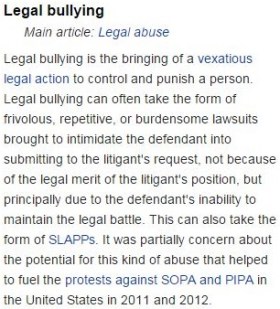
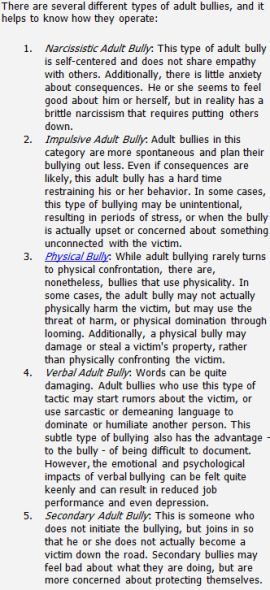
One would think that as people mature and progress through life, that they would stop behaviors of their youth. Unfortunately, this is not always the case. Sadly, adults can be bullies, just as children and teenagers can be bullies. While adults are more likely to use verbal bullying as opposed to physical bullying, the fact of the matter is that adult bullying exists. The goal of an adult bully is to gain power over another person, and make himself or herself the dominant adult. They try to humiliate victims, and “show them who is boss” (BullyingStatistics.org, “Adult Bullying”).

StopBullying.gov defines bullying as including name-calling, taunting, threatening, spreading rumors about someone, and embarrassing someone in public. Falsely labeling someone a stalker, child abuser, violent danger, or sexual deviant in one or more public trials whose findings are impressed on the target’s permanent record and are accompanied by menacing threats (if not immediate punishment) plainly qualifies. Among identified effects of bullying are suicide (“bullycide”) and violence, including murder. “Extreme emotional disturbance” is a defense for murder in some states (a finding that doesn’t excuse the act but does lighten the sentence), and a related murder defense is “provocation.”

Sure, character assassination is bloodless. What of it? If I circulate lies about someone and s/he snaps, I’m a bully, and I had it coming. Few people would say otherwise.

Ah, but if I lie and use the law as my medium to insult, demean, badger, intimidate, or otherwise persecute—hey, that’s different. I’m the “good guy.”

So suck it. And keep on sucking it, because the public record says my lies are the truth. Neener-neener.

A system that represents its purpose to be the curtailment of violence shouldn’t be promoting it by pandering to bullies, even “unofficially,” and its officers shouldn’t be serving as those bullies’ lieutenants and enforcers. If the system makes it easy to lie about and humiliate people, doesn’t hold liars accountable, and furthermore punishes the falsely accused based on lies, then it’s promoting violence.

This shouldn’t require social science research to corroborate. It shouldn’t even require this analyst’s observation.

Copyright © 2015 RestrainingOrderAbuse.com

Criminalizing Criticism: Restraining Orders, the First Amendment, and Chan v. Ellis

This search term brought a visitor here a day or two ago: “restraining order in ohio because a couple texts.”

It struck a chord with this author, because he himself was issued a restraining order on a similar basis (three emails over a weekend). There were accompanying allegations, but the court’s final ruling was based exclusively on the emails (i.e., speech). They weren’t even judged threatening, just unwanted (the contents, in fact, weren’t read by the court).

Some people are issued restraining orders on even more tenuous bases, like criticizing their plaintiffs on Facebook or in a blog or other online medium. If you’re such a person, you should be aware of a case before the Georgia Supreme Court that’s been the subject of a prior post on this blog: Chan v. Ellis.

The court was scheduled to hear opening arguments on October 7.

A summary of the case by UCLA Law Professor Eugene Volokh, along with his legal commentary in support of the appellant, Matthew Chan, is here.

The First Amendment protects the right to speak about people, so long as the speech does not fall into an established First Amendment exception (such as those for defamation or for true threats). This includes the right to speak about private figures, especially when they do something that others see—rightly or wrongly—as unethical.

Restraining orders and criminal stalking law may properly restrict unwanted speech to a person. But they may not restrict unwanted speech about a person, again unless the speech falls within a First Amendment exception. The trial court’s order thus violates the First Amendment.

If you’ve been issued an injunction from the court based exclusively on your speaking publicly about its plaintiff (and you didn’t threaten or lie about him or her), a verdict in favor of Mr. Chan could conceivably provide you with grounds for an appeal. FYI.

See Mr. Chan’s website, ExtortionLetterInfo.com, for trial updates. A ruling, he reports, should be returned between mid-January and mid-March.

The case stands to highlight judicial abuse of discretion and power and is one anybody who’s been put through the restraining order wringer will want to track.

Copyright © 2014 RestrainingOrderAbuse.com

*Update: The Georgia Supreme Court returned a verdict in favor of Matthew Chan on March 27, 2015.

Facts and Fairness: Using Arizona’s Policies to Expose Restraining Order Iniquity

I live in Arizona where I was issued a restraining order in 2006 petitioned by a woman I nightly encountered hanging around outside of my house. The restraining order said I was a danger to her husband and shouldn’t be permitted to approach or talk to him.

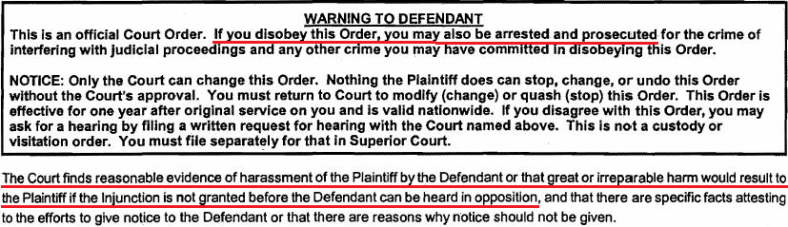
If you receive a restraining order in my home state, here’s the first thing that greets your eye:

On the basis of the form this warning captions—which looks like it was drafted by someone using a pizza crust as a straightedge—citizens are recorded in state and national police databases as stalkers and violent abusers.

Consider that the immediate impression this warning is meant to give is beware. It naturally excites fear—and if you’ve been falsely accused, a host of other emotions, besides, none of which conduces to calm and lucid thinking.

Something you wouldn’t guess from this “Warning to Defendant” is that if a defendant “disagrees” with an order issued in Arizona, s/he has the statutory right to apply for an appeals hearing at any time during the order’s effectiveness. For example, if the duration of the order is one calendar year, the defendant can take 11 months to assemble his or her appeal and save up, if necessary, to have an attorney represent that appeal.

Here’s the law:

At any time during the period during which the injunction is in effect, the defendant is entitled to one hearing on written request. No fee may be charged for requesting a hearing. A hearing that is requested by a defendant shall be held within ten days from the date requested unless the court finds compelling reasons to continue the hearing. The hearing shall be held at the earliest possible time. An ex parte injunction that is issued under this section shall state on its face that the defendant is entitled to a hearing on written request and shall include the name and address of the judicial office where the request may be filed. After the hearing, the court may modify, quash or continue the injunction.

The statute says the court’s order must inform the defendant that s/he’s entitled to a hearing, but it doesn’t require that the order inform the defendant that s/he has a year (or possibly years) in which to prep and apply for that hearing, that the hearing is free, or that the defendant may be represented by an attorney.

Restraining orders are rhetorical psych-outs. Their language is overtly menacing, and neither the law nor the issuing courthouse gives any consideration to apprising defendants of their rights.

The stress is on apprising defendants, who are presumed to suck (sight unseen), of what rights they’re no longer deemed worthy of.

Appreciate that the court’s basis for issuing the document capped with the “Warning” pictured above is nothing more than some allegations from the order’s plaintiff, allegations scrawled on a form and typically made orally to a judge in four or five minutes.

In the courthouse where the order issued against me was obtained, restraining order petitioners file into a room like a small bus station terminal, submit their applications, wait for an audience with a judge, chat with him or her for a few minutes, and leave.

That’s it.

Consequences of receiving an order of the court whose merits are determined on this basis include registration in state and national law enforcement databases, and may also include loss of entitlement to home, children, and possessions, and loss of employment.

In contravention of due process, orders are issued against defendants that may deny them liberties and property without the court’s hearing from them at all.

Ever.

In Arizona, unless a defendant requests a hearing before a judge, that’s an end on the process. No judge will even have learned what s/he looks like, and the truth of the plaintiff’s claims will never have been controverted—claims, to reiterate, that were made in a few minutes and could include anything from annoyance to physical or sexual violence.

Such claims often amount to nothing more certain than finger-pointing.

(Docket time afforded by the court to the testimony of defendants who go to the trouble of appealing rulings based on such claims, incidentally, is about 15 minutes. The cost of attorney representation at an appeals hearing may be $2,000 to $5,000.)

The only provision the law or the court makes for discouraging false testimony (some motives for which are here) is this one, which predictably appears at the very end of the application form:

The plaintiff signs below.

Applicants aren’t of course told what “perjury” is, and they’re certainly not told it’s a felony crime that carries a prison term (as it is and does in Arizona and many other states). Lying to the court is never sanctioned or prosecuted, anyway.

Recent posts on this blog were answers to dismissal by a doctor of laws of criticisms that the restraining order process is unfair. The process would have to be far more deliberative than it is, in fact, to be merely “unfair.”

The process is automated.

Copyright © 2014 RestrainingOrderAbuse.com

Connecticut Lawmakers Conclude Getting a Restraining Order Isn’t Easy Enough Already

Those victimized by liars who abuse restraining order and domestic violence laws often blame their judges. It’s natural. They’re the ones who deprive the wrongly accused of dignity, liberty, property, and family—and theirs are the words that echo in the memory and grate on the nerves during the empty hours.

Lawmakers it must be remembered, though, are the enablers.

Judges may be careless. They may even be cruel. But legislators are clueless.

To give an example, consider this story reported today in Hartford, Connecticut’s The Courant (August 25, 2014):

Domestic violence victims need to have a simpler process of applying for restraining orders and better communication with the agencies that handle them, a legislative subcommittee said Monday.

To that end, the subcommittee of the task force on restraining orders agreed to recommend a streamlined version of restraining order applications and an accompanying checklist to pave the way for better communication among victims, marshals and courts.

The Connecticut legislature purposes to make simpler yet a process that’s already so “streamlined” that accusers don’t have to prove anything.

CONN. GEN. STAT. ANN. § 46b-15(b): “The court, in its discretion, may make such orders as it deems appropriate for the protection of the applicant and such dependent children or other persons as the court sees fit.… If an applicant alleges an immediate and present physical danger to the applicant, the court may issue an ex parte order granting such relief as it deems appropriate.”

This literally means that if a domestic partner merely alleges s/he feels in danger, which only takes a few seconds to do, the court is authorized to order the accused to be forcibly ejected from his or her home by armed agents of the state—even if the accused owns that home and has lived in it all of his or her life. In other words (again, for example), it’s entirely possibly for someone who has no home to move in with someone else, falsely accuse him or her of abuse, and for all intents and purposes seize possession of his or her home. Other obvious motives for lying are malice or gaining custody of kids.

No evidence of anything is required by the law, which is a blank check that authorizes accusers to say whatever they feel like and judges to do whatever they feel like.

Members of the legislative subcommittee referenced in The Courant article reportedly expect to improve their understanding of the flaws inherent in the restraining order process by taking a field trip. They plan “a ‘ride along’ with the representative of the state marshals on the panel…to learn more about how restraining orders are served.”

The urgent problem with restraining orders as they see it is ensuring that more of them are successfully delivered.

The article cites concerns expressed by the executive director of the Connecticut Coalition Against Domestic Violence “about the complicated process domestic violence victims face when they apply for restraining orders.”

The “complicated process” to have someone evicted shoeless from his or her home in the Connecticut winter and prohibited access to his or kids based on an allegation is filling out a form.

The Connecticut legislators “decided to remove the instructions in small print at the top of the form, which start with the outdated suggestion that the applicant ‘use a typewriter.’ Applicants will have access to a separate sheet of paper that has step-by-step instructions.”

Authorizing the court “in its discretion” to fill out orders “as it deems appropriate” would seem more expeditious and economical to this writer.

Copyright © 2014 RestrainingOrderAbuse.com

Ungoverned: Restraining Order Laws in Arkansas

not-governed

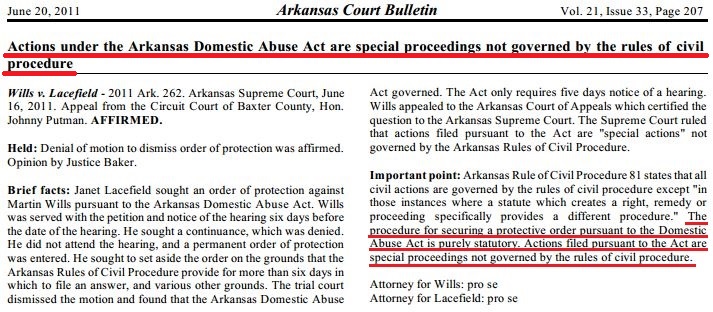
I’ve combed the Internet in recent weeks for motion-to-dismiss forms applicable to restraining orders issued in the 50 states. For Arkansas, there’s nothing to be found. Zip. If that weren’t suggestive enough that the process is a lock, consider the above entry excerpted from a 2011 Arkansas Court Bulletin.

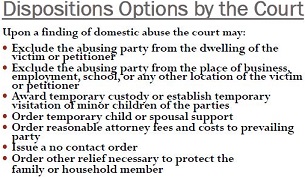
This means an accuser may be awarded exclusive entitlement to the family residence; sole custody of children; a monthly stipend from the former breadwinner, who may find himself out of a job subsequent to being issued a “domestic abuse” restraining order; and reimbursement of costs. Filing for a protection order, in other words, may gain a plaintiff everything and cost her (or sometimes him) nothing—whether the allegations it’s based on are true, hyped, or lies.

The case commentary (which you’ll observe publicly discloses the names of the parties to the action) concerns a man who was served with a notice to appear in court to answer allegations of “domestic abuse” six days thence.

Rough translation: “Dear sir, you’re expected in a courtroom next week to respond to allegations that you beat your wife.”

For people who know nothing about restraining order processes, appreciate that this man was given less than a week’s time to prepare a defense against obviously serious charges with obviously serious repercussions. In six days, he was supposed to come to grips with public allegations that may have horrified him, procure an attorney’s services, gather relevant evidence and testimony, etc.

Six days.

The bulletin reports that the man “sought a continuance [postponement], which was denied.” He didn’t attend the hearing. The commentary doesn’t indicate a reason. His request to have the order set aside, because the expectation of an immediate response didn’t conform to the Arkansas Rules of Civil Procedure, was also denied. Why? Because the Arkansas Domestic Abuse Act trumps the rules of civil procedure.

This case exemplifies why restraining order adjudications strike so many people as Kafkaesque: “I move—.” “No.” “Then—.” “No.” “But—.” “The rules don’t apply in your case, sir, and we don’t negotiate our decisions.”

Defendants’ being railroaded, of course, is nothing extraordinary. “Emergency” restraining orders may allow respondents only a weekend to prepare before having to appear in court to answer allegations—very possibly false allegations—that have the potential to permanently alter the course of their lives.

Extraordinary is the Arkansas courts’ openly and nonchalantly recognizing in a bulletin that their protective order process is “not governed by the rules.”

Its proceedings are “special.”

Copyright © 2014 RestrainingOrderAbuse.com

“Redeeming Feminism”: Making It about Equality and Not Victimhood

Since the publication of this post, the feminist blog it cites and criticizes has been made private.


When criticizing injustices wrought by prejudicial, feminist-motivated laws and court procedures like the restraining order process, restraint isn’t easy to pull off.

It’s nevertheless worthy of striving for, because the gender divide that fosters the perpetuation of these prejudicial laws and procedures needs to be bridged—for the sake not just of their male victims but of their female victims, too.

I came across a blog yesterday titled, Redeeming Feminism. It arrested my attention, because its banner reads, “Equality of rights under the law shall not be denied or abridged by the United States or by any state on account of sex.”

The dramatic irony is lost on the blog’s author, but this is, of course, the argument against feminism, whose “second wave” has done at least as much to promote and enforce sexual bigotry as it has to eliminate it. (First-wave feminists, who sought to dissolve gender discrimination instead of cement it, were those who pushed for the 1972 Equal Rights Amendment from which the quotation above derives.)

Some feminists categorically can’t be reasoned with. They’re the equivalents of high-conflict courtroom litigants who reason with their feelings. But I don’t get the impression that the author of this blog is one such, and I think there are many self-styled feminists like her out there. She seems very much in earnest and without spiteful motive. Her intentions are well-meaning.

To judge from the wattage of her smile in the photograph of her on her blog, however, she’s never been stalked by someone only to have that person publicly and persuasively accuse her of stalking, or had it falsely suggested to authorities and the courts, for example, that she’s violent or a danger to children.

To quote a falsely accused woman I’ve corresponded with for the past six months, a professional nurse and mother of three who’s been through years of hell, that sort of thing “changes a person on a cellular level.” Had the blog author been subjected to what my correspondent has been—or what most of the respondents to this blog and to other blogs and petitions it links to have been—her smile would be considerably more muted (which would be a shame, because it’s a good smile).

This is the shortcoming of most vigorous feminist advocacy out there: It tends to see only what it was looking for in the first place. Its argumentation is based in the abstract. I wouldn’t wish the real on anyone, but before taking up arms, advocates of one position or another have a moral obligation to look up, down, and sideways.

The post on the referenced blog that I read is called, “Anti-Feminist Memes pt.3: ‘Domestic abuse, Men are the real victims’.” It rebuts the rhetorical strategies of counter-feminist “memes” on the Internet.

This is a meme.

This type of meme is extremely popular. In looking for memes to write about for this blog project, this theme was one of the most prevalent. Memes like these send a lot of messages simultaneously. First, they suggest that feminism is rooted in hypocrisy. They want us to assume that feminists not only support negative gender restrictions on men, but that they also encourage policy that will oppress men. A lot of these memes have phrases in them like “according to feminists,” “feminists believe,” and “feminist logic.” It’s not enough for these memes to suggest that men are oppressed more than women claim to be, the meme must also suggest that feminism causes and supports violence against men, with the aim of total male oppression.

Her criticisms, though spirited, lack balance. The “memes” she refers to don’t actually “suggest feminism is rooted in hypocrisy” (though this is certainly true of today’s feminism) or posit that “men are oppressed more than women,” nor do they appear to want anyone to “assume” anything. What they do is point out and denounce a double standard, which is an endeavor every true feminist should commend. The author of the blog doesn’t address the double standard; she takes a defensive tack and asserts that women are victims of violence and that such “memes” insensitively ignore this urgent fact.

This line of (emotional) reasoning basically says never mind if there is a double standard, because women are victims. It’s a logical bait-and-switch—and one that betrays unawareness that women are also injured by the same double standard.

meme2

These, too, are memes.

Laws that have arisen and been fortified in the last three decades in response to demands for the curtailment of violence against women are applied unequally and unfairly (which is another way of saying they disregard the most basic tenets of our Constitution). The prevalence of violence in the world is completely beside the point. John Doe isn’t his brother’s keeper and can’t justly be held to account for the actions of others. The fact is whenever anyone makes a complaint of domestic violence today, whether a woman or a man, his or her allegation may be presumed valid, especially in civil court, and the reason why this is so owes to feminist lobbying, which has engendered prejudice against defendants (who, once upon a time, were only men). When allegations of abuse are exaggerated or false, the consequences are often the same as they would have been had the allegations been true. Innocent men and women are rubbed out every day by procedures that are virtually automated. They’re criminalized, exiled from their families, stripped of property and resource, and sometimes barred from employment and even left living out of their cars or homeless.

The blog writer, a young woman, is piqued by domestic violence, as should we all be. Matters peripheral to it, like legal inequities, are lost in the shadows cast by its specter—and shouldn’t be. Even the specter itself is seldom scrutinized.

It must be considered, for example, that the authority for the statistic “1 in 4 women will experience domestic violence in her lifetime” cited by this writer (and which is commonly cited) is a pamphlet: “Domestic Violence Facts.”

Consulting its footnotes, you’ll find that this stat is derived from something called the National Violence Against Women Survey. In other words, the figure’s based on what women report on questionnaires.

Last week, I was sitting outside of a Starbucks in a posh strip mall and observed a couple standing 20 feet distant from me in the company of two others. The woman repeatedly belted the man in the shoulder and chest with a closed fist, and then proceeded to pinch him a series of good ones. He laughed and cringed from the attack. “Did you fart?” she demanded. He giggled. She punched him a few more times—good, resonant thwacks like you’d hear if you slapped a ham. She was still punching and pinching him when I turned back to my laptop.

What someone like the author of the blog I’ve cited would never conceive is that had this man called the cops and alleged that his wife assaulted him, there’s a very excellent chance that horseplay like this could cost her everything she owns, including her identity. “Did she punch him?” an officer might ask of witnesses. “Well…yeah, but….” And that might be that (criminal restraining order to ensue). It happens. Sometimes even the reports of onlookers precipitate arrests.

What everyone must be brought to appreciate is that a great deal of what’s called “domestic violence” (and, for that matter, “stalking”) depends on subjective interpretation, that is, it’s all about how someone reports feeling (or what someone reports perceiving).

Important to recognize is that how someone reports feeling about being punched or pinched may depend a lot on how that person is feeling toward the puncher or pincher at the time (or at a later time). In other words, actions that are harmless can be represented however a person wants to represent them.

When the state gets involved in private, interpersonal matters, consequences can be severe. What the “memes” the referenced blog writer confronts are concerned with is public perception that translates into law. Fervent condemnations of domestic violence don’t simply inform general opinion; they inform legislation and the application of laws by police officers and judges.

Feminist predilections, both to blame men and to perceive “violence” everywhere, encourage and, consciously or not, endorse exaggerated, impulsive, and/or false allegations. Feminism’s basic message to women today is, “You’re a victim.”

Is there any person walking the face of the planet over the age of five who hasn’t been slapped, punched, kicked, spanked, pinched, poked, or threatened? That’s a rhetorical question. Everyone has been the “victim of violence” if not the “victim of domestic violence” sometime in his or her life. The difference is not everyone is going to characterize him- or herself as a “victim.”

When someone like the author of the blog I’ve referenced uses the phrase domestic violence, she means wanton physical abuse and household terrorism, which is what the phrase used to mean. That’s not, however, how domestic violence is any longer defined by the law. The same phrase may be applied to angry phone calls—even a single angry phone call (which may easily be misrepresented or not even real). This blogger’s outrage is sympathetic; she’s just unconscious—as most people are—that the messages she’s outraged by aren’t veiled arguments in defense of battery; they’re rejections of a feminist message that has jaundiced popular perceptions and corrupted our laws and how they’re applied.

The zealousness of the public and of the authorities and courts to acknowledge people, particularly women, who claim to be “victims” as victims has produced miscarriages of justice that are far more epidemic than domestic violence is commonly said to be. Discernment goes out the window, and lives are unraveled based on finger-pointing. Thanks to feminism’s greasing the gears and to judicial procedures that can be initiated or even completed in minutes, people in the throes of angry impulses can have those impulses gratified instantly. All parties involved—plaintiffs, police officers, and judges—are simply reacting, as they’ve been conditioned to.

When everyone’s simply reacting, nobody’s actually thinking.

The road to feminism’s redemption will only be paved when feminists begin making observations like this.

Copyright © 2014 RestrainingOrderAbuse.com

“Clear and Convincing” Evidence: Applying a Standard of Decency to Restraining Order Prosecutions

“This spring, the Maryland legislature killed a bill that would have brought Maryland’s restraining order policies into line with every other state in the union. Remarkably, in Maryland, a stalking victim seeking help is required to prove her case with ‘clear and convincing’ evidence, a higher standard than ‘preponderance of the evidence,’ which is the universal standard for civil dispute.

“There can be only one reason for this absurd requirement: that the Maryland legislators who voted for the bill…believe that women who testify that they’ve been abused are less credible than men who deny being abusers. That’s not a level playing field, and it’s an absolutely unacceptable attitude for a legislator to hold.”

Ms. Magazine Blog (May 19, 2010)

It really isn’t an unacceptable attitude.

“Credibility” is not the equivalent of fact. For that matter, requiring substantiation of allegations that can undo a person’s life is hardly unreasonable, let alone “absurd.” What’s absurd is that the author of this blog post assumes that sexism is “the only reason” legislators might find proof to be reasonable standard to apply to restraining order allegations.

Concluding that “‘clear and convincing’ evidence” is an unfair judicial demand betrays a misunderstanding of what fair means.

What the writer’s conclusions also betray are the suppositions that false allegations are never made, that allegations of stalking or domestic violence should be matters of indifference to defendants (no biggie), that restraining orders are only sought by women, and that women are never the victims of false allegations.

Wrong, on all counts.

The Ms. Magazine Blog post features a picture of a woman with bruises on her throat and is titled, “Abused Women in Maryland Aren’t Lying.” There’s little reason to doubt that many women who allege abuses in Maryland aren’t lying. Saying so and posting lurid graphics, however, doesn’t prove that all of them are telling the truth or that all who allege abuses in the future would be. Laws tend to stick around for a while.

Requiring clear and convincing evidence that public accusations are true isn’t absurd; it’s the hallmark of civilization.

The idea that even one perpetrator of violence should escape justice is horrible, but the idea that anyone who’s alleged to have committed a violent offense or act of deviancy should be assumed guilty is far worse.

I don’t fault the writer for her earnestness. I think, rather, that she overestimates what the phrase preponderance of the evidence may signify. Too often in civil prosecutions, this standard may equate to persuasiveness; and false accusers, who may be in the throes of bitter malice or may live for an audience, can be very persuasive…for all the wrong motives. Restraining orders are issued ex parte, which means that in the absence of a standard of proof, anything plaintiffs say during brief interviews with judges is taken at face value and immune from controverting evidence from defendants, who are only inked names on bureaucratic forms. Defendants are excluded from the application process entirely.

No one wants victims’ plaints to go disregarded, but there must be a failsafe in place to protect against false allegations and guarantee a measure of equity. An ex parte ruling is already a prejudicial one.

Expecting less than a standard of clear and convincing evidence is absurd.

Copyright © 2014 RestrainingOrderAbuse.com

If You’re not Part of the Solution, You’re Part of the Problem: On Why Restraining Order Abuses Have Persisted for So Long and How to Do Something about It

“Men are bastards!”

“Women are cun[ning]!”

I could end this editorial here, and I would have summed up the problem, which originates with hearts but owes its infinitude to different organs entirely.

Predictably, since most restraining orders are sought against a member of the opposite sex, online forums about dirty divorces, domestic abuse, treacherous lovers, vengeful exes, predatory or parasitic whackjobs, etc. often boil down to cross-gender sniping and “team camaraderie.” Women just want to be pissed with men and bitch about them with other women, and men just want to be pissed with women and bitch about them with other men.

Both genders have limitless potential to suck; sex is beside the point.

Those who profit politically and monetarily by the misery inflicted through court processes that are easily abused by the “morally unencumbered” love all this conflict and misdirected rage, which only ensure that these corrupt processes continue to thrive.

They’ve already hummed along without a hitch for over 30 years. In fact, they’ve gained momentum, despite reasoned and articulately critical pans from distinguished members of the legal, journalistic, academic/philosophic, and public policy communities.

Not only does cross-gender bitching by victims of state abuses distract from the actual source of the problem, which is bad laws; it makes those victims sound like the cranks and nuts everyone else is glad to assume they are.

True, the person who betrayed you and lied about you should be subjected to medieval punishment. True, the judge you got may be worthy of the same for his or her cruelty or carelessness or cluelessness. But…the reason either was entitled to abuse and humiliate, rob and defame you was THE LAW.

Except for the statutes that authorized your injuries, those injuries wouldn’t have been possible.

Passive aggression isn’t going to accomplish anything. I can’t imagine venting even makes anyone feel better for very long.

Aggressive aggression holds a lot more promise. If you’ve been wronged, tell your story, and tell it in a way that will count. Sign a petition and add a comment about your own circumstances. You don’t even have to expose your name. Sign several and tweet them, too (a few are below). Start a petition of your own. Tweet that also and post it here. Start a Facebook page. Connect and consolidate forces.

STOP FALSE ALLEGATIONS OF DOMESTIC VIOLENCE

THE SUPREME COURT: FEATHER FOR THE FALSELY ACCUSED

RESTRAINING ORDER LAWS ARE DANGEROUS AND UNFAIR TO MEN

This may seem unthinkable to you, especially if your wounds are fresh, but appreciate that the impulse to conceal shame only potentiates that shame. If you’ve been wronged, the shame isn’t yours. Re-channel your emotions in constructive ways. You’re not alone.

No one wants to do this. No one should have to. I wanted to write humor for kids. Though not a big dream, it contented me, and I think I would have been successful at it by now and that other doors would have opened. I was dragged from my interior world and away from the life I might have enjoyed. Not only am I not a political person; I don’t even like board games.

I do, though, hate bullies, especially ones with gangs behind them.

Recognize that the ringleader of the gang that assaulted you isn’t that petty lowlife you mistakenly invested your trust in; he’s an invisible man who’s represented in posters wearing red, white, and blue, and his gang is everybody.

The only way you can beat him and attain some satisfaction is by taking away his gang and making it yours.

Copyright © 2014 RestrainingOrderAbuse.com

The New Domestic Violence: Restraining Order Abuse

Daughter: “He hits me, Ma.”

Mother: “Well…I can’t say I’m surprised. What’d ya do?”

Daughter: “Whaddya mean, what’d I do?”

Mother: “What’d ya do to make him angry? He didn’t just hit ya outta the blue.”

Daughter: “I guess I didn’t do what he wanted me to.”

This exchange is extracted from a recent Hollywood movie set in the 1970s immediately preceding the advent of the restraining order and illustrates the social mindset that ’70s-era feminists sought to counteract, namely, one that tolerated spousal abuse and placed the blame for it on its victims.

Living in an environment of insecurity and intimidation is a daily torment no one should have to bear, and no one can deny that the motives that led to restraining order legislation’s being drafted were very sympathetic ones.

What this blog and others like it seek to bring to light is that restraining orders have become the arbitrarily brutal hand that they were originally conceived to check—and they’ve put brass knuckles on it.

Restraining orders’ abuses arise from the same impulse: anger, jealousy, or control, for instance; but they’re much worse in many ways than slaps and threats, because their consequences are more exacting, enduring, and inescapable.

As in the exchange above, the answer to why someone had a restraining order petitioned against him or her is too often: “I guess I didn’t do what [s/he] wanted me to.”  The motive for the abuser’s action may be identical. Only the means of abuse are different.

Because those means may, and often do, include lying and lying publicly and savagely, abuses accomplished with restraining orders don’t fade like bruises do. A man falsely accused of domestic violence, for example, is publicly recognized as a batterer for the rest of his life, and that label may follow him from job to job or relationship to relationship. Years of his life may pass in agony before his ordeal in the courts has even concluded. A lie impulsively told to a judge in a few minutes may be something its victim has to continue to counteract forever, and though counseling may help him reconcile himself to the lie and its injuries, no amount of it will ever erase that lie, because it’s branded on his public face.

And while women alleged to be batterers may not be perceived as harshly as men accused of domestic violence, women, too, may be abused by restraining orders in exactly the same way, making a process that was designed to protect women a convenient means of brutalizing them that has the sanction of both the government and the feminist establishment.

Fraudulent allegations, furthermore, don’t need to be of domestic violence to lay victims low. Falsely characterizing them as stalkers or sources of sexual harassment or threat may be just as damning and damaging, both socially and psychologically. The implications of the phrase “protection order” or “restraining order” are alone sufficient enough, because their resonance never diminishes. It and its ramifications persist indefinitely.

The horror of the woman in the domestic situation suggested in the scene recited above was that she was stuck in an untenable situation, a situation she was powerless to correct or extricate herself from. Thirty years ago, a woman might have had nowhere to turn. Even mom and dad might turn her away and remind her that she swore a vow of fidelity she was obligated to honor (which is what the mother in this scene does).

Today, a (female) victim of spousal abuse has options. Public and familial reactions to her plaints are liable to be very different. She can move out and divorce without any stigma affixing itself to her, and if she lacks the wherewithal, there are shelters that may take her in until she’s able to provide for herself.

For the victim of restraining order abuse, there are no escapes. The stigma, which may be debilitating, is permanent and may be accompanied besides by his or her being denied access to home, kids, pets, property, and money. In other words, s/he may find him- or herself robbed by the state of all resources and values on top of having to bear a psychic wound there’s no staunching.

Restraining order frauds go over easily, because three decades later authorities and the courts are still responding to what they imagine are scenarios like the one sketched in the scene above. Irrespective of the actual circumstances, it’s what sparks and fuels the indignation that meets many defendants on the faces and in the conduct of judges they’re brought before, conduct that verges on retributive vigilantism.

It’s time to dust off the misperceptions and the process itself. Restraining order laws, which originated in the 1970s, have “evolved” retrospectively, seemingly aiming to amend injustices that occurred before many or most recipients of restraining orders today even drew breath.

The sins of our fathers and forefathers, however villainous (and they assuredly were), aren’t anyone’s but theirs.

Copyright © 2013 RestrainingOrderAbuse.com

Presumed Guilty: On How Restraining Order Laws Enable and Promote Abuse

I’ve had occasion in the last few months to scrutinize my own state’s (Arizona’s) restraining order statutes, which are a study in prejudice, civil rights compromises, and politically coerced naïvety. Their outdated perspective fails even to acknowledge the possibility of misuse let alone recognize the need for remedial actions to undo it.

Restraining orders are issued upon presumptive conclusions (conclusions made without judges ever even knowing who recipients are—to the judges, recipients are just names inked on boilerplate forms), and the laws that authorize these presumptive conclusions likewise presume that restraining order applicants’ motives and allegations are legitimate, that is, that they’re not lying or otherwise acting with malicious intent.

That, you might note, is a lot of presuming.

In criminal law, the state must presume that defendants are innocent; in civil law (restraining orders are civil instruments), defendants may be presumed guilty. What’s outrageous about this with respect to restraining orders is that public allegations made on them may be criminal or criminal in nature, and violations of restraining orders—real or falsely alleged—have criminal consequences. Due process and the presumption of innocence are circumvented entirely; and with these safeguards out of the way, a defendant may be jailed on no valid evidence or for doing something that’s only illegal because a judge issued a restraining order on false grounds that made it so. (A parent who’s under a court-ordered injunction may be jailed, for example, for sending his child a birthday present.)

One of my motives for consulting my state’s restraining order statutes is having absorbed a broad array of stories of restraining order abuse over the past two years. Common themes among these stories are judicial bias; lying and fraud by plaintiffs (applicants); restraining order plaintiffs’ calling, emailing, or texting the people they’ve petitioned restraining orders against (or showing up at their homes or places of work—or following them); and restraining orders’ being serially applied for by plaintiffs whose past orders have been repeatedly dismissed (that is, restraining orders’ being used to harass and torment with impunity).

Those who’ve shared their stories want to know how these abuses are possible and what, if anything, they can do to gain relief from them. The answer to the question of how lies within the laws themselves, which are flawed; the answer to the question of what to do about it may well lie outside of legal bounds entirely, which fact loudly declaims just how terribly flawed those laws are.

Arizona restraining orders are of two sorts, called respectively “injunctions against harassment” and “orders of protection.” They’re defined differently, but the same allegations may be used to obtain either. Most of the excerpted clauses below are drawn directly from Arizona’s protection order statute. Overlap with its sister statute is significant, however, and which order is entered simply depends on whether the plaintiff and defendant are relatives or cohabitants or not.

“[If a court issues an order of protection, the court may do any of the following:] Grant one party the use and exclusive possession of the parties’ residence on a showing that there is reasonable cause to believe that physical harm may otherwise result.”

This means that if your wife/husband or girlfriend/boyfriend alleges you’re dangerous, you may be forcibly evicted from your home (even if you’re the owner of that home). The latitude for satisfying the “reasonable cause” provision is broad and purely discretionary. “Reasonable cause” may be found on nothing more real than the plaintiff’s being persuasive (or having filled out the application right).

“If the other party is accompanied by a law enforcement officer, the other party may return to the residence on one occasion to retrieve belongings.”

This means you can slink back to your house once, with a police officer hovering over your shoulder, to collect a change of socks. Even this opportunity to recover some basic essentials may be denied defendants in other jurisdictions.

“[If a court issues an order of protection, the court may do any of the following:] Restrain the defendant from contacting the plaintiff or other specifically designated persons and from coming near the residence, place of employment or school of the plaintiff or other specifically designated locations or persons on a showing that there is reasonable cause to believe that physical harm may otherwise result.”

This means defendants can be denied access to their children (so-called “specifically designated persons”) based on allegations of danger that may be false.

“[If a court issues an order of protection, the court may do any of the following:] Grant the petitioner the exclusive care, custody or control of any animal that is owned, possessed, leased, kept or held by the petitioner, the respondent or a minor child residing in the residence or household of the petitioner or the respondent, and order the respondent to stay away from the animal and forbid the respondent from taking, transferring, encumbering, concealing, committing an act of cruelty or neglect in violation of section 13-2910 or otherwise disposing of the animal.”

This means defendants can be denied access to the family pet(s), besides.

Note that the linguistic presumption in all of these clauses is that recipients of restraining orders are wife-batterers, child-beaters, and torturers of puppies, and recall that restraining orders are issued without  judges’ even knowing what defendants look like. This is because restraining orders were originally conceived as a deterrent to domestic violence (which, relative to the vast numbers of restraining orders issued each year, is only rarely alleged on them today at all). It’s no wonder then that judicial presumption of defendants’ guilt may be correspondently harsh. Nor is it any wonder that in any number of jurisdictions, an order of protection can be had by a plaintiff’s alleging nothing more substantive than “I’m afraid” (on which basis a judge is authorized to conclude that a defendant is a “credible threat”).

“A peace officer, with or without a warrant, may arrest a person if the peace officer has probable cause to believe that the person has violated section 13-2810 by disobeying or resisting an order that is issued in any jurisdiction in this state pursuant to this section, whether or not such violation occurred in the presence of the officer.”

This means you can be arrested and jailed based on nothing more certain than the plaintiff’s word that a violation of a court order was committed. More than one respondent to this blog has reported being arrested and jailed for a lengthy period on fraudulent allegations. Some, unsurprisingly, have lost their jobs as a consequence (on top of being denied home, money, and property).

“There is no statutory limit on the number of petitions for protective orders that a plaintiff may file.”

This observation, drawn from Arizona’s Domestic Violence Civil Benchbook, means there’s no restriction on the number of restraining orders a single plaintiff may petition, which means a single plaintiff may continuously reapply for restraining orders even upon previous applications’ having been denied.

Renewing already granted orders (which may have been false to begin with) requires no new evidence at all. Reapplying after prior applications have been denied just requires that the grounds for the latest application be different, which is of course no impediment if those grounds are made up. As search terms like this one reveal, the same sort of harassment can be accomplished by false allegations to the police: “boyfriends ex keeps calling police with false allegations.” Unscrupulous plaintiffs can perpetually harass targets of their wrath this way—and do.

No restrictions whatever are placed upon plaintiffs’ actions, which means that they’re free to bait, taunt, entrap, or stalk defendants on restraining orders they’ve successfully petitioned with impunity. And neither false allegations to the police nor false allegations to the courts (felony perjury) are ever prosecuted.

“A fee shall not be charged for filing a petition under this section or for service of process.”

This means the process is entirely free of charge.

Copyright © 2013 RestrainingOrderAbuse.com

A Safety Seal: What Restraining Orders and Tic Tacs Should Have in Common but Don’t

I’ve written recently about restraining orders’ circumvention of due process and remarked that at the time of their advent—the 1970s—this may have seemed to lawmakers like an urgently necessary evil.

The phrase due process, to recap, refers to granting defendants (like recipients of restraining orders) the opportunity to defend themselves before a judgment is entered on allegations made against them. Restraining orders deny defendants due process, because their guilt is conclusively presumed without judges’ knowing who they are (even so-called “appeals hearings” may afford a defendant no more than a 15-minute audience with a judge who already supposes him or her to be guilty).

To put it baldly, defendants are issued orders from the court that manifestly identify them as creeps and that may summarily (and indefinitely) deprive them access to home, children, money, and property based on the court’s knowing nothing more about them than their names and what someone alleged against them, which the Fourteenth Amendment was drafted to guarantee can’t happen.

The motive for denying restraining order defendants due process—for which legislators are to blame, not judges—was satisfying feminist outrage by ensuring female victims of domestic violence didn’t have to worry about their allegations being discounted or criticized by the police, as they well might have been in the ’70s (imagine being knocked around and terrorized at home then publicly ridiculed or excoriated by authorities—all men—for complaining about it). Restraining orders authorized battered women to take their allegations directly to a judge and thereby be granted immediate relief from unbearable circumstances.

Though social attitudes toward women’s rights and domestic abuse have shifted radically in 30 years (to a vulgar extreme, many might argue), no one, however, has looked back. Restraining orders continue to follow the same policies they did from the start (or laxer ones) and have only become more widely applied and sprouted more and sharper teeth.

The last commentary noted that at the time restraining orders were enacted, legislators assuredly never gave a thought to the possibility that they would be abused.

At that time, no one had considered that somebody might intentionally sabotage foodstuffs or over-the-counter medications, either. It never occurred to manufacturers or government overseers of product safety standards that somebody might poison others just for the fun of doing them harm—or just because they could.

Following Tylenol’s being tampered with in 1981, everything from diced onions to multivitamins requires a safety seal. Naive trust was violated, and legislators responded.

Legal lions, scholars, and journalists have denounced the injustice of restraining orders for 20 years now at least, and any number of lives fractured by wrongfully issued restraining orders have been publicly chronicled. Even government studies have concluded that a majority of restraining orders are sought unnecessarily or falsely and that only a small minority ever even allege violence.

How many more people have to be poisoned by a widely abused judicial process before the same cautionary measures applied to Tic Tacs are applied to it?

Time for a manufacturer recall.

Copyright © 2013 RestrainingOrderAbuse.com

Circumventing Due Process: On How Restraining Orders Personalize Law

A frequent commenter to this blog, one with philosophical leanings, pointed out recently that restraining orders personalize law.

His point is that where prior to the advent of restraining orders complaints of abuse would have been vetted and either rejected or acted upon by the police and district attorney based on the evident merits of those complaints’ allegations, today the middlemen whose scrutiny formerly provided a safeguard against false or frivolous allegations’ unjustly contaminating a defendant’s life have been removed from the equation.

A plaintiff now effectively determines what should merit the court’s intervention him- or herself merely by filling out a boilerplate form and leveling allegations in a brief interview with a judge, which allegations (especially if made by a woman) judges have been trained to all but accept unquestioningly.

A plaintiff, whose motives can hardly be expected to be free of bias and may be wholly malicious, preempts the roles of the police and district attorney and is furthermore entitled not only to communicate his or her allegations directly to a judge but to expect that the judge will accept those allegations at face value—in the complete absence, moreover, of any contradictory testimony or evidence from the defendant, who is also bypassed.

Due process, a constitutional guarantee, is skirted entirely: a person walks in off the street and says it; therefore it is so.

Loan officers at banks were as easily persuaded six years ago that anyone who strolled through the door should be given a loan. They observed the same turnstile policy commonly followed by the courts in the issuance of restraining orders. Applicants were happy, because they weren’t disappointed, and officers looked good, because they met their quotas.

The result of this policy was that one of the systems that hold together the fabric of our society was bankrupted.

Copyright © 2013 RestrainingOrderAbuse.com

Restraining Order Laws Hold Nothing Sacred

I’ve been in correspondence with a woman who was recently forced to abandon her home to make herself unavailable to further allegations of abuse from her neighbor, allegations that she reports aren’t just false but nuts (and that have continued to escalate and compound over weeks and months).

This woman, a solitary 65-year-old with no nearby family to turn to for support, has had to relinquish her independence and move in with a friend at great sacrifice to both her comfort and pride.

She has also, of course, had to retain the services of an attorney.

And chances are that no matter how the controversy resolves in court, she’ll never again feel safe and easy in her own house and will have to uproot.

Her situation emphasizes a number of the horrors that attend restraining orders and the policies that inform their administration:

  • Confounding the constitutional guarantees to life, liberty, and the pursuit of happiness, restraining orders may deny defendants all rights to property, children, and home—or, as in this woman’s case, the right to feel secure in that home—based on unverified (and possibly unverifiable) accusations leveled by plaintiffs in a span of a few minutes. Aptly applying a quotation from Woody Allen to how easily restraining orders are obtained: “Eighty percent of success is showing up.”
  • The standard of proof is so meager that a lone defendant has little hope of defusing allegations by an aggressive and insistent plaintiff. (And it’s almost always the case that had the defendant been the first party in a dispute to seek a restraining order, the court would as likely have found the defendant’s representation to be the more urgent “truth of the matter.” Especially when, as in this case, both the plaintiff and defendant are women. Certainly the first party before a judge has the competitive edge—not least of all because the opposing party is never interviewed.)
  • Once an unscrupulous plaintiff gets a taste of what s/he can get away with, s/he may repeatedly up the ante. Harsher allegations, counterintuitively, are no more likely to be closely scrutinized by the court and all the more likely to be accepted. I say “accepted,” because their accuracy is irrelevant. Restraining orders aren’t approved based on the truth of a plaintiff’s individual allegations so much as on the forcefulness of their totality (even if some or all are bogus). Basically, the harder allegations are for a judge to ignore, the more likely they are to work. A person succeeds in getting a restraining order; s/he doesn’t get one because everything s/he alleges is true (though all allegations remain on public record, true or false—which of course means false ones become “true” by virtue of a judge’s signature).

The woman whose story prompts this post has been left with seeking solace from her faith, because there are no other sources. That a citizen of the United States of America must sooner trust in prayer than in the justice of her own government tells you everything you need to know about the iniquities of this process.

Copyright © 2013 RestrainingOrderAbuse.com

Restraining Order Administration and Money, Money, Money, Money, Money

“The restraining order law is perhaps the second most unconstitutional abomination in our legal system, after our so-called child protection (DSS) laws. The restraining order process is designed to allow an order to be issued very easily, and to be appealed, stopped, or vacated only with the utmost difficulty….

“The motives for this law are legion. First, it makes the Commonwealth a bunch of money by allowing it to leverage massive Federal grants. It makes feminist victim groups a lot of money by providing millions in state and federal grants to stop ‘domestic violence.’ It makes lawyers and court personnel a lot money as they administer the Godzilla-sized system they have built to deal with these orders. It makes police a lot of money, as they are able to leverage huge grants for arrests of violators. It makes mental health professionals a lot of money dealing with the mandatory therapy always required in these situations. It makes thousands of social workers a lot of money providing social services for all the families that the law destroys. It makes dozens of men’s batterers programs a lot of money providing anger management treatment ordered by courts in these proceedings.”

Attorney Gregory Hession

The aggregation of money is not only the dirty little secret behind the perpetuation of constitutionally insupportable restraining order laws that are a firmly rooted institution in this country and in many others across the globe; money is also what ensures that very few mainstream public figures ever voice dissenting views on the legitimacy and justice of restraining orders.

Lawyers and judges I’ve talked to readily own their disenchantment with restraining order policy and don’t hesitate to acknowledge its malodor. It’s very rare, though, to find a quotation in print from an officer of the court that says as much. Job security is as important to them as it is to the next guy, and restraining orders are a political hot potato, because the feminist lobby is a powerful one and one that’s not distinguished for its temperateness or receptiveness to compromise or criticism.

I’m not employed as an investigative journalist. I’m a would-be kids’ humorist who earns his crust as a manual laborer and sometime editor of student essays and flier copy. My available research tools are a beater laptop and Google.

What a casual search engine query returned to me in terms of numbers and government rhetoric that substantiate the arguments made in this post’s epigraph is this (emphases in the excerpts below are added):

Grants to Encourage Arrest Policies and Enforcement of Protection Orders Program

Number: 16.590
Agency: Department of Justice
Office: Violence Against Women Office

Program Information

Authorization:

Violence Against Women and Department of Justice Reauthorization Act of 2005, Title I, Section 102, Public Law 109-162; Violence Against Women Act of 2000, Public Law 106-386; Violent Crime Control and Law Enforcement Act of 1994, 42 U.S.C. 3796hh, as amended.

Objectives:

To encourage States, Indian tribal governments, State and local courts (including juvenile courts), tribal courts, and units of local government to treat domestic violence, dating violence, sexual assault, and stalking as serious violations of criminal law.

Types of Assistance:

PROJECT GRANTS

Uses and Use Restrictions:

Grants may be used for the following statutory program purposes: (1) To implement proarrest programs and policies in police departments, including policies for protection order violations. (2) To develop policies, educational programs, protection order registries, and training in police departments to improve tracking of cases involving domestic violence, dating violence, sexual assault, and stalking. Policies, educational programs, protection order registries, and training described in this paragraph shall incorporate confidentiality, and privacy protections for victims of domestic violence, dating violence, sexual assault, and stalking. (3) To centralize and coordinate police enforcement, prosecution, or judicial responsibility for domestic violence, dating violence, sexual assault, and stalking cases in teams or units of police officers, prosecutors, parole and probation officers, or judges. (4) To coordinate computer tracking systems to ensure communication between police, prosecutors, parole and probation officers, and both criminal and family courts. (5) To strengthen legal advocacy service programs for victims of domestic violence, dating violence, sexual assault, and stalking, including strengthening assistance to such victims in immigration matters. (6) To educate judges in criminal and civil courts (including juvenile courts) about domestic violence, dating violence, sexual assault, and stalking and to improve judicial handling of such cases. (7) To provide technical assistance and computer and other equipment to police departments, prosecutors, courts, and tribal jurisdictions to facilitate the widespread enforcement of protection orders, including interstate enforcement, enforcement between States and tribal jurisdictions, and enforcement between tribal jurisdictions. (8) To develop or strengthen policies and training for police, prosecutors, and the judiciary in recognizing, investigating, and prosecuting instances of domestic violence and sexual assault against older individuals (as defined in section 3002 of this title) and individuals with disabilities (as defined in section 12102(2) of this title). (9) To develop State, tribal, territorial, or local policies, procedures, and protocols for preventing dual arrests and prosecutions in cases of domestic violence, dating violence, sexual assault, and stalking, and to develop effective methods for identifying the pattern and history of abuse that indicates which party is the actual perpetrator of abuse. (10) To plan, develop and establish comprehensive victim service and support centers, such as family justice centers, designed to bring together victim advocates from non-profit, non-governmental victim services organizations, law enforcement officers, prosecutors, probation officers, governmental victim assistants, forensic medical professionals, civil legal attorneys, chaplains, legal advocates, representatives from community-based organizations and other relevant public or private agencies or organizations into one centralized location, in order to improve safety, access to services, and confidentiality for victims and families. Although funds may be used to support the colocation of project partners under this paragraph, funds may not support construction or major renovation expenses or activities that fall outside of the scope of the other statutory purpose areas. (11) To develop and implement policies and training for police, prosecutors, probation and parole officers, and the judiciary in recognizing, investigating, and prosecuting instances of sexual assault, with an emphasis on recognizing the threat to the community for repeat crime perpetration by such individuals. (12) To develop, enhance, and maintain protection order registries. (13) To develop human immunodeficiency virus (HIV) testing programs for sexual assault perpetrators and notification and counseling protocols.

Applicant Eligibility:

Grants are available to States, Indian tribal governments, units of local government, and State, tribal, territorial, and local courts.

Beneficiary Eligibility:

Beneficiaries include criminal and tribal justice practitioners, domestic violence, dating violence, sexual assault and stalking victim advocates, and other service providers who respond to victims of domestic violence, dating violence, sexual assault, and stalking.

Credentials/Documentation:

According to 42 U.S.C. § 3796hh(c), to be eligible to receive funding through this Program, applicants must:
(1) certify that their laws or official policies
(A) encourage or mandate arrests of domestic violence offenders based on probable cause that an offense has been committed; and
(B) encourage or mandate arrest of domestic violence offenders who violate the terms of a valid and outstanding protection order;
(2) demonstrate that their laws, policies, or practices and their training programs
discourage dual arrests of offender and victim;
(3) certify that their laws, policies, or practices prohibit issuance of mutual restraining orders of protection except in cases where both spouses file a claim and the court makes detailed findings of fact indicating that both spouses acted primarily as aggressors and that neither spouse acted primarily in self-defense; and
(4) certify that their laws, policies, and practices do not require, in connection with the prosecution of any misdemeanor or felony domestic violence offense, or in connection with the filing, issuance, registration, or service of a protection order, or a petition for a protection order, to protect a victim of sexual assault, domestic violence, or stalking, that the victim bear the costs associated with the filing of criminal charges against the offender, or the costs associated with the filing, issuance, registration, or service of a warrant, protection order, petition for a protection order, or witness subpoena, whether issued inside or outside the State, Tribal or local jurisdiction; and
(5) certify that their laws, policies, or practices ensure that
(A) no law enforcement officer, prosecuting officer or other government official shall ask or require an adult, youth, or child victim of a sex offense as defined under Federal, Tribal, State, Territorial, or local law to submit to a polygraph examination or other truth telling device as a condition for proceeding with the investigation of such an offense; and
(B) the refusal of a victim to submit to an examination described in subparagraph (A) shall not prevent the investigation of the offense.

Range and Average of Financial Assistance:

Range: $176,735–$1,167,713
Average: $571,816.

That’s a pretty fair lump of dough, and what it’s for—among other things as you’ll notice if you read between the lines—is to “educate” our police officers and judges about what their priorities should be.

Note that eligibility requirements for receiving grants through this program include (1) the prohibition of counter-injunctions, that is, restraining orders counter-filed by people who have had restraining orders issued against them; (2) the issuance of restraining orders at no cost to their applicants; and (3) the acceptance of plaintiffs’ allegations on faith. Note, also, that one of the objectives of this program is to promote the establishment of registries that make the names of restraining order recipients conveniently available to the general public.

The legitimacy of these grants (“grants” having a more benevolent resonance to it than “inducements”) goes largely uncontested, because who’s going to say they’re “for” crimes against women and children?

The rhetorical design of all things related to the administration of restraining orders and the laws that authorize them is ingenious and, on its surface, unimpeachable.

By everyone, that is, except the victims of a process that is as manifestly and multifariously crooked as a papier-mâché flagpole.

Paying authorities and the judiciary to assume a preferential disposition toward restraining order applicants completely undermines the principles of impartiality and fair and equal treatment that our system of laws was established upon.

It isn’t cash this process needs. It’s change.

Copyright © 2013 RestrainingOrderAbuse.com