An Aggressive Approach to Restraining Order Policy Reform: Threaten to Sue the State Courts Administrator in Federal Court

Restraining orders are public records, and recent posts have concerned or commented on their publicity and the unavailability of having their traces expunged even if orders are dismissed by their petitioners or otherwise vacated. This post highlights the pioneering efforts of one Missouri civil rights lawyer to upset the imbalance by threatening to file a federal lawsuit.

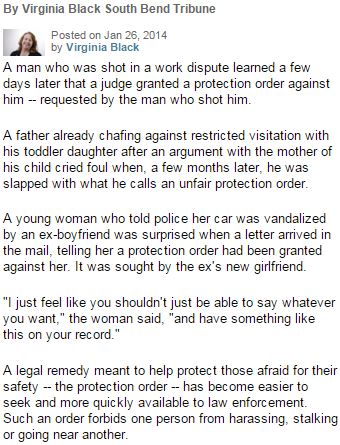
“Unless expunged, criminal case records remain online, even if prosecutors drop the charges. Civil lawsuits [which include restraining orders] stay on Case.net even if a judge dismisses the claims, [Kansas City media attorney Jean Maneke] noted.

“‘Openness is generally a better way to clean up concerns about inaccuracy than attempting to put everything back in a box,’ Maneke said.”

—“Pending Protection Orders Yanked from Public View

Everyone is entitled to his or her opinion. “Bullshit” is this writer’s opinion of the one quoted above. If you’ve been wrongly implicated in an abuse of process (or several), you probably disagree with views like Ms. Maneke’s, too, and believe that lies should never have been taken out of the box in the first place let alone engraved in databases and preserved indefinitely for public scrutiny.

Here are among what views like Ms. Maneke’s ignore:

  1. Restraining orders aren’t criminal cases, so they can never be expunged. Even if a judge dismisses (“tosses”) the allegations, only Tennessee has legislation that affords a wronged defendant the opportunity to have the case against him or her erased from the public record. Many orders, moreover, are finalized despite being grounded on fraud.
  2. Restraining orders aren’t criminal cases, but they’re not strictly civil cases, either. Acts imputed to defendants are often, if not typically, criminal (e.g., harassment, sexual harassment, stalking, terroristic threats, assault, battery, child abuse, sexual violence, or domestic violence).
  3. Unlike in other kinds of civil cases, a restraining order judgment may be wordless and formed in mere minutes, and the defendant may never be heard from at all. (An order can be obtained in a county or state other than the one a defendant resides in, so s/he may have no practicable opportunity to defend.) Also, an order may be awarded even though some of what may be many allegations are never considered by the court or are determined to be baseless. An approved order is an approved order. There aren’t necessarily any qualifications from the court on the recorded instrument to indicate which claims it regarded to be real and urgent, which suspect, or which baseless. To a third-party reader of the order, then, the accusations that appear on it are taken at face value.
  4. The mere title of an order may be prejudicial all by itself, regardless of the facts litigated in court.

The story the epigraph was excerpted from begins like this:

The client couldn’t stand it.

He typed his name into Case.net and up popped an ugly classification: “Protection Order: Adult Abuse Stalking.”

Who needs any more than those five words to form a conclusion about the person they were applied to? The case was dropped by the woman who made the accusation, but those five words nevertheless remained on the Internet.

The man was naturally concerned about the affect those words could have on his business and asked his lawyer to intervene.

[Bevis] Schock, a St. Louis attorney, [drafted] a federal equal protection lawsuit against the Office of State Courts Administrator. He never filed it, because four months later a Missouri Supreme Court committee decided privacy concerns trumped the public nature of this type of electronic court records.

Now pending orders of protection don’t appear on Case.net until judges grant full orders of protection.

The policy shift isn’t unopposed, but today “if the judge denies a petition or the filing party drops her request, it won’t ever appear online [and the] rule change is retroactive; OSCA scrubbed any previous ex parte orders from Case.net, including those involving Schock’s client.”

Schock said he spent 40 to 50 unpaid hours drafting an 18-page federal lawsuit against Greg Linhares, state courts administrator. Among other arguments, the lawsuit claimed the prior public records rule treats respondents differently than petitioners, because respondents are named online but petitioners are not.

The federal 2005 Violence Against Women Act prohibits states from publishing online any identifying information about people seeking protection.

Remarkable is that it takes the threat of a federal lawsuit to alert the courts to an obvious inequity. (Note, too, that finalized orders remain online, even though they may have been based on false allegations, and that even dismissed orders are preserved and can be accessed at the courthouse.)

The story is recommended reading. It notes in passing several facts about the process that are rarely observed, for example, that plaintiffs may file “seven or eight orders of protection” only to have them dismissed.

Under Missouri’s former policy, all of these dismissed petitions would have been visible online.

Unsurprisingly, a staff attorney with the Domestic Violence Unit at Legal Services of Southern Missouri is quoted as expressing the conviction that a “history” like this is indicative of true victimhood.

It can also be indicative of persecution by a venal and vindictive ex, vexatious neighbor, or fixated nutcase.

Copyright © 2016 RestrainingOrderAbuse.com
States that MAY Allow Records of “Protective Orders” to be Expunged…and Why They’re So Few

“The consequences that arise once a protective order is entered against a person (the respondent) are substantial. Though technically considered civil proceedings, protective orders have a close relationship to criminal law. The consequences of having a protective order entered often include restrictions on constitutional rights in addition to financial obligations. Violations of protective orders bring about serious criminal charges.”

Attorney Misha Lopez

“I have been fighting for 10 years to clear my son’s name from a false restraining order that [was] dismissed and vacated by the court. But to clear themselves, [officers of] the judicial system turn their heads to the wrongdoing and cause this young man to be [defamed], not able to continue his education, etc. His [access to] life has, it seems like, forever been barred.”

Blog respondent

The remark above by a criminal lawyer on the “consequences of protective orders” echoes those of many other attorneys (which may observe that restraining order records limit job opportunities and can interfere with the lease of a home, getting government housing, or obtaining credit). I could find you a quotation along the same lines from a law firm in any state of the Union. The woman whose remark follows the lawyer’s, Lena Bennett, identifies herself as a “concerned mother who needs to be heard,” and this post is dedicated to her and her son.

Black_debateA former trial attorney, Larry Smith, who knows the law in this arena better than he wishes he did, responded to Lena:  “I doubt that you can get an expired order expunged in most states because the restraining order, although it has may components of the criminal law, is said to be civil.”

As usual, Larry gets right to the heart of the matter. The fact is there are laws on the books that allow a person who’s been convicted in a criminal court of, say, harassment, stalking, terroristic threats, or assault to later have the charges expunged.

But if a person is baselessly accused of any or all of these acts on a civil restraining order, there’s no legislation in place (except in Tennessee) to enable him or her to have the accusations removed from his or her public record even if a judge determined them to be baseless and dismissed the order.

Note: People who have actually committed crimes can relieve themselves of the onus of a court record (that may hobble their employment opportunities), while people who’ve merely been accused on an ex parte order of the court (30 minutes in and out) are incriminated for life without ever having been tried for a crime, and that, again, is even if a judge formally decreed them innocent and tossed the accusations.

The paper trail, which may include multiple false reports to police officers and registration in police and publicly accessible state databases, is indefinitely preserved.

(Let’s say you’re an employer screening a male job applicant, and you see a restraining order record on which a woman has indicated that he stalked or sexually assaulted her. Let’s even say the court dismissed the case as lacking any foundation. Will you or won’t you be influenced by that record?)

Excuses for preserving restraining order records, which emerge from anti-domestic-violence dogmatists, are anachronistic. Typical of the law, statutes are about 20 years behind social trends.

Consider:

MD_bill

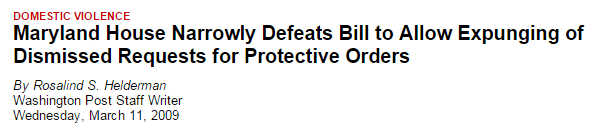
The bill whose defeat is reported in the headline above would have allowed citizens of Maryland who had been accused of domestic violence on a dismissed restraining order petition to have the allegations completely expunged (erased). It was shot down.

Supporters of the measure argued that abuse accusations carry such a stigma that allowing records to remain public in cases that have been deemed unfounded unfairly hurts innocent people as they seek employment or housing.

Opponents contended that requests for protective orders are often dismissed because battered victims, usually women, are too scared or intimidated to pursue the matter. They said records are not expunged in other kinds of civil cases, even when allegations are unproved.

Never mind that these opponents are well aware that restraining order cases are not like “other kinds of civil cases.” Their implications are plainly criminal and highly prejudicial. They’re recorded in police databases.

MD_bill2A year later, another bill is proposed to the same legislature. This one wouldn’t expunge anything, but it would “hide” restraining order records from public view.

“Shielding” is possible in Maryland today and only requires a clerk to sign off on it. It removes the record of a dismissed order from Maryland’s Judiciary Case Search. The record still exists, however, and can be easily accessed by anyone who swings by the courthouse.

In the whole of the nation, as revealed by a Google search performed yesterday, these are the only states in which there are reportedly means to have a restraining order expunged:

Of these, only Tennessee has an actual statute (law) enabling a person who’s been accused on a restraining order petition that was later dismissed to move the court to expunge the record.

And in only a handful of states (again, according to a casual Google search) has legislation been proposed that would offer the same opportunity to their citizens:

That’s it.

Copyright © 2016 RestrainingOrderAbuse.com
(Straw) Hats off to Tennessee, the One State in the Nation That Has a Provision for Expunging a Bogus Restraining Order

“TCA 40-32-101(a)(5) All public records concerning an order of protection [ex-parte, exparte] authorized by title 36, chapter 3, part 6, which was successfully defended and denied by the court following a hearing conducted pursuant to § 36-3-605, shall, upon petition by that person to the court denying the order, be removed and destroyed without cost to the person.”

 —Wikpedia, “Expungement in the United States” (Tennessee)

A woman wrote this week desperate to learn how to seal or expunge the record of a temporary restraining order petitioned against her in California. The order was rejected by the judge, but she’s concerned about the potential ramifications of a lingering record to both her and her children.

Not unduly.

In trying to discover what recourse might be available to her to have the record zapped, I chanced upon the Tennessee statute highlighted in the epigraph. It appears to be the only one of its kind in the country.

Ironically, I’ve also been in correspondence with a gutsy Tennessee woman, Betty Krachey, who was issued a protection order by her boyfriend a few months ago that was dismissed by the court but whose reported fraudulence so outraged Betty that she’s been vigorously petitioning her state to “hold false accusers accountable.”

I wrote to Betty about the Tennessee provision for expunging the record yesterday. I told her I only hoped knowledge of it wouldn’t dull her fervor to inspire change. She says no way.

The order of protection that was served on me was dropped when we went to court. BUT I know a lot of people (all men but me) that this has happened to whose were not dropped and are still on their records. I want something done to my ex for filing this false report against me, and I want to get the law changed to hold anyone who does this accountable for trying to ruin someone’s life. (I know it’s mostly women who file these false reports!) A friend of mine’s ex-wife did this to him, and I remember when the police came to serve him (at my store, while he was having breakfast). He was telling everyone it wasn’t true and he never laid a hand on her.  No one believed him. I remember thinking he must have done something or the cops wouldn’t be serving him papers to leave his home. I know better now, and I know how people think of the ones this is done to.

For its being more legally evolved than the rest of the nation, hats off to Tennessee—and, as I quipped to Betty, I didn’t think people there even wore shoes.

Copyright © 2015 RestrainingOrderAbuse.com

*Betty quipped back, “And most of the people out here DON’T wear shoes…or teeth!!!!”