The Most Important Things to Know When Defending against Restraining Order Lies

The following represents the advice of a man who was persecuted in the courts for over 12 years by a soulless liar. It is the advice of a defendant who has been in the hot seat many times. It is not, however, nor does it purport to be, the advice of a qualified practitioner of law.

For answers to specific questions regarding the civil injunction process, the reader is directed to this site’s Q&A page. The same caveat applies to all information and opinions found there.


  1. The truth doesn’t matter.
  2. The truth DOES NOT matter. You may have been lied about egregiously. The lies may multiply and intensify when you appear in court. Reconcile yourself to this reality and soldier on with your head erect.
  3. You may not think of yourself as a criminal, but everyone else will. Legal experts even refer to civil injunctions as “quasi-criminal.” Accordingly, you must think like a criminal defense attorney. A legal defense is a narrative tailored to place a defendant in the best possible light and to cast doubt and suspicion on his or her accuser. A criminal defense team doesn’t rack their brains trying to figure out how to most effectively tell the truth (“Well, Your Honor, that’s true but…”). A criminal defense team formulates a strategy to win.
  4. Your story must be wholly yours and not merely a rebuttal of the plaintiff’s accusations. Simply answering what the court has already accepted as true will not make you look innocent. It may just reinforce the position the court assumed before you ever showed up.
  5. Citizens are often warned: Never talk to cops. The same reasoning applies to judges. Resist admitting anything that it isn’t going to serve you to admit. The objective is not to satisfy a judge’s preconceived expectations; the objective is to confound them.
  6. You have a brief window of minutes in which to present your defense. You may recite it, submit evidence (bring extra copies), and ask the judge to allow you to question the prosecuting witness (the person pointing a finger at you). You may have to insist upon your right under the basic rules of adversarial process to examine your accuser. Don’t hesitate to assert that right. (And if you’re denied that right or any other, obtain a recording of the hearing, and promptly file an appeal. Retain this information: your case number, the time and date of your hearing, the location, and the name of the judge.)
  7. Know what you’re going to say. Know what you’re going to ask. But come as prepared as you can so that you can adapt and improvise as needed.
  8. You may opt to flatly deny the allegations against you. You may opt to deny the validity or the factuality of whatever evidence the prosecuting witness has presented. These are choices you must make bearing in mind that your aim is to win and not to make an indifferent judge who won’t remember your name like you better. You occupy the same status in his or her eyes as a cockroach.
  9. The phrase, “Yes, but…,” is one you should strive to avoid pronouncing. The only thing the judge will hear is your agreement that you did something s/he may condemn you for.
  10. Use basic, straightforward language. Judges are never the discerning jurists they’re represented to be on TV. Your judge may be a nitwit. Nevertheless, s/he won’t like feeling condescended to: Judicial egos are epic. Be clear not smart. (The relevant lawyer’s acronym is KISS: Keep it simple, stupid.)
  11. Never take it for granted that a judge will perceive your meaning. Tell the judge what you want him or her to know in no uncertain terms. You may preface your account this way: “This is the truth, Your Honor.” Or you might begin by saying, “The plaintiff’s representations to the court are completely false.” (These terms are interchangeable and refer to your accuser: plaintiff, complainant, prosecuting witness.)
  12. Be calm, cool, and collected but not meek. You must believe in yourself and your story, which is your defense. Address the judge as “judge” or “Your Honor.” Do not show anger or spite. Do not whine, snivel, or plead. You are a rational person dealing with the wrongful accusations of an irrational one. Remember: calm, cool, and collected but not meek or resigned. (A judge is not God; s/he’s a government employee whose salary is paid with your tax dollars: You accordingly have the right to expect civil treatment.)
  13. Your goal is to tell and support an effective narrative, choosing what facts you present and what questions you ask to suit that end.
  14. The truth doesn’t matter. If you’ve been accused by a liar, and you’ve been summoned to court because of lies, then this has already been proven to you. If the law were genuinely concerned with ascertaining the “whole truth” (whatever that means), you would be granted more than a few days to prepare a defense, and the process would be allotted more than 30 minutes on a judge’s docket.
  15. You’re in a contest. Prevail.

Copyright © 2023 RestrainingOrderAbuse.com

*When the writer was first trying to come to terms with being serially accused in and out of court, he consulted a nonprofit that was dedicated to exposing the inequities of so-called “women’s law.” The writer sought advice by email. The man who agreed to speak with him insisted that the writer call him, presumably so that there would be no paper trail. Fear and intimidation taint every aspect of this arena of law. They must be confronted and ignored. The reason psychopaths are the most credible witnesses is that they’re not emotionally inhibited; they’re machines that don’t qualm about slanting the truth or outright lying.

A Novel Restraining Order Defense

Restraining orders (also called orders of protection or protective orders) are often referred to as “quasi-criminal.” That’s because while they issue from civil courts, consequences of their real or merely alleged violation can have criminal consequences for defendants, for example, imprisonment.

As a thought exercise, consider when the last time was you heard of some sleazy fat cat, say, appearing before the court on criminal charges and pleading, “Did I do it? Yer goddam right I did!”

Never happens.

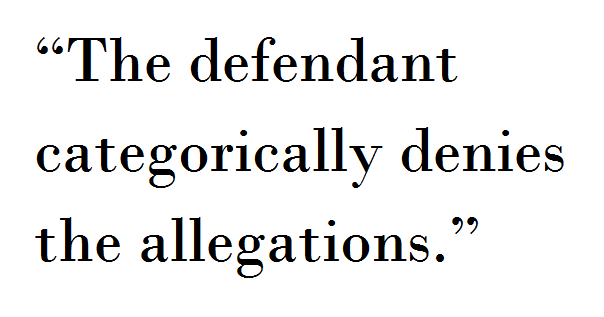
Here’s what you inevitably hear instead: “My client categorically denies the charges.

Yet the same person who pled innocent is never heaped with additional penalties for his or her plea if s/he’s later deemed guilty.

The restraining order defendant, a civil court defendant, is denied free counsel, denied time to prepare a defense, denied presumption of innocence, denied more than a few minutes to present what defense s/he may be able to throw together, and generally denied any orientation whatever.

This helps the process hum along efficiently.

The defendant may complain that some accusation or other is one-sided or half-true. S/he may think a judge is going to be sensitive to a here’s-the-whole-story approach. But this just presents the judge with the task of trying to tweeze important facts out of a swamp, and judges are notoriously lazy, inept, and indifferent.

This post imagines an alternative approach that takes its cue from criminal court.

What if the defendant, instead of trying to clarify, simply denied the allegations?

Q: “Do you know the plaintiff?”

A: “No I do not.”

Q: “Did you [call/text/email/visit] the plaintiff?”

A: “No I did not. The claim is false.”

Etc.

If, for instance, the defendant were married to the plaintiff, denying any familiarity with him or her could pose some credibility problems. So a defendant taking this approach would have to be selective in what s/he denied.

The writer only imagines that were a defendant to deny everything s/he could and propose alternative explanations for any material evidence presented (“forged,” “faked,” “spoofed,” or what have you), it would shift the burden of proof onto the shoulders where it belongs, namely, the accuser’s.

That would be novel indeed.

Copyright © 2022 RestrainingOrderAbuse.com

*The writer can report that deflections by plaintiffs work very well: “I don’t recall that” and “That doesn’t sound like me” and “I don’t remember it that way.”

It’s Court, Sport: Lying Isn’t Punished; Only Losing Is

A falsely accused defendant facing trial, especially a scrupulously honest one, should meditate on the title’s maxim long and hard.

If it inspires one or more of the following conclusions, then reflection on it has paid off.

  • The truth doesn’t matter if it’s ineffective.
  • The defendant who considers him- or herself a “defendant” and not a combatant is meat (and boy and girl scouts are prime cuts).
  • Judges decide “truth” based on “evidence,” which can be represented any way either litigant wants.
  • Compelling narration is more important than truth.
  • The counteractive story that controverts a lie and that can be supported by the “facts and evidence” is more effective than denial of the “facts and evidence” (especially if the “facts and evidence” are histrionic claims and interpretations that can’t be disproved).
  • There is no “what really happened”; there’s only what a judge is moved to believe really happened.

Truth is the concern of philosophers. Judges are not philosophers.

Copyright © 2017 RestrainingOrderAbuse.com

If Restraining Order Cases Are Only about Narrative, How Do You Beat a Liar in Court?

pawn-triumphs

The next to last post stressed the importance of narrative in restraining order cases.

Stories complainants tell pursuant to obtaining a restraining order don’t particularly matter. “I’m afraid” may suffice.

In contrast, defendants’ narratives are critical.

Strategic defense is not about “telling the truth.” It’s about telling the better story. Competing narratives are universally regarded as “he-said/she-said” (so to speak: Restraining orders are not strictly procured by women against men). The only thing that counts is whose story a judge favors when the end-of-the-round bell dings. (Significantly, there’s only one round, and it’s often only a few minutes long.)

Fraudulent claims in restraining order affidavits are commonplace—and what restraining orders do, especially ones whose grounds include false allegations, is inspire those who’ve been accused to register betrayal, indignation, and outrage. Since opportunities to defend may come and go in a few days’ time, those emotions aren’t likely to settle (and may be compounded by many others: fear, bewilderment, uncertainty, vulnerability, etc.).

The urge of defendants will be to stress in court how they’ve been wronged: “It’s really [him or her] who’s the bad guy, Judge.” This urge must be resisted.

The judge couldn’t care any less if s/he were paid to—and s/he is paid to.

Defendants need to defuse whatever has been alleged against them. Merely relating a meandering history (or “history”) of mistreatment can work great for plaintiffs; it does nothing for defendants.

This may seem unfair. It is, and that doesn’t matter—and that’s what a defendant must focus on: what matters.

Sometimes what matters is the law. For example, many recent posts here concern allegations that writing about someone online is “harassment” or “stalking.” One-to-many speech (online or otherwise) is neither, and it’s protected by the First Amendment. To qualify as “harassment” or “stalking,” someone has to contact someone else, repeatedly, after being told not to. Contact must be one-to-one or through a middleman. No confrontation, emails, texts, phone calls, letters, or relayed messages means no contact, and that means no grounds for court interference. Cases in which a constitutional defense is strictly applicable, however, are rare.

(The author of this post is in such a case right now with a woman who he has been told has been diagnosed with a mental illness. The law is clear: The woman has admitted I’ve had no contact with her in years; therefore there were no grounds to authorize an injunction. Making the law clear to a municipal trial judge is a different story. Do I start by playing a voicemailU that this woman, who claims I’ve stalked her since I met her in 2005, left me in 2012, in which she urges me to call her? Maybe. That kind of evidence makes a good first impression. It says—without saying it—that she’s lying. It upsets her narrative. Do I start by saying, “She’s crazy”? No. That’s aggressive and makes a poor impression. It would only get the judge’s hackles up.)

What makes a good narrative? First, follow the creative writer’s maxim: Show, don’t tell. Sometimes defendants have contradictory evidence to present; sometimes there is none. If there is evidence, it must be framed with care (and defendants are recommended to read it aloud in court and not to depend upon a judge to “get it.”) Legal method proceeds from evidence to conclusion. Defendants shouldn’t start with the conclusion, for example, “He’s lying.” They should present a story that gives a convincing impression. Then they can say, “He’s lying.” Attorney Gregory Hession, a specialist in restraining order defense, would call this highlighting plaintiffs’ “ulterior motives” (their real reasons) for petitioning a restraining order. These may include malice, for example, or cover-up.

Defendants shouldn’t rile the judge. What riles a judge is defending by accusing the other guy. Defendants’ narratives should do that. Judges actually think it’s incomprehensible that defendants should be irate, even defendants who’ve been lied about. Expressions of anger by defendants inspire theirs. Misrepresented defendants must seem misrepresented. (No normal human reactions should be expected from judges, furthermore, and normal human reactions from judges should not be relied upon. Judges will often be very civil even as they insert the knife. Defendants should never be lulled into thinking judges are on their side until after the gavel falls in their favor.)

Narratives must be organized, coherent, and taut: no jangly pockets to upset the seams.

Obviously, they should be rehearsed.

Narratives, too, shouldn’t be one-sided. Defendants should cross-examine (ask questions of) their accusers with the aim of tripping them up, and they should anticipate accusers’ answers. If an accuser has made contradictory claims to the police, for example, a way to obviate an outright denial is to phrase a question like this: “Would it surprise you to know that Officer [A] recorded that you said [X] on [date], and Officer [B] recorded that you said [Y] on [later/earlier date]?” (Any defendant who has been accused to the police should obtain the complete file and scour it. It’s there for the asking.) The objective is not to show that plaintiffs are capable of lying but that they have lied about something material (that is, about something that would tend to influence the judge’s understanding and verdict). Exposed details or contradictions should be relevant and significant details or contradictions.

Defendants with documents that corroborate their narratives and contradict their accusers’ should bring them to court in triplicate. Trial judges are seldom sage; they’re just people doing a job. Anything that appears to be “evidence” should be exploited.

Restraining order trials are storytelling competitions. Whether or how defendants embellish the facts is a question for their consciences. In a criminal trial, a defense attorney will flatly deny anything that can’t be proved by the plaintiff, even if the attorney knows the denial isn’t “the truth.” The attorney’s job is to exculpate his or her client: “Can you prove my client even knows you?”

Being storytelling competitions, restraining order trials are not won by telling “truer” stories. They’re won by telling stories that are more appealing to the listener.

Copyright © 2016 RestrainingOrderAbuse.com

Restraining Order Cases Are about One Thing: NARRATIVE

narrative

The universal conviction is that the court involves itself in a citizen’s life because the citizen did something wrong. Even judges are inclined to believe this.

It’s wrong, and they’re wrong—and it’s very wrong of them to be wrong about something so important.

The court involves itself in a citizen’s life because someone (automatically designated a “victim”) told it a narrative, one that characterized the citizen as a miscreant. Someone told it a story.

That’s it. It would accordingly be swell if administrators, legislators, the judiciary, the general public, and the press recognized this.

If a story the court is told is true, there are consequences. If a story the court is told is untrue, there are consequences. The consequences, however, are always borne by the accused, that is, the person the story is about, irrespective of whether the story is true.

The accuser may be rewarded, or s/he may not be rewarded: “No harm, no foul.

This goes a long way toward explaining why the universal conviction is that the court involves itself in a citizen’s life because the citizen did something wrong: S/he’s the only one who’s ever implicated in wrongdoing (and, whatever the circumstances, s/he is never called a “victim”).

The inequity is obvious. This inequity is magnified in restraining order cases, because stories are subject to minimal or no scrutiny in procedures that may be mere minutes long.

The “standard of proof” is how trial judges feel, and that may actually be reflected in states’ statutes, which in cases explicitly authorize judges to do as they “deem appropriate.” (Who determines whether they actually do what they think is right? They do.)

This is why it’s impossible to answer questions like this: “Can someone get a restraining order on you for calling her a bitch?” The law says one thing (no); a judge may feel otherwise.

“Justice” in this arena is freewheeling, as First Amendment authority Aaron Caplan has remarked.

In other sorts of cases, defendants may appeal a judge’s decision. Not only are few able or inclined to do so in restraining order cases (which can cost a defendant $5,000 based on a three-minute fish tale that’s swallowed hook, line, and sinker—or force him or her to cross the country to answer charges in a 10-minute hearing); there may be no point. The standard applied by appellate judges, barring arguments like violation of civil rights, is “clear abuse of discretion.” Since trial judges’ discretion is without limit, satisfying the “clear abuse of discretion” standard isn’t strictly possible. Post-trial defense is almost always an exercise in futility.

A narrative that works…works. It doesn’t matter if it was false. That had to have been proved at trial, and it had to have made an impression on the judge, who isn’t obligated to dismiss a complaint that’s fraudulent. S/he doesn’t have to justify his or her decision. It’s indisputable.

A narrative that works…works.

Copyright © 2016 RestrainingOrderAbuse.com

*The process is derisible for many more reasons than this. Significant to take from this post is that restraining order cases are storytelling competitions. There is no justice or accountability. All a defendant can do is endeavor to tell the better story. To be continued….

“There’s No Justice System; There’s Just a System”: A California Paralegal’s Advice on Defending Yourself against a Restraining Order Based on Fraud

The commentary and advice that follow are from a “paralegal at a top-tier criminal defense firm in Southern California.”

I will go on record saying we have some clients that were slapped with permanent restraining orders and some were also on probation for prior convictions while the restraining order injunction was issued. A number of our clients were arrested and put in jail multiple times by vindictive exes who used the RO in an abusive manner such as asking the restrained person to come over so they could reconcile and then calling the police as soon as the restrained person arrived. Another “protected person” in particular called the restrained person and claimed she was going to commit suicide. When the restrained person (our client) came over, she immediately called the cops, and he got hauled off to jail. We have another client who got locked up for responding to his ex via text message! Those are classic examples of “RO set-ups,” and it happens too often. Evil!

This topic hits close to home, because I too was the victim of a false/frivolous DV restraining order (or at least a failed attempt to get one placed on me) not too long ago. My ex-fiancée used a few e-mails I had written, admittedly in poor taste, of course, as evidence against me. The e-mails, though rather offensive, did not have any indications or inclinations of imminent danger towards my ex. No threats of physical harm towards my ex or her family at all. She even amended the protective order a couple of days after she originally filed it to include her brother, her mother, and the family dog!

I was shocked a temporary restraining order (TRO) was granted but later came to realize the courts tend to grant TROs quite easily with minimal evidence as a “safe measure” in case the petitioner is truly in immediate danger. Fortunately for me, my ex and her bro lacked basic legal knowledge and were not well-prepared for the hearing when the day came. I hired an attorney who specialized in domestic violence/criminal defense, and she was able to discredit/impeach my ex’s bro’s testimony and pretty much shoot down much of what my ex had to say with regard to my being a threat to her and her family. My ex did tell the judge she was fearful of me, and the judge did sympathize with her in that area. Long story short, the petition for a permanent restraining order was denied, and I hope I never see my ex or any members of her family ever again.

I’m sure this site has this info already, but I’d like to reiterate:

  1. When you get served with a temporary restraining order, regardless of how frivolous, OBEY THE TEMPORARY RESTRAINING ORDER. Make no effort in any way, shape, or form to communicate with the petitioner/protected person(s).
  2. If you have firearms, turn them in to a local firearms dealer for storage.
  3. Get an attorney who is reputable and skilled in domestic violence as well as criminal defense.
  4. If the hearing date is less than a week away, have your attorney request a continuance so you can better prepare for the hearing.
  5. Have your attorney file a formal response to the petition before the actual hearing, and make sure it gets served to the court and the petitioner.
  6. You and your attorney must go over your strategy in defending against the petitioner prior to the hearing.

I never lived with my ex nor did I have any history of domestic violence, but I still had to deal with the bullshit that came with a TRO. Even so, I stood my ground and fought the bogus petition.

Innocent people fight when they are wrongly accused rather than submit. Those who blatantly lie and lack reasonable evidence to support the lies will get shot down by competent defense counsel (as well as a confident and competent respondent/defendant).

  1. Maintain your composure at all times, especially during the hearing—dress nice, speak well, and discredit your accuser(s) in a cordial and professional manner, and you will prevail.
  2. If the judge feels the petition for the restraining order was completely unmerited, you can request that the judge order the petitioner to pay your attorney’s fees as well as any other expenses such as reimbursement for firearm storage fees.

The sad thing, though, is nine out of 10 times if the petitioner simply says s/he was truly in fear, the judge will say the TRO did have “some” merit.

Anyhow, my heart truly goes out to those of you falsely restrained and subjected to all the headaches that come along with it. Sometimes the system does truly suck.

Copyright © 2015 RestrainingOrderAbuse.com

A Consideration of Attorney Gregory Hession’s “How to Fight a False Allegation Restraining Order”

“In thousands of 10-minute hearings held all over the Commonwealth, judges are now able to do what the Marxists have only dreamed of doing before now, and could never hope to do before they were able to use the pretext of ‘domestic violence.’ However, the real violence is almost always to the rights of the defendant, and to the Constitution itself….”

—Attorney Gregory Hession

As a follow-up to the previous post, “Pointers for Contesting a Restraining Order,” this post analyzes (and recommends) attorney Gregory Hession’s tutorial “How to Fight a False Allegation Restraining Order.”

The title’s a little weird. An earlier version of the explication used the phrase “false restraining order.” Evidently Mr. Hession wanted to clarify that he means a restraining order that’s very real but based on an allegation that’s false—hence the phrase “false allegation restraining order.”

Massachusetts attorney Gregory Hession, who urges the wrongly implicated to expose their accusers’ false motives, identifies the above as “ulterior” reasons for the procurement of a restraining order.

The quotation of Mr. Hession’s that was lifted for the epigraph above highlights that violence is the pretext used to justify procedures that are constitutionally unconscionable. Often no violence is alleged. The word, however, emphatically appears everywhere in state statutes as a smokescreen. It makes any violation or abuse of the accused “okay.” The courts aren’t messing around with people’s lives for kicks; they’re protecting the vulnerable from “violence.”

Here, therefore, is what you, as the “defendant” or “respondent” (the accused), are up against:

In restraining order hearings, judges may ignore ALL traditional due process protections such as jury trials, the rules of evidence, the right to innocent until proven guilty, etc. They may also usurp several other dearly held rights, such as the right to be with one’s children, to occupy one’s own home and property, or travel where one pleases. No one has yet come up with so demonic a perversion of our legal system to match the breathtaking scope of the unconstitutional deprivations of this law.

What is the actual legal basis for getting an abuse restraining order? Many courts issue restraining orders without following the requirements of the law (which are already so flimsy as to be a mockery). If a person comes into court (called the “complainant” or “plaintiff”) and whines about feeling “fear,” a court will often issue an order, even though many times it is improper and illegal to do it.

Restraining orders—not just in Mr. Hession’s state of Massachusetts but in most if not all states—require that some intimation of “imminent physical harm” be suggested by the alleged conduct of the accused. Mr. Hession urges that this qualification be picked apart.

First the harm has to be “imminent,” [that is], immediate, right there, right now. Not a vague threat to do something someday. Not a phone call from a far location. Next, it has to be “serious.” The [Massachusetts] attorney general, on a ballot referendum to overturn some recent changes to the domestic violence laws, defined “serious bodily injury” as follows:

“Injury that results in a permanent disfigurement; long-term loss or impairment of a bodily function, arm, leg, or organ; or substantial risk of death.” [If you’re appealing an order in another state, you may investigate how your state defines “serious bodily injury.”]

Lastly, the fear has to be of “physical” harm, not emotional harm, psychic harm, hurt feelings, or any number of other non-physical issues that people commonly get orders for.

If courts went by this definition strictly, fewer frivolous orders would be issued. However, as you likely know, judges often issue an order if they feel it should be issued, regardless of the law’s requirements.

(Statutes are often mishmashes. Ridiculously, an injunction against harassment in the author’s state of Arizona reads, “The Court finds reasonable evidence of harassment of the Plaintiff by the Defendant or that great or irreparable harm would result….” There’s plainly a huge gulf between annoyance and “irreparable harm.” That’s how these statutes are designed: to apply to virtually any alleged conduct, however harmless, but to make it seem as though plaintiffs are being protected from violent assault…or murder. That’s how the laws are justified. The person who sends some angry text messages is equated with tomorrow’s serial killer.)

If you hope to appeal a restraining order, Mr. Hession stresses, you must appeal the initial order (which may issue from any of a number of courts). It is possible to contest an order through higher tiers of the court system if the first judge finds against you, but if you blow off your initial court appearance, “fuhgetaboutit.”

First, Mr. Hession says, get your “docket number” (your case number), go to the courthouse, and demand to see all of the allegations against you. (Sometimes the plaintiff’s affidavit, his or her sworn narrative statement, isn’t provided to the defendant when the order is served and must be requested.)

Second, he offers a number of strategies to attack the allegations against you, mainly by exposing falsehoods. For these, go to the source: “How to Fight a False Allegation Restraining Order.”

If you have no experience of court procedure, Mr. Hession’s tutorial is a challenging read. It’s also long, which can be off-putting. It is, however, definitely worthwhile, whatever state you may be in.

The point of this heads-up is to ensure that the substance of Mr. Hession’s advice isn’t discounted by the bewildered defendant who may think it only applies to the wrongfully accused in Massachusetts. Absorb the gist of the material, and it’s likely you’ll fare far better in an appeal than you would have otherwise.

Copyright © 2015 RestrainingOrderAbuse.com

Pointers for Contesting a Restraining Order

One of the earliest posts on this blog (from 2011) offers some procedural orientation to the falsely accused. The author hasn’t revisited the post except to update a link to attorney Gregory Hession’s blog, MassOutrage, which is recommended reading.

Much of the author’s early advice is important: show up early, dress well, be polite, organize your defense and rehearse it ahead of time, make three sets of whatever evidence and exhibits you intend to present, etc. It can also be boiled down to (1) mind your p’s and q’s, and (2) don’t “wing it.”

This post offers some more seasoned counsel to the defendant who can’t afford representation:

  1. Be direct. If something alleged against you is false, say it’s “false.” Be explicit. Don’t “defend yourself” by explaining how the accusations against you couldn’t be true. Say they aren’t true (and then offer what proofs you can). If allegations are “mostly” not true, if they’re hyped or skewed or exaggerated, they’re “false.” Say so right off the bat.
  2. The author suggested this statement as a “for example” to a recent commenter who wanted to know how to defend herself against false allegations. She reported her ex falsely alleged on a temporary restraining order petition that she had threatened to kill herself and her son. She said her ex took their son, refused to return him, and filed for a restraining order on bogus grounds so that he’d never have to return the boy or pay child support. Consider how a statement like this is much more effective than a long rehash of a relationship history that might only distract the judge from hearing what’s important.

    You’re the bad guy, so present an argument instead of an explanation. You won’t win over the judge by appealing to his or her sympathy.

  3. Be humble. Judges are vain, proud, and self-important, and some resent it if you sound like a smarty-pants. (Yes, a judge is capable of finding against you just because s/he thinks you’re haughty. The rules are whatever s/he wants them to be.)
  4. Keep it simple. These procedures are in-and-out. If your story is long and convoluted, change it. CHANGE IT. The truth that serves you is what’s important, not “facts.” Facts may not tell the truth. In these procedures, what counts are impressions.
  5. Be straightforward. Use brief, declarative sentences. Don’t backpedal. Some qualifiers are okay, like these: “I believe,” “I think,” or “Plain to me, Your Honor, is that….” Prefacing remarks like this expresses humility and honesty. Some qualifiers aren’t okay: “Well…,” “What I meant was…,” “Then again…,” “Perhaps….” They sound wimpy and uncertain, and they inspire suspicion; they say you’re guilty.
  6. Don’t leave anything up to a judge’s interpretation. Don’t submit an exhibit and expect the judge to see what you want him or her to see. Tell the judge what s/he should see (“What this shows, Your Honor, is…”). The judge doesn’t know anything, and s/he’s not on your side.
  7. Don’t mince. Use loaded words. Instead of saying something was “untoward,” for instance, say it was “sexual.” Graphic words make an impression. Careful ones don’t.
  8. Cross-examine (question) your accuser. Put him or her on the defensive. Some accusers are vehement fraudsters and will deny the truth and lie freely. If you can trip your accuser up, however, possibly by getting him or her to commit to a lie that you can disprove with evidence, this can be a winning move, as can be forcing your accuser to own an inconvenient truth because s/he knows you have proof of it.
  9. These procedures are contests between personalities, not just competing facts. The person who looks and sounds best, fares best. Aggressive defenses make an impression. Limp ones do, too, but not a favorable one.
  10. Expose lies to make an impression, but don’t depend on it that proving the plaintiff lied about something will impact the judge’s ruling. No one in these procedures is ever sanctioned or prosecuted for perjury. Presenting proof of lying can mean absolutely nothing; a restraining order petition will not be dismissed simply because a plaintiff demonstrably told a lie. Your accuser’s behavior is not what the judge is there to form an opinion on; yours is.
  11. You’re right; your accuser is wrong—that’s the impression you need to make. To win, you must convince the judge that the accusations against you are without merit.

Copyright © 2015 RestrainingOrderAbuse.com

What Restraining Order Defendants Need to Know That No One Ever Tells Them: The Truth Doesn’t Matter

The ambition of this post, an intermission between considerations of graver subjects, is to dispel restraining order defendants’ faith in the value of “truth.” Defendants are led to believe that if they’re truthful in the defiance of lies or hyped allegations, all will turn out as it should. But truth is a false idol that answers no prayers.


If you haven’t yet had to swear this oath, you’ve heard it before on TV: “Do you swear to tell the truth, the whole truth, and nothing but the truth?” (Sometimes God and the word solemnly are thrown in for emphasis…maybe to suggest you’ll be struck by lightning if you distort the facts or omit any.)

The significance of this courtroom ritual is none, and taking it literally is for chumps.

Civil trials, especially the kind this blog concerns, do not weigh “truth”; they weigh testimony, along with evidence as it’s represented (in procedures that may span minutes only). The savvy defendant will think in terms of economics and marketing. “Truth” has no inherent value to a defense. Unless it conclusively proves something you want to prove, it’s totally worthless. Worse, it may distract and dilute the potency of what you’re trying to sell. Facts, besides, may not tell the truth. The word truth is a trap for the naïve.

What wins cases are successful representations, ones that work the desired effect (i.e., what wins is salesmanship not scrupulous reporting).

While the court asks for honesty, it doesn’t reward it. It’s what you say and how you say it that counts, not “the truth.” God isn’t the judge; a man or woman is, and his or her favor goes to the person who gives the most compelling presentation (i.e., sales pitch).

Why do lying plaintiffs win? They win because their representations were persuasive. Did they tell “the whole truth and nothing but”? They may have told none at all. (Restraining orders have reportedly been obtained by people using assumed names; they didn’t even tell the truth of who they were.)

What do cunning attorneys who represent lying clients (or any clients) do? They tell only those truths that support their stories…and no others. (They may lie, also—and vigorously.)

The fastidious defendant who finicks over every detail, who backpedals and carefully qualifies his statements (in the interest of complete and accurate disclosure), and who otherwise invests his or her trust in “the truth” grossly misperceives the nature of process.

Representations win court contests, not “the truth.” The truth doesn’t matter.

~ EPILOG ~

A few months ago, the writer spoke for an hour or so with a 30-something man who said he was an obsessive-compulsive. He had written that he was “starting to go downhill really fast” and needed help. “I will try to eventually explain,” he began, “but there’s such a long history of what happened.”

What he explained was that he’d been bullied by a woman many years prior, while they were in high school, and had been haunted and galled by the abuse ever since. He said she had tried to coerce him to have sex with a friend of hers, that he had refused, and that she had spitefully urged some guys to rough him up (one of them would later be convicted of murder, so this wasn’t bush league bullying). She had also greeted him with a sneer whenever they met after that, and flipped him the bird and yelled “Fuck you!” at him as he passed by. He had tried to reach an accord but had only been mocked. He said he never used to stand up for himself and was sick of turning the other cheek.

He impulsively ventilated rage that he had bottled for 20 years by calling the cell of the woman’s husband and leaving her a voicemail that called her a “rude, mean bitch” and that ended with a string of “Fuck you!”s. That was pretty much the extent of it, but he was handily represented as a stalker.

He wanted to know what pointers I could offer that might aid him in his defense against a restraining order petitioned by a woman who claimed to have no memory of the events he described and whose stepmother, he said, was a former lawyer who had prosecuted cases before the state supreme court and was, besides, the director of a “domestic abuse and physical violence organization.”

Yeah.

I repeatedly impressed upon him that reciting a history that spanned decades wasn’t likely to move a judge to anything but a yawn (or a rebuke) and that he should consider how to frame his story to put himself in the most favorable light, for example, by updating the context (and abandoning a rigidly chronological narrative).

Each time I interrupted, he said he understood and then recommenced his story, which stretched back to his anguished childhood. He was very earnest and conscientious, and continually paused and qualified his remarks with “Granted, I….” It was important to him, he said, to tell his “heart’s truth” (i.e., the “whole truth”). He wanted someone to sympathize, and I did. But I knew a judge would not.

I never heard from him again.

Copyright © 2015 RestrainingOrderAbuse.com

The Court Isn’t against You, It Just Doesn’t Understand You: On Why Restraining Order Defenses often Fail

Eight years ago, I was a curmudgeon working on a manuscript of humor for kids. I had appeared for jury duty before but was sent home, because the cases were dismissed or settled out of court. The only time I’d ever sat in on a trial—either out of curiosity or because a professor I had recommended I do it—the bailiff banished me, because I was wearing shorts. He invited me to return if I found some pants.

I couldn’t have told you anything about how the justice system works. I have, however, learned a good deal about it since. Mostly involuntarily.

A judge I appeared before last spring memorably remarked to me, “Pretend I don’t know anything.” I didn’t appreciate that he was in earnest. What I appreciate now is that everyone who appears before a judge should always assume the judge knows nothing.

I don’t mean this critically but practically. Judges may know a lot, but the way trials proceed is by each side’s informing the judge of what s/he should know. When lawyers cite legal cases, they’re not just reminding judges; they’re cluing them in to rulings they may well have no familiarity with whatever.

What this means is that it’s insufficient to tell the truth and expect a judge to perceive what action s/he should take. Judges are moved by argument, not facts alone. Put simply, judges should be told how they should rule, and this is what attorneys do. Attorneys don’t always do this because they believe they’re right or even because they anticipate the judge will agree with them. They hurl theories and arguments hoping one will hit home.

Law isn’t about what it should be about: right and wrong, truth and falsity. Law is about persuasion, even domination. I’ve been involved in two superior court actions now. Both times I was astonished by the dictatorial tone of the attorney I opposed. More astonishing to me was that the attorney was never rebuked for his demands but more often than not bowed to.

It’s unlikely that judges will be as obsequious toward non-attorneys, but the self-represented should nevertheless take care to spell out how they think the judge should act and not leave that to interpretation.

Litigants who aren’t attorneys must take care not to come on too strong, because judicial impulse may be to kneecap them for their impudence. It’s a difficult balancing act, but as anyone who’s been wronged by a miscarriage of justice will tell you, the reason his or her opponent “prevailed” had little or nothing to do with truth or reason.

What restraining order plaintiffs seek is understood going in. They don’t have to clarify their expectations. Defendants do: dismissal. And the grounds for dismissal must be argued, not simply articulated, especially if defendants are responding to false allegations, because judges won’t understand that the motives for a restraining order may be completely fraudulent or that the whole thing may be an elaborate and malicious hoax.

Self-represented litigants should be polite but direct and insistent. They shouldn’t, that is, be afraid of playing the legal game, which isn’t a duel of contrasting facts but a Sumo match that terminates with one side’s moving the judge to assume his or her perspective.

Copyright © 2014 RestrainingOrderAbuse.com