Can Anyone Publish and Criticize a Judicial Ruling (Including a Restraining Order)?

A judicial ruling, like a law, is among what the U.S. Copyright Office terms edicts of government, and edicts of government cannot be hushed. “If either statutes or decisions could be made private property, it would be in the power of an individual to shut out the light by which we guide our actions.” Wheaton v. Peters, 33 US (8 Pet) 591, 668 (1834). Public access to judicial documents is a common law right.

Why is this worthy of mention?

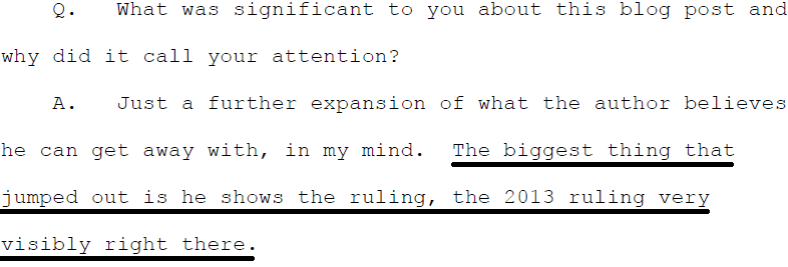
Below is an excerpt from testimony given during an aborted trial proceeding that sought to have this writer jailed in 2016 for contempt of a judicial injunction. The speaker is Phil Bredfeldt, husband of Tiffany Bredfeldt, a woman the writer knew for three months in 2005 and hasn’t had any contact with since 2006, who admitted during the same prosecution that she had accused the writer “to the Court multiple times [and] to multiple police departments, detectives, federal agencies, and other officials in several states [over what has become an 11-year period].” She was eager to impress this upon a judge but less keen for the whole world to know about it. The Bredfeldts petitioned an injunction against the writer in 2013 that unconstitutionally prohibited him from talking about his own case.

One of the many heinous consequences of a restraining order process run amok is the erroneous faith, held by both trial court judges and complainants eager to conceal mischief, that judicial rulings may be suppressed. They may not be. Similarly, defendants may not be prohibited from talking about their experiences in the judicial meat mill. It’s unconstitutional.

American plaintiffs want to exploit court process yet remain anonymous; American attorneys want to bend or break the rules without having reminders of infractions they’ve been caught at available for public consumption; and American trial judges want the freedom to enter sketchy rulings and the security of knowing that those sketchy rulings will never be scrutinized.

They’re in the wrong country.

Copyright © 2017 RestrainingOrderAbuse.com

Some Inconvenient Facts to Consider before You Apply for a Restraining Order

chirp_chirp

Restraining orders are urgently encouraged by many, including the police. They reward impulse and can be procured in moments. Everyone may goad you to act, including friends and family, which can exert a coercive influence on your decision. This is what they don’t know and you won’t be told.

  1. Application for a restraining order may cost you nothing, but that doesn’t mean it’s free; the taxpayer foots the bill (which by some estimates may run from $1,000 to $2,000).
  2. Accordingly, “your” restraining order is not yours; it’s the public’s, bought and paid for.
  3. The court, the district prosecutor, and the police represent the public interest; the restraining order is theirs. You are just the complainant, and your control ends there.
  4. The court may allow you to recant your allegations and vacate the order if you reconsider, or it may not, and the system will act on those allegations regardless of whether you want it to; you have nothing to say about it. You can whine, wheedle, and beg, and it won’t matter; process is blind and deaf, and you have made the accused vulnerable to incarceration by placing a target on his or her back.
  5. Once you introduce an allegation publicly, it becomes a permanent public record.
  6. That record may be aired publicly by anyone anywhere and anytime in accordance with the First Amendment. That includes in a blog, on YouTube, or in a newspaper.
  7. To accuse someone is to make it a criminal offense for that person to communicate with you. You have no power to “allow” exceptions to what a court orders. You concede your adult right to exercise personal discretion when you petition the court to assume a parental role in your life.
  8. To accuse someone publicly is furthermore to make him or her subject to warrantless arrest, subject to automatic enrollment in public (including police) databases, and consequently subject to prohibition from certain forms of employment and denial of the benefits that would otherwise accompany that employment (traces of the record do not dissipate; they’re permanent).
  9. Since this will likely be objectionable to the accused, it can set in motion a cycle of reciprocal accusation and prosecution besides create enduring strife in families and social circles. Legal action cements a lasting distrust and enmity, and makes it impossible (because illegal) for anyone to talk things out and reach a detente.

Copyright © 2015 RestrainingOrderAbuse.com

*A restraining order is not “just a restraining order.” The point of restraining orders was to cull and identify violent abusers, and the imperative promoted by feminist proponents of “women’s law” is to make that label permanent and punitive.

“Somebody Do Something to End This Madness!”: One Commenter’s Appeal for Restraining Order Reform

A comment Wednesday resonated with the author’s experiences of legal abuse and many others’. It said its writer’s life was trashed because he showed compassion for another. He exhausted his savings to help his ex-wife out of a fix, flying out to California from Colorado on a day’s notice. Five years later, having lived with the aftereffects of legal madness every day of the interim—which included appeals in another state, postponements, and a five-year restraining order extension—he says he feels his life is “over.” Of particular note is that the apparent instigator of the fraudulent restraining order petitioned against him was his ex-wife’s son; the son allegedly threatened to turn his back on his mother and evict her from his home if she didn’t comply with his wishes.

The commenter’s account:

[In] 2010, she calls me in Denver [Colorado], where I had a two-bedroom apartment, crying the blues that she had a big fight with her boyfriend, and requested to stay with me for a little while. I gave in as we were married for 23 years and had remained friends.

I fly out to San Jose [California] the next day, and we drive directly from the airport to U-Haul, pick up a truck, and are on the road in a couple of hours. Five days later, I move her into her own bedroom and put her furniture in storage.

Things went fine until she wanted this dog up in Wyoming that had some issues.

We drive up to get the dog and then after getting it home, I find out the issues—the dog would just pee on the carpet at random. I told her the dog had to go. She’s not happy, but we surrendered it to the local shelter.

Next thing I know, there is a knock on the door with her son ready to drive her back to San Jose.

Not a problem until two weeks later when the sheriff delivered the TRO [temporary restraining order] that stated I had to give up my guns and appear in San Jose at a hearing in seven days. “Why?” I asked. “Don’t we have laws in Colorado? Shouldn’t the case be tried in Denver?” Apparently not. I lost that argument.

I went to San Jose, had a 10-minute hearing in front of—what else?—a woman judge. My ex had a lawyer [thanks to] the good old folks at VAWA providing the funding. I [checked with] over 30 attorneys, and no one would touch the case pro bono (she took any spare money I had moving her).

Then we found out that she can talk to me; I just can’t talk to her (great system).

We found a way to communicate…through the Internet on one of those game shows. We would pass notes back and forth. She did not have a problem with that. The son found out and over his IPhone requested an extension on the court order.

Turns out, truth be told, that the son was the one who wanted her to get the RO. She never had any intention of doing such a thing. The son apparently was angry because he asked me what happened between his mother and me. I responded by asking him if he was sure that he really wanted to know the truth about his mom. Well, I told him the truth. I told him that his mother was screwing around on me every chance that she had.

That did not sit well with him. So here we are…RO. Every lie in that first and second complaint was written by him. He forced his mother to go along with it by threatening that he would not want her to be around him anymore and that she would have to move out of his house.

With all the postponements, when we finally got a ruling on the attempt to continue the first RO, which only had two weeks left on it, the judge, a new woman judge, ruled against me. She would not even let me speak.

So, long story short, after all the delays in between the appearances, I now received an additional five-year RO causing my total RO to be about 7 years.

I don’t give a shit whether I ever see her again, but I thought that this was a country of laws. There was never any violence between us. Yet this judge violated my Second Amendment rights once again.

So…lesson learned: Never even raise your voice to your significant (???) other. When she finds out how much money she can get out of all the federal funding, inclusive of cars, a place to stay, educational programs, etc., etc., she will come after you without a second thought.

The entire law is wrong. It violates [the First, Second, and Sixth Amendments, and probably others]. And the worse part of it is that any woman you want to date is going to plug your name into the Internet before she considers going out with you. Or her son or daughter or girlfriend will…just because they want to make sure she’s not going out with a “bum.”

My life is over. I have no social life [and] no place to turn. Not one lawyer will help. Not one congressman or senator will go against all the women who started all of this in 1994. And why? The only reason that I can come up with is that they don’t want to get “cut off.” They have no balls and couldn’t care less about what is right or wrong.

This is a bad law. I think if I remember the VAWA statute correctly, the phrase man or men is mentioned one time. I am for anyone who has any ideas on how to overturn this law and at least give us our “rights” back. I can understand it if you are a wife-beater or something like that, but the word harassment is so ambiguous. How can any judge make an honest decision?

Please, everyone, chime in. This could happen to you! If your wife gets an RO on you, you are in “the system.” You no longer will have a job, friends will shy away from you, and even your own family will distance themselves from you.

SOMEBODY DO SOMETHING TO END THIS MADNESS!

Please.

Copyright © 2015 RestrainingOrderAbuse.com

*The anonymous commenter’s remarks began: “I will be more than happy to pay any attorney to get my Santa Clara County, California RO taken off of the Internet!”

“On the Receiving End of a Sociopath’s Lies”: A Professional Mom’s Story of Restraining Order Abuse

The following account is reproduced almost verbatim from an email of recent vintage. Its writer is a professional woman and single mother of three with whom I corresponded last year while she was embroiled in strife—legal, medical, and emotional (a synergy of torments that’s been reported here before). The capsule version of her story is that she was in an abusive relationship (including violently abusive), sought a restraining order, which was dismissed on appeal, and then was issued an order petitioned by her abuser, which she reports was based on fraud, and which was nevertheless upheld despite her appealing it. She brought criminal charges, also. Her abuser smoothly extricated himself from those, too. The victim of assault is the one with the “restraining order” on her permanent record. She asked that I not use her name because she’s “terrified of  the possibility of repercussions.”

In her own words, which more poignantly express the psychic trauma of procedural abuses than any I’ve ever read:

My active involvement with my sociopath has, mercifully, ended.

[H]e refused to accept a plea deal, he took his assault case to a jury trial, and he was found not guilty by a jury of his peers. His lies were, apparently, more believable than my truth, or, best case, the jurors didn’t really believe him but couldn’t find him guilty beyond a reasonable doubt. Either way, it doesn’t matter. I’ve seen enough of the court system to learn that the truth is completely immaterial, and that the officers of the court will consistently choose the “easy” ruling over the one that is true. If the matter before them requires some thought, some extrapolation, some reading between the lines, and/or some backbone, forget it. The truth will be jettisoned faster than a grenade with its pin pulled.

I don’t really know how to describe how profoundly my brushes with domestic abuse/restraining order abuse/generalized legal abuse have affected me. In a few short months, a year will have passed since the criminal trial against my abuser took place. Four years will have passed since the whole odyssey began on Easter of 2011, when I walked into the police station and reported my abuser’s attack after agonizing overnight about whether or not I should do so. Imagine that—agonizing overnight about whether or not to report a crime! On some level, I must have known even then how very awry it all could go.

Let me just attempt to put this into perspective: I have lived through my parents’ divorce. I have boarded an Amtrak train headed for New Orleans at 16 years old in an effort to escape a miserable childhood. I have been scarred by the shame of being a high school dropout and then gone on to receive a college education. I have experimented with more drugs than I can count on two hands. I have traveled all over Europe with little more than a backpack and a few pfennigs. I have been robbed at gunpoint while working third shift in a Shell-Mart in Anniston, Alabama. I have scuba-dived off the coast of Honduras. I have watched my stepmother fight to regain pulmonary function after she was stabbed by a purse-snatching punk in the alley behind her home in Washington, D.C., only to watch her die an agonizing death from lung cancer fifteen years later. I have held a lion cub in my arms. I have lain helplessly in a hospital bed as not one, not two, but three premature babies were whisked from my body and transferred straight into the NICU. I have survived breast cancer, and then my mother’s untimely death from a hospital-acquired infection four months after my diagnosis. I have been sliced and diced and blasted by radiation. I have been exposed to, and treated for, tuberculosis. I have lived through bacterial meningitis and undergone a blood patch procedure after a botched spinal tap. I have been resuscitated with Narcan after being given too much IV narcotic during an acute episode of kidney stones. I have skydived over the Newport, Rhode Island coastline. I have loved multiple dogs and cats and then held them in my arms when it was their time to leave this earth. I have fought for my children and for myself against a relentlessly bitter spouse during a contentious, protracted divorce.

Not one of those things has affected me as deeply as being on the receiving end of a sociopath’s lies, and the legal system’s subsequent validation of those lies. There is no “coming out the other side” of a public, on-the-legal-record character assassination. It gnaws at me on a near-daily basis like one of those worms that lives inside those Mexican jumping beans for sale to tourists on the counters of countless cheesy gift shops in Tijuana.

I have sort of moved on; I mean, what else can one do, particularly when one has young children? But the horror, outrage, shame, and, yes, fury engendered by being wrongly accused by a perpetrator, and then having that perpetrator be believed, chafes at me constantly. Some things born of irritation and pressure are ones of beauty, like a pearl, or a diamond, but not this. This is a stoma on one’s soul—it never heals, it’s always chapped and raw, and if you’re not careful, it can leak and soil everything around it.

These days, when sleep escapes me, which seems to be fairly frequently, I often relive the various court hearings associated with this shit show. One is the court hearing for the restraining order that my abuser sought against me (and which was granted) based on his completely vague, bullshit story that he felt “afraid” of me—this from the beast that had assaulted me on numerous occasions, slashed my tires, and had a documented history of abusing previous girlfriends. Another is his trial for assault and battery, during which I was forced to undergo a hostile, nasty, and innuendo-laced cross-examination by his scumbag defense attorney in front of a courtroom full of strangers. But the hearing that really gnaws at me and fills me with an almost homicidal enmity for the judge overseeing it is the one where I was requesting a restraining order against my abuser, this after a particularly heinous assault in the days following my cancer diagnosis and my partial mastectomy.

That judge apparently believed my abuser’s bald-faced, self-serving, and absurdly improbable lies over my detailed, accurate, and horrific account of his behavior immediately following my surgery. That judge believed that a well-dressed, employed, and reasonably intelligent woman would drag her ass to court a week after a life-threatening diagnosis and major surgery just to harass her blameless ex. My memory of the surreal, humiliating, and completely unexpected ruling that day, made even more galling by the judge’s proclamation that he found the defendant to be “more credible” than me, is as grievously harrowing today as it was then.

To say that I feel indignant about it would be an understatement. Take indignation, add a dollop of pain, some hefty pinches of fear, embarrassment, and hopelessness, and a heaping dose of fury, and you’ve got a toxic mix of emotions that, if I don’t actively squelch them whenever they surface, could blow the top of my skull clean off. No amount of therapy can mitigate this particular affront; I’ve learned that the best I can hope for is some measure of containment. Kind of like radioactive waste.

foreverI will have that prick’s bogus restraining order on my record today, tomorrow, next week, and on and on into perpetuity. I am a licensed professional whose employers require a full background check prior to being hired. I honestly don’t know how that restraining order was missed by the company that my most recent employer contracted to perform my pre-employment vetting. I live with the ever-present dread that someday, someone will unearth the perverse landmine that my abusive ex planted in my legal record, and that dread hasn’t lessened one whit since the day the restraining order was granted.

I understand that the existence of a past restraining order can be a valuable red flag for the police when dealing with domestic abusers and stalkers. Most domestic abusers are repeat offenders, so prior bad acts can help to establish a pattern that law enforcement should be aware of (though, confoundingly, these same bad acts are not admissible during any trial). Even though I’m not necessarily comfortable with the existence of a permanent registry of all restraining orders—both those that are sought and those that are actually granted (which, as you know, is what currently exists)—what I’m not comfortable with is that this information is available not just to the police, not just to other governmental agencies, but to the public at large! My height and weight taken while at the doctor’s office are protected by law. A hospital cannot disclose if I was treated there for a sore throat. But an inflammatory, defamatory, embarrassing, unsubstantiated, and oftentimes false restraining order affidavit can be obtained by whoever strolls into a courthouse and requests a copy from the clerk.

I don’t believe this registry will ever be abolished, because restraining order abuse isn’t “sexy” and no one thinks it could ever happen to her, but can we at least limit who can access this information and the circumstances under which they can access it? It’s mind-boggling to me. It’s just so goddamn devastating to the people who are unfairly stigmatized, and, call me pessimistic, but I don’t think these casualties will ever have a voice.

[Today] I’m working full-time at a job that I basically enjoy, and my three children are flourishing. I no longer feel that I am defined by my intensely negative experiences with my abuser and with the legal system, or that my life is being hijacked on a daily basis. I go days at a time without any of this crossing my mind. To say that I have “gotten over it,” though, would be a lie. A piece of me was lost because of this, and an emotional fissure was left behind, that, from what I can tell, simply cannot be fixed or ignored. My only succor is my halfhearted hope that karma is, indeed, a bitch.

Copyright © 2015 RestrainingOrderAbuse.com

Restraining Orders Are Public Records

It’s hard to tell whether this is a goad or a guarantee: “Find Restraining Order Records For Anyone Instantly!” Either way, it’s enticing.

If you’re dating someone and you’ve noticed how their temper gets out of control, before things go any further, check their record on Restraining Order Records. They might not have ever committed a crime, but if their name shows up on Restraining Order Records, you might think twice about pursuing this relationship.

Lawyers discount restraining orders as he said/she said matters: no biggie. Judges may also consider objections to them to be overstated—simply because they’ve been stated at all. These dismissals stand in stark contrast to the admonition: “Restraining Orders aren’t pleasant to think about, but the consequences can be worse. Check Restraining Order Records.”

Which appraisal of the significance of restraining orders do you think more closely corresponds to the public’s? (That is a rhetorical question, yes.)

The quoted material above is featured on the site PublicRecordsReview.com, which advertises the “Top Restraining Order Records Sites”: Instant Checkmate, United States Background Checks, Been Verified, U.S. People Records, and SpyFly.

Whether the returns from such sites can be relied upon is something the reader may investigate if s/he chooses; the writer doesn’t want to know. Whatever the case, however, the issuance of a civil restraining order represents a judicial ruling, and judicial rulings are public records. Here’s “why”:

Essential to the rule of law is the public performance of the judicial function. The public resolution of court cases and controversies affords accountability, fosters public confidence, and provides notice of the legal consequences of behaviors and choices.

[…]

The public in general and news media in particular have a qualified right of access to court proceedings and records. This right is rooted in the common law. The First Amendment also confers on the public a qualified right of access. In 1980, the Supreme Court held that the First Amendment right of access to court proceedings includes the public’s right to attend criminal trials. The Court suggested that a similar right extends to civil trials…. Some courts of appeals have held that the public’s First Amendment right of access to court proceedings includes both criminal and civil cases (Timothy Reagan, “Sealing Court Records and Proceedings: A Pocket Guide”).

Although they’re civil instruments, restraining orders are associated with violent or otherwise criminally deviant behavior, so they’re recorded and preserved in statewide police databases and the FBI’s National Crime Information Center (NCIC) database, which private investigator Brian Willingham calls the “closest thing to a nationwide criminal records check in the United States today” (italics added). They’re also recorded (virtually in perpetuity) at their courthouses of origin. Defendants named on domestic violence restraining orders may furthermore be entered into a domestic violence (specific) registry, possibly even if a temporary order against them is dismissed. The potential consequences to employment and even employability in certain fields could hardly be more obvious.

A profession as mundane as “substitute teacher” requires that its applicants undergo an FBI background check, and any interviewer may, of course, simply ask if a prospective employee has “ever been the subject of a restraining order.”

Ease of access to restraining order records by the general public differs from state to state. In Indiana, for example, it just takes an Internet connection. In other states, records aren’t as conveniently scrutinized.

That doesn’t, however, mean they’re inaccessible.

The animus behind advocacy for restraining orders is the animus behind all law related to violence against women. Whether advocates are anti-rape or anti-domestic-violence, the argument is the same: that the accused must be exposed so that (female) victims of violence will be encouraged to come forward. Publicity isn’t just incidental; it’s demanded.

Superficially, the demand isn’t without sympathy.

Restraining orders, however, are adjudicated in civil court. That means they’re matters instigated by private citizens whose allegations aren’t (necessarily) vetted by the authorities or by government prosecutors. They are, very literally, he said/she said prosecutions. Temporary restraining orders may be obtained in minutes based only on finger-pointing and feelings (“I’m afraid”), or on testimony that’s significantly or totally false (or even maliciously fabricated). The evidentiary bar is so low as to be skipped over—tra-la-la—and judicial bias is endemic and may even be mandated.

Elaine Epstein, former president of the Massachusetts Bar Association, famously observed decades ago, “Everyone knows restraining orders…are granted to virtually all who apply.”

The situation that obtains then is one of damning documents’ being generated on the basis of one or two protestations of fear or danger made to prejudiced judges in mere minutes-long procedures whose rulings are recorded indefinitely in public databases that any teen with a laptop and Daddy’s credit card can poke a zitty nose into from McDonald’s.

Copyright © 2015 RestrainingOrderAbuse.com

“Predator” v. “Porn Star”: Restraining Order Fraud, False Allegations, and Suing for Defamation

destroyPeople falsely alleged to be abusers on restraining order petitions, particularly men, are treated like brutes, sex offenders, and scum by officers of the court and its staff, besides by authorities and any number of others. Some report their own relatives remain suspicious—often based merely on finger-pointing that’s validated by some judge in a few-minute procedure (and that’s when relatives aren’t the ones making the false allegations).

The social alienation and emotional distress felt by the falsely accused may be both extreme and persistent.

The urge to credit accusations of abuse has been sharpened to a reflex in recent decades by feminist propaganda and its ill begot progeny, the Violence Against Women Act. No one thinks twice about it.

Using four-letter words in court is strictly policed. Even judges can’t do it without risking censure. Falsely implicating someone, however, as a stalker, for example, or a child molester—that isn’t policed at all. Commerce in lies, whether by accusers, their representatives, or even judges themselves is unregulated. No one is answerable for sh* s/he makes up.

Accordingly, false allegations and fraud are rewarding and therefore commonplace.

It should be noted that false allegations and fraud can be distinctly different. For example, David Letterman famously had a restraining order petitioned against him by a woman who was seemingly convinced he was communicating to her through her TV, and her interpretations of his “coded messages” probably were genuinely oppressive to her. David Letterman lived in another state, had never met her, and assuredly had no idea who she was. Her allegations of misconduct weren’t true, but they weren’t intended to mislead (and the fact that they did mislead a judge into signing off on her petition only underscores the complete absence of judicial responsibility in this legal arena).

Fraud, in contrast, is manipulative and deceptive by design. It occurs when an accuser intentionally lies (or spins the facts) to give a false impression and steer a judge toward a wrong conclusion that serves the interests of the fraudster.

Regardless, though, of whether false allegations are made knowingly or unknowingly, they’re rarely discerned as false by the court, are seldom acknowledged as false even if recognized as such, and are always destructive when treated as real, urgent, and true, which they commonly are.

The falsely accused (often private citizens who’ve never had a prior brush with the law) are publicly humiliated and shamed, which by itself is predictably traumatizing. They are besides invariably (and indefinitely) entered into police databases, both local and national, and may be entered into one or more domestic violence registries, too (also indefinitely). These facts pop up on background checks, and defendants in some states may even appear in registries accessible by anyone (including friends, neighbors, family members, boy- and girlfriends, employers, colleagues, students, patients, and/or clients).

This costs the falsely accused leases, loans, and jobs (being turned down for which, of course, aggravates the gnawing indignity and outrage they already feel). Those falsely accused of domestic violence may further be prohibited from attending school functions or working with or around children (permanently). Defendants of false restraining orders may besides be barred from their homes, children, assets, and possessions. Some (including salaried, professional men and women) are left ostracized and destitute. Retirees report having to live out of their cars.

This, remember, is the result of someone’s lodging a superficial complaint against them in a procedure that only requires that the accuser fill out some paperwork and briefly talk to a judge. A successful fraud may be based on nothing more substantive, in fact, than five “magic” words: “I’m afraid for my life” (which can be directed against anyone: a friend, a neighbor, an intimate, a spouse, a relative, a coworker—even a TV celebrity their speaker has never met).

This incantation takes a little over a second to utter (and its speaker, who can be a criminal or a mental case, need not even live in the same state as the accused).

Accordingly, people’s names and lives are trashed—and no surprise if they become unhinged. (Those five “magic” words, what’s more, may be uttered by the actual abusers in relationships to conceal their own misconduct and redirect blame. That includes, for example, stalkers. Those “magic” words may also be used to cover up any nature of other misbehavior, including criminal. They instantly discredit anything the accused might say about their speakers.)

The prescribed course of action to redress slanders and libels is a defamation suit, but allegations of defamation brought by those falsely accused on restraining orders or in related prosecutions are typically discounted by the court. Perjury (lying to the court) can’t be prosecuted by a private litigant (only by the district attorney’s office, which never does), and those who allege defamation are typically told the court has already ruled on the factualness of the restraining order petitioner’s testimony and that it can’t be reviewed (the facts may not even be reviewed by appellate judges, who may only consider whether the conduct of the previous judge demonstrated “clear abuse of discretion”). The plaintiff’s testimony, they’re told, is a res judicata—an already “decided thing.” (Never mind that docket time dedicated to the formation of that “decision” may literally have been a couple of minutes.)

So…slanders and libels made by abuse of court process aren’t actionable, slanders and libels that completely sunder the lives of the wrongly accused, who can’t even get them expunged from their records to simply reset their fractured lives to zero.

Such slanders and libels may include false allegations of stalking, physical or sexual aggression, assault, child abuse, or even rape. In the eyes of the court, someone’s being falsely implicated as a monster, publicly and for life, is no biggie.

In contrast, it was reported last month that the court awarded a Kansas woman $1,000,000 in a defamation suit brought against a radio station that falsely called her a “porn star.”

When violated people speak of legal inequities, this exemplifies what they’re talking about: Falsely and publicly implicating someone as a sex offender is fine and no grounds for complaint in the eyes of the justice system, but for the act of falsely and publicly calling someone a mere sex performer, someone may be fined a million bucks.

Copyright © 2014 RestrainingOrderAbuse.com

Restraining Order Registries: Using Indiana’s Policies to Expose Government’s Abuse of Its Citizens

One of the thrusts of the Violence Against Women Act (VAWA) has been to establish public restraining order registries like those that identify sex offenders.

To underscore the inappropriateness of equating restraining order recipients with sex offenders, appreciate that the latter (sex offenders) have been tried and convicted in criminal court, and the former (restraining order defendants) have typically been labeled “offenders” according to civil criteria.

You’ve heard the phrases “innocent until proven guilty” and “proof beyond a reasonable doubt”? These don’t apply.

The usual “standard” applied to restraining order adjudications is “preponderance of the evidence,” according to which if a judge feels, on the force of a plaintiff’s testimony, that there’s a 51% probability that s/he’s mostly telling the truth, a restraining order should be awarded.

Often no ascertainable evidence is required at all to substantiate allegations ranging from pestering to physical or sexual assault. A mere claim of abuse or apprehension may be sufficient.

Restraining orders are largely approved according to judicial discretion. Judges are authorized to reckon the truth based on brief interviews with accusers (the accused are just names on forms). Judicial predisposition, furthermore, has been conditioned by federal cash inducements under VAWA to favor those pointing fingers. (These inducements are in the form of grants issued to courts in return for having their judges and staff “educated” about how to regard restraining order plaintiffs’ accusations.)

Note: restraining order proceedings are concluded in minutes, and there are no juries (or even anyone looking over judges’ shoulders). The game is played by house rules.

Despite the dubiousness of restraining order rulings vis-à-vis criminal rulings, however, it’s deemed just not only to enter the names of restraining order recipients in state and national police databases (indefinitely) but to enter them in conveniently accessible public registries (also indefinitely) the way sex offenders’ names are.

This isn’t a universal policy, but unquestionably were certain political interests to be given their way (and they increasingly have been in recent decades), it would be universal policy.

Recent reading I’ve done almost prompted me to take back past statements on this blog that public registries make finding out who’s received a restraining order “enticing” or “alluring.” Several state registries I’ve learned of limit registry access to specific government agencies, staff and officers of the court, and the like.

Some, however, don’t. Their registries are public in the most literal sense.

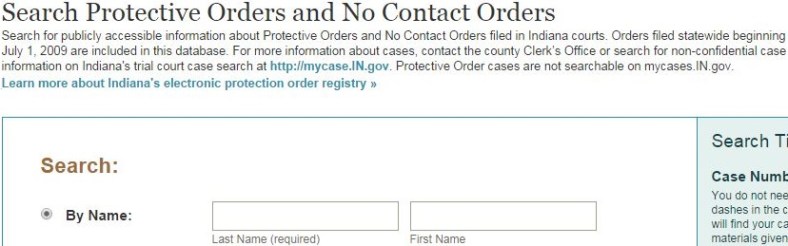
Here, for example, is what Indiana’s registry website looks like:

Every Indianan who’s been issued a “protective order” or “no contact order” since July 1, 2009 is recorded in this registry, including the ones whose cases were dismissed, that is, even those found “innocent” of the allegations against them are “outed” as having been accused of stalking, perhaps, or domestic violence or sexual assault. Browsers’ imaginations are free to take wing.

This search engine is simple to use. A restraining order recipient’s employer, landlord, student, client, patient, neighbor, girl- or boyfriend, etc. can perform a search in seconds—and as the headnote helpfully explains, “more information about cases” can be obtained by contacting the county clerk’s office.

Consider for a moment what the justification for a database like this could be. It doesn’t do anything to “protect” the plaintiffs of restraining orders. Therefore the justification must be to “protect” the public. Implicit then in the existence of such a database is that restraining order defendants are “dangerous.” Recall the basis upon which the determination of “dangerousness” was formed in the first place: a five-minute interview. Appreciate, too, that a restraining order recipient registered in a database like this may have been condemned for text messaging someone who resented the contact. And, as should go without saying, s/he may have been condemned on completely false allegations.

A process that’s highly prejudiced and answerable to no oversight is also highly punitive. Restraining order defendants are implicated according to kangaroo procedures whose rulings their noses are then rubbed in everlastingly.

Defendants often have mere days to respond to restraining orders, which can make procuring an attorney’s aid impossible even if defendants grasp the need for representation and can afford to shell out a few thousand at the drop of a hat. Appeals hearings, moreover, may be 30 minutes or less in duration (and only half that time is afforded to defendants’ testimony).

The process is a lock, but rulings are represented as the products of diligence and deliberation—and the public takes those rulings seriously, rulings that Indiana legitimates and publishes in a conveniently accessible database.

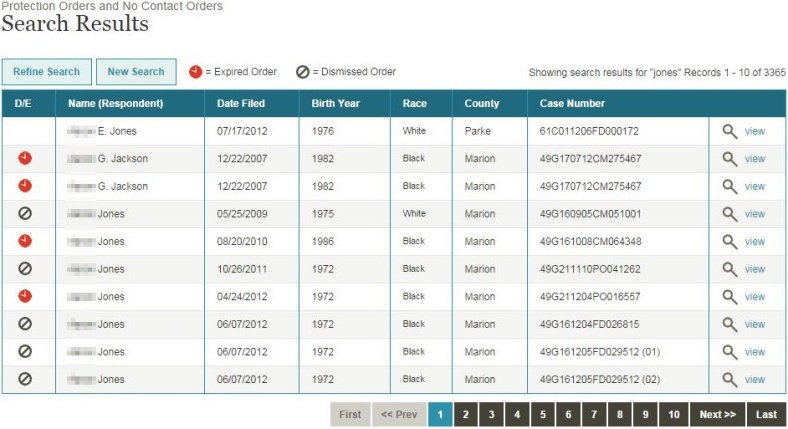
Here’s what returns look like if you simply enter the last name Jones into Indiana’s registry search engine:

Only half of the orders on the first page this search pulled up were actually finalized. The other half were tossed—after previously having been approved. The judicial error rate reflected in this random sampling is 50%. This statistic’s economic ($) implications are disgraceful by themselves. If you further allow that some of the restraining orders that were upheld were cases of false allegations’ succeeding, then judicial error is the norm.

A few months ago, a friend joked to me that her daughter (a smart cookie) had researched her teachers’ criminal records to use as leverage in the event of a grade crisis.

Arizona, blessedly, doesn’t yet have a nifty resource like Indiana’s for teenaged blackmailers to mine.

Copyright © 2014 RestrainingOrderAbuse.com

Battering Women to Protect Battered Women: Using Massachusetts’s Policies to Examine Restraining Order Publicity and Its Damages

“In the event a Restraining Order is issued for any period of time (initial 10 days or subsequent extension/dismissal), you will be listed in the statewide Domestic Violence Registry system. This could impact your ability to obtain or maintain employment in government, law enforcement, certain medical fields, or social services, or to work with/coach children. Impoundment of the restraining order does not expunge your listing on the statewide domestic violence registry, as certain government agencies and private companies with significant government contracts still have access to the registry system.”

—“Massachusetts Restraining Orders Procedure and Ramifications

I’ve just been corresponding with a Florida woman named Ally who had a domestic violence (209A) protection order petitioned against her in Massachusetts alleging she was a danger to a former boyfriend (these kinds of instruments can be obtained by plaintiffs who don’t even live in the same state or country as their defendants).

Ally contends the allegations against her are false and has been living in hell for over a year.

She’s surviving day to day and can’t afford to procure the services of an attorney. Ally’s trying to defend herself and clear her name with no money and from another time zone. She’s preparing a motion on her own (very possibly ill-fated) to request that the order against her be expunged, because it has ruined her employability.

Note: As the epigraph explains, even were Ally to succeed in having the order simply dismissed (which is itself unlikely), she would still remain registered as a domestic abuser.

From a draft of Ally’s “Motion to Expunge”:

Defendant was refused jobs, [is] not allowed to attend [or] volunteer [at] her daughter’s school events, [and has had] numerous other rights taken away due to Plaintiff’s Abuse of Process and Fraudulent Allegations and written Affidavit to the Court. This continues today.

Note: To successfully combat prosecutions like this requires money…which prosecutions like this prevent their defendants from earning.

A recent post on this blog observed the court’s schizophrenic regard toward restraining orders. On the one hand, they’re viewed by judges as urgent, potentially life-or-death matters; on the other hand, they’re viewed as inconsequential as long as defendants mind their prohibitions for the prescribed period of time.

Ignored is that adjudications both initiated and finalized in minutes yield rulings that are entered into state and national law enforcement databases indefinitely. Orders become “inactive” once they expire, but they don’t disappear. A woman like Ally remains for the rest of her life marked as a perpetrator of domestic violence.

In contrast—and the contrast is a telling one—consider this excerpt from a “Memoradum” issued by the Massachusetts Supreme Court last year on “Internet Dissemination of Personal Protection Order Information.”

As transparency and improved access remain court goals, it is important that we not unknowingly or unintentionally release victims’ personally identifiable information through the Internet, recognizing that this information is easily accessed and that access to such information could be dangerous to victims. Additionally, it has been brought to our attention that current federal law prohibits providing information over the Internet about personal protection orders (PPOs) that would be likely to reveal the identity or location of the petitioner (“PPO Information”).

18 USC 2265(d)(3) states:

A State, Indian tribe, or territory shall not make available publicly on the Internet any information regarding the registration, filing of a petition for, or issuance of a protection order, restraining order, or injunction in either the issuing or enforcing State, tribal or territorial jurisdiction, if such publication would be likely to publicly reveal the identity or location of the party protected under such order. A State, Indian tribe, or territory may share court-generated and law enforcement-generated information contained in secure, governmental registries for protection order enforcement purposes.

The privacy of restraining order plaintiffs (who are nominated “victims”) is to be tightly guarded.

Note: Based on “determinations” formed in minutes and possibly based on nothing more substantial than accusation, a plaintiff is deemed a “victim” whose identity and privacy must be protected, and the defendant is deemed a “violent threat” whose privacy is accordingly due no consideration. After the term of the restraining order has flown, the “danger” to the accuser is assumed to have been resolved, but the accuser continues to enjoy anonymity while the accused must go on bearing the implications of the restraining order for the rest of his or her life, exactly as if those implications were a criminal sentence.

Only in the recent past, in fact, did it even become possible to remove a Massachusetts restraining order defendant’s name from the domestic violence registry if it were found that allegations against him or her were substantially or totally false. (Remember that such allegations are made ex parte in the time it takes to place an order at McDonald’s.)

Until recently, it was almost impossible to expunge a person’s record with the domestic violence registry once the initial entry was made. In the 2006 case of Commissioner of Probation v. Adams, it was recognized that a judge has the inherent authority to expunge a record of an abuse [from the] violence registry system in the rare and limited circumstance that the judge finds the order was obtained through fraud on the court.

Note: The phrase rare…circumstance (of fraud) is emphasized in the original document quoted above (“Massachusetts Restraining Orders Procedure and Ramifications”), which was authored by an all-female law firm (Mavrides Law of Boston). Allegations of rampant restraining order misuse in Massachusetts have actually been the subject of press coverage and at least one law review monograph, and one of the most outspoken critics of restraining orders, attorney Gregory Hession, practices in Massachusetts and has for many years reported that restraining orders are “out of control.”

The previous two posts on this blog were responses to allegations that those who criticize restraining orders and domestic violence laws are “opposed to the battered women’s movement.” Defenders of these laws are urged to ask themselves how Ally’s wanting to be able to provide for her daughter and one day attend her daughter’s graduation has anything to do with battered women at all.

They’re also urged to ask themselves how denying Ally these opportunities isn’t itself an act of brutality.

Copyright © 2014 RestrainingOrderAbuse.com

“The PPO Destroyed My Career”: Grant’s Story of Restraining Order Abuse

Grant Dossetto has a degree in finance he can’t use.

That’s because a personal protection order (PPO) was petitioned against him in 2010 by a friend, and the law mandates that all restraining order recipients be registered in the FBI’s National Crime Information Center (NCIC) database—indefinitely.

The Securities and Exchange Act of 1934 requires those working in my field to be fingerprinted and to submit that to the FBI national database. This is on top of normal background checks, disclosure of any and all charitable donations as well as political donations, etc. Ironically we don’t have to pee in a cup for a drug test, but everything else goes well beyond that which my engineering friends et al. have been subjected to. I went to the Livonia police department and had my prints pressed in ink the old fashioned way on the standard card to be delivered to my employer by my first week of employment. The card then was supposed to find its way to the proper regulatory authorities before getting passed through the system.

A month after I began work at the brokerage, I was called by my boss after hours and told to mail back in my key. He fired me while out of town over the phone.

Grant is 27 years old, and he can never realize his ambition to be a stockbroker.

To this day, I have never been sponsored to get my licenses, and I am sure I never will. I can pass the CFA [to become a chartered financial analyst] but cannot take an order for a trade. The PPO destroyed my career.

Though his mother lived to see him earn his degree with honors in 2009, neither of Grant’s parents will ever know that their investment in their son’s success was betrayed or that his professional aspirations were dashed, because they’ve passed away.

When my father had a heart attack, I was just 14 years old. He passed in his sleep. Before my mom had dragged him off to bed, he had fallen asleep in my room while we were watching TV together and drooled on my pillow. When he didn’t wake the next morning, I can remember opening his mouth to try to resuscitate him and seeing how his tongue was already blackened from lack of oxygen. It was the first time I had to let in an EMT through the wide double front doors to go through the motions to tend to someone who was already gone.

Grant’s mother died in 2010 just days before Grant got word of the court order that identified him as a threat to the safety of a woman he hadn’t even seen in over a year.

I was celebrating a birthday party with my twin brother. He had just been commissioned as an artillery officer in the Marine Corps and was heading to Fort Sill in Oklahoma for training in a couple weeks, so it was a going away party as well. It ended with me carrying my mom up from the bottom of the stairs that led to the basement, blood trickling from the back of her head. She had had a stroke bringing up a food tray and collapsed. The right hemisphere of her brain immediately ceased all activity. I got to stand over another pair of EMTs, this time dabbing her eyes with a tissue. The pupils, fully dilated, failed to show any reaction. She maintained enough brain function to throw up, trying to recover from the worst concussion you could imagine, but by the next day a second opinion came back that she could not survive. My brother and I pulled the plug and held her hand until she forgot to breathe on her own. It took less than a half hour. It was a brilliantly sunny Michigan May day, those days that make suffering through the gray winter worth it. It’s hard to imagine something more at odds with how I felt.

Grant learned a protection order had been issued against him two days later. Notice of it was waiting for him upon his return from the funeral home in the form of a business card a sheriff handed his stepdad.

In Grant’s home state of Michigan, this qualifies as service. No copy of the order was ever provided to him.

I called the sheriff back, and he went through what I would later come to find out was the front page of the order. He asked me to drive to downtown Detroit, a half hour away, to be served the order. Seeing as I had seven hours of funeral activities in a day and a half, I told him that would be impossible. He said he’d mail it to me. I was never notified that I had just days to appeal or given an explanation of the consequences of the order. The order was never mailed to me. I tried twice to notify the officer that I had not received the PPO. He brushed it off once, and the second call went to voicemail and was never returned.

Grant was denied the opportunity to defend himself in court against an accuser he hadn’t even been in physical proximity to.

The last thing I had said to her was that my mom had died, and I was giving the eulogy at the funeral and would like her there even though we had our differences. The order had been issued ex parte, which requires the court to classify me as an immediate threat who will cause imminent and irreparable damage, per Michigan law. I did not meet those criteria. The hearing was held without my knowledge or participation.
No surprise, Grant has “suffered from severe depression that still surfaces at times now.” His case exemplifies the justice system’s willingness to compound the stresses of real exigencies like family crises with false exigencies like nonexistent danger.

My grandparents were going through their own personal troubles. One had emergency quadruple bypass surgery and is suffering from dementia. One was declared terminal and hung on for two and a half years as his kidneys shut down until he was also unable to tell reality from fiction. One had a hip replacement turn into a seven-surgery odyssey that involved a severe staph infection that ravaged her for most of a year. She needed over 50 blood transfusions over that period and has just recovered from fatigue in the past 12 months. I got a lifetime of bad news I couldn’t control in a couple years, and it took its toll on me.

The order of the court that turned Grant’s career path into a blind alley was petitioned by a woman whose own prospects, Grant says, declined during his senior year of college.

We enjoyed movies, card games (she cheats at euchre), parties, went to school football and hockey games. She sought me out in the parking lot of the campus church and asked me to sit with her at mass. I can’t think of an act of friendship much more intimate than that. When we were close, she was on the dean’s list.

I had been friends with her from September, sophomore year of college until midway through my senior year. In a month, I went from being someone she talked to on Facebook at one in the morning and publically said she loved to being accused of felony property damage—tire-slashing, in particular.

She had gotten involved with a bad crowd, joined a terrible varsity team at school. In April of my junior year, she asked a mutual friend of ours to do cocaine—not exactly something a happy person says. The next fall, I heard about how her parents didn’t give a damn about her, and in November she called my roommate and me over only to snap at us until she kicked us out just before 10 to take a tablespoon of Nyquil that would force her to sleep. She also talked about how she had been getting dizzy and suffering from vertigo, which got her a prescription medication. A doctor had said it was iron deficiency. I can tell you from personal experience it was stress. Her grades slipped to C’s.
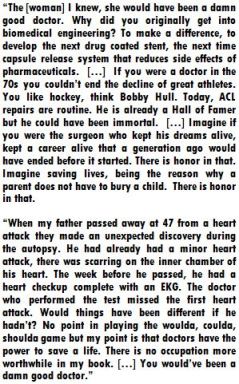
This letter of encouragement represents the “misconduct” of Grant’s that his accuser and the court deemed evidence of “imminent” and potentially “irreparable” harm. The letter ends, “Do what you were meant to do. Be the person you were meant to be.”

As Grant charts his relationship, he urged his friend to make “wholesale changes” and was punished for his concern. “I was sharp,” he says, “but only after I had exhausted every other option.”

Houghton is a small town—population around 10,000—and our school has an undergrad student body of about 6,000. Wal-Mart and not much else is a big deal there as the copper and iron mines shut down decades ago driving out industry and families with it. Not surprisingly, we saw each other a lot the second half of my senior year. I saw her at the gym, had class in an adjacent room two days a week, she worked next door to my lab twice a week, and I worked in the same building as her lab.

I stopped by her house because it was a bad situation given the fact the last thing she had said to me were criminal allegations. We talked for hours, getting along enough that I sincerely believed we had patched things up. She was still miserable, though. One thing got her to brighten up like the girl I first became friends with, and that was a goal to go to med school, a reasonable one for a biomedical engineer.

I invited her out to the movies with my housemates whom she was friends with. I said she should come to the surprise birthday party I was helping to throw for a mutual friend. I tried to get her back to the group she was successful with. For that I got another round of false allegations (destroying the front quarter panel of her car).

When a protection order was issued against Grant in 2010, he hadn’t seen his accuser in over a year. The sheriff who notified him of the order “essentially told [him he] had been contacting her, and now [he] couldn’t.” Grant only got a look at the order that he was never served this month (four years later).

The first time I saw it was two weeks ago. It is a permanent file in the Macomb County Courthouse, file #10-2184-PH. I was marked a threat by my government without me present or ever having physical possession of the order. There is no way for me to have the order removed.

Grant’s former friend, the petitioner of the protection order, had gotten a job after college that apparently hadn’t worked out and returned home. In 2013, the office Grant worked in was slated to relocate near her (in a town of 10,000 residents).

I texted her, because I knew that was a problem. Given what she sent back, I replied that I was going to have to seriously consider leaving my job unless I got assurances from her this wouldn’t be an issue.
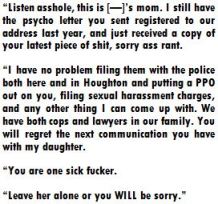
Grant received actual threats from the family of his accuser but says he has never considered applying for a protection order himself.

Grant’s texts instead inspired his accuser to dash to the nearest courthouse all over again.

In April 2013, she filed another PPO against me even though I had not seen her in over four years. I had made no attempt to try and meet up with her. It was also issued ex parte, probably because of the first one. She began texting me less than three days after it had taken effect and didn’t show up to the appeals hearing that I scheduled. I missed parts of three days of work to fight an order that she didn’t even feel like defending. In two weeks, the same court, Wayne County this time, ruled against me then for me.

What Grant means is the same court that deemed him a “threat” (sight unseen) was content to consider him benign a couple weeks later just because the protection order petitioner didn’t make a follow-up appearance. His observations underscore the cattle-call nature of restraining order adjudications that readily implicate defendants as criminal menaces but may just as readily conclude they’re harmless and send them home.

Mine was not the only PPO to be overturned—far from it—and the entire docket (about 12 cases) was decided in less than 30 minutes after we waited over an hour for the judge, who was late. Is that justice? How can I ever respect the courts again?

The same orders Grant says were summarily dismissed had just as summarily been approved days or weeks earlier. Restraining orders are typically rubber-stamped upon a few minutes’ “deliberation.”

I sued her after that. In her response to my complaint, she admitted that I had never done anything illegal. You wouldn’t know that by my public record.

Grant dropped the lawsuit, which communicated that he wouldn’t tolerate further prosecutions. The 2010 PPO remains on his record, however, and the stain not only galls him but has derailed his life.

The judge who issued the 2010 order, James Biernat, Sr., is famous for presiding over the “Comic Book Murder” case. It was big enough to make Dateline and the other true crime outlets. He overturned a guilty conviction from a jury and demanded a retrial. The action was extraordinary, held up on appeal by a split decision. The Macomb prosecutor publically rebuked him as being soft on crime. That made national news. All the cable outlets covered the second trial, which yielded the same result: guilty. He was rebuked by two dozen jurors, three appellate justices, and the prosecutor. It’s funny, if he had just given me a hearing, let alone a second, I truly believe a PPO would never have been issued.

A questionable judge who is soft on guilty murderers didn’t have a problem destroying a 23-year-old he had never met for non-threatening, legal contact. How could you not believe that the system is hopelessly broken?

Copyright © 2014 RestrainingOrderAbuse.com

Since this writing, Grant has channeled his thwarted energies into creative writing and completed a novel, The Hopping Bird, which has been praised in Kirkus Reviews: “Harold Freeman enjoyed success as a player, which included a World Series championship, until it was cut short due to injury. His managerial career has not been as smooth, but that is all behind him as he takes the reins of the Toledo Mud Hens for the 2014 season. After a last place finish in the International League’s West Division a season ago, can he turn the team around?”


Schizo: How Judges Think about Restraining Orders

It’s often reported by recipients of restraining orders that the cops and constables who serve them recognize they’re stigmatizing.
Restraining order respondents receive court orders “around the corner” or in parking lots or other spots remote from prying eyes.

At the same time, restraining orders are dispensed by our courts as freely as supermarket circulars. They’re typically issued ex parte, which means judges never even meet the parties they’re issued against. Sometimes respondents never appear in court at all. They remain simply inked names on forms, despite the fact that the allegations made against them, which are matters of public record, may be grave.

Judges issue restraining orders and then wash their hands of them and expect them to just run their courses and evaporate. In accordance with the law, they don’t…ever. They’re permanent public records (in some states accessible by anyone, and in no states accessible by no one). They’re further entered into state and federal law enforcement databases (again, permanently).

Restraining orders cost people employment (and, in cases, employability in their chosen fields). They cost people leases. And they cost people their children, assets, social credibility, and health. These are serious consequences, and restraining orders are of course regarded seriously by anyone who learns of them—except, that is, officers of the court, who may regard them dismissively…after having regarded them as urgent, life-or-death matters.

“Obscure public records” is how some officers of the court think of restraining orders. In the age of the Internet, there are no such things. Many judges are in their 60s and 70s, however, and scarcely know the first thing about the Internet, let alone Twitter, Facebook, and YouTube. They’re still living in the days of mimeographs and microfiche.
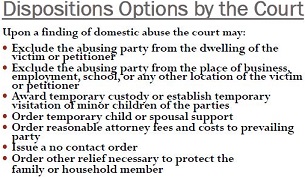

The sternness that judges exhibit in the courtroom upon finalizing restraining orders may border on brutal. Irrespective of the allegations against them, all restraining order defendants are treated like villains. Yet though they’re often falsely accused, they’re expected to be unfazed by this treatment. Down the road, what’s more, if defendants seek damages, other judges who revisit their cases may express wonderment at what the big deal is.

“It’s only a restraining order.”

Copyright © 2014 RestrainingOrderAbuse.com

Ungoverned: Restraining Order Laws in Arkansas

not-governed

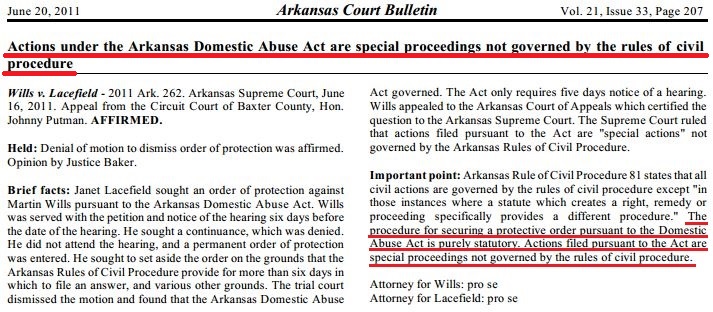
I’ve combed the Internet in recent weeks for motion-to-dismiss forms applicable to restraining orders issued in the 50 states. For Arkansas, there’s nothing to be found. Zip. If that weren’t suggestive enough that the process is a lock, consider the above entry excerpted from a 2011 Arkansas Court Bulletin.

This means an accuser may be awarded exclusive entitlement to the family residence; sole custody of children; a monthly stipend from the former breadwinner, who may find himself out of a job subsequent to being issued a “domestic abuse” restraining order; and reimbursement of costs. Filing for a protection order, in other words, may gain a plaintiff everything and cost her (or sometimes him) nothing—whether the allegations it’s based on are true, hyped, or lies.

The case commentary (which you’ll observe publicly discloses the names of the parties to the action) concerns a man who was served with a notice to appear in court to answer allegations of “domestic abuse” six days thence.

Rough translation: “Dear sir, you’re expected in a courtroom next week to respond to allegations that you beat your wife.”

For people who know nothing about restraining order processes, appreciate that this man was given less than a week’s time to prepare a defense against obviously serious charges with obviously serious repercussions. In six days, he was supposed to come to grips with public allegations that may have horrified him, procure an attorney’s services, gather relevant evidence and testimony, etc.

Six days.

The bulletin reports that the man “sought a continuance [postponement], which was denied.” He didn’t attend the hearing. The commentary doesn’t indicate a reason. His request to have the order set aside, because the expectation of an immediate response didn’t conform to the Arkansas Rules of Civil Procedure, was also denied. Why? Because the Arkansas Domestic Abuse Act trumps the rules of civil procedure.

This case exemplifies why restraining order adjudications strike so many people as Kafkaesque: “I move—.” “No.” “Then—.” “No.” “But—.” “The rules don’t apply in your case, sir, and we don’t negotiate our decisions.”

Defendants’ being railroaded, of course, is nothing extraordinary. “Emergency” restraining orders may allow respondents only a weekend to prepare before having to appear in court to answer allegations—very possibly false allegations—that have the potential to permanently alter the course of their lives.

Extraordinary is the Arkansas courts’ openly and nonchalantly recognizing in a bulletin that their protective order process is “not governed by the rules.”

Its proceedings are “special.”

Copyright © 2014 RestrainingOrderAbuse.com

A Legislated License to Lie: Nothing CAN’T Be Falsely Alleged on a Restraining Order

OK

Battery, rape, child molestation—any heinous allegation imaginable can be made in a petition for a restraining order, and it can be made falsely without consequence to the accuser.

Victims of false allegations often ask incredulously, “Can somebody say that?”

There’s nothing that can’t be alleged to the courts (or, for that matter, to the police). There’s no such thing as “can’t allege.” A judge might view allegations of genocide or conspiracy with aliens to achieve global domination as suspect—or s/he might not. Certainly there’s nothing to stop a restraining order applicant from making these allegations, and there’s nothing to stop a judge from crediting them. Neither accusers nor judges are answerable to a literal burden of proof.

As the infamous David Letterman case shows, even the most outlandish allegations easily duck judicial radar. For anyone unfamiliar with the case, here’s Massachusetts attorney Gregory Hession’s synopsis and commentary (quoted from “Restraining Orders Out of Control”):

One day in December of 2005, Colleen Nestler came to Santa Fe County District Court in New Mexico with a bizarre seven-page typed statement and requested a domestic-abuse restraining order against late-night TV host David Letterman.

She stated, under oath, that Letterman seriously abused her by causing her bankruptcy, mental cruelty, and sleep deprivation since 1994. Nestler also alleged that he sent her secret signals “in code words” through his television program for many years and that he “responded to my thoughts of love” by expressing that he wanted to marry her.

Judge Daniel Sanchez issued a restraining order against Letterman based on those allegations. By doing so, it put Letterman on a national list of domestic abusers, gave him a criminal record, took away several of his constitutionally protected rights, and subjected him to criminal prosecution if he contacted Nestler directly or indirectly, or possessed a firearm.

Letterman had never met Colleen Nestler, and this all happened without his knowledge. Nonetheless, she requested that the order include an injunction requiring him not to “think of me, and release me from his mental harassment and hammering.” Asked to explain why he had issued a restraining order on the basis of such an unusual complaint, Judge Sanchez answered that Nestler had filled out the restraining-order request form correctly. After much national ridicule, the judge finally dismissed the order against Letterman. Those who don’t have a TV program and deep pockets are rarely so fortunate.

If allegations like these don’t trip any alarms, consider how much easier putting across plausible allegations is, plausible allegations that may be egregiously false and may include battery, rape, child molestation, or the commission of any other felony crimes.

What recent posts to this blog have endeavored to expose is that false allegations on restraining orders are very effective, because the “standard of evidence” applied to restraining order allegations both tolerates and rewards lying. The only thing that keeps false allegations reasonably in check is the fear that malicious litigants may have of their lies’ being detected. Normal people at least understand that lying is “bad” and that you don’t want to get caught doing it.

To some degree at least, this understanding restricts all but the mentally ill, who may be delusional, and high-conflict litigants, who may have personality disorders and have no conscience, or whose thinking, like that of personality-disordered people’s, is overruled by intense emotions, self-identification as victims, and an urgent will to blame. Normal people may lie cunningly or viciously; high-conflict people may lie cunningly, viciously, compulsively, outrageously, and constantly.
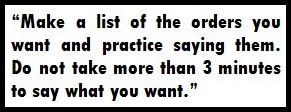
The fear of getting caught in a lie is in fact baseless, because perjury (lying to the court) is prosecuted so rarely as to qualify as never. Most false litigants, however, don’t know that, so their lies are seldom as extravagant as they could be.

Often, though, their lies are extravagant enough to unhinge or trash the lives of those they’ve accused.

Appreciate that false allegations on restraining orders of battery, rape, child molestation, or their like don’t have to be proved. Restraining orders aren’t criminal prosecutions. Allegations just have to persuade a judge that the defendant is a sick puppy who should be kenneled. An allegation of battery, rape, or child molestation is just a contributing influence—except to the people who have to bear its stigma.

More typical than utterly heinous lies are devious misrepresentations. Accusations of stalking and untoward contact or conduct, which may simply be implied, are a common variety. The alleged use merely of cruel language may be very effective by itself. Consider how prejudicial a female plaintiff’s accusing someone (male or female) of forever calling her a “worthless bitch” could be. Substantiation isn’t necessary. Restraining order judges are already vigilantly poised to whiff danger and foul misconduct everywhere. In processes that are concluded in minutes, false or malicious accusers just have to toss judges a few red herrings.

Irrespective of the severity of allegations, the consequences to the fraudulently accused are the same: impediment to or loss of employment and employability, humiliation, distrust, gnawing outrage, depression, and despondency, along with possibly being menacingly barred access to home, children, property, and financial resource. This is all besides being forced to live under the ever-looming threat of further state interference, including arrest and incarceration, should additional false allegations be brought forth.

Even if no further allegations are made, restraining orders, which are public records accessible by anyone, are recorded in the databases of state and federal police…indefinitely.

This “advice,” which urges restraining order applicants to rehearse, comes from the California court system and is offered on a page titled, “Ask for a Restraining Order.” The page’s title is not only invitational but can be read as an order itself: Do it. Note, also, that finalization of a restraining order may be based on less than “3 minutes” of testimony and that the court prefers it to be.

Recourses available to the falsely accused are few, and even lawsuits that allege abuse of process may face hurdles like claim preclusion (res judicata), which prohibits previously adjudicated facts from being reexamined. Never mind that the prior rulings may have been formulated in mere minutes based on fantasy and/or cooked allegations. Victims of defamation, fraud on the police and courts, and intentional infliction of emotional distress may moreover face stony indifference from judges, even if their lives have been entirely dismantled. And it should be stressed that attempting to rectify and purge their records of fraudulent allegations, which are established in minutes, can consume years of falsely accused defendants’ lives.

Recognizing that there are no bounds placed upon what false accusers may claim and that there are no consequences to false accusers for lying, the wonder is that more victims of lies aren’t alleged to be “batterers,” “rapists,” and “child molesters.”

Copyright © 2014 RestrainingOrderAbuse.com

How “Preponderance of the Evidence” Rewards Restraining Order Fraud and Why Bigger Lies Work Better than Smaller Ones

Recent posts to this blog have discussed American evidentiary standards and stressed that the standard applied to civil restraining orders, “preponderance of the evidence,” has nothing to do with proof. According to this standard, a judge should find in favor of a restraining order plaintiff if s/he figures there’s a greater probability that the plaintiff’s claims are true than that they’re totally false.

The word to bear in mind here is probability.

I’ll give you a for-instance. Let’s say Person A applies for a protection order and claims Person B threatened to rape her and then kill her with a butcher knife.

Along with the allegation of the rape/death threat, Person A tells Judge A that she and Person B dated for six months, that she dumped Person B, that he refuses to leave her alone and insists that she’s the love of his life and that if he can’t have her no one will, and that she’s terrified of him. Person A shows Judge A a text message from Person B that says, “I want what’s mine.” She also tells Judge A that Person B insisted that she engage in sexual role-playing during their relationship and that he liked to spank her. “Sometimes he was very rough and scared me,” Person A says. Too, she says she thinks Person B jealously monitored her email correspondence and adds that he frequently accused her of seeing other men behind his back (“He would just suddenly go off sometimes for no reason”).

Judge A doesn’t know Person A, and all he knows of Person B is what Person A has just told him. How does Judge A determine that there’s a greater probability Person A is telling the truth than that she’s lying? With no certain facts other than a text message, he can’t. He issues a protection order anyway, because Person A might be telling the truth, and he doesn’t want to be answerable to his conscience or the public if she were to come to harm.

Person B, who didn’t actually threaten to rape or kill Person A, is more than unsettled by the allegations against him and appears in court to deny them. He tells Judge B that he and Person A dated for six months after she hit on him at a party, and that they had discussed moving in together but that he discovered Person A had been cheating on him and angrily demanded that she return expensive gifts she had asked him to buy for her during their relationship. He tells the judge that Person A laughed at him and called him “a fool,” and that he’s never been abused this way before. “She was horrible to me,” he says, “and I was only ever nice to her.” Person B also tells the judge that Person A was sexually withholding, and would often, he realizes now, use the promise of sex to manipulate him, and that he had never hit her, even in fun. “There was no role-playing,” he says indignantly. “That’s a complete lie!” Person B admits that he may have heatedly called Person A “a sick bitch” when he last saw her and slammed her apartment door behind him. Person B also admits to sending the text message, but testifies that he’s never struck or even threatened another person in his life.

Judge B has no more ascertainable grounds for determining whether Person B threatened to rape and kill Person A than Judge A did previously. On the basis of Person B’s admitted rage and reason for feeling vengeful, however, he rules in favor of Person A and affirms the protection order. The alleged rape/death threat, which may have been influential but was otherwise irrelevant, is preserved on public record along with allegations of “constant temper tantrums,” “violent sex games,” and stalking.  The protection order is also recorded in the databases of state and federal police.

Person A circulates the details she shared with the court, which are embellished and further honed with repetition, among her friends and colleagues over the ensuing days, months, and years.


Person B, a widowed engineer, is fired from the position he’d occupied for over a decade with a national defense contractor. Consequent to his being terminated, Person B’s daughter, whose tuition at an Ivy League university he’d been paying, is forced to drop out of school 12 months shy of graduation with honors.

This scenario, though purely allegorical, is mirrored to a greater or lesser extent by thousands, tens of thousands, or hundreds of thousands of restraining order cases adjudicated in this country every year (false allegations, including false criminal allegations, may moreover be made to the police, besides the courts). Its gender reversal (Person A = male; Person B = female), while less probable, is also entirely possible. Women, too, are falsely accused of threats, violence, stalking, and other crimes on restraining orders, including felonies. Feminist advocates of restraining orders, consciously or not, defend the daily dismemberment of women’s lives across the map.

(Besides facing loss of employment and employability, victims of false allegations and distortions of the truth may be forcibly removed from their homes and prohibited access to their children, money, and property. Legal derelictions, besides, make such victims vulnerable to further state interference, including arrest and incarceration, upon additional false reports’ being filed by malicious accusers.)

The point of the above hypothetical is neither to deny that real rape or death threats are made nor to characterize complainants of such abuse as liars. Unquestionably many complainants, particularly of extreme abuse, honestly and reasonably fear for their safety. Its point, rather, is to illustrate that the truth of any allegation made pursuant to the procurement of a restraining order is literally irrelevant (except to the accused). It’s not the brief of judges of restraining order cases to determine whether individual facts are truthfully reported, nor is ascertainment of the truth or falsity of individual allegations required by the standard of “preponderance of the evidence.”

This standard is satisfied by probability, which is gauged according to a judge’s personal lights. It doesn’t depend on certainty of anything.

Emphatically noteworthy of a standard that’s satisfied by probability is that it acknowledges from the start that truth doesn’t matter. A standard that relied on proof wouldn’t contain the word probability or its derivatives at all.

Consider further that lying is rarely if ever prosecuted or even acknowledged by the courts.

Consider finally this question: If the object of a restraining order applicant is to win—and it always is—what tactics will most assuredly be effective in persuading a judge that his or her allegations (on balance) are probably true? The answer is lying, lying luridly and sensationally, and lying copiously, particularly about facts that are impossible to verify (facts that in a criminal case would be discounted or dismissed).

Because “preponderance of the evidence” is based on the overall forcefulness of allegations rather than the truth or falsity of one, two, or a few of them, the most effective way to win a restraining order case is to lie hugely.

As should be obvious, “preponderance of the evidence” is seldom if ever actually satisfied in cases where restraining orders are awarded, because specific claims on restraining order applications are often impossible to accurately assess as even 51% likely to be true. “Satisfaction” of this standard is based, instead, on the acceptance that the sum total of allegations (their tenor or essence), which collectively support an overarching allegation of “fear” or “distress,” can together be called “preponderant” (which means more potent, convincing, or influential).

In other words, there’s no point in malicious litigants’ lying small.

Copyright © 2014 RestrainingOrderAbuse.com

“Fag,” “Stalker,” “Sicko,” “Brute,” “Creep”: On Labeling and the Psychic Effects of Public Revilement in and out of Court

One of my favorite puzzles when I was a boy directed the solver to figure out what was different between almost identical pictures. I think it appeared in Highlights for Children. I have a collection of Highlights someplace, because I meant to write for kids and used to study and practice children’s writing daily, but I haven’t looked at them in years.

I’m reminded of this, because, as you might have discerned, one among the epithets in this post’s title is distinct from the others: fag.

When I was growing up, I knew a very simple boy who was singled out at an early age—nine or thereabouts—and routinely ridiculed by the “cool” boys at school. Some girls occasionally joined in, too, albeit half-heartedly, to curry favor with boys they wanted to like them. “Fag!” or “Faggot!” was a favored insult among schoolboys. No other had anything close to its heft as a term of contempt to pierce a man-child to the bone.

The boy I’m recalling happened to be Polish, and Polack was a competing term of derision that might have conveniently been used to hurt him. It didn’t rouse nearly as much pack frenzy, though. His name started with F, besides, so its pairing with fag was poetic kismet. “Fag!” followed this boy from grade to grade like a toxic echo. It was how he was greeted, and he would sometimes mince, affect limp wrists, and swipe at the other boys, because it amused them and won him attention and the closest thing to membership he could hope for.

The boy wasn’t gay; he was just easy meat to sate the bloodlust of cruel kids.

The last time I saw him was when I was a young adult. He was panhandling outside of a drugstore for diaper money. He’d apparently gotten a girl pregnant right out of high school to prove his virility. The abuses to which he’d been relentlessly subjected determined the arc of his life.

I relate this story in the context of restraining order abuse to highlight the grave effects of public humiliation and revilement. Labeling of this sort isn’t just tormenting and alienating but destructive. It corrupts the mind, silently and sinuously. It confounds ambitions, erodes trust, and hobbles lives.

Victims of false allegations made on restraining orders may be labeled “stalker,” “batterer,” “sicko,” “sexual harasser,” “child-abuser,” “whore,” or even “rapist”—publicly and permanently—by accusers whose sole motive is to brutalize. And agents of these victims’ own government(s) arbitrarily authorize this bullying and may baselessly and basely participate in it, compounding the injury exponentially.

I’ve been contacted by people who’ve either been explicitly or implicitly branded with one or several of these labels. Falsely and maliciously. I’ve been branded with more than one myself, and these epithets have been repeatedly used with and among people I don’t even know. For many years. Even at one of my former places of work. And there’s f* all I can do about it, legally.

Labels like these, even when perceived as false by judges, aren’t scrupulously scrubbed away. Resisting them, furthermore, simply invites the application of more of the same. Judges’ turning a blind eye to them, what’s more than that, authorizes their continuously being used with impunity, as the boys in the story I shared used the word fag. Victims of false allegations report being in therapy, being on meds for psychological disturbances like depression and insomnia, leaving or losing jobs—sometimes serially—and entertaining homicidal thoughts and even acting on suicidal ones.

No standard of proof is applied to labels scribbled or check-marked on restraining orders, which to malicious accusers are the documentary equivalents of toilet stalls begging for graffiti.

That the courts may only enable bullying, taunting, and humiliation is no defense, nor is “policy.” Adding muscle to malice is hardly blameless. Anyone occupying a position of public trust who abets this kind of brutality, actively or passively, knowingly or carelessly, should be removed, whether a judge, a police officer, or other government official, agent, or employee.

This hateful misconduct is bad enough when it originates on the playground.

Copyright © 2014 RestrainingOrderAbuse.com