The following account is reproduced almost verbatim from an email of recent vintage. Its writer is a professional woman and single mother of three with whom I corresponded last year while she was embroiled in strife—legal, medical, and emotional (a synergy of torments that’s been reported here before). The capsule version of her story is that she was in an abusive relationship (including violently abusive), sought a restraining order, which was dismissed on appeal, and then was issued an order petitioned by her abuser, which she reports was based on fraud, and which was nevertheless upheld despite her appealing it. She brought criminal charges, also. Her abuser smoothly extricated himself from those, too. The victim of assault is the one with the “restraining order” on her permanent record. She asked that I not use her name because she’s “terrified of the possibility of repercussions.”
In her own words, which more poignantly express the psychic trauma of procedural abuses than any I’ve ever read:
My active involvement with my sociopath has, mercifully, ended.
[H]e refused to accept a plea deal, he took his assault case to a jury trial, and he was found not guilty by a jury of his peers. His lies were, apparently, more believable than my truth, or, best case, the jurors didn’t really believe him but couldn’t find him guilty beyond a reasonable doubt. Either way, it doesn’t matter. I’ve seen enough of the court system to learn that the truth is completely immaterial, and that the officers of the court will consistently choose the “easy” ruling over the one that is true. If the matter before them requires some thought, some extrapolation, some reading between the lines, and/or some backbone, forget it. The truth will be jettisoned faster than a grenade with its pin pulled.
 I don’t really know how to describe how profoundly my brushes with domestic abuse/restraining order abuse/generalized legal abuse have affected me. In a few short months, a year will have passed since the criminal trial against my abuser took place. Four years will have passed since the whole odyssey began on Easter of 2011, when I walked into the police station and reported my abuser’s attack after agonizing overnight about whether or not I should do so. Imagine that—agonizing overnight about whether or not to report a crime! On some level, I must have known even then how very awry it all could go.
Let me just attempt to put this into perspective: I have lived through my parents’ divorce. I have boarded an Amtrak train headed for New Orleans at 16 years old in an effort to escape a miserable childhood. I have been scarred by the shame of being a high school dropout and then gone on to receive a college education. I have experimented with more drugs than I can count on two hands. I have traveled all over Europe with little more than a backpack and a few pfennigs. I have been robbed at gunpoint while working third shift in a Shell-Mart in Anniston, Alabama. I have scuba-dived off the coast of Honduras. I have watched my stepmother fight to regain pulmonary function after she was stabbed by a purse-snatching punk in the alley behind her home in Washington, D.C., only to watch her die an agonizing death from lung cancer fifteen years later. I have held a lion cub in my arms. I have lain helplessly in a hospital bed as not one, not two, but three premature babies were whisked from my body and transferred straight into the NICU. I have survived breast cancer, and then my mother’s untimely death from a hospital-acquired infection four months after my diagnosis. I have been sliced and diced and blasted by radiation. I have been exposed to, and treated for, tuberculosis. I have lived through bacterial meningitis and undergone a blood patch procedure after a botched spinal tap. I have been resuscitated with Narcan after being given too much IV narcotic during an acute episode of kidney stones. I have skydived over the Newport, Rhode Island coastline. I have loved multiple dogs and cats and then held them in my arms when it was their time to leave this earth. I have fought for my children and for myself against a relentlessly bitter spouse during a contentious, protracted divorce.
 Not one of those things has affected me as deeply as being on the receiving end of a sociopath’s lies, and the legal system’s subsequent validation of those lies. There is no “coming out the other side” of a public, on-the-legal-record character assassination. It gnaws at me on a near-daily basis like one of those worms that lives inside those Mexican jumping beans for sale to tourists on the counters of countless cheesy gift shops in Tijuana.
I have sort of moved on; I mean, what else can one do, particularly when one has young children? But the horror, outrage, shame, and, yes, fury engendered by being wrongly accused by a perpetrator, and then having that perpetrator be believed, chafes at me constantly. Some things born of irritation and pressure are ones of beauty, like a pearl, or a diamond, but not this. This is a stoma on one’s soul—it never heals, it’s always chapped and raw, and if you’re not careful, it can leak and soil everything around it.
 These days, when sleep escapes me, which seems to be fairly frequently, I often relive the various court hearings associated with this shit show. One is the court hearing for the restraining order that my abuser sought against me (and which was granted) based on his completely vague, bullshit story that he felt “afraid” of me—this from the beast that had assaulted me on numerous occasions, slashed my tires, and had a documented history of abusing previous girlfriends. Another is his trial for assault and battery, during which I was forced to undergo a hostile, nasty, and innuendo-laced cross-examination by his scumbag defense attorney in front of a courtroom full of strangers. But the hearing that really gnaws at me and fills me with an almost homicidal enmity for the judge overseeing it is the one where I was requesting a restraining order against my abuser, this after a particularly heinous assault in the days following my cancer diagnosis and my partial mastectomy.
That judge apparently believed my abuser’s bald-faced, self-serving, and absurdly improbable lies over my detailed, accurate, and horrific account of his behavior immediately following my surgery. That judge believed that a well-dressed, employed, and reasonably intelligent woman would drag her ass to court a week after a life-threatening diagnosis and major surgery just to harass her blameless ex. My memory of the surreal, humiliating, and completely unexpected ruling that day, made even more galling by the judge’s proclamation that he found the defendant to be “more credible” than me, is as grievously harrowing today as it was then.
To say that I feel indignant about it would be an understatement. Take indignation, add a dollop of pain, some hefty pinches of fear, embarrassment, and hopelessness, and a heaping dose of fury, and you’ve got a toxic mix of emotions that, if I don’t actively squelch them whenever they surface, could blow the top of my skull clean off. No amount of therapy can mitigate this particular affront; I’ve learned that the best I can hope for is some measure of containment. Kind of like radioactive waste.
 I will have that prick’s bogus restraining order on my record today, tomorrow, next week, and on and on into perpetuity. I am a licensed professional whose employers require a full background check prior to being hired. I honestly don’t know how that restraining order was missed by the company that my most recent employer contracted to perform my pre-employment vetting. I live with the ever-present dread that someday, someone will unearth the perverse landmine that my abusive ex planted in my legal record, and that dread hasn’t lessened one whit since the day the restraining order was granted.
I understand that the existence of a past restraining order can be a valuable red flag for the police when dealing with domestic abusers and stalkers. Most domestic abusers are repeat offenders, so prior bad acts can help to establish a pattern that law enforcement should be aware of (though, confoundingly, these same bad acts are not admissible during any trial). Even though I’m not necessarily comfortable with the existence of a permanent registry of all restraining orders—both those that are sought and those that are actually granted (which, as you know, is what currently exists)—what I’m not comfortable with is that this information is available not just to the police, not just to other governmental agencies, but to the public at large! My height and weight taken while at the doctor’s office are protected by law. A hospital cannot disclose if I was treated there for a sore throat. But an inflammatory, defamatory, embarrassing, unsubstantiated, and oftentimes false restraining order affidavit can be obtained by whoever strolls into a courthouse and requests a copy from the clerk.
 I don’t believe this registry will ever be abolished, because restraining order abuse isn’t “sexy” and no one thinks it could ever happen to her, but can we at least limit who can access this information and the circumstances under which they can access it? It’s mind-boggling to me. It’s just so goddamn devastating to the people who are unfairly stigmatized, and, call me pessimistic, but I don’t think these casualties will ever have a voice.
[Today] I’m working full-time at a job that I basically enjoy, and my three children are flourishing. I no longer feel that I am defined by my intensely negative experiences with my abuser and with the legal system, or that my life is being hijacked on a daily basis. I go days at a time without any of this crossing my mind. To say that I have “gotten over it,” though, would be a lie. A piece of me was lost because of this, and an emotional fissure was left behind, that, from what I can tell, simply cannot be fixed or ignored. My only succor is my halfhearted hope that karma is, indeed, a bitch.
Copyright © 2015 RestrainingOrderAbuse.com




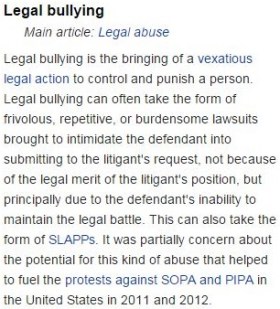
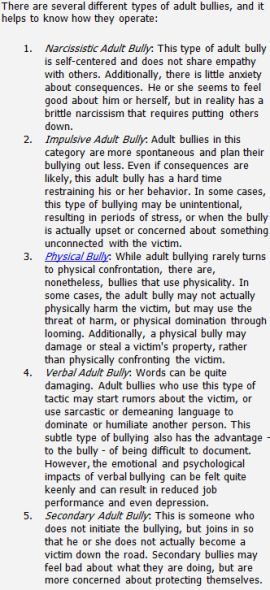


 Victims of false allegations made on restraining orders may be labeled “stalker,” “batterer,” “sicko,” “sexual harasser,” “child-abuser,” “whore,” or even “rapist”—publicly and permanently—by accusers whose sole motive is to brutalize. And agents of these victims’ own government(s) arbitrarily authorize this bullying and may baselessly and basely participate in it, compounding the injury exponentially.
 Those who profit politically and monetarily by the misery inflicted through court processes that are easily abused by the “morally unencumbered” love all this conflict and misdirected rage, which only ensure that these corrupt processes continue to thrive.
 TALKING BACK to restraining orders