A rhetorical catfight has been waged for years on the Internet between injured men and injured women or people who advocate on behalf of injured women. It’s a logical mare’s nest. Untold men (and women) have been wronged by casually abused and abusive procedures of law whose genesis owes to rabid feminist politicking at the end of the last century. These men (and women) have, again in untold because incalculable numbers, been unjustly deprived of children, home, property, livelihood, security, dignity, and/or liberty, and that fact has largely gone disregarded. A perusal of the quotations in the margin of this blog will satisfy any conscientious reader that this is a fact and not merely an allegation. The laws themselves are bent. Injured men (their predominant victims) have, sensibly or not, accordingly sought to draw attention to lying by women by emphasizing that women will lie even about rape (the specter in the room, incidentally, during any legal proceeding based on an allegation of abuse). There have, of course, been many documented cases of false rape allegations’ being made by women. Feminist advocates deny false accusation of rape “occurs” to any significant degree, ignoring the underlying male plaint, namely, that women lie in heinously vengeful, passive-aggressive, attention-seeking, destructive ways—and contrary to what some apologists for feminine lying would have the public believe, unscrupulous women (and men) don’t lie because they’re crazy, per se. They lie because it’s effective, just as diverting the “conversation” away from lying to lying about rape is effective at denying either one merits consideration.

These are not people.
“Feminism is the radical notion that women are people.”
—Marie Shear
Far from suggesting that women are Barbie dolls or marble angels, a proposition that may even have offended its speaker, this quotation, oft brandished by feminists today, promotes the idea that women are people. And people, unlike Barbie dolls or marble angels, lie. They lie about anything it serves them to lie about.
So much then for the myth of the faultless woman—which is one you’re unlikely to find debunked on Jezebel.com.
The question this post considers is that if women are willing to lie to cops and judges (and they are, as are men), why pussyfoot and not just accuse any target of malice of sexual violation? It’s a potent allegation.
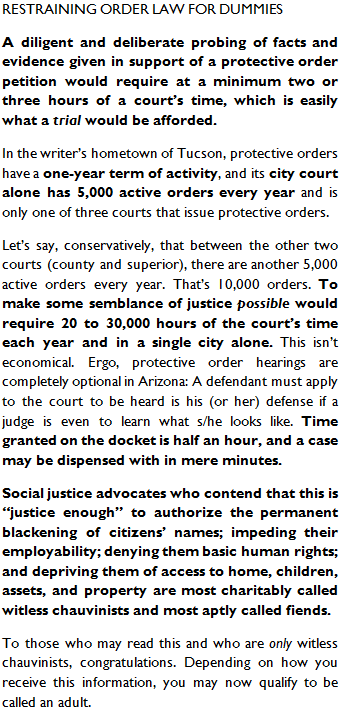
Well, it comes with a host of complications is why. In civil court, a false (or possibly real but baseless) claim of fear is all it takes to procure a protective order and turn a person’s life on its head. It can win a perfect stranger the exclusive entitlement to a person’s home and property while possibly landing him or her in jail. Unless a lying plaintiff aims to drive her victim to suicide, falsely alleging rape is overkill and pointlessly invites exposure.
 A criminal claim of rape, on the other hand, both figuratively and literally invites strangers’ noses into uncomfortable places. Government wants specifics and evidence. Girlfriends and family members may gently inquire about details.
This is the kind of claim, if false, that requires a great deal of determination to pull off and carries a heavy risk of tattering under scrutiny.
Let’s not deceive ourselves that unscrupulous women are too virtuous to lie about rape. Rather let’s be honest: Lying about rape is demanding and dicey.
That said, it’s really not that tough in civil court, which doesn’t require “proof beyond a reasonable doubt.” In civil court, it’s just he-said-she-said. A defendant doesn’t even have to be heard in court for a “default” judgment to be entered against him. And even if he does appear, there’s no guarantee the plaintiff will be required to or that the accused will have the opportunity to cross-examine her, making a mockery of the adversarial process. A judgment in civil court doesn’t represent a finding that a rape was committed, necessarily, but it’s not a denial that a rape was committed, either, and the accusation is what’s preserved.
The injustice is glaring but note that it’s legally no worse than that any other allegation that works can be made and can accomplish the same damaging consequences.
People have to live with this shit. Their families have to live with this shit. Their children have to live with this shit.
This is what men’s rights advocates would be saying if there were anyone who would listen or have the least capacity to comprehend the breadth and depth of injuries that instead tend to be casually batted aside (while accounts of groping or sexual harassment are gravely highlighted on NPR).
Most of these men have not been accused of rape, which doesn’t mean they couldn’t also have been accused of rape had their accusers been gutsy enough or that it wasn’t implied (point 1). And it doesn’t mean they have nothing to complain about (point 2).
Injustice is always something to complain about (point 3).
Copyright © 2019 RestrainingOrderAbuse.com
*I think I even read that on a liberal yard sign.



 TALKING BACK to restraining orders