What Can Be Done with Public Records, Like Restraining Orders, Arrests, and Convictions: A Tutorial for Judges and Everyone Who’s Been Lied about to One

Court records are available for public consumption, freely or for a few dollars, besides people’s home addresses, telephone numbers, birth dates and ages, work histories, list of associates and family members, etc. Men and women falsely targeted for blame in drive-thru court procedures may be fined or jailed for airing information about their accusers’ conduct that’s far less sensitive than what anyone with an Internet connection and a credit card can glean in five minutes—which may include decisions against men and women falsely targeted for blame in drive-thru court procedures….

sniffing

Decisions of the court in public proceedings are public records.

Remarkably, not even judges grasp the significance of the word public. More astonishing than that many judges today don’t know the first thing about the Internet is that no one in government seems to think it’s important that they be instructed.

The conditioned imperative is blame…and the consequences be damned.

Billions of federal tax dollars have been dedicated over the past 20 years to biasing police and judicial responses to accusations of abuse, but not one has been earmarked to show judges how the Internet works and how the public records they generate may be used.

This post will attempt to amend the lapse.

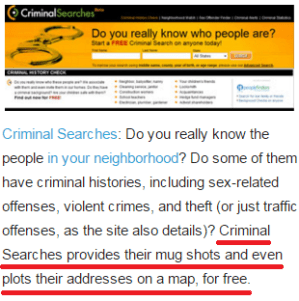
Here are a mere handful of websites that peddle so-called “private” information:

What follows is a demonstration of how they work.

In the most recent fiction-based prosecution against the author of this post, it was ruled by a superior court judge that I violated the privacy of my accuser by discussing her motives online, and I was unlawfully prohibited from publicly referencing her in future. My judge was Carmine Cornelio, and here is what is returned (at no charge) if I enter his first and last names into SwitchBoard.com:

  1. his middle initial,
  2. his approximate age,
  3. his phone number (a landline provided by Coxcom),
  4. his home address (and a map showing where his home is located),
  5. a tab that provides directions to his house,
  6. a tab that leads to information about his neighbors,
  7. the names of a couple of “people [he] may know,” and
  8. an invitation to “View [his] Background & Public Record Information.”

If I enter his name into Intelius.com (again for free), his age is confirmed to be 64, and I’m provided with the names of five of his relatives, as well as his address history, aliases, and prior jobs he’s held (he’s identified as an attorney but not a judge). All of this is right there on the surface. If I cared to know more, here’s what else I could learn for a trivial fee:
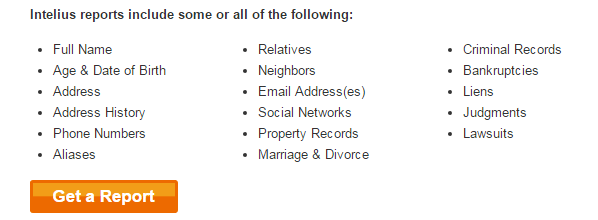


Matthew Chan of Defiantly.net has recently chronicled the case of a New Jersey man, Bruce Aristeo, who was jailed for six months for “vlogging” about a woman who accused him of abuse after he was issued something called an “indefinite temporary restraining order.” The judge didn’t even view the contents of the YouTube videos his ruling was based on. I’ve viewed some of their contents, which are mostly satire and fully protected under the First Amendment, and they’re a lot less invasive that an Intelius report. Mr. Aristeo has been arrested at least four times based on allegations he says are false, and those arrests are all public records that may be pulled from an Intelius report, by an employer, for instance, or a prospective girlfriend.

Below is a screenshot from a website called BustedMugshots.com (a product of U.S. Data Co. Ltd.).
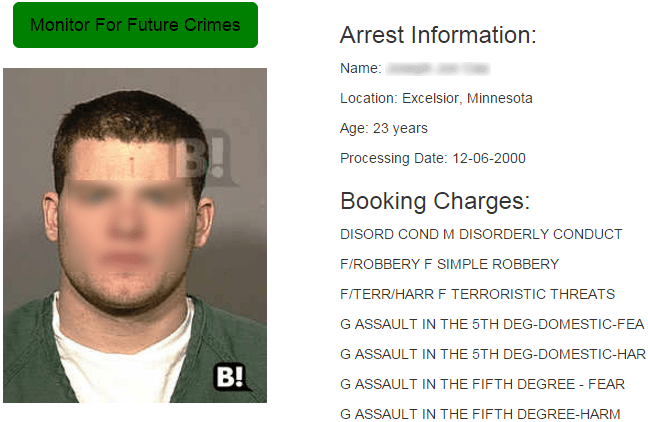
blurred mugshot


I was told by this man’s sister that accusations against him were falsified:

It makes me wonder, how common is this? Because my own brother had his girlfriend and mother of his child accuse him of rape a few years ago. He went to prison for it even though she later recanted her lie, but the case was already in the court’s hands and they wouldn’t accept her testimony. She truly ruined his life.

This certainly isn’t something a viewer of this record (e.g., an employer, a neighbor, or a girlfriend) would conclude. Significantly, also, this record is 15 years old. Court records, besides being very public, are very permanent.

Twice on the same page featuring the above record appears this search bar:

It encourages the viewer to look up the public records of yet other people. A button under the mugshot offers the viewer the option to “Order Complete Background Report” from the same “National Database” (called “Instant Checkmate”). The viewer is also invited to enroll in a service that notifies him or her of future arrests of the same person (“Monitor For Future Crimes”).

People, possibly on arrantly false grounds, are set up as targets for constant and endless scrutiny…to which they can hardly be insensitive.

While a line of text under the mugshot suggests a person can “Request This Record to be Modified or Purged,” here’s what pops up when you click its hyperlink:
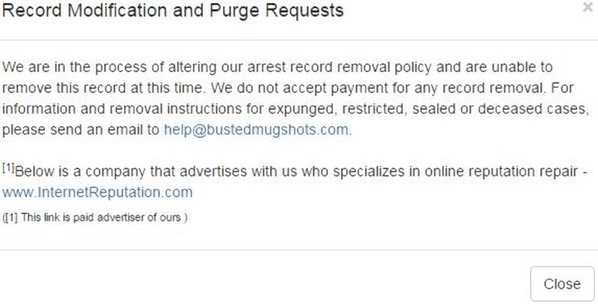


It’s a tease. The website will only remove the record if it’s been ordered sealed or vacated by the court, or if the person it identifies has died. The blurb hastily clarifies that BustedMugshots.com isn’t out to blackmail people. It doesn’t have to: It collects fees from its advertisers.
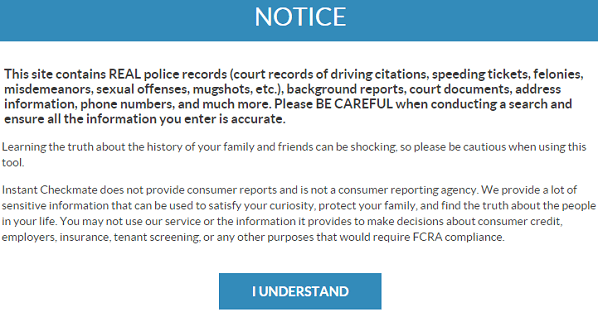
This titillating “warning” greets the visitor to InstantCheckmate.com.

Besides advertising the services of Instant Checkmate, BustedMugshots.com advertises for InternetReputation.com, with which the notice above tacitly urges someone with a mugshot published online to inquire (“Protect Your Online Privacy”).
Observe the squeeze: Damning information is published (legally) for the person it concerns to see. That person also sees that anyone can access this and other sensitive information, and is urged to exploit the services of a company that offers to protect his or her reputation…for a fee.

(Summary in media res: A person may be falsely accused in a farcical “trial” and emotionally and financially devastated. S/he may be arrested and imprisoned based on lies. The records may be used to further maim him or her in additional prosecutions. And—and—the records of all of these proceedings, based on a fraud or frauds, may be aired publicly. But the accused may not discuss them defensively without risk of court censure. No wonder, then, that some victims of procedural abuse never want to leave the house and flinch when the doorbell rings.)

This blog concerns restraining orders, which can be obtained easily on hyped or fraudulent grounds and make defendants vulnerable to arrest and conviction for “crimes” that only they can commit, for example, sending an email or placing a phone call.

Vigilant response to any claimed violation of an order has been vigorously conditioned for decades (by the Office on Violence Against Women), and it’s not uncommon for people to report that they’ve been arrested multiple times for falsified violations of restraining orders with falsified bases (see above).

On top of all of this, the records generated by this mischief can be legally published or sold, and the government, besides, has its own public databases that may be freely accessed by anyone with an Internet connection.

These are among the reasons why principle must be restored to process.

Copyright © 2016 RestrainingOrderAbuse.com

*BustedMugshots.com includes this contemptible sentence in its disclaimer: “The data may not reflect the status of current charges or convictions and all individuals are presumed innocent until proven guilty in a court of law.” Sure they are.

The Words Get in the Way: Reconceiving Arguments against Restraining Order Fraud

block
Traffickers of this blog will sometimes advise that complainants of abuse of so-called “protective orders” consider “the bigger picture.” They feel the matter is less about personal loss than about statutory and procedural derelictions (bad law and judicial bias, carelessness, and tyranny). They emphasize principle over individual privation.

For some, the bigger picture that’s stressed is denial of constitutional rights to due process (for example, the right to be heard before a judgment is entered, the right to court-appointed legal counsel, or the right to a trial by jury); for others, the bigger picture is the right to freedom of speech. Some underscore gender and race inequities; some the undermining of the family.

The obstacle to making whatever “bigger picture” is emphasized perceptible to the public at large is the phrase “restraining order” or “protection order,” which comes with a host of conditioned prejudices. It arouses images of violence against those helpless to defend themselves. Accordingly, even many who acknowledge the process is flawed nevertheless say they recognize it to be necessary…in cases.

So even those against the process may not actually be against the process. This has created a disjointed community of complainants, namely, a marginalized extreme labeled “misogynist cranks,” “angry white men,” or “restraining-order-Americans” and a fence-sitting majority who against all evidence and experience retains the faith that reason will prevail against unreason if we just talk it out long enough: “All around the mulberry bush, the monkey chased the weasel….”

The monkey never catches the weasel, so there’s nothing to recommend monkeying around.

What needs to be stressed and comprehended, to this writer’s way of thinking, is that civil court is no place for the litigation of accusations that explicitly or implicitly allege violence, violent threat, or other criminal acts, and that in civil court, which applies no standard of evidence, fraud is too easily perpetrated. The exposure of falsehood or exaggerated claims of fear will not necessarily discredit a plaintiff’s claims, and findings in favor of a plaintiff who’s a proven liar are possible and acceptable to the court.

Therefore the procedure is vexed; it’s wrongly engineered. The concept is corrupt.

Instead of denouncing “restraining order fraud,” it’s civil court rulings that exact an unconscionable toll that should be denounced. It’s all about the words. Civil procedures should not result, ever, in people’s being placed in police databases. Civil rulings should not criminalize people or make them vulnerable to warrantless arrest (for alleged behavior that may not violate any laws). It should not be possible to have a person evicted from a residence he or she owns by a civil ex parte decision, nor should such a decision predispose a court to find against that person when s/he’s permitted to address the court in his or her defense (if such an opportunity is even practicable to the accused, who may preposterously be required to travel to another county or state to be heard).

Against policies of law and process so manifestly unjust, even improved due process rights would promise to be a shabby deterrent against abuse and miscarriages.

Not only have we become habituated to the reality of “restraining orders” to the extent that we believe they must be here to stay; procedural process has become rote (adjudication by rubber stamp). Yes, new “safety catches” could be installed, but what guarantee would there be that the conditioned habits of those who administrate the process would change? Economy would require that there continue to be minimal oversight and accountability, and the trial judge would still have the final (and absolute) discretion to make a determination, according to his or her own personal lights. So long as the process were conducted in civil court, rulings could still be arbitrary (anything goes), because the standard of evidence would remain whatever the trial judge chose.

Social and judicial impression cannot be overhauled—what’s etched on the brain stays there—and the preconceptions attached to the phrase restraining order will never be dispelled. Judgment by a single man or woman who has had his or her priorities conditioned by rhetoric and social and political expectations (possibly for decades) cannot be impartial. The implications of the process and dictates about how it’s supposed to be administered are too deeply ingrained. The phrase restraining order is by itself damning (right from the get-go). It stirs presuppositions of guilt, and this is inimical to fair and just process. Accordingly, the phrase must be abolished and the process reconceived from the ground up.

Copyright © 2015 RestrainingOrderAbuse.com

Restraining Order Registries: Using Indiana’s Policies to Expose Government’s Abuse of Its Citizens

One of the thrusts of the Violence Against Women Act (VAWA) has been to establish public restraining order registries like those that identify sex offenders.
To underscore the inappropriateness of equating restraining order recipients with sex offenders, appreciate that the latter (sex offenders) have been tried and convicted in criminal court, and the former (restraining order defendants) have typically been labeled “offenders” according to civil criteria.

You’ve heard the phrases “innocent until proven guilty” and “proof beyond a reasonable doubt”? These don’t apply.

The usual “standard” applied to restraining order adjudications is “preponderance of the evidence,” according to which if a judge feels, on the force of a plaintiff’s testimony, that there’s a 51% probability that s/he’s mostly telling the truth, a restraining order should be awarded.

Often no ascertainable evidence is required at all to substantiate allegations ranging from pestering to physical or sexual assault. A mere claim of abuse or apprehension may be sufficient.

Restraining orders are largely approved according to judicial discretion. Judges are authorized to reckon the truth based on brief interviews with accusers (the accused are just names on forms). Judicial predisposition, furthermore, has been conditioned by federal cash inducements under VAWA to favor those pointing fingers. (These inducements are in the form of grants issued to courts in return for having their judges and staff “educated” about how to regard restraining order plaintiffs’ accusations.)

Note: restraining order proceedings are concluded in minutes, and there are no juries (or even anyone looking over judges’ shoulders). The game is played by house rules.

Despite the dubiousness of restraining order rulings vis-à-vis criminal rulings, however, it’s deemed just not only to enter the names of restraining order recipients in state and national police databases (indefinitely) but to enter them in conveniently accessible public registries (also indefinitely) the way sex offenders’ names are.

This isn’t a universal policy, but unquestionably were certain political interests to be given their way (and they increasingly have been in recent decades), it would be universal policy.

Recent reading I’ve done almost prompted me to take back past statements on this blog that public registries make finding out who’s received a restraining order “enticing” or “alluring.” Several state registries I’ve learned of limit registry access to specific government agencies, staff and officers of the court, and the like.

Some, however, don’t. Their registries are public in the most literal sense.

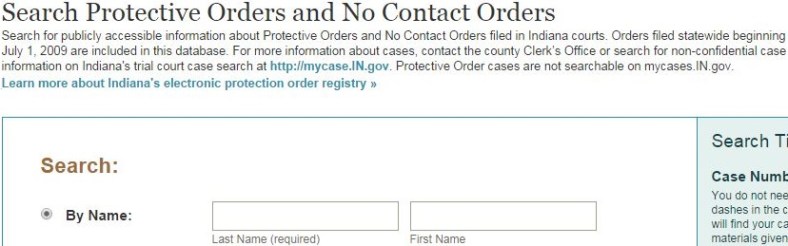
Here, for example, is what Indiana’s registry website looks like:

Every Indianan who’s been issued a “protective order” or “no contact order” since July 1, 2009 is recorded in this registry, including the ones whose cases were dismissed, that is, even those found “innocent” of the allegations against them are “outed” as having been accused of stalking, perhaps, or domestic violence or sexual assault. Browsers’ imaginations are free to take wing.

This search engine is simple to use. A restraining order recipient’s employer, landlord, student, client, patient, neighbor, girl- or boyfriend, etc. can perform a search in seconds—and as the headnote helpfully explains, “more information about cases” can be obtained by contacting the county clerk’s office.

Consider for a moment what the justification for a database like this could be. It doesn’t do anything to “protect” the plaintiffs of restraining orders. Therefore the justification must be to “protect” the public. Implicit then in the existence of such a database is that restraining order defendants are “dangerous.” Recall the basis upon which the determination of “dangerousness” was formed in the first place: a five-minute interview. Appreciate, too, that a restraining order recipient registered in a database like this may have been condemned for text messaging someone who resented the contact. And, as should go without saying, s/he may have been condemned on completely false allegations.

A process that’s highly prejudiced and answerable to no oversight is also highly punitive. Restraining order defendants are implicated according to kangaroo procedures whose rulings their noses are then rubbed in everlastingly.

Defendants often have mere days to respond to restraining orders, which can make procuring an attorney’s aid impossible even if defendants grasp the need for representation and can afford to shell out a few thousand at the drop of a hat. Appeals hearings, moreover, may be 30 minutes or less in duration (and only half that time is afforded to defendants’ testimony).

The process is a lock, but rulings are represented as the products of diligence and deliberation—and the public takes those rulings seriously, rulings that Indiana legitimates and publishes in a conveniently accessible database.

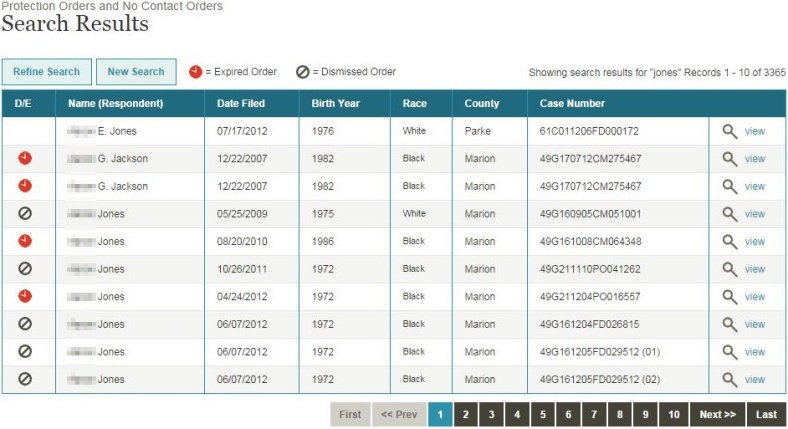
Here’s what returns look like if you simply enter the last name Jones into Indiana’s registry search engine:

Only half of the orders on the first page this search pulled up were actually finalized. The other half were tossed—after previously having been approved. The judicial error rate reflected in this random sampling is 50%. This statistic’s economic ($) implications are disgraceful by themselves. If you further allow that some of the restraining orders that were upheld were cases of false allegations’ succeeding, then judicial error is the norm.

A few months ago, a friend joked to me that her daughter (a smart cookie) had researched her teachers’ criminal records to use as leverage in the event of a grade crisis.

Arizona, blessedly, doesn’t yet have a nifty resource like Indiana’s for teenaged blackmailers to mine.

Copyright © 2014 RestrainingOrderAbuse.com