Criminalizing Criticism: Restraining Orders, the First Amendment, and Chan v. Ellis

This search term brought a visitor here a day or two ago: “restraining order in ohio because a couple texts.”

It struck a chord with this author, because he himself was issued a restraining order on a similar basis (three emails over a weekend). There were accompanying allegations, but the court’s final ruling was based exclusively on the emails (i.e., speech). They weren’t even judged threatening, just unwanted (the contents, in fact, weren’t read by the court).

Some people are issued restraining orders on even more tenuous bases, like criticizing their plaintiffs on Facebook or in a blog or other online medium. If you’re such a person, you should be aware of a case before the Georgia Supreme Court that’s been the subject of a prior post on this blog: Chan v. Ellis.

The court was scheduled to hear opening arguments on October 7.

A summary of the case by UCLA Law Professor Eugene Volokh, along with his legal commentary in support of the appellant, Matthew Chan, is here.

The First Amendment protects the right to speak about people, so long as the speech does not fall into an established First Amendment exception (such as those for defamation or for true threats). This includes the right to speak about private figures, especially when they do something that others see—rightly or wrongly—as unethical.

Restraining orders and criminal stalking law may properly restrict unwanted speech to a person. But they may not restrict unwanted speech about a person, again unless the speech falls within a First Amendment exception. The trial court’s order thus violates the First Amendment.

If you’ve been issued an injunction from the court based exclusively on your speaking publicly about its plaintiff (and you didn’t threaten or lie about him or her), a verdict in favor of Mr. Chan could conceivably provide you with grounds for an appeal. FYI.

See Mr. Chan’s website, ExtortionLetterInfo.com, for trial updates. A ruling, he reports, should be returned between mid-January and mid-March.

The case stands to highlight judicial abuse of discretion and power and is one anybody who’s been put through the restraining order wringer will want to track.

Copyright © 2014 RestrainingOrderAbuse.com

*Update: The Georgia Supreme Court returned a verdict in favor of Matthew Chan on March 27, 2015.

Hocus-Pocus: More on False Restraining Orders and the Five Magic Words

Some recent posts on this blog have touched on what might be called the five magic words, because their utterance may be all that’s required of a petitioner to obtain a restraining order. The five magic words are these: “I’m afraid for my life.”

Cops, it’s even reported, tell women whom they goad to get restraining orders that they should recite this magical phrase to the judge (wink, wink)—and some of these women complain later that they felt forced onto a course that they regretted pursuing but weren’t permitted to correct.

(Notably, billions in federal tax dollars have been invested under the Violence Against Women Act in so-called STOP grants—“Services and Training for Officers and Prosecutors”—as well as in grants to encourage arrests, according to which VAWA grants police officers have essentially been instructed to promote restraining orders.)

The I’m-afraid-for-my-life enchantment has variant forms. This writer’s accuser, who had for months nightly hung around outside of his residence alone in the dark, used this one: “Will I be attacked?”

The abbreviated version, “I’m afraid,” can even suffice. What’s more, judges in some jurisdictions may cue a restraining order applicant to say it, because they’re not authorized to issue the requested injunction unless s/he does (e.g., “I can only issue a restraining order if you tell me you’re afraid of [him or her]. I’m going to ask you one more time: Are you afraid?”).

Gamesmanship in this arena is both bottom-up and top-down. Liars hustle judges…and judges hustle liars along.

Claims of fear are seldom unaccompanied by specific for-instances (sometimes real, sometimes not), but typically if it weren’t for the magic words’ coloring the for-instances, they would signify little by themselves.

(A California man employed as a little league umpire, for example, had a restraining order petitioned against him this year by his sister-in-law. She alleged that looks the man had cast in his nephew’s direction—while the boy was playing baseball, and the man was in the park to perform his job—caused his nephew grave emotional upset. She also cited an incident when she said her brother-in-law had aggressively honked and waved at her and her son from his car. The so-called relevant facts were only made sinister by their reporter’s alleged apprehension.)

Words aren’t magical, and allegations of fear aren’t facts. In procedures as brief and superficial as those mandated by restraining order laws, even facts aren’t facts. They’re often just innuendo upon which foundation a judge is urged and authorized to erect an outhouse.

Copyright © 2014 RestrainingOrderAbuse.com

The Five Magic Words: What Do Restraining Order Defendants Mean when They Say They’ve Been Falsely Accused?

A presumption of people—including even law professors—is that when restraining order defendants say the accusations against them are false, they mean that specific allegations of fact made by their accusers are untrue.

This is a misunderstanding, and it’s a totally understandable one that accounts for the incredulity expressed by proponents of the battered women’s movement when they hear statistics propounded like 50 to 90% of restraining orders are based on “false accusations.” (A family court judge might say 30%. The jaded former director of a woman’s shelter might say 40 or 50%. A men’s rights activist might say 60 to 80%, and a family attorney might well agree.) There are no “official” statistics—and there can’t be, because no records of false accusations are kept, and false accusations, besides, are seldom called “false accusations” in court rulings. Figures put forward are always speculative.)

It must be appreciated that restraining order prosecutions aren’t criminal prosecutions. They don’t evolve from detailed allegations made to the police and vetted by public attorneys; they’re based on forms filled out in 10 or 15 minutes by private litigants who deliver their claims straight to a judge (who meets with them for about the time it takes to make a sandwich).

To falsely accuse someone of “domestic violence,” for example, may just mean putting a check mark in a box on such a form.

That’s the false accusation—and if a defendant doesn’t show up to court to challenge that check-marked accusation, s/he becomes, by default, a “domestic abuser” according to the various law enforcement and registry databases his or her name is entered into.

hey-prestoPeople on the outside of the restraining order process imagine that the phrase false accusations refers to elaborately contrived frame-ups. Frame-ups certainly occur, but they’re mostly improvised. We’re talking about processes that are mere minutes in duration (that includes the follow-up hearings that purport to give defendants the chance to refute the allegations against them).

The fact is when defendants say accusers lie, they may just mean those accusers uttered the five magic words: “I’m afraid for my life.”

The magic words, which may of course be untrue, aren’t even susceptible to contradiction. They can’t be refuted; what they represent is an alleged feeling, not a fact that can be disproved. You can’t even really call them an accusation.

Contrary to all things reasonable and sound, a restraining order may be issued on the basis of the five magic words alone.

Copyright © 2014 RestrainingOrderAbuse.com

A Story of Female Sterilization That Should Stress to Those Who’ve Been Violated by Fraudulent Abuse of Legal Process Why Reporting Judicial Tyranny and False Accusers Is by Itself Pointless (You Must Demand Change)

The point of sharing the explication below is to emphasize how forlorn prospective recourses for redressing rights violations stemming from false restraining order and similar prosecutions are. Accountability is zero, across the board.

If you’ve ever wondered why a judge may be censured for rude conduct but not for ignoring lies or misrepresenting evidence, here’s why.

Quoted from “The Plumb Line: So What Else is New?” (Murray N. Rothbard, Libertarian Review, 1978), reprinted on LewRockwell.com as “The Tyranny of the Bench”:

The United States Supreme Court ruled, in 1872, that judges were immune from any damage suits for any “judicial acts” that they had performed—regardless of how wrong, evil, or unconstitutional those acts may have been. When clothed in judicial authority, judges can do no wrong. Period. Recently a case of an errant judge has come up again—because his action as a judge was considered generally to be monstrous and illegal. In 1971, Mrs. Ora Spitler McFarlin petitioned Judge Harold D. Stump of the DeKalb County, Indiana, Circuit Court to engage in a covert, compulsory sterilization of her 15-year-old daughter, Linda Kay Spitler. Although Linda was promoted each year with her class, Mrs. McFarlin opined that she was “somewhat retarded” and had begun to stay out overnight with older youths. And we all know what that can lead to.

Judge Stump quickly signed the order, and the judge and mamma hustled Linda into a hospital, telling her it was for an appendicitis operation. Linda was then sterilized without her knowledge. Two years later, Linda married a Leo Sparkman and discovered that she had been sterilized without her knowledge. The Sparkmans proceeded to sue mamma, mamma’s attorney, the doctors, the hospital, and Judge Stump, alleging a half-dozen constitutional violations.

All of these people, in truth, had grossly violated Linda’s rights and aggressed against her. All should have been made to pay, and pay dearly, for their monstrous offense. But the federal district court ruled otherwise. First, it ruled that mamma, her lawyer, and the various members of the “healing professions” were all immune because everything they did had received the sanction of a certified judge. And second, Judge Stump was also absolutely immune, because he had acted in his capacity as a judge, even though, the district court acknowledged, he had had “an erroneous view of the law.” So, not only is a judge immune, but he can confer his immunity in a king-like fashion even onto lowly civilians who surround him.

The U.S. Court of Appeals, Seventh Circuit, unaccountably didn’t understand the program, and so it reversed the district court, claiming that Judge Stump had forfeited his immunity “because of his failure to comply with elementary principles of due process,” and had therefore in a sense “not acted within his jurisdiction.” To allow Stump’s action to stand, said the appeals court, would be to sanction “tyranny from the bench.”

Now this was pretty flimsy stuff, and besides it opened an entertaining wedge toward holding judges accountable to the law and to the protection of rights like everyone else. But this would have shaken the foundations of our monopoly archist legal system. And so the U.S. Supreme Court, on March 28, set the matter straight. In a 5–3 decision in this illuminating case of Stump v. Sparkman, Justice Byron R. (“Whizzer”) White, speaking for the majority, sternly reminded the appellate court of the meaning of the 1872 ruling:

A judge will not be deprived of immunity because the action he took was in error, was done maliciously, or was in excess of his authority. Rather, he will be subject to liability only when he has acted in the “clear absence of all jurisdiction.”

Justice White conceded that no state law or court ruling anywhere could be said to have authorized Judge Stump’s action; but the important point, he went on, is that there was no statute or ruling which prohibited such an action by the judge.

Those interested in reading more are urged to click the link to Mr. Rothbard’s article at the top of the post.

What all of this should make clear is that for redress of rights violations stemming from false allegations made in restraining order and related prosecutions to be possible, the laws themselves must be rectified—and legislative reform will only be urged when more people loudly demand it.

For rights abuses to be capable of remedy by process of law, they must be illegal, which means the processes that authorize those abuses must be revamped or repealed by lawmakers (your state representatives). So long as the standard applied to restraining orders is merely a discretionary one, judges can rule however they want (that’s the statutory latitude they’ve been given), and they’re accountable for those rulings to no one.

Copyright © 2014 RestrainingOrderAbuse.com

Beating up Disabled Girls: False Allegations and Judicial Dishonor

“There is no normal. The rational has been torn away from your ability to grasp it.”

Cartoonist Scott Stantis (on growing up in an abusive household)

This is the sentiment shared by everyone who’s been wrongly blamed—and abused and condemned for it.

Consider that current restraining order and domestic violence legislation and policy are defended as protecting battered women and children. Consider further that honor is not only represented as the guiding principle of judicial conduct but that it’s the title that judges are expected to ceremoniously be addressed by.

Now consider this appeal posted three weeks ago (September 30, 2014) to the e-petition “Stop False Allegations of Domestic Violence” by Phoenicia W. of Springfield, Missouri:

Hi im disabled 28 year old women. And just. Because. I was sick of being. Beat by my exboyfrend I kicked him out and he put fales charges on my cost me 10.000 dollars and I lost. Alot. How can his lies be taken. Off my record. Please. IV never. Even. Could. Hurt a fly please. I cry every. Nite. Help me.im incident I swere.

I’ve edited copy since I was teenager. Here’s what Phoenicia means:

Hi, I’m a disabled 28-year-old woman, and just because I was sick of being beaten by my ex-boyfriend [and] kicked him out…he put false charges on me that cost me $10,000—and I lost. A lot. How can his lies be taken off my record? Please. I’ve never even (and couldn’t) hurt a fly. Please. I cry every night. Help me. I’m innocent, I swear.

The gist of Mr. Stantis’s cartoon essay is that when you’re punished for something you didn’t do, and there’s no way to make sense of your situation or escape it, it “mangles the soul.”

My tidied version makes Phoenicia sound very able and together. Look again at the unedited script, though, which is a poem of pain.

Does it look and sound like it was authored by someone who could capably represent herself in court? For that matter, does it look and sound like it was authored by someone dangerous? Finally, how honorable is beating up (or beating down, if you prefer) a disabled girl and leaving her crying herself to sleep each night—a disabled girl, what’s more, who says she was beaten by the man who accused her of violence?

Feminists are urged to ask themselves which they think will have a more lasting consequence on this woman’s psyche: having been hit by an ex-boyfriend or living day and night with the court’s judgment? Which obviously haunts her? Which has healed, and which can’t heal? (When the court acts on lies by abusers, it compounds the abuse many times and makes it gnawing and constant: “There is no normal.” Ever. Again.)

You can’t relate pain like Phoenicia’s with a lurid picture of a black eye. Her pain and its source are invisible—and count on it that all traces of either have been carefully concealed beneath layers of judicial impression management.

If you’re not familiar with the phrase impression management, here’s an example: “She’ll be okay. She just ran into a door.”

Copyright © 2014 RestrainingOrderAbuse.com

BLACKMAIL: Using Restraining Orders to Extort and Punish

“A blackmailer could attempt to blackmail someone with a threat to accuse him falsely, but we should expect such cases to be rare because the victim has a good remedy: sue the blackmailer for defamation. Good but not perfect, because the blackmailer may not have the resources to pay a legal judgment. Criminalizing this form of blackmail can thus be viewed as backing up the law against defamation.”

—Judge Richard A. Posner, “Blackmail, Privacy, and Freedom of Contract

In theory, the judge is right that victims of false allegations have a “good remedy”; in practice, however, he’s mistaken.

That’s not because the judge doesn’t comprehend his subject (to the contrary, his explication is very adept); it’s because the judge only considers the “attempt to blackmail someone with a threat to accuse him falsely” as a tool to extort money.

Among human economic transactions, money isn’t the only sought-after commodity.

A perusal of the e-petition “Stop False Allegations of Domestic Violence” will garner the social scientist any number of anecdotal accounts of blackmailers’ threatening to make false allegations in order to bend people to their will. Here’s a recent example:

My husband filed false child abuse charges against me to obtain full custody of our children. I cannot count the number of times that he threatened to keep the children away from me. He said he would tell people I abused them. I am a victim of domestic violence, and this allegation has just allowed him to continue the abuse.

In this instance, a husband used threats of filing false allegations of child abuse to blackmail his wife to stay with him and keep quiet about his abuse of her (cf. Dr. Tara Palmatier’s “Presto, Change-o, DARVO: Deny, Attack, and Reverse Victim and Offender”). The brief account doesn’t explain why the husband made good on the threats. Maybe his wife wasn’t as compliant as he wanted—or maybe he met someone to replace her with, and she was just an albatross around his neck.

Women, of course, do the same to men, particularly to men who’ve indicated they want to break up (sometimes kids are used as leverage, sometimes not).

Here’s a recent comment on the blog from the mother of a blackmail victim of this type:

My son’s girlfriend…filed a domestic abuse CPO [civil protection order] against my son, again telling him that he shouldn’t have left her. He hasn’t been served yet—they keep missing him. She calls my son constantly, stringing him along with the idea that she “might” let it go. He’s taking her out to eat, giving her money, staying the night with her. Hoping that she’ll let it go. All that and yet two hearing dates for him have come and gone with her showing up at both his hearings asking for a continuance because he hasn’t been served.

For the uninitiated, appreciate that restraining orders alleging abuse are obtained at no cost—and in a few hours if not minutes. Getting one is cake. It costs an accuser absolutely nothing to file serial petitions, and there are no statutory limits on the number of times s/he can file (some people do this over and over for years). The commenter has herself also been repeatedly accused by the woman in her story (her son’s “former” girlfriend) of stalking the woman and causing her to fear “for her life.”

When the court date comes up, she doesn’t show, and the case is dismissed. She then goes and files a new CPO to keep the cycle going. I tried to get a CPO protection order against her, but the magistrate denied it.

This is a reality that the court is either blind to or finds it impolitic to acknowledge—and no wonder: millions of restraining orders are issued per annum, and owning that restraining orders are abused to blackmail and terrorize defendants would implicate the court as an accessory to extortion, defamation, harassment, fraud, etc.

The “remedy” proposed by the judge quoted in the epigraph, i.e., suing for defamation, is for the same reason a nonstarter. If the court entertained defamation suits brought by the victims of false restraining orders, it would have to acknowledge its own culpability. It would have to own, that is, that restraining orders are urgent and conveniently available tools of blackmail, harassment, and terrorism. It would also have to own that it’s easily duped. The court doesn’t like to admit that it makes mistakes, let alone that it’s gullible.

This writer has filed a defamation suit and has corresponded with others who’ve done the same. The court refuses to accept the claim that “testimony” can be “defamatory.” Litigants are batted away with invocations of “res judicata” (they’re told the false allegations are already “decided things” and can’t be revisited). Never mind that consequences of false testimony include defendants’ being entered into domestic violence registries and state and federal police databases, as well as being denied employment (and, for example, the right to attend their children’s school activities, coach or teach kids, etc.).

False restraining orders, in other words, not only defame but defame with the authority of the court behind them. The reputations of those accused aren’t merely “sullied”; defamatory allegations are credited as incontrovertible truths established in a court of law.

When the motive of blackmailers is to extort money, following through with the threat by exposing the person threatened means blackmailers don’t get what they want. When, however, the motive is to dominate another person, and false allegations of abuse are the threat, following through with the threat does enable blackmailers to get what they want: control.

That includes control of the truth. Some cases of blackmail this author has been informed of were instances of the parties accused knowing something about their accusers that their accusers didn’t want to get around (usually criminal activity). When the guilty parties no longer trusted that coercion would ensure that those who had the goods on them would keep quiet, they filed restraining orders against them alleging abuse, which instantly discredited anything the people they accused might disclose about their activities.

Some such activities reported to this writer have been domestic violence, immigration fraud (selling green cards), drug use, and tax evasion. All someone who’s obtained a restraining order has to say to authorities if their actions are reported is that the allegations were brought by a crank they “had to get a restraining order against.” Case closed.

Restraining orders are perfect tools of cover-up.

Contrary, then, to what the judge quoted in the epigraph concludes, people who blackmail others with threats of filing false allegations can not only make good on their threats with the expectation of impunity; they can conceal other crimes behind the shield of the court.

For blackmailers, it’s a win-win proposition.

Copyright © 2014 RestrainingOrderAbuse.com

Class Action Lawsuits: Suing Uncle Sam for Rights Violations Arising from Restraining Order and Domestic Violence Prosecutions

“I think action would be better than just mere words. How do you think same-sex marriages were passed? We all need to come together and file a class action lawsuit. These laws plainly violate our constitutional rights as U.S. citizens. There is no due process of law for these allegations, and the cause-and-effect deprives an individual of life, liberty, and property.”

—Michael K. from Alamogordo, New Mexico

The man makes a good point.

Cursory reading on class actions suggests, too, that a lawsuit like the one he proposes is feasible. According to Wikipedia, “Nationwide plaintiff classes are possible [if] such suits…have a commonality of issues across state lines.”

Controlling statutes and procedures concerning domestic violence and restraining order prosecutions, as well as “child welfare” interventions, vary state to state, but a “commonality of issues” vis-à-vis civil rights violations and unjust privations definitely does exist—and certainly class actions within states’ lines are at least as worthy of consideration.

Wikipedia again: “The procedure for filing a class action is to file suit with one or several named plaintiffs on behalf of a proposed class. The proposed class must consist of a group of individuals [who] have suffered a common injury or injuries.”

The most sympathetic candidates for a class action are probably those who’ve unjustly been deprived of property, employment, and/or access to children.

A recent NPR story reports that dozens of students who’ve been accused of rape are suing their universities. They allege they were denied due process and fair treatment by college investigative committees, that is, that they were “railroaded” (and publicly humiliated and reviled). The basis for a suit alleging civil rights violations, then, might also exist (that is, independent of claims of material privation). Certainly most or all restraining order defendants and many domestic violence defendants are “railroaded” and subjected to public shaming and social rejection unjustly.

How to Start a Class Action Lawsuit,” a primer authored by Linda Jo Martin, creator of FightCPS.com, explains the basics of the procedure. (Ms. Martin advocates for the filing of class actions against Child Protective Services in all 50 states.)

Getting a class action going of the sort this post concerns requires self-starters with good networking skills and a great deal of perseverance, because inducing people who’ve been abused by state process to come forward with complaints is tough. They’re scathed, distrustful, and afraid.

Names of willing participants have to be gathered and a law firm enlisted. Attorney fees aren’t a hindrance, because they’re collected from the reward. But a law firm would have to be confident of a win.

A firm that represent class actions is Lieff, Cabraser, Heimann, and Bernstein. Its website offer further information about class actions. Alternatively or additionally, see Stanford Law Professor Janet Cooper Alexander’s “An Introduction to Class Action Procedure in the United States.”

Undertaking a venture like coordinating a class action is beyond the resources of this writer, but anyone with the gumption to try and transform words into action is welcome to post a notice here.

Placing a notice on an e-petition like “Stop False Allegations of Domestic Violence” would be of limited value, because it would recede into the archives in a couple of days. Mining the petition for names, however, could be rewarding, because some respondents include their telephone numbers and email addresses along with their stories. Using Facebook and Twitter would be the most potentially profitable tacks.

The intrepid social activist would besides do well to contact the likes of A Voice for Men, and put out the word. Any group or hub that represents the interests of people with similar complaints should be notified.

Professors who’ve written about the particular rights abuses a class action would seek to redress, particularly law professors, might also be recruited to provide amicus briefs to the court (authoritative opinions that lend support).

Abuses of the sorts this blog and related sites concern have persisted without check for decades. Even prompts for others to take action are still just words.

Someone has to step forward and attempt to translate thought into action. Is that person you?

Copyright © 2014 RestrainingOrderAbuse.com

What Journalists Need to Understand about What Restraining Orders Are: A Tutorial for Investigators, Part 2

“Orders for protection represent a legislative attempt to incorporate distinct features from both civil law and criminal law. On the one hand, a private litigant can initiate judicial proceedings to seek redress against another private individual. On the other hand, criminal penalties, such as fines and incarceration, will attach if a protection order is violated. Unlike both civil and criminal proceedings, protection order actions involve a great deal of informality, with the end result being an order for protection that is often issued on an ex parte basis without the benefit of a full evidentiary hearing.

“Many aspects of Nevada law in this area can best be described as ‘murky,’ with virtually no critical or scholarly study available to assist Nevada’s courts. Moreover, statistical information about protection orders in Nevada is almost non-existent.”

—Staff attorney Joe Tommasino, Las Vegas Justice Court

The first thing reporters need to grasp about restraining orders is that they’re a kluge (a Frankenstein’s monster crudely stitched together from dubiously compatible parts). For plaintiffs (accusers), they merge the most favorable aspects of civil and criminal prosecutions; for defendants, the least favorable.

The scales of justice are tipped from the start.

Restraining orders allow a “private litigant [to] initiate judicial proceedings to seek redress against another private individual” just as civil lawsuits do (though restraining order applications by contrast are typically processed free of charge). They’re also adjudicated according to the lowest civil standard of proof (“preponderance of the evidence”). State standards vary rhetorically, but the criterion for rulings is basically the same: whatever judges fancy is just (and there are only two choices—thumbs up or thumbs down).

On this basis, citizens can be rousted from their homes and kicked to the curb (and some are left destitute). On this basis, also, they may be entered into domestic violence registries (indefinitely), besides state and federal law enforcement databases (indefinitely), and denied security clearances, loans, leases, and even employment in certain fields (just like convicted felons).

Notwithstanding that restraining order allegations are introduced in civil court and aren’t subject to the criminal standard of evidence (“proof beyond a reasonable doubt”), “criminal penalties, such as fines and incarceration, will attach if a protection order is violated”—or is simply alleged to have been violated: arresting officers need only have a reasonable suspicion that a violation occurred, which they need not have witnessed.

The savvy observer will note that suspicion is the motive determiner of liability at all levels. Suspicion informs judicial disposition, subsequent police response to claims of violation, and of course interpretation by third parties, including employers (judges trust accusers, and everyone else trusts judges). Emphatically worthy of remark is that billions of dollars of federal monies have been invested over the past 20 years toward conditioning judicial and police suspicion.

This may incline the savvy observer to suspect the fix is in.

He or she should appreciate further that restraining orders are most commonly issued ex parte, which means accusers simply fill out a form and very briefly interview with a judge without defendants’ being present to contest the allegations and without their even being aware that they’ve been made. (Some courts even explicitly advise plaintiffs to rehearse their allegations so they can recite them as quickly as they would an order at a drive-thru.) Although most states mandate that a follow-up hearing be slated to give the accused an opportunity to controvert the allegations against them and receive an “unbiased” second opinion, follow-up hearings are held in the same court that prejudicially ruled against them in the first place: “We found you guilty. Go ahead and tell us why we screwed up. You have 15 minutes.” Because restraining order trials are civil proceedings, defendants aren’t provided with legal counsel. They’re nevertheless afforded only a few days (or a couple of weeks at the outside) to prepare a defense.

Returning to this post’s epigraph, here’s its author’s elaboration of the points it introduces (which apply irrespective of what a restraining order is called):

The concept of a “protection order” or a “TPO” is a curious one under the law. Unlike a criminal case, where the awesome power of the State is wielded against a private citizen, an action for a protection order allows one private citizen to invoke judicial authority directly against another private citizen.

The implications are staggering when one considers that a protection order allows individuals to trigger invisible force fields affecting the conduct, movement, speech, and legal rights of others.

Even more significant is the fact that Nevada law allows a person to obtain a protection order based upon only a brief ex parte application [as do most or all states’ laws].

From these concepts, questions immediately present themselves. Are protection orders being utilized in oppressive or unexpected ways? Are the factual scenarios involved similar to what the [legislature] envisioned them to be? Are courts utilizing protection order tools correctly? Are judges issuing ex parte orders that trample upon the rights of innocent people before a hearing is held to determine the validity of specific allegations? Is this area of the law an insufficiently regulated “wild frontier”?

Loyola Law School Prof. Aaron Caplan, in a 2013 law review article that cites the 2008 paper of Mr. Tommasino’s quoted in this post, says yes.

Many structural factors of civil harassment litigation lead to higher-than-usual risk of constitutional error. As with family law, civil harassment law has a way of encouraging some judges to dispense freewheeling, Solomonic justice according to their visions of proper behavior and the best interests of the parties. Judges’ legal instincts are not helped by the accelerated and abbreviated procedures required by the statutes. The parties are rarely represented by counsel, and ex parte orders are encouraged, which means courts may not hear the necessary facts and legal arguments. Very few civil harassment cases lead to appeals, let alone appeals with published opinions. As a result, civil harassment law tends to operate with a shortage of two things we ordinarily rely upon to ensure accurate decision-making by trial courts: the adversary system and appellate review.

The process essentially operates “in a vacuum”:

Harassment orders, when granted, are very rarely appealed. In the Justice Courts of Las Vegas in 2008, only three out of 2034 non-domestic violence petitions resulted in an appeal. No appellate court opinions interpret the Nevada statute—even though it was enacted in 1989 [that’s zero appellate court opinions in 20 years]. As a result, “the limited jurisdiction courts [of Nevada] have been operating in a vacuum and creating ad hoc, reactive solutions” to recurring problems.

The stagecoach, in other words, is steered without reins. The laxity of the statutes means judges of the lowest-tier courts call the shots, and there are no big brothers looking over their shoulders. They’re licensed to do what they want. (The quotations above refer to different types of restraining order, but the two types aren’t necessarily treated any differently. Whether a petitioned injunction is a protection order or a harassment order may only depend on which box was ticked on the application form. In most jurisdictions, what distinguishes one from the other is the nature of the relationship between the accuser and the accused. The allegations may be identical.)

The legislative insensitivity to constitutional principles and protections as well as the lack of judicial housekeeping in this area of law are beneath the perceptual threshold of the public. To the uninitiated, the absence of controversy originating from “legitimate” sectors suggests that everything’s working as it should: restraining orders are issued to dangerous people who need to be tethered.

While how commonly the process is exploited for ulterior motives is a matter of heated dispute, its availability for abuse is plain. The prevailing attitude toward allegations of rampant abuse is that if statistics can’t be adduced to support them, the complaint is irrelevant and should exercise no influence on policy reform. The absurdity of this attitude is likewise plain. The process is designed to favor accusers, judges are predisposed to credit accuser’s accounts (in part according to explicit instruction), those accounts need not be substantiated, the process is initiated and completed in hearings spanning minutes only, and (as the court attorney who wrote the epigraph notes) comprehensive statistical information about restraining orders is virtually non-existent.

The restraining order process is conducted in a black hole. There’s not only no transparency; there’s no light.

Copyright © 2014 RestrainingOrderAbuse.com

What Journalists Need to Understand about Restraining Orders and Their Abuse: A Tutorial for Investigators, Part 1

“Restraining orders give victims of domestic violence a tool to keep their abusers away or at least have them arrested if they come close. Anyone in a relationship with recent history of abuse can apply, and the order can be signed the same day.

“It gives victims the right to stay in the home and keep the kids. But the civil document relies on their abusers to respect the law.”

—“Are Restraining Orders False Security?(USA Today)

Reporters are often keen and eager detectives when there are two sides to a story, and they want to get to the bottom of things. When there aren’t clearly defined contestants with competing narratives, however, reporters are as prone as anyone else to swallow what they’re told.

The news story the epigraph was excerpted from was prompted by a recent murder in Oregon and explores the impotence of restraining orders, in particular to “stop bullets.” Just as shooting sprees inspire reporters to investigate gun legislation, murder victims who had applied for restraining orders that proved worthless inspire reporters to investigate restraining order policies. The presumption, always, is that the law failed.

The solution suggested by the story—the same solution that’s always suggested by such stories—is to beef up protocols and give the statutes more teeth.

What’s inevitably lost in considerations like this is that for every person who’s attacked or killed in spite of a restraining order, thousands, tens of thousands, or even hundreds of thousands of people face grave indignities and privations consequent to orders’ being used exploitatively (including public revilement, chronic harassment, criminal profiling, social alienation, and loss of employment, health, and access to kids, home, and property). This is a fact it seems journalists would only be given cause to confront if more victims of procedural abuse killed themselves.

Preferable, certainly, would be if reporters could be depended on to sniff out and censure injustice without anyone’s having to die.

Toward this end, this post encourages reporters to recognize what the quoted paragraphs that introduce it actually say. This is revealed by removing the obfuscating rhetoric. Replace the phrase victims of domestic violence with accusers, and replace their abusers with the accused.

Now consider the implications of the same paragraphs, slightly revised:

“Restraining orders give accusers a tool to keep the accused away or at least have them arrested if they come close. Anyone in a relationship…can apply, and the order can be signed the same day.

“It gives accusers the right to stay in the home and keep the kids….”

The mere substitution of factually accurate, unbiased labels changes the meaning of these paragraphs significantly, and brings their implications to the fore.

Now dare to think the unthinkable (as every factual analyst should) and replace the word accusers with the word liars and the phrase the accused with the phrase those lied about, and pare away a few more words.

“Restraining orders give liars a tool to keep those lied about away or have them arrested. Anyone in a relationship can apply, and the order can be signed the same day.

“It gives liars the right to stay in the home and keep the kids.”

The same two paragraphs, reconceived, say that a restraining order can be got by lying to the court, can be used to have someone arrested without warrant based on the report of the liar, can be had in a single day (without the accused’s even being given prior notice of the proceedings), and can be used to gain immediate and sole entitlement to a place of residence and immediate and sole custody of children.

Appreciate that there are no (enforced) penalties for lying, and suddenly the motives and opportunity for fraud—particularly against a target of malice—become plain.

Appreciate further that allegations made by restraining order petitioners aren’t subject to the criminal standard (“proof beyond a reasonable doubt”). Restraining order trials are civil adjudications, not criminal ones. The “standard of proof” applied is “preponderance of the evidence,” which means no certain substantiation of allegations ranging from nuisance to sexual assault is required. Approval of a restraining order isn’t a (literal) finding of guilt, per se. No proof of anything must be established.

People, including journalists, only see what they hear.

The truth of how conveniently and urgently restraining orders avail themselves as tools of abuse is right under the noses of everyone who writes about them. It just gets obscured by loaded words (victims and abusers, for example) and the images they excite. Blindness to these words’ unexamined assumptions is further reinforced by the hysteria aroused by a (single) sensational act of violence.

Principal among these unexamined assumptions is that everyone who claims to be a victim is a victim (according to which belief everyone who claims to be a victim is treated as a victim by the court—which every false claimant dependably anticipates).

Observing this by using a story about a tragedy shouldn’t seem callous, because (1) it’s in the wake of tragedies like the one reported in the referenced story that hysteria runs highest and completely eclipses critical scrutiny, and (2) it’s tragedies like the one reported in the referenced story that show that restraining orders, besides being excellent tools to realize spiteful or avaricious intentions, aren’t any good at doing the one thing that’s said to justify them: averting violence.

On the contrary, the story reports:

“For some people it’s more dangerous [to get a restraining order],” said Kim Larson, director for Marion County District Attorney Victim Assistance Division. “Sometimes it makes people really angry, getting served with a restraining order.”

This is especially true if the order is false. (Besides inspiring violent people to commit further violence, restraining orders may drive nonviolent people to lash out or even kill in desperation, particularly if they’ve been falsely accused, publicly excoriated, and deprived of all that gave their lives meaning.)

This isn’t rocket science. People lie, and when people lie about abuse, they do egregious and often irrevocable harm to those they falsely blame—who only very rarely kill themselves. No one looks beneath the surface, because they faithfully cleave to popular conceptions and reasonably assume that there are safeguards in place (due process and such) to ensure that allegations of abuse are properly vetted and substantiated.

Investigators shouldn’t assume.

Copyright © 2014 RestrainingOrderAbuse.com

Feminist Response Invited: Mom Gives up after Spending $25,000 to Fight a False Restraining Order and Regain Custody of Her Son Only to Have Her Ex-Husband Start the Whole Thing over Again

Feminists who identify with the “battered women’s movement” (the domestic violence lobby) insist fathers’ claims that women lie about abuse are false or overblown. This writer wonders whether they feel the same about mothers’ claims that men lie about abuse.

Here’s one mom’s account (submitted yesterday):

My ex-husband’s family just filed their second bogus restraining order against me to overturn custody of our 13-year-old. The first one, three years ago, I spent three months and $25,000 to fight, and got my son back. This one? I promised myself not to fight if they tried again, and I didn’t and lost today in court. They upheld the emergency order of protection and extended a restraining order against me for no contact with my own son for nothing I did at all—for two years. My son wants to be with them, so I’m not fighting. I just don’t want him to grow up thinking I did anything wrong and that’s why they took him from me. I don’t need to lose any more money and get fired from any more jobs trying to fight…. I’m done.

Restraining orders suck when used for ulterior motives. Unfortunately, they’re used to legally kidnap children, and I wish anyone who’s going through what I’m going through strength and health.

For those who don’t know how an “emergency order of protection” works, it’s this simple: the petitioner goes to court and files some allegations (“under oath”) that the defendant has to respond to a few days later. Typically the window to respond is far too narrow to make it possible for a defendant to retain legal counsel even if she weren’t resigned to defeat, as the mom whose story appears above was (after running up $25,000 in costs fighting a previous prosecution, losing jobs, and possibly being emotionally harried to the brink of insanity).

Feminists are encouraged to respond to this mom’s story, whether with sympathy or criticism. The court process she’s a victim of isn’t one this writer condones. Let’s hear from some people who do condone it.

This writer is tired and has no words of solace. The mother whose story this post concerns is prohibited contact with her son for two years, which may mean she’ll never have a normal, healthy relationship with him again.

Feminists out there—and I know you’re out there—are invited to remind her why this is as it should be.

Perhaps you could tell her how the courts never swallow lies, so she must be lying. Perhaps you could tell her how a process comprising two hearings mere days apart, a process that’s initiated and concluded in minutes, is fair and just. Perhaps you could reassure her that her sacrifice is ensuring the protection of abused women she’ll never meet. Don’t, however, let me put words in your mouths.

Ladies?

Copyright © 2014 RestrainingOrderAbuse.com

“Women scare the sh— out of me”: When Restraining Orders Are Petitioned by Female Stalkers against Men Who Treat Them Sensitively

On 15 March 2009 at 11.07pm: Hi there! How are you? I am lying in my bed and thinking…I miss you and miss having you in my life and I would love to have you back in it…. I do have a lot of issues, I know, and I suppose I am a difficult woman at times…. In the same breath, I could have made the biggest tit out of myself now, because you might have met someone else…. Deep down inside I hope you miss me as much as I miss you! […] I don’t want you to feel that I am pressurising you….

On 21 April 2009: Hallo Col, you must think I am crazy…. I just read the mail I sent you on Sunday and it was a bit intense…. It feels like my life is falling apart….

On 13 July, 2009: Col, I don’t understand why you don’t answer my emails. Have you thought about what I said? I really think we’d be great together.

Later that day [Colin] replies:  Hi Danielle, I feel we keep going over this. I think you keep misreading my friendship. I like you as a person but am just not interested in going out with you. Please just accept this as you are making things awkward. Colin.

On 18 July, 2009, [Danielle] writes: You are obviously very angry with me and have decided not to contact me at all. I, on the other hand, am not a person of a few words, as you very well know and have decided to mail you, because I know you won’t even pick up the phone if I try to call you. I should probably just let you be, but…I have gotten used to spending time with you…. You always say I am needy. Perhaps, but it is because I feel like the outsider in your life, the one you keep at a distance….

You’re probably thinking I’m some sort of psycho chick and that I keep contacting you in all sorts of ways, but…I do mean well…. Hope to hear from you soon, Danielle x.

—from “Trivial Pursuit” (Noseweek magazine)

One of the parties in this “correspondence” got a protection order against the other. Which do you imagine it was?

A female respondent to the blog brought my attention to the three-year-old story out of Cape Town, South Africa from which the epigraph is excerpted. It’s about a man who was served with a domestic violence restraining order (later revised to a stalking protection order) petitioned by a woman he’d threatened to “un-friend” on Facebook and with whom he’d never had a domestic relationship (he says they had fatefully “kissed once or twice” during a “brief fling”). The order was apparently the tag-team brainchild of this woman, who would be called a stalker according to even the most forgiving standards, and another woman, an attorney the man had dated for six months.

Harmless, right? Tee-hee.

The man agreed to speak with reporters about the business in 2011 because, he said, “I’ve exhausted every avenue to clear my name” (a sentiment that may sound familiar).

The seedy “girl plot” evolved on Facebook and is too long to include in its entirety. It’s impressively sick (and tragic).

The story is one this writer can relate to and synchs with any number of accounts that have been shared with him over the past three years. (Feminists who contend that opposition to restraining orders originates exclusively from fathers’ rights groups—or FRGs, as they call them—are decidedly wrong.)

The restraining order against the man in the story (Colin) was eventually dismissed. Here’s the upshot:

“At this stage, one side of me is relieved, as the stalker girl is gone, but another part of me feels aggrieved. Firstly, I had incurred unnecessary legal costs—I had stopped counting at R20,000. Secondly, I was furious that an unsubstantiated order had been brought against me by ‘a woman scorned’ who lied to the court, and thirdly, I could not understand why [my ex-girlfriend] had become involved. I could not think of a single thing I had done against her. The only thing I was guilty of was doing good things for her and her family. In return, she branded me with the stigma of a domestic violence charge which never goes away. People just think that you go around beating up women.”

Two weeks ago, [Colin] asked a woman out. “She had heard this story that I threaten women. Cape Town is a small place.”

He can’t imagine having a normal life and a normal relationship. “To be honest, women scare the shit out of me at the moment. I have no plans to date any women for the foreseeable future.”

Harmless, right? Tee-hee.

Copyright © 2014 RestrainingOrderAbuse.com

*The female judge in the matter, who was interviewed by the magazine that aired the story, is quoted as explaining, “We are all trained and experienced magistrates, but we do not know whether somebody is lying under oath.” What this means is judges just approve restraining orders on faith. Harmless, right? Tee-hee.

A Brief Look at Perjury Prosecutions: Who and What Counts and Who and What Doesn’t

Here are two recent headlines that caught my eye: “Former Judge Charged with Perjury for Allegedly ‘Fixing’ DUI Case” and “State [Senator] Resigns over Perjury Conviction.”

Here are the facts:

A former Pennsylvania judge is facing criminal charges for allegedly improperly dropping a DUI case brought against a prosecutor’s nephew.

And:

[A California state senator] submitted his resignation Monday after he was sentenced last week to three months in jail for lying about where he lived when he ran for office.

The judge charged with perjury was a 25-year veteran. His defense against accusations of ticket-fixing were determined “not credible” by a grand jury. The prosecutor whose nephew he’s alleged to have fixed the ticket for has since become a judge herself.

The senator, called a “career politician” by the judge who determined him no longer eligible to hold office, was suspended with pay (and jailed for three months). A petition has been filed by the Judicial Conduct Board of Pennsylvania against the judge who was charged with perjury seeking his suspension from “any future judicial assignments and to bar him from being granted senior status through the Administrative Office of Pennsylvania Courts.”

Recognize that in these rare instances when perjury statutes are enforced, the motive is political impression management (government face-saving). Everyday claimants who lie to judges are never charged at all, because the victims of their lies (moms, dads, retirees, veterans, engineers, stockbrokers, cops, therapists, teachers, etc.) don’t rate.

They’re nameless and isolated, so they don’t signify.

It’s worthy of remark that the above-referenced senator was reelected even after he was charged with defrauding the public by lying about his residency status. It didn’t affect anyone; no one cared. In contrast, lies that may trash citizen’s lives—for example, false allegations of abuse made on restraining orders or in domestic violence prosecutions—are never acknowledged by judges, let alone punished.

The justice system would seem to have a very arbitrary definition of what justice is—or a very convenient one.

It errs, besides, in believing that only the actions of judges and politicians like those cited in the stories that inspired this post “affect everyone.” The referenced judge and senator may have acted improperly, but their actions didn’t negatively impact anyone; they just made government look bad.

They tarnished its appearance of uprightness and propriety.

The court’s making the standard of justice no certain standard at all is what actually impacts everyone…and makes government look a whole lot worse in the eyes of a whole lot more people.

Copyright © 2014 RestrainingOrderAbuse.com

Restraining Order Registries: Using Indiana’s Policies to Expose Government’s Abuse of Its Citizens

One of the thrusts of the Violence Against Women Act (VAWA) has been to establish public restraining order registries like those that identify sex offenders.

To underscore the inappropriateness of equating restraining order recipients with sex offenders, appreciate that the latter (sex offenders) have been tried and convicted in criminal court, and the former (restraining order defendants) have typically been labeled “offenders” according to civil criteria.

You’ve heard the phrases “innocent until proven guilty” and “proof beyond a reasonable doubt”? These don’t apply.

The usual “standard” applied to restraining order adjudications is “preponderance of the evidence,” according to which if a judge feels, on the force of a plaintiff’s testimony, that there’s a 51% probability that s/he’s mostly telling the truth, a restraining order should be awarded.

Often no ascertainable evidence is required at all to substantiate allegations ranging from pestering to physical or sexual assault. A mere claim of abuse or apprehension may be sufficient.

Restraining orders are largely approved according to judicial discretion. Judges are authorized to reckon the truth based on brief interviews with accusers (the accused are just names on forms). Judicial predisposition, furthermore, has been conditioned by federal cash inducements under VAWA to favor those pointing fingers. (These inducements are in the form of grants issued to courts in return for having their judges and staff “educated” about how to regard restraining order plaintiffs’ accusations.)

Note: restraining order proceedings are concluded in minutes, and there are no juries (or even anyone looking over judges’ shoulders). The game is played by house rules.

Despite the dubiousness of restraining order rulings vis-à-vis criminal rulings, however, it’s deemed just not only to enter the names of restraining order recipients in state and national police databases (indefinitely) but to enter them in conveniently accessible public registries (also indefinitely) the way sex offenders’ names are.

This isn’t a universal policy, but unquestionably were certain political interests to be given their way (and they increasingly have been in recent decades), it would be universal policy.

Recent reading I’ve done almost prompted me to take back past statements on this blog that public registries make finding out who’s received a restraining order “enticing” or “alluring.” Several state registries I’ve learned of limit registry access to specific government agencies, staff and officers of the court, and the like.

Some, however, don’t. Their registries are public in the most literal sense.

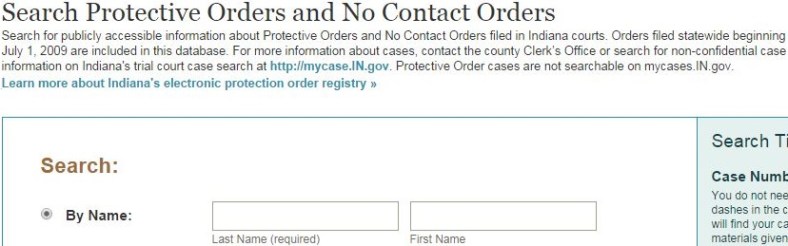
Here, for example, is what Indiana’s registry website looks like:

Every Indianan who’s been issued a “protective order” or “no contact order” since July 1, 2009 is recorded in this registry, including the ones whose cases were dismissed, that is, even those found “innocent” of the allegations against them are “outed” as having been accused of stalking, perhaps, or domestic violence or sexual assault. Browsers’ imaginations are free to take wing.

This search engine is simple to use. A restraining order recipient’s employer, landlord, student, client, patient, neighbor, girl- or boyfriend, etc. can perform a search in seconds—and as the headnote helpfully explains, “more information about cases” can be obtained by contacting the county clerk’s office.

Consider for a moment what the justification for a database like this could be. It doesn’t do anything to “protect” the plaintiffs of restraining orders. Therefore the justification must be to “protect” the public. Implicit then in the existence of such a database is that restraining order defendants are “dangerous.” Recall the basis upon which the determination of “dangerousness” was formed in the first place: a five-minute interview. Appreciate, too, that a restraining order recipient registered in a database like this may have been condemned for text messaging someone who resented the contact. And, as should go without saying, s/he may have been condemned on completely false allegations.

A process that’s highly prejudiced and answerable to no oversight is also highly punitive. Restraining order defendants are implicated according to kangaroo procedures whose rulings their noses are then rubbed in everlastingly.

Defendants often have mere days to respond to restraining orders, which can make procuring an attorney’s aid impossible even if defendants grasp the need for representation and can afford to shell out a few thousand at the drop of a hat. Appeals hearings, moreover, may be 30 minutes or less in duration (and only half that time is afforded to defendants’ testimony).

The process is a lock, but rulings are represented as the products of diligence and deliberation—and the public takes those rulings seriously, rulings that Indiana legitimates and publishes in a conveniently accessible database.

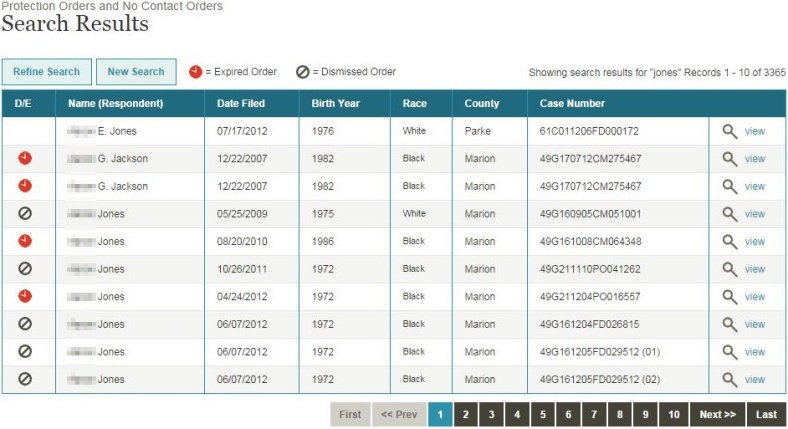
Here’s what returns look like if you simply enter the last name Jones into Indiana’s registry search engine:

Only half of the orders on the first page this search pulled up were actually finalized. The other half were tossed—after previously having been approved. The judicial error rate reflected in this random sampling is 50%. This statistic’s economic ($) implications are disgraceful by themselves. If you further allow that some of the restraining orders that were upheld were cases of false allegations’ succeeding, then judicial error is the norm.

A few months ago, a friend joked to me that her daughter (a smart cookie) had researched her teachers’ criminal records to use as leverage in the event of a grade crisis.

Arizona, blessedly, doesn’t yet have a nifty resource like Indiana’s for teenaged blackmailers to mine.

Copyright © 2014 RestrainingOrderAbuse.com

A Circle of Moms Reports on False Allegations to CPS (and Says the Same Things That Father’s Groups Say about the Abuse of Restraining Orders and Domestic Violence Laws)

Here’s a group of women on a forum for mothers with school-aged kids responding to a conversational prompt that deserves the attention of those who believe false allegations made out of spite are rare and that the report of such allegations is overblown and only originates from father’s rights groups (or what one notable polemicist calls “FRGs”).

Has someone ever called CPS on you out of spite? Have you called on someone? Why?

Not surprising to this writer, a number of respondents commented in the affirmative. Also worthy of note in this context is that the site FightCPS.com is authored by a woman.

Here are a few of the topmost comments on the Circle of Moms thread:

Yes, twice I’ve had CPS called on me out of spite. Both times a social worker came to my house. I had nothing to hide, so I let them in and they both said, “I can’t tell you who called us, but I can tell you this is absolutely ludicrous for us to even come to your house, because we can’t find a single thing wrong. Sounds like a false allegation to me.” I was like, “I know, right. Thank you.” They couldn’t tell me who called, but I already knew who was behind it. The person who did it was just mad because I wouldn’t pay them money I didn’t even owe! This person was my babysitter, who is the most manipulative, money hungry witch. I just didn’t know it until now.

[M]y mom and sister have been calling and making false accusations about me ever since I told them they’re not my children’s mom—I am. They thought they were just going to tell me how to [rear my] kids, and I told them both, sorry about your luck, I’m their mom, and that’s final. I’ve never gotten a break from CPS since. Especially because my mom didn’t raise us—we did ourselves. And then she thought she was going to take mine and my husband’s first daughter and raise her as her [own] to try to fix mistakes that couldn’t be fixed. UH-UH, she wasn’t getting my daughter. Not till she called my sick, demented sister in to plot against me for 16 years and stole my life, my soul, my heart, my babies. Don’t trust no one.

The person [who] called them on me and my two children knew my mom was very sick and did not have much time to live. My mom died four days ago. Six days before she died, CPS came out. The person who called them on me wanted to add even more pain to my life—and fear. I went and picked up the report. It said [no] on every one of the allegations. I think CPS should let you know who called so you can file a lawsuit. I mean, if they do not do anything, then we should have a choice. We should have the right to know so we can stay away from those who called on us. It should be up to us to tell CPS to press charges or let us do it ourselves, and if we do not know who did call, then we have not got the right kind of privacy or peace throughout our lives.

According to a brochure published by the U.S. Department of Health and Human Services’ Children’s Bureau:

Approximately 29 States carry penalties in their civil child protection laws for any person who willfully or intentionally makes a report of child abuse or neglect that the reporter knows to be false. In New York, Ohio, Pennsylvania, and the Virgin Islands, making false reports of child maltreatment is made illegal in criminal sections of State code.

Nineteen states and the Virgin Islands classify false reporting as a misdemeanor or similar charge. In Florida, Illinois, Tennessee, and Texas, false reporting is a felony, while in Arkansas, Illinois, Indiana, Missouri, and Virginia, second or subsequent offenses are upgraded to felonies.

In Michigan, false reporting can be either a misdemeanor or a felony, depending on the seriousness of the alleged abuse in the report. No criminal penalties are imposed in California, Maine, Montana, Minnesota, and Nebraska; however, immunity from civil or criminal action that is provided to reporters of abuse or neglect is not extended to those who make a false report.

Eleven States and the Virgin Islands specify the penalties for making a false report. Upon conviction, the reporter can face jail terms ranging from 90 days to 5 years or fines ranging from $500 to $5,000. Florida imposes the most severe penalties: In addition to a court sentence of 5 years and $5,000, the Department of Children and Family Services may fine the reporter up to $10,000. In six States, the reporter may be civilly liable for any damages caused by the report.

Based on the anecdotal reports in the referenced Circle of Moms thread, consider how likely it is any of the reported mischief was ever prosecuted. This kind of sniping, which is impossible to fend off, exactly corresponds to that perpetrated by abusers of the restraining order process, which is also exempted from the exacting standards of police and judicial scrutiny that are supposed to be applied when allegations have criminal overtones or can lead to serious privations or criminal consequences.

The women responding in this forum aren’t “anti-feminists,” and they’re certainly not motivated to report malicious exploitation of state process because they’re “for” child abuse: They’re moms.

Yet despite that under the Violence Against Women Act (VAWA), billions of dollars have been invested over the past 20 years toward conditioning authorities and the courts to take allegations of violence and abuse on faith, when fathers allege identical exploitation of restraining orders and domestic violence laws according to the spiteful motives alleged by the mothers cited in this post, they’re dismissed as cranks by feminists and their partisans.

Disinterested parties and feminist sympathizers are urged to recognize that if mothers and fathers are saying the same things, then the claim that allegations of procedural abuses are nothing more than the baseless rants of angry men is flatly wrong.

Copyright © 2014 RestrainingOrderAbuse.com

Facts and Fairness: Using Arizona’s Policies to Expose Restraining Order Iniquity

I live in Arizona where I was issued a restraining order in 2006 petitioned by a woman I nightly encountered hanging around outside of my house. The restraining order said I was a danger to her husband and shouldn’t be permitted to approach or talk to him.

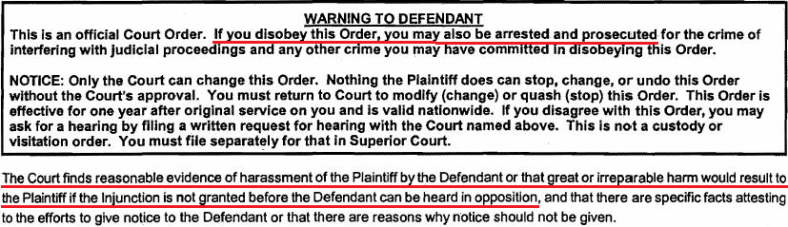
If you receive a restraining order in my home state, here’s the first thing that greets your eye:

On the basis of the form this warning captions—which looks like it was drafted by someone using a pizza crust as a straightedge—citizens are recorded in state and national police databases as stalkers and violent abusers.

Consider that the immediate impression this warning is meant to give is beware. It naturally excites fear—and if you’ve been falsely accused, a host of other emotions, besides, none of which conduces to calm and lucid thinking.

Something you wouldn’t guess from this “Warning to Defendant” is that if a defendant “disagrees” with an order issued in Arizona, s/he has the statutory right to apply for an appeals hearing at any time during the order’s effectiveness. For example, if the duration of the order is one calendar year, the defendant can take 11 months to assemble his or her appeal and save up, if necessary, to have an attorney represent that appeal.

Here’s the law:

At any time during the period during which the injunction is in effect, the defendant is entitled to one hearing on written request. No fee may be charged for requesting a hearing. A hearing that is requested by a defendant shall be held within ten days from the date requested unless the court finds compelling reasons to continue the hearing. The hearing shall be held at the earliest possible time. An ex parte injunction that is issued under this section shall state on its face that the defendant is entitled to a hearing on written request and shall include the name and address of the judicial office where the request may be filed. After the hearing, the court may modify, quash or continue the injunction.

The statute says the court’s order must inform the defendant that s/he’s entitled to a hearing, but it doesn’t require that the order inform the defendant that s/he has a year (or possibly years) in which to prep and apply for that hearing, that the hearing is free, or that the defendant may be represented by an attorney.

Restraining orders are rhetorical psych-outs. Their language is overtly menacing, and neither the law nor the issuing courthouse gives any consideration to apprising defendants of their rights.

The stress is on apprising defendants, who are presumed to suck (sight unseen), of what rights they’re no longer deemed worthy of.

Appreciate that the court’s basis for issuing the document capped with the “Warning” pictured above is nothing more than some allegations from the order’s plaintiff, allegations scrawled on a form and typically made orally to a judge in four or five minutes.

In the courthouse where the order issued against me was obtained, restraining order petitioners file into a room like a small bus station terminal, submit their applications, wait for an audience with a judge, chat with him or her for a few minutes, and leave.

That’s it.

Consequences of receiving an order of the court whose merits are determined on this basis include registration in state and national law enforcement databases, and may also include loss of entitlement to home, children, and possessions, and loss of employment.

In contravention of due process, orders are issued against defendants that may deny them liberties and property without the court’s hearing from them at all.

Ever.

In Arizona, unless a defendant requests a hearing before a judge, that’s an end on the process. No judge will even have learned what s/he looks like, and the truth of the plaintiff’s claims will never have been controverted—claims, to reiterate, that were made in a few minutes and could include anything from annoyance to physical or sexual violence.

Such claims often amount to nothing more certain than finger-pointing.

(Docket time afforded by the court to the testimony of defendants who go to the trouble of appealing rulings based on such claims, incidentally, is about 15 minutes. The cost of attorney representation at an appeals hearing may be $2,000 to $5,000.)

The only provision the law or the court makes for discouraging false testimony (some motives for which are here) is this one, which predictably appears at the very end of the application form:

The plaintiff signs below.

Applicants aren’t of course told what “perjury” is, and they’re certainly not told it’s a felony crime that carries a prison term (as it is and does in Arizona and many other states). Lying to the court is never sanctioned or prosecuted, anyway.

Recent posts on this blog were answers to dismissal by a doctor of laws of criticisms that the restraining order process is unfair. The process would have to be far more deliberative than it is, in fact, to be merely “unfair.”

The process is automated.

Copyright © 2014 RestrainingOrderAbuse.com

Battering Women to Protect Battered Women: Using Massachusetts’s Policies to Examine Restraining Order Publicity and Its Damages

“In the event a Restraining Order is issued for any period of time (initial 10 days or subsequent extension/dismissal), you will be listed in the statewide Domestic Violence Registry system. This could impact your ability to obtain or maintain employment in government, law enforcement, certain medical fields, or social services, or to work with/coach children. Impoundment of the restraining order does not expunge your listing on the statewide domestic violence registry, as certain government agencies and private companies with significant government contracts still have access to the registry system.”

—“Massachusetts Restraining Orders Procedure and Ramifications

I’ve just been corresponding with a Florida woman named Ally who had a domestic violence (209A) protection order petitioned against her in Massachusetts alleging she was a danger to a former boyfriend (these kinds of instruments can be obtained by plaintiffs who don’t even live in the same state or country as their defendants).

Ally contends the allegations against her are false and has been living in hell for over a year.

She’s surviving day to day and can’t afford to procure the services of an attorney. Ally’s trying to defend herself and clear her name with no money and from another time zone. She’s preparing a motion on her own (very possibly ill-fated) to request that the order against her be expunged, because it has ruined her employability.

Note: As the epigraph explains, even were Ally to succeed in having the order simply dismissed (which is itself unlikely), she would still remain registered as a domestic abuser.

From a draft of Ally’s “Motion to Expunge”:

Defendant was refused jobs, [is] not allowed to attend [or] volunteer [at] her daughter’s school events, [and has had] numerous other rights taken away due to Plaintiff’s Abuse of Process and Fraudulent Allegations and written Affidavit to the Court. This continues today.

Note: To successfully combat prosecutions like this requires money…which prosecutions like this prevent their defendants from earning.

A recent post on this blog observed the court’s schizophrenic regard toward restraining orders. On the one hand, they’re viewed by judges as urgent, potentially life-or-death matters; on the other hand, they’re viewed as inconsequential as long as defendants mind their prohibitions for the prescribed period of time.

Ignored is that adjudications both initiated and finalized in minutes yield rulings that are entered into state and national law enforcement databases indefinitely. Orders become “inactive” once they expire, but they don’t disappear. A woman like Ally remains for the rest of her life marked as a perpetrator of domestic violence.

In contrast—and the contrast is a telling one—consider this excerpt from a “Memoradum” issued by the Massachusetts Supreme Court last year on “Internet Dissemination of Personal Protection Order Information.”

As transparency and improved access remain court goals, it is important that we not unknowingly or unintentionally release victims’ personally identifiable information through the Internet, recognizing that this information is easily accessed and that access to such information could be dangerous to victims. Additionally, it has been brought to our attention that current federal law prohibits providing information over the Internet about personal protection orders (PPOs) that would be likely to reveal the identity or location of the petitioner (“PPO Information”).

18 USC 2265(d)(3) states:

A State, Indian tribe, or territory shall not make available publicly on the Internet any information regarding the registration, filing of a petition for, or issuance of a protection order, restraining order, or injunction in either the issuing or enforcing State, tribal or territorial jurisdiction, if such publication would be likely to publicly reveal the identity or location of the party protected under such order. A State, Indian tribe, or territory may share court-generated and law enforcement-generated information contained in secure, governmental registries for protection order enforcement purposes.

The privacy of restraining order plaintiffs (who are nominated “victims”) is to be tightly guarded.

Note: Based on “determinations” formed in minutes and possibly based on nothing more substantial than accusation, a plaintiff is deemed a “victim” whose identity and privacy must be protected, and the defendant is deemed a “violent threat” whose privacy is accordingly due no consideration. After the term of the restraining order has flown, the “danger” to the accuser is assumed to have been resolved, but the accuser continues to enjoy anonymity while the accused must go on bearing the implications of the restraining order for the rest of his or her life, exactly as if those implications were a criminal sentence.

Only in the recent past, in fact, did it even become possible to remove a Massachusetts restraining order defendant’s name from the domestic violence registry if it were found that allegations against him or her were substantially or totally false. (Remember that such allegations are made ex parte in the time it takes to place an order at McDonald’s.)

Until recently, it was almost impossible to expunge a person’s record with the domestic violence registry once the initial entry was made. In the 2006 case of Commissioner of Probation v. Adams, it was recognized that a judge has the inherent authority to expunge a record of an abuse [from the] violence registry system in the rare and limited circumstance that the judge finds the order was obtained through fraud on the court.

Note: The phrase rare…circumstance (of fraud) is emphasized in the original document quoted above (“Massachusetts Restraining Orders Procedure and Ramifications”), which was authored by an all-female law firm (Mavrides Law of Boston). Allegations of rampant restraining order misuse in Massachusetts have actually been the subject of press coverage and at least one law review monograph, and one of the most outspoken critics of restraining orders, attorney Gregory Hession, practices in Massachusetts and has for many years reported that restraining orders are “out of control.”

The previous two posts on this blog were responses to allegations that those who criticize restraining orders and domestic violence laws are “opposed to the battered women’s movement.” Defenders of these laws are urged to ask themselves how Ally’s wanting to be able to provide for her daughter and one day attend her daughter’s graduation has anything to do with battered women at all.

They’re also urged to ask themselves how denying Ally these opportunities isn’t itself an act of brutality.

Copyright © 2014 RestrainingOrderAbuse.com

Responding to a Feminist Professor Kelly Behre’s Perspectives on Men’s Rights Activism

Since the publication of this post, the “research paper” it responds to has been removed from the Internet.


“I had a false allegation of domestic violence ordered against me on June 19, 2006. It was based on lies, but the local sheriff’s office and state attorney’s office didn’t care that he was a covert, lying narcissist. I doubt they ever heard of the term, in fact. I made the mistake of moving back in with him in September 2008.

“Last year, on July 23, 2013, he, with the help of his conniving sister, literally abandoned me. Left me without transportation and tried to have the electricity cut off. However, the electric company told him it was unlawful to do so. I am disabled, because of him, and have been fighting to get my life, reputation, and sanity restored. It has been over a year, and while life goes on for him, I am still struggling from deep scars of betrayal, lies, and his continued smear campaign against me.

“I thank you for the opportunity to speak out and stand with other true victims of abuse. You see, it isn’t just women who abuse the system, but men, as well.”

—Female e-petition respondent (August 30, 2014)

Contrast this woman’s story with this excerpt from a UC Davis Law Prof. Kelly Behre’s 2014 research paper:

At first glance, the modern fathers’ rights movement and law reform efforts appear progressive, as do the names and rhetoric of the “father’s rights” and “children’s rights” groups advocating for the reforms. They appear a long way removed from the activists who climbed on bridges dressed in superhero costumes or the member martyred by the movement after setting himself on fire on courthouse steps. Their use of civil rights language and appeal to formal gender equality is compelling. But a closer look reveals a social movement increasingly identifying itself as the opposition to the battered women’s movement and intimate partner violence advocates. Beneath a veneer of gender equality language and increased political savviness remains misogynistic undertones and a call to reinforce patriarchy.

The professor’s perceptions aren’t wrong. Her perspective, however, is limited, because stories like the one in the epigraph fall outside of the boundaries of her focus and awareness (and her interest and allegiance, besides).

What isn’t appreciated by critics of various men’s rights advocacy groups is that these groups’ own criticisms are provoked by legal inequities that are inspired and reinforced by feminist groups and their socially networked loyalists. These feminist groups arrogate to themselves the championship of female causes, among them that of battered women. Feminists are the movers behind the “battered women’s movement.”

Those who criticize unfair laws and policies that purport to protect battered women are not “pro-domestic violence”; they’re anti-injustice, which may well mean they’re anti-feminist, and this can be construed as “opposition to the battered women’s movement.” The opposition, however, is to what the feminist movement has wrought. No one is “for” the battery of women or “against” the protection of battered women.

To put this across in a way a feminist can appreciate, to believe women should have the right to abort a fetus is not the same thing as being “pro-abortion.” No one is “for” abortion, and no one is “for” domestic violence. (“Yay, abortion” is never a sign you’ll see brandished by a picketer at a pro-choice demonstration.)

The Daily Beast op-ed this excerpt is drawn from criticizes a group called “Women Against Feminism” and asserts that feminism is defined by the conviction that “men and women should be social, political, and economic equals.” If this were strictly true, then inequities in judicial process that favor female complainants would be a target of feminism’s censure instead of its vigorous support.

The “clash” the professor constructs in her paper is not, strictly speaking, adversarial, and thinking of it this way is the source of the systemic injustices complained of by the groups she targets. Portraying it as a gender conflict is also archly self-serving, because it represents men’s rights groups as “the enemy.” Drawing an Us vs. Them dichotomy (standard practice in the law) promotes a far more visceral opposition to the plaints of men’s groups than the professor’s 64-page evidentiary survey could ever hope to (“Oh, they’re against us, are they?”).

The basic, rational argument against laws intended to curb violence against women is that they privilege women’s interests and deem women more (credit)worthy than men, which has translated to plaintiffs’ being regarded as more “honest” than defendants, and this accounts for female defendants’ also being victimized by false allegations.

(Women, too, are the victims of false restraining orders and fraudulent accusations of domestic abuse. Consequently, women also lose their jobs, their children, their good names, their health, their social credibility, etc.)

The thesis of the professor’s densely annotated paper (“Digging beneath the Equality Language: The Influence of the Father’s Rights Movement on Intimate Partner Violence Public Policy Debates and Family Law Reform”) is that allegations of legal inequities by men’s groups shouldn’t be preferred to facts, and that only facts should exercise influence on decision-making. This assertion is controverted by the professor’s defense of judicial decisions that may be based on no ascertainable facts whatever—and need not be according to the law. The professor on the one hand denounces finger-pointing from men’s groups and on the other hand defends finger-pointing by complainants of abuse, who are predominately women.

In the arena of law this post concerns, the courts typically follow the dictum that the person pointing the finger is right (and this person is usually female). In other words, the courts judge allegations to be facts. In many instances, what’s more, state law authorizes this formulation. It grants judges the authority “at their discretion” to rule according to accusations and nothing more. Hearsay is fine (and, for example, in California where the professor teaches, the law explicitly says hearsay is fine). The expression of a feeling of danger (genuinely felt or not) suffices as evidence of danger.

The professor’s defense of judicial decision-making based on finger-pointing rather undercuts the credibility of her 64-page polemic against decision-making based on finger-pointing by men’s groups that allege judicial inequities. The professor’s arguments, then, reduce to this position: women’s entitlement to be heeded is greater than men’s.

The problem with critiques of male opposition to domestic violence and restraining order statutes is that those critiques stem from the false presuppositions that (1) the statutes are fair and constitutionally conscientious (they’re not), (2) adjudications based on those statutes are even-handed and just (they’re not), and (3) no one ever exploits those statutes for malicious or otherwise self-serving ends by lying (they do—because they can, for the reasons enumerated above).

Attorneys acknowledge procedural abuses are common.

Many critiques of men’s, father’s, and children’s rights groups fail to even recognize that motives for lying exist. What presupposition underlies this? That everyone’s an angel? If everyone were an angel, we wouldn’t need laws at all. Or is the presupposition that women are angels? A woman should know better.

A casual Google query will turn up any number of licensed, practicing attorneys all over the country who acknowledge restraining orders and domestic violence laws are abused and offer their services to the falsely accused. Surely the professor wouldn’t allege that these attorneys are fishing for clients who don’t exist—and pretending there’s a problem that doesn’t exist—because they, too, are part of the “anti-battered-women conspiracy.”

The professor’s evidentiary pastiche is at points compelling—it’s only natural that a lot of rage will have been ventilated by people who’ve had their lives torn apart—but her paper’s arguments are finally, exactly like those they criticize, tendentious.

It’s obvious what the professor’s “side” is.

(She accordingly identifies her opposition indiscriminately. For example, the blog you’re right now reading was labeled the product of a father’s rights group or “FRG” in the footnotes of the professor’s paper. This blog is authored by one person only, and he’s not a father. Wronged dads have this writer’s sympathies, but this blog has no affiliation with any groups.)

The professor carefully prefaces her points with phrases like “Researchers have noted,” which gives them the veneer of plausibility but ignores this obvious question: where do the loyalties of those “researchers” lie? The professor cites, for example, the Southern Poverty Law Center’s equation of SAVE Services with a hate group. An attentive survey of SAVE’s reportage, however, would suggest little correspondence. The professor doesn’t quote any of SAVE’s reports; she simply quotes an opposing group’s denunciation of them as being on a par with white supremacist propaganda.

(What the professor does quote are some statistics generated by SAVE that she contends are dubious, like estimates of the number and costs of false and frivolous prosecutions. Such estimates must necessarily be speculative, because there are no means of conclusively determining the degree or extent of false allegations. Lies are seldom if ever acknowledged by the courts even if they’re detected. This fact, again, is one that’s corroborated by any number of attorneys who practice in the trenches. Perjury is rarely recognized or punished, so there are no ironclad statistics on its prevalence for advocacy groups to adduce.)

Besides plainly lacking neutrality, insofar as no comparative critical analysis of feminist rhetoric is performed, the professor’s logocentric orientation wants compassion. How much of what she perceives (or at least represents) as bigoted or even crazy would seem all too human if she were to ask herself, for instance, how would I feel if my children were ripped from me by the state in response to lies from someone I trusted, and I were falsely labeled a monster and kicked shoeless to the curb? Were she to ask herself this question and answer it honestly, most of the outraged and inflammatory language she finds offensively “vitriolic” and incendiary would quite suddenly seem understandable, if not sympathetic.

The professor’s approach is instead coolly legalistic, which is exactly the approach that has spawned the heated actions and language she finds objectionable.

Copyright © 2014 RestrainingOrderAbuse.com

“The PPO Destroyed My Career”: Grant’s Story of Restraining Order Abuse

Grant Dossetto has a degree in finance he can’t use.

That’s because a personal protection order (PPO) was petitioned against him in 2010 by a friend, and the law mandates that all restraining order recipients be registered in the FBI’s National Crime Information Center (NCIC) database—indefinitely.

The Securities and Exchange Act of 1934 requires those working in my field to be fingerprinted and to submit that to the FBI national database. This is on top of normal background checks, disclosure of any and all charitable donations as well as political donations, etc. Ironically we don’t have to pee in a cup for a drug test, but everything else goes well beyond that which my engineering friends et al. have been subjected to. I went to the Livonia police department and had my prints pressed in ink the old fashioned way on the standard card to be delivered to my employer by my first week of employment. The card then was supposed to find its way to the proper regulatory authorities before getting passed through the system.

A month after I began work at the brokerage, I was called by my boss after hours and told to mail back in my key. He fired me while out of town over the phone.

Grant is 27 years old, and he can never realize his ambition to be a stockbroker.

To this day, I have never been sponsored to get my licenses, and I am sure I never will. I can pass the CFA [to become a chartered financial analyst] but cannot take an order for a trade. The PPO destroyed my career.

Though his mother lived to see him earn his degree with honors in 2009, neither of Grant’s parents will ever know that their investment in their son’s success was betrayed or that his professional aspirations were dashed, because they’ve passed away.

When my father had a heart attack, I was just 14 years old. He passed in his sleep. Before my mom had dragged him off to bed, he had fallen asleep in my room while we were watching TV together and drooled on my pillow. When he didn’t wake the next morning, I can remember opening his mouth to try to resuscitate him and seeing how his tongue was already blackened from lack of oxygen. It was the first time I had to let in an EMT through the wide double front doors to go through the motions to tend to someone who was already gone.

Grant’s mother died in 2010 just days before Grant got word of the court order that identified him as a threat to the safety of a woman he hadn’t even seen in over a year.

I was celebrating a birthday party with my twin brother. He had just been commissioned as an artillery officer in the Marine Corps and was heading to Fort Sill in Oklahoma for training in a couple weeks, so it was a going away party as well. It ended with me carrying my mom up from the bottom of the stairs that led to the basement, blood trickling from the back of her head. She had had a stroke bringing up a food tray and collapsed. The right hemisphere of her brain immediately ceased all activity. I got to stand over another pair of EMTs, this time dabbing her eyes with a tissue. The pupils, fully dilated, failed to show any reaction. She maintained enough brain function to throw up, trying to recover from the worst concussion you could imagine, but by the next day a second opinion came back that she could not survive. My brother and I pulled the plug and held her hand until she forgot to breathe on her own. It took less than a half hour. It was a brilliantly sunny Michigan May day, those days that make suffering through the gray winter worth it. It’s hard to imagine something more at odds with how I felt.

Grant learned a protection order had been issued against him two days later. Notice of it was waiting for him upon his return from the funeral home in the form of a business card a sheriff handed his stepdad.

In Grant’s home state of Michigan, this qualifies as service. No copy of the order was ever provided to him.

I called the sheriff back, and he went through what I would later come to find out was the front page of the order. He asked me to drive to downtown Detroit, a half hour away, to be served the order. Seeing as I had seven hours of funeral activities in a day and a half, I told him that would be impossible. He said he’d mail it to me. I was never notified that I had just days to appeal or given an explanation of the consequences of the order. The order was never mailed to me. I tried twice to notify the officer that I had not received the PPO. He brushed it off once, and the second call went to voicemail and was never returned.

Grant was denied the opportunity to defend himself in court against an accuser he hadn’t even been in physical proximity to.

The last thing I had said to her was that my mom had died, and I was giving the eulogy at the funeral and would like her there even though we had our differences. The order had been issued ex parte, which requires the court to classify me as an immediate threat who will cause imminent and irreparable damage, per Michigan law. I did not meet those criteria. The hearing was held without my knowledge or participation.

No surprise, Grant has “suffered from severe depression that still surfaces at times now.” His case exemplifies the justice system’s willingness to compound the stresses of real exigencies like family crises with false exigencies like nonexistent danger.

My grandparents were going through their own personal troubles. One had emergency quadruple bypass surgery and is suffering from dementia. One was declared terminal and hung on for two and a half years as his kidneys shut down until he was also unable to tell reality from fiction. One had a hip replacement turn into a seven-surgery odyssey that involved a severe staph infection that ravaged her for most of a year. She needed over 50 blood transfusions over that period and has just recovered from fatigue in the past 12 months. I got a lifetime of bad news I couldn’t control in a couple years, and it took its toll on me.

The order of the court that turned Grant’s career path into a blind alley was petitioned by a woman whose own prospects, Grant says, declined during his senior year of college.

We enjoyed movies, card games (she cheats at euchre), parties, went to school football and hockey games. She sought me out in the parking lot of the campus church and asked me to sit with her at mass. I can’t think of an act of friendship much more intimate than that. When we were close, she was on the dean’s list.

I had been friends with her from September, sophomore year of college until midway through my senior year. In a month, I went from being someone she talked to on Facebook at one in the morning and publically said she loved to being accused of felony property damage—tire-slashing, in particular.

She had gotten involved with a bad crowd, joined a terrible varsity team at school. In April of my junior year, she asked a mutual friend of ours to do cocaine—not exactly something a happy person says. The next fall, I heard about how her parents didn’t give a damn about her, and in November she called my roommate and me over only to snap at us until she kicked us out just before 10 to take a tablespoon of Nyquil that would force her to sleep. She also talked about how she had been getting dizzy and suffering from vertigo, which got her a prescription medication. A doctor had said it was iron deficiency. I can tell you from personal experience it was stress. Her grades slipped to C’s.

This letter of encouragement represents the “misconduct” of Grant’s that his accuser and the court deemed evidence of “imminent” and potentially “irreparable” harm. The letter ends, “Do what you were meant to do. Be the person you were meant to be.”

As Grant charts his relationship, he urged his friend to make “wholesale changes” and was punished for his concern. “I was sharp,” he says, “but only after I had exhausted every other option.”

Houghton is a small town—population around 10,000—and our school has an undergrad student body of about 6,000. Wal-Mart and not much else is a big deal there as the copper and iron mines shut down decades ago driving out industry and families with it. Not surprisingly, we saw each other a lot the second half of my senior year. I saw her at the gym, had class in an adjacent room two days a week, she worked next door to my lab twice a week, and I worked in the same building as her lab.

I stopped by her house because it was a bad situation given the fact the last thing she had said to me were criminal allegations. We talked for hours, getting along enough that I sincerely believed we had patched things up. She was still miserable, though. One thing got her to brighten up like the girl I first became friends with, and that was a goal to go to med school, a reasonable one for a biomedical engineer.

I invited her out to the movies with my housemates whom she was friends with. I said she should come to the surprise birthday party I was helping to throw for a mutual friend. I tried to get her back to the group she was successful with. For that I got another round of false allegations (destroying the front quarter panel of her car).

When a protection order was issued against Grant in 2010, he hadn’t seen his accuser in over a year. The sheriff who notified him of the order “essentially told [him he] had been contacting her, and now [he] couldn’t.” Grant only got a look at the order that he was never served this month (four years later).

The first time I saw it was two weeks ago. It is a permanent file in the Macomb County Courthouse, file #10-2184-PH. I was marked a threat by my government without me present or ever having physical possession of the order. There is no way for me to have the order removed.

Grant’s former friend, the petitioner of the protection order, had gotten a job after college that apparently hadn’t worked out and returned home. In 2013, the office Grant worked in was slated to relocate near her (in a town of 10,000 residents).

I texted her, because I knew that was a problem. Given what she sent back, I replied that I was going to have to seriously consider leaving my job unless I got assurances from her this wouldn’t be an issue.

Grant received actual threats from the family of his accuser but says he has never considered applying for a protection order himself.

Grant’s texts instead inspired his accuser to dash to the nearest courthouse all over again.

In April 2013, she filed another PPO against me even though I had not seen her in over four years. I had made no attempt to try and meet up with her. It was also issued ex parte, probably because of the first one. She began texting me less than three days after it had taken effect and didn’t show up to the appeals hearing that I scheduled. I missed parts of three days of work to fight an order that she didn’t even feel like defending. In two weeks, the same court, Wayne County this time, ruled against me then for me.

What Grant means is the same court that deemed him a “threat” (sight unseen) was content to consider him benign a couple weeks later just because the protection order petitioner didn’t make a follow-up appearance. His observations underscore the cattle-call nature of restraining order adjudications that readily implicate defendants as criminal menaces but may just as readily conclude they’re harmless and send them home.

Mine was not the only PPO to be overturned—far from it—and the entire docket (about 12 cases) was decided in less than 30 minutes after we waited over an hour for the judge, who was late. Is that justice? How can I ever respect the courts again?

The same orders Grant says were summarily dismissed had just as summarily been approved days or weeks earlier. Restraining orders are typically rubber-stamped upon a few minutes’ “deliberation.”

I sued her after that. In her response to my complaint, she admitted that I had never done anything illegal. You wouldn’t know that by my public record.

Grant dropped the lawsuit, which communicated that he wouldn’t tolerate further prosecutions. The 2010 PPO remains on his record, however, and the stain not only galls him but has derailed his life.

The judge who issued the 2010 order, James Biernat, Sr., is famous for presiding over the “Comic Book Murder” case. It was big enough to make Dateline and the other true crime outlets. He overturned a guilty conviction from a jury and demanded a retrial. The action was extraordinary, held up on appeal by a split decision. The Macomb prosecutor publically rebuked him as being soft on crime. That made national news. All the cable outlets covered the second trial, which yielded the same result: guilty. He was rebuked by two dozen jurors, three appellate justices, and the prosecutor. It’s funny, if he had just given me a hearing, let alone a second, I truly believe a PPO would never have been issued.

A questionable judge who is soft on guilty murderers didn’t have a problem destroying a 23-year-old he had never met for non-threatening, legal contact. How could you not believe that the system is hopelessly broken?

Copyright © 2014 RestrainingOrderAbuse.com

Since this writing, Grant has channeled his thwarted energies into creative writing and completed a novel, The Hopping Bird, which has been praised in Kirkus Reviews: “Harold Freeman enjoyed success as a player, which included a World Series championship, until it was cut short due to injury. His managerial career has not been as smooth, but that is all behind him as he takes the reins of the Toledo Mud Hens for the 2014 season. After a last place finish in the International League’s West Division a season ago, can he turn the team around?”

Connecticut Lawmakers Conclude Getting a Restraining Order Isn’t Easy Enough Already

Those victimized by liars who abuse restraining order and domestic violence laws often blame their judges. It’s natural. They’re the ones who deprive the wrongly accused of dignity, liberty, property, and family—and theirs are the words that echo in the memory and grate on the nerves during the empty hours.

Lawmakers it must be remembered, though, are the enablers.

Judges may be careless. They may even be cruel. But legislators are clueless.

To give an example, consider this story reported today in Hartford, Connecticut’s The Courant (August 25, 2014):

Domestic violence victims need to have a simpler process of applying for restraining orders and better communication with the agencies that handle them, a legislative subcommittee said Monday.

To that end, the subcommittee of the task force on restraining orders agreed to recommend a streamlined version of restraining order applications and an accompanying checklist to pave the way for better communication among victims, marshals and courts.

The Connecticut legislature purposes to make simpler yet a process that’s already so “streamlined” that accusers don’t have to prove anything.

CONN. GEN. STAT. ANN. § 46b-15(b): “The court, in its discretion, may make such orders as it deems appropriate for the protection of the applicant and such dependent children or other persons as the court sees fit.… If an applicant alleges an immediate and present physical danger to the applicant, the court may issue an ex parte order granting such relief as it deems appropriate.”

This literally means that if a domestic partner merely alleges s/he feels in danger, which only takes a few seconds to do, the court is authorized to order the accused to be forcibly ejected from his or her home by armed agents of the state—even if the accused owns that home and has lived in it all of his or her life. In other words (again, for example), it’s entirely possibly for someone who has no home to move in with someone else, falsely accuse him or her of abuse, and for all intents and purposes seize possession of his or her home. Other obvious motives for lying are malice or gaining custody of kids.

No evidence of anything is required by the law, which is a blank check that authorizes accusers to say whatever they feel like and judges to do whatever they feel like.

Members of the legislative subcommittee referenced in The Courant article reportedly expect to improve their understanding of the flaws inherent in the restraining order process by taking a field trip. They plan “a ‘ride along’ with the representative of the state marshals on the panel…to learn more about how restraining orders are served.”

The urgent problem with restraining orders as they see it is ensuring that more of them are successfully delivered.

The article cites concerns expressed by the executive director of the Connecticut Coalition Against Domestic Violence “about the complicated process domestic violence victims face when they apply for restraining orders.”

The “complicated process” to have someone evicted shoeless from his or her home in the Connecticut winter and prohibited access to his or kids based on an allegation is filling out a form.

The Connecticut legislators “decided to remove the instructions in small print at the top of the form, which start with the outdated suggestion that the applicant ‘use a typewriter.’ Applicants will have access to a separate sheet of paper that has step-by-step instructions.”

Authorizing the court “in its discretion” to fill out orders “as it deems appropriate” would seem more expeditious and economical to this writer.

Copyright © 2014 RestrainingOrderAbuse.com

Schizo: How Judges Think about Restraining Orders

It’s often reported by recipients of restraining orders that the cops and constables who serve them recognize they’re stigmatizing.

Restraining order respondents receive court orders “around the corner” or in parking lots or other spots remote from prying eyes.

At the same time, restraining orders are dispensed by our courts as freely as supermarket circulars. They’re typically issued ex parte, which means judges never even meet the parties they’re issued against. Sometimes respondents never appear in court at all. They remain simply inked names on forms, despite the fact that the allegations made against them, which are matters of public record, may be grave.

Judges issue restraining orders and then wash their hands of them and expect them to just run their courses and evaporate. In accordance with the law, they don’t…ever. They’re permanent public records (in some states accessible by anyone, and in no states accessible by no one). They’re further entered into state and federal law enforcement databases (again, permanently).

Restraining orders cost people employment (and, in cases, employability in their chosen fields). They cost people leases. And they cost people their children, assets, social credibility, and health. These are serious consequences, and restraining orders are of course regarded seriously by anyone who learns of them—except, that is, officers of the court, who may regard them dismissively…after having regarded them as urgent, life-or-death matters.

“Obscure public records” is how some officers of the court think of restraining orders. In the age of the Internet, there are no such things. Many judges are in their 60s and 70s, however, and scarcely know the first thing about the Internet, let alone Twitter, Facebook, and YouTube. They’re still living in the days of mimeographs and microfiche.

The sternness that judges exhibit in the courtroom upon finalizing restraining orders may border on brutal. Irrespective of the allegations against them, all restraining order defendants are treated like villains. Yet though they’re often falsely accused, they’re expected to be unfazed by this treatment. Down the road, what’s more, if defendants seek damages, other judges who revisit their cases may express wonderment at what the big deal is.

“It’s only a restraining order.”

Copyright © 2014 RestrainingOrderAbuse.com

Preserving the Safety of Persecuted Cheerleaders: New Jersey’s Domestic Violence Restraining Orders Revisited

Whatever it is you thought you understood about the solemnity and significance of legal process and restraining orders, this story should disabuse you of it: “Parent-Suing Cheerleader Who Claimed ‘Ex-boyfriend Choked Her during Domestic Violence Incident’ Reaches Agreement to Drop Restraining Orders.”

What follows is the gist.

A high school cheerleader whose dad is a former chief of police had a boyfriend her parents disapproved of. The girl says her parents “threw her out” because of him; her parents say she left because she didn’t want to abide by their rules.

From her parents’ house, the 18-year-old moved into the home of an attorney. The attorney’s family then sued her parents on the girl’s behalf for child support and college costs, exciting press attention.

Then the girl got a domestic violence restraining order against her boyfriend, alleging he choked her during a spat (this is the same boyfriend her parents didn’t want her to see). Then the boyfriend got a domestic violence restraining order against her. Then both of them had their orders dismissed.

The two “independently reached the conclusion that they should enter their college years without having to worry about the possible consequences of having restraining orders on their respective records and that the actions that led to the filing of the complaints did not rise to the level of domestic violence.”

You may be thinking, does that mean judges in New Jersey approve restraining orders automatically? You may also be thinking, how nice everything got ironed out and how magnanimous of the court to acknowledge possible negative consequences to the futures of attractive (and ostensibly affluent) white teenagers and acquiesce to their wishes. Probably you’re not thinking, “I can totally identify.”

The girl dropped her lawsuit, too, reconciled with her parents, and moved back home. Her parents told USA Today “they decided not to interfere with their daughter’s love life anymore.”

The girl “graduated this spring and will be attending Western New England University as a biomedical engineering major in the fall on a $56,000 scholarship.”

No estimate to the tax-paying public of the costs incurred by the various prosecutions was reported.

Copyright © 2014 RestrainingOrderAbuse.com

Larry’s Story: Restraining Order Abuse and the Neighbor from Hell

“She habitually engages in psychological projection. She has caused me to be compelled under threat of arrest and prosecution for failure to appear to attend court on her frivolous lawsuits 25 times. Yes! Twenty-five times. The frivolous prosecutions started in 2011, and they are still raging. I have been cited back to court on her application for a new restraining order on the 12th and a criminal warrant for cyberstalking on the 17th of this month. She has tried so many times to have me jailed I have lost count.”

—Larry Smith, author of BuncyBlawg.com (2014)

The quotation above is an excerpt from an email sent to the creator of “Neighbors from Hell” on ABC’s 20/20. The Feb. 8 email was a sorely persecuted man’s response to being fingered on Facebook as a candidate for the series by his neighbor, Marty Tackitt-Grist, who has forced him to appear before judges nearly 30 times in the span of a few years to answer “two restraining orders, three show-cause orders, two cyberstalking arrests, and a failure-to-appear arrest and jailing despite faxes from two doctors that I was too crippled, disabled, and suffering from herniated discs to be able to attend court.”

Here’s the reply the email elicited from ABC’s Bob Borzotta: “Hi Larry, I don’t seem to have heard further from her.  Sounds like quite a situation….” Cursory validations like this one are the closest thing to solace that victims of chronic legal abuses can expect.

Concern shown by the police and courts to complaints from attention-seekers can make them feel like celebrities. Random wild accusations are all it takes for the perennial extra in life to realize his or her name in lights.

Not unpredictably, the thrill is addictive.

I think I first heard from Larry, the author of BuncyBlawg.com, in 2013—or maybe it was 2012. In the artificial limbo created by “high-conflict” people like the one he describes in the epigraph, temporal guideposts are few and far between. A target like Larry can find him- or herself living the same day over and over for years, because s/he’s unable to plan, look forward to anything, or even enjoy a moment’s tranquility.

The target of a high-conflict person is perpetually on the defensive, trying to recover his or her former life from the unrelenting grasp of a crank with an extreme (and often pathological) investment in eroding that life for self-aggrandizement and -gratification.

Among Larry’s neighbor’s published allegations are that he’s a disbarred attorney who “embezzled from his clients” and a textbook psychopath, that he has “barked like a dog for hours” to provoke another neighbor’s (imaginary) dog to howl at her, that he has called her names, that he has enlisted “mentally challenged adults” to harass her while shopping, that he has cyberstalked her, that he has “hacked into phones” and computers, that he has tried to cause her (and “many others”) to lose their jobs by “reporting false information,” that he has made false complaints about her “to every city, state, and county service,” that he sends her mail “constantly,” and that he has “mooned” her neighbors and friends.

The ease with which a restraining order is obtained encourages outrageous defamations like these (Larry’s neighbor has sworn out two). Once a high-conflict person sees how readily any fantastical allegation can be put over on the police and courts, s/he’s inspired to unleash his or her imagination. That piece of paper not only licenses lies; it motivates them.

Larry’s a quiet guy with a degenerative spinal disorder who’s been progressively going deaf for 25 years. He lives for his three toy poodles and watches birds. “I grew up,” he says, “in a little Arcadian valley here in western North Carolina with the nicest people, mostly farmers; and I guess my youth just left me naïve about some people. I always saw the good in them.” Larry began practicing law in 1973 in Asheville but voluntarily withdrew from the profession in 1986, because he was disgusted by the corruption—and the irony of having his retirement years fouled by that corruption isn’t lost on him.

You might guess his accuser’s motive to be that of a woman scorned, but Larry’s association with her has never exceeded that of the usual neighborly sort. He reports, however, that she has alleged in court that he covets her and nurses unrequited longings and desires.

Compare the details of the infamous David Letterman case, and see if you don’t note the same correspondence Larry has.
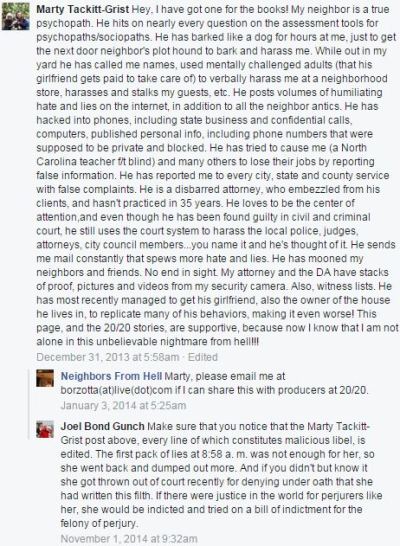
Marty Tackitt-Grist, Martha Tackitt-Grist, Larry Smith, North Carolina, ABC’s 20/20, Nasty Neighbors, Neighbors from HellThat’s the horror that only the objects of high-conflict people’s fixations understand. Stalkers and “secret admirers” procure restraining orders to get attention and embed themselves in other’s lives—like shrapnel.

This writer has been in and out of court for eight years subsequent to encountering a stranger standing outside of his residence one day…and naïvely welcoming her. One respondent to this blog reported having had a restraining order issued against her by a man she sometimes encountered by her home who always made a point of noticing her but with whom she’d never exchanged a single word.

It isn’t only intimates and exes who lie to subject targets to public humiliation and punishment. Sometimes it’s lurkers and passers-by, covert observers who peer between fence slats and entertain fantasies—or, as in Larry’s case, a neighbor who feels s/he’s been slighted or wronged according to metrics that only make sense to him or her.

Larry thinks the unilateral feud that has exploded the last several years of his life originates with his complaining about cats his neighbor housed, after they savaged the fledgling birds that have always been his springtime joy to watch.

For 25 years I have lived on this street with lovely people. We always got along, although one or two you had to watch. During most of that 25 years, there have been three different owners of the house across the street. The other two we dearly loved. The last one, the incarnation of purest evil, moved here in 2005. She was a divorcée who volunteered that her divorce was especially nasty, the first red flag which I foolishly disregarded: She constantly badmouthed her ex. For the first few years, we were friends, but as time went by she became an almost insufferable mooch and just way too friendly, expecting more attention from her neighbors, and from us, than we wanted to give. Sometime in early 2011, I left her a voicemail and told her I didn’t want to be close friends with her anymore. She was a hoverer, she manipulated, she was a narcissist. And the message meant that I did not want to be called on to mow her lawn anymore, or help her trim her trees, or lend her tools, or watch her pet while she was gone, or help her move heavy loads like furniture, or listen to her constant whining. I just wanted to cool it with her.

In the spring of 2011, she had been converting her home to a sort of boarding house and brought in tenants, and [between] them they had two cats that constantly prowled, especially the tenant’s. What became very irksome to me was the tenant’s cat creeping into our yard and killing our baby birds, which we always looked forward to in the spring. And the minute I brought it up with her, she pitched a fit, and so did the tenant. So for the first two months of baby bird season, [their] cats killed all our fledglings and the mother songbirds—wrens, cardinals, robins, mockingbirds, towhees, mourning doves, even the hummingbirds, just wiped them out. I finally got in touch with our Animal Services officers, but by that time bird season was over with, and you know something, [she] began going about telling neighbors that I was a disbarred lawyer (a particularly nasty slander). One thing led to another, and finally the tenant with the marauding cat moved away, but the irreparable damage was done, and all through the summer I had been warned by other neighbors that the neighbor from hell was plotting revenge.

I went to her one day and asked her if there was anything I could do to make it so we could at least drop all the nasty hostilities. She exploded. Next thing I knew, she had three police cruisers here with a false tale that I was “harassing” her and calling her names. This was no surprise, because early on I learned not to believe a thing she said because she just made up the most unbelievable tales about her personal crises. One of the five cops who came spoke with me in the yard, and I thought this would all blow over, but in a few days a process server was banging on the door with papers to serve me. I met him in a commercial parking lot nearby and accepted the lawsuit, an application for a restraining order, a TRO, and, well, a great big wad of lies. It was a shocker. And little did I know that the very day I received this horse-choking wad of papers, at around 10:15 a.m., [she] was back in the courthouse filing another affidavit to have me ordered to show cause why I should not be jailed for contempt. In other words, before I even had notice of the TRO, she was trying to have me jailed for violating it. That’s just how damn mean that woman is.

High-conflict people are driven by a lust to punish—any slight is a provocation to go to war—and their craving for attention can be boundless. Judicial process rewards both.
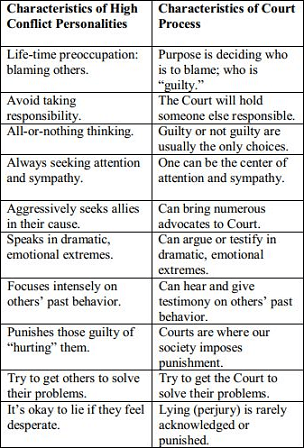
This table, prepared by attorneys Beth E. Maultsby and Kathryn Flowers Samler for the 2013 State Bar of Texas Annual Advanced Family Law Course, shows how high-conflict people and court process are an exquisitely infernal fit. Its authors’ characterization of high-conflict people’s willingness to lie (“if they feel desperate”) is generous. Many lie both on impulse or reflex and with deliberate cunning, though their chain of reasoning may be utterly bizarre.

Restraining orders are easily obtained, particularly by histrionic women. Once petitioners—especially high-conflict petitioners—realize how readily the state’s prepared to credit any evil nonsense they sputter or spew, and once they realize, too, the social hay they can make out of reporting to others that they “had to get a restraining order” (a five-minute affair), they can become accusation junkies.

Larry has responded in the most reasonable way he can to his situation. He’s voiced his outrage and continues to in a blog, and the vehemence of his criticisms might lead some who don’t know Larry to dismiss him as a crank. If you consulted his blog, you’d see it’s fairly rawboned and hardly suggests the craftsmanship of a technical wizard who can hack email accounts and remotely eavesdrop on telephone conversations. What the commentaries there suggest, rather, is the moral umbrage of an intelligent man who’s been acutely, even traumatically sensitized to injustice.

Here’s the diabolical beauty of our restraining order process. Judges accept allegations of abuse at face value and don’t scruple about incising them on the public records of those accused. They furthermore expect those who are defamed to pacifically tolerate public allegations that may have no relationship with reality whatever or may be the opposite of the truth, may be scandalous, and may destroy them socially, professionally, and psychologically. Judges, besides, make the accused vulnerable to any further allegations their accusers may hanker to concoct, which can land them in jail and give them criminal records. And finally judges react with disgust and contempt when the accused ventilate anger, which they may even be punished for doing.

Judicial reasoning apparently runs something like this: If you’re angry about false allegations, then they weren’t false; if you’re not angry about false allegations, then they weren’t false.

Larry’s been jailed, Larry’s been reported to the police a dozen times or more, an officer has rested the laser sight of her sidearm on him through the window of his residence, and the number of times he’s been summoned to court is closing on 30.

The allegations against him have been false. How angry should he be?

Copyright © 2014 RestrainingOrderAbuse.com

The Feminist Self-Contradiction: On the Flawed Conception of Restraining Orders and the Error of Preferring the Stick to the Carrot

Consider: At least a couple more restraining orders will have been issued in the time it takes you to read this post.

I pointed out recently that after 30 years and the issuance of millions or tens of millions of restraining orders, feminists and others continue to report that the incidence rate of domestic violence, which is the go-to rationale for restraining orders, is unchanged.

They report, in fact, that it’s “epidemic.”

Plainly restraining orders have put no dent in the problem. What’s more, it’s possible they’ve made it worse.

How this may be possible is simple. By authorizing gross and large-scale (epidemic) civil rights abuses for decades, the system has jaded the sentiment of a significant sector of the public. The punitive nature of both biased legal policies and the feminist rhetoric that has inspired them does nothing to change minds. It inspires resentment, outrage, and distrust, if not contempt.

Male victims of false restraining orders, in particular, who may well be a majority of recipients and number in the millions, can hardly be expected to sympathize with the feminist agenda. Worse yet, a goodly proportion of them may be far from sensitive to the interests of women generally, because feminism has associated itself with those interests inextricably.

Feminism doesn’t appeal to or cultivate sympathy; it largely strives to chastise and dominate, which can only foster misogyny.

Resentment toward feminist-influenced legal processes conduces to resentment toward feminists and consequently resentment toward women. Feminism works against its own mission statement and the interests of its nominated beneficiaries.

It’s certain that restraining orders have provided peace of mind to some petitioners. It’s certain, also, that they’ve compromised or devastated the lives of a significantly greater number of falsely accused defendants, who receive no compassion from feminist quarters.

On balance, the curative value of restraining orders is null if not negative. Per capita, that is, they do more harm than good. And the impact of each instance of abuse of power is chain-reactive, because every victim has relatives and friends who may be jarred by the reverberations.

Although it doesn’t occur to feminists, because they’re the darlings of the government and the media, their zeal to blame and punish is alienating instead of unifying.

The feminist m.o. is to win not win over…and nobody doesn’t hate a bully.

Thanks to kangaroo legal processes that are effectively products of their authorship, feminists’ potential supporters may number several fewer now than when you started reading this post.

Copyright © 2014 RestrainingOrderAbuse.com

Further Reflections on MSNBC’s Coverage of the First Annual International Conference on Men’s Issues

Rereading MSNBC’s article on the first annual International Conference on Men’s Issues, I have to marvel that so firmly has feminism taken hold that even reporters (whose watchword is objectivity) may respond with Pavlovian menace to an act of civil disobedience—which challenging feminism is.

Consider that feminism originates with the 19th-century suffrage movement, that is, with some ragtag groups of women banding together to oppose second-class citizenship and demand the right to vote. Consider, too, that reactions to their early rallies to assert their rights presaged those of the MSNBC reporter who wrote about last month’s men’s conference.

His rhetorical strategies (which, like an apt pupil—or myrmidon—he lifts straight from the feminist playbook) were these:

  • Underrepresent the opposition. The MSNBC piece is surmounted by a photograph (snapped and cropped by the writer) showing a sparsely populated conference room. Some 16 people are visible if you count the odd pair of hands or feet poking into the frame. Though in a passing nod to journalistic accuracy the writer later reports attendees numbered “more than 100,” the first impression the reader is clearly meant to draw is “handful of nutters.”
  • Distort and caricature. Quotations featured in the piece were plainly culled for sensationalist impact. Commentary—for example on the phrase equity feminists, coined by a female feminist philosopher whose acumen is redoubtable—was confidently careless and pandering.
  • Distract. “The conference comes amid increased focus on women’s rights,” the writer observes saliently. Later he quotes a feminist post-grad as saying, “[D]ue to concerns for physical safety, we have decided the best way to oppose the conference that is now going on…is to keep our distance.” The source of fear was unspecified.
  • Ridicule. Pick a paragraph, any paragraph.

Attacks on the efforts of the early suffragists to have their grievances answered were…right, exactly the same.

Copyright © 2014 RestrainingOrderAbuse.com

Confusing Women’s Rights with Feminism: Some Observations on MSNBC’s Coverage of the First Annual International Conference on Men’s Issues

Apparently the first annual International Conference on Men’s Issues was held in Michigan recently. I read this fact on the MSNBC website in an article that disdained even to capitalize the title of the conference and which, for more reasons than just that one, reminded me of the days when I edited my high school paper.

My journalism adviser would’ve given the piece a C, among other reasons because it seems uncertain whether it wants to be a news story or an editorial—or an advertisement for its writer’s Twitter feed.

Its introduction, at least, was gripping to read: “At what was billed as the first annual international conference on men’s issues, feminists were ruining everything.” I was keen to hear about how the meeting was disrupted by a mob of angry women swinging truncheons.

I’ve come to expect disappointment, which expectation the reporter continued to cement over an ensuing two dozen paragraphs.

Not having attended the conference, I can’t say whether the reporter’s characterization of its presenters’ arguments as cranky is fair or not. Remarking that he failed to probe any of the topics he glosses in the article, however, does seem fair. A reporter’s job is to ask questions, not assemble a boa of plucked horsefeathers and hyperlinks.

I’m sympathetic to men’s plaints about legal mockeries that trash lives, including those of children, so I found the MSNBC coverage offensively yellow-tinged in more senses than one, but I’m not what feminists call an MRA or “men’s rights activist.” I don’t think men need any rights the Constitution doesn’t already promise them. What they need is for their government to recognize and honor those rights. The objection to feminism is that it has induced the state to act in wanton violation of citizens’ civil entitlements—not just men’s, but women’s, too.

On this subject, something useful the referenced MSNBC article does accomplish is reveal its writer’s unexamined presupposition that women’s rights and what feminists advocate for are the same thing. Probably many women are under the same illusion.

It’s understandable. Feminism still waves the same banner its pioneers sewed decades ago on which is blazoned that rainbow word EQUALITY. Today’s mainstream feminists, however, have redefined that word to mean “whatever’s best for us,” which doesn’t always mean what’s best for women.

To illustrate, take the 60-year-old woman who wrote last year to relate that she was expelled from the home she’d shared for 10 years with her invalid mother and terminally ill brother, whom she nursed, by her sister. The latter spitefully lied about her to the court—possibly because she was the executor of her mother’s will—and then destroyed her belongings, including her clothes and family memorabilia (photos, videos, etc.—a lifetime’s worth) when it was mandated that she vacate her residence. Her sister’s malicious testimony was rendered in a few minutes without the woman’s even being present. Though the fraudulent restraining order it succeeded in having issued was tossed on appeal, the woman’s record was sufficiently corrupted to cost her her job at a bank and the income and medical benefits it provided. When I last heard from her, she was living out of her car and trying to stay warm.

Or take the naïve girl who was lured away from her family, knocked up, and deserted by a twice-divorced pastor’s son. When the girl appealed to him to take an interest nine months later and moved to Virginia with her newborn on assurances from him that he’d found Jesus and wanted to do right by her, he and his family represented her as a hysteric to the court and, when last I got a status update, were in the process of seeking custody of her baby (cf. Charlotte Perkins Gilman’s “The Yellow Wallpaper”).

These aren’t merely people who “believe” they’ve been treated unfairly; these are women who’ve been used viciously and rolled into the gutter.

Women I’ve corresponded with in the three years I’ve maintained this blog have reported being stripped of their dignity and good repute, their livelihoods, their homes and possessions, and even their children according to prejudicial laws and court processes that are feminist handiworks. These laws and processes favor plaintiffs, who are typically women, so their prejudices are favored by feminists. Feminists decry inequality when it’s non-advantageous. They’re otherwise cool with it. What’s more, when victims of the cause’s interests are women, those victims are just as indifferently shrugged off—as “casualties of war,” perhaps.

I don’t know that feminists are “ruining everything,” but I do know that among the fruits of their industry has been ruining a lot of people’s lives.

Copyright © 2014 RestrainingOrderAbuse.com