Games That Kill: Sex, the “Justice System,” Accusal, Restraining Orders, and “the News”

“‘She likes playing the little mind games too,’ he remarked. ‘She’s not quite as innocent as she makes it out to be.’”

—A Texas man to the police, 16 hours before he killed his girlfriend and himself

The headline reads, “Texas man threatens girlfriend 7 times in a month, then kills her hours after she begs police for help.” The story, however, isn’t so cut-and-dried.

According to Raw Story reporter David Edwards,

33-year-old Heather Coglaiti went to the Corpus Christi Police Department (CCPD) to report that her on-again-off-again boyfriend, José Calderon, had threatened to hurt her, and had slashed her car tires.

While Coglaiti was speaking with officers, Calderon called her cellphone, and he agreed to come in to the station to give his side of the story.

That was February 2, 2015. Coglaiti and Calderon were dead less than a day later. Evidence confirms Calderon shot her, then himself.

“CCPD records showed incidents between the couple going back to January of 2014—including seven death threats and other incidents last month,” Raw Story reports.

It also reports these statements made by Mr. Calderon to the police on the 2nd:

“We’ve done this a lot through the whole two years. We go back and forth, we’ll fight like this and she knows I won’t punch her but she punches the hell out of me in the face and she’ll bite, do whatever,” he said.

“She said, ‘I’m so scared you’re gonna kill me,’” Calderon admitted during the interview. “I’ve never said that out of my mouth.”

“Never do I ever threaten this lady. Never,” he insisted. “I don’t know why she says this and that.”

Raw Story relates the facts, and it relates them almost as a news source should: objectively. Mr. Edwards, the reporter, might properly have said, however, of the “seven death threats and other incidents” (and earlier “incidents”) that they were “alleged” or “reported.” Plainly from Mr. Calderon’s statements to the police, he didn’t put any death threats on paper and sign them; he says he never made any at all. So “alleged death threats and other incidents” is what the journalist should have written (even at the risk of the story’s sounding less “raw”). The headline reports a “Texas man threatens girlfriend 7 times in a month, then kills her.” That the Texas man’s girlfriend is dead by his hand is forensically ascertainable, more or less; that the Texas man threatened his girlfriend seven times in a month is not.

This isn’t pettifoggery. Distinctions like this aren’t minor, and they betray how we interpret allegations: We believe they must be true. Objectivity, if not skepticism, though, is the journalist’s brief, not credulity.

Credulity is especially prone to kick in if it seems warranted by later circumstances, for example, a homicide. Nevertheless, there’s no tweezing out whether Ms. Coglaiti’s reports to the police were accurate, and there’s no knowing what influence they may have had on Mr. Calderon’s actions.

A murderer isn’t given the benefit of the doubt. Significantly, however, neither is anyone else. Accusations are taken at face value (particularly accusations of threats or violence made by women against men).

We discount the effect that allegation and scrutiny have on the mind, and discounting that effect may have cost a woman her life. Not only must it be acknowledged that “the system” failed to protect a complainant of fear; it must be owned that use and abuse of “the system” affects the mental state of the accused, as it may well have in this case.

It may be harsh to ask why a woman who had alleged she’d been threatened with death seven times in a month and who had reported other incidents to the police over the course of a year hadn’t relocated and changed her phone number. But the scrupulous thinker must wonder.

Dogma has it that it’s wrong to second-guess “the victim.” Who was or wasn’t a victim of what in this case, however, is probably something no one will ever conclusively know.

The scrupulous thinker must ask himself why a man who intended to commit murder would voluntarily submit to police questioning, and what might it suggest that he committed murder less than a day later?

Did he avert suspicion just long enough to carry out his fell plot, or was he pushed further than he could tolerate? One interpretation certainly jibes better with PC dogma. Is the former, though, really likelier than the latter?

Raw Story’s reportage ends:

At a press conference on Tuesday, CCPD officials said that they did all that they could do to protect Coglaiti under state and federal laws.

CCPD Criminal Investigative Division Captain Hollis Bowers explained that victims were often frustrated by the legal system.

“The law not only gives us authority, but it restricts our authority so the system works in a very methodical way,” Bowers said. “Victims need to understand that when [we] start to suggest that you leave your home or your job, it’s for immediate safety, not because the legal system needs that.”

He pointed out that an emergency protective order requires “a certain level of violence.”

“So a protective order can’t be—criminal mischief, for instance, will not reach a level where somebody can get a protective order,” Bowers noted. “It requires violence at a certain level. It is issued by a judge.”

Two things, finally, are worthy of remark. First, those who induce people to trust that “the system” may be relied upon to protect them from threat mislead them and may be to blame for harm they subsequently, if not consequently, come to. Second, if Mr. Calderon’s intentions were what they’ve been represented to be, the issuance of a “protective order” against him would probably have led to the same tragic end.

“The system” fails not because it isn’t stringent enough; it fails because the premises for its reasoning are bad.

Casualties like Ms. Coglaiti are eagerly offered up by advocates as corroborations that stiffer laws are required. The facts of her death and the value of her life are conveniently exploited, even as they’re conveniently forgotten.

Copyright © 2015 RestrainingOrderAbuse.com

Accusation of “Whatever”: How We’ve Forgotten What Restraining Orders Were For

In an offhand response to a comment yesterday, I remarked that restraining orders weren’t meant to provide people with a sense of security; they were meant to secure people from danger.

There’s a distinction, as I also remarked, and it’s been forgotten.

So entrenched an institution of law and so commonplace has the “restraining order” become that people assume that a foreboding or a feeling of unease or apprehension is grounds to petition one (and judicial performance in no way discourages this assumption and may reward it).

I’m even asked, earnestly, “Can I get a restraining order if she called me a bitch?”

My response, though it inclines toward skepticism, is nevertheless, “Who knows?” If a judge says, “Sure,” then the answer is, “Sure.” Whatever the judge says goes. Judicial latitude in these matters is boundless. Statutes may explicitly license the trial court to do “as it sees fit” or “as it deems appropriate.”

By this standard, people are removed from their homes. By this standard, people are denied jobs. By this standard, people are entered into public registries and prohibited from working with or around children and ever seeing their own.

This is how I lost my day-to-day stability to be a normal, reasonable, and gainfully employed person in the community’s eyes [comment submitted four hours ago].

What’s been forgotten is that the motive justification for an unarguably tendentious, superficial, and baggy procedure was real and immediate danger. Restraining orders were conceived as a quick fix to a problem that was both rampant and, more urgently, ignored 35 years ago. That problem was domestic battery.

Today, restraining orders are a quick fix to a new rampant problem: accusation of “whatever.”

Allegations of domestic violence are not today discounted by authorities, as they might have been in the 1970s and 80s, nor is making them scorned by the public as “talking out of church.” Sympathy is all but universal.

Not only, then, is the motive justification for an unarguably tendentious, superficial, and baggy procedure a relic of the past, but violence may not even be alleged in a majority of petitions.

I’ve been in close correspondence with a man who’s challenging the constitutionality of a restraining order against him that exerts “prior restraint.” He’s forbidden to talk about someone online—not temporarily but for all time. He’s been restrained, in other words, for speech acts he hasn’t committed.

In First Amendment law, a prior restraint is government action that prohibits speech or other expression before it can take place. There are two common forms of prior restraints. The first is a statute or regulation that requires a speaker to acquire a permit or license before speaking, and the second is a judicial injunction that prohibits certain speech. Both types of prior restraint are strongly disfavored, and, with some exceptions, generally unconstitutional [Cornell University Law School Legal Information Institute].

He’s appealing the trial court’s injunction on First Amendment grounds, and constitutional law is on his side.

Consider, though, that any number of restraining orders are issued on a similar basis. People are restrained not for acts that injured someone but for acts that possibly, perhaps, conceivably could indicate a potential intention to injure someone.

In criminal cases, judges have no reluctance about sternly pronouncing: “Speculation has no place in a courtroom.” Speculation, however, is the heart and soul of civil restraining order cases. Judges may “infer fear” based on the alleged actions of a defendant, and on this tenuously speculative basis, form a ruling whose consequences may exercise a profoundly negative influence on that person’s life.

In other words, people are punished not for things they’ve done, per se, but for things someone feels (or intimates) they might do.

The purpose of restraining orders was not to provide complainants of fear with a sense of security; the purpose of restraining orders was to secure complainants of injury from further harm.

Harm isn’t speculative. It leaves very visible traces.

Copyright © 2015 RestrainingOrderAbuse.com

*Since this post was published it has reportedly become possible for Minnesotans to apply for restraining orders online to prohibit, among other things, “repeated incidents of unwanted…gestures” (cf. the First Amendment).

RestrainingOrderAbuse.com Guest Post by Matthew S. Chan, the Appellant in a Restraining Order Case before Georgia’s Highest Court

Matthew S. Chan is the creator and administrator of ExtortionLetterInfo.com (ELI) and the appellant in the Georgia Supreme Court case Chan v. Ellis.

In my desire to give something back to RestrainingOrderAbuse.com (ROA) for the enormous help, contribution, and insights into my own protective order appeal case with the Georgia Supreme Court that it provided, I found myself a bit stumped as to what to write about that might be helpful and perhaps a bit different from the articles and commentaries I have read on ROA so far. So, if I make some wrong assumptions about ROA, please forgive me as I am a relative newcomer. As a disclaimer, I do not feel qualified to speak specifically on matters of domestic protective/restraining orders as they relate to divorces, custody fights, or other family disputes.  I feel those issues are highly volatile, and I don’t have the background to properly discuss them.

What I do feel qualified to speak on, however, are matters that pertain to the First Amendment, free speech, and that speech as it relates to online speech. Whether disputing parties are related or not, the First Amendment, backed by many significant rulings from the U.S. Supreme Court, makes it clear that everyone in the U.S. (including murderers, rapists, robbers, embezzlers, and any other type of criminal you can name) enjoys the right to free speech. That free speech comes with certain exceptions and restrictions as defined by the U.S. Supreme Court.

Some of them are:

  • Incitement
  • Defamation (including libel and slander)
  • Obscenities, such as child pornography
  • Fighting words

It is almost always legal to engage in speech about someone publicly or privately, unflattering or not. But it is not always acceptable to engage in speech to a person, especially if it is unwanted. In the context of the Internet, you should have the right to speak freely about anything or anyone as long as your speech doesn’t fall within the list of exceptions and restrictions.

And yet, I am hearing more about these underground restraining orders that instruct people to be absolutely silent regarding a certain person or party, i.e., that dictate you cannot speak publicly about that person or party to anyone. That is clearly unconstitutional.

This is an abuse of the protective/restraining order system that frequently happens in courts of local and smaller jurisdictions. It is no surprise that many of these cases involve “pro se” (self-represented) parties, who are more likely to be taken advantage of by an overzealous and overstepping judge. Up to this point, I have stated what most ROA readers already know.
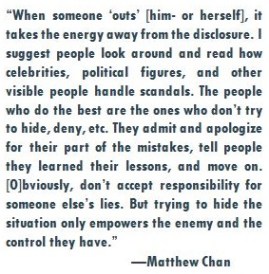
But what then can you do about it? The easy, copout answer is hire a good lawyer. But we all know “pro se” parties represent themselves because they either can’t find a good lawyer or they can’t afford a good lawyer.

Having lived with a protective order for nearly two years, I have found that it largely doesn’t impact my day-to-day existence. I have very little emotional baggage about it. Although my protective order is a matter of public record, it is not easily found, nor is it advertised. However, my accuser chooses to make mine public as a way to get revenge/payback and to embarrass and humiliate me.  I don’t feel embarrassed or humiliated at all anymore. I’ve had two years to let it sink in. She went to her local newspaper as well as a photography blog site to publicize my protective order. I am very certain she approached several other media sources, but she only managed to succeed in getting two to write her story. When she went public, I also went public, and I got way more coverage than she did because of the First Amendment issue.

It goes without saying that I became angry about her actions because the “facts” as told by her were incorrect. I was faced with one of two decisions:  either slink away silently and live in fear, shame, and embarrassment of the protective order…or speak out and fight back, and tell my story.

An issue I see is that people let little pieces of paper define them, such as high school diplomas, college degrees, technical and professional certifications, their financial statements, their marriage certificate, etc. A basic protective/restraining order is simply a piece of paper that formally instructs someone to stay away and not bother someone. It is a civil issue, not a criminal one.  But accusers like to try to criminalize the matter. My accuser loves to do the “stalkie-talkie” routine and likes to refer to me as her “stalker.” I have called her a copyright extortionist even longer. And yet, we have never met, spoken, emailed, text-messaged, snail-mailed, or even faxed. There has never been any contact. Still, she wants to say I am a “stalker” because she currently has a little piece of paper that says “stalking protective order.”

She is attempting to define who I am to whomever will listen. The problem she has is that I don’t buy into it; I have no guilt or shame over it, and I don’t hide from it.  And because I am pretty good at explaining the facts of my case and position, only the most gullible or uninformed believe her.

Too many people take things too literally. Too many people are legally ignorant. Too many people do not understand how the judicial system works. Too many people do not understand the realities of the judicial system.

For example, I live in a city where there are overcrowded jails. I don’t think that is unique to the city I live in. I also live in a city where the district attorney and prosecutor’s office has many cases to pursue and a tight budget to do it with. I live in a city where there is an abundance of physical and “harder” crimes such as burglaries, robberies, murders, drug crimes, rapes, etc. In that context, I see the matter of a protective/restraining order (a civil matter) as ranking low in the prosecutorial pecking order.

Generally speaking, protective/restraining orders are designed to prohibit unwanted physical contact and unwanted communications.  In my view, unless you have some huge emotional issues or obsessive tendencies towards your accuser, most orders are easy to follow, and they are not unconstitutional.

However, what if you have a restriction on your free speech where you can’t breathe a word about your accuser to anyone?  It is certainly problematic on the local level, but it is even more problematic at a state or national level. It is simply unconstitutional, which is my way of saying that it is, in a sense, “illegal.”  But some of you might say, what the order says goes. I don’t necessarily agree with that, because illegal contracts are not enforceable. For example, two people agree to do a drug deal. If one person decides to break the rules of the deal, it is unenforceable, because the deal was illegal to begin with. Likewise, an agreement broken by a John to pay a prostitute is unenforceable because it was illegal from the start. I similarly view it as illegal for my accuser to try to have me arrested or fined because I spoke or wrote about her (not to her) on my own website, and I think it would be embarrassing for any public official to dare to find me in violation of the law. That is my truth because I know what I know, but it may not be enough for you.

The sense of right and wrong has to be weighed against the costs of being a silent victim. The ability to overcome fear and ignorance, personal resourcefulness, the urgency to right a wrong, the fortitude to face conflict and risk—these are factors, and they are ones each person must self-assess.

It all begins with introspection and evaluation of whether the fight is “worth it.” In my case, if I had received a “stay away” order for one year, I would have been angry and unhappy, but I probably would never have appealed the order placed upon me. To me, it would have been an easy order to comply with, and I would not have seen it as devastating to my reputation, even if it were made public. The reason is that I know how to tell my story (and I have many times) in an open and authentic way.  Certainly, there are some less than flattering reports about me but none worse than what I have seen about others.
I have a larger view of myself in this world. I am not famous, and most people don’t care about me or what I do. I am largely unimportant (to them). I am not a celebrity; I am one of many. But for many, because it happens to them, they think the whole world is actually looking at them and their restraining orders. The truth of the matter is that most people simply don’t care.

In the larger view, famous people have committed all kinds of indiscretions, including having affairs, divorcing, getting into fights, committing DUI’s, doing drugs, getting arrested, soliciting prostitutes, etc. There is a huge list of all the embarrassing things people get themselves into. But the fact of the matter is most of that is small potatoes in the big scheme of things. You think people will shun and hate you, but the reality is, to most, it is trivial. You are just another person who allegedly committed an indiscretion.

You may ask, if I believe it is all small potatoes, why am I fighting so hard against my protective order?  There are actually multiple reasons for my current course of action.

My accuser inflamed me. For a woman who is so allegedly afraid of me and my alleged “stalking,” her actions betrayed that she really wasn’t that frightened of me or about whether I would actually cause her any physical harm or endanger her personal safety. She chose to flaunt, brag, and gloat over her “win,” and there was no good purpose in that.

The lawyer who represented her, Elizabeth W. McBride, engaged in unethical tactics like not providing me with a copy of her exhibits so I could examine them closely, while I, a non-lawyer, gave her the professional courtesy of providing an extra copy of mine. When the hearing was over, I both called and emailed the lawyer about getting a preview copy of the protective order. I also wanted to coordinate with her about both of us getting a copy of the courtroom transcript, because it was a shared resource that was agreed upon at the beginning of my hearing. I realized she treated me the way she did because I was not a lawyer and she was trying to cheat me. Because I was opposing counsel, she was required to interact with me on certain matters as she would with another lawyer. She chose not to, and I have remembered this the last two years. One day, I am confident it will come back to bite her.

But the biggest reason I fought back was the outrage that I and others felt that there was a flagrant disregard of the First Amendment as it related to online speech, a total disregard of the actual context of my speech, and a total disregard for Section 230 of the Communications Decency Act, which states that website owners are not responsible for content other users post. These were all points I clearly argued but the judge seemingly ignored.

I saw this as serious misbehavior by the judge and the local court system that could potentially have wide-ranging and long-term consequences to me and any other Georgia website owner. As a matter of disclosure, I do place a great importance on my Internet presence and online activities to my business and reputation. I am a self-employed entrepreneur and business owner who regards the Internet as a hugely important resource to both his personal and business life—probably much more so than the average person who works at a job 40 hours per week for an employer.

For all those reasons, I fought back. But I would be lying if I said there weren’t moments when I wavered. I had moments of weakness, but I also had my anger to prop me up. A lot of my impetus owes to the actions of my adversary and her lawyers.  By their actions, they practically taunted and drove me into appealing the case. Because of my anger and sense of injustice, I was galvanized into action.

I want to take the time to point out an important element of my fight-back. It is very helpful to find friends and supporters who understand you, your character, and the type of person you are. Getting moral support from people who will empower and encourage you is motivating.  Having “support” from people who are fearful, bashful, risk-averse, cynical, and unwilling is not.

In my life, I believe “like attracts like” and “birds of a feather flock together.” In my case, I have many people around me, people who are independent-minded, self-determined, believe in fighting for a cause (such as free speech) and not letting your enemies get the best of you. And believe it or not, most of my best support actually comes from those I have never met in “real life.”  My best support came from “strangers” I have met on the Internet. I have never met or spoken to Todd of ROA and yet, unbeknownst to him, his work on ROA has had a huge influence on my fight.

There are so many layers to the conversation of how to fight back against a wrongful restraining order restricting your right to free speech. There is no way I could get into all the stories, tactics, and strategies, or the mindset involved in my own journey. I will one day write a book on the subject. However, as a guest blogger on ROA, I thought I would share some insights into how my mind works and the mindset that drives me.

I consider myself a victim of protective/restraining order abuse, but I have also chosen to publicly fight back against my accuser and the lower court that allowed the unconstitutional order. Win, lose, or draw, I have no regrets, because my voice is loud and travels far. And I will never let my accuser, a judge, a court, or a piece of paper define who I am. Not as long as I live.

It is that attitude, which has resonated outwards, that I believe helped attract many supporters to my side, including the lawyers who have worked on my (and my position’s) behalf.

Matthew S. Chan is the creator and administrator of ExtortionLetterInfo.com (ELI) and the appellant in Chan v. Ellis, an appeal of a lifetime protection order presently under deliberation by the Georgia Supreme Court.

Copyright © 2015 RestrainingOrderAbuse.com and Matthew S. Chan

*Update: The Georgia Supreme Court returned a verdict in favor of Matthew Chan on March 27, 2015.


(Straw) Hats off to Tennessee, the One State in the Nation That Has a Provision for Expunging a Bogus Restraining Order

“TCA 40-32-101(a)(5) All public records concerning an order of protection [ex-parte, exparte] authorized by title 36, chapter 3, part 6, which was successfully defended and denied by the court following a hearing conducted pursuant to § 36-3-605, shall, upon petition by that person to the court denying the order, be removed and destroyed without cost to the person.”

 —Wikpedia, “Expungement in the United States” (Tennessee)

A woman wrote this week desperate to learn how to seal or expunge the record of a temporary restraining order petitioned against her in California. The order was rejected by the judge, but she’s concerned about the potential ramifications of a lingering record to both her and her children.

Not unduly.

In trying to discover what recourse might be available to her to have the record zapped, I chanced upon the Tennessee statute highlighted in the epigraph. It appears to be the only one of its kind in the country.

Ironically, I’ve also been in correspondence with a gutsy Tennessee woman, Betty Krachey, who was issued a protection order by her boyfriend a few months ago that was dismissed by the court but whose reported fraudulence so outraged Betty that she’s been vigorously petitioning her state to “hold false accusers accountable.”

I wrote to Betty about the Tennessee provision for expunging the record yesterday. I told her I only hoped knowledge of it wouldn’t dull her fervor to inspire change. She says no way.

The order of protection that was served on me was dropped when we went to court. BUT I know a lot of people (all men but me) that this has happened to whose were not dropped and are still on their records. I want something done to my ex for filing this false report against me, and I want to get the law changed to hold anyone who does this accountable for trying to ruin someone’s life. (I know it’s mostly women who file these false reports!) A friend of mine’s ex-wife did this to him, and I remember when the police came to serve him (at my store, while he was having breakfast). He was telling everyone it wasn’t true and he never laid a hand on her.  No one believed him. I remember thinking he must have done something or the cops wouldn’t be serving him papers to leave his home. I know better now, and I know how people think of the ones this is done to.

For its being more legally evolved than the rest of the nation, hats off to Tennessee—and, as I quipped to Betty, I didn’t think people there even wore shoes.

Copyright © 2015 RestrainingOrderAbuse.com

*Betty quipped back, “And most of the people out here DON’T wear shoes…or teeth!!!!”

Restraining Orders Are Public Records

It’s hard to tell whether this is a goad or a guarantee: “Find Restraining Order Records For Anyone Instantly!” Either way, it’s enticing.
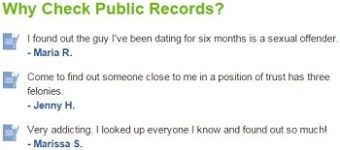
If you’re dating someone and you’ve noticed how their temper gets out of control, before things go any further, check their record on Restraining Order Records. They might not have ever committed a crime, but if their name shows up on Restraining Order Records, you might think twice about pursuing this relationship.

Lawyers discount restraining orders as he said/she said matters: no biggie. Judges may also consider objections to them to be overstated—simply because they’ve been stated at all. These dismissals stand in stark contrast to the admonition: “Restraining Orders aren’t pleasant to think about, but the consequences can be worse. Check Restraining Order Records.”

Which appraisal of the significance of restraining orders do you think more closely corresponds to the public’s? (That is a rhetorical question, yes.)

The quoted material above is featured on the site PublicRecordsReview.com, which advertises the “Top Restraining Order Records Sites”: Instant Checkmate, United States Background Checks, Been Verified, U.S. People Records, and SpyFly.

Whether the returns from such sites can be relied upon is something the reader may investigate if s/he chooses; the writer doesn’t want to know. Whatever the case, however, the issuance of a civil restraining order represents a judicial ruling, and judicial rulings are public records. Here’s “why”:

Essential to the rule of law is the public performance of the judicial function. The public resolution of court cases and controversies affords accountability, fosters public confidence, and provides notice of the legal consequences of behaviors and choices.

[…]

The public in general and news media in particular have a qualified right of access to court proceedings and records. This right is rooted in the common law. The First Amendment also confers on the public a qualified right of access. In 1980, the Supreme Court held that the First Amendment right of access to court proceedings includes the public’s right to attend criminal trials. The Court suggested that a similar right extends to civil trials…. Some courts of appeals have held that the public’s First Amendment right of access to court proceedings includes both criminal and civil cases (Timothy Reagan, “Sealing Court Records and Proceedings: A Pocket Guide”).

Although they’re civil instruments, restraining orders are associated with violent or otherwise criminally deviant behavior, so they’re recorded and preserved in statewide police databases and the FBI’s National Crime Information Center (NCIC) database, which private investigator Brian Willingham calls the “closest thing to a nationwide criminal records check in the United States today” (italics added). They’re also recorded (virtually in perpetuity) at their courthouses of origin. Defendants named on domestic violence restraining orders may furthermore be entered into a domestic violence (specific) registry, possibly even if a temporary order against them is dismissed. The potential consequences to employment and even employability in certain fields could hardly be more obvious.

A profession as mundane as “substitute teacher” requires that its applicants undergo an FBI background check, and any interviewer may, of course, simply ask if a prospective employee has “ever been the subject of a restraining order.”

Ease of access to restraining order records by the general public differs from state to state. In Indiana, for example, it just takes an Internet connection. In other states, records aren’t as conveniently scrutinized.

That doesn’t, however, mean they’re inaccessible.

The animus behind advocacy for restraining orders is the animus behind all law related to violence against women. Whether advocates are anti-rape or anti-domestic-violence, the argument is the same: that the accused must be exposed so that (female) victims of violence will be encouraged to come forward. Publicity isn’t just incidental; it’s demanded.

Superficially, the demand isn’t without sympathy.

Restraining orders, however, are adjudicated in civil court. That means they’re matters instigated by private citizens whose allegations aren’t (necessarily) vetted by the authorities or by government prosecutors. They are, very literally, he said/she said prosecutions. Temporary restraining orders may be obtained in minutes based only on finger-pointing and feelings (“I’m afraid”), or on testimony that’s significantly or totally false (or even maliciously fabricated). The evidentiary bar is so low as to be skipped over—tra-la-la—and judicial bias is endemic and may even be mandated.

Elaine Epstein, former president of the Massachusetts Bar Association, famously observed decades ago, “Everyone knows restraining orders…are granted to virtually all who apply.”

The situation that obtains then is one of damning documents’ being generated on the basis of one or two protestations of fear or danger made to prejudiced judges in mere minutes-long procedures whose rulings are recorded indefinitely in public databases that any teen with a laptop and Daddy’s credit card can poke a zitty nose into from McDonald’s.

Copyright © 2015 RestrainingOrderAbuse.com

Not All Feminists Are Women, but All Feminists Are Responsible for Why False Accusations Are Rampant and Why They Work

Feminist lobbying is to blame for the injustice of restraining order and related laws and policies. There are no ifs, ands, or buts about it.

False accusations shouldn’t work, but they do—commonly, and not uncommonly to devastating effect.

That’s thanks to feminist crusaders, who may or may not represent Women, and who may or may not be women. This clarification isn’t intended for men who’ve been abused by court process; they don’t have any problem criticizing feminists, whatever form they come in.

Women, however, do—even women who’ve been abused by court process themselves. The clarification is for them.

Consider:

(1994) “Hi, Senator. This is Polly Wannacracker of COMA, the Consortium Opposing Male Aggression. I’m calling to share some startling statistics about violence, violence, and more violence. May I forward our research findings to your office?”

(1998) “Hi, Senator. This is Polly Wannacracker of COMA, the Consortium Opposing Male Aggression. I’m calling to share some more startling statistics about violence, violence, and more violence—also to tell you about the exciting progress we’ve made toward alerting the public to  the horrors of domestic abuse. Of course, nothing is ever enough when the stakes are this high!”

(2005) “Hi, Senator. This is Polly Wannacracker of COMA, the Consortium Opposing Male Aggression. How are you? How’s your wife? Oh, Bob, you kidder! We’ve so appreciated the support you’ve shown our cause over the years. Ha, you know me too well! Yes, I was of course calling to share some further startling statistics about violence, which, as you know, is epidemic, epidemic, epidemic….”

The allegory may be corny, but you get the point. This is how legislation is prompted, and support for it solidified and maintained. Names change; the message doesn’t.

Money has steadily aggregated to representatives of feminist causes over the decades, and this money has been used to secure public opinion through “information campaigns.” Too, it has inspired grant allocations to agencies of the justice system amounting to billions under the feminist motivated Violence Against Women Act (VAWA). Federal grants are also issued to promote and fund social science that validates these expenditures and laws related to violence against women, including restraining order laws. Both money and this tailored research are used to influence police policy and condition judicial priorities.

Women, defensively, may deny that members of their sex instigate malicious prosecutions more often than men or to greater effect. Who lies and why doesn’t matter, though. Judges should be vigilant against false claims, which should be detected, dismissed, and punished. Judges aren’t vigilant, false claims aren’t detected, and their claimants aren’t sanctioned. Why?

Thanks to dogged and vehement feminist politicking for the past 30 years or more, standards for substantiating claims of abuse made by restraining order petitioners are none, and penalties for lying are none. That’s because (women, please note) if the law made the standards too demanding or it threatened penalties for iffy testimony—so the dated argument runs—abused women might be afraid to come forward. They would just “suffer in silence” instead.

To ensure abused women aren’t afraid to come forward—again, so the dated argument runs—allegations must be taken on faith, and judges must have complete latitude to rule as they “think best” to protect the interests of people who can’t protect themselves.

If all this wiggle room means some people (or a lot of people) get falsely implicated…so what?

Law follows politics, and the political fix has been in for a long time. It stays in, because the architecture of laws has been concrete-reinforced. Feminist advocates continue to “monitor public policy” and to maintain their painstakingly erected social webwork. They have the money to do it. Oppositional voices are neither bankrolled nor have any political cachet. They’re not just the underdogs; they’re the usual suspects.

The above makes the below possible (comment submitted to this blog a few days ago by “Rhonda Lynn”):

I’m going to court in a few hours. I haven’t slept or eaten, and I’m a wreck. My life is over. Today.

I fled a [domestic violence] situation in another state and moved back to Washington. I bounced around a bit and finally ended up renting a room. (I’m disabled, on Social Security.) Yes, Craigslist.

I felt I asked all the right questions: Are you married? Do you live on the property? Do you own the home? Who else lives there? Both [man and woman] were surprised to learn [I was disabled, because] the other tenants renting the room across from me were disabled, as well. The man of the [tenant] couple was deaf, and I know American Sign Language.

Upon moving in, I began noticing the lies being told. The disabled couple was made to turn over their food cards. They tried with me when I signed the month-to-month agreement. I, of course, declined.

I helped with the deaf man and his developmentally disabled woman, because the female “owner” (also a lie) was overwhelmed and claimed she was sick. I cooked and cleaned (28 loads of laundry, using the washer and dryer I brought from my previous residence). I paid for Thanksgiving dinner.

Then Hell came. A friend of the female claimed the “husband” had been coming on to her…long story. The next day, it was me! […] First she tells me to move out; then she’s my friend.

The exploitation of the couple continues. The sister of the deaf man calls me [and] then calls Adult Protective Services. I make a call as well. There is an active investigation.

Ready?

sign-languageThe police knock on my bedroom door and give me 10 minutes to get some clothes. The “husband-owner” filed a restraining order on me!

I had a couple stay overnight for a movie marathon the night before, so I had a bit of help. The female officer verified I had a lock for my room. She advised the petitioner no one was to enter my room. She had me turn over the house key. I was in shock, crying.

As we pull away, the “husband” sends me a voice recording…saying, “See…who got [who] out of whose house? I got you out of my house! Neener Neener.”

I called the police. No good. I am not the victim. I’m the perpetrator. While on the phone…two more [messages] telling me I’m not getting any more of my stuff back, can’t come back to the house…even with an officer. “You’re burnt bitch! If the police ask where’s your stuff, I’m gonna say I don’t know.”

Then, there’s the “order.” A Domestic Violence Protection Order!

The allegations, all false…and very damning: stealing his mail, opening it and not giving it to him, going in his wallet, taking his [Social Security] card and old i.d., shoving him into a wall, causing a bruise on his back, yelling at all hours of the day and night, causing such stress on the disabled couple that they can’t eat or sleep and have PTSD episodes, calling members of the house vulgar names, texting and calling everyone while they sleep, [threatening] to burn the house down, [warning] him not to sleep, because I’d kill him. [He alleges] he is in fear of his life, afraid to take a shower or come home.

Then, lastly, the night before (when I had company), [he says] I came at him with a kitchen knife as he was getting ready for work [and that] he tried to call the cops, and I took his cell phone away. Then gave it back that morning.

Oh, my lord!

They both went on my Facebook [page]. He called me a hooker, said I would sleep with any man, and called me a horrible name. I didn’t respond, of course. Then he said I do meth, [which] he knows because I lived with him and he cleaned my room and found pipes and bags. Then she responds and says…and rigs and baggies. Now we know [they say] why she cleaned, and it explains her treatment of us. He [wrote] in another post: “I just want everyone to know she does methamphetamines.” (He is in outpatient treatment.)

[…]

I call the police…to get my stuff. I left my daughter’s ashes and pictures.

They say, “How can you prove you live there? If he doesn’t say you live there, we won’t bust down the door.”

I’M GOING TO JUMP OFF A BRIDGE.
(BUT DON’T DRIVE AND NO BUS FARE)
PLEASE. HELP ME.
RHONDA

The reader may choose to indict the male accuser in Rhonda’s story instead of the apparatus he exploited because he could, or the reader may choose to indict the apparatus itself and those who inspired it, defend it, keep it well lubricated, profit from it, and convincingly deny it’s abused.

Neither position will help Rhonda, who may be broken forever (or until she finds a bridge), but one of them may eventually make it illegal for a life to be so viciously demeaned as hers has been.

Copyright © 2015 RestrainingOrderAbuse.com

“You have bullsh*t; we have research”: The National Coalition Against Domestic Violence v. Daddy Justice (Or, Why False Allegations Are a Serious Problem)

A correspondent, friend, and fellow blogger who’s been relentlessly attacked through the courts by a disturbed neighbor (over a period now spanning years) sent a link to the YouTube vid “The Grand Poobah” last week. It’s a 2011 “interview” between men’s rights activist Ben Vonderheide (a.k.a. “Daddy Justice”) and Rita Smith, former executive director of the National Coalition Against Domestic Violence (NCADV), an influential Colorado-based nonprofit.

(Note: The word in the video’s title should be spelled “poohbah,” after a comic opera character whose name was probably formed from the interjections pooh + bah. Mr. Vonderheide’s spelling it “poobah” might have been an accident—or it might have been on purpose.)

The setting of the interview, which would more aptly be called an exchange of words, isn’t clear, but it seems to be a post-conference mix-and-mingle. Mr. Vonderheide takes issue with the NCADV’s feminine bias and the propagandist tenor of the factsheets it publishes, which aren’t uncommonly cited by feminist advocates.

As the quotation in this post’s title suggests, the questions he poses to Ms. Smith aren’t favorably received. Those questions regard the NCADV’s disinclination to acknowledge maternal child abuse (Ms. Smith: “It’s not our focus of work”), as well as its denial that false accusations of domestic violence are a serious problem, false accusations that Mr. Vonderheide alleges are “promoted by [the NCADV’s] budget.”

Daddy Justice’s interview style (à la Michael Moore) is obtrusive—he’s plainly crashed the party—but while Mr. Vonderheide is necessarily assertive, the worst you could say of his questions is that they’re confrontational. They’re nevertheless called “abusive” and “aggressive,” and he’s prodded to leave.

The grudging answers his questions prompt before he’s rebuffed don’t provide much informational grist for the mill, but to his allegation that more than 80% of restraining orders are based on false accusations, Ms. Smith significantly counters that her facts say it’s only “2% of the time” (and she urges Mr. Vonderheide to “stop lying”). Later she revises her estimate of the number of false accusations from 2% to “2 to 5%,” dismissively, despite the fact that if, say, 2,000,000 restraining orders are petitioned a year (and the total may be much higher), the extra 3% translates to the invasion, disruption, and possible dismantling of 60,000 innocent defendants’ lives, besides those of their children and others peripheral to the mischief.

A mere 5% false allegation rate means the victimization of 100,000 (or many more) innocent people per year (again, not including ambient casualties). Anecdotal reports, of course—including from judges and attorneys—put the false allegation rate 6 to 18 times higher than 5% (30 to 90%). It just depends who you’re asking.

Even a ridiculously conservative false allegation rate like the posited 5% plainly recommends legislative reform, because there’s absolutely no accountability in the restraining order process. False accusers aren’t punished, and damages from false allegations aren’t remediable by lawsuit. Additional false claims can what’s more be lodged almost immediately by the same accusers using the same process. There’s no statutory ceiling on the number of orders a single complainant may apply for. (Some victims of procedural abuse report spending tens of thousands of dollars to fend off one petition only to throw up their hands—and in cases forfeit their custody entitlements—when a second comes down the pike a few months later. See here for an example.)

It should be appreciated, too, that any audit-derived estimate of the number of false allegations can only be based on allegations that are recorded as false (by “somebody”). No official false allegation rate accounts for the number of times false allegations succeed or the number of times cases based on them are simply “dismissed” without comment.

In other words, false allegations may well be rampant or “epidemic” (a word favored by anti-domestic-violence advocates), and there would be no record that says so.

The nyah-nyah from the title—“We have research; you have bullshit”—deserves reflection, also. (It doesn’t come from Ms. Smith, incidentally, but from an unidentified confederate who can’t resist a Parthian shot at Mr. Vonderheide before she and the “Grand Poobah” turn their backs to him). The “research” that advocacy groups posit is survey-based, that is, it amounts to responses to questionnaires that are administered to sample groups and then extrapolated to the population as a whole. Even this survey data we must take on faith.

Appreciate that conducting “research” of this sort depends on means, which depend on money, which is only allocated to groups like the NCADV. Consider:

The NCADV’s reported income for 2011 was $643,797, down about $70,000 from the previous year. Ms. Smith’s salary was $74,586.

Among the programs toward which the NCADV’s 2011 budget was dedicated were “General Program – provides information to educate and inform the general public about domestic violence” ($240,991), “Public Policy – works in collaboration with other national organizations to affect societal response to domestic violence through public education and coalition building, monitors federal legislation, and contacts legislators regarding domestic violence issues” ($88,808), “Membership – publishes a newsletter and provides networking opportunities for individuals and organizations interested in the work to empower battered women and their children” ($67,607), “Child custody – provides resources, referrals and support to advocates working with victims of domestic violence involved in family court cases with their abusers also provides resources to victims, attorney, and family members when family court issues are present” ($97,402).

In contrast to the social largesse enjoyed by groups like the NCADV, no money is allocated for the administration of surveys to determine, for example, incident rates of depression, drug or alcohol abuse, stress-related injuries, or suicide proximal to being falsely accused; no surveys appraise the resulting lost earnings and assets; and no surveys attempt to measure the hits taken by health insurance providers as a result. Prognosis of the long-term consequences to the welfare and life prospects of injured children is, moreover, impossible. Worse, it’s not even considered, which casts rather a long shadow on the purported “mission” of groups like the NCADV to protect kids.

Clearly, that motive is context-specific.

Daddy Justice makes up for the lack of information his “interview” questions elicit with quotations interposed between snippets of footage. Here are some of them:

  • “Everyone knows restraining orders…are granted to virtually all who apply.” […] “In many cases, allegations of abuse are used for tactical advantage” (Elaine Epstein, former president of the Massachusetts Bar Association).
  • “Restraining orders are now considered part of the ‘gamesmanship of divorce’” (Illinois Bar Journal, 2005).
  • “In nonreciprocally violent relationships, women were the perpetrators in more than 70% of the cases” (American Journal of Public Health, May 2007).
  • “Women were slightly more likely than men to use one or more acts of physical aggression and to use such acts more frequently” (Psychological Bulletin, 26, No. 5, pp. 651-680).
  • “Leading sociologists have repeatedly found that men and women commit violence at similar rates” (Law Professor Linda Kelly, 2003).
  • “More women than men engage in controlling behavior in their current marriages” (Violence and Victims, 22, Issue 4, 2007).
  • “Of all persons who suffer injuries from partner aggression, 38% are male” (Dr. John Archer, Psychological Bulletin).
  • “There is no doubt that this law [Ohio’s domestic violence statute] has been abused” (Judge Nadine Allen of Hamilton County, Ohio).
  • “Standards for proving abuse have been so relaxed that any man who stands accused is considered guilty” (Cheryl Hanna, William and Mary Law Review).
  • “Women are nine times more likely to report domestic violence than male victims” (National Family Violence Survey).
  • “85% of temporary restraining orders are filed against men” (Cathy Young, “Domestic Violence: An In-Depth Analysis,” 2005).
  • “Many judges view restraining orders as ‘a rubber-stamping exercise,’ and subsequently hearings are ‘usually a sham’” (Attorney Arnold Rutkin, Family Advocate, Winter 1996).
  • “The mere allegation of domestic violence may shift the burden of proof to the defendant” (Massachusetts Law Weekly, 1995).

Notable is that cited remarks from legal experts that categorically define the restraining order process as prejudiced, if not an outright abomination against rudimentary civil rights and principles of law, may be a decade or decades old. Rhetorical stances like the NCADV’s aren’t fooling anybody in the know, and they haven’t for a long time. But they continue to dominate political debate. They’re heeded because they’re supposed to be. Not coincidentally, women’s advocates hold the keys to the treasury.

The value of Mr. Vonderheide’s video, finally, isn’t in the information it educes or even the information it asserts but the psychological study it offers of the women behind the dogma and the sway they exercise on public perception. His questions, only impeachable as indelicate, inspire predictable reactions: antagonism, levity, or disdain.

According to tried and true method (a method both practiced and preached), the “self-reliant” feminist women who are the targets of Mr. Vonderheide’s questions register alarm. These deniers of false allegations and undue hysteria…call the police.

Copyright © 2015 RestrainingOrderAbuse.com

*Daddy Justice’s videos can be found here.

Dust It Off: This Isn’t 1979, and It’s Time Restraining Order Laws Were Reconsidered

I remarked to a commenter the other day that when I became a vegetarian in the ’80s, I was still a kid, and my family took it as an affront, which was a common reaction then. Today, everyone’s a vegetarian or “tried vegetarianism” or has “thought about becoming a vegetarian.” Other subjects that were outré or taboo in my childhood like atheism, cross-dressing, and depression—they’re no longer stigmatized, either (in the main). Gay people, who were only whispered about then, can marry in a majority of states. When I was a kid, it was shaming for bra straps or underpants bands to be visible. Today they’re exposed on purpose.

It’s a brave new world.

While domestic violence is no more comfortable a topic of conversation now than it was then, it’s also hardly hush-hush. When restraining orders were conceived, it was unmentionable, and that was the problem. It was impossible for battered women to reliably get help. They faced alienation from their families and even ridicule from the police if they summoned the courage to ask for it. They were trapped.

Restraining orders cut through all of the red tape and made it possible for battered women to go straight to the courthouse to talk one-on-one with a judge and get immediate relief. The intention, at least, was good.

It’s probable, too, that when restraining orders were enacted way back when, their exploitation was minimal. It wouldn’t have occurred to many people to abuse them, just as it wouldn’t have occurred to lawmakers that anyone would take advantage.

This isn’t 1979. Times have changed and with them social perceptions and ethics. Reporting domestic violence isn’t an act of moral apostasy. It’s widely encouraged.

No one has gone back, however, and reconsidered the justice of a procedure of law that omits all safeguards against misuse. Restraining orders circumvent investigation by police and the vetting of accusations by district attorneys. They allow individuals to prosecute allegations all on their own, trusting that those individuals won’t lie about fear or abuse, despite the fact that there are any number of compelling motives to do so, including greed/profit, spite, victim-playing, revenge, mental illness, personality disorder, bullying, blame-shifting, cover-up, infidelity/adultery, blackmail, coercion, citizenship, stalking, and the mere desire for attention.

Restraining orders laws have steadily accreted even as the original (problematic) blueprint has remained unchanged. Claims no longer need to be of domestic violence (though its legal definition has grown so broad as to be virtually all-inclusive, anyway). They can be of harassment, “stalking,” threat, or just inspiring vague unease.

These aren’t claims that are hard to manufacture, and they don’t have to be proved (and there’s no ascertaining the truth of alleged “feelings” or “beliefs,” anyway, just as there’s no defense against them). Due to decades of feminist lobbying, moreover, judges are predisposed to issue restraining orders on little or no more basis than a petitioner’s saying s/he needs one.

What once upon a time made this a worthy compromise of defendants’ constitutionally guaranteed expectation of due process and equitable treatment under the law no longer does. The anticipation of rejection or ridicule that women who reported domestic violence in the ’70s and ’80s faced from police, and which recommended a workaround like the restraining order, is now anachronistic.
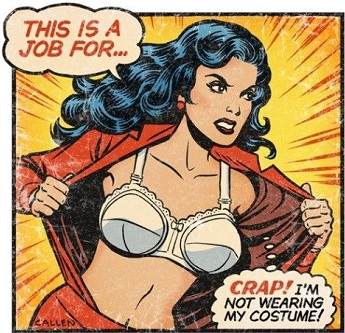
Prevailing reflex from authorities has swiveled 180 degrees. If anything, the conditioned reaction to claims of abuse is their eager investigation; it’s compulsory policy.

Laws that authorize restraining order judges, based exclusively on their discretion, to impose sanctions on defendants like registry in public databases that can permanently foul employment prospects, removal from their homes, and denial of access to their kids and property are out of date. Their license has expired.

Besides material privations, defendants against allegations made in brief trips to the courthouse are subjected to humiliation and abuse that’s lastingly traumatic. Making false claims is a simple matter, and offering damning misrepresentations that don’t even depend on lies is simpler yet.

What shouldn’t be possible happens. A lot. Almost as bad is that we make believe it doesn’t.

Just as it was wrong to avert our eyes from domestic violence 30 years ago, it’s wrong to pretend that attempts to curb it since haven’t fostered new forms of taunting, terrorism, and torment that use the state as their agent.

Copyright © 2015 RestrainingOrderAbuse.com

“Trapped”: Betty’s Story of Restraining Order Abuse

Betty Krachey says she only wishes she had superpowers. She has, nevertheless, been flexing her muscles pretty impressively for a former drugstore clerk.

Betty launched an e-petition not long ago to bring flaws in the administration of restraining orders and the need to hold false accusers accountable to the attention of lawmakers in her home state of Tennessee (and beyond). Betty emphasizes that restraining orders can be “taken out on innocent people based on false allegations so a vindictive person can gain control with the help of authorities.” She stresses, too, that “false accusers are being allowed to walk away and pay NO consequences for swearing to lies to get these orders.”

Betty’s charges shouldn’t be revelations; opponents of restraining order laws (and related laws inspired by violence against women) have been saying what Betty is for years. What makes her denunciations eye-opening is that they’re coming from an injured woman who refuses to take her licks and silently retreat into the shadows like she’s supposed to do. Besides that, the typical rebuttals to complaints like Betty’s, rebuttals that play to our sympathies for abused women, don’t apply.

Betty is an abused woman. She was nearly deprived of her home and consigned to the curb, for no reason, like yesterday’s trash (a situation others find themselves in every day). Betty’s story, as she tells it, corresponds moreover to those of women who are considered victims of emotional abuse (which state statutes may classify as “domestic violence”).

I used to be a very private person—till all this crap—and told very few people my business, so everyone thought everything was going good with me and [him]. They had no idea I was living with someone I felt trapped with. I could NEVER talk to him or even ask him a question without him blowing up. That’s not a very happy life to live with someone. Even though I never told others how bad things were at home, I NEVER made it a secret to [him] that I wanted to leave…! I never posted lies on Facebook or emailed my friends telling them lies about [him] like he did me to try to get people to feel sorry for me and think [he] was such a bad person. Now that I think about it, he’s always played the victim….

The counterclaim feminists inevitably reach for to bat away complaints of restraining order abuse like Betty has made is that invisible, voiceless legions of battered women never receive justice, so tough luck, Charlie Brown, if you’re not treated fairly. The argument appeals to pathos, but its influence on our laws and justice system is plainly corrupt. Remarking that there are starving children in India has never made and never will make broccoli taste like cheesecake. It’s not the place of our justice system to punish people for things they haven’t done, let alone to blame them for the imagined crimes of strangers.

The posited pains and privations of unnamed others don’t justify running an innocent person through the wringer, female or male. Publicly implicating people as batterers and creeps based on superficial claims scrawled on forms and mouthed in five-minute meetings with judges shouldn’t be possible in a developed society. On these grounds, citizens are cast out of their homes by agents of the state, as Betty almost was.

Our courts take no interest in the lives they invade and often derail or devastate. The people restraining order judges summarily condemn are just names on forms; judges may never even know what the owners of those names look like—forget about who they are.

Let’s meet one.

Betty’s story begins in 1992 when she moved from Florida to Tennessee with her boyfriend, and the two built a house and life together there.

The circumstances that led to Betty’s being falsely accused by her boyfriend decades later are cliché. He slimmed down in midlife, she says, and began “cheating on me with younger girls…. So he had to figure out a way to get my half of our house from me.”

A protection order fit the bill perfectly: no muss, no fuss, and no division of assets. The boyfriend would be granted sole entitlement to the house that Jack and Jill built. Jill, with a little shove, would tumble down the hill alone, and an empty bucket to collect handouts in is all she’d end up with.

His first plan was to bully and threaten me into signing over my half of the house by signing a quitclaim deed. He had told me he would give me $50K, which…I knew I’d never see, and he promised me this would be my best deal. And if I did not sign the house over to him, he let me know I would lose everything I had worked my ass off for. “You watch and see, I promise you that,” he would tell me over and over.

Betty says she was tempted to sign. One of her dearest companions, her Doberman Dragon, had died, and Betty reckoned she could provide for her remaining dog, Lacy, by herself. “One reason I stayed was for my dogs,” she admits. “I had been wanting to leave…for years.” She and her boyfriend had effectively separated, and Betty intuited her boyfriend “knew he wasn’t going to be able to trick me into staying and paying half the bills much longer,” and she planned to call it quits. But he beat her to the punch.

His next plan, with the advice from his awesome friend, was to get the police involved and then to file the order of protection on me to get me kicked out of the house! If it weren’t for my lawyer, I would have had to leave my home from Aug. 29th to the court date Sept. 12th! [He, the ex] knew and did NOT care one teeny tiny bit that I had NOWHERE TO GO! Plus I had Lacy to worry about. [He] had moved out of our house August 6th and wasn’t even living in the home at the time he did this. [He] has another house to live in that has everything he needs. I had NOTHING else and nowhere else to go!

Betty’s situation mirrors that of many others who are falsely accused by domestic partners. Those not so lucky to have (or to be able to afford) effective legal representation may find themselves abruptly homeless (besides jobless and penniless, in cases), sleeping in their cars, sheltering with strangers, or living on the street. These are people who the day before may have been living normal, comfortable middleclass or even upper-middleclass lives.

On our court date—Sept 12th—the order of protection was dropped. My lawyer told me I was right: “This is all about the house and YOUR money you have coming from your business you sold.” I knew it!! And [he, the ex] wanted ME to pay the court costs for this!

The best laid plans of lice and men go oft astray. Betty quips, “All I can say is [he] had a lot more to be concerned about than me causing him ‘bodily harm’!”

Betty’s been in touch with a Tennessee state representative who’s indicated to her that she has “a good chance at getting [the] law changed. But he said the soonest it will go into effect is July 2015, and he let me know that means it will NOT help me with what my ex did to me, because he filed his false report on me in August!”

Besides singlehandedly pressing for reform of one of the most intransigent legal mockeries ever conceived, she’s considering a lawsuit.

Happy New Year, Betty.

Copyright © 2015 RestrainingOrderAbuse.com

The Southern Poverty Law Center v. Betty Krachey: Why the Only Honest Voices in Discussions of Restraining Order and Related Procedural Abuses Are the Little Ones

This blog was inspired by firsthand experience with judicial iniquity.

Its author has never been accused of violence, doesn’t sanction violence except in self-defense or the defense of others, and has been a practicing vegetarian since adolescence. I have, what’s more, hazarded my life going to the aid of non-human animals. In one instance, I lost the use of my hand for a year; in another, I had various of my bones fractured or crushed, and that damage is permanent.

Although I’ve never been accused of violence (only its threat: “Will I be attacked?”), I know very well I might have been accused of violence, and I know with absolute certainty that the false accusation could have stuck—and easily—regardless of my ethical scruples and what my commitment to them has cost me.

Who people are, what they stand for, and what they have or haven’t done—these make no difference when they’re falsely fingered by a dedicated accuser who alleges abuse or fear.

This is wrong, categorically wrong, and the only arguments for maintenance of the status quo are ones that favor a particular interest group or political persuasion, which means those arguments contravene the rule of constitutional law.

Justice that isn’t equitable isn’t justice. Arguments for the perpetuation of the same ol’ same ol’, then, are nonstarters. Dogma continues to prevail, however, by distraction: “a majority of rapes go unreported,” “most battered women suffer in silence,” “domestic violence is epidemic” (men have it coming to them). Invocation of social ills that have no bearing on individual cases has determined public policy and conditioned judicial impulse.

Injustice, no surprise, arouses animosity; injustice that confounds lives, moreover, provokes rage, predictably and justly. This post looks at how that rage is severed from its roots—injustice—and held aloft like a monster’s decapitated head to be scorned and reviled.

I first learned of the Southern Poverty Law Center (SPLC) from a research paper published by Law Professor Kelly Behre this year that equates men’s rights activism with hatemongering. I later heard this position of the SPLC’s reiterated in an NPR piece about the first International Conference on Men’s Issues.

Injustice, it should be noted preliminarily, is of no lesser interest to women than to men. Both men and women are abused by laws and practices purportedly established to protect women, laws and practices that inform civil, criminal, and family court proceedings.

Groups like the SPLC, however, represent opposition to these laws and practices as originating strictly from MRAs, or men’s rights activists, whom they dismiss as senseless haters. This lumping is characteristic of the smoke-and-mirrors tactics favored by those allied to various women’s causes. They limn the divide as being between irrationally irate men and battered women’s advocates (or between “abusers” and “victims”).

They don’t necessarily deny there’s a middle ground; they just ignore it. Consequently, they situate themselves external to it. There are no women’s rights activists (“WRAs”?) who mediate between extremes. They’re one of the extremes.

I’m a free agent, and this blog isn’t associated with any group, though the above-mentioned law professor, Dr. Behre, identifies the blog in her paper as authored by an “FRG” (father’s rights group), based on my early on citing the speculative statistic that as many as 80% of restraining orders are said to be “unnecessary” or based on false claims, which may in fact be true even if Dr. Behre finds the estimate unscientific. (Survey statistics cited by women’s advocates and represented as fact are no more ascertainably conclusive; they’re only perceived as more “legitimate.”)

SAVE Services, one of the nonprofits to cite a 2008 West Virginia study from which the roughly 80% or 4-out-of-5 statistic is derived, is characterized by the SPLC and consequently Dr. Behre as being on a par with a “hate group,” like white supremacists. It isn’t, and the accusation is silly, besides nasty. This kind of facile association, though, has proven to be very effective at neutering opposing perspectives, even moderate and disciplined ones. Journalists, the propagators of information, may more readily credit a nonprofit like the SPLC, which identifies itself as a law center and has a longer and more illustrious history, than it may SAVE, which is also a nonprofit. The SPLC’s motto, “Fighting Hate • Teaching Tolerance • Seeking Justice,” could just as aptly be applied to SAVE’s basic endeavor.

On the left is a symbol for the Ku Klux Klan; on the right, the symbol for feminist solidarity. The images have common features, and their juxtaposition suggests the two groups are linked. This little gimmick exemplifies how guilt by association works.

The SPLC’s rhetorical strategy, an m.o. typical of those with the same political orientation, is as follows: (1) scour websites and forums in the “manosphere” for soundbites that include heated denunciations and misogynistic epithets, (2) assemble a catalog of websites and forums that espouse or can be said to sympathize with extremist convictions or positions, and (3) lump all websites and forums speaking to discrimination against men together and collectively label them misogynistic. Thus reports like these: “Misogyny: The Sites” and “Men’s Rights Movement Spreads False Claims about Women.”

Cherry-picked posts, positions, and quotations are highlighted; arguments are desiccated into ideological blurbs punctuated with indelicate words; and all voices are mashed up into a uniform, sinister hiss.

The SPLC’s explicit criticism may not be unwarranted, but coming as it does from a “law center” whose emblem is a set of balanced scales, that criticism is fairly reproached for its carelessness and chauvinism. There are no qualifications to suggest there’s any merit to the complaints that the SPLC criticizes.

The SPLC’s criticism, rather, invites its audience to conclude that complaints of feminist-motivated iniquities in the justice system are merely hate rhetoric, which makes the SPLC’s criticism a PC version of hate rhetoric. The bias is just reversed.

Complaints from the “[mad]manosphere” that are uncivil (or even rabid) aren’t necessarily invalid. The knee-jerk urge to denounce angry rhetoric betrays how conditioned we’ve been by the prevailing dogma. No one is outraged that people may be falsely implicated as stalkers, batterers, and child molesters in public trials. Nor is anyone outraged that the falsely accused may consequently be forbidden access to their children, jackbooted from their homes, denied employment, and left stranded and stigmatized. This isn’t considered abusive, let alone acknowledged for the social obscenity that it is. “Abusive” is when the falsely implicated who’ve been typified as brutes and sex offenders and who’ve been deprived of everything that meant anything to them complain about it.

Impolitely. (What would Mrs. Grundy say?)

There’s no question the system is corrupt, and the SPLC doesn’t say it isn’t. It reinforces the corruption by caricaturing the opposition as a horde of frothing woman-haters.

Enter Betty Krachey, a Tennessee woman who knows court corruption intimately. Betty launched a website and e-petition this year to urge her state to prosecute false accusers after being issued an injunction that labeled her a domestic abuser and that she alleges was based on fraud and motivated by spite and greed. Ask her if she’s angry about that, and she’ll probably say you’re damn right. (Her life has nothing to do with whether “most battered women suffer in silence” or “a majority of rapes go unreported,” and those facts in no way justify her being railroaded and menaced by the state.)

I made this website to make people aware of Order of Protections & restraining orders being taken out on innocent people based on false allegations so a vindictive person can gain control with the help of authorities. The false accusers are being allowed to walk away and pay NO consequences for swearing to lies to get these orders!  […]

I know that, in my case, the judge didn’t know me. Even though I talked to the magistrate the day BEFORE the order of protection was taken out on me & I told him what I heard [he] had planned for me. They didn’t know that I might have superpowers where I could cause him bodily harm 4 1/2 miles away. SO they had no choice but to protect [him] from me. BUT when they found out this order of protection was based on lies that he swore to, and he used the county in a cunning and vindictive way to get me kicked out of the house – HE SHOULD HAVE HAD TO PAY SOME CONSEQUENCES INSTEAD OF BEING ALLOWED TO WALK AWAY LIKE NOTHING HAPPENED!!!!

Seems like a fair point, and it’s fair points like Betty’s that get talked around and over. There are no legal advocates with the SPLC’s clout looking out for people like Betty; they’re busy making claims like hers seem anomalous, trivial, or crackpot.

Copyright © 2014 RestrainingOrderAbuse.com

*Betty reports she’s been in conference with one of her state’s representatives and has been told she has “a good chance at getting this law changed,” albeit too belatedly to affect her own circumstances. Says Betty, “I still want the law changed to hold false accusers accountable!” Amen to that.

Scapegoating: All Violence against Women, Including Rape, IS Punished—It’s Just Not the Guilty Who Necessarily Bear the Blame

Many of the posts published here in 2014 concern how we talk about violence against women.

Criticism of anti-violence rhetoric and policies is sternly denounced or dismissed, including by mainstream, populist writers. Toeing the line of political correctness, they call such criticism “denialist.” To criticize anti-rape zealotry, for instance, is said to mean a critic is a “rape denier.”

This is what the late William F. Buckley called rebuttal by epithet.

Name-calling isn’t an argument. But it’s easier than thinking—and when it identifies you with the in-crowd, it’s congenial, besides. Using epithets like “rape denier” is PC; it makes you one of the team.

The fact is the people who are said to “deny” rape are often the people who bear the blame for all of the rapists and domestic tyrants who never receive the punishment they’re due, and never will.

I had a brief but enlightening conversation years ago with a detective in my local county attorney’s office. I called to report perjury (lying to the court) by a restraining order petitioner. He sympathized but said his office was too preoccupied with prosecuting more pressing felonies, like murder, to investigate allegations of perjury.

His evasion wasn’t the enlightening part.

The enlightening part was this: He opined that the reason why judges so eagerly gibbet restraining order defendants is that they’re straw targets. They’re available scapegoats.

Realize that judges have been told for decades that physical and sexual violence against women is “epidemic,” and the alert status has never been downgraded from red. Judges, furthermore, are hardly insensitive to the expectation placed upon the justice system to arrest violence against women—or to statistics that say a majority of rapes are never reported, let alone punished.

Judges can’t act independently of allegations; they can only exercise wrath upon those who are implicated as abusers…and they do. Physical and sexual violence that’s said to go unpunished is punished—by proxy.

Proving rape in a criminal proceeding is exceedingly hard. There are seldom witnesses, and evidence can be highly uncertain, besides being ephemeral. Because rape is a serious crime punishable by a lengthy prison sentence, the evidentiary bar is high, so rulings can predictably disappoint. Rapists, even when they are reported, may escape justice.

Those accused in civil court, though, are fish in a barrel. Judges are authorized to decide restraining order cases according to personal whim. There’s no “proof beyond a reasonable doubt” criterion to satisfy, and they know they have the green light to rule however they want.


How they’re predisposed to rule shouldn’t be a mystery.

Restraining order defendants aren’t exclusively male, but most of them are of the demonized sex. Courts, what’s more, proceed by precedent, and judges act habitually. So female restraining order defendants face judicial vigilantism by association. Restraining order recipients are trussed targets, and they bear the brunt of society’s lust for vengeance, because they can be made to.

Criticism here and elsewhere of how we talk about rape and domestic violence doesn’t deny that they occur. It urges, rather, that the influence of rhetoric be recognized and that its fervor be tempered. Violent rhetoric, no less than physical violence, destroys lives.

The person who believes otherwise is the one in denial.

Copyright © 2014 RestrainingOrderAbuse.com

You Can’t Sue for Perjury: Why Targets of Restraining Order Fraud and Other Procedural Abuses Based on Lies Get Screwed and Stay Screwed

The postscript (P.S.) to a series of comments left on the blog this week by the stepmother of a man who was falsely accused of violence asks whether he could sue his ex-girlfriend for lying.

The details, as the stepmother reports them, are these:

  1. Man and woman, who aren’t married, were together for four years and have a one-year-old daughter.
  2. During the term of their relationship, no reports of any kind of domestic conflict were made to authorities.

  3. The woman has heart disease (diagnosed as “congestive heart failure”) and can only perform minimally stressful activities, so this had typified the couple’s daily life: The man “gets up [at] 5 a.m., feeds [the] daughter, changes [her] diaper, makes his lunch, and heads to work. [He] gets home around 4­–4:30, and she is still in bed [and the] baby is still in [the] same diaper from that morning. […] He cleans, cooks, [does the] dishes [and] laundry, bathes [the] child, and heads to bed—and [the woman] bitches ‘cause he rolls over and goes to sleep.”
  4. On or about December 13, 2014, the couple “got in an argument, and she moved out, taking [their] child with her. She then texted [the child’s father] saying she was taking [the] child and moving to Oregon and he [would] never see [his] daughter again.”
  5. The woman then returned home to retrieve her belongings, “and when she went downstairs, he went out [the] door with [the] child. She freaked out. [Two] days later she filed a protection order saying all these lies about him…and he had to give [the] daughter back.”
  6. The woman, with her dad’s help, then relocated to Oregon with the child.

Among the woman’s allegedly false statements, apparently made to the police before she prepared to abscond with the child, was that the man pushed her into a fish tank, which it’s reported she actually slammed with her fist in a fit of rage while the man’s back was turned. Since the woman’s knuckles were plainly lacerated from punching glass, no arrest ensued. According to the man’s stepmother, the woman lied similarly to procure a protection order a couple of days later.

The stepmom wants to know if her stepson can sue his girlfriend for lying under oath. The answer, which is no, exposes why lying to the court is so effective, besides being easy.

Quoting “The Rule against Civil Actions for Perjury in Administrative Agency Proceedings: A Hobgoblin of Little Minds” (University of Pennsylvania Law Review, 1983):

“No action lies to recover damages caused by perjury.” If A is injured by the false or misleading testimony of B in a judicial proceeding, A cannot maintain an action for damages against B; A can obtain relief only by a direct attack on the judgment. So it was at common law, and although some observers have called for its abandonment, courts today are unanimous in following that ancient rule.

Tennessean and fraud victim Betty Krachey has launched a petition to urge her state to punish lying.

Appreciate that a corollary of that “ancient rule” is that if someone who’s lied about in a judicial proceeding lapses into suicidal despondency and kills him- or herself, his or her loved ones have no legal recourse. If you publicly mislabel someone a stalker, child molester, or batterer, for instance, outside of court, and that person kills him- or herself, you can be sued. But if the same end results from false allegations you make in court, you get away scot free.

Perjury—that is, knowingly lying to the court about influential facts—is a “serious criminal offense,” as a law student from South Africa recently remarked in a comment about a case of restraining order fraud that emerged in her country’s popular press. In many if not most jurisdictions in the U.S., perjury is a felony.

Punishment for it, however, can only follow its prosecution by the district attorney’s office, which rarely initiates perjury proceedings and only does so in slam-dunk cases of prominent interest like misconduct by public officials. Private litigants can sue for damages caused by the commission of other crimes—murder, for example—and they can sue for slanders and libels made outside of court. They can’t, though, sue for damages caused by lies told in judicial proceedings, no matter how injurious those lies might be.

The reason why, basically, is that the system likes closure. Once it rules on something, it doesn’t want to think about it again.


Consider what would happen if Person A lied about Person B, and Person B were authorized to sue Person A for lying. This would open the door for Person A to turn around and claim Person B lied in the second proceeding and sue Person B back. Person B could then pursue another action that alleged Person A lied about Person B in the third proceeding, and on and on ad infinitum.

While this would force the court to pay more than a lick of attention to the facts and also motivate it to drop the hammer on liars, it’s messy and time-consuming. So it’s rejected in the name of economy—and damn the consequences to people who are lied about.

This policy is among the reasons why restraining orders should be repealed.

Temporary orders are issued upon a few minutes’ prejudicial deliberation (really none at all). A petitioner goes to the courthouse, fills out some paperwork, and has a chitty-chat. If the accused doesn’t appeal, the court’s entire application to the case will have been those few minutes (sandwiched between stifled yawns). Even when a defendant does appear in court to contest allegations against him or her, judicial “review” of the matter may be less than 30 minutes.

On the basis of this brief “review” (which is often merely theater), a person like the man in the story above can be branded a “domestic abuser,” have his or her name entered into state and national police databases (permanently), and be denied contact with his or her child (besides potentially being denied credit, leases, and jobs, and having to indefinitely endure the agony and humiliation of being re-judged for something s/he didn’t do). S/he can also be made to pay court costs for having his or her life torn apart by lies.

A person like him, who can be male or female, can attack the false judgment in a further appeal—provided s/he has the emotional and financial resource—but s/he can’t seek redress for fraudulent testimony given in evidence against him or her.

That would inconvenience the court.

Copyright © 2014 RestrainingOrderAbuse.com

Smile, You’re on Candid Camera: Bringing a Measure of Accountability to Restraining Order Trials

Many if not most of the posts on this blog concern the absence of accountability in the restraining order process. Accusers lie, and so may judges.

State law often designates lying in court a felony offense punishable by a term in prison, and there are ethical canons that prescribe how judges should behave.

With regard to the honest representation of facts in court, however, both accusers and judges fudge (and that’s putting it mildly). Each may frame facts to produce a favored impression.


Lying in court, even if it’s discerned, is never called “lying”—which isn’t to say judges never tacitly express disdain or disgust. Frowns, scoffs, and scowls, though, aren’t picked up by microphones or preserved in trial transcripts.

Judges know the system would fall apart if they began acknowledging in the record that accusers lie, so lies are generally talked around if they’re remarked at all. No one, furthermore, reviews testimony afterwards to detect lies or material contradictions (which constitute “perjury by inconsistent statements”).

Consider how different things might be if courtroom procedures were recorded on video. Just consciousness of scrutiny puts people on notice. It triggers a primal alarm.

The knowledge or fear that we’re being watched exerts a disciplining influence on how we behave. Park an empty cop car on a street corner, and suddenly people are mindful of traffic signs. Rules are obeyed without anyone’s having to tell us to obey them.

Park a camera in a courtroom, and count on it that judges would be a lot more conscious of their performance and how their acumen stood to be perceived by others. Liars, too, would likely be a good deal warier of being caught out.

Making frauds visible, what’s more, and available for airplay would pressure district attorneys to treat lying like the serious crime it is. The concern wouldn’t be that some shaming video soundbite would appear; the concern would be what if.

Exceptions to video-recording testimony could be made in criminal trials when a witness might be inhibited or endangered by it. Since civil restraining order trials are regarded as no big deal, anyway, however, there’s much to recommend this simple, inexpensive measure to enhance accountability without having to do anything at all.

True, a possible negative consequence of cameras in court might be that the bench would only attract hams and blowhards.

Would anyone, though, notice a difference?

Copyright © 2014 RestrainingOrderAbuse.com

Restraining Orders and the First Amendment: A Female Blogger’s Successful Appeal of a Restraining Order That Labeled Her a “Cyber-Stalker”

“The First Amendment is FIRST for a reason.”

Larry Smith, former attorney and indomitable muckraker

A recent post on this blog revisited the case of Matthew Chan, author of ExtortionLetterInfo.com (ELI), whose appeal of a lifetime restraining order is presently under consideration by the Georgia Supreme Court. A verdict is anticipated within the coming month or months.

Criticisms are handily represented as acts of terrorism to the courts, whose officers have been conditioned to pander to accusers. Anyone is a potential target of facile accusations, which are made in mere moments. Retirees and vegetarian soccer moms, for whom the cost of attorney representation is often prohibitive, report being implicated as violent menaces and tyrants.

This post reports a successful appeal waged by North Carolinian Cindie Harman, who was issued a no-contact order for allegedly “cyber-stalking” a mother and her minor daughter by publicly criticizing them in a blog. Mrs. Harman named the adult plaintiff’s daughter a “bully” of other children and opined that her behavior was influenced by her mother’s conduct.

According to the Associated Press, the mother, who owns or owned an Asheville-area water services company, was “sentenced to nearly three years in prison for faking thousands of tests designed to ensure that drinking water is safe” in 2012 (and also faced “conspiracy charges”), had “plead guilty in 2010 to mail fraud,” and “paid a fine and did community service after pleading guilty to misconduct by a public official after she was charged with embezzling more than $10,000 from Marshal when she served as town clerk there.” Mrs. Harman’s accuser, whose husband is a former magistrate, controverts the popular notion that restraining order applicants are innocent lambs seeking protection from marauding predators.

Mrs. Harman prevailed in her restraining order appeal, but the vindication of her character and her judgment of her accuser’s character didn’t come without a steep price—and that’s excluding attorney fees.

According to the blogger quoted in the epigraph, Larry Smith, a friend of Mrs. Harman’s and fellow comrade-in-arms:

During the long time this case was pending, I had been talking to Cindie on the telephone, trying to reassure her that she would win her case in the NC Court of Appeals. She was very nervous, inconsolable, dyspeptic, upset about it.

Being accused of stalking, let alone being accused of stalking a child, isn’t funny. It’s the kind of thing that breaks a person.

To be charged with stalking in North Carolina signifies you’ve caused someone “to suffer substantial emotional distress by placing that person in fear of death, bodily injury, or continued harassment.” (Note that the latter element of the statutory definition of stalking, “continued harassment,” is glaringly incongruous to the elements that precede it. The contrast between fear of “death [or] bodily injury” and fear of “continued harassment” underscores the slapdash, catch-all nature of stalking and related statutes that makes them not only objectionable but outrageous, and urges their legislative revision or repeal.)

The trial court that heard the restraining order case against Mrs. Harman, and whose backroom judgment was overturned by the North Carolina Court of Appeals, had ruled, “Defendant [Harman] has harassed plaintiffs within the meaning of [N.C. Gen. Stat. §] 50C-1(6) and (7) by knowingly publishing electronic or computerized transmissions directed at plaintiffs that torments, terrorizes, or terrifies plaintiffs and serves no legitimate purpose” (italics added).

Observe that even the court’s grammar was bad. The ruling should have read “transmissions…that torment, terrorize, or terrify.” Gaffes like this are hardly surprising considering how hastily and carelessly restraining order judgments are formed.

Mrs. Harman was said to have tormented, terrorized, or terrified the child plaintiff by referring to her as a “bully” (a “reason kids hate to go to school”) and tormented, terrorized, or terrified her mother by calling her a “crow,” an “idiot,” and a “wack” on a blog.

Terrifying indeed.

At the beginning of this year, Law Professor Jonathan Turley eagerly reported that the U.S. Court of Appeals for the Ninth Circuit ruled “Bloggers Have Same First Amendment Rights As Journalists” (cf. Robinson Meyer’s “U.S. Court: Bloggers Are Journalists,” published in The Atlantic, and “Reporters’ Privilege,” prepared by the Electronic Frontier Foundation). Judges in North Carolina seem not to have heard the news.

The decision came in a defamation lawsuit where the panel ordered a new trial in the case of Crystal L. Cox, a blogger from Eureka, Montana. Cox was sued for defamation by attorney Kevin Padrick and his company, Obsidian Finance Group LLC, after she wrote about what she viewed as fraud, corruption, money-laundering and other illegal activities.

The details may sound familiar.

In legal commentary presented in Chan v. Ellis, the appeal mentioned in the introduction to this post, Law Profs. Eugene Volokh and Aaron Caplan asserted to the Georgia Supreme Court:

The First Amendment protects the right to speak about people, so long as the speech does not fall into an established First Amendment exception (such as those for defamation or for true threats). This includes the right to speak about private figures, especially when they do something that others see—rightly or wrongly—as unethical.

Restraining orders and criminal stalking law may properly restrict unwanted speech to a person. But they may not restrict unwanted speech about a person, again unless the speech falls within a First Amendment exception. The trial court’s order thus violates the First Amendment.

This may also sound familiar.

Cindie Harman ultimately won the case against her, a case that should never have been entertained by the court in the first place, but a victory that should have reassured her that freedom of speech in our country is a revered and inviolate privilege has had the opposite effect.

Reportedly consequent to receiving threats against her person and having several of her pets poisoned, Mrs. Harman has removed her blogs. Even her Twitter feed is now “protected” and no longer accessible to a general audience. Mrs. Harman lives in the sticks and says if she weren’t armed, she’d be afraid to be alone.

She has been terrorized into silence.

Copyright © 2014 RestrainingOrderAbuse.com

*The author of this blog, too, has had a lifetime injunction imposed upon him by the court for communication “about a person” (communication that alleged misconduct, including criminal, by a public official). His 2013 trial, which was conducted in the Superior Court of Arizona and in which he represented himself, concluded less than four months before the Ninth Circuit Court of Appeals’ ruling in Cox v. Obsidian Finance Group. He hasn’t subsequently received any threats but has been monitored. His accuser, a married woman he encountered standing outside of his house one day in 2005 (and many nights thereafter), is believed to be among the first to read anything posted here.

Judicial Impression Management: What Makes False Allegations “True” and True Allegations “False” (and Drives Victims of Procedural Abuses to Despair)

“Politics, corporate bullshit—it’s all the same game of impression management.”

House of Lies

What do political spin-doctoring, corporate PR, government-sponsored science, and judicial rulings have in common?

Each is about impression management, the selective representation of facts to create a composite “truth” that suits a particular set of social, political, and/or economic imperatives.

Pols and corporations engage in flimflam to win votes and increase profit shares. Science, too, seeks acclaim and profit, and judicial motives aren’t so different. Judges know what’s expected of them, and they know how to interpret information to satisfy expectations.

The general context of discussions on this blog is the issuance of restraining orders, an arena of law that receives little scrutiny either from within the system or from the public; there is no oversight. Judges are moreover licensed to rule according to their discretion, so their latitude for impression management is broad. Any set of facts or plausible fictions can be rendered damning with a little rhetorical footwork, which needn’t be subtle—skewed rulings more often suggest clog dancing than ballet.

Nobody’s paying attention anyhow, except to make sure judges are fulfilling their mandate to make government look good and keep special interest groups mollified.

Since judges can rule however they want, and since they know that very well, they don’t even have to lie, per se, just massage the facts a little. It’s all about which facts are emphasized and which facts are suppressed, how select facts are interpreted, and whether “fear” can be reasonably inferred from those interpretations. A restraining order ruling can only be construed as “wrong” if it can be demonstrated that it violated statutory law (or the source that that law must answer to: the Constitution). There are no “mistakes,” only the very exceptional “over-reach.”

The restraining order process is the product of lobbying by special interest groups (collectively called “feminism”), which have secured government favor in recent decades, and this favor has conditioned how judges manage impressions. Favoring special interest groups has translated into the investment of billions, which has directed trends in social science research (including monetarily), swayed public opinion, and besides conditioned police and judicial impulses and priorities, thereby determining how allegations ranging from harassment to violent and/or sexual assault are credited and acted upon by officers of the justice system.

A crude evolutionary précis (not necessarily chronological) might look something like this:

  • Feminism gets the nod;
  • legislation is passed enacting restraining orders;
  • further legislation is passed making them more stringent and punitive;
  • additional legislation is passed: domestic violence acts and statutes, stalking statutes, etc.;
  • the definition of “domestic violence” is broadened to be inclusive of almost anything that can be construed as “abusive” according to judicial discretion;
  • the Violence Against Women Act (VAWA) is passed;
  • a special office of the Justice Department is established;
  • billions of dollars of federal monies are doled out in the form of grants to police departments and the courts to beef up arrest policies and “train” judges and police officers how to interpret allegations of violence or merely “fear”;
  • and the popular press is enlisted, knowingly or not, to flak the whole business.

Impression management marks the standard operating procedure from top to bottom.

Feminism’s foot soldiers in the blogosphere and on social media, finally, spread the “good word,” and John and Jane Doe believe what they’re told—unless or until they’re torturously disabused of their illusions. Stories like those you’ll find here are often the stories of average people who’ve been publicly maligned and have maddeningly discovered that “the truth” is whatever the system chooses to enter into the record.
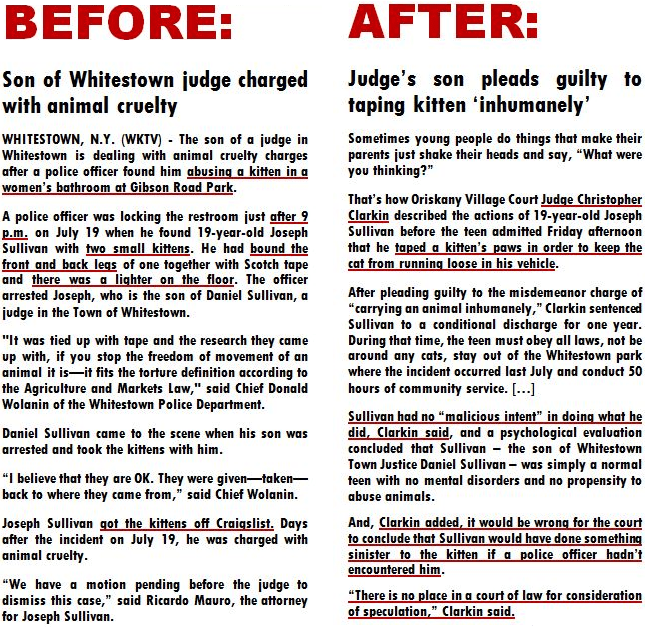
To conclude this abstract litany with a concrete illustration, consider these stories, published six months apart (“Son of Whitestown judge charged with animal cruelty” and “Judge’s son pleads guilty to taping kitten ‘inhumanely’”):

The difference you’ll detect between the two versions of the facts and how they’re interpreted exemplifies impression management.

Copyright © 2014 RestrainingOrderAbuse.com

The Politics of Feminism and Women’s Law: A Response to Zerlina Maxwell’s Editorial “No Matter What Jackie Said, We Should Generally Believe Rape Claims”

Implicit in the headline of this op-ed is that even “wrongly accused” men are “perps.”

The only complimentary thing this writer can find to say about attorney Zerlina Maxwell’s December 6 column in The Washington Post is—yeah, scratch that; it has no redeeming qualities.

The editorial is not only intellectually callow but morally vacuous. Even its research and computations are careless.

Ms. Maxwell’s piece concerns a story published last month in Rolling Stone Magazine about a purported gang rape at the University of Virginia. The story was swiftly lofted upon a current of hot air then failed to maintain elevation because of a number of holes.

By Ms. Maxwell’s pained logic, the story’s having nosedived is all the more reason why allegations of rape should be accepted wholesale.

Many people (not least U-Va. administrators) will be tempted to see this as a reminder that officials, reporters and the general public should hear both sides of the story and collect all the evidence before coming to a conclusion in rape cases. This is what we mean in America when we say someone is “innocent until proven guilty.” After all, look what happened to the Duke lacrosse players.

In important ways, this is wrong. We should believe, as a matter of default, what an accuser says.

Default means negligence, which Ms. Maxwell equates with propriety. According to feminist algebra, negligence = propriety is a balanced equation.

Note that Ms. Maxwell isn’t actually making an argument for policy reform. We already do, by default, believe what an accuser says, hence outraged and anguished accounts like the ones you’ll find here: “Stop False Allegations of Domestic Violence.”

Ms. Maxwell fails to appreciate that our crediting what a rape accuser says “as a matter of default” means the slope is greased all the way to the bottom. Accepting allegations of rape on faith means accepting on faith all allegations that relate to or imply violence.

And the grease flows sideways, also, not just top-down.

According to the same policy, women  too, are victimized by false allegations, false allegations made in criminal, civil, and family court (as well as to government agencies like Child Protective Services)—and the standard applied in non-criminal procedures is already much reduced from “innocent until proven guilty.” Women unjustly lose their good names, their livelihoods, their children, and their homes (and that’s just the abbreviated list). These are among the consequences of equating allegations with facts “as a matter of default.”

false-rape-letterMs. Maxwell concludes: “Ultimately, the costs of wrongly disbelieving a survivor far outweigh the costs of calling someone a rapist.”

She asserts that rape leaves a “lasting psychological wound” but that the fallout from being falsely accused of rape is minor and ephemeral. “The accused would have a rough period,” she allows. “He might be suspended from his job; friends might defriend him on Facebook.”

Haunting is not only that people like Ms. Maxwell can appeal to pathos to make their case or that they can make such an appeal despite demonstrating no faculty for empathy; haunting is that their appeals nevertheless succeed.

Ms. Maxwell says the “cost of disbelieving women…signals that women don’t matter and that they are disposable.” No, it signals that no one is any more disposable than anyone else.

Copyright © 2014 RestrainingOrderAbuse.com

Blinded by Science: Examining the Australian Government’s Sexual Assault Statistics to Expose How Such Science Is Derived, How It’s Applied, and Why It’s Not Really as Scientific as It’s Represented to Be

Here is the Australian government’s Institute of Family Studies’ sexual assault “Facts & Figures” page.

And here is the first thing it says: “Statistics carry significant power and persuasion.”

That’s putting it mildly. That power and that persuasion influence lives on a magnitude that no numbers could quantify. Appreciate that figures concerning sexual assault and how these figures are popularly exploited influence court rulings in all cases that touch on violence or the purported fear of it, including in civil and family court, cases based on allegations of harassment, stalking, child abuse, and/or domestic violence, among others.

You’ll encounter these statistics bruited ubiquitously on the Internet.

“Sexual assault statistics are based on two main types of data,” according to the Australian government website:

  • victimisation survey data—data collated from surveys conducted with individuals, asking them about their experiences of sexual assault victimisation, regardless of whether they have reported to police; and
  • administrative data—data extracted through the various systems that respond to sexual assault (e.g., police, courts, corrections or support services).

Important to note at the outset of this discussion is that statistics often quoted by advocates and commentators of one stripe or another (including journalists) may originate from survey responses, that is, from “intelligence” that may be unqualified by any corroborating investigation. Though this post looks at Australian statistics, figures cited as originating from the United States, for example, are derived the same way. When a statistic is phrased “[x number] of [men or women] report being the victim of [x],” that figure was derived from survey responses.

The Australian Institute of Family Studies draws its statistics from six national surveys. This number suggests scrupulous science, but no ascertainable accuracy can be ascribed to the raw data, which is anecdotal.

The 2012-13 Crime Victimisation Survey (CVS), for example, which is one of the six surveys from which the Australian government draws its statistics, is based on interview responses from one member (“selected at random”) of 30,749 “fully responding households,” that is, on the personal interpretations and alleged experiences of fewer than 31,000 people, a study sample that represents about a tenth of 1% of the Australian population. What percentage of this sample is male and what percentage female isn’t reported on the CVS webpage (though other surveys, like the Personal Safety Survey, do report gender-specific conclusions).

Survey-based statistics are among the sorts you’ll encounter broadly promulgated in feminist “fact sheets” and brochures—and consequently everywhere else.

Important to consider, furthermore, is that “administrative data” (police and court statistics), the second data set from which government figures are derived, may itself be influenced by the former sort of data. Survey responses, much touted, may exert either a direct influence on how officers of the law and courts are trained to respond to or interpret allegations, or they may exert a proximal influence by having inspired the direction of social science research that’s used for training. The former data, survey responses, may in other words determine the conclusions and actions of agents of the justice system to some degree, and possibly to a very considerable one.

“Statistics carry significant power and persuasion,” and neither police officers nor judges are any less susceptible to that power and persuasion than anyone else. In fact, they more than almost anyone else are required to absorb these statistics.

Granted, survey statistics are probably as comprehensive as it’s practical for them to be, and contrary statistics that these figures are rejoined with by advocates for disenfranchised groups like battered men may themselves be based on surveys of even smaller groups of people. All such studies are subject to sampling error, because there’s no practicable means to interview an entire population, and sampling error is hardly the only error inherent to such studies, which are based on reported facts that may be impossible to substantiate.
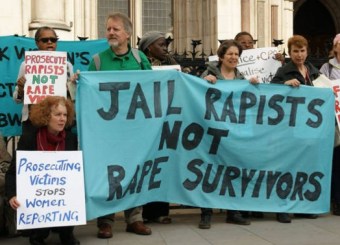

What must be appreciated in all of this is that what’s called “science” is far from certain and is no more verifiable or creditworthy than are responses to online petitions like this one: “Stop False Allegations of Domestic Violence.” Both types of data, that is, are anecdotal.

The significant difference is that respondents to petitions aren’t “randomly selected” or interviewed by trained questioners. There are no “controls.”

So-called controls, however, may themselves influence findings.

Government surveys are inherently biased insofar as their aim is to collect information according to specific questions. The questions determine the nature and bounds of the responses to them and are determined by designated topics of interest.

Petitions in contrast place no constraints on respondents’ comments—and indirectly garner uninhibited answers to questions like, “Have you or someone you know been the victim of fraudulent abuse of court or state process?”

They garner answers to questions, that is, that the government doesn’t care to ask.

Copyright © 2014 RestrainingOrderAbuse.com

Stepford Syndrome: Why Feminist Rape Rhetoric Is Both Tiresome and Disturbing (and How It Hurts Not Only Men, but Women, Too)

“A U.S. law professor, who will be speaking at the Commons, said the UK’s stance on false allegations [of rape] is more aggressive than in countries such as the United States, Canada, and Australia. Prof. Lisa Avalos, of the University of Arkansas, said false allegations in the U.S. were dealt with as a misdemeanour offence, not a felony—and most women were not jailed if found guilty.

“‘In the course of my research, I have not found any country that pursues these cases against women rape complainants in the way the UK does. The UK has an unusual approach, and I think their approach violates human rights,’ she said.”

The Guardian (December 1, 2014)

This quotation about rape “complainants” is drawn from a story that appeared in The Guardian this week (“109 women prosecuted for false rape claims in five years, say campaigners”), a story that’s mirrored on a number of other sites, including Jezebel.com and Salon.com.

Picketers object to the prosecution of 109 British women in recent years for perverting the course of justice by falsely alleging rape. According to the protesters’ signs, all female accusers are “victims” and “rape survivors,” and the men they accuse are all “rapists” (ipso facto).

The story concerns outrage expressed by activist representatives of the charity Women Against Rape, or WAR, whose assertions require no elucidation; they’re clockwork.

Whether WAR’s outrage has merit is difficult to discern.

Obviously lost in the uproar, however, is what the (female) American law professor who’s quoted in the epigraph actually says, which is this: Falsely accusing someone of rape in the United States is merely a misdemeanor offense and one for which an accuser is rarely punished and may never be prosecuted at all.

This fact isn’t perceived as unfair by feminist activists—far from it. It’s touted, rather, as a reason why it’s a “human rights violation” for the United Kingdom to mete out sterner justice.

This writer, for one, would be more sympathetic to the denouncements of WAR if there were any headline-grabbing activist groups tabulating how many men are arrested and/or prosecuted each year for being falsely accused of rape.

In the fictional community of Stepford, all the women have been replaced by robots whose responses are programmed.

Even allowing that the 2 to 8% false allegation rate commonly cited by feminists were true (and it isn’t), the number of men falsely accused of rape is many times greater than the number of women prosecuted for false allegations, in the UK and everywhere else (for analysis of the rate of false allegations of rape, see Cathy Young’s 2014 Slate.com article, “Crying Rape: False rape accusations exist, and they are a serious problem,” and Emily Bazelon and Rachel Larimore’s 2009 piece, “How Often Do Women Falsely Cry Rape?” published in the same outlet).

Feminist outcry is reflexive, even arguably robotic, and invariably insensitive to male victimization. The argument that a majority of rapes goes unpunished in no way (logically, morally, or otherwise) excuses the unjust implication or punishment of even a single person, ever.

Besides being insensitive to male victimization, moreover, feminists evince no awareness that women, too, are victimized by their furor’s trickle-down effect. Feminists’ making an international case of the prosecution of 109 women works a very real influence on how rulings on charges “lesser” than rape are formed by the courts—charges made in restraining order, stalking, domestic violence, and related cases—and the defendants in these cases are far from exclusively men.

False allegations made against women in prosecutions involving or implying violence may only be a fraction of those made against men, but with those prosecutions’ numbering in the millions each year, that fraction is hardly inconsiderable and easily dwarfs a figure like 109. To posit, as activist groups like WAR tacitly do, that accusers’ allegations should be credited on faith means a lot of women (globally) will continue to be falsely implicated or punished based on judicial impulses that have been conditioned by feminist rhetoric. Much of the “social science” that’s used to “train” judges how to rule in prosecutions predicated on allegations of violence or the fear of violence is inspired by groups like WAR.

To illustrate how feminists’ gears turn (and why those gears need retooling), contemplate this letter printed in The Guardian recently that was composed by a 21-year-old man who was accused of rape as a boy: “A letter to…the girl who accused me of rape when I was 15.”

Now consider this steely response to it by Lucia Osborne-Crowley published almost simultaneously (buzz…whir…click) on WomensAgenda.com: “Why did the Guardian publish this letter about false rape accusations?

Need any more really be said?

Copyright © 2014 RestrainingOrderAbuse.com

Retracting False Allegations to the Court

Apologies are offered upfront to the reader expecting a tutorial on how to recant false testimony (though here is an explication about how a restraining order may be dismissed by a petitioner who has reconsidered).

The reason this post must disappoint is that to withdraw false allegations would be to confess to lying to the court and would, as well, be to require that the court acknowledge it was snookered. Hence is copping to lies a doubly taboo subject.

A thorough scouring of the Internet for a simple how-to on retracting false allegations to the court will reward an earnest inquirer with virtually nothing.

The fact is that in America, Land of the Brave Knave, the most fundamental legal precept is admit nothing. Application of that precept apparently extends to the court itself, whose officers may practice moral contortionism sooner than own on record that lies are ever detected.

Their reflex, when no amount of revision can redeem a false allegation, is to talk around it or reach for a nonjudgmental word like unfounded or baseless. Complainants never lie; at worst, they err.

The question remains, however, of how “errant” testimony may be retracted.

This writer proposes that since judges provide false accusations with the agency to work their pernicious effects on untold people’s lives, a judge should be the one to fill the informational void presently under consideration.

The judicial impulse to frame rulings according to personal conceptions of “right behavior” must surely reject the qualification of lying as conscionable conduct. Arrogating to themselves the right to prescribe rules for how others should behave, besides, presumes judges have faith in their intelligence. They must therefore know false accusations are made even if it’s against policy to say so. It’s not for nothing, after all, that statutes nominating perjury a crime exist.

Since only ignorant people could innocently deny lying occurs, and since we’ve established judges don’t regard themselves as ignorant, to them is this question humbly put: “How may false allegations to the court be simply taken back?”

Copyright © 2014 RestrainingOrderAbuse.com

Restraining Orders as “Revenge Porn”

In the second season of HBO’s The Newsroom, a lead character is exposed on a website called Revenge Porn by a man with whom she’d had a brief fling.

After sitting huddled in a corner and pronouncing, “I want to die,” she rallies and confronts her former lover while he’s conducting a business meeting. Without much prelude, she kicks him in the testicles and bloodies his nose.

It makes for engaging TV.

If only an ex-intimate’s exploitation of the legal equivalent of Revenge Porn could be so briskly requited and resolved.

What I’m referring to, of course, is treacherously defamatory representations to the court on a civil restraining order, representations intended to publicly humiliate and satisfy a scorned lover’s urge to wound. The restraining order is an invitation for the system to poke its nose into the crevices, one it’s glad to accept.

The TV show character wasn’t able to sue the man who betrayed her, because she posed for the pictures. She even bought the camera for him.

Had the man surreptitiously shot the photos and aired them without her consent, she could have taken him to the cleaners. The courts do more than frown upon that kind of thing, especially when the photos are nudies.

Non-photographic representations that use the justice system as their porn site, though, are embraced as compelling causes of action.

Stalking, indecent exposure, assault, child molestation, bestiality, rape—no pubic allegation, however scandalous, is off the table, and there are no consequences for falsely portraying someone as a lewd and lascivious beast. It’s not defamation; it’s testimony. This distinction sublimates obscene slanders and libels into protected speech, and denies defendants any recourse for realizing compensation for the damage they inflict, psychological, physical, financial, and material.

The court hosts the site, and judges, the site’s administrators, are only answerable to the law, which licenses the site.

This revenge porn is legal—and has the feminist stamp of approval.

Copyright © 2014 RestrainingOrderAbuse.com

Chicken Sh*t from Rotten Eggs: Rosemary’s Story of Restraining Order Abuse

The account below, by Rosemary Anderson of Australia, was submitted to the e-petition End Restraining Order Abuses (since terminated by its host) and is highlighted here to show (1) that restraining orders are abused not only by intimates but by neighbors and strangers, (2) that the ease with which they’re applied for entices vexatious litigants (especially once their appetite has been whetted), and (3) that restraining orders are abused in countries other than the United States.

Assuredly due to language barriers, most visitors to this blog are from predominately English-speaking countries (England, Canada, and Australia, in particular, among nations abroad), and for whatever reason, over 90% of visitors are American.

Foreign complainants of restraining order abuse, however, shouldn’t hesitate to report their stories and share their criticisms on blogs like this one or on petitions like the one Rosemary used, because the value of those stories and criticisms, ultimately, is to expose injustice. The civil restraining order is common to countries across the globe, as are its abuses.

Rosemary’s story (with minor editorial tweaks):

We have had several restraining order summons served upon us by our neighbours, and on one occasion a worker whom I had reported to police for exposing himself to me (evidenced in photos) tried to take a VRO out against my husband (VRO = violence restraining order). To date they haven’t gone the distance thanks to our lawyer, but we know they will never stop trying.

The allegations are false, though we admit to giving them the finger from time to time in retaliation for being abused or watched.

The matter began when we opposed the expansion of their egg farm. We did so through the appropriate channels and in the appropriate manner. They have a CCW on their property and for reasons unknown were allowed to build the egg farm far too close to our boundary and house.

Their settlement to buy their property went through in January (2011). Ours was delayed and went through in February. They keep telling people they were there and had already built and were running their egg farm before we bought our property. The egg farm did not end up how it was supposed to and has been poorly managed, creating unpleasant issues for us. To expand any farther, they need our property and have indicated they would like to purchase but are not willing to pay what it is worth.

Every time they are overstocked or doing something wrong, they will make some sort of false allegation against us, cost us thousands of dollars, and generally make our lives unpleasant. On one occasion, we had the police come out and accuse us of stealing their dog after we had to catch it to stop it from chasing our horses. On another occasion, they rang the ranger and accused us of shooting their dog after it had gone missing. It turned up two days later alive and well in the dog pound.

The woman is about the same age as me, in her 50s and supposedly religious. She married a disabled man, and she uses these things to gain sympathy. She will lie and first turn on the tears, and if that doesn’t work she will become aggressive and threaten, and get others to threaten.

She once threatened my employer to get me sacked. I had luckily recorded several previous incidents that proved to my boss the lies they tell. They once took us to court over the boundary fence even though we had evidence in the form of letters and photos. Miraculously they won as they brought the non-professional fencing person with them as a witness. We weren’t given the appropriate notice by the court of their witness and could have selected several witnesses of our own to prove the fencing contractor assisted our neighbours to make a false insurance claim. The summons for this also came 18 months after we had given them what we had considered an appropriate payment. They had cashed the cheque and never contacted us in between to dispute it.
I found the behaviour of the local magistrate and the local court registrar very suspicious, and seriously wonder if they are members of their church. I wish I had more time to explain. I have had people ring us on our silent phone number and abuse us as well as had threatening letters sent to our PO box and which also contained our pet names.

Rosemary’s accuser fits the profile of many others characterized by visitors who’ve left comments on this blog and is prototypical of the serial-accuser-cum-neighbor. Almost without exception, people like this are triggered by some petty grievance.

Restraining orders, because they’re issued on one party’s word alone, are addictive gateway drugs for vexatious litigants, who are induced to abuse process continuously once they see how conveniently it’s accomplished. There are no consequences for filing false or frivolous complaints. Not only do the courts never motivate serial accusers to stop; they often reward sniping and treachery.

It’s good for business.

Copyright © 2014 RestrainingOrderAbuse.com

J’s Story: Restraining Order Abuse and the “Dreaded Crazy”

J, a single dad who lives in Texas with his two kids, submitted his story as a comment to the blog in September, prefacing it: “I am writing this to share [it] with the rest of my fellow male victims [who] fall in with the dreaded Crazy.”

The “dreaded Crazy” in J’s case manifested as an Arkansas woman J began a romance with online, a high-conflict person whom a clinician might diagnose with borderline personality disorder (BPD).

(For an elucidation of BPD, see psychologist Tara Palmatier’s “In His Own Words: Dangerous Crazy Bitch Ahead,” which chronicles a case similar to J’s. See also any of Dr. Palmatier’s detailed explications of personality disorders.)

Here’s J’s story in his own words (lightly edited):

I met a beautiful, sexy, well-educated woman online. We met in person, and I was smitten. We shared our life stories with each other and began to see each other more. Although she lived over 500 miles away with her two children, I visited her every chance I could.

Her past was fraught will evil men who had taken advantage of her. She told me she was a young widow and that her first husband died suddenly of heart failure at a very early age, leaving her and her first child all alone. She said she remarried shortly after and had her second child. Unfortunately the second husband turned out to be a quite the carouser and left suddenly for Europe to be with another woman.

I felt so bad for her. I had two children of my own as a single father, so I was able to connect with how hard it was. She told me how she loved children and had always wanted a big family. She lamented feeling that her own family had deserted her, shunning her because she wasn’t a devout Christian.

There were so many twists and turns to her story. How could all this happen to such a wonderful and beautiful woman? She was such a nice and giving person….

Because it was all complete bullsh*t.

I won’t go into the details of my awakening. Let’s just say dates didn’t match up. Her kids’ (Fruit Loops’) stories didn’t match up. As a matter of fact, just about everything she told me didn’t match up. But I was smitten. So this went on for a long time until one day I just flatly called her on it. Suddenly my little scoop of heaven turned into a raging, clawing, screaming harpy. She accused me of being like every other son of a bitch in her life. Then she was swinging at me and screaming at me to get out.

I was already sprinting backwards, car keys in hand, toward my car. I got inside and sped off as she was chasing me. I was outta there, heading back to Texas never to return.

I did not see, speak, or talk to that woman again for over six months. Then one day a constable walks into my office and says, “Are you so-and-so?” I said yes. “Well, I have a restraining order for you from Arkansas.” Confused, I took it and read it. The constable then said as he was leaving, “I normally don’t read those. But looks like one crazy bitch to me. Better stay away. Ha-ha. Have a nice day.”

I was blown away.

The order claimed that I had snuck inside her house the weekend prior and forced her to call some other guy to tell this other guy (whom I don’t know, never met or heard of) that she was madly in love with me. Then her statement said I “roughed [her] up” then vanished into the night. Damn I was stunned. I did not know what to do. The order stated that I had 14 days to show up in Arkansas! I wasn’t even there. I lived in another state! I had not seen or heard from this woman in six months!

So I called an attorney friend of mine. He jokingly asked, “Did you do it”? I replied, “Hell no!” He then asked me to fax over the order. After he reviewed it, he called back and said, “Yep, it’s a restraining order, and you have 14 days. In the meantime, you have to stay away from her and her children.”

I replied, “This is bullsh*t! What if I just ignore it?” He said, “Well, if you ignore it and don’t show up in court on that day, you will automatically be found guilty. The charge will stay on your record, and you may not be able to buy a firearm.” “What the f—!” I yelled. “Can’t you just send a letter to the court explaining I wasn’t there and live 500 miles away?” He said no. “If you want to fight the charge, you have to show up.” He said he would have gone for me but wasn’t licensed in Arkansas.

He gave me the number of an attorney friend who worked in Little Rock. Next thing I knew, I’m having to fax or email every record I kept that shows my whereabouts on that day: gas receipts, store receipts, etc. I had to get a list of movies that I watched from the video download company we use. Cell phone calls. Text messages. (By the way, they really do monitor those. They can pinpoint your exact location, but you have to send a written request.) All of this to prove I was not there. Once I gave that attorney everything, he told me he would go to court that day and ask for an extension of 60 days. And I would still have to show up in Arkansas. Sh*t!

I cannot express the worry I endured during this time. Here I was falsely accused of something I did not do and was guilty until I proved otherwise in another state!

Prior to my court date, the attorney hired a private detective to run police reports on this woman’s current and former addresses. All you really have to do is call the local police department, and for a small copy fee it will give you all of the police reports related to a specific address for a specified time period. It’s really quite easy to do.

I was shocked when I saw them.

This woman, over a period of five years, had called the police over 20 times between two different addresses claiming either an assault or attempted break-in. All the police reports were noted as unfounded. One was a claim of rape. On that claim, she took some poor guy all the way to a grand jury, which promptly dismissed it. (Grand jury decisions are sealed, but the defendant’s name and attorney were listed. My attorney called that guy’s attorney and got a few details.)

The file on her sordid past was pretty thick. I thought that this was going to be over. Nope! I couldn’t use this information in court. It didn’t pertain to this incident. It was still her word against mine.

The day of the court hearing came. I drove out of state to be there. She actually showed in up in court that day. I suspect she didn’t expect I would show. The judge called out our docket. She sat on one side of the courtroom. My attorney and I sat on the other.

Seconds before the hearing, my attorney asked to briefly speak just to the prosecutor. They met in front of the bench, and my attorney handed him the file with prior police reports and my receipts and information as to my whereabouts on the day in question. The prosecutor then asked the judge if he could take a few minutes with the plaintiff. The prosecutor walked over to her with the file and whispered in her ear as he let her review the contents of the file. You could see the blood drain from her face. She whispered something to him. The prosecutor then stood up and said, “Your Honor, the plaintiff requests to withdraw her charge.” The judge just laughed and said, “Case dismissed.” That was it. It was over, no questions asked: $3,800 bucks and a long drive back home.

I did return to the local sheriff’s office and file an amended police report to state I was falsely accused and the case was dismissed on this date. You can have the dismissal form put in the police record.

I also had a cease-and-desist letter drafted by my attorney stating basically, “Don’t ever do this again, or I will sue you for liability.” You can put that in the police record, as well.

I had a copy of that letter sent to her by certified mail. I also had a copy personally delivered to her place of work by the same investigator who ran the background check. He went to her office and told the receptionist that he had a “special delivery” letter for her and that he needed to deliver it in person.

The receptionist called her to the front office. When she did, the investigator introduced himself and informed her that he had a letter to present. He pulled the letter out and proceeded to read the cease-and-desist letter out loud to her in the crowded waiting room. Then he handed it to her and left. He reported back that she appeared to have been in shock.

That’s it. Haven’t heard from her to date.

Copyright © 2014 RestrainingOrderAbuse.com

Interminable Indeterminacy: How False Allegations on Restraining Orders May Be Worse than False Allegations of Rape


Journalists who recognize the harm of facile or false allegations invariably focus on rape. This ignores the harm done to women by false allegations, of course, and shows ignorance, besides, of a significantly more fertile yet equally damaging source of wrongful prosecutions: the civil restraining order.

Unarguably there are few miscarriages of justice worse than when rape is falsely alleged and the victim of the false accusation is nevertheless found guilty. That’s a life brutally scarred or ruined for absolutely nothing—and ruined not by a lone malefactor but by the state itself.

Most negative commentary on rape allegations, though, focuses on cases where the evidence is less than conclusive or is found to be utterly false.

Just as there’s no quantifying the effects of being raped, there’s no quantifying the effects of being falsely accused of rape. The stigma is devastating, and public sympathy is nevertheless scant. Even online support groups for victims of false allegations of rape may be accessible to screened subscribers only, so distrustful and averse to scrutiny are the men who are maligned this way.

If, however, an allegation of rape is officially determined baseless, its victim has at least the solace of being able to say so. This hardly dispels the psychic effects, but it does mitigate external ramifications, like access to jobs.

False restraining orders, in contrast, often aren’t discerned as false (and restraining orders may be awarded in spite of false allegations’ being detected), and the consequences their recipients must live with are more than psychological. The damning records are preserved indefinitely. In some regions (like Massachusetts), to merely be accused of domestic violence in an ex parte civil court procedure is to be recorded in a state registry as a violent offender. Even if claims are later dismissed when the accused is given an opportunity to defend him- or herself, that is, even if a judge later recognizes on record that s/he’s “innocent,” s/he’s still “guilty” according to the system, and “guilty” is all a background check will reflect.

The implications of restraining orders, what’s more, are generic. There’s no specific charge associated with them. They’re catchalls that categorically imply everything sordid, violent, and creepy. They most urgently suggest stalking, violence, and sexual deviance.


Rape, it should be noted, may be among the actual allegations made by a restraining order applicant—and unlike in a criminal trial, a judgment grounded on such an allegation, amid others, may be affirmed in spite of the allegation’s merits’ never having been assessed.

Restraining orders don’t determine anything. The procedures from which they issue are too accelerated and loosey-goosey to be conclusive.

That no punishment attends the issuance of a restraining order is a tacit acknowledgment by the state that it may be based on nothing more substantive than hearsay and innuendo, and that its implications should be discounted.

They aren’t discounted, though. They’re regarded just as gravely in some respects as felony sentences. Restraining order recipients are denied jobs, leases, and loans. Some are prohibited from working with or around children—and even from attending their own children’s school events (sometimes based on accusations they’re never granted the practicable opportunity to contest in court—and always based on accusations they’re at most given a few minutes to controvert, typically without benefit of legal counsel).

Restraining order rulings are inevitably sketchy at best. They’re indeterminate but nevertheless treated as decisive—and they never go away.

“On the force of the plaintiff’s testimony, the court concludes it’s a crocodile.”

Victims of false rape allegations are socially disgraced and alienated, and psychologically tormented. Victims of false restraining orders may be, too, and besides may lose everything of value to them or have it taken from them by the state. People report spending as much as $100,000 or more to defend themselves in protracted litigations whose seed was an accuser’s filling out some paperwork and having a few-minute chinwag with a judge. They report losing their homes, becoming estranged from their children, and being permanently barred from employment in their fields of qualification and expertise.

Negative associations that attend a charge of rape are unquestionably more sensational and severe than those that accompany the issuance of a restraining order, but on balance the lived consequences of a restraining order may be comparable if not worse.

False allegations of rape should emphatically be called out by reporters to check the impulse that prevails today to credit finger-pointing as fact (particularly finger-pointing by women). Because the implications of rape are so loud and urgent, revelations of false allegations are loud and urgent, too. They arouse consciousness and conscience.

The question that they should stimulate and have yet to, however, is that if people will lie about rape, what won’t they lie about and what quieter and subtler lies and their consequences are being overlooked?

Exposure in the press would indicate that newsworthy instances of dubious or false allegations of rape are few. The problem with giving exclusive attention to them is that it hides more than it reveals.

The cancer of false allegations is far more advanced and widespread.

Copyright © 2014 RestrainingOrderAbuse.com

Living in the Crosshairs: Crackpot Neighbors, False Reports, and Restraining Order Abuse

I bonded with a client recently while wrestling a tough job to conclusion. I’ll call him “Joe.” Joe and I were talking in his backyard, and he confided to me that his next-door neighbor was “crazy.” She’d reported him to the police “about a 100 times,” he said, including for listening to music after dark on his porch.


His neighbor had never been punished for her mischief, only indulged and rewarded. This is behavior the police and court have been conditioned to treat as urgent. The woman’s husband refused to participate in her sniping—but didn’t interfere with it, either. He had to live with her. Others in the vicinity just tried to stay off her radar.

The neighboring house was dim and still as Joe related the woman’s pranks, which spanned a period of years. “She’s probably listening to us now,” he remarked.

I commiserated but didn’t share with Joe that I wrote about such things and heard about them monthly from people whose lives were sometimes crippled by hyped allegations of fear and danger.

Joe told me, unsurprisingly, that his neighbor had twice sworn out restraining orders against him. The first was laughed out of court on appeal; the second he didn’t bother to contest. He gestured as if to say, “What would’ve been the point?” Maybe Joe intuited that high-conflict people like his neighbor live for strife and attention, and decided to deny her the satisfaction of a fight.

(Many respondents to this blog report they’ve had multiple false restraining orders petitioned against them. One e-petition respondent recently reported being the recipient of seven fraudulent restraining orders obtained by a “diagnosed narcissist.”)

Joe informed me, with a hint of sarcasm, that his neighbor was a professional psychic. Surveillance cameras nevertheless hung from the corners of her home’s roofline. I guess she couldn’t see everything coming.

(Among people who report being stalked or serially accused by neighbors through the courts, the presence of security cameras is commonly mentioned. The neighbors also tend to be of middle or advanced age and female—as are their victims, sometimes. One 60-year-old woman, chronically accused by a female neighbor, has reported having to abandon her house and flee to forestall further allegations. Men who are spies, peepers, and cranks are more likely to be the recipients of restraining orders than the petitioners of them: women accuse sooner than men do—and they do it more effectively.)

Joe didn’t get too explicit, but he told me he’d been photographed fooling around with his wife in the hot tub, which he’d since removed. In Arizona, at least, it’s apparently legal to monitor your neighbor over a bordering fence.

Joe said after he and his wife divorced, his neighbor told his ex-wife he was having an affair. He took in a male roommate. His neighbor photographed him, too—through the window adjacent to her backyard.

Joe shifted an arbor from one side of his patio to the other after getting approval (but no compensation) from the homeowners’ association. Two massive Tombstone rosebushes interwove to form a decent privacy screen.

I asked Joe whether he’d ever tried to get the woman off his back. He told me, unrepentant, that he’d once shot her with the garden hose while she was peeping. To this day, he says, she circulates it that he “assaulted her with a high-pressure hose.” He may have said this was the grounds for one of the restraining orders.

His neighbor has reported her other neighbors, too. The neighbor across the street knew of her particular “sensitivities” and informed her in advance that she was having a birthday party for her little girl at 2 in the afternoon on a weekend. The neighbor from hell reported it, anyway—on principle, I guess. The kids’ party was disrupted by cops.

Joe says his neighbor’s record is seven calls to the sheriff’s department in a single day (just on him). Deputies finally told her that if she called again, they’d cite her.

Joe works as a chef and didn’t appear to have any kids. With a few beers in him, he seemed to take the whole thing in stride.

I wonder if a feminist would be as tolerant.

Copyright © 2014 RestrainingOrderAbuse.com

How Dogma Is Preserved: A Feminist Law Professor Is Awarded a $500,000 Grant from Uncle Sam to Prove Claims of False Allegations in Family Court Are “Junk Science”

“Ten years ago, about one in 10 domestic violence arrests involved women as defendants. Now, it’s one in five in Michigan and Connecticut, one in four in Vermont and Colorado, and more than one in three in New Hampshire. Public officials are trying to figure out what’s going on. They are especially mystified because, according to [The New York Times], the trend ‘so diverges from the widely accepted estimate that 95 percent of batterers are men.’

“Interesting logic: first, a dogma contradicted by virtually all social science research [namely, 95% of batterers are men] becomes ‘widely accepted.’ Then, when it’s disproved by the facts, the response is to ask what’s wrong with the facts.”

—Cathy Young, “Female Aggression—Domestic Violence’s ‘Dirty Little Secret’” (1999)

What the quoted writer means is that when dogma becomes “widely accepted,” it stays “widely accepted.” Time has proven her right. Fifteen years later, that dogma—men are abusers; women are victims—still predominates.

It gets by with a little help from its friends.
Some months ago, a post on this blog responded to research conclusions published this year by Prof. Kelly Behre, director of the UC Davis Law School’s Family Protection and Legal Assistance Clinic.

Among those conclusions was that anecdotal reports of procedural abuses, false allegations, and judicial bias by what she calls FRGs (fathers’ rights groups) have no “legitimate” research studies to back them up and should therefore exert no influence on public policy. They should, according to the professor’s own research, be disregarded.

Last month, it was reported that a George Washington University law professor was awarded a $500,000 grant from the National Institute of Justice (i.e., taxpayers) to “conduct a study in which she hopes to show that family courts across the country have fallen into a pattern of awarding custody” of children to fathers who are “known abusers.”

The professor, Joan Meier, directs the university’s Domestic Violence Project. She’s also the “founder and legal director of the Domestic Violence Legal Empowerment and Appeals Project, a nonprofit that [helps] domestic violence survivors receive pro-bono [legal aid].” Her credentials, you’ll notice, are conspicuously similar to those of Prof. Behre, referenced above.

Consider why Prof. Meier was awarded the grant:

She said researchers can say anecdotally that courts have awarded custody to known abusers or fathers whose [partners or ex-partners] have warned could be abusive to children, but researchers and advocates’ sharing their experiences alone hasn’t yet led to change.

Now consider that fathers’ rights researchers and advocates’ sharing their experiences has also yet to lead to change, and appreciate that those researchers and advocates aren’t being cut half-million-dollar checks to compile research data. What they have to say doesn’t accord with the “widely accepted” dogma; it isn’t popular.

Because their anecdotal reports of false allegations, procedural abuses, and judicial bias don’t have any official research to validate them, they’re to be ignored.

Ignoring those reports, in fact, is essential for a hypothesis like Prof. Meier’s to be tenable. It depends on absolutely denying that those whom the professor calls “known abusers” could be men who’ve been falsely implicated.

Prof. Meier says she expects to use the $500,000 federal grant to conclusively expose gender bias in family court against women—and to do it using a study sample of “over 1,000 court cases from the past 15 years” (a study sample, in other words, of fewer than 2,000 cases).

For the professor’s hypothesis to be proven “true,” it just has to be shown that in a significant number of the “over 1,000 cases” reviewed, a father awarded custody of children had previously been accused of abuse.

The researchers hope to debunk “junk science” that mothers make false accusations of abuse to alienate fathers from their sons or daughters, a misconception that Meier said has put many children in danger.

Prof. Meier seems to fail to grasp that the complaint is that mothers successfully “make false accusations of abuse to alienate fathers from their sons and daughters.” Even if her study were to show that child custody is awarded to fathers who’ve been successfully accused of abuse, it wouldn’t necessarily prove that the complaint that false accusations are routine  is based on “junk science” (unless by that phrase she means science that hasn’t been government-funded and -audited).

Prof. Meier’s assertion that claims of false allegations are a “misconception,” what’s more, ignores that any number of attorneys who practice family law publicly corroborate that so-called misconception. Some indeed say false allegations to gain the advantage in custody battles are commonplace. These are the attorneys who actually practice in the trenches. Their reports, however, are once again only anecdotal.

Fathers and their advocates who claim false accusations are made don’t, of course, misconceive anything. They know what they know; they’ve lived it. The professor’s use of the word misconception is directed at the “people who count,” that is, the policy-makers. What she means is any credibility they might be disposed to show complainants of procedural abuse is based on a misconception. That misconception, apparently, is that men without law degrees could possibly be telling the truth.

The professor’s assertion that reports of false accusations are “junk science,” furthermore, would seem to advocate for good science, and there’s certainly nothing scientific about prejudicially dismissing those reports offhand. Studies like those proposed by Prof. Meier need to be counterbalanced by studies with opposing hypotheses—and they aren’t.

Meier and her team of legal and statistical experts will create a database of court opinions that she hopes will show a pattern that supports her hypothesis, and will then present it to activists, local courts, and organizations that train judges.

Preservation of dogma is a game of ring-around-a-rosy. Advocacy for what’s widely accepted to be true is lavishly funded, and the resultant “science” may then be used to “train” judges how to rule, further reinforcing the dogma.

(If the context of this policy were Russia instead of the United States, would training still be the word we used to mean influencing judges?)

This is how underhand gets the upper hand, and it’s remarkable how openly this kind of business is transacted. No one bats an eye, because it’s “official.”

Prof. Meier may have the best of intentions. The author of this post has never known anyone whom he would characterize as a domestic violence “survivor.” He has no doubt, however, that there are people who are daily subject to violent cruelty, and if he did know someone like that, he’d be grateful that there were people like Prof. Meier looking out for their interests.

Victims need advocates and defenders.

The reality is, though, that victims of domestic violence have quite an abundance of public and private sympathizers, while victims of abuse of civil and criminal processes legislated to protect battered women and children (including restraining orders) receive little public recognition at all. An agency that calls itself the “National Institute of Justice” shouldn’t play (or pay) favorites. Justice would, in fact, advocate that an equal payout be provided to researchers to study the frequency of fraudulent accusations, which can’t be determined from court rulings, because those rulings are influenced if not dictated by the prevailing dogma.

Hypotheses, it’s been amply observed, tend to incline researchers to find evidence of whatever it was they were looking for in the first place (this is called “confirmation bias” or “myside bias”).

Leora Rosen, a former senior social science analyst at the National Institute of Justice, said [Prof. Meier’s] study is unique because it is transparent about its lack of objectivity and looks at family court rather than criminal court cases. She has partnered with Meier for the study.

Copyright © 2014 RestrainingOrderAbuse.com