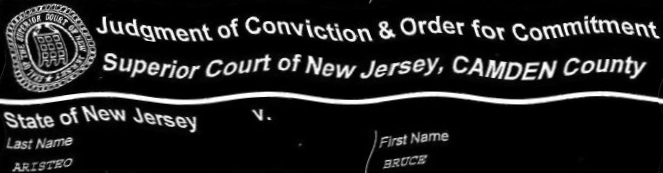
“PERMANENTLY PROHIBITED”: Camden County, New Jersey’s Idea of a Just Order of the Court

NOTE TO THE COURT: Facts in this post were gleaned by its author and do not originate from its subject, Bruce Aristeo, who had no influence on its composition. Commentary, likewise, is solely that of its writer.


Camden County, NJ, New Jersey, unlawful orders of the court, civil rights violations, constitutional rights violations, prior restraint, indefinite temporary restraining order

A recent post on this blog highlighted the case of Raines v. Aristeo, out of Camden County, New Jersey.

You can find the post on Google. You won’t, however, find an association between that post and the name of the plaintiff, Jody Raines, if you use that name as your search term (or the name of her business, WebMarCom). That’s because the judge returned a verdict on April 26, 2016, against defendant Bruce Aristeo requiring that any such association be severed.

I got a chance to look at the judge’s order this week. To call it an offense against free speech (and some other constitutional guarantees) would be like calling public defecation impolite.

Bear in mind that Mr. Aristeo was prosecuted for posting satirical videos ABOUT Ms. Raines on YouTube. That’s the basis for his being nominated a “criminal stalker”—also that he’d previously been issued something called an “indefinite temporary restraining order” (unique to Camden County, New Jersey). Mr. Aristeo’s videos purportedly violated this “indefinite temporary” whatchamacallit and were represented as “harassing” and therefore evidence of “stalking” and “domestic violence.” (Don’t strain to find logical connections. You’ll give yourself a nosebleed.)

This is actually how the order, issued by Judge Frederick J. Schuck, reads:

  1. The Defendant shall be PERMANENTLY PROHIBITED from entering the residence or place of employment of Jody Raines and shall be further prohibited from being present upon the grounds or property surrounding said locations whether in the State of New Jersey or another jurisdiction as specified below.
  2. The Defendant shall be PERMANENTLY PROHIBITED from any future acts of domestic violence against Jody Raines enumerated in J.S. 2C:25-19a and specifically from following, monitoring, surveilling, stalking, harassing and/or threatening Jody Raines.
  3. The Defendant shall be PERMANENTLY PROHIBITED from any and all personal contact with Jody Raines.
  4. The Defendant shall be PERMANENTLY PROHIBITED from any and all communication to or about Jody Raines and her business (see paragraph 8).
  5. The Defendant shall be PERMANENTLY PROHIBITED from causing any communication to or about Jody Raines and her business and any contact to be made with Jody Raines directly or indirectly, or through any third parties, mediums or agents.
  6. The Defendant shall be PERMANENTLY PROHIBITED from any and all communication or personal contact with any family members, friends, employers and co-workers of Jody Raines or other persons with whom communication would be likely to cause annoyance or alarm to Jody Raines.
  7. The Defendant shall be PERMANENTLY PROHIBITED from utilizing any internet and/or social media postings, directly or indirectly, or through any third parties, mediums, or agents regarding, referring to, or simulating, characterizing or alluding to Jody Raines, her family, her friends, her business, or her pets in any form, including but not limited to YouTube, Facebook, LinkedIn, and Twitter.
  8. Prohibited contact or communication in Paragraphs 3, 4, 5, 6, and 7 above shall include any form of communication made by any means, including but not limited to, any verbal or written communication, communications conveyed by any electronic communication device or medium, including but not limited to, a telephone, including a cordless, cellular or digital telephone, computer, or any other means of transmitting voice or data, including but not limited to text message, email, social media, social networking sites, internet or other communication via computer or electronic device, including but not limited to the posting or publication of images or audio recordings of Jody Raines, and communication made by sign or gesture and the physical presence of the Defendant in proximity to Jody Raines or at the specified prohibited locations.
  9. The Defendant shall further be PERMANENTLY PROHIBITED from communicating, sharing, disclosing, or disseminating to any third party, medium or agent any information referencing Jody Raines, her business, her family, or her pets via any method described [above].
  10. The Defendant shall cause to take down and remove from the Internet any and all publications or postings over which he has control that mention the name of Jody Raines or any business owned or operated by her, exhibit her image, or contain audio recordings of her voice.
  11. A violation of this Order shall be governed by J.S. 29-9a; however, nothing in this paragraph shall preclude the filing of additional criminal complaints based upon the act(s) constituting a violation of this Order.

Remember that Mr. Aristeo, a former schoolteacher, was found guilty of “stalking” (in contempt of a “temporary indefinite” restraining order) for publishing some one-to-many satirical videos.

(Ironic of that is how the judge’s order reads like satire: “including but not limited to, any verbal or written communication, communications conveyed by any electronic communication device or medium, including but not limited to, a telephone, including a cordless, cellular or digital telephone, computer, or any other means of transmitting voice or data, including but not limited to text message, email, social media, social networking sites, internet or other communication via computer or electronic device, including but not limited to….” How can you not hear that in the voice of John Cleese?)

Mr. Aristeo is now PERMANENTLY PROHIBITED from publicly referencing (“including but not limited to”) a goldfish Ms. Raines might own—and congratulations to county prosecutor Tracy Cogan for that snot blob on the Constitution.

Mr. Aristeo, whom Ms. Raines has had jailed before, was sentenced to 364 days behind bars (less 190 previously served). There’s more, too:

  • Four (4) years’ probation, subject to standard conditions.
  • Defendant shall undergo a psychological evaluation and treatment if necessary.
  • Defendant shall abide by all of the terms of the Permanent Restraining Order entered separately this date.
  • Defendant shall provide a DNA sample.
  • The Court separately shall enter a permanent stalking restraining order pursuant to N.J.S.A. 2C:12-10.01.
  • The State’s request for forfeiture of the Defendant’s Mac Pro Laptop Computer, and Apple Desktop Computer is denied. The State shall return to the Defendant any property seized from him immediately upon his release from incarceration, unless the State otherwise has initiated an appropriate civil action pursuant to N.J.S.A. 2C 64-3.

He was also fined: VCCA Assessment, $50; Law Enforcement Officers Training and Equipment Fund Penalty, $30; Safe Neighborhood Services Fund, $75; Probation Supervision Fee, $5; Domestic Violence Offender Surcharge, $100.

VAWA_order

Fittingly, the judge’s name, Schuck, is just one letter shy of an earthy Yiddish slang word that means dick.

Copyright © 2016 RestrainingOrderAbuse.com

*The arrests and prosecutions of Bruce Aristeo have cost taxpayers tens of thousands of dollars, for which they stand to be refunded $260 (if the judge corrects his math) by a man the state has left indigent (with a corrupted public record). If Mr. Aristeo now has grounds to sue the state for obscene abuses of power and false imprisonment, that may mean tens of thousands of dollars more drained from the public till, from which the costs of Mr. Aristeo’s housing, as well as the filing fees for his appeal, will also be drawn—all because he published some satirical material online representing his accuser as a toy monkey.

Jody Raines, Bruce Aristeo, WebMarCom

A Man’s “Tasty Little Balls…What a Treat!”: On RAINES v. ARISTEO, Free Speech, and Censorship


Typical of cases stemming from court injunctions, the case that occasions this post, Raines v. Aristeo, is a he-said/she-said quagmire. Not disputed is that the woman and the man had a four-month relationship in 2010. He says he ended the relationship after learning “disturbing…information” from her ex-husband about her. She says she ended the relationship because he became “strident,” “demanding,” and “threatening.” Both acknowledge they had a business relationship outside of their personal relationship. He says she owed him money and brought criminal complaints against him to get out of paying. This post doesn’t belabor the backstory but instead raises some questions: Is this, as in so many similar instances, a tempest in a teapot? Has a public interest been served by a man’s serial arrest and prosecution, or has it only sated a single woman’s rancor? Should this be countenanced? And, finally, is it lawful? The only pointed observation this post makes is that a woman has been annoyed, and a man is in jail.

NOTE TO THE COURT: Facts in this post were gleaned by its author and do not originate from its subject, Bruce Aristeo, who had no influence on its composition. Commentary, likewise, is solely that of its writer.


Jody Raines, WebMarCom, Raines v. Aristeo, Bruce Aristeo

In her YouTube video “Smiles for Ruger,” Internet marketing adviser Jody Raines imitates feeding a man’s “TINY, TINY, TINY” testicles to her dog.

“Agitator” Matthew Chan, who introduced me to how restraining orders are used to squelch protected speech, brought this search engine return to my attention on Friday:

This notice greets the person who queries Google either about Jody Raines, a woman who describes herself as a “recognized expert with Social Media, Internet Marketing and Website Development,” or Bruce Aristeo, a former schoolteacher she has prosecuted, not for the first time, and had sentenced to three months in jail.

Bruce Aristeo, Jody Raines, Raines v. Aristeo

Bruce Aristeo

The two dated in 2010, besides having a business relationship at the same time. Beyond these details, accounts predictably differ. Beyond question, however, is that Mr. Aristeo has been jailed for expression protected by the First Amendment.

His “crime” was posting satirical videos on YouTube ABOUT Ms. Rainesand even asserting that much is subject to interpretation. The basis for Mr. Aristeo’s arrest and subsequent incarceration was his being issued something called an “indefinite temporary restraining order” (unique to Camden County, New Jersey) in 2012. This bizarre instrument (issued in a state long-known for its harsh judicial treatment of male defendants) exposes Mr. Aristeo to warrantless arrest anytime for the rest of his life.

Prior to the most recent prosecution, Ms. Raines has had Mr. Aristeo arrested multiple times and jailed for over half a year. (Whatever Ms. Raines’ talents as a marketer outside of court may be, inside of one she’s proven herself to be highly effective.)

The conflict between the two inspired a YouTube “cold war” that went preemptively nuclear in 2015. Ms. Raines’ latest prosecution concerned Mr. Aristeo’s videos. This post examines one of his and one of hers.

Among Ms. Raines’ reported passions are motorcycles and Belgian Malinois dogs. One of her personal pets is called Ruger (also the name of a gun manufacturer). Mr. Aristeo waggishly produced a video “promoting” a brand of breakfast meats called “RU Burger Farms” (RUger).

Jody Raines, WebMarCom, Raines v. Aristeo, Bruce Aristeo

The vid’s “production company,” “MonkeyCom Banana Strategies,” both identifies the work as satire (which is protected speech) as well as takes a poke as Ms. Raines’ company, WebMarCom, which advertises marketing strategy advice. In the video, Mr. Aristeo (clad in a scarf and a fuchsia sweater) lustily tucks into some “Malinois sausage patties,” and his narration includes tongue-in-cheek patter like this: “I love to prepare my Malinois like the Amish do, where they put a little syrup on top after….”

Jody Raines, WebMarCom, Raines v. Aristeo, Bruce Aristeo

This apparently is supposed to represent a “true threat” to either Ms. Raines or her dog, neither of whom is explicitly identified. The video wasn’t brought to Ms. Raines’ attention by Mr. Aristeo—that is, he didn’t contact her—which means to have seen it, she had to have sought it out.

Ms. Raines responded to Mr. Aristeo’s homemade flick with a satirical video of her own. It suggests she has castrated Mr. Aristeo and is feeding his testicles to her dog. It’s called, “Smiles for Ruger.”

Here’s a still from it:

Jody Raines, WebMarCom, Raines v. Aristeo, Bruce Aristeo

The word troll in the frame that follows is Internet slang for a person who lurks in forums and sows discord on the Internet for self-amusement. Its application here is an ill fit, because Mr. Aristeo didn’t plant his video anyplace with the intent to provoke: Ms. Raines had to know where to look.

Jody Raines, WebMarCom, Raines v. Aristeo, Bruce Aristeo

The frame below intimates that Ms. Raines’ video was inspired by Mr. Aristeo’s “picking on” Ruger (who’s an intelligent dog but doesn’t speak English) with his video.

Jody Raines, WebMarCom, Raines v. Aristeo, Bruce Aristeo

Ironic is that the video documents Ms. Raines’ taunting Ruger before finally letting him devour the “TINY balls.” The video also taunts Mr. Aristeo. It doesn’t just mock his genital size and virility but concludes with Ruger’s “saying”: “Yes, they taste like CHICKEN.”

Jody Raines, WebMarCom, Raines v. Aristeo, Bruce Aristeo

Ms. Raines plainly means Mr. Aristeo is a chicken. She taunts a man whom she had already had arrested several times and jailed.

A question the court might have considered during sentencing this year, if not before that, is whether this is the act of a woman who’s “afraid.” Another question it might have considered is whether a sophisticated online spat justifies interference by the state at taxpayer expense. Finally, it might have considered whether it was constitutionally sanctioned to stick its nose in, which it wasn’t.

Ms. Raines meanwhile is performing a post-trial mop-up for “image maintenance.” Her video “castration” of Mr. Aristeo remains online, however, and has not been targeted for censorship by Google or age-restricted by YouTube.

Copyright © 2016 RestrainingOrderAbuse.com

*How many tens of thousands of dollars of public funds have been chewed through to sate what is arguably one woman’s yen for vengeance is anyone’s guess. Besides the costs of the trials, arrests, and incarcerations, Mr. Aristeo was jobless and homeless while prosecuting his defense, and living on the state’s dime in government-subsidized housing. Worthy of reflection, too, is the setback to citizens’ constitutional entitlement to free speech:

Introducing the “Indefinite Temporary Restraining Order”

No, this isn’t satire, and Joseph Heller, author of Catch-22, didn’t coin the phrase “indefinite temporary.” It’s a capsular commentary on the state of our courts, however, that actual judges can actually use a phrase like this in actual rulings that affect actual people.

That these judges can actually get away with it says a lot about the state of our press, too.

The injunctive process is rife with oxymorons. Among this writer’s favorites is “speedy justice” (a phrase used by his own most recent judge to excuse carelessness). Restraining order courts are home to findings like “vegetarian stalker” and “handicapped batterer.” Trials in this arena operate in a vacuum (as law professor and former ACLU staff attorney Aaron Caplan observes); there is no oversight or accountability, and “meritorious” grounds for appeal are few, so judgments seldom receive scrutiny by the higher courts at all, and published rulings are scant. (Appellate courts don’t rehear cases; they only rule on the conduct of judges. Patent absurdities and abject fraud may be winked at…and legally.)

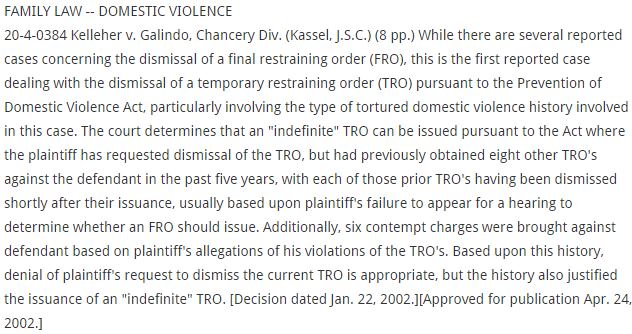
This post concerns a New Jersey family court ruling in the case of Kelleher v. Galindo. The case is 13 years old. That’s how asleep at the wheel our popular press is.

Follow the link to the case above, and the first sentence you’ll see in the ruling is this: “No appearance by Plaintiff. No appearance by Defendant.” That’s right, no one actually appeared in court, but a restraining order was issued anyway…an “indefinite temporary” one.

The plaintiff in the case petitioned nine restraining orders against the defendant between the years of 1996 and 2002, and in each and every instance, the order was dismissed, in most cases because “plaintiff [the person who petitioned the order] failed to appear at the hearing”; in a couple of cases, because she requested a dismissal.

The reasoning of the latest judge’s ruling runs thus (emphases added) and should be heard in the voice of a character from Alice in Wonderland:

This court has no doubt that if it were to grant plaintiff’s request to dismiss this most recent TRO [temporary restraining order], it would not be very long before plaintiff was back in the Cherry Hill Municipal Court seeking a tenth TRO against defendant.

[…]

It is this court’s opinion that, despite plaintiff’s telephonic request to dismiss this most recent TRO, the plaintiff’s past history of obtaining eight TROs against defendant in a five year period, all of which were dismissed prior to an FRO hearing [final restraining order hearing], along with six prior contempt charges filed against defendant based upon plaintiff’s allegation of violations of those TROs, all of which were likewise dismissed prior to an adjudication, justifies this court’s denial of plaintiff’s request to dismiss the TRO and instead justifies the issuance of an indefinite TRO.

There was no determined basis for an order and no basis for a ruling (in the absence of the litigants in the case). “Therefore” the judge, Michael J. Kassel, ruled that the latest temporary order be indefinitely sustained.

In the interest of economy, that is, the court determined itself justified in issuing an order contrary to the plaintiff’s express wishes and without any trial at all.

Copyright © 2015 RestrainingOrderAbuse.com

*The judge’s legal contortionism is illuminating. Because the judge couldn’t “justify” entering a “final ruling” in the absence of the parties but plainly wanted to, he circumvented the rules of civil procedure and made a “temporary” order permanent (instead of, for example, sanctioning the petitioner of the nine orders for “squandering judicial and law enforcement resources and diverting attention from urgent and meritorious domestic violence matters”). This provides other judges with a precedent to cite to justify violating other defendants’ due process rights, limited as they already are in this process.

Preserving the Safety of Persecuted Cheerleaders: New Jersey’s Domestic Violence Restraining Orders Revisited

Whatever it is you thought you understood about the solemnity and significance of legal process and restraining orders, this story should disabuse you of it: “Parent-Suing Cheerleader Who Claimed ‘Ex-boyfriend Choked Her during Domestic Violence Incident’ Reaches Agreement to Drop Restraining Orders.”

What follows is the gist.

A high school cheerleader whose dad is a former chief of police had a boyfriend her parents disapproved of. The girl says her parents “threw her out” because of him; her parents say she left because she didn’t want to abide by their rules.

From her parents’ house, the 18-year-old moved into the home of an attorney. The attorney’s family then sued her parents on the girl’s behalf for child support and college costs, exciting press attention.

Then the girl got a domestic violence restraining order against her boyfriend, alleging he choked her during a spat (this is the same boyfriend her parents didn’t want her to see). Then the boyfriend got a domestic violence restraining order against her. Then both of them had their orders dismissed.

The two “independently reached the conclusion that they should enter their college years without having to worry about the possible consequences of having restraining orders on their respective records and that the actions that led to the filing of the complaints did not rise to the level of domestic violence.”

You may be thinking, does that mean judges in New Jersey approve restraining orders automatically? You may also be thinking, how nice everything got ironed out and how magnanimous of the court to acknowledge possible negative consequences to the futures of attractive (and ostensibly affluent) white teenagers and acquiesce to their wishes. Probably you’re not thinking, “I can totally identify.”

The girl dropped her lawsuit, too, reconciled with her parents, and moved back home. Her parents told USA Today “they decided not to interfere with their daughter’s love life anymore.”

The girl “graduated this spring and will be attending Western New England University as a biomedical engineering major in the fall on a $56,000 scholarship.”

No estimate to the tax-paying public of the costs incurred by the various prosecutions was reported.

Copyright © 2014 RestrainingOrderAbuse.com

“N.J. Judges Told to Ignore Rights in Abuse TROs”: A Retrospective Look at Vicious Restraining Order Policies 20 Years Later

Among the challenges of exposing crookedness in the adjudication of restraining orders is credibility. Power rules, and the people who’ve been abused typically have none. Their plaints are discounted or dismissed.

Influential and creditworthy commentators have denounced restraining order injustice, including systemic judicial misconduct, and they’ve in fact done it for decades. But they aren’t saying what the politically entitled want to hear, so the odd peep and quibble are easily drowned in the maelstrom.

Below is a exquisite journalistic exposé that I can’t simply provide a link to because the nearly 20-year-old reportage is only preserved on the Internet by proxy hosts (for example, here).

The article, “N.J. Judges Told to Ignore Rights in Abuse TROs,” is by Russ Bleemer and was published in the April 24, 1995 edition of the New Jersey Law Journal.

New Jersey attorneys corroborate that the rigid policy it scrutinizes still obtains today. What’s more, the general prescriptions of the New Jersey training judge on whom the articles focuses arguably inform restraining order policy nationwide. The only things dated about the article are (1) judges’ being “trained on the issue of domestic violence” is no longer “unique” to New Jersey but is contractually mandated everywhere in return for courts’ receiving hefty federal grants under the Violence Against Women Act (VAWA), which grants average out at over $500,000 per; and (2) the resultant policy now injures not only men who are fingered as abusers in five-minute procedures that are often merely perfunctory.

According to the same complacently biased “standards,” it also trashes the lives of accused women, who are not infrequently prosecuted by other women (including their mothers, daughters, and sisters).

______________



Text of “N.J. Judges Told to Ignore Rights in Abuse TROs” by Russ Bleemer (Copyright © 1995 American Lawyer Newspapers Group, Inc.):

On Friday, at a training session at the Hughes Justice Complex in Trenton, novitiate municipal judged were given the “scared straight” version of dealing with requests for temporary restraining orders in domestic violence cases.

The recommendation: Issue the order, or else.

Failing to issue temporary restraining orders in domestic violence cases, the judges are told, will turn them into fodder for headlines.

They’re also instructed not to worry about the constitution.

The state law carries a strong presumption in favor of granting emergency TROs for alleged domestic violence victims, the new judges were told at the seminar run by the Administrative Office of the Courts. Public sentiment, mostly due to the O.J. Simpson case, runs even stronger.
The judges’ training is rife with hyperbole apparently designed to shock the newcomers. It sets down a rigid procedure, one that the trainers say is the judges’ only choice under a tough 1991 domestic violence law and its decade-old predecessor.

Since the Legislature has made domestic violence a top priority, municipal court judges are instructed that they can do their part by issuing temporary restraining orders pronto.

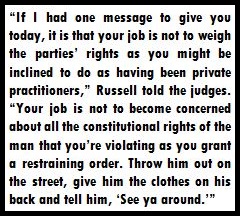
“Throw him out on the street,” said trainer and municipal court judge Richard Russell at a similar seminar a year ago, “give him the clothes on his back, and tell him, ‘See ya around.’”

This napalm approach to implementing the domestic violence statute has some state judges talking. No one disputes the presumption in the law of granting a TRO, and there have been no serious court challenges to the statute’s ex parte provisions.

The strident teaching, however, doesn’t always sit well with some judges, even those who characterize the instruction as deliberate verbal flares directed at a worthy goal.

“[It’s] one of the most inflammatory things I have ever heard,” says one municipal court judge, who asked not to be identified, about a presentation held last year. “We’re supposed to have the courage to make the right decisions, not do what is ‘safe.’”

At the same time, even former and current municipal and Superior Court judges who are critical of the seminar have words of admiration for the candor of trainers Russell, Somerset County Superior Court Judge Graham Ross and Nancy Kessler, chief of juvenile and family services for the AOC. One municipal court judge says that while the statements reflect an incorrect approach, “I wouldn’t be real keen to inhibit the trainers at these sessions from exhibiting their honest opinions.”

For their part, Russell and Kessler say they are doing what the law says they should do—protecting victims, which in turn can save lives. Ross didn’t return telephone calls about the training. He, Russell and Kessler were scheduled to conduct Friday’s program for new judges, a program Kessler says the trio has conducted for judges at least five times since the law was passed.
The law, N.J.S.A. 2C:25-17 et seq., requires judges to be trained on the issue of domestic violence, a requirement that women’s rights advocates say is unique. The TRO provisions also were reemphasized three years ago, encouraging the use of such orders after a municipal court judge hears from one complainant.

Under N.J.S.A. 2C:25-28, municipal court judges assigned to cover for their Superior Court counterparts at nights and on weekends and holidays can issue an ex parte TRO, which is subject to a hearing within 10 days in the Superior Court’s family part “when necessary to protect the life, health or well-being of a victim on whose behalf the relief is sought.”

The TRO may prohibit the defendant from returning to the scene of the alleged act, strip the defendant of firearms or weapons, and provide “any other appropriate relief.” The law also says that the emergency relief “shall be granted for good cause shown.”

Dating Relationships Included

The training, however, stresses the Legislature’s urgency in passing the law, which last year was amended again to extend possible domestic violence situations to dating relationships. The trainers encourage the judges to focus on the legislative findings, which, in emphasizing rapid law enforcement response, state “that there are thousands of persons in this State who are regularly beaten, tortured and in some cases even killed by their spouses or cohabitants.”
This, said Kessler at a training session last year, is justification for an approach advocated by Russell: Talk to the complainant, talk to the reporting officer, issue the TRO, and let the family court sort it out later.

On a tape of the April 1994 session obtained by the Law Journal, Kessler told the judges that “in that legislative findings section, people are told to interpret this law broadly in order to maximize protection for the victim. So if anybody ever came back at you and said, ‘Gee, that’s a real reach in terms of probable cause,’ you have a legislatively mandated response which is, ‘I erred on the side of caution for the victim.’”

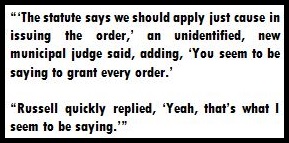
Kessler was reacting to a question that arose during Russell’s presentation. “The statute says we should apply just cause in issuing the order,” an unidentified, new municipal judge said, adding, “You seem to be saying to grant every order.”

Russell quickly replied, “Yeah, that’s what I seem to be saying.”

Russell, a municipal court judge in Ocean City and Woodbine, as well as a partner in Ocean City’s Loveland, Garrett, Russell & Young, answered the question at last year’s seminar after he had spoken for some time on the middle-of-the-night procedures the new judges would have to follow.

At the outset, Russell said that he was on the bench when the original domestic violence act was enacted in 1982 “and that just blew up all of my learning, all my understanding, all my concept of constitutional protections and I had to acclimate myself to a whole new ball game.

“If I had one message to give you today, it is that your job is not to weigh the parties’ rights as you might be inclined to do as having been private practitioners,” Russell told the judges. “Your job is not to become concerned about all the constitutional rights of the man that you’re violating as you grant a restraining order. Throw him out on the street, give him the clothes on his back and tell him, ‘See ya around.’ Your job is to be a wall that is thrown between the two people that are fighting each other and that’s how you can rationalize it. Because that’s what the statute says. The statute says that there is something called domestic violence and it says that it is an evil in our society.”

Not all judges agree with Russell’s approach. Philip Gruccio, a former trial and Appellate Division judge, says that even orders based on ex parte requests require hearings, to a certain extent. “It involves a certain amount of judicial discretion,” he says.

Robert Penza, who retired last year after serving as a family court judge in Morris County for two years, agrees. “I could just never rubber stamp a complaint,” says Penza. “A judge has got to judge.”

Gruccio, who says he is familiar with the work of Russell and Ross on the bench and that both are top notch judges, strongly disagrees with the approach. “My view is that you just can’t say, ‘Forget about the defendant’s rights.’ You can’t say that. It is wrong to say that. It is wrong to train people that constitutional rights aren’t important.”

Gruccio, a professor at Widener University Law School in Wilmington, Del., and director of its judicial administration program, concludes, “I think what has happened is, for emphasis purposes, somebody has lost their way.”

Catering to Popular Objectives

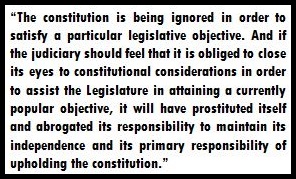
Sitting judges interviewed for this article readily agree with Gruccio. Says one: “The constitution is being ignored in order to satisfy a particular legislative objective. And if the judiciary should feel that it is obliged to close its eyes to constitutional considerations in order to assist the Legislature in attaining a currently popular objective, it will have prostituted itself and abrogated its responsibility to maintain its independence and its primary responsibility of upholding the constitution.”

One municipal court judge who has heard the AOC lecture says, “This is throwing people out of their homes in the middle of the night,” adding, “We have an obligation under our oath of office to be fair, not to be safe.”

A problem that arises by such wholesale approvals of TROs, judges say, is that word spreads, and litigants can try to use them as a club. Kessler couldn’t provide statistics on the number of TROs that are later dismissed by the family court, but she says that the number is “significant.” She adds that more than 58,000 TROs and amended TROs were issued by New Jersey courts last year, with about 60 percent of the complaints originating in municipal courts.

While some municipal court judges acknowledge that the domestic violence law can create injustices—one calls it “probably the most abused piece of legislation that comes to my mind”—there are counterpoints. Melanie Griffin, executive director of the Commission to Study Sex Discrimination in the Statutes, a legislative commission that drafted much of the 1991 law, says that for every individual who files a false report, “there are 100 women who don’t come in at all and stay there and get beaten.”

Judges who have seen the training presentation say that if anyone objects, they keep it to themselves. Russell says that sometimes “those with no background express disbelief, until we explain the intent of the legislation.”

Moreover, Russell says there is nothing wrong with the teaching approach. Abuse victims, he says, may apply and relinquish TROs repeatedly before they finally do something about breaking away. Once they do so, he says, the Legislature’s prevention goal has been met.

Russell continues: “So when you say to me, am I doing something wrong telling these judges they have to ignore the constitutional protections most people have, I don’t think so. The Legislature described the problem and how to address it, [and] I am doing my job properly by teaching other judges to follow the legislative mandate.”

Russell disputes that the TRO training removes judicial discretion where it is needed. On the tape, Russell and Kessler emphasize that first, the judge must decide whether the domestic violence statute grants jurisdiction over the complainant and the defendant. Russell said last week that he was updating Friday’s lecture to include the 1994 expansion of the domestic violence statute to situations in which the complainant was dating the accused or alleges that the accused is a stalker. The judge also has to speak to the party or review the written material and make a decision whether to proceed. “The judge has to be guided by instinct,” Russell explains, before he or she can go ahead with the TRO.

Says one municipal court judge who also has conducted training and asked not to be named: “I would say, ‘If there is any doubt in your mind about want to do, you should issue the restraining order.’” The judge adds, “I would never approach the topic by saying, ‘Look, these people are stripped of their constitutional rights.’”

Making Headlines

Much of the seminar’s rhetoric alludes to actions that keep the judges out of the headlines, which are mentioned in the taped seminar repeatedly. Near the beginning of his presentation, Judge Graham Ross, reacting to Russell, says that dealing with domestic violence “is not something that we can take a shortcut on. Forgetting about reading your name in the paper—and that certainly is very troubling, I don’t want to read my name—but that’s really secondary.

“The bottom line is we’re trying to protect the victim,” Ross continues. “We don’t want the victim hurt. We don’t want the victim killed. So yes, you don’t want your name in the paper, but you’d feel worse than that if the victim was dead. So yeah, your name will be in the paper…if you’ve done something wrong. And I’ve said that to my municipal court judges. If you don’t follow the law after I told you what to do, I will guarantee that you will be headlines. That’s not a threat. That’s an absolute promise on my part. This is serious stuff.”

The AOC’s Kessler says the media references are a training technique, and judges aren’t influenced by public opinion polls. The focus, she says, follows the statute’s emphasis on protecting victims by dealing with the dynamics of domestic violence and the importance of intervention. “When there is a discussion about headlines,” she says, “it tends to be more in recognition of what they already are aware of and concerned about.”
One former judge agrees that judges don’t work wearing blinders, but says that if worries about bad publicity affect their work, “it defrauds the system.” A current municipal court judge who has been through the training on domestic violence says, “We have to stand back from the hysteria and the newspapers and all and do what’s right.”

But most others disagreed. The “approach isn’t bad because it’s got a shock value,” says retired judge Robert Penza.

A current municipal court judge liked the realism of the media references. “A newspaper headline can be death to a municipal court judge’s career,” says the long-time jurist, “and the prospect of an unfavorable newspaper headline is a frightening one.” The judge added, however, that attention-getting devices must not be confused with legal principles.

And the judge paid the overall approach a backhanded compliment frequently repeated in some form among the former and current judges contacted for this article. Referring to Russell, the judge declared: “What he said is valuable because he is expressing the state of affairs. He should be commended for his candor, although I must say I find his viewpoint to be anathema.”

Copyright © 2014 RestrainingOrderAbuse.com