GaLyn Hargis, Mother of a Freak Who Accused Me to the FBI, Could Put This on Her Pinterest Page

GaLyn Hargis, GaLyn Hargis, GaLyn Hargis, GaLyn Hargis, GaLyn Hargis, GaLyn Hargis, Tiffany Hargis, Jon Hargis, Tim Hargis, Timothy Hargis, Arkansas

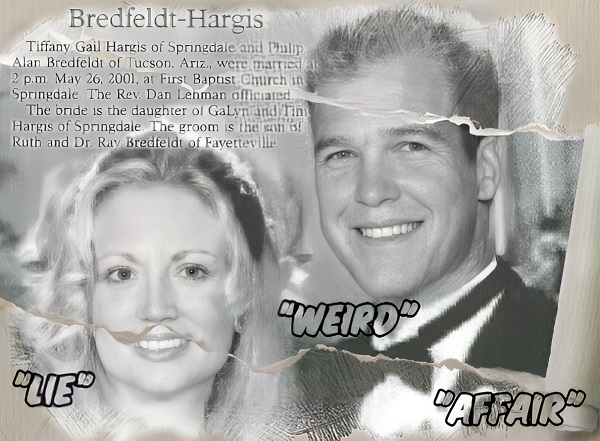
The images juxtaposed above (dated approximately 2005, 2016, and 2022) are of the same person, a serial liar named Tiffany (Hargis) Bredfeldt, daughter of GaLyn Hargis.


Below is a photo of one of the few mementos of my father I possess, besides the plastic box containing his ashes. The flip phone was returned to me by the nursing home where he starved to death in 2016.

My dad’s other belongings, things that my brother and I had made for him when we were kids, for example, were unceremoniously dumped in a landfill after the bank foreclosed on his home. That was while I was last in court with the freak daughter of GaLyn Hargis: for two years, under threat of imprisonment, based on a web of lies her daughter had been spinning for a decade to conceal an extramarital dalliance at my home.


GaLyn Hargis, the wife of retired Arkansas banker Tim Hargis, considered launching a Pinterest page during the interim, I guess, and then aborted the project. I gather that her son-in-law ditched her daughter around the time the court put an end to her daughter’s petty reign of terror in 2018, which besides multiple prosecutions included crackpot reports to city, county, state, and federal police.

It would sure suck if the dissolution of her daughter’s marriage dampened GaLyn Hargis’s enthusiasm for online scrapbooking.

A solution might be for her to reconceive her ambitions for the project. I wouldn’t be surprised if her husband, a fourth-generation cattle rancher, didn’t have a stuffed head or two on a wall someplace and a something-or-other-skin rug on the floor.

Gay Hargis could put up a collection of trophies of her own. The photo of my father’s phone that’s included in this post would make a fine centerpiece.

Copyright © 2021 RestrainingOrderAbuse.com

*Like many of those who were caught up in a 12-year hoax perpetrated on the police and courts by her daughter, Tiffany (Hargis) Bredfeldt, at the expense of my family and me, GaLyn Hargis seems to prefer a low profile, which she has kept since she was informed of the truth 15 years ago. Her daughter, who is or was a public official in Texas, apparently devotes a portion of her days now to endeavoring to suppress reports of her and her stooges’ sick conduct.

GaLyn Hargis, Gay Hargis GaLyn Hargis, Gay Hargis GaLyn Hargis, Gay Hargis GaLyn Hargis, Gay Hargis

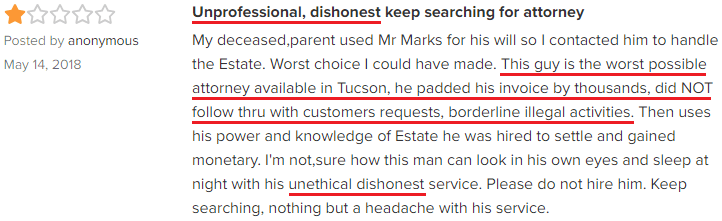
“An Asshole”: A Review of Jeffrey Marks, Tucson Attorney at Law (Who’s Disliked Even by His Heart Doctor)


Tucson attorney Jeffrey Marks, attorney Jeff Marks, Jeffrey A. Marks, Southwest Legal

This client review of Tucson attorney Jeffrey Marks appears on Avvo.com, which notes that the number of times Marks has been endorsed by other lawyers is none.


In 2013, I told a cardiologist I knew, Lee Goldberg, M.D., that I was in court with some monsters and that they were represented by a degenerate attorney. Goldberg, who had a business relationship with my father at the time, guessed the attorney was probably one of his patients. Sure enough he said he’d seen Jeffrey Marks (whose heart I already knew was rotten). Goldberg described how Marks would commandeer his waiting room and set up shop there like the lord of the manor.

He’s an asshole,” Goldberg agreed.

My opinion had been cemented years earlier. I’d been in court with Marks in 2010, when he represented the same client he did in 2013, Tiffany Bredfeldt, a woman who has accused me serially since 2006 and whom Marks would go on to represent in 2016, too. But only briefly. Marks insisted I be jailed in that prosecution, I moved the court to appoint me counsel, it did…and Marks hastily took his leave of the matter.

It’s not as jolly squaring off against a fellow attorney as it is taunting a self-represented defendant (as Marks had delighted in doing repeatedly).

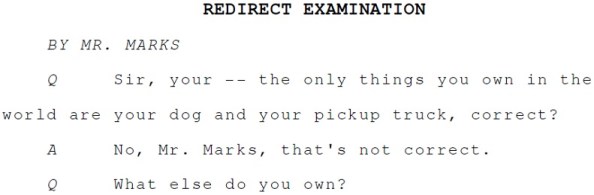
Here’s Marks cross-examining me in 2013:

Tucson attorney Jeffrey Marks, attorney Jeff Marks, Jeffrey A. Marks, Southwest Legal

And that’s nothing next to how Marks mocked the court. His first witness, Michael Honeycutt (who today chairs the EPA’s Science Advisory Board) testified:

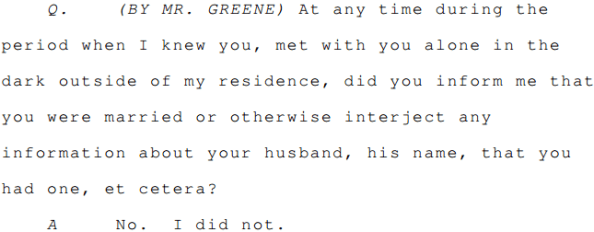
Then Marks’s client, the prosecuting witness, who told her boss that I had “propositioned” her, told the court this:

Then Marks submitted a brief to the court a couple months later acknowledging this:

And Marks had already provided the court an email by his client to me that said I’d been “nice to [her]” and that she had “never felt the need” to tell me she was married.

Marks didn’t even try to hide obvious contradictions, which any disinterested onlooker might reasonably consider evidence of lying (of a grave nature) to whitewash hanky-panky. I think Marks enjoyed showing me just how stage-manageable judges of the Pima County Superior Court were.

Marks succeeded in coercing an illegal speech injunction against me that year from a judge who has since been shamed off the bench, Carmine Cornelio. It was indicted as unconstitutional in 2017 in an amicus brief to the Arizona Court of Appeals by UCLA law professor and distinguished First Amendment scholar Eugene Volokh (who blogs about such violations of citizens’ civil liberties in The Washington Post). The injunction unlawfully prohibited me from disclosing facts about my own case like those I just have.

By trying to enforce the order in 2016, Marks made himself vulnerable to a lawsuit, but I had to relinquish my damage claims for constitutional injury this month in order to permanently arrest false or frivolous claims to the police by his client—who would face punishment were she to engage in this conduct in future.

The unlawful injunction Marks finessed was gutted (at a cost to the Arizona taxpayer of tens of thousands).

A low-rent opportunist, Marks has an advertisement on his Facebook page that says everything a prospective client should need to know about his character: “Don’t forget about our incredible October surprise: 25% OFF ALL MONTH LONG[—]Wills, Personal Injury Cases, Divorces, and More!!

His Twitter subscriptions include several about pets, including Baby Animals (@BabyAnimalPics), Cats (@Cats), Cute Emergency (@CuteEmergency), and Emergency Kittens (@EmrgencyKittens).

His Twitter subscriptions also include this (fourth among 40 when this screenshot was taken):


Tucson attorney Jeffrey Marks, attorney Jeff Marks, Jeffrey A. Marks, Southwest Legal


At least Marks doesn’t try to conceal he’s an asshole.

Copyright © 2018 RestrainingOrderAbuse.com

Sexual Solicitation, Assault Alleged by Texas Officials Michael Honeycutt and Tiffany Bredfeldt in Contradictory Testimony to the Arizona Superior Court, Implicating a Tucson Man Who’s Been Falsely Accused for 11 Years: ILLEGAL GAG ORDER GUTTED; “WOMEN’S LAW,” TCEQ DISCREDITED

This post, published on the first day of the year, was updated on July 9, 2018 (reflected in the new title), and content that had been unlawfully censored by the court has been restored. A recent respondent to this blog commented, “I think these injunctions violate the Constitution.” Despite the baggy parameters dictated by the law, it’s certain that many are impeachable as unconstitutional. The saga that follows relates the story of such an injunction. Readers merely interested in learning what unscrupulous plaintiffs can get away with (again and again for years) may skip the preamble and gain a clear picture by contrasting various sworn and unsworn statements by two such plaintiffs, who are quoted verbatim. Other quotations show how a witness, Michael Honeycutt, was induced to give misleading testimony, besides how willing attorneys may be to steer the court amiss…for the right price.

Michael Honeycutt TCEQ, Michael Honeycutt PhD, Michael Honeycutt EPA, Tiffany Bredfeldt TCEQ, Tiffany Bredfeldt PhD, Tiffany Bredfeldt EPA, Bredfeldt TG, Texas Commission on Environmental Quality, TCEQ, EPA, Environmental Protection Agency, EPA Science Advisory Board, SAB, EPA Chemical Assessment Advisory Committee

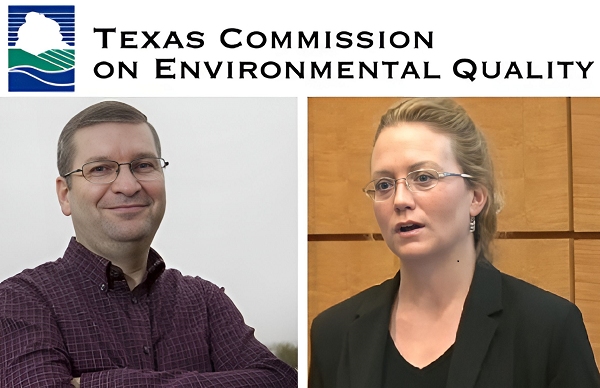
Texas state toxicologists and newly appointed EPA reps Michael Honeycutt and Tiffany Bredfeldt gave testimony before an Arizona Superior Court judge in 2013 that succeeded in persuading the judge to issue an unconstitutional speech injunction against the writer. The court was told the writer had “propositioned” Bredfeldt (a married woman) in 2005, “wouldn’t take no for an answer,” and “had been harassing her ever since.” Honeycutt, who has never met the writer, recited this secondhand story with the same smug complacency that marks his expression above. Based on the fiction’s effectiveness, four additional legal actions were brought against the writer in 2016, two of which menaced him with the threat of incarceration for exercising his freedom of speech. One of the actions was aborted; two were dismissed. Despite an appeal in 2017, the 2013 gag order, which the writer was alleged in 2016 to have “continuously and contemptuously violated,” remained in effect until July 2018, when it was gutted. All charges brought against the writer in the past decade have been invalidated.

Numerous accounts related on this blog since its launch six years ago have contrasted what he said with what she said in testimony given under penalty of perjury. The account this post relates doesn’t have to. It contrasts what she said here with what she said there—and with what her statured witness said she said. Statements that should harmonize, conflict.

A lesson of what this post unfolds, valuable for anybody to learn who has been wronged by a judge and isn’t sure if s/he’s “allowed” to talk about it, is that when people get away with something in a courtroom, which is a public forum, that in no way immunizes them from being exposed for it in a different public forum (for example, Facebook, Twitter, a personal blog, or one sponsored by The Washington Post). The only legal surety against criticism in this country is square conduct. While a court can lawfully issue a restraining order that prohibits unwanted speech to someone (like phone calls or emails), it cannot lawfully prohibit unwanted speech about anyone. Critical speech directed to the world at large, however objectionable it may be to those it names, whether private individuals, public officials, or judges, is protected speech as long as it isn’t false or threatening (and opinions are sacrosanct); the Constitution doesn’t favor any citizen over another, nor does it distinguish between bloggers, pamphleteers, or picketers and the institutional press. The aegis of the First Amendment doesn’t even require that criticism be deserved. In this instance, however, blamelessness is a nonissue.
Eugene Volokh, First Amendment, freedom of speech, The Volokh ConspiracyThis post discredits a widely championed arena of law, as well as how it’s administered. Linked audio clips of one trial judge will make a seasoned courtroom veteran flinch; those of another, a presiding municipal court magistrate, acknowledge frankly that restraining orders “are abused,” no question, and that “people come in and…say things that are just blatantly false” but are “never…charge[d],” let alone prosecuted.

The post also discredits accusations made by a woman (women, in fact) against a man. To some, this will be its most compelling virtue. Men have traditionally been the butt of abused and abusive procedures, and by far continue to be their most populous feedstock. Assertions that men are “presumed guilty” and unfairly “demonized” are not exaggerations and never have been, contrary to the pajama punditry of demagogues like David Futrelle, Mari Brighe, Amanda Marcotte, and Lindy West, who would smother even the most righteous motives for male contempt beneath the blanket label “misogynist.”

Fixation on gender politics, though, has obscured from view that injustice has been legislated into the law and fortified by decades of accustomed application (albeit that politics is the reason why). Today women—straight, gay, or otherwise—enjoy no greater safety from accusation and arbitrary violations of their civil rights than men do (in drive-thru procedures promoted as “female-empowering”), and women too may be accused by women (including their own mothers, sisters, daughters, and neighbors—which is a predictable consequence when accusation is tolerated as a recreational sport). Law that mocks due process and facilitates and rewards its own abuse is iniquitous, period. What this post reveals, importantly and inescapably, is that how many people choose to understand accusation, court process, and their repercussions is deplorably simplistic. Among these many are most politicians, academics, journalists, and social justice activists.
Eugene Volokh, First Amendment, freedom of speech, The Volokh ConspiracyThe Tucson man in the title of the post is also its author, and there was a time, within his memory, when to allege sexual impropriety without urgent grounds would have stirred outrage, because such an accusation is always damaging. In the climate that has prevailed since the advent of the Violence Against Women Act, however, the female plaintiff who doesn’t allege sexual violation, or at least trespass, squanders invaluable leverage. To a potently shrill sector of the community, this represents social progress. It has made pollution de rigueur.

Inaugurating the task of restoring a site inspired by the tenacity of false accusations like those exposed below, this post breaks a year-and-a-half-long silence coerced from the site’s owner by a series of lawsuits, which included two that demanded that he be jailed for exercising his First Amendment rights. The principal complainant, Tiffany Bredfeldt, an official at the Texas Commission on Environmental Quality (TCEQ), has repeatedly alleged to the Arizona Superior Court that the writer’s criticisms of her honesty, ethics, and character are untrue. Bredfeldt told the court in 2016 that the “ongoing fear, stress, and associated physical impacts” the writer’s criticisms had caused her “have been a decision factor as to whether or not [she has] children.” She also reported she has “talked to more people at police departments, sheriffs’ departments, and federal and state agencies than [she] can count,” and urged the court to impose “significant consequences” to bring her relief from a “continual rollercoaster of fear.”

Judge Richard Gordon, Pima County Superior Court

I am not going to hold him in contempt for talking about his case,” Pima County Superior Court Judge Richard Gordon pronounced in response to a 2016 complaint that demanded the writer be jailed for doing exactly that. Also commendably, the judge granted the writer a court-appointed attorney without reservation. Disagreeing, however, that the law authorized him to revise or dissolve an illegal prior restraint entered against the writer in 2013, the judge instead delimited its vague and overbroad proscriptions. The writer continued to be (1) forbidden from publishing images of the plaintiffs on this site; (2) forbidden from using “[meta] tags” with their names to label images or contents of posts, supposedly elevating them in Google’s returns for certain search terms thereby; (3) forbidden from “repeating” three “specific statements” that, absent a jury opinion, the 2013 court deemed “defamatory”—only two of which the writer may have made, both concerning honesty; and (4) forbidden from contacting the plaintiffs, Tiffany and Phil Bredfeldt, the former’s employers at the Texas Commission on Environmental Quality, or “their friends, their acquaintances, or their family.” The writer’s own friends and family are among Tiffany Bredfeldt’s acquaintances, and who else may be is impossible for the writer to know, which underscores the recklessness of the 2013 order Judge Gordon construed rather than vacated. That order’s prohibitions, which were substantially narrowed in July of this year, could have been interpreted very differently by another judge at any time for the rest of the writer’s life.

Bredfeldt sued the writer in 2013, neither for the first time nor the last. Michael Honeycutt, to whom the writer had communicated his criticisms of Bredfeldt’s conduct by letter two years before, served her as a witness—telephonically, from the comfort of his desk chair in Texas. Honeycutt is Bredfeldt’s boss at the TCEQ and an old hand at testifying; his bio [deleted from the Internet since this publication] boasts that he has testified before Congress. His role in accusing the writer, who in 2013 had already grappled with crippling allegations for seven years, was to ensure that he would live with them indefinitely—and it’s unlikely that Honeycutt acted without the full approval and support of the TCEQ’s administration.

The upshot of the 2013 prosecution, in which the writer represented himself, was that Bredfeldt was granted an unconstitutional restraining order that prohibited the writer from publishing anything about her “to anybody, in any way, oral, written or web-based” by the judge whose words appear a few times in the transcript excerpts that follow. That Pima County Superior Court judge, Carmine Cornelio, is a judge no longer. In June of 2016, 84% of an Arizona Commission on Judicial Performance Review panel concluded he did not meet standards. The judge declined to face voters that fall, and his tenure on the bench terminated two months later.

(The no-confidence rating returned against Judge Cornelio in 2016 followed reprimands by the Arizona Supreme Court in 2010 and 2013 for the judge’s saying “fuck you” to an attorney during a settlement conference, causing a 19-year-old girl to cry during a different one, and gesturing accusatorily at a female court employee in public, among other alleged acts of “abusive conduct.” In a guest column in the Arizona Daily Star, Judge Cornelio wrote, “I leave with head held high….” He told the same paper in an interview that he “intends to go into private practice in alternative dispute resolution.” Judges of the Arizona Superior Court are paid $145,000 a year, and a proposal has been tabled to raise their salaries to $160,000.)

The speech injunction Judge Cornelio imposed on this writer in 2013, which the judge made permanent without bothering with a trial, was affirmed in 2016 by a second Pima County Superior Court judge, Richard Gordon, despite Judge Gordon’s having acknowledged in open court that the conduct of the 2013 proceedings was “not legal” and that the prior restraint that issued from them offended the Constitution. “There are obviously some parts that are just too broad and then don’t make a whole lot of sense,” Judge Gordon conceded in court in July. In his subsequent Sept. 2016 ruling, little trace of this acknowledgment survives. The writer’s father died a month after the ruling was returned. More than a year has transpired since (and, as the U.S. Supreme Court has held, “[t]he loss of First Amendment freedoms, for even minimal periods of time, unquestionably constitutes irreparable injury”).

An appeal of the 2016 ruling to the Arizona Court of Appeals’ Second Division was denied in December (five months after it was filed). The court—consisting of Judge Philip Espinosa, Judge Christopher Staring, and Judge Sean Brearcliffedeclined to address the prior restraint’s unconstitutionality and sidestepped use of the phrase prior restraint entirely:

[T]he issue before us is not whether the injunction is constitutionally permissible, but whether the [2016] trial court properly refused to modify or dissolve it.

The appeals court, whose decision may have been influenced by a case narrative that this post will show is false, did acknowledge that “[a]t least one provision of the [2013] injunction would appear clearly unconstitutional, ordering that ‘[t]he defendant…immediately cease and desist all future publications on his website or otherwise.’” The word publication means any act of public speech. This provision, which was dissolved in July of this year, accordingly prohibited the writer from, for example, finishing a Ph.D., addressing the city council, marketing a book, or defending himself in a courtroom, all of which require publication. Also accordingly, courts have consistently found prior restraints facially invalid, even ones far less vague and overbroad than the one issued against the writer, and such orders have been vacated as much as 30 years later, which the writer’s attorney informed the appellate judges by brief and in oral argument. This was unremarked in their Dec. 18, 2017 ruling.

Eugene Volokh, free speech, First Amendment

UCLA Law Prof. Eugene Volokh, addressing the U.S. Senate Judiciary Committee on June 20

Unlike in 2013 (and previously), the writer wasn’t alone in court in 2016 or 2017. His defense was aided by two gifted lawyers representing the Pima County Legal Defender: Kristine Alger, who drafted and orally augmented a faultless appeal, and Kent F. Davis, whose zealous advocacy made an appeal possible in the first place. Their arguments were what’s more reinforced by no lesser light than Eugene Volokh, who’s distinguished as one of the country’s foremost authorities on First Amendment law and who, in conjunction with the Electronic Frontier Foundation (EFF) and Phoenix attorney Eric M. Fraser, graciously submitted an amicus brief to the court on the writer’s behalf. Alison Boaz of the UCLA School of Law, who assisted Prof. Volokh, is also due credit. A win in the appellate court would have been much more theirs than this writer’s, and they have the writer’s thanks for their Herculean exertions.

(It’s conceivable that a legal critique of the matter may one day appear on The Volokh Conspiracy, which is listed by the ABA Journal in its “Blawg 100 Hall of Fame.”)

Exemplifying the importance of the First Amendment, this post will illuminate how trial courts are manipulated into forming bad conclusions by lowering its beam into the crevices to rest on those who do the manipulating.

A byproduct of the writer’s representation in 2016 and 2017 was access to courtroom transcripts, so the post won’t offer much in the way of opinion. Commentary can be denied. Testimony given under oath…cannot be.
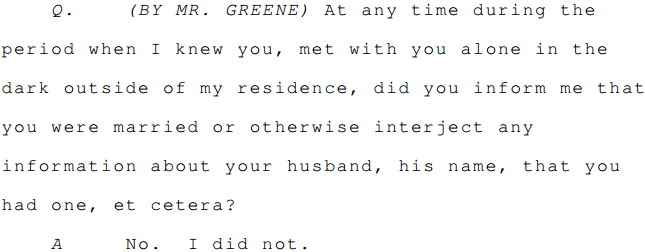

Dr. Tiffany Bredfeldt, on cross-examination by the writer in 2013

Dr. Michael Honeycutt, on cross-examination by the writer in 2013

Based on nothing more than the two statements quoted above, a precocious child would wrinkle her nose. Yet such obvious contradictions have inspired no judge to arch an eyebrow nor any Ph.D. to scruple. In over 11 years.

Calling someone a liar risks being sued, and trial judges interpret whatever they want however they want. They’re acutely aware, moreover, of which direction their criteria are supposed to skew when abuse is alleged. This remark cannot be called defamatory: Although this post isn’t about air or water pollution, as would befit one that quotes environmental scientists, it does concern filth.

Cheryl Lyn Walker PhD, Cheryl Walker PhD, MD Anderson Cancer Center, Texas A&M University Health Science Center, TAMHSC, Institute of Biosciences and Technology

Director of the Texas A&M Health Science Center Institute of Biosciences and Technology Cheryl Lyn Walker, remarks by whom were used in evidence against the writer in 2013 and 2016

It relates sworn testimony to the Arizona Superior Court by two representatives of the Texas Commission on Environmental Quality (TCEQ), reportedly the second largest agency of its kind after the EPA. Those public sector scientists are Michael Honeycutt, Ph.D., the TCEQ’s toxicology director and an adjunct professor at Texas A&M University, who was recently entrusted with a role in forming national health policy, and one of Honeycutt’s protégés, senior toxicologist Tiffany Bredfeldt, who’s also a Ph.D. and who had already been entrusted with a role in forming national health policy. On April 4, 2017, the TCEQ tweeted its congratulations to Bredfeldt for her being selected to serve on the Chemical Assessment Advisory Committee of the EPA’s Science Advisory Board, which her boss now chairs. The bio of Bredfeldt’s associated with her appointment highlights her experience as an “expert witness.” This merits note, as does Honeycutt’s superior claim to the same distinction.

A second Texas A&M professor, Dr. Cheryl Lyn Walker, Ph.D., who was Bredfeldt’s postdoc adviser at M. D. Anderson Cancer Center, has been aware of the conduct of Bredfeldt’s detailed in this post for a decade. Appeals by this writer to Walker’s conscience and integrity only inspired her to tell Bredfeldt in a 2008 email: “I am very concerned about your safety.” Bredfeldt entered Walker’s email in evidence against the writer in 2013 and also quoted it to the court in 2016.

Authorial intrusions in the survey of statements to follow will be terse. Bredfeldt and her witnesses will do the preponderant storytelling.

Tiffany Bredfeldt, romancing the camera in 2005

Some orienting details are required. The writer encountered Bredfeldt, then a doctoral student in the University of Arizona College of Pharmacy, at his home in late summer 2005 and met with her there routinely over the ensuing months, mostly after dark. Bredfeldt, otherwise a stranger, declined to mention to the writer that she was married while, for example, taunting him for not inviting her in at midnight: “Where I come from, it’s considered rude not to at least invite a person onto your porch.” Then she disappeared, providing no explanation. A few months after that, when the writer sought one, Bredfeldt variously reported to the police and numerous courts—in statements that remain public in perpetuity and that are not deemed defamatory—that the writer had made unwelcome sexual advances toward her, despite being repeatedly “rebuff[ed]” and “rebuked”; that he posed a violent danger to her and to assorted others she was concerned the writer would talk to about her conduct at his home (among them her mother, who lived 1,200 miles away); that he should be prohibited from possessing firearms; and that he had stalked her, a woman the writer had only ever met hanging around his yard like a stray cat.

Here’s Bredfeldt’s account in her own words to Judge Jack Peyton on April 10, 2006:

Okay, I’ll begin by defining my relationship, um, with Mr. Greene. I met Mr. Greene in about September or October of 2005 when I was boarding a horse that I own at a boarding facility owned by his family. At that time, uh, we were acquaintances, and we spent time talking and — at his family barn. And that’s about the nature of our — our interaction. During that time, I think, um, he developed maybe romantic feelings for me that — that made me uncomfortable, and I generally would rebuff his advances, asking him to stop.

Mrs. Bredfeldt, whom the writer knew for three months and with whom he has had no contact since March 2006, has along with one of two or three girlfriends of hers who were also routinely around the writer’s residence in 2005 sued the writer some six times. Four legal actions were brought against the writer in 2016 alone, two of which sought his incarceration and all of which endeavored to suppress what this post relates. In a “Victim’s Impact Statement” Bredfeldt submitted to the court in 2016, she owned that she had accused the writer “to the Court multiple times [and] to multiple police departments, detectives, federal agencies, and other officials in several states”—including the Arizona Dept. of Public Safety and the FBI—and it’s this writer’s belief that only with the blind support of loyalists like Mike Honeycutt would Bredfeldt have been so emboldened.
attorney Beth E. Maultsby, attorney Kathryn Flowers Samler, high-conflict litigants, high-conflict people, high-conflict litigation, false testimony, lying in courtThe legal onslaught has spanned (and consumed) almost 12 years, despite the writer’s appealing to dozens of people to look between the lines, including Honeycutt, who’s notably a husband with two college-aged sons. Honeycutt is besides a distinguished scientist, cited for his rigorous investigative standards, whose testimony quoted immediately below includes the statements, “I didn’t ask for details” and “I didn’t clarify that.” As a departmental director of the TCEQ, Honeycutt is paid $137,000 per. The writer, in contrast, has for the past decade earned a subsistence wage doing manual jobs that allow him to keep an insomniac’s hours and be left alone—formerly in the company of his dog, his dearest friend, who died suddenly in 2015 while the writer was still daily distracted with trying to clear his name and recover time and opportunities that had been stolen from them. (Here is a letter the writer hired an attorney to prepare in 2009. Bredfeldt represented it to the court in 2013 as evidence of harassment, and testified she believed her “psychiatric prognosis” would improve if such speech were restrained. “One of the most difficult parts of dealing with something, since this is profoundly stressful,” she told the court, “is that the stress doesn’t go away.”) The writer had aspired to be a commercial author of humor for kids, as Bredfeldt knew, and had labored toward realizing his ambition for many years before encountering her and her cronies on his doorstep. His manuscripts have since only gathered dust.

(A further counterpoint: The first public official the writer notified of Bredfeldt’s conduct, who also took no heed, was University of Arizona Dean of Pharmacy J. Lyle Bootman, Ph.D. A decade later, Bootman was charged with raping and beating an unconscious woman in his home. For almost two years following his indictment in 2015, while free on his own recognizance, Bootman faced trial—a fundamental due process right this writer was denied in 2013. Despite having been placed on administrative leave, Bootman continued to draw a faculty salary of over $250,000 from the U of A, the writer’s alma mater and former place of employ. As a graduate teaching assistant in the English Dept. in the late ’90s, the writer cleared about $200 a week. While he awaited a ruling in Greene v. Bredfeldt, the appeal of the last of the lawsuits brought against him during the same period of time by Bredfeldt and a cohort of hers, the five felony charges against Bootman were dropped. A tort case based on the same facts continues. Bootman’s attorneys filed for a protective order in December to bar public access to records.)
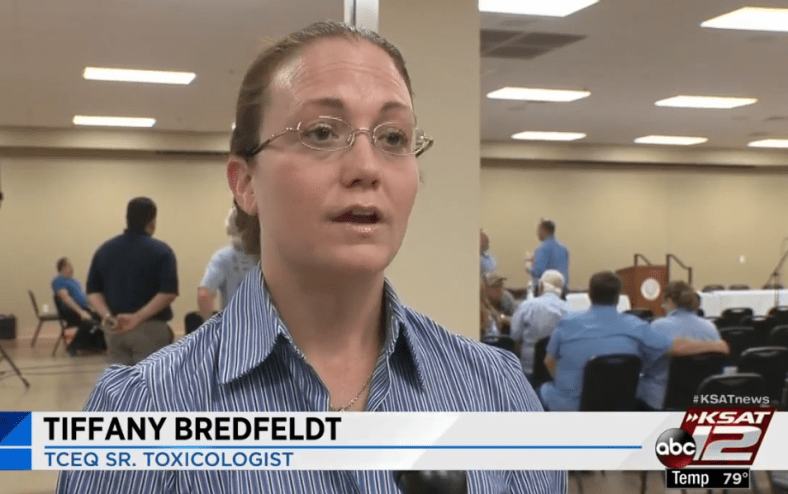
In an interview that aired in 2017, Tiffany Bredfeldt, the writer’s accuser, reassured the audience of ABC News that it could place its trust in the TCEQ. Bredfeldt made a similar pitch before the National Research Council of the National Academies of Sciences, Engineering, and Medicine in 2013. Bredfeldt, who the court was told in 2013 and 2016 is not a public official, has repeatedly appeared as the face of the Texas Commission on Environmental Quality. Her attorneys have argued that since she isn’t a public official, she isn’t obligated by law to prove her allegation that objectionable statements by this writer are false and therefore unprotected speech. Her boss, Michael Honeycutt, told the court in 2013: “Tiffany is just like the other 14 employees that I have.” If no other assertions by the TCEQ cause Texans concern, that one should.

This post’s presentation is simple: It juxtaposes contradictory statements that span seven years (2006–2013), most of them made under oath and all of them made by state scientists. (Those in small print may be enlarged in a new tab by clicking on them, or magnification of the entire post may be increased by pressing [CTRL] or [COMMAND, the cloverleaf-shaped key on Macs] + [+]. Zoom may be reversed similarly: [CTRL] or [COMMAND] + [-].) Scrutiny of the quotations below may lead the reader to conclude they’re evidence of false reporting, perjury, subornation of perjury, stalking, harassment, mobbing (including attorney-complicit abuse of process and civil conspiracy), defamation, bureaucratic negligence, professional incompetence, mental derangement, and/or general depravity.

The writer will let the facts speak for themselves.

MICHAEL HONEYCUTT, on cross-examination by the writer on May 20, 2013:
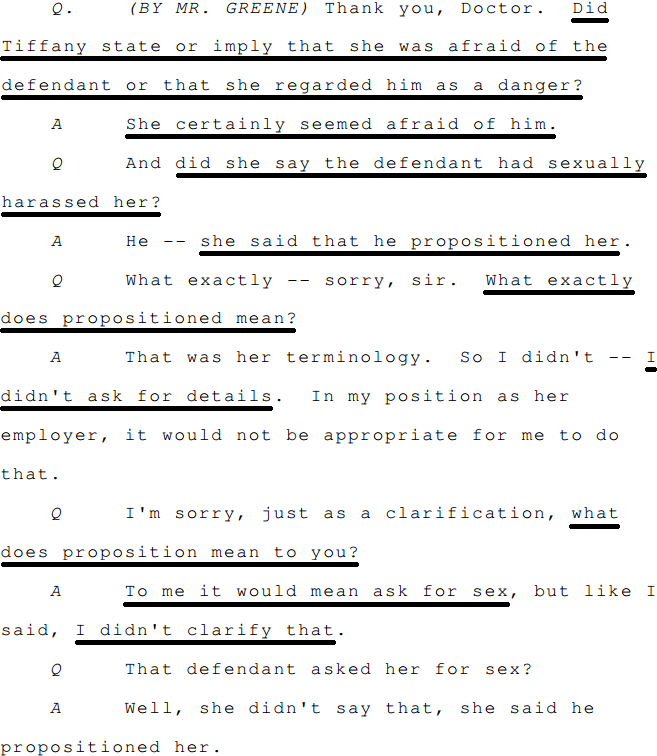
Honeycutt testifies in 2013 that Bredfeldt told him the writer “propositioned” her in 2005, which to him, he says, “would mean ask[ed] for sex.”

Bredfeldt’s attorney, Jeffrey Marks, would follow up on Honeycutt’s testimony by beginning his cross-examination of the writer with a jab instead of a question: “She says you propositioned her.” The writer replied, “What does that mean?” Marks chirped, “That you offered her sex.” Bredfeldt, while gazing around the room at her audience, nodded solemnly.

TIFFANY BREDFELDT, in an email to the writer sent Friday, March 17, 2006, that she entered into evidence three days later (Monday, March 20, 2006) along with her petition for restraining order number one:
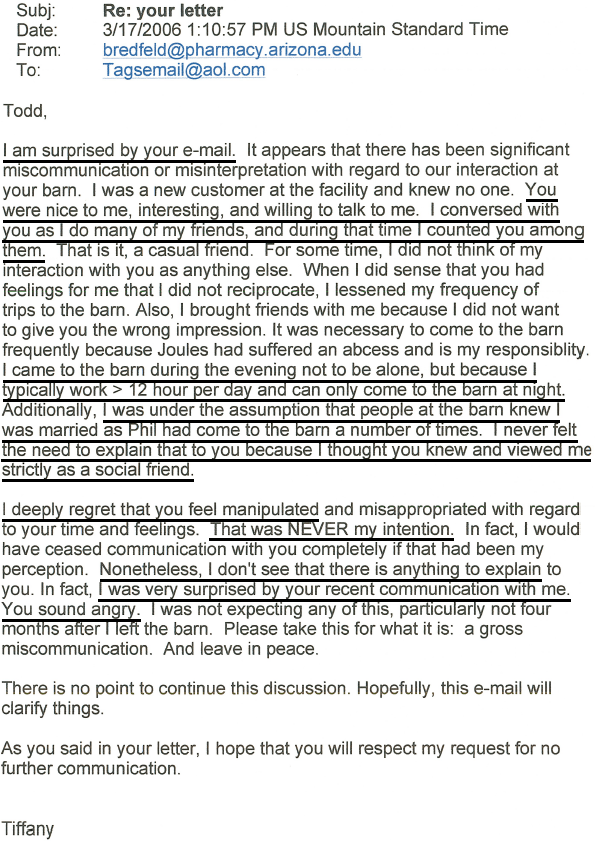
Bredfeldt states in this self-contradictory email, which she would submit days later in evidence to the court in the 2006 procedure that began the controversy, that the writer had been “nice” to her and that she had never felt the need” to “explain” to him she was married, because her husband had come to the writer’s place of residence “a number of times,” and she thought the writer already knew and besidesviewed [her] strictly as a social friend.” Contrast Honeycutt’s 2013 testimony: “[S]he said that he propositioned her.

On April 10, 2006, not a month after Bredfeldt sent this email, she would testify before a judge (in her husband’s presence) that she had had to repeatedly “rebuff…advances” by the writer in 2005. The writer was identified to the court not as a considerate “friend” but as an “acquaintance” with whom Bredfeldt had “interact[ed].” Ten years later, the husband the writer was supposed to have known about, a geoscientist today employed by Weston Solutions as a project manager, would be asked in court on direct examination by his lawyer, “Do you know the defendant, Todd Greene?” Philip Bredfeldt’s answer: “I never met him….” Then Mr. Bredfeldt would clarify to the 2016 court that he “first came to know about the [writer] in early 2006,” that is, the same week his wife sent this email, during which the writer was alleged to have sent her a “series of disturbing emails” and “packages,” a fiction that by itself would take another entire post to unweave. Significantly, Phil Bredfeldt had no idea the writer existed until 2006 and, according to his 2016 testimony, was not informed by his wife of any sexual aggression toward her in 2005—nor was anybody else, for example, the writer’s mother, who was daily at the property where the writer lives from morning till dusk, and whom Bredfeldt knew and spoke with routinely. (The writer’s mother was then in treatment for cancer, a fact Bredfeldt exploited to flaunt her knowledge of the disease, which was a subject of her dissertation research.) Where Phil Bredfeldt was while his wife was outside of the writer’s residence at 1 a.m.—and with whom—has never been clarified.

Honeycutt, in a 2013 quotation below, will testify in further contrast to Bredfeldt’s statements in this email that he was told the writer’s behavior in 2005 was “erratic and bizarre” and that he “wouldn’t take no for an answer.”

TIFFANY BREDFELDT, in a statement to the University of Arizona Police Dept. given on March 18, 2006 (the next day):
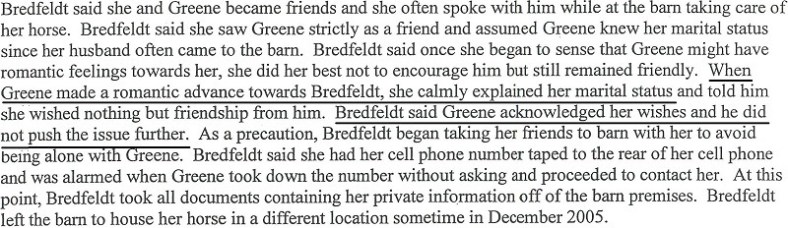
Bredfeldt, in contrast to her emailed statements to the writer 24 hours prior (and in contrast to her subsequent testimony to the court in 2006 and both hers and Honeycutt’s in 2013), reports to the police that the writer had made “a romantic advance” toward her in 2005, inspiring her to admit to him she was married, after which he desisted. Bredfeldt then says the writer seized her cell phone, copied down her number, and contacted her. Bredfeldt’s work and home addresses and telephone numbers were publicly listed, and the writer never spoke with Bredfeldt on the phone. There was no need; she could be found outside of his residence most nights, as often as not in a red tank top.

On the single occasion the writer had handled Bredfeldt’s cell phone, borrowing it because his phone had been destroyed by a power surge, Bredfeldt had insisted on typing the numbers for him before sliding the phone into his palm and caressing his fingers (repeatedly). That was in late Nov. 2005 after she and a friend of hers had invited themselves into the writer’s house. Bredfeldt’s “chaperone,” a stranger then calling herself Jenn Oas, began conversation by telling the writer she had just returned from India where she “mostly” hadn’t worn a bra. Bredfeldt chimed in with a quip about “granny panties” (after having excused herself and returned wearing freshly applied eye makeup, complaining that she had “misplaced” her glasses). A couple of weeks later, Bredfeldt would vanish.

(Flash-forward: The policewoman who instructed Bredfeldt how to obtain a court-ordered injunction, Bethany Wilson, is today a librarian in charge of kid lit—what the writer had aspired in 2006 to make his profession.)

TIFFANY (AND PHIL) BREDFELDT, in a sworn affidavit to Judge Roger Duncan (then a pro tem) filed on March 20, 2006 (two days later):
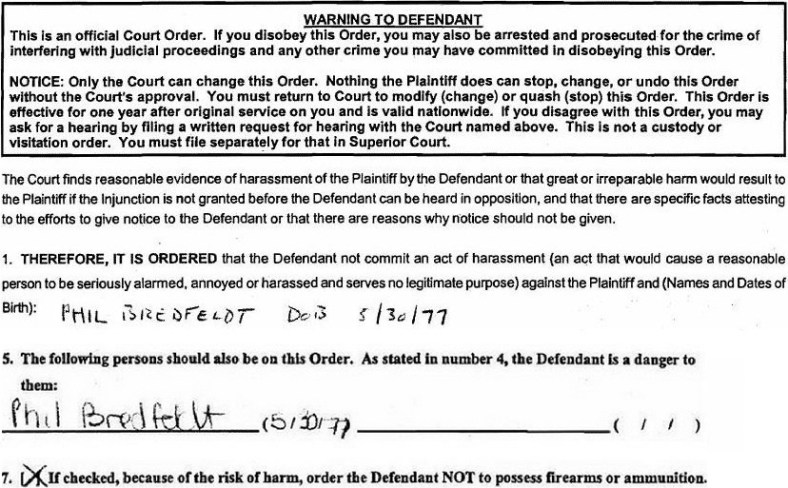
Bredfeldt urgently petitions a protective order tailored to prohibit the writer (three days earlier called a “friend” who had been “nice” to her) from having any contact with her husband, Phil, a stranger, who is alleged to be in violent “danger.”

Later the same day, the writer would be sent an email, ostensibly by Phil Bredfeldt, that begins, “STAY THE HELL AWAY FROM MY WIFE, YOU SICK FUCK,” and ends, “THIS IS THE LAST TIME YOU WILL BE TOLD.

(The Bredfeldts simultaneously sent the email to UAPD Officer Bethany Wilson, with whom she later told the writer they had been on the phone at the time. Officer Wilson, who had met both of them, opined during a 2006 interview with the writer that Mrs. Bredfeldt “wore the pants.”)

Judge Jack Peyton, JP, Justice of the Peace, Pima County Justice Court

Judge Jack Peyton

The evidence of harassment Tiffany Bredfeldt presented to the court was five emails she and the writer had exchanged over a weekend (March 16–20): two from her, three from him in reply. The March 17 email of hers shown above was shuffled to the back of the sheaf, out of chronological order, causing the judge who presided over the writer’s April 10, 2006 hearing, Pima County Justice of the Peace Jack Peyton, to remark, “I don’t think I have a copy,” and then to ask, “Am I missing one [of the emails]?” Bredfeldt had to include the contradictory email among her evidence, which was never anyhow scrutinized, because it contained one of the only two requests she had ever made to the writer not to contact her: “I hope that you will respect my request for no further communication.” The other request was in an email she had sent him 20 hours earlier, in which Bredfeldt had represented the writer to himself as a stalker after he had gently tried to learn the motives for her behaviors at his home and her concealment from him that she was married. Judge Peyton confirmed with Bredfeldt that the minimum qualification demanded by the law, namely, two requests for no contact, had been met. The writer need not have been present.

Alleged on March 20 to be in danger of violent assault, Phil Bredfeldt had to be repeatedly reprimanded for displays of temper in open court three weeks later. Judge Peyton finally told him, after ordering his name stricken from his wife’s protective order:

I won’t think twice about asking you to leave the courtroom, because you’re not a party. You are welcome to be here. This is a public forum. But I won’t have you interrupting, and I will not have you making me uncomfortable about what your next action might be.

The judge, reputed to be the go-to JP for women alleging abuse by men, nevertheless cemented the protective order against the writer, explaining: “I do not get the impression that [Mr. Bredfeldt] was placed on that order by design.

(The following year, Judge Peyton was appointed to head a county domestic violence specialty court, which was financed by a $350,000 gubernatorial grant that included no budgetary allowance for defense attorneys. The judge, a onetime Maryland labor lawyer d/b/a J. Craig Peyton, underwent a “five-day domestic violence training session” in preparation. Reportedly operating only two days a week, his court has since processed well upwards of 25,000 cases.)

TIFFANY BREDFELDT, on cross-examination by the writer on May 20, 2013 (seven years later):
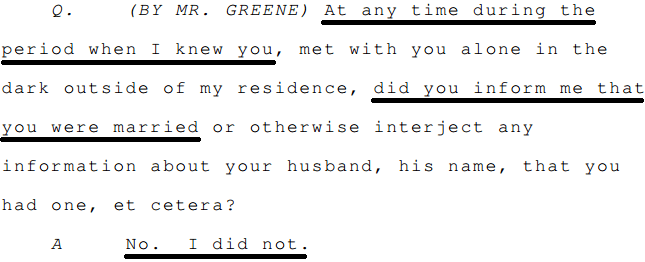
In contrast to her statements to the police in 2006, Bredfeldt testifies in 2013 that she never told the writer she was married. What Bredfeldt told the writer in 2005 was that she lived with a dog. The writer asked if it was alone at night while she was with him. Bredfeldt answered, “Yes.” The writer urged her to bring the dog with her so it wasn’t by itself and gave her a toy to take home.

TIFFANY BREDFELDT, on cross-examination by the writer on May 20, 2013 (the same afternoon):
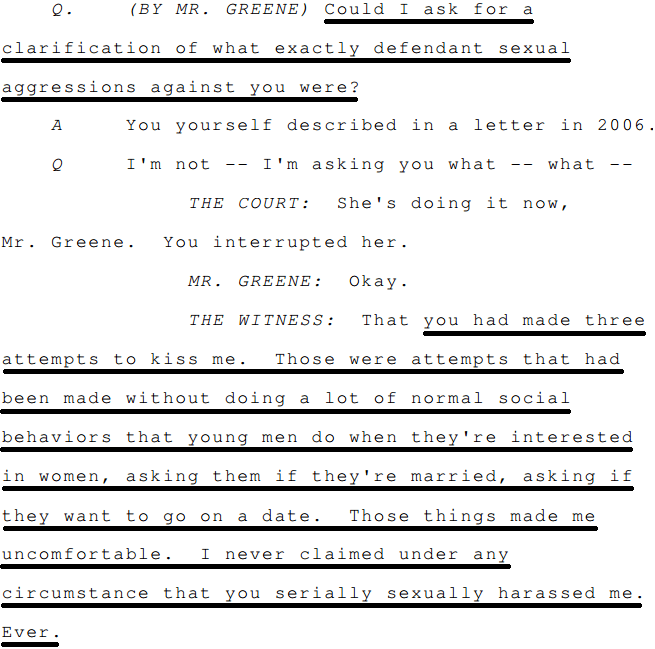
Also contradicting her statements to the police in 2006 (besides controverting what her first witness, Honeycutt, told the court in 2013 that she had told him), Bredfeldt testifies (in the presence of her husband) that the writer made “three attempts to kiss [her]” in 2005—which made her “uncomfortable” but not so uncomfortable as to prompt her to tell the writer she was married (or to tell her husband that another man had repeatedly tried to kiss her). Then Bredfeldt denies she has “ever” accused the writer of sexual harassment.

TIFFANY BREDFELDT, in a memorandum to Superior Court Judge Charles Harrington filed July 30, 2006:

In a “Statement of Factsto the court, contradicting her statements to the police (besides to the writer himself, which emailed statements she submitted to the court in 2006, 2013, and 2016), Bredfeldt alleges the writer made “several physical, romantic advances toward [her],” despite being “rebuked,” and that she was forced to flee[w]hen such advances continued.”

There were no physical advances. Bredfeldt was invited to have Thanksgiving dinner with the writer’s family in 2005. Instead of telling the writer she had a husband to get home to, she said she was suffering from a migraine. The writer put his hand on her shoulder and said he hoped she felt better. All other physical contacts between Bredfeldt and the writer, clasps and caresses, were initiated by her, typically during conversations in which she pointedly referred to breasts, bras, or panties, her naked body, striptease, or the like. At the conclusion of an earlier meeting in November, Bredfeldt had thrust her face in the writer’s and wagged it back and forth as if to tease a kiss. The writer didn’t respond, because there was nothing romantic about it. That was on the night Bredfeldt returned after attending an out-of-state wedding—her sister-in-law’s (Sara Bredfeldt’s), a detail she omitted mentioning.

A month later, on the evening before Bredfeldt “left the horse boarding facility” (in 2005 not 2006), the writer encountered her loitering in the dark outside of his house—alone. Bredfeldt returned a coffeemaker she had borrowed from him to prepare poultices for her horse’s abscessed leg. During the transfer, Bredfeldt tried to brush the writer’s hands with hers. Bredfeldt and the writer spoke as usual—he remembers talking to her about shooting stars—and the writer’s mother briefly joined them and invited Bredfeldt to a Christmas party. Bredfeldt removed her horse the next day while the writer was at work.

TIFFANY BREDFELDT, during cross-examination by the writer on May 20, 2013:
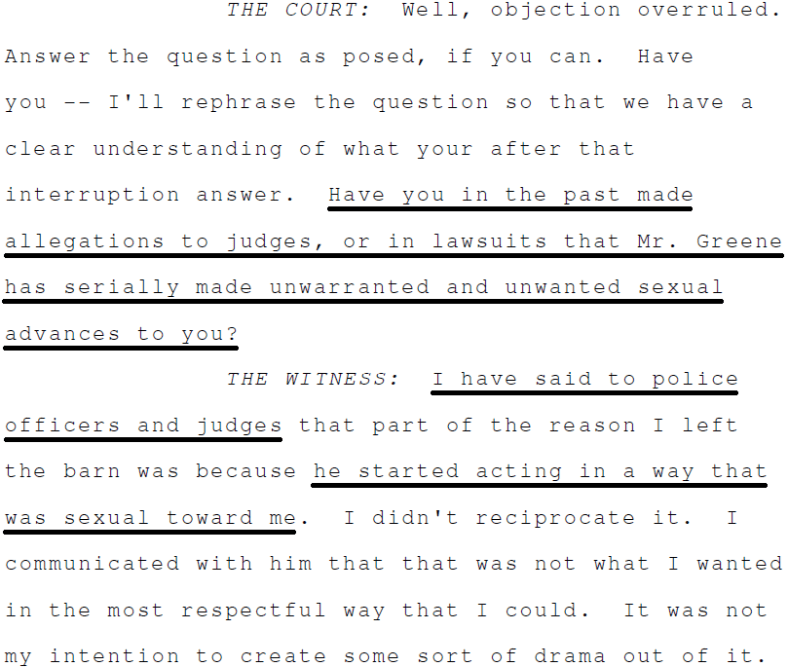
Bredfeldt testifies on examination by the judge that she has only ever told police officers and judges that the writer “act[ed] in a way that was sexual toward [her].” She “communicated with him that that was not what [she] wanted in the most respectful way that [she] could,” she says, which did not include either informing the writer she was married or wearing her wedding ring.

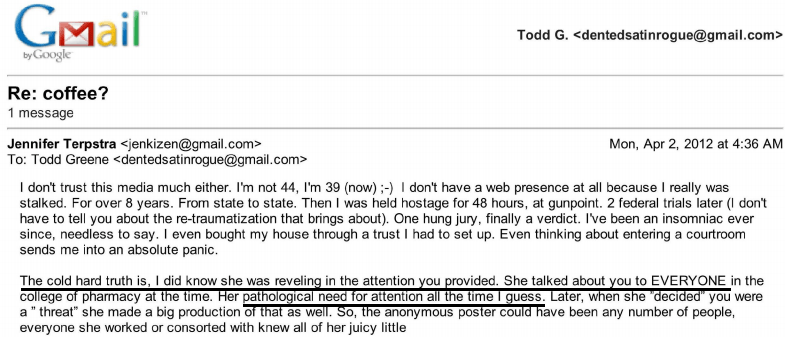
JENNIFER (OAS-)TERPSTRA, Bredfeldt’s other witness in 2013, a former colleague of hers from her University of Arizona days who went by Jenn Oas when the writer was introduced to her in 2005, in an email to the writer sent April 2, 2012 (a year earlier):
Jennifer Terpstra, Jen J. Terpstra, Terpstra JJ, Jennifer Oas-Terpstra, Jenn Oas, South Texas College, STC

This and the rest of Terpstra’s some two dozen emails to the writer in 2012 have been submitted to the court in multiple cases and are public documents accessible to anyone. Whether the emails have ever been scrutinized by a judge is uncertain. No trial has been conducted since the writer was granted a 20-minute audience before a judge in 2006. The 2013 proceeding from which the focal testimony in this post is drawn was a two-hour “preliminary” hearing. Judge Carmine Cornelio, though he drew the case out for half a year and returned several scalding rulings, found a two-hour hearing to be a sufficient basis for indefinitely depriving the writer of his First Amendment privileges. (When the writer had begun to object in open court to an order that was flagrantly unlawful, the judge threatened to summon security. Among the Arizona Court of Appeals’ stated reasons for denying the writer’s 2017 appeal of the order was that the writer had not “challenged” the judge’s ruling at the time.)

In this email, Terpstra tells the writer she was “stalked [f]or over 8 years [f]rom state to state.” Both Bredfeldt and Terpstra have claimed to be victims of multiple stalkers—including this writer. Bredfeldt, who the writer would be informed four years later has held a black belt in tae kwon do since her teens, came to the writer’s door in 2005 seeking his protection from some “men in a van” who she said had been “stalking” her while she was alone in the dark outside of his residence. Narratives of the “event,” which was unwitnessed and may have had no basis in reality, were circulated by Bredfeldt among other horse boarders on the property where the writer lives. The writer bought a wireless doorbell and installed it by the gate to his yard so that Bredfeldt could summon him quickly in case of a “recurrence.” When he showed it to her, she smiled.

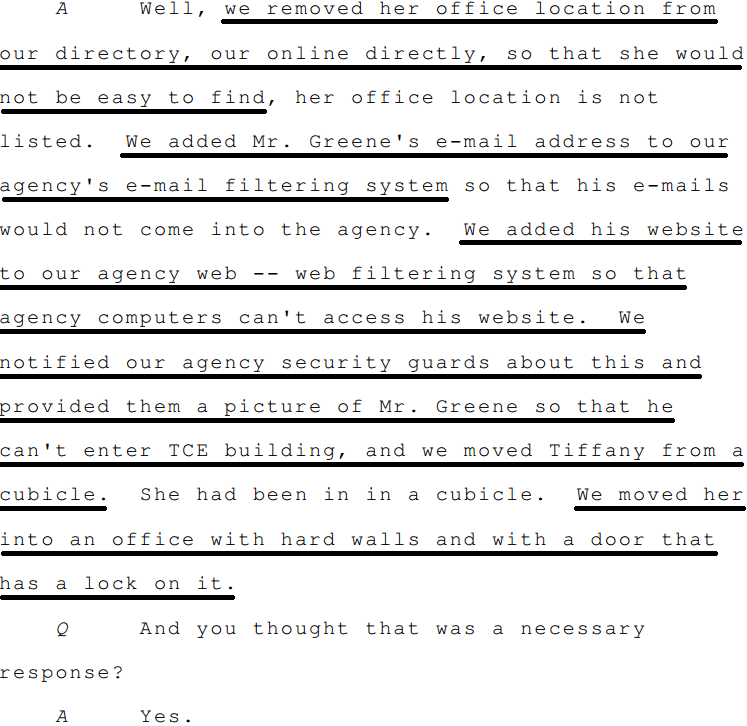
A few months subsequent, when Bredfeldt’s accusations against the writer began, she was reported to have told colleagues that she thought she had seen him around her residence—and at workday’s end would ask to be escorted to her car. In testimony to the court quoted in a postscript to this exposé, Honeycutt, Bredfeldt’s first witness in 2013, says the TCEQ rewarded similar expressions of fear from her by providing her with a private office (“with hard walls and with a door that has a lock on it” in Texas).

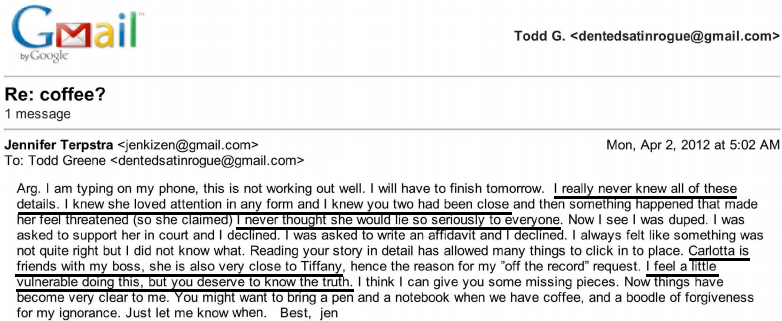
JENNIFER TERPSTRA, in an email to the writer sent April 2, 2012:
Jennifer Terpstra, Jen J. Terpstra, Terpstra JJ, Jennifer Oas-Terpstra, Jenn Oas, South Texas College, STC, Carlotta Groves PhD, Carlotta Groves DVM

In this email, sent a year before Terpstra would join Bredfeldt in testifying against the writer, Terpstra says that she “never thought [Bredfeldt] would lie so seriously to everyone” and that she knew Bredfeldt and the writer had been “close,” which remark alone contradicts everything Bredfeldt has told the court in the past decade. Terpstra also says she feels professionally “vulnerable” confiding in the writer but that he “deserve[s] to know the truth.” She suggests the writer “bring a pen and a notebook” to a meeting she proposed so that he doesn’t forget anything.

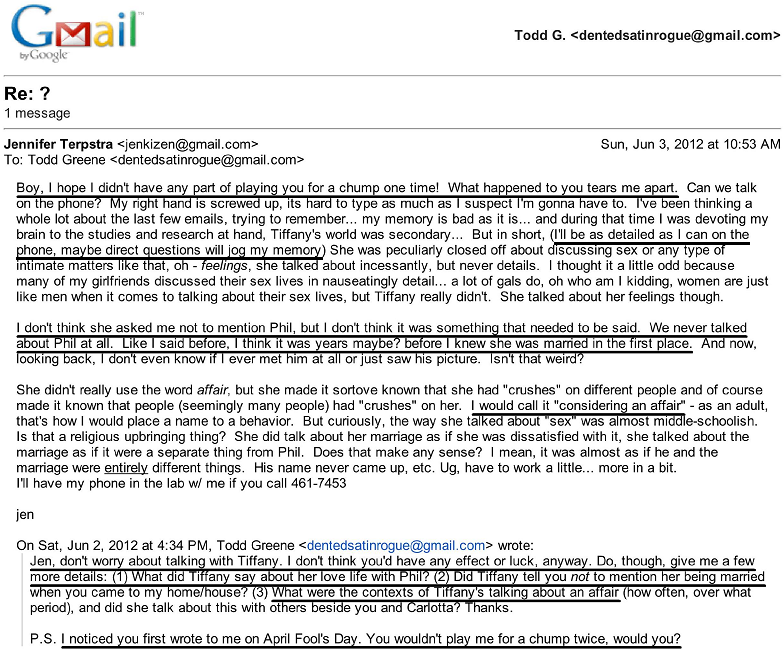
JENNIFER TERPSTRA, in an email to the writer sent June 3, 2012 (a month and a half after the two met for coffee):

Jennifer Terpstra, Jen J. Terpstra, Terpstra JJ, Jennifer Oas-Terpstra, Jenn Oas, South Texas College, STC

Terpstra told the writer over coffee in mid-April 2012 (when his father and his best friend were still alive, and a settlement could have reversed their decline) that Bredfeldt’s spouse, Phil, was known in their circle as “the phantom husband” and that Bredfeldt had urged her friends to go to the writer’s home to “check [him] out”—besides routinely talked about the writer to an audience of “25 or 30 people” at the University of Arizona College of Pharmacy.

Terpstra says in this email that Bredfeldt never talked about her husband and that she (Terpstra) wasn’t sure she had ever seen the man in person or only seen what she had described to the writer over coffee as a laminated newspaper clipping with a picture of him that was tacked to Bredfeldt’s refrigerator. Terpstra says that based on Bredfeldt’s behaviors in 2005, she judged she had been “considering an affair” with the writer, which wildly contradicts any account Bredfeldt has ever related to anybody.

In the first of the emails Terpstra sent him in 2012, she explained her six-year delay in confiding this to the writer by saying, “I don’t lie or bend the truth [but] I do avoid conflict.”

JENNIFER TERPSTRA, on direct examination by Bredfeldt’s attorney, Jeffrey Marks, on May 20, 2013 (less than a year later):
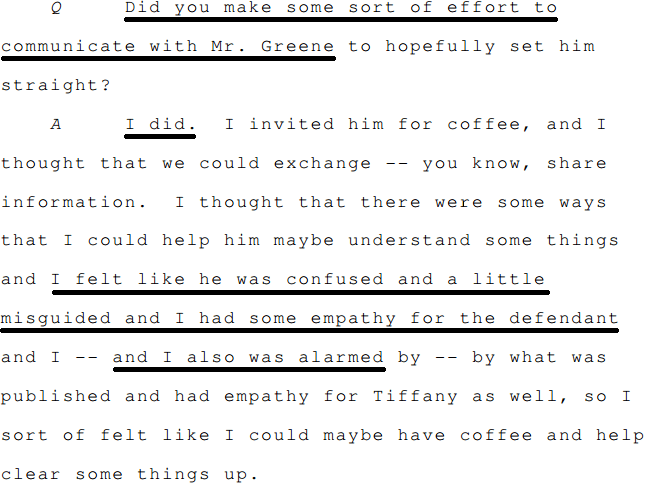
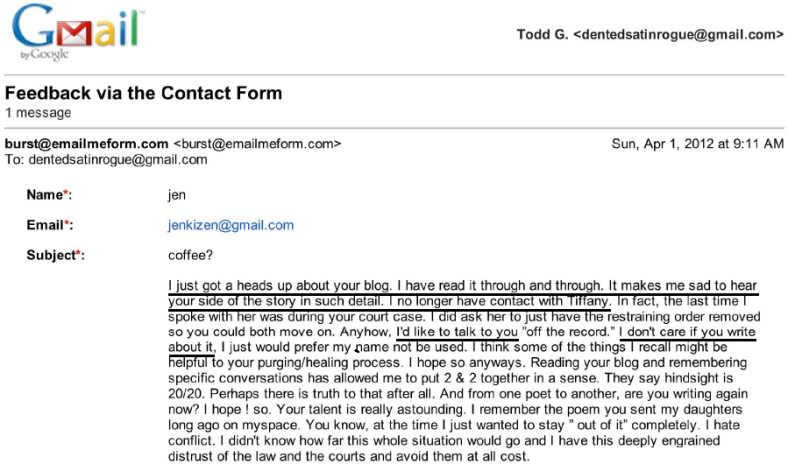
JENNIFER TERPSTRA, in an email to the writer sent April 1, 2012:
Jennifer Terpstra, Jen J. Terpstra, Terpstra JJ, Jennifer Oas-Terpstra, Jenn Oas, South Texas College, STC

In this email, Terpstra tells the writer she had asked Bredfeldt “to just have the restraining order removed” in 2006. (Terpstra would tell the writer the same thing over coffee a couple of weeks later, saying Bredfeldt had answered, “‘No.’ Just…‘no.’”) In contrast to Terpstra’s statements in this email and the others she sent him in 2012, besides in contrast to an email she sent him in 2007, Terpstra would report to Officer Nicole Britt of the Tucson Police Dept. in 2015 that “in 2005 she and her friend [Tiffany Bredfeldt] met [Todd Greene]. He then became fixated on the two of them and began stalking them.” (According to the same interview notes, Terpstra said this blog was “set up in honor” of her and “dedicated” to her.) A couple of months later (early 2016), Terpstra would report to TPD Det. Todd Schladweiler, who is assigned to the Tucson Police Mental Health Support Team, that she “now carries a handgun due to her concern that [Greene] is a threat to her safety.” Det. Schladweiler also recorded that Terpstra “said she communicated with [Greene] a few times [in 2012] and then he became very sexual in nature” and that Terpstra denied contacting the writer after they met for coffee in mid-April 2012, following which meeting she had insisted the writer give her a hug and then emailed and phoned him for a quarter of a year.
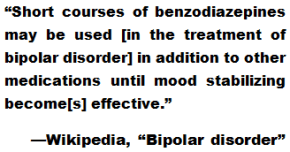
Then students in the University of Arizona College of Pharmacy, Terpstra and Bredfeldt told the writer in 2005, after inviting themselves into his house, that they took “benzos” to relieve stress. The writer asked where they got the drugs. Terpstra (who would marry a former bartender with a cocaine conviction not long afterwards and be charged with DUI in 2011) answered, “From work.” Bredfeldt echoed, “From work.”

Terpstra, who is reportedly diagnosed with bipolar disorder, told Det. Schladweiler she believed the writer was mentally ill. Although Det. Schladweiler was provided with Terpstra’s emails when he arrested the writer on Jan. 5, 2016, the subsequent synopsis of their interview gives no indication the detective spared the emails a glance.

Less than four months after her second police report, in which Terpstra alleged she feared for her safety and was carrying a gun, she would have her home address forwarded to the writer by email in the first of a spate of “copyright infringement” claims that represented her third legal action against him in 2016 and that succeeded in having this blog temporarily suspended by its host. The writer contested the claims, alleging perjury and fraud, and Terpstra declined to litigate them in court.

Terpstra, who has coauthored with Dr. Michael J. Frank, Ph.D., professor of cognitive, linguistic, and psychological sciences at Brown University, is the daughter of feminist painter Joan Bemel Iron Moccasin (Oas) and was employed as a research specialist in the University of Arizona College of Medicine under psychiatrist Francisco Moreno until 2016, when, after making her sundry false allegations, she left the jurisdiction.

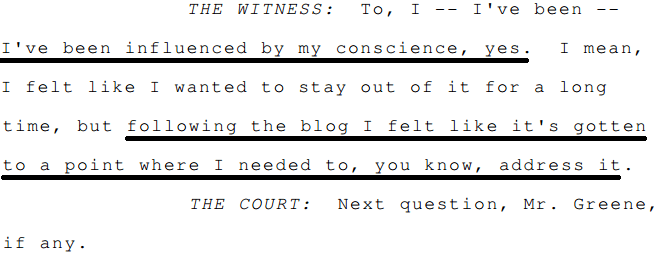
JENNIFER TERPSTRA, on cross-examination by the writer on May 20, 2013:
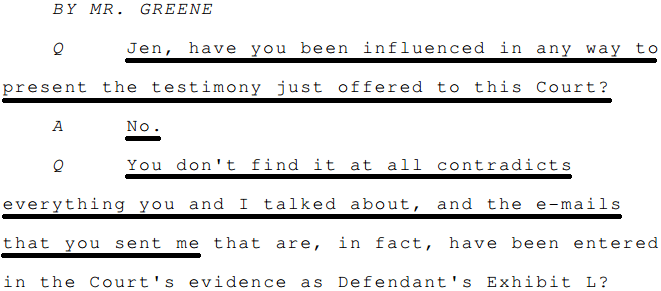
Jennifer Terpstra, Jen J. Terpstra, Terpstra JJ, Jennifer Oas-Terpstra, Jenn Oas, South Texas College, STC

Over coffee with the writer in 2012, Terpstra complained of financial problems. She also remarked, “Tiffany’s dad has a lot of money.” Tiffany and Phil Bredfeldt’s was a mutually prosperous union of two wealthy, fundamentalist Christian families. Phil Bredfeldt’s father was his best man in 2001; his sister Sara was a bridesmaid; and Tiffany Bredfeldt’s brother, Jon Hargis, was a groomsman. Four years later, Sara Bredfeldt was married to a medical student, Roberto “Bobby” Rojas, who is today an M.D. (Aurora St. Luke’s Medical Center in Milwaukee).

Ray Bredfeldt MD, Raymond Bredfeldt MD, Dr. Ray Bredfeldt, Arkansas Blue Cross and Blue Shield, ABCBSTiffany Bredfeldt’s father, Timothy “Tim” Hargis, is or was a bank vice president (First Security of Arkansas), as was his father before him. Phil Bredfeldt’s father, Raymond “Ray” Bredfeldt, is a family physician who practiced privately and besides rented his credentials to Arkansas Blue Cross and Blue Shield for some dozen years. The starting salary for an ABCBS regional medical director is today around $180,000. Dr. Ray Bredfeldt, M.D., had volunteered to join Terpstra in giving witness testimony in 2016 that was meant to induce the court to jail the writer while the writer’s own father, who didn’t graduate from high school, lay dying—in a home in foreclosure. Ray and Ruth Bredfeldt and Tim and GaLyn Hargis have known of what this post details from the start and have temporized for over a decade rather than acknowledge any liability for their families’ ways. “It’s what people like that do,” Terpstra commented to the writer in 2012. (Testifying in 2016, while his father was nearby, Phil Bredfeldt acknowledged on the stand that he was very aware of Terpstra’s 2012 emails. He quoted a post about them. Construing his statements to the court, the only thing that disturbed him about the emails was their contents’ being public.)

The court was told on Dec. 21, 2016, that Terpstra, who was sued to have her evicted from her house the year before, had moved from Arizona to Texas, where Tiffany and Phil Bredfeldt have resided since 2006 (in a house Terpstra told the writer that Tiffany Bredfeldt’s father had bought for them)—and the writer would be surprised if Terpstra’s legal representation in 2016 and 2017 cost her a penny.

JENNIFER TERPSTRA, on cross-examination by the writer on May 20, 2013:
JENNIFER TERPSTRA, in an email to the writer sent June 7, 2012:
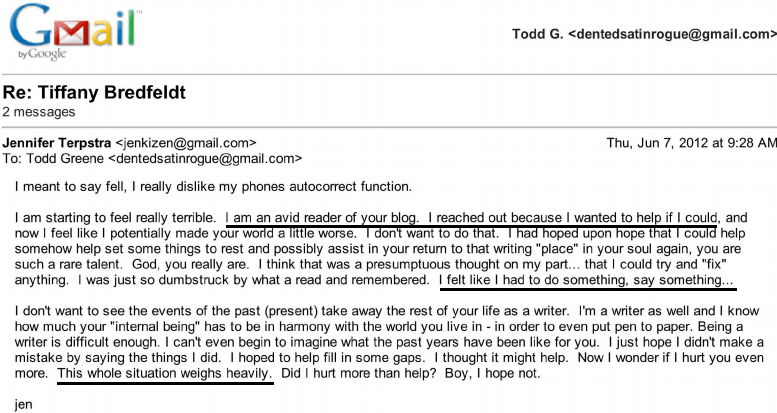
Jennifer Terpstra, Jen J. Terpstra, Terpstra JJ, Jennifer Oas-Terpstra, Jenn Oas, South Texas College, STC

JENNIFER TERPSTRA, on cross-examination by the writer on May 20, 2013:
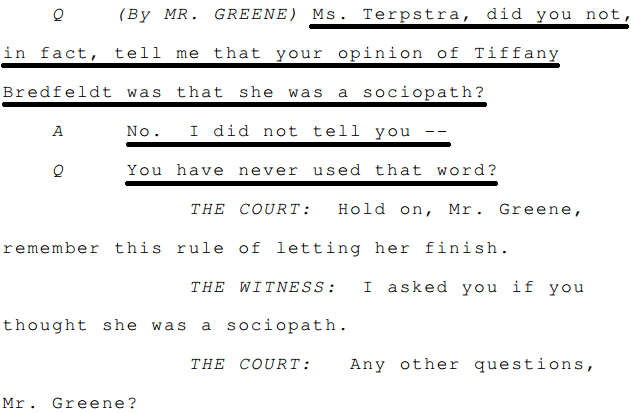
Jennifer Terpstra, Jen J. Terpstra, Terpstra JJ, Jennifer Oas-Terpstra, Jenn Oas, South Texas College, STC

JENNIFER TERPSTRA, in an email to the writer sent June 3, 2012:
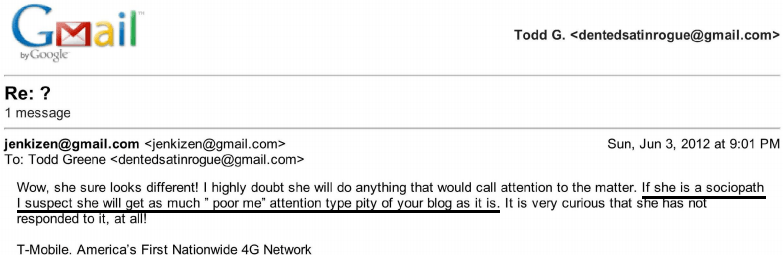
Jennifer Terpstra, Jen J. Terpstra, Terpstra JJ, Jennifer Oas-Terpstra, Jenn Oas, South Texas College, STC

Jennifer Oas-Terpstra, whom the writer has met three times in his life and only once in the past decade (and with whom he has had no contact since 2012), brought three legal actions against him in 2016 that each sought to suppress the emails quoted above—emails that today implicate both Bredfeldt and her (and criminal statutes of limitation, like those for false reporting and forswearing, stop running when perpetrators are outside of the state’s boundaries). Terpstra’s actions included a criminal prosecution, dismissed seven months later, in which Bredfeldt was also named a plaintiff, and a restraining order identical to the one Bredfeldt petitioned in 2006, which had inspired this blog and inspired Terpstra to tell the writer in 2012: “I can’t even begin to imagine what the past years have been like for you.” Terpstra’s restraining order was dismissed 20 months later.

Here are the allegations Terpstra made in her affidavit. These ex parte allegations remain a public record indefinitely. Here, in contrast, is how “vindication” from them appears. The writer was told that this handwritten dismissal, which required eight months of appeals to obtain, exists as a piece of paper only and won’t be reflected in the digitized record. Judge Antonio Riojas, who granted the Aug. 25, 2017 dismissal, accordingly recommended that the writer “carry [it] with [him].” His clerk provided the writer with the yellow copy of the triplicate form, the one meant for the plaintiff, who never appeared in court and will never be criminally accountable for her false allegations to the police in 2015 and 2016.

I’ve been doing this for 20 years,” Judge Riojas told the writer, “and I’ve never known a police [officer] or a prosecutor to charge someone for…false reports, no matter how blatant….” He added: “I wish they would, because I think people come in, and they say things that are just blatantly false—and lying.” A false or vexatious complainant “can keep filing as much as [s/he] wants,” Judge Riojas said (costing an attorney-represented defendant thousands of dollars a pop and his or her accuser nothing; application is free to all comers). “There is no mechanism to stop someone from filing these orders.” What may be worse, even a dismissed order, the judge explained, “can’t be expunged” (and anything may be alleged on a fill-in-the-blank civil injunction form, for example, rape, conspiracy to commit murder, or cross-dressing; whether heinous or merely humiliating, allegations that may be irrelevant to the approval of a keep-away order and/or that may never be litigated in court, let alone substantiated, will still be preserved indefinitely in the public record above a judge’s signature). Significantly, Judge Riojas, who is the presiding magistrate of the Tucson municipal court (and a member of the Arizona Judicial Council and the Task Force on Fair Justice for All), agreed that restraining orders were “abused”. Of that, he said, “[t]here’s no doubt.”

(In a given year, there are reportedly 5,000 active restraining orders in Tucson City Court, which recently added an annex dedicated to their administration exclusively—and the municipal court is just one of three courts in Tucson that issue such orders.)
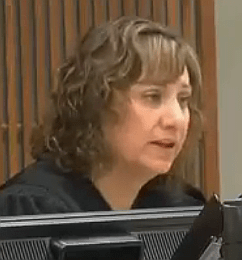
Judge Wendy Million, Tucson City Court

Judge Wendy Million

The reason Judge Riojas had to dismiss the order against the writer, nine months after he requested his day in court, was that the writer had been denied his statutory right to a hearing by Judge Wendy Million, necessitating a lengthy appeal and her admonishment by Superior Court Judge Catherine Woods for abuse of discretion. (Among approximately 15 judges to have been exposed to some aspect of this matter, Judge Woods was the first to return a ruling clearly untainted by political motives, for which she has this defendant’s highest respect.) Judge Million, who twice continued the writer’s hearing until the injunction expired and then nominated the case a “dead file,” notably coordinates Tucson’s domestic violence court and is acknowledged as an editor of Arizona’s Domestic Violence and Protective Order Bench Book. Dismissal of the case was further delayed by Judge Cynthia Kuhn, who was first assigned to the writer’s superior court appeal. Judge Kuhn sua sponte (that is, without being asked) granted Terpstra’s attorney additional time to respond to the writer’s appellate memorandum—and then abruptly recused herself, citing an unspecified “conflict of interest” as the reason.

Terpstra, in the first of the 22 emails she sent him in 2012, had told the writer: “I have this deeply engrained distrust of the law and the courts and avoid them at all cost.” Besides witnessing against him in May 2013, accusing him to the police in Nov. 2015, petitioning a civil injunction and instigating a criminal prosecution a month after that, filing a second police report in Jan. 2016, and threatening to sue him in federal court for copyright infringement 14 weeks later, Terpstra was poised to witness against the writer all over again that summer in the lawsuit brought by Bredfeldt and her husband that demanded the writer be jailed for contempt of the 2013 prior restraint. In between, in 2014, Terpstra prosecuted her husband, alleging domestic violence. A relative of his, who afterwards wept, told the writer in 2016 that she believed the man was relentlessly provoked, which the writer finds more than credible. In a voicemail Terpstra left him in 2012 (in which she tacitly identifies Bredfeldt as a “crazy person” from the writer’s “life book”), Terpstra told the writer someone had “threatened to call the police on [her].” Later, by phone, she clarified that this was another man she had been corresponding with that year—who blamed her for a woman’s suicide.
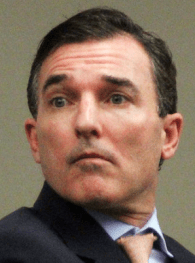
Tucson attorney Chris Scileppi, attorney Christopher Scileppi

Attorney Christopher Scileppi

Bredfeldt and Terpstra, (carrion) birds of a feather, were represented by the same (criminal) attorney in 2016 and 2017, Christopher “Chris” Scileppi, whose plumage is no different from theirs. Scileppi attained minor notoriety in 2008 for having been given a hug by his “very close friend” the mayor in front of jurors at a rape trial in which Scileppi represented one of the alleged rapists of a 15-year-old girl. Scileppi remarked to the outraged judge: “Courtrooms are open to the public, and I don’t think it is inappropriate when high-profile people come in and show support for somebody who is on trial.” Scileppi’s client was cut free, but the mayor later did a stint in prison for public corruption despite Scileppi’s representation.

Showing the same unscrupulousness during hearings in the 2016 civil case, Bredfeldt v. Greene, Scileppi threatened in open court to prosecute the writer for purported felony crimes (“extortion” and “aggravated harassment,” specifically) to intimidate him into capitulating to Bredfeldt’s censorship demands, then offered to drop the lawsuit if the writer agreed to leave this site invisible to the public and accessible by request only (apparently because his clients’ fear would be eased if they didn’t know what was on the writer’s mind), and finally, as a Parthian shot, directed the judge to jail the writer for the nonpayment of a $350 sanction from 2013 (explained below): “Put him in contempt,” Scileppi said, “and somebody can post a bond and pay that and then he will be released as soon as that bond is posted….

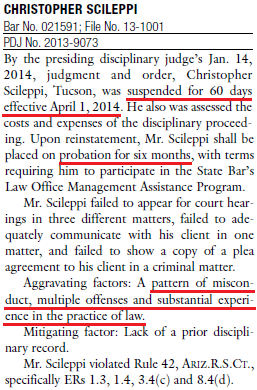
Tucson attorney Chris Scileppi, attorney Christopher ScileppiScileppi, who was suspended for 60 days and placed on six months’ probation in 2014 for violating various ethical rules (ERs), endeavored to convince the 2016 court that the writer had “terrorize[d], demonize[d], harass[ed], and defame[d]” the Bredfeldts, in particular through the use of “[meta] tags” on this blog, that is, keywords that describe its contents. These terms, which haven’t been used by any major search engine in eight years, were alleged to have hijacked the Bredfeldts’ public images on Google and to have “contact[ed]” anyone whose name appeared among them. Because a Google Alert Phil Bredfeldt had “set up” had allegedly been triggered by tags on the blog (in publications to the world at large), that was said to represent illicit “communication [and] contactby the writer with Mr. Bredfeldt and his wife. Scileppi enlisted an information technology expert, “part-time professor” and (criminal) attorney Brian Chase, to loosely substantiate this theory on the stand. Lamely objecting to an eminent constitutional scholar’s weighing in as an amicus curiae (Latin for “friend of the court”), Scileppi also defended the 2013 prior restraint last year before the Arizona Court of Appeals. He told the court that the writer was the liar.

Jeffrey “25% OFF ALL MONTH LONG” Marks, the low-rent opportunist who represented Tiffany Bredfeldt in 2010 and 2013, and is quoted below, represented her in 2016, also, but was hastily replaced after the writer was granted a court-appointed lawyer of his own. Marks, like his replacement, Scileppi, attempted to induce the court to stifle even third-party criticism of Bredfeldt, for example, that of Georgia entrepreneur Matthew Chan, who (aided by Prof. Eugene Volokh) successfully appealed a prior restraint in 2015 in his state’s supreme court and who introduced the writer to the finer points of First Amendment law.

To explain away Terpstra’s emails to the writer in 2012 and the contradictory testimony she gave a year later, Scileppi told Judge Catherine Woods in 2017 that “[i]n the midst of Greene’s harassment of Dr. Bredfeldt, [Terpstra] reached out to Greene and met with him. Through meeting with Greene, Terpstra became privy to his harassment of Dr. Bredfeldt.” In contrast to Scileppi’s claims, which Judge Woods shrewdly disregarded, Terpstra had offered to help the writer settle the conflict with Bredfeldt in 2012 (three months after Terpstra “reached out to [the writer] and met with him”). In an email Terpstra sent the writer on July 18 of that year (the first of four she sent that day), she wrote: “Maybe I can be a go between if the pastor [Jeremy Cheezum, a brother-in-law of Phil Bredfeldt’s] will not. I told Tiffany we met for coffee.” The email ended, “Hoping for the best.” That was the last day the writer heard from Terpstra, who is notably the mother of two college-aged daughters. Desperate to raise money to secure a surgery for his dog to enable her to run and jump again—something else Terpstra had said she was eager to help him accomplish—the writer scarcely gave Terpstra another thought until she appeared as a surprise witness 10 months later and deceived the court for Bredfeldt.

The other friend of Bredfeldt’s the writer met at his home in 2005, Dr. Carlotta Groves, a reported recipient of $740,000 in scientific research grants who uses the alias “Jahchannah” and identifies herself as a “Black Hebrew Israelite” and “servant of Yah,” lives in Arizona but apparently couldn’t be persuaded to give witness testimony for Bredfeldt in either 2013 or 2016. Like Terpstra did in the first of her emails to the writer in 2012, Groves told him in a blog comment around the same time that her own brother had been falsely accused. Terpstra said her brother had been falsely accused of rape and that it had “truly ruined his life.” For 12 years, Groves has done what Terpstra did for six: spectate. Groves, a DVM and a Ph.D. (who “love[s] to read and support aspiring authors!”), works at a low-cost veterinary clinic in Tucson.
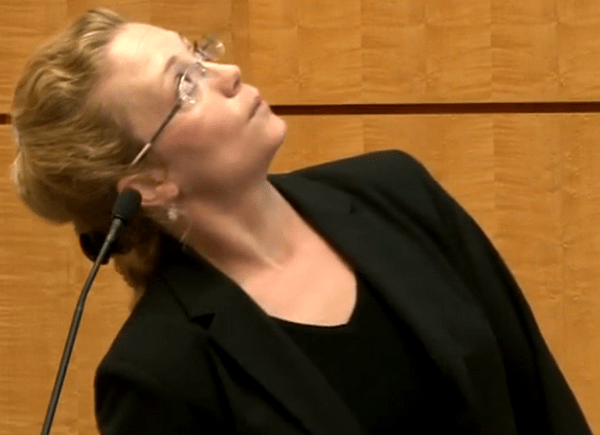

Tiffany Bredfeldt TCEQ, Tiffany Bredfeldt PhD, Tiffany Bredfeldt EPA, TCEQ, Texas Commission on Environmental Quality, EPA, Environmental Protection Agency, EPA Chemical Assessment Advisory Committee


TIFFANY BREDFELDT, on cross-examination by the writer on May 20, 2013:

TIFFANY BREDFELDT, on cross-examination by the writer on May 20, 2013:
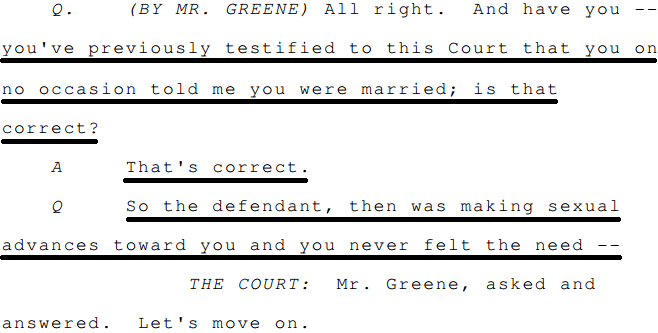
JEFFREY MARKS, Bredfeldt’s attorney, speaking for her in a memorandum to the court filed July 10, 2013:

The difference between Bredfeldt’s attorney’s offhand estimation, “2005 or 2006,” was a year of this writer’s life (and his friends’ and his family’s). The year after the “genesis of this case” was one the writer spent every waking moment conscious he could be arrested without a warrant based on a further contrived allegation by Bredfeldt (in which case the writer’s dog, who was part Rottweiler and vigorously barked at any approaching stranger, could easily have been shot and killed).

Contrary to Marks’s claim, Bredfeldt employed others to tend to her horse’s daily hygiene in 2005. Within six or seven weeks of her installing her horse 30′ from the writer’s residence, it became lame and could not even be ridden, after which Bredfeldt increased the frequency of her nighttime visits.
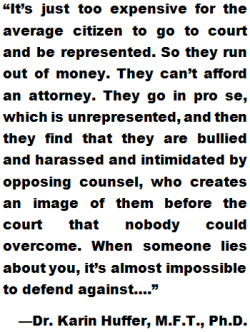
Karin Huffer PhD, Legal Abuse Syndrome, legal abuse, LASMarks, who boasts of having served as a superior court judge himself, also tells the court in this memorandum, which was captioned, “Plaintiffs’ Response to Defendant’s ‘Chronology of Tiffany Bredfeldt’s 2006 Frauds,’” that “[e]ven assuming arguendo that Plaintiff Tiffany Bredfeldt is a chronic liar, her veracity is totally irrelevant to the necessity to restrain Defendant’s [speech] conduct.” Marks moved the 2013 court to strike the writer’s “scandalous” chronology from the record so that it couldn’t be accessed by the public. The judge, Carmine Cornelio, complied, rebuked the writer, and sanctioned him $350 for filing the brief, despite having invited him to: “Mr. Greene,” the judge had said in open court, “you can file anything you want.” Then the judge permanently prohibited the writer from telling anyone else what that chronology related—including by word of mouth. Bredfeldt’s handmaidens, Honeycutt and Terpstra, said exactly what they knew they should to inspire the illegal injunction. The judge permanently prohibited the writer from talking about them, also, including by reporting the testimony they gave in a public proceeding in the United States of America.

(Last year, two days before the writer’s attorney would file an appeal reminding an American court that citizens of this country enjoy freedom of speech, The New York Times published an editorial on censorship in China adapted from an essay by iconic artist and agitator Ai Weiwei. In it, Ai argues that censorship, an essential tool of oppression, does the opposite of pacify: It stimulates “behavior [that] can become wild, abnormal and violent.” Having to live with lies, as Ai told NPR in an interview in 2013, “is suffocating. It’s like bad air all the time.”)

MICHAEL HONEYCUTT, on cross-examination by the writer on May 20, 2013:
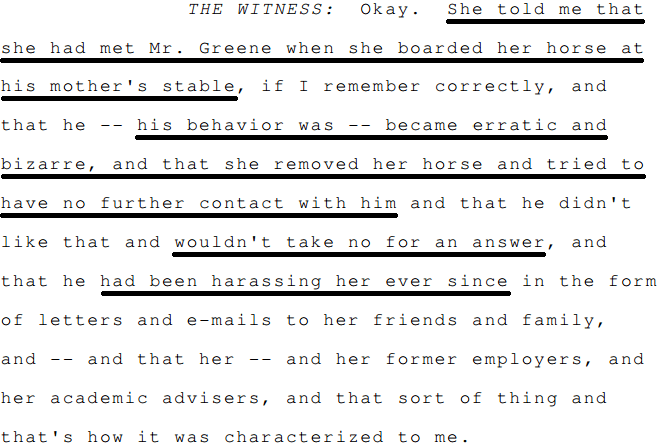
MICHAEL HONEYCUTT, on direct examination by Bredfeldt’s attorney, Jeffrey Marks, on May 20, 2013:

The testimony of “Where’s my mike?” Honeycutt exemplifies how the Texas Commission on Environmental Quality responds to “pretty significant allegations” of ethical misconduct by its scientists: It ignores the allegations…and abets the misconduct.

Under Arizona law, a “false sworn statement in regard to a material issue” is perjury, a felony crime. Honeycutt influentially testified in 2013 that the writer had called Bredfeldt a “fraudulent scientist.” Here, in contrast, is what the writer told Honeycutt in 2011, in a letter that is today a public document.
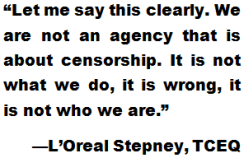
L'Oreal Stepney, TCEQ, Texas Commission on Environmental Quality, censorshipIn the Texas Observer the summer before last, Naveena Sadasivam reported that “Honeycutt sent at least 100 emails to state air pollution regulators, university professors and industry representatives and lawyers asking them to send the EPA a letter supporting his nomination to the Clean Air Science Advisory Committee….” Probably none of them sought to have him silenced on pain of imprisonment for requesting support. In a further instance of incandescent hypocrisy, Honeycutt is quoted in the story as pronouncing: “Ideology is different from science and data.” The reader is invited to consider which master Honeycutt was serving when he testified against this writer four and a half years ago.

After a hearing held on July 15, 2016, during which her husband had testified he was “frighten[ed],” Tiffany Bredfeldt swore in court, “God damn it,” because instead of ordering that the writer be jailed, the judge had stayed the proceedings pending further briefings from the attorneys on the First Amendment. Then, less than a year after the writer had buried his best friend and a few months before the writer’s father would succumb to cancer by starving to death, Bredfeldt laughed. She said Honeycutt had joked that her prosecution of the writer was “good experience” for when she gave expert witness testimony. “That’s something we have to do,” Bredfeldt explained to her entourage.

Copyright © 2018 RestrainingOrderAbuse.com

DR. MICHAEL HONEYCUTT, PH.D.:
DR. TIFFANY BREDFELDT, PH.D.:
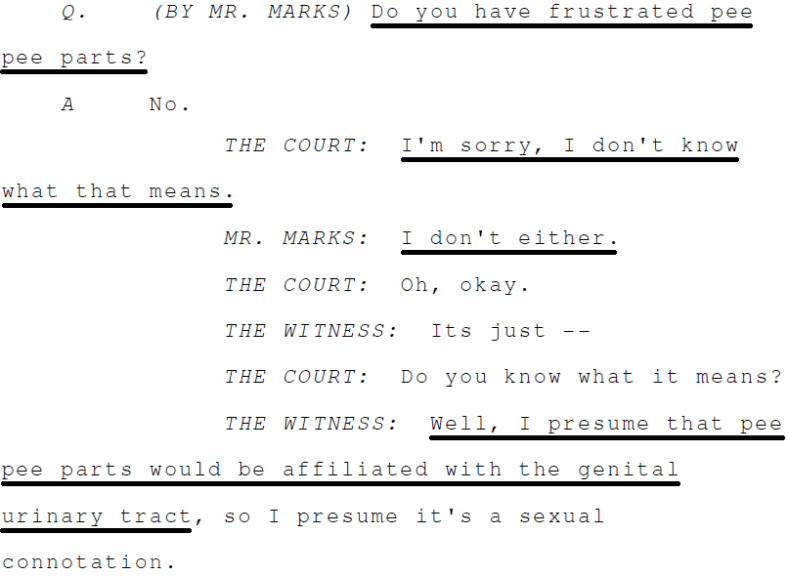
A Man’s “Tasty Little Balls…What a Treat!”: On RAINES v. ARISTEO, Free Speech, and Censorship


Typical of cases stemming from court injunctions, the case that occasions this post, Raines v. Aristeo, is a he-said/she-said quagmire. Not disputed is that the woman and the man had a four-month relationship in 2010. He says he ended the relationship after learning “disturbing…information” from her ex-husband about her. She says she ended the relationship because he became “strident,” “demanding,” and “threatening.” Both acknowledge they had a business relationship outside of their personal relationship. He says she owed him money and brought criminal complaints against him to get out of paying. This post doesn’t belabor the backstory but instead raises some questions: Is this, as in so many similar instances, a tempest in a teapot? Has a public interest been served by a man’s serial arrest and prosecution, or has it only sated a single woman’s rancor? Should this be countenanced? And, finally, is it lawful? The only pointed observation this post makes is that a woman has been annoyed, and a man is in jail.

NOTE TO THE COURT: Facts in this post were gleaned by its author and do not originate from its subject, Bruce Aristeo, who had no influence on its composition. Commentary, likewise, is solely that of its writer.


Jody Raines, WebMarCom, Raines v. Aristeo, Bruce Aristeo

In her YouTube video “Smiles for Ruger,” Internet marketing adviser Jody Raines imitates feeding a man’s “TINY, TINY, TINY” testicles to her dog.

“Agitator” Matthew Chan, who introduced me to how restraining orders are used to squelch protected speech, brought this search engine return to my attention on Friday:

This notice greets the person who queries Google either about Jody Raines, a woman who describes herself as a “recognized expert with Social Media, Internet Marketing and Website Development,” or Bruce Aristeo, a former schoolteacher she has prosecuted, not for the first time, and had sentenced to three months in jail.

Bruce Aristeo, Jody Raines, Raines v. Aristeo

Bruce Aristeo

The two dated in 2010, besides having a business relationship at the same time. Beyond these details, accounts predictably differ. Beyond question, however, is that Mr. Aristeo has been jailed for expression protected by the First Amendment.

His “crime” was posting satirical videos on YouTube ABOUT Ms. Rainesand even asserting that much is subject to interpretation. The basis for Mr. Aristeo’s arrest and subsequent incarceration was his being issued something called an “indefinite temporary restraining order” (unique to Camden County, New Jersey) in 2012. This bizarre instrument (issued in a state long-known for its harsh judicial treatment of male defendants) exposes Mr. Aristeo to warrantless arrest anytime for the rest of his life.

Prior to the most recent prosecution, Ms. Raines has had Mr. Aristeo arrested multiple times and jailed for over half a year. (Whatever Ms. Raines’ talents as a marketer outside of court may be, inside of one she’s proven herself to be highly effective.)

The conflict between the two inspired a YouTube “cold war” that went preemptively nuclear in 2015. Ms. Raines’ latest prosecution concerned Mr. Aristeo’s videos. This post examines one of his and one of hers.

Among Ms. Raines’ reported passions are motorcycles and Belgian Malinois dogs. One of her personal pets is called Ruger (also the name of a gun manufacturer). Mr. Aristeo waggishly produced a video “promoting” a brand of breakfast meats called “RU Burger Farms” (RUger).

Jody Raines, WebMarCom, Raines v. Aristeo, Bruce Aristeo

The vid’s “production company,” “MonkeyCom Banana Strategies,” both identifies the work as satire (which is protected speech) as well as takes a poke as Ms. Raines’ company, WebMarCom, which advertises marketing strategy advice. In the video, Mr. Aristeo (clad in a scarf and a fuchsia sweater) lustily tucks into some “Malinois sausage patties,” and his narration includes tongue-in-cheek patter like this: “I love to prepare my Malinois like the Amish do, where they put a little syrup on top after….”

Jody Raines, WebMarCom, Raines v. Aristeo, Bruce Aristeo

This apparently is supposed to represent a “true threat” to either Ms. Raines or her dog, neither of whom is explicitly identified. The video wasn’t brought to Ms. Raines’ attention by Mr. Aristeo—that is, he didn’t contact her—which means to have seen it, she had to have sought it out.

Ms. Raines responded to Mr. Aristeo’s homemade flick with a satirical video of her own. It suggests she has castrated Mr. Aristeo and is feeding his testicles to her dog. It’s called, “Smiles for Ruger.”

Here’s a still from it:

Jody Raines, WebMarCom, Raines v. Aristeo, Bruce Aristeo

The word troll in the frame that follows is Internet slang for a person who lurks in forums and sows discord on the Internet for self-amusement. Its application here is an ill fit, because Mr. Aristeo didn’t plant his video anyplace with the intent to provoke: Ms. Raines had to know where to look.

Jody Raines, WebMarCom, Raines v. Aristeo, Bruce Aristeo

The frame below intimates that Ms. Raines’ video was inspired by Mr. Aristeo’s “picking on” Ruger (who’s an intelligent dog but doesn’t speak English) with his video.

Jody Raines, WebMarCom, Raines v. Aristeo, Bruce Aristeo

Ironic is that the video documents Ms. Raines’ taunting Ruger before finally letting him devour the “TINY balls.” The video also taunts Mr. Aristeo. It doesn’t just mock his genital size and virility but concludes with Ruger’s “saying”: “Yes, they taste like CHICKEN.”

Jody Raines, WebMarCom, Raines v. Aristeo, Bruce Aristeo

Ms. Raines plainly means Mr. Aristeo is a chicken. She taunts a man whom she had already had arrested several times and jailed.

A question the court might have considered during sentencing this year, if not before that, is whether this is the act of a woman who’s “afraid.” Another question it might have considered is whether a sophisticated online spat justifies interference by the state at taxpayer expense. Finally, it might have considered whether it was constitutionally sanctioned to stick its nose in, which it wasn’t.

Ms. Raines meanwhile is performing a post-trial mop-up for “image maintenance.” Her video “castration” of Mr. Aristeo remains online, however, and has not been targeted for censorship by Google or age-restricted by YouTube.

Copyright © 2016 RestrainingOrderAbuse.com

*How many tens of thousands of dollars of public funds have been chewed through to sate what is arguably one woman’s yen for vengeance is anyone’s guess. Besides the costs of the trials, arrests, and incarcerations, Mr. Aristeo was jobless and homeless while prosecuting his defense, and living on the state’s dime in government-subsidized housing. Worthy of reflection, too, is the setback to citizens’ constitutional entitlement to free speech:

Why the Restraining Order Is the Perfect White Trash Instrument of Malice

People who exploit restraining orders are not necessarily victims, and they’re not necessarily the “good guys.”

This post will be brief. Its only ambition is to show why restraining orders present trashy people with the chance to commit malicious acts with far-reaching and permanent consequences—and to do it hands-free using our justice system as their bully agent.

  1. Restraining orders are cheap or totally free of charge (as the Office on Violence Against Women requires).
  2. They’re available to anyone and require no bona fides at all. Felons can obtain restraining orders just like anyone else. It has been reported on this site that restraining orders can even be procured under assumed names. No i.d. is necessarily required, because accusers are automatically “victims,” and the pretense is that victims never lie.
  3. Restraining orders are issued ex parte, which means “respondents” (defendants) don’t actually get to be “respondents” until after they’ve been judged and found guilty.
  4. Restraining orders can be petitioned from other counties or even other states…against total strangers.
  5. They’re often issued more or less automatically: Ask and you shall receive.
  6. Lies that aren’t successfully exposed in what may be a 10-minute follow-up hearing cannot be attacked in a collateral action. In other words, if lies work once, they work forever. Defendants cannot sue for perjury, and they cannot base an appeal to a higher court on allegations of perjury or fraud.
  7. Restraining orders, even if dismissed, remain public records, and the mere title of a restraining order is prejudicial if not damning. They blacken citizens’ names and cost them relationships, jobs, and even employability in some fields (which of course affects them psychologically and physically).
  8. Restraining orders, because they represent civil not criminal trespasses, can rarely be expunged. Their traces linger even if judges determined they were unfounded or petitioned fraudulently.
  9. People who lie to obtain restraining orders, including egregiously, are never prosecuted.

Now appreciate that on top of all of this, even if a defendant successfully has a fraudulent order that was petitioned by some lowlife dismissed, that lowlife is likely to be judgment-proof. That means even if the defendant sues him or her for malicious prosecution/abuse of process—a stressful six-month ordeal all by itself—s/he has no chance of realizing any compensation, because the lowlife has no money.

The restraining order is the ideal white trash tool of malice.

Copyright © 2016 RestrainingOrderAbuse.com

*The author of this post attended a criminal arraignment this week. That’s where people who have been accused of crimes plead guilty or not guilty. The city prosecutor, in every instance, referred to accusers as “victims.”

Litigation Privilege: Why Restraining Order Fraud Is Pandered to and Why the Falsely Accused Are Denied Recourse to the Law for Vindication, Relief, and Recovery of Damages

“Fraud is deliberately deceiving someone else [including a judge] with the intent of causing damage.”

Cornell Legal Information Institute

“Generally, lying during trial (or any other part of litigation) is expected to come out at the time of trial. This means an action against someone for lying during a prior proceeding would fail because even lies are protected by the litigation privilege. You have to catch them at the time; you cannot attack them collaterally (in a different proceeding).”

Attorney Catherine Elizabeth Bennett

Here are examples of restraining order fraud and repeated abuse of process (others are here and here, and comments and posts on this site are replete with them).

Here is the obstacle to obtaining relief from fraud committed by restraining order petitioners that the falsely accused face no matter how high up the judicial chain they muster the fortitude to climb:

  1. So-called protective orders were designed to allow battered women to apply directly to a judge for relief from household violence and intimidation. Their origin harks back to the late ’70s/early ’80s. When these orders were conceived 30 or 40 years ago, domestic violence was hush-hush, and (actual) victims faced alienation from their families for airing dirty laundry in public and rocking the boat. They faced, as well, the possibility of their claims’ being discounted by police or even ridiculed (compounding their misery and humiliation). So the middlemen (i.e., cops and prosecutors) were cut out of the process. Thus could allegations be made and ruled upon in the absence of any investigation. It seemed a reasonable stopgap at the time. Over the decades since, despite radical changes in how claims of domestic violence are received by the public and law enforcement (due in no small part to the investment of billions of federal tax dollars), the standards for substantiating an assertion of victimhood remain lenient, while what qualifies as grounds for a court injunction has steadily broadened. People now get orders against their friends, lovers, neighbors, moms, dads, kids, etc., and violence need not even be alleged; some claim of apprehension usually suffices. The process has morphed from a life-preserver for battered women with no other way out of a hellish situation to a sop to satisfy any complainant who fills out an application. Court policy pretends that anybody who walks into a courthouse with a beef (real or not) deserves a private audience with a judge to shield him or her from the terrors of public scorn or disapproval from the cops. Anyone with an ax to grind, that is, is treated like a battered woman circa 1979. So institutionalized has the process become, and so profitable to so many (both financially and politically), that no one questions whether this is ethical. So the restraining order process has become a game, a game played according to anachronistic rules. Maximum latitude is given to anyone (no fee or i.d. required) to litigate any claims s/he wants in a backroom conference with a judge, and rulings are issued ex parte, which means the person who’s accused is prejudged sight unseen. The due process rights of the accused are scotched. Grants under the Violence Against Women Act will explicitly forbid the use of lie detectors. The dictate is purely rhetorical; it’s meant to stress that what a complainant alleges shouldn’t be doubted. This expectation extends to any petitioner. Hence judicial scrutiny is minimal, and judges may actually bristle when the falsely accused allege that petitioners are lying. This is called fair and just.
  2. The idea behind “litigation privilege,” which basically ensures that whatever a litigant or his or her attorney alleges is protected from liability (from charges of defamation, for example), is the same: Accusers need to feel secure to air “the facts” without fear of prosecution.

The protections sketched above were not put in place to defend the right of any fraudster to falsely allege anything off the top of his or her head against a target of malice in a court of law. Perjury, after all, is a statutory crime. Lying isn’t condoned by the law, but it is swallowed by cops and defended by judges.

They’ve had their priorities impressed upon them in no uncertain terms.

So emphatic is the priority to give accusers the benefit of the doubt that people who’ve been wrongly accused have little or no credibility with judges and absolutely no recourse to sue for damages caused by false allegations (to reputation, employment, enjoyment of life, and health). The court doesn’t recognize there are any damages to being falsely accused of stalking, for instance, or violent threat, sexual harassment, assault, or even rape. False accusations that are dismissed as baseless are harmful enough (the stresses they cause are beyond quantification). When false allegations stick, the guilt of the accused is presumed, and subsequent legal actions they may venture to undertake (lawsuits and appeals) may be summarily tossed for lacking merit. In contrast, the merit of rulings that are typically the products of procedures lasting mere minutes isn’t questioned. Some judges will even hold that accusations litigated in court can’t constitute perjury because of the “litigation privilege” (i.e., because they were uttered in court instead of on, say, Facebook or the radio, they can’t be lies).

Accusers (all of them identified with battered women of 1979) must be free to claim whatever they want without fear of risk or blame—that’s the overriding precept. Translated, this means the court’s position is that people must be allowed to lie and snooker the court as they choose…and anyone who’s lied about be damned.

Copyright © 2015 RestrainingOrderAbuse.com

*From “‘Out of Left Field’: The Litigation Privilege Defense to Adverse Party Suits” by attorney Keith A. Call (emphases added):

Despite some authority characterizing the litigation privilege as “absolute,” it is certainly not without limits. There are some claims for which the litigation privilege is usually not a defense. Such claims may include malicious prosecution, fraud, criminal perjury, suborning perjury, and professional discipline. See, e.g., Hagberg v. Cal. Fed. Bank FSB, 81 P.3d 244, 259 (Cal. 2004) (the litigation privilege “operates to bar civil liability for any tort claim based upon a privileged communication, with the exception of malicious prosecution”); Bushell v. Caterpillar, Inc., 683 N.E.2d 1286, 1289 (Ill. Ct. App. 1997) (litigation privilege does not provide immunity from criminal perjury); Hawkins v. Harris, 661 A.2d 284, 288 (N.J. 1995) (litigation privilege is not bar to professional discipline or criminal perjury); Dello Russo v. Nagel, 817 A.2d 426, 433 (N.J. Super. Ct. App. Div. 2003) (litigation privilege does not insulate against malicious prosecution or professional discipline); N.Y. Cooling Towers, Inc. v. Goidel, 805 N.Y.S.2d 779, 783 (N.Y. Sup. Ct. 2005) (refusing to dismiss claims against adverse party’s attorney based on fraud and collusion); Clark v. Druckman, 624 S.E.2d 864, 870-72 (W. Va. Ct. App. 2005) (litigation privilege does not immunize attorney from claims of fraud or malicious conduct).

Abandon All Hope Ye Who Enter Here: The Hell of Legal Abuse Syndrome

This is the third sequential post on this blog about Legal Abuse Syndrome (LAS), a condition proposed by marriage and family therapist Karin P. Huffer “that develops in individuals assaulted by ethical violations, legal abuses, betrayals, and fraud” and that’s exacerbated by “abuse of power and authority and a profound lack of accountability in our courts.” This post surveys accounts of affliction (and its sources) drawn from various websites.

abandon all hope
Editorial intrusions and commentary in this post have been kept to a minimum, but some grammatical polishing is acknowledged.

You May Be Suffering from Legal Abuse Syndrome if You Have Been a Victim of DCF”:

I have been doing some reading on LAS (Legal Abuse Syndrome) and PTSD since I have begun to fear my own shadow. I hate the doorbell to ring. I run to the window to try to see who it might be, and rarely answer. If someone knocks on the door with any force, I am paralyzed. I do not like to answer the phone and thank God for caller ID. When I go out of the house, heaven help me if I see a child who reminds me of what we have lost. I cannot tell you the number of times I have vomited in public toilets. A police car in the rearview mirror leads to deep breathing and panic attacks. The thought of walking into a courtroom is enough to reduce me to a shaking mess. Certain names…can cause me to feel a sense of violation like no other. Sleep rarely happens and is often interrupted by nightmares, or even worse, waking and screaming for my child. No one cares; all of those I thought would protect us have not only failed us but willingly allowed misconduct and lies. Those I held in high regard due to their positions of trust and power I have found to have let their power corrupt their values and morals. Do I think I am ill? Yes, I know I am. I have a good doctor who is trying to help, a church to support me, and my husband and children who have stood by me, but I also know I will never be the same person I was. I will never trust in the “system” and have been totally disillusioned by what I always thought were my constitutional rights as an American citizen not only being disregarded but willfully being trampled on by those sworn to protect them.

Sufferer Legal Abuse Syndrome” (MyPTSD.com):

I was just diagnosed with PTSD from a prolonged and nasty legal battle (10 years). It was my understanding that PTSD was only for vets coming back from war. I guess there are other ways to fight wars. Mine was in the courtroom trying to fight off the onslaught of unethical attorneys and judges. I believe I fought for a good cause, but it has taken its toll on me. My nerves are shot; I have anxiety from the minute I wake up until I go to bed. Thoughts of what they did and the power they had over me and my children are with me always. I want to have a life, but I still deal with the consequences every day. I feel guilty for feeling this way as there are so many other people who have been through much worse. I think the feeling of being powerless and abused by a system I had faith in has shaken my foundation. My feelings about people and the world have changed forever, and my trust level is very low. A psychologist involved in the battle betrayed me and my family with lies, along with two other professionals in this field, all my attorneys, and the judges. You might discount my viewpoint as overboard. It took a long time to see it myself, but my investigations proved correct.

Legal Abuse Syndrome” (Caught.net):

I became depressed, physically ill, and seriously suicidal after experiencing the insanity of litigation. I lost my home and was sent to the street with nothing but the clothes on my back. Literally everything I owned was gone for several years. I fought my fight to points of exhaustion where all I could do was stare into space. Friends had left; I was emotionally isolated, and normal living activities were no longer normal. Rage doesn’t come close to describing the feelings I lived with for years. Even this is not the full story of how bad it got.

Posttraumatic Stress Disorder Legal Abuse Syndrome”:

I was diagnosed about two years ago with LAS [Legal Abuse Syndrome]. Protracted litigation and corrupt court decisions not only exacerbated my fibromyalgia but caused me to begin a whole new set of debilitating symptoms which have rendered me unable to sleep properly, hold a job, succeed in relationships, enjoy life, maintain goals, dreams, and hope. I suffer from what I call “spinal cord attacks,” which feel like rushes of adrenaline or cortisol permeating my spine, making me feel paralyzed, causing severe pain, lasting for 30 seconds to two minutes, and resulting in complete exhaustion and distress.

My once beautiful life as a drama and music teacher, writer and producer of children’s musicals, and fledgling writer has all but vanished. I am so debilitated from extensive legal research, useless and destructive attorneys and judges, horrendous living conditions imposed upon me by corrupt judges who denied me due process, the loss of my beautiful family home to my ex (which I had been paying for but couldn’t qualify for), the purging of all my earthly belongings, a now transient lifestyle, and increasing medical problems like high blood pressure, anxiety attacks, and hopelessness.

Massachusetts Mother Calling for Family Court Justice in Domestic Abuse Cases”:

I have missed all of my three daughters’ birthdays, first days of school, first dances, holidays, vacations, and school volunteering since 2007. My youngest daughter, Kelly, is nine. That means I have already missed out on half her life. I am not a drug addict. I am not an alcoholic.  I was and still am an upstanding citizen in the community despite Attorney Arabasz and his clients’ attempts to cause deliberate and malicious harm to me. I do my best to volunteer in the community, including hospice and domestic abuse, and have won numerous awards for my volunteerism over the years, which tends to bring me a renewed sense of healing from my own traumas. My children and I cannot get back those formative years we have missed. They are gone forever, never to return.  I am speechless in my ability to describe the pain and anguish I feel over this injustice alone.

Over that time, as documented through the courts, I have endured numerous, repeated, serious abuses that I have come to the court pleading for help with to no avail.  I am a human being who can take being abused only for so long.  I have suffered serious, repeated, unrelenting, undue stresses, many of which are criminal in nature, that have caused health issues. When the trial arrived, I prayed and hoped for justice to finally prevail for the sake of my children.

I have been severed from my children’s lives with little to no contact since August 3, 2011, and even longer since September 2007. The verdict of August 2012 from the trial was devastating to me and I worried about the long-term negative impact it would have on my children….

As a result, I am currently being treated for ADHD, Legal Abuse Syndrome, and trauma-related stress, and my treatment since trial has increased. Symptoms of trauma-related stress include gastrointestinal issues; anxiety and fear, especially when exposed to situations reminding me of the many repeated traumatic events; trouble sleeping; trouble eating; low energy; memory problems, including difficulty remembering aspects of the trauma; a “scattered” feeling and inability to focus on work or daily activities;  emotional “numbness,” which causes me to feel withdrawn, disconnected, or different from others; and protectiveness of loved ones or fear for their safety.

I did not suffer any of these symptoms until after I married an abusive partner and endured years of abuse. I was a victim that the system failed to protect, and now I suffer greatly. I was a fantastic mother, and even the father never questioned my ability to care for or mother these children until he got what he wanted and stole financially through the divorce.  However, the system has stripped away all my ability to love, nurture, and parent my three daughters who need me greatly.

The foregoing first-person accounts are hardly comprehensive; they were culled because they’re evocative. Notably, they echo numerous comments submitted by visitors to this blog, who have reported everything from homelessness and hopelessness to living “like a hamster” to contemplating suicide. Many respondents to the e-petition “Stop False Allegations of Domestic Violence” have reported the same.

The third-person account below, though it leaves the victim’s torment to the reader’s imagination, is certainly no less sympathetic than those above. It speaks, particularly, to how blind or indifferent others may be to the effects of legal abuse.

How academia betrayed and continues to betray Aaron Swartz”:

As news spread last week that digital rights activist Aaron Swartz had killed himself ahead of a federal trial on charges that he illegally downloaded a large database of scholarly articles with the intent to freely disseminate its contents, thousands of academics began posting free copies of their work online, coalescing around the Twitter hashtag #pdftribute.

This was a touching tribute: a collective effort to complete the task Swartz had tried—and many people felt died trying—to accomplish himself. But it is a tragic irony that the only reason Swartz had to break the law to fulfill his quest to liberate human knowledge was that the same academic community that rose up to support his cause after he died had routinely betrayed it while he was alive.

This survey concludes with an impersonal commentary from a woman who’s still embroiled in legal strife and fears the consequences of speaking about it too candidly in a public medium. She has removed herself to another state to escape a malicious accuser’s clutches but remains in the crosshairs, despite having been deprived of everything she once took for granted—including her sense of self.

‘White Collar’ Domestic Violence Sanctioned by the State”:

The fraudulently obtained protective order is the new tool of abuse for abusers to obtain total power and control over their victims. The protective order is obtained using false allegations of domestic violence and abuse against the victim in an open court of law without due process or an evidentiary hearing. The protective order is then used as a state-sanctioned license to stalk, harass, intimidate, and continue to abuse the victim. The victim lives in constant fear that s/he will be arrested and incarcerated any time the abuser chooses to place him or her in jail. The accuser plays the victim of his or her own crime [cf. Dr. Tara Palmatier’s “Presto, Change-o, DARVO: Deny, Attack, and Reverse Victim and Offender”].

This is the new “white collar” form of domestic violence and abuse. It is a tactic used by both men and women to gain the upper hand in a divorce or custody battle, or to have a domestic partner simply removed from a lease and ejected from his or her own home. In the case of a victim’s terrible misfortune of coupling with a psychopath or sociopath suffering from a narcissistic or borderline personality disorder, the protective order is fraudulently obtained by means of false accusations of domestic abuse simply to gain total power and control over him or her while simultaneously inflicting emotional distress to hurt and humiliate him or her and publicly harm his or her reputation. This in and of itself allows the abuser to compromise the integrity of his or her victim with a permanent public record, thereby impugning the victim’s character. This not only serves to satisfy the malicious intent of the abuser; it also renders the victim helpless in any and all attempts to plead innocence and defend him- or herself to law enforcement and the courts.

Acts of malicious intent by way of falsifying police reports, manufacturing evidence, and committing perjury in a court of law—all crimes at a felony offense level—go criminally unprosecuted because restraining order courts are of a civil nature, held by low level officials with no due process. Any attempts by the victim to file complaints or police reports of his or her own are useless and futile attempts at self-protection, because probable cause cannot be proven; a victim simply cannot prove with tangible evidence the intent or motive of the abuser. All attempts by the victim to file complaints or police reports to protect him- or herself do is embolden and provoke the abuser to escalate the abusive behavior toward the victim to the point that the victim cannot attend school, go to work, or even leave his or her own home out of living in a constant state of fear that the abuser will have him or her arrested on a whim.

Without due process and without protection, the victim is ultimately under the total power and control of the abuser. Law enforcement and the legal system (the courts, the judges, the attorneys) are all simply pawns in the sociopath’s sick game of abuse of process. A carefully constructed web of lies is in itself so complex that the victim is powerless to prove s/he is the victim of abuse, not its perpetrator. Over time, after the victim is professionally and academically destroyed, publicly humiliated, and ultimately alienated and completely isolated from his or her community, from friends, and even from family, s/he begins to doubt him- or herself and eventually loses all sense of human identity. Many victims commit suicide as a result of the abuse.

Copyright © 2015 RestrainingOrderAbuse.com

*See also this post about the death of Christopher Mackney, which contains links to his suicide note: “First Amendment Rights from Beyond the Grave: Defense of a Suicide’s Publication of His Final Words by the Randazza Legal Group.” The circumstances that conduced to Mr. Mackney’s taking his life are chronicled in a forthcoming book by investigative journalist Michael Volpe, which is titled, Bullied to Death: The Chris Mackney Story.

Not All Feminists Are Women, but All Feminists Are Responsible for Why False Accusations Are Rampant and Why They Work

Feminist lobbying is to blame for the injustice of restraining order and related laws and policies. There are no ifs, ands, or buts about it.

False accusations shouldn’t work, but they do—commonly, and not uncommonly to devastating effect.

That’s thanks to feminist crusaders, who may or may not represent Women, and who may or may not be women. This clarification isn’t intended for men who’ve been abused by court process; they don’t have any problem criticizing feminists, whatever form they come in.

Women, however, do—even women who’ve been abused by court process themselves. The clarification is for them.

Consider:

(1994) “Hi, Senator. This is Polly Wannacracker of COMA, the Consortium Opposing Male Aggression. I’m calling to share some startling statistics about violence, violence, and more violence. May I forward our research findings to your office?”

(1998) “Hi, Senator. This is Polly Wannacracker of COMA, the Consortium Opposing Male Aggression. I’m calling to share some more startling statistics about violence, violence, and more violence—also to tell you about the exciting progress we’ve made toward alerting the public to  the horrors of domestic abuse. Of course, nothing is ever enough when the stakes are this high!”

(2005) “Hi, Senator. This is Polly Wannacracker of COMA, the Consortium Opposing Male Aggression. How are you? How’s your wife? Oh, Bob, you kidder! We’ve so appreciated the support you’ve shown our cause over the years. Ha, you know me too well! Yes, I was of course calling to share some further startling statistics about violence, which, as you know, is epidemic, epidemic, epidemic….”

The allegory may be corny, but you get the point. This is how legislation is prompted, and support for it solidified and maintained. Names change; the message doesn’t.

Money has steadily aggregated to representatives of feminist causes over the decades, and this money has been used to secure public opinion through “information campaigns.” Too, it has inspired grant allocations to agencies of the justice system amounting to billions under the feminist motivated Violence Against Women Act (VAWA). Federal grants are also issued to promote and fund social science that validates these expenditures and laws related to violence against women, including restraining order laws. Both money and this tailored research are used to influence police policy and condition judicial priorities.

Women, defensively, may deny that members of their sex instigate malicious prosecutions more often than men or to greater effect. Who lies and why doesn’t matter, though. Judges should be vigilant against false claims, which should be detected, dismissed, and punished. Judges aren’t vigilant, false claims aren’t detected, and their claimants aren’t sanctioned. Why?

Thanks to dogged and vehement feminist politicking for the past 30 years or more, standards for substantiating claims of abuse made by restraining order petitioners are none, and penalties for lying are none. That’s because (women, please note) if the law made the standards too demanding or it threatened penalties for iffy testimony—so the dated argument runs—abused women might be afraid to come forward. They would just “suffer in silence” instead.

To ensure abused women aren’t afraid to come forward—again, so the dated argument runs—allegations must be taken on faith, and judges must have complete latitude to rule as they “think best” to protect the interests of people who can’t protect themselves.

If all this wiggle room means some people (or a lot of people) get falsely implicated…so what?

Law follows politics, and the political fix has been in for a long time. It stays in, because the architecture of laws has been concrete-reinforced. Feminist advocates continue to “monitor public policy” and to maintain their painstakingly erected social webwork. They have the money to do it. Oppositional voices are neither bankrolled nor have any political cachet. They’re not just the underdogs; they’re the usual suspects.

The above makes the below possible (comment submitted to this blog a few days ago by “Rhonda Lynn”):

I’m going to court in a few hours. I haven’t slept or eaten, and I’m a wreck. My life is over. Today.

I fled a [domestic violence] situation in another state and moved back to Washington. I bounced around a bit and finally ended up renting a room. (I’m disabled, on Social Security.) Yes, Craigslist.

I felt I asked all the right questions: Are you married? Do you live on the property? Do you own the home? Who else lives there? Both [man and woman] were surprised to learn [I was disabled, because] the other tenants renting the room across from me were disabled, as well. The man of the [tenant] couple was deaf, and I know American Sign Language.

Upon moving in, I began noticing the lies being told. The disabled couple was made to turn over their food cards. They tried with me when I signed the month-to-month agreement. I, of course, declined.

I helped with the deaf man and his developmentally disabled woman, because the female “owner” (also a lie) was overwhelmed and claimed she was sick. I cooked and cleaned (28 loads of laundry, using the washer and dryer I brought from my previous residence). I paid for Thanksgiving dinner.

Then Hell came. A friend of the female claimed the “husband” had been coming on to her…long story. The next day, it was me! […] First she tells me to move out; then she’s my friend.

The exploitation of the couple continues. The sister of the deaf man calls me [and] then calls Adult Protective Services. I make a call as well. There is an active investigation.

Ready?

sign-languageThe police knock on my bedroom door and give me 10 minutes to get some clothes. The “husband-owner” filed a restraining order on me!

I had a couple stay overnight for a movie marathon the night before, so I had a bit of help. The female officer verified I had a lock for my room. She advised the petitioner no one was to enter my room. She had me turn over the house key. I was in shock, crying.

As we pull away, the “husband” sends me a voice recording…saying, “See…who got [who] out of whose house? I got you out of my house! Neener Neener.”

I called the police. No good. I am not the victim. I’m the perpetrator. While on the phone…two more [messages] telling me I’m not getting any more of my stuff back, can’t come back to the house…even with an officer. “You’re burnt bitch! If the police ask where’s your stuff, I’m gonna say I don’t know.”

Then, there’s the “order.” A Domestic Violence Protection Order!

The allegations, all false…and very damning: stealing his mail, opening it and not giving it to him, going in his wallet, taking his [Social Security] card and old i.d., shoving him into a wall, causing a bruise on his back, yelling at all hours of the day and night, causing such stress on the disabled couple that they can’t eat or sleep and have PTSD episodes, calling members of the house vulgar names, texting and calling everyone while they sleep, [threatening] to burn the house down, [warning] him not to sleep, because I’d kill him. [He alleges] he is in fear of his life, afraid to take a shower or come home.

Then, lastly, the night before (when I had company), [he says] I came at him with a kitchen knife as he was getting ready for work [and that] he tried to call the cops, and I took his cell phone away. Then gave it back that morning.

Oh, my lord!

They both went on my Facebook [page]. He called me a hooker, said I would sleep with any man, and called me a horrible name. I didn’t respond, of course. Then he said I do meth, [which] he knows because I lived with him and he cleaned my room and found pipes and bags. Then she responds and says…and rigs and baggies. Now we know [they say] why she cleaned, and it explains her treatment of us. He [wrote] in another post: “I just want everyone to know she does methamphetamines.” (He is in outpatient treatment.)

[…]

I call the police…to get my stuff. I left my daughter’s ashes and pictures.

They say, “How can you prove you live there? If he doesn’t say you live there, we won’t bust down the door.”

I’M GOING TO JUMP OFF A BRIDGE.
(BUT DON’T DRIVE AND NO BUS FARE)
PLEASE. HELP ME.
RHONDA

The reader may choose to indict the male accuser in Rhonda’s story instead of the apparatus he exploited because he could, or the reader may choose to indict the apparatus itself and those who inspired it, defend it, keep it well lubricated, profit from it, and convincingly deny it’s abused.

Neither position will help Rhonda, who may be broken forever (or until she finds a bridge), but one of them may eventually make it illegal for a life to be so viciously demeaned as hers has been.

Copyright © 2015 RestrainingOrderAbuse.com

Restraining Orders as “Revenge Porn”

In the second season of HBO’s The Newsroom, a lead character is exposed on a website called Revenge Porn by a man with whom she’d had a brief fling.

After sitting huddled in a corner and pronouncing, “I want to die,” she rallies and confronts her former lover while he’s conducting a business meeting. Without much prelude, she kicks him in the testicles and bloodies his nose.

It makes for engaging TV.

If only an ex-intimate’s exploitation of the legal equivalent of Revenge Porn could be so briskly requited and resolved.

What I’m referring to, of course, is treacherously defamatory representations to the court on a civil restraining order, representations intended to publicly humiliate and satisfy a scorned lover’s urge to wound. The restraining order is an invitation for the system to poke its nose into the crevices, one it’s glad to accept.

The TV show character wasn’t able to sue the man who betrayed her, because she posed for the pictures. She even bought the camera for him.

Had the man surreptitiously shot the photos and aired them without her consent, she could have taken him to the cleaners. The courts do more than frown upon that kind of thing, especially when the photos are nudies.

Non-photographic representations that use the justice system as their porn site, though, are embraced as compelling causes of action.

Stalking, indecent exposure, assault, child molestation, bestiality, rape—no pubic allegation, however scandalous, is off the table, and there are no consequences for falsely portraying someone as a lewd and lascivious beast. It’s not defamation; it’s testimony. This distinction sublimates obscene slanders and libels into protected speech, and denies defendants any recourse for realizing compensation for the damage they inflict, psychological, physical, financial, and material.

The court hosts the site, and judges, the site’s administrators, are only answerable to the law, which licenses the site.

This revenge porn is legal—and has the feminist stamp of approval.

Copyright © 2014 RestrainingOrderAbuse.com

A Story of Female Sterilization That Should Stress to Those Who’ve Been Violated by Fraudulent Abuse of Legal Process Why Reporting Judicial Tyranny and False Accusers Is by Itself Pointless (You Must Demand Change)

The point of sharing the explication below is to emphasize how forlorn prospective recourses for redressing rights violations stemming from false restraining order and similar prosecutions are. Accountability is zero, across the board.

If you’ve ever wondered why a judge may be censured for rude conduct but not for ignoring lies or misrepresenting evidence, here’s why.

Quoted from “The Plumb Line: So What Else is New?” (Murray N. Rothbard, Libertarian Review, 1978), reprinted on LewRockwell.com as “The Tyranny of the Bench”:

The United States Supreme Court ruled, in 1872, that judges were immune from any damage suits for any “judicial acts” that they had performed—regardless of how wrong, evil, or unconstitutional those acts may have been. When clothed in judicial authority, judges can do no wrong. Period. Recently a case of an errant judge has come up again—because his action as a judge was considered generally to be monstrous and illegal. In 1971, Mrs. Ora Spitler McFarlin petitioned Judge Harold D. Stump of the DeKalb County, Indiana, Circuit Court to engage in a covert, compulsory sterilization of her 15-year-old daughter, Linda Kay Spitler. Although Linda was promoted each year with her class, Mrs. McFarlin opined that she was “somewhat retarded” and had begun to stay out overnight with older youths. And we all know what that can lead to.

Judge Stump quickly signed the order, and the judge and mamma hustled Linda into a hospital, telling her it was for an appendicitis operation. Linda was then sterilized without her knowledge. Two years later, Linda married a Leo Sparkman and discovered that she had been sterilized without her knowledge. The Sparkmans proceeded to sue mamma, mamma’s attorney, the doctors, the hospital, and Judge Stump, alleging a half-dozen constitutional violations.


All of these people, in truth, had grossly violated Linda’s rights and aggressed against her. All should have been made to pay, and pay dearly, for their monstrous offense. But the federal district court ruled otherwise. First, it ruled that mamma, her lawyer, and the various members of the “healing professions” were all immune because everything they did had received the sanction of a certified judge. And second, Judge Stump was also absolutely immune, because he had acted in his capacity as a judge, even though, the district court acknowledged, he had had “an erroneous view of the law.” So, not only is a judge immune, but he can confer his immunity in a king-like fashion even onto lowly civilians who surround him.

The U.S. Court of Appeals, Seventh Circuit, unaccountably didn’t understand the program, and so it reversed the district court, claiming that Judge Stump had forfeited his immunity “because of his failure to comply with elementary principles of due process,” and had therefore in a sense “not acted within his jurisdiction.” To allow Stump’s action to stand, said the appeals court, would be to sanction “tyranny from the bench.”

Now this was pretty flimsy stuff, and besides it opened an entertaining wedge toward holding judges accountable to the law and to the protection of rights like everyone else. But this would have shaken the foundations of our monopoly archist legal system. And so the U.S. Supreme Court, on March 28, set the matter straight. In a 5–3 decision in this illuminating case of Stump v. Sparkman, Justice Byron R. (“Whizzer”) White, speaking for the majority, sternly reminded the appellate court of the meaning of the 1872 ruling:

A judge will not be deprived of immunity because the action he took was in error, was done maliciously, or was in excess of his authority. Rather, he will be subject to liability only when he has acted in the “clear absence of all jurisdiction.”

Justice White conceded that no state law or court ruling anywhere could be said to have authorized Judge Stump’s action; but the important point, he went on, is that there was no statute or ruling which prohibited such an action by the judge.

Those interested in reading more are urged to click the link to Mr. Rothbard’s article at the top of the post.

What all of this should make clear is that for redress of rights violations stemming from false allegations made in restraining order and related prosecutions to be possible, the laws themselves must be rectified—and legislative reform will only be urged when more people loudly demand it.

For rights abuses to be capable of remedy by process of law, they must be illegal, which means the processes that authorize those abuses must be revamped or repealed by lawmakers (your state representatives). So long as the standard applied to restraining orders is merely a discretionary one, judges can rule however they want (that’s the statutory latitude they’ve been given), and they’re accountable for those rulings to no one.

Copyright © 2014 RestrainingOrderAbuse.com

“Predator” v. “Porn Star”: Restraining Order Fraud, False Allegations, and Suing for Defamation

destroyPeople falsely alleged to be abusers on restraining order petitions, particularly men, are treated like brutes, sex offenders, and scum by officers of the court and its staff, besides by authorities and any number of others. Some report their own relatives remain suspicious—often based merely on finger-pointing that’s validated by some judge in a few-minute procedure (and that’s when relatives aren’t the ones making the false allegations).

The social alienation and emotional distress felt by the falsely accused may be both extreme and persistent.

The urge to credit accusations of abuse has been sharpened to a reflex in recent decades by feminist propaganda and its ill begot progeny, the Violence Against Women Act. No one thinks twice about it.

Using four-letter words in court is strictly policed. Even judges can’t do it without risking censure. Falsely implicating someone, however, as a stalker, for example, or a child molester—that isn’t policed at all. Commerce in lies, whether by accusers, their representatives, or even judges themselves is unregulated. No one is answerable for sh* s/he makes up.

Accordingly, false allegations and fraud are rewarding and therefore commonplace.

It should be noted that false allegations and fraud can be distinctly different. For example, David Letterman famously had a restraining order petitioned against him by a woman who was seemingly convinced he was communicating to her through her TV, and her interpretations of his “coded messages” probably were genuinely oppressive to her. David Letterman lived in another state, had never met her, and assuredly had no idea who she was. Her allegations of misconduct weren’t true, but they weren’t intended to mislead (and the fact that they did mislead a judge into signing off on her petition only underscores the complete absence of judicial responsibility in this legal arena).

Fraud, in contrast, is manipulative and deceptive by design. It occurs when an accuser intentionally lies (or spins the facts) to give a false impression and steer a judge toward a wrong conclusion that serves the interests of the fraudster.

Regardless, though, of whether false allegations are made knowingly or unknowingly, they’re rarely discerned as false by the court, are seldom acknowledged as false even if recognized as such, and are always destructive when treated as real, urgent, and true, which they commonly are.

The falsely accused (often private citizens who’ve never had a prior brush with the law) are publicly humiliated and shamed, which by itself is predictably traumatizing. They are besides invariably (and indefinitely) entered into police databases, both local and national, and may be entered into one or more domestic violence registries, too (also indefinitely). These facts pop up on background checks, and defendants in some states may even appear in registries accessible by anyone (including friends, neighbors, family members, boy- and girlfriends, employers, colleagues, students, patients, and/or clients).

This costs the falsely accused leases, loans, and jobs (being turned down for which, of course, aggravates the gnawing indignity and outrage they already feel). Those falsely accused of domestic violence may further be prohibited from attending school functions or working with or around children (permanently). Defendants of false restraining orders may besides be barred from their homes, children, assets, and possessions. Some (including salaried, professional men and women) are left ostracized and destitute. Retirees report having to live out of their cars.

This, remember, is the result of someone’s lodging a superficial complaint against them in a procedure that only requires that the accuser fill out some paperwork and briefly talk to a judge. A successful fraud may be based on nothing more substantive, in fact, than five “magic” words: “I’m afraid for my life” (which can be directed against anyone: a friend, a neighbor, an intimate, a spouse, a relative, a coworker—even a TV celebrity their speaker has never met).

This incantation takes a little over a second to utter (and its speaker, who can be a criminal or a mental case, need not even live in the same state as the accused).

Accordingly, people’s names and lives are trashed—and no surprise if they become unhinged. (Those five “magic” words, what’s more, may be uttered by the actual abusers in relationships to conceal their own misconduct and redirect blame. That includes, for example, stalkers. Those “magic” words may also be used to cover up any nature of other misbehavior, including criminal. They instantly discredit anything the accused might say about their speakers.)

The prescribed course of action to redress slanders and libels is a defamation suit, but allegations of defamation brought by those falsely accused on restraining orders or in related prosecutions are typically discounted by the court. Perjury (lying to the court) can’t be prosecuted by a private litigant (only by the district attorney’s office, which never does), and those who allege defamation are typically told the court has already ruled on the factualness of the restraining order petitioner’s testimony and that it can’t be reviewed (the facts may not even be reviewed by appellate judges, who may only consider whether the conduct of the previous judge demonstrated “clear abuse of discretion”). The plaintiff’s testimony, they’re told, is a res judicata—an already “decided thing.” (Never mind that docket time dedicated to the formation of that “decision” may literally have been a couple of minutes.)

So…slanders and libels made by abuse of court process aren’t actionable, slanders and libels that completely sunder the lives of the wrongly accused, who can’t even get them expunged from their records to simply reset their fractured lives to zero.

Such slanders and libels may include false allegations of stalking, physical or sexual aggression, assault, child abuse, or even rape. In the eyes of the court, someone’s being falsely implicated as a monster, publicly and for life, is no biggie.

In contrast, it was reported last month that the court awarded a Kansas woman $1,000,000 in a defamation suit brought against a radio station that falsely called her a “porn star.”

When violated people speak of legal inequities, this exemplifies what they’re talking about: Falsely and publicly implicating someone as a sex offender is fine and no grounds for complaint in the eyes of the justice system, but for the act of falsely and publicly calling someone a mere sex performer, someone may be fined a million bucks.

Copyright © 2014 RestrainingOrderAbuse.com

How It Serves Political Interests to Issue Restraining Orders Falsely

Under the Violence Against Women Act (VAWA), some $10 billion has been invested over the past 20 years in procedures meant to redress violence against women, and restraining orders are the centerpiece of a host of related legislative measures.

The truth is restraining orders can’t prevent violence; they’re just pieces of paper. Their only value is rhetorical (they influence). They put defendants on notice, and they make it look like the government is protecting people.

When defendants are falsely blamed, their (isolated) protests are seldom registered or credited by others. Because their complaints are discounted or disregarded, they don’t tarnish the court’s image or inspire the press to investigate.

At the same time, it serves the court’s interests when defendants are falsely blamed. The greatest likelihood that an order of the court will appear to have averted violence is realized when that order is issued to someone who was never a threat at all.

Put another way, if the court only issued restraining orders to volatile people, it’s a fair bet that a discomforting percentage of orders would be violated, and the negative statistics would urgently disclose their ineffectiveness as deterrents.

Issuing a majority of restraining orders to people who pose little or no violent threat, contrariwise, ensures violations will be fewer and less consequential by and large. Negative figures, like murders, are thereby minimized, and the process appears to live up to its promise of insulation.

All of this is to say that if you issue 60 restraining orders against nonviolent people to every one issued against a violent aggressor, violations of restraining orders resulting in injuries or death will be comparatively few respective to the total number of people “restrained.” It skews the odds in favor of positive perception.

It’s good PR.

More restraining orders, besides, guarantees greater job security for those who administer them. It means there’s more “work” to get (handsomely) paid for doing.

More restraining orders also means greater substantiation of claims of “epidemic” this and that, which keeps dominant political interests happy and thriving (cha-ching!)…and justifies ramping up the process even further.

Copyright © 2014 RestrainingOrderAbuse.com

Larry’s Story, Part 2: Suing a False Accuser and the Judge She Rode in On

Buncombe County, North Carolina, where Larry Smith has for three years been harried by relentless false allegations from a disturbed neighbor, is the source of the word bunkum.

Bunkum (or bunk) is more familiarly called BS, which is what Larry’s been daily forced to tolerate for three years. He’s 70, and the time he’s had stolen from him was precious.

Larry filed a lawsuit in federal district court this week (pro se) against the State of North Carolina, his neighbor-cum-accuser, the judge who encouraged her reign of terror, and a number of other public officials to be named later in an amendment to his complaint.

Larry, a grandfather living on Social Security who practiced law in his salad days, is an object lesson about why it’s ill-advised to poke a sleeping bear.

Despite suffering from agonizing scoliosis (a degenerative spinal disorder), Larry’s been summoned to court over 30 times since 2011, locked in a cell, and had a gun pointed at him consequent to crank allegations from a vengeful neighbor who’s publicly accused him of being a disbarred attorney, an embezzler, and a psychopath (including on Facebook).

She says he’s “barked like a dog” at her, recruited “mentally challenged adults” to harass her while shopping, and mooned her friends. She says he’s cyberstalked her, too, besides hacking into her phone and computer.

Larry, who’s in pain even when he’s sitting down, has been reported to the police a dozen times or more while out walking his toy poodles or just puttering around his house. His accuser has also twice filed restraining orders against him since he took exception to her cat’s killing the local songbirds that have always been a source of joy to him to watch. The first time she petitioned a restraining order, she reported that he violated it later the same day.

Larry hadn’t even seen the woman.

Larry’s accuser’s is an extreme version of the mischief that’s widely reported by targets of restraining orders. Notable (and telling) is that even the outrageous degree of flagrant procedural abuse Larry’s been subjected to is winked at by authorities and judges.

There’s liable to be more blinking than winking this time around: Mr. Smith is going to Washington—and circumventing the local old boy’s network.

Larry’s lawsuit alleges deception; fraud; judicial dereliction; frivolous and malicious prosecution; fundamental constitutional rights violations; false imprisonment; unjust stigmatization; judicial politicking; collusion, conspiracy, and tyrannical oppression by representatives of regional government; and felonious forgery of a criminal complaint.

It also requests a jury.

One man’s debunking procedures this country and many others have invested faith and a fortune in is probably a forlorn hope, but the endeavor is nothing shy of heroic (and may at least restore to a sorely hectored man his peace of mind).

Copyright © 2014 RestrainingOrderAbuse.com

Larry’s Story: Restraining Order Abuse and the Neighbor from Hell

“She habitually engages in psychological projection. She has caused me to be compelled under threat of arrest and prosecution for failure to appear to attend court on her frivolous lawsuits 25 times. Yes! Twenty-five times. The frivolous prosecutions started in 2011, and they are still raging. I have been cited back to court on her application for a new restraining order on the 12th and a criminal warrant for cyberstalking on the 17th of this month. She has tried so many times to have me jailed I have lost count.”

—Larry Smith, author of BuncyBlawg.com (2014)

The quotation above is an excerpt from an email sent to the creator of “Neighbors from Hell” on ABC’s 20/20. The Feb. 8 email was a sorely persecuted man’s response to being fingered on Facebook as a candidate for the series by his neighbor, Marty Tackitt-Grist, who has forced him to appear before judges nearly 30 times in the span of a few years to answer “two restraining orders, three show-cause orders, two cyberstalking arrests, and a failure-to-appear arrest and jailing despite faxes from two doctors that I was too crippled, disabled, and suffering from herniated discs to be able to attend court.”

Here’s the reply the email elicited from ABC’s Bob Borzotta: “Hi Larry, I don’t seem to have heard further from her.  Sounds like quite a situation….” Cursory validations like this one are the closest thing to solace that victims of chronic legal abuses can expect.

Concern shown by the police and courts to complaints from attention-seekers can make them feel like celebrities. Random wild accusations are all it takes for the perennial extra in life to realize his or her name in lights.

Not unpredictably, the thrill is addictive.

I think I first heard from Larry, the author of BuncyBlawg.com, in 2013—or maybe it was 2012. In the artificial limbo created by “high-conflict” people like the one he describes in the epigraph, temporal guideposts are few and far between. A target like Larry can find him- or herself living the same day over and over for years, because s/he’s unable to plan, look forward to anything, or even enjoy a moment’s tranquility.

The target of a high-conflict person is perpetually on the defensive, trying to recover his or her former life from the unrelenting grasp of a crank with an extreme (and often pathological) investment in eroding that life for self-aggrandizement and -gratification.

Among Larry’s neighbor’s published allegations are that he’s a disbarred attorney who “embezzled from his clients” and a textbook psychopath, that he has “barked like a dog for hours” to provoke another neighbor’s (imaginary) dog to howl at her, that he has called her names, that he has enlisted “mentally challenged adults” to harass her while shopping, that he has cyberstalked her, that he has “hacked into phones” and computers, that he has tried to cause her (and “many others”) to lose their jobs by “reporting false information,” that he has made false complaints about her “to every city, state, and county service,” that he sends her mail “constantly,” and that he has “mooned” her neighbors and friends.

The ease with which a restraining order is obtained encourages outrageous defamations like these (Larry’s neighbor has sworn out two). Once a high-conflict person sees how readily any fantastical allegation can be put over on the police and courts, s/he’s inspired to unleash his or her imagination. That piece of paper not only licenses lies; it motivates them.
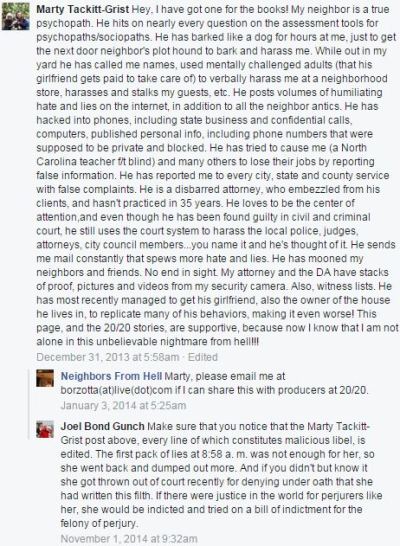
Larry’s a quiet guy with a degenerative spinal disorder who’s been progressively going deaf for 25 years. He lives for his three toy poodles and watches birds. “I grew up,” he says, “in a little Arcadian valley here in western North Carolina with the nicest people, mostly farmers; and I guess my youth just left me naïve about some people. I always saw the good in them.” Larry began practicing law in 1973 in Asheville but voluntarily withdrew from the profession in 1986, because he was disgusted by the corruption—and the irony of having his retirement years fouled by that corruption isn’t lost on him.

You might guess his accuser’s motive to be that of a woman scorned, but Larry’s association with her has never exceeded that of the usual neighborly sort. He reports, however, that she has alleged in court that he covets her and nurses unrequited longings and desires.

Compare the details of the infamous David Letterman case, and see if you don’t note the same correspondence Larry has.

Marty Tackitt-Grist, Martha Tackitt-Grist, Larry Smith, North Carolina, ABC’s 20/20, Nasty Neighbors, Neighbors from HellThat’s the horror that only the objects of high-conflict people’s fixations understand. Stalkers and “secret admirers” procure restraining orders to get attention and embed themselves in other’s lives—like shrapnel.

This writer has been in and out of court for eight years subsequent to encountering a stranger standing outside of his residence one day…and naïvely welcoming her. One respondent to this blog reported having had a restraining order issued against her by a man she sometimes encountered by her home who always made a point of noticing her but with whom she’d never exchanged a single word.

It isn’t only intimates and exes who lie to subject targets to public humiliation and punishment. Sometimes it’s lurkers and passers-by, covert observers who peer between fence slats and entertain fantasies—or, as in Larry’s case, a neighbor who feels s/he’s been slighted or wronged according to metrics that only make sense to him or her.

Larry thinks the unilateral feud that has exploded the last several years of his life originates with his complaining about cats his neighbor housed, after they savaged the fledgling birds that have always been his springtime joy to watch.

For 25 years I have lived on this street with lovely people. We always got along, although one or two you had to watch. During most of that 25 years, there have been three different owners of the house across the street. The other two we dearly loved. The last one, the incarnation of purest evil, moved here in 2005. She was a divorcée who volunteered that her divorce was especially nasty, the first red flag which I foolishly disregarded: She constantly badmouthed her ex. For the first few years, we were friends, but as time went by she became an almost insufferable mooch and just way too friendly, expecting more attention from her neighbors, and from us, than we wanted to give. Sometime in early 2011, I left her a voicemail and told her I didn’t want to be close friends with her anymore. She was a hoverer, she manipulated, she was a narcissist. And the message meant that I did not want to be called on to mow her lawn anymore, or help her trim her trees, or lend her tools, or watch her pet while she was gone, or help her move heavy loads like furniture, or listen to her constant whining. I just wanted to cool it with her.

In the spring of 2011, she had been converting her home to a sort of boarding house and brought in tenants, and [between] them they had two cats that constantly prowled, especially the tenant’s. What became very irksome to me was the tenant’s cat creeping into our yard and killing our baby birds, which we always looked forward to in the spring. And the minute I brought it up with her, she pitched a fit, and so did the tenant. So for the first two months of baby bird season, [their] cats killed all our fledglings and the mother songbirds—wrens, cardinals, robins, mockingbirds, towhees, mourning doves, even the hummingbirds, just wiped them out. I finally got in touch with our Animal Services officers, but by that time bird season was over with, and you know something, [she] began going about telling neighbors that I was a disbarred lawyer (a particularly nasty slander). One thing led to another, and finally the tenant with the marauding cat moved away, but the irreparable damage was done, and all through the summer I had been warned by other neighbors that the neighbor from hell was plotting revenge.
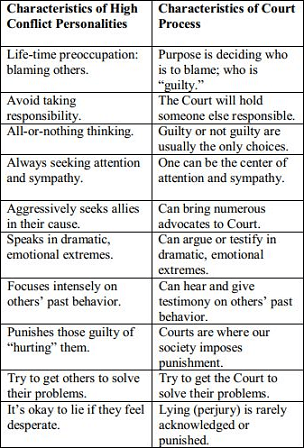

I went to her one day and asked her if there was anything I could do to make it so we could at least drop all the nasty hostilities. She exploded. Next thing I knew, she had three police cruisers here with a false tale that I was “harassing” her and calling her names. This was no surprise, because early on I learned not to believe a thing she said because she just made up the most unbelievable tales about her personal crises. One of the five cops who came spoke with me in the yard, and I thought this would all blow over, but in a few days a process server was banging on the door with papers to serve me. I met him in a commercial parking lot nearby and accepted the lawsuit, an application for a restraining order, a TRO, and, well, a great big wad of lies. It was a shocker. And little did I know that the very day I received this horse-choking wad of papers, at around 10:15 a.m., [she] was back in the courthouse filing another affidavit to have me ordered to show cause why I should not be jailed for contempt. In other words, before I even had notice of the TRO, she was trying to have me jailed for violating it. That’s just how damn mean that woman is.

High-conflict people are driven by a lust to punish—any slight is a provocation to go to war—and their craving for attention can be boundless. Judicial process rewards both.

This table, prepared by attorneys Beth E. Maultsby and Kathryn Flowers Samler for the 2013 State Bar of Texas Annual Advanced Family Law Course, shows how high-conflict people and court process are an exquisitely infernal fit. Its authors’ characterization of high-conflict people’s willingness to lie (“if they feel desperate”) is generous. Many lie both on impulse or reflex and with deliberate cunning, though their chain of reasoning may be utterly bizarre.

Restraining orders are easily obtained, particularly by histrionic women. Once petitioners—especially high-conflict petitioners—realize how readily the state’s prepared to credit any evil nonsense they sputter or spew, and once they realize, too, the social hay they can make out of reporting to others that they “had to get a restraining order” (a five-minute affair), they can become accusation junkies.

Larry has responded in the most reasonable way he can to his situation. He’s voiced his outrage and continues to in a blog, and the vehemence of his criticisms might lead some who don’t know Larry to dismiss him as a crank. If you consulted his blog, you’d see it’s fairly rawboned and hardly suggests the craftsmanship of a technical wizard who can hack email accounts and remotely eavesdrop on telephone conversations. What the commentaries there suggest, rather, is the moral umbrage of an intelligent man who’s been acutely, even traumatically sensitized to injustice.

Here’s the diabolical beauty of our restraining order process. Judges accept allegations of abuse at face value and don’t scruple about incising them on the public records of those accused. They furthermore expect those who are defamed to pacifically tolerate public allegations that may have no relationship with reality whatever or may be the opposite of the truth, may be scandalous, and may destroy them socially, professionally, and psychologically. Judges, besides, make the accused vulnerable to any further allegations their accusers may hanker to concoct, which can land them in jail and give them criminal records. And finally judges react with disgust and contempt when the accused ventilate anger, which they may even be punished for doing.

Judicial reasoning apparently runs something like this: If you’re angry about false allegations, then they weren’t false; if you’re not angry about false allegations, then they weren’t false.

Larry’s been jailed, Larry’s been reported to the police a dozen times or more, an officer has rested the laser sight of her sidearm on him through the window of his residence, and the number of times he’s been summoned to court is closing on 30.

The allegations against him have been false. How angry should he be?

Copyright © 2014 RestrainingOrderAbuse.com

False Restraining Orders That Allege Emotional Abuse ARE Emotional Abuse

A theme that emerges upon consideration of restraining order abuse is lack of empathy—from impulsive or false accusers and from those who abet them. Plaintiffs who act either spitefully or viciously seldom appreciate the ramifications of their actions. They may possess what we call a normal conscience but either don’t think or, in the heat of the moment, don’t care.

The horror is that this same indifference extends not only to authorities and officers of the court but to feminist advocates for restraining orders and the public at large, who are persuaded that the gravity of violence against women trivializes all other considerations. Their indifference may in fact be unconsciousness, but when people’s livelihoods and lives are at stake, unconsciousness is no more pardonable.

It’s ironic that the focus of those who should be most sensitized to injustice is so narrow. Ironic, moreover, is that “emotional abuse” is frequently a component of state definitions of domestic violence. The state recognizes the harm of emotional violence done in the home but conveniently regards the same conduct as harmless when it uses the state as its instrument.
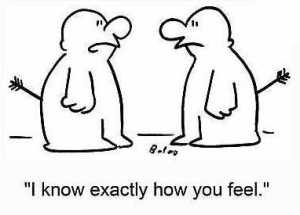
From “Are You a Victim of Emotional Abuse?” by Cathy Meyer:

Emotional abuse is used to control, degrade, humiliate, and punish a spouse. While emotional abuse differs from physical abuse, the end result is the same….

Note the writer’s conclusion that emotional abuse is equivalent to violence in its effects.

Her orientation, of course, is toward victims of domestic violence, but her judgment is just as applicable to false allegations, whose intent is to “control, degrade, humiliate, and punish.”

Plainly the motive of most reasonable feminist arguments and appeals, at least as that motive is understood by those making them, is to induce empathic understanding. They want people to care.

Here’s yet another irony. Too often the perspectives of those who decry injustices are partisan. Feminists themselves are liable to see only one side.

“But my side’s more important” isn’t a rebuttal but a confirmation of chauvinism.

In the explication quoted above, the writer compares the conduct of emotional abusers to that of prison guards toward prisoners of war, who use psychological torment to achieve compliance from their wards. Consider that victims of false allegations may literally be imprisoned.

Consider further some of the tactics that Ms. Meyer identifies as emotionally abusive:

  • Isolating a spouse from friends and family.
  • Discourag[ing] any independent activities such as work; taking classes or activities with friends.
  • If the spouse does not give into the control, they are threatened, harassed, punished, and intimidated by the abuser.
  • Us[ing] the children to gain control by undermining the other parent’s authority or threatening to leave and take the children.
  • Control[ling] all the financial decisions, refus[ing] to listen to their partner’s opinion, withhold[ing] important financial information and mak[ing] their spouse live on limited resources.
  • Mak[ing] all major decisions such as where to live, how to furnish the home, and what type of automobile to drive.

Now consider the motives of false allegations and their certain and potential effects: isolation, termination of employment and impediment to or negation of employability, inaccessibility to children (who are used as leverage), and being forced to live on limited means (while possibly being required under threat of punishment to provide spousal and child support) and perhaps being left with no home to furnish or automobile to drive at all.
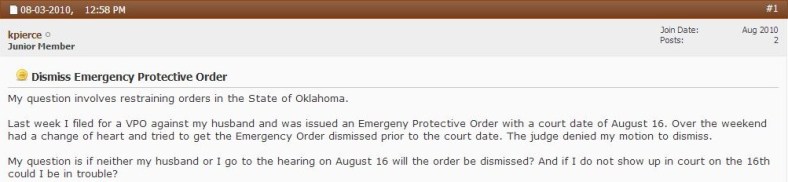
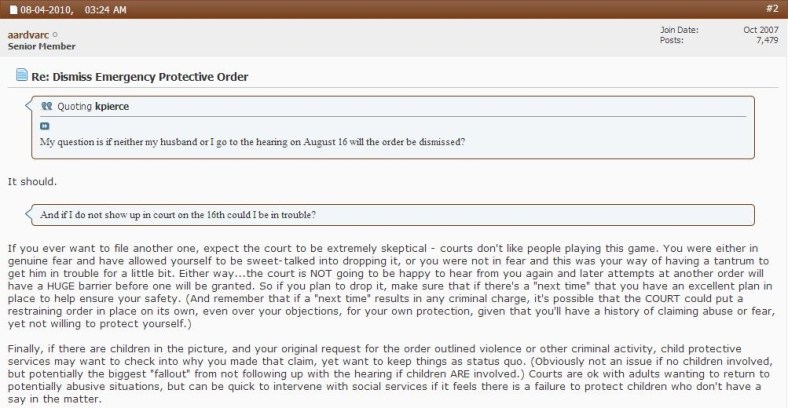
The correspondence is obvious…if you’re looking for it. Opponents of emotional abuse need to recognize it in all of its manifestations, because the expectation of empathy is only justified if it’s reciprocated.

Copyright © 2014 RestrainingOrderAbuse.com

Impulse: How Restraining Orders Encourage and Reward Tantrum Behavior and Why Feminist Advocates Should Be the First to Push for Their Reform

It’s often fairly remarked that feminists tend not to acknowledge restraining order abuse, let alone express resentment toward female offenders. There are exceptional instances, however, as you’ll see below.

It’s also remarked that rash or false allegations mock and discredit the suffering of genuine victims. The respondent in the forum exchange that follows, though she doesn’t say as much, clearly agrees.

Notable about the response, whose tone is reproving, is that its writer recognizes that restraining orders may be sought impulsively to gratify a “tantrum” and get their defendants “in trouble” (which recognition fittingly uses the language of the playground).

Notable, contrariwise, however, is that the respondent discourages the petitioner of the restraining order, who’s admitted to proceeding impulsively, from following through with her expressed intention to rectify an act that may have been motivated by spite. The respondent is the executive director of AARDVARC (An Abuse, Rape, and Domestic Violence Aid and Resource Collection), and behaviors like those the questioner owns up to undermine her endeavor’s credibility.

Notable, finally, is the respondent’s observation that once the state machine is roused, it can be tough to quiet again—like a swarm of killer bees.

The slack standards applied to the restraining order process cut both ways. Not only do they make it easy to lynch defendants undeservedly based on a few brief statements rendered in minutes; the drive-thru, come-one-come-all policy they authorize urges plaintiffs to proceed full-steam ahead without consideration of consequence to themselves and their families.

Plaintiffs shouldn’t be able to incriminate others impulsively, and those who are baited into doing so have as much reason to fault the state as they do to fault themselves.

Representatives of victims of domestic violence and rape, furthermore, are at least as keenly aware as anyone that people follow vicious impulses when there are no checks on their behavior. Logically, then, feminist proponents should be the first to perceive that if state processes have no reins, they’ll be abused. These activists should, accordingly, recognize restraining orders’ potential for abuse and be at the forefront of advocacy for more rigorous and responsible policy.

Copyright © 2014 RestrainingOrderAbuse.com

WomensLaw: A Domain Name That Says All You Need to Know about Where Restraining Order Reform Needs to Start

The biggest challenge to sensitizing people to abusive restraining order policies that are readily and pervasively exploited by malicious litigants can be summed up in a single word: sex.


Women, who are often victims of abuse of court process, don’t want to implicate women in their injuries; they want to blame their false accusers, who are frequently men. Appreciate that this urge to blame men is the reason why restraining orders as processes of law exist in the first place.

Appreciate also that men aren’t the force behind the perpetuation of the status quo, and pointing fingers in their direction isn’t going to change that fact.

In the last month, I’ve sifted the Internet to discover what types of restraining order are available where and how to undo their misapplication. The most thorough source of information on restraining orders offered by the various states that I’ve found—and one I’ve repeatedly returned to—is WomensLaw.org.

It’ll tell you everything you ever wanted to know about restraining orders in your neck of the woods. Its domain name will also remind you why restraining orders exist and what they signify (there is no MensLaw.org).

After decades of rampant abuse’s being tolerated and with restraining orders’ having become a familiar institution, men have hopped onto the abuse industry bandwagon, and their malicious exploitation of restraining orders will probably continue to escalate with the passage of time.

The authorship of restraining orders, however, is by women, for women. Anyone with an interest in social justice or in reforming a handily abused process that fractures families and derails lives every day must acknowledge this fact and resist the reflex to divert blame from where it’s due.

The women who advocate for restraining orders don’t necessarily understand that they’re abused, why they’re abused, how they’re abused, or what the consequences of their abuse are. And they’re not going to take men’s word for it.

Copyright © 2014 RestrainingOrderAbuse.com

Rethinking “Stalking”: When Sociopathic Stalkers Apply for Restraining Orders

“Stalking acts are engaged in by a perpetrator for different reasons: to initiate a relationship (i.e., Some call it stalking; [he or] she calls it courtship); to persuade/coerce a former partner to reconcile; to punish, frighten, or control the victim; to feel a sense of personal power; to feel a ‘connection’ to the victim; or some combination of all of the above. Stalking is a form of abuse, and most abusers ultimately want control over their victims. Therefore, stalking is about controlling a love object, a hate object, or a love/hate object. Both love and hate can inspire obsession.

“Abusive personalities and stalkers often lack or have selective empathy for their victims. In fact, a characteristic of stalking is that the stalker objectifies [his or] her victim. If you don’t see your victim as another human being with feelings, needs, and rights, it becomes very easy to perpetrate any number of cruel, crazy, malicious, spiteful, and sick behaviors upon him or her. What about stalkers who believe they’re in love with their victims? Again, this is about possession and control; not love. They want to possess and control you regardless of what you want.”

Dr. Tara J. Palmatier, Psy.D.

Laws tend to define stalking as the exhibition of unwanted behaviors that alarm people.

What a broader yet nuanced definition of stalking like Dr. Palmatier’s reveals is that what makes someone a stalker isn’t how his or her target perceives him or her; it’s how s/he perceives his or her target: as an object (what stalking literally means is the stealthy pursuit of prey—that is, food).

Who perceives others as objects? The sociopath. Mention sociopath and restraining order in the same context, and the assumption will be that the victim of a coldblooded abuser will have sought the court’s protection from him or her.

The opposite, however, may as easily be the case.

Appreciate that stalking is about coercion, punishment, domination, and control of a target who’s viewed as an object, and it’s easy to see why the stalker in a relationship might be the petitioner of a restraining order, an instrument of coercion, punishment, domination, and control.

(“[T]o feel a sense of personal power,” furthermore, is a recognized reward motive for the commission of fraud. Pulling one over on other people, particularly those in authority, feels gooood.)

Appreciate, also, that a stalker’s motives for “courtship” (i.e., what s/he stands to gain from a relationship) may not be recognized by his or her target as abnormal at all. Nor, of course, will they be understood as abnormal by the stalker. What this means is, stalking isn’t always recognized as stalking (predator behavior), and correspondingly isn’t always repelled.

The Psychology of Stalking: Clinical and Forensic Perspectives notes that the majority of stalkers manifest Cluster B personality disorders, which I’ve talked about in the previous two posts, citing various authorities. People like this—borderlines, antisocials, narcissists, and histrionics—often pass as normal (“neurotypical”). They’re around us all the time…and invisible. Dr. Palmatier, a psychologist from whose writings the epigraph is drawn, has posited that Cluster B personality disorders “form a continuum” and “stem from sociopathy,” a trait of which is viewing others as objects, not subjects. Not only may others be unconscious of personality-disordered people’s motives; such people may be unconscious of their motives themselves.

(Out of respect for the author of the epigraph, I should note that my application of the word stalker in the context of this post departs from hers. The position of this post is that the person who pursues an objectified target and then displaces blame for aberrant behavior onto that target to “punish, frighten, or control” him or her is no less a stalker than the person who relentlessly seeks to possess his or her target. The topic of Dr. Palmatier’s exposition is attachment pathology of the latter sort.)

Contrary to the popular conception that stalkers are wallflower weirdos who obsessively trail dream lovers from a distance with the aid of telescopic lenses, stalkers may be socially aggressive and alluring—or at least sympathetic—and may exhibit no saliently weird qualities whatever.

Returning to Dr. Palmatier’s definition of stalking, what makes someone a stalker isn’t how s/he acts, per se, it’s why she acts the way s/he does. What makes an act an act of stalking is the motive of that act (the impulse behind it), which isn’t necessarily evident to a stalker’s quarry.

Placed in proper perspective, then, not all acts of stalkers are rejected or alarming, because their targets don’t perceive their motives as deviant or predatory. The overtures of stalkers, interpreted as normal courtship behaviors, may be invited or even welcomed by the unsuspecting.

The author of the blog Dating a Sociopath astutely limns the course of a relationship with a stalker (someone who views the other as a means, not an end with “feelings, needs, and rights”).

The sociopath wears a mask. But [s/he] will only wear that mask for as long as it is getting him [or her] what [s/he] wants. The sociopath is not emotionally connected, to you or anybody else. Whilst the sociopath might show connection, this would only be a disguise, to serve his [or her] own needs.

When the sociopath realises that [s/he] can have better supply elsewhere, or if [s/he] feels that supply with you is coming to an end, [s/he] will leave you without warning. The sociopath would have sourced a new victim for supply, but this would have been done behind your back and without your knowledge.

To do so, it is likely that the sociopath needed to play victim to the new source. Often [s/he] would have made complaints about you to gain sympathy and win support. Again, this will be something that you have absolutely no knowledge of, until later.

Consider her conclusion that a sociopath may “play victim” to acquire new narcissistic supply, and you’ll perceive how perfectly lies to the police and/or the courts (donning a new mask) may assist him or her in realizing his or her pathological wishes.

The blog post from which this quoted material is drawn concerns being abruptly discarded by a sociopath, which the writer notes may leave the sociopath’s quarry feeling:

  • Confused
  • Bewildered
  • Lost
  • Desperate for answers
  • A longing and neediness to understand
  • Wanting back the honeymoon stage
  • Unsure if the relationship is actually over or not?
  • Self-blame
  • Manipulated, conned, and deceived

Expressions of these feelings, whose motives are not those of stalkers but of normal people prompted by a need to understand the inexplicable, may take the form of telephone calls, emails, or attempts at direct confrontation—all of which lend themselves exquisitely to misrepresentation by stalkers as the behaviors of stalkers.

The personality-disordered answer primal urges, and among those urges is the will to blame others when their bizarre expectations aren’t satisfied—and they inevitably aren’t—or when others express natural expectations of their own that defy disordered personalities’ fantasized versions of how things are supposed to go.

The author of this blog, a formerly private man who had a restraining order petitioned against him characterizing him as a stalker (and who has been back to court three times since to respond to the same allegation, the least of several), has been monitored for eight years by a stranger he naïvely responded to whom he found standing outside of his house one day as he went to climb into his car.

I was a practicing writer for kids.

The first correspondent I had when I began this blog three years ago was a woman who’d been pursued and discarded by a pathological narcissist, who subsequently obtained a restraining order against her (by fraud), representing her as a stalker (cf. Dr. Palmatier’s “Presto, Change-o, DARVO: Deny, Attack, and Reverse Victim and Offender”).

She taught music to kids.

Last fall, I exchanged numerous emails with a woman who’d fallen for a man with borderline personality disorder, who abused her, including violently, then did the same thing after she sought a restraining order against him, which was denied.

She was a nurse who had three kids.

You’ll note that those labeled “stalkers” by the state in these cases—and they’re hardly exceptions—confound the popular stalker profile that’s promoted by restraining order advocates.

An irony of this already twisted business is that injuries done to people by their being misrepresented to the authorities and the courts by disordered personalities as stalkers ignite in them the need to clear their names, on which their livelihoods may depend (never mind their sanity); and their determination, which for obvious reasons may be obsessive, seemingly corroborates stalkers’ false allegations of stalking.

This in turn further feeds into the imperative of personality-disordered stalkers to divert blame from themselves and exert it on their targets. People like this fatten on drama and conflict, and legal abuses gratify their appetites like no other source, both because the residue of legal abuses never evaporates and because those abuses can be refreshed or repeated, setting off further chain reactions ad infinitum.

The agents of processes that were conceived to arrest social parasitism and check the conduct of stalkers are no less susceptible to believing the false faces and frauds of predatory people than their victims are.

Copyright © 2014 RestrainingOrderAbuse.com

Blame, No Shame: Restraining Order Abuse by High-Conflict, Personality-Disordered Plaintiffs

“Court is perfectly suited to the fantasies of someone with a personality disorder: There is an all-powerful person (the judge) who will punish or control the other [person]. The focus of the court process is perceived as fixing blame—and many with personality disorders are experts at blame. There is a professional ally who will champion their cause (their attorney—or if no attorney, the judge) […]. Generally, those with personality disorders are highly skilled at—and invested in—the adversarial process.

“Those with personality disorders often have an intensity that convinces inexperienced professionals—counselors and attorneys—that what they say is true. Their charm, desperation, and drive can reach a high level in this very emotional bonding process with the professional. Yet this intensity is a characteristic of a personality disorder, and is completely independent from the accuracy of their claims.”

—William (Bill) Eddy (1999)

Contemplating these statements by therapist, attorney, and mediator Bill Eddy should make it clear how perfectly the disordered personality and the restraining order click. Realization of the high-conflict person’s fantasies of punishment and control is accomplished as easily as making some false or histrionically hyped allegations in a few-minute interview with a judge.

Contemplating these statements should also make clear the all-but-impossible task that counteracting the fraudulent allegations of high-conflict people can pose, both because disordered personalities lie without compunction and because they’re intensely invested in domination, blaming, and punishment.

Lying may be justified in their eyes—possibly to bring a reconciliation. (This can be quite convoluted, like the former wife who alleged child sexual abuse so that her ex-husband’s new wife would divorce him and he would return to her—or so she seemed to believe.) Or lying may be justified as a punishment in their eyes.

As Mr. Eddy explains in a related article (2008):

Courts rely heavily on “he said, she said” declarations, signed “under penalty of perjury.” However, a computer search of family law cases published by the appellate courts shows only one appellate case in California involving a penalty for perjury: People v. Berry (1991) 230 Cal. App. 3d 1449. The penalty? Probation.

Perjury is a criminal offense, punishable by fine or jail time, but it must be prosecuted by the District Attorney, who does not have the time. [J]udges have the ability to sanction (fine) parties but no time to truly determine that one party is lying. Instead, they may assume both parties are lying or just weigh their credibility. With no specific consequence, the risks of lying are low.

High-conflict fraudsters, in other words, get away with murder—or at least character assassination (victims of which eat themselves alive). Lying is a compulsion of personality disorders and is typical of high-conflict disordered personalities: borderlines, antisocials, narcissists, and histrionics.

When my own life was derailed eight years ago, I’d never heard the phrase personality disorder. Five years later, when I started this blog, I still hadn’t. My interest wasn’t in comprehension; it was to recover my sanity and cheer so I could return to doing what was dear to me. I’m sure most victims are led to do the same and never begin to comprehend the motives of high-conflict abusers.

slanderI’ve read Freud, Lacan, and some other abstruse psychology texts, because I was trained as a literary analyst, and psychological theories are sometimes used by textual critics as interpretive prisms. None of these equipped me, though, to understand the kind of person who would wantonly lie to police officers and judges, enlist others in smear campaigns, and/or otherwise engage in dedicatedly vicious misconduct.
What my collegiate training did provide me with, though, is a faculty for discerning patterns and themes, and it has detected patterns and themes that have been the topics of much of the grudging writing I’ve done in this blog.

Absorbing the explications of psychologists and dispute mediators after having absorbed the stories of many victims of abuse of court process, I’ve repeatedly noticed that the two sources mutually corroborate each other.

Not long ago, I approached the topic of what I called “group-bullying,” because it’s something I’ve been subject to and because many others had reported to me (and continue to report) being subject to the same: sniping by multiple parties, conspiratorial harassment, derision on social media, false reports to employers and rumor-milling, fantastical protestations of fear and apprehension, etc.

The other day, I encountered the word mobbing applied by a psychologist to the same behavior, a word that says the same thing much more crisply.

Quoting Dr. Tara Palmatier (see also the embedded hyperlinks, which I’ve left in):

If you’re reading this, perhaps you’ve been or currently are the Target of Blame of a high-conflict spouse, girlfriend, boyfriend, ex, colleague, boss, or stranger(s). Perhaps you’ve been on the receiving end of mobbing (bullying by a group instigated by one or two ringleaders) and/or a smear campaign or distortion campaign of a high-conflict person who has decided you’re to blame for her or his unhappiness. It’s a horrible position to be in, particularly because high-conflict individuals don’t seem to ever stop their blaming and malicious behaviors.

A perfect correspondence. And what more aptly describes the victim of restraining order abuse than “Target of Blame”?

This phrase in turn is found foremost on the website of the High Conflict Institute, founded by Bill Eddy, whom I opened this post by quoting:

high_conflict_yellow

Restraining orders are seldom singled out or fully appreciated for the torture devices they are by those who haven’t been intensively made aware of their unique potential to upturn or trash lives, but the victims who comment on this and other blogs, petitions, and online forums are saying the same things the psychologists and mediators are, and they’re talking about the same perpetrators.

Judges understand blaming. That’s their bailiwick and raison d’être. They may even understand false blaming much better than they let on. What they don’t understand, however, is false blaming as a pathological motive.

Quoting “Strategies and Methods in Mediation and Communication with High Conflict People” by Duncan McLean, which I highlighted in the last post:

Emotionally healthy people base their feelings on facts, whereas people with high conflict personalities tend to bend the facts to fit what they are feeling. This is known as “emotional reasoning.” The facts are not actually true, but they feel true to the individual. The consequence of this is that they exhibit an enduring pattern of blaming others and a need to control and/or manipulate.

There are no more convenient expedients for realizing the compulsions of disordered personalities’ emotional reasoning and will to divert blame from themselves and exert it on others than restraining orders, which assign blame before the targets of that blame even know what hit them.

Returning to the concept of “mobbing” (and citing Dr. Palmatier), consider:

The group victimization of a single target has several goals, including demeaning, discrediting, alienating, excluding, humiliating, scapegoating, isolating and, ultimately, eliminating the targeted individual.

Group victimization can be the product of a frenzied horde. But it can also be accomplished by one pathologically manipulative individual…and a judge.

Copyright © 2014 RestrainingOrderAbuse.com

The Restraining Order Plaintiff from Hell: Malicious Prosecution and the “High-Conflict Person”

“The term ‘high conflict person’ has been popularised relatively recently in legal texts and general discourse to describe those people with certain behavioural clusters who are often observed in legal disputes. This is not meant to suggest that it is a new phenomenon. On the contrary, vexatious individuals and difficult clients are not new to agencies of accountability, lawyers, or mediators, especially those working in highly emotive legal dispute areas such as family law.”

Duncan McLean

Since I’m neither a psychologist nor an attorney, I’m free to say politically incorrect things. Layman’s license authorizes me to clarify, for instance, that the high-conflict people referred to in the epigraph can be monstrous. A clinician might hesitate to call the conduct of high-conflict people sick, and a mediator would reject such labeling as counterproductive to compromise. Nevertheless, that conduct can be extremely sick and far exceed the bounds of words like contrary, vexatious, and difficult.

If you’ve been attacked serially by someone you trusted who’s abused legal process to hurt you, spread false rumors about you, made false allegations against you, and otherwise manipulated others to join in bullying you (possibly over a period spanning years and despite your reasonable attempts to settle the situation), your persecutor is an example of the high-conflict person to whom the epigraph refers, and understanding his or her motives may be of value to your self-protection.

What the author of the monograph from which the quotation above is excerpted means by “behavioral clusters” (switching to the American spelling) is a set of traits and patterns of habitual conduct. High-conflict people, people with personality disorders (or who at least manifest some of their maladaptive traits), are defined by clusters of observable characteristics that guide them to instigate and sustain conflict, including conflict through abuse of legal process. Borderline, antisocial, narcissistic, and histrionic personality disorder (collectively, the “Cluster B disorders”) are defined by such characterological clusters.

Personality disorders are grouped into clusters based on their predominant features, and it is the Cluster B disorders which typically present with high expression of emotions, neuroticism, dramatization, and hostility.

Cluster B disorders are categorised into the following four sub-types:

  1. Borderline Personality – marked by instability of mood and intense anger, self-destructiveness, a poor sense of self, fears of abandonment, and manipulative behaviour.
  2. Antisocial Personality – a disregard for, and violation of, the rights of others and the rules of society; a lack of empathy and remorse; exploitative, reckless, and irresponsible behaviour.
  3. Narcissistic Personality – a pattern of grandiosity, self-love, and a need for admiration; a sense of entitlement and haughty, arrogant attitudes; preoccupation with success, power, brilliance.
  4. Histrionic Personality – pervasive and excessive emotionality and attention-seeking behaviour; shallow or insincere emotions; inappropriately seductive or provocative behaviour; impressionistic and flamboyant speech.

Note that a single individual may possess traits of more than one personality disorder (or may have more than one personality disorder) and that these definitions are not impervious to overlap. “The people diagnosed with these four disorders are known for their frequent and dramatic interpersonal conflicts and crises. Their personality characteristics often bring them into disputes which involve many others to resolve—including the courts” (Cheryl Cohen, Jack Mahler, and Gwen Jones, “Managing High Conflict Personalities in Mediation”).

If a reader of this post takes nothing else away from the epigraph, s/he should at least note Mr. McLean’s remark that high-conflict, personality-disordered people are “often observed in legal disputes,” a remark echoed by the quotation immediately above, which comes from a different source. Although high-conflict personalities are a minority respective to the population as a whole, they’re disproportionately commonplace among complainants to the courts and other “agencies of accountability” (like child protective services and the police, to offer but a couple of examples).

[P]eople with Cluster B personality disorders are more likely to escalate their disputes to satisfy their underlying need for dominance, blame, denial of responsibility and, sometimes, revenge.

High-conflict people, plainly, are your false accusers and vexatious litigants from hell. They’re driven to divert blame from themselves and exert it on others (who may be their victims).

Restraining orders, due to their low evidentiary threshold and ease of procurement, are ideal media for abuse by those with no scruples about lying or manipulating others and a keen interest in exciting drama and mayhem.

Mediators are circumspect in their judgments, because their role is to pacify strife and facilitate bridge-building between disputants. Effectively doing their work depends on possessing an empathic understanding of the motives of high-conflict people, which may also be worthwhile to those who’ve been victimized by them.

Cognitive distortions, thoughts that are based on a false premise, are a significant feature of high conflict personalities’ thinking style. Often as a consequence of disrupted attachment or a dysfunctional or abusive upbringing, sufferers will develop cognitive distortions and defence mechanisms in an attempt to make sense of the world and to make their experiences fit their own emotions.

Emotionally healthy people base their feelings on facts, whereas people with high conflict personalities tend to bend the facts to fit what they are feeling. This is known as “emotional reasoning.” The facts are not actually true, but they feel true to the individual. The consequence of this is that they exhibit an enduring pattern of blaming others and a need to control and/or manipulate.

The mediator’s position is that high-conflict people are in a sense “unconscious” of their lies and manipulations. More accurate might be that such people aren’t self-critical; they rationalize their conduct, which may be much more impulsive than premeditated but is always relentless and nonetheless destructive. Certainly many psychologists are less generous in their estimations of how unaware the personality-disordered are of their deceits and manipulations—as their victims are bound to be.

That notwithstanding, the appearance of monographs like the one I’ve highlighted in this post is a big deal, because our courts and other “agencies of accountability” are pretty much clueless about personalities like the ones on which it focuses attention (as in fact are most victims of such people).

That’s not to say Mr. McLean’s observations are new. His paper, which was published last year, shadows the professional writing of therapist, attorney, and mediator William (Bill) Eddy, who’s been elucidating the challenges posed by people with personality disorders in the court system (particularly family court) for decades. The monograph, moreover, cites Mr. Eddy’s work more than once. More recently, psychologist Tara Palmatier, whose online explications of the behaviors of the personality-disordered also draw on the pioneering observations of Mr. Eddy, has written volubly, accessibly, and explicitly about abuses, including legal abuses, committed by high-conflict people (as have a number of other psychologists who zero in on the narcissist personality). Many, if not most, of Dr. Palmatier’s patients have been the victims of such abuses and/or abusers, and some of their personal accounts (“In His Own Words”) appear on her blog.

Returning to Mr. McLean’s paper (which, again, echoes summations of both Mr. Eddy and Dr. Palmatier):

High conflict behavior…can be broadly described as behaviour which escalates rather than minimises conflict. The individual tends to escalate because they receive some kind of secondary gain from the dispute, but contrarily, they are inclined to blame others whilst perceiving themselves as the victim. The displayed emotion is often disproportionate to the dispute in question, and often there is the presence of poorly regulated emotions in the form of anger, impulsivity, and criticism of others, whilst it is not uncommon to observe controlling and manipulative behaviours.

High-conflict personalities are worse than liars; they’re liars who delude themselves that their lies are justified. They don’t reconsider or back down, and they’re capable of fomenting and sustaining conflict for years, including (especially in the case of narcissists) by gross fraud, smear tactics, and the enlistment of third parties to abet their frauds or participate in bullying their victims.

Because high conflict people tend to distort facts to suit their emotions, they often put a lot of energy into blaming other people for their cognitive distortions. The need to release internal distress results in reality-distorting defence mechanisms, such as projection and denial, which results in [their] failing to recognise their part in conflict. These cognitive distortions (also known as emotional facts) are frequently transferred to other people, which in turn often enables and exacerbates the behaviour.

In his paper, which I urge readers to consult, Mr. McLean includes actual transcript excerpts from cases heard in court that are both enlightening and impressive, and should encourage anyone in a legal clash with a high-conflict person who’s capable of obtaining the aid and representation of a mediator to consider it.

It’s deplorably the case that “rapport-building” is never an option in the drive-thru arena that is the restraining order process.

Examination of Mr. McLean’s professional insights into the specific personality disorders underscores how vexed resolving legal conflicts in this arena may be. He notes, for instance, that exposing a narcissist’s misconduct by confronting him or her with that misconduct or making him or her “look bad” will only fan the flames. He’s no doubt right, but in hearings that last mere minutes, painstaking assuagement of a narcissist’s ego isn’t practicable. Similarly he observes that among histrionics, “[e]xaggerated emotions and phoniness may be common initially.”

In a court process that’s concluded almost as soon as it’s begun, like a restraining order hearing, exaggerations and phoniness can’t be exposed through methodical cross-examination. The severity of a plaintiff’s allegations of apprehension may in fact excuse him or her from attending a hearing, altogether scotching the opportunity to expose his or her falsehoods by questioning.

Emphatically noteworthy, then, is the virtual absence from any but very lengthy and deliberate trials that are influenced by expertise like Mr. McLean’s of any chance to prosecute a capable defense against the frauds of high-conflict people.

Copyright © 2014 RestrainingOrderAbuse.com

Disdain for a Feminist Institution of Law Isn’t the Same as Disdain for Women

“I am the victim of false accusations [by] a female with sociopathic tendencies. She stabbed my husband [and] threatened to kill me, but for whatever reason filed for a domestic violence protective order on me. I value respect from people, so I do and act morally to maintain my relationships, but because any given person, whether sane or not, can go file a petition with its being granted depending on how it’s worded, I was treated like a criminal and not one time given the opportunity to inform even the judge that the petitioner had committed perjury. Only in [West Virginia] a felony can be committed and go unpunished. This is [an overlooked] flaw that needs immediate attention!!!! This not only jeopardizes my future, but my kids’ future, because if the petitioner wouldn’t have dropped it, it would [have been] filed in a national database, popping up whenever a background check is done on me, including [by] my college for my admission into Nuclear Medicine Technology…and this is all based on a drug-addicted, manipulating, vindictive person’s false accusations.”

—Female e-petition respondent

“Dangerous law easily used as a sword instead of shield. A Butte man died over this. His girlfriend, after making the false allegations, cleaned out his bank account. He committed suicide. His mother, Ruth, had no money to bury him. The girlfriend depleted his assets partying.”

—Female e-petition respondent

“I can relate to this topic, because I once made false allegations against my lover because I was a woman scorned and wanted to get even with him and make him feel the same level of pain that he made me feel. Luckily for him and me, I was convicted in my spirit and confessed to the court that I’d lied, and the matter was dropped. If I’d not been led to do that, my lie could have ruined this man’s life….”

—Female e-petition respondent

“It makes me sick that there are so many families affected by false allegations. The children [who] are affected break my heart. We have been living this nightmare for over a year now—over $40 thousand dollars spent, and this woman still keeps us in court with her false allegations…. At what point will the courts make these people accountable???”

—Female e-petition respondent

A recent comment to this blog from a female victim of restraining order abuse (by her husband) expressed the perception that criticism of feminist motives and the restraining order process, a feminist institution of law, seemed vitriolic toward women.

Her reaction is understandable.

What isn’t perceived generally, including by female victims of fraudulent abuse of process, is that the restraining order was prompted by feminist lobbying just a few decades ago and that its manifest injustices are sustained by feminist lobbying. It’s not as though reform has never been proposed; it’s that reform is rejected by those with a political interest in preserving the status quo.

Political motives, remember, aren’t humanitarian motives; they’re power motives.

So enculturated has the belief that women are helpless victims become that no one recognizes that feminist political might is unrivaled—unrivaled—and it’s in the interest of preserving that political might and enhancing it that the belief that women are helpless victims is vigorously promulgated by the feminist establishment that should be promoting the idea that women aren’t helpless.

It’s this belief and this political might that make restraining order abuses, including abuses that trash the lives of women, possible. Not only does the restraining order process victimize women; it denies that women have personal agency.

Nurturance of the belief that women are helpless victims puts a lot of money in a lot of hands, and very few of those hands belong to victims.

The original feminist agenda, one that’s been all but eclipsed, was inspiring women with a sense of personal empowerment and dispelling the notion that they’re helpless. The restraining order process is anti-feminist as is today’s mainstream feminist agenda, which equity feminists have been saying for decades.

Restraining orders continue to be doled out (in the millions per annum) on the basis of meeting a civil standard of evidence (which means no proof is necessary), pursuant to five- or 10-minute interviews between plaintiffs and judges, from which defendants are excluded.

So certainly has the vulnerability and helplessness of women been universally accepted that the state credits claims of danger or threat made in civil restraining order applications on reflex, including by men, because our courts must be perceived as “fair.” Consequently, fraudulent claims are both rampant and easily put over.

Restraining orders aren’t pro-equality and don’t contribute to the advancement of social justice. They do, though, put a lot of people’s kids through college, like lawyers’ and judges’.

Copyright © 2014 RestrainingOrderAbuse.com

Face Mask or Baseball Bat?: Abuse of Domestic Violence Laws and Restraining Orders

“As a male victim of domestic violence, my voice was never heard by any responding police officer. In fact, when they arrived my batterer made false allegations against me [that] led to my arrest. Three years later, the Eloy Police Department settled out of court, admitting wrongdoing. Still, I lost my career, my name, and three years of income because of the sexist actions taken by Arizona law enforcement.”

—E-petition respondent

“As strange as it sounds, the very laws designed to help victims sometimes hurt them. After I spent over a year as a lead attorney in a specialized felony domestic violence court, I realized the potential for abuse of the domestic violence system. Often, perpetrators of domestic violence would twist the system by accusing their victims of domestic violence. On the theory that ‘the best defense is a good offense,’ batterers accused the victims to neutralize any claims they feared their victims would make against them. In addition, I have seen parties to family law cases make allegations of domestic violence to try to gain an advantage in a divorce proceeding as relates to custody or property settlements.”

—Family attorney Samantha D. Malloy

Everything that’s wrong with restraining orders becomes emphatically pronounced when you observe that a process originally conceived to provide relief to victims of domestic violence may easily be abused to magnify and compound their torments.

That abusers should eagerly embrace the opportunity to heap further pain on their victims (while simultaneously exculpating themselves) should hardly be shocking to anyone. What’s shocking is how readily this opportunity for offenders to reverse roles with their victims presents itself (which role-reversal, readers will note, the quoted attorney remarks occurs “often” not rarely, as is commonly posited by those hostile to exposure of the rampancy of false allegations and abuses of restraining orders).

To get a protective order, one must only complete and sign a petition “under oath” or “penalty of perjury.” The petition is given “ex parte” (in the absence of the accused and without their notice) to a judge, who will enter the order if certain necessary allegations are made. There is no trial or requirement of further evidence before the initial order is entered.

The subsequent hearing of testimony and evidence, typically prejudiced by the preconception that the accused is guilty, is furthermore answerable to no strict standard of proof (hence Ms. Malloy’s advertisement of her services). It’s too often the case that procurement of an “initial order” represents a fait accompli, because calculated histrionics, finger-pointing, and concocted allegations from a persuasive plaintiff (particularly a female plaintiff) are all but certain to clinch a favorable judgment.

Noteworthy finally is Ms. Malloy’s acknowledgment that false allegations of violence, which are devastating in the emotional oppression, humiliation, and social and professional havoc they wreak on the falsely accused, are used strategically to gain leverage in divorce proceedings.

None of this information is new. Its potency, however, is defused by feminist dogmatists and their sympathizers—who refuse to concede that false allegations are commonplace—with the claim that men’s rights or fathers’ rights groups sensationalize the frequency of false allegations or purvey false information about their frequency. If feminist hardliners were sincerely invested in social justice, they would ask practitioners in the field of law, particularly family law, what their impressions and perceptions are (based on real-life experience).

Ms. Malloy, who may well be an exceptional attorney but isn’t exceptional among attorneys in her acknowledgment that restraining orders are abused, advertises her services both to victims of domestic violence and victims of false allegations of domestic violence. If the dogmatists were right about false allegations’ being rare, or if the restraining order process were anything approaching fair and just, she wouldn’t have to switch-hit, would she?

Copyright © 2014 RestrainingOrderAbuse.com

Who BS-es the Police and Court? Who Doesn’t.

“Everyone lies to me.”

—University of Arizona police officer

The willingness of false accusers to lie to authorities and the courts—and of some authorities and officers of the court to lie—is a tough pill to swallow, especially for those who learn about it the hard way, as have many of those who visit or have responded to this blog.

Scholars, members of the clergy, and practitioners of disciplines like medicine, science, and the law, among others from whom we expect scrupulous truthfulness and a contempt for deception, are furthermore no more above lying (or actively or passively abetting fraud) than anyone else.

The false accusers from whom I’ve seen and been informed the most devious and unmitigated frauds originate, in fact, are the self-entitled, those who imagine they’re distinguished from the crowd and therefore exempt from its rules. They lie smoothly, righteously, and with an air of affronted dignity. That such people typically enjoy the security and reassuring presence of an attorney by their sides no doubt factors largely into their confidence.

M.D., Ph.D., Th.D., LL.D.—no one is above lying, and the fact is the better a liar’s credentials are, the more ably s/he expects to and can pull the wool over the eyes of judges, because in the political arena judges occupy, titles carry weight: might makes right.

Like most of us are prone to, judges presume a superior standard of integrity from people with advanced degrees or other tokens of accomplishment who practice in areas of influence. The court takes the ethics of such people on faith. It’s a prejudice as old as human hierarchies. Those who have power or its semblance aren’t to be held accountable for abuses of power.

The court shouldn’t presume integrity from these people; it should demand it and hold such people accountable to the high standards to which it presently and wrongly presumes such people hold themselves.

Copyright © 2014 RestrainingOrderAbuse.com

Motives of the False Accuser According to the FBI: Mental Illness, Attention-Seeking, Profit, Blame-Shifting, and Revenge

“At 7:30 a.m., an unknown male abducted Pamela at knifepoint while she fueled her car at a convenience store. The offender then forced her to drive to a bridge, where they crossed into a neighboring state. During the long ride, he choked her with a bicycle security chain and slashed her with a knife.

“Next, the assailant ordered Pamela to park the vehicle in a secluded rural area and led her into the woods. He bound her to a tree, placing the bicycle chain around her neck. The subject then assaulted her vaginally with a box cutter and lacerated her breasts and right nipple.

“Then, he ordered Pamela back into her car and had her drive them to a nearby ferry. The subject exited the vehicle and disappeared while heading toward the ferry at about 3 p.m. Pamela drove herself to the nearest hospital for treatment, and staff members notified the police. After receiving medical attention, she was released.

“State and local police investigators conducted the initial interview of Pamela at the hospital. Although initially cooperative, she stopped answering questions. Pamela agreed to meet investigators at a later date at the state police barracks to discuss the abduction and sexual assault, but she never arrived.

“A review of hospital medical records showed that Pamela received treatment for superficial lacerations to her right hand, left breast, right breast and nipple, and neck. She also had several superficial abrasions in her pubic region. The doctor described her as tired but in no acute discomfort.

“Officers found no forensic evidence from Pamela or her vehicle. They contacted the FBI’s National Center for the Analysis of Violent Crime (NCAVC) for assistance in developing an interview strategy. Investigators determined that Pamela suffered from depression and anxiety and had a prescription for an antidepressant. Working with NCAVC, officers developed a successful interview strategy, and Pamela finally admitted that she fabricated the abduction and sexual assault.

“Her false allegation tied up the resources of several state and local police departments, as well as the area FBI office. Significant media attention focused on the case prior to her confession. An artist’s sketch of the imaginary offender circulated. The media quoted a spokesperson for a local women’s rape crisis center as saying, ‘What I see is a community that is scared….’”

Federal Bureau of Investigation (FBI)

Does this sort of thing happen frequently? No. What’s often and deplorably discounted by those hostile to exposure of false allegations, however, is that it does happen. And typically the alleged offender isn’t a phantom but a real person (victim).

The likelihood of false allegations to withstand critical scrutiny by multiple police agencies is remote. What the cited case highlights, however, is that false accusers can be extremely convincing and deliberate in their frauds; and what this blog seeks to expose is that false accusers can very easily abuse civil procedure, specifically the restraining order process, according to the same motives that false criminal accusers exhibit, which according to the FBI are these:

  • Mental illness/depression
  • Attention/sympathy
  • Financial/profit
  • Alibi
  • Revenge

It’s no coincidence that this catalog exactly corresponds to the motives of false restraining order applicants, whose allegations are made in brief, five- or 10-minute interviews with judges, and are subject to no particular scrutiny whatever. Any number of the posts on and comments made to this blog concern abuses motivated by mental illness or personality disorders, attention-seeking, financial gain (including wresting money, property, and home from the falsely accused), blame-shifting (establishing an alibi for misconduct and shifting the blame for that misconduct onto its victim), and/or good old-fashioned vengeance.

These motives for legal attacks are moreover readily corroborated by psychologists.

The FBI Law Enforcement Bulletin I’ve quoted goes on at some length to detail the difficulties and complexities that unraveling false claims entails for agents of the FBI. Appreciate then how absurd is the state’s faith that a single judge—or a couple of them—can ascertain the truth of civil restraining order allegations by auditing claims in a hearing or hearings arrived at with no prior information, that last mere minutes, and that are furthermore biased by the preconception that the accused is guilty.

The only reasonable conclusion to be drawn is that the state believes judges can discern what teams of crack FBI specialists working around the clock may not or that the truth doesn’t matter.

What makes this conclusion outrageous is that though false criminal allegations may result in a false conviction for a crime, the consequences of false civil allegations may be no less severe.

At the very least, those falsely accused in civil court are subject to threats, menace, curtailment of freedom, humiliation, and the contamination of their public records, which can permanently interfere with or exclude employment prospects and options—all of this topped off by the psychological trauma that necessarily ensues. The falsely accused may further be subject to incarceration resulting from further false allegations by malicious and/or mentally ill or personality-disordered plaintiffs (possibly for terms as lengthy as sentences based on false criminal allegations might impose), as well as loss of entitlement to home and property. Some false restraining order defendants are left homeless and bereft of everything that made their lives meaningful. As one advocate puts it, the falsely accused may be “erased.”

These consequences, recall, stem from cursory auditions of allegations that are answerable to no standard of proof. Allegations in civil court are judged largely according to impressions. Civil rulings, contrasted with criminal investigations, are no more conclusive than coin tosses.

The restraining order process is a tidy workaround that allows false accusers to realize the same objectives fraudulent criminal allegations might gratify, possibly to a much greater extremity, while requiring no lengthy interrogation and threatening no risk of criminal consequences to the false accuser who’s caught out. False allegations made in civil court are more often than not slyly ignored even when detected, and they’re certainly not recorded in any statistical database. They’re typically unremarked, typically unremarked on when discerned, and duck public awareness and scrutiny entirely.

The reason why this is so lies in the last line of the epigraph: “The media quoted a spokesperson for a local women’s rape crisis center as saying, ‘What I see is a community that is scared….’”

Copyright © 2014 RestrainingOrderAbuse.com

Learning to Talk the Talk: Resources for Victims of “Disturbed” People Who’ve Also Been Victimized by the Courts

“[Narcissism] is, in my opinion, the single most damaging and maladaptive tendency seen in sociopaths. When taken to extremes, it can lead to seriously abusive patterns of behavior that are repulsive and idiotic, both from any sort of ethical perspective and from the perspective of sheer self-interest. It is also fundamentally misunderstood. The word ‘narcissist’ connotes, to most people, merely personal vanity taken to an extreme. This is not what the word narcissism means in the context of sociopathic psychology. Narcissism…means the inability to understand that other people exist as distinct entities from oneself—with their own wants, emotions, and personal space—combined with a grandiose and exaggerated perception of self. The ‘narcissistic personality disorder’ described in the DSM is in my opinion simply the identification of sociopathic individuals who allow their own narcissistic tendencies to become so severe that [they begin] to ruin their lives and the lives of those around them.”

—Clinically diagnosed sociopath and blogger

I encountered this exceptional writer in an online forum recently and quoted much of what he had to say about the motives of the sociopathic mind, as well as his “insider” conclusions about what makes narcissists tick. He corroborated some of my own lay suspicions and corroborates as well the belief of psychologist Tara Palmatier, who has written volubly about abuses of legal procedure, that the personality disorders most damaging to others stem from sociopathy.

This writer, who very plausibly calls himself a “high-functioning sociopath” but who doesn’t otherwise identify himself, perceives people with these personality disorders (specifically, narcissistic personality disorder and borderline personality disorder) as “low-functioning sociopaths” who are prone to indulge hedonistic (that is, pleasure-seeking) impulses, both to their own detriment and that of those who run afoul of them. Put plainly, they hurt other people to gratify the urges of their haywire brains. This writer’s ideas are carefully and lengthily qualified, and with convincing earnestness and intelligence, and I urge anyone who’s interested in a nuanced understanding of disordered brains and their eccentricities to visit this writer’s blog, as well as that of the aforementioned psychologist, Dr. Tara Palmatier, for personal and clinical perspectives on disordered personalities and how to deal with them.

The reasons the personality-disordered are often brought up in this blog are two: (1) because these people have limitless capacity to destroy the lives of others and no scruples or inhibitions about lying to disown accountability for their actions, and (2) because their victims, who are also often victims of legal clashes people like this instigate to distance themselves from their crimes, don’t have the words or concepts to qualify what in the hell just happened to them.

Those who’ve been pursued by or had relationships with disordered personalities, particularly narcissists, whose peculiarities aren’t prominent and easily distinguished as aberrant, may be inclined to doubt or question their own perceptions (which narcissists are masters at manipulating) and may be no more able to characterize the conduct and chronic lying of such people than as “hurtful” or “disturbed” or “psycho.” The motives of the personality-disordered aren’t easily explicable, because they don’t make any sense. Until you’ve been initiated and made an earnest effort to comprehend such bewilderingly anomalous minds, you don’t have the tools to even articulate what you’ve been subjected to. It’s no wonder, for example, that blogs about victimization by narcissists have titles like An Upturned Soul and Out of the Fog—or that using the search term “narcissist” on Amazon.com yields 1,028 returns (including the titles, How Many Lies Are Too Many?: How to Spot Liars, Con Artists, Narcissists, and Psychopaths before It’s Too Late and Web of Lies: My Life with a Narcissist).

Fascinatingly, reading the blog of the “high-functioning sociopath” I’ve commended, and considering that sociopaths are popularly said to be emotional vacuums, there’s no avoiding the impression that he is very empathic, though his isn’t an “I feel you” empathy so much as a reasoned, analytic (“I feel me”) one, which actually makes for very lucid explication unmuddied by touchy-feely distractions that are hardly soothing, anyway, to people who’ve had their lives derailed and are looking for answers rather than palliatives.

Copyright © 2014 RestrainingOrderAbuse.com

*The original blog cited and recommended in this post, QuestioningSociopathy.com, has since been deleted by its author.