Alison Friedman and Karen Mallard: A Consideration of Two Congressional Candidates from Virginia Who Could Move for Reform of Corrupt Abuse Laws if Elected But Who Probably Wouldn’t

Two recent posts here have commented on a restraining order petitioned by Warrenton, Virginia Vice Mayor Sunny Reynolds. The order was grounded on an exchange of words in a restaurant that lasted “three or four minutes.” To critics of feminist-inspired civil court processes that reek of kangaroo, the absurdity of Ms. Reynolds’ complaint, for which a man is now registered in the FBI’s National Crime Information Center (NCIC) database, isn’t necessary to remark.

Misapprehended, though, almost by everyone, is that what makes such travesties endlessly possible are laws, laws made by the legislators who we vote into office (and can vote out of office).

This post rhetorically analyzes the campaign videos of two congressional candidates from Sunny Reynolds’ state. The women in the videos may be tomorrow’s lawmakers.

One message is by an activist mom and former State Dept. official, Alison Friedman (“Alison for Virginia”):

The other is by a schoolteacher, Karen Mallard (“Teacher for Congress”):

Both advertisements conspicuously center around children, and their appeals are emotional. Her voice trembles as Ms. Friedman narrates a series of stills. She describes her grade school daughter’s fear that the President would “[bring] his guns to [their] house” if news of a letter she wrote to him were leaked. Mrs. Mallard, who’s on camera throughout her ad, gets teary-eyed as she recalls learning that her father was illiterate and teaching him to read.

Adult male presences in the ads are tame or mute. Ms. Friedman seems to be a single mom. Mrs. Mallard’s husband, David, appears in her video, but how he appears is positively morose:
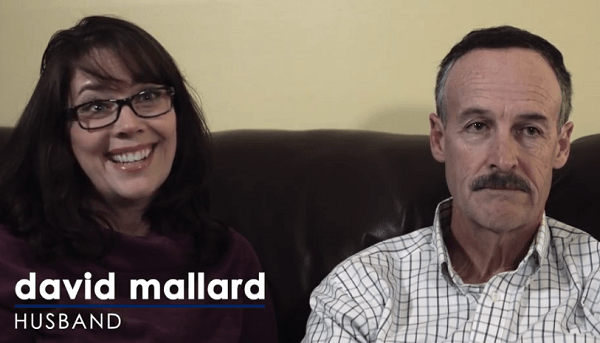
Mr. Mallard becomes animated later on—after he cooks dinner, which he’s filmed doing. Two young men, who seem to be Mrs. Mallard’s sons, are seen on the beach in her company but never speak.

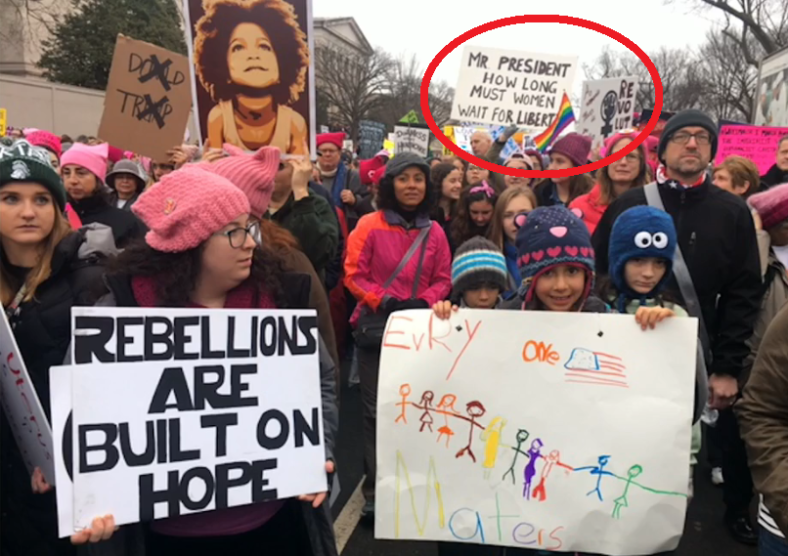
The structure of Ms. Friedman’s video is provided by a homework assignment given to her daughter, Olivia, “to write a letter to the President.” Below are some of Olivia’s appeals to “Trump,” juxtaposed with images that will resonate with citizens who’ve been injured or crippled by false allegations of abuse.


Make sure everyone has freedom.


Love instead of hate.


No violence; only words.


Please remember everyone matters.


In this still from Ms. Friedman’s campaign video, her daughter, Olivia (in the foreground), is flanked by predominately female protesters in pink, some holding up feminist signs, one with a clenched fist. Olivia’s sign reads, “EV[E]RY ONE Mat[t]ers,” and features a daisy chain of unified male and female stick figures.


Mrs. Mallard is endorsed by the People’s House Project:

We recruit and support excellent candidates in Republican-held congressional districts in Midwestern and Appalachian states. Our candidates are classically Progressive, true to their working- and middle-class roots, and focused on issues of consequence to those who work not for personal fulfillment but for a living.

It purports to be looking out for the interests of “working- and middle-class” America.

The president of the People’s House Project is described as “an author, activist, [and] social media innovator” who’s “central to Glamour magazine’s political coverage, where she concentrates on issues important to women.”

Her name is Krystal Ball…which is something no one should need to predict the future if the present course isn’t corrected.

Copyright © 2018 RestrainingOrderAbuse.com
An Aggressive Approach to Restraining Order Policy Reform: Threaten to Sue the State Courts Administrator in Federal Court

Restraining orders are public records, and recent posts have concerned or commented on their publicity and the unavailability of having their traces expunged even if orders are dismissed by their petitioners or otherwise vacated. This post highlights the pioneering efforts of one Missouri civil rights lawyer to upset the imbalance by threatening to file a federal lawsuit.


“Unless expunged, criminal case records remain online, even if prosecutors drop the charges. Civil lawsuits [which include restraining orders] stay on Case.net even if a judge dismisses the claims, [Kansas City media attorney Jean Maneke] noted.

“‘Openness is generally a better way to clean up concerns about inaccuracy than attempting to put everything back in a box,’ Maneke said.”

—“Pending Protection Orders Yanked from Public View

Everyone is entitled to his or her opinion. “Bullshit” is this writer’s opinion of the one quoted above. If you’ve been wrongly implicated in an abuse of process (or several), you probably disagree with views like Ms. Maneke’s, too, and believe that lies should never have been taken out of the box in the first place let alone engraved in databases and preserved indefinitely for public scrutiny.

Here are among what views like Ms. Maneke’s ignore:

  1. Restraining orders aren’t criminal cases, so they can never be expunged. Even if a judge dismisses (“tosses”) the allegations, only Tennessee has legislation that affords a wronged defendant the opportunity to have the case against him or her erased from the public record. Many orders, moreover, are finalized despite being grounded on fraud.
  2. Restraining orders aren’t criminal cases, but they’re not strictly civil cases, either. Acts imputed to defendants are often, if not typically, criminal (e.g., harassment, sexual harassment, stalking, terroristic threats, assault, battery, child abuse, sexual violence, or domestic violence).
  3. Unlike in other kinds of civil cases, a restraining order judgment may be wordless and formed in mere minutes, and the defendant may never be heard from at all. (An order can be obtained in a county or state other than the one a defendant resides in, so s/he may have no practicable opportunity to defend.) Also, an order may be awarded even though some of what may be many allegations are never considered by the court or are determined to be baseless. An approved order is an approved order. There aren’t necessarily any qualifications from the court on the recorded instrument to indicate which claims it regarded to be real and urgent, which suspect, or which baseless. To a third-party reader of the order, then, the accusations that appear on it are taken at face value.
  4. The mere title of an order may be prejudicial all by itself, regardless of the facts litigated in court.

The story the epigraph was excerpted from begins like this:

The client couldn’t stand it.

He typed his name into Case.net and up popped an ugly classification: “Protection Order: Adult Abuse Stalking.”

Who needs any more than those five words to form a conclusion about the person they were applied to? The case was dropped by the woman who made the accusation, but those five words nevertheless remained on the Internet.

The man was naturally concerned about the affect those words could have on his business and asked his lawyer to intervene.

[Bevis] Schock, a St. Louis attorney, [drafted] a federal equal protection lawsuit against the Office of State Courts Administrator. He never filed it, because four months later a Missouri Supreme Court committee decided privacy concerns trumped the public nature of this type of electronic court records.

Now pending orders of protection don’t appear on Case.net until judges grant full orders of protection.

The policy shift isn’t unopposed, but today “if the judge denies a petition or the filing party drops her request, it won’t ever appear online [and the] rule change is retroactive; OSCA scrubbed any previous ex parte orders from Case.net, including those involving Schock’s client.”

Schock said he spent 40 to 50 unpaid hours drafting an 18-page federal lawsuit against Greg Linhares, state courts administrator. Among other arguments, the lawsuit claimed the prior public records rule treats respondents differently than petitioners, because respondents are named online but petitioners are not.

The federal 2005 Violence Against Women Act prohibits states from publishing online any identifying information about people seeking protection.

Remarkable is that it takes the threat of a federal lawsuit to alert the courts to an obvious inequity. (Note, too, that finalized orders remain online, even though they may have been based on false allegations, and that even dismissed orders are preserved and can be accessed at the courthouse.)

The story is recommended reading. It notes in passing several facts about the process that are rarely observed, for example, that plaintiffs may file “seven or eight orders of protection” only to have them dismissed.

Under Missouri’s former policy, all of these dismissed petitions would have been visible online.

Unsurprisingly, a staff attorney with the Domestic Violence Unit at Legal Services of Southern Missouri is quoted as expressing the conviction that a “history” like this is indicative of true victimhood.

It can also be indicative of persecution by a venal and vindictive ex, vexatious neighbor, or fixated nutcase.

Copyright © 2016 RestrainingOrderAbuse.com

If a Man Who Complains of Procedural Abuse is an “MRA,” What Do You Call a Woman Who Complains of Procedural Abuse?

It isn’t just the men disparaged as “MRAs” (men’s rights activists) who denounce the injustice of feminist-inspired “women’s law.” Women also lose their homes, their families, their dignity, and their lives to misapplications of restraining order and domestic violence statutes. Unlike the men whose lot they share, these women aren’t distinguished with a label.

I propose the acronym “BRA,” which could stand for any of the following:

  • Beleaguered rights activist;
  • Baffled, boggled, buffaloed, or bewildered rights activist; or
  • Buggered rights activist.

The latter of these, especially, would evoke the same mockery shown the men’s rights activist to whom “MRA” is applied like a markdown sticker.

Make no mistake: Women who complain of procedural abuses are no less ignored than the men who do. They’re not saying anything anyone wants to hear—not the ACLU nor the Southern Poverty Law Center nor battered women’s advocates nor feminists in general. They’re misfits, and they’re accordingly denied status. No one dares contradict them, because that might sound misogynist. So they’re just disregarded.

Here are some different proposals for what BRA might represent: bypassed rights activist, betrayed rights activist…or balanced rights activist.

You want the straight dope about false accusation and the need for procedural reform? Ask the ex-wife who’s had her child taken from her, ask the disabled girl who’s been accused of domestic violence and cries herself to sleep every night, ask the mom who can’t attend her child’s school functions or keep a job, ask the ex-girlfriend who was nearly parked on the curb, or ask the professional woman who’s been denied protection against a brute and then framed.

But only ask if you can tolerate an inconvenient truth.

Copyright © 2015 RestrainingOrderAbuse.com

*A woman is the best rights activist, and more women’s voices should be heard in coordinated public protest.

Women Are Bigmouths: Why This Has Been Bad for People Who’ve Been Abused by the Court…but COULD Be Good

I grudgingly constructed a page this week on Facebook, which confirmed to me two things I already knew: (1) I really hate Facebook, and (2) women are more socially networked than men.
Calling women “bigmouths” isn’t strictly right, and people affronted by the assertion will insist women and men talk about the same amount, or that men talk more than women do.

Uh-huh.

Not impolite to observe is that women “collaborate” more than men do, that is, they sooner work in tandem, which is what statistics I gleaned from Facebook corroborate.

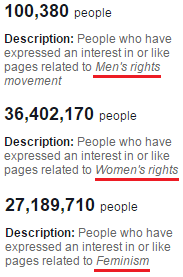
“Tell us about the people you’d most like to connect with,” Facebook urges when you piece together a page on its site. My entries under “Interests” brought up terms like Men’s rights movement, Feminism, and Women’s rights. Accompanying these topics were figures about how many others had expressed an interest in connecting with people who shared those interests.

See for yourself.

Notice that 200 to 400 times greater interest in bonding with people concerned with women’s rights has been shown than interest in bonding with people concerned with men’s rights. That’s a lot…A LOT a lot.


I don’t think there’s anyone who would deny that the fruits of feminism owe to social networking. Some of these fruits have been great; some really horrible. This blog concerns the rotten ones: a culture of victimhood and false accusation combined with the legislation of accelerated and derelict legal procedures presided over by judges bigoted by politics, bad practices (including engineered social science), and money.

Men have been the majority of victims, and they’ve been the only source of concentrated complaint, concentrated complaint that’s been mocked and muted. If we can assume the 200 to 400 times greater interest shown in women’s rights translates more or less proportionally to the number of people disinterested in or opposed to men’s beefs, then no wonder. Female influence, which is significantly feminist influence, is vastly predominant. The sympathy market has been cornered.

Men aren’t the only victims of procedural abuse, however.

Many if not most of the victims who comment on this blog are women, and they’re often desolate. Some live like hermits, some like refugees. They feel exiled and isolated.

The irony is this is exactly how women felt before the rise of feminism, and there’s a lesson to be taken from that.

Men’s struggles for a market share of sympathy face a phalanx of resistance and the priority of conditioned sentiment (prejudice); they’re also troubled by men’s lesser inclination to work collaboratively (the maverick mentality is a losing one). Women, however, can work from behind the lines. They can tap into the women’s rights network and harness its power.

And they should.

Copyright © 2015 RestrainingOrderAbuse.com

The Relationship between False Allegations of Rape and Restraining Order Abuse

It’s not without regret for how they may affect victims of sexual violence that a number of journalistic reports that expose false rape allegations have been highlighted on this blog. Although the blog’s focus is restraining order abuse, the potency of restraining orders and the laxity applied to the allegations they’re based on derive from the specter of domestic and sexual violence, the shadow of which has infected and jaundiced the perceptions of our legislators and judges.

The volume of false rape allegations that have been brought to public attention this year—mostly in the U.K., which is less squeamish about acknowledging fraud of this sort—will probably make further mention excessive, because it threatens to distract from reports and explications more directly relevant to the blog’s primary concern, which is restraining order injustice (a redundant phrase). Several news stories were noted this month, and some of these stories are each but one of a series that trace the same saga of mischief.

Law Graduate Falsely Accused Boyfriend of Rape and Assault as Excuse, Jury Told” (Steven Morris, The Guardian, 2014)

Oxford Union ‘Rape Victim Knew Her Claim Was False’” (Oliver Duggan, Amelia Hamer, and James Rothwell, The Telegraph, 2014)

Woman Accused of Making Repeated False Rape Allegations(The Inquisitr, 2014)

Woman Sentenced after Falsely Accusing Two Men of Rape” (UPI, 2014) (see also commentary by attorney and former Houston Law Review editor Robert Franklin)

Woman Who Cut Herself with Razor and Claimed She’d Been Raped Is Jailed” (Michael Donnelly, Belfast Telegraph, 2014)

Victim of False Rape Accusation Seeks Compensation(The Northern Echo, 2014)

Man Wrongly Accused of Sexual Assault Sues Police” (Rachel Olding, Sydney Morning Herald, 2014)

The purpose of collecting these reports of false rape allegations hasn’t been to discount the claims of real victims or even to reveal that false allegations are made, which should be unsurprising in a sociopolitical climate that’s eager to credit allegations of violence against women; the purpose, rather, is to reveal the motives of false accusers and to emphasize that there’s no lie that a dedicated false accuser will balk at telling and holding fast to. It happens that when false accusers frame people for a crime society holds in the highest contempt, their motives become more noteworthy.

If accusers are willing to falsely allege even rape (and casually), there’s no estimating how many “lesser” false accusations are made routinely, particularly when no risk or serious investment is entailed. Civil restraining orders are had in hours if not minutes based on brief interviews with judges, and there are no repercussions to their plaintiffs if the allegations they’re based on are untrue. They can furthermore instantly gratify multiple motives for false allegations at the same time.

These motives are sorted by the Federal Bureau of Investigation (FBI) under five broad rubrics: mental illness (or aberrance), attention-seeking/sympathy, profit, alibi (blame-shifting or cover-up), and revenge (or spite).

A false restraining order litigant with a malicious yen may leave a courthouse shortly after entering it having gained sole entitlement to a residence, attendant properties, and children, possibly while displacing blame from him- or herself for misconduct, and having enjoyed the reward of an authority figure’s undivided attention won at the expense of his or her victim.

S/he may, besides, be crackerjacks.

The exposure of false allegations of rape shouldn’t be interpreted as denying the reality or brutality of sexual violence. What it should do, however, is serve as a rude awakening to those who believe (and promote the belief) that allegations of abuse should be accepted without suspicion. It should also stress that false allegations aren’t negligible, rare, or harmless.

They’re anything but.

Copyright © 2014 RestrainingOrderAbuse.com

Reporting Restraining Order Abuse to Elected Officials

“I am suffering from the effects of a fraudulent protection order in Colorado, which was filed by my female roommate and had me and my young daughter kicked out of our home.

“There appears to be no recourse for me, but I did contact 10 state representatives and senators, and I heard back from three of them. If more people report this abuse to their elected officials, maybe something will actually be done about this awful system.”

—Respondent to this blog

Writing to district and state representatives can be a lot like trying to communicate with judges. Expecting a human response isn’t unreasonable, but it’s often disappointed.

There’s nevertheless value in bringing systemic injustices to the attention of legislators (senators and congressmen and -women), because (1) they make, reform, and repeal laws, and (2) if they hear the same complaints over and over—and especially if they know other people of influence are hearing the same complaints and looking to them for action—there’s a chance some of them might step up.

The voices of women who’ve been abused by court process, particularly, need to be heard, because the procedures that are most often and easily abused are ones it’s presumed are protecting them.

Consult this site for the names and addresses/websites of elected officials with whom to register a complaint (state legislators should be first in order of importance):

Find Your Representatives

See also these tutorials:

Writing to Your Legislator

“How to Write a Letter to Your United States Senator

How to Write Letters to Congress

A petition that automatically forwards stories of abuses of domestic violence laws and restraining orders to legislators/administrators is here.

Copyright © 2014 RestrainingOrderAbuse.com

*See also: What to Do if You’ve Been Abused by a Judge

If You’re not Part of the Solution, You’re Part of the Problem: On Why Restraining Order Abuses Have Persisted for So Long and How to Do Something about It

“Men are bastards!”

“Women are cun[ning]!”

I could end this editorial here, and I would have summed up the problem, which originates with hearts but owes its infinitude to different organs entirely.

Predictably, since most restraining orders are sought against a member of the opposite sex, online forums about dirty divorces, domestic abuse, treacherous lovers, vengeful exes, predatory or parasitic whackjobs, etc. often boil down to cross-gender sniping and “team camaraderie.” Women just want to be pissed with men and bitch about them with other women, and men just want to be pissed with women and bitch about them with other men.

Both genders have limitless potential to suck; sex is beside the point.

Those who profit politically and monetarily by the misery inflicted through court processes that are easily abused by the “morally unencumbered” love all this conflict and misdirected rage, which only ensure that these corrupt processes continue to thrive.

They’ve already hummed along without a hitch for over 30 years. In fact, they’ve gained momentum, despite reasoned and articulately critical pans from distinguished members of the legal, journalistic, academic/philosophic, and public policy communities.

Not only does cross-gender bitching by victims of state abuses distract from the actual source of the problem, which is bad laws; it makes those victims sound like the cranks and nuts everyone else is glad to assume they are.

True, the person who betrayed you and lied about you should be subjected to medieval punishment. True, the judge you got may be worthy of the same for his or her cruelty or carelessness or cluelessness. But…the reason either was entitled to abuse and humiliate, rob and defame you was THE LAW.

Except for the statutes that authorized your injuries, those injuries wouldn’t have been possible.

Passive aggression isn’t going to accomplish anything. I can’t imagine venting even makes anyone feel better for very long.

Aggressive aggression holds a lot more promise. If you’ve been wronged, tell your story, and tell it in a way that will count. Sign a petition and add a comment about your own circumstances. You don’t even have to expose your name. Sign several and tweet them, too (a few are below). Start a petition of your own. Tweet that also and post it here. Start a Facebook page. Connect and consolidate forces.

STOP FALSE ALLEGATIONS OF DOMESTIC VIOLENCE

THE SUPREME COURT: FEATHER FOR THE FALSELY ACCUSED

RESTRAINING ORDER LAWS ARE DANGEROUS AND UNFAIR TO MEN

This may seem unthinkable to you, especially if your wounds are fresh, but appreciate that the impulse to conceal shame only potentiates that shame. If you’ve been wronged, the shame isn’t yours. Re-channel your emotions in constructive ways. You’re not alone.

No one wants to do this. No one should have to. I wanted to write humor for kids. Though not a big dream, it contented me, and I think I would have been successful at it by now and that other doors would have opened. I was dragged from my interior world and away from the life I might have enjoyed. Not only am I not a political person; I don’t even like board games.

I do, though, hate bullies, especially ones with gangs behind them.

Recognize that the ringleader of the gang that assaulted you isn’t that petty lowlife you mistakenly invested your trust in; he’s an invisible man who’s represented in posters wearing red, white, and blue, and his gang is everybody.

The only way you can beat him and attain some satisfaction is by taking away his gang and making it yours.

Copyright © 2014 RestrainingOrderAbuse.com