There Are No “Sides” to a Story That’s BS: How Restraining Order Policy Turns Lies into Realities

A mathematician would dismissively tell you that you can’t describe one-half of zero. The project is absurd.

Yet civil courts, as a matter of policy, demand that defendants perform this nonsensical exercise every day.

This advice about telling “your side of the story about what happened” is offered by the California Court System, and it presumes that something must have happened to inspire some accuser to petition a restraining order. No tips are included about what to do if “what happened” was that this accuser had a malicious impulse to lie or is crazy.

I’m not a mathematician; I was trained as a critic. While a mathematician would almost certainly pronounce that trying to articulate one-half of nothing is meaningless and a waste of time (and then wave you away), a critic, arching an eyebrow, would tell you that the act of trying to articulate one-half of nothing raises the expectation that nothing is something after all. The act of explaining, in other words, creates meaning; it exerts an influence. It says there is “a story.”

To describe “your side” of nothing gives substance and dimensions to zero; it turns zero (a lie or lies) into something real—and this is what the civil court forces defendants to do…then it faults them for the stories it makes them tell about what was BS to begin with.

This sorcery goes on routinely and n-n-n-duh-mbly. The presumption of civil courts that accusations are “facts” that have “sides” is a grave blindness. This prejudice can, and it regularly does, turn nothing into “something.”

A defendant could answer honestly: “Your Honor, it’s bullshit, wholly bullshit, and nothing but bullshit.” But the judge would reject that answer out of hand and would, besides, threaten the speaker with penalties for insulting the court’s “dignity.” The judge could even rule that a defendant is “guilty” of allegations that are bullshit to punish him or her for saying the allegations are bullshit.

Fun, huh? Lives are intruded upon by judges (who are paid lavishly to warm chair seats), and then these judges produce reams of records to make people blameworthy for nothing they’ve actually done.

The mindset of judges is that there must be something, which means they find something where there was nothing. They “find” something even if they have to make it up.

This is all (yet another) explanation of how civil process is (1) stupid, (2) corrupt, (3) stupid, (4) noxious, (106) absurd, and (5) reprehensible.

Copyright © 2018 RestrainingOrderAbuse.com

*People are daily deprived of their liberties, livelihoods, and even their reasons for living based on equations like this one: 0 = 22.

What Defamation Is and Isn’t: On Writing about Abuses of Process


“Defamation is the general term for a legal claim involving injury to one’s reputation caused by a false statement of fact and includes both libel (defamation in written or fixed form) and slander (spoken defamation). The crux of a defamation claim is falsity. Truthful statements that harm another’s reputation will not create liability for defamation (although they may open you up to other forms of liability if the information you publish is of a personal or highly private nature).”

Digital Media Law Project

No honest lawyer would deny that a whole lot of lying goes on in court—though there are more than a few jaded veterans of legal process who would deny there’s such a thing as an honest lawyer.

Either way: a whole lot of lying.

A purpose of the First Amendment is to protect the citizen’s right to register disapproval of anyone or anything, for example, rampant lying in court. If a plaintiff lies in court and prevails because of it, a defendant may have no means to reverse the court’s opinion after the fact. The plaintiff will, for legal purposes, have gotten away with it.

That doesn’t, of course, mean s/he didn’t lie.

It also doesn’t mean the defendant is prohibited from bringing the truth to light in the court of public opinion. What transpires in a courtroom is public property, and the right of a witness to talk about that (and his or her life) is sacrosanct. There’s an obvious public interest, besides, in knowing lying occurs in court, which makes speech about lying in court political, and political speech is what the First Amendment is preeminently there to safeguard.

Journalism is the true court of last resort, and bloggers enjoy the same privileges as the institutional press. A trial judge may not recognize that, but the law does.

A purpose of a plaintiff’s lying to the court to procure an injunction (a “restraining order”) is always to shut the defendant up (possibly to conceal unethical or unlawful acts s/he has committed). The same plaintiff who thought it was perfectly fine to lie up and down about the defendant under oath will be livid if s/he’s then exposed for it in a public medium that could be read by friends, family, and coworkers. Bottling the truth to maintain appearances was the point of misleading the court in the first place.

The plaintiff’s immediate turn-to recourse will be to claim the defendant violated the injunction by writing about him or her. This is invalidated by the First Amendment, but a trial judge may not know that (talking or writing to someone may be properly prohibited by the court; not so talking or writing about someone, which is protected speech). Additional to alleging harassment, a plaintiff will likely claim s/he has been “defamed.

Defamation is a word that’s applied casually to any negative speech about a person. As the epigraph shows, the significance of the word in the law is very narrow, however: to qualify as defamatory, speech must be false. Speech that’s merely critical, offensive, upsetting, or coercive (i.e., meant to urge someone to change his or her ways) is protected by the First Amendment.

To ground this discussion, let’s say a man cheats on his wife, and let’s say the unknowing mistress finds out and threatens to tell her—and his friends, his boss, etc.—unless he apologizes and comes clean. The man gets a restraining order to silence the woman, maybe alleging harassment or stalking…or threats against his pet bunny. (He can make up anything he wants—and if there are a few angry emails or texts, easy-peasy.)

This disarms the woman (who is the actual wronged party), robs her of credibility—“She’s just some crazy person who’s obsessed with me; I had to get a restraining order”—and besides humiliates and terrifies her: She is instantly the creep.

Now what if instead of contacting the man’s wife (boss, friends, etc.), the deceived woman subsequently writes about the ordeal in a blog? Contrary to what most may think, including lawyers and judges, this is protected one-to-many speech—like orating on a campus quad or in the town square, or wearing a sandwich board and marching up and down the sidewalk. Willing listeners can attend; everyone else can turn away.

Negative speech about a person usually will qualify, by the dictionary definition of the word, as defamatory. Certainly if I call someone a “scumbag,” it’s not likely to enhance his or her image and popularity. Is calling someone a name actionable? No.

So speech can defame and still be defensible. Liability for defamation requires that unwanted speech be false.

If I think someone’s a scumbag, that’s not false speech; it’s my opinion. So it isn’t defamatory according to the law…even if a judge might believe otherwise.

Let’s help him or her out: Is pronouncing that someone is a criminal defamatory? Certainly. But judges do it all the time. Defaming people is their business. Generally speaking, judges’ defamatory speech is the most harmful kind.

The distinction is, if someone is sentenced for the commission of a criminal act, s/he is ipso facto a “convicted criminal” (and maybe even a “felon”). Saying so is defamatory, but it isn’t “defamation” by the standard recognized by the law. It isn’t false.

Similarly, if someone committed a crime (like perjury) and wasn’t caught, that doesn’t mean s/he didn’t lie under oath. (Parenthetically, there is no one who has never told a lie so just calling someone a liar can never be defamatory by the legal standard.)

In a courtroom, a person’s allowed to make any defamatory allegation against someone else, whether true or not. Judges (and everybody else) get hung up on the question of what you can say outside of one. It’s as if they imagine what happens in court isn’t public or “doesn’t count.”

An irony lost on judges is that lies uttered with impunity in court procedures can carry grave and permanent consequences. A judge will just stonily sit there and listen. (The author, for example, was accused in 2013 of “propositioning” a woman he’s been in and out of court with for almost 12 years. It never happened, but the judge didn’t bat an eyelash.) “Objectionable” opinions and truths spoken outside of court may well arouse a judge’s ire, though. This is a prejudice, and it’s more than a little backwards.

Critical speech cannot help but defame. That doesn’t mean it’s unjust, and it doesn’t mean it’s punishable.

We don’t say the truth hurts for nothing.

Copyright © 2017 RestrainingOrderAbuse.com

*An Arizona Superior Court judge in 2013 ruled speech of mine to be “defamatory on its face.” Defamation is a jury question (as any superior court judge should know…and I wasn’t even afforded a bench trial). The law doesn’t recognize the instant conclusion “defamatory on its face” (i.e., at first glance). Many of the conclusions drawn by the judge who declared my speech “defamatory on its face” were flagrantly unlawful. His administration of the 2013 case, Bredfeldt v. Greene, violated both the state constitution and the Constitution. Judges can do that, you ask? They can and they do—all the time.

Legal Abuse and “Learned Helplessness” (Including Commentary on the Mythical Value of “Taking the High Road”)

“Learned helplessness is behavior typical of an organism (human or animal) that has endured repeated painful or otherwise aversive stimuli which it was unable to escape or avoid. After such experience, the organism often fails to learn escape or avoidance in new situations where such behavior would be effective. In other words, the organism seems to have learned that it is helpless in aversive situations, that it has lost control, and so it gives up trying. Such an organism is said to have acquired learned helplessness. Learned helplessness theory is the view that clinical depression and related mental illnesses may result from such real or perceived absence of control over the outcome of a situation.”

Wikipedia

I introduced this psychological theory to a judge in 2010 when I filed a lawsuit against a woman who falsely accused me to the police and multiple courts in 2006. The accusations began in March, and before the close of July, she had defrauded at least four judges.

To be falsely accused is bewildering; it savages the mind. To then learn that efforts to expose the truth are met by judges not with keen interest and probing questions but variably with mute indifference, scornful derision, and offhand dismissal—that’s to have it firmly impressed upon you that resistance is futile. Worse, it’s to learn that resistance compounds the frustration and pain.

The system isn’t on your side, and bucking it for many is just an invitation to be scourged afresh.

After attempting some direct appeals to people who, I reasoned, might care more about the truth than the court did (2007), then writing about the business online (2008), then employing an attorney to mediate a resolution (2009), all of which efforts were met with stony silence, I filed a lawsuit (on my own).

That was in 2010. By then, unknown to me, the statutes of limitation on the civil torts I alleged—fraud, false light, defamation, and intentional infliction of emotional distress—had flown. My accuser’s attorney, with mock ingenuousness, wondered to the court why I hadn’t filed my suit in 2006, right after having had the court twice swat down my appeals.

learned_helplessnessI offered the explanation to the judge that people who go through this become conditioned to helplessness (or hopelessness), because process militates against the proposition that a claimant of abuse has engaged in deception. The righteous indignation and outrage of the wronged defendant gradually succumb to the inevitable conclusion that facts, truth, and reason are impotent against fraud and judicial bias. (The defendant lives besides under the constant menace of unwarranted arrest.)

I didn’t know I could prosecute a lawsuit on my own until a legal assistant told me so in 2009, which I also told the judge. I might have been motivated to find out sooner if I’d had the least faith that a judge would heed my testimony.

My accuser’s attorney disdained the explanation for my tardy filing as “self-diagnosis,” and the judge eagerly echoed his assessment and dismissed the case (the court’s interest is in economy, not truth or justice). What was another six months of my life? (Letters from a physician and a therapist, along with witness affidavits, including one from a former cop, made no difference.)

I wasn’t wrong, though. People who defy a rigged system—whether restraining order defendants, domestic violence defendants, or family court defendants—can be conditioned to helplessness, and many accordingly report experiencing posttraumatic stress (which fortifies their distrust and their aversion to further rude scrutiny and contemptuous treatment from the court).

A lesson to take from this is that the “high road” (i.e., trusting in facts, truth, and reason) is a detour to hell. If I had known in 2006 what I know today, I could have extricated myself from my accuser’s false accusations in five minutes by playing the game according to her rules, which were “whatever works.”

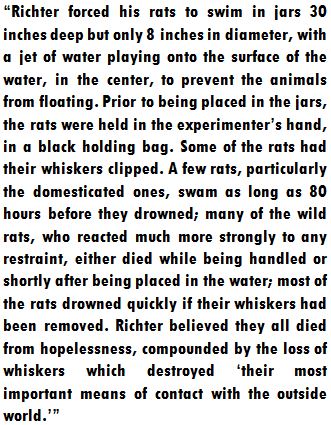
The studies from which the term “learned helplessness” emerged were studies of drowned rats and tortured dogs. Playing fair (or aspiring to saintliness by never uttering an ill word against your accuser) is noble, but nobly drowned is still drowned. If an accuser lies about you, denounce him or her as a liar. Similarly, if a process of law is bullshit, call it what it is.

Some respondents to this blog, even after they’ve been through the courthouse ringer, retain a beleaguered faith in ethics. They believe that if injustice is laid bare to a discerning audience by rhetorical appeals to reason and decency, this will spur change. “Our objective is to fix the problem, not the blame” was quoted in a recent comment.

The abstract and impersonal may be informative, but they don’t arouse curiosity, because they don’t inflame the passions; controversy does. Advocates of the “high road” eschew naming names, for example, because it’s aggressive. Avoidance of confrontation, however, accomplishes little and exemplifies “learned helplessness.” The “high road” is safe and tame, and it leads to a dead-end.

The reason restraining order abuse endures is that the abused are paralyzed by indecisiveness. They won’t knuckle down and demand that a flawed process be repealed.

Among people who’ve been damaged by fraudulent abuse of restraining orders and related civil court procedures that are supposed to protect the defenseless, you’ve got, for instance, your liberals who’ll defend the process on principle, because they insist it must be preserved to protect the vulnerable, and they’ll fence-sit just to spite conservatives who flatly denounce the process as a governmental intrusion that undermines family.

Liberals and women who identify with legitimately victimized women feel obligated to “negotiate the gray space” and acknowledge the pros and cons of “women’s law.”

Then you have people (of whatever political allegiance or none) who believe that if you eliminated procedural inequities and ensured that defendants’ due process rights were observed, the system would work fine.

Maybe they believe a process that allows a person in Nevada to mosey into a courthouse, fill out some forms, and accuse a person in Wyoming of “stalking” or “domestic violence,” necessitating that the person in Wyoming hustle him- or herself to Nevada to present a defense within the week, can be made fair, and maybe they don’t know that the same Nevadan can prosecute the same claim over and over against the same Wyomingite (three times, six times, a dozen times, or more).

Maybe they believe that appeals to public conscience will urge the passage of laws that require free legal counsel be provided to defendants.

This would mean that if, say, a million restraining orders are petitioned a year, and legal representation for each defendant in each case could be capped at $2,000 (which might translate to a feeble defense, anyway), state governments would be required to shell out $2,000,000,000 to make everything “fair and square.” But that’s not all. If government gave free representation to “abusers,” advocates for “victims” would demand the same for them. So your $2,000,000,000 would become $4,000,000,000.

That’s per annum. (Also, the hypothetical Wyomingite would still need to travel to Nevada, and who’s paying for that?)

Others believe that if lying (perjury) were prosecuted, that would straighten things out. The costs to prosecute what may be hundreds of thousands of liars a year might be less than $4,000,000,000…or it might not be. Too, how do you prove someone is lying about an emotional state, like “fear”? How do you prove an alleged event didn’t happen?

You can’t, not conclusively, which is what a criminal prosecution requires.

More say appeal to your senator, to the president, to the press…nicely and cogently. They follow a utopian faith that basic decency will prevail if “the problem” is exposed.

As a rhetorical stance, the position has its merits. It suggests calmness and rationality, and calmness and rationality should recommend attention from others. “We’re calm and rational,” proponents of the position imply, “so when we say there’s a problem in need of fixing, it’s calmness and rationality speaking, not anger.”

The limitation is that no one who needs to be convinced has a motive to listen. No one can be made to care about abstractions like equity and due process when in the other ear they’re being cited statistics about epidemic violence.

Everything to do with the law is adversarial. If you seek to revise it without being personal or confrontational, the soonest you can expect a just reward is in the afterlife.

Protesters march on a SlutWalk in Newcastle

Copyright © 2015 RestrainingOrderAbuse.com

*Splendid writers, particularly Cathy Young, have responsibly and lucidly exposed “the problem” for 20 years in major news outlets. The system has responded with statutes that are broader, laxer, and more punishing.

The Words Get in the Way: Reconceiving Arguments against Restraining Order Fraud

block
Traffickers of this blog will sometimes advise that complainants of abuse of so-called “protective orders” consider “the bigger picture.” They feel the matter is less about personal loss than about statutory and procedural derelictions (bad law and judicial bias, carelessness, and tyranny). They emphasize principle over individual privation.

For some, the bigger picture that’s stressed is denial of constitutional rights to due process (for example, the right to be heard before a judgment is entered, the right to court-appointed legal counsel, or the right to a trial by jury); for others, the bigger picture is the right to freedom of speech. Some underscore gender and race inequities; some the undermining of the family.

The obstacle to making whatever “bigger picture” is emphasized perceptible to the public at large is the phrase “restraining order” or “protection order,” which comes with a host of conditioned prejudices. It arouses images of violence against those helpless to defend themselves. Accordingly, even many who acknowledge the process is flawed nevertheless say they recognize it to be necessary…in cases.

So even those against the process may not actually be against the process. This has created a disjointed community of complainants, namely, a marginalized extreme labeled “misogynist cranks,” “angry white men,” or “restraining-order-Americans” and a fence-sitting majority who against all evidence and experience retains the faith that reason will prevail against unreason if we just talk it out long enough: “All around the mulberry bush, the monkey chased the weasel….”

The monkey never catches the weasel, so there’s nothing to recommend monkeying around.

What needs to be stressed and comprehended, to this writer’s way of thinking, is that civil court is no place for the litigation of accusations that explicitly or implicitly allege violence, violent threat, or other criminal acts, and that in civil court, which applies no standard of evidence, fraud is too easily perpetrated. The exposure of falsehood or exaggerated claims of fear will not necessarily discredit a plaintiff’s claims, and findings in favor of a plaintiff who’s a proven liar are possible and acceptable to the court.

Therefore the procedure is vexed; it’s wrongly engineered. The concept is corrupt.

Instead of denouncing “restraining order fraud,” it’s civil court rulings that exact an unconscionable toll that should be denounced. It’s all about the words. Civil procedures should not result, ever, in people’s being placed in police databases. Civil rulings should not criminalize people or make them vulnerable to warrantless arrest (for alleged behavior that may not violate any laws). It should not be possible to have a person evicted from a residence he or she owns by a civil ex parte decision, nor should such a decision predispose a court to find against that person when s/he’s permitted to address the court in his or her defense (if such an opportunity is even practicable to the accused, who may preposterously be required to travel to another county or state to be heard).

Against policies of law and process so manifestly unjust, even improved due process rights would promise to be a shabby deterrent against abuse and miscarriages.

Not only have we become habituated to the reality of “restraining orders” to the extent that we believe they must be here to stay; procedural process has become rote (adjudication by rubber stamp). Yes, new “safety catches” could be installed, but what guarantee would there be that the conditioned habits of those who administrate the process would change? Economy would require that there continue to be minimal oversight and accountability, and the trial judge would still have the final (and absolute) discretion to make a determination, according to his or her own personal lights. So long as the process were conducted in civil court, rulings could still be arbitrary (anything goes), because the standard of evidence would remain whatever the trial judge chose.

Social and judicial impression cannot be overhauled—what’s etched on the brain stays there—and the preconceptions attached to the phrase restraining order will never be dispelled. Judgment by a single man or woman who has had his or her priorities conditioned by rhetoric and social and political expectations (possibly for decades) cannot be impartial. The implications of the process and dictates about how it’s supposed to be administered are too deeply ingrained. The phrase restraining order is by itself damning (right from the get-go). It stirs presuppositions of guilt, and this is inimical to fair and just process. Accordingly, the phrase must be abolished and the process reconceived from the ground up.

Copyright © 2015 RestrainingOrderAbuse.com

Low and Outside: An Umpire’s Story of Restraining Order Abuse (by an Underhand Screwball)

As the story in this post shows, the phrase “America’s Game” has taken on a new meaning.

The common assumption—one that’s been vigorously enforced by advocates of the “abuse industry”—is that restraining orders are used to protect “victims” from “abusers.” So-called abusers are represented as violent husbands or boyfriends, or as stalkers, representations that account for the ubiquity of restraining orders and the ease of their procurement.

The man whose story of restraining order abuse appears below reports that restraining orders can be obtained by drive-thru in his state (California), like milkshakes and onion rings.

The restraining order against this father and family man was petitioned by his sister-in-law on behalf of her son, his nephew. The man affronted his sister-in-law by umpiring two of her son’s games (his job), contrary to her wishes. That’s the basis of her complaint to the court.

Fighting that complaint has now cost the man and his family some $15,000 (besides money he would have earned as an umpire), and his life’s on hold while he awaits an appellate court ruling that won’t emerge for six to 24 months.

Here’s his story, as he tells it:

I am a victim of restraining order abuse.

At the age of 37, I married the love of my life. It wasn’t until after we were engaged that I found out that most of my wife’s family didn’t like me. This is the foundation of my story.

I am a little league, travel ball, and high school umpire. I umpire because I love the game and to make some additional money on the side. I have been umpiring baseball for close to 25 years without any incident whatsoever, and most reviews of my performance have been complimentary.

When my wife and I were married, we resided in Orange County, California. Our residence was far from the rest of her family, which limited our exposure to her parents and her sisters. My wife has two sisters, one older and one younger. Her elder sister is a lawyer, and her younger sister is a stay-at-home mom.

The eldest sister and her family and I have a great relationship. The problem is with the youngest sister, who is a control freak. She likes to control everything, including how many cups of coffee her husband has a day, and if she’s denied control, she will go to whatever lengths she has to to get it.

Two years or so ago, my wife was offered a job that would move us nearer to the younger sister. This was something that excited my wife, because she loves her family very much and wanted to be closer to her nieces and nephews. When she decided to take the job, she contacted her sister and told her the good news. Her sister was excited and worked with my wife to find a house that was near hers, and she found us a great one.

After moving in, we were visited quite frequently by my wife’s little sister and her family. Every time she visited, however, she pointedly let my wife know about her displeasure with the way we parented our eight-year-old little girl. As a stay-at-home mom whose entire existence revolves around her four kids, she has read every book on parenting and considers herself an expert in child-rearing. I had even caught her entering my house and administering medication to my daughter without our consent, which I firmly put a stop to.

Back to baseball.

After we moved, I enlisted with the local little league to umpire. I worked for a local umpire company that was very pleased with the service I provided to them. It considered me one of its better umpires. One day, I was assigned to umpire one of my wife’s younger sister’s kids’ games. I checked with the league to see if there was an issue and was told no and that it had people umpiring their relatives’ games all the time. Just be neutral, I was told, which I always am.

My wife’s younger sister found out that I was going to be umpiring her son’s game and called my wife to tell her to have me remove myself from the game. When asked why, she stated she just wanted to keep things separate. My wife didn’t understand why and told her to not worry, that I would not show any bias toward her kids and everything would be great. He sister repeated that she just wanted to keep things separate. My wife still didn’t understand why, because her son and I had a great relationship, with no problems at all. At this point, the woman became hysterical and said, “Keep your husband away from my son.” My wife got very upset and hung up on her. After that, we found out that the younger sister called the older sister and asked what she should do to repair things with my wife because she had upset her.

Well, because there was no good reason for my sister-in-law to be upset, and because the umpire company needed me to cover the game, I did. There was no issue with the game, and I received many compliments afterwards. I ended up working another one of my nephew’s games a couple of weeks later, again with no issues. The next week, I got a call from my umpire assignor reporting that my sister-in-law filed a complaint with the league saying her son was “uncomfortable” with my working behind the plate.

At that point, I banned her and her son from visiting my house. This really angered her and inspired her to get back at me.

Meanwhile, my assignor and I got together and agreed I should no longer work any of her kids’ games because she was clearly sick. So I was assigned to other games at the park that didn’t involve her kids.

This wasn’t acceptable to her. She didn’t want me at the fields at all. So she took pictures of me there on the days I was scheduled to work and created a story that involved my hunting and stalking her kids, and affecting their mental well-being.

She went to court and was granted an ex parte restraining order.

When I was served the restraining order, the deputy sheriff told me that he had read it and thought it was the funniest thing he had ever seen. He said he had no idea why it was issued and told me to just stay away from my sister-in-law.

When the time came for me to appear in court to fight the order, I had an attorney and she did not. The judge clearly stated that he would not give her preferential treatment, even so.

This turned out to be completely false.

My attorney laid out a solid case to have the order dismissed, presenting facts that showed there was no proof of any stalking or harassment, and that up until the time of my sister-in-law’s going crazy, her kids and I had had a great relationship.

After about a two-hour hearing, the judge ruled against me. He stated that because my wife informed me that her younger sister had told her to keep me away from her kid that I was put on notice…yet persisted in showing up at the fields to work. Never mind that I was told two months after their conversation (my wife didn’t tell me right away because she thought it was just her sister acting crazy). The judge then went on to say that a mother had the right to determine who got to be around her kids and didn’t need a good reason.

Now since the restraining order was made permanent, my sister-in-law has been using it to harass me and my family.

She went to the elementary school and instructed staff there that I was only to be allowed to pick up and drop off my daughter, and she warned them that if I dared to attend any of my child’s awards ceremonies, school performances, science fairs, or other school functions, she would call the police and have me arrested. She has also been sending letters with false claims about police reports and bullying to the little league administration that regulates all of the local little leagues, and has effectively had me removed from umpiring any games at any of the area little leagues, even ones in which her kids don’t participate.

Her family has been following me and my daughter to public parks and then approaching me to tell me I am in violation of the restraining order. Also, they have changed their walking routes to school so they walk by me and my daughter, or by me as I walk home after taking my daughter to school, to accuse me of “pushing the envelope.” They constantly photograph me when I am waiting at school, and make up stories about me doing things to harass them or their kids.

We have filed a motion for a new trial with compelling evidence. It was denied by the same judge. We have also filed a motion to modify the order to allow me to attend my daughter’s school events since I am her primary caregiver while my wife is at work (I own my own business), and this too was denied, because the judge thought it would be too hard for the school and the police to enforce.

We have filed an appeal, and briefs have been submitted. We are currently waiting for the appellate court to consider the briefs and issue a ruling. We were informed that it can take anywhere from six months to two years for this to happen. Now we are investigating whether we have proper grounds to file a motion asking for expedition to move our case closer to the front of the queue.

To show you just how crazy this restraining order is, the local police department asked, when we dropped off our guns, what clown would sign such a stupid restraining order? They said they would hold our guns for as long as needed to get this thing appealed.

This is my story, which has been my life for a year…and counting.

Copyright © 2015 RestrainingOrderAbuse.com

*From “High Conflict Family Law Matters and Personality Disorders” by attorneys Beth E. Maultsby and Kathryn Flowers Samler:

high_conflict_indicators

Restraining Orders Are Public Records

It’s hard to tell whether this is a goad or a guarantee: “Find Restraining Order Records For Anyone Instantly!” Either way, it’s enticing.

If you’re dating someone and you’ve noticed how their temper gets out of control, before things go any further, check their record on Restraining Order Records. They might not have ever committed a crime, but if their name shows up on Restraining Order Records, you might think twice about pursuing this relationship.

Lawyers discount restraining orders as he said/she said matters: no biggie. Judges may also consider objections to them to be overstated—simply because they’ve been stated at all. These dismissals stand in stark contrast to the admonition: “Restraining Orders aren’t pleasant to think about, but the consequences can be worse. Check Restraining Order Records.”

Which appraisal of the significance of restraining orders do you think more closely corresponds to the public’s? (That is a rhetorical question, yes.)

The quoted material above is featured on the site PublicRecordsReview.com, which advertises the “Top Restraining Order Records Sites”: Instant Checkmate, United States Background Checks, Been Verified, U.S. People Records, and SpyFly.

Whether the returns from such sites can be relied upon is something the reader may investigate if s/he chooses; the writer doesn’t want to know. Whatever the case, however, the issuance of a civil restraining order represents a judicial ruling, and judicial rulings are public records. Here’s “why”:

Essential to the rule of law is the public performance of the judicial function. The public resolution of court cases and controversies affords accountability, fosters public confidence, and provides notice of the legal consequences of behaviors and choices.

[…]

The public in general and news media in particular have a qualified right of access to court proceedings and records. This right is rooted in the common law. The First Amendment also confers on the public a qualified right of access. In 1980, the Supreme Court held that the First Amendment right of access to court proceedings includes the public’s right to attend criminal trials. The Court suggested that a similar right extends to civil trials…. Some courts of appeals have held that the public’s First Amendment right of access to court proceedings includes both criminal and civil cases (Timothy Reagan, “Sealing Court Records and Proceedings: A Pocket Guide”).

Although they’re civil instruments, restraining orders are associated with violent or otherwise criminally deviant behavior, so they’re recorded and preserved in statewide police databases and the FBI’s National Crime Information Center (NCIC) database, which private investigator Brian Willingham calls the “closest thing to a nationwide criminal records check in the United States today” (italics added). They’re also recorded (virtually in perpetuity) at their courthouses of origin. Defendants named on domestic violence restraining orders may furthermore be entered into a domestic violence (specific) registry, possibly even if a temporary order against them is dismissed. The potential consequences to employment and even employability in certain fields could hardly be more obvious.

A profession as mundane as “substitute teacher” requires that its applicants undergo an FBI background check, and any interviewer may, of course, simply ask if a prospective employee has “ever been the subject of a restraining order.”

Ease of access to restraining order records by the general public differs from state to state. In Indiana, for example, it just takes an Internet connection. In other states, records aren’t as conveniently scrutinized.

That doesn’t, however, mean they’re inaccessible.

The animus behind advocacy for restraining orders is the animus behind all law related to violence against women. Whether advocates are anti-rape or anti-domestic-violence, the argument is the same: that the accused must be exposed so that (female) victims of violence will be encouraged to come forward. Publicity isn’t just incidental; it’s demanded.

Superficially, the demand isn’t without sympathy.

Restraining orders, however, are adjudicated in civil court. That means they’re matters instigated by private citizens whose allegations aren’t (necessarily) vetted by the authorities or by government prosecutors. They are, very literally, he said/she said prosecutions. Temporary restraining orders may be obtained in minutes based only on finger-pointing and feelings (“I’m afraid”), or on testimony that’s significantly or totally false (or even maliciously fabricated). The evidentiary bar is so low as to be skipped over—tra-la-la—and judicial bias is endemic and may even be mandated.

Elaine Epstein, former president of the Massachusetts Bar Association, famously observed decades ago, “Everyone knows restraining orders…are granted to virtually all who apply.”

The situation that obtains then is one of damning documents’ being generated on the basis of one or two protestations of fear or danger made to prejudiced judges in mere minutes-long procedures whose rulings are recorded indefinitely in public databases that any teen with a laptop and Daddy’s credit card can poke a zitty nose into from McDonald’s.

Copyright © 2015 RestrainingOrderAbuse.com

“Predator” v. “Porn Star”: Restraining Order Fraud, False Allegations, and Suing for Defamation

destroyPeople falsely alleged to be abusers on restraining order petitions, particularly men, are treated like brutes, sex offenders, and scum by officers of the court and its staff, besides by authorities and any number of others. Some report their own relatives remain suspicious—often based merely on finger-pointing that’s validated by some judge in a few-minute procedure (and that’s when relatives aren’t the ones making the false allegations).

The social alienation and emotional distress felt by the falsely accused may be both extreme and persistent.

The urge to credit accusations of abuse has been sharpened to a reflex in recent decades by feminist propaganda and its ill begot progeny, the Violence Against Women Act. No one thinks twice about it.

Using four-letter words in court is strictly policed. Even judges can’t do it without risking censure. Falsely implicating someone, however, as a stalker, for example, or a child molester—that isn’t policed at all. Commerce in lies, whether by accusers, their representatives, or even judges themselves is unregulated. No one is answerable for sh* s/he makes up.

Accordingly, false allegations and fraud are rewarding and therefore commonplace.

It should be noted that false allegations and fraud can be distinctly different. For example, David Letterman famously had a restraining order petitioned against him by a woman who was seemingly convinced he was communicating to her through her TV, and her interpretations of his “coded messages” probably were genuinely oppressive to her. David Letterman lived in another state, had never met her, and assuredly had no idea who she was. Her allegations of misconduct weren’t true, but they weren’t intended to mislead (and the fact that they did mislead a judge into signing off on her petition only underscores the complete absence of judicial responsibility in this legal arena).

Fraud, in contrast, is manipulative and deceptive by design. It occurs when an accuser intentionally lies (or spins the facts) to give a false impression and steer a judge toward a wrong conclusion that serves the interests of the fraudster.

Regardless, though, of whether false allegations are made knowingly or unknowingly, they’re rarely discerned as false by the court, are seldom acknowledged as false even if recognized as such, and are always destructive when treated as real, urgent, and true, which they commonly are.

The falsely accused (often private citizens who’ve never had a prior brush with the law) are publicly humiliated and shamed, which by itself is predictably traumatizing. They are besides invariably (and indefinitely) entered into police databases, both local and national, and may be entered into one or more domestic violence registries, too (also indefinitely). These facts pop up on background checks, and defendants in some states may even appear in registries accessible by anyone (including friends, neighbors, family members, boy- and girlfriends, employers, colleagues, students, patients, and/or clients).

This costs the falsely accused leases, loans, and jobs (being turned down for which, of course, aggravates the gnawing indignity and outrage they already feel). Those falsely accused of domestic violence may further be prohibited from attending school functions or working with or around children (permanently). Defendants of false restraining orders may besides be barred from their homes, children, assets, and possessions. Some (including salaried, professional men and women) are left ostracized and destitute. Retirees report having to live out of their cars.

This, remember, is the result of someone’s lodging a superficial complaint against them in a procedure that only requires that the accuser fill out some paperwork and briefly talk to a judge. A successful fraud may be based on nothing more substantive, in fact, than five “magic” words: “I’m afraid for my life” (which can be directed against anyone: a friend, a neighbor, an intimate, a spouse, a relative, a coworker—even a TV celebrity their speaker has never met).

This incantation takes a little over a second to utter (and its speaker, who can be a criminal or a mental case, need not even live in the same state as the accused).

Accordingly, people’s names and lives are trashed—and no surprise if they become unhinged. (Those five “magic” words, what’s more, may be uttered by the actual abusers in relationships to conceal their own misconduct and redirect blame. That includes, for example, stalkers. Those “magic” words may also be used to cover up any nature of other misbehavior, including criminal. They instantly discredit anything the accused might say about their speakers.)

The prescribed course of action to redress slanders and libels is a defamation suit, but allegations of defamation brought by those falsely accused on restraining orders or in related prosecutions are typically discounted by the court. Perjury (lying to the court) can’t be prosecuted by a private litigant (only by the district attorney’s office, which never does), and those who allege defamation are typically told the court has already ruled on the factualness of the restraining order petitioner’s testimony and that it can’t be reviewed (the facts may not even be reviewed by appellate judges, who may only consider whether the conduct of the previous judge demonstrated “clear abuse of discretion”). The plaintiff’s testimony, they’re told, is a res judicata—an already “decided thing.” (Never mind that docket time dedicated to the formation of that “decision” may literally have been a couple of minutes.)

So…slanders and libels made by abuse of court process aren’t actionable, slanders and libels that completely sunder the lives of the wrongly accused, who can’t even get them expunged from their records to simply reset their fractured lives to zero.

Such slanders and libels may include false allegations of stalking, physical or sexual aggression, assault, child abuse, or even rape. In the eyes of the court, someone’s being falsely implicated as a monster, publicly and for life, is no biggie.

In contrast, it was reported last month that the court awarded a Kansas woman $1,000,000 in a defamation suit brought against a radio station that falsely called her a “porn star.”

When violated people speak of legal inequities, this exemplifies what they’re talking about: Falsely and publicly implicating someone as a sex offender is fine and no grounds for complaint in the eyes of the justice system, but for the act of falsely and publicly calling someone a mere sex performer, someone may be fined a million bucks.

Copyright © 2014 RestrainingOrderAbuse.com

Facts and Fairness: Using Arizona’s Policies to Expose Restraining Order Iniquity

I live in Arizona where I was issued a restraining order in 2006 petitioned by a woman I nightly encountered hanging around outside of my house. The restraining order said I was a danger to her husband and shouldn’t be permitted to approach or talk to him.

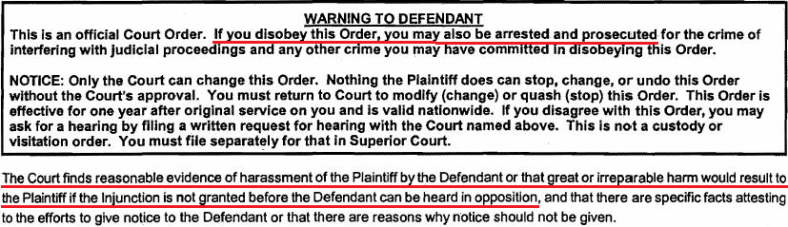
If you receive a restraining order in my home state, here’s the first thing that greets your eye:

On the basis of the form this warning captions—which looks like it was drafted by someone using a pizza crust as a straightedge—citizens are recorded in state and national police databases as stalkers and violent abusers.

Consider that the immediate impression this warning is meant to give is beware. It naturally excites fear—and if you’ve been falsely accused, a host of other emotions, besides, none of which conduces to calm and lucid thinking.

Something you wouldn’t guess from this “Warning to Defendant” is that if a defendant “disagrees” with an order issued in Arizona, s/he has the statutory right to apply for an appeals hearing at any time during the order’s effectiveness. For example, if the duration of the order is one calendar year, the defendant can take 11 months to assemble his or her appeal and save up, if necessary, to have an attorney represent that appeal.

Here’s the law:

At any time during the period during which the injunction is in effect, the defendant is entitled to one hearing on written request. No fee may be charged for requesting a hearing. A hearing that is requested by a defendant shall be held within ten days from the date requested unless the court finds compelling reasons to continue the hearing. The hearing shall be held at the earliest possible time. An ex parte injunction that is issued under this section shall state on its face that the defendant is entitled to a hearing on written request and shall include the name and address of the judicial office where the request may be filed. After the hearing, the court may modify, quash or continue the injunction.

The statute says the court’s order must inform the defendant that s/he’s entitled to a hearing, but it doesn’t require that the order inform the defendant that s/he has a year (or possibly years) in which to prep and apply for that hearing, that the hearing is free, or that the defendant may be represented by an attorney.

Restraining orders are rhetorical psych-outs. Their language is overtly menacing, and neither the law nor the issuing courthouse gives any consideration to apprising defendants of their rights.

The stress is on apprising defendants, who are presumed to suck (sight unseen), of what rights they’re no longer deemed worthy of.

Appreciate that the court’s basis for issuing the document capped with the “Warning” pictured above is nothing more than some allegations from the order’s plaintiff, allegations scrawled on a form and typically made orally to a judge in four or five minutes.

In the courthouse where the order issued against me was obtained, restraining order petitioners file into a room like a small bus station terminal, submit their applications, wait for an audience with a judge, chat with him or her for a few minutes, and leave.

That’s it.

Consequences of receiving an order of the court whose merits are determined on this basis include registration in state and national law enforcement databases, and may also include loss of entitlement to home, children, and possessions, and loss of employment.

In contravention of due process, orders are issued against defendants that may deny them liberties and property without the court’s hearing from them at all.

Ever.

In Arizona, unless a defendant requests a hearing before a judge, that’s an end on the process. No judge will even have learned what s/he looks like, and the truth of the plaintiff’s claims will never have been controverted—claims, to reiterate, that were made in a few minutes and could include anything from annoyance to physical or sexual violence.

Such claims often amount to nothing more certain than finger-pointing.

(Docket time afforded by the court to the testimony of defendants who go to the trouble of appealing rulings based on such claims, incidentally, is about 15 minutes. The cost of attorney representation at an appeals hearing may be $2,000 to $5,000.)

The only provision the law or the court makes for discouraging false testimony (some motives for which are here) is this one, which predictably appears at the very end of the application form:

The plaintiff signs below.

Applicants aren’t of course told what “perjury” is, and they’re certainly not told it’s a felony crime that carries a prison term (as it is and does in Arizona and many other states). Lying to the court is never sanctioned or prosecuted, anyway.

Recent posts on this blog were answers to dismissal by a doctor of laws of criticisms that the restraining order process is unfair. The process would have to be far more deliberative than it is, in fact, to be merely “unfair.”

The process is automated.

Copyright © 2014 RestrainingOrderAbuse.com

Battering Women to Protect Battered Women: Using Massachusetts’s Policies to Examine Restraining Order Publicity and Its Damages

“In the event a Restraining Order is issued for any period of time (initial 10 days or subsequent extension/dismissal), you will be listed in the statewide Domestic Violence Registry system. This could impact your ability to obtain or maintain employment in government, law enforcement, certain medical fields, or social services, or to work with/coach children. Impoundment of the restraining order does not expunge your listing on the statewide domestic violence registry, as certain government agencies and private companies with significant government contracts still have access to the registry system.”

—“Massachusetts Restraining Orders Procedure and Ramifications

I’ve just been corresponding with a Florida woman named Ally who had a domestic violence (209A) protection order petitioned against her in Massachusetts alleging she was a danger to a former boyfriend (these kinds of instruments can be obtained by plaintiffs who don’t even live in the same state or country as their defendants).

Ally contends the allegations against her are false and has been living in hell for over a year.

She’s surviving day to day and can’t afford to procure the services of an attorney. Ally’s trying to defend herself and clear her name with no money and from another time zone. She’s preparing a motion on her own (very possibly ill-fated) to request that the order against her be expunged, because it has ruined her employability.

Note: As the epigraph explains, even were Ally to succeed in having the order simply dismissed (which is itself unlikely), she would still remain registered as a domestic abuser.

From a draft of Ally’s “Motion to Expunge”:

Defendant was refused jobs, [is] not allowed to attend [or] volunteer [at] her daughter’s school events, [and has had] numerous other rights taken away due to Plaintiff’s Abuse of Process and Fraudulent Allegations and written Affidavit to the Court. This continues today.

Note: To successfully combat prosecutions like this requires money…which prosecutions like this prevent their defendants from earning.

A recent post on this blog observed the court’s schizophrenic regard toward restraining orders. On the one hand, they’re viewed by judges as urgent, potentially life-or-death matters; on the other hand, they’re viewed as inconsequential as long as defendants mind their prohibitions for the prescribed period of time.

Ignored is that adjudications both initiated and finalized in minutes yield rulings that are entered into state and national law enforcement databases indefinitely. Orders become “inactive” once they expire, but they don’t disappear. A woman like Ally remains for the rest of her life marked as a perpetrator of domestic violence.

In contrast—and the contrast is a telling one—consider this excerpt from a “Memoradum” issued by the Massachusetts Supreme Court last year on “Internet Dissemination of Personal Protection Order Information.”

As transparency and improved access remain court goals, it is important that we not unknowingly or unintentionally release victims’ personally identifiable information through the Internet, recognizing that this information is easily accessed and that access to such information could be dangerous to victims. Additionally, it has been brought to our attention that current federal law prohibits providing information over the Internet about personal protection orders (PPOs) that would be likely to reveal the identity or location of the petitioner (“PPO Information”).

18 USC 2265(d)(3) states:

A State, Indian tribe, or territory shall not make available publicly on the Internet any information regarding the registration, filing of a petition for, or issuance of a protection order, restraining order, or injunction in either the issuing or enforcing State, tribal or territorial jurisdiction, if such publication would be likely to publicly reveal the identity or location of the party protected under such order. A State, Indian tribe, or territory may share court-generated and law enforcement-generated information contained in secure, governmental registries for protection order enforcement purposes.

The privacy of restraining order plaintiffs (who are nominated “victims”) is to be tightly guarded.

Note: Based on “determinations” formed in minutes and possibly based on nothing more substantial than accusation, a plaintiff is deemed a “victim” whose identity and privacy must be protected, and the defendant is deemed a “violent threat” whose privacy is accordingly due no consideration. After the term of the restraining order has flown, the “danger” to the accuser is assumed to have been resolved, but the accuser continues to enjoy anonymity while the accused must go on bearing the implications of the restraining order for the rest of his or her life, exactly as if those implications were a criminal sentence.

Only in the recent past, in fact, did it even become possible to remove a Massachusetts restraining order defendant’s name from the domestic violence registry if it were found that allegations against him or her were substantially or totally false. (Remember that such allegations are made ex parte in the time it takes to place an order at McDonald’s.)

Until recently, it was almost impossible to expunge a person’s record with the domestic violence registry once the initial entry was made. In the 2006 case of Commissioner of Probation v. Adams, it was recognized that a judge has the inherent authority to expunge a record of an abuse [from the] violence registry system in the rare and limited circumstance that the judge finds the order was obtained through fraud on the court.

Note: The phrase rare…circumstance (of fraud) is emphasized in the original document quoted above (“Massachusetts Restraining Orders Procedure and Ramifications”), which was authored by an all-female law firm (Mavrides Law of Boston). Allegations of rampant restraining order misuse in Massachusetts have actually been the subject of press coverage and at least one law review monograph, and one of the most outspoken critics of restraining orders, attorney Gregory Hession, practices in Massachusetts and has for many years reported that restraining orders are “out of control.”

The previous two posts on this blog were responses to allegations that those who criticize restraining orders and domestic violence laws are “opposed to the battered women’s movement.” Defenders of these laws are urged to ask themselves how Ally’s wanting to be able to provide for her daughter and one day attend her daughter’s graduation has anything to do with battered women at all.

They’re also urged to ask themselves how denying Ally these opportunities isn’t itself an act of brutality.

Copyright © 2014 RestrainingOrderAbuse.com

Big Money v. No Money: VAWA and the Men’s Rights Movement

The previous post was a response to research conclusions published this year by Dr. Kelly Behre, director of the UC Davis Law School’s Family Protection and Legal Assistance Clinic.

In a paper titled, “Digging beneath the Equality Language: The Influence of the Fathers’ Rights Movement on Intimate Partner Violence Public Policy Debates and Family Law Reform,” Dr. Behre asserts there’s an absence of empirical evidence to support various arguments and statistical estimates published by men’s rights advocates respecting false restraining orders, false allegations of domestic violence, and judicial bias against men in family courts.

Ironic is that Dr. Behre’s denial of men’s groups’ position that men aren’t treated fairly is itself unfair.

When Dr. Behre says there’s no “empirical support” for estimates like 60 to 80% of restraining orders are unnecessary or based on falsehood, she means there are no formal audits of the process to back them up. She further examines studies that have been pointed to and finds those studies “problematic.”

Dr. Behre may well be right that empirical support for the claims of men’s groups is scant, shaky, or at best anecdotal. It’s disturbing, though, that Dr. Behre doesn’t find the dearth of studies that could be cited as empirical support a source of concern.

Clearly she has interests in both justice and human welfare.

A truism in law is that those with no money have no voice. Men’s rights groups are not lavishly funded teams of crack Ph.D.’s (they may in fact represent ragtag groups of man-on-the-street volunteers), and many if not most of those represented by such groups are themselves on the outside of the system looking in.

In contrast, consider these facts from the chart “Comparison of VAWA 1994, VAWA 2000, and VAWA 2005 Reauthorization Bill” compiled by the National Coalition Against Domestic Violence (NCADV) eight years ago.

  • Grand total of [federal] money allocated [under the Violence Against Women Act] from 1994 to 2011: $9.43 billion, including:
  • STOP (Services and Training for Officers and Prosecutors) Grants: $2.85 billion
  • Grants to Encourage Arrest Policies: $886 million
  • Rural Domestic Violence and Child Abuse Enforcement Grants: $555 million
  • Civil Legal Assistance for Victims of Violence: $588 million
  • Sexual Assault Services: $250 million
  • Education and Training for Judges and Court Personnel: $35 million

If battered women’s advocates like Dr. Behre find little empirical support for the plaints of men’s groups, they might at least find ample motive in these figures for systemic prejudice against men—and by extension all defendants who find themselves the targets of allegations of abuse (male and female).

While it’s noteworthy that comparatively little federal money has been approved for allocation to research studies, the magnitude of investment toward countering domestic violence is a clear pronouncement of priority, and this investment alone should suggest to a mind as trained and astute as Dr. Behre’s that allegations like “family courts discriminate against men and…mothers frequently and successfully make false allegations against men to obtain custody of children” entirely plausible.

Dr. Behre would call this observation a “commonsense argument” (“implying that the truth…is intuitively evident”).

Fair enough.

Copyright © 2014 RestrainingOrderAbuse.com

“N.J. Judges Told to Ignore Rights in Abuse TROs”: A Retrospective Look at Vicious Restraining Order Policies 20 Years Later

Among the challenges of exposing crookedness in the adjudication of restraining orders is credibility. Power rules, and the people who’ve been abused typically have none. Their plaints are discounted or dismissed.

Influential and creditworthy commentators have denounced restraining order injustice, including systemic judicial misconduct, and they’ve in fact done it for decades. But they aren’t saying what the politically entitled want to hear, so the odd peep and quibble are easily drowned in the maelstrom.

Below is a exquisite journalistic exposé that I can’t simply provide a link to because the nearly 20-year-old reportage is only preserved on the Internet by proxy hosts (for example, here).

The article, “N.J. Judges Told to Ignore Rights in Abuse TROs,” is by Russ Bleemer and was published in the April 24, 1995 edition of the New Jersey Law Journal.

New Jersey attorneys corroborate that the rigid policy it scrutinizes still obtains today. What’s more, the general prescriptions of the New Jersey training judge on whom the articles focuses arguably inform restraining order policy nationwide. The only things dated about the article are (1) judges’ being “trained on the issue of domestic violence” is no longer “unique” to New Jersey but is contractually mandated everywhere in return for courts’ receiving hefty federal grants under the Violence Against Women Act (VAWA), which grants average out at over $500,000 per; and (2) the resultant policy now injures not only men who are fingered as abusers in five-minute procedures that are often merely perfunctory.

According to the same complacently biased “standards,” it also trashes the lives of accused women, who are not infrequently prosecuted by other women (including their mothers, daughters, and sisters).

______________



Text of “N.J. Judges Told to Ignore Rights in Abuse TROs” by Russ Bleemer (Copyright © 1995 American Lawyer Newspapers Group, Inc.):

On Friday, at a training session at the Hughes Justice Complex in Trenton, novitiate municipal judged were given the “scared straight” version of dealing with requests for temporary restraining orders in domestic violence cases.

The recommendation: Issue the order, or else.

Failing to issue temporary restraining orders in domestic violence cases, the judges are told, will turn them into fodder for headlines.

They’re also instructed not to worry about the constitution.

The state law carries a strong presumption in favor of granting emergency TROs for alleged domestic violence victims, the new judges were told at the seminar run by the Administrative Office of the Courts. Public sentiment, mostly due to the O.J. Simpson case, runs even stronger.
The judges’ training is rife with hyperbole apparently designed to shock the newcomers. It sets down a rigid procedure, one that the trainers say is the judges’ only choice under a tough 1991 domestic violence law and its decade-old predecessor.

Since the Legislature has made domestic violence a top priority, municipal court judges are instructed that they can do their part by issuing temporary restraining orders pronto.

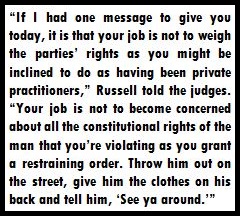
“Throw him out on the street,” said trainer and municipal court judge Richard Russell at a similar seminar a year ago, “give him the clothes on his back, and tell him, ‘See ya around.’”

This napalm approach to implementing the domestic violence statute has some state judges talking. No one disputes the presumption in the law of granting a TRO, and there have been no serious court challenges to the statute’s ex parte provisions.

The strident teaching, however, doesn’t always sit well with some judges, even those who characterize the instruction as deliberate verbal flares directed at a worthy goal.

“[It’s] one of the most inflammatory things I have ever heard,” says one municipal court judge, who asked not to be identified, about a presentation held last year. “We’re supposed to have the courage to make the right decisions, not do what is ‘safe.’”

At the same time, even former and current municipal and Superior Court judges who are critical of the seminar have words of admiration for the candor of trainers Russell, Somerset County Superior Court Judge Graham Ross and Nancy Kessler, chief of juvenile and family services for the AOC. One municipal court judge says that while the statements reflect an incorrect approach, “I wouldn’t be real keen to inhibit the trainers at these sessions from exhibiting their honest opinions.”

For their part, Russell and Kessler say they are doing what the law says they should do—protecting victims, which in turn can save lives. Ross didn’t return telephone calls about the training. He, Russell and Kessler were scheduled to conduct Friday’s program for new judges, a program Kessler says the trio has conducted for judges at least five times since the law was passed.
The law, N.J.S.A. 2C:25-17 et seq., requires judges to be trained on the issue of domestic violence, a requirement that women’s rights advocates say is unique. The TRO provisions also were reemphasized three years ago, encouraging the use of such orders after a municipal court judge hears from one complainant.

Under N.J.S.A. 2C:25-28, municipal court judges assigned to cover for their Superior Court counterparts at nights and on weekends and holidays can issue an ex parte TRO, which is subject to a hearing within 10 days in the Superior Court’s family part “when necessary to protect the life, health or well-being of a victim on whose behalf the relief is sought.”

The TRO may prohibit the defendant from returning to the scene of the alleged act, strip the defendant of firearms or weapons, and provide “any other appropriate relief.” The law also says that the emergency relief “shall be granted for good cause shown.”

Dating Relationships Included

The training, however, stresses the Legislature’s urgency in passing the law, which last year was amended again to extend possible domestic violence situations to dating relationships. The trainers encourage the judges to focus on the legislative findings, which, in emphasizing rapid law enforcement response, state “that there are thousands of persons in this State who are regularly beaten, tortured and in some cases even killed by their spouses or cohabitants.”
This, said Kessler at a training session last year, is justification for an approach advocated by Russell: Talk to the complainant, talk to the reporting officer, issue the TRO, and let the family court sort it out later.

On a tape of the April 1994 session obtained by the Law Journal, Kessler told the judges that “in that legislative findings section, people are told to interpret this law broadly in order to maximize protection for the victim. So if anybody ever came back at you and said, ‘Gee, that’s a real reach in terms of probable cause,’ you have a legislatively mandated response which is, ‘I erred on the side of caution for the victim.’”

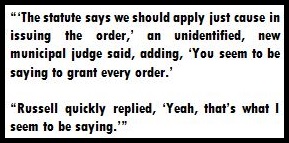
Kessler was reacting to a question that arose during Russell’s presentation. “The statute says we should apply just cause in issuing the order,” an unidentified, new municipal judge said, adding, “You seem to be saying to grant every order.”

Russell quickly replied, “Yeah, that’s what I seem to be saying.”

Russell, a municipal court judge in Ocean City and Woodbine, as well as a partner in Ocean City’s Loveland, Garrett, Russell & Young, answered the question at last year’s seminar after he had spoken for some time on the middle-of-the-night procedures the new judges would have to follow.

At the outset, Russell said that he was on the bench when the original domestic violence act was enacted in 1982 “and that just blew up all of my learning, all my understanding, all my concept of constitutional protections and I had to acclimate myself to a whole new ball game.

“If I had one message to give you today, it is that your job is not to weigh the parties’ rights as you might be inclined to do as having been private practitioners,” Russell told the judges. “Your job is not to become concerned about all the constitutional rights of the man that you’re violating as you grant a restraining order. Throw him out on the street, give him the clothes on his back and tell him, ‘See ya around.’ Your job is to be a wall that is thrown between the two people that are fighting each other and that’s how you can rationalize it. Because that’s what the statute says. The statute says that there is something called domestic violence and it says that it is an evil in our society.”

Not all judges agree with Russell’s approach. Philip Gruccio, a former trial and Appellate Division judge, says that even orders based on ex parte requests require hearings, to a certain extent. “It involves a certain amount of judicial discretion,” he says.

Robert Penza, who retired last year after serving as a family court judge in Morris County for two years, agrees. “I could just never rubber stamp a complaint,” says Penza. “A judge has got to judge.”

Gruccio, who says he is familiar with the work of Russell and Ross on the bench and that both are top notch judges, strongly disagrees with the approach. “My view is that you just can’t say, ‘Forget about the defendant’s rights.’ You can’t say that. It is wrong to say that. It is wrong to train people that constitutional rights aren’t important.”

Gruccio, a professor at Widener University Law School in Wilmington, Del., and director of its judicial administration program, concludes, “I think what has happened is, for emphasis purposes, somebody has lost their way.”

Catering to Popular Objectives

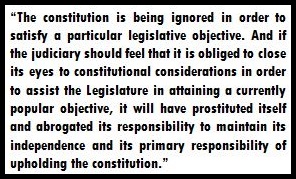
Sitting judges interviewed for this article readily agree with Gruccio. Says one: “The constitution is being ignored in order to satisfy a particular legislative objective. And if the judiciary should feel that it is obliged to close its eyes to constitutional considerations in order to assist the Legislature in attaining a currently popular objective, it will have prostituted itself and abrogated its responsibility to maintain its independence and its primary responsibility of upholding the constitution.”
One municipal court judge who has heard the AOC lecture says, “This is throwing people out of their homes in the middle of the night,” adding, “We have an obligation under our oath of office to be fair, not to be safe.”

A problem that arises by such wholesale approvals of TROs, judges say, is that word spreads, and litigants can try to use them as a club. Kessler couldn’t provide statistics on the number of TROs that are later dismissed by the family court, but she says that the number is “significant.” She adds that more than 58,000 TROs and amended TROs were issued by New Jersey courts last year, with about 60 percent of the complaints originating in municipal courts.

While some municipal court judges acknowledge that the domestic violence law can create injustices—one calls it “probably the most abused piece of legislation that comes to my mind”—there are counterpoints. Melanie Griffin, executive director of the Commission to Study Sex Discrimination in the Statutes, a legislative commission that drafted much of the 1991 law, says that for every individual who files a false report, “there are 100 women who don’t come in at all and stay there and get beaten.”

Judges who have seen the training presentation say that if anyone objects, they keep it to themselves. Russell says that sometimes “those with no background express disbelief, until we explain the intent of the legislation.”

Moreover, Russell says there is nothing wrong with the teaching approach. Abuse victims, he says, may apply and relinquish TROs repeatedly before they finally do something about breaking away. Once they do so, he says, the Legislature’s prevention goal has been met.

Russell continues: “So when you say to me, am I doing something wrong telling these judges they have to ignore the constitutional protections most people have, I don’t think so. The Legislature described the problem and how to address it, [and] I am doing my job properly by teaching other judges to follow the legislative mandate.”

Russell disputes that the TRO training removes judicial discretion where it is needed. On the tape, Russell and Kessler emphasize that first, the judge must decide whether the domestic violence statute grants jurisdiction over the complainant and the defendant. Russell said last week that he was updating Friday’s lecture to include the 1994 expansion of the domestic violence statute to situations in which the complainant was dating the accused or alleges that the accused is a stalker. The judge also has to speak to the party or review the written material and make a decision whether to proceed. “The judge has to be guided by instinct,” Russell explains, before he or she can go ahead with the TRO.

Says one municipal court judge who also has conducted training and asked not to be named: “I would say, ‘If there is any doubt in your mind about want to do, you should issue the restraining order.’” The judge adds, “I would never approach the topic by saying, ‘Look, these people are stripped of their constitutional rights.’”

Making Headlines

Much of the seminar’s rhetoric alludes to actions that keep the judges out of the headlines, which are mentioned in the taped seminar repeatedly. Near the beginning of his presentation, Judge Graham Ross, reacting to Russell, says that dealing with domestic violence “is not something that we can take a shortcut on. Forgetting about reading your name in the paper—and that certainly is very troubling, I don’t want to read my name—but that’s really secondary.

“The bottom line is we’re trying to protect the victim,” Ross continues. “We don’t want the victim hurt. We don’t want the victim killed. So yes, you don’t want your name in the paper, but you’d feel worse than that if the victim was dead. So yeah, your name will be in the paper…if you’ve done something wrong. And I’ve said that to my municipal court judges. If you don’t follow the law after I told you what to do, I will guarantee that you will be headlines. That’s not a threat. That’s an absolute promise on my part. This is serious stuff.”

The AOC’s Kessler says the media references are a training technique, and judges aren’t influenced by public opinion polls. The focus, she says, follows the statute’s emphasis on protecting victims by dealing with the dynamics of domestic violence and the importance of intervention. “When there is a discussion about headlines,” she says, “it tends to be more in recognition of what they already are aware of and concerned about.”
One former judge agrees that judges don’t work wearing blinders, but says that if worries about bad publicity affect their work, “it defrauds the system.” A current municipal court judge who has been through the training on domestic violence says, “We have to stand back from the hysteria and the newspapers and all and do what’s right.”

But most others disagreed. The “approach isn’t bad because it’s got a shock value,” says retired judge Robert Penza.

A current municipal court judge liked the realism of the media references. “A newspaper headline can be death to a municipal court judge’s career,” says the long-time jurist, “and the prospect of an unfavorable newspaper headline is a frightening one.” The judge added, however, that attention-getting devices must not be confused with legal principles.

And the judge paid the overall approach a backhanded compliment frequently repeated in some form among the former and current judges contacted for this article. Referring to Russell, the judge declared: “What he said is valuable because he is expressing the state of affairs. He should be commended for his candor, although I must say I find his viewpoint to be anathema.”

Copyright © 2014 RestrainingOrderAbuse.com

(Female) Stalkers, False Allegations, and Restraining Order Abuse

Restraining orders are maliciously abused—not sometimes, but often. Typically this is done in heat to hurt or hurt back, to shift blame for abusive misconduct, or to gain the upper hand in a conflict that may have far-reaching consequences.

There’s a cooler, more methodical style of abuse practiced by people who aren’t in intimate daily proximity to their victims, however, that’s alternatively called stalkingbullying, or mobbing. These words have distinct meanings but are nevertheless porous, because motives for the behaviors they represent are the same: coercion, punishment, domination, and control.

There’s a lot of crossover between them—as is there crossover between the various high-conflict personality types who engage in these behaviors, who contrary to popular perception may be women.

Journalists’, psychologists’, and bloggers’ representations of those with personality disorders that stem from sociopathy tend to use gendered language that implies most abusers (or the worst abusers) are male.  Possibly this is because many who write about sociopaths and narcissists are female, and their experiences are of abuse by men. Or possibly this is because making women out to be villains is ungallant. Or possibly it’s assumed that men can’t be victims of women, even sociopaths, because men have nerves of steel or because their general physical advantage carries over into all contexts. Neither of the latter beliefs is true, and when the context is abuse of legal process, it’s usually the case that the bigger you are, the harder you fall.

Consider these illustrated WikiHow tutorials on “How to Spot a Sociopath” and “How to Identify a Psychopath,” which are pretty good, except that the reader is likely to get the impression from the cartoons that all sociopaths are men.

They aren’t.

These “tips” from “How to Spot a Sociopath” are at least as applicable to women as men, and suggest why abuse of legal process, including restraining order abuse, is so attractive to the sociopathic mind—and why it comes easily to sociopaths or to those who manifest sociopathic traits.

  • “Most sociopaths can commit vile actions and not feel the least bit of remorse. Such actions may include physical abuse or public humiliation of others. If the person is a true sociopath, then he or she will feel no remorse about hurting others, lying, manipulating people, or just generally acting in an unacceptable way.”

    Sociopaths often know how to make others believe they are the victim while actually being the aggressor.

  • Sociopaths tend to blame the victim for their shortcomings. They can never admit to fault and instead attack the victim. Key factor in any DSM diagnosis.
  • This type of person will tell you things to get you to forgive them and then say they never told you. This is a tactic to play mind games.
  • If a person is “too good to be true,” they probably are. This is the case for any DSM diagnosis, including sociopathy, borderline [personality], and narcissism.
  • Most are aware of their need to hide cold traits, and are good actors (have adapted to being different)….
  • Some scientists believe that sociopaths suffer from damage to the prefrontal cortex which regulates emotions and morality, etc.
  • Sociopathic behavior is strongly inherited, so look at problems in the family as a clue to a person’s real personality.
  • Some experts say that a great number of sociopaths were also child abuse sufferers.

The same tutorial, despite its gendered cartoons, references a book published last year titled, Confessions of a Sociopath, which is by a female sociopath who uses the penname M. E. Thomas—and who’s an attorney and law professor, which shouldn’t be particularly surprising to anyone who’s been exposed to legal practitioners.

It may be that not all sociopaths are fairly typified as stalkers and bullies, but if you read this review of Confessions of a Sociopath, you’ll appreciate that motives for abusive conduct come readily enough to the sociopathic psyche.

Thinking of women as stalkers or bullies is just something we’re unaccustomed to or something we treat lightly.

In a series of hers titled, “Female Stalkers,” psychologist Tara Palmatier notes that “female stalking behaviors are portrayed as ‘funny’ or ‘cute.’” We’ve been conditioned—and “we” includes the police and judges—to think of women as both harmless and helpless. Women don’t hurt people.

They do, though.

Popular perceptions of “stalking,” domestic violence, and other abuses tend inordinately to inculpate men. The object of observing that women also act hurtfully isn’t to suggest that women more often act hurtfully than men but to controvert the popular notion that they don’t or can’t, which is both false and largely to blame for the absurd ease with which legal process is maliciously abused.

Accounts submitted to this blog by both men and women indicate that individuals of either gender may and do abuse legal process to torment others, horribly and sometimes for years on end. Either sex may engage in cyclic mind games, as well: manipulating another into trust and then punishing that trust (“It’s okay, I’m sorry, come here”…WHACK!). Repeatedly. One woman’s (mother’s) account of this, shared a few months ago, is numbing: affairs by her (probably borderline personality-disordered) boyfriend followed by apologies followed by recriminations (rinse, repeat) followed by false allegations to the police, to the court, to child protective services, to the military, and on and on.

Most group-stalking or -bullying (mobbing) acts reported to this blog, though, are orchestrated by women. These include combinations of behaviors like making false allegations, spreading false and ruinous rumors with the help of negative advocates (accomplices), using social media to taunt and intimidate from multiple directions, etc. These passive-aggressive forms of abuse to punish, frighten, and dominate—which, depending on the context, may alternatively be called bullying, harassment, or stalking—are usually viewed as less harmful than physical assault. This perception is facile, however, and wrong.

A recent male respondent to this blog, for example, reports encountering an ex while out with his kids and being lured over, complimented, etc. (“Here, boy! Come!”), following which the woman reported to the police that she was terribly alarmed by the encounter and, while brandishing a restraining order application she’d filled out, had the man charged with stalking. Though the meeting was recorded on store surveillance video and was unremarkable, the woman had no difficulty persuading a male officer that she responded to the man in a friendly manner because she was afraid of him (a single father out with his two little kids). The man also reports (desperately and apologetic for being a “bother”) that he and his children have been baited and threatened on Facebook, including by a female friend of his ex’s and by strangers.

Harassment by these means, which tends to be unrelenting but is just as bad when sporadic, creates anxiety and insecurity in its victims, and may well undo them not only psychologically but professionally, financially, and in every other possible way. False allegations (which alone gnaw and corrode) may lead to criminal charges, which may lead to incarceration, from which ensues traumatization of children and possibly loss of employment (from which ensues further traumatization of children…). Same thing with restraining orders, which may easily be obtained in an afternoon by spiteful fraud and which don’t go away—and may also lead not only to loss of employment but loss of employability in a given field.

When a restraining order is issued, it’s entered into state law enforcement databases as well as the FBI’s National Crime Information Center (NCIC) database. The pretense is that restraining orders are civil misdemeanors of no particular significance. Repeat: National Crime Information Center.

Records of restraining orders are public, besides, and accessible by anyone, and may moreover be recorded in public registries for easy access. Allegations on those records, no matter how scandalous and even if found to be exaggerated or maliciously false, aren’t censored.

Our perceptions of the consequences of public allegations, as well as the justice system’s perceptions of them, are completely schizoid. They’re neither actually “no big deal” nor actually treated as though they’re “no big deal.” And they’re certainly not “no big deal” to those falsely accused and everyone who depends on them. False allegations may range from stalking to sexual harassment to battery or worse.

The actuality is that allegations made on restraining orders, which may be utterly malicious fabrications, are presumed to be legitimate by everyone. Just the phrase restraining order instantly establishes the credibility of an accuser who may be a bully or stalker.

Applicants for restraining orders, it’s again presumed, are afraid of the people they’ve accused and want nothing to do with them. Accordingly, there are no limitations placed on the conduct of petitioners and no repercussions to them for their harassing the people they’ve alleged they’re afraid of. Restraining orders license abusers—bullies, stalkers, and their confederates—to act with impunity. Even when abuses are reported, the tendency of cops and court staff is to shrug.

Restraining orders, because they establish credibility with judges and police officers (based on no standard of evidence and on mere minutes-long “trials” that never approach conclusiveness), make further claims that bullies or stalkers allege, whether proximally or later on (even years later on), entirely plausible. Conflict can be rekindled and stoked endlessly and whimsically.

Lives are derailed this way: sanity compromised, careers sabotaged or sundered, savings exhausted, and on and on. Trials may lead to further trials without end.

And all of this may originate with sick games whose motives are dismissed as “harmless”—or even “cute.”

Copyright © 2014 RestrainingOrderAbuse.com
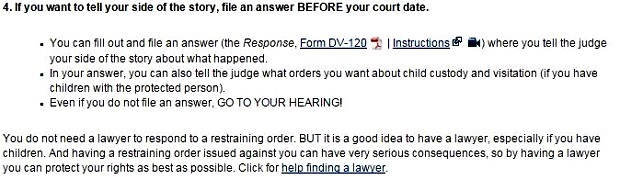
How VAWA Has Turned Our Courts into Restraining Order Vending Machines

Under the Violence Against Women Act (VAWA), our courts and police districts are awarded hefty federal grants (averaging $500,000) in return for having their officers (judges and cops) “educated” about how to respond to allegations of fear or violence.

Allegations made pursuant to the procurement of a restraining order, per the terms of these grants, aren’t to be questioned.

It’s a little known fact that qualification training for police officers is about a quarter of that required for certification to cut hair. It’s bad enough, then, that cops are licensed to act on impulse. Far worse is that judges are licensed to do so.

That’s because the belief that judges base rulings on facts is mistaken. Judges avoid this whenever possible. If principles of law (rules) authorize officers of the court to dodge making “judgment calls,” they will be dodged. Typically what a “just” ruling means is a ruling that can be justified according to the rules.

To give an example, imagine a bewildered restraining order defendant who’s been falsely accused. If s/he misses or blows his or her opportunity to defend, “claim preclusion” rules forbid him or her from having the case heard or reheard later. The facts don’t matter. The court is authorized to ignore them—and it will.

Remedial legislation has been proposed, such as Oregon House Bill 2966 (“Allows respondent against whom restraining order has been issued to request withdrawal of order based on false allegations of abuse”):

At any time after a restraining order has been issued under ORS 107.095 (1)(c) or (d), 107.716 or 107.718, and after the restraining order has been entered into the Law Enforcement Data System maintained by the Department of State Police and into the databases of the National Crime Information Center of the United States Department of Justice as required under ORS 107.720, and into any other manual or computerized database maintained by the Department of State Police for purposes of tracking restraining orders issued under ORS 107.095 (1)(c) or (d), 107.716 or 107.718, the respondent may request that the court withdraw the order on the grounds that the petition and order were based upon false allegations of abuse. The request may be made at a hearing requested under ORS 107.718 (10) or by a separate motion filed with the court by the respondent.

But as things stand, if false allegations are put over on the court, they’re put over for good.

Judicial process proceeds from rules first and facts second. Our entire system of law is based upon the principle of stare decisis, which says that what has previously been decided must be adhered to.

A restraining order, which is issued without a defendant’s even knowing about it and based on a few-minute interview between a judge and plaintiff, already represents a preliminary decision. If, on top of this influential fact, the rule impressed upon judges is that allegations aren’t to be questioned, then “decisions” to confirm restraining orders aren’t really decisions at all.

Copyright © 2014 RestrainingOrderAbuse.com

Presumed Guilty: On How Restraining Order Laws Enable and Promote Abuse

I’ve had occasion in the last few months to scrutinize my own state’s (Arizona’s) restraining order statutes, which are a study in prejudice, civil rights compromises, and politically coerced naïvety. Their outdated perspective fails even to acknowledge the possibility of misuse let alone recognize the need for remedial actions to undo it.

Restraining orders are issued upon presumptive conclusions (conclusions made without judges ever even knowing who recipients are—to the judges, recipients are just names inked on boilerplate forms), and the laws that authorize these presumptive conclusions likewise presume that restraining order applicants’ motives and allegations are legitimate, that is, that they’re not lying or otherwise acting with malicious intent.

That, you might note, is a lot of presuming.

In criminal law, the state must presume that defendants are innocent; in civil law (restraining orders are civil instruments), defendants may be presumed guilty. What’s outrageous about this with respect to restraining orders is that public allegations made on them may be criminal or criminal in nature, and violations of restraining orders—real or falsely alleged—have criminal consequences. Due process and the presumption of innocence are circumvented entirely; and with these safeguards out of the way, a defendant may be jailed on no valid evidence or for doing something that’s only illegal because a judge issued a restraining order on false grounds that made it so. (A parent who’s under a court-ordered injunction may be jailed, for example, for sending his child a birthday present.)

One of my motives for consulting my state’s restraining order statutes is having absorbed a broad array of stories of restraining order abuse over the past two years. Common themes among these stories are judicial bias; lying and fraud by plaintiffs (applicants); restraining order plaintiffs’ calling, emailing, or texting the people they’ve petitioned restraining orders against (or showing up at their homes or places of work—or following them); and restraining orders’ being serially applied for by plaintiffs whose past orders have been repeatedly dismissed (that is, restraining orders’ being used to harass and torment with impunity).

Those who’ve shared their stories want to know how these abuses are possible and what, if anything, they can do to gain relief from them. The answer to the question of how lies within the laws themselves, which are flawed; the answer to the question of what to do about it may well lie outside of legal bounds entirely, which fact loudly declaims just how terribly flawed those laws are.

Arizona restraining orders are of two sorts, called respectively “injunctions against harassment” and “orders of protection.” They’re defined differently, but the same allegations may be used to obtain either. Most of the excerpted clauses below are drawn directly from Arizona’s protection order statute. Overlap with its sister statute is significant, however, and which order is entered simply depends on whether the plaintiff and defendant are relatives or cohabitants or not.

“[If a court issues an order of protection, the court may do any of the following:] Grant one party the use and exclusive possession of the parties’ residence on a showing that there is reasonable cause to believe that physical harm may otherwise result.”

This means that if your wife/husband or girlfriend/boyfriend alleges you’re dangerous, you may be forcibly evicted from your home (even if you’re the owner of that home). The latitude for satisfying the “reasonable cause” provision is broad and purely discretionary. “Reasonable cause” may be found on nothing more real than the plaintiff’s being persuasive (or having filled out the application right).

“If the other party is accompanied by a law enforcement officer, the other party may return to the residence on one occasion to retrieve belongings.”

This means you can slink back to your house once, with a police officer hovering over your shoulder, to collect a change of socks. Even this opportunity to recover some basic essentials may be denied defendants in other jurisdictions.

“[If a court issues an order of protection, the court may do any of the following:] Restrain the defendant from contacting the plaintiff or other specifically designated persons and from coming near the residence, place of employment or school of the plaintiff or other specifically designated locations or persons on a showing that there is reasonable cause to believe that physical harm may otherwise result.”

This means defendants can be denied access to their children (so-called “specifically designated persons”) based on allegations of danger that may be false.

“[If a court issues an order of protection, the court may do any of the following:] Grant the petitioner the exclusive care, custody or control of any animal that is owned, possessed, leased, kept or held by the petitioner, the respondent or a minor child residing in the residence or household of the petitioner or the respondent, and order the respondent to stay away from the animal and forbid the respondent from taking, transferring, encumbering, concealing, committing an act of cruelty or neglect in violation of section 13-2910 or otherwise disposing of the animal.”

This means defendants can be denied access to the family pet(s), besides.

Note that the linguistic presumption in all of these clauses is that recipients of restraining orders are wife-batterers, child-beaters, and torturers of puppies, and recall that restraining orders are issued without  judges’ even knowing what defendants look like. This is because restraining orders were originally conceived as a deterrent to domestic violence (which, relative to the vast numbers of restraining orders issued each year, is only rarely alleged on them today at all). It’s no wonder then that judicial presumption of defendants’ guilt may be correspondently harsh. Nor is it any wonder that in any number of jurisdictions, an order of protection can be had by a plaintiff’s alleging nothing more substantive than “I’m afraid” (on which basis a judge is authorized to conclude that a defendant is a “credible threat”).

“A peace officer, with or without a warrant, may arrest a person if the peace officer has probable cause to believe that the person has violated section 13-2810 by disobeying or resisting an order that is issued in any jurisdiction in this state pursuant to this section, whether or not such violation occurred in the presence of the officer.”

This means you can be arrested and jailed based on nothing more certain than the plaintiff’s word that a violation of a court order was committed. More than one respondent to this blog has reported being arrested and jailed for a lengthy period on fraudulent allegations. Some, unsurprisingly, have lost their jobs as a consequence (on top of being denied home, money, and property).

“There is no statutory limit on the number of petitions for protective orders that a plaintiff may file.”

This observation, drawn from Arizona’s Domestic Violence Civil Benchbook, means there’s no restriction on the number of restraining orders a single plaintiff may petition, which means a single plaintiff may continuously reapply for restraining orders even upon previous applications’ having been denied.

Renewing already granted orders (which may have been false to begin with) requires no new evidence at all. Reapplying after prior applications have been denied just requires that the grounds for the latest application be different, which is of course no impediment if those grounds are made up. As search terms like this one reveal, the same sort of harassment can be accomplished by false allegations to the police: “boyfriends ex keeps calling police with false allegations.” Unscrupulous plaintiffs can perpetually harass targets of their wrath this way—and do.

No restrictions whatever are placed upon plaintiffs’ actions, which means that they’re free to bait, taunt, entrap, or stalk defendants on restraining orders they’ve successfully petitioned with impunity. And neither false allegations to the police nor false allegations to the courts (felony perjury) are ever prosecuted.

“A fee shall not be charged for filing a petition under this section or for service of process.”

This means the process is entirely free of charge.

Copyright © 2013 RestrainingOrderAbuse.com

Rape and Restraining Order Fraud: On How Men Betray Women, How Women Betray Men, and How the Courts and the Feminist Establishment Betray Them Both

I had an exceptional encounter with an exceptional woman this week who was raped as a child (by a child) and later violently raped as a young adult, and whose assailants were never held accountable for their actions. It’s her firm conviction—and one supported by her own experiences and those of women she’s counseled—that allegations of rape and violence in criminal court can too easily be dismissed when, for example, a woman has voluntarily entered a man’s living quarters and an expectation of consent to intercourse has been aroused.

Her perception of judicial bias against criminal plaintiffs is one shared by many and not without cause.

By contrast, I’ve heard from hundreds of people (of both genders) who’ve been violated by false accusers in civil court and who know that frauds are readily and indifferently accepted by judges. (Correspondingly, more than one female victim of civil restraining order abuse has characterized her treatment in court and by the courts as “rape.”)

Their perception of judicial bias against civil defendants is equally validated.

Lapses by the courts have piqued the outrage of victims of both genders against the opposite gender, because most victims of rape are female, and most victims of false allegations are male.

The failures of the court in the prosecution of crimes against women, which arouse feminist ire like nothing else, are largely responsible for the potency of restraining order laws, which are the product of dogged feminist politicking, and which are easily abused to do malice (or psychological “rape”).

In ruminating on sexual politics and the justice system, I’m inexorably reminded of the title of a book by psychologist R. D. Laing that I read years ago: Knots.

In the first title I conceived for this piece, I used the phrase “can’t see eye to eye.” The fact is these issues are so incendiary and prejudicial that no one can see clearly period. Everyone just sees red.

Under the Violence Against Women Act (VAWA), federal funds are doled out to police precincts and courts in the form of grants purportedly intended to educate police officers and judges and sensitize them to violations against women, which may have the positive effect of ensuring that more female victims of violent crimes see justice but simultaneously ensures that standards applied to the issuance of civil restraining orders slacken still further, allowing casual abuse of a free process to run rampant and destroy lives. The victim toll of false restraining orders negates strides made toward achieving justice for female victims in criminal prosecutions. What is more, though restraining orders are four times more often applied for by women than men, making women their predominant abusers, the laxity of restraining order administration allows women to be violated by men, too.

Not only was a woman I’ve recently been in correspondence with repeatedly assaulted by her short-term boyfriend, a charming and very cunning guy; he also succeeded in petitioning a false restraining order against her, alleging, among other things, violence. She had even applied for a restraining order against him first, which was dismissed:

There are no words for how I felt as I walked to my car that afternoon. To experience someone I had cared deeply about lying viciously in open court, to have a lawyer infer that I’m a liar, and to be told by a judge that, basically, he didn’t believe me (i.e., again, that I’m a liar), filled me with a despair so intense that I could hardly live with it. You know how, in trauma medicine, doctors will sometimes put grossly brain-injured patients into medically-induced comas so as to facilitate healing? That afternoon, I needed and longed for a medically-induced emotional coma to keep my skull from popping off the top of my head. I don’t know how else to describe it. It was that day that I learned that the justice system is rotten, that the truth doesn’t mean shit, and that to the most depraved liar go the spoils.

As many people who’ve responded to this blog have been, this woman was used and abused then publicly condemned and humiliated to compound the torment. She’s shelled out thousands in legal fees, lost a job, is in therapy to try to maintain her sanity, and is due back in court next week. And she has three kids who depend on her.


The perception that consequences of civil frauds are no big deal is wrong and makes possible the kind of scenario illustrated by this woman’s case: the agony and injury of physical assault being exacerbated by the agony and injury of public shame and humiliation, a psychological assault abetted and intensified by the justice system itself.

The consequences of the haywire circumstance under discussion are that victims multiply, and bureaucrats and those who feed at the bureaucratic trough (or on what spills over the side) thrive. The more victims there are and the more people there are who can be represented as victims, the busier and more prosperous grow courts, the police, attorneys, advocacy groups, therapists, etc.

What’s glaringly absent in all of this is oversight and accountability. Expecting diligence and rigor from any government apparatus is a pipedream. So is expecting people to be honest when they have everything to gain from lying and nothing to lose from getting caught at it, because false allegations to civil courts are never prosecuted.

Expecting that judges will be diligent, rigorous, and fair if failing to do so hazards their job security, and expecting civil plaintiffs to be honest if being caught in a lie means doing a stint in prison for felony perjury—that, at least, is reasonable.

The obstacle is that those who hold political sway object to this change. The feminist establishment, whose concern for women’s welfare is far more dogmatic than conscientious, has a strong handhold and no intention of loosening its grip.

Typically both criminal allegations of assault or rape and civil allegations in restraining order cases (which may be of the same or a similar nature) boil down to he-said-she-said. In criminal cases, the standard of guilt is proof beyond a reasonable doubt, a criterion that may be impossible to establish when one person is saying one thing and the other person another, evidence is uncertain, and there are no witnesses. In civil cases, no proof is necessary. So though feminist outrage is never going to be fully satisfied, for example, with the criminal prosecution of rapists, because some rapists will always get off, feminists can always boast success in the restraining order arena, because the issuance of restraining orders is based on judicial discretion and requires no proof at all; and the courts have been socially, politically, and monetarily influenced to favor female plaintiffs. However thwarted female and feminist interests may be on the criminal front, feminists own the civil front.

And baby hasn’t come a long way only to start checking her rearview mirror for smears on the tarmac now.

Copyright © 2013 RestrainingOrderAbuse.com

Just because Simon Says Someone’s a Danger Doesn’t Make It So: On the Playground Nature of Restraining Order Administration

Restraining orders occupy an exceptional status among complaints made to our courts, because their defendants (recipients) are denied due process, that is, they have no say in the “preliminary” conclusions formed by judges.

A plaintiff (applicant) waltzes into a courthouse and makes some allegations against a defendant, who is just a name on a form. That’s it. And those allegations are subject to no special standard of verification, which is why the word preliminary in the first sentence is enclosed in quotation marks of contempt: presumed conclusions are seldom revised even when defendants pursue what meager opportunities they may be afforded to challenge and controvert allegations casually leveled against them.

Once a judge signs off on a restraining order, it’s typically a done deal. Which is a problem, because no due process means plaintiffs get to play Simon Says with the truth.

“Simon says he’s a danger.”

Check.

“Simon says she’s a stalker.”

Check.

The restraining order process has devolved into a playground game—all comers welcome!—that is provided a gloss of legitimacy by the stern and forbidding rhetoric and consequences that attend it and the earnest faith it’s afforded by those who don’t know any better, which certainly includes the general public and may include authorities and officers of the court, also.

It’s a sham, a scam, and a shame on our justice system.

Allegations of any nature, including assault (physical or sexual), can be made on restraining orders without applicants being charged a penny or having to satisfy any standard of proof (and these allegations may be permanently stamped on recipients’ public records for anyone to peruse—employers, for example—or entered into public registries). And they can be made straight to a judge who it’s usually the case has been instructed not merely to take those allegations seriously but to accept them at face value.

In fact, contrary to reason, the worse an allegation is, the less it’s to be questioned. The truth of an allegation of violence, especially, is to be accepted as given.

There are even “emergency restraining orders” that may deny their defendants any more than a weekend to prepare a defense (try finding a lawyer on a Thursday who’s willing to represent you on the following Monday), and the standard of credibility applied by judges to applications for these orders is no more demanding. Emergency restraining orders may likelier be approved on reflex because of the implications of the word emergency (I wish I were kidding).

Hysteria is not evidence, and finger-pointing is not fact. Parents scold their children: “Would you jump off a bridge just because everybody else did?” Little kids are exhorted to think independently and not to act on impulse or in sheepish compliance with convention.

Judges, I’m pretty sure, are supposed to do the same.

Copyright © 2013 RestrainingOrderAbuse.com