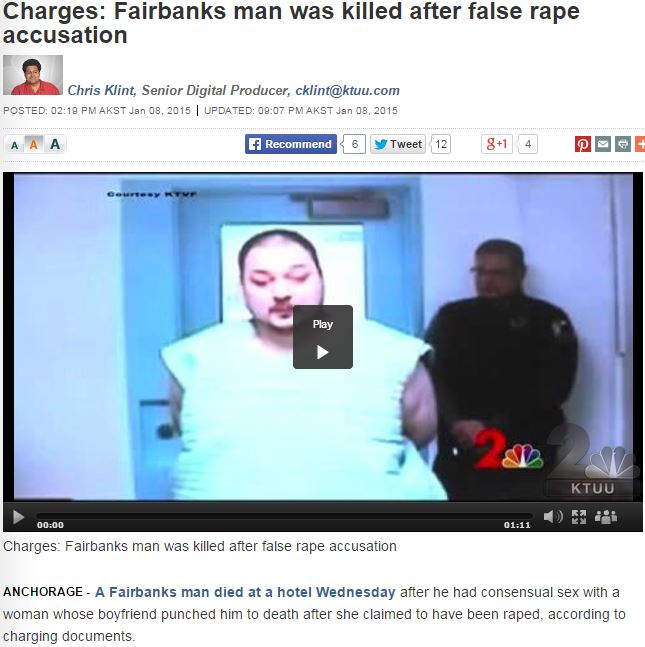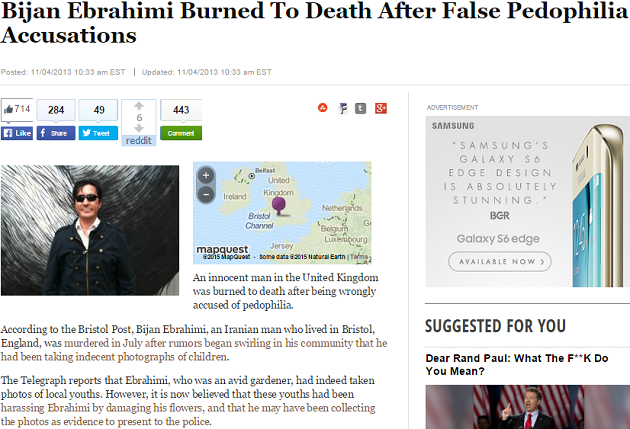
False Accusations and Murder: More Headlines about the Effects of Finger-Pointing and Legal Abuse

“[W]hy would someone lie about being sexually assaulted? What could be gained from that? Nothing, really.”

Tracie Egan Morrissey, Jezebel (Feb. 28, 2014)

The quotation above derives from a piece titled, “Rape, Lies and the Internet: The Story of Conor Oberst and His Accuser.” It’s spotlighted because it echoes the sentiment expressed by the writer of the prior post’s epigraph, who’s also a feminist and who betrays the same blindness.

What’s disturbing to the author of the blog you’re reading is that feminists who ask questions like Ms. Morrissey’s make a strong case for rape denial, because it might just as unreasonably be asked, “Why would someone sexually assault anyone? What could be gained from that?”

What could be “gained” from raping someone is the same thing that could be “gained” from lying about being raped—or lying about any number of other offenses: the exultation of control (i.e., power, dominance).

Other reasons for lying suggested by Ms. Morrisey’s own reportage are attention-seeking, self-aggrandizement, and mythomania. There have also been a number of publicized cases about false rape accusations’ being used for concealment of sexual infidelity. Two hyperlinks in this post lead to stories exemplifying this motive. Of course (and significantly), none of these motives applies exclusively to false rape claims. Besides avarice and malice, they’re common motives among false accusers (of all types). People hurt people…to hurt people. Appetites, least of all vicious ones, don’t answer to sense.

The previous post emphasized the emotional trauma of accusation, particularly false accusation, by highlighting a number of suicides reported in the news.

Suicide is a recognized consequence of bullying; name-calling and public humiliation are recognized as among the forms that bullying takes; and falsely branding someone a stalker, rapist, child abuser, or killer, for example, certainly qualifies as publicly humiliating name-calling.

Whether someone is disparaged on the playground, on Facebook, in a courtroom, or in the headlines makes absolutely no difference; the effect is the same, and it may be unbearable.

This stuff shouldn’t need to be pointed out to grown-ups. But since the fatal consequences of false accusation don’t support any dominant political agendas—and may undermine them—they’re ignored. That people are harried and hectored by lies, sometimes to death, is an inconvenient truth.

At least it is here. Many of the news clippings featured in the last post notably originate from the U.K., as do two of the clippings below. Journalism is far more balanced there, and it’s less taboo to call a jade a jade. A Jezebel reporter might denounce this as “misogynistic,”  but truth isn’t misogynistic; it’s just the truth, and it doesn’t play favorites (nor should its purveyors).

This post looks at the other lethal upshot of false accusation: murder. The stories that follow are about people who existed and now do not.

The point of introducing these stories isn’t to assert incidents like these are common; the point is to reveal the emotions that are inspired by false accusations, whether by women, by men, or by mobs. It’s also to reveal their consequences…writ large and lurid. These same emotions are aroused in cops and judges no less than they are in anyone else. False accusers know what reactions they can expect, and they know how to manipulate their audience—and bending others to do their will is thrilling.

Nothing makes the emotions provoked by accusation more manifest than when accusation inspires others to beat someone to death—or set him ablaze.

This is nevertheless typically lost on reporters and their viewers and readers. The details that are stressed and eagerly sought are who got it, and how. Why, which is always the more speculative aspect, is in its broader implications the most important one, however.

Gore is sexy. It’s what gets airplay and column space. It’s an attention-grabber and a ratings booster. Nothing draws the eye like the color red.

What sensation eclipses, though, is that for every false accusation that ends in red, thousands or hundreds of thousands end in gray, an interminable state of disquiet, disease, and dolor.

Copyright © 2015 RestrainingOrderAbuse.com

*Jezebel, if I’m remembering my Bible stories right, was a mass murderer who was condemned for promoting a false dogma. (Among her victims was a man she had judicially executed.)

STINKIER: Not Only Do the Courts Toss Most Restraining Order Petitions, a Lot of the Ones That Are Finalized Are Later Withdrawn by Their Petitioners

stinkier
A couple available rejection rates for restraining order petitions filed with the courts were scrutinized in the last post. Those rates, based on news reports out of Colorado (1998) and Connecticut (2014) were high: roughly 82% (lowball calculation) and 72%, respectively. That’s how many restraining order petitions may be denied or dismissed by our courts. They’re either rejected at first glance, or they’re preliminarily approved and then vacated on review.

They’re judged to be stinky.

Yesterday, I came across this: “Many abuse victims request protection orders then have them dismissed” (March 26, 2015). How many? Almost half (in the cited county, anyhow).

The headline and slant of the story pain me, and I’m compelled to comment on them before broaching the meat of the article.

Note that the typical journalistic bias is in evidence: accusers are termed “abuse victims.” This bias accounts significantly for why the bad odor of the restraining order process is obscured. It stinks, too—of Glade aerosol.

My criticism may seem cold—many accusers assuredly are abuse victims—but a journalist’s brief is to report what he’s investigated, and it’s a safe bet that the “many abuse victims” referenced in the headline aren’t people whose cases the writer looked into. At all. He assumes they’re “abuse victims,” apparently because why else would they have claimed to be?

This is smelly news reporting, and Journalism 101 urges a revision: “Many who are granted protection orders then have them dismissed.” There’s a difference, and the journalist who doesn’t discern that difference is in the wrong line of work.

The writer also begins his story with an account of a woman who’d obtained a protection order against her husband only to be subsequently shot to death by that husband. Then the reader is informed:

Though [the homicide victim] had not asked for her protection order to be dismissed, many other victims do and some of them end up coming back and asking for additional protection orders.

In other words, the reported tragedy has absolutely nothing to do with people who “request protection orders then have them dismissed.” I studied journalism in high school under the tutelage of a man who was the real deal, so lurid and careless journalism offends me.

What do we know from what’s related by Matt Elofson, the crime and courts reporter for Alabama’s Dothan Eagle? We know people apply for restraining orders, get them, and then reconsider (and sometimes re-reconsider). And we know that one person, who never reconsidered the restraining order she was granted, was fatally shot (possibly as a consequence of seeking the state’s protection). These are facts; the rest is rhetoric and specious connections, which are journalistic no-nos.

The reportage of Mr. Elofson’s that isn’t corrupt, however, is telling.

Roughly 40 percent of the petitions for protection from abuse filed in Houston County over the past year were dismissed upon request of the victim.

Houston County Circuit Clerk Carla Woodall said 223 petitions for protection from abuse were filed in Houston County from March 2014 to March of this year. She said 90 of the 223 petitions were later dismissed upon request by the victim.

For “victim,” substitute “petitioner” (pretend, in other words, that it’s a news story that’s been quoted) and then note that it says nearly half of orders that are approved and finalized are afterwards withdrawn by their petitioners.

Nearly half.

Here’s what a journalist (somewhere, someday) should observe: Most restraining orders are denied or dismissed by our courts, and an arresting proportion of those that aren’t denied or dismissed are withdrawn. That’s a whole lot of “sound and fury signifying nothing” except a whole lot of misery for a whole lot of accused people.

This, furthermore, ignores that a majority of orders that are approved and not withdrawn may be false.

We’re not allowed to call the restraining order process a farce, because—as Mr. Elofson reminds us—sometimes people who procure restraining orders are legitimately at risk.

How, though, does Mr. Elofson remind us that restraining orders are necessary and vital to the protection of women? He reminds us by citing an instance in which a restraining order may have gotten its petitioner killed.

Copyright © 2015 RestrainingOrderAbuse.com

Games That Kill: Sex, the “Justice System,” Accusal, Restraining Orders, and “the News”

“‘She likes playing the little mind games too,’ he remarked. ‘She’s not quite as innocent as she makes it out to be.’”

—A Texas man to the police, 16 hours before he killed his girlfriend and himself

The headline reads, “Texas man threatens girlfriend 7 times in a month, then kills her hours after she begs police for help.” The story, however, isn’t so cut-and-dried.

According to Raw Story reporter David Edwards,

33-year-old Heather Coglaiti went to the Corpus Christi Police Department (CCPD) to report that her on-again-off-again boyfriend, José Calderon, had threatened to hurt her, and had slashed her car tires.

While Coglaiti was speaking with officers, Calderon called her cellphone, and he agreed to come in to the station to give his side of the story.

That was February 2, 2015. Coglaiti and Calderon were dead less than a day later. Evidence confirms Calderon shot her, then himself.

“CCPD records showed incidents between the couple going back to January of 2014—including seven death threats and other incidents last month,” Raw Story reports.

It also reports these statements made by Mr. Calderon to the police on the 2nd:

“We’ve done this a lot through the whole two years. We go back and forth, we’ll fight like this and she knows I won’t punch her but she punches the hell out of me in the face and she’ll bite, do whatever,” he said.

“She said, ‘I’m so scared you’re gonna kill me,’” Calderon admitted during the interview. “I’ve never said that out of my mouth.”

“Never do I ever threaten this lady. Never,” he insisted. “I don’t know why she says this and that.”

Raw Story relates the facts, and it relates them almost as a news source should: objectively. Mr. Edwards, the reporter, might properly have said, however, of the “seven death threats and other incidents” (and earlier “incidents”) that they were “alleged” or “reported.” Plainly from Mr. Calderon’s statements to the police, he didn’t put any death threats on paper and sign them; he says he never made any at all. So “alleged death threats and other incidents” is what the journalist should have written (even at the risk of the story’s sounding less “raw”). The headline reports a “Texas man threatens girlfriend 7 times in a month, then kills her.” That the Texas man’s girlfriend is dead by his hand is forensically ascertainable, more or less; that the Texas man threatened his girlfriend seven times in a month is not.

This isn’t pettifoggery. Distinctions like this aren’t minor, and they betray how we interpret allegations: We believe they must be true. Objectivity, if not skepticism, though, is the journalist’s brief, not credulity.
Credulity is especially prone to kick in if it seems warranted by later circumstances, for example, a homicide. Nevertheless, there’s no tweezing out whether Ms. Coglaiti’s reports to the police were accurate, and there’s no knowing what influence they may have had on Mr. Calderon’s actions.

A murderer isn’t given the benefit of the doubt. Significantly, however, neither is anyone else. Accusations are taken at face value (particularly accusations of threats or violence made by women against men).

We discount the effect that allegation and scrutiny have on the mind, and discounting that effect may have cost a woman her life. Not only must it be acknowledged that “the system” failed to protect a complainant of fear; it must be owned that use and abuse of “the system” affects the mental state of the accused, as it may well have in this case.

It may be harsh to ask why a woman who had alleged she’d been threatened with death seven times in a month and who had reported other incidents to the police over the course of a year hadn’t relocated and changed her phone number. But the scrupulous thinker must wonder.

Dogma has it that it’s wrong to second-guess “the victim.” Who was or wasn’t a victim of what in this case, however, is probably something no one will ever conclusively know.

The scrupulous thinker must ask himself why a man who intended to commit murder would voluntarily submit to police questioning, and what might it suggest that he committed murder less than a day later?

Did he avert suspicion just long enough to carry out his fell plot, or was he pushed further than he could tolerate? One interpretation certainly jibes better with PC dogma. Is the former, though, really likelier than the latter?

Raw Story’s reportage ends:

At a press conference on Tuesday, CCPD officials said that they did all that they could do to protect Coglaiti under state and federal laws.

CCPD Criminal Investigative Division Captain Hollis Bowers explained that victims were often frustrated by the legal system.

“The law not only gives us authority, but it restricts our authority so the system works in a very methodical way,” Bowers said. “Victims need to understand that when [we] start to suggest that you leave your home or your job, it’s for immediate safety, not because the legal system needs that.”

He pointed out that an emergency protective order requires “a certain level of violence.”

“So a protective order can’t be—criminal mischief, for instance, will not reach a level where somebody can get a protective order,” Bowers noted. “It requires violence at a certain level. It is issued by a judge.”

Two things, finally, are worthy of remark. First, those who induce people to trust that “the system” may be relied upon to protect them from threat mislead them and may be to blame for harm they subsequently, if not consequently, come to. Second, if Mr. Calderon’s intentions were what they’ve been represented to be, the issuance of a “protective order” against him would probably have led to the same tragic end.

“The system” fails not because it isn’t stringent enough; it fails because the premises for its reasoning are bad.

Casualties like Ms. Coglaiti are eagerly offered up by advocates as corroborations that stiffer laws are required. The facts of her death and the value of her life are conveniently exploited, even as they’re conveniently forgotten.

Copyright © 2015 RestrainingOrderAbuse.com

Yes, Virgil, There Is a Santa Claus: In a Month, Not Only Has Feminism Received Stern Scrutiny from Distinguished Members of the Press…So Has the Press

This is what an anti-feminist looks like.

Feminism may not know it yet, but 2014 will mark the year when patrons whose sympathies it has enjoyed for decades stopped taking a knee.

There were intimations of a climate change last summer. An intrepid band of men’s rights activists staged an International Conference on Men’s Issues in June. Turnout was slim, MSNBC mocked its presenters, and its reverberations were seemingly minor. It nevertheless inaugurated a shift. People were talking back—and not just anonymously from behind cartoon avatars on blogs and in forums.

Women Against Feminism’s Tumblr page drew hundreds of submissions like the one above.

Results of a Time Magazine poll urged a ban on the the word feminist (until Time was bullied into begging feminists’ pardon and pulling the word from its list).

This week, things came to a head.

One of those lightning rod stories feminist advocates rally around, a November Rolling Stone article about a purported frat house gang rape, turned out to be sketchy at best, and besides being roundly criticized has started journalists questioning what they’ve been taking for granted.

Feminist attorney and writer Zerlina Maxwell opined in a Washington Post piece days ago that the Rolling Stone story’s failings shouldn’t deter “us” from continuing to accept allegations of sexual violence at face value. She, too, has been taken to task by her peers, many of whom are asking, “What do you mean ‘us’?”

Quite suddenly, denunciations of feminist excesses are emerging from other than fringe sources, which means they won’t be so easily discounted. Yesterday, Philip Terzian of The Weekly Standard panned the press for feeding into PC prejudices, and Bloomberg columnist Megan McArdle, bless her heart, produced an op-ed that ran Tuesday under the title, “You Can’t Just Accuse People of Rape.”

Next thing you know, writers will be saying you can’t just accuse people…period.

Copyright © 2014 RestrainingOrderAbuse.com


Judicial Impression Management: What Makes False Allegations “True” and True Allegations “False” (and Drives Victims of Procedural Abuses to Despair)

“Politics, corporate bullshit—it’s all the same game of impression management.”

House of Lies

What do political spin-doctoring, corporate PR, government-sponsored science, and judicial rulings have in common?

Each is about impression management, the selective representation of facts to create a composite “truth” that suits a particular set of social, political, and/or economic imperatives.

Pols and corporations engage in flimflam to win votes and increase profit shares. Science, too, seeks acclaim and profit, and judicial motives aren’t so different. Judges know what’s expected of them, and they know how to interpret information to satisfy expectations.

The general context of discussions on this blog is the issuance of restraining orders, an arena of law that receives little scrutiny either from within the system or from the public; there is no oversight. Judges are moreover licensed to rule according to their discretion, so their latitude for impression management is broad. Any set of facts or plausible fictions can be rendered damning with a little rhetorical footwork, which needn’t be subtle—skewed rulings more often suggest clog dancing than ballet.

Nobody’s paying attention anyhow, except to make sure judges are fulfilling their mandate to make government look good and keep special interest groups mollified.

Since judges can rule however they want, and since they know that very well, they don’t even have to lie, per se, just massage the facts a little. It’s all about which facts are emphasized and which facts are suppressed, how select facts are interpreted, and whether “fear” can be reasonably inferred from those interpretations. A restraining order ruling can only be construed as “wrong” if it can be demonstrated that it violated statutory law (or the source that that law must answer to: the Constitution). There are no “mistakes,” only the very exceptional “over-reach.”

The restraining order process is the product of lobbying by special interest groups (collectively called “feminism”), which have secured government favor in recent decades, and this favor has conditioned how judges manage impressions. Favoring special interest groups has translated into the investment of billions, which has directed trends in social science research (including monetarily), swayed public opinion, and besides conditioned police and judicial impulses and priorities, thereby determining how allegations ranging from harassment to violent and/or sexual assault are credited and acted upon by officers of the justice system.

A crude evolutionary précis (not necessarily chronological) might look something like this:

  • Feminism gets the nod;
  • legislation is passed enacting restraining orders;
  • further legislation is passed making them more stringent and punitive;
  • additional legislation is passed: domestic violence acts and statutes, stalking statutes, etc.;
  • the definition of “domestic violence” is broadened to be inclusive of almost anything that can be construed as “abusive” according to judicial discretion;
  • the Violence Against Women Act (VAWA) is passed;
  • a special office of the Justice Department is established;
  • billions of dollars of federal monies are doled out in the form of grants to police departments and the courts to beef up arrest policies and “train” judges and police officers how to interpret allegations of violence or merely “fear”;
  • and the popular press is enlisted, knowingly or not, to flak the whole business.

Impression management marks the standard operating procedure from top to bottom.

Feminism’s foot soldiers in the blogosphere and on social media, finally, spread the “good word,” and John and Jane Doe believe what they’re told—unless or until they’re torturously disabused of their illusions. Stories like those you’ll find here are often the stories of average people who’ve been publicly maligned and have maddeningly discovered that “the truth” is whatever the system chooses to enter into the record.
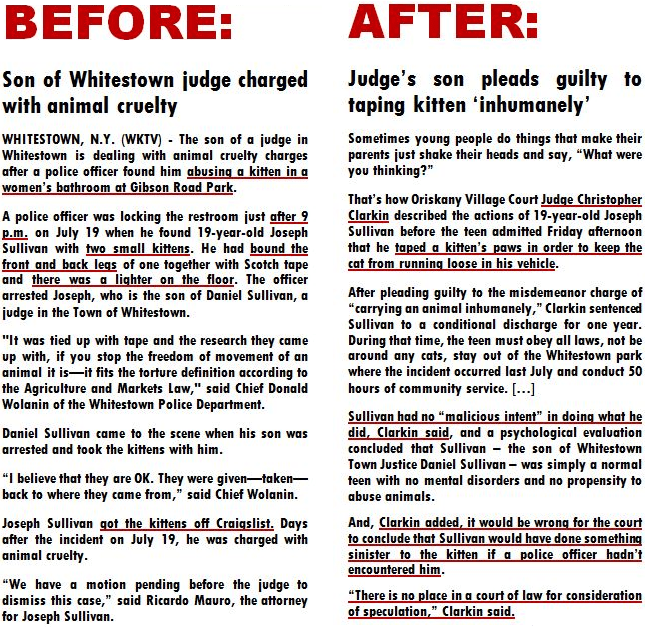
To conclude this abstract litany with a concrete illustration, consider these stories, published six months apart (“Son of Whitestown judge charged with animal cruelty” and “Judge’s son pleads guilty to taping kitten ‘inhumanely’”):

The difference you’ll detect between the two versions of the facts and how they’re interpreted exemplifies impression management.

Copyright © 2014 RestrainingOrderAbuse.com

What Journalists Need to Understand about What Restraining Orders Are: A Tutorial for Investigators, Part 2

“Orders for protection represent a legislative attempt to incorporate distinct features from both civil law and criminal law. On the one hand, a private litigant can initiate judicial proceedings to seek redress against another private individual. On the other hand, criminal penalties, such as fines and incarceration, will attach if a protection order is violated. Unlike both civil and criminal proceedings, protection order actions involve a great deal of informality, with the end result being an order for protection that is often issued on an ex parte basis without the benefit of a full evidentiary hearing.

“Many aspects of Nevada law in this area can best be described as ‘murky,’ with virtually no critical or scholarly study available to assist Nevada’s courts. Moreover, statistical information about protection orders in Nevada is almost non-existent.”

—Staff attorney Joe Tommasino, Las Vegas Justice Court

The first thing reporters need to grasp about restraining orders is that they’re a kluge (a Frankenstein’s monster crudely stitched together from dubiously compatible parts). For plaintiffs (accusers), they merge the most favorable aspects of civil and criminal prosecutions; for defendants, the least favorable.

The scales of justice are tipped from the start.

Restraining orders allow a “private litigant [to] initiate judicial proceedings to seek redress against another private individual” just as civil lawsuits do (though restraining order applications by contrast are typically processed free of charge). They’re also adjudicated according to the lowest civil standard of proof (“preponderance of the evidence”). State standards vary rhetorically, but the criterion for rulings is basically the same: whatever judges fancy is just (and there are only two choices—thumbs up or thumbs down).

On this basis, citizens can be rousted from their homes and kicked to the curb (and some are left destitute). On this basis, also, they may be entered into domestic violence registries (indefinitely), besides state and federal law enforcement databases (indefinitely), and denied security clearances, loans, leases, and even employment in certain fields (just like convicted felons).

Notwithstanding that restraining order allegations are introduced in civil court and aren’t subject to the criminal standard of evidence (“proof beyond a reasonable doubt”), “criminal penalties, such as fines and incarceration, will attach if a protection order is violated”—or is simply alleged to have been violated: arresting officers need only have a reasonable suspicion that a violation occurred, which they need not have witnessed.

The savvy observer will note that suspicion is the motive determiner of liability at all levels. Suspicion informs judicial disposition, subsequent police response to claims of violation, and of course interpretation by third parties, including employers (judges trust accusers, and everyone else trusts judges). Emphatically worthy of remark is that billions of dollars of federal monies have been invested over the past 20 years toward conditioning judicial and police suspicion.

This may incline the savvy observer to suspect the fix is in.

He or she should appreciate further that restraining orders are most commonly issued ex parte, which means accusers simply fill out a form and very briefly interview with a judge without defendants’ being present to contest the allegations and without their even being aware that they’ve been made. (Some courts even explicitly advise plaintiffs to rehearse their allegations so they can recite them as quickly as they would an order at a drive-thru.) Although most states mandate that a follow-up hearing be slated to give the accused an opportunity to controvert the allegations against them and receive an “unbiased” second opinion, follow-up hearings are held in the same court that prejudicially ruled against them in the first place: “We found you guilty. Go ahead and tell us why we screwed up. You have 15 minutes.” Because restraining order trials are civil proceedings, defendants aren’t provided with legal counsel. They’re nevertheless afforded only a few days (or a couple of weeks at the outside) to prepare a defense.

Returning to this post’s epigraph, here’s its author’s elaboration of the points it introduces (which apply irrespective of what a restraining order is called):

The concept of a “protection order” or a “TPO” is a curious one under the law. Unlike a criminal case, where the awesome power of the State is wielded against a private citizen, an action for a protection order allows one private citizen to invoke judicial authority directly against another private citizen.

The implications are staggering when one considers that a protection order allows individuals to trigger invisible force fields affecting the conduct, movement, speech, and legal rights of others.

Even more significant is the fact that Nevada law allows a person to obtain a protection order based upon only a brief ex parte application [as do most or all states’ laws].

From these concepts, questions immediately present themselves. Are protection orders being utilized in oppressive or unexpected ways? Are the factual scenarios involved similar to what the [legislature] envisioned them to be? Are courts utilizing protection order tools correctly? Are judges issuing ex parte orders that trample upon the rights of innocent people before a hearing is held to determine the validity of specific allegations? Is this area of the law an insufficiently regulated “wild frontier”?

Loyola Law School Prof. Aaron Caplan, in a 2013 law review article that cites the 2008 paper of Mr. Tommasino’s quoted in this post, says yes.

Many structural factors of civil harassment litigation lead to higher-than-usual risk of constitutional error. As with family law, civil harassment law has a way of encouraging some judges to dispense freewheeling, Solomonic justice according to their visions of proper behavior and the best interests of the parties. Judges’ legal instincts are not helped by the accelerated and abbreviated procedures required by the statutes. The parties are rarely represented by counsel, and ex parte orders are encouraged, which means courts may not hear the necessary facts and legal arguments. Very few civil harassment cases lead to appeals, let alone appeals with published opinions. As a result, civil harassment law tends to operate with a shortage of two things we ordinarily rely upon to ensure accurate decision-making by trial courts: the adversary system and appellate review.

The process essentially operates “in a vacuum”:

Harassment orders, when granted, are very rarely appealed. In the Justice Courts of Las Vegas in 2008, only three out of 2034 non-domestic violence petitions resulted in an appeal. No appellate court opinions interpret the Nevada statute—even though it was enacted in 1989 [that’s zero appellate court opinions in 20 years]. As a result, “the limited jurisdiction courts [of Nevada] have been operating in a vacuum and creating ad hoc, reactive solutions” to recurring problems.

The stagecoach, in other words, is steered without reins. The laxity of the statutes means judges of the lowest-tier courts call the shots, and there are no big brothers looking over their shoulders. They’re licensed to do what they want. (The quotations above refer to different types of restraining order, but the two types aren’t necessarily treated any differently. Whether a petitioned injunction is a protection order or a harassment order may only depend on which box was ticked on the application form. In most jurisdictions, what distinguishes one from the other is the nature of the relationship between the accuser and the accused. The allegations may be identical.)

The legislative insensitivity to constitutional principles and protections as well as the lack of judicial housekeeping in this area of law are beneath the perceptual threshold of the public. To the uninitiated, the absence of controversy originating from “legitimate” sectors suggests that everything’s working as it should: restraining orders are issued to dangerous people who need to be tethered.

While how commonly the process is exploited for ulterior motives is a matter of heated dispute, its availability for abuse is plain. The prevailing attitude toward allegations of rampant abuse is that if statistics can’t be adduced to support them, the complaint is irrelevant and should exercise no influence on policy reform. The absurdity of this attitude is likewise plain. The process is designed to favor accusers, judges are predisposed to credit accuser’s accounts (in part according to explicit instruction), those accounts need not be substantiated, the process is initiated and completed in hearings spanning minutes only, and (as the court attorney who wrote the epigraph notes) comprehensive statistical information about restraining orders is virtually non-existent.

The restraining order process is conducted in a black hole. There’s not only no transparency; there’s no light.

Copyright © 2014 RestrainingOrderAbuse.com

What Journalists Need to Understand about Restraining Orders and Their Abuse: A Tutorial for Investigators, Part 1

“Restraining orders give victims of domestic violence a tool to keep their abusers away or at least have them arrested if they come close. Anyone in a relationship with recent history of abuse can apply, and the order can be signed the same day.

“It gives victims the right to stay in the home and keep the kids. But the civil document relies on their abusers to respect the law.”

—“Are Restraining Orders False Security?(USA Today)

Reporters are often keen and eager detectives when there are two sides to a story, and they want to get to the bottom of things. When there aren’t clearly defined contestants with competing narratives, however, reporters are as prone as anyone else to swallow what they’re told.

The news story the epigraph was excerpted from was prompted by a recent murder in Oregon and explores the impotence of restraining orders, in particular to “stop bullets.” Just as shooting sprees inspire reporters to investigate gun legislation, murder victims who had applied for restraining orders that proved worthless inspire reporters to investigate restraining order policies. The presumption, always, is that the law failed.


The solution suggested by the story—the same solution that’s always suggested by such stories—is to beef up protocols and give the statutes more teeth.

What’s inevitably lost in considerations like this is that for every person who’s attacked or killed in spite of a restraining order, thousands, tens of thousands, or even hundreds of thousands of people face grave indignities and privations consequent to orders’ being used exploitatively (including public revilement, chronic harassment, criminal profiling, social alienation, and loss of employment, health, and access to kids, home, and property). This is a fact it seems journalists would only be given cause to confront if more victims of procedural abuse killed themselves.

Preferable, certainly, would be if reporters could be depended on to sniff out and censure injustice without anyone’s having to die.

Toward this end, this post encourages reporters to recognize what the quoted paragraphs that introduce it actually say. This is revealed by removing the obfuscating rhetoric. Replace the phrase victims of domestic violence with accusers, and replace their abusers with the accused.

Now consider the implications of the same paragraphs, slightly revised:

“Restraining orders give accusers a tool to keep the accused away or at least have them arrested if they come close. Anyone in a relationship…can apply, and the order can be signed the same day.

“It gives accusers the right to stay in the home and keep the kids….”

The mere substitution of factually accurate, unbiased labels changes the meaning of these paragraphs significantly, and brings their implications to the fore.

Now dare to think the unthinkable (as every factual analyst should) and replace the word accusers with the word liars and the phrase the accused with the phrase those lied about, and pare away a few more words.

“Restraining orders give liars a tool to keep those lied about away or have them arrested. Anyone in a relationship can apply, and the order can be signed the same day.

“It gives liars the right to stay in the home and keep the kids.”

The same two paragraphs, reconceived, say that a restraining order can be got by lying to the court, can be used to have someone arrested without warrant based on the report of the liar, can be had in a single day (without the accused’s even being given prior notice of the proceedings), and can be used to gain immediate and sole entitlement to a place of residence and immediate and sole custody of children.

Appreciate that there are no (enforced) penalties for lying, and suddenly the motives and opportunity for fraud—particularly against a target of malice—become plain.

Appreciate further that allegations made by restraining order petitioners aren’t subject to the criminal standard (“proof beyond a reasonable doubt”). Restraining order trials are civil adjudications, not criminal ones. The “standard of proof” applied is “preponderance of the evidence,” which means no certain substantiation of allegations ranging from nuisance to sexual assault is required. Approval of a restraining order isn’t a (literal) finding of guilt, per se. No proof of anything must be established.

People, including journalists, only see what they hear.

The truth of how conveniently and urgently restraining orders avail themselves as tools of abuse is right under the noses of everyone who writes about them. It just gets obscured by loaded words (victims and abusers, for example) and the images they excite. Blindness to these words’ unexamined assumptions is further reinforced by the hysteria aroused by a (single) sensational act of violence.

Principal among these unexamined assumptions is that everyone who claims to be a victim is a victim (according to which belief everyone who claims to be a victim is treated as a victim by the court—which every false claimant dependably anticipates).

Observing this by using a story about a tragedy shouldn’t seem callous, because (1) it’s in the wake of tragedies like the one reported in the referenced story that hysteria runs highest and completely eclipses critical scrutiny, and (2) it’s tragedies like the one reported in the referenced story that show that restraining orders, besides being excellent tools to realize spiteful or avaricious intentions, aren’t any good at doing the one thing that’s said to justify them: averting violence.

On the contrary, the story reports:

“For some people it’s more dangerous [to get a restraining order],” said Kim Larson, director for Marion County District Attorney Victim Assistance Division. “Sometimes it makes people really angry, getting served with a restraining order.”

This is especially true if the order is false. (Besides inspiring violent people to commit further violence, restraining orders may drive nonviolent people to lash out or even kill in desperation, particularly if they’ve been falsely accused, publicly excoriated, and deprived of all that gave their lives meaning.)

This isn’t rocket science. People lie, and when people lie about abuse, they do egregious and often irrevocable harm to those they falsely blame—who only very rarely kill themselves. No one looks beneath the surface, because they faithfully cleave to popular conceptions and reasonably assume that there are safeguards in place (due process and such) to ensure that allegations of abuse are properly vetted and substantiated.

Investigators shouldn’t assume.

Copyright © 2014 RestrainingOrderAbuse.com