A Word on Restraining Order Statistics and the Rate of False Restraining Orders

I responded to a paper published last year by law professor Kelly Behre, who took umbrage that so-called FRGs (father’s rights groups) were promulgating the statistic that 80% of restraining orders were frivolous or false. This conjectural statistic (60 to 80%) was, I believe, postulated by Save Services based on its studying available information, which is scant. I don’t know that the estimate is unimpeachable, but I don’t believe its authors ever asserted it was conclusive.

Speaking conclusively about figures like this is impossible. Even estimates of how many restraining orders are issued every year in the United States is speculative (and informed guesses I’ve read range from 900,000 to two or three million).

The posited “80%” statistic was seized upon by critics of the restraining order process and bruited broadly on the Internet. I published it myself, and this blog, accordingly, was cited in Prof. Behre’s paper as the product of an “FRG.” It’s actually the product of a single tired and uninspired man who knows that false accusations are made.

Is the statistic wrong? Who knows. Who can say, even, what such a statistic purports to refer to? Does it mean most restraining order petitions are false? Does it mean most temporary restraining orders are dismissed as insufficiently founded? Or does it mean most restraining orders that are finalized have bogus grounds?

There are three phases to the process. A petitioner files an application, which may be approved by a judge or may not be. If it’s approved (ex parte), a temporary order is issued. This order is then supposed to be subjected to review by another judge before being affirmed and made “permanent.” (The word permanent is misleading. A “permanent” order typically has a duration of one year—though, to compound the confusion, some orders may actually be permanent and never expire. What isn’t misleading is that the public record of a restraining order is permanent.)

Three phases: application, temporary order, “permanent” order—got that?

What people invested in exposing this travesty of justice must understand is that it’s possible an unknown (and significant) number of applications for restraining orders are rejected at the outset. Their petitioners are refused. Is this number recorded someplace? Maybe, maybe not. We’re a federation of states, and every one of those states has its own budget, recordkeeping practices, and priorities.

Perhaps even its individual courthouses do.

Putting aside the fact that the number of applications that are rejected may not be recorded, there’s also the question of how many orders are preliminarily approved by the court and then dismissed on review.

I recently quoted a statistic reported in The Denver Post: “In fiscal 1998, about 18,000 temporary and 3,300 permanent domestic-violence-related restraining orders were issued in Colorado counties.” This statistic itself suggests that over 80% of restraining orders are determined to be frivolous, flimsy, or false. It says that of some 18,000 initially approved (i.e., temporary) restraining orders, only a fractional 3,300 were found meritorious on review.

It says the “80%” statistic is, in one sense at least, right on the money, if not conservative.

If comprehensive statistics for all courts were available that showed how many restraining orders were petitioned, how many of those petitions were rejected outright, and how many of those petitions were rejected on review, the proper statistic for restraining orders determined to be unfounded or indefensible by the court might prove to be in the 90th-percentile range.

And that’s ignoring that a goodly number (and maybe a majority) of the restraining order petitions that “pass muster” and are affirmed by judges may themselves be based partly or wholly on BS claims.

Even what “false” may mean in respect to restraining order allegations is ambiguous. Does “false” mean misrepresentative of the truth, i.e., misleading? Does it mean inclusive of true and falsified allegations? Or does it mean fabricated wholesale, i.e., purely and maliciously untrue?

James Thurber: “It is better to know some of the questions than all of the answers.”

Copyright © 2015 RestrainingOrderAbuse.com

The Southern Poverty Law Center v. Betty Krachey: Why the Only Honest Voices in Discussions of Restraining Order and Related Procedural Abuses Are the Little Ones

This blog was inspired by firsthand experience with judicial iniquity.

Its author has never been accused of violence, doesn’t sanction violence except in self-defense or the defense of others, and has been a practicing vegetarian since adolescence. I have, what’s more, hazarded my life going to the aid of non-human animals. In one instance, I lost the use of my hand for a year; in another, I had various of my bones fractured or crushed, and that damage is permanent.

Although I’ve never been accused of violence (only its threat: “Will I be attacked?”), I know very well I might have been accused of violence, and I know with absolute certainty that the false accusation could have stuck—and easily—regardless of my ethical scruples and what my commitment to them has cost me.

Who people are, what they stand for, and what they have or haven’t done—these make no difference when they’re falsely fingered by a dedicated accuser who alleges abuse or fear.

This is wrong, categorically wrong, and the only arguments for maintenance of the status quo are ones that favor a particular interest group or political persuasion, which means those arguments contravene the rule of constitutional law.
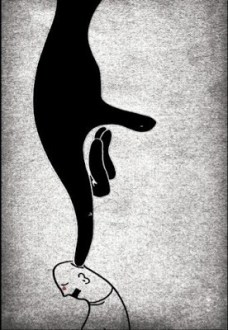
Justice that isn’t equitable isn’t justice. Arguments for the perpetuation of the same ol’ same ol’, then, are nonstarters. Dogma continues to prevail, however, by distraction: “a majority of rapes go unreported,” “most battered women suffer in silence,” “domestic violence is epidemic” (men have it coming to them). Invocation of social ills that have no bearing on individual cases has determined public policy and conditioned judicial impulse.

Injustice, no surprise, arouses animosity; injustice that confounds lives, moreover, provokes rage, predictably and justly. This post looks at how that rage is severed from its roots—injustice—and held aloft like a monster’s decapitated head to be scorned and reviled.

I first learned of the Southern Poverty Law Center (SPLC) from a research paper published by Law Professor Kelly Behre this year that equates men’s rights activism with hatemongering. I later heard this position of the SPLC’s reiterated in an NPR piece about the first International Conference on Men’s Issues.

Injustice, it should be noted preliminarily, is of no lesser interest to women than to men. Both men and women are abused by laws and practices purportedly established to protect women, laws and practices that inform civil, criminal, and family court proceedings.

Groups like the SPLC, however, represent opposition to these laws and practices as originating strictly from MRAs, or men’s rights activists, whom they dismiss as senseless haters. This lumping is characteristic of the smoke-and-mirrors tactics favored by those allied to various women’s causes. They limn the divide as being between irrationally irate men and battered women’s advocates (or between “abusers” and “victims”).

They don’t necessarily deny there’s a middle ground; they just ignore it. Consequently, they situate themselves external to it. There are no women’s rights activists (“WRAs”?) who mediate between extremes. They’re one of the extremes.

I’m a free agent, and this blog isn’t associated with any group, though the above-mentioned law professor, Dr. Behre, identifies the blog in her paper as authored by an “FRG” (father’s rights group), based on my early on citing the speculative statistic that as many as 80% of restraining orders are said to be “unnecessary” or based on false claims, which may in fact be true even if Dr. Behre finds the estimate unscientific. (Survey statistics cited by women’s advocates and represented as fact are no more ascertainably conclusive; they’re only perceived as more “legitimate.”)

SAVE Services, one of the nonprofits to cite a 2008 West Virginia study from which the roughly 80% or 4-out-of-5 statistic is derived, is characterized by the SPLC and consequently Dr. Behre as being on a par with a “hate group,” like white supremacists. It isn’t, and the accusation is silly, besides nasty. This kind of facile association, though, has proven to be very effective at neutering opposing perspectives, even moderate and disciplined ones. Journalists, the propagators of information, may more readily credit a nonprofit like the SPLC, which identifies itself as a law center and has a longer and more illustrious history, than it may SAVE, which is also a nonprofit. The SPLC’s motto, “Fighting Hate • Teaching Tolerance • Seeking Justice,” could just as aptly be applied to SAVE’s basic endeavor.

On the left is a symbol for the Ku Klux Klan; on the right, the symbol for feminist solidarity. The images have common features, and their juxtaposition suggests the two groups are linked. This little gimmick exemplifies how guilt by association works.

The SPLC’s rhetorical strategy, an m.o. typical of those with the same political orientation, is as follows: (1) scour websites and forums in the “manosphere” for soundbites that include heated denunciations and misogynistic epithets, (2) assemble a catalog of websites and forums that espouse or can be said to sympathize with extremist convictions or positions, and (3) lump all websites and forums speaking to discrimination against men together and collectively label them misogynistic. Thus reports like these: “Misogyny: The Sites” and “Men’s Rights Movement Spreads False Claims about Women.”

Cherry-picked posts, positions, and quotations are highlighted; arguments are desiccated into ideological blurbs punctuated with indelicate words; and all voices are mashed up into a uniform, sinister hiss.

The SPLC’s explicit criticism may not be unwarranted, but coming as it does from a “law center” whose emblem is a set of balanced scales, that criticism is fairly reproached for its carelessness and chauvinism. There are no qualifications to suggest there’s any merit to the complaints that the SPLC criticizes.

The SPLC’s criticism, rather, invites its audience to conclude that complaints of feminist-motivated iniquities in the justice system are merely hate rhetoric, which makes the SPLC’s criticism a PC version of hate rhetoric. The bias is just reversed.

Complaints from the “[mad]manosphere” that are uncivil (or even rabid) aren’t necessarily invalid. The knee-jerk urge to denounce angry rhetoric betrays how conditioned we’ve been by the prevailing dogma. No one is outraged that people may be falsely implicated as stalkers, batterers, and child molesters in public trials. Nor is anyone outraged that the falsely accused may consequently be forbidden access to their children, jackbooted from their homes, denied employment, and left stranded and stigmatized. This isn’t considered abusive, let alone acknowledged for the social obscenity that it is. “Abusive” is when the falsely implicated who’ve been typified as brutes and sex offenders and who’ve been deprived of everything that meant anything to them complain about it.

Impolitely. (What would Mrs. Grundy say?)

There’s no question the system is corrupt, and the SPLC doesn’t say it isn’t. It reinforces the corruption by caricaturing the opposition as a horde of frothing woman-haters.

Enter Betty Krachey, a Tennessee woman who knows court corruption intimately. Betty launched a website and e-petition this year to urge her state to prosecute false accusers after being issued an injunction that labeled her a domestic abuser and that she alleges was based on fraud and motivated by spite and greed. Ask her if she’s angry about that, and she’ll probably say you’re damn right. (Her life has nothing to do with whether “most battered women suffer in silence” or “a majority of rapes go unreported,” and those facts in no way justify her being railroaded and menaced by the state.)

I made this website to make people aware of Order of Protections & restraining orders being taken out on innocent people based on false allegations so a vindictive person can gain control with the help of authorities. The false accusers are being allowed to walk away and pay NO consequences for swearing to lies to get these orders!  […]

I know that, in my case, the judge didn’t know me. Even though I talked to the magistrate the day BEFORE the order of protection was taken out on me & I told him what I heard [he] had planned for me. They didn’t know that I might have superpowers where I could cause him bodily harm 4 1/2 miles away. SO they had no choice but to protect [him] from me. BUT when they found out this order of protection was based on lies that he swore to, and he used the county in a cunning and vindictive way to get me kicked out of the house – HE SHOULD HAVE HAD TO PAY SOME CONSEQUENCES INSTEAD OF BEING ALLOWED TO WALK AWAY LIKE NOTHING HAPPENED!!!!

Seems like a fair point, and it’s fair points like Betty’s that get talked around and over. There are no legal advocates with the SPLC’s clout looking out for people like Betty; they’re busy making claims like hers seem anomalous, trivial, or crackpot.

Copyright © 2014 RestrainingOrderAbuse.com

*Betty reports she’s been in conference with one of her state’s representatives and has been told she has “a good chance at getting this law changed,” albeit too belatedly to affect her own circumstances. Says Betty, “I still want the law changed to hold false accusers accountable!” Amen to that.

Stepford Syndrome: Why Feminist Rape Rhetoric Is Both Tiresome and Disturbing (and How It Hurts Not Only Men, but Women, Too)

“A U.S. law professor, who will be speaking at the Commons, said the UK’s stance on false allegations [of rape] is more aggressive than in countries such as the United States, Canada, and Australia. Prof. Lisa Avalos, of the University of Arkansas, said false allegations in the U.S. were dealt with as a misdemeanour offence, not a felony—and most women were not jailed if found guilty.

“‘In the course of my research, I have not found any country that pursues these cases against women rape complainants in the way the UK does. The UK has an unusual approach, and I think their approach violates human rights,’ she said.”

The Guardian (December 1, 2014)

This quotation about rape “complainants” is drawn from a story that appeared in The Guardian this week (“109 women prosecuted for false rape claims in five years, say campaigners”), a story that’s mirrored on a number of other sites, including Jezebel.com and Salon.com.

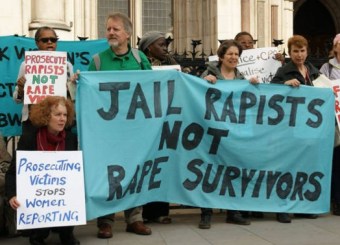
Picketers object to the prosecution of 109 British women in recent years for perverting the course of justice by falsely alleging rape. According to the protesters’ signs, all female accusers are “victims” and “rape survivors,” and the men they accuse are all “rapists” (ipso facto).

The story concerns outrage expressed by activist representatives of the charity Women Against Rape, or WAR, whose assertions require no elucidation; they’re clockwork.

Whether WAR’s outrage has merit is difficult to discern.

Obviously lost in the uproar, however, is what the (female) American law professor who’s quoted in the epigraph actually says, which is this: Falsely accusing someone of rape in the United States is merely a misdemeanor offense and one for which an accuser is rarely punished and may never be prosecuted at all.

This fact isn’t perceived as unfair by feminist activists—far from it. It’s touted, rather, as a reason why it’s a “human rights violation” for the United Kingdom to mete out sterner justice.

This writer, for one, would be more sympathetic to the denouncements of WAR if there were any headline-grabbing activist groups tabulating how many men are arrested and/or prosecuted each year for being falsely accused of rape.

In the fictional community of Stepford, all the women have been replaced by robots whose responses are programmed.

Even allowing that the 2 to 8% false allegation rate commonly cited by feminists were true (and it isn’t), the number of men falsely accused of rape is many times greater than the number of women prosecuted for false allegations, in the UK and everywhere else (for analysis of the rate of false allegations of rape, see Cathy Young’s 2014 Slate.com article, “Crying Rape: False rape accusations exist, and they are a serious problem,” and Emily Bazelon and Rachel Larimore’s 2009 piece, “How Often Do Women Falsely Cry Rape?” published in the same outlet).

Feminist outcry is reflexive, even arguably robotic, and invariably insensitive to male victimization. The argument that a majority of rapes goes unpunished in no way (logically, morally, or otherwise) excuses the unjust implication or punishment of even a single person, ever.

Besides being insensitive to male victimization, moreover, feminists evince no awareness that women, too, are victimized by their furor’s trickle-down effect. Feminists’ making an international case of the prosecution of 109 women works a very real influence on how rulings on charges “lesser” than rape are formed by the courts—charges made in restraining order, stalking, domestic violence, and related cases—and the defendants in these cases are far from exclusively men.

False allegations made against women in prosecutions involving or implying violence may only be a fraction of those made against men, but with those prosecutions’ numbering in the millions each year, that fraction is hardly inconsiderable and easily dwarfs a figure like 109. To posit, as activist groups like WAR tacitly do, that accusers’ allegations should be credited on faith means a lot of women (globally) will continue to be falsely implicated or punished based on judicial impulses that have been conditioned by feminist rhetoric. Much of the “social science” that’s used to “train” judges how to rule in prosecutions predicated on allegations of violence or the fear of violence is inspired by groups like WAR.

To illustrate how feminists’ gears turn (and why those gears need retooling), contemplate this letter printed in The Guardian recently that was composed by a 21-year-old man who was accused of rape as a boy: “A letter to…the girl who accused me of rape when I was 15.”

Now consider this steely response to it by Lucia Osborne-Crowley published almost simultaneously (buzz…whir…click) on WomensAgenda.com: “Why did the Guardian publish this letter about false rape accusations?

Need any more really be said?

Copyright © 2014 RestrainingOrderAbuse.com

Retracting False Allegations to the Court

Apologies are offered upfront to the reader expecting a tutorial on how to recant false testimony (though here is an explication about how a restraining order may be dismissed by a petitioner who has reconsidered).

The reason this post must disappoint is that to withdraw false allegations would be to confess to lying to the court and would, as well, be to require that the court acknowledge it was snookered. Hence is copping to lies a doubly taboo subject.

A thorough scouring of the Internet for a simple how-to on retracting false allegations to the court will reward an earnest inquirer with virtually nothing.

The fact is that in America, Land of the Brave Knave, the most fundamental legal precept is admit nothing. Application of that precept apparently extends to the court itself, whose officers may practice moral contortionism sooner than own on record that lies are ever detected.

Their reflex, when no amount of revision can redeem a false allegation, is to talk around it or reach for a nonjudgmental word like unfounded or baseless. Complainants never lie; at worst, they err.

The question remains, however, of how “errant” testimony may be retracted.

This writer proposes that since judges provide false accusations with the agency to work their pernicious effects on untold people’s lives, a judge should be the one to fill the informational void presently under consideration.

The judicial impulse to frame rulings according to personal conceptions of “right behavior” must surely reject the qualification of lying as conscionable conduct. Arrogating to themselves the right to prescribe rules for how others should behave, besides, presumes judges have faith in their intelligence. They must therefore know false accusations are made even if it’s against policy to say so. It’s not for nothing, after all, that statutes nominating perjury a crime exist.

Since only ignorant people could innocently deny lying occurs, and since we’ve established judges don’t regard themselves as ignorant, to them is this question humbly put: “How may false allegations to the court be simply taken back?”

Copyright © 2014 RestrainingOrderAbuse.com

J’s Story: Restraining Order Abuse and the “Dreaded Crazy”

J, a single dad who lives in Texas with his two kids, submitted his story as a comment to the blog in September, prefacing it: “I am writing this to share [it] with the rest of my fellow male victims [who] fall in with the dreaded Crazy.”

The “dreaded Crazy” in J’s case manifested as an Arkansas woman J began a romance with online, a high-conflict person whom a clinician might diagnose with borderline personality disorder (BPD).

(For an elucidation of BPD, see psychologist Tara Palmatier’s “In His Own Words: Dangerous Crazy Bitch Ahead,” which chronicles a case similar to J’s. See also any of Dr. Palmatier’s detailed explications of personality disorders.)

Here’s J’s story in his own words (lightly edited):

I met a beautiful, sexy, well-educated woman online. We met in person, and I was smitten. We shared our life stories with each other and began to see each other more. Although she lived over 500 miles away with her two children, I visited her every chance I could.

Her past was fraught will evil men who had taken advantage of her. She told me she was a young widow and that her first husband died suddenly of heart failure at a very early age, leaving her and her first child all alone. She said she remarried shortly after and had her second child. Unfortunately the second husband turned out to be a quite the carouser and left suddenly for Europe to be with another woman.

I felt so bad for her. I had two children of my own as a single father, so I was able to connect with how hard it was. She told me how she loved children and had always wanted a big family. She lamented feeling that her own family had deserted her, shunning her because she wasn’t a devout Christian.

There were so many twists and turns to her story. How could all this happen to such a wonderful and beautiful woman? She was such a nice and giving person….

Because it was all complete bullsh*t.

I won’t go into the details of my awakening. Let’s just say dates didn’t match up. Her kids’ (Fruit Loops’) stories didn’t match up. As a matter of fact, just about everything she told me didn’t match up. But I was smitten. So this went on for a long time until one day I just flatly called her on it. Suddenly my little scoop of heaven turned into a raging, clawing, screaming harpy. She accused me of being like every other son of a bitch in her life. Then she was swinging at me and screaming at me to get out.

I was already sprinting backwards, car keys in hand, toward my car. I got inside and sped off as she was chasing me. I was outta there, heading back to Texas never to return.

I did not see, speak, or talk to that woman again for over six months. Then one day a constable walks into my office and says, “Are you so-and-so?” I said yes. “Well, I have a restraining order for you from Arkansas.” Confused, I took it and read it. The constable then said as he was leaving, “I normally don’t read those. But looks like one crazy bitch to me. Better stay away. Ha-ha. Have a nice day.”

I was blown away.

The order claimed that I had snuck inside her house the weekend prior and forced her to call some other guy to tell this other guy (whom I don’t know, never met or heard of) that she was madly in love with me. Then her statement said I “roughed [her] up” then vanished into the night. Damn I was stunned. I did not know what to do. The order stated that I had 14 days to show up in Arkansas! I wasn’t even there. I lived in another state! I had not seen or heard from this woman in six months!

So I called an attorney friend of mine. He jokingly asked, “Did you do it”? I replied, “Hell no!” He then asked me to fax over the order. After he reviewed it, he called back and said, “Yep, it’s a restraining order, and you have 14 days. In the meantime, you have to stay away from her and her children.”

I replied, “This is bullsh*t! What if I just ignore it?” He said, “Well, if you ignore it and don’t show up in court on that day, you will automatically be found guilty. The charge will stay on your record, and you may not be able to buy a firearm.” “What the f—!” I yelled. “Can’t you just send a letter to the court explaining I wasn’t there and live 500 miles away?” He said no. “If you want to fight the charge, you have to show up.” He said he would have gone for me but wasn’t licensed in Arkansas.

He gave me the number of an attorney friend who worked in Little Rock. Next thing I knew, I’m having to fax or email every record I kept that shows my whereabouts on that day: gas receipts, store receipts, etc. I had to get a list of movies that I watched from the video download company we use. Cell phone calls. Text messages. (By the way, they really do monitor those. They can pinpoint your exact location, but you have to send a written request.) All of this to prove I was not there. Once I gave that attorney everything, he told me he would go to court that day and ask for an extension of 60 days. And I would still have to show up in Arkansas. Sh*t!

I cannot express the worry I endured during this time. Here I was falsely accused of something I did not do and was guilty until I proved otherwise in another state!

Prior to my court date, the attorney hired a private detective to run police reports on this woman’s current and former addresses. All you really have to do is call the local police department, and for a small copy fee it will give you all of the police reports related to a specific address for a specified time period. It’s really quite easy to do.

I was shocked when I saw them.

This woman, over a period of five years, had called the police over 20 times between two different addresses claiming either an assault or attempted break-in. All the police reports were noted as unfounded. One was a claim of rape. On that claim, she took some poor guy all the way to a grand jury, which promptly dismissed it. (Grand jury decisions are sealed, but the defendant’s name and attorney were listed. My attorney called that guy’s attorney and got a few details.)

The file on her sordid past was pretty thick. I thought that this was going to be over. Nope! I couldn’t use this information in court. It didn’t pertain to this incident. It was still her word against mine.

The day of the court hearing came. I drove out of state to be there. She actually showed in up in court that day. I suspect she didn’t expect I would show. The judge called out our docket. She sat on one side of the courtroom. My attorney and I sat on the other.

Seconds before the hearing, my attorney asked to briefly speak just to the prosecutor. They met in front of the bench, and my attorney handed him the file with prior police reports and my receipts and information as to my whereabouts on the day in question. The prosecutor then asked the judge if he could take a few minutes with the plaintiff. The prosecutor walked over to her with the file and whispered in her ear as he let her review the contents of the file. You could see the blood drain from her face. She whispered something to him. The prosecutor then stood up and said, “Your Honor, the plaintiff requests to withdraw her charge.” The judge just laughed and said, “Case dismissed.” That was it. It was over, no questions asked: $3,800 bucks and a long drive back home.

I did return to the local sheriff’s office and file an amended police report to state I was falsely accused and the case was dismissed on this date. You can have the dismissal form put in the police record.

I also had a cease-and-desist letter drafted by my attorney stating basically, “Don’t ever do this again, or I will sue you for liability.” You can put that in the police record, as well.

I had a copy of that letter sent to her by certified mail. I also had a copy personally delivered to her place of work by the same investigator who ran the background check. He went to her office and told the receptionist that he had a “special delivery” letter for her and that he needed to deliver it in person.

The receptionist called her to the front office. When she did, the investigator introduced himself and informed her that he had a letter to present. He pulled the letter out and proceeded to read the cease-and-desist letter out loud to her in the crowded waiting room. Then he handed it to her and left. He reported back that she appeared to have been in shock.

That’s it. Haven’t heard from her to date.

Copyright © 2014 RestrainingOrderAbuse.com

Interminable Indeterminacy: How False Allegations on Restraining Orders May Be Worse than False Allegations of Rape


Journalists who recognize the harm of facile or false allegations invariably focus on rape. This ignores the harm done to women by false allegations, of course, and shows ignorance, besides, of a significantly more fertile yet equally damaging source of wrongful prosecutions: the civil restraining order.

Unarguably there are few miscarriages of justice worse than when rape is falsely alleged and the victim of the false accusation is nevertheless found guilty. That’s a life brutally scarred or ruined for absolutely nothing—and ruined not by a lone malefactor but by the state itself.

Most negative commentary on rape allegations, though, focuses on cases where the evidence is less than conclusive or is found to be utterly false.

Just as there’s no quantifying the effects of being raped, there’s no quantifying the effects of being falsely accused of rape. The stigma is devastating, and public sympathy is nevertheless scant. Even online support groups for victims of false allegations of rape may be accessible to screened subscribers only, so distrustful and averse to scrutiny are the men who are maligned this way.

If, however, an allegation of rape is officially determined baseless, its victim has at least the solace of being able to say so. This hardly dispels the psychic effects, but it does mitigate external ramifications, like access to jobs.

False restraining orders, in contrast, often aren’t discerned as false (and restraining orders may be awarded in spite of false allegations’ being detected), and the consequences their recipients must live with are more than psychological. The damning records are preserved indefinitely. In some regions (like Massachusetts), to merely be accused of domestic violence in an ex parte civil court procedure is to be recorded in a state registry as a violent offender. Even if claims are later dismissed when the accused is given an opportunity to defend him- or herself, that is, even if a judge later recognizes on record that s/he’s “innocent,” s/he’s still “guilty” according to the system, and “guilty” is all a background check will reflect.

The implications of restraining orders, what’s more, are generic. There’s no specific charge associated with them. They’re catchalls that categorically imply everything sordid, violent, and creepy. They most urgently suggest stalking, violence, and sexual deviance.


Rape, it should be noted, may be among the actual allegations made by a restraining order applicant—and unlike in a criminal trial, a judgment grounded on such an allegation, amid others, may be affirmed in spite of the allegation’s merits’ never having been assessed.

Restraining orders don’t determine anything. The procedures from which they issue are too accelerated and loosey-goosey to be conclusive.

That no punishment attends the issuance of a restraining order is a tacit acknowledgment by the state that it may be based on nothing more substantive than hearsay and innuendo, and that its implications should be discounted.

They aren’t discounted, though. They’re regarded just as gravely in some respects as felony sentences. Restraining order recipients are denied jobs, leases, and loans. Some are prohibited from working with or around children—and even from attending their own children’s school events (sometimes based on accusations they’re never granted the practicable opportunity to contest in court—and always based on accusations they’re at most given a few minutes to controvert, typically without benefit of legal counsel).

Restraining order rulings are inevitably sketchy at best. They’re indeterminate but nevertheless treated as decisive—and they never go away.

“On the force of the plaintiff’s testimony, the court concludes it’s a crocodile.”

Victims of false rape allegations are socially disgraced and alienated, and psychologically tormented. Victims of false restraining orders may be, too, and besides may lose everything of value to them or have it taken from them by the state. People report spending as much as $100,000 or more to defend themselves in protracted litigations whose seed was an accuser’s filling out some paperwork and having a few-minute chinwag with a judge. They report losing their homes, becoming estranged from their children, and being permanently barred from employment in their fields of qualification and expertise.

Negative associations that attend a charge of rape are unquestionably more sensational and severe than those that accompany the issuance of a restraining order, but on balance the lived consequences of a restraining order may be comparable if not worse.

False allegations of rape should emphatically be called out by reporters to check the impulse that prevails today to credit finger-pointing as fact (particularly finger-pointing by women). Because the implications of rape are so loud and urgent, revelations of false allegations are loud and urgent, too. They arouse consciousness and conscience.

The question that they should stimulate and have yet to, however, is that if people will lie about rape, what won’t they lie about and what quieter and subtler lies and their consequences are being overlooked?

Exposure in the press would indicate that newsworthy instances of dubious or false allegations of rape are few. The problem with giving exclusive attention to them is that it hides more than it reveals.

The cancer of false allegations is far more advanced and widespread.

Copyright © 2014 RestrainingOrderAbuse.com

“Predator” v. “Porn Star”: Restraining Order Fraud, False Allegations, and Suing for Defamation

destroyPeople falsely alleged to be abusers on restraining order petitions, particularly men, are treated like brutes, sex offenders, and scum by officers of the court and its staff, besides by authorities and any number of others. Some report their own relatives remain suspicious—often based merely on finger-pointing that’s validated by some judge in a few-minute procedure (and that’s when relatives aren’t the ones making the false allegations).

The social alienation and emotional distress felt by the falsely accused may be both extreme and persistent.

The urge to credit accusations of abuse has been sharpened to a reflex in recent decades by feminist propaganda and its ill begot progeny, the Violence Against Women Act. No one thinks twice about it.

Using four-letter words in court is strictly policed. Even judges can’t do it without risking censure. Falsely implicating someone, however, as a stalker, for example, or a child molester—that isn’t policed at all. Commerce in lies, whether by accusers, their representatives, or even judges themselves is unregulated. No one is answerable for sh* s/he makes up.

Accordingly, false allegations and fraud are rewarding and therefore commonplace.

It should be noted that false allegations and fraud can be distinctly different. For example, David Letterman famously had a restraining order petitioned against him by a woman who was seemingly convinced he was communicating to her through her TV, and her interpretations of his “coded messages” probably were genuinely oppressive to her. David Letterman lived in another state, had never met her, and assuredly had no idea who she was. Her allegations of misconduct weren’t true, but they weren’t intended to mislead (and the fact that they did mislead a judge into signing off on her petition only underscores the complete absence of judicial responsibility in this legal arena).

Fraud, in contrast, is manipulative and deceptive by design. It occurs when an accuser intentionally lies (or spins the facts) to give a false impression and steer a judge toward a wrong conclusion that serves the interests of the fraudster.

Regardless, though, of whether false allegations are made knowingly or unknowingly, they’re rarely discerned as false by the court, are seldom acknowledged as false even if recognized as such, and are always destructive when treated as real, urgent, and true, which they commonly are.

The falsely accused (often private citizens who’ve never had a prior brush with the law) are publicly humiliated and shamed, which by itself is predictably traumatizing. They are besides invariably (and indefinitely) entered into police databases, both local and national, and may be entered into one or more domestic violence registries, too (also indefinitely). These facts pop up on background checks, and defendants in some states may even appear in registries accessible by anyone (including friends, neighbors, family members, boy- and girlfriends, employers, colleagues, students, patients, and/or clients).

This costs the falsely accused leases, loans, and jobs (being turned down for which, of course, aggravates the gnawing indignity and outrage they already feel). Those falsely accused of domestic violence may further be prohibited from attending school functions or working with or around children (permanently). Defendants of false restraining orders may besides be barred from their homes, children, assets, and possessions. Some (including salaried, professional men and women) are left ostracized and destitute. Retirees report having to live out of their cars.

This, remember, is the result of someone’s lodging a superficial complaint against them in a procedure that only requires that the accuser fill out some paperwork and briefly talk to a judge. A successful fraud may be based on nothing more substantive, in fact, than five “magic” words: “I’m afraid for my life” (which can be directed against anyone: a friend, a neighbor, an intimate, a spouse, a relative, a coworker—even a TV celebrity their speaker has never met).

This incantation takes a little over a second to utter (and its speaker, who can be a criminal or a mental case, need not even live in the same state as the accused).

Accordingly, people’s names and lives are trashed—and no surprise if they become unhinged. (Those five “magic” words, what’s more, may be uttered by the actual abusers in relationships to conceal their own misconduct and redirect blame. That includes, for example, stalkers. Those “magic” words may also be used to cover up any nature of other misbehavior, including criminal. They instantly discredit anything the accused might say about their speakers.)

The prescribed course of action to redress slanders and libels is a defamation suit, but allegations of defamation brought by those falsely accused on restraining orders or in related prosecutions are typically discounted by the court. Perjury (lying to the court) can’t be prosecuted by a private litigant (only by the district attorney’s office, which never does), and those who allege defamation are typically told the court has already ruled on the factualness of the restraining order petitioner’s testimony and that it can’t be reviewed (the facts may not even be reviewed by appellate judges, who may only consider whether the conduct of the previous judge demonstrated “clear abuse of discretion”). The plaintiff’s testimony, they’re told, is a res judicata—an already “decided thing.” (Never mind that docket time dedicated to the formation of that “decision” may literally have been a couple of minutes.)

So…slanders and libels made by abuse of court process aren’t actionable, slanders and libels that completely sunder the lives of the wrongly accused, who can’t even get them expunged from their records to simply reset their fractured lives to zero.

Such slanders and libels may include false allegations of stalking, physical or sexual aggression, assault, child abuse, or even rape. In the eyes of the court, someone’s being falsely implicated as a monster, publicly and for life, is no biggie.

In contrast, it was reported last month that the court awarded a Kansas woman $1,000,000 in a defamation suit brought against a radio station that falsely called her a “porn star.”

When violated people speak of legal inequities, this exemplifies what they’re talking about: Falsely and publicly implicating someone as a sex offender is fine and no grounds for complaint in the eyes of the justice system, but for the act of falsely and publicly calling someone a mere sex performer, someone may be fined a million bucks.

Copyright © 2014 RestrainingOrderAbuse.com

How It Serves Political Interests to Issue Restraining Orders Falsely

Under the Violence Against Women Act (VAWA), some $10 billion has been invested over the past 20 years in procedures meant to redress violence against women, and restraining orders are the centerpiece of a host of related legislative measures.

The truth is restraining orders can’t prevent violence; they’re just pieces of paper. Their only value is rhetorical (they influence). They put defendants on notice, and they make it look like the government is protecting people.

When defendants are falsely blamed, their (isolated) protests are seldom registered or credited by others. Because their complaints are discounted or disregarded, they don’t tarnish the court’s image or inspire the press to investigate.

At the same time, it serves the court’s interests when defendants are falsely blamed. The greatest likelihood that an order of the court will appear to have averted violence is realized when that order is issued to someone who was never a threat at all.

Put another way, if the court only issued restraining orders to volatile people, it’s a fair bet that a discomforting percentage of orders would be violated, and the negative statistics would urgently disclose their ineffectiveness as deterrents.

Issuing a majority of restraining orders to people who pose little or no violent threat, contrariwise, ensures violations will be fewer and less consequential by and large. Negative figures, like murders, are thereby minimized, and the process appears to live up to its promise of insulation.

All of this is to say that if you issue 60 restraining orders against nonviolent people to every one issued against a violent aggressor, violations of restraining orders resulting in injuries or death will be comparatively few respective to the total number of people “restrained.” It skews the odds in favor of positive perception.


It’s good PR.

More restraining orders, besides, guarantees greater job security for those who administer them. It means there’s more “work” to get (handsomely) paid for doing.

More restraining orders also means greater substantiation of claims of “epidemic” this and that, which keeps dominant political interests happy and thriving (cha-ching!)…and justifies ramping up the process even further.

Copyright © 2014 RestrainingOrderAbuse.com

Beating up Disabled Girls: False Allegations and Judicial Dishonor

“There is no normal. The rational has been torn away from your ability to grasp it.”

Cartoonist Scott Stantis (on growing up in an abusive household)

This is the sentiment shared by everyone who’s been wrongly blamed—and abused and condemned for it.

Consider that current restraining order and domestic violence legislation and policy are defended as protecting battered women and children. Consider further that honor is not only represented as the guiding principle of judicial conduct but that it’s the title that judges are expected to ceremoniously be addressed by.

Now consider this appeal posted three weeks ago (September 30, 2014) to the e-petition “Stop False Allegations of Domestic Violence” by Phoenicia W. of Springfield, Missouri:

Hi im disabled 28 year old women. And just. Because. I was sick of being. Beat by my exboyfrend I kicked him out and he put fales charges on my cost me 10.000 dollars and I lost. Alot. How can his lies be taken. Off my record. Please. IV never. Even. Could. Hurt a fly please. I cry every. Nite. Help me.im incident I swere.

I’ve edited copy since I was teenager. Here’s what Phoenicia means:

Hi, I’m a disabled 28-year-old woman, and just because I was sick of being beaten by my ex-boyfriend [and] kicked him out…he put false charges on me that cost me $10,000—and I lost. A lot. How can his lies be taken off my record? Please. I’ve never even (and couldn’t) hurt a fly. Please. I cry every night. Help me. I’m innocent, I swear.

The gist of Mr. Stantis’s cartoon essay is that when you’re punished for something you didn’t do, and there’s no way to make sense of your situation or escape it, it “mangles the soul.”

My tidied version makes Phoenicia sound very able and together. Look again at the unedited script, though, which is a poem of pain.

Does it look and sound like it was authored by someone who could capably represent herself in court? For that matter, does it look and sound like it was authored by someone dangerous? Finally, how honorable is beating up (or beating down, if you prefer) a disabled girl and leaving her crying herself to sleep each night—a disabled girl, what’s more, who says she was beaten by the man who accused her of violence?

Feminists are urged to ask themselves which they think will have a more lasting consequence on this woman’s psyche: having been hit by an ex-boyfriend or living day and night with the court’s judgment? Which obviously haunts her? Which has healed, and which can’t heal? (When the court acts on lies by abusers, it compounds the abuse many times and makes it gnawing and constant: “There is no normal.” Ever. Again.)

You can’t relate pain like Phoenicia’s with a lurid picture of a black eye. Her pain and its source are invisible—and count on it that all traces of either have been carefully concealed beneath layers of judicial impression management.

If you’re not familiar with the phrase impression management, here’s an example: “She’ll be okay. She just ran into a door.”

Copyright © 2014 RestrainingOrderAbuse.com

BLACKMAIL: Using Restraining Orders to Extort and Punish

“A blackmailer could attempt to blackmail someone with a threat to accuse him falsely, but we should expect such cases to be rare because the victim has a good remedy: sue the blackmailer for defamation. Good but not perfect, because the blackmailer may not have the resources to pay a legal judgment. Criminalizing this form of blackmail can thus be viewed as backing up the law against defamation.”

—Judge Richard A. Posner, “Blackmail, Privacy, and Freedom of Contract

In theory, the judge is right that victims of false allegations have a “good remedy”; in practice, however, he’s mistaken.

That’s not because the judge doesn’t comprehend his subject (to the contrary, his explication is very adept); it’s because the judge only considers the “attempt to blackmail someone with a threat to accuse him falsely” as a tool to extort money.

Among human economic transactions, money isn’t the only sought-after commodity.

A perusal of the e-petition “Stop False Allegations of Domestic Violence” will garner the social scientist any number of anecdotal accounts of blackmailers’ threatening to make false allegations in order to bend people to their will. Here’s a recent example:

My husband filed false child abuse charges against me to obtain full custody of our children. I cannot count the number of times that he threatened to keep the children away from me. He said he would tell people I abused them. I am a victim of domestic violence, and this allegation has just allowed him to continue the abuse.

In this instance, a husband used threats of filing false allegations of child abuse to blackmail his wife to stay with him and keep quiet about his abuse of her (cf. Dr. Tara Palmatier’s “Presto, Change-o, DARVO: Deny, Attack, and Reverse Victim and Offender”). The brief account doesn’t explain why the husband made good on the threats. Maybe his wife wasn’t as compliant as he wanted—or maybe he met someone to replace her with, and she was just an albatross around his neck.

Women, of course, do the same to men, particularly to men who’ve indicated they want to break up (sometimes kids are used as leverage, sometimes not).

Here’s a recent comment on the blog from the mother of a blackmail victim of this type:

My son’s girlfriend…filed a domestic abuse CPO [civil protection order] against my son, again telling him that he shouldn’t have left her. He hasn’t been served yet—they keep missing him. She calls my son constantly, stringing him along with the idea that she “might” let it go. He’s taking her out to eat, giving her money, staying the night with her. Hoping that she’ll let it go. All that and yet two hearing dates for him have come and gone with her showing up at both his hearings asking for a continuance because he hasn’t been served.

For the uninitiated, appreciate that restraining orders alleging abuse are obtained at no cost—and in a few hours if not minutes. Getting one is cake. It costs an accuser absolutely nothing to file serial petitions, and there are no statutory limits on the number of times s/he can file (some people do this over and over for years). The commenter has herself also been repeatedly accused by the woman in her story (her son’s “former” girlfriend) of stalking the woman and causing her to fear “for her life.”

When the court date comes up, she doesn’t show, and the case is dismissed. She then goes and files a new CPO to keep the cycle going. I tried to get a CPO protection order against her, but the magistrate denied it.

This is a reality that the court is either blind to or finds it impolitic to acknowledge—and no wonder: millions of restraining orders are issued per annum, and owning that restraining orders are abused to blackmail and terrorize defendants would implicate the court as an accessory to extortion, defamation, harassment, fraud, etc.

The “remedy” proposed by the judge quoted in the epigraph, i.e., suing for defamation, is for the same reason a nonstarter. If the court entertained defamation suits brought by the victims of false restraining orders, it would have to acknowledge its own culpability. It would have to own, that is, that restraining orders are urgent and conveniently available tools of blackmail, harassment, and terrorism. It would also have to own that it’s easily duped. The court doesn’t like to admit that it makes mistakes, let alone that it’s gullible.

This writer has filed a defamation suit and has corresponded with others who’ve done the same. The court refuses to accept the claim that “testimony” can be “defamatory.” Litigants are batted away with invocations of “res judicata” (they’re told the false allegations are already “decided things” and can’t be revisited). Never mind that consequences of false testimony include defendants’ being entered into domestic violence registries and state and federal police databases, as well as being denied employment (and, for example, the right to attend their children’s school activities, coach or teach kids, etc.).

False restraining orders, in other words, not only defame but defame with the authority of the court behind them. The reputations of those accused aren’t merely “sullied”; defamatory allegations are credited as incontrovertible truths established in a court of law.

When the motive of blackmailers is to extort money, following through with the threat by exposing the person threatened means blackmailers don’t get what they want. When, however, the motive is to dominate another person, and false allegations of abuse are the threat, following through with the threat does enable blackmailers to get what they want: control.

That includes control of the truth. Some cases of blackmail this author has been informed of were instances of the parties accused knowing something about their accusers that their accusers didn’t want to get around (usually criminal activity). When the guilty parties no longer trusted that coercion would ensure that those who had the goods on them would keep quiet, they filed restraining orders against them alleging abuse, which instantly discredited anything the people they accused might disclose about their activities.

Some such activities reported to this writer have been domestic violence, immigration fraud (selling green cards), drug use, and tax evasion. All someone who’s obtained a restraining order has to say to authorities if their actions are reported is that the allegations were brought by a crank they “had to get a restraining order against.” Case closed.

Restraining orders are perfect tools of cover-up.

Contrary, then, to what the judge quoted in the epigraph concludes, people who blackmail others with threats of filing false allegations can not only make good on their threats with the expectation of impunity; they can conceal other crimes behind the shield of the court.

For blackmailers, it’s a win-win proposition.

Copyright © 2014 RestrainingOrderAbuse.com

Class Action Lawsuits: Suing Uncle Sam for Rights Violations Arising from Restraining Order and Domestic Violence Prosecutions

“I think action would be better than just mere words. How do you think same-sex marriages were passed? We all need to come together and file a class action lawsuit. These laws plainly violate our constitutional rights as U.S. citizens. There is no due process of law for these allegations, and the cause-and-effect deprives an individual of life, liberty, and property.”

—Michael K. from Alamogordo, New Mexico

The man makes a good point.

Cursory reading on class actions suggests, too, that a lawsuit like the one he proposes is feasible. According to Wikipedia, “Nationwide plaintiff classes are possible [if] such suits…have a commonality of issues across state lines.”

Controlling statutes and procedures concerning domestic violence and restraining order prosecutions, as well as “child welfare” interventions, vary state to state, but a “commonality of issues” vis-à-vis civil rights violations and unjust privations definitely does exist—and certainly class actions within states’ lines are at least as worthy of consideration.

Wikipedia again: “The procedure for filing a class action is to file suit with one or several named plaintiffs on behalf of a proposed class. The proposed class must consist of a group of individuals [who] have suffered a common injury or injuries.”

The most sympathetic candidates for a class action are probably those who’ve unjustly been deprived of property, employment, and/or access to children.

A recent NPR story reports that dozens of students who’ve been accused of rape are suing their universities. They allege they were denied due process and fair treatment by college investigative committees, that is, that they were “railroaded” (and publicly humiliated and reviled). The basis for a suit alleging civil rights violations, then, might also exist (that is, independent of claims of material privation). Certainly most or all restraining order defendants and many domestic violence defendants are “railroaded” and subjected to public shaming and social rejection unjustly.

How to Start a Class Action Lawsuit,” a primer authored by Linda Jo Martin, creator of FightCPS.com, explains the basics of the procedure. (Ms. Martin advocates for the filing of class actions against Child Protective Services in all 50 states.)

Getting a class action going of the sort this post concerns requires self-starters with good networking skills and a great deal of perseverance, because inducing people who’ve been abused by state process to come forward with complaints is tough. They’re scathed, distrustful, and afraid.

Names of willing participants have to be gathered and a law firm enlisted. Attorney fees aren’t a hindrance, because they’re collected from the reward. But a law firm would have to be confident of a win.

A firm that represent class actions is Lieff, Cabraser, Heimann, and Bernstein. Its website offer further information about class actions. Alternatively or additionally, see Stanford Law Professor Janet Cooper Alexander’s “An Introduction to Class Action Procedure in the United States.”

Undertaking a venture like coordinating a class action is beyond the resources of this writer, but anyone with the gumption to try and transform words into action is welcome to post a notice here.

Placing a notice on an e-petition like “Stop False Allegations of Domestic Violence” would be of limited value, because it would recede into the archives in a couple of days. Mining the petition for names, however, could be rewarding, because some respondents include their telephone numbers and email addresses along with their stories. Using Facebook and Twitter would be the most potentially profitable tacks.

The intrepid social activist would besides do well to contact the likes of A Voice for Men, and put out the word. Any group or hub that represents the interests of people with similar complaints should be notified.

Professors who’ve written about the particular rights abuses a class action would seek to redress, particularly law professors, might also be recruited to provide amicus briefs to the court (authoritative opinions that lend support).

Abuses of the sorts this blog and related sites concern have persisted without check for decades. Even prompts for others to take action are still just words.

Someone has to step forward and attempt to translate thought into action. Is that person you?

Copyright © 2014 RestrainingOrderAbuse.com

What Journalists Need to Understand about What Restraining Orders Are: A Tutorial for Investigators, Part 2

“Orders for protection represent a legislative attempt to incorporate distinct features from both civil law and criminal law. On the one hand, a private litigant can initiate judicial proceedings to seek redress against another private individual. On the other hand, criminal penalties, such as fines and incarceration, will attach if a protection order is violated. Unlike both civil and criminal proceedings, protection order actions involve a great deal of informality, with the end result being an order for protection that is often issued on an ex parte basis without the benefit of a full evidentiary hearing.

“Many aspects of Nevada law in this area can best be described as ‘murky,’ with virtually no critical or scholarly study available to assist Nevada’s courts. Moreover, statistical information about protection orders in Nevada is almost non-existent.”

—Staff attorney Joe Tommasino, Las Vegas Justice Court

The first thing reporters need to grasp about restraining orders is that they’re a kluge (a Frankenstein’s monster crudely stitched together from dubiously compatible parts). For plaintiffs (accusers), they merge the most favorable aspects of civil and criminal prosecutions; for defendants, the least favorable.

The scales of justice are tipped from the start.

Restraining orders allow a “private litigant [to] initiate judicial proceedings to seek redress against another private individual” just as civil lawsuits do (though restraining order applications by contrast are typically processed free of charge). They’re also adjudicated according to the lowest civil standard of proof (“preponderance of the evidence”). State standards vary rhetorically, but the criterion for rulings is basically the same: whatever judges fancy is just (and there are only two choices—thumbs up or thumbs down).

On this basis, citizens can be rousted from their homes and kicked to the curb (and some are left destitute). On this basis, also, they may be entered into domestic violence registries (indefinitely), besides state and federal law enforcement databases (indefinitely), and denied security clearances, loans, leases, and even employment in certain fields (just like convicted felons).

Notwithstanding that restraining order allegations are introduced in civil court and aren’t subject to the criminal standard of evidence (“proof beyond a reasonable doubt”), “criminal penalties, such as fines and incarceration, will attach if a protection order is violated”—or is simply alleged to have been violated: arresting officers need only have a reasonable suspicion that a violation occurred, which they need not have witnessed.

The savvy observer will note that suspicion is the motive determiner of liability at all levels. Suspicion informs judicial disposition, subsequent police response to claims of violation, and of course interpretation by third parties, including employers (judges trust accusers, and everyone else trusts judges). Emphatically worthy of remark is that billions of dollars of federal monies have been invested over the past 20 years toward conditioning judicial and police suspicion.

This may incline the savvy observer to suspect the fix is in.

He or she should appreciate further that restraining orders are most commonly issued ex parte, which means accusers simply fill out a form and very briefly interview with a judge without defendants’ being present to contest the allegations and without their even being aware that they’ve been made. (Some courts even explicitly advise plaintiffs to rehearse their allegations so they can recite them as quickly as they would an order at a drive-thru.) Although most states mandate that a follow-up hearing be slated to give the accused an opportunity to controvert the allegations against them and receive an “unbiased” second opinion, follow-up hearings are held in the same court that prejudicially ruled against them in the first place: “We found you guilty. Go ahead and tell us why we screwed up. You have 15 minutes.” Because restraining order trials are civil proceedings, defendants aren’t provided with legal counsel. They’re nevertheless afforded only a few days (or a couple of weeks at the outside) to prepare a defense.

Returning to this post’s epigraph, here’s its author’s elaboration of the points it introduces (which apply irrespective of what a restraining order is called):

The concept of a “protection order” or a “TPO” is a curious one under the law. Unlike a criminal case, where the awesome power of the State is wielded against a private citizen, an action for a protection order allows one private citizen to invoke judicial authority directly against another private citizen.

The implications are staggering when one considers that a protection order allows individuals to trigger invisible force fields affecting the conduct, movement, speech, and legal rights of others.

Even more significant is the fact that Nevada law allows a person to obtain a protection order based upon only a brief ex parte application [as do most or all states’ laws].

From these concepts, questions immediately present themselves. Are protection orders being utilized in oppressive or unexpected ways? Are the factual scenarios involved similar to what the [legislature] envisioned them to be? Are courts utilizing protection order tools correctly? Are judges issuing ex parte orders that trample upon the rights of innocent people before a hearing is held to determine the validity of specific allegations? Is this area of the law an insufficiently regulated “wild frontier”?

Loyola Law School Prof. Aaron Caplan, in a 2013 law review article that cites the 2008 paper of Mr. Tommasino’s quoted in this post, says yes.

Many structural factors of civil harassment litigation lead to higher-than-usual risk of constitutional error. As with family law, civil harassment law has a way of encouraging some judges to dispense freewheeling, Solomonic justice according to their visions of proper behavior and the best interests of the parties. Judges’ legal instincts are not helped by the accelerated and abbreviated procedures required by the statutes. The parties are rarely represented by counsel, and ex parte orders are encouraged, which means courts may not hear the necessary facts and legal arguments. Very few civil harassment cases lead to appeals, let alone appeals with published opinions. As a result, civil harassment law tends to operate with a shortage of two things we ordinarily rely upon to ensure accurate decision-making by trial courts: the adversary system and appellate review.

The process essentially operates “in a vacuum”:

Harassment orders, when granted, are very rarely appealed. In the Justice Courts of Las Vegas in 2008, only three out of 2034 non-domestic violence petitions resulted in an appeal. No appellate court opinions interpret the Nevada statute—even though it was enacted in 1989 [that’s zero appellate court opinions in 20 years]. As a result, “the limited jurisdiction courts [of Nevada] have been operating in a vacuum and creating ad hoc, reactive solutions” to recurring problems.

The stagecoach, in other words, is steered without reins. The laxity of the statutes means judges of the lowest-tier courts call the shots, and there are no big brothers looking over their shoulders. They’re licensed to do what they want. (The quotations above refer to different types of restraining order, but the two types aren’t necessarily treated any differently. Whether a petitioned injunction is a protection order or a harassment order may only depend on which box was ticked on the application form. In most jurisdictions, what distinguishes one from the other is the nature of the relationship between the accuser and the accused. The allegations may be identical.)

The legislative insensitivity to constitutional principles and protections as well as the lack of judicial housekeeping in this area of law are beneath the perceptual threshold of the public. To the uninitiated, the absence of controversy originating from “legitimate” sectors suggests that everything’s working as it should: restraining orders are issued to dangerous people who need to be tethered.

While how commonly the process is exploited for ulterior motives is a matter of heated dispute, its availability for abuse is plain. The prevailing attitude toward allegations of rampant abuse is that if statistics can’t be adduced to support them, the complaint is irrelevant and should exercise no influence on policy reform. The absurdity of this attitude is likewise plain. The process is designed to favor accusers, judges are predisposed to credit accuser’s accounts (in part according to explicit instruction), those accounts need not be substantiated, the process is initiated and completed in hearings spanning minutes only, and (as the court attorney who wrote the epigraph notes) comprehensive statistical information about restraining orders is virtually non-existent.

The restraining order process is conducted in a black hole. There’s not only no transparency; there’s no light.

Copyright © 2014 RestrainingOrderAbuse.com

What Journalists Need to Understand about Restraining Orders and Their Abuse: A Tutorial for Investigators, Part 1

“Restraining orders give victims of domestic violence a tool to keep their abusers away or at least have them arrested if they come close. Anyone in a relationship with recent history of abuse can apply, and the order can be signed the same day.

“It gives victims the right to stay in the home and keep the kids. But the civil document relies on their abusers to respect the law.”

—“Are Restraining Orders False Security?(USA Today)

Reporters are often keen and eager detectives when there are two sides to a story, and they want to get to the bottom of things. When there aren’t clearly defined contestants with competing narratives, however, reporters are as prone as anyone else to swallow what they’re told.

The news story the epigraph was excerpted from was prompted by a recent murder in Oregon and explores the impotence of restraining orders, in particular to “stop bullets.” Just as shooting sprees inspire reporters to investigate gun legislation, murder victims who had applied for restraining orders that proved worthless inspire reporters to investigate restraining order policies. The presumption, always, is that the law failed.


The solution suggested by the story—the same solution that’s always suggested by such stories—is to beef up protocols and give the statutes more teeth.

What’s inevitably lost in considerations like this is that for every person who’s attacked or killed in spite of a restraining order, thousands, tens of thousands, or even hundreds of thousands of people face grave indignities and privations consequent to orders’ being used exploitatively (including public revilement, chronic harassment, criminal profiling, social alienation, and loss of employment, health, and access to kids, home, and property). This is a fact it seems journalists would only be given cause to confront if more victims of procedural abuse killed themselves.

Preferable, certainly, would be if reporters could be depended on to sniff out and censure injustice without anyone’s having to die.

Toward this end, this post encourages reporters to recognize what the quoted paragraphs that introduce it actually say. This is revealed by removing the obfuscating rhetoric. Replace the phrase victims of domestic violence with accusers, and replace their abusers with the accused.

Now consider the implications of the same paragraphs, slightly revised:

“Restraining orders give accusers a tool to keep the accused away or at least have them arrested if they come close. Anyone in a relationship…can apply, and the order can be signed the same day.

“It gives accusers the right to stay in the home and keep the kids….”

The mere substitution of factually accurate, unbiased labels changes the meaning of these paragraphs significantly, and brings their implications to the fore.

Now dare to think the unthinkable (as every factual analyst should) and replace the word accusers with the word liars and the phrase the accused with the phrase those lied about, and pare away a few more words.

“Restraining orders give liars a tool to keep those lied about away or have them arrested. Anyone in a relationship can apply, and the order can be signed the same day.

“It gives liars the right to stay in the home and keep the kids.”

The same two paragraphs, reconceived, say that a restraining order can be got by lying to the court, can be used to have someone arrested without warrant based on the report of the liar, can be had in a single day (without the accused’s even being given prior notice of the proceedings), and can be used to gain immediate and sole entitlement to a place of residence and immediate and sole custody of children.

Appreciate that there are no (enforced) penalties for lying, and suddenly the motives and opportunity for fraud—particularly against a target of malice—become plain.

Appreciate further that allegations made by restraining order petitioners aren’t subject to the criminal standard (“proof beyond a reasonable doubt”). Restraining order trials are civil adjudications, not criminal ones. The “standard of proof” applied is “preponderance of the evidence,” which means no certain substantiation of allegations ranging from nuisance to sexual assault is required. Approval of a restraining order isn’t a (literal) finding of guilt, per se. No proof of anything must be established.

People, including journalists, only see what they hear.

The truth of how conveniently and urgently restraining orders avail themselves as tools of abuse is right under the noses of everyone who writes about them. It just gets obscured by loaded words (victims and abusers, for example) and the images they excite. Blindness to these words’ unexamined assumptions is further reinforced by the hysteria aroused by a (single) sensational act of violence.

Principal among these unexamined assumptions is that everyone who claims to be a victim is a victim (according to which belief everyone who claims to be a victim is treated as a victim by the court—which every false claimant dependably anticipates).

Observing this by using a story about a tragedy shouldn’t seem callous, because (1) it’s in the wake of tragedies like the one reported in the referenced story that hysteria runs highest and completely eclipses critical scrutiny, and (2) it’s tragedies like the one reported in the referenced story that show that restraining orders, besides being excellent tools to realize spiteful or avaricious intentions, aren’t any good at doing the one thing that’s said to justify them: averting violence.

On the contrary, the story reports:

“For some people it’s more dangerous [to get a restraining order],” said Kim Larson, director for Marion County District Attorney Victim Assistance Division. “Sometimes it makes people really angry, getting served with a restraining order.”


This is especially true if the order is false. (Besides inspiring violent people to commit further violence, restraining orders may drive nonviolent people to lash out or even kill in desperation, particularly if they’ve been falsely accused, publicly excoriated, and deprived of all that gave their lives meaning.)

This isn’t rocket science. People lie, and when people lie about abuse, they do egregious and often irrevocable harm to those they falsely blame—who only very rarely kill themselves. No one looks beneath the surface, because they faithfully cleave to popular conceptions and reasonably assume that there are safeguards in place (due process and such) to ensure that allegations of abuse are properly vetted and substantiated.

Investigators shouldn’t assume.

Copyright © 2014 RestrainingOrderAbuse.com

Battering Women to Protect Battered Women: Using Massachusetts’s Policies to Examine Restraining Order Publicity and Its Damages

“In the event a Restraining Order is issued for any period of time (initial 10 days or subsequent extension/dismissal), you will be listed in the statewide Domestic Violence Registry system. This could impact your ability to obtain or maintain employment in government, law enforcement, certain medical fields, or social services, or to work with/coach children. Impoundment of the restraining order does not expunge your listing on the statewide domestic violence registry, as certain government agencies and private companies with significant government contracts still have access to the registry system.”

—“Massachusetts Restraining Orders Procedure and Ramifications

I’ve just been corresponding with a Florida woman named Ally who had a domestic violence (209A) protection order petitioned against her in Massachusetts alleging she was a danger to a former boyfriend (these kinds of instruments can be obtained by plaintiffs who don’t even live in the same state or country as their defendants).

Ally contends the allegations against her are false and has been living in hell for over a year.

She’s surviving day to day and can’t afford to procure the services of an attorney. Ally’s trying to defend herself and clear her name with no money and from another time zone. She’s preparing a motion on her own (very possibly ill-fated) to request that the order against her be expunged, because it has ruined her employability.

Note: As the epigraph explains, even were Ally to succeed in having the order simply dismissed (which is itself unlikely), she would still remain registered as a domestic abuser.

From a draft of Ally’s “Motion to Expunge”:


Defendant was refused jobs, [is] not allowed to attend [or] volunteer [at] her daughter’s school events, [and has had] numerous other rights taken away due to Plaintiff’s Abuse of Process and Fraudulent Allegations and written Affidavit to the Court. This continues today.

Note: To successfully combat prosecutions like this requires money…which prosecutions like this prevent their defendants from earning.

A recent post on this blog observed the court’s schizophrenic regard toward restraining orders. On the one hand, they’re viewed by judges as urgent, potentially life-or-death matters; on the other hand, they’re viewed as inconsequential as long as defendants mind their prohibitions for the prescribed period of time.

Ignored is that adjudications both initiated and finalized in minutes yield rulings that are entered into state and national law enforcement databases indefinitely. Orders become “inactive” once they expire, but they don’t disappear. A woman like Ally remains for the rest of her life marked as a perpetrator of domestic violence.

In contrast—and the contrast is a telling one—consider this excerpt from a “Memoradum” issued by the Massachusetts Supreme Court last year on “Internet Dissemination of Personal Protection Order Information.”

As transparency and improved access remain court goals, it is important that we not unknowingly or unintentionally release victims’ personally identifiable information through the Internet, recognizing that this information is easily accessed and that access to such information could be dangerous to victims. Additionally, it has been brought to our attention that current federal law prohibits providing information over the Internet about personal protection orders (PPOs) that would be likely to reveal the identity or location of the petitioner (“PPO Information”).

18 USC 2265(d)(3) states:

A State, Indian tribe, or territory shall not make available publicly on the Internet any information regarding the registration, filing of a petition for, or issuance of a protection order, restraining order, or injunction in either the issuing or enforcing State, tribal or territorial jurisdiction, if such publication would be likely to publicly reveal the identity or location of the party protected under such order. A State, Indian tribe, or territory may share court-generated and law enforcement-generated information contained in secure, governmental registries for protection order enforcement purposes.

The privacy of restraining order plaintiffs (who are nominated “victims”) is to be tightly guarded.

Note: Based on “determinations” formed in minutes and possibly based on nothing more substantial than accusation, a plaintiff is deemed a “victim” whose identity and privacy must be protected, and the defendant is deemed a “violent threat” whose privacy is accordingly due no consideration. After the term of the restraining order has flown, the “danger” to the accuser is assumed to have been resolved, but the accuser continues to enjoy anonymity while the accused must go on bearing the implications of the restraining order for the rest of his or her life, exactly as if those implications were a criminal sentence.

Only in the recent past, in fact, did it even become possible to remove a Massachusetts restraining order defendant’s name from the domestic violence registry if it were found that allegations against him or her were substantially or totally false. (Remember that such allegations are made ex parte in the time it takes to place an order at McDonald’s.)

Until recently, it was almost impossible to expunge a person’s record with the domestic violence registry once the initial entry was made. In the 2006 case of Commissioner of Probation v. Adams, it was recognized that a judge has the inherent authority to expunge a record of an abuse [from the] violence registry system in the rare and limited circumstance that the judge finds the order was obtained through fraud on the court.

Note: The phrase rare…circumstance (of fraud) is emphasized in the original document quoted above (“Massachusetts Restraining Orders Procedure and Ramifications”), which was authored by an all-female law firm (Mavrides Law of Boston). Allegations of rampant restraining order misuse in Massachusetts have actually been the subject of press coverage and at least one law review monograph, and one of the most outspoken critics of restraining orders, attorney Gregory Hession, practices in Massachusetts and has for many years reported that restraining orders are “out of control.”

The previous two posts on this blog were responses to allegations that those who criticize restraining orders and domestic violence laws are “opposed to the battered women’s movement.” Defenders of these laws are urged to ask themselves how Ally’s wanting to be able to provide for her daughter and one day attend her daughter’s graduation has anything to do with battered women at all.

They’re also urged to ask themselves how denying Ally these opportunities isn’t itself an act of brutality.

Copyright © 2014 RestrainingOrderAbuse.com

Big Money v. No Money: VAWA and the Men’s Rights Movement

The previous post was a response to research conclusions published this year by Dr. Kelly Behre, director of the UC Davis Law School’s Family Protection and Legal Assistance Clinic.

In a paper titled, “Digging beneath the Equality Language: The Influence of the Fathers’ Rights Movement on Intimate Partner Violence Public Policy Debates and Family Law Reform,” Dr. Behre asserts there’s an absence of empirical evidence to support various arguments and statistical estimates published by men’s rights advocates respecting false restraining orders, false allegations of domestic violence, and judicial bias against men in family courts.

Ironic is that Dr. Behre’s denial of men’s groups’ position that men aren’t treated fairly is itself unfair.

When Dr. Behre says there’s no “empirical support” for estimates like 60 to 80% of restraining orders are unnecessary or based on falsehood, she means there are no formal audits of the process to back them up. She further examines studies that have been pointed to and finds those studies “problematic.”

Dr. Behre may well be right that empirical support for the claims of men’s groups is scant, shaky, or at best anecdotal. It’s disturbing, though, that Dr. Behre doesn’t find the dearth of studies that could be cited as empirical support a source of concern.

Clearly she has interests in both justice and human welfare.

A truism in law is that those with no money have no voice. Men’s rights groups are not lavishly funded teams of crack Ph.D.’s (they may in fact represent ragtag groups of man-on-the-street volunteers), and many if not most of those represented by such groups are themselves on the outside of the system looking in.

In contrast, consider these facts from the chart “Comparison of VAWA 1994, VAWA 2000, and VAWA 2005 Reauthorization Bill” compiled by the National Coalition Against Domestic Violence (NCADV) eight years ago.

  • Grand total of [federal] money allocated [under the Violence Against Women Act] from 1994 to 2011: $9.43 billion, including:
  • STOP (Services and Training for Officers and Prosecutors) Grants: $2.85 billion
  • Grants to Encourage Arrest Policies: $886 million
  • Rural Domestic Violence and Child Abuse Enforcement Grants: $555 million
  • Civil Legal Assistance for Victims of Violence: $588 million
  • Sexual Assault Services: $250 million
  • Education and Training for Judges and Court Personnel: $35 million

If battered women’s advocates like Dr. Behre find little empirical support for the plaints of men’s groups, they might at least find ample motive in these figures for systemic prejudice against men—and by extension all defendants who find themselves the targets of allegations of abuse (male and female).

While it’s noteworthy that comparatively little federal money has been approved for allocation to research studies, the magnitude of investment toward countering domestic violence is a clear pronouncement of priority, and this investment alone should suggest to a mind as trained and astute as Dr. Behre’s that allegations like “family courts discriminate against men and…mothers frequently and successfully make false allegations against men to obtain custody of children” entirely plausible.

Dr. Behre would call this observation a “commonsense argument” (“implying that the truth…is intuitively evident”).

Fair enough.

Copyright © 2014 RestrainingOrderAbuse.com

False Restraining Orders That Allege Emotional Abuse ARE Emotional Abuse

A theme that emerges upon consideration of restraining order abuse is lack of empathy—from impulsive or false accusers and from those who abet them. Plaintiffs who act either spitefully or viciously seldom appreciate the ramifications of their actions. They may possess what we call a normal conscience but either don’t think or, in the heat of the moment, don’t care.

The horror is that this same indifference extends not only to authorities and officers of the court but to feminist advocates for restraining orders and the public at large, who are persuaded that the gravity of violence against women trivializes all other considerations. Their indifference may in fact be unconsciousness, but when people’s livelihoods and lives are at stake, unconsciousness is no more pardonable.

It’s ironic that the focus of those who should be most sensitized to injustice is so narrow. Ironic, moreover, is that “emotional abuse” is frequently a component of state definitions of domestic violence. The state recognizes the harm of emotional violence done in the home but conveniently regards the same conduct as harmless when it uses the state as its instrument.
From “Are You a Victim of Emotional Abuse?” by Cathy Meyer:

Emotional abuse is used to control, degrade, humiliate, and punish a spouse. While emotional abuse differs from physical abuse, the end result is the same….

Note the writer’s conclusion that emotional abuse is equivalent to violence in its effects.

Her orientation, of course, is toward victims of domestic violence, but her judgment is just as applicable to false allegations, whose intent is to “control, degrade, humiliate, and punish.”

Plainly the motive of most reasonable feminist arguments and appeals, at least as that motive is understood by those making them, is to induce empathic understanding. They want people to care.

Here’s yet another irony. Too often the perspectives of those who decry injustices are partisan. Feminists themselves are liable to see only one side.

“But my side’s more important” isn’t a rebuttal but a confirmation of chauvinism.

In the explication quoted above, the writer compares the conduct of emotional abusers to that of prison guards toward prisoners of war, who use psychological torment to achieve compliance from their wards. Consider that victims of false allegations may literally be imprisoned.

Consider further some of the tactics that Ms. Meyer identifies as emotionally abusive:

  • Isolating a spouse from friends and family.
  • Discourag[ing] any independent activities such as work; taking classes or activities with friends.
  • If the spouse does not give into the control, they are threatened, harassed, punished, and intimidated by the abuser.
  • Us[ing] the children to gain control by undermining the other parent’s authority or threatening to leave and take the children.
  • Control[ling] all the financial decisions, refus[ing] to listen to their partner’s opinion, withhold[ing] important financial information and mak[ing] their spouse live on limited resources.
  • Mak[ing] all major decisions such as where to live, how to furnish the home, and what type of automobile to drive.

Now consider the motives of false allegations and their certain and potential effects: isolation, termination of employment and impediment to or negation of employability, inaccessibility to children (who are used as leverage), and being forced to live on limited means (while possibly being required under threat of punishment to provide spousal and child support) and perhaps being left with no home to furnish or automobile to drive at all.

The correspondence is obvious…if you’re looking for it. Opponents of emotional abuse need to recognize it in all of its manifestations, because the expectation of empathy is only justified if it’s reciprocated.

Copyright © 2014 RestrainingOrderAbuse.com

Motives of the False Accuser According to the FBI: Mental Illness, Attention-Seeking, Profit, Blame-Shifting, and Revenge

“At 7:30 a.m., an unknown male abducted Pamela at knifepoint while she fueled her car at a convenience store. The offender then forced her to drive to a bridge, where they crossed into a neighboring state. During the long ride, he choked her with a bicycle security chain and slashed her with a knife.

“Next, the assailant ordered Pamela to park the vehicle in a secluded rural area and led her into the woods. He bound her to a tree, placing the bicycle chain around her neck. The subject then assaulted her vaginally with a box cutter and lacerated her breasts and right nipple.

“Then, he ordered Pamela back into her car and had her drive them to a nearby ferry. The subject exited the vehicle and disappeared while heading toward the ferry at about 3 p.m. Pamela drove herself to the nearest hospital for treatment, and staff members notified the police. After receiving medical attention, she was released.

“State and local police investigators conducted the initial interview of Pamela at the hospital. Although initially cooperative, she stopped answering questions. Pamela agreed to meet investigators at a later date at the state police barracks to discuss the abduction and sexual assault, but she never arrived.

“A review of hospital medical records showed that Pamela received treatment for superficial lacerations to her right hand, left breast, right breast and nipple, and neck. She also had several superficial abrasions in her pubic region. The doctor described her as tired but in no acute discomfort.

“Officers found no forensic evidence from Pamela or her vehicle. They contacted the FBI’s National Center for the Analysis of Violent Crime (NCAVC) for assistance in developing an interview strategy. Investigators determined that Pamela suffered from depression and anxiety and had a prescription for an antidepressant. Working with NCAVC, officers developed a successful interview strategy, and Pamela finally admitted that she fabricated the abduction and sexual assault.

“Her false allegation tied up the resources of several state and local police departments, as well as the area FBI office. Significant media attention focused on the case prior to her confession. An artist’s sketch of the imaginary offender circulated. The media quoted a spokesperson for a local women’s rape crisis center as saying, ‘What I see is a community that is scared….’”

Federal Bureau of Investigation (FBI)

Does this sort of thing happen frequently? No. What’s often and deplorably discounted by those hostile to exposure of false allegations, however, is that it does happen. And typically the alleged offender isn’t a phantom but a real person (victim).

The likelihood of false allegations to withstand critical scrutiny by multiple police agencies is remote. What the cited case highlights, however, is that false accusers can be extremely convincing and deliberate in their frauds; and what this blog seeks to expose is that false accusers can very easily abuse civil procedure, specifically the restraining order process, according to the same motives that false criminal accusers exhibit, which according to the FBI are these:

  • Mental illness/depression
  • Attention/sympathy
  • Financial/profit
  • Alibi
  • Revenge

It’s no coincidence that this catalog exactly corresponds to the motives of false restraining order applicants, whose allegations are made in brief, five- or 10-minute interviews with judges, and are subject to no particular scrutiny whatever. Any number of the posts on and comments made to this blog concern abuses motivated by mental illness or personality disorders, attention-seeking, financial gain (including wresting money, property, and home from the falsely accused), blame-shifting (establishing an alibi for misconduct and shifting the blame for that misconduct onto its victim), and/or good old-fashioned vengeance.

These motives for legal attacks are moreover readily corroborated by psychologists.

The FBI Law Enforcement Bulletin I’ve quoted goes on at some length to detail the difficulties and complexities that unraveling false claims entails for agents of the FBI. Appreciate then how absurd is the state’s faith that a single judge—or a couple of them—can ascertain the truth of civil restraining order allegations by auditing claims in a hearing or hearings arrived at with no prior information, that last mere minutes, and that are furthermore biased by the preconception that the accused is guilty.

The only reasonable conclusion to be drawn is that the state believes judges can discern what teams of crack FBI specialists working around the clock may not or that the truth doesn’t matter.

What makes this conclusion outrageous is that though false criminal allegations may result in a false conviction for a crime, the consequences of false civil allegations may be no less severe.

At the very least, those falsely accused in civil court are subject to threats, menace, curtailment of freedom, humiliation, and the contamination of their public records, which can permanently interfere with or exclude employment prospects and options—all of this topped off by the psychological trauma that necessarily ensues. The falsely accused may further be subject to incarceration resulting from further false allegations by malicious and/or mentally ill or personality-disordered plaintiffs (possibly for terms as lengthy as sentences based on false criminal allegations might impose), as well as loss of entitlement to home and property. Some false restraining order defendants are left homeless and bereft of everything that made their lives meaningful. As one advocate puts it, the falsely accused may be “erased.”

These consequences, recall, stem from cursory auditions of allegations that are answerable to no standard of proof. Allegations in civil court are judged largely according to impressions. Civil rulings, contrasted with criminal investigations, are no more conclusive than coin tosses.

The restraining order process is a tidy workaround that allows false accusers to realize the same objectives fraudulent criminal allegations might gratify, possibly to a much greater extremity, while requiring no lengthy interrogation and threatening no risk of criminal consequences to the false accuser who’s caught out. False allegations made in civil court are more often than not slyly ignored even when detected, and they’re certainly not recorded in any statistical database. They’re typically unremarked, typically unremarked on when discerned, and duck public awareness and scrutiny entirely.

The reason why this is so lies in the last line of the epigraph: “The media quoted a spokesperson for a local women’s rape crisis center as saying, ‘What I see is a community that is scared….’”

Copyright © 2014 RestrainingOrderAbuse.com

The Impact of Fraudulent Restraining Orders on Employment Prospects

“This law needs to change. NOW! A very good friend of mine had a false PFA filed against her by her sister, causing her to lose her career as a police officer. I have seen firsthand how this can ruin someone’s life! Please help bring the true victims in these circumstances some justice!”

E-petition respondent

One of the prevailing myths about civil restraining orders is that they’re harmless. In fact, they may exercise a graver effect on a defendant’s future prospects than a felony conviction might, because the immediate associations evoked by “restraining order” or “protection order” are those of stalking, threat, and violence. It’s presumed that a restraining order plaintiff would only petition a restraining order because s/he was afraid for his or her safety.

A restraining order defendant, including one who’s the victim of false allegations, may well be viewed with greater distaste, suspicion, and apprehension than someone with a criminal record (a burglar, for instance) whose crimes didn’t suggest s/he posed a danger to another person.

Those who’ve responded to this blog whose careers have been imperiled or derailed by false allegations made through the medium of a restraining order include an inventor and entrepreneur with a Ph.D. in science, a nurse, a lawyer, a therapist, a stock broker, a firefighter, teachers (one an aspirant composer and performer), university students, and several police officers. And any number of people who haven’t identified their professions have visited this site desperate to know if restraining orders are public records and can damage their careers.

They are and they can.

Job applications may explicitly ask whether applicants have “ever been the subject of a restraining order.” And not only has more than one visitor here reported that s/he’s lost multiple jobs because of a false restraining order; several have reported losing jobs because of a false restraining order that was dismissed. Even restraining orders recognized by the court as groundless are liabilities.

That’s how prejudicial these instruments are.

The general public has no idea how easily they’re obtained, let alone how easily they’re obtained by fraud—or that they’re obtained by fraud.

This is due as much to the system’s successfully shaming and intimidating its victims into silence as it is to propaganda that promotes restraining orders as instruments that can only do good. And that perception of restraining orders’ being harmless and of public benefit extends to government and other administrators, as well as to lawmakers. Judges and authorities may very well know that restraining orders are abused, as many lawyers certainly do, but are compelled to act otherwise.

I have a lifelong friend who works for a defense contractor and is subject to periodic background checks, as, for example, was the aforementioned stock broker. By the FBI. My friend doesn’t even have text messaging on his cell phone, because he has to be vigilant about paper trails. A restraining order would finish him: hasta la bye-bye. The aforementioned lawyer, a young woman fresh out of law school who was victimized by a false accuser, wanted to work for the FBI. Not gonna happen. And that may have been her dream since she was a little girl. She was falsely fingered as a crackpot by an older, male colleague (also an attorney) who seduced her while concealing from her that he was married. He wanted to shut her up and shut her down—and did.

It was easy.

One of the aforementioned teachers was on his way to Nashville to become a songwriter, that is, a creative artist. Any career in the public eye like this one is vulnerable to being compromised or trashed by a scandal that may be based on nothing but cunning lies or a disturbed person’s fantasies spewed impulsively in a window of five or 10 minutes. Besides the obvious impairment that something like this can exert on income prospects, its psychological effects alone can make performance of a job impossible. And nothing kills income prospects more surely than that.

Restraining orders are publicly recorded on courthouse websites, and in some regions restraining order recipients are entered in public registries, like sex offenders. Imagine being a schoolteacher and never knowing when one of your students is going to out that you were issued a restraining order that may have been filed by some short-term loser boy- or girlfriend and based on malicious lies. The juicy parts can be copied at the local courthouse for a couple of dollars (and scanned and electronically circulated on the Internet for nothing).

The abovementioned therapist has agonized over whether to publicly own what she’s been put through for fear than she’ll damage her professional standing or embarrass her children. She’s opted on the path that she’d probably counsel a patient to take: reject shame, own what’s happened to you, and defy lies sooner than let them unravel your sanity. That path is commendably courageous, but what the consequences of choosing it will be only time will tell.

Implications are what restraining orders are based on (no proof of anything is requisite), and those implications can be socially and psychologically crippling or fatal.

The prosperity of the independently wealthy—trust fund babies, for instance—doesn’t depend on public image. For these people, restraining orders likely aren’t big deals. Not coincidentally, of course, these are the folks who successfully escape from courtroom travails, anyway.

Bullshit talks, money walks.

Copyright © 2014 RestrainingOrderAbuse.com

Granting Restraining Orders to Stalkers: On How the Courts Are Abused to Abet or Conceal Stalking (or Label Conduct “Stalking” That Hardly Qualifies)

Restraining orders, which some have called blank checks to do malice, are marvelously versatile instruments. Consider, for example, that while they were conceived to deter stalkers from, say, hanging around other’s homes at night and propositioning them in the dark, they’re also easily obtained by stalkers to legitimate the same or similar conduct.

Because restraining orders place no limitations on the actions of their plaintiffs (that is, their applicants), stalkers who successfully petition for restraining orders (which are easily had by fraud) may follow their targets around; call, text, or email them; or show up at their homes or places of work with no fear of rejection or repercussion. In fact, any acts to drive them off may be represented to authorities as violations of those stalkers’ restraining orders. It’s very conceivable that a stalker could even assault his or her victim with complete impunity, representing the act of violence as self-defense (and at least one such victim of assault has been brought to this blog).


A stalker who petitions a restraining order against his or her target can toy with him or her like a cat might a mouse. Even if the target had solid grounds for some type of reciprocal or retributive legal action, the uncertainty and apprehension inspired by having received a restraining order would likely work a paralytic effect on him or her. No one who hasn’t had the state rapping on his or her door can appreciate the menace and uncertainty that linger after the echo has faded.

A reasonable person would expect there to be a readily available recourse in place to redress and remedy such a scenario. That reasonable person would find his expectation disappointed. Neither laws nor the courts officially recognize that abuses of restraining orders occur.

Granted, in most situations like this, the “stalker” is a girlfriend who impulsively procured a restraining order but still nurses amative feelings for the boyfriend she obtained it against—or a grudge. (Both defendants complaining of being stalked by those who’ve petitioned restraining orders against them and petitioners concerned to know whether they’re “in trouble” for violating their own orders are brought to this blog weekly.) This situation is less sinister than a source of constant anxiety for the target, who has no way of questioning or interpreting his or her stalker’s motives, or anticipating what further menace to expect.

A variant theme is represented by the person who becomes infatuated with or fixated on someone and later seeks to disown his or her feelings and conduct. For whatever reason—maybe the person is married—s/he professes apprehension of his or her target to the police and courts (and others) to generate a smokescreen. S/he flips the truth and alleges that the person s/he stalked stalked him or her. This is accomplished with particular ease by a woman, who can have every man she knows walking her to her car like a Secret Service entourage with a few hysterical attestations of terror.

There are in fact few more effective ways for stalkers to imprint themselves on the lives of objects of their (current or former) interest or obsession. For a stalker, a restraining order may even represent a token of love that its object is powerless to refuse.

Stalkers are driven by obsession. Realizing some consummated idyllic relationship with the objects of their fixations may not be their earnest goal at all. The source of gratification may be the stalking (the proximity, real or imagined: the connection).

Of course, a great deal of what’s called “stalking” isn’t, and the absurd over-application of this word is mocked by its use by one of a pair of acquaintances when they repeatedly bump into each other unexpectedly: “Are you stalking me?”

Restraining orders and the culture of hysteria that they nurture and reward, and which at the same time ensures their being both offhandedly approved by judges and reflexively credited as legit by everyone who’s informed of them, have invested the words stalking and stalker with talismanic foreboding: “Ooh, a stalker.” I can’t count the number of women I’ve been told have or have had a “stalker” or “stalkers” (and the veracity of the woman who most recently impressed upon me her “stalker ordeal”—and hugged me afterwards for my sympathetic responses—I’ve been given exorbitant reason to doubt). Their eagerness to share sometimes reminds me of the pride people used to derive from having full dance cards.

Just last month I caught a story about a former Baywatch babe who was issued a restraining order petitioned by a woman whom the TV actress had labeled her “stalker” and gotten a restraining order against years prior: a mom with a young son who’d brought the actress presents (gasp!). The recent restraining order case had something to do with the two encountering each other at a community swimming pool.

I can certainly appreciate the karmic turnabout (and do), but enough already.

Real harm is caused by hyped and fraudulent allegations used to set state machinery in motion, and our being conditioned to respond to hysterical trumpery as if it signified something more than its purveyor’s egotism and self-exaltation has clouded detection of genuine mischief.

When someone casually drops that s/he’s being or has been “stalked,” we should be at least as suspicious as sympathetic.

Copyright © 2013 RestrainingOrderAbuse.com

Objections to Restraining Orders AREN’T about Restraining Orders

Let’s get something clear: protests against restraining orders aren’t about restraining orders.

Granted, it’s a violation against decency and all things American for the government to casually curtail citizens’ freedoms without even consulting them first. But, seriously, who cares if a judge says one adult can’t talk to some other adult?

Objections to restraining orders are never about not being allowed to talk to the plaintiffs who were treacherous enough seek them. I would imagine (and I don’t strictly have to imagine) that most restraining order defendants’ feelings toward the people they’re prohibited from talking to are considerably less than friendly, anyway.

Here’s what objections to restraining orders are about:

  • On a modicum of evidence of “threat” or none at all, a spouse or boy- or girlfriend can be ejected from his or her home (even if s/he holds the deed) and forbidden access to his or her children, pets, money, and property on pain of police arrest.
  • Allegations ranging from harassment to domestic violence can be permanently stamped on defendants’ (that is, recipients’) records, again based on a modicum of evidence (very possibly misrepresented) or none at all. An allegation amounting to nothing more than “I’m afraid” is sufficient to obtain an “order of protection,” the implications of which phrase alone signify stalking, violence, or violent intent.
  • Restraining orders are public documents that may be accessible to anyone, including employers and would-be employers. Records of their issuance remain on public view even after their expiration and may be entered into public registries.
  • The truth or falsity of allegations that may be as extreme as assault with a deadly weapon, child molestation, or rape is determined according to the same civil standard of evidence as contract and insurance disputes: “preponderance of the evidence.” Regardless of the extremity of allegations on restraining orders, neither a trial by jury nor “proof beyond a reasonable doubt” is ever required for their validation. If a judge feels there’s a better than 50/50 probability that allegations are true, “preponderance of the evidence” is satisfied.
  • Allegations on restraining orders, which may be either criminal or criminal in nature and may besides be entirely false, indefinitely remain on defendants’ public records whether they’re found meritorious or not, that is, even baseless allegations that a judge ignores are never stricken from the record but remain on public view and may reasonably be interpreted as true or valid by anyone who consults those records.
  • The restraining order process is conducted ex parte, which means orders are issued based on one party’s claims alone, and these may be both damning and egregiously false.
  • Statutory penalties for lying to police officers and judges (false reporting and perjury) are never enforced, and allegations of lying are furthermore discounted by the courts.
  • Federal grant monies (average grants being in the neighborhood of $500,000) are awarded to police districts and courts in return for their consenting to have their officers “educated” about how they should respond to allegations of fear and violence. Mandated responses include accepting allegations of violence by women at face value (that is, they’re not to be questioned). This mandated response roughly translates to allegations by anyone being recognized as legitimate.
  • Irrespective of the nature of allegations entered against a defendant, which may be innocuous or false, that defendant is subjected to traumatizing menace, intimidation, and public disparagement by the state. S/he is treated generically like a fiend, the paradigmatic basis for which treatment is the domestic batterer whose conduct restraining orders were originally conceived to check, despite allegations of violence being rare today relative to the vast number of restraining orders issued (estimated at two to three million per annum).
  • Restraining orders, which circumvent due process entirely and which originate in civil court and are therefore subject to no standard of proof, may implicate defendants as criminals and may have criminal consequences if “violated.” Alleged violations, also, may be subject to no standard of proof. In other words, a defendant can find him- or herself locked up, never having been granted his or her constitutional right to a trial and very possibly on maliciously false grounds (based on a decision formed by the court prior to even knowing what that defendant looked like).
  • Opportunities to contest allegations on restraining orders, which defendants may literally have to ask for within a brief window of time, may be assigned no more than a few minutes, and defendants are never provided counsel. An innocent defendant forced to contest utterly malicious allegations may face the quandary of living with them permanently stamped on his or her public record or shelling out $2,500 to $5,000 for an attorney’s representation, which measure is no guarantee of vindication and which measure few can afford even if they’re conscious of the need (which few are).
  • Restraining orders are usually free for the asking and may be petitioned serially or multiply by a single applicant, making them marvelous instruments of harassment and torment. There’s no statutory limit on the number of restraining orders a single applicant may apply for, no penalties for having false or groundless restraining orders dismissed, and of course no penalties for lying.
  • Restraining orders impose no limitations on the actions of plaintiffs (that is, applicants), leaving them free to taunt or stalk defendants, or bait them into violating orders of the court.
  • Courts pander to and reward even those guided by spite, jealousy, malice, and/or personality disorders or mental illnessThe interchange between a judge and a plaintiff is no more than five or 10 minutes in duration and is more procedural and perfunctory than probative. A judge authorizes a restraining order, which may permanently alter many lives for the worse (including those of children), based on knowing nothing whatever about its defendant, who’s just a name on a form, and almost nothing about its petitioner, who may be disturbed or even insane.
  • Upon plaintiffs’ successfully making false allegations stick once (or baiting defendants into violating false restraining orders), they now have a foundation upon which to make further falsehoods entirely plausible. Thus can innocent defendants’ lives be scarred or fractured irreparably by chronic abuse (a single potent lie, or a series of them, can be nursed for years). And these defendants may have been the actual victims in the first place.

Most people (including authorities and officers of the court) aren’t conscious that restraining orders are abused, let alone conscious of how they’re abused, why they’re abused, or how extremely they can be abused.

It’s hoped that this synopsis makes the means and motive for restraining order abuse clearer to those in the dark, at sea, or on the ropes. Whether you’re a legislator, a judge, a police officer, an attorney, a counselor, a feminist or feminist partisan, a victim of restraining order fraud, or just someone with reasonable expectations about how the justice system operates, whatever your perceptions were about restraining orders and their administration, those perceptions were probably either naïve or wrong.

The ease and convenience with which restraining orders may be obtained make their attractiveness as instruments of passive-aggressive castigation, spite, and vengeance irresistible.

You’ve seen that game carnival-goers are invited to take a crack at that gives them three tries to drop a seated person into a pool of water? Restraining orders are sort of the same thing, only the cost of a ticket is free, a player doesn’t need to be able to hit the broadside of a barn, and the water beneath the target is scalding.

Copyright © 2013 RestrainingOrderAbuse.com

What HE Said: On Why Once a Restraining Order Fraud Has Been Put Over on the Courts, It Sticks like Pigeon Scat on a Car Hood

A principle of law that everyone ensnarled in any sort of legal shenanigan should be aware of is stare decisis. This Latin phrase means “to abide by, or adhere to, decided things” (Black’s Law Dictionary). Law proceeds and “evolves” in accordance with stare decisis.

Anybody who’s read a Grisham novel or seen its screen adaptation knows that precedents are evoked to establish the merits of legal arguments. Precedents are cases whose judicial opinions imposed some novel tweak, limit, or elaboration on previous opinions. Law “advances” by means of this sort of accretion and seldom backpedals. Lawyers inform judges of precedents to persuade them that such-and-such was agreed upon by another judge, so you guys need to form your rulings correspondently.

The orientation of the courts is toward accepting that what’s previously been found to be the case must remain the case (or “the truth”).

Victims of restraining order fraud express amazement at the courts’ unwillingness to acknowledge obvious lies by designing plaintiffs (applicants). The fact is that once a restraining order has been successfully petitioned, and this is simply a matter of a plaintiff plaintively persuading a judge of his or her need in a 10-minute interview, it becomes a (presumptively) decided matter. Court rhetoric would have it believed that no final conclusion is made until the defendant can be heard in opposition, but all things judicial lean toward the notion exemplified by stare decisis, that is, what’s decided is decided.

Translation: “It’s true, because we said it was.” This is called a tautology (the assertion that a fact is its own reason) and would get a practitioner tossed out of Critical Thinking 101.

Defendants who opt to contest false allegations on restraining orders only to have judges belittle their efforts in the brief, half-hour hearings afforded them often report being horrified by judicial bias, laziness, or indifference, and leave courtrooms feeling like the outcomes were preordained.

That’s because in a very real sense they were.

Ex parte rulings may well be done deals, because judges, consciously or not, follow the precept that they should adhere to precedents and not unsettle things previously established (“stare decisis et non quieta movere”). And all restraining orders are approved ex parte, that is, without judges even knowing who defendants are, so what has previously been established has been established unilaterally (that is, prejudicially or one-sidedly) and in the absence of due process of law.

Restraining order appeals, which may climb successive rungs of the court ladder if defendants possess the financial means and moral fortitude to keep resisting, face this prejudice all the way up. So too do lawsuits seeking damages for restraining order abuse (especially if litigants are self-represented).

If you ever receive an apology from a judge, frame it.

Truth may literally be irrelevant. Procedural rules trump it and incline and authorize judges not merely to discount contradictory evidence provided by defendants but to ignore it entirely. Some disturbed person’s incriminatory fantasy, therefore, can drain the quality of years of a restraining order defendant’s life. This is the grotesque reality of the restraining order process and underscores its inherent corruption.

Government studies have concluded that a majority of restraining orders (80% by at least one reckoning) are issued unnecessarily or on false grounds.

It’s clear then that unless due process is retrofitted into the system, and defendants are granted the opportunity to be heard prior to restraining orders’ being issued so that they’re not forced to enter the process having to clear the hurdle of an unfair prejudgment (on top of feeling betrayed and menaced by the state), restraining orders will necessarily continue to do more harm than they arrest.

It would also be nice if the statutory consequence of prison time for those who lie to the courts were once and while enforced.

Copyright © 2013 RestrainingOrderAbuse.com

“restraining order is bullsh*t”: A Lesson in Lying

The previous post concerned lying to get restraining orders, how easily frauds are put over, and the possible value to recipients of false restraining orders of lying better than their accusers.

The quoted phrase in this post’s title, slightly censored, represents an actual search term that has brought several such recipients to this blog.

Among those with no firsthand knowledge of how restraining orders are abused or why, there’s an assumption that by lying, complainants of restraining order fraud mean exaggeration, inflation of allegations that at least bear some correspondence to fact.

This assumption is mistakenly based on the belief that courts only act on proof. Proof is not the standard by which civil matters are judged or the criterion upon which civil restraining orders are approved. Restraining order interviews between applicants and judges are five- or 10-minute screen tests, nothing more; proof is unnecessary.

“But surely you can’t just make things up!” You surely can. Anything. There are no consequences to lying to the police, lying under oath to a judge, or lying on a sworn document unless the district attorney’s office opts to prosecute you, and this seldom happens in civil matters and never in those as low on its list of priorities as restraining order fraud. Statutes that threaten penalties for false reporting or committing perjury are like padlocks: they’re only meant to keep honest people honest.

Not only can people lie to the courts—and with impunity—they can lie BIG.

Not many years ago, philosopher Harry Frankfurt published a treatise that I was amused to discover called On Bullshit (which predictably mounted the bestseller list on the allure of its title alone).

In his book—which is brilliant, in fact, and well-deserving of acclaim—Dr. Frankfurt distinguishes “lies” from “bullshit.” Lies, he explains, have a basic or tangential relationship with the truth, that is, they’re not purely imaginative; they fandango the truth. Bullshit, in contrast to lies, lacks even a passing acquaintance with truth. It’s wholly improvisational. The bullshitter doesn’t “reject the authority of the truth, as the liar does, and oppose himself to it. He pays no attention to it at all.”

False allegations on restraining orders may not be lies simply; they may be bullshit, fabrications that are utterly divorced from reality. A number of respondents to this blog who have been accused of violence, for example, are vegetarian or vegan women who scruple about the welfare of insects and regard violence as unthinkable. Their accusers haven’t merely misrepresented them but reinvented them. The motive? Sheer malice. What correspondence restraining order applicants’ bullshit may have with the truth is antithetical: they allege falsehoods—ones completely estranged from the truth—that they know will most searingly damage their victims.

Success in leading anyone who hasn’t been abused in this way toward realizing that accusers can and do lie is tricky enough; getting them to perceive that allegations may be out-and-out bullshit requires forceful eye-opening.

I can’t responsibly advocate lying. I do, however, acknowledge that since opportunities afforded restraining order defendants to expose the bullshit of unscrupulous accusers may permit them all of 15 minutes to work a miracle, defendants’ following the dictum “if you can’t beat ‘em, join ‘em” has something to recommend it.

The logical extension of there being no consequences for lying is there being no consequences for lying back. Bigger and better.

It could be advantageous, speaking practically not morally, for defendants of false restraining orders to embrace this premise and—instead of trying to deflect turds flung at them—to respond in kind (and even less kindly). Fairness, one of our courts’ fundamental procedural principles, dictates that if judicators are willing to tolerate monkey-cage antics from one side (and moreover reward those antics), they can hardly be averse to bilateral flingfests.

Maybe the only way to prompt this process to evolve is to expose it to its own degeneracy: Monkey see, monkey doo-doo.

Copyright © 2013 RestrainingOrderAbuse.com

“a restraining order ruined my life”: A Partial Catalog of Search Engine Queries Leading to This Blog on a Single Day

The 148 search engine terms that appear below—at least one to two dozen of which concern false allegations—are ones that brought readers to this blog between the hours of 12 a.m. and 7:21 p.m. yesterday (and don’t include an additional 49 “unknown search terms”).
Were it the case that only 12 of the thousands of restraining orders issued on a given day were based on false allegations, the number of fraudulent restraining orders generated by our courts in a single year would be 4,380 (the recipients of which may have to live, for example, with false allegations of stalking or domestic violence on their public records, and may besides have been forcibly evicted from their homes, possibly at gunpoint). This absurdly conservative casualty toll of restraining order abuse ignores lives peripherally affected by it, including those of spouses, boy- and girlfriends, and children and other family members.

It’s in fact estimated by extrapolation from government studies that a majority of the two to three million restraining orders issued each year are either “unnecessary” (that is, frivolous) or grounded on trumped-up allegations. Statistics concerning restraining orders (for example, the number of them that are thrown out on appeal, often at a cost of thousands of dollars to their defendants) either aren’t compiled or aren’t made readily available to the public by our judicial system—nor is there any way of determining the incident rates of depression, stress-related injury and disease, alcoholism and drug abuse, job and income loss, suicide or premature death, etc. linked to restraining order abuse.

The number of plaintiffs prosecuted for committing felony perjury to obtain restraining orders is zero.

  • due process in restraining order
  • can a police officer work in a town if someone has a restraining order against them
  • dated a manipulator whose threatening me with a restraining order
  • how much does it cost to heat a restraining order
  • state puts restraining order
  • fighting exparte maryland
  • does my husband have the right to slander my name to my doctor
  • wisconsin consequences of false accuse get t restraining order harrassing non-violent
  • can u beat pfa in ohio if you have prior mental issues
  • can you get a protective order cause of a threatening phone call
  • can i include my girlfriend in a restraining order
  • court order protected party lets restrained party contact
  • my friend called the police and gave a false statement. this person owes me money and now i cant call or talk to him. how do i get my money?
  • ex abusive restraining order broken uk
  • can he make a restraining order against me
  • court order to stop me being approached
  • if someone files a police report on me for saying i would slap them but i didn’t and they threw a book at the door i was exiting out of who would get charged
  • how long do you have to wait to file a restraining order from the time you filed a police report?
  • is posting pictures of someone on facebook who has a pfa illegal?
  • can you put a restraining order on your mom
  • a restraining order ruined my life
  • wife filed restraining order against me
  • odds of getting a restraining order
  • can a restraining order be filed against an officer
  • what happens if i violate my restraing order in the us
  • if i dont want to press charges will they drop the restraining order
  • i was violent ny girlfriend wont take me back
  • restraining order aginst crazy ex boyfriend houston texas law
  • peace order in new york for a church’s
  • how does a lawyer handle a defendant for restraining order in pennsylvania
  • what happens if someone avoids being served a restraining order
  • order of protection for stalking-does it go on your record
  • can my adult son take legal action if i try to call him?
  • what happens if you run from the cops while they’re trying to serve you a restraining order
  • is there a protective order against me without being served
  • what type of attorney do i hire to prosecute malicious prosecution
  • can i email to offer a settlmeent to someone who has a tro on me
  • pressing charges againstfraudulent restraining order
  • how to get a restraining order against someone who has one against me
  • can you charge someone with fraud without concrete evidence ny
  • expunging ex parte orders missouri
  • how to stop someone from filing false lawsuit
  • restraining order in washington can i my attorney represent me?
  • how to protect yourself against false accusations protective order hearing
  • how long before a ppo expires if u never get served with it
  • can i send a email to someone who issued me a tro offering a settlement
  • defemding yourself against a civill harrassemnt order ca
  • can i get in trouble for responding to my ex if there is a no contact order
  • counter restraining order
  • my wife is the plaintiff and broke her own protection order in kansas is it still in effect?
  • if u never physically harmed someone can they put a restraining order on you
  • can you appeal a protective order entered against you
  • do you have to notify your job you have a ppo against someone
  • is it put defendant in better position if plaintiff dies?
  • what to do if served with an order of protection arizona
  • what happens when a restraining order is dropped
  • restraining orders cause women to get hurt
  • can a restraining order be issued if charges are dropped
  • narcissistic friends and family
  • court ordered protective order for minor expires
  • should i notify my job about peace order
  • is it legal for a lawyer to call me and say i have a court date but not serve me by paper?
  • can i file a pfa against an exlovers new girlfriend
  • is it easy to ask for more distance in a restraining order
  • can you report protection order based on suspicion only
  • how to get a court order lifted off my child, i dunno if social had it on all my girlfriend
  • do they put date i went on restraining orders
  • husband under protection order rules
  • can i file protective order on someone who has filed one on me
  • my wife wanted temporary support and my lswyer was able to fight it and let the status quo remain
  • can an order of protection be placed without pressing charges in nys
  • my husbands girlfriend filed a restraining order against me so they can try to take my baby away what can i do
  • tro was dropped but i want to prove she lied
  • if i call someone a name can they get a restraining order against me
  • how to sue my daughters mother for filing a false claim
  • what to do if someone files a false restraining order against you
  • can i speak to the judge for a restraining order before my court date?
  • can court provide lawyer for defendant with restraining order
  • what to do if ex girlfriend files ppo an
  • does continued unwanted third party contact violate a protection order
  • is requesting the pettiontioner on face valate restrainign order
  • how do you get a restraining order in arkansas against my daughters boyfriend
  • can employers find out about restraining order
  • can i sue someone for a false order of protection
  • can i lay charges against someone who says im having aids?
  • what if i’m threatened with libel and slander
  • how can i pick up my belongings from ex wife that hit me with restraining order
  • how to defeat a pfa
  • restraining order served me
  • fighting false restraining order in illinois
  • can i report someone breaking restraining order even if its not against me
  • if someone files a says they police report against you saying you hit someone
  • can a person get a false restraining order
  • is telling someone’s boyfriend that he can do better than his present girlfriend a defamation of character
  • what to write on removing a restraining order
  • slander in restraining order violation
  • how to vacate a protection order in massachusetts
  • bogus criminal protection orders
  • maryland protection order petitioner does not show
  • washington state legal action against texting harassment
  • how to cancel injunction for self but keep kids on?
  • canmy ex husband get a restraining order to stop me sending letters to my kids
  • are az injunction against harassment ever thrown out on appeal
  • can my husband file a restraining order without cause in california
  • can you file a restraining order against someone who has posted a video of you
  • can you sue someone for put a restraining order on you
  • how to cancel a protective order in ok
  • how to stop a restraining order against me
  • how to take off a restraining order in missouri
  • my fiance dad keeps attacking my fiance by sending him to court
  • what if a person files a false tro in california
  • “civil restraining order” alberta
  • the police called me on phone restraining order
  • vacating restraining order when alleged victin is incarcerated
  • how much trouble for braking protection order
  • what would happen if you don’t follow protective order
  • what possibility could happen if the judge findss out allegations of harrassing are false accusation
  • if someone keeps taking communictain threats warrants out on me and dropping them is that slander
  • drop restraining order before
  • person using dishonest restraining order to intimidate
  • is my husband post new pictures online and then put the disclaimer that i can’t copy them will it be illegal for me to copy them
  • can they file a restraining order for making phone call
  • which is the hr theory where one is defending oneself just because he is telling other do the same and no action it taken against him
  • what to say on a restraining order to get it dropped
  • can a email someone with a settlement offer if i have a tro
  • what happens to the plaintiff if she is caught with the defendant in a restraining order
  • beating a narcissistic sociopath
  • what happens if i have a restraining order and at same party
  • what happens if a family court order of protection is broken through phone calls
  • nm law on appealing an order of protection
  • npd father won’t accept no contact keeps calling to my house
  • can i call my spouse’s girlfriend without getting into trouble
  • how much will an attorney cost me to represent me in a restraining order hearing
  • courts won’t honor my request to drop restraining order
  • sue wife for defromation of charchter after restraing order
  • can a police officer work in a town if someone has a restraining order
  • expungement arrest for restraining order alabama
  • im charging someone with abuse
  • will police pursue criminal charges based on a restraining order
  • if i have a hearing in court for a temporary restraining order can i go in and see the judge early
  • knotty
  • what if i don’t go to court to enforce restraining order
  • when the mother of a child file a restraining order and is lying
  • defamation of character and wrongful dismissal because of spousal dispute
  • penalty for lying on a restraining order
  • when temporary restraining order expires does come back
  • defending a restaining order from your own home
  • ex-girlfriend served restraining order falsely

Copyright © 2013 RestrainingOrderAbuse.com

Knotty, Knotty: False Allegations and Restraining Orders

Whoever came up with restraining orders must have been a marvel at Twister.

Though they’re billed as civil instruments, restraining orders threaten their recipients with criminal consequences and may be based on allegations of a criminal nature, for example, stalking, sexual harassment, the threat of violence, or assault.

The standard of substantiation applied to criminal allegations is “proof beyond a reasonable doubt.”

Since restraining orders are “civil” instruments, however, their issuance doesn’t require proof beyond a reasonable doubt of anything at all. Approval of restraining orders is based instead on a “preponderance of evidence.” Because restraining orders are issued ex parte, the only evidence the court vets is that provided by the applicant. This evidence may be scant or none, and the applicant may be a sociopath. The “vetting process” his or her evidence is subjected to by a judge, moreover, may very literally comprise all of five minutes.

Based on allegations leveled in this hiccup of time by a person with an obvious interest in seeing you suffer, you are now officially recognized as a stalker, batterer, and/or violent crank and will be served at your home with a restraining order (and possibly evicted from that home) by an agent of the nanny state: “Sign here, please” (“and don’t let the door hit you on your way out”).

The application of a standard of proof to restraining order allegations is circumvented entirely: what a plaintiff claims you are becomes the truth of you. The loophole is neatly conceived (and it’s exploited thousands of times a day). Your record may be corrupted by criminal allegations like those enumerated above based on crocodile tears and arrant lies spilled on a boilerplate bureaucratic form. And these allegations may tear your life apart.

Abuse of restraining orders for malicious ends is a court-catered cakewalk.

How easily it’s exploited for foul purposes, in fact, is the restraining order process’s claim to distinction from other judicial procedures. Even by veteran officers of the court, false allegations made in restraining order petitions are routinely accepted at face value. The reasons for this are manifold:

  1. Judges are trained to regard women’s plaints as legitimate and may never question this prejudice, because it’s shared by the society at large. And to appear to be fair, a judge may apply the same prejudice to allegations brought by men against women.
  2. No judge wants to be the one who refused a restraining order to someone who later comes to harm, because (a) he will have failed a constituent in need and be perceived as having had a hand in her (or his) injury; and (b) because he will be publicly vilified, likely fired or forced to resign, and possibly sued.
  3. Innocent defendants never succeed in making a stink that would put a judge’s career in jeopardy: erring on the side of a plaintiff poses no threat to a judge’s job security, while erring on the side of a defendant may cost him not only his job but considerably more.
  4. It’s in the financial interests of local jurisdictions and their judges to appear to be “cracking down” on society’s bad eggs.

Lying to obtain a restraining order, therefore, is a cinch. Any lowlife can do it.

Disinterest (a.k.a. objectivity, fairness, impartiality, yadda-yadda-yadda) is the essential canon of judicial ethics. Since it’s one that clearly doesn’t obtain in the restraining order process, this judicial procedure is also distinguished from others by its inherent corruptness.

This corruptness is obscured from public awareness by yet another knot. Innocent defendants, in endeavoring to extricate themselves from false allegations—for example, as this author has by clamoring in a blog—cannot help but appear to be the fixated “deviants” that those false allegations represent them to be. The more they resist the allegations, the more they seem to corroborate them.

Appearances are not only the predominant grounds for restraining orders; appearances are what motivated their sketchy conception in the first place (“We’ve got to show we care”), and appearances are what preserve the corrupt process from which they issue from being recognized for the disgrace that it is.

Copyright © 2013 RestrainingOrderAbuse.com

“Take That!”: On Restraining Orders’ Catering to Hurtful Impulses

Someone asks: “Can I be charged for talking to someone I put a protective order against?”

Someone else asks: “What to do when [the] petitioner contacts you under a restraining order to tell you she loves you?”

Search engine queries like these regularly lead readers to this blog. Along similar lines, one reader reports his girlfriend moved back in with him after filing a restraining order to forbid him from coming near her. Another reports his girlfriend’s subsequently moving in up the street from him after doing the same. Yet another reports his girlfriend’s stalking him after successfully petitioning for a restraining order against him. Such questions and reports prompt an unavoidable conclusion: restraining orders are obtained impulsively.

Which leads to a further obvious conclusion, namely, that they’re urged too readily by authorities and gotten too easily.

This is the scenario as I’ve seen it play out in the restraining order cases I’ve personally been privy to: party goes to the police to register a complaint, police solicitously “suggest” a restraining order, party—feeling righteously supported by the system and possibly obligated to it—immediately goes to the courthouse and obtains one (which in my state is free and takes less than an hour to acquire).

I’m sure that restraining orders are sometimes taken out by people with very real concerns for their safety and that some of these probably accomplish what they’re meant to (which is to provide their plaintiffs with a sense of security).

I’m unconvinced, however, that this recommendation validates the restraining order process’s annual $4-billion-dollar-plus price tag (and that’s just its cost to the United States). Or the untold costs to defendants of frivolous and fraudulent restraining orders.

After a year of monitoring queries to this blog by restraining order plaintiffs and defendants, this is what I am convinced of: that restraining orders are commonly petitioned in hot blood by plaintiffs who are ushered (or goaded) through the procedure and who neither weigh the consequences of their actions on defendants or ever have the gravity or expense of this action impressed upon them. I’m further convinced that danger is only rarely a legitimate factor in restraining order cases and that motives for petitioning restraining orders are commonly ulterior to those stated—typically boiling down to “Take that!”

Worse, I’m convinced that officers of the court—lawyers and judges—know this very well and are by and large content to play along and profit on the discord and misery they abet.

Oh, and to the man who writes, “Does she still love me if she got a restraining order on me?” the answer, disturbingly, may be yes.

Copyright © 2012 RestrainingOrderAbuse.com