How an Innocent Woman May Be Accused of Molestation, Rape, or Murder and Have to Live with It

Consider the following allegations:

“She has repeatedly exposed herself to me.”

“She told me on multiple occasions that if I wouldn’t have sex with her again she would tell the police I raped her.”

“She has stalked me since I met her. I’ve kept a dated log of all of the instances when she appeared someplace where I was. I’ve told her to leave me alone but she won’t. She says I’m her ‘destiny.’”

“She grabbed my crotch. When I pushed her hand away and ran, she laughed and called me a ‘pussy.’”

“I loaned her money. She told me if I asked for it back one more time, she and a friend of hers would hurt me. She bragged that they had killed someone before.”

“She has sent me panties covered with blood, urine, and feces. I threw them away because they were disgusting.”

“She showed me a knife and said that if I didn’t leave my girlfriend she would ‘cut her good.’”

“She said she wanted to drink my blood.”

An affidavit on a protective order application could include any or all of these statements and any number of others, including, say, alleged confessions of any act conceivable by the imagination of the accuser.

An affidavit, that is, a statement of facts alleged and sworn to be true, can usually be of any length and could include detailed descriptions of the accused’s anatomy, commentaries on his or her hygiene, and judgments of any variety, besides including an account of “what happened.”

There are no rules, and the court cannot retroactively censor what is effectively a complainant’s testimony.

Note that none of the accusations listed above could ever be ascertained as true or false, and a judge, accordingly, has no particular investment in “the truth.” His or her job, as prescribed by the law, is to decide whether the accuser is convincing.

An even cruder fact is that a judge may never read a complainant’s affidavit at all but simply ask for a verbal accounting, that’s if s/he does anything more than make sure the paperwork is filled out correctly. Once validated by a judge’s signature, unless contested and successfully quashed during a hearing that may be afforded 30 minutes on a judge’s docket, the order is a binding instrument of law and an indefinitely preserved public document that can be quoted or published.

Restraining orders are typically issued ex parte. That means based on the accuser’s say-so only. The accused may know nothing about it until a law enforcement officer or agent of the court appears at his or her door, possibly in the presence of friends, family, and/or neighbors.

The whole application and approval process may take from a few minutes to a few hours.

The latitude granted to judges in this arena of law is virtually boundless, as the politicking behind so-called “women’s law” intended it to be. A single statement from the list that heads this post, delivered persuasively enough, could suffice to make any number of allegations “stick” (whether relevant or not). Or repeated emphatic claims of terror and violation could. Or the testimony of a crony witness. Or a real or faked series of text messages or emails. Or a real or spoofed series of calls on a phone (which, if real, could have been about anything).

As Ralph Nader said, “Power has to be insecure to be responsive.” To judges, this business is just quotidian paper-shuffling, and they have no liability for their rulings, which are issued without oversight (including by judges who aren’t even judges but merely seasonal temps). Grounds for appeal, furthermore, are almost none (and “lying” is not among the few).

A reasonable person would conclude that anyone who supported laws that would allow a woman to be falsely accused of molestation, rape, or murder would have to be a monster.

The left-leaning feminist humanists and self-styled social justice advocates who do militantly support these laws emphasize their virtue: bringing relief to women in abusive relationships. This is somewhat like explaining communism’s goal is the protection of the working class citizen—while ignoring that tens of millions of working class citizens have been killed in the name of an idealistic social experiment.

Perhaps social justice crusaders who promote “women’s law” would say they’ve only ever meant for it to treat men monstrously.

Copyright © 2022 RestrainingOrderAbuse.com

*In civil lawsuits that aren’t filed for free, as restraining order applications usually are, a defendant could move the court to strike inflammatory statements that weren’t relevant and that could only serve to damage (his or) her reputation and, for example, professional standing (and health, security, interpersonal relationships, etc.). Whether this would fare any chance of success in drive-thru procedures conceived to permanently document misdeeds is less than iffy. (It would require redacting, or “blacking out,” parts of the original order, which is contrary to its purpose.)

What TCEQ Exec L’Oreal Stepney Would Ask Tiffany Bredfeldt if She Cared Whether the Scientists Her Agency Employed Were Fucking Liars

TCEQ, Texas Commission on Environmental Quality, Tiffany Bredfeldt, Tiffany Bredfeldt TCEQ, L'Oreal Stepney, L'Oreal Stepney TCEQ, Toby Baker TCEQ, Michael Honeycutt, Michael Honeycutt PhD, Michael Honeycutt TCEQ, Tiffany Bredfeldt PhD, Loreal Stepney

The author of this post, Todd Greene, was targeted at his home in 2005 by a disturbed married woman named Tiffany Bredfeldt who was then a doctoral candidate at the University of Arizona and has since 2006 been a Ph.D. She indulged an infatuation and then lied to whitewash her conduct.

For the next 12 years, Greene would be in and out of court with Bredfeldt, based largely on allegations of hers stemming from their three-month acquaintance in 2005. Those allegations, by her own admission (in 2016), would be made “to the Court multiple times [and] to multiple police departments, detectives, federal agencies, and other officials in several states”—including the Arizona Dept. of Public Safety and the FBI.

In 2010, Bredfeldt joined the staff of Texas Commission on Environmental Quality (TCEQ). Three years later, she prosecuted Greene with the help of her boss, TCEQ Toxicology Director Michael Honeycutt, to prevent Greene from talking about his experiences in court. The upshot of their tag-team effort was an unlawful injunction imposed upon Greene that forbid him from speaking about Bredfeldt’s conduct or his own travails in the “justice system,” even “by word of mouth.”

The illegal injunction, which violated Greene’s First Amendment rights (and concealed lies), was dissolved in 2018 (five years later) after Bredfeldt sued to have Greene wrongfully imprisoned for allegedly violating the censorship order.

Recent posts on this blog have criticized administrators at the TCEQ for their claims and conduct and provided a brief series of statements culled from the hours and reams of “evidence” that show so plainly that Bredfeldt is a liar that even a bureaucrat or a judge couldn’t fail to discern the fact.

What follow are questions that TCEQ administrators who probably rankle at my criticisms might pose to Dr. Bredfeldt to clarify conclusively whether they have supported and continue to employ a person who is most succinctly called a fucking liar.


In sworn testimony given in evidence against Mr. Greene in 2013, Dr. Honeycutt informed the court that you had told him Mr. Greene had “propositioned” you in 2005, and he opined that “propositioned” meant Mr. Greene had sought to have sex with you.

QUESTIONS: How did Mr. Greene “proposition” you? What specifically did he say? Did he touch you?

In a document you submitted in evidence to the court in 2006, an email from you to him, you tell Mr. Greene that you “never felt the need” to inform him you were married because you thought he viewed you “strictly as a social friend.” In the same email, you say he had been “nice” to you.

QUESTION: How does this align with the account you later related to Dr. Honeycutt prior to the 2013 lawsuit?

A few months after you provided evidence to the court that you had “never felt the need” to tell Mr. Greene that you were married, you alleged to the court that Mr. Greene had made “several physical, romantic advances” toward you despite being rebuked and that he continued to engage in this conduct and forced you to respond by removing yourself from the premises where he lived.

QUESTION: How is the statement that you “never felt the need” to tell Mr. Greene you were married consistent with your statement that he made repeated “physical…advances” toward you?

QUESTIONS: What form did these “physical, romantic advances” take? Did he grasp you?

Immediately before providing these seemingly contradictory statements to the court, you informed the police Mr. Greene had made a single advance toward you, that you “calmly explained” your marital status, and that he acknowledged your wish to be friends only.

QUESTION: Why did you later tell the court that he made repeated advances toward you?

In your statement to the police, you said you had told him you were married.

QUESTION: Why then during the later action Dr. Honeycutt supported you in, in 2013, did you testify that you had never told Mr. Greene you were married?

Copyright © 2020 RestrainingOrderAbuse.com

*One of the TCEQ’s administrators the author of this post has (obliquely) criticized, Stephanie Perdue, its (former) deputy executive officer, has a law degree. The others, Michael Honeycutt and L’Oreal Stepney, who was recently promoted to deputy executive director, have advanced degrees in science and engineering, respectively. Honeycutt is today the EPA’s top scientist. Bredfeldt apparently separated from her husband at or about the time their final lawsuit against the writer was dismissed.

What Massachusetts Law Firm Dane Shulman Associates Says about Restraining Order Abuse and Divorce

Below is Massachusetts law firm Dane Shulman Associates writing about the game of false accusation. Lawyers know this happens. They know it very well.

Various feminist advocates doggedly assert that restraining order abuse, particularly to gain leverage in family court, is insignificant—or worse, that claims of it are merely men’s rights propaganda—and such assertions are made even by professors of law. Practitioners of law (the lawyers in the trenches, not the ivory tower) report otherwise.

Restraining Order Abuse in Divorce Cases” (emphases added):

Unfortunately, some people are abusing Massachusetts’ restraining order laws and using them as a divorce tactic. An individual involved in divorce proceedings may file a temporary restraining order against [his or her] spouse, alleging abuse of him or [her] or of the couple’s children. This would prevent the alleged abuser from having contact with his or her children during the 10-day temporary order, and if the allegations stick, the restraining order would last up to a year after the accusations were made. Often, such allegations are false, and only a way to put a wrench in the divorce proceedings and for the accusing spouse to gain custody of the children involved.

To prevent the restraining order from being extended, it is imperative that the alleged abuser present evidence [in] the second hearing that the allegations made against him or her are false. This is the first and only time an alleged abuser can present his or her case. If he or she fails to appear, chances are that the restraining order will be extended, and the accusing spouse will gain custody of the children.

A restraining order can have disastrous effects on the alleged abuser. The order is put on his or her criminal record, and any violation of the order results in criminal charges. The alleged abuser is also listed in the statewide Domestic Violence Registry, a record that never goes away. All of these actions greatly impact an alleged abuser’s ability to secure new employment, especially jobs for the government or jobs that involve working with children.

Massachusetts’ courts issue restraining orders to protect victims, not so the orders can be used as frivolous tactics to gain the upper hand in a divorce or a child custody matter. Restraining orders have serious consequences for the alleged abuser, and also for the relationship between the alleged abuser and his or her children, since the order could put strain on the parent-child relationship. A restraining order is something no one should consider obtaining without a serious, truthful cause.

Copyright © 2018 RestrainingOrderAbuse.com

*One of the most outspoken critics of restraining orders, attorney Gregory Hession, also practices in Massachusetts.

Most False Restraining Orders against Feminists Who Abuse Children Work

If you’re not sure what the title means, that’s the point.

It’s satirical and intended to emphasize that if you falsely accuse someone of abusing a child and the accusation sticks, there’s about a 100% probability that the restraining order will work to deter future abuse of that child by the falsely accused person who never abused the child in the first place.

As a feminist might reason, however, zero probability of abuse is good, and that zero probability recommends that all feminists be restrained by order of the court from abusing children…because how could that be a bad thing?

It’s certainly likely that there are feminist child abusers. If all feminists were put on notice, then, malefactors among them would be discouraged from committing further abuses.

Okay, sure, non-child-abusing feminists might resent the implication of a court order that prohibited them from abusing children. But so what? As a feminist might observe, the net effect of forbidding all feminists from abusing children would be enhanced protection of children. Unquestionably this would be worth some ruffled fur.

Now, do I mean the above as lampoon, or am I being serious? When it comes to the subject of restraining orders, both amount to the same thing.

These remarks and my choice of words in this post’s title were inspired by a 15-year-old “family violence special report” headlined, “Most restraining orders work.” It was written by Kristen Go for The Denver Post and published Sept. 12, 1999.

The headline’s assertion is the kind that makes people who’ve been falsely accused grate their teeth.

Imagine, just for argument’s sake, that most restraining order accusations are hyped or false. If that were the case, then naturally most restraining orders would “work” (to curb behavior that the accused never exhibited in the first place).

What Ms. Go’s report saliently relates is that three Colorado women who obtained restraining orders against “abusive husbands” were subsequently shot to death by those husbands.

While these recent high-profile cases in Grand Junction, Fort Collins and Colorado Springs make it appear that restraining orders don’t work, experts say that’s not the case. Enforcing a restraining order can be difficult but not impossible. And obtaining a restraining order is just one step toward leaving an abusive relationship and staying safe, experts say.

“The reality is that a restraining order is a piece of paper,” said John Poley, an assistant city attorney in Denver’s Domestic Violence Unit. “It’s not going to stop bullets. If you get a restraining order without a safety plan in a domestic situation, I think that’s almost asking for trouble.”

Translation: Restraining orders against violent people may not actually do a damn thing but make those violent people murderously angry, and those much-promoted pieces of paper may inspire a false sense of security in their applicants that gets them killed.

No one…keeps track of how many domestic-abuse homicide victims had restraining orders against their killers.

Translation: No one really cares what the consequences are so long as perception is predominantly positive.

Recent studies—which include data collected in Denver—are inconsistent about how often orders are violated. A 1994 study by the National Center for State Courts found that two-thirds of restraining orders are never violated. Yet a 1993 study by the Urban Institute reported that 60 percent of women said their abuser violated the order.

Translation: What the courts report contradicts what women report, and what women report contradicts what Ms. Go does (“Most restraining orders work”).

What the studies do agree on, however, is that about 70 percent of people who obtain restraining orders report feeling safer.

Translation: A majority of people who obtain restraining orders report “feeling” safer, and this means most restraining orders “work.”

The foregoing may be summarized thus: (1) Restraining orders against violent people may get their applicants killed; (2) no one takes a particular interest in how often this occurs; (3) most restraining orders “work”; (4) if most restraining orders are based on BS, it only stands to reason that they should; and (5) we know that three restraining orders obtained in Colorado in the late 90s were presumably legit…and ascertainably worthless.

Copyright © 2018 RestrainingOrderAbuse.com

*Ms. Go’s report also relates the following data: “In fiscal 1998, about 18,000 temporary and 3,300 permanent domestic-violence-related restraining orders were issued in Colorado counties.” If Ms. Go is correct, there’s no evidence in her reportage that she understands this means over 80% of domestic-violence-related restraining orders issued in Colorado counties in 1998 were dismissed. Of the approximately 18,000 petitions preliminarily approved by the court, that is, less than 20% (3,300) were affirmed (made “permanent”). Over 14,500 cases, then, may have been (tacitly) deemed frivolous, flimsy, or false by Colorado courts. Appreciate, besides, that a significant proportion of the 3,300 orders that were upheld may have had false grounds. Almost 20 more years of this charade have gone by since.

Why Are Pro Se Defendants More Suspect in the Eyes of Judges than Lying Accusers?


Showing candor that was as unexpected as it was refreshing, a judge I stood before in August acknowledged that he knew restraining orders were “abused” by litigants who made “blatantly false” statements to the police and the court.

Doing the former is a misdemeanor crime; the latter, a felony.

The judge, Tony Riojas, besides being the presiding magistrate of the Tucson City Court, is a member of the Task Force on Fair Justice for All. Much of what he told me I already knew: Neither false reporting nor perjury is ever prosecuted, there are no “mechanisms” to stop false litigants, and there’s no statutory limit on the number of times they can file fictive complaints with the court.

(For the curious or indignant: This status quo owes to feminist politicking. See also VAWA. No act by government, women’s advocates insist, should be seen to discourage “true victims” from coming forward. It’s a sentiment whose use-by date expired at least 20 years ago.)

After my brief dialogue with the judge, he tossed out allegations brought against me 20 months earlier by a woman I’d only met once in the previous decade and who is reportedly diagnosed with a mental illness (bipolar disorder). I lived with her allegations, made in one of three legal actions she brought back-to-back in 2016, every day for most of two years. All of the actions were frauds, and all have been dismissed. (In 2014, she had initiated or instigated multiple prosecutions against her own husband, from whom she’s now divorced.)

This post formerly featured my accuser, Jennifer Terpstra, in a selfie she published on a website cataloging her professional accomplishments. A generous critic might call her countenance “forbidding.” This person, whom I first encountered hanging around my residence in late 2005 and who insisted I meet with her and give her a hug in 2012 (when she called herself my “avid reader”), told officers in multiple police departments in 2015 and 2016 that I had been stalking her since she invited herself into my house 11 years earlier.

When all of her and a friend’s legal actions began to unravel in 2016, Terpstra, who also uses the names Jenn Oas and Jen Oas-Terpstra, fled the jurisdiction.

(She had been employed for over a decade as a researcher in the University of Arizona College of Medicine. Today she has apparently returned to my home town and possibly to her old job but has assumed a new last name.)

I was a “pro se” defendant in the restraining order case Terpstra initiated, and after 11 years of false accusations, it was the first case I’d won—despite having been denied my lawful right to a hearing and having had my first notice of appeal dismissed by the judge quoted above, possibly because I was a pro se defendant.

Pro se is Latin for “for oneself” or “on one’s own behalf.” It means I was my own lawyer.

In court, where no phrase is used more pejoratively, pro se connotes unqualified, unworthy, or off-the-wall, and lawyers use it to remind judges that they shouldn’t trust anything their unschooled adversaries say. Pro se, in other words, means easily blown off.

It’s yet another excuse to deny the credibility of the accused in restraining order cases, which can be initiated by any scrofulous degenerate entirely for free. (See again VAWA.)

No one, of course, applies the phrase pro se derogatorily to plaintiffs who breeze into courthouses, fill out some forms, and recite narratives that may be arrant lies during a five-minute interview with a judge—which is all procurement of restraining orders demands. Accusers, who are largely pro se, are called “victims.” They don’t have to be competent to represent anything but their “torment.”

To prevail, in contrast, the falsely accused

  1. MUST appear in court to defend themselves already prejudged guilty;
  2. MUST defuse lies that may be incapable of disproof like “I’m afraid”; and
  3. MUST do it within rigid time constraints (usually minutes).

They may what’s more be prohibited from cross-examining the prosecuting witness, who may not even be required to show up. (In the prosecution against me referenced above, in which there were three hearings, the plaintiff never appeared a single time.)

On top of this, defendants may be treated dismissively based on their inability or unwillingness to shell out $5,000 to hire an attorney…to troubleshoot the court’s defective garbage disposal.

Copyright © 2018 RestrainingOrderAbuse.com

*As the reader might have predicted, remedying inequities like those sketched above is not the brief of Arizona’s “Task Force on Fair Justice for All.”

Sexual Solicitation, Assault Alleged by Texas Officials Michael Honeycutt and Tiffany Bredfeldt in Contradictory Testimony to the Arizona Superior Court, Implicating a Tucson Man Who’s Been Falsely Accused for 11 Years: ILLEGAL GAG ORDER GUTTED; “WOMEN’S LAW,” TCEQ DISCREDITED

This post, published on the first day of the year, was updated on July 9, 2018 (reflected in the new title), and content that had been unlawfully censored by the court has been restored. A recent respondent to this blog commented, “I think these injunctions violate the Constitution.” Despite the baggy parameters dictated by the law, it’s certain that many are impeachable as unconstitutional. The saga that follows relates the story of such an injunction. Readers merely interested in learning what unscrupulous plaintiffs can get away with (again and again for years) may skip the preamble and gain a clear picture by contrasting various sworn and unsworn statements by two such plaintiffs, who are quoted verbatim. Other quotations show how a witness, Michael Honeycutt, was induced to give misleading testimony, besides how willing attorneys may be to steer the court amiss…for the right price.

Michael Honeycutt TCEQ, Michael Honeycutt PhD, Michael Honeycutt EPA, Tiffany Bredfeldt TCEQ, Tiffany Bredfeldt PhD, Tiffany Bredfeldt EPA, Bredfeldt TG, Texas Commission on Environmental Quality, TCEQ, EPA, Environmental Protection Agency, EPA Science Advisory Board, SAB, EPA Chemical Assessment Advisory Committee

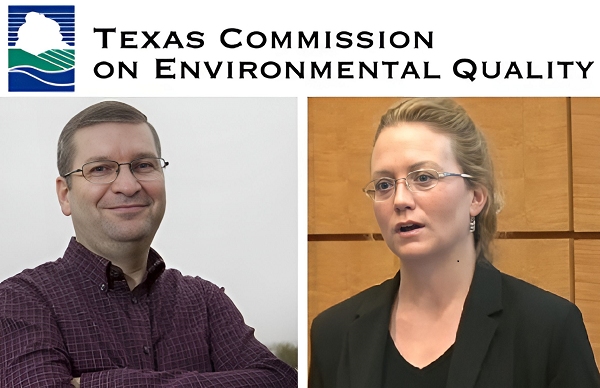
Texas state toxicologists and newly appointed EPA reps Michael Honeycutt and Tiffany Bredfeldt gave testimony before an Arizona Superior Court judge in 2013 that succeeded in persuading the judge to issue an unconstitutional speech injunction against the writer. The court was told the writer had “propositioned” Bredfeldt (a married woman) in 2005, “wouldn’t take no for an answer,” and “had been harassing her ever since.” Honeycutt, who has never met the writer, recited this secondhand story with the same smug complacency that marks his expression above. Based on the fiction’s effectiveness, four additional legal actions were brought against the writer in 2016, two of which menaced him with the threat of incarceration for exercising his freedom of speech. One of the actions was aborted; two were dismissed. Despite an appeal in 2017, the 2013 gag order, which the writer was alleged in 2016 to have “continuously and contemptuously violated,” remained in effect until July 2018, when it was gutted. All charges brought against the writer in the past decade have been invalidated.

Numerous accounts related on this blog since its launch six years ago have contrasted what he said with what she said in testimony given under penalty of perjury. The account this post relates doesn’t have to. It contrasts what she said here with what she said there—and with what her statured witness said she said. Statements that should harmonize, conflict.

A lesson of what this post unfolds, valuable for anybody to learn who has been wronged by a judge and isn’t sure if s/he’s “allowed” to talk about it, is that when people get away with something in a courtroom, which is a public forum, that in no way immunizes them from being exposed for it in a different public forum (for example, Facebook, Twitter, a personal blog, or one sponsored by The Washington Post). The only legal surety against criticism in this country is square conduct. While a court can lawfully issue a restraining order that prohibits unwanted speech to someone (like phone calls or emails), it cannot lawfully prohibit unwanted speech about anyone. Critical speech directed to the world at large, however objectionable it may be to those it names, whether private individuals, public officials, or judges, is protected speech as long as it isn’t false or threatening (and opinions are sacrosanct); the Constitution doesn’t favor any citizen over another, nor does it distinguish between bloggers, pamphleteers, or picketers and the institutional press. The aegis of the First Amendment doesn’t even require that criticism be deserved. In this instance, however, blamelessness is a nonissue.
Eugene Volokh, First Amendment, freedom of speech, The Volokh ConspiracyThis post discredits a widely championed arena of law, as well as how it’s administered. Linked audio clips of one trial judge will make a seasoned courtroom veteran flinch; those of another, a presiding municipal court magistrate, acknowledge frankly that restraining orders “are abused,” no question, and that “people come in and…say things that are just blatantly false” but are “never…charge[d],” let alone prosecuted.

The post also discredits accusations made by a woman (women, in fact) against a man. To some, this will be its most compelling virtue. Men have traditionally been the butt of abused and abusive procedures, and by far continue to be their most populous feedstock. Assertions that men are “presumed guilty” and unfairly “demonized” are not exaggerations and never have been, contrary to the pajama punditry of demagogues like David Futrelle, Mari Brighe, Amanda Marcotte, and Lindy West, who would smother even the most righteous motives for male contempt beneath the blanket label “misogynist.”

Fixation on gender politics, though, has obscured from view that injustice has been legislated into the law and fortified by decades of accustomed application (albeit that politics is the reason why). Today women—straight, gay, or otherwise—enjoy no greater safety from accusation and arbitrary violations of their civil rights than men do (in drive-thru procedures promoted as “female-empowering”), and women too may be accused by women (including their own mothers, sisters, daughters, and neighbors—which is a predictable consequence when accusation is tolerated as a recreational sport). Law that mocks due process and facilitates and rewards its own abuse is iniquitous, period. What this post reveals, importantly and inescapably, is that how many people choose to understand accusation, court process, and their repercussions is deplorably simplistic. Among these many are most politicians, academics, journalists, and social justice activists.
Eugene Volokh, First Amendment, freedom of speech, The Volokh ConspiracyThe Tucson man in the title of the post is also its author, and there was a time, within his memory, when to allege sexual impropriety without urgent grounds would have stirred outrage, because such an accusation is always damaging. In the climate that has prevailed since the advent of the Violence Against Women Act, however, the female plaintiff who doesn’t allege sexual violation, or at least trespass, squanders invaluable leverage. To a potently shrill sector of the community, this represents social progress. It has made pollution de rigueur.

Inaugurating the task of restoring a site inspired by the tenacity of false accusations like those exposed below, this post breaks a year-and-a-half-long silence coerced from the site’s owner by a series of lawsuits, which included two that demanded that he be jailed for exercising his First Amendment rights. The principal complainant, Tiffany Bredfeldt, an official at the Texas Commission on Environmental Quality (TCEQ), has repeatedly alleged to the Arizona Superior Court that the writer’s criticisms of her honesty, ethics, and character are untrue. Bredfeldt told the court in 2016 that the “ongoing fear, stress, and associated physical impacts” the writer’s criticisms had caused her “have been a decision factor as to whether or not [she has] children.” She also reported she has “talked to more people at police departments, sheriffs’ departments, and federal and state agencies than [she] can count,” and urged the court to impose “significant consequences” to bring her relief from a “continual rollercoaster of fear.”

Judge Richard Gordon, Pima County Superior Court

I am not going to hold him in contempt for talking about his case,” Pima County Superior Court Judge Richard Gordon pronounced in response to a 2016 complaint that demanded the writer be jailed for doing exactly that. Also commendably, the judge granted the writer a court-appointed attorney without reservation. Disagreeing, however, that the law authorized him to revise or dissolve an illegal prior restraint entered against the writer in 2013, the judge instead delimited its vague and overbroad proscriptions. The writer continued to be (1) forbidden from publishing images of the plaintiffs on this site; (2) forbidden from using “[meta] tags” with their names to label images or contents of posts, supposedly elevating them in Google’s returns for certain search terms thereby; (3) forbidden from “repeating” three “specific statements” that, absent a jury opinion, the 2013 court deemed “defamatory”—only two of which the writer may have made, both concerning honesty; and (4) forbidden from contacting the plaintiffs, Tiffany and Phil Bredfeldt, the former’s employers at the Texas Commission on Environmental Quality, or “their friends, their acquaintances, or their family.” The writer’s own friends and family are among Tiffany Bredfeldt’s acquaintances, and who else may be is impossible for the writer to know, which underscores the recklessness of the 2013 order Judge Gordon construed rather than vacated. That order’s prohibitions, which were substantially narrowed in July of this year, could have been interpreted very differently by another judge at any time for the rest of the writer’s life.

Bredfeldt sued the writer in 2013, neither for the first time nor the last. Michael Honeycutt, to whom the writer had communicated his criticisms of Bredfeldt’s conduct by letter two years before, served her as a witness—telephonically, from the comfort of his desk chair in Texas. Honeycutt is Bredfeldt’s boss at the TCEQ and an old hand at testifying; his bio [deleted from the Internet since this publication] boasts that he has testified before Congress. His role in accusing the writer, who in 2013 had already grappled with crippling allegations for seven years, was to ensure that he would live with them indefinitely—and it’s unlikely that Honeycutt acted without the full approval and support of the TCEQ’s administration.

The upshot of the 2013 prosecution, in which the writer represented himself, was that Bredfeldt was granted an unconstitutional restraining order that prohibited the writer from publishing anything about her “to anybody, in any way, oral, written or web-based” by the judge whose words appear a few times in the transcript excerpts that follow. That Pima County Superior Court judge, Carmine Cornelio, is a judge no longer. In June of 2016, 84% of an Arizona Commission on Judicial Performance Review panel concluded he did not meet standards. The judge declined to face voters that fall, and his tenure on the bench terminated two months later.

(The no-confidence rating returned against Judge Cornelio in 2016 followed reprimands by the Arizona Supreme Court in 2010 and 2013 for the judge’s saying “fuck you” to an attorney during a settlement conference, causing a 19-year-old girl to cry during a different one, and gesturing accusatorily at a female court employee in public, among other alleged acts of “abusive conduct.” In a guest column in the Arizona Daily Star, Judge Cornelio wrote, “I leave with head held high….” He told the same paper in an interview that he “intends to go into private practice in alternative dispute resolution.” Judges of the Arizona Superior Court are paid $145,000 a year, and a proposal has been tabled to raise their salaries to $160,000.)

The speech injunction Judge Cornelio imposed on this writer in 2013, which the judge made permanent without bothering with a trial, was affirmed in 2016 by a second Pima County Superior Court judge, Richard Gordon, despite Judge Gordon’s having acknowledged in open court that the conduct of the 2013 proceedings was “not legal” and that the prior restraint that issued from them offended the Constitution. “There are obviously some parts that are just too broad and then don’t make a whole lot of sense,” Judge Gordon conceded in court in July. In his subsequent Sept. 2016 ruling, little trace of this acknowledgment survives. The writer’s father died a month after the ruling was returned. More than a year has transpired since (and, as the U.S. Supreme Court has held, “[t]he loss of First Amendment freedoms, for even minimal periods of time, unquestionably constitutes irreparable injury”).

An appeal of the 2016 ruling to the Arizona Court of Appeals’ Second Division was denied in December (five months after it was filed). The court—consisting of Judge Philip Espinosa, Judge Christopher Staring, and Judge Sean Brearcliffedeclined to address the prior restraint’s unconstitutionality and sidestepped use of the phrase prior restraint entirely:

[T]he issue before us is not whether the injunction is constitutionally permissible, but whether the [2016] trial court properly refused to modify or dissolve it.

The appeals court, whose decision may have been influenced by a case narrative that this post will show is false, did acknowledge that “[a]t least one provision of the [2013] injunction would appear clearly unconstitutional, ordering that ‘[t]he defendant…immediately cease and desist all future publications on his website or otherwise.’” The word publication means any act of public speech. This provision, which was dissolved in July of this year, accordingly prohibited the writer from, for example, finishing a Ph.D., addressing the city council, marketing a book, or defending himself in a courtroom, all of which require publication. Also accordingly, courts have consistently found prior restraints facially invalid, even ones far less vague and overbroad than the one issued against the writer, and such orders have been vacated as much as 30 years later, which the writer’s attorney informed the appellate judges by brief and in oral argument. This was unremarked in their Dec. 18, 2017 ruling.

Eugene Volokh, free speech, First Amendment

UCLA Law Prof. Eugene Volokh, addressing the U.S. Senate Judiciary Committee on June 20

Unlike in 2013 (and previously), the writer wasn’t alone in court in 2016 or 2017. His defense was aided by two gifted lawyers representing the Pima County Legal Defender: Kristine Alger, who drafted and orally augmented a faultless appeal, and Kent F. Davis, whose zealous advocacy made an appeal possible in the first place. Their arguments were what’s more reinforced by no lesser light than Eugene Volokh, who’s distinguished as one of the country’s foremost authorities on First Amendment law and who, in conjunction with the Electronic Frontier Foundation (EFF) and Phoenix attorney Eric M. Fraser, graciously submitted an amicus brief to the court on the writer’s behalf. Alison Boaz of the UCLA School of Law, who assisted Prof. Volokh, is also due credit. A win in the appellate court would have been much more theirs than this writer’s, and they have the writer’s thanks for their Herculean exertions.

(It’s conceivable that a legal critique of the matter may one day appear on The Volokh Conspiracy, which is listed by the ABA Journal in its “Blawg 100 Hall of Fame.”)

Exemplifying the importance of the First Amendment, this post will illuminate how trial courts are manipulated into forming bad conclusions by lowering its beam into the crevices to rest on those who do the manipulating.

A byproduct of the writer’s representation in 2016 and 2017 was access to courtroom transcripts, so the post won’t offer much in the way of opinion. Commentary can be denied. Testimony given under oath…cannot be.
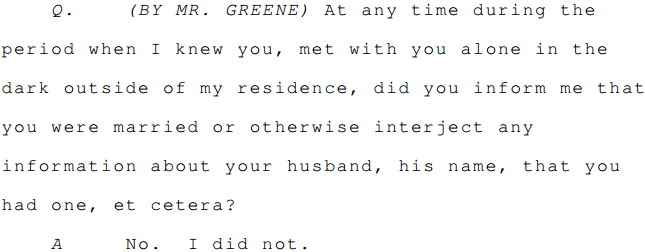

Dr. Tiffany Bredfeldt, on cross-examination by the writer in 2013

Dr. Michael Honeycutt, on cross-examination by the writer in 2013

Based on nothing more than the two statements quoted above, a precocious child would wrinkle her nose. Yet such obvious contradictions have inspired no judge to arch an eyebrow nor any Ph.D. to scruple. In over 11 years.

Calling someone a liar risks being sued, and trial judges interpret whatever they want however they want. They’re acutely aware, moreover, of which direction their criteria are supposed to skew when abuse is alleged. This remark cannot be called defamatory: Although this post isn’t about air or water pollution, as would befit one that quotes environmental scientists, it does concern filth.

Cheryl Lyn Walker PhD, Cheryl Walker PhD, MD Anderson Cancer Center, Texas A&M University Health Science Center, TAMHSC, Institute of Biosciences and Technology

Director of the Texas A&M Health Science Center Institute of Biosciences and Technology Cheryl Lyn Walker, remarks by whom were used in evidence against the writer in 2013 and 2016

It relates sworn testimony to the Arizona Superior Court by two representatives of the Texas Commission on Environmental Quality (TCEQ), reportedly the second largest agency of its kind after the EPA. Those public sector scientists are Michael Honeycutt, Ph.D., the TCEQ’s toxicology director and an adjunct professor at Texas A&M University, who was recently entrusted with a role in forming national health policy, and one of Honeycutt’s protégés, senior toxicologist Tiffany Bredfeldt, who’s also a Ph.D. and who had already been entrusted with a role in forming national health policy. On April 4, 2017, the TCEQ tweeted its congratulations to Bredfeldt for her being selected to serve on the Chemical Assessment Advisory Committee of the EPA’s Science Advisory Board, which her boss now chairs. The bio of Bredfeldt’s associated with her appointment highlights her experience as an “expert witness.” This merits note, as does Honeycutt’s superior claim to the same distinction.

A second Texas A&M professor, Dr. Cheryl Lyn Walker, Ph.D., who was Bredfeldt’s postdoc adviser at M. D. Anderson Cancer Center, has been aware of the conduct of Bredfeldt’s detailed in this post for a decade. Appeals by this writer to Walker’s conscience and integrity only inspired her to tell Bredfeldt in a 2008 email: “I am very concerned about your safety.” Bredfeldt entered Walker’s email in evidence against the writer in 2013 and also quoted it to the court in 2016.

Authorial intrusions in the survey of statements to follow will be terse. Bredfeldt and her witnesses will do the preponderant storytelling.

Tiffany Bredfeldt, romancing the camera in 2005

Some orienting details are required. The writer encountered Bredfeldt, then a doctoral student in the University of Arizona College of Pharmacy, at his home in late summer 2005 and met with her there routinely over the ensuing months, mostly after dark. Bredfeldt, otherwise a stranger, declined to mention to the writer that she was married while, for example, taunting him for not inviting her in at midnight: “Where I come from, it’s considered rude not to at least invite a person onto your porch.” Then she disappeared, providing no explanation. A few months after that, when the writer sought one, Bredfeldt variously reported to the police and numerous courts—in statements that remain public in perpetuity and that are not deemed defamatory—that the writer had made unwelcome sexual advances toward her, despite being repeatedly “rebuff[ed]” and “rebuked”; that he posed a violent danger to her and to assorted others she was concerned the writer would talk to about her conduct at his home (among them her mother, who lived 1,200 miles away); that he should be prohibited from possessing firearms; and that he had stalked her, a woman the writer had only ever met hanging around his yard like a stray cat.

Here’s Bredfeldt’s account in her own words to Judge Jack Peyton on April 10, 2006:

Okay, I’ll begin by defining my relationship, um, with Mr. Greene. I met Mr. Greene in about September or October of 2005 when I was boarding a horse that I own at a boarding facility owned by his family. At that time, uh, we were acquaintances, and we spent time talking and — at his family barn. And that’s about the nature of our — our interaction. During that time, I think, um, he developed maybe romantic feelings for me that — that made me uncomfortable, and I generally would rebuff his advances, asking him to stop.

Mrs. Bredfeldt, whom the writer knew for three months and with whom he has had no contact since March 2006, has along with one of two or three girlfriends of hers who were also routinely around the writer’s residence in 2005 sued the writer some six times. Four legal actions were brought against the writer in 2016 alone, two of which sought his incarceration and all of which endeavored to suppress what this post relates. In a “Victim’s Impact Statement” Bredfeldt submitted to the court in 2016, she owned that she had accused the writer “to the Court multiple times [and] to multiple police departments, detectives, federal agencies, and other officials in several states”—including the Arizona Dept. of Public Safety and the FBI—and it’s this writer’s belief that only with the blind support of loyalists like Mike Honeycutt would Bredfeldt have been so emboldened.
attorney Beth E. Maultsby, attorney Kathryn Flowers Samler, high-conflict litigants, high-conflict people, high-conflict litigation, false testimony, lying in courtThe legal onslaught has spanned (and consumed) almost 12 years, despite the writer’s appealing to dozens of people to look between the lines, including Honeycutt, who’s notably a husband with two college-aged sons. Honeycutt is besides a distinguished scientist, cited for his rigorous investigative standards, whose testimony quoted immediately below includes the statements, “I didn’t ask for details” and “I didn’t clarify that.” As a departmental director of the TCEQ, Honeycutt is paid $137,000 per. The writer, in contrast, has for the past decade earned a subsistence wage doing manual jobs that allow him to keep an insomniac’s hours and be left alone—formerly in the company of his dog, his dearest friend, who died suddenly in 2015 while the writer was still daily distracted with trying to clear his name and recover time and opportunities that had been stolen from them. (Here is a letter the writer hired an attorney to prepare in 2009. Bredfeldt represented it to the court in 2013 as evidence of harassment, and testified she believed her “psychiatric prognosis” would improve if such speech were restrained. “One of the most difficult parts of dealing with something, since this is profoundly stressful,” she told the court, “is that the stress doesn’t go away.”) The writer had aspired to be a commercial author of humor for kids, as Bredfeldt knew, and had labored toward realizing his ambition for many years before encountering her and her cronies on his doorstep. His manuscripts have since only gathered dust.

(A further counterpoint: The first public official the writer notified of Bredfeldt’s conduct, who also took no heed, was University of Arizona Dean of Pharmacy J. Lyle Bootman, Ph.D. A decade later, Bootman was charged with raping and beating an unconscious woman in his home. For almost two years following his indictment in 2015, while free on his own recognizance, Bootman faced trial—a fundamental due process right this writer was denied in 2013. Despite having been placed on administrative leave, Bootman continued to draw a faculty salary of over $250,000 from the U of A, the writer’s alma mater and former place of employ. As a graduate teaching assistant in the English Dept. in the late ’90s, the writer cleared about $200 a week. While he awaited a ruling in Greene v. Bredfeldt, the appeal of the last of the lawsuits brought against him during the same period of time by Bredfeldt and a cohort of hers, the five felony charges against Bootman were dropped. A tort case based on the same facts continues. Bootman’s attorneys filed for a protective order in December to bar public access to records.)
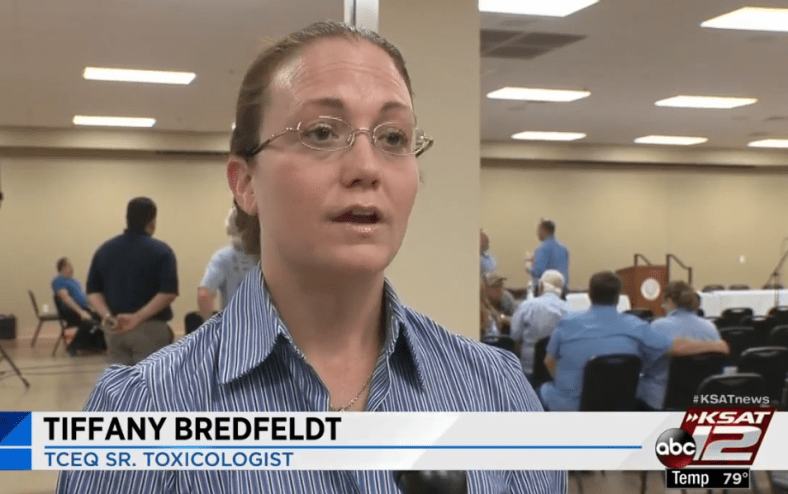
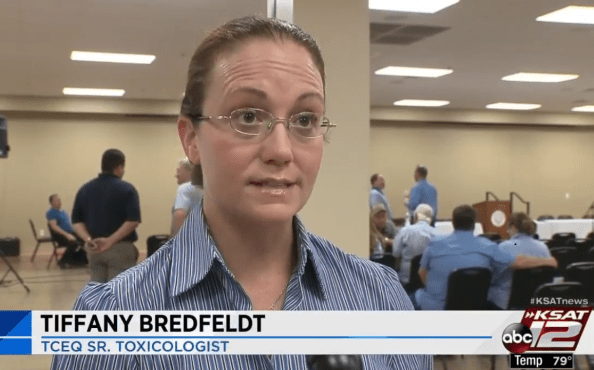
In an interview that aired in 2017, Tiffany Bredfeldt, the writer’s accuser, reassured the audience of ABC News that it could place its trust in the TCEQ. Bredfeldt made a similar pitch before the National Research Council of the National Academies of Sciences, Engineering, and Medicine in 2013. Bredfeldt, who the court was told in 2013 and 2016 is not a public official, has repeatedly appeared as the face of the Texas Commission on Environmental Quality. Her attorneys have argued that since she isn’t a public official, she isn’t obligated by law to prove her allegation that objectionable statements by this writer are false and therefore unprotected speech. Her boss, Michael Honeycutt, told the court in 2013: “Tiffany is just like the other 14 employees that I have.” If no other assertions by the TCEQ cause Texans concern, that one should.

This post’s presentation is simple: It juxtaposes contradictory statements that span seven years (2006–2013), most of them made under oath and all of them made by state scientists. (Those in small print may be enlarged in a new tab by clicking on them, or magnification of the entire post may be increased by pressing [CTRL] or [COMMAND, the cloverleaf-shaped key on Macs] + [+]. Zoom may be reversed similarly: [CTRL] or [COMMAND] + [-].) Scrutiny of the quotations below may lead the reader to conclude they’re evidence of false reporting, perjury, subornation of perjury, stalking, harassment, mobbing (including attorney-complicit abuse of process and civil conspiracy), defamation, bureaucratic negligence, professional incompetence, mental derangement, and/or general depravity.

The writer will let the facts speak for themselves.

MICHAEL HONEYCUTT, on cross-examination by the writer on May 20, 2013:
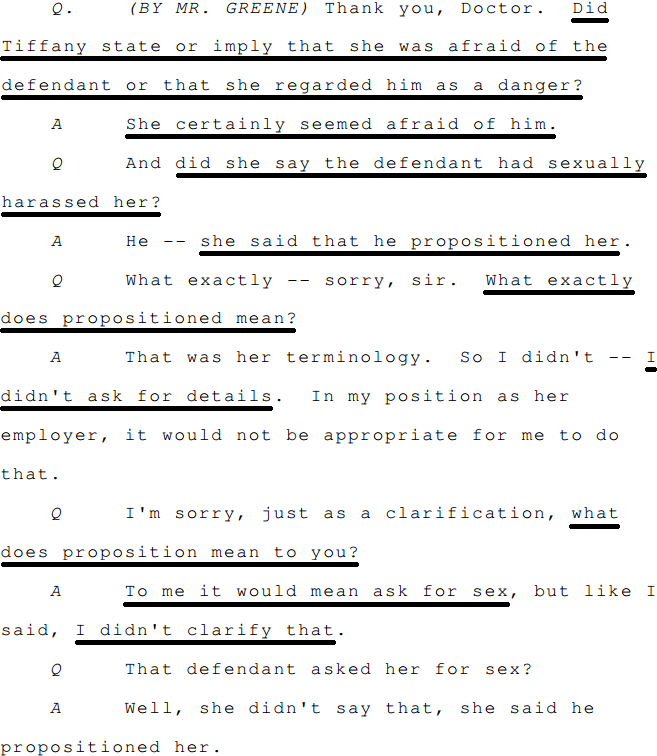
Honeycutt testifies in 2013 that Bredfeldt told him the writer “propositioned” her in 2005, which to him, he says, “would mean ask[ed] for sex.”

Bredfeldt’s attorney, Jeffrey Marks, would follow up on Honeycutt’s testimony by beginning his cross-examination of the writer with a jab instead of a question: “She says you propositioned her.” The writer replied, “What does that mean?” Marks chirped, “That you offered her sex.” Bredfeldt, while gazing around the room at her audience, nodded solemnly.

TIFFANY BREDFELDT, in an email to the writer sent Friday, March 17, 2006, that she entered into evidence three days later (Monday, March 20, 2006) along with her petition for restraining order number one:
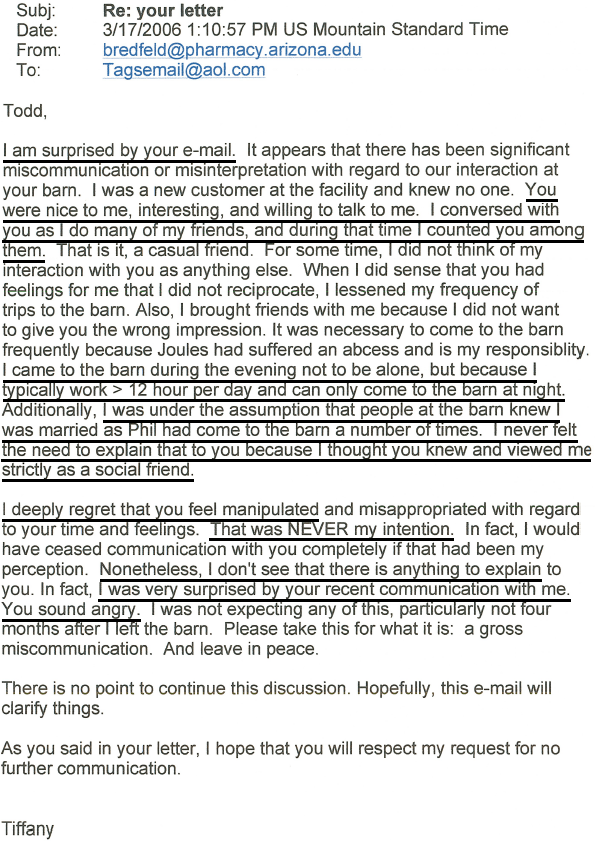
Bredfeldt states in this self-contradictory email, which she would submit days later in evidence to the court in the 2006 procedure that began the controversy, that the writer had been “nice” to her and that she had never felt the need” to “explain” to him she was married, because her husband had come to the writer’s place of residence “a number of times,” and she thought the writer already knew and besidesviewed [her] strictly as a social friend.” Contrast Honeycutt’s 2013 testimony: “[S]he said that he propositioned her.

On April 10, 2006, not a month after Bredfeldt sent this email, she would testify before a judge (in her husband’s presence) that she had had to repeatedly “rebuff…advances” by the writer in 2005. The writer was identified to the court not as a considerate “friend” but as an “acquaintance” with whom Bredfeldt had “interact[ed].” Ten years later, the husband the writer was supposed to have known about, a geoscientist today employed by Weston Solutions as a project manager, would be asked in court on direct examination by his lawyer, “Do you know the defendant, Todd Greene?” Philip Bredfeldt’s answer: “I never met him….” Then Mr. Bredfeldt would clarify to the 2016 court that he “first came to know about the [writer] in early 2006,” that is, the same week his wife sent this email, during which the writer was alleged to have sent her a “series of disturbing emails” and “packages,” a fiction that by itself would take another entire post to unweave. Significantly, Phil Bredfeldt had no idea the writer existed until 2006 and, according to his 2016 testimony, was not informed by his wife of any sexual aggression toward her in 2005—nor was anybody else, for example, the writer’s mother, who was daily at the property where the writer lives from morning till dusk, and whom Bredfeldt knew and spoke with routinely. (The writer’s mother was then in treatment for cancer, a fact Bredfeldt exploited to flaunt her knowledge of the disease, which was a subject of her dissertation research.) Where Phil Bredfeldt was while his wife was outside of the writer’s residence at 1 a.m.—and with whom—has never been clarified.

Honeycutt, in a 2013 quotation below, will testify in further contrast to Bredfeldt’s statements in this email that he was told the writer’s behavior in 2005 was “erratic and bizarre” and that he “wouldn’t take no for an answer.”

TIFFANY BREDFELDT, in a statement to the University of Arizona Police Dept. given on March 18, 2006 (the next day):
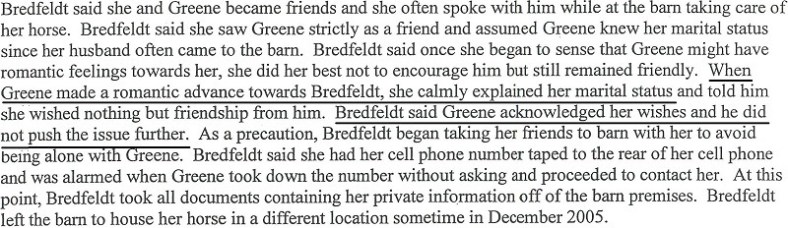
Bredfeldt, in contrast to her emailed statements to the writer 24 hours prior (and in contrast to her subsequent testimony to the court in 2006 and both hers and Honeycutt’s in 2013), reports to the police that the writer had made “a romantic advance” toward her in 2005, inspiring her to admit to him she was married, after which he desisted. Bredfeldt then says the writer seized her cell phone, copied down her number, and contacted her. Bredfeldt’s work and home addresses and telephone numbers were publicly listed, and the writer never spoke with Bredfeldt on the phone. There was no need; she could be found outside of his residence most nights, as often as not in a red tank top.

On the single occasion the writer had handled Bredfeldt’s cell phone, borrowing it because his phone had been destroyed by a power surge, Bredfeldt had insisted on typing the numbers for him before sliding the phone into his palm and caressing his fingers (repeatedly). That was in late Nov. 2005 after she and a friend of hers had invited themselves into the writer’s house. Bredfeldt’s “chaperone,” a stranger then calling herself Jenn Oas, began conversation by telling the writer she had just returned from India where she “mostly” hadn’t worn a bra. Bredfeldt chimed in with a quip about “granny panties” (after having excused herself and returned wearing freshly applied eye makeup, complaining that she had “misplaced” her glasses). A couple of weeks later, Bredfeldt would vanish.

(Flash-forward: The policewoman who instructed Bredfeldt how to obtain a court-ordered injunction, Bethany Wilson, is today a librarian in charge of kid lit—what the writer had aspired in 2006 to make his profession.)

TIFFANY (AND PHIL) BREDFELDT, in a sworn affidavit to Judge Roger Duncan (then a pro tem) filed on March 20, 2006 (two days later):
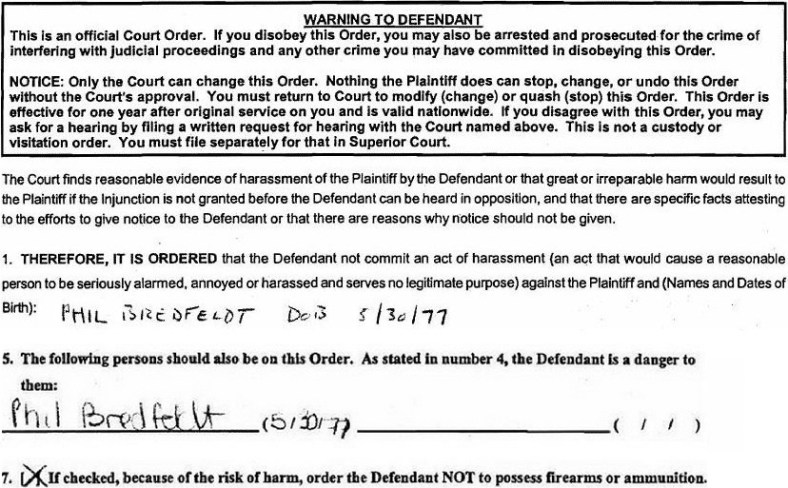
Bredfeldt urgently petitions a protective order tailored to prohibit the writer (three days earlier called a “friend” who had been “nice” to her) from having any contact with her husband, Phil, a stranger, who is alleged to be in violent “danger.”

Later the same day, the writer would be sent an email, ostensibly by Phil Bredfeldt, that begins, “STAY THE HELL AWAY FROM MY WIFE, YOU SICK FUCK,” and ends, “THIS IS THE LAST TIME YOU WILL BE TOLD.

(The Bredfeldts simultaneously sent the email to UAPD Officer Bethany Wilson, with whom she later told the writer they had been on the phone at the time. Officer Wilson, who had met both of them, opined during a 2006 interview with the writer that Mrs. Bredfeldt “wore the pants.”)

Judge Jack Peyton, JP, Justice of the Peace, Pima County Justice Court

Judge Jack Peyton

The evidence of harassment Tiffany Bredfeldt presented to the court was five emails she and the writer had exchanged over a weekend (March 16–20): two from her, three from him in reply. The March 17 email of hers shown above was shuffled to the back of the sheaf, out of chronological order, causing the judge who presided over the writer’s April 10, 2006 hearing, Pima County Justice of the Peace Jack Peyton, to remark, “I don’t think I have a copy,” and then to ask, “Am I missing one [of the emails]?” Bredfeldt had to include the contradictory email among her evidence, which was never anyhow scrutinized, because it contained one of the only two requests she had ever made to the writer not to contact her: “I hope that you will respect my request for no further communication.” The other request was in an email she had sent him 20 hours earlier, in which Bredfeldt had represented the writer to himself as a stalker after he had gently tried to learn the motives for her behaviors at his home and her concealment from him that she was married. Judge Peyton confirmed with Bredfeldt that the minimum qualification demanded by the law, namely, two requests for no contact, had been met. The writer need not have been present.

Alleged on March 20 to be in danger of violent assault, Phil Bredfeldt had to be repeatedly reprimanded for displays of temper in open court three weeks later. Judge Peyton finally told him, after ordering his name stricken from his wife’s protective order:

I won’t think twice about asking you to leave the courtroom, because you’re not a party. You are welcome to be here. This is a public forum. But I won’t have you interrupting, and I will not have you making me uncomfortable about what your next action might be.

The judge, reputed to be the go-to JP for women alleging abuse by men, nevertheless cemented the protective order against the writer, explaining: “I do not get the impression that [Mr. Bredfeldt] was placed on that order by design.

(The following year, Judge Peyton was appointed to head a county domestic violence specialty court, which was financed by a $350,000 gubernatorial grant that included no budgetary allowance for defense attorneys. The judge, a onetime Maryland labor lawyer d/b/a J. Craig Peyton, underwent a “five-day domestic violence training session” in preparation. Reportedly operating only two days a week, his court has since processed well upwards of 25,000 cases.)

TIFFANY BREDFELDT, on cross-examination by the writer on May 20, 2013 (seven years later):
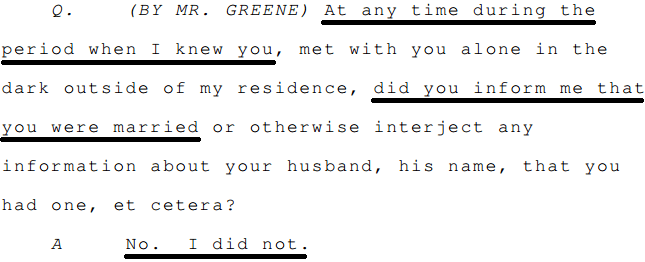
In contrast to her statements to the police in 2006, Bredfeldt testifies in 2013 that she never told the writer she was married. What Bredfeldt told the writer in 2005 was that she lived with a dog. The writer asked if it was alone at night while she was with him. Bredfeldt answered, “Yes.” The writer urged her to bring the dog with her so it wasn’t by itself and gave her a toy to take home.

TIFFANY BREDFELDT, on cross-examination by the writer on May 20, 2013 (the same afternoon):
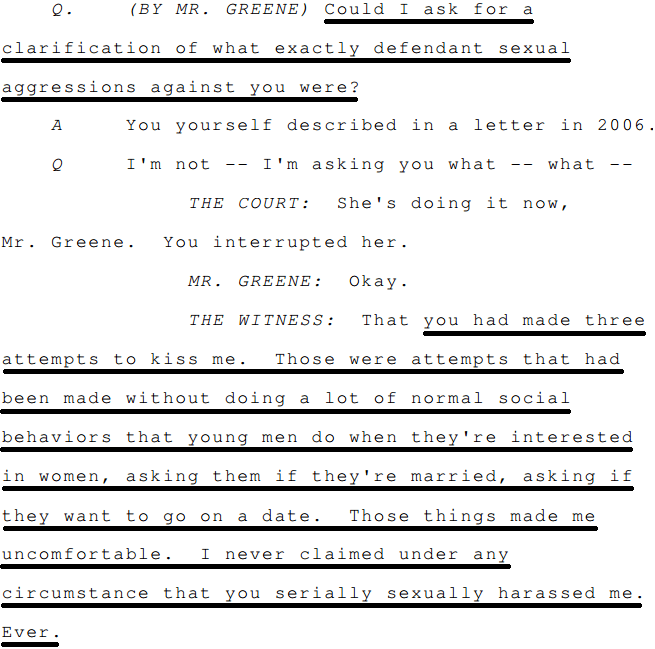
Also contradicting her statements to the police in 2006 (besides controverting what her first witness, Honeycutt, told the court in 2013 that she had told him), Bredfeldt testifies (in the presence of her husband) that the writer made “three attempts to kiss [her]” in 2005—which made her “uncomfortable” but not so uncomfortable as to prompt her to tell the writer she was married (or to tell her husband that another man had repeatedly tried to kiss her). Then Bredfeldt denies she has “ever” accused the writer of sexual harassment.

TIFFANY BREDFELDT, in a memorandum to Superior Court Judge Charles Harrington filed July 30, 2006:

In a “Statement of Factsto the court, contradicting her statements to the police (besides to the writer himself, which emailed statements she submitted to the court in 2006, 2013, and 2016), Bredfeldt alleges the writer made “several physical, romantic advances toward [her],” despite being “rebuked,” and that she was forced to flee[w]hen such advances continued.”

There were no physical advances. Bredfeldt was invited to have Thanksgiving dinner with the writer’s family in 2005. Instead of telling the writer she had a husband to get home to, she said she was suffering from a migraine. The writer put his hand on her shoulder and said he hoped she felt better. All other physical contacts between Bredfeldt and the writer, clasps and caresses, were initiated by her, typically during conversations in which she pointedly referred to breasts, bras, or panties, her naked body, striptease, or the like. At the conclusion of an earlier meeting in November, Bredfeldt had thrust her face in the writer’s and wagged it back and forth as if to tease a kiss. The writer didn’t respond, because there was nothing romantic about it. That was on the night Bredfeldt returned after attending an out-of-state wedding—her sister-in-law’s (Sara Bredfeldt’s), a detail she omitted mentioning.

A month later, on the evening before Bredfeldt “left the horse boarding facility” (in 2005 not 2006), the writer encountered her loitering in the dark outside of his house—alone. Bredfeldt returned a coffeemaker she had borrowed from him to prepare poultices for her horse’s abscessed leg. During the transfer, Bredfeldt tried to brush the writer’s hands with hers. Bredfeldt and the writer spoke as usual—he remembers talking to her about shooting stars—and the writer’s mother briefly joined them and invited Bredfeldt to a Christmas party. Bredfeldt removed her horse the next day while the writer was at work.

TIFFANY BREDFELDT, during cross-examination by the writer on May 20, 2013:
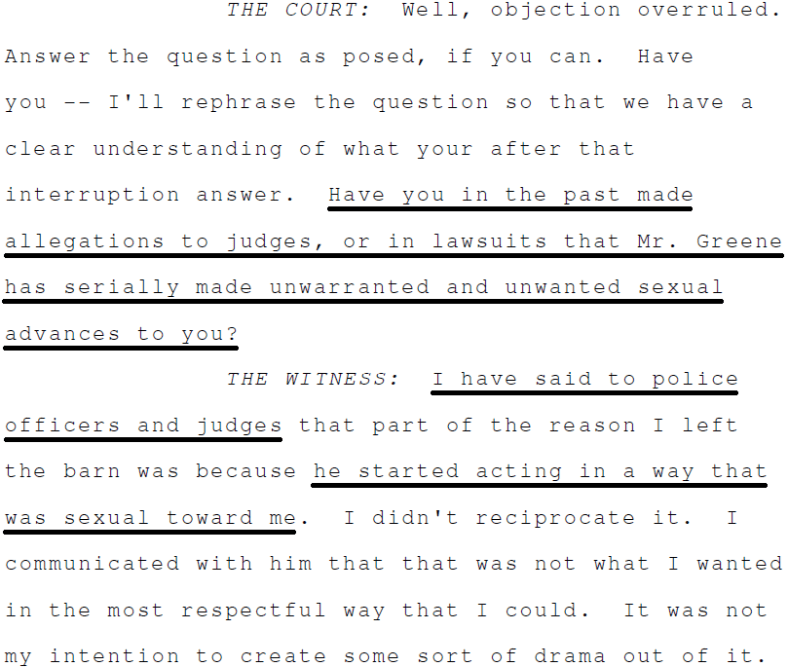
Bredfeldt testifies on examination by the judge that she has only ever told police officers and judges that the writer “act[ed] in a way that was sexual toward [her].” She “communicated with him that that was not what [she] wanted in the most respectful way that [she] could,” she says, which did not include either informing the writer she was married or wearing her wedding ring.

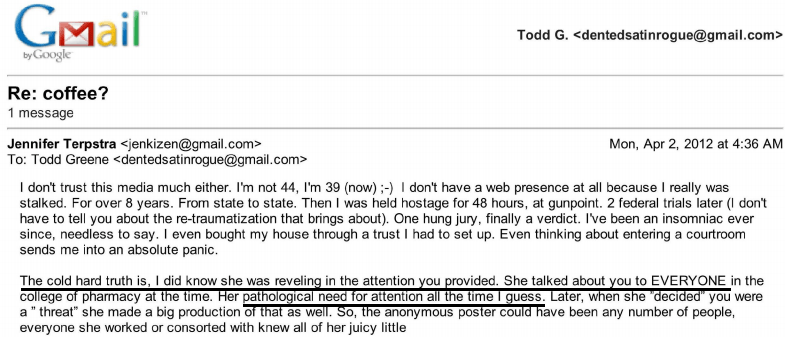
JENNIFER (OAS-)TERPSTRA, Bredfeldt’s other witness in 2013, a former colleague of hers from her University of Arizona days who went by Jenn Oas when the writer was introduced to her in 2005, in an email to the writer sent April 2, 2012 (a year earlier):
Jennifer Terpstra, Jen J. Terpstra, Terpstra JJ, Jennifer Oas-Terpstra, Jenn Oas, South Texas College, STC

This and the rest of Terpstra’s some two dozen emails to the writer in 2012 have been submitted to the court in multiple cases and are public documents accessible to anyone. Whether the emails have ever been scrutinized by a judge is uncertain. No trial has been conducted since the writer was granted a 20-minute audience before a judge in 2006. The 2013 proceeding from which the focal testimony in this post is drawn was a two-hour “preliminary” hearing. Judge Carmine Cornelio, though he drew the case out for half a year and returned several scalding rulings, found a two-hour hearing to be a sufficient basis for indefinitely depriving the writer of his First Amendment privileges. (When the writer had begun to object in open court to an order that was flagrantly unlawful, the judge threatened to summon security. Among the Arizona Court of Appeals’ stated reasons for denying the writer’s 2017 appeal of the order was that the writer had not “challenged” the judge’s ruling at the time.)

In this email, Terpstra tells the writer she was “stalked [f]or over 8 years [f]rom state to state.” Both Bredfeldt and Terpstra have claimed to be victims of multiple stalkers—including this writer. Bredfeldt, who the writer would be informed four years later has held a black belt in tae kwon do since her teens, came to the writer’s door in 2005 seeking his protection from some “men in a van” who she said had been “stalking” her while she was alone in the dark outside of his residence. Narratives of the “event,” which was unwitnessed and may have had no basis in reality, were circulated by Bredfeldt among other horse boarders on the property where the writer lives. The writer bought a wireless doorbell and installed it by the gate to his yard so that Bredfeldt could summon him quickly in case of a “recurrence.” When he showed it to her, she smiled.

A few months subsequent, when Bredfeldt’s accusations against the writer began, she was reported to have told colleagues that she thought she had seen him around her residence—and at workday’s end would ask to be escorted to her car. In testimony to the court quoted in a postscript to this exposé, Honeycutt, Bredfeldt’s first witness in 2013, says the TCEQ rewarded similar expressions of fear from her by providing her with a private office (“with hard walls and with a door that has a lock on it” in Texas).

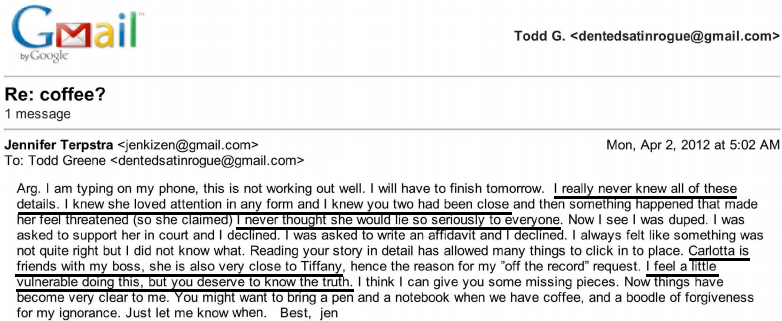
JENNIFER TERPSTRA, in an email to the writer sent April 2, 2012:
Jennifer Terpstra, Jen J. Terpstra, Terpstra JJ, Jennifer Oas-Terpstra, Jenn Oas, South Texas College, STC, Carlotta Groves PhD, Carlotta Groves DVM

In this email, sent a year before Terpstra would join Bredfeldt in testifying against the writer, Terpstra says that she “never thought [Bredfeldt] would lie so seriously to everyone” and that she knew Bredfeldt and the writer had been “close,” which remark alone contradicts everything Bredfeldt has told the court in the past decade. Terpstra also says she feels professionally “vulnerable” confiding in the writer but that he “deserve[s] to know the truth.” She suggests the writer “bring a pen and a notebook” to a meeting she proposed so that he doesn’t forget anything.

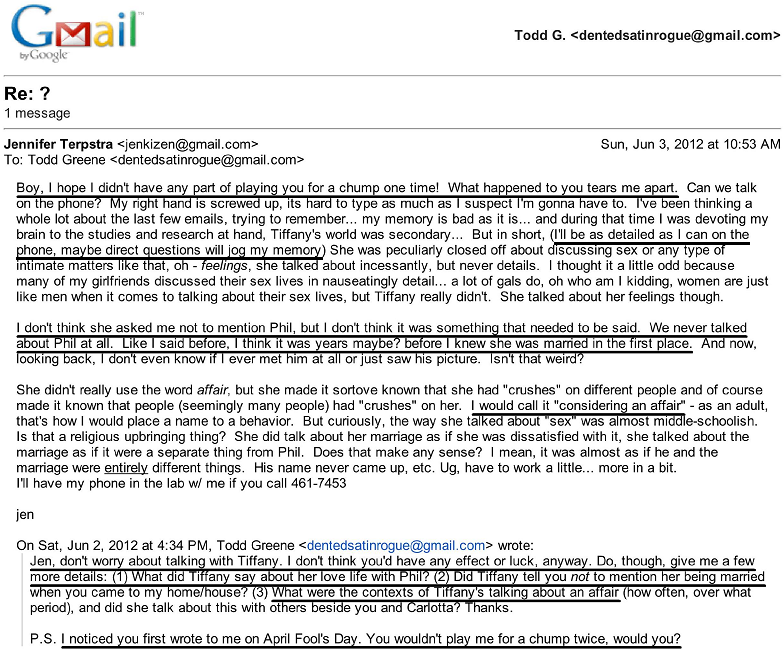
JENNIFER TERPSTRA, in an email to the writer sent June 3, 2012 (a month and a half after the two met for coffee):

Jennifer Terpstra, Jen J. Terpstra, Terpstra JJ, Jennifer Oas-Terpstra, Jenn Oas, South Texas College, STC

Terpstra told the writer over coffee in mid-April 2012 (when his father and his best friend were still alive, and a settlement could have reversed their decline) that Bredfeldt’s spouse, Phil, was known in their circle as “the phantom husband” and that Bredfeldt had urged her friends to go to the writer’s home to “check [him] out”—besides routinely talked about the writer to an audience of “25 or 30 people” at the University of Arizona College of Pharmacy.

Terpstra says in this email that Bredfeldt never talked about her husband and that she (Terpstra) wasn’t sure she had ever seen the man in person or only seen what she had described to the writer over coffee as a laminated newspaper clipping with a picture of him that was tacked to Bredfeldt’s refrigerator. Terpstra says that based on Bredfeldt’s behaviors in 2005, she judged she had been “considering an affair” with the writer, which wildly contradicts any account Bredfeldt has ever related to anybody.

In the first of the emails Terpstra sent him in 2012, she explained her six-year delay in confiding this to the writer by saying, “I don’t lie or bend the truth [but] I do avoid conflict.”

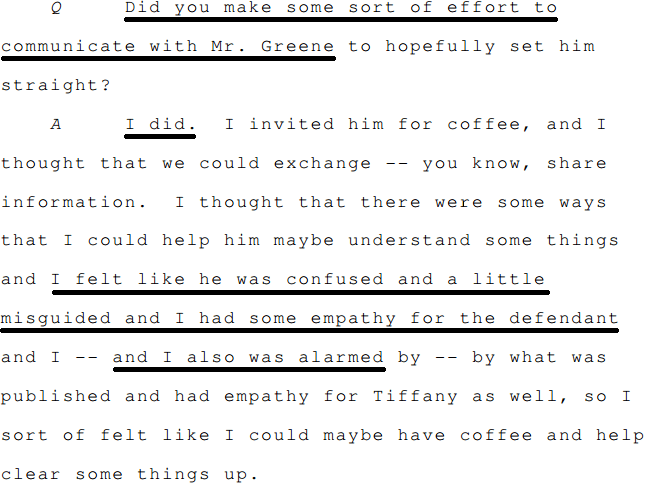
JENNIFER TERPSTRA, on direct examination by Bredfeldt’s attorney, Jeffrey Marks, on May 20, 2013 (less than a year later):
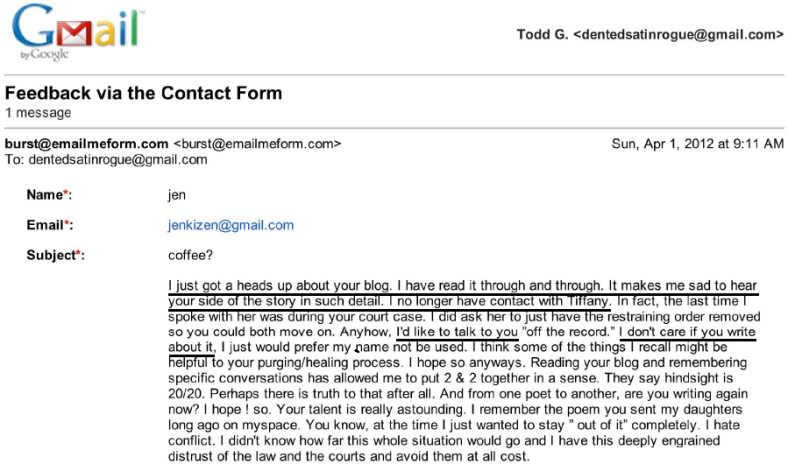
JENNIFER TERPSTRA, in an email to the writer sent April 1, 2012:
Jennifer Terpstra, Jen J. Terpstra, Terpstra JJ, Jennifer Oas-Terpstra, Jenn Oas, South Texas College, STC

In this email, Terpstra tells the writer she had asked Bredfeldt “to just have the restraining order removed” in 2006. (Terpstra would tell the writer the same thing over coffee a couple of weeks later, saying Bredfeldt had answered, “‘No.’ Just…‘no.’”) In contrast to Terpstra’s statements in this email and the others she sent him in 2012, besides in contrast to an email she sent him in 2007, Terpstra would report to Officer Nicole Britt of the Tucson Police Dept. in 2015 that “in 2005 she and her friend [Tiffany Bredfeldt] met [Todd Greene]. He then became fixated on the two of them and began stalking them.” (According to the same interview notes, Terpstra said this blog was “set up in honor” of her and “dedicated” to her.) A couple of months later (early 2016), Terpstra would report to TPD Det. Todd Schladweiler, who is assigned to the Tucson Police Mental Health Support Team, that she “now carries a handgun due to her concern that [Greene] is a threat to her safety.” Det. Schladweiler also recorded that Terpstra “said she communicated with [Greene] a few times [in 2012] and then he became very sexual in nature” and that Terpstra denied contacting the writer after they met for coffee in mid-April 2012, following which meeting she had insisted the writer give her a hug and then emailed and phoned him for a quarter of a year.
Then students in the University of Arizona College of Pharmacy, Terpstra and Bredfeldt told the writer in 2005, after inviting themselves into his house, that they took “benzos” to relieve stress. The writer asked where they got the drugs. Terpstra (who would marry a former bartender with a cocaine conviction not long afterwards and be charged with DUI in 2011) answered, “From work.” Bredfeldt echoed, “From work.”

Terpstra, who is reportedly diagnosed with bipolar disorder, told Det. Schladweiler she believed the writer was mentally ill. Although Det. Schladweiler was provided with Terpstra’s emails when he arrested the writer on Jan. 5, 2016, the subsequent synopsis of their interview gives no indication the detective spared the emails a glance.

Less than four months after her second police report, in which Terpstra alleged she feared for her safety and was carrying a gun, she would have her home address forwarded to the writer by email in the first of a spate of “copyright infringement” claims that represented her third legal action against him in 2016 and that succeeded in having this blog temporarily suspended by its host. The writer contested the claims, alleging perjury and fraud, and Terpstra declined to litigate them in court.

Terpstra, who has coauthored with Dr. Michael J. Frank, Ph.D., professor of cognitive, linguistic, and psychological sciences at Brown University, is the daughter of feminist painter Joan Bemel Iron Moccasin (Oas) and was employed as a research specialist in the University of Arizona College of Medicine under psychiatrist Francisco Moreno until 2016, when, after making her sundry false allegations, she left the jurisdiction.

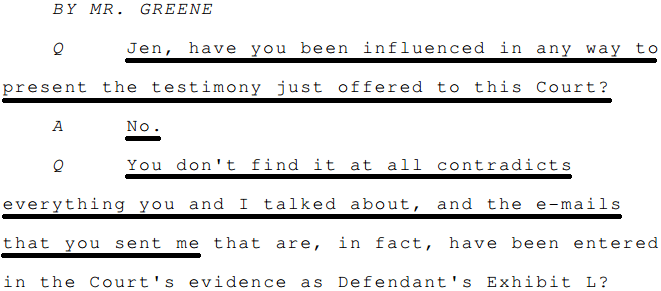
JENNIFER TERPSTRA, on cross-examination by the writer on May 20, 2013:
Jennifer Terpstra, Jen J. Terpstra, Terpstra JJ, Jennifer Oas-Terpstra, Jenn Oas, South Texas College, STC

Over coffee with the writer in 2012, Terpstra complained of financial problems. She also remarked, “Tiffany’s dad has a lot of money.” Tiffany and Phil Bredfeldt’s was a mutually prosperous union of two wealthy, fundamentalist Christian families. Phil Bredfeldt’s father was his best man in 2001; his sister Sara was a bridesmaid; and Tiffany Bredfeldt’s brother, Jon Hargis, was a groomsman. Four years later, Sara Bredfeldt was married to a medical student, Roberto “Bobby” Rojas, who is today an M.D. (Aurora St. Luke’s Medical Center in Milwaukee).

Ray Bredfeldt MD, Raymond Bredfeldt MD, Dr. Ray Bredfeldt, Arkansas Blue Cross and Blue Shield, ABCBSTiffany Bredfeldt’s father, Timothy “Tim” Hargis, is or was a bank vice president (First Security of Arkansas), as was his father before him. Phil Bredfeldt’s father, Raymond “Ray” Bredfeldt, is a family physician who practiced privately and besides rented his credentials to Arkansas Blue Cross and Blue Shield for some dozen years. The starting salary for an ABCBS regional medical director is today around $180,000. Dr. Ray Bredfeldt, M.D., had volunteered to join Terpstra in giving witness testimony in 2016 that was meant to induce the court to jail the writer while the writer’s own father, who didn’t graduate from high school, lay dying—in a home in foreclosure. Ray and Ruth Bredfeldt and Tim and GaLyn Hargis have known of what this post details from the start and have temporized for over a decade rather than acknowledge any liability for their families’ ways. “It’s what people like that do,” Terpstra commented to the writer in 2012. (Testifying in 2016, while his father was nearby, Phil Bredfeldt acknowledged on the stand that he was very aware of Terpstra’s 2012 emails. He quoted a post about them. Construing his statements to the court, the only thing that disturbed him about the emails was their contents’ being public.)

The court was told on Dec. 21, 2016, that Terpstra, who was sued to have her evicted from her house the year before, had moved from Arizona to Texas, where Tiffany and Phil Bredfeldt have resided since 2006 (in a house Terpstra told the writer that Tiffany Bredfeldt’s father had bought for them)—and the writer would be surprised if Terpstra’s legal representation in 2016 and 2017 cost her a penny.

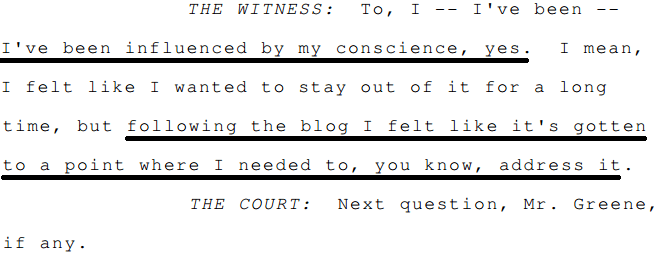
JENNIFER TERPSTRA, on cross-examination by the writer on May 20, 2013:
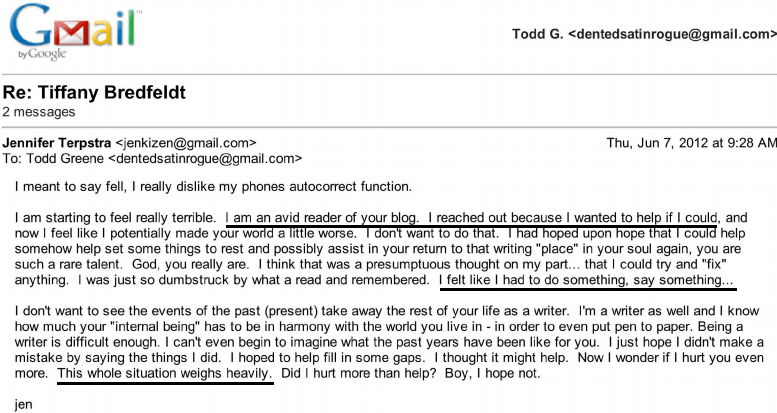
JENNIFER TERPSTRA, in an email to the writer sent June 7, 2012:
Jennifer Terpstra, Jen J. Terpstra, Terpstra JJ, Jennifer Oas-Terpstra, Jenn Oas, South Texas College, STC

JENNIFER TERPSTRA, on cross-examination by the writer on May 20, 2013:
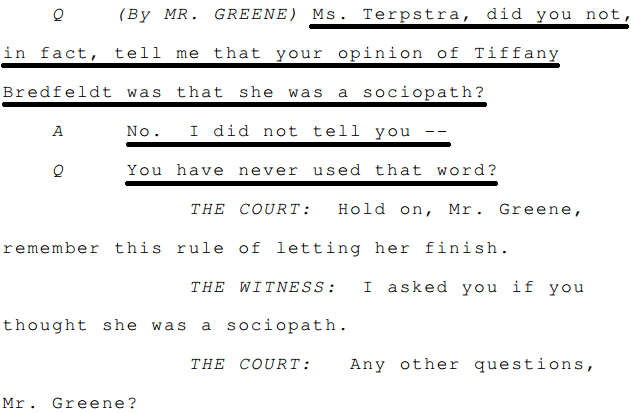
Jennifer Terpstra, Jen J. Terpstra, Terpstra JJ, Jennifer Oas-Terpstra, Jenn Oas, South Texas College, STC

JENNIFER TERPSTRA, in an email to the writer sent June 3, 2012:
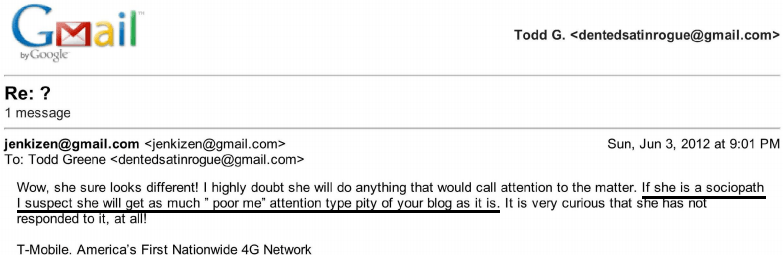
Jennifer Terpstra, Jen J. Terpstra, Terpstra JJ, Jennifer Oas-Terpstra, Jenn Oas, South Texas College, STC

Jennifer Oas-Terpstra, whom the writer has met three times in his life and only once in the past decade (and with whom he has had no contact since 2012), brought three legal actions against him in 2016 that each sought to suppress the emails quoted above—emails that today implicate both Bredfeldt and her (and criminal statutes of limitation, like those for false reporting and forswearing, stop running when perpetrators are outside of the state’s boundaries). Terpstra’s actions included a criminal prosecution, dismissed seven months later, in which Bredfeldt was also named a plaintiff, and a restraining order identical to the one Bredfeldt petitioned in 2006, which had inspired this blog and inspired Terpstra to tell the writer in 2012: “I can’t even begin to imagine what the past years have been like for you.” Terpstra’s restraining order was dismissed 20 months later.

Here are the allegations Terpstra made in her affidavit. These ex parte allegations remain a public record indefinitely. Here, in contrast, is how “vindication” from them appears. The writer was told that this handwritten dismissal, which required eight months of appeals to obtain, exists as a piece of paper only and won’t be reflected in the digitized record. Judge Antonio Riojas, who granted the Aug. 25, 2017 dismissal, accordingly recommended that the writer “carry [it] with [him].” His clerk provided the writer with the yellow copy of the triplicate form, the one meant for the plaintiff, who never appeared in court and will never be criminally accountable for her false allegations to the police in 2015 and 2016.

I’ve been doing this for 20 years,” Judge Riojas told the writer, “and I’ve never known a police [officer] or a prosecutor to charge someone for…false reports, no matter how blatant….” He added: “I wish they would, because I think people come in, and they say things that are just blatantly false—and lying.” A false or vexatious complainant “can keep filing as much as [s/he] wants,” Judge Riojas said (costing an attorney-represented defendant thousands of dollars a pop and his or her accuser nothing; application is free to all comers). “There is no mechanism to stop someone from filing these orders.” What may be worse, even a dismissed order, the judge explained, “can’t be expunged” (and anything may be alleged on a fill-in-the-blank civil injunction form, for example, rape, conspiracy to commit murder, or cross-dressing; whether heinous or merely humiliating, allegations that may be irrelevant to the approval of a keep-away order and/or that may never be litigated in court, let alone substantiated, will still be preserved indefinitely in the public record above a judge’s signature). Significantly, Judge Riojas, who is the presiding magistrate of the Tucson municipal court (and a member of the Arizona Judicial Council and the Task Force on Fair Justice for All), agreed that restraining orders were “abused”. Of that, he said, “[t]here’s no doubt.”

(In a given year, there are reportedly 5,000 active restraining orders in Tucson City Court, which recently added an annex dedicated to their administration exclusively—and the municipal court is just one of three courts in Tucson that issue such orders.)
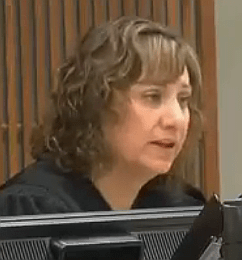
Judge Wendy Million, Tucson City Court

Judge Wendy Million

The reason Judge Riojas had to dismiss the order against the writer, nine months after he requested his day in court, was that the writer had been denied his statutory right to a hearing by Judge Wendy Million, necessitating a lengthy appeal and her admonishment by Superior Court Judge Catherine Woods for abuse of discretion. (Among approximately 15 judges to have been exposed to some aspect of this matter, Judge Woods was the first to return a ruling clearly untainted by political motives, for which she has this defendant’s highest respect.) Judge Million, who twice continued the writer’s hearing until the injunction expired and then nominated the case a “dead file,” notably coordinates Tucson’s domestic violence court and is acknowledged as an editor of Arizona’s Domestic Violence and Protective Order Bench Book. Dismissal of the case was further delayed by Judge Cynthia Kuhn, who was first assigned to the writer’s superior court appeal. Judge Kuhn sua sponte (that is, without being asked) granted Terpstra’s attorney additional time to respond to the writer’s appellate memorandum—and then abruptly recused herself, citing an unspecified “conflict of interest” as the reason.

Terpstra, in the first of the 22 emails she sent him in 2012, had told the writer: “I have this deeply engrained distrust of the law and the courts and avoid them at all cost.” Besides witnessing against him in May 2013, accusing him to the police in Nov. 2015, petitioning a civil injunction and instigating a criminal prosecution a month after that, filing a second police report in Jan. 2016, and threatening to sue him in federal court for copyright infringement 14 weeks later, Terpstra was poised to witness against the writer all over again that summer in the lawsuit brought by Bredfeldt and her husband that demanded the writer be jailed for contempt of the 2013 prior restraint. In between, in 2014, Terpstra prosecuted her husband, alleging domestic violence. A relative of his, who afterwards wept, told the writer in 2016 that she believed the man was relentlessly provoked, which the writer finds more than credible. In a voicemail Terpstra left him in 2012 (in which she tacitly identifies Bredfeldt as a “crazy person” from the writer’s “life book”), Terpstra told the writer someone had “threatened to call the police on [her].” Later, by phone, she clarified that this was another man she had been corresponding with that year—who blamed her for a woman’s suicide.

Tucson attorney Chris Scileppi, attorney Christopher Scileppi

Attorney Christopher Scileppi

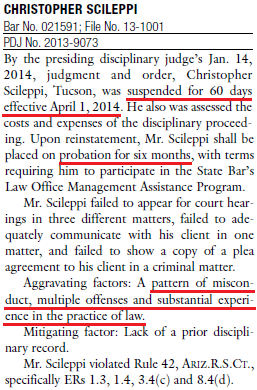
Bredfeldt and Terpstra, (carrion) birds of a feather, were represented by the same (criminal) attorney in 2016 and 2017, Christopher “Chris” Scileppi, whose plumage is no different from theirs. Scileppi attained minor notoriety in 2008 for having been given a hug by his “very close friend” the mayor in front of jurors at a rape trial in which Scileppi represented one of the alleged rapists of a 15-year-old girl. Scileppi remarked to the outraged judge: “Courtrooms are open to the public, and I don’t think it is inappropriate when high-profile people come in and show support for somebody who is on trial.” Scileppi’s client was cut free, but the mayor later did a stint in prison for public corruption despite Scileppi’s representation.

Showing the same unscrupulousness during hearings in the 2016 civil case, Bredfeldt v. Greene, Scileppi threatened in open court to prosecute the writer for purported felony crimes (“extortion” and “aggravated harassment,” specifically) to intimidate him into capitulating to Bredfeldt’s censorship demands, then offered to drop the lawsuit if the writer agreed to leave this site invisible to the public and accessible by request only (apparently because his clients’ fear would be eased if they didn’t know what was on the writer’s mind), and finally, as a Parthian shot, directed the judge to jail the writer for the nonpayment of a $350 sanction from 2013 (explained below): “Put him in contempt,” Scileppi said, “and somebody can post a bond and pay that and then he will be released as soon as that bond is posted….

Tucson attorney Chris Scileppi, attorney Christopher ScileppiScileppi, who was suspended for 60 days and placed on six months’ probation in 2014 for violating various ethical rules (ERs), endeavored to convince the 2016 court that the writer had “terrorize[d], demonize[d], harass[ed], and defame[d]” the Bredfeldts, in particular through the use of “[meta] tags” on this blog, that is, keywords that describe its contents. These terms, which haven’t been used by any major search engine in eight years, were alleged to have hijacked the Bredfeldts’ public images on Google and to have “contact[ed]” anyone whose name appeared among them. Because a Google Alert Phil Bredfeldt had “set up” had allegedly been triggered by tags on the blog (in publications to the world at large), that was said to represent illicit “communication [and] contactby the writer with Mr. Bredfeldt and his wife. Scileppi enlisted an information technology expert, “part-time professor” and (criminal) attorney Brian Chase, to loosely substantiate this theory on the stand. Lamely objecting to an eminent constitutional scholar’s weighing in as an amicus curiae (Latin for “friend of the court”), Scileppi also defended the 2013 prior restraint last year before the Arizona Court of Appeals. He told the court that the writer was the liar.

Jeffrey “25% OFF ALL MONTH LONG” Marks, the low-rent opportunist who represented Tiffany Bredfeldt in 2010 and 2013, and is quoted below, represented her in 2016, also, but was hastily replaced after the writer was granted a court-appointed lawyer of his own. Marks, like his replacement, Scileppi, attempted to induce the court to stifle even third-party criticism of Bredfeldt, for example, that of Georgia entrepreneur Matthew Chan, who (aided by Prof. Eugene Volokh) successfully appealed a prior restraint in 2015 in his state’s supreme court and who introduced the writer to the finer points of First Amendment law.

To explain away Terpstra’s emails to the writer in 2012 and the contradictory testimony she gave a year later, Scileppi told Judge Catherine Woods in 2017 that “[i]n the midst of Greene’s harassment of Dr. Bredfeldt, [Terpstra] reached out to Greene and met with him. Through meeting with Greene, Terpstra became privy to his harassment of Dr. Bredfeldt.” In contrast to Scileppi’s claims, which Judge Woods shrewdly disregarded, Terpstra had offered to help the writer settle the conflict with Bredfeldt in 2012 (three months after Terpstra “reached out to [the writer] and met with him”). In an email Terpstra sent the writer on July 18 of that year (the first of four she sent that day), she wrote: “Maybe I can be a go between if the pastor [Jeremy Cheezum, a brother-in-law of Phil Bredfeldt’s] will not. I told Tiffany we met for coffee.” The email ended, “Hoping for the best.” That was the last day the writer heard from Terpstra, who is notably the mother of two college-aged daughters. Desperate to raise money to secure a surgery for his dog to enable her to run and jump again—something else Terpstra had said she was eager to help him accomplish—the writer scarcely gave Terpstra another thought until she appeared as a surprise witness 10 months later and deceived the court for Bredfeldt.

The other friend of Bredfeldt’s the writer met at his home in 2005, Dr. Carlotta Groves, a reported recipient of $740,000 in scientific research grants who uses the alias “Jahchannah” and identifies herself as a “Black Hebrew Israelite” and “servant of Yah,” lives in Arizona but apparently couldn’t be persuaded to give witness testimony for Bredfeldt in either 2013 or 2016. Like Terpstra did in the first of her emails to the writer in 2012, Groves told him in a blog comment around the same time that her own brother had been falsely accused. Terpstra said her brother had been falsely accused of rape and that it had “truly ruined his life.” For 12 years, Groves has done what Terpstra did for six: spectate. Groves, a DVM and a Ph.D. (who “love[s] to read and support aspiring authors!”), works at a low-cost veterinary clinic in Tucson.
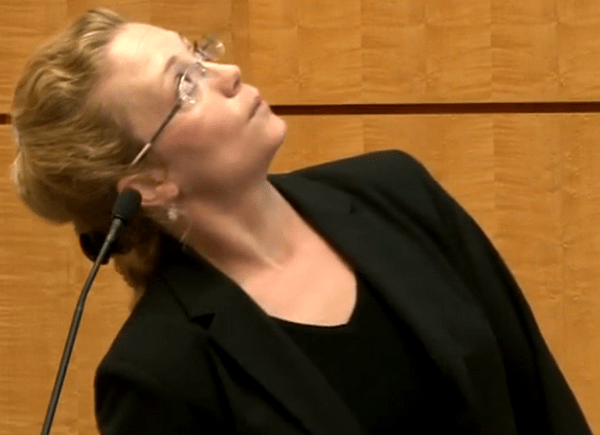

Tiffany Bredfeldt TCEQ, Tiffany Bredfeldt PhD, Tiffany Bredfeldt EPA, TCEQ, Texas Commission on Environmental Quality, EPA, Environmental Protection Agency, EPA Chemical Assessment Advisory Committee


TIFFANY BREDFELDT, on cross-examination by the writer on May 20, 2013:

TIFFANY BREDFELDT, on cross-examination by the writer on May 20, 2013:
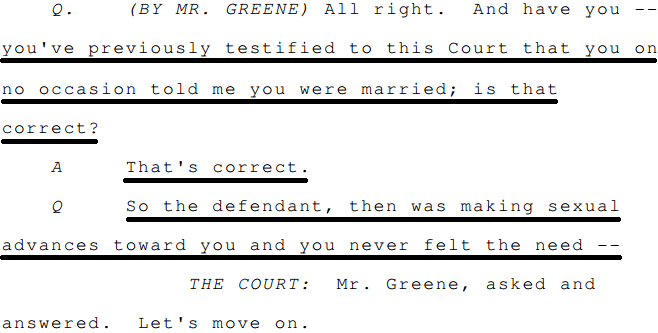
JEFFREY MARKS, Bredfeldt’s attorney, speaking for her in a memorandum to the court filed July 10, 2013:

The difference between Bredfeldt’s attorney’s offhand estimation, “2005 or 2006,” was a year of this writer’s life (and his friends’ and his family’s). The year after the “genesis of this case” was one the writer spent every waking moment conscious he could be arrested without a warrant based on a further contrived allegation by Bredfeldt (in which case the writer’s dog, who was part Rottweiler and vigorously barked at any approaching stranger, could easily have been shot and killed).

Contrary to Marks’s claim, Bredfeldt employed others to tend to her horse’s daily hygiene in 2005. Within six or seven weeks of her installing her horse 30′ from the writer’s residence, it became lame and could not even be ridden, after which Bredfeldt increased the frequency of her nighttime visits.
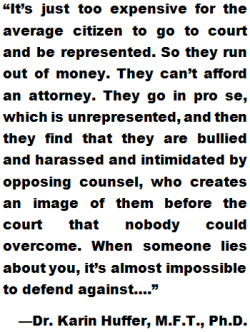
Karin Huffer PhD, Legal Abuse Syndrome, legal abuse, LASMarks, who boasts of having served as a superior court judge himself, also tells the court in this memorandum, which was captioned, “Plaintiffs’ Response to Defendant’s ‘Chronology of Tiffany Bredfeldt’s 2006 Frauds,’” that “[e]ven assuming arguendo that Plaintiff Tiffany Bredfeldt is a chronic liar, her veracity is totally irrelevant to the necessity to restrain Defendant’s [speech] conduct.” Marks moved the 2013 court to strike the writer’s “scandalous” chronology from the record so that it couldn’t be accessed by the public. The judge, Carmine Cornelio, complied, rebuked the writer, and sanctioned him $350 for filing the brief, despite having invited him to: “Mr. Greene,” the judge had said in open court, “you can file anything you want.” Then the judge permanently prohibited the writer from telling anyone else what that chronology related—including by word of mouth. Bredfeldt’s handmaidens, Honeycutt and Terpstra, said exactly what they knew they should to inspire the illegal injunction. The judge permanently prohibited the writer from talking about them, also, including by reporting the testimony they gave in a public proceeding in the United States of America.

(Last year, two days before the writer’s attorney would file an appeal reminding an American court that citizens of this country enjoy freedom of speech, The New York Times published an editorial on censorship in China adapted from an essay by iconic artist and agitator Ai Weiwei. In it, Ai argues that censorship, an essential tool of oppression, does the opposite of pacify: It stimulates “behavior [that] can become wild, abnormal and violent.” Having to live with lies, as Ai told NPR in an interview in 2013, “is suffocating. It’s like bad air all the time.”)

MICHAEL HONEYCUTT, on cross-examination by the writer on May 20, 2013:
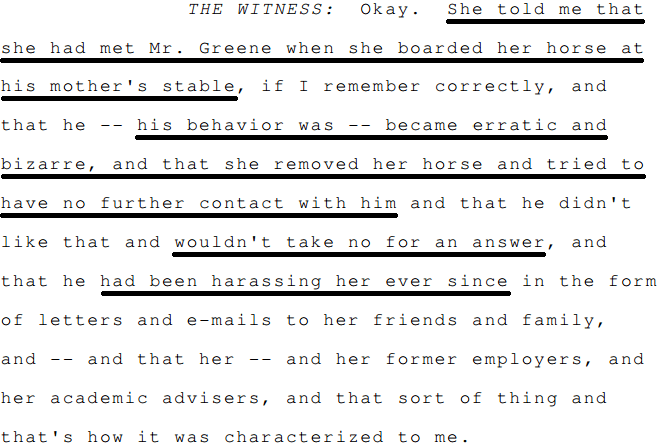
MICHAEL HONEYCUTT, on direct examination by Bredfeldt’s attorney, Jeffrey Marks, on May 20, 2013:

The testimony of “Where’s my mike?” Honeycutt exemplifies how the Texas Commission on Environmental Quality responds to “pretty significant allegations” of ethical misconduct by its scientists: It ignores the allegations…and abets the misconduct.

Under Arizona law, a “false sworn statement in regard to a material issue” is perjury, a felony crime. Honeycutt influentially testified in 2013 that the writer had called Bredfeldt a “fraudulent scientist.” Here, in contrast, is what the writer told Honeycutt in 2011, in a letter that is today a public document.
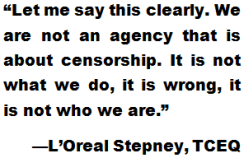
L'Oreal Stepney, TCEQ, Texas Commission on Environmental Quality, censorshipIn the Texas Observer the summer before last, Naveena Sadasivam reported that “Honeycutt sent at least 100 emails to state air pollution regulators, university professors and industry representatives and lawyers asking them to send the EPA a letter supporting his nomination to the Clean Air Science Advisory Committee….” Probably none of them sought to have him silenced on pain of imprisonment for requesting support. In a further instance of incandescent hypocrisy, Honeycutt is quoted in the story as pronouncing: “Ideology is different from science and data.” The reader is invited to consider which master Honeycutt was serving when he testified against this writer four and a half years ago.

After a hearing held on July 15, 2016, during which her husband had testified he was “frighten[ed],” Tiffany Bredfeldt swore in court, “God damn it,” because instead of ordering that the writer be jailed, the judge had stayed the proceedings pending further briefings from the attorneys on the First Amendment. Then, less than a year after the writer had buried his best friend and a few months before the writer’s father would succumb to cancer by starving to death, Bredfeldt laughed. She said Honeycutt had joked that her prosecution of the writer was “good experience” for when she gave expert witness testimony. “That’s something we have to do,” Bredfeldt explained to her entourage.

Copyright © 2018 RestrainingOrderAbuse.com

DR. MICHAEL HONEYCUTT, PH.D.:
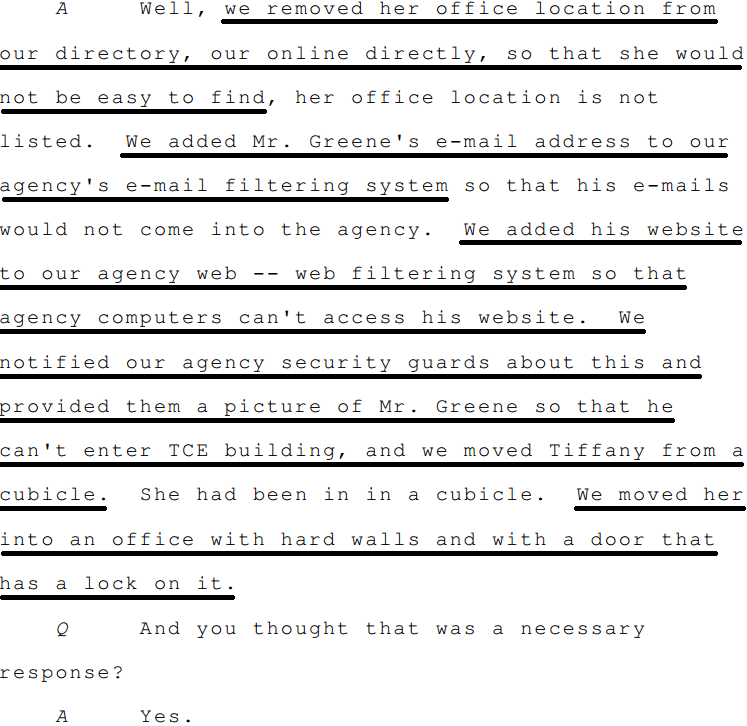
DR. TIFFANY BREDFELDT, PH.D.:
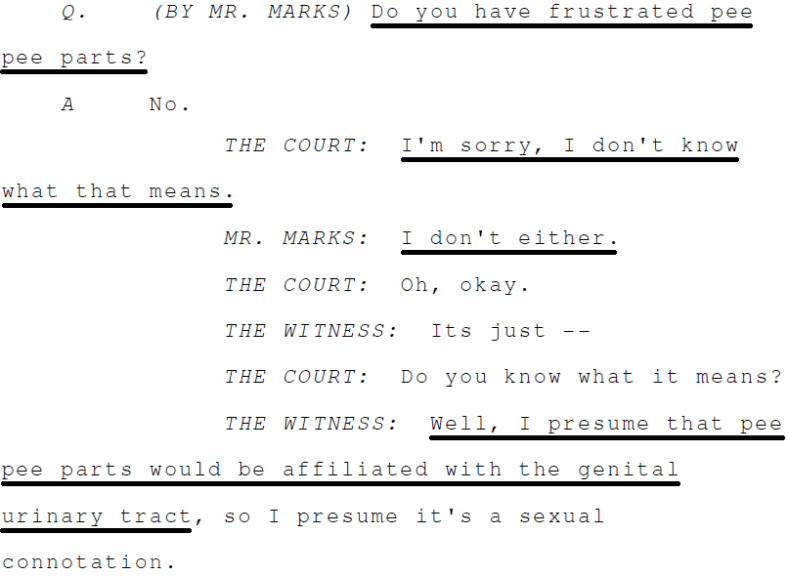
If Restraining Order Cases Are Only about Narrative, How Do You Beat a Liar in Court?

pawn-triumphs

The next to last post stressed the importance of narrative in restraining order cases.

Stories complainants tell pursuant to obtaining a restraining order don’t particularly matter. “I’m afraid” may suffice.

In contrast, defendants’ narratives are critical.

Strategic defense is not about “telling the truth.” It’s about telling the better story. Competing narratives are universally regarded as “he-said/she-said” (so to speak: Restraining orders are not strictly procured by women against men). The only thing that counts is whose story a judge favors when the end-of-the-round bell dings. (Significantly, there’s only one round, and it’s often only a few minutes long.)

Fraudulent claims in restraining order affidavits are commonplace—and what restraining orders do, especially ones whose grounds include false allegations, is inspire those who’ve been accused to register betrayal, indignation, and outrage. Since opportunities to defend may come and go in a few days’ time, those emotions aren’t likely to settle (and may be compounded by many others: fear, bewilderment, uncertainty, vulnerability, etc.).

The urge of defendants will be to stress in court how they’ve been wronged: “It’s really [him or her] who’s the bad guy, Judge.” This urge must be resisted.

The judge couldn’t care any less if s/he were paid to—and s/he is paid to.

Defendants need to defuse whatever has been alleged against them. Merely relating a meandering history (or “history”) of mistreatment can work great for plaintiffs; it does nothing for defendants.

This may seem unfair. It is, and that doesn’t matter—and that’s what a defendant must focus on: what matters.

Sometimes what matters is the law. For example, many recent posts here concern allegations that writing about someone online is “harassment” or “stalking.” One-to-many speech (online or otherwise) is neither, and it’s protected by the First Amendment. To qualify as “harassment” or “stalking,” someone has to contact someone else, repeatedly, after being told not to. Contact must be one-to-one or through a middleman. No confrontation, emails, texts, phone calls, letters, or relayed messages means no contact, and that means no grounds for court interference. Cases in which a constitutional defense is strictly applicable, however, are rare.

(The author of this post is in such a case right now with a woman who he has been told has been diagnosed with a mental illness. The law is clear: The woman has admitted I’ve had no contact with her in years; therefore there were no grounds to authorize an injunction. Making the law clear to a municipal trial judge is a different story. Do I start by playing a voicemailU that this woman, who claims I’ve stalked her since I met her in 2005, left me in 2012, in which she urges me to call her? Maybe. That kind of evidence makes a good first impression. It says—without saying it—that she’s lying. It upsets her narrative. Do I start by saying, “She’s crazy”? No. That’s aggressive and makes a poor impression. It would only get the judge’s hackles up.)

What makes a good narrative? First, follow the creative writer’s maxim: Show, don’t tell. Sometimes defendants have contradictory evidence to present; sometimes there is none. If there is evidence, it must be framed with care (and defendants are recommended to read it aloud in court and not to depend upon a judge to “get it.”) Legal method proceeds from evidence to conclusion. Defendants shouldn’t start with the conclusion, for example, “He’s lying.” They should present a story that gives a convincing impression. Then they can say, “He’s lying.” Attorney Gregory Hession, a specialist in restraining order defense, would call this highlighting plaintiffs’ “ulterior motives” (their real reasons) for petitioning a restraining order. These may include malice, for example, or cover-up.

Defendants shouldn’t rile the judge. What riles a judge is defending by accusing the other guy. Defendants’ narratives should do that. Judges actually think it’s incomprehensible that defendants should be irate, even defendants who’ve been lied about. Expressions of anger by defendants inspire theirs. Misrepresented defendants must seem misrepresented. (No normal human reactions should be expected from judges, furthermore, and normal human reactions from judges should not be relied upon. Judges will often be very civil even as they insert the knife. Defendants should never be lulled into thinking judges are on their side until after the gavel falls in their favor.)

Narratives must be organized, coherent, and taut: no jangly pockets to upset the seams.

Obviously, they should be rehearsed.

Narratives, too, shouldn’t be one-sided. Defendants should cross-examine (ask questions of) their accusers with the aim of tripping them up, and they should anticipate accusers’ answers. If an accuser has made contradictory claims to the police, for example, a way to obviate an outright denial is to phrase a question like this: “Would it surprise you to know that Officer [A] recorded that you said [X] on [date], and Officer [B] recorded that you said [Y] on [later/earlier date]?” (Any defendant who has been accused to the police should obtain the complete file and scour it. It’s there for the asking.) The objective is not to show that plaintiffs are capable of lying but that they have lied about something material (that is, about something that would tend to influence the judge’s understanding and verdict). Exposed details or contradictions should be relevant and significant details or contradictions.

Defendants with documents that corroborate their narratives and contradict their accusers’ should bring them to court in triplicate. Trial judges are seldom sage; they’re just people doing a job. Anything that appears to be “evidence” should be exploited.

Restraining order trials are storytelling competitions. Whether or how defendants embellish the facts is a question for their consciences. In a criminal trial, a defense attorney will flatly deny anything that can’t be proved by the plaintiff, even if the attorney knows the denial isn’t “the truth.” The attorney’s job is to exculpate his or her client: “Can you prove my client even knows you?”

Being storytelling competitions, restraining order trials are not won by telling “truer” stories. They’re won by telling stories that are more appealing to the listener.

Copyright © 2016 RestrainingOrderAbuse.com

Restraining Order Cases Are about One Thing: NARRATIVE

narrative

The universal conviction is that the court involves itself in a citizen’s life because the citizen did something wrong. Even judges are inclined to believe this.

It’s wrong, and they’re wrong—and it’s very wrong of them to be wrong about something so important.

The court involves itself in a citizen’s life because someone (automatically designated a “victim”) told it a narrative, one that characterized the citizen as a miscreant. Someone told it a story.

That’s it. It would accordingly be swell if administrators, legislators, the judiciary, the general public, and the press recognized this.

If a story the court is told is true, there are consequences. If a story the court is told is untrue, there are consequences. The consequences, however, are always borne by the accused, that is, the person the story is about, irrespective of whether the story is true.

The accuser may be rewarded, or s/he may not be rewarded: “No harm, no foul.

This goes a long way toward explaining why the universal conviction is that the court involves itself in a citizen’s life because the citizen did something wrong: S/he’s the only one who’s ever implicated in wrongdoing (and, whatever the circumstances, s/he is never called a “victim”).

The inequity is obvious. This inequity is magnified in restraining order cases, because stories are subject to minimal or no scrutiny in procedures that may be mere minutes long.

The “standard of proof” is how trial judges feel, and that may actually be reflected in states’ statutes, which in cases explicitly authorize judges to do as they “deem appropriate.” (Who determines whether they actually do what they think is right? They do.)

This is why it’s impossible to answer questions like this: “Can someone get a restraining order on you for calling her a bitch?” The law says one thing (no); a judge may feel otherwise.

“Justice” in this arena is freewheeling, as First Amendment authority Aaron Caplan has remarked.

In other sorts of cases, defendants may appeal a judge’s decision. Not only are few able or inclined to do so in restraining order cases (which can cost a defendant $5,000 based on a three-minute fish tale that’s swallowed hook, line, and sinker—or force him or her to cross the country to answer charges in a 10-minute hearing); there may be no point. The standard applied by appellate judges, barring arguments like violation of civil rights, is “clear abuse of discretion.” Since trial judges’ discretion is without limit, satisfying the “clear abuse of discretion” standard isn’t strictly possible. Post-trial defense is almost always an exercise in futility.

A narrative that works…works. It doesn’t matter if it was false. That had to have been proved at trial, and it had to have made an impression on the judge, who isn’t obligated to dismiss a complaint that’s fraudulent. S/he doesn’t have to justify his or her decision. It’s indisputable.

A narrative that works…works.

Copyright © 2016 RestrainingOrderAbuse.com

*The process is derisible for many more reasons than this. Significant to take from this post is that restraining order cases are storytelling competitions. There is no justice or accountability. All a defendant can do is endeavor to tell the better story. To be continued….

FABRY v. POWERS: An Injunction against a Woman That Underscores the Wastefulness and Absurdity of the Restraining Order Process, and Its Licensing of Civil Rights Violations by the Courts

Contents of this post were independently investigated by the writer. He alone is responsible for the post’s authorship.


Tennessee ball player Jacob Benjamin Fabry petitioned an “order of protection” against a Colorado woman 20 years his senior in September. He told the court he feared “harm” from the woman, Sheila Powers, who is 65 lbs. lighter than he is, stands 7″ shorter, and has never been within the borders of the state in which Fabry lives.

Here is a chart prepared by the “state administrative offices of the courts” in 2010 that puts the number of “general” and “limited” jurisdiction state courts in our country at about 30,000.

Here is a single judge’s docket for this week. It has about 30 cases on it, eight of which (about a fourth) are protection order cases.

That’s one judge, one week, eight restraining order cases. While it’s unlikely this means there are 240,000 restraining orders issued each week in the United States, it does suggest that there are a whole lot. (A cost estimate by DailyFinance.com, also from 2010, projects the national expenditure to be at least $4,000,000,000 per annum.)

The particular judge whose docket is cited is L. Marie Williams, who issued a restraining order in Tennessee last year petitioned by Jacob Fabry against Coloradan Sheila Powers. The judge’s order requires that Ms. Powers, who lives three states distant from Mr. Fabry, “stay away” from him and his children, and it mandated that she turn over any firearms in her possession within 48 hours.

Mr. Fabry’s affidavit to the court claims “threats of harm,” besides “harassment and stalking,” as the motives for his application for an injunction. Ms. Powers says she has never been to Tennessee, including to contest Mr. Fabry’s “order of protection.” The order was finalized by default: “The Tennessee judge…refused to let me appear by phone and then threw my notarized affidavit out, [rejecting] it as hearsay.”

Mr. Fabry, the plaintiff, is a competitive baseball player who stands 6′ 1″ and weighs 195 lbs.; Ms. Powers is 5′ 6″, weighs 130, and lives in a different time zone. She’s also 20 years older than Mr. Fabry.

Jacob Fabry

Judge Williams ruled:

Respondent shall refrain from contacting Petitioner, his family, his girlfriend or his employer, directly or indirectly, from stalking, harassing, threatening, texting, emailing, posting on the Internet or any social media platform anything about, referring to in any way referencing the Petitioner, his family, his girlfriend or his employer.

The judge’s ruling exemplifies how an already extravagantly expensive, easily exploited, and dubiously necessary process opens the door to gross violations of citizens’ civil rights. In wanton excess of her jurisdiction, the judge prohibited Ms. Powers from exercising her right to freedom of speech.

This order, besides highlighting palpable absurdities endemic to the restraining order process, is transparently unlawful (i.e., unconstitutional) and therefore void (which does not mean it can be safely disobeyed).

Copyright © 2016 RestrainingOrderAbuse.com

*The order concludes: “Neither you nor the Petitioner can agree to change this Order. Even if the Petitioner attempts to contact you or agrees to have contact with you, you must obey this Order. If you do not, you can be jailed for up to 11 months and 29 days and fined up to $2,500.” (Emphases added.)

Jacob Fabry


Evidence of Perjury Cannot Be Used to Appeal a Fraudulently Obtained Restraining Order

Someone once told me that the only value of a lock is to keep an honest man honest.

The value of perjury statutes is exactly the same: They make an honest person extra careful about what s/he tells the court.

To a liar (the person they’re supposed to thwart), they’re just “blah-blah-blah.” Perjury (often recognized as a felony crime) isn’t prosecuted—and for that reason, judges seldom even use the word. If a plaintiff is caught lying, and the lying is significant enough to urge dismissal of the case, s/he may get a stern talking to post-trial. That’s about it.

Restraining order judges make a liberal determination about whether sufficient merit exists in a plaintiff’s claims to warrant upholding a temporary order. Lies irrelevant to that determination may be ignored even if a judge detects them.

Judicial disposition is to credit plaintiffs and suspect defendants, and that’s a high hurdle for a defendant to clear. The defendant also enters the courtroom having been prejudged “guilty.” (Some respondents to this blog report never having been allowed to address the court at all—or being silenced after a few minutes.) Besides their being prejudiced, hearings to finalize restraining orders are, putting it generously, “highly accelerated” trials. Putting it accurately, they’re superficial.

But no allowance for that is made after they’re over.

The only way to have a restraining order that’s based on fraud vacated is to expose lies during the “highly accelerated” trial. That’s why attorney Greg Hession, a strenuous critic of restraining orders (his blog is MassOutrage.com), emphasizes the importance of exposing a plaintiff’s lies and “ulterior motives” during trial: There is no “second chance.”

From Easterling v. Ameristate Bancorp., Inc. (2012):

[I]t is well settled that “[p]erjury in a prior case cannot support a cause of action in a subsequent civil case.” Elliott v. Brown, 2d Dist. Miami No. 10-CA-19, 2010-Ohio-5749, ¶12; see also Costell v. Toledo Hosp., 38 Ohio St.3d 221, 223-24, 527 N.E.2d 858 (1988) (“[A]ppellants have essentially set forth allegations constituting perjury, subornation of perjury, and conspiracy to commit perjury, all of which are punishable under the criminal statutes but which, for public policy reasons, may not be the basis of a civil lawsuit.”).

You can’t appeal a restraining order that succeeded on false evidence on the grounds that it succeeded on false evidence (unless new proof is discovered that you couldn’t have previously brought to the court’s attention). You can’t sue for perjury, either.

Similarly, unless you prevailed at trial, the odds of winning a lawsuit brought for fraud or intentional infliction of emotional distress, for instance, are very low.

You have one window of time in which to expose false accusations (and ulterior motives), and that window is very narrow.

Other countries follow the same policy ours does (in the interest of economy), for example, Canada:

[T]he claim to vacate a judgment on the grounds of perjury cannot succeed unless by new evidence and shewing that the aggrieved party could not by reasonable diligence have been able to discover and bring forward at the trial such new evidence as desired to be presented in the action….

That opinion (in MacDonald v. Pier) was entered almost 100 years ago (hence the antique spelling of showing). It’s etched in stone.

Everyone who’s been fraudulently misrepresented to a judge and railroaded in court is excited to learn the word perjury, because s/he just knew lying under oath had to be a crime.

What s/he might have expected, though, is that perjury, like telling the truth, doesn’t matter.

Copyright © 2016 RestrainingOrderAbuse.com

*To expose false accusations and ulterior motives at trial, it’s essential that defendants insist upon the right to cross-examine (question) their accusers. It’s one thing to say the plaintiff is lying or to try to show that s/he has lied with evidence; it’s another to actually have the plaintiff admit lies (or contradict him- or herself) on the stand in the presence of the judge.

“Somebody Do Something to End This Madness!”: One Commenter’s Appeal for Restraining Order Reform

A comment Wednesday resonated with the author’s experiences of legal abuse and many others’. It said its writer’s life was trashed because he showed compassion for another. He exhausted his savings to help his ex-wife out of a fix, flying out to California from Colorado on a day’s notice. Five years later, having lived with the aftereffects of legal madness every day of the interim—which included appeals in another state, postponements, and a five-year restraining order extension—he says he feels his life is “over.” Of particular note is that the apparent instigator of the fraudulent restraining order petitioned against him was his ex-wife’s son; the son allegedly threatened to turn his back on his mother and evict her from his home if she didn’t comply with his wishes.

The commenter’s account:

[In] 2010, she calls me in Denver [Colorado], where I had a two-bedroom apartment, crying the blues that she had a big fight with her boyfriend, and requested to stay with me for a little while. I gave in as we were married for 23 years and had remained friends.

I fly out to San Jose [California] the next day, and we drive directly from the airport to U-Haul, pick up a truck, and are on the road in a couple of hours. Five days later, I move her into her own bedroom and put her furniture in storage.

Things went fine until she wanted this dog up in Wyoming that had some issues.

We drive up to get the dog and then after getting it home, I find out the issues—the dog would just pee on the carpet at random. I told her the dog had to go. She’s not happy, but we surrendered it to the local shelter.

Next thing I know, there is a knock on the door with her son ready to drive her back to San Jose.

Not a problem until two weeks later when the sheriff delivered the TRO [temporary restraining order] that stated I had to give up my guns and appear in San Jose at a hearing in seven days. “Why?” I asked. “Don’t we have laws in Colorado? Shouldn’t the case be tried in Denver?” Apparently not. I lost that argument.

I went to San Jose, had a 10-minute hearing in front of—what else?—a woman judge. My ex had a lawyer [thanks to] the good old folks at VAWA providing the funding. I [checked with] over 30 attorneys, and no one would touch the case pro bono (she took any spare money I had moving her).

Then we found out that she can talk to me; I just can’t talk to her (great system).

We found a way to communicate…through the Internet on one of those game shows. We would pass notes back and forth. She did not have a problem with that. The son found out and over his IPhone requested an extension on the court order.

Turns out, truth be told, that the son was the one who wanted her to get the RO. She never had any intention of doing such a thing. The son apparently was angry because he asked me what happened between his mother and me. I responded by asking him if he was sure that he really wanted to know the truth about his mom. Well, I told him the truth. I told him that his mother was screwing around on me every chance that she had.

That did not sit well with him. So here we are…RO. Every lie in that first and second complaint was written by him. He forced his mother to go along with it by threatening that he would not want her to be around him anymore and that she would have to move out of his house.

With all the postponements, when we finally got a ruling on the attempt to continue the first RO, which only had two weeks left on it, the judge, a new woman judge, ruled against me. She would not even let me speak.

So, long story short, after all the delays in between the appearances, I now received an additional five-year RO causing my total RO to be about 7 years.

I don’t give a shit whether I ever see her again, but I thought that this was a country of laws. There was never any violence between us. Yet this judge violated my Second Amendment rights once again.

So…lesson learned: Never even raise your voice to your significant (???) other. When she finds out how much money she can get out of all the federal funding, inclusive of cars, a place to stay, educational programs, etc., etc., she will come after you without a second thought.

The entire law is wrong. It violates [the First, Second, and Sixth Amendments, and probably others]. And the worse part of it is that any woman you want to date is going to plug your name into the Internet before she considers going out with you. Or her son or daughter or girlfriend will…just because they want to make sure she’s not going out with a “bum.”

My life is over. I have no social life [and] no place to turn. Not one lawyer will help. Not one congressman or senator will go against all the women who started all of this in 1994. And why? The only reason that I can come up with is that they don’t want to get “cut off.” They have no balls and couldn’t care less about what is right or wrong.

This is a bad law. I think if I remember the VAWA statute correctly, the phrase man or men is mentioned one time. I am for anyone who has any ideas on how to overturn this law and at least give us our “rights” back. I can understand it if you are a wife-beater or something like that, but the word harassment is so ambiguous. How can any judge make an honest decision?

Please, everyone, chime in. This could happen to you! If your wife gets an RO on you, you are in “the system.” You no longer will have a job, friends will shy away from you, and even your own family will distance themselves from you.

SOMEBODY DO SOMETHING TO END THIS MADNESS!

Please.

Copyright © 2015 RestrainingOrderAbuse.com

*The anonymous commenter’s remarks began: “I will be more than happy to pay any attorney to get my Santa Clara County, California RO taken off of the Internet!”

Understanding the Significance of False Accusations in Restraining Order and Related “Trials”

Misperception of the significance of false accusations is a topic that’s been considered in past posts on this blog, particularly false accusations of sexual assault, which are the only false accusations anyone seems to believe are deserving of mention.

It’s wrong to say that the nature of false accusations doesn’t matter. But more relevant to observing corruption than a consideration of what is alleged is a consideration of how it’s alleged and decided.

Imagine if special courts were convened to judge accused people of a certain type, and imagine if the normal standards of evidence applied to allegations that may impute criminal wrongdoing to them were suspended. Imagine if instead of having to prove they had done what they were accused of, it were enough for a single judge (absent a jury) to “determine” upon a few minutes’ deliberation that the allegations were probably true and sufficiently urgent to merit the court’s intrusion.

These are among recent search terms that brought readers to this site.

If the accused people of a certain type were Jews or African-Americans, for instance, we would denounce these special courts to be an abomination. This kind of discrimination would raise our hackles.

Yet such special courts exist. Restraining order allegations are decided exactly this way, as may be allegations of domestic violence or rape, allegations that can also be made on restraining order petitions. There is nothing that can’t be alleged on a restraining order petition. Yet nothing alleged must be verified.

Now the critic of complaints about the harm of false allegations will chime in at this point and say, yeah, but it’s not like the victim of false accusations decided in a kangaroo court will be served a felony conviction.

Yes…and no. The critic should ask him- or herself what kind of person would maliciously or self-servingly lie about stalking, sexual violation, or violence and then ask him- or herself whether it’s reasonable not to expect more and worse from such a person.

Subsequent false allegations can give people criminal records (possibly, again, without a jury’s ever having vetted the evidence). They can give people criminal records because of the prior lie. A person can find him- or herself deprived of everything, including liberty, based on a tissue of frauds.

My ex-husband used to batter me and then go crawling on his hands and knees through the neighborhood until he reached the hospital or police station, and he would claim I had attacked him. I’d be hysterical, and police would arrest me. This happened repeatedly. […] I was made homeless on multiple occasions. He would involve my family, his family, all of our friends, employers, and university professors, and I was always the bad guy and still am. […] They filed restraining orders against me and claimed I was a danger to everyone; kidnapped my son, my dogs; stole my car at one point; drained bank accounts, PayPal accounts; and sawed locks of my storage unit and took off with everything…and EVERY F[—]ING TIME, police just validated the abuse and continued to terrorize me.

To complicate matters, a ruling on a false accusation can criminalize lawful behavior. So a subsequent allegation against someone can be true, but the alleged behavior that lands him or her in jail might only have been unlawful because of the original false accusation.

She filed a PFA [protection from abuse order] against me in April of 2014. Several months later, I was charged [by the district attorney on two counts of] violating the PFA. (1) My wife read my private password-protected Facebook emails. I asked a friend to contact her ex-husband #2 and tell him what was going on between her and me (he lives in Mexico and was listed on the PFA as one of the people I could not contact). The friend I emailed didn’t contact her ex-husband. In fact, nobody contacted her ex-husband. (2) I drafted a letter to my wife and gave it to my lawyer. My lawyer in turn forwarded it to her lawyer. They claimed this was also a PFA violation. We went to court, and the judge agreed on both counts and sent me to jail for 30 days. [This commenter’s wife was a Mexican national whom he met in March 2013 (Match.com) and married a month later. The PFA was filed after he “got her and her children their immigration papers” and later told her he wanted to divorce her because the marriage was unsatisfactory.]

Appreciate that one false record can be invoked until the end of time. The superficial critic thinks that once a trial is concluded and the framed victim survives his or her licks, the matter is concluded.

Not so. Ignoring the psychological residue for the moment, if the victim of a false accusation is falsely accused a second time, it can now be alleged that s/he has a “history” or “pattern” of abusive behavior, which may influence a divorce or child custody proceeding, a lawsuit, or even a criminal prosecution.

Respondent [—] and Father have a history of domestic violence that includes, but may not be limited to, the issuance of temporary restraining orders in cases […] and the issuance of a permanent restraining order in case […] which was entered by default on January 16, 2015, placing the welfare of the Child at risk. [The “Father” in this case was married to his wife for a brief period before she left and then filed a number of allegations of violence, both with the police and the court, over the ensuing six months. She then committed suicide after being institutionalized. She gave birth to a daughter a couple of months prior whom she had told the father she had miscarried. The father was never heard by a court in his defense but has nevertheless been represented as a serial abuser by the district prosecutor, who has sought to deny him any role in his child’s life.]

Lies that stick…cling, and they can be recycled. Public records don’t expire, and court rulings that impute grave misdeeds, even if those rulings were formed in mere minutes, aren’t questioned. They’re as valid as any other ruling.

Lies that stick, moreover, are entered into public (police) databases, registries that throw up red flags…indefinitely. The person falsely accused of domestic violence, for instance, may be permanently barred from certain types of employment and even, say, from attending his or her daughter’s dance recitals at school.

Defendant was refused jobs, [is] not allowed to attend [or] volunteer [at] her daughter’s school events, [and has had] numerous other rights taken away due to Plaintiff’s Abuse of Process and Fraudulent Allegations and written Affidavit to the Court. This continues today. [This is an excerpt from the draft of a commenter’s “Motion to Expunge,” which she was preparing herself with no legal know-how.]

Again, privations endure permanently, for always, ad infinitum.

The liberal critic who declaims s/he’s for immigrant rights and for restraining orders should be aware that a non-citizen who’s falsely accused in a restraining order proceeding and then accused of violating an order obtained by fraud can be summarily booted from the country: Adios, muchachito (we don’t like your kind here).

Based on lies, people are deprived of their good names, their dignity, their children, their homes, their property, their livelihoods, and their security.

Finally, being lied about and then scorned by cops and lambasted by judges—these traumas last, and they last no less indefinitely than false records do. So on top of everything else, people may be driven out of their minds.

Copyright © 2015 RestrainingOrderAbuse.com

*Public records, besides being permanent, are also public records, and a lie that a judge legitimates is a lie that everyone else will regard as true (e.g., a neighbor, a boy- or girlfriend, a student, a patient, a client, an employer, a loan officer, a landlord….).

A Consideration of Attorney Gregory Hession’s “How to Fight a False Allegation Restraining Order”

“In thousands of 10-minute hearings held all over the Commonwealth, judges are now able to do what the Marxists have only dreamed of doing before now, and could never hope to do before they were able to use the pretext of ‘domestic violence.’ However, the real violence is almost always to the rights of the defendant, and to the Constitution itself….”

—Attorney Gregory Hession

As a follow-up to the previous post, “Pointers for Contesting a Restraining Order,” this post analyzes (and recommends) attorney Gregory Hession’s tutorial “How to Fight a False Allegation Restraining Order.”

The title’s a little weird. An earlier version of the explication used the phrase “false restraining order.” Evidently Mr. Hession wanted to clarify that he means a restraining order that’s very real but based on an allegation that’s false—hence the phrase “false allegation restraining order.”

Massachusetts attorney Gregory Hession, who urges the wrongly implicated to expose their accusers’ false motives, identifies the above as “ulterior” reasons for the procurement of a restraining order.

The quotation of Mr. Hession’s that was lifted for the epigraph above highlights that violence is the pretext used to justify procedures that are constitutionally unconscionable. Often no violence is alleged. The word, however, emphatically appears everywhere in state statutes as a smokescreen. It makes any violation or abuse of the accused “okay.” The courts aren’t messing around with people’s lives for kicks; they’re protecting the vulnerable from “violence.”

Here, therefore, is what you, as the “defendant” or “respondent” (the accused), are up against:

In restraining order hearings, judges may ignore ALL traditional due process protections such as jury trials, the rules of evidence, the right to innocent until proven guilty, etc. They may also usurp several other dearly held rights, such as the right to be with one’s children, to occupy one’s own home and property, or travel where one pleases. No one has yet come up with so demonic a perversion of our legal system to match the breathtaking scope of the unconstitutional deprivations of this law.

What is the actual legal basis for getting an abuse restraining order? Many courts issue restraining orders without following the requirements of the law (which are already so flimsy as to be a mockery). If a person comes into court (called the “complainant” or “plaintiff”) and whines about feeling “fear,” a court will often issue an order, even though many times it is improper and illegal to do it.

Restraining orders—not just in Mr. Hession’s state of Massachusetts but in most if not all states—require that some intimation of “imminent physical harm” be suggested by the alleged conduct of the accused. Mr. Hession urges that this qualification be picked apart.

First the harm has to be “imminent,” [that is], immediate, right there, right now. Not a vague threat to do something someday. Not a phone call from a far location. Next, it has to be “serious.” The [Massachusetts] attorney general, on a ballot referendum to overturn some recent changes to the domestic violence laws, defined “serious bodily injury” as follows:

“Injury that results in a permanent disfigurement; long-term loss or impairment of a bodily function, arm, leg, or organ; or substantial risk of death.” [If you’re appealing an order in another state, you may investigate how your state defines “serious bodily injury.”]

Lastly, the fear has to be of “physical” harm, not emotional harm, psychic harm, hurt feelings, or any number of other non-physical issues that people commonly get orders for.

If courts went by this definition strictly, fewer frivolous orders would be issued. However, as you likely know, judges often issue an order if they feel it should be issued, regardless of the law’s requirements.

(Statutes are often mishmashes. Ridiculously, an injunction against harassment in the author’s state of Arizona reads, “The Court finds reasonable evidence of harassment of the Plaintiff by the Defendant or that great or irreparable harm would result….” There’s plainly a huge gulf between annoyance and “irreparable harm.” That’s how these statutes are designed: to apply to virtually any alleged conduct, however harmless, but to make it seem as though plaintiffs are being protected from violent assault…or murder. That’s how the laws are justified. The person who sends some angry text messages is equated with tomorrow’s serial killer.)

If you hope to appeal a restraining order, Mr. Hession stresses, you must appeal the initial order (which may issue from any of a number of courts). It is possible to contest an order through higher tiers of the court system if the first judge finds against you, but if you blow off your initial court appearance, “fuhgetaboutit.”

First, Mr. Hession says, get your “docket number” (your case number), go to the courthouse, and demand to see all of the allegations against you. (Sometimes the plaintiff’s affidavit, his or her sworn narrative statement, isn’t provided to the defendant when the order is served and must be requested.)

Second, he offers a number of strategies to attack the allegations against you, mainly by exposing falsehoods. For these, go to the source: “How to Fight a False Allegation Restraining Order.”

If you have no experience of court procedure, Mr. Hession’s tutorial is a challenging read. It’s also long, which can be off-putting. It is, however, definitely worthwhile, whatever state you may be in.

The point of this heads-up is to ensure that the substance of Mr. Hession’s advice isn’t discounted by the bewildered defendant who may think it only applies to the wrongfully accused in Massachusetts. Absorb the gist of the material, and it’s likely you’ll fare far better in an appeal than you would have otherwise.

Copyright © 2015 RestrainingOrderAbuse.com

Who Lies about Whom on Restraining Order Petitions?

Feminists would have the public believe that complaints of procedural abuse and courthouse fraud come from a single source: ex-husbands who’ve been left high and dry after a contentious divorce. The impression they promote is that criticism of feminist-inspired procedures of law is nothing more than the misogynistic ravings of bitter men who got what they deserved.

(The Southern Poverty Law Center and some leftist dweeb collective styling itself “RationalWiki” maintain lists of what they pejoratively term “MRA” websites, which they lavish with contempt, and the blog We Hunted the Mammoth is dedicated to mocking the men’s rights movement.)

No allowance is made that the claims of husbands and fathers could be true or even understated, claims, for example, of vicious frauds by false accusers and institutionalized discrimination. Obviously, no allowance can be made by the profiteers of the that discrimination; it would discredit their “cause.” Accordingly, the array of relationships accusers and the accused have is also concealed. That array is ugly to contemplate, and it ridicules the restraining order and domestic violence processes themselves.

Here are some of the scenarios the author of this blog has heard firsthand, all of them reportedly based on false or hyped allegations to the court:

This list is by no means comprehensive. Asterisks indicate how repeatedly the scenario has been reported here.

Copyright © 2015 RestrainingOrderAbuse.com

If a Man Who Complains of Procedural Abuse is an “MRA,” What Do You Call a Woman Who Complains of Procedural Abuse?

It isn’t just the men disparaged as “MRAs” (men’s rights activists) who denounce the injustice of feminist-inspired “women’s law.” Women also lose their homes, their families, their dignity, and their lives to misapplications of restraining order and domestic violence statutes. Unlike the men whose lot they share, these women aren’t distinguished with a label.

I propose the acronym “BRA,” which could stand for any of the following:

  • Beleaguered rights activist;
  • Baffled, boggled, buffaloed, or bewildered rights activist; or
  • Buggered rights activist.

The latter of these, especially, would evoke the same mockery shown the men’s rights activist to whom “MRA” is applied like a markdown sticker.

Make no mistake: Women who complain of procedural abuses are no less ignored than the men who do. They’re not saying anything anyone wants to hear—not the ACLU nor the Southern Poverty Law Center nor battered women’s advocates nor feminists in general. They’re misfits, and they’re accordingly denied status. No one dares contradict them, because that might sound misogynist. So they’re just disregarded.

Here are some different proposals for what BRA might represent: bypassed rights activist, betrayed rights activist…or balanced rights activist.

You want the straight dope about false accusation and the need for procedural reform? Ask the ex-wife who’s had her child taken from her, ask the disabled girl who’s been accused of domestic violence and cries herself to sleep every night, ask the mom who can’t attend her child’s school functions or keep a job, ask the ex-girlfriend who was nearly parked on the curb, or ask the professional woman who’s been denied protection against a brute and then framed.

But only ask if you can tolerate an inconvenient truth.

Copyright © 2015 RestrainingOrderAbuse.com

*A woman is the best rights activist, and more women’s voices should be heard in coordinated public protest.

It All Starts with the “Rape Question”: Before Society Can Be Expected to Redress the Harms of False Accusation, It Must First Be Led to Acknowledge That False Accusation Destroys

“Having demonstrated that the percentage of false sexual assault reports is not as high as many people think, this does not deny their terrible reality. We all know that false reports do really exist, and they are incredibly damaging both to criminal justice personnel and to the countless victims of sexual assault whose credibility they undermine.”

Dr. Kimberly A. Lonsway, et al. (2009)

Everyone “thinks” that male invocations and criticisms of false rape claims are really the misogynist yowls of the disentitled patriarchy…or something like that. They aren’t. Rape is the tinderbox issue. If complainants of false accusation and unjust demonization, who are typically men, seem to focus on false rape claims, it’s because that’s where everyone else’s focus is directed.

Rape overrules all other concerns and trivializes them.

Read the epigraph by Dr. Lonsway again and ask yourself what’s missing from her brief catalog of “incredibly damaging” consequences of false rape reports.

Her statement owns that “false reports [of rape] do really exist.” It also owns that they’re “incredibly damaging.” But it completely discounts the damage to the people falsely accused by those reports.

They’re not even mentioned as victims; they don’t count at all.

If victims of false rape claims aren’t acknowledged to be victims of anything, then how can victims of false accusations of other sorts expect to be afforded a sympathetic ear? Societal regard has been coerced to the extent that acknowledgment of false accusation (any act of false accusation) is equated with rape denial. To own false accusation is a significant problem is to commit an act of moral treason.

What those who haven’t been abused by process will never appreciate, so long as false accusation is dismissed as inconsequential, is that any foothold a false accuser can obtain can spell the end of someone’s life as s/he knew it.

People can be hounded to the end of time, particularly through civil procedures (like restraining orders), which generate records that gnaw, humiliate, and limit life options, and that open the door (gapingly wide) for further false accusations. The falsely accused can lose everything. They can find themselves felons and exiles, homeless and jobless, and possibly suicidal or homicidal…based on nothing real or true: a layered sandwich of lies.

What’s more, the dismissal of false accusation as an urgent societal concern is contagious. It influences judicial policy and practice; it influences the law. Thus is the problem compounded: False accusation is encouraged, because it’s effective. There are no risks, so there’s no downside.

Denial of the problem worsens it.

Our civil rights advocates vociferously decry violations of women’s rights, children’s rights, minority rights, gay and lesbian (GLBTQ) rights, animal rights, and on and on, and there aren’t any of these rights that aren’t violated by false accusers. None. Children are scarred (voicelessly); women are stigmatized and stripped of all resource; minorities, who may have the least access to legal representation, are railroaded or sidelined; gays and lesbians are handily represented as “creepy queers”; and pets are abandoned (possibly to be killed).

They might as well be living in 1956…and that’s significantly because of the “rape question.”

Look, how widespread false accusations of rape are is irrelevant. It’s irrelevant. What’s relevant is that they hurt and they kill, as do false accusations of all varieties. Rape also hurts and kills…but only also. What hurts and kills must be censured categorically, not selectively.

Dogma must be rebuked. Those who haven’t been falsely accused have no place at the table. They’re due to listen for a change.

The reason so many energies are concentrated on the “rape question” is that until the harm of being falsely accused of society’s “worst” crime is acknowledged, there can be no expectation that the harm of being falsely accused of any other will even register.

Copyright © 2015 RestrainingOrderAbuse.com

*Rape has been used to chasten society’s conscience, which means anti-rape advocates have determined society’s conscience. Their priorities have become “our” priorities and to gainsay them is to be ridiculed and vilified. A reason news stories of false rape claims are bruited by those denounced as “MRAs” (men’s rights activists) is because they often reveal deeply warped motives and methods, and these deeply warped motives and methods aren’t exclusive to false rape claimants.

Low and Outside: An Umpire’s Story of Restraining Order Abuse (by an Underhand Screwball)

As the story in this post shows, the phrase “America’s Game” has taken on a new meaning.

The common assumption—one that’s been vigorously enforced by advocates of the “abuse industry”—is that restraining orders are used to protect “victims” from “abusers.” So-called abusers are represented as violent husbands or boyfriends, or as stalkers, representations that account for the ubiquity of restraining orders and the ease of their procurement.

The man whose story of restraining order abuse appears below reports that restraining orders can be obtained by drive-thru in his state (California), like milkshakes and onion rings.

The restraining order against this father and family man was petitioned by his sister-in-law on behalf of her son, his nephew. The man affronted his sister-in-law by umpiring two of her son’s games (his job), contrary to her wishes. That’s the basis of her complaint to the court.

Fighting that complaint has now cost the man and his family some $15,000 (besides money he would have earned as an umpire), and his life’s on hold while he awaits an appellate court ruling that won’t emerge for six to 24 months.

Here’s his story, as he tells it:

I am a victim of restraining order abuse.

At the age of 37, I married the love of my life. It wasn’t until after we were engaged that I found out that most of my wife’s family didn’t like me. This is the foundation of my story.

I am a little league, travel ball, and high school umpire. I umpire because I love the game and to make some additional money on the side. I have been umpiring baseball for close to 25 years without any incident whatsoever, and most reviews of my performance have been complimentary.

When my wife and I were married, we resided in Orange County, California. Our residence was far from the rest of her family, which limited our exposure to her parents and her sisters. My wife has two sisters, one older and one younger. Her elder sister is a lawyer, and her younger sister is a stay-at-home mom.

The eldest sister and her family and I have a great relationship. The problem is with the youngest sister, who is a control freak. She likes to control everything, including how many cups of coffee her husband has a day, and if she’s denied control, she will go to whatever lengths she has to to get it.

Two years or so ago, my wife was offered a job that would move us nearer to the younger sister. This was something that excited my wife, because she loves her family very much and wanted to be closer to her nieces and nephews. When she decided to take the job, she contacted her sister and told her the good news. Her sister was excited and worked with my wife to find a house that was near hers, and she found us a great one.

After moving in, we were visited quite frequently by my wife’s little sister and her family. Every time she visited, however, she pointedly let my wife know about her displeasure with the way we parented our eight-year-old little girl. As a stay-at-home mom whose entire existence revolves around her four kids, she has read every book on parenting and considers herself an expert in child-rearing. I had even caught her entering my house and administering medication to my daughter without our consent, which I firmly put a stop to.
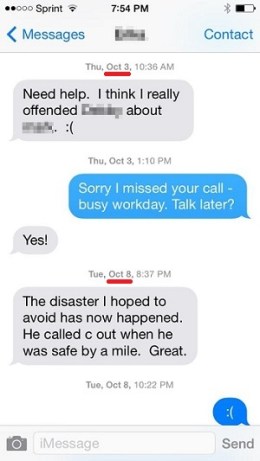
Back to baseball.

After we moved, I enlisted with the local little league to umpire. I worked for a local umpire company that was very pleased with the service I provided to them. It considered me one of its better umpires. One day, I was assigned to umpire one of my wife’s younger sister’s kids’ games. I checked with the league to see if there was an issue and was told no and that it had people umpiring their relatives’ games all the time. Just be neutral, I was told, which I always am.

My wife’s younger sister found out that I was going to be umpiring her son’s game and called my wife to tell her to have me remove myself from the game. When asked why, she stated she just wanted to keep things separate. My wife didn’t understand why and told her to not worry, that I would not show any bias toward her kids and everything would be great. He sister repeated that she just wanted to keep things separate. My wife still didn’t understand why, because her son and I had a great relationship, with no problems at all. At this point, the woman became hysterical and said, “Keep your husband away from my son.” My wife got very upset and hung up on her. After that, we found out that the younger sister called the older sister and asked what she should do to repair things with my wife because she had upset her.

Well, because there was no good reason for my sister-in-law to be upset, and because the umpire company needed me to cover the game, I did. There was no issue with the game, and I received many compliments afterwards. I ended up working another one of my nephew’s games a couple of weeks later, again with no issues. The next week, I got a call from my umpire assignor reporting that my sister-in-law filed a complaint with the league saying her son was “uncomfortable” with my working behind the plate.

At that point, I banned her and her son from visiting my house. This really angered her and inspired her to get back at me.

Meanwhile, my assignor and I got together and agreed I should no longer work any of her kids’ games because she was clearly sick. So I was assigned to other games at the park that didn’t involve her kids.

This wasn’t acceptable to her. She didn’t want me at the fields at all. So she took pictures of me there on the days I was scheduled to work and created a story that involved my hunting and stalking her kids, and affecting their mental well-being.

She went to court and was granted an ex parte restraining order.

When I was served the restraining order, the deputy sheriff told me that he had read it and thought it was the funniest thing he had ever seen. He said he had no idea why it was issued and told me to just stay away from my sister-in-law.

When the time came for me to appear in court to fight the order, I had an attorney and she did not. The judge clearly stated that he would not give her preferential treatment, even so.

This turned out to be completely false.

My attorney laid out a solid case to have the order dismissed, presenting facts that showed there was no proof of any stalking or harassment, and that up until the time of my sister-in-law’s going crazy, her kids and I had had a great relationship.

After about a two-hour hearing, the judge ruled against me. He stated that because my wife informed me that her younger sister had told her to keep me away from her kid that I was put on notice…yet persisted in showing up at the fields to work. Never mind that I was told two months after their conversation (my wife didn’t tell me right away because she thought it was just her sister acting crazy). The judge then went on to say that a mother had the right to determine who got to be around her kids and didn’t need a good reason.

Now since the restraining order was made permanent, my sister-in-law has been using it to harass me and my family.

She went to the elementary school and instructed staff there that I was only to be allowed to pick up and drop off my daughter, and she warned them that if I dared to attend any of my child’s awards ceremonies, school performances, science fairs, or other school functions, she would call the police and have me arrested. She has also been sending letters with false claims about police reports and bullying to the little league administration that regulates all of the local little leagues, and has effectively had me removed from umpiring any games at any of the area little leagues, even ones in which her kids don’t participate.

Her family has been following me and my daughter to public parks and then approaching me to tell me I am in violation of the restraining order. Also, they have changed their walking routes to school so they walk by me and my daughter, or by me as I walk home after taking my daughter to school, to accuse me of “pushing the envelope.” They constantly photograph me when I am waiting at school, and make up stories about me doing things to harass them or their kids.

We have filed a motion for a new trial with compelling evidence. It was denied by the same judge. We have also filed a motion to modify the order to allow me to attend my daughter’s school events since I am her primary caregiver while my wife is at work (I own my own business), and this too was denied, because the judge thought it would be too hard for the school and the police to enforce.

We have filed an appeal, and briefs have been submitted. We are currently waiting for the appellate court to consider the briefs and issue a ruling. We were informed that it can take anywhere from six months to two years for this to happen. Now we are investigating whether we have proper grounds to file a motion asking for expedition to move our case closer to the front of the queue.

To show you just how crazy this restraining order is, the local police department asked, when we dropped off our guns, what clown would sign such a stupid restraining order? They said they would hold our guns for as long as needed to get this thing appealed.

This is my story, which has been my life for a year…and counting.

Copyright © 2015 RestrainingOrderAbuse.com

*From “High Conflict Family Law Matters and Personality Disorders” by attorneys Beth E. Maultsby and Kathryn Flowers Samler:

high_conflict_indicators

False Accusations and Procedural Abuse Hurt Pets…and May Be the Death of Them

This post is the first of a projected series that will explore the rollback of advances in women’s rights, civil rights, minority rights, gay and lesbian (GLBTQ) rights, children’s rights, and animal rights by bad procedural policy, bad procedural practice, and procedural abuse. The detriment to animal rights begins the series because dogs are dear to the blog’s author and many of its friends, including fraud victims and blog authors Betty Krachey (who maintains a Facebook page dedicated to Dobermans) and Larry Smith (who dotes on three toy poodles).

Consequences of legal abuse are often invisible, and its victims may die invisibly…whether by slow deterioration or in terror.

“Pets, mostly dogs and cats, can be used as pawns to threaten and coerce people to stay in abusive situations or keep quiet about them. Women are told if they leave the relationship, their beloved pet will be harmed or killed. Abused children may be threatened into silence because they fear their pet will be hurt, too.”

—Cathy M. Rosenthal, “Preventing pets from being used as pawns” (2013)

This is the scenario the public hears about, and it’s a reality, certainly, and a horrific one.

Consequently, protection order statutes to safeguard pets from domestic abusers exist in many states. (See this 2012 survey prepared by Phil Arkow of the National Link Coalition: “Pets in Protection Orders by State.”)

A reality that’s not publicized is that pets, no less so and possibly much more so than adults and children, may be victims of false accusations and procedural abuse, which aren’t uncommon when relationships stagnate or couples’ conflict reaches a crescendo. Procedural abusers are also hostage-takers…or may relish the prospect of a pet’s demise as the decisive blow in a malicious attack based on lies.

Millions of pets are abandoned each year and subsequently killed.

Legal abuse often aims for the heart. (The author of this blog was contacted by a friend of his false accuser in 2012, while his dog was crippled and in need of a surgery. His and his dog’s lives were daily a misery. The woman strung him along for months, insisting she was an ally and promising aid as his dog’s condition worsened. She then testified against him the following year in the fifth of a series of prosecutions over a seven-year span, all based on a hoax begun in 2006. The blog author’s dog has lived her entire life in the shadow of lies.)

Naval officer Theresa Donnelly, who calls her three boxers her “fur kids,” was inspired to write about “What to do with pets when getting divorced,” because she recognizes that the stresses of separation can lead to companion animals’ being abandoned. “If you’re facing a family separation, please explore every possible option before dropping the animal off at a shelter,” she urges.

How much more likely pet abandonment is in instances of bitter and vicious legal abuse is easily imagined. Some falsely accused are left homeless and unable to provide for themselves. Shelters, besides, may not admit pets. Victims of a malicious restraining order or false allegations of domestic violence can find themselves instantly on the curb and stripped of all resource.

The flipside to the scenario sketched in the epigraph is the misapplication of protection order statutes designed to protect pets from abusers. Nancy Peterson, an issues specialist with the Humane Society of the United States, has been quoted as saying, “[T]he pet may become a symbol of power and control.” Since “power and control” are common motives of procedural abusers, possession of pets may be part of the grand f*-you.

Also unacknowledged by earnest dogmatists who never consider the misuse of the laws they celebrate is that domestic abusers may also abuse process—to compound the abuse and to conceal it. The protection order process, which is handily manipulated by liars and usually costs them nothing to exploit, is perfectly suited to this purpose. Accordingly pets, like children, may be awarded to abusers by the court. “Protection” orders can be instrumental in child and pet abuse.

Then there are the cases when one person in a stagnant relationship rides it out, because s/he’s concerned for the welfare of his or her animal friend(s). Betty Krachey, whose legal ordeal has been chronicled on this blog, exemplifies such a person. Betty postponed calling it quits with her long-term boyfriend, concerned for her dogs, only to be falsely accused and nearly left indigent. She faced the choice of living on the streets until her court date or seeking residency in a shelter that didn’t admit pets.

Only about one in 10 dogs in this country ever finds a home in the first place, according to “11 Facts about Animal Homelessness,” which also approximates that 7.6 million dogs and cats are abandoned to shelters every year and that 2.7 million dogs and cats are killed.

How pets are killed is by lethal injection, suffocation in a decompression or gas chamber, or electrocution—among other methods. Their bodies are then cremated (atypically), rendered into reusable products, or buried in a landfill.

Do formerly cherished, exuberantly joyful, trusting members of families meet such an end because of impulsive lies and petty vindictiveness?

Unquestionably they do…every day.

Copyright © 2015 RestrainingOrderAbuse.com

*Government and agents of the press are more concerned with “service dog fraud” than they are with legal fraud and its consequences.

You Don’t Want to “Be a Part of It”: Commentary on New York’s Protection Order Biz

I corresponded with a man last year, a man in a homosexual relationship, who was assaulted by his partner severely enough to require the ministrations of a surgeon. His boyfriend was issued a restraining order coincident to his being charged with assault. That’s how it typically works in New York: A protection order is issued following a criminal complaint.

The man who wrote reported that he contacted the violent partner while the order was in effect to impress upon him how badly he had been hurt. The boyfriend used the contact to have the assault charge reduced and to obtain a protection order of his own, which he then abused serially to drive the man he had assaulted from his job and eventually from the state. This only required that he repeatedly claim he felt threatened, which is what he did. (According to the man, “The DA did not even try to substantiate my ex’s allegations and pursued the case to the utmost of his ability.”) The law licenses “mandatory arrest” under such circumstances. Arresting officers told the man all they needed was his accuser’s statement. (It didn’t matter who the actual victim was.)

The man was badly traumatized, at least as much by the lies and legal abuse as by the violence. Though he can’t look in the mirror without being reminded of it—one of its mementos is a scar under his eye—the effects of the violence subsided; the lies and legal abuse eventuated in his public disgrace, alienation from his friends, his being arrested at his place of work, and his being asked to leave by his employer after his business dried up and he had accrued massive debts, including from legal fees and medical treatment for PTSD and depression. He says he developed “terrible agoraphobia” (“afraid I would inadvertently run into my ex and have him accuse me of anything just to have me arrested yet again”) and continues to suffer nightmares (“that cause great daily despair”) even now—in another state where he fled to the safety of his family and where he gets by on disability insurance while he plots a reemergence secure from the risk of further legal assaults.

His story, which has here been stripped of detail to preserve his confidentiality, should serve to inject some color into the black-and-white tutorial on New York protection orders that’s examined below.


I digested a page on protection orders recently that was prepped for the New York Court System by the very earnest Judge Penelope D. Clute. It obliquely highlights absurdities in the system that merit some remark.

According to the judge, there are two types of protection orders: “stay away” orders and “refrain from” orders.

The former are pretty straightforward in their prohibitions:

  • No physical contact of any kind.
  • Stay away from the home, school, business or place of employment of the person named in the Order.
  • No phone calls.
  • No letters, emails, or faxes.
  • No messages through other people.
  • No presents.
  • No contacting the person in any way at all, even if you are invited to talk or meet by that person.

Note the last line—and note that it is the last line.

It acknowledges that people who are nominated “victims” on protection orders may entice their “abusers” to contact them. The quotation marks around the words victims and abusers in the previous sentence are there to stress that the language used by the courts and inscribed in the law is suspect. The court itself recognizes that there are cases when “victims” invite “abusers” to chat or hang out (or move in). As the story that introduces this post shows, besides, there are instances when actual victims seek the understanding of abusers, and this may come with its own host of complications and horrors.

Attorneys like these know very well that allegations of abuse may be hyped or fraudulent.

Unstated in Judge Clute’s bullet list is that the burden of blame falls on the accused even if s/he’s invited to violate the court’s order. Unstated but implicit is that “victims” may not be victims, and “abusers” may not be abusers. Entirely unconscious is that telling people whom they are or are not “permitted” to send a message or gift to contravenes the basic principles of liberty we define ourselves by and pride ourselves on. Restraining orders obviate the chance of reconciliation between parties in conflict by criminalizing contact and making what may be strained relations wholly and possibly virulently antagonistic.

(But, I hear you counter, you sacrifice your freedom when you violate the law. The issuance of a restraining order may be in conjunction with a criminal case, as it commonly is in New York, or it may not bedoesn’t necessarily require proof conclusive of anything; isn’t itself a criminal judgment but an admonitory one; and may be grounded on cranky interpretations of perfectly lawful acts, on lies constituting fraud, or on mere finger-pointing and a few moments of the court’s attention only. The issuance of a restraining order is, however, regarded as a criminal judgment, even in the absence of a criminal charge, and a finding that the order was violated is a criminal judgment. Appreciate that a violation could be the “abuser’s” calling the “victim” and reporting, “Your dad phoned and says your mom’s been in an accident.” A restraining order makes that act criminal, and the court’s prohibitions aren’t negotiable. Restraining orders make perfectly lawful acts, even morally imperative acts, criminal ones, ones you may be arrested for, denied jobs and housing for, and/or deported for.)

These contradictions will likely be familiar to the repeat reader.

Fascinating to learn of was New York’s “refrain from” order. Its contradictions are less likely to be familiar. According to Judge Clute, if you’re issued a “refrain from” order, “you can live together and have contact, but you’re prohibited from harassing, intimidating, threatening, or otherwise interfering with the person protected by the Order.”

This means, evidently and bizarrely, that there are people dwelling under the same roof as their accusers who may be cited for criminal contempt if an accuser calls and reports them for “harassment” that occurred, for example, in the hallway or the kitchen. The implications, which are fairly stunning, bring to mind the phrase “sleeping with the enemy.” The law invests its complete faith in the virtuousness of accusers’ motives. What will be plain to anyone who’s been falsely accused is that an accuser who’s been granted a “refrain from” order and resides with his or her “abuser” holds the life of the accused in the palm of his or her hand.

A writer for the feminist house organ Jezebel might ask, “Why would anyone make a false accusation of harassment, intimidation, or threat? What could be gained by that?”

Since feminists aren’t actually obtuse, the question doesn’t require an answer. Pretending, though, that they are obtuse, here is one: A residence could be gained by making a false accusation. Property could be. Children could be. Revenge could be (see the introduction above). Attention could be. The list goes on.

Judge Clute wraps up her tutorial on protection orders with this advice on “How Defendants Can Avoid Problems,” which reinforces the earlier observations that “victims” may call their “abusers” or otherwise attempt to reconcile, and which notes, besides, how a court order may stir conflict and confrontation with “family or friends.”

  • Do not go to places where you know the other person goes.
  • Leave a building, restaurant, store, or other place if you realize that the other person is there.
  • Hang up the phone immediately if the person calls you. Record the call on your answering machine, if possible. Tell your lawyer about the call.
  • Do not send letters, emails, or faxes to the other person and do not respond if that person sends one to you. Give your lawyer any message you receive from the other person.
  • Do not get into arguments or confrontations with the person’s family or friends. Walk away. Try to avoid them completely.
  • Do not get together with the other person, even to apologize or to try to work things out unless the Judge has dropped the Order of Protection.

Everything that makes these bureaucratic intrusions and impositions ridiculous is right there on the page.

Remember: If you spot your accuser, run away and hide! If s/he calls, hang up immediately (and call your lawyer posthaste)! Alsono sending presents!

Should such a debasing and debased statutory process really be one embraced by an enlightened citizenry?

Copyright © 2015 RestrainingOrderAbuse.com

*The author of this post has listened to National Public Radio for about 20 years (and done The New York Times crossword for at least as long). If a cosmopolitan New York doyen(ne) of the art world, someone with the right background and the right associations, were saddled with a protection order based on false accusations (which are easily staged or concocted and may be heinous or a foot in the door for the commission of years of legal abuse), it might be treated on an NPR program (or in The Times) like a rare and inexplicable bird sighting, and the torments, indignities, and privations of the sensitive, cultivated victim of this “anomalous” miscarriage of justice likened to those suffered by a detainee in a Siberian gulag. It’s estimated that millions of restraining orders are issued in this country each year, and it’s posited that a majority are based on hyped or false claims. It’s further speculated by this author that only a tiny minority of the country’s privileged class are victims of such frauds.

Abandon All Hope Ye Who Enter Here: The Hell of Legal Abuse Syndrome

This is the third sequential post on this blog about Legal Abuse Syndrome (LAS), a condition proposed by marriage and family therapist Karin P. Huffer “that develops in individuals assaulted by ethical violations, legal abuses, betrayals, and fraud” and that’s exacerbated by “abuse of power and authority and a profound lack of accountability in our courts.” This post surveys accounts of affliction (and its sources) drawn from various websites.

abandon all hope
Editorial intrusions and commentary in this post have been kept to a minimum, but some grammatical polishing is acknowledged.

You May Be Suffering from Legal Abuse Syndrome if You Have Been a Victim of DCF”:

I have been doing some reading on LAS (Legal Abuse Syndrome) and PTSD since I have begun to fear my own shadow. I hate the doorbell to ring. I run to the window to try to see who it might be, and rarely answer. If someone knocks on the door with any force, I am paralyzed. I do not like to answer the phone and thank God for caller ID. When I go out of the house, heaven help me if I see a child who reminds me of what we have lost. I cannot tell you the number of times I have vomited in public toilets. A police car in the rearview mirror leads to deep breathing and panic attacks. The thought of walking into a courtroom is enough to reduce me to a shaking mess. Certain names…can cause me to feel a sense of violation like no other. Sleep rarely happens and is often interrupted by nightmares, or even worse, waking and screaming for my child. No one cares; all of those I thought would protect us have not only failed us but willingly allowed misconduct and lies. Those I held in high regard due to their positions of trust and power I have found to have let their power corrupt their values and morals. Do I think I am ill? Yes, I know I am. I have a good doctor who is trying to help, a church to support me, and my husband and children who have stood by me, but I also know I will never be the same person I was. I will never trust in the “system” and have been totally disillusioned by what I always thought were my constitutional rights as an American citizen not only being disregarded but willfully being trampled on by those sworn to protect them.

Sufferer Legal Abuse Syndrome” (MyPTSD.com):

I was just diagnosed with PTSD from a prolonged and nasty legal battle (10 years). It was my understanding that PTSD was only for vets coming back from war. I guess there are other ways to fight wars. Mine was in the courtroom trying to fight off the onslaught of unethical attorneys and judges. I believe I fought for a good cause, but it has taken its toll on me. My nerves are shot; I have anxiety from the minute I wake up until I go to bed. Thoughts of what they did and the power they had over me and my children are with me always. I want to have a life, but I still deal with the consequences every day. I feel guilty for feeling this way as there are so many other people who have been through much worse. I think the feeling of being powerless and abused by a system I had faith in has shaken my foundation. My feelings about people and the world have changed forever, and my trust level is very low. A psychologist involved in the battle betrayed me and my family with lies, along with two other professionals in this field, all my attorneys, and the judges. You might discount my viewpoint as overboard. It took a long time to see it myself, but my investigations proved correct.

Legal Abuse Syndrome” (Caught.net):

I became depressed, physically ill, and seriously suicidal after experiencing the insanity of litigation. I lost my home and was sent to the street with nothing but the clothes on my back. Literally everything I owned was gone for several years. I fought my fight to points of exhaustion where all I could do was stare into space. Friends had left; I was emotionally isolated, and normal living activities were no longer normal. Rage doesn’t come close to describing the feelings I lived with for years. Even this is not the full story of how bad it got.

Posttraumatic Stress Disorder Legal Abuse Syndrome”:

I was diagnosed about two years ago with LAS [Legal Abuse Syndrome]. Protracted litigation and corrupt court decisions not only exacerbated my fibromyalgia but caused me to begin a whole new set of debilitating symptoms which have rendered me unable to sleep properly, hold a job, succeed in relationships, enjoy life, maintain goals, dreams, and hope. I suffer from what I call “spinal cord attacks,” which feel like rushes of adrenaline or cortisol permeating my spine, making me feel paralyzed, causing severe pain, lasting for 30 seconds to two minutes, and resulting in complete exhaustion and distress.

My once beautiful life as a drama and music teacher, writer and producer of children’s musicals, and fledgling writer has all but vanished. I am so debilitated from extensive legal research, useless and destructive attorneys and judges, horrendous living conditions imposed upon me by corrupt judges who denied me due process, the loss of my beautiful family home to my ex (which I had been paying for but couldn’t qualify for), the purging of all my earthly belongings, a now transient lifestyle, and increasing medical problems like high blood pressure, anxiety attacks, and hopelessness.

Massachusetts Mother Calling for Family Court Justice in Domestic Abuse Cases”:

I have missed all of my three daughters’ birthdays, first days of school, first dances, holidays, vacations, and school volunteering since 2007. My youngest daughter, Kelly, is nine. That means I have already missed out on half her life. I am not a drug addict. I am not an alcoholic.  I was and still am an upstanding citizen in the community despite Attorney Arabasz and his clients’ attempts to cause deliberate and malicious harm to me. I do my best to volunteer in the community, including hospice and domestic abuse, and have won numerous awards for my volunteerism over the years, which tends to bring me a renewed sense of healing from my own traumas. My children and I cannot get back those formative years we have missed. They are gone forever, never to return.  I am speechless in my ability to describe the pain and anguish I feel over this injustice alone.

Over that time, as documented through the courts, I have endured numerous, repeated, serious abuses that I have come to the court pleading for help with to no avail.  I am a human being who can take being abused only for so long.  I have suffered serious, repeated, unrelenting, undue stresses, many of which are criminal in nature, that have caused health issues. When the trial arrived, I prayed and hoped for justice to finally prevail for the sake of my children.

I have been severed from my children’s lives with little to no contact since August 3, 2011, and even longer since September 2007. The verdict of August 2012 from the trial was devastating to me and I worried about the long-term negative impact it would have on my children….

As a result, I am currently being treated for ADHD, Legal Abuse Syndrome, and trauma-related stress, and my treatment since trial has increased. Symptoms of trauma-related stress include gastrointestinal issues; anxiety and fear, especially when exposed to situations reminding me of the many repeated traumatic events; trouble sleeping; trouble eating; low energy; memory problems, including difficulty remembering aspects of the trauma; a “scattered” feeling and inability to focus on work or daily activities;  emotional “numbness,” which causes me to feel withdrawn, disconnected, or different from others; and protectiveness of loved ones or fear for their safety.

I did not suffer any of these symptoms until after I married an abusive partner and endured years of abuse. I was a victim that the system failed to protect, and now I suffer greatly. I was a fantastic mother, and even the father never questioned my ability to care for or mother these children until he got what he wanted and stole financially through the divorce.  However, the system has stripped away all my ability to love, nurture, and parent my three daughters who need me greatly.

The foregoing first-person accounts are hardly comprehensive; they were culled because they’re evocative. Notably, they echo numerous comments submitted by visitors to this blog, who have reported everything from homelessness and hopelessness to living “like a hamster” to contemplating suicide. Many respondents to the e-petition “Stop False Allegations of Domestic Violence” have reported the same.

The third-person account below, though it leaves the victim’s torment to the reader’s imagination, is certainly no less sympathetic than those above. It speaks, particularly, to how blind or indifferent others may be to the effects of legal abuse.

How academia betrayed and continues to betray Aaron Swartz”:

As news spread last week that digital rights activist Aaron Swartz had killed himself ahead of a federal trial on charges that he illegally downloaded a large database of scholarly articles with the intent to freely disseminate its contents, thousands of academics began posting free copies of their work online, coalescing around the Twitter hashtag #pdftribute.

This was a touching tribute: a collective effort to complete the task Swartz had tried—and many people felt died trying—to accomplish himself. But it is a tragic irony that the only reason Swartz had to break the law to fulfill his quest to liberate human knowledge was that the same academic community that rose up to support his cause after he died had routinely betrayed it while he was alive.

This survey concludes with an impersonal commentary from a woman who’s still embroiled in legal strife and fears the consequences of speaking about it too candidly in a public medium. She has removed herself to another state to escape a malicious accuser’s clutches but remains in the crosshairs, despite having been deprived of everything she once took for granted—including her sense of self.

‘White Collar’ Domestic Violence Sanctioned by the State”:

The fraudulently obtained protective order is the new tool of abuse for abusers to obtain total power and control over their victims. The protective order is obtained using false allegations of domestic violence and abuse against the victim in an open court of law without due process or an evidentiary hearing. The protective order is then used as a state-sanctioned license to stalk, harass, intimidate, and continue to abuse the victim. The victim lives in constant fear that s/he will be arrested and incarcerated any time the abuser chooses to place him or her in jail. The accuser plays the victim of his or her own crime [cf. Dr. Tara Palmatier’s “Presto, Change-o, DARVO: Deny, Attack, and Reverse Victim and Offender”].

This is the new “white collar” form of domestic violence and abuse. It is a tactic used by both men and women to gain the upper hand in a divorce or custody battle, or to have a domestic partner simply removed from a lease and ejected from his or her own home. In the case of a victim’s terrible misfortune of coupling with a psychopath or sociopath suffering from a narcissistic or borderline personality disorder, the protective order is fraudulently obtained by means of false accusations of domestic abuse simply to gain total power and control over him or her while simultaneously inflicting emotional distress to hurt and humiliate him or her and publicly harm his or her reputation. This in and of itself allows the abuser to compromise the integrity of his or her victim with a permanent public record, thereby impugning the victim’s character. This not only serves to satisfy the malicious intent of the abuser; it also renders the victim helpless in any and all attempts to plead innocence and defend him- or herself to law enforcement and the courts.

Acts of malicious intent by way of falsifying police reports, manufacturing evidence, and committing perjury in a court of law—all crimes at a felony offense level—go criminally unprosecuted because restraining order courts are of a civil nature, held by low level officials with no due process. Any attempts by the victim to file complaints or police reports of his or her own are useless and futile attempts at self-protection, because probable cause cannot be proven; a victim simply cannot prove with tangible evidence the intent or motive of the abuser. All attempts by the victim to file complaints or police reports to protect him- or herself do is embolden and provoke the abuser to escalate the abusive behavior toward the victim to the point that the victim cannot attend school, go to work, or even leave his or her own home out of living in a constant state of fear that the abuser will have him or her arrested on a whim.

Without due process and without protection, the victim is ultimately under the total power and control of the abuser. Law enforcement and the legal system (the courts, the judges, the attorneys) are all simply pawns in the sociopath’s sick game of abuse of process. A carefully constructed web of lies is in itself so complex that the victim is powerless to prove s/he is the victim of abuse, not its perpetrator. Over time, after the victim is professionally and academically destroyed, publicly humiliated, and ultimately alienated and completely isolated from his or her community, from friends, and even from family, s/he begins to doubt him- or herself and eventually loses all sense of human identity. Many victims commit suicide as a result of the abuse.

Copyright © 2015 RestrainingOrderAbuse.com

*See also this post about the death of Christopher Mackney, which contains links to his suicide note: “First Amendment Rights from Beyond the Grave: Defense of a Suicide’s Publication of His Final Words by the Randazza Legal Group.” The circumstances that conduced to Mr. Mackney’s taking his life are chronicled in a forthcoming book by investigative journalist Michael Volpe, which is titled, Bullied to Death: The Chris Mackney Story.

Kangaroo Court: The Australian Government Acknowledges “Abuse of Process,” so Why Doesn’t Ours?

The previous post introduced Legal Abuse Syndrome (LAS), a condition posited by marriage and family therapist Karin P. Huffer and defined as a form of posttraumatic stress disorder (PTSD). “It is a personal injury that develops in individuals assaulted by ethical violations, legal abuses, betrayals, and fraud,” Dr. Huffer explains. “Abuse of power and authority and a profound lack of accountability in our courts have become rampant, compounding an already stressful experience.” This post catalogs types of legal abuse that exemplify the “ethical violations…betrayals, and fraud” to which Dr. Huffer refers.


Australians aren’t distinguished for their refinement. I like them, though.

Plenty have plainly spent too much time with the sheep—I think we have an Aussie to thank for the Creation Museum, which features dinosaurs cavorting in the Garden of Eden—but Australians tend to tell it straighter than Americans do; they’re frank.

Maybe it comes of living in an equatorial zone that forbids the Puritan dress code.

I learned last week that they have a “Law Reform Commission.” The Australian government, like governments everywhere else, may be slow to acknowledge abusive laws, but at least it acknowledges laws are abused.

In America, feminism (not the equity-for-all kind but the men-suck kind) holds sway. There’s no shortage of conscientious objectors who feel abuses of statutory processes that were conceived to curb violence against women are out of control, but their voices are effectively subdued. To express a quibble is to be immediately beset by frenzied piranha.

So I was pleasantly surprised to discover that the Australian Law Reform Commission openly acknowledges “false or misleading evidence about family violence” and “vexatious applications in protection order proceedings”—which it wouldn’t do if these violations weren’t a lot more common than Americans like to pretend they are.

(Vexatious, incidentally, means “intended to harass.” It’s a warm-and-fuzzy euphemism for intended to destroy.)

The commission predictably wimps out and concludes that “existing measures [in Australia] to sanction persons who give false evidence of family violence are sufficient,” but it does indicate that it finds “merit in allowing courts to order that a person who has brought several vexatious applications or cross applications for protection orders against the same person without reasonable grounds may not make further applications except with the leave of the court.”

This absurdly says that even if a person is repeatedly found to abuse process, the worst consequence s/he should face is having to ask special permission before doing it again. What makes the commission’s comments significant, however, is that they actually own that there are people who exploit court process to hurt others and that they may do it over and over.

In America, you’re not allowed to acknowledge this—or even to allege process is abused to any degree worthy of note. To criticize legal processes instituted to protect women means you think women are “disposable.” The indictment is a non sequitur, but it works. It shuts most politicians up. It shuts most professors and journalists up, too. Never mind that each of “several vexatious applications” for restraining orders or assertions of “false or misleading evidence about family violence” may (permanently) associate the accused with “stalking,” “violent threat,” “assault,” “child abuse,” “molestation,” or even “rape.” Remarkably, there are influential people who briskly opine in venerable media that being accused of these acts, including rape, is no big deal.

(What do you wanna bet it hasn’t happened to them?)

It’s a big enough deal that some people never recover, and some kill themselves (or others). Most survive and persist, but this isn’t the same thing as recovering; they may never be “whole” again. One false accusation that sticks can unravel a life…and the accusation doesn’t even have to stick.

Victims of legal abuse are said to be negligible by the political powers that be, however, because there are women who are battered or raped who never receive justice. Victims of legal abuse are called a “drop in the bucket” in contrast. This argument—ye olde non sequitur again—ignores (among a great many other considerations) that there are women who are battered and/or raped who are also then falsely accused by their batterers or rapists to compound the violation and conceal their crimes. In some cases, at least, feminists who deny legal abuse and its horrors abet batterers and rapists of women.

Completely lost on flatulent opinion-mongers, besides, is that falsely accusing someone of violence or one or more “violence-related” acts is an acutely personal attack that’s often committed by a trusted intimate or former intimate (a friend, for example, or a spouse, family member, or lover), and that judicial process is punishing even when no punishment is meted out. It’s dehumanizing. People’s dignity is violated, their credibility is compromised, their names are tarnished, and their trust is savaged. The scrutiny alone is traumatic—just the anticipation of it is. Regardless of the court’s judgment, an entire network of relationships may be trashed. Members become invested in one side or the other, and no one backs down. Even if the truth emerges and frauds are exposed, apologies and reconciliations may be rare and grudging.

It’s not called “adversarial process” for nothing.

Legal gamesmanship, what’s more, runs the gamut, and this, too, is significant among the Australian Law Reform Commission’s observations. It includes false or misleading accusations of violence, false petitions for state protection, false cross-petitions for protection, false claims made to have restraining orders changed or revoked, etc. (fraud here, fraud there, fraud everywhere). What no one in authority wants to concede is that if the laws make it easy and attractive to lie impulsively and hurtfully, people will lie impulsively and hurtfully.

One of my favorite phrases in the English language is shit for brains when it’s pronounced in an Australian accent. It never fails to make me smile.

What the Australian Law Reform Commission’s remarks make clear is that any shit for brains should recognize that a whole lot of fraud is committed in these volatile yet superficial court procedures that are often started and finished in minutes but whose consequences, irrespective of rulings, are nevertheless extensive, lasting, and crushing.

Copyright © 2015 RestrainingOrderAbuse.com

A Word on Restraining Order Statistics and the Rate of False Restraining Orders

I responded to a paper published last year by law professor Kelly Behre, who took umbrage that so-called FRGs (father’s rights groups) were promulgating the statistic that 80% of restraining orders were frivolous or false. This conjectural statistic (60 to 80%) was, I believe, postulated by Save Services based on its studying available information, which is scant. I don’t know that the estimate is unimpeachable, but I don’t believe its authors ever asserted it was conclusive.

Speaking conclusively about figures like this is impossible. Even estimates of how many restraining orders are issued every year in the United States is speculative (and informed guesses I’ve read range from 900,000 to two or three million).

The posited “80%” statistic was seized upon by critics of the restraining order process and bruited broadly on the Internet. I published it myself, and this blog, accordingly, was cited in Prof. Behre’s paper as the product of an “FRG.” It’s actually the product of a single tired and uninspired man who knows that false accusations are made.

Is the statistic wrong? Who knows. Who can say, even, what such a statistic purports to refer to? Does it mean most restraining order petitions are false? Does it mean most temporary restraining orders are dismissed as insufficiently founded? Or does it mean most restraining orders that are finalized have bogus grounds?

There are three phases to the process. A petitioner files an application, which may be approved by a judge or may not be. If it’s approved (ex parte), a temporary order is issued. This order is then supposed to be subjected to review by another judge before being affirmed and made “permanent.” (The word permanent is misleading. A “permanent” order typically has a duration of one year—though, to compound the confusion, some orders may actually be permanent and never expire. What isn’t misleading is that the public record of a restraining order is permanent.)

Three phases: application, temporary order, “permanent” order—got that?

What people invested in exposing this travesty of justice must understand is that it’s possible an unknown (and significant) number of applications for restraining orders are rejected at the outset. Their petitioners are refused. Is this number recorded someplace? Maybe, maybe not. We’re a federation of states, and every one of those states has its own budget, recordkeeping practices, and priorities.

Perhaps even its individual courthouses do.

Putting aside the fact that the number of applications that are rejected may not be recorded, there’s also the question of how many orders are preliminarily approved by the court and then dismissed on review.

I recently quoted a statistic reported in The Denver Post: “In fiscal 1998, about 18,000 temporary and 3,300 permanent domestic-violence-related restraining orders were issued in Colorado counties.” This statistic itself suggests that over 80% of restraining orders are determined to be frivolous, flimsy, or false. It says that of some 18,000 initially approved (i.e., temporary) restraining orders, only a fractional 3,300 were found meritorious on review.

It says the “80%” statistic is, in one sense at least, right on the money, if not conservative.

If comprehensive statistics for all courts were available that showed how many restraining orders were petitioned, how many of those petitions were rejected outright, and how many of those petitions were rejected on review, the proper statistic for restraining orders determined to be unfounded or indefensible by the court might prove to be in the 90th-percentile range.

And that’s ignoring that a goodly number (and maybe a majority) of the restraining order petitions that “pass muster” and are affirmed by judges may themselves be based partly or wholly on BS claims.

Even what “false” may mean in respect to restraining order allegations is ambiguous. Does “false” mean misrepresentative of the truth, i.e., misleading? Does it mean inclusive of true and falsified allegations? Or does it mean fabricated wholesale, i.e., purely and maliciously untrue?

James Thurber: “It is better to know some of the questions than all of the answers.”

Copyright © 2015 RestrainingOrderAbuse.com

More on False Accusation Culture: A Memoir That Exemplifies how False Accusations Are Motivated by “Mass Panic”

Meredith Maran, in writing about falsely accusing her father of molesting her, has been lauded for her bravery, compassion, and honesty by no lesser literary lights than Anne Lamott, Elizabeth Loftus, and Michael Chabon. One must wonder, however, whether a memoir by her father about the torment of being falsely accused and alienated from his grandchildren, particularly if Ms. Maran had maintained her story of abuse, would have received the same sympathetic interest, never mind the same critical acclaim.

Thanks to how Google News is prioritizing its returns for the search term “false accusations,” I came across a Salon.com interview the other day (published in 2010) that speaks significantly to how false claims of abuse, even “false memories” of abuse, can be socially coerced. What it relates exemplifies why how we talk about violence is a very big deal.

More than 20 years ago, Meredith Maran falsely accused her father of molestation. That she came to believe such a thing was possible reveals what can happen when personal turmoil meets a powerful social movement. In her book My Lie: A True Story of False Memory (the introduction of which is excerpted on Salon), Maran recounts the 1980s feminist-inspired campaign to expose molestation, which hit feverish levels in 1988 with the book The Courage to Heal. As an early reporter on the story, Maran observed family therapy sessions, interviewed molesters, and steeped herself in cases where abuse clearly took place. Meanwhile, she divorced her husband and fell in love with a woman who was also an incest survivor. Maran began having nightmares about her own molestation and soon what had been a contentious relationship with her father turned into accusations of unspeakable crimes. Eventually, she came to realize the truth. She was the person who had done wrong.

Toward the end of her memoir, her father asks her, “What I really want to know is how the hell you could have thought that of me.”

Ms. Maran tells Salon reporter Michael Humphrey that she was a thrall of “mass hysteria” (of “mind control” or “brainwashing”).

I was working as a feminist journalist, writing exposés of child sexual abuse, trying to convince the world that incest was more than a one-in-a-million occurrence. In the process, I convinced myself that my father had molested me. After five years of incest nightmares and incest workshops and incest therapy, I accused my father, estranging myself and my sons from him for the next eight years.

In the early 1990s the culture flipped, and so did I. Across the country, falsely accused fathers were suing their daughters’ incest therapists. Falsely accused molesters were being freed from jail—and I realized that my accusation was false. I was one of the lucky ones. My father was still alive, and he forgave me.

The early ’90s, coincidentally, was when restraining orders entered full swing, and the Violence Against Women Act emerged—and allegations of “epidemic violence,” largely from feminist quarters, have never broken stride since.

Ms. Maran’s memoir presents a case study in the coercive effects of rhetoric, especially when it’s backed by widely embraced “social science.”

In 2007, I was out for a walk with someone I wasn’t even that close to. She asked me if I’d ever done anything I was ashamed of and had never forgiven myself for. And without hesitation I said, yeah, when I was in my 30s I accused my father of molesting me, and then I realized it wasn’t true. She stopped walking and stood still, just staring at me and she said, “The same exact thing happened to me.” When I came home from that hike I started calling people I had known back then and speaking to some of the therapists I had seen during that period. With the exception of my ex-lover, every other person I talked to who had accused her father in the ’80s and early ’90s now believed she had been wrong.

[…]

It really shocked me, I must say, to see how much influence the external had on the internal. That the most intimate emotions and relationships can be so affected by the dominant paradigm.

Today’s “dominant paradigm” (a.k.a. dogma) is that accusers who allege abuse are telling it straight, especially if the accusers are female and they’re alleging violence. Conscientious voices continue to meet with vehement hostility, even for making the mild (and very reasonable) suggestion that allegations shouldn’t be treated as facts.

[T]he statement of accusation is all it takes to put the wheels in motion. Either legally or in your family. One thing I’ve learned is the relevance of the phrase “the perfect storm.” Not only for me, but for a lot of women I know who made these false accusations, it was very much a social phenomenon. Metaphorically, everything we were saying was true. But there was a confusion between a metaphor and a fact. And it was a highly relevant difference.

Put plainly, the difference Ms. Maran remarks is between real and fictional—a “highly relevant difference” indeed. So much of the rhetoric that continues to exert a governing influence on social perspectives mirrors what we “want to think” or what we’ve been motivated or conditioned to think (what it’s “right” or politically correct to think). There’s a broad and vocal contingent of “true believers” who are deeply invested in the notion that “violence is epidemic” and that “victim’s” needs should preempt all other concerns, including justice and the false implication of the innocent.

Mr. Humphrey’s interview with Ms. Maran ends on a chilling statement that’s worthy of reflection, coming as it does from a woman who’s written a book acknowledging that people may be led to falsely accuse and that she herself was “brainwashed” into doing so.

In the middle of the book, while you are still deeply in the mind-set of being molested, there’s a notion you agree with that if one innocent man goes to prison, but it stops a hundred molesters, it’s worth it. Do you still agree with that notion?

I’m fairly close to a man still in prison, and really believe he is innocent. I know how he’s suffered. I know he’s 80 years old and in ill health. He’s spent 20 years in prison, for no reason. If every elementary school child is now taught how to protect themselves from sexual abuse—and even more to the point, some father or preschool teacher who feels the urge to molest a child will be inhibited from doing so because they think there are guys still in jail for doing that—but innocent people are in prison, do I have to make that choice? It is a Sophie’s choice kind of thing. Would I allow an innocent man to sit in prison if it meant keeping children safe?

So would you make that choice?

I think so.

In closing, appreciate these facts: (1) A false accuser isn’t pilloried but praised for “bravely” admitting the truth years later, years during which someone else—may we also say “bravely”?—lived with the isolating stigma of her accusations; and (2) the same false accuser who “saw the light” nevertheless opines that other people’s lives are arbitrarily expendable for a virtuous cause.

If these compound horrors weren’t bad enough, the view the memoirist expresses is generally shared and, for all intents and purposes, held by our own “justice system” (consequently).

The question the interviewer poses isn’t a “Sophie’s choice.” The character in William Styron’s novel is forced by a Nazi soldier to choose which of her children should be allowed to live. The choice wasn’t a moral one. Opting to punish people for crimes they haven’t committed to make “object lessons” of them against their will decidedly is.

Whether it’s “worth it” to expediently destroy some other person’s life for the betterment of society isn’t a decision anyone gets to make but the owner of that life—and how dare anyone presume otherwise.

Copyright © 2015 RestrainingOrderAbuse.com

*The definition of expedient in my dictionary (World Book) includes this model sentence: “No honest judge would make a decision that was expedient rather than fair and just.”

“She Said That I Had Been Burning Him Intentionally and That I Had Kidnapped Him”: Aaron’s Story of Restraining Order Abuse

The account below was recently submitted as a comment to BuncyBlawg.com, a site I’ve mentioned in several recent posts. Its administrator, Larry Smith, a former attorney, has been waging a one-man war on corruption excited by his relentless persecution through and by the legal system since 2011.
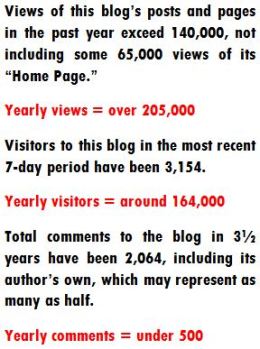
Aaron’s story is one of a spiteful ex-partner whose false allegations orbit popular themes: fear, emotional torment, stalking, and other (unprovable) crimes and misdemeanors that become more sensational and incriminating over time.

What makes Aaron’s story exceptional is that it has a reasonably happy ending, because the court saw through the lies.

In Aaron’s own words (lightly edited):

In my accuser’s affidavit, she repeatedly used “deathly afraid” and spoke of the medications she was on due to three years of stalking by me, vicious verbal abuse of herself and her family by me, and my stalking her where she works, shops, and lives. She claimed to have video surveillance of me following her into a grocery store. She even claimed to have a police report where I was “caught” sitting behind her home at 10 at night, etc.

She was granted an ex parte restraining order lasting two years.

Of course, none of it was true, none of her evidence existed, and the family that I had supposedly verbally abused didn’t even come to court. There was no police report, nor was there a surveillance video, because I didn’t have time to subpoena it; and had she brought the video, it would’ve shown her following me into the store she knew I was going to be at because I told her I was going to get groceries there at an exchange of our son. Had this video been brought to court, it would’ve conflicted with her affidavit.

On top of all of that, I brought in three copies of 40 pages that had every text message we had sent to each other for the previous two years in chronological conversation format. In these texts, two months prior she was inviting me into her home for “dessert” and asking to borrow money from me. Six months prior, she offered to loan or sell me her other car because I was having mechanical problems with my Jeep. These and other very common things. The texts also contained many instances of very immature ranting and attempts to create animosity and intensify disagreements into arguments, which I never fell for and always just said what needed to be said for our son’s sake. I never cursed or belittled her, though to someone like this the truth hurts.

After several hours, the judge shut the whole thing down, dismissed the order, and gave her a stern lecture. All this and no charge of perjury against her! One week later, she was granted an ex parte OFP on behalf of our then three-year-old son by a different judge in the same county! Same style of affidavit.

She said that I had been burning him intentionally and that I had kidnapped him.

He did have a burn about half the size of a pea on his finger, because he had touched a hot pot on the stove. I didn’t kidnap our son. She didn’t show up to pick him up! Since she was issued an OFP on behalf of our son, she was then afforded the services of a battered women’s and children’s center. She signed me up for psych evals and supervised visitation only with our son. Her instructions to law enforcement in her application were to arrest me for kidnapping and return her son to her.

Once again I proved the entire thing to be a lie. It was dismissed entirely. STILL NO CHARGES FILED AGAINST HER FOR PERJURY! Just stern words from a judge toward her and even a bit directed my way in that the two of us needed “to learn each other’s triggers and steer clear of conflict that needed to be sorted out by the courts”! I had to share custody with her for two more years and attempt to co-parent with her.

Our son is six now, and he lives with me and goes to her every other weekend. I had to use kindergarten as a guise to change our custody agreement. Although I am very thankful the courts named my home as our son’s primary residence, the court’s impotence to prosecute liars and the horrifying parenting that has to take place before they’ll change rights are despicable! I do think it is far worse to be a self-consumed person than to be a target of one, though. Karma is on our side.

This blog definitely gave me great insight into other people’s struggles outside of my own and opened my eyes to some of the types of people who abuse the system. I never could’ve imagined how easy and common it is until it happened.

Copyright © 2015 RestrainingOrderAbuse.com

If You’re Silent, You’re Guilty: Take a Page from the Feminist Playbook and Register Your Complaint

It was impressed upon me by a new mentor—who possesses a much more practical mind than mine—that I don’t want to still be writing about this stuff when I’m old and gray (and that, besides, if I keep trying to “make a difference” by myself, “old and gray” will be just around the corner).

What these statistics reflect is that (1) confusion about restraining orders, if not fraudulent abuse of restraining orders, is epidemic; and (2) complainants of procedural abuses are intimidated into silence. No one wants to own humiliating or demonizing accusations against him or her, even if they’re false. This is, perhaps ironically, why fraudulent abuse of process continues unabated: Too few people talk back, so no one in a position to reform the status quo realizes there’s a problem in need of urgent remedy.

In the week leading up to Friday the 13th, 2015, WordPress reports that over 3,000 people visited this site (a few of them probably the same people on different days, but nevertheless…). Of that 3,000-plus, maybe 20 left comments or responded to petitions this site links to.

Maybe.

To one of the people who did submit a comment, a woman who was charged with assaulting her husband because she inadvertently scratched his arm while she was appealing to him to be nicer to her (during a verbal attack), I remarked that more people need to speak up about what they’ve been put through.

This woman, Izabella, has a restraining order against her, based on “all sorts of allegations,” that she reports her husband got to dominate and control her (to bully her, plain and simple). She says he’s never been an “involved dad” but uses their children now to “blackmail” her, because she had the temerity to “stand up to him.” The kids are pawns in a petty power game.

This is the kind of thing feminists deny happens (and adamantly deny happens to men). They insist restraining orders are there to protect women like Izabella.

Feminists are often wrong but never uncertain.

Their rigid advocacy is actually what makes scenarios like this possible, and for that reason, among others, I seldom find cause to sing their praises (though I’m not closed to the idea). One of their constant refrains, however, that victims will only speak up if they feel confident they’ll be believed, is right (and it’s why restraining orders exist to begin with).

Victims of procedural abuses need to speak up so that others will.

Respondents to this blog don’t need to identify themselves; they don’t even have to provide their email addresses if they don’t want to, though that information isn’t made public and allows them to be notified of others’ responses to their comments. It also lets them have dialogues among themselves.

Provided everyone plays nice, this writer is glad to take a backseat. (He’s been informed that nothing anyone else says is his responsibility, anyway.)

“Outing” yourself isn’t necessary, per se, to motivate change. But the public only understands what it sees and hears. If it sees and hears nothing, then that’s exactly what it will understand.

Copyright © 2015 RestrainingOrderAbuse.com