
Consider the following allegations:
“She has repeatedly exposed herself to me.”
“She told me on multiple occasions that if I wouldn’t have sex with her again she would tell the police I raped her.”
“She has stalked me since I met her. I’ve kept a dated log of all of the instances when she appeared someplace where I was. I’ve told her to leave me alone but she won’t. She says I’m her ‘destiny.’”
“She grabbed my crotch. When I pushed her hand away and ran, she laughed and called me a ‘pussy.’”
“I loaned her money. She told me if I asked for it back one more time, she and a friend of hers would hurt me. She bragged that they had killed someone before.”
“She has sent me panties covered with blood, urine, and feces. I threw them away because they were disgusting.”
“She showed me a knife and said that if I didn’t leave my girlfriend she would ‘cut her good.’”
“She said she wanted to drink my blood.”
An affidavit on a protective order application could include any or all of these statements and any number of others, including, say, alleged confessions of any act conceivable by the imagination of the accuser.
An affidavit, that is, a statement of facts alleged and sworn to be true, can usually be of any length and could include detailed descriptions of the accused’s anatomy, commentaries on his or her hygiene, and judgments of any variety, besides including an account of “what happened.”
There are no rules, and the court cannot retroactively censor what is effectively a complainant’s testimony.
Note that none of the accusations listed above could ever be ascertained as true or false, and a judge, accordingly, has no particular investment in “the truth.” His or her job, as prescribed by the law, is to decide whether the accuser is convincing.
An even cruder fact is that a judge may never read a complainant’s affidavit at all but simply ask for a verbal accounting, that’s if s/he does anything more than make sure the paperwork is filled out correctly. Once validated by a judge’s signature, unless contested and successfully quashed during a hearing that may be afforded 30 minutes on a judge’s docket, the order is a binding instrument of law and an indefinitely preserved public document that can be quoted or published.
Restraining orders are typically issued ex parte. That means based on the accuser’s say-so only. The accused may know nothing about it until a law enforcement officer or agent of the court appears at his or her door, possibly in the presence of friends, family, and/or neighbors.
The whole application and approval process may take from a few minutes to a few hours.
The latitude granted to judges in this arena of law is virtually boundless, as the politicking behind so-called “women’s law” intended it to be. A single statement from the list that heads this post, delivered persuasively enough, could suffice to make any number of allegations “stick” (whether relevant or not). Or repeated emphatic claims of terror and violation could. Or the testimony of a crony witness. Or a real or faked series of text messages or emails. Or a real or spoofed series of calls on a phone (which, if real, could have been about anything).
As Ralph Nader said, “Power has to be insecure to be responsive.” To judges, this business is just quotidian paper-shuffling, and they have no liability for their rulings, which are issued without oversight (including by judges who aren’t even judges but merely seasonal temps). Grounds for appeal, furthermore, are almost none (and “lying” is not among the few).
A reasonable person would conclude that anyone who supported laws that would allow a woman to be falsely accused of molestation, rape, or murder would have to be a monster.
The left-leaning feminist humanists and self-styled social justice advocates who do militantly support these laws emphasize their virtue: bringing relief to women in abusive relationships. This is somewhat like explaining communism’s goal is the protection of the working class citizen—while ignoring that tens of millions of working class citizens have been killed in the name of an idealistic social experiment.
Perhaps social justice crusaders who promote “women’s law” would say they’ve only ever meant for it to treat men monstrously.
Copyright © 2022 RestrainingOrderAbuse.com
*In civil lawsuits that aren’t filed for free, as restraining order applications usually are, a defendant could move the court to strike inflammatory statements that weren’t relevant and that could only serve to damage (his or) her reputation and, for example, professional standing (and health, security, interpersonal relationships, etc.). Whether this would fare any chance of success in drive-thru procedures conceived to permanently document misdeeds is less than iffy. (It would require redacting, or “blacking out,” parts of the original order, which is contrary to its purpose.)




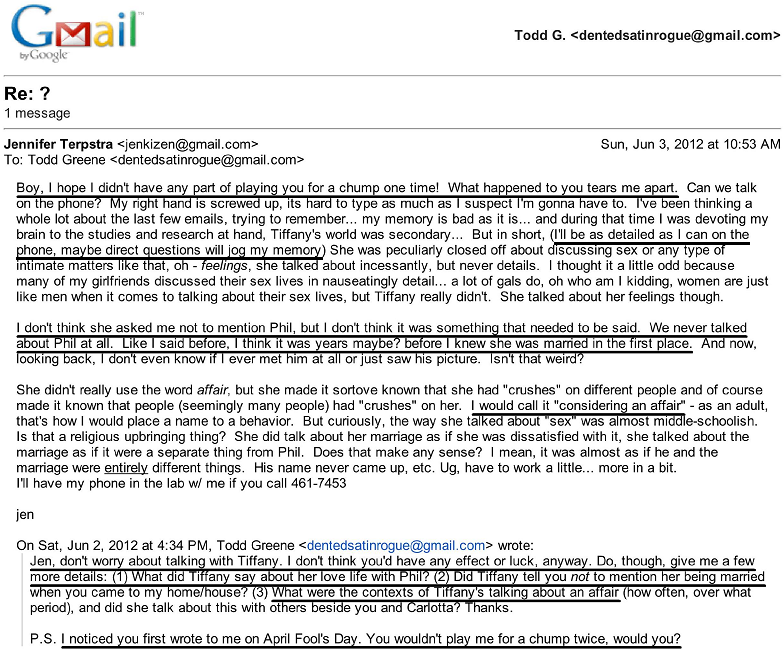




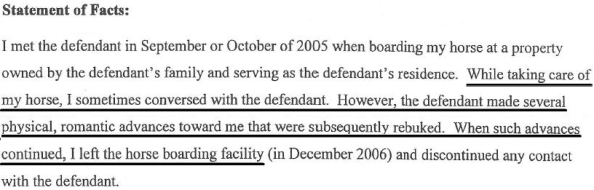

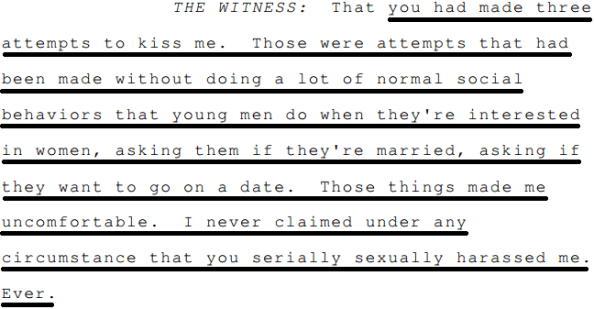
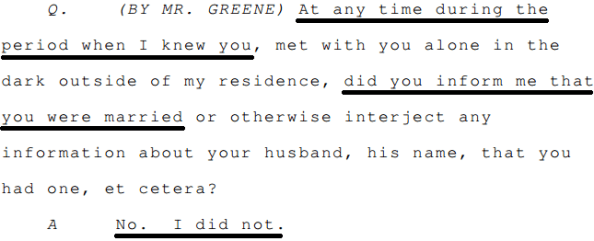




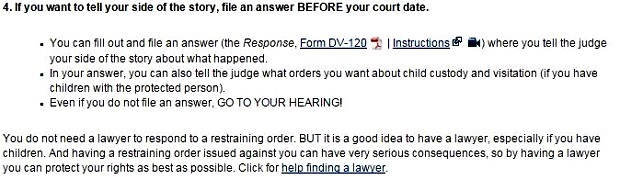
 To describe “your side” of nothing gives substance and dimensions to zero; it turns zero (a lie or lies) into something real—and this is what the civil court forces defendants to do…then it faults them for the stories it makes them tell about what was BS to begin with.
 Below is
  As a feminist might reason, however, zero probability of abuse is good, and that zero probability recommends that all feminists be restrained by order of the court from abusing children…because how could that be a bad thing?








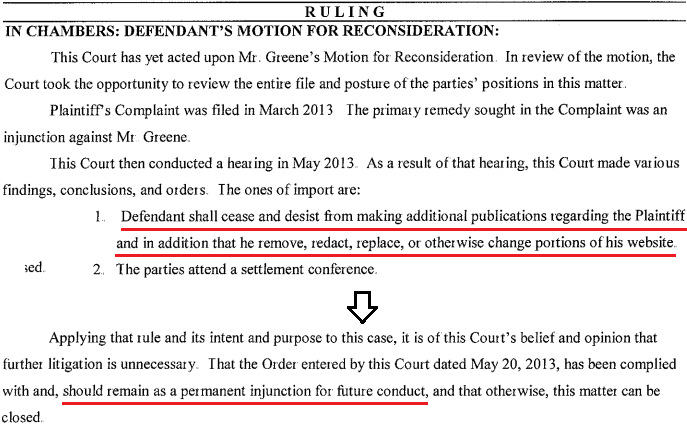











 I am a little league, travel ball, and high school umpire. I umpire because I love the game and to make some additional money on the side. I have been umpiring baseball for close to 25 years without any incident whatsoever, and most reviews of my performance have been complimentary.
 parenting and considers herself an expert in child-rearing. I had even caught her entering my house and administering medication to my daughter without our consent, which I firmly put a stop to.
 Well, because there was no good reason for my sister-in-law to be upset, and because the umpire company needed me to cover the game, I did. There was no issue with the game, and I received many compliments afterwards. I ended up working another one of my nephew’s games a couple of weeks later, again with no issues. The next week, I got a call from my umpire assignor reporting that my sister-in-law filed a complaint with the league saying her son was “uncomfortable” with my working behind the plate.
 After about a two-hour hearing, the judge ruled against me. He stated that because my wife informed me that her younger sister had told her to keep me away from her kid that I was put on notice…yet persisted in showing up at the fields to work. Never mind that I was told two months after their conversation (my wife didn’t tell me right away because she thought it was just her sister acting crazy). The judge then went on to say that a mother had the right to determine who got to be around her kids and didn’t need a good reason.
 We have filed a motion for a new trial with compelling evidence. It was denied by the same judge. We have also filed a motion to modify the order to allow me to attend my daughter’s school events since I am her primary caregiver while my wife is at work (I own my own business), and this too was denied, because the judge thought it would be too hard for the school and the police to enforce.

 A: Right (
 I corresponded with a man last year, a man in a homosexual relationship, who was assaulted by his partner severely enough to require the ministrations of a surgeon. His boyfriend was issued a restraining order coincident to his being charged with assault. That’s how it typically works in New York: A protection order is issued following a criminal complaint.
 This means, evidently and bizarrely, that there are people dwelling under the same roof as their accusers who may be cited for criminal contempt if an accuser calls and reports them for “harassment” that occurred, for example, in the hallway or the kitchen. The implications, which are fairly stunning, bring to mind the phrase “sleeping with the enemy.” The law invests its
  I started to include the contents of this post in the last one, “
 It’s an attractively tidy idea and syncs up with feminist dogma nicely, but it’s critically shallow, besides ethically and empathically vacuous.
 Those who posit that complainants of courthouse dirty dealings are predominately angry white men aren’t necessarily wrong, but they may be right for reasons they haven’t considered.
 a New York Jew. While neither one’s conclusions can be dismissed offhand, their cultural and class remove from the subjects of Dr. Kimmel’s book makes their identification with those subjects suspect, and Ms. Rosin’s objectivity and access are plainly dubious. From Ms. Rosin’s review: “Kimmel’s balance of critical distance and empathy works best in his chapter on the fathers’ rights movement, a subset of the men’s rights movement. Members of this group are generally men coming out of bitter divorce proceedings who believe the courts cheated them out of the chance to be close to their children.” Contrast this confidently categorical interpretation of men’s and fathers’ complaints to this firsthand account by a father who was ruined by “bitter divorce proceedings”: “
 If procedural abuses are epidemic (and they are), why do so few vociferously complain? Why isn’t the Internet inundated with personal horror stories (and why aren’t state representatives’ in-boxes choked with them)? We purportedly enjoy the
 A woman I’m in correspondence with and have written about was accused of abuse on a petition for a protection order last year by a scheming long-term domestic partner, a man who’d seemingly been thrilled by the prospect of publicly ruining her and having her tossed to the curb with nothing but the clothes on her back. He probably woke up each morning to find his pillow saturated with drool.
 Now her former boyfriend complains that the stir she’s caused by expressing her outrage in public media is affecting his business, and he reportedly wants to obtain a restraining order to shut her up…for exposing his last attempt to get a restraining order…which was based on fraud.

 I hope the outraged title of this piece reaches its attention, because the story below exemplifies a modern manifestation of racial bigotry and violence, and it’s one the Southern Poverty Law Center
  The following account is reported by North Carolinian Neil Shelton, a father denied access to his son and daughter for “three years now and counting.”
 Mr. Shelton’s allegations are abhorrent yet all too believable. Significantly, none of the criminal allegations introduced against him have held up in court.
 On May 29, 2012, which was shortly after I was kicked out of my house by my now ex-wife, I was arrested three times in one day.
 When my now ex-wife was made aware of my impending release, she took her sister-in-law, who was the director of Surry’s Stop Child Abuse Now (SCAN), and they went to the Surry County Sheriff’s Dept. and had me charged with criminal trespassing.
 “I’m dangerous broke, as y’all have shut down all my businesses, but I’m not dangerous with $5,000 and no restraining order against me?” With that, I told her I was finished. She said, “Yes, you are,” and we proceeded into the courtroom. I called her a few choice words, and her reply was, “Boy, am I gonna have fun playing with you.”
 Upon my release, I showed the judge the two failed commitment attempts, the six not-guilty verdicts for allegedly violating the restraining order, the dismissal of the letter charges, the phone number of the FBI agent who told me the FBI had never been involved and had never investigated the letter—which supposed investigation the other side had used to hold me in jail—and the handwriting analysis proving the lawyer, Zach Brintle, wrote the letter. But the judge still extended the restraining order for yet another year.
 TALKING BACK to restraining orders