Is the Policy of Arizona’s Courts under Chief Justice Scott Bales Taught at UCLA as an Example of State Judges’ Contempt for the Constitution (and Bad Practice Generally)?

The author of this post recently chipped off a bit more of his dilapidated front teeth on the brim of the coffee mug that’s virtually wedded to his hands. After years of demoralization in the courts, he depends on external energy sources to triumph over inertia and earn a living. The occasion of the damage was his running to give a stylist-in-training a $5 tip for an $8 haircut. This is where one can easily find himself after 12 years of abuse in the court and by the court, whose handsomely paid judges almost invariably excuse themselves for their arrogance, their misperceptions, their shortsightedness, and their professional failings. The exercise of dominance over the lives of others should at the very least demand scrupulous care. This post is inspired by its utter absence.
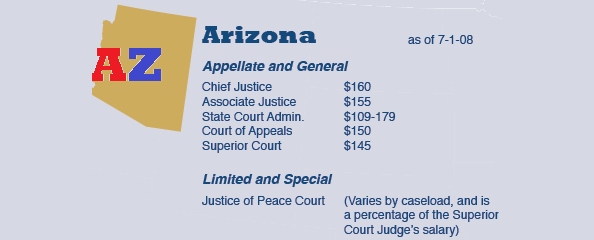

The number of thousands of dollars paid to Arizona judges and judicial administrators each year

I occasionally corresponded with UCLA Law Prof. Eugene Volokh in 2016 and 2017 when he consulted with my attorneys in advance of an appeal of numerous unlawful “prior restraints” imposed upon my freedom of speech in 2013 (by a judge who has since been shamed off the bench), and Prof. Volokh was very charitable with his time.
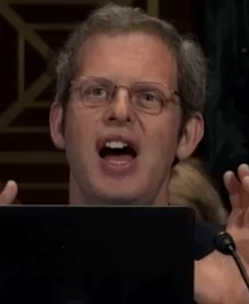
UCLA Law Prof. Eugene Volokh before the U.S. Senate Judiciary Committee in 2017

I don’t know him well enough to bother him with inquiries about his classroom curricula, though. So I don’t really know the answer to the question posed in this post’s title.

I can, however, surmise.

Prof. Volokh, aided by a gifted law student, Alison Boaz, invested more than a little time in preparing an amicus brief to the Arizona Court of Appeals on my behalf. This is a very big deal. I know, too, that Prof. Volokh is a brilliant jurist, that his arguments to the court were unassailable, and that the court’s disregard for those arguments (which weren’t even mentioned) is a symptom of crap practice that I believe to be pandemic to the point of institutionalization.

(I have no doubt Prof. Volokh would express qualms he had more circumspectly—neutrality comes harder for those who’ve been in the defendant’s seat—but I don’t think he would find much fault with my characterization insofar as it concerns respect for liberties guaranteed by the First Amendment.)
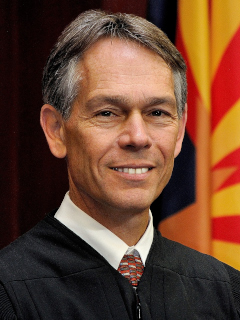
Arizona Chief Justice Scott Bales, who has beautiful teeth, a state that a $160,000 salary and a $130,000/year pension should guarantee he always enjoys

Certainly one way Prof. Volokh could recover on his investment in my case would be to use the ruling returned by Arizona Court of Appeals judges Philip Espinosa, Sean Brearcliffe, and Christopher Staring to show his First Amendment students what they’re up against, namely, recalcitrantly erroneous (i.e., crap) practice by state courts.

In the last post, I shared some informed impressions of some of the judges who’ve weighed in against me over the past 13 years. It’s mostly been crap practice all the way up the ladder, and I know from years of correspondence with others all over the country (and abroad) that my experience is unexceptional.

In 2017, much more knowledgeable after a decade of legal abuse, I succeeded in having two Tucson municipal court judges verbally spanked for abuse of discretion (which roughly translates to judicial abuse of authority), and one of them, Judge Wendy Million, could be said to have literally written the book on protective order law (which will only seem ironic to those who’ve never found themselves in its crosshairs). Judges in this arena can’t even be relied upon to observe statutory requirements let alone comport themselves with anything approaching rigor, impartiality, or politeness.

People like Arizona Supreme Court Chief Justice W. Scott Bales, who has backed a proposal to raise judicial salaries by $15,000, shouldn’t be concerned, in this writer’s opinion, about whether judges are getting paid lavishly enough (already $100,000 to $160,000 per plus lifetime pensions that alone exceed the yearly incomes of most of those whose lives they impact and whose labor provides for their salaries).

What people like Scott Bales should be concerned about is whether judges are actually earning anywhere near their purported value.

Copyright © 2019 RestrainingOrderAbuse.com

*The professor referenced in this post, Eugene Volokh, is a renowned constitutional scholar, and his blog, The Volokh Conspiracy, which is listed by the ABA Journal in its “Blawg 100 Hall of Fame,” appears on the website of The Washington Post. I discerned no hint that the Arizona Court of Appeals judges also referenced in this post had ever heard his name. Prof. Volokh addressed the U.S. Senate Judiciary Committee the same year he addressed them.


Terse Reviews of Arizona Judges I’ve Been Disappointed with So Far (with Critiques of a Couple of Arizona Attorneys and a Police Task Force Tacked On)

What follow are brief reviews of judges the writer had during 12 years of prosecutions (2006–2018) prompted by a vindictive liar (see this post’s third endnote), her husband, and a cohort of theirs. All allegations introduced against the writer during the previous decade by the three—and some that reach back over a dozen years—were discredited and/or dismissed in the past 24 months, no thanks to any but one of the judges referenced below. (Besides to the court, allegations were made to municipal, state, and federal police, among others.) The writer was awarded no compensation by the court, which has, with rare exception, never formally acknowledged error.


Judge Christopher Staring, Judge Sean Brearcliffe, Judge Philip Espinosa, Judge Paul Tang, Judge Carmine Cornelio, Arizona Courts, Judge Richard Gordon, Judge Roger Duncan, Judge Jack Peyton, Judge Jay Cranshaw, Judge Antonio Riojas, Judge Wendy Million


ARIZONA COURT OF APPEALS (DIVISION 2)

Judge Christopher Staring (2017):

Distinctly polite and affable, Judge Staring would make a superlative Walmart greeter. What qualifications he may possess as a negotiator of facts and interpreter of law were indiscernible.

Judge Sean Brearcliffe (2017):

A pedant who seemed to consider freedom of speech a nonessential civil liberty that could be casually revoked by a court.

Judge Philip Espinosa (2017):

Profoundly limited.


ARIZONA SUPERIOR COURT (PIMA COUNTY)

Judge Charles Harrington (2006):

Pedestrian and unworthy of note.

Judge Paul Tang (2010):

Like several of the judges critiqued here, Judge Tang is distinguished only for adding ethnic diversity to the court. (In a 2010 case, Judge Tang servilely parroted back what he was told by opposing counsel almost verbatim—at least in this writer’s opinion—and the writer believes he may have documents from the court not inaptly stamped “P. Tang.” See UrbanDictionary.com.)

Judge Carmine Cornelio (2013):

A disgrace who was twice censured by the Arizona Supreme Court for abusive conduct, in 2010 and 2013, and shamed off the bench in 2016 by a no-confidence vote returned by the Arizona Judicial Performance Review. Judge Cornelio unlawfully denied the writer a trial in 2013 and imposed an unconstitutional speech injunction that denied the writer core civil liberties for five years, including the right to speak about his experiences in court even “by word of mouth.” (The amoral attorney who coerced the illegal injunction from Judge Cornelio has also served as a judge of the Arizona Superior Court.)

Judge Richard Gordon (2016–2018):

Faultlessly civil, a too rare quality among judges, but from this writer’s perspective not above placing personal/political motives before the law. Judge Gordon ruled against the writer in 2016, a couple of months before a retention election, only to mandate a settlement of the case two years later after an eminent constitutional scholar, UCLA Law Prof. Eugene Volokh, tweezed apart the court’s rationale.


PIMA COUNTY JUSTICE COURT

Judge Roger Duncan (2006):

As a judge pro tem the year he intruded upon the writer’s life, thoroughly incompetent.

Judge Jack Peyton (2006):

A bombastic bully whose neck must have strained under the weight of his inflated head.


TUCSON CITY COURT

Judge (Timothy) Jay Cranshaw (2016):

Recommended only by the quality of his grooming and manners, which are somehow meant to justify a $100,000 salary.

Judge Wendy Million (2016–2017):

A scold who was more civil on a second encounter but whose derelictions necessitated reprimand by the superior court for abuse of discretion.

Presiding Magistrate Antonio Riojas (2017):

Genial and conscientious after rebuke by the superior court for abuse of discretion, which translated to seven months of added stress to this writer’s life. To his credit, Judge Riojas acknowledged to the writer that he knew court process was routinely abused…with impunity.

Copyright © 2019 RestrainingOrderAbuse.com

*TUCSON ATTORNEYS

Jeffrey Marks (2010, 2013, 2016) and Chris Scileppi (2016–2018):

This writer would categorically characterize these officers of the court, both of whom frivolously attempted to have him jailed on multiple grounds, as an aggregate of used latex condoms recycled into matching douchebags.

**TUCSON POLICE TASK FORCE

Tucson Police Mental Health Support Team (2016):

The Tucson Police Mental Health Support Team is a clown car. A detective of this task force issued the writer two criminal citations based on statements made by a woman who is herself reportedly diagnosed mentally ill (bipolar disorder). Both charges were subsequently dismissed.

***WHAT STARTED IT ALL


Eugene Volokh Is a Name Restraining Order Defendants Should Know

Eugene Volokh

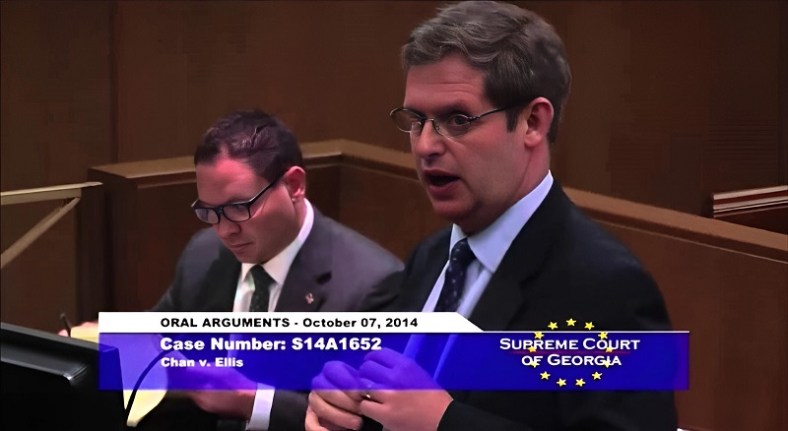
Above, Prof. Eugene Volokh argues before the Georgia Supreme Court in Chan v. Ellis (2014). Prof. Volokh teaches free speech law, religious freedom law, church-state relations law, a First Amendment Amicus Brief Clinic, and tort law at UCLA School of Law.

“If you post on social media about your life, is that going against a restraining order if you don’t mention the petitioner’s name?”

—Search term that led someone here last week

As UCLA Law Prof. Eugene Volokh has doggedly emphasized in his blog, The Volokh Conspiracy (formerly hosted by The Washington Post), the answer to this question is no, it isn’t going against a restraining order if you write ABOUT the order, ABOUT the person who petitioned it, or ABOUT the impact it’s had on your life. Your right to express your opinions and talk about your life to the public at large is protected by the First Amendment.

A person may legitimately be prohibited by a judge from communicating something TO someone (by phone or text, say, or by email or in a letter, or in person), but a judge “can’t order someone to just stop saying anything about a person.”

The citizen’s right to talk about him- or herself, about someone else (including by name), or about anything (excepting state secrets) is sacrosanct. It’s protected by the First Amendment, and a trial judge has no rightful authority to contradict the Constitution.

Note that the key phrase here is rightful authority. A judge can act in ignorance, and s/he can even act in willful contravention of the law.

Why Eugene Volokh’s is a name to know is that Prof. Volokh has endeavored to make the distinction between speech that may be prohibited and speech that may not be prohibited everyday knowledge. He’s done that by writing in a medium accessible to everybody, a blog, rather than exclusively in law journals, as well as by framing in simplest terms the difference between speech that may be censored and speech that may not be.

He’s building steam, too. These posts are from last month alone:

VC_May 2016

It’s important to observe that nothing in the restraining order arena is hard-and-fast, because judges can rule however they want. When what they do clashes with the law, an abused defendant’s only recourse is to appeal, and the intrepid writer should be prepared to do that…right on up the ladder. (S/he should also know that s/he has the right to request reimbursement for lost time, for costs, etc.)

A blogger wrote last month to report that an ex-boyfriend’s claims of “domestic violence” were laughed out of court and that the motive for the accusations was that she had criticized him in a blog. The guy went back to the courthouse a couple of weeks later, petitioned another order from a different judge, and that one stuck. His abuse of process had recent precedent, and it didn’t matter.

Such manipulations of the justice system by false complainants and spongy decision-making by judges owe to 20 years of mainstream feminist rhetoric decrying “epidemic” violence. Judges have been trained according to tailored social science and had it impressed upon them what their priorities should be. Too, they’ve traditionally been given no cause to second-guess themselves.

Eugene Volokh is changing that.

A steady stream of cogent arguments against the due process violations (and statutory and conditioned inequities) that make the restraining order process contemptible has been voiced by influential critics since the ’90s…to little effect.

Rather than appeals to reason and social conscience, what may finally turn the tide against a corrupt procedure of law is an indirect attack on its legitimacy. Once it’s commonly known that speech about its victims’ experiences cannot lawfully be squelched, and that both the issuers of orders and their petitioners can be exposed, warts and all, what has been an unaccountable process no longer will be. Shadowy (and shady) proceedings that have enjoyed invisibility will have to tolerate the glare of spotlights.

And bullies don’t like reading about themselves.

Copyright © 2016 RestrainingOrderAbuse.com

*The motives of a goodly proportion of false complainants are to cause pain and have the party they’ve injured gagged. Restraining orders are the perfect tool for this. But what people say on public record (e.g., in a courtroom) is public property. It’s supposed to be the opposite of hush-hush.