Undocumented Immigrants and “Women’s Law”: Reflections on Liberal Incoherence

The plight of undocumented immigrants has become a banner cause for the liberal left. They don’t comprehend the law; they just reckon detaining people for being in this country without official leave is cruel—and maybe unconstitutional.

Welcome to the United States civil justice system, the same civil justice system whose criminalization of its own citizens liberals have applauded for decades. Unlike the criminal justice system, the civil justice system affords scant protections to those who fall under its scrutiny.

The liberal position: It’s not okay to suspect noncitizens, deny them due process and free access to attorney services, deprive them of residence and access to family members, permanently record their names in police databases, and subject them to indefinite detention. But it is okay to suspect citizens based on no ascertainable proof, deny them due process and free access to attorney services, deprive them of residence and access to family members, permanently record their names in police databases, and make them subject to warrantless arrest and criminal incarceration, sometimes indefinitely, which is what the instrument called the civil restraining order authorizes.

Liberals furthermore are affronted by discrimination and injustice, according to their rhetoric, baffled by those who reject their values, and confused by this country’s intransigent political polarization.

Copyright © 2018 RestrainingOrderAbuse.com

*This week on NPR, the “cathedral of [liberal] political correctness,” it was deplored that undocumented detainees weren’t granted hearings with judges—that’s when they’re granted hearings at all; many sit in limbo for years in privatized detention centers with no de facto government oversight. Hearings are often conducted by video, meaning even if defendants have lawyers, they can’t confer with them. The instrument called the civil restraining order is typically issued ex parte, meaning defendants can’t confront their judges, either, and the issuing judges only know them as names on fill-in-the-blank forms. Restraining order hearings in the overwhelming majority of cases are required by statute to occur within days, making effective legal representation, which may be unavailable and is anyway seldom affordable, sketchy at best. Looping back around, the filing of a restraining order against a documented immigrant, again based on no certain evidence, is often grounds for his or her deportation.

About Liberalism and Its Deterioration of Civil Rights…and Its Own Credibility

Liberals are curiously less than rapturous about a political victory only they could have accomplished: the election of Donald Trump, a living caricature straight from the pages of a satirical novel, to the country’s highest office. Liberals do count as a victory, and have for a long time, laws that authorize the wholesale removal of citizens from their homes by armed agents of the state based on what may amount to nothing more substantive than finger-pointing.

In this writer’s opinion, they’re the same victory.

Since the advent of the restraining order in the 1970s, and particularly since the enactment of the Violence Against Women Act in 1994—under the auspices of which billions of federal tax dollars have been poured into state courts and police precincts to condition how judges and law enforcement officials respond to complaints of abuse—the priority in the U.S. has been to curtail evidentiary requirements and due process rights to expediently meet political expectations, expectations inspired by liberal feminist politicking.

With typical dramatic irony, liberals today vehemently denounce immigration policies that divide family members who have entered the country illegally, that is, in plain violation of the law. Meanwhile the separation of accused citizens from their families, citizens who have not, in a majority of cases, been proven to have violated any laws, continues to quietly transpire, as it has for decades. Attorney Liz Mandarano posits that “[t]here are between 2 and 3 million temporary restraining orders issued in the United States annually,” and attorney Gregory Hession, a vocal critic of protective order laws, observes that “500,000 children are right now in the custody of the state” (“an astounding number”).

Liberals consider conservatives “dumb” yet fail to perceive that alienation of such a broad swathe of the populace could inspire contempt for their values if not a raw animal loathing for everything they represent. Liberals adduce (and Twitter-reinforce) preposterous and hackneyed theories to explain disenchantment with their positions like resistance to progress and a longing to return to the days of “patriarchy.”

The author of this post has recently examined criticisms by NYU Journalism Prof. Katie Roiphe of #MeToo feminists’ disregard for due process (for which she has been excoriated almost everywhere but in the National Review, which called her criticisms courageously commonsensical). Prof. Roiphe has similarly qualmed about the extrajudicial “rape trials” of male college students. Even she, however, seems to assume that if the merits of “abuse” complaints are decided in a courtroom, then defendants have been afforded due process of law.

The assumption is understandable but ignorant of the legal standards and the practical ones that have come to inform how civil claims of abuse are adjudicated, claims that affect the lives of millions of American citizens every year.

It’s a truism of language that the meanings of words follow usage. Applied poorly, language degrades. Rights are no different, which is something our “educated” class should already know.

On a scale our government disdains to even calculate, citizens are denied both rights and dignity, besides in many cases family, property, and liberty, in the absence of determinate evidence, which is not, in any case, heard by a jury. Liberals, who often “identify” as humanist, say they simply deplore insensitivity.

The only thing more hateful to voters than a hypocrite is a party of hypocrites who support arbitrary attacks on citizens in their own homes.

Copyright © 2018 RestrainingOrderAbuse.com

If Restraining Orders CAN Be Abused, then the PROCESS Is Abusive—and Should Be Repealed

This post addresses a block its writer has noted even in the commentaries of those profoundly injured by unjust or false accusations. That block typically runs something like this: “I’m totally for restraining orders when they protect the violently abused, but….” This perspective is blind, and this post will explain why.

“The road to hell is paved with good intentions.”

—Proverb

“You know, the very powerful and the very stupid have one thing in common: They don’t alter their views to fit the facts; they alter the facts to fit the views. Which can be uncomfortable if you happen to be one of the facts that needs altering.”

Dr. Who

I was accused of a number of unsavory things in the spring of 2006 by a disturbed and very married woman who had hung around outside of my house in the dark for a few months the previous fall. She filed multiple police reports then complained to a judge in my presence that my request for “an explanation of sorts” had caused her grave upset and interfered with her work. (Also, she was concerned she might be “attacked”…and her husband might be…and her friends might be…and her mother might be…and….)

Michael Honeycutt TCEQ, Michael Honeycutt EPA, Michael Honeycutt PhD, TCEQ, EPA Science Advisory Board, Texas Commission on Environmental Quality, Environmental Protection Agency

This man, Dr. Michael Honeycutt, Ph.D., testified to the Superior Court of Arizona in 2013 (by phone) that the government department he heads (in another state) had instituted special security measures to protect a woman from me whom I hadn’t seen or contacted in seven years. When I found this self-styled damsel in distress standing outside of my residence in 2005, I was a practicing children’s humorist who fed birds and had a pup who wore a pink collar. The same woman who would accuse me of stalking and violent intentions had come to my door one night seeking a defender against men she feared were stalking her and had violent intentions. This established a relationship that included her plying me with conversation about her breasts and underwear and trying to follow me into my house after midnight (minus her wedding ring).

That was 12 years ago, and this woman has dramatically and broadly misrepresented me ever since. She’s also induced others to join her in her hoax.

I tried to find you in our system,” I was told in my initial police interview many years ago (when I still had plans and dreams of my own), “but there was nothing. At all. That’s really rare.

Over the four years I’ve maintained this blog, begun five years after my interviews with the cop, I’ve heard repeatedly from others who allege they were falsely accused and who report they had had no prior acquaintance with police precincts or courthouses, either.

Consider how this jibes with the assertion that restraining orders protect victims of violent abusers. It plainly doesn’t, and only “the very powerful and the very stupid” would say otherwise.

Public sentiment has been coerced by “the very powerful and the very stupid” to the extent that even those who know the procedure is a travesty feel compelled to allow that there are cases when restraining orders are necessary.

Changing the minds of “the very powerful and the very stupid” has to start with changing the minds of people who are neither powerful nor stupid, and who know better. There is no justification for bad law. It should be repealed.

What victims of that bad law mean when they say “there are cases when restraining orders are necessary” is that they acknowledge there are people in abusive relationships or imminent danger who need relief. They should appreciate, though, that it isn’t restraining orders that are necessary; something is. Rejecting bad law doesn’t obligate its critic to propose what that something should be. Clearly, however, what that something should be should never have innocent casualties. A law that’s supposed to protect the innocent but may destroy them is both wildly flawed and dangerous.

These are facts: Restraining orders deny defendants their constitutional right to due process; justice rendered in drive-thru procedures that may deprive defendants of employment, security, home, and family can only ever be dubious at best; and being misrepresented in a court of law, scourged by a biased judge, and gibbeted on grounds that may be trumped up or cunningly fraudulent is hurtful and possibly ruinous, and shouldn’t be possible…ever.

If you acknowledge these facts, then you must be against restraining orders, and you must be against them categorically—no ifs, ands, or buts. They’re not the answer. They were a stopgap that has become an institution. That doesn’t mean their engineering was ever sound.

Sure, it may be correct to say that you’re certain not all petitioners lie and that some desperately need protection and deserve it. It’s politically correct to say so, certainly, and it’s sympathetic to say so, too. And, sure, it may be correct to say that sometimes justice does prevail.

But if you own that rulings can be manipulated and that pitfalls are built into the process itself, then you cannot be for restraining orders under any circumstances, because the very same procedure that sometimes assuredly works good also assuredly works evil (and more easily).

Lives are at stake. A process that’s inherently corrupt is inherently wrong, regardless of whether its intentions are good and regardless of whether rulings may be righteous.

Put simply, you can’t make chicken salad out of chicken shit.

Copyright © 2018 RestrainingOrderAbuse.com

How Perjury in Restraining Order Cases Is “Incentivized”

SRU

“Perjury in restraining orders is actually incentivized, not only by failing to prosecute it, but by allowing one-person hearings (ex parte) to get the orders originally, a super-low burden of proof to issue orders, no juries, a judiciary which actually gets training from feminist groups about the need for issuing orders, no rules of evidence to keep out unreliable phony stuff like hearsay, and much else. Given all this pro-perjury bias, it is a miracle when an innocent defendant wins.”

—Massachusetts attorney Greg Hession

Mr. Hession says it more authoritatively on his own blog, MassOutrage.com, but here’s what he means, elaborated point by point.

Laws concerning restraining orders, which originated in the ’70s when women complaining of domestic violence had no voice, authorize the courts to hear plaintiffs privately (ex parte) and to issue orders based on nothing more than claims that are often unsubstantiated and may be impervious to proof (or disproof). An allegation of “fear can suffice, and that’s an allegation anyone can make against anyone else (anywhere), truthfully or not, reasonably or not.

Though the justification for ex parte hearings is anachronistic (women certainly don’t lack a voice today), restraining order laws resist overdue reform. Nobody wants to rock a boat captained by politically powerful advocacy groups. (Restraining orders have besides spawned a booming cottage industry with a financial stake in maintaining the status quo.)

In the interest of economy over observation of civil rights (like due process), hearings to finalize restraining orders are both prejudiced and streamlined: no jury (albeit that consequences for allegedly violating an order are criminal), no appointment of counsel for the defendant, no guarantee of the right to cross-examine (which is fundamental to a fair adversarial system), and the extension to trial judges of broad discretionary powers (for example, to curtail a hearing to 10 minutes).

Many respondents to this blog have reported being told by a judge, “I’ve heard enough.” Some report never being afforded a chance to get a word in (and lest anyone imagine otherwise, many of these complainants are women).

Making matters worse, judges are trained by feminist advocates, who often cite tailored “social science” (that may be funded by the Justice Department), making the idea of an “independent judiciary” more than suspect. Courts, too, are issued grant monies under the Violence Against Women Act (VAWA) and have been for 20 years. Judicial bribery is scandalous, but payouts from Uncle Sam are “in the public interest.”

Hearsay” (secondhand evidence with no reliability: “She told me he said,” for example) isn’t just admissible; it’s explicitly authorized by the law.

This is a formula for a lot of jaded, angry people. And if those jaded, angry people express their outrage by exercising their First Amendment rights, they risk being prosecuted for that, too. (If they do it anonymously, they’re mocked as cowards and discredited as cranks and misogynists.)

This villainy persists unchecked and largely unacknowledged by the “free press” or by “rights advocacy groups.” Even the American Civil Liberties Union (ACLU) is circumspect in its criticism, because it has close ties with the feminist community and has long congratulated itself for its contributions toward realizing “equality.”

A process that is not just manifestly unjust, manifestly corrupt, and manifestly indecent is lauded as an “essential protection,” including sometimes by people who’ve been victimized by it.

That’s how strongly we’ve been conditioned.

Copyright © 2016 RestrainingOrderAbuse.com

*Or blinded.

No One Is a VICTIM Just because S/he Says S/he Is: A Reminder for Reporters…and Other People Who Shouldn’t Need Reminding

I looked at a form I was handed a couple of weeks ago at a criminal arraignment I was ordered to attend. The form gives the impression I was supposed to sign it, which no one asked me to do. This would be disturbing if I were still capable of registering disturbance. I noticed with dim approval, though, that it said this:

alleged_victim

When accusations are made on “protective orders” or are of the type “protective orders” typically purport to concern (e.g., harassment, stalking, or domestic violence), journalists routinely call accusers “victims” automatically. They reason, apparently, that a person can’t be awarded a restraining order unless s/he has demonstrably been victimized. (More accurately, “reporters” don’t scruple overmuch about the facts or how the process works, because they know where their loyalties are supposed to lie.) Probably a majority of injunctions are awarded based on their petitioners’ say-so alone. To understand what that means, a “reporter” would have to investigate (instead of, say, quoting a pamphlet authored by the National Coalition Against Domestic Violence).

Prosecutors? They seem to call all accusers “victims” on reflex. Their job, after all, is to “prevail” in court. If they think they can win, they try to; it’s not about justice. That’s rosy rhetoric for the rubes…like journalists.

Whether intentionally or not, both journalists and prosecutors get it wrong. Legislators do, too. The statutes they enact may explicitly call accusers “victims” (due process be damned).

The (criminal) court at least got this much right: Allegations aren’t facts, and until some semblance of due process has been staged, an accuser is an “alleged victim,” not a “victim.”

Judges don’t always get this right, either, however.

I couldn’t say with complete assurance whether lapses in objectivity, ethics, and procedural propriety like this have always existed or whether they’re testaments to systemic bigotry conditioned since the mid-’90s by the Violence Against Women Act (VAWA)—whose megabuck grant contracts stipulate that alleged victims should be treated as victims in every instance.

I feel pretty confident, though, in my suspicions of corruption.

The lines can’t help but have become blurry since the advent of the restraining order, which authorizes the court to draw conclusions prior to a trial, based on a few minutes of testimony and what may be no ascertainable facts at all.

If “verdicts” can be formed without proof and possibly without any adversarial contest in which controverting evidence could be adduced, that would seem to make the distinction between “victim” and “alleged victim” merely academic.

Restraining order judgments aren’t uncommonly “default” judgments, because defendants either don’t show up in court or can’t. An “emergency” injunction can require a defendant to appear in court mere days after service, possibly after having been booted to the curb (and left without resource or a vehicle), and even a non-emergency injunction may require a defendant to appear in court within a week. There’s no time to secure legal representation, even if the means are available and even if the respondent appreciates the significance of the paperwork that’s been thrust in his or her hand, and injunctions can be issued against defendants in other counties or states. (Some defendants, moreover, may not be first-timers, and they may simply conclude: “F— it. What’s the point?”)

(What defendants are told: “Here’s your restraining order. Don’t violate it, or we’ll arrest you.” What they’re not told: “You have six days to learn enough law to extricate yourself from allegations of which you’ve already been found guilty.” At the time they’re told anything, chances are they won’t know what the word defendant means.)

When procedure is engineered to find anyone who has alleged victimhood to be a “victim,” maybe calling every accuser a victim to begin with is just economical. Maybe it’s also the closest thing to honest a person can expect from a manifestly crooked business.

Copyright © 2016 RestrainingOrderAbuse.com

*And make no mistake: It is a business.

Introducing the “Indefinite Temporary Restraining Order”

No, this isn’t satire, and Joseph Heller, author of Catch-22, didn’t coin the phrase “indefinite temporary.” It’s a capsular commentary on the state of our courts, however, that actual judges can actually use a phrase like this in actual rulings that affect actual people.

That these judges can actually get away with it says a lot about the state of our press, too.

The injunctive process is rife with oxymorons. Among this writer’s favorites is “speedy justice” (a phrase used by his own most recent judge to excuse carelessness). Restraining order courts are home to findings like “vegetarian stalker” and “handicapped batterer.” Trials in this arena operate in a vacuum (as law professor and former ACLU staff attorney Aaron Caplan observes); there is no oversight or accountability, and “meritorious” grounds for appeal are few, so judgments seldom receive scrutiny by the higher courts at all, and published rulings are scant. (Appellate courts don’t rehear cases; they only rule on the conduct of judges. Patent absurdities and abject fraud may be winked at…and legally.)

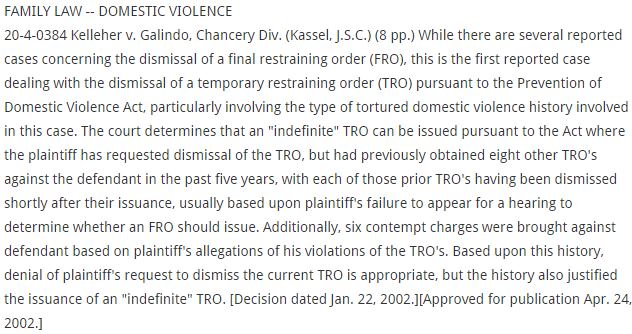
This post concerns a New Jersey family court ruling in the case of Kelleher v. Galindo. The case is 13 years old. That’s how asleep at the wheel our popular press is.

Follow the link to the case above, and the first sentence you’ll see in the ruling is this: “No appearance by Plaintiff. No appearance by Defendant.” That’s right, no one actually appeared in court, but a restraining order was issued anyway…an “indefinite temporary” one.

The plaintiff in the case petitioned nine restraining orders against the defendant between the years of 1996 and 2002, and in each and every instance, the order was dismissed, in most cases because “plaintiff [the person who petitioned the order] failed to appear at the hearing”; in a couple of cases, because she requested a dismissal.

The reasoning of the latest judge’s ruling runs thus (emphases added) and should be heard in the voice of a character from Alice in Wonderland:

This court has no doubt that if it were to grant plaintiff’s request to dismiss this most recent TRO [temporary restraining order], it would not be very long before plaintiff was back in the Cherry Hill Municipal Court seeking a tenth TRO against defendant.

[…]

It is this court’s opinion that, despite plaintiff’s telephonic request to dismiss this most recent TRO, the plaintiff’s past history of obtaining eight TROs against defendant in a five year period, all of which were dismissed prior to an FRO hearing [final restraining order hearing], along with six prior contempt charges filed against defendant based upon plaintiff’s allegation of violations of those TROs, all of which were likewise dismissed prior to an adjudication, justifies this court’s denial of plaintiff’s request to dismiss the TRO and instead justifies the issuance of an indefinite TRO.

There was no determined basis for an order and no basis for a ruling (in the absence of the litigants in the case). “Therefore” the judge, Michael J. Kassel, ruled that the latest temporary order be indefinitely sustained.

In the interest of economy, that is, the court determined itself justified in issuing an order contrary to the plaintiff’s express wishes and without any trial at all.

Copyright © 2015 RestrainingOrderAbuse.com

*The judge’s legal contortionism is illuminating. Because the judge couldn’t “justify” entering a “final ruling” in the absence of the parties but plainly wanted to, he circumvented the rules of civil procedure and made a “temporary” order permanent (instead of, for example, sanctioning the petitioner of the nine orders for “squandering judicial and law enforcement resources and diverting attention from urgent and meritorious domestic violence matters”). This provides other judges with a precedent to cite to justify violating other defendants’ due process rights, limited as they already are in this process.

The Words Get in the Way: Reconceiving Arguments against Restraining Order Fraud

block
Traffickers of this blog will sometimes advise that complainants of abuse of so-called “protective orders” consider “the bigger picture.” They feel the matter is less about personal loss than about statutory and procedural derelictions (bad law and judicial bias, carelessness, and tyranny). They emphasize principle over individual privation.

For some, the bigger picture that’s stressed is denial of constitutional rights to due process (for example, the right to be heard before a judgment is entered, the right to court-appointed legal counsel, or the right to a trial by jury); for others, the bigger picture is the right to freedom of speech. Some underscore gender and race inequities; some the undermining of the family.

The obstacle to making whatever “bigger picture” is emphasized perceptible to the public at large is the phrase “restraining order” or “protection order,” which comes with a host of conditioned prejudices. It arouses images of violence against those helpless to defend themselves. Accordingly, even many who acknowledge the process is flawed nevertheless say they recognize it to be necessary…in cases.

So even those against the process may not actually be against the process. This has created a disjointed community of complainants, namely, a marginalized extreme labeled “misogynist cranks,” “angry white men,” or “restraining-order-Americans” and a fence-sitting majority who against all evidence and experience retains the faith that reason will prevail against unreason if we just talk it out long enough: “All around the mulberry bush, the monkey chased the weasel….”

The monkey never catches the weasel, so there’s nothing to recommend monkeying around.

What needs to be stressed and comprehended, to this writer’s way of thinking, is that civil court is no place for the litigation of accusations that explicitly or implicitly allege violence, violent threat, or other criminal acts, and that in civil court, which applies no standard of evidence, fraud is too easily perpetrated. The exposure of falsehood or exaggerated claims of fear will not necessarily discredit a plaintiff’s claims, and findings in favor of a plaintiff who’s a proven liar are possible and acceptable to the court.

Therefore the procedure is vexed; it’s wrongly engineered. The concept is corrupt.

Instead of denouncing “restraining order fraud,” it’s civil court rulings that exact an unconscionable toll that should be denounced. It’s all about the words. Civil procedures should not result, ever, in people’s being placed in police databases. Civil rulings should not criminalize people or make them vulnerable to warrantless arrest (for alleged behavior that may not violate any laws). It should not be possible to have a person evicted from a residence he or she owns by a civil ex parte decision, nor should such a decision predispose a court to find against that person when s/he’s permitted to address the court in his or her defense (if such an opportunity is even practicable to the accused, who may preposterously be required to travel to another county or state to be heard).

Against policies of law and process so manifestly unjust, even improved due process rights would promise to be a shabby deterrent against abuse and miscarriages.

Not only have we become habituated to the reality of “restraining orders” to the extent that we believe they must be here to stay; procedural process has become rote (adjudication by rubber stamp). Yes, new “safety catches” could be installed, but what guarantee would there be that the conditioned habits of those who administrate the process would change? Economy would require that there continue to be minimal oversight and accountability, and the trial judge would still have the final (and absolute) discretion to make a determination, according to his or her own personal lights. So long as the process were conducted in civil court, rulings could still be arbitrary (anything goes), because the standard of evidence would remain whatever the trial judge chose.

Social and judicial impression cannot be overhauled—what’s etched on the brain stays there—and the preconceptions attached to the phrase restraining order will never be dispelled. Judgment by a single man or woman who has had his or her priorities conditioned by rhetoric and social and political expectations (possibly for decades) cannot be impartial. The implications of the process and dictates about how it’s supposed to be administered are too deeply ingrained. The phrase restraining order is by itself damning (right from the get-go). It stirs presuppositions of guilt, and this is inimical to fair and just process. Accordingly, the phrase must be abolished and the process reconceived from the ground up.

Copyright © 2015 RestrainingOrderAbuse.com

What Is “the Court,” and Who’s REALLY Looking Out for Its Honor?

Yes, sites like this one criticize judges. Judges aren’t the Court.

Yes, sites like this one criticize laws and procedures. Laws and procedures aren’t the Court.

Sites like this one criticize lawyers and law professors and writers and accusers and feminists (whose rhetoric emboldens false testimony). Lawyers, professors, writers, accusers, and feminists—they, also, are not the Court.

What is “the Court”? It’s an idea, and inclusive in that idea are principles like truth, justice, and the American way. More minutely, the idea entails fairness (equity) and observation of civil rights, like those to due process and freedom of speech. The idea is pretty straightforward: adversaries at law state their cases truthfully to a judge who impartially and honestly negotiates the facts with great deliberation and arrives at a just determination.

According to this idea, lies are censured (as “sturdy blows to the root of justice”), abuse isn’t tolerated, and never are people stripped of their dignity, family, property, and livelihood on a whim. “The Court” is a bulwark against moral anomie, and it’s never arbitrary or capricious in its decisions.

“The Court” isn’t real (it doesn’t exist); it’s an ideal. It’s something to be striven after.

Sites like this one don’t criticize the Court. They defend it.

Copyright © 2015 RestrainingOrderAbuse.com

*One of the most vigorous and vehement denouncers of corruption this writer knows, the author of BuncyBlawg.com, began his professional life as an earnest young attorney. He meant to do good. His faith in “the Court” was betrayed by reality. As if he needed a further reminder of why he abandoned his vocation decades ago, he has for the last several years been relentlessly hectored by procedural abuses (during a phase of his life when he should be savoring every moment).

A Story of Female Sterilization That Should Stress to Those Who’ve Been Violated by Fraudulent Abuse of Legal Process Why Reporting Judicial Tyranny and False Accusers Is by Itself Pointless (You Must Demand Change)

The point of sharing the explication below is to emphasize how forlorn prospective recourses for redressing rights violations stemming from false restraining order and similar prosecutions are. Accountability is zero, across the board.

If you’ve ever wondered why a judge may be censured for rude conduct but not for ignoring lies or misrepresenting evidence, here’s why.

Quoted from “The Plumb Line: So What Else is New?” (Murray N. Rothbard, Libertarian Review, 1978), reprinted on LewRockwell.com as “The Tyranny of the Bench”:

The United States Supreme Court ruled, in 1872, that judges were immune from any damage suits for any “judicial acts” that they had performed—regardless of how wrong, evil, or unconstitutional those acts may have been. When clothed in judicial authority, judges can do no wrong. Period. Recently a case of an errant judge has come up again—because his action as a judge was considered generally to be monstrous and illegal. In 1971, Mrs. Ora Spitler McFarlin petitioned Judge Harold D. Stump of the DeKalb County, Indiana, Circuit Court to engage in a covert, compulsory sterilization of her 15-year-old daughter, Linda Kay Spitler. Although Linda was promoted each year with her class, Mrs. McFarlin opined that she was “somewhat retarded” and had begun to stay out overnight with older youths. And we all know what that can lead to.

Judge Stump quickly signed the order, and the judge and mamma hustled Linda into a hospital, telling her it was for an appendicitis operation. Linda was then sterilized without her knowledge. Two years later, Linda married a Leo Sparkman and discovered that she had been sterilized without her knowledge. The Sparkmans proceeded to sue mamma, mamma’s attorney, the doctors, the hospital, and Judge Stump, alleging a half-dozen constitutional violations.

All of these people, in truth, had grossly violated Linda’s rights and aggressed against her. All should have been made to pay, and pay dearly, for their monstrous offense. But the federal district court ruled otherwise. First, it ruled that mamma, her lawyer, and the various members of the “healing professions” were all immune because everything they did had received the sanction of a certified judge. And second, Judge Stump was also absolutely immune, because he had acted in his capacity as a judge, even though, the district court acknowledged, he had had “an erroneous view of the law.” So, not only is a judge immune, but he can confer his immunity in a king-like fashion even onto lowly civilians who surround him.

The U.S. Court of Appeals, Seventh Circuit, unaccountably didn’t understand the program, and so it reversed the district court, claiming that Judge Stump had forfeited his immunity “because of his failure to comply with elementary principles of due process,” and had therefore in a sense “not acted within his jurisdiction.” To allow Stump’s action to stand, said the appeals court, would be to sanction “tyranny from the bench.”

Now this was pretty flimsy stuff, and besides it opened an entertaining wedge toward holding judges accountable to the law and to the protection of rights like everyone else. But this would have shaken the foundations of our monopoly archist legal system. And so the U.S. Supreme Court, on March 28, set the matter straight. In a 5–3 decision in this illuminating case of Stump v. Sparkman, Justice Byron R. (“Whizzer”) White, speaking for the majority, sternly reminded the appellate court of the meaning of the 1872 ruling:

A judge will not be deprived of immunity because the action he took was in error, was done maliciously, or was in excess of his authority. Rather, he will be subject to liability only when he has acted in the “clear absence of all jurisdiction.”

Justice White conceded that no state law or court ruling anywhere could be said to have authorized Judge Stump’s action; but the important point, he went on, is that there was no statute or ruling which prohibited such an action by the judge.

Those interested in reading more are urged to click the link to Mr. Rothbard’s article at the top of the post.

What all of this should make clear is that for redress of rights violations stemming from false allegations made in restraining order and related prosecutions to be possible, the laws themselves must be rectified—and legislative reform will only be urged when more people loudly demand it.

For rights abuses to be capable of remedy by process of law, they must be illegal, which means the processes that authorize those abuses must be revamped or repealed by lawmakers (your state representatives). So long as the standard applied to restraining orders is merely a discretionary one, judges can rule however they want (that’s the statutory latitude they’ve been given), and they’re accountable for those rulings to no one.

Copyright © 2014 RestrainingOrderAbuse.com

Facts and Fairness: Using Arizona’s Policies to Expose Restraining Order Iniquity

I live in Arizona where I was issued a restraining order in 2006 petitioned by a woman I nightly encountered hanging around outside of my house. The restraining order said I was a danger to her husband and shouldn’t be permitted to approach or talk to him.

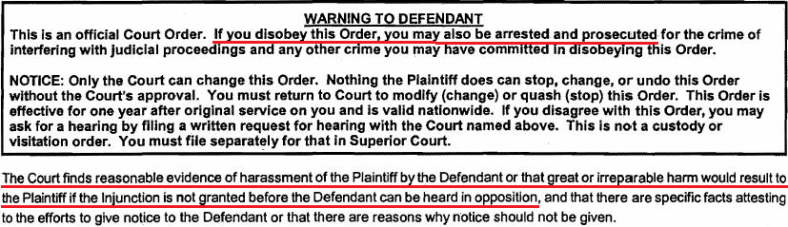
If you receive a restraining order in my home state, here’s the first thing that greets your eye:

On the basis of the form this warning captions—which looks like it was drafted by someone using a pizza crust as a straightedge—citizens are recorded in state and national police databases as stalkers and violent abusers.

Consider that the immediate impression this warning is meant to give is beware. It naturally excites fear—and if you’ve been falsely accused, a host of other emotions, besides, none of which conduces to calm and lucid thinking.

Something you wouldn’t guess from this “Warning to Defendant” is that if a defendant “disagrees” with an order issued in Arizona, s/he has the statutory right to apply for an appeals hearing at any time during the order’s effectiveness. For example, if the duration of the order is one calendar year, the defendant can take 11 months to assemble his or her appeal and save up, if necessary, to have an attorney represent that appeal.

Here’s the law:

At any time during the period during which the injunction is in effect, the defendant is entitled to one hearing on written request. No fee may be charged for requesting a hearing. A hearing that is requested by a defendant shall be held within ten days from the date requested unless the court finds compelling reasons to continue the hearing. The hearing shall be held at the earliest possible time. An ex parte injunction that is issued under this section shall state on its face that the defendant is entitled to a hearing on written request and shall include the name and address of the judicial office where the request may be filed. After the hearing, the court may modify, quash or continue the injunction.

The statute says the court’s order must inform the defendant that s/he’s entitled to a hearing, but it doesn’t require that the order inform the defendant that s/he has a year (or possibly years) in which to prep and apply for that hearing, that the hearing is free, or that the defendant may be represented by an attorney.

Restraining orders are rhetorical psych-outs. Their language is overtly menacing, and neither the law nor the issuing courthouse gives any consideration to apprising defendants of their rights.

The stress is on apprising defendants, who are presumed to suck (sight unseen), of what rights they’re no longer deemed worthy of.

Appreciate that the court’s basis for issuing the document capped with the “Warning” pictured above is nothing more than some allegations from the order’s plaintiff, allegations scrawled on a form and typically made orally to a judge in four or five minutes.

In the courthouse where the order issued against me was obtained, restraining order petitioners file into a room like a small bus station terminal, submit their applications, wait for an audience with a judge, chat with him or her for a few minutes, and leave.

That’s it.

Consequences of receiving an order of the court whose merits are determined on this basis include registration in state and national law enforcement databases, and may also include loss of entitlement to home, children, and possessions, and loss of employment.

In contravention of due process, orders are issued against defendants that may deny them liberties and property without the court’s hearing from them at all.

Ever.

In Arizona, unless a defendant requests a hearing before a judge, that’s an end on the process. No judge will even have learned what s/he looks like, and the truth of the plaintiff’s claims will never have been controverted—claims, to reiterate, that were made in a few minutes and could include anything from annoyance to physical or sexual violence.

Such claims often amount to nothing more certain than finger-pointing.

(Docket time afforded by the court to the testimony of defendants who go to the trouble of appealing rulings based on such claims, incidentally, is about 15 minutes. The cost of attorney representation at an appeals hearing may be $2,000 to $5,000.)

The only provision the law or the court makes for discouraging false testimony (some motives for which are here) is this one, which predictably appears at the very end of the application form:

The plaintiff signs below.

Applicants aren’t of course told what “perjury” is, and they’re certainly not told it’s a felony crime that carries a prison term (as it is and does in Arizona and many other states). Lying to the court is never sanctioned or prosecuted, anyway.

Recent posts on this blog were answers to dismissal by a doctor of laws of criticisms that the restraining order process is unfair. The process would have to be far more deliberative than it is, in fact, to be merely “unfair.”

The process is automated.

Copyright © 2014 RestrainingOrderAbuse.com

Responding to a Feminist Professor Kelly Behre’s Perspectives on Men’s Rights Activism

Since the publication of this post, the “research paper” it responds to has been removed from the Internet.


“I had a false allegation of domestic violence ordered against me on June 19, 2006. It was based on lies, but the local sheriff’s office and state attorney’s office didn’t care that he was a covert, lying narcissist. I doubt they ever heard of the term, in fact. I made the mistake of moving back in with him in September 2008.

“Last year, on July 23, 2013, he, with the help of his conniving sister, literally abandoned me. Left me without transportation and tried to have the electricity cut off. However, the electric company told him it was unlawful to do so. I am disabled, because of him, and have been fighting to get my life, reputation, and sanity restored. It has been over a year, and while life goes on for him, I am still struggling from deep scars of betrayal, lies, and his continued smear campaign against me.

“I thank you for the opportunity to speak out and stand with other true victims of abuse. You see, it isn’t just women who abuse the system, but men, as well.”

—Female e-petition respondent (August 30, 2014)

Contrast this woman’s story with this excerpt from a UC Davis Law Prof. Kelly Behre’s 2014 research paper:

At first glance, the modern fathers’ rights movement and law reform efforts appear progressive, as do the names and rhetoric of the “father’s rights” and “children’s rights” groups advocating for the reforms. They appear a long way removed from the activists who climbed on bridges dressed in superhero costumes or the member martyred by the movement after setting himself on fire on courthouse steps. Their use of civil rights language and appeal to formal gender equality is compelling. But a closer look reveals a social movement increasingly identifying itself as the opposition to the battered women’s movement and intimate partner violence advocates. Beneath a veneer of gender equality language and increased political savviness remains misogynistic undertones and a call to reinforce patriarchy.

The professor’s perceptions aren’t wrong. Her perspective, however, is limited, because stories like the one in the epigraph fall outside of the boundaries of her focus and awareness (and her interest and allegiance, besides).

What isn’t appreciated by critics of various men’s rights advocacy groups is that these groups’ own criticisms are provoked by legal inequities that are inspired and reinforced by feminist groups and their socially networked loyalists. These feminist groups arrogate to themselves the championship of female causes, among them that of battered women. Feminists are the movers behind the “battered women’s movement.”

Those who criticize unfair laws and policies that purport to protect battered women are not “pro-domestic violence”; they’re anti-injustice, which may well mean they’re anti-feminist, and this can be construed as “opposition to the battered women’s movement.” The opposition, however, is to what the feminist movement has wrought. No one is “for” the battery of women or “against” the protection of battered women.

To put this across in a way a feminist can appreciate, to believe women should have the right to abort a fetus is not the same thing as being “pro-abortion.” No one is “for” abortion, and no one is “for” domestic violence. (“Yay, abortion” is never a sign you’ll see brandished by a picketer at a pro-choice demonstration.)
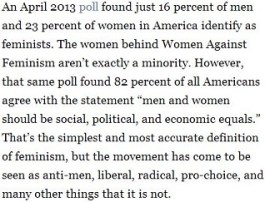
The Daily Beast op-ed this excerpt is drawn from criticizes a group called “Women Against Feminism” and asserts that feminism is defined by the conviction that “men and women should be social, political, and economic equals.” If this were strictly true, then inequities in judicial process that favor female complainants would be a target of feminism’s censure instead of its vigorous support.

The “clash” the professor constructs in her paper is not, strictly speaking, adversarial, and thinking of it this way is the source of the systemic injustices complained of by the groups she targets. Portraying it as a gender conflict is also archly self-serving, because it represents men’s rights groups as “the enemy.” Drawing an Us vs. Them dichotomy (standard practice in the law) promotes a far more visceral opposition to the plaints of men’s groups than the professor’s 64-page evidentiary survey could ever hope to (“Oh, they’re against us, are they?”).

The basic, rational argument against laws intended to curb violence against women is that they privilege women’s interests and deem women more (credit)worthy than men, which has translated to plaintiffs’ being regarded as more “honest” than defendants, and this accounts for female defendants’ also being victimized by false allegations.

(Women, too, are the victims of false restraining orders and fraudulent accusations of domestic abuse. Consequently, women also lose their jobs, their children, their good names, their health, their social credibility, etc.)

The thesis of the professor’s densely annotated paper (“Digging beneath the Equality Language: The Influence of the Father’s Rights Movement on Intimate Partner Violence Public Policy Debates and Family Law Reform”) is that allegations of legal inequities by men’s groups shouldn’t be preferred to facts, and that only facts should exercise influence on decision-making. This assertion is controverted by the professor’s defense of judicial decisions that may be based on no ascertainable facts whatever—and need not be according to the law. The professor on the one hand denounces finger-pointing from men’s groups and on the other hand defends finger-pointing by complainants of abuse, who are predominately women.

In the arena of law this post concerns, the courts typically follow the dictum that the person pointing the finger is right (and this person is usually female). In other words, the courts judge allegations to be facts. In many instances, what’s more, state law authorizes this formulation. It grants judges the authority “at their discretion” to rule according to accusations and nothing more. Hearsay is fine (and, for example, in California where the professor teaches, the law explicitly says hearsay is fine). The expression of a feeling of danger (genuinely felt or not) suffices as evidence of danger.

The professor’s defense of judicial decision-making based on finger-pointing rather undercuts the credibility of her 64-page polemic against decision-making based on finger-pointing by men’s groups that allege judicial inequities. The professor’s arguments, then, reduce to this position: women’s entitlement to be heeded is greater than men’s.

The problem with critiques of male opposition to domestic violence and restraining order statutes is that those critiques stem from the false presuppositions that (1) the statutes are fair and constitutionally conscientious (they’re not), (2) adjudications based on those statutes are even-handed and just (they’re not), and (3) no one ever exploits those statutes for malicious or otherwise self-serving ends by lying (they do—because they can, for the reasons enumerated above).
Attorneys acknowledge procedural abuses are common.

Many critiques of men’s, father’s, and children’s rights groups fail to even recognize that motives for lying exist. What presupposition underlies this? That everyone’s an angel? If everyone were an angel, we wouldn’t need laws at all. Or is the presupposition that women are angels? A woman should know better.

A casual Google query will turn up any number of licensed, practicing attorneys all over the country who acknowledge restraining orders and domestic violence laws are abused and offer their services to the falsely accused. Surely the professor wouldn’t allege that these attorneys are fishing for clients who don’t exist—and pretending there’s a problem that doesn’t exist—because they, too, are part of the “anti-battered-women conspiracy.”

The professor’s evidentiary pastiche is at points compelling—it’s only natural that a lot of rage will have been ventilated by people who’ve had their lives torn apart—but her paper’s arguments are finally, exactly like those they criticize, tendentious.

It’s obvious what the professor’s “side” is.

(She accordingly identifies her opposition indiscriminately. For example, the blog you’re right now reading was labeled the product of a father’s rights group or “FRG” in the footnotes of the professor’s paper. This blog is authored by one person only, and he’s not a father. Wronged dads have this writer’s sympathies, but this blog has no affiliation with any groups.)
The professor carefully prefaces her points with phrases like “Researchers have noted,” which gives them the veneer of plausibility but ignores this obvious question: where do the loyalties of those “researchers” lie? The professor cites, for example, the Southern Poverty Law Center’s equation of SAVE Services with a hate group. An attentive survey of SAVE’s reportage, however, would suggest little correspondence. The professor doesn’t quote any of SAVE’s reports; she simply quotes an opposing group’s denunciation of them as being on a par with white supremacist propaganda.

(What the professor does quote are some statistics generated by SAVE that she contends are dubious, like estimates of the number and costs of false and frivolous prosecutions. Such estimates must necessarily be speculative, because there are no means of conclusively determining the degree or extent of false allegations. Lies are seldom if ever acknowledged by the courts even if they’re detected. This fact, again, is one that’s corroborated by any number of attorneys who practice in the trenches. Perjury is rarely recognized or punished, so there are no ironclad statistics on its prevalence for advocacy groups to adduce.)

Besides plainly lacking neutrality, insofar as no comparative critical analysis of feminist rhetoric is performed, the professor’s logocentric orientation wants compassion. How much of what she perceives (or at least represents) as bigoted or even crazy would seem all too human if she were to ask herself, for instance, how would I feel if my children were ripped from me by the state in response to lies from someone I trusted, and I were falsely labeled a monster and kicked shoeless to the curb? Were she to ask herself this question and answer it honestly, most of the outraged and inflammatory language she finds offensively “vitriolic” and incendiary would quite suddenly seem understandable, if not sympathetic.

The professor’s approach is instead coolly legalistic, which is exactly the approach that has spawned the heated actions and language she finds objectionable.

Copyright © 2014 RestrainingOrderAbuse.com

“The PPO Destroyed My Career”: Grant’s Story of Restraining Order Abuse

Grant Dossetto has a degree in finance he can’t use.

That’s because a personal protection order (PPO) was petitioned against him in 2010 by a friend, and the law mandates that all restraining order recipients be registered in the FBI’s National Crime Information Center (NCIC) database—indefinitely.

The Securities and Exchange Act of 1934 requires those working in my field to be fingerprinted and to submit that to the FBI national database. This is on top of normal background checks, disclosure of any and all charitable donations as well as political donations, etc. Ironically we don’t have to pee in a cup for a drug test, but everything else goes well beyond that which my engineering friends et al. have been subjected to. I went to the Livonia police department and had my prints pressed in ink the old fashioned way on the standard card to be delivered to my employer by my first week of employment. The card then was supposed to find its way to the proper regulatory authorities before getting passed through the system.

A month after I began work at the brokerage, I was called by my boss after hours and told to mail back in my key. He fired me while out of town over the phone.

Grant is 27 years old, and he can never realize his ambition to be a stockbroker.

To this day, I have never been sponsored to get my licenses, and I am sure I never will. I can pass the CFA [to become a chartered financial analyst] but cannot take an order for a trade. The PPO destroyed my career.

Though his mother lived to see him earn his degree with honors in 2009, neither of Grant’s parents will ever know that their investment in their son’s success was betrayed or that his professional aspirations were dashed, because they’ve passed away.

When my father had a heart attack, I was just 14 years old. He passed in his sleep. Before my mom had dragged him off to bed, he had fallen asleep in my room while we were watching TV together and drooled on my pillow. When he didn’t wake the next morning, I can remember opening his mouth to try to resuscitate him and seeing how his tongue was already blackened from lack of oxygen. It was the first time I had to let in an EMT through the wide double front doors to go through the motions to tend to someone who was already gone.

Grant’s mother died in 2010 just days before Grant got word of the court order that identified him as a threat to the safety of a woman he hadn’t even seen in over a year.

I was celebrating a birthday party with my twin brother. He had just been commissioned as an artillery officer in the Marine Corps and was heading to Fort Sill in Oklahoma for training in a couple weeks, so it was a going away party as well. It ended with me carrying my mom up from the bottom of the stairs that led to the basement, blood trickling from the back of her head. She had had a stroke bringing up a food tray and collapsed. The right hemisphere of her brain immediately ceased all activity. I got to stand over another pair of EMTs, this time dabbing her eyes with a tissue. The pupils, fully dilated, failed to show any reaction. She maintained enough brain function to throw up, trying to recover from the worst concussion you could imagine, but by the next day a second opinion came back that she could not survive. My brother and I pulled the plug and held her hand until she forgot to breathe on her own. It took less than a half hour. It was a brilliantly sunny Michigan May day, those days that make suffering through the gray winter worth it. It’s hard to imagine something more at odds with how I felt.

Grant learned a protection order had been issued against him two days later. Notice of it was waiting for him upon his return from the funeral home in the form of a business card a sheriff handed his stepdad.

In Grant’s home state of Michigan, this qualifies as service. No copy of the order was ever provided to him.

I called the sheriff back, and he went through what I would later come to find out was the front page of the order. He asked me to drive to downtown Detroit, a half hour away, to be served the order. Seeing as I had seven hours of funeral activities in a day and a half, I told him that would be impossible. He said he’d mail it to me. I was never notified that I had just days to appeal or given an explanation of the consequences of the order. The order was never mailed to me. I tried twice to notify the officer that I had not received the PPO. He brushed it off once, and the second call went to voicemail and was never returned.

Grant was denied the opportunity to defend himself in court against an accuser he hadn’t even been in physical proximity to.

The last thing I had said to her was that my mom had died, and I was giving the eulogy at the funeral and would like her there even though we had our differences. The order had been issued ex parte, which requires the court to classify me as an immediate threat who will cause imminent and irreparable damage, per Michigan law. I did not meet those criteria. The hearing was held without my knowledge or participation.

No surprise, Grant has “suffered from severe depression that still surfaces at times now.” His case exemplifies the justice system’s willingness to compound the stresses of real exigencies like family crises with false exigencies like nonexistent danger.

My grandparents were going through their own personal troubles. One had emergency quadruple bypass surgery and is suffering from dementia. One was declared terminal and hung on for two and a half years as his kidneys shut down until he was also unable to tell reality from fiction. One had a hip replacement turn into a seven-surgery odyssey that involved a severe staph infection that ravaged her for most of a year. She needed over 50 blood transfusions over that period and has just recovered from fatigue in the past 12 months. I got a lifetime of bad news I couldn’t control in a couple years, and it took its toll on me.

The order of the court that turned Grant’s career path into a blind alley was petitioned by a woman whose own prospects, Grant says, declined during his senior year of college.

We enjoyed movies, card games (she cheats at euchre), parties, went to school football and hockey games. She sought me out in the parking lot of the campus church and asked me to sit with her at mass. I can’t think of an act of friendship much more intimate than that. When we were close, she was on the dean’s list.

I had been friends with her from September, sophomore year of college until midway through my senior year. In a month, I went from being someone she talked to on Facebook at one in the morning and publically said she loved to being accused of felony property damage—tire-slashing, in particular.

She had gotten involved with a bad crowd, joined a terrible varsity team at school. In April of my junior year, she asked a mutual friend of ours to do cocaine—not exactly something a happy person says. The next fall, I heard about how her parents didn’t give a damn about her, and in November she called my roommate and me over only to snap at us until she kicked us out just before 10 to take a tablespoon of Nyquil that would force her to sleep. She also talked about how she had been getting dizzy and suffering from vertigo, which got her a prescription medication. A doctor had said it was iron deficiency. I can tell you from personal experience it was stress. Her grades slipped to C’s.

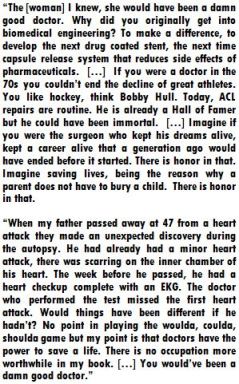
This letter of encouragement represents the “misconduct” of Grant’s that his accuser and the court deemed evidence of “imminent” and potentially “irreparable” harm. The letter ends, “Do what you were meant to do. Be the person you were meant to be.”

As Grant charts his relationship, he urged his friend to make “wholesale changes” and was punished for his concern. “I was sharp,” he says, “but only after I had exhausted every other option.”

Houghton is a small town—population around 10,000—and our school has an undergrad student body of about 6,000. Wal-Mart and not much else is a big deal there as the copper and iron mines shut down decades ago driving out industry and families with it. Not surprisingly, we saw each other a lot the second half of my senior year. I saw her at the gym, had class in an adjacent room two days a week, she worked next door to my lab twice a week, and I worked in the same building as her lab.

I stopped by her house because it was a bad situation given the fact the last thing she had said to me were criminal allegations. We talked for hours, getting along enough that I sincerely believed we had patched things up. She was still miserable, though. One thing got her to brighten up like the girl I first became friends with, and that was a goal to go to med school, a reasonable one for a biomedical engineer.

I invited her out to the movies with my housemates whom she was friends with. I said she should come to the surprise birthday party I was helping to throw for a mutual friend. I tried to get her back to the group she was successful with. For that I got another round of false allegations (destroying the front quarter panel of her car).

When a protection order was issued against Grant in 2010, he hadn’t seen his accuser in over a year. The sheriff who notified him of the order “essentially told [him he] had been contacting her, and now [he] couldn’t.” Grant only got a look at the order that he was never served this month (four years later).

The first time I saw it was two weeks ago. It is a permanent file in the Macomb County Courthouse, file #10-2184-PH. I was marked a threat by my government without me present or ever having physical possession of the order. There is no way for me to have the order removed.

Grant’s former friend, the petitioner of the protection order, had gotten a job after college that apparently hadn’t worked out and returned home. In 2013, the office Grant worked in was slated to relocate near her (in a town of 10,000 residents).

I texted her, because I knew that was a problem. Given what she sent back, I replied that I was going to have to seriously consider leaving my job unless I got assurances from her this wouldn’t be an issue.

Grant received actual threats from the family of his accuser but says he has never considered applying for a protection order himself.

Grant’s texts instead inspired his accuser to dash to the nearest courthouse all over again.

In April 2013, she filed another PPO against me even though I had not seen her in over four years. I had made no attempt to try and meet up with her. It was also issued ex parte, probably because of the first one. She began texting me less than three days after it had taken effect and didn’t show up to the appeals hearing that I scheduled. I missed parts of three days of work to fight an order that she didn’t even feel like defending. In two weeks, the same court, Wayne County this time, ruled against me then for me.

What Grant means is the same court that deemed him a “threat” (sight unseen) was content to consider him benign a couple weeks later just because the protection order petitioner didn’t make a follow-up appearance. His observations underscore the cattle-call nature of restraining order adjudications that readily implicate defendants as criminal menaces but may just as readily conclude they’re harmless and send them home.

Mine was not the only PPO to be overturned—far from it—and the entire docket (about 12 cases) was decided in less than 30 minutes after we waited over an hour for the judge, who was late. Is that justice? How can I ever respect the courts again?

The same orders Grant says were summarily dismissed had just as summarily been approved days or weeks earlier. Restraining orders are typically rubber-stamped upon a few minutes’ “deliberation.”

I sued her after that. In her response to my complaint, she admitted that I had never done anything illegal. You wouldn’t know that by my public record.

Grant dropped the lawsuit, which communicated that he wouldn’t tolerate further prosecutions. The 2010 PPO remains on his record, however, and the stain not only galls him but has derailed his life.

The judge who issued the 2010 order, James Biernat, Sr., is famous for presiding over the “Comic Book Murder” case. It was big enough to make Dateline and the other true crime outlets. He overturned a guilty conviction from a jury and demanded a retrial. The action was extraordinary, held up on appeal by a split decision. The Macomb prosecutor publically rebuked him as being soft on crime. That made national news. All the cable outlets covered the second trial, which yielded the same result: guilty. He was rebuked by two dozen jurors, three appellate justices, and the prosecutor. It’s funny, if he had just given me a hearing, let alone a second, I truly believe a PPO would never have been issued.

A questionable judge who is soft on guilty murderers didn’t have a problem destroying a 23-year-old he had never met for non-threatening, legal contact. How could you not believe that the system is hopelessly broken?

Copyright © 2014 RestrainingOrderAbuse.com
Since this writing, Grant has channeled his thwarted energies into creative writing and completed a novel, The Hopping Bird, which has been praised in Kirkus Reviews: “Harold Freeman enjoyed success as a player, which included a World Series championship, until it was cut short due to injury. His managerial career has not been as smooth, but that is all behind him as he takes the reins of the Toledo Mud Hens for the 2014 season. After a last place finish in the International League’s West Division a season ago, can he turn the team around?”

Connecticut Lawmakers Conclude Getting a Restraining Order Isn’t Easy Enough Already

Those victimized by liars who abuse restraining order and domestic violence laws often blame their judges. It’s natural. They’re the ones who deprive the wrongly accused of dignity, liberty, property, and family—and theirs are the words that echo in the memory and grate on the nerves during the empty hours.

Lawmakers it must be remembered, though, are the enablers.

Judges may be careless. They may even be cruel. But legislators are clueless.

To give an example, consider this story reported today in Hartford, Connecticut’s The Courant (August 25, 2014):

Domestic violence victims need to have a simpler process of applying for restraining orders and better communication with the agencies that handle them, a legislative subcommittee said Monday.

To that end, the subcommittee of the task force on restraining orders agreed to recommend a streamlined version of restraining order applications and an accompanying checklist to pave the way for better communication among victims, marshals and courts.

The Connecticut legislature purposes to make simpler yet a process that’s already so “streamlined” that accusers don’t have to prove anything.

CONN. GEN. STAT. ANN. § 46b-15(b): “The court, in its discretion, may make such orders as it deems appropriate for the protection of the applicant and such dependent children or other persons as the court sees fit.… If an applicant alleges an immediate and present physical danger to the applicant, the court may issue an ex parte order granting such relief as it deems appropriate.”

This literally means that if a domestic partner merely alleges s/he feels in danger, which only takes a few seconds to do, the court is authorized to order the accused to be forcibly ejected from his or her home by armed agents of the state—even if the accused owns that home and has lived in it all of his or her life. In other words (again, for example), it’s entirely possibly for someone who has no home to move in with someone else, falsely accuse him or her of abuse, and for all intents and purposes seize possession of his or her home. Other obvious motives for lying are malice or gaining custody of kids.

No evidence of anything is required by the law, which is a blank check that authorizes accusers to say whatever they feel like and judges to do whatever they feel like.

Members of the legislative subcommittee referenced in The Courant article reportedly expect to improve their understanding of the flaws inherent in the restraining order process by taking a field trip. They plan “a ‘ride along’ with the representative of the state marshals on the panel…to learn more about how restraining orders are served.”

The urgent problem with restraining orders as they see it is ensuring that more of them are successfully delivered.

The article cites concerns expressed by the executive director of the Connecticut Coalition Against Domestic Violence “about the complicated process domestic violence victims face when they apply for restraining orders.”

The “complicated process” to have someone evicted shoeless from his or her home in the Connecticut winter and prohibited access to his or kids based on an allegation is filling out a form.

The Connecticut legislators “decided to remove the instructions in small print at the top of the form, which start with the outdated suggestion that the applicant ‘use a typewriter.’ Applicants will have access to a separate sheet of paper that has step-by-step instructions.”

Authorizing the court “in its discretion” to fill out orders “as it deems appropriate” would seem more expeditious and economical to this writer.

Copyright © 2014 RestrainingOrderAbuse.com

Victims Are Important, but They’re Not More Important than Anyone Else: Amending Priorities and Reconceiving Restraining Order Policy According to the Principle of Equality

“While some municipal court judges acknowledge that the domestic violence law can create injustices—one calls it ‘probably the most abused piece of legislation that comes to my mind’—there are counterpoints. Melanie Griffin, executive director of the Commission to Study Sex Discrimination in the Statutes, a legislative commission that drafted much of the 1991 law, says that for every individual who files a false report, ‘there are 100 women who don’t come in at all and stay there and get beaten.’”

—“N.J. Judges Told to Ignore Rights in Abuse TROs

This quotation comes from a nearly 20-year-old journalistic exposé, yet you’ll find the same starkly meretricious apology for restraining order abuse routinely voiced today.

This quotation from the proposed Equal Rights Amendment (ERA) means that all people should be treated equally under the law, not that women should be privileged. Anyone who’s for women’s being afforded special treatment by the authorities and the courts, as proponents of the Violence Against Women Act (VAWA) are, opposes the ERA.

This quotation from the proposed Equal Rights Amendment (ERA) means that all people should be treated equally under the law, not that women should be privileged. Anyone who’s for women’s being afforded special treatment by the authorities and the courts opposes the message of the ERA, as do proponents of the Violence Against Women Act (VAWA).

The argument, basically, is that it doesn’t matter if restraining order defendants’ rights are ignored, and it doesn’t matter if defendants are falsely accused, because there are many more victims of abuse who suffer in silence than there are false accusers.

The argument equates apples with orangutans. Its reasoning is partisan and purely emotion-based—and betrays ignorance of the fact that women, too, are falsely accused of domestic violence. Its thesis is that since there may be multitudes of unacknowledged victims of domestic violence, the state’s creating victims by abetting false prosecutions is of no statistical significance.

While everyone should feel for women who are “beaten” at home, no one should be forced by the state to endure “sympathy pains.” The falsely accused man or woman whose life is upturned or undone by hyped allegations or gross lies credited by careless judges is absolutely blameless for the suffering of strangers.

Life, liberty, and the pursuit of happiness are inalienable rights guaranteed to all citizens under the Constitution, and equality and fair treatment under the law are among its mandates that brook no compromise. Denying the latter to anyone, ever—even if the motive is a sympathetic one—is categorically wrong.

The statement in the epigraph says: It’s okay if you, Mr. or Ms. Doe, are falsely accused and battered by the system, and it’s okay if it deprives you of your kids and home and livelihood and dignity and sanity, because some people you don’t know and never will know are reportedly “beaten” by some other people you don’t know and never will know.

It says there are women who suffer unjustly, so never mind if we make you suffer unjustly, too.

Copyright © 2014 RestrainingOrderAbuse.com

Mocking the Constitution for 35 Years: A Summary of Defendants’ Due Process Rights under the American Charter and How Restraining Orders Treat Them Contemptuously

taped_mouth_cropI’ve written before about “due process,” a constitutional privilege that’s universally denied to restraining order defendants. Recently I was contacted by an intelligent 17-year-old girl who wanted to know what her rights were under the law. She didn’t stand accused of anything. Rather her adult boyfriend had been issued a mandatory (criminal) restraining order in California “on her behalf” that she didn’t seek, and she wanted to know what she could do about it.

She has a tough row to hoe, and I couldn’t provide her with much solace.

In hunting around for resources to direct her attention to, though, I came across a page prepared by the Virginia Office of the Attorney General titled, “Legal Rights of Juveniles.”

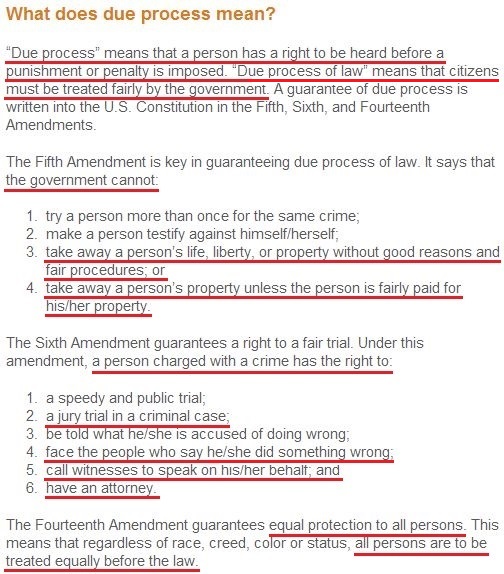
Its summation of defendants’ due process entitlements under the Constitution is worthy of the attention of anyone who’s being or who’s been put through the restraining order ringer, as well as of anyone who’s paid to craft laws that honor civil rights. Past posts on this blog have focused on the Fourteenth Amendment. This synopsis covers the Fifth and Sixth Amendments, also.

Contrast:

  • Restraining orders are issued ex parte, which means penalty is imposed upon a defendant without the court’s even knowing a thing about him or her other than his or her name—and in some jurisdictions, s/he’s not granted even the opportunity to be heard unless s/he applies for that opportunity (and the window to apply may be brief) = Sixth Amendment.
  • A defendant is deprived of liberty and often property, besides, without compensation and in accordance with manifestly unfair procedures concluded in minutes = Fifth Amendment.
  • A defendant is subject to criminal sanctions, including incarceration, without benefit of a trial by jury and consequent to a hasty civil adjudication (half an hour) that requires him or her to hire private counsel if s/he’s to be represented at all, that may not allow him or her to face his or her accuser in court, and whose pretrial preparation period affords too little time for witnesses to be gathered (two to 10 days) = Sixth Amendment.
  • Defendants are discriminated against generically, and male defendants are discriminated against specifically to mollify the special interest groups that motivated enactment of restraining orders in the first place = Fourteenth Amendment.

The restraining order process isn’t merely abusive on an epidemic scale; it treats the Constitution with contempt.

Copyright © 2014 RestrainingOrderAbuse.com

Ungoverned: Restraining Order Laws in Arkansas

not-governed

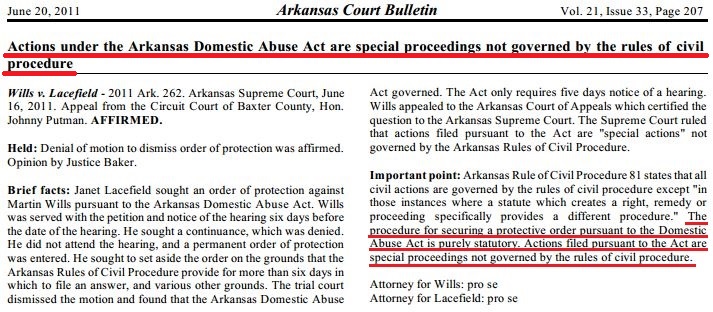
I’ve combed the Internet in recent weeks for motion-to-dismiss forms applicable to restraining orders issued in the 50 states. For Arkansas, there’s nothing to be found. Zip. If that weren’t suggestive enough that the process is a lock, consider the above entry excerpted from a 2011 Arkansas Court Bulletin.

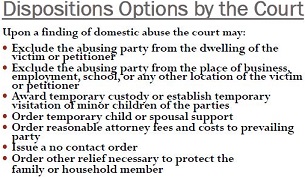
This means an accuser may be awarded exclusive entitlement to the family residence; sole custody of children; a monthly stipend from the former breadwinner, who may find himself out of a job subsequent to being issued a “domestic abuse” restraining order; and reimbursement of costs. Filing for a protection order, in other words, may gain a plaintiff everything and cost her (or sometimes him) nothing—whether the allegations it’s based on are true, hyped, or lies.

The case commentary (which you’ll observe publicly discloses the names of the parties to the action) concerns a man who was served with a notice to appear in court to answer allegations of “domestic abuse” six days thence.

Rough translation: “Dear sir, you’re expected in a courtroom next week to respond to allegations that you beat your wife.”

For people who know nothing about restraining order processes, appreciate that this man was given less than a week’s time to prepare a defense against obviously serious charges with obviously serious repercussions. In six days, he was supposed to come to grips with public allegations that may have horrified him, procure an attorney’s services, gather relevant evidence and testimony, etc.

Six days.

The bulletin reports that the man “sought a continuance [postponement], which was denied.” He didn’t attend the hearing. The commentary doesn’t indicate a reason. His request to have the order set aside, because the expectation of an immediate response didn’t conform to the Arkansas Rules of Civil Procedure, was also denied. Why? Because the Arkansas Domestic Abuse Act trumps the rules of civil procedure.

This case exemplifies why restraining order adjudications strike so many people as Kafkaesque: “I move—.” “No.” “Then—.” “No.” “But—.” “The rules don’t apply in your case, sir, and we don’t negotiate our decisions.”

Defendants’ being railroaded, of course, is nothing extraordinary. “Emergency” restraining orders may allow respondents only a weekend to prepare before having to appear in court to answer allegations—very possibly false allegations—that have the potential to permanently alter the course of their lives.

Extraordinary is the Arkansas courts’ openly and nonchalantly recognizing in a bulletin that their protective order process is “not governed by the rules.”

Its proceedings are “special.”

Copyright © 2014 RestrainingOrderAbuse.com
No False Motives: On WHY Judges Refuse to Acknowledge Restraining Order Fraud

In the last post, I stressed that the courts refuse to acknowledge false allegations made by restraining order plaintiffs as lies, perjury, or fraud. It’s unlikely courts will call them “true.” Rather they’ll just accept them as given.

This shouldn’t be too surprising considering that the legitimacy and worthiness of the restraining order process is itself unquestioned. Why? Because it’s favored by the feminist establishment, which has gained so much political sway in recent decades that society, particularly its liberal constituency, is inclined to feel that what feminists want is what women want, and what women want is what everyone should want. Even women may not question whether what feminists want is what’s in their best interests. Restraining orders are promoted as positive and empowering for women. Also, they’re there to bring bad guys to bay and advance the causes of peace, justice, and the American way. So what possible grounds could exist for criticizing them? No harm, no foul, right?

The answer to these questions is of course known to (besides men) any number of women who’ve been victimized by the restraining order process. They’re not politicians, though. Or members of the ivory-tower club that determines the course of what we call mainstream feminism. They’re just the people who actually know what they’re talking about, because they’ve been broken by the state like butterflies pinned to a board and slowly vivisected with a nickel by a sadistic child.


And the value of their lives is deemed negligible. They’re what feminist jihadists would likely refer to as casualties of war.

The perpetuation of the restraining order process and the preservation of its appearance of propriety is the product of prejudice and perception mutually reinforcing each other. Public perception is that restraining orders are “good,” because they answer a social need. Judicial perception of restraining order applicants’ motives is accordingly prejudiced by pressures both political and social. If that weren’t enough, it’s also programmed. Courts receive massive federal grants under the Violence Against Women Act (VAWA) in return for having their judges submit to indoctrination.

Thus judges not only ignore whether allegations made on restraining orders are false; they may well assume the position that restraining orders are never sought maliciously (or frivolously).

They do what people expect of them, what the state wants of them, and what accordingly feels righteous and noble. That it’s also in their professional interests is a bonus (as is the possible gratification they derive from making “miscreants” cavil and quail). All of these motives are wrong and are furthermore contrary to judicial ethics (due process, Constitutional privilege, social justice, etc.), but the only people who care about principle are this travesty’s sacrificial lambs.

And they’re mostly silent.

Copyright © 2013 RestrainingOrderAbuse.com

Objections to Restraining Orders AREN’T about Restraining Orders

Let’s get something clear: protests against restraining orders aren’t about restraining orders.

Granted, it’s a violation against decency and all things American for the government to casually curtail citizens’ freedoms without even consulting them first. But, seriously, who cares if a judge says one adult can’t talk to some other adult?

Objections to restraining orders are never about not being allowed to talk to the plaintiffs who were treacherous enough seek them. I would imagine (and I don’t strictly have to imagine) that most restraining order defendants’ feelings toward the people they’re prohibited from talking to are considerably less than friendly, anyway.

Here’s what objections to restraining orders are about:

  • On a modicum of evidence of “threat” or none at all, a spouse or boy- or girlfriend can be ejected from his or her home (even if s/he holds the deed) and forbidden access to his or her children, pets, money, and property on pain of police arrest.
  • Allegations ranging from harassment to domestic violence can be permanently stamped on defendants’ (that is, recipients’) records, again based on a modicum of evidence (very possibly misrepresented) or none at all. An allegation amounting to nothing more than “I’m afraid” is sufficient to obtain an “order of protection,” the implications of which phrase alone signify stalking, violence, or violent intent.
  • Restraining orders are public documents that may be accessible to anyone, including employers and would-be employers. Records of their issuance remain on public view even after their expiration and may be entered into public registries.
  • The truth or falsity of allegations that may be as extreme as assault with a deadly weapon, child molestation, or rape is determined according to the same civil standard of evidence as contract and insurance disputes: “preponderance of the evidence.” Regardless of the extremity of allegations on restraining orders, neither a trial by jury nor “proof beyond a reasonable doubt” is ever required for their validation. If a judge feels there’s a better than 50/50 probability that allegations are true, “preponderance of the evidence” is satisfied.
  • Allegations on restraining orders, which may be either criminal or criminal in nature and may besides be entirely false, indefinitely remain on defendants’ public records whether they’re found meritorious or not, that is, even baseless allegations that a judge ignores are never stricken from the record but remain on public view and may reasonably be interpreted as true or valid by anyone who consults those records.
  • The restraining order process is conducted ex parte, which means orders are issued based on one party’s claims alone, and these may be both damning and egregiously false.
  • Statutory penalties for lying to police officers and judges (false reporting and perjury) are never enforced, and allegations of lying are furthermore discounted by the courts.
  • Federal grant monies (average grants being in the neighborhood of $500,000) are awarded to police districts and courts in return for their consenting to have their officers “educated” about how they should respond to allegations of fear and violence. Mandated responses include accepting allegations of violence by women at face value (that is, they’re not to be questioned). This mandated response roughly translates to allegations by anyone being recognized as legitimate.
  • Irrespective of the nature of allegations entered against a defendant, which may be innocuous or false, that defendant is subjected to traumatizing menace, intimidation, and public disparagement by the state. S/he is treated generically like a fiend, the paradigmatic basis for which treatment is the domestic batterer whose conduct restraining orders were originally conceived to check, despite allegations of violence being rare today relative to the vast number of restraining orders issued (estimated at two to three million per annum).
  • Restraining orders, which circumvent due process entirely and which originate in civil court and are therefore subject to no standard of proof, may implicate defendants as criminals and may have criminal consequences if “violated.” Alleged violations, also, may be subject to no standard of proof. In other words, a defendant can find him- or herself locked up, never having been granted his or her constitutional right to a trial and very possibly on maliciously false grounds (based on a decision formed by the court prior to even knowing what that defendant looked like).
  • Opportunities to contest allegations on restraining orders, which defendants may literally have to ask for within a brief window of time, may be assigned no more than a few minutes, and defendants are never provided counsel. An innocent defendant forced to contest utterly malicious allegations may face the quandary of living with them permanently stamped on his or her public record or shelling out $2,500 to $5,000 for an attorney’s representation, which measure is no guarantee of vindication and which measure few can afford even if they’re conscious of the need (which few are).
  • Restraining orders are usually free for the asking and may be petitioned serially or multiply by a single applicant, making them marvelous instruments of harassment and torment. There’s no statutory limit on the number of restraining orders a single applicant may apply for, no penalties for having false or groundless restraining orders dismissed, and of course no penalties for lying.
  • Restraining orders impose no limitations on the actions of plaintiffs (that is, applicants), leaving them free to taunt or stalk defendants, or bait them into violating orders of the court.
  • Courts pander to and reward even those guided by spite, jealousy, malice, and/or personality disorders or mental illnessThe interchange between a judge and a plaintiff is no more than five or 10 minutes in duration and is more procedural and perfunctory than probative. A judge authorizes a restraining order, which may permanently alter many lives for the worse (including those of children), based on knowing nothing whatever about its defendant, who’s just a name on a form, and almost nothing about its petitioner, who may be disturbed or even insane.
  • Upon plaintiffs’ successfully making false allegations stick once (or baiting defendants into violating false restraining orders), they now have a foundation upon which to make further falsehoods entirely plausible. Thus can innocent defendants’ lives be scarred or fractured irreparably by chronic abuse (a single potent lie, or a series of them, can be nursed for years). And these defendants may have been the actual victims in the first place.

Most people (including authorities and officers of the court) aren’t conscious that restraining orders are abused, let alone conscious of how they’re abused, why they’re abused, or how extremely they can be abused.

It’s hoped that this synopsis makes the means and motive for restraining order abuse clearer to those in the dark, at sea, or on the ropes. Whether you’re a legislator, a judge, a police officer, an attorney, a counselor, a feminist or feminist partisan, a victim of restraining order fraud, or just someone with reasonable expectations about how the justice system operates, whatever your perceptions were about restraining orders and their administration, those perceptions were probably either naïve or wrong.

The ease and convenience with which restraining orders may be obtained make their attractiveness as instruments of passive-aggressive castigation, spite, and vengeance irresistible.

You’ve seen that game carnival-goers are invited to take a crack at that gives them three tries to drop a seated person into a pool of water? Restraining orders are sort of the same thing, only the cost of a ticket is free, a player doesn’t need to be able to hit the broadside of a barn, and the water beneath the target is scalding.

Copyright © 2013 RestrainingOrderAbuse.com

What HE Said: On Why Once a Restraining Order Fraud Has Been Put Over on the Courts, It Sticks like Pigeon Scat on a Car Hood

A principle of law that everyone ensnarled in any sort of legal shenanigan should be aware of is stare decisis. This Latin phrase means “to abide by, or adhere to, decided things” (Black’s Law Dictionary). Law proceeds and “evolves” in accordance with stare decisis.


Anybody who’s read a Grisham novel or seen its screen adaptation knows that precedents are evoked to establish the merits of legal arguments. Precedents are cases whose judicial opinions imposed some novel tweak, limit, or elaboration on previous opinions. Law “advances” by means of this sort of accretion and seldom backpedals. Lawyers inform judges of precedents to persuade them that such-and-such was agreed upon by another judge, so you guys need to form your rulings correspondently.

The orientation of the courts is toward accepting that what’s previously been found to be the case must remain the case (or “the truth”).

Victims of restraining order fraud express amazement at the courts’ unwillingness to acknowledge obvious lies by designing plaintiffs (applicants). The fact is that once a restraining order has been successfully petitioned, and this is simply a matter of a plaintiff plaintively persuading a judge of his or her need in a 10-minute interview, it becomes a (presumptively) decided matter. Court rhetoric would have it believed that no final conclusion is made until the defendant can be heard in opposition, but all things judicial lean toward the notion exemplified by stare decisis, that is, what’s decided is decided.

Translation: “It’s true, because we said it was.” This is called a tautology (the assertion that a fact is its own reason) and would get a practitioner tossed out of Critical Thinking 101.

Defendants who opt to contest false allegations on restraining orders only to have judges belittle their efforts in the brief, half-hour hearings afforded them often report being horrified by judicial bias, laziness, or indifference, and leave courtrooms feeling like the outcomes were preordained.

That’s because in a very real sense they were.

Ex parte rulings may well be done deals, because judges, consciously or not, follow the precept that they should adhere to precedents and not unsettle things previously established (“stare decisis et non quieta movere”). And all restraining orders are approved ex parte, that is, without judges even knowing who defendants are, so what has previously been established has been established unilaterally (that is, prejudicially or one-sidedly) and in the absence of due process of law.

Restraining order appeals, which may climb successive rungs of the court ladder if defendants possess the financial means and moral fortitude to keep resisting, face this prejudice all the way up. So too do lawsuits seeking damages for restraining order abuse (especially if litigants are self-represented).

If you ever receive an apology from a judge, frame it.

Truth may literally be irrelevant. Procedural rules trump it and incline and authorize judges not merely to discount contradictory evidence provided by defendants but to ignore it entirely. Some disturbed person’s incriminatory fantasy, therefore, can drain the quality of years of a restraining order defendant’s life. This is the grotesque reality of the restraining order process and underscores its inherent corruption.

Government studies have concluded that a majority of restraining orders (80% by at least one reckoning) are issued unnecessarily or on false grounds.

It’s clear then that unless due process is retrofitted into the system, and defendants are granted the opportunity to be heard prior to restraining orders’ being issued so that they’re not forced to enter the process having to clear the hurdle of an unfair prejudgment (on top of feeling betrayed and menaced by the state), restraining orders will necessarily continue to do more harm than they arrest.

It would also be nice if the statutory consequence of prison time for those who lie to the courts were once and while enforced.

Copyright © 2013 RestrainingOrderAbuse.com

Just because Simon Says Someone’s a Danger Doesn’t Make It So: On the Playground Nature of Restraining Order Administration

Restraining orders occupy an exceptional status among complaints made to our courts, because their defendants (recipients) are denied due process, that is, they have no say in the “preliminary” conclusions formed by judges.

A plaintiff (applicant) waltzes into a courthouse and makes some allegations against a defendant, who is just a name on a form. That’s it. And those allegations are subject to no special standard of verification, which is why the word preliminary in the first sentence is enclosed in quotation marks of contempt: presumed conclusions are seldom revised even when defendants pursue what meager opportunities they may be afforded to challenge and controvert allegations casually leveled against them.

Once a judge signs off on a restraining order, it’s typically a done deal. Which is a problem, because no due process means plaintiffs get to play Simon Says with the truth.

“Simon says he’s a danger.”

Check.

“Simon says she’s a stalker.”

Check.

The restraining order process has devolved into a playground game—all comers welcome!—that is provided a gloss of legitimacy by the stern and forbidding rhetoric and consequences that attend it and the earnest faith it’s afforded by those who don’t know any better, which certainly includes the general public and may include authorities and officers of the court, also.

It’s a sham, a scam, and a shame on our justice system.

Allegations of any nature, including assault (physical or sexual), can be made on restraining orders without applicants being charged a penny or having to satisfy any standard of proof (and these allegations may be permanently stamped on recipients’ public records for anyone to peruse—employers, for example—or entered into public registries). And they can be made straight to a judge who it’s usually the case has been instructed not merely to take those allegations seriously but to accept them at face value.

In fact, contrary to reason, the worse an allegation is, the less it’s to be questioned. The truth of an allegation of violence, especially, is to be accepted as given.

There are even “emergency restraining orders” that may deny their defendants any more than a weekend to prepare a defense (try finding a lawyer on a Thursday who’s willing to represent you on the following Monday), and the standard of credibility applied by judges to applications for these orders is no more demanding. Emergency restraining orders may likelier be approved on reflex because of the implications of the word emergency (I wish I were kidding).

Hysteria is not evidence, and finger-pointing is not fact. Parents scold their children: “Would you jump off a bridge just because everybody else did?” Little kids are exhorted to think independently and not to act on impulse or in sheepish compliance with convention.

Judges, I’m pretty sure, are supposed to do the same.

Copyright © 2013 RestrainingOrderAbuse.com

A Safety Seal: What Restraining Orders and Tic Tacs Should Have in Common but Don’t

I’ve written recently about restraining orders’ circumvention of due process and remarked that at the time of their advent—the 1970s—this may have seemed to lawmakers like an urgently necessary evil.

The phrase due process, to recap, refers to granting defendants (like recipients of restraining orders) the opportunity to defend themselves before a judgment is entered on allegations made against them. Restraining orders deny defendants due process, because their guilt is conclusively presumed without judges’ knowing who they are (even so-called “appeals hearings” may afford a defendant no more than a 15-minute audience with a judge who already supposes him or her to be guilty).

To put it baldly, defendants are issued orders from the court that manifestly identify them as creeps and that may summarily (and indefinitely) deprive them access to home, children, money, and property based on the court’s knowing nothing more about them than their names and what someone alleged against them, which the Fourteenth Amendment was drafted to guarantee can’t happen.

The motive for denying restraining order defendants due process—for which legislators are to blame, not judges—was satisfying feminist outrage by ensuring female victims of domestic violence didn’t have to worry about their allegations being discounted or criticized by the police, as they well might have been in the ’70s (imagine being knocked around and terrorized at home then publicly ridiculed or excoriated by authorities—all men—for complaining about it). Restraining orders authorized battered women to take their allegations directly to a judge and thereby be granted immediate relief from unbearable circumstances.

Though social attitudes toward women’s rights and domestic abuse have shifted radically in 30 years (to a vulgar extreme, many might argue), no one, however, has looked back. Restraining orders continue to follow the same policies they did from the start (or laxer ones) and have only become more widely applied and sprouted more and sharper teeth.

The last commentary noted that at the time restraining orders were enacted, legislators assuredly never gave a thought to the possibility that they would be abused.

At that time, no one had considered that somebody might intentionally sabotage foodstuffs or over-the-counter medications, either. It never occurred to manufacturers or government overseers of product safety standards that somebody might poison others just for the fun of doing them harm—or just because they could.

Following Tylenol’s being tampered with in 1981, everything from diced onions to multivitamins requires a safety seal. Naive trust was violated, and legislators responded.


Legal lions, scholars, and journalists have denounced the injustice of restraining orders for 20 years now at least, and any number of lives fractured by wrongfully issued restraining orders have been publicly chronicled. Even government studies have concluded that a majority of restraining orders are sought unnecessarily or falsely and that only a small minority ever even allege violence.

How many more people have to be poisoned by a widely abused judicial process before the same cautionary measures applied to Tic Tacs are applied to it?

Time for a manufacturer recall.

Copyright © 2013 RestrainingOrderAbuse.com

Circumventing Due Process Isn’t Just What Restraining Orders Do—It’s What They Were Designed to Do

detour
“Due process of law implies the right of the person affected thereby to be present before the tribunal which pronounces judgment upon the question of life, liberty, or property, in its most comprehensive sense; to be heard, by testimony or otherwise, and to have the right of controverting, by proof, every material fact which bears on the question of right in the matter involved. If any question of fact or liability be conclusively presumed against him, this is not due process of law.”

Black’s Law Dictionary

The phrase due process (or due process of law) names those most fundamental legal entitlements that ensure an individual is provided the means and opportunity to defend him- or herself and his or her interests in court.

In the previous post, I observed that restraining orders skirt due process entirely—which I’m hardly the first person to remark.

As this post’s epigraph explains, whenever the court presumes that a person is liable for or guilty of some alleged transgression and enters a judgment against that person without first granting that person the opportunity to challenge the allegations against him or her, that person is denied due process.

Not kinda-sorta but flatly.

Since restraining orders (by legislative mandate) are issued ex parte, which means that the only parties judges hear from prior to entering rulings are restraining order applicants, every restraining order recipient is denied due process. Every one of them. Always. Restraining order defendants are just inked names on paper forms; judges have no idea whom they’re entering judgments against, and defendants have no idea judgments have been entered against them until a constable comes knocking.

Restated using legalese from this post’s epigraph, when a defendant’s guilt is “conclusively presumed,” as it is when a judge approves a restraining order, “this is not due process of law.” Restated simply, when rulings are made prior to defendants’ being given a chance to defend themselves, there’s no due process. Restated simplest, restraining orders = no due process = no adherence to the most basic principles of law = dirty pool.

This is an obvious and indisputable fact, and as I stated earlier, I’m hardly the first person to have noted it.

What’s more rarely observed is that denying defendants due process was the purpose of restraining orders’ being enacted. Restraining order legislation, by design, authorizes a plaintiff to communicate his or her allegations directly to a judge, without having to convince any legal authorities of the merits of those allegations, and requires that a judge enter a ruling on those allegations without a plaintiff’s having to face the person s/he’s accused. (Due process is a constitutional guarantee under the Fourteenth Amendment—except when lawmakers say otherwise.)

The motive for this circumvention of due process is now a very dusty one.

Restraining orders were born three decades ago in response to a pressing demand from female advocates for a process that allowed at-risk women, particularly victims of domestic violence, to avoid the pain and humiliation of having to take their claims to the police (who may have discounted those claims or even criticized women for making them) and go straight to a judge, that is, to have the opportunity to quickly and quietly explain their hardships in a situation of security and minimal scrutiny.

In the social climate that predominated in the 1970s, this made sense. Wives were still expected, by and large, to stay home, tend to their kids and kitchens, and mind their husbands. If husbands sometimes got a little free with their hands, that wasn’t something you broadcast to the world.

Restraining orders, which were legal finesses from the outset, were meant to arrest domestic violence and provide abused women with a discreet and minimally agonizing way to communicate abuse to the court and gain immediate relief from it. It certainly wasn’t on the minds of lawmakers at the time (or anyone else) that restraining orders would one day be applied to routine annoyances or that applicants might fabricate allegations or manipulate a free and convenient process for malicious or selfish ends.

Legislators bowed to social pressures for very sympathetic reasons. The problem is they’ve gone right on bowing for 30 years without consideration to how far restraining orders have drifted from their original intent or to whether their denial of due process to defendants is still justifiable.

Today, relative to the millions of restraining orders that are issued every year, it’s only seldom that allegations of violence are made on restraining orders at all.

Which doesn’t at all mean that the presumption of violence (stalking, sex offenses, etc.) isn’t applied to restraining order recipients universally.

Warrant for the continuation of a process whose nuclear cloud has gusted so far from its target demands a retrofit. This isn’t 1979, and there no longer exists any conscionable excuse for denying defendants due process of law. This is 2013, and violating defendants’ civil rights and burdening them thereby with criminal imputations for the rest of their lives is cruel and unusual punishment.

It’s vicious.

The restraining order process either needs to be dusted off and revisited or relegated to the dustbin of history.

Copyright © 2013 RestrainingOrderAbuse.com

Circumventing Due Process: On How Restraining Orders Personalize Law

A frequent commenter to this blog, one with philosophical leanings, pointed out recently that restraining orders personalize law.

His point is that where prior to the advent of restraining orders complaints of abuse would have been vetted and either rejected or acted upon by the police and district attorney based on the evident merits of those complaints’ allegations, today the middlemen whose scrutiny formerly provided a safeguard against false or frivolous allegations’ unjustly contaminating a defendant’s life have been removed from the equation.

A plaintiff now effectively determines what should merit the court’s intervention him- or herself merely by filling out a boilerplate form and leveling allegations in a brief interview with a judge, which allegations (especially if made by a woman) judges have been trained to all but accept unquestioningly.

A plaintiff, whose motives can hardly be expected to be free of bias and may be wholly malicious, preempts the roles of the police and district attorney and is furthermore entitled not only to communicate his or her allegations directly to a judge but to expect that the judge will accept those allegations at face value—in the complete absence, moreover, of any contradictory testimony or evidence from the defendant, who is also bypassed.

Due process, a constitutional guarantee, is skirted entirely: a person walks in off the street and says it; therefore it is so.

Loan officers at banks were as easily persuaded six years ago that anyone who strolled through the door should be given a loan. They observed the same turnstile policy commonly followed by the courts in the issuance of restraining orders. Applicants were happy, because they weren’t disappointed, and officers looked good, because they met their quotas.

The result of this policy was that one of the systems that hold together the fabric of our society was bankrupted.

Copyright © 2013 RestrainingOrderAbuse.com

“Are You Serious?”: One Commenter’s Experience of Restraining Order Corruption

A commenter on this blog’s Q&A page recently submitted an update on his own ordeal that illumines the contradictions, corruption, and chaos that mar the restraining order process. His story, which I’ve edited for clarity, is worthy of the attention of legislators and should be of interest to anyone who has a stake in these matters or is curious to know how the restraining order process has been debauched since its advent decades ago.

As I mentioned before, I made an attempt to file an order of protection against the scorned sociopathic woman who put one on me. I was told I could not, yet nobody was able to tell me what statute prohibits this or what the law says except, “You cannot put an order of protection on anyone who has one on you.” I did, however, file a motion to dismiss/vacate.

One day last week I was going to visit my mother for lunch—her house is one of the few places I will go. She lives downtown. While on the way to visit her, I decided to make another attempt to file this order of protection. The court building is very close to where my mother lives. I went to the main courthouse and was ultimately told by a clerk (as well as lawyer who had overheard me) that to file a restraining order, I had to go to another building specifically for this. This new courthouse is about three years old. I took a taxi to the new building, made it into the area to file, gave my info, signed in, and waited. Ninety percent of the people there were women, most of whom looked like trouble. There were no secretaries. Questions and answers were audible to everyone. There were some very legitimate people, though I could see a lot of these people were simply looking for trouble. Not one was turned away.

They should get a revolving door put in soon.

There were about 20 forms to fill out. I was handed examples of how to fill them out with arrows, underlines, and check marks to indicate where everything went. I had already filled mine out in advance, using an online PDF. I handed the paperwork in, and it was gone over with me before the helper entered it into the computer. A short while later, a woman called my name. She asked me if had a case with this woman. I said yes. She said she sees I’m in the computer for filing a motion to vacate. She asked, “Vacate what?” I said, “Restraining order.” She told me, “You cannot put an order of protection on a person who has one on you.” I said, “I have not been out of my house in a year. I am the one who needs this. This woman is a scorned sociopath, and she is looking to get me in trouble.” She said a judge usually won’t hear a case like this. I said, “The constitution says we have equal protection under the law.” She said, “Let me see what I can do.” A short while later another woman called me and said the judge will see you at 2. I sat around and phoned my mother to say lunch was off. Two o’clock rolled around. I headed to the courtroom and saw the youngest female judge I have ever encountered (my fourth female judge). I thought to myself, she looks like a nice woman; I think she will be unbiased.

I honestly think people become possessed by demons when they put that black robe on. Most of them, anyway.

While I waited to be called, I did witness a couple of cases that were legit. I also saw some are-you-serious? cases. One woman just wanted her ex-boyfriend to stop calling and bugging her. I thought, no way is she getting one. The judge asked her, “Are you afraid he will hurt you?” She answered, “No.” The judge said, “I cannot issue one if you have no fear of him.” She said, “I don’t think he will hurt me…I don’t want him to bug me,” and fumbled for what else to say. The judge again leaned in, stuck her head forward and said, “I am going to ask you one more time: Do you fear him?” She said, “Yes.” Bingo! You just won a restraining order. Congrats!

Now I was called.

The judge had thought my order was up in a couple weeks, though that was the motion to dismiss. She said, “I cannot give an order of protection to anyone who has one on them from the other party.” I said, “What about the U.S. Constitution and the Illinois Constitution that state citizens have equal protection under the law?” She was cocky and said, “Oh, really. Where exactly does it say that?” I went into my carrier, which has a stack of paperwork for this case, and I pulled out the full constitution and said, “Article1, Section 2: ‘nor be denied the equal protection of the laws.’” I heard gasps at the back of the courtroom. She said, “Well, it is law I cannot give you one.” (By the way, this was the fastest talker I had ever encountered in my life—Adderall added, I’m guessing.) I grabbed my pen and said, “I have looked all over for such laws and cannot find any. Can you give me that statute?” She grabbed a book and said it was in the Illinois restraining order law book (I missed the page number), statute 750:60/215. I tried to find this book or that statute and had no luck. I must have written it down wrong, or she made it up, because she found it as fast as I could put pen to paper.

The good news is she made the restraining order “pending,” and it will be heard the same day as the motion. Her final words were, “You’ve made all the proper steps so far.” Like a game, eh? If that book does exists (I’m sure it does), I’d love to buy a copy!

The statute the judge quoted to him does exist (750 ILCS 60/215):

Mutual orders of protection; correlative separate orders. Mutual orders of protection are prohibited. Correlative separate orders of protection undermine the purposes of this Act and are prohibited unless both parties have properly filed written pleadings, proved past abuse by the other party, given prior written notice to the other party unless excused under Section 217, satisfied all prerequisites for the type of order and each remedy granted, and otherwise complied with this Act. In these cases, the court shall hear relevant evidence, make findings, and issue separate orders in accordance with Sections 214 and 221. The fact that correlative separate orders are issued shall not be a sufficient basis to deny any remedy to petitioner or to prove that the parties are equally at fault or equally endangered.

This statute is over 25 years old and derives from the Illinois Domestic Violence Act of 1986. The commenter above was not a batterer, nor, it’s very likely, were most of the men (and possibly women) who were slated to be issued restraining orders as a consequence of allegations made against them on the afternoon the commenter visited the courthouse (allegations, it’s worthy to note, that may have been coerced by the presiding judge: judicial subornation of perjury). The language of the statute (“protection,” “abuse,” “endangered”) along with the title of the act that instituted it into law plainly suggest that a much narrower application of it was intended by lawmakers than obtains in the administration of restraining orders today.

I find this commenter’s account very credible, as I hope any legislators who may read it will. “Are you serious?” is right.

Copyright © 2013 RestrainingOrderAbuse.com

Coercing Coercion: State Abuses of the Restraining Order Process

I was emailed yesterday by a humbly polite man whose family was under threat of eviction from their state-subsidized living quarters if his wife refused to swear out a restraining order against him. He admits to a criminal past but says he’s engaged in no recent conduct that would warrant this invasive action. Nevertheless his inaccessibility to legal representation and his family’s being in dire financial straits make his wife’s “choice” inevitable: either he lives in a refrigerator box on the streets or he shares one with his wife and children.

Browsing the Internet brings up similar accounts of coercion by government agents (of a process that is itself inherently coercive: “Do what we say or live in a cage”):

coercion, restraining order, restraining orders

coercion, restraining order, restraining orders, CPS

And these stories are echoed by others that have led visitors to this blog over the past year.

So unregulated and debauched is the restraining order process that even agents of the state abuse it without worry of censure or reprisal. Its manipulation has become standard operating procedure and is both systemic and systematic. There are even secret passwords to cue judges as to how they should rule on restraining order applications: “Just say you’re ‘in fear of immediate danger’”—wink, wink.

These are the cynical conspiracies of those who know they have the power and can abuse it arbitrarily. Public perception of restraining orders is that they’re indispensably vital to checking the misconduct of “bad guys.” The propagandists who maintain this duck blind—feminist advocates, for example—are often true believers who militate for even broader court discretion and laxer standards of due process, ignoring the truism that absolute power corrupts absolutely. And lawmakers and administrators yield to popular sentiment.

As for the kids who are either left fatherless or are tossed to the curb or fostered out—they don’t vote, anyway.

Copyright © 2013 RestrainingOrderAbuse.com