
Dust It Off: This Isn’t 1979, and It’s Time Restraining Order Laws Were Reconsidered

I remarked to a commenter the other day that when I became a vegetarian in the ’80s, I was still a kid, and my family took it as an affront, which was a common reaction then. Today, everyone’s a vegetarian or “tried vegetarianism” or has “thought about becoming a vegetarian.” Other subjects that were outré or taboo in my childhood like atheism, cross-dressing, and depression—they’re no longer stigmatized, either (in the main). Gay people, who were only whispered about then, can marry in a majority of states. When I was a kid, it was shaming for bra straps or underpants bands to be visible. Today they’re exposed on purpose.

It’s a brave new world.

While domestic violence is no more comfortable a topic of conversation now than it was then, it’s also hardly hush-hush. When restraining orders were conceived, it was unmentionable, and that was the problem. It was impossible for battered women to reliably get help. They faced alienation from their families and even ridicule from the police if they summoned the courage to ask for it. They were trapped.

Restraining orders cut through all of the red tape and made it possible for battered women to go straight to the courthouse to talk one-on-one with a judge and get immediate relief. The intention, at least, was good.

It’s probable, too, that when restraining orders were enacted way back when, their exploitation was minimal. It wouldn’t have occurred to many people to abuse them, just as it wouldn’t have occurred to lawmakers that anyone would take advantage.

This isn’t 1979. Times have changed and with them social perceptions and ethics. Reporting domestic violence isn’t an act of moral apostasy. It’s widely encouraged.

No one has gone back, however, and reconsidered the justice of a procedure of law that omits all safeguards against misuse. Restraining orders circumvent investigation by police and the vetting of accusations by district attorneys. They allow individuals to prosecute allegations all on their own, trusting that those individuals won’t lie about fear or abuse, despite the fact that there are any number of compelling motives to do so, including greed/profit, spite, victim-playing, revenge, mental illness, personality disorder, bullying, blame-shifting, cover-up, infidelity/adultery, blackmail, coercion, citizenship, stalking, and the mere desire for attention.

Restraining orders laws have steadily accreted even as the original (problematic) blueprint has remained unchanged. Claims no longer need to be of domestic violence (though its legal definition has grown so broad as to be virtually all-inclusive, anyway). They can be of harassment, “stalking,” threat, or just inspiring vague unease.

These aren’t claims that are hard to manufacture, and they don’t have to be proved (and there’s no ascertaining the truth of alleged “feelings” or “beliefs,” anyway, just as there’s no defense against them). Due to decades of feminist lobbying, moreover, judges are predisposed to issue restraining orders on little or no more basis than a petitioner’s saying s/he needs one.

What once upon a time made this a worthy compromise of defendants’ constitutionally guaranteed expectation of due process and equitable treatment under the law no longer does. The anticipation of rejection or ridicule that women who reported domestic violence in the ’70s and ’80s faced from police, and which recommended a workaround like the restraining order, is now anachronistic.

Prevailing reflex from authorities has swiveled 180 degrees. If anything, the conditioned reaction to claims of abuse is their eager investigation; it’s compulsory policy.

Laws that authorize restraining order judges, based exclusively on their discretion, to impose sanctions on defendants like registry in public databases that can permanently foul employment prospects, removal from their homes, and denial of access to their kids and property are out of date. Their license has expired.

Besides material privations, defendants against allegations made in brief trips to the courthouse are subjected to humiliation and abuse that’s lastingly traumatic. Making false claims is a simple matter, and offering damning misrepresentations that don’t even depend on lies is simpler yet.

What shouldn’t be possible happens. A lot. Almost as bad is that we make believe it doesn’t.

Just as it was wrong to avert our eyes from domestic violence 30 years ago, it’s wrong to pretend that attempts to curb it since haven’t fostered new forms of taunting, terrorism, and torment that use the state as their agent.

Copyright © 2015 RestrainingOrderAbuse.com

BLACKMAIL: Using Restraining Orders to Extort and Punish

“A blackmailer could attempt to blackmail someone with a threat to accuse him falsely, but we should expect such cases to be rare because the victim has a good remedy: sue the blackmailer for defamation. Good but not perfect, because the blackmailer may not have the resources to pay a legal judgment. Criminalizing this form of blackmail can thus be viewed as backing up the law against defamation.”

—Judge Richard A. Posner, “Blackmail, Privacy, and Freedom of Contract

In theory, the judge is right that victims of false allegations have a “good remedy”; in practice, however, he’s mistaken.

That’s not because the judge doesn’t comprehend his subject (to the contrary, his explication is very adept); it’s because the judge only considers the “attempt to blackmail someone with a threat to accuse him falsely” as a tool to extort money.

Among human economic transactions, money isn’t the only sought-after commodity.

A perusal of the e-petition “Stop False Allegations of Domestic Violence” will garner the social scientist any number of anecdotal accounts of blackmailers’ threatening to make false allegations in order to bend people to their will. Here’s a recent example:

My husband filed false child abuse charges against me to obtain full custody of our children. I cannot count the number of times that he threatened to keep the children away from me. He said he would tell people I abused them. I am a victim of domestic violence, and this allegation has just allowed him to continue the abuse.

In this instance, a husband used threats of filing false allegations of child abuse to blackmail his wife to stay with him and keep quiet about his abuse of her (cf. Dr. Tara Palmatier’s “Presto, Change-o, DARVO: Deny, Attack, and Reverse Victim and Offender”). The brief account doesn’t explain why the husband made good on the threats. Maybe his wife wasn’t as compliant as he wanted—or maybe he met someone to replace her with, and she was just an albatross around his neck.

Women, of course, do the same to men, particularly to men who’ve indicated they want to break up (sometimes kids are used as leverage, sometimes not).

Here’s a recent comment on the blog from the mother of a blackmail victim of this type:

My son’s girlfriend…filed a domestic abuse CPO [civil protection order] against my son, again telling him that he shouldn’t have left her. He hasn’t been served yet—they keep missing him. She calls my son constantly, stringing him along with the idea that she “might” let it go. He’s taking her out to eat, giving her money, staying the night with her. Hoping that she’ll let it go. All that and yet two hearing dates for him have come and gone with her showing up at both his hearings asking for a continuance because he hasn’t been served.

For the uninitiated, appreciate that restraining orders alleging abuse are obtained at no cost—and in a few hours if not minutes. Getting one is cake. It costs an accuser absolutely nothing to file serial petitions, and there are no statutory limits on the number of times s/he can file (some people do this over and over for years). The commenter has herself also been repeatedly accused by the woman in her story (her son’s “former” girlfriend) of stalking the woman and causing her to fear “for her life.”

When the court date comes up, she doesn’t show, and the case is dismissed. She then goes and files a new CPO to keep the cycle going. I tried to get a CPO protection order against her, but the magistrate denied it.

This is a reality that the court is either blind to or finds it impolitic to acknowledge—and no wonder: millions of restraining orders are issued per annum, and owning that restraining orders are abused to blackmail and terrorize defendants would implicate the court as an accessory to extortion, defamation, harassment, fraud, etc.

The “remedy” proposed by the judge quoted in the epigraph, i.e., suing for defamation, is for the same reason a nonstarter. If the court entertained defamation suits brought by the victims of false restraining orders, it would have to acknowledge its own culpability. It would have to own, that is, that restraining orders are urgent and conveniently available tools of blackmail, harassment, and terrorism. It would also have to own that it’s easily duped. The court doesn’t like to admit that it makes mistakes, let alone that it’s gullible.

This writer has filed a defamation suit and has corresponded with others who’ve done the same. The court refuses to accept the claim that “testimony” can be “defamatory.” Litigants are batted away with invocations of “res judicata” (they’re told the false allegations are already “decided things” and can’t be revisited). Never mind that consequences of false testimony include defendants’ being entered into domestic violence registries and state and federal police databases, as well as being denied employment (and, for example, the right to attend their children’s school activities, coach or teach kids, etc.).

False restraining orders, in other words, not only defame but defame with the authority of the court behind them. The reputations of those accused aren’t merely “sullied”; defamatory allegations are credited as incontrovertible truths established in a court of law.

When the motive of blackmailers is to extort money, following through with the threat by exposing the person threatened means blackmailers don’t get what they want. When, however, the motive is to dominate another person, and false allegations of abuse are the threat, following through with the threat does enable blackmailers to get what they want: control.

That includes control of the truth. Some cases of blackmail this author has been informed of were instances of the parties accused knowing something about their accusers that their accusers didn’t want to get around (usually criminal activity). When the guilty parties no longer trusted that coercion would ensure that those who had the goods on them would keep quiet, they filed restraining orders against them alleging abuse, which instantly discredited anything the people they accused might disclose about their activities.

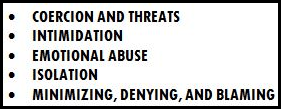
Some such activities reported to this writer have been domestic violence, immigration fraud (selling green cards), drug use, and tax evasion. All someone who’s obtained a restraining order has to say to authorities if their actions are reported is that the allegations were brought by a crank they “had to get a restraining order against.” Case closed.

Restraining orders are perfect tools of cover-up.

Contrary, then, to what the judge quoted in the epigraph concludes, people who blackmail others with threats of filing false allegations can not only make good on their threats with the expectation of impunity; they can conceal other crimes behind the shield of the court.

For blackmailers, it’s a win-win proposition.

Copyright © 2014 RestrainingOrderAbuse.com

A Scratch, a Push, a Pinch: “Domestic Violence,” False Allegations, and Restraining Order Abuse

The subject of this excursion is “domestic violence,” which phrase is placed in quotation marks because it’s a suspect term that’s become so broadly inclusive as to mean virtually anything a user wants it to.

This is how domestic violence is defined by the American Psychiatric Association—and by many states’ statutes, as well:

Domestic violence is control by one partner over another in a dating, marital, or live-in relationship. The means of control include physical, sexual, emotional, and economic abuse, threats, and isolation.

Emphatically noteworthy at the outset of this discussion is that false allegations of domestic violence have the same motive identified by the APA that domestic violence has: “control”; have the same consequences: “psychological and economic entrapment [and] physical isolation”; use the same methods to abuse: “fear of social judgment, threats, and intimidation”; have the same mental health effects on victims: “depression, anxiety, panic attacks, substance abuse, and post-traumatic stress disorder”; and can also “trigger suicide attempts [and] homelessness.”

A domestic violence factsheet published by the National Coalition Against Domestic Violence features a “Power and Control” pie chart. These segments of it are ALSO among the motives and effects of false allegations.

Accordingly, then, making false allegations of domestic violence is domestic violence.

When I was a kid, domestic violence meant something very distinct. It meant serial violence, specifically the habitual bullying or wanton battery by a man of his wife. The phrase represented a chronic behavior, one that gave rise to terms like battered-wife syndrome and to domestic violence and restraining order statutes.

These days, however, domestic violence, which is the predominant grounds for the issuance of civil protection orders, can be a single act, an act whose qualification as “violence” may be highly dubious, and an act not only of a man but of a woman (that can be alleged on a restraining order application merely by ticking a box).

As journalist Cathy Young observed more than 15 years ago, the War on Domestic Violence, which was “[b]orn partly in response to an earlier tendency to treat wife-beating as nothing more than a marital sport,” has caused the suspension of rational standards of discernment and introduced martial law into our courtrooms. “[T]his campaign treats all relationship conflict as a crime. The zero-tolerance mentality of current domestic violence policy means that no offense is too trivial, not only for arrest but for prosecution.” Reduced standards of judicial discrimination inspired by this absolutist mentality further mean that even falsely alleged minor offenses are both credited and treated as urgent and damnable.

Consider this recent account posted to the e-petition Stop False Allegations of Domestic Violence:

My boyfriend accused me of DV after an argument about separating and my 18-month-old…. The officer arrested me in front of my daughter, and when I asked why, he said he had a scratch on his arm.

A scratch.

The woman goes on to report that she spent two days in jail, had to post a $5,000 bond to get out, and that she was subsequently “displaced” from her former life.

Here’s another:

My ex-husband told the police that I pushed him, even though a witness had called the police on him for pushing me. He was completely drunk…but I got arrested instead. Right in front of my stunned family.

And another:

I was accused of domestic violence because I pinched my ex-husband when he pinned me and my son between two trucks. He ruined my life.

A scratch, a push, a pinch—which may not even have been real but whose allegation had real enough consequences.

I’ve also heard from and written about a man who caught his wife texting her lover and tried to take her phone. The two rowed for an hour, wrestling for it. The upshot was that the man was arrested and tried for domestic violence and ended up having to forfeit the home they shared to his wife, into which she had already moved her boyfriend.

(This week, I was contacted by a man trying to vacate an old restraining order whose story is identical: “[T]he only incident was in 2008 when I caught her cheating and tried to grab her phone.”)

False allegations to shift blame for misconduct are common, as are stories like these—stories of lives turned upside down by acts of “violence” that are daily tolerated by little kids—and they’re the motive of my politically incorrect two cents.

I read a feminist bulletin about domestic violence not long ago that featured for its graphic a woman who had very conspicuously been punched in the eye. Her injury was certainly more serious than a scratch or a pinch, but it, too, may have represented a single occurrence and was an injury that would heal within a month or two at the outside.

The gravity with which a single act of assault like this is regarded by the justice system can’t be overstated. The perpetrator is liable to have the book thrown at him.

By contrast, false allegations of domestic violence—or any number of other disreputable offenses—aren’t regarded by the courts or the public with any gravity at all, and their injuries don’t go away.

I work outside with my hands most days—which I wouldn’t be doing if I hadn’t had my own aspirations curtailed by the courts years ago (not based on allegations of domestic violence but on ones sufficiently crippling). I bang, stab, and gash myself routinely. From stress, besides, I’m prone to the occasional ruptured capillary in one of my eyes. I wouldn’t tolerate someone’s hurting a woman—or anyone else—in my presence, but at the same time, if I were offered the chance to recover my name, my peace of mind, and the years I’ve lost by taking a punch in the eye, I’d take the punch. In fact, I’d take many more than one.

I think other targets of false allegations who’ve had their lives wrung dry by them would say the same.

In my 20s, I was run down in the road when I left my vehicle to go to the help of a maimed animal. A 35-year-old guy, driving on a lit street under a full moon, smashed into me hard enough to lift me out of my shoes. The consequences of my injuries are ones I still live with, but a few surgeries and a year later, I was walking without a noticeable limp. I haven’t given the driver another thought since and couldn’t tell you his last name today. I think it started with an M.

Not only do I dispute the idea that physical injuries are worse than injuries done by fraudulent abuse of legal process; I don’t believe most physical injuries even compare.

And I think victims of domestic terrorism, whose torments are ridiculed by false accusers, would acknowledge that the lasting damage of that terrorism is psychic, which further corroborates my point.

Such violation promotes insecurity, distrust, and a state of constant anxiety—exactly as false allegations to authorities and the courts do, which may besides strip from a victim everything s/he has, everything s/he is, and possibly everything that s/he hoped to have and be.

There are no support groups for victims like this—nor shelters, nor relief, nor sympathy. Victims of lies aren’t even recognized as victims.

I’ve written recently about the abuse of restraining orders by fraudulent litigants to punish. What needs observation is that the laws themselves, that is, restraining order and domestic violence statutes, are corrupted by the same motive: to punish. Their motive is not simply to protect (a fact that’s borne out by the prosecution of alleged pinchers).
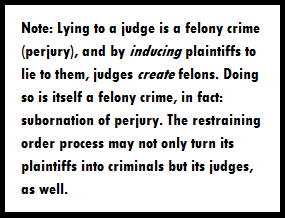
Reforms meant to apply perspective to these statutes and reduce miscarriages of justice from their exploitation have been proposed; they’ve just been vehemently resisted by the feminist establishment.

Laws that were conceived decades ago to redress a serious societal problem have not only been let out at the seams but are easily contorted into tools of domestic violence. This hasn’t been accomplished by fraudulent manipulators of legal process, who merely take advantage of a readily available weapon; it’s rather the product of a dogmatic will to punish exerted by advocates who wouldn’t concede that even real scratches, pushes, or pinches are hardly just grounds for having people forcibly detained, tried, and exiled.

Copyright © 2014 RestrainingOrderAbuse.com

Repeat after Me: RESTRAINING ORDER and FRAUD May Mean the Same Thing

Judge: “Are you afraid of her?”

Man: “No, I….”

Judge: “Are you afraid of her?”

Man: “No, it’s not that. It’s—”

Judge: “I can’t award a restraining order unless you tell me you’re afraid of her. I’m going to ask you one more time: Are you afraid of her?”

Man: “Okay, yes, I’m very afraid of her.”

The above isn’t satire but an exchange between a plaintiff and a judge whose equivalent may be heard any weekday, particularly in Midwestern states like Illinois and Ohio. While this sort of ritual litany might have its place in church, it has no place in a courtroom.

The restraining order process has become a perfunctory routine verging on a skit, a scripted pas de deux between a judge and a complainant. Exposure of the iniquity of this procedural farce hardly requires commentary.

Upon the basis of a manifestly crooked “adjudication of facts” like this one, a defendant will be confronted at his or her home by an officer of the state and presented with a minatory order of the court alleging anything from harassment to stalking to threatening conduct or battery and warning him or her that s/he’ll be subject to arrest and incarceration for violation of that order.

This alone is excruciatingly humiliating and nerve-wracking, and brings a defendant’s life to an abrupt halt. These allegations become all s/he can think about—and this state of emotional anarchy may be one that a defendant is forced to live in for years (while everything around him or her deteriorates). Restraining orders expire but never wither and fall off the books unless vacated. All this horror may be based on allegations that are false and/or coerced.

It’s no wonder that some defendants refer to the restraining order process as “domestic terrorism.”

Once a plaintiff, by contrast, sees how eager the state is to play along, s/he may transform from a child of spite into a monster of menace, and a few impulsive lies may rapidly blossom into a protracted and layered assault.

Alleging a defendant violated an order of the court may be as farcical an exchange as the one sketched above, only this time it will be between the plaintiff and a cop: “Did she?” “Um.” “Did she?” “Er.” “DID SHE?” “YES!” A plaintiff may alternatively bait a defendant into actually violating a restraining order’s proscriptions by conveying the message that s/he had the order canceled, cold-calling him or her, or approaching him or her and provoking a scene.

A few posts ago, I stressed that the restraining order racket wasn’t the product of a conspiracy, and I keep finding myself having to qualify that. Police officers and officers of the court follow an established protocol, possibly knowing goddam well that its basis is a sham. They don’t perceive this as a collusive act, but an outsider’s perceiving it that way is certainly reasonable.

What restraining orders and their policies do is authorize these public servants to act. Though the grounds for action may be arbitrary, those grounds can be represented as sound and just. Policy is clear-cut and easily executed with no risk of repercussions to its agents.

That execution may spell the devastation of a life (or several), but it fills the day and ensures that there’ll be plenty more to do tomorrow.

Copyright © 2013 RestrainingOrderAbuse.com