About Liberalism and Its Deterioration of Civil Rights…and Its Own Credibility

Liberals are curiously less than rapturous about a political victory only they could have accomplished: the election of Donald Trump, a living caricature straight from the pages of a satirical novel, to the country’s highest office. Liberals do count as a victory, and have for a long time, laws that authorize the wholesale removal of citizens from their homes by armed agents of the state based on what may amount to nothing more substantive than finger-pointing.

In this writer’s opinion, they’re the same victory.

Since the advent of the restraining order in the 1970s, and particularly since the enactment of the Violence Against Women Act in 1994—under the auspices of which billions of federal tax dollars have been poured into state courts and police precincts to condition how judges and law enforcement officials respond to complaints of abuse—the priority in the U.S. has been to curtail evidentiary requirements and due process rights to expediently meet political expectations, expectations inspired by liberal feminist politicking.

With typical dramatic irony, liberals today vehemently denounce immigration policies that divide family members who have entered the country illegally, that is, in plain violation of the law. Meanwhile the separation of accused citizens from their families, citizens who have not, in a majority of cases, been proven to have violated any laws, continues to quietly transpire, as it has for decades. Attorney Liz Mandarano posits that “[t]here are between 2 and 3 million temporary restraining orders issued in the United States annually,” and attorney Gregory Hession, a vocal critic of protective order laws, observes that “500,000 children are right now in the custody of the state” (“an astounding number”).

Liberals consider conservatives “dumb” yet fail to perceive that alienation of such a broad swathe of the populace could inspire contempt for their values if not a raw animal loathing for everything they represent. Liberals adduce (and Twitter-reinforce) preposterous and hackneyed theories to explain disenchantment with their positions like resistance to progress and a longing to return to the days of “patriarchy.”

The author of this post has recently examined criticisms by NYU Journalism Prof. Katie Roiphe of #MeToo feminists’ disregard for due process (for which she has been excoriated almost everywhere but in the National Review, which called her criticisms courageously commonsensical). Prof. Roiphe has similarly qualmed about the extrajudicial “rape trials” of male college students. Even she, however, seems to assume that if the merits of “abuse” complaints are decided in a courtroom, then defendants have been afforded due process of law.

The assumption is understandable but ignorant of the legal standards and the practical ones that have come to inform how civil claims of abuse are adjudicated, claims that affect the lives of millions of American citizens every year.

It’s a truism of language that the meanings of words follow usage. Applied poorly, language degrades. Rights are no different, which is something our “educated” class should already know.

On a scale our government disdains to even calculate, citizens are denied both rights and dignity, besides in many cases family, property, and liberty, in the absence of determinate evidence, which is not, in any case, heard by a jury. Liberals, who often “identify” as humanist, say they simply deplore insensitivity.

The only thing more hateful to voters than a hypocrite is a party of hypocrites who support arbitrary attacks on citizens in their own homes.

Copyright © 2018 RestrainingOrderAbuse.com

If Restraining Orders CAN Be Abused, then the PROCESS Is Abusive—and Should Be Repealed

This post addresses a block its writer has noted even in the commentaries of those profoundly injured by unjust or false accusations. That block typically runs something like this: “I’m totally for restraining orders when they protect the violently abused, but….” This perspective is blind, and this post will explain why.

“The road to hell is paved with good intentions.”

—Proverb

“You know, the very powerful and the very stupid have one thing in common: They don’t alter their views to fit the facts; they alter the facts to fit the views. Which can be uncomfortable if you happen to be one of the facts that needs altering.”

Dr. Who

I was accused of a number of unsavory things in the spring of 2006 by a disturbed and very married woman who had hung around outside of my house in the dark for a few months the previous fall. She filed multiple police reports then complained to a judge in my presence that my request for “an explanation of sorts” had caused her grave upset and interfered with her work. (Also, she was concerned she might be “attacked”…and her husband might be…and her friends might be…and her mother might be…and….)

Michael Honeycutt TCEQ, Michael Honeycutt EPA, Michael Honeycutt PhD, TCEQ, EPA Science Advisory Board, Texas Commission on Environmental Quality, Environmental Protection Agency

This man, Dr. Michael Honeycutt, Ph.D., testified to the Superior Court of Arizona in 2013 (by phone) that the government department he heads (in another state) had instituted special security measures to protect a woman from me whom I hadn’t seen or contacted in seven years. When I found this self-styled damsel in distress standing outside of my residence in 2005, I was a practicing children’s humorist who fed birds and had a pup who wore a pink collar. The same woman who would accuse me of stalking and violent intentions had come to my door one night seeking a defender against men she feared were stalking her and had violent intentions. This established a relationship that included her plying me with conversation about her breasts and underwear and trying to follow me into my house after midnight (minus her wedding ring).

That was 12 years ago, and this woman has dramatically and broadly misrepresented me ever since. She’s also induced others to join her in her hoax.

I tried to find you in our system,” I was told in my initial police interview many years ago (when I still had plans and dreams of my own), “but there was nothing. At all. That’s really rare.

Over the four years I’ve maintained this blog, begun five years after my interviews with the cop, I’ve heard repeatedly from others who allege they were falsely accused and who report they had had no prior acquaintance with police precincts or courthouses, either.

Consider how this jibes with the assertion that restraining orders protect victims of violent abusers. It plainly doesn’t, and only “the very powerful and the very stupid” would say otherwise.

Public sentiment has been coerced by “the very powerful and the very stupid” to the extent that even those who know the procedure is a travesty feel compelled to allow that there are cases when restraining orders are necessary.

Changing the minds of “the very powerful and the very stupid” has to start with changing the minds of people who are neither powerful nor stupid, and who know better. There is no justification for bad law. It should be repealed.

What victims of that bad law mean when they say “there are cases when restraining orders are necessary” is that they acknowledge there are people in abusive relationships or imminent danger who need relief. They should appreciate, though, that it isn’t restraining orders that are necessary; something is. Rejecting bad law doesn’t obligate its critic to propose what that something should be. Clearly, however, what that something should be should never have innocent casualties. A law that’s supposed to protect the innocent but may destroy them is both wildly flawed and dangerous.

These are facts: Restraining orders deny defendants their constitutional right to due process; justice rendered in drive-thru procedures that may deprive defendants of employment, security, home, and family can only ever be dubious at best; and being misrepresented in a court of law, scourged by a biased judge, and gibbeted on grounds that may be trumped up or cunningly fraudulent is hurtful and possibly ruinous, and shouldn’t be possible…ever.

If you acknowledge these facts, then you must be against restraining orders, and you must be against them categorically—no ifs, ands, or buts. They’re not the answer. They were a stopgap that has become an institution. That doesn’t mean their engineering was ever sound.

Sure, it may be correct to say that you’re certain not all petitioners lie and that some desperately need protection and deserve it. It’s politically correct to say so, certainly, and it’s sympathetic to say so, too. And, sure, it may be correct to say that sometimes justice does prevail.

But if you own that rulings can be manipulated and that pitfalls are built into the process itself, then you cannot be for restraining orders under any circumstances, because the very same procedure that sometimes assuredly works good also assuredly works evil (and more easily).

Lives are at stake. A process that’s inherently corrupt is inherently wrong, regardless of whether its intentions are good and regardless of whether rulings may be righteous.

Put simply, you can’t make chicken salad out of chicken shit.

Copyright © 2018 RestrainingOrderAbuse.com

How Perjury in Restraining Order Cases Is “Incentivized”

SRU

“Perjury in restraining orders is actually incentivized, not only by failing to prosecute it, but by allowing one-person hearings (ex parte) to get the orders originally, a super-low burden of proof to issue orders, no juries, a judiciary which actually gets training from feminist groups about the need for issuing orders, no rules of evidence to keep out unreliable phony stuff like hearsay, and much else. Given all this pro-perjury bias, it is a miracle when an innocent defendant wins.”

—Massachusetts attorney Greg Hession

Mr. Hession says it more authoritatively on his own blog, MassOutrage.com, but here’s what he means, elaborated point by point.

Laws concerning restraining orders, which originated in the ’70s when women complaining of domestic violence had no voice, authorize the courts to hear plaintiffs privately (ex parte) and to issue orders based on nothing more than claims that are often unsubstantiated and may be impervious to proof (or disproof). An allegation of “fear can suffice, and that’s an allegation anyone can make against anyone else (anywhere), truthfully or not, reasonably or not.

Though the justification for ex parte hearings is anachronistic (women certainly don’t lack a voice today), restraining order laws resist overdue reform. Nobody wants to rock a boat captained by politically powerful advocacy groups. (Restraining orders have besides spawned a booming cottage industry with a financial stake in maintaining the status quo.)

In the interest of economy over observation of civil rights (like due process), hearings to finalize restraining orders are both prejudiced and streamlined: no jury (albeit that consequences for allegedly violating an order are criminal), no appointment of counsel for the defendant, no guarantee of the right to cross-examine (which is fundamental to a fair adversarial system), and the extension to trial judges of broad discretionary powers (for example, to curtail a hearing to 10 minutes).

Many respondents to this blog have reported being told by a judge, “I’ve heard enough.” Some report never being afforded a chance to get a word in (and lest anyone imagine otherwise, many of these complainants are women).

Making matters worse, judges are trained by feminist advocates, who often cite tailored “social science” (that may be funded by the Justice Department), making the idea of an “independent judiciary” more than suspect. Courts, too, are issued grant monies under the Violence Against Women Act (VAWA) and have been for 20 years. Judicial bribery is scandalous, but payouts from Uncle Sam are “in the public interest.”

Hearsay” (secondhand evidence with no reliability: “She told me he said,” for example) isn’t just admissible; it’s explicitly authorized by the law.

This is a formula for a lot of jaded, angry people. And if those jaded, angry people express their outrage by exercising their First Amendment rights, they risk being prosecuted for that, too. (If they do it anonymously, they’re mocked as cowards and discredited as cranks and misogynists.)

This villainy persists unchecked and largely unacknowledged by the “free press” or by “rights advocacy groups.” Even the American Civil Liberties Union (ACLU) is circumspect in its criticism, because it has close ties with the feminist community and has long congratulated itself for its contributions toward realizing “equality.”

A process that is not just manifestly unjust, manifestly corrupt, and manifestly indecent is lauded as an “essential protection,” including sometimes by people who’ve been victimized by it.

That’s how strongly we’ve been conditioned.

Copyright © 2016 RestrainingOrderAbuse.com

*Or blinded.

Law Professor Brooke Coleman Explains Why the Civil Defendant Is Denied Legal Counsel, and Why This Is Unjust


From “Prison Is Prison” by Seattle Law School Prof. Brooke Coleman (Notre Dame Law Review, 2013):

Two indigent men stand before two separate judges. Both will be sent to prison if they lose their cases. One receives appointed counsel, but the other does not. This discrepancy seems terribly unjust, yet the Supreme Court has no problem with it. It recently affirmed in Turner v. Rogers that where an indigent individual is subject to criminal charges that can result in incarceration, he has a right to appointed counsel, but where an indigent individual is subject to civil proceedings where incarceration is a consequence, he does not. In other words, criminal and civil proceedings have different rules, and the right to appointed counsel is no exception. This Article argues that because the consequence of these proceedings is exactly the same, the right to appointed counsel should be the same. Prison is prison. This consequence, and not just doctrinal distinctions, should guide the Court’s analysis in deciding whether an indigent individual receives appointed counsel. By systematically examining the Court’s narratives in both criminal and civil right-to-counsel cases, this Article seeks to determine why the Court continues to treat the same situation so differently. The Court states that it is driven solely by doctrine, but it uses radically different language to discuss the individuals, attorneys, and nature of the proceedings in the criminal versus civil setting. This Article argues that the Court’s different goals in the criminal and civil context better explain the Court’s approach than doctrinal distinctions alone. With criminal cases, its goal is legitimacy, while with civil cases, its primary goal is efficiency.

Copyright © 2015 RestrainingOrderAbuse.com

*Restraining order prosecutions are civil procedures. Arguable synonyms for efficiency are short shrift and railroading (also travesty).

Understanding the Significance of False Accusations in Restraining Order and Related “Trials”

Misperception of the significance of false accusations is a topic that’s been considered in past posts on this blog, particularly false accusations of sexual assault, which are the only false accusations anyone seems to believe are deserving of mention.

It’s wrong to say that the nature of false accusations doesn’t matter. But more relevant to observing corruption than a consideration of what is alleged is a consideration of how it’s alleged and decided.

Imagine if special courts were convened to judge accused people of a certain type, and imagine if the normal standards of evidence applied to allegations that may impute criminal wrongdoing to them were suspended. Imagine if instead of having to prove they had done what they were accused of, it were enough for a single judge (absent a jury) to “determine” upon a few minutes’ deliberation that the allegations were probably true and sufficiently urgent to merit the court’s intrusion.

These are among recent search terms that brought readers to this site.

If the accused people of a certain type were Jews or African-Americans, for instance, we would denounce these special courts to be an abomination. This kind of discrimination would raise our hackles.

Yet such special courts exist. Restraining order allegations are decided exactly this way, as may be allegations of domestic violence or rape, allegations that can also be made on restraining order petitions. There is nothing that can’t be alleged on a restraining order petition. Yet nothing alleged must be verified.

Now the critic of complaints about the harm of false allegations will chime in at this point and say, yeah, but it’s not like the victim of false accusations decided in a kangaroo court will be served a felony conviction.

Yes…and no. The critic should ask him- or herself what kind of person would maliciously or self-servingly lie about stalking, sexual violation, or violence and then ask him- or herself whether it’s reasonable not to expect more and worse from such a person.

Subsequent false allegations can give people criminal records (possibly, again, without a jury’s ever having vetted the evidence). They can give people criminal records because of the prior lie. A person can find him- or herself deprived of everything, including liberty, based on a tissue of frauds.

My ex-husband used to batter me and then go crawling on his hands and knees through the neighborhood until he reached the hospital or police station, and he would claim I had attacked him. I’d be hysterical, and police would arrest me. This happened repeatedly. […] I was made homeless on multiple occasions. He would involve my family, his family, all of our friends, employers, and university professors, and I was always the bad guy and still am. […] They filed restraining orders against me and claimed I was a danger to everyone; kidnapped my son, my dogs; stole my car at one point; drained bank accounts, PayPal accounts; and sawed locks of my storage unit and took off with everything…and EVERY F[—]ING TIME, police just validated the abuse and continued to terrorize me.

To complicate matters, a ruling on a false accusation can criminalize lawful behavior. So a subsequent allegation against someone can be true, but the alleged behavior that lands him or her in jail might only have been unlawful because of the original false accusation.

She filed a PFA [protection from abuse order] against me in April of 2014. Several months later, I was charged [by the district attorney on two counts of] violating the PFA. (1) My wife read my private password-protected Facebook emails. I asked a friend to contact her ex-husband #2 and tell him what was going on between her and me (he lives in Mexico and was listed on the PFA as one of the people I could not contact). The friend I emailed didn’t contact her ex-husband. In fact, nobody contacted her ex-husband. (2) I drafted a letter to my wife and gave it to my lawyer. My lawyer in turn forwarded it to her lawyer. They claimed this was also a PFA violation. We went to court, and the judge agreed on both counts and sent me to jail for 30 days. [This commenter’s wife was a Mexican national whom he met in March 2013 (Match.com) and married a month later. The PFA was filed after he “got her and her children their immigration papers” and later told her he wanted to divorce her because the marriage was unsatisfactory.]

Appreciate that one false record can be invoked until the end of time. The superficial critic thinks that once a trial is concluded and the framed victim survives his or her licks, the matter is concluded.

Not so. Ignoring the psychological residue for the moment, if the victim of a false accusation is falsely accused a second time, it can now be alleged that s/he has a “history” or “pattern” of abusive behavior, which may influence a divorce or child custody proceeding, a lawsuit, or even a criminal prosecution.

Respondent [—] and Father have a history of domestic violence that includes, but may not be limited to, the issuance of temporary restraining orders in cases […] and the issuance of a permanent restraining order in case […] which was entered by default on January 16, 2015, placing the welfare of the Child at risk. [The “Father” in this case was married to his wife for a brief period before she left and then filed a number of allegations of violence, both with the police and the court, over the ensuing six months. She then committed suicide after being institutionalized. She gave birth to a daughter a couple of months prior whom she had told the father she had miscarried. The father was never heard by a court in his defense but has nevertheless been represented as a serial abuser by the district prosecutor, who has sought to deny him any role in his child’s life.]

Lies that stick…cling, and they can be recycled. Public records don’t expire, and court rulings that impute grave misdeeds, even if those rulings were formed in mere minutes, aren’t questioned. They’re as valid as any other ruling.

Lies that stick, moreover, are entered into public (police) databases, registries that throw up red flags…indefinitely. The person falsely accused of domestic violence, for instance, may be permanently barred from certain types of employment and even, say, from attending his or her daughter’s dance recitals at school.

Defendant was refused jobs, [is] not allowed to attend [or] volunteer [at] her daughter’s school events, [and has had] numerous other rights taken away due to Plaintiff’s Abuse of Process and Fraudulent Allegations and written Affidavit to the Court. This continues today. [This is an excerpt from the draft of a commenter’s “Motion to Expunge,” which she was preparing herself with no legal know-how.]

Again, privations endure permanently, for always, ad infinitum.

The liberal critic who declaims s/he’s for immigrant rights and for restraining orders should be aware that a non-citizen who’s falsely accused in a restraining order proceeding and then accused of violating an order obtained by fraud can be summarily booted from the country: Adios, muchachito (we don’t like your kind here).

Based on lies, people are deprived of their good names, their dignity, their children, their homes, their property, their livelihoods, and their security.

Finally, being lied about and then scorned by cops and lambasted by judges—these traumas last, and they last no less indefinitely than false records do. So on top of everything else, people may be driven out of their minds.

Copyright © 2015 RestrainingOrderAbuse.com

*Public records, besides being permanent, are also public records, and a lie that a judge legitimates is a lie that everyone else will regard as true (e.g., a neighbor, a boy- or girlfriend, a student, a patient, a client, an employer, a loan officer, a landlord….).

What Is “the Court,” and Who’s REALLY Looking Out for Its Honor?

Yes, sites like this one criticize judges. Judges aren’t the Court.

Yes, sites like this one criticize laws and procedures. Laws and procedures aren’t the Court.

Sites like this one criticize lawyers and law professors and writers and accusers and feminists (whose rhetoric emboldens false testimony). Lawyers, professors, writers, accusers, and feminists—they, also, are not the Court.

What is “the Court”? It’s an idea, and inclusive in that idea are principles like truth, justice, and the American way. More minutely, the idea entails fairness (equity) and observation of civil rights, like those to due process and freedom of speech. The idea is pretty straightforward: adversaries at law state their cases truthfully to a judge who impartially and honestly negotiates the facts with great deliberation and arrives at a just determination.

According to this idea, lies are censured (as “sturdy blows to the root of justice”), abuse isn’t tolerated, and never are people stripped of their dignity, family, property, and livelihood on a whim. “The Court” is a bulwark against moral anomie, and it’s never arbitrary or capricious in its decisions.

“The Court” isn’t real (it doesn’t exist); it’s an ideal. It’s something to be striven after.

Sites like this one don’t criticize the Court. They defend it.

Copyright © 2015 RestrainingOrderAbuse.com

*One of the most vigorous and vehement denouncers of corruption this writer knows, the author of BuncyBlawg.com, began his professional life as an earnest young attorney. He meant to do good. His faith in “the Court” was betrayed by reality. As if he needed a further reminder of why he abandoned his vocation decades ago, he has for the last several years been relentlessly hectored by procedural abuses (during a phase of his life when he should be savoring every moment).

Restraining Orders Don’t Empower Anyone but Police Officers, Prosecutors, and Judges; “Victims” Are Relieved of Their Rights, Also

“I don’t know of any other provision in law in which people go to court and take out a civil action with the goal of handing over some of their power to a judge. When you get a restraining order, you relinquish your power to unilaterally consent to being contacted by the restrained party. As the ‘Notice to Restrained Person’ that the court gave me says, ‘If you violate this Order thinking that the Protected Person or anyone else has given you permission, you are wrong, and can be arrested and prosecuted. The terms of this Order cannot be changed by agreement of the parties. Only the court can change the order.’ The ‘Notice to Protected Person’ says ‘You cannot give the Restrained Person permission to change or ignore this Order in any way. Only the Court can change this Order.’”

—Blog respondent (July 2, 2015)

There’s an unexamined assumption that restraining orders “empower” those to whom they’re granted. Ask a feminist, and there’s a good chance this is exactly what she’ll say restraining orders do.

They don’t.

Restraining orders don’t empower anyone but police officers, judges, and prosecutors; they only take rights away. They prohibit normal, lawful conduct under penalty of punishment.

Those on the receiving end of an order are perceived to be the ones who are deprived of rights. But so, too, are those to whom orders are granted denied freedoms. Restraining order petitioners concede their power of choice, often unknowingly. Some petitioners of orders assume the value of an order is to give them the power of consent so they can choose or decline to associate with the defendant on the order according to their preference.

Petitioners have no discretionary rights. They forfeit their freedom of choice when they file allegations, and they do it voluntarily.

It isn’t “If I say yes, it’s yes; if I say no, it’s no.” It’s just no. A restraining order doesn’t bestow any entitlements; it erects a barrier.

An order of the court is an order, and that order can only be modified or revoked by the court. Observance of its prohibitions is never optional. Plaintiffs surrendered their say when they invited the state to play parent.

Returning to our imagined (straw) feminist, she might remark that restraining order plaintiffs don’t want anything to do with the people they petitioned orders against, so they haven’t been denied anything they cared about. But real life is seldom as black-and-white as a feminist’s imagination.

Some plaintiffs say they felt they were coerced into getting restraining orders and express resentment when they discover the consequences; others say they were ignorant of the import of orders. Some of the latter report that they renewed relations with the people they petitioned orders against and even moved in with them or had a child with them, assuming consent was theirs to give.

They desperately want to know what they can do when the people they petitioned orders against and then invited back into their lives are arrested and face jail time for contempt of court.

Similarly, domestic partners want to know how to communicate with the spouse or boy- or girlfriend they obtained an order against. They’re at a loss for how to deal with daily exigencies like home repairs and bills. They thought getting a court injunction was a measure to pacify conflict, not a complete severance of relations. They didn’t realize they were signing over their autonomy to the state.

Predictably, a significant proportion of petitioners (reportedly as many as half) subsequently return to court to request that orders be withdrawn. A judge may agree, or s/he may not, according to his or her legislated prerogative. Some petitioners know to ask; some don’t know moving the court to dismiss an order is an option and instead act in violation of a judicial ruling that only exists because they requested it in the first place.

In “Protecting Victims from Themselves, but not Necessarily from Abusers: Issuing a No-Contact Order over the Objection of the Victim-Spouse” (2010), attorney Robert F. Friedman considers the constitutional right to autonomy that the advent of restraining orders has legislated away.

It gets worse.

Orders may also be issued by judges on their own initiative (sua sponte) if someone in a household reports a domestic altercation. They can even be issued if a third party (like a bystander or a neighbor) reports what s/he thinks is an altercation.

It’s not about who “presses charges.” That’s a misconception derived from TV. The state “presses charges.” The apparent “victim” has nothing to do with it. S/he can refuse to cooperate. S/he can even protest…and it doesn’t matter.

An order that’s imposed by the court, called a criminal or mandatory order, isn’t electively petitioned, so the person who’s named “the victim” can’t just go to a judge later on and ask that the order be canceled. Typically only the district prosecutor’s office can do this, and it has no compelling reason to.

Once the state is invited to be the arbiter of conflict, the rights of the parties involved become its to dictate. The only one “empowered” is Uncle Sam.

Copyright © 2015 RestrainingOrderAbuse.com

It All Starts with the “Rape Question”: Before Society Can Be Expected to Redress the Harms of False Accusation, It Must First Be Led to Acknowledge That False Accusation Destroys

“Having demonstrated that the percentage of false sexual assault reports is not as high as many people think, this does not deny their terrible reality. We all know that false reports do really exist, and they are incredibly damaging both to criminal justice personnel and to the countless victims of sexual assault whose credibility they undermine.”

Dr. Kimberly A. Lonsway, et al. (2009)

Everyone “thinks” that male invocations and criticisms of false rape claims are really the misogynist yowls of the disentitled patriarchy…or something like that. They aren’t. Rape is the tinderbox issue. If complainants of false accusation and unjust demonization, who are typically men, seem to focus on false rape claims, it’s because that’s where everyone else’s focus is directed.

Rape overrules all other concerns and trivializes them.

Read the epigraph by Dr. Lonsway again and ask yourself what’s missing from her brief catalog of “incredibly damaging” consequences of false rape reports.

Her statement owns that “false reports [of rape] do really exist.” It also owns that they’re “incredibly damaging.” But it completely discounts the damage to the people falsely accused by those reports.

They’re not even mentioned as victims; they don’t count at all.

If victims of false rape claims aren’t acknowledged to be victims of anything, then how can victims of false accusations of other sorts expect to be afforded a sympathetic ear? Societal regard has been coerced to the extent that acknowledgment of false accusation (any act of false accusation) is equated with rape denial. To own false accusation is a significant problem is to commit an act of moral treason.

What those who haven’t been abused by process will never appreciate, so long as false accusation is dismissed as inconsequential, is that any foothold a false accuser can obtain can spell the end of someone’s life as s/he knew it.

People can be hounded to the end of time, particularly through civil procedures (like restraining orders), which generate records that gnaw, humiliate, and limit life options, and that open the door (gapingly wide) for further false accusations. The falsely accused can lose everything. They can find themselves felons and exiles, homeless and jobless, and possibly suicidal or homicidal…based on nothing real or true: a layered sandwich of lies.

What’s more, the dismissal of false accusation as an urgent societal concern is contagious. It influences judicial policy and practice; it influences the law. Thus is the problem compounded: False accusation is encouraged, because it’s effective. There are no risks, so there’s no downside.

Denial of the problem worsens it.

Our civil rights advocates vociferously decry violations of women’s rights, children’s rights, minority rights, gay and lesbian (GLBTQ) rights, animal rights, and on and on, and there aren’t any of these rights that aren’t violated by false accusers. None. Children are scarred (voicelessly); women are stigmatized and stripped of all resource; minorities, who may have the least access to legal representation, are railroaded or sidelined; gays and lesbians are handily represented as “creepy queers”; and pets are abandoned (possibly to be killed).

They might as well be living in 1956…and that’s significantly because of the “rape question.”

Look, how widespread false accusations of rape are is irrelevant. It’s irrelevant. What’s relevant is that they hurt and they kill, as do false accusations of all varieties. Rape also hurts and kills…but only also. What hurts and kills must be censured categorically, not selectively.

Dogma must be rebuked. Those who haven’t been falsely accused have no place at the table. They’re due to listen for a change.

The reason so many energies are concentrated on the “rape question” is that until the harm of being falsely accused of society’s “worst” crime is acknowledged, there can be no expectation that the harm of being falsely accused of any other will even register.

Copyright © 2015 RestrainingOrderAbuse.com

*Rape has been used to chasten society’s conscience, which means anti-rape advocates have determined society’s conscience. Their priorities have become “our” priorities and to gainsay them is to be ridiculed and vilified. A reason news stories of false rape claims are bruited by those denounced as “MRAs” (men’s rights activists) is because they often reveal deeply warped motives and methods, and these deeply warped motives and methods aren’t exclusive to false rape claimants.

In Its Condemnation of the Men’s and Fathers’ Rights Movements, the Southern Poverty Law Center Has Institutionalized Bigotry and Hate (Including Racial Bigotry and Hate)—Here’s How

There are prominent voices on the Internet, in the ivory tower, and in the press that disparage the plaints of fathers who are alienated from their children by lies and legal abuse, and denied roles in their kids’ lives. They call these fathers’ ventilations of despair and anger “misogynist,” and they look no further.

This post criticizes one such voice, possibly the loudest among them.

The Southern Poverty Law Center equates complainants of legal abuse—male ones, that is—with racists, and it’s taken seriously. It commands social prestige based on its illustrious history of combatting racial hate and violence.

I hope the outraged title of this piece reaches its attention, because the story below exemplifies a modern manifestation of racial bigotry and violence, and it’s one the Southern Poverty Law Center scoffs at and ridicules.

It’s one the Southern Poverty Law Center vociferously fortifies.

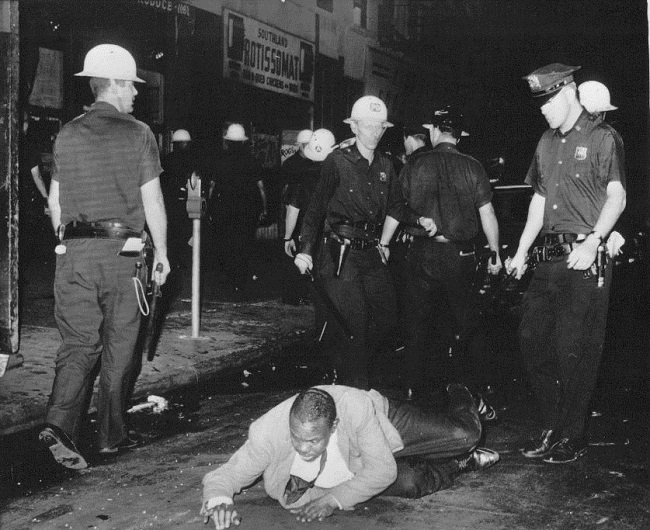
The following account, which echoes others and which includes a casual assault of a black man by police based on false allegations by his white wife, was submitted to this blog on April 27, 2015, by a father of two young children who is not a violent man; he just misses his kids and is in perdition. (What this man will be five years from now—or whether he will be five years from now—is another question all together. A man may be taunted like a dog chained to a post. Then when he snaps, there are those content to judge him mad and urge that he be put down.)

Advocacy groups like the Southern Poverty Law Center presume to blame without listening to the details. This is what the details sound like (trigger alert: real life):

Hello. Anyone out there who can help a man who is at the saddest hour of his life? For I feel life is not even worth living at this point due to the evil and malicious acts of my wife.

We had been talking about a divorce for the last year and a half as we have been married for four years and been together since we were 22—for 16 long years. We have a two-year-old and seven-month-old, both baby boys. My wife has rage issues and extreme hormone issues…and she’s clearly depressed, and I cannot help her anymore.

When our marriage became a sexless one, we agreed we were just roommates taking care of the children until we started our divorce. My wife was contacted by a jealous woman who wanted to destroy my life because I would not leave my wife to be with her. She told my wife all sorts of lies. The next day, my wife filed for divorce but also filed a fake restraining order to ensure I burn in hell, and it’s working.

My wife didn’t come home with the kids on Friday evening after picking them up from daycare. No calls, no answer, nothing. I called daycare, and I was advised that my wife picked the kids up with her mother around 4 p.m. We live in L.A., and her mother lives in Ohio, so I was like, “Her mother? I didn’t know she was in town.” It’s now about 11:30 p.m., so I call the hotel her mother usually stays at around the corner on Sunset Blvd. My wife answers and says, “My mother came in town to help us. She’s concerned about us.”

I told her to bring the kids home because she didn’t pack any Pampers or a change of clothes for them. She said, “I’ll be home in the morning.” The next day, they still were missing. I left to run errands, and my wife called about 6 p.m. saying she was back home. When I got back home, the locks to my front door were changed. I banged on the door demanding to be let into my own house and see my boys. Her mother, who was visiting, said, “Go away. She doesn’t want you here.”

I called the cops and went downstairs to wait.

When they arrived, a cop instantly started attacking me and beating me. I screamed, “I called you to help me get in my house!” He was rude, beat me and cuffed me, then put me in the back of a patrol car. I was in there for about 20 minutes.

Finally, I was let go—un-cuffed, bleeding, stepping out of the police car—and her mother is outside the police car and says you’ve been served, and hands me a packet of paperwork. I thought WTF? a divorce, cool, no problem, but it was a restraining order claiming I had done physical violence to my wife for years and years. I never ever breathed too hard on my wife, so how could she make such claims? I lost my breath for a few seconds in disbelief.

I had to leave my house as was, no money, in flip-flops and shorts, no credit cards, no suits for work, no children, no food, nothing. I was threatened with jail if I even tried to call her or stopped at my boys’ daycare. My hearing wasn’t for another 25 days.

I thought, what can I do? This is hell being homeless, but most of all I am the full-time dad and mom to our boys. I do all the cooking, cleaning, dishes, shopping, putting to bed, baths, everything. My wife has given the boys a bath maybe three times in their entire lives. She wakes up at 6 a.m. and leaves out the door while I wake up and bath the children, change Pampers, fix breakfast, dress them, dress myself in a three-piece suit , take them to daycare, and then work 11 hours at the office. My wife picks them up at 6 p.m. from daycare, then I’m home at 7 to fix dinner, put the children to bed, clean, and finally sit down about 11 when my day is complete.

I survived the 25 days of being homeless, living in hotels and racking up around $12,000 in debt, including the cost of an attorney for the hearing. The hearing was going great, my wife getting caught up in lies, backtracking, bringing up events where I might have pushed her on the bed in 2012 or dropped a cup that she stepped on in 2013…or told her I’m going to kill her every day. Yeah, right! No proof, no police reports, no police calls, no telling a friend, no nothing, just her words against my words and phone records.

I thought about all the women getting punched in the head, slapped in the mouth, and living in total fear of their husbands and how it must really suck to live like that. Then I stared at my wife on the stand lying about getting pushed on the bed years ago and saying that she was afraid for her life but still having stayed in the house every night and eaten my cooking and commanded me to be her slave.

The judge still sided with her and issued a permanent restraining order allowing me 18% visitation rights to my kids, my flesh and blood. My boys were dying to see Daddy. It’s been a month. She’s getting child support, too. I have 18% visitation, and I can’t even call my wife. I got a move-out order, but my wife and her mom made moving out hell and even called the cops because they thought I was taking some money secretly stashed in the house. I didn’t even collect my things before I was blocked in the driveway by my wife and her angry mother.

I am a black man, and my wife is white. It doesn’t go well for black men in my position.

[…]

I just had a chance to see my boys this last weekend on Saturday and Sunday from 6 a.m. to 9 p.m. I cried like the world had given me the moon when my two-year-old held onto my neck for 10 minutes and said, “I miss you so much, Dada.”

I now feel so much anger and helplessness. It was heart-wrenching that a woman could be this evil to take the boys away from a man like me. All the deadbeat dads, and my kids are my only focus in life. I’m a CPA for a corporation. My wife lied, lie after lie after lie on the stand, and then even cried after lying that she was not a professionally trained actress three times until my attorney asked, “Are you a paying member of the SAG organization [Screen Actors Guild]?” Then she finally said, “Why, yes, I am, ha-ha.”

It’s killing me not to have any rights. I feel like my world has been turned upside down without my boys with me every day. I’m struggling, still living in hotels, blowing money left and right just to sleep. My car is full of clothes, and legal costs are mounting. I feel like jumping off a bridge as this woman’s evil portrayals of me are irreversible.

Now what do I do? I can’t take it. I’m going to lose my mind and snap.

I’d rather she put a gun to my head and pull the trigger than put me through lies and manipulation of the court and hurt my boys, who go insane when I have to drop them back to their mother. It’s most disconcerting to listen to a 65-year-old white judge tell me that I have 18% of my flesh and blood over he-said-she-said and not one ounce of proof at all. The judge was Judge B. Scott Silverman, Los Angeles Superior Court. Please help me, God. Please Please Please.

Thank you for reading.

The Man Who’s Dying Slowly

Contrast the impassioned story above with this antiseptic one: “Claims and activities associated with the men’s rights movement have been criticized by scholars, the Southern Poverty Law Center, and commentators. Some sectors of the movement have been described as misogynist” (Wikipedia).

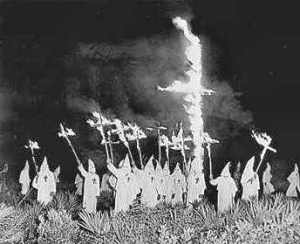
The Southern Poverty Law Center doesn’t lynch people; its advocacy inspires a social and legal atmosphere of intolerance and civil rights violations that urges people to lynch themselves. The difference is instead of bedsheets’ being worn by a mob, they’re knotted into nooses by lonely, isolated individuals forlorn of hope.

The result is the same.

Copyright © 2015 RestrainingOrderAbuse.com

*As of this writing, the top tier members of the senior program staff of the Southern Poverty Law Center are eight affluent whites/Jews (most of them female) and one black woman, Lecia Brooks. Ms. Brooks is the “outreach director,” i.e., the group’s public face.

Criminalizing Criticism: Restraining Orders, the First Amendment, and Chan v. Ellis

This search term brought a visitor here a day or two ago: “restraining order in ohio because a couple texts.”

It struck a chord with this author, because he himself was issued a restraining order on a similar basis (three emails over a weekend). There were accompanying allegations, but the court’s final ruling was based exclusively on the emails (i.e., speech). They weren’t even judged threatening, just unwanted (the contents, in fact, weren’t read by the court).

Some people are issued restraining orders on even more tenuous bases, like criticizing their plaintiffs on Facebook or in a blog or other online medium. If you’re such a person, you should be aware of a case before the Georgia Supreme Court that’s been the subject of a prior post on this blog: Chan v. Ellis.

The court was scheduled to hear opening arguments on October 7.

A summary of the case by UCLA Law Professor Eugene Volokh, along with his legal commentary in support of the appellant, Matthew Chan, is here.

The First Amendment protects the right to speak about people, so long as the speech does not fall into an established First Amendment exception (such as those for defamation or for true threats). This includes the right to speak about private figures, especially when they do something that others see—rightly or wrongly—as unethical.

Restraining orders and criminal stalking law may properly restrict unwanted speech to a person. But they may not restrict unwanted speech about a person, again unless the speech falls within a First Amendment exception. The trial court’s order thus violates the First Amendment.

If you’ve been issued an injunction from the court based exclusively on your speaking publicly about its plaintiff (and you didn’t threaten or lie about him or her), a verdict in favor of Mr. Chan could conceivably provide you with grounds for an appeal. FYI.

See Mr. Chan’s website, ExtortionLetterInfo.com, for trial updates. A ruling, he reports, should be returned between mid-January and mid-March.

The case stands to highlight judicial abuse of discretion and power and is one anybody who’s been put through the restraining order wringer will want to track.

Copyright © 2014 RestrainingOrderAbuse.com

*Update: The Georgia Supreme Court returned a verdict in favor of Matthew Chan on March 27, 2015.

Facts and Fairness: Using Arizona’s Policies to Expose Restraining Order Iniquity

I live in Arizona where I was issued a restraining order in 2006 petitioned by a woman I nightly encountered hanging around outside of my house. The restraining order said I was a danger to her husband and shouldn’t be permitted to approach or talk to him.

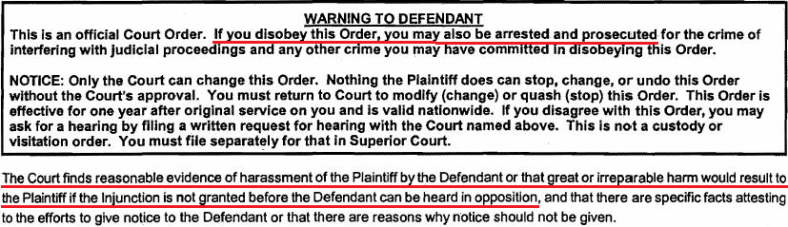
If you receive a restraining order in my home state, here’s the first thing that greets your eye:

On the basis of the form this warning captions—which looks like it was drafted by someone using a pizza crust as a straightedge—citizens are recorded in state and national police databases as stalkers and violent abusers.

Consider that the immediate impression this warning is meant to give is beware. It naturally excites fear—and if you’ve been falsely accused, a host of other emotions, besides, none of which conduces to calm and lucid thinking.

Something you wouldn’t guess from this “Warning to Defendant” is that if a defendant “disagrees” with an order issued in Arizona, s/he has the statutory right to apply for an appeals hearing at any time during the order’s effectiveness. For example, if the duration of the order is one calendar year, the defendant can take 11 months to assemble his or her appeal and save up, if necessary, to have an attorney represent that appeal.

Here’s the law:

At any time during the period during which the injunction is in effect, the defendant is entitled to one hearing on written request. No fee may be charged for requesting a hearing. A hearing that is requested by a defendant shall be held within ten days from the date requested unless the court finds compelling reasons to continue the hearing. The hearing shall be held at the earliest possible time. An ex parte injunction that is issued under this section shall state on its face that the defendant is entitled to a hearing on written request and shall include the name and address of the judicial office where the request may be filed. After the hearing, the court may modify, quash or continue the injunction.

The statute says the court’s order must inform the defendant that s/he’s entitled to a hearing, but it doesn’t require that the order inform the defendant that s/he has a year (or possibly years) in which to prep and apply for that hearing, that the hearing is free, or that the defendant may be represented by an attorney.

Restraining orders are rhetorical psych-outs. Their language is overtly menacing, and neither the law nor the issuing courthouse gives any consideration to apprising defendants of their rights.

The stress is on apprising defendants, who are presumed to suck (sight unseen), of what rights they’re no longer deemed worthy of.

Appreciate that the court’s basis for issuing the document capped with the “Warning” pictured above is nothing more than some allegations from the order’s plaintiff, allegations scrawled on a form and typically made orally to a judge in four or five minutes.

In the courthouse where the order issued against me was obtained, restraining order petitioners file into a room like a small bus station terminal, submit their applications, wait for an audience with a judge, chat with him or her for a few minutes, and leave.

That’s it.

Consequences of receiving an order of the court whose merits are determined on this basis include registration in state and national law enforcement databases, and may also include loss of entitlement to home, children, and possessions, and loss of employment.

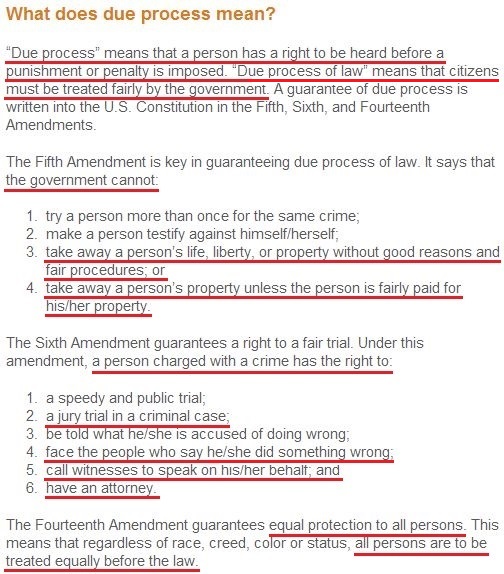
In contravention of due process, orders are issued against defendants that may deny them liberties and property without the court’s hearing from them at all.

Ever.

In Arizona, unless a defendant requests a hearing before a judge, that’s an end on the process. No judge will even have learned what s/he looks like, and the truth of the plaintiff’s claims will never have been controverted—claims, to reiterate, that were made in a few minutes and could include anything from annoyance to physical or sexual violence.

Such claims often amount to nothing more certain than finger-pointing.

(Docket time afforded by the court to the testimony of defendants who go to the trouble of appealing rulings based on such claims, incidentally, is about 15 minutes. The cost of attorney representation at an appeals hearing may be $2,000 to $5,000.)

The only provision the law or the court makes for discouraging false testimony (some motives for which are here) is this one, which predictably appears at the very end of the application form:

The plaintiff signs below.

Applicants aren’t of course told what “perjury” is, and they’re certainly not told it’s a felony crime that carries a prison term (as it is and does in Arizona and many other states). Lying to the court is never sanctioned or prosecuted, anyway.

Recent posts on this blog were answers to dismissal by a doctor of laws of criticisms that the restraining order process is unfair. The process would have to be far more deliberative than it is, in fact, to be merely “unfair.”

The process is automated.

Copyright © 2014 RestrainingOrderAbuse.com

Battering Women to Protect Battered Women: Using Massachusetts’s Policies to Examine Restraining Order Publicity and Its Damages

“In the event a Restraining Order is issued for any period of time (initial 10 days or subsequent extension/dismissal), you will be listed in the statewide Domestic Violence Registry system. This could impact your ability to obtain or maintain employment in government, law enforcement, certain medical fields, or social services, or to work with/coach children. Impoundment of the restraining order does not expunge your listing on the statewide domestic violence registry, as certain government agencies and private companies with significant government contracts still have access to the registry system.”

—“Massachusetts Restraining Orders Procedure and Ramifications

I’ve just been corresponding with a Florida woman named Ally who had a domestic violence (209A) protection order petitioned against her in Massachusetts alleging she was a danger to a former boyfriend (these kinds of instruments can be obtained by plaintiffs who don’t even live in the same state or country as their defendants).

Ally contends the allegations against her are false and has been living in hell for over a year.

She’s surviving day to day and can’t afford to procure the services of an attorney. Ally’s trying to defend herself and clear her name with no money and from another time zone. She’s preparing a motion on her own (very possibly ill-fated) to request that the order against her be expunged, because it has ruined her employability.

Note: As the epigraph explains, even were Ally to succeed in having the order simply dismissed (which is itself unlikely), she would still remain registered as a domestic abuser.

From a draft of Ally’s “Motion to Expunge”:

Defendant was refused jobs, [is] not allowed to attend [or] volunteer [at] her daughter’s school events, [and has had] numerous other rights taken away due to Plaintiff’s Abuse of Process and Fraudulent Allegations and written Affidavit to the Court. This continues today.

Note: To successfully combat prosecutions like this requires money…which prosecutions like this prevent their defendants from earning.

A recent post on this blog observed the court’s schizophrenic regard toward restraining orders. On the one hand, they’re viewed by judges as urgent, potentially life-or-death matters; on the other hand, they’re viewed as inconsequential as long as defendants mind their prohibitions for the prescribed period of time.

Ignored is that adjudications both initiated and finalized in minutes yield rulings that are entered into state and national law enforcement databases indefinitely. Orders become “inactive” once they expire, but they don’t disappear. A woman like Ally remains for the rest of her life marked as a perpetrator of domestic violence.

In contrast—and the contrast is a telling one—consider this excerpt from a “Memoradum” issued by the Massachusetts Supreme Court last year on “Internet Dissemination of Personal Protection Order Information.”

As transparency and improved access remain court goals, it is important that we not unknowingly or unintentionally release victims’ personally identifiable information through the Internet, recognizing that this information is easily accessed and that access to such information could be dangerous to victims. Additionally, it has been brought to our attention that current federal law prohibits providing information over the Internet about personal protection orders (PPOs) that would be likely to reveal the identity or location of the petitioner (“PPO Information”).

18 USC 2265(d)(3) states:

A State, Indian tribe, or territory shall not make available publicly on the Internet any information regarding the registration, filing of a petition for, or issuance of a protection order, restraining order, or injunction in either the issuing or enforcing State, tribal or territorial jurisdiction, if such publication would be likely to publicly reveal the identity or location of the party protected under such order. A State, Indian tribe, or territory may share court-generated and law enforcement-generated information contained in secure, governmental registries for protection order enforcement purposes.

The privacy of restraining order plaintiffs (who are nominated “victims”) is to be tightly guarded.

Note: Based on “determinations” formed in minutes and possibly based on nothing more substantial than accusation, a plaintiff is deemed a “victim” whose identity and privacy must be protected, and the defendant is deemed a “violent threat” whose privacy is accordingly due no consideration. After the term of the restraining order has flown, the “danger” to the accuser is assumed to have been resolved, but the accuser continues to enjoy anonymity while the accused must go on bearing the implications of the restraining order for the rest of his or her life, exactly as if those implications were a criminal sentence.

Only in the recent past, in fact, did it even become possible to remove a Massachusetts restraining order defendant’s name from the domestic violence registry if it were found that allegations against him or her were substantially or totally false. (Remember that such allegations are made ex parte in the time it takes to place an order at McDonald’s.)

Until recently, it was almost impossible to expunge a person’s record with the domestic violence registry once the initial entry was made. In the 2006 case of Commissioner of Probation v. Adams, it was recognized that a judge has the inherent authority to expunge a record of an abuse [from the] violence registry system in the rare and limited circumstance that the judge finds the order was obtained through fraud on the court.

Note: The phrase rare…circumstance (of fraud) is emphasized in the original document quoted above (“Massachusetts Restraining Orders Procedure and Ramifications”), which was authored by an all-female law firm (Mavrides Law of Boston). Allegations of rampant restraining order misuse in Massachusetts have actually been the subject of press coverage and at least one law review monograph, and one of the most outspoken critics of restraining orders, attorney Gregory Hession, practices in Massachusetts and has for many years reported that restraining orders are “out of control.”

The previous two posts on this blog were responses to allegations that those who criticize restraining orders and domestic violence laws are “opposed to the battered women’s movement.” Defenders of these laws are urged to ask themselves how Ally’s wanting to be able to provide for her daughter and one day attend her daughter’s graduation has anything to do with battered women at all.

They’re also urged to ask themselves how denying Ally these opportunities isn’t itself an act of brutality.

Copyright © 2014 RestrainingOrderAbuse.com

Responding to a Feminist Professor Kelly Behre’s Perspectives on Men’s Rights Activism

Since the publication of this post, the “research paper” it responds to has been removed from the Internet.


“I had a false allegation of domestic violence ordered against me on June 19, 2006. It was based on lies, but the local sheriff’s office and state attorney’s office didn’t care that he was a covert, lying narcissist. I doubt they ever heard of the term, in fact. I made the mistake of moving back in with him in September 2008.

“Last year, on July 23, 2013, he, with the help of his conniving sister, literally abandoned me. Left me without transportation and tried to have the electricity cut off. However, the electric company told him it was unlawful to do so. I am disabled, because of him, and have been fighting to get my life, reputation, and sanity restored. It has been over a year, and while life goes on for him, I am still struggling from deep scars of betrayal, lies, and his continued smear campaign against me.

“I thank you for the opportunity to speak out and stand with other true victims of abuse. You see, it isn’t just women who abuse the system, but men, as well.”

—Female e-petition respondent (August 30, 2014)

Contrast this woman’s story with this excerpt from a UC Davis Law Prof. Kelly Behre’s 2014 research paper:

At first glance, the modern fathers’ rights movement and law reform efforts appear progressive, as do the names and rhetoric of the “father’s rights” and “children’s rights” groups advocating for the reforms. They appear a long way removed from the activists who climbed on bridges dressed in superhero costumes or the member martyred by the movement after setting himself on fire on courthouse steps. Their use of civil rights language and appeal to formal gender equality is compelling. But a closer look reveals a social movement increasingly identifying itself as the opposition to the battered women’s movement and intimate partner violence advocates. Beneath a veneer of gender equality language and increased political savviness remains misogynistic undertones and a call to reinforce patriarchy.

The professor’s perceptions aren’t wrong. Her perspective, however, is limited, because stories like the one in the epigraph fall outside of the boundaries of her focus and awareness (and her interest and allegiance, besides).

What isn’t appreciated by critics of various men’s rights advocacy groups is that these groups’ own criticisms are provoked by legal inequities that are inspired and reinforced by feminist groups and their socially networked loyalists. These feminist groups arrogate to themselves the championship of female causes, among them that of battered women. Feminists are the movers behind the “battered women’s movement.”

Those who criticize unfair laws and policies that purport to protect battered women are not “pro-domestic violence”; they’re anti-injustice, which may well mean they’re anti-feminist, and this can be construed as “opposition to the battered women’s movement.” The opposition, however, is to what the feminist movement has wrought. No one is “for” the battery of women or “against” the protection of battered women.

To put this across in a way a feminist can appreciate, to believe women should have the right to abort a fetus is not the same thing as being “pro-abortion.” No one is “for” abortion, and no one is “for” domestic violence. (“Yay, abortion” is never a sign you’ll see brandished by a picketer at a pro-choice demonstration.)
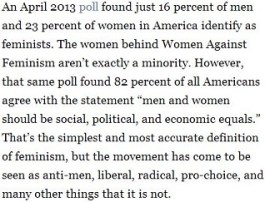
The Daily Beast op-ed this excerpt is drawn from criticizes a group called “Women Against Feminism” and asserts that feminism is defined by the conviction that “men and women should be social, political, and economic equals.” If this were strictly true, then inequities in judicial process that favor female complainants would be a target of feminism’s censure instead of its vigorous support.

The “clash” the professor constructs in her paper is not, strictly speaking, adversarial, and thinking of it this way is the source of the systemic injustices complained of by the groups she targets. Portraying it as a gender conflict is also archly self-serving, because it represents men’s rights groups as “the enemy.” Drawing an Us vs. Them dichotomy (standard practice in the law) promotes a far more visceral opposition to the plaints of men’s groups than the professor’s 64-page evidentiary survey could ever hope to (“Oh, they’re against us, are they?”).

The basic, rational argument against laws intended to curb violence against women is that they privilege women’s interests and deem women more (credit)worthy than men, which has translated to plaintiffs’ being regarded as more “honest” than defendants, and this accounts for female defendants’ also being victimized by false allegations.

(Women, too, are the victims of false restraining orders and fraudulent accusations of domestic abuse. Consequently, women also lose their jobs, their children, their good names, their health, their social credibility, etc.)

The thesis of the professor’s densely annotated paper (“Digging beneath the Equality Language: The Influence of the Father’s Rights Movement on Intimate Partner Violence Public Policy Debates and Family Law Reform”) is that allegations of legal inequities by men’s groups shouldn’t be preferred to facts, and that only facts should exercise influence on decision-making. This assertion is controverted by the professor’s defense of judicial decisions that may be based on no ascertainable facts whatever—and need not be according to the law. The professor on the one hand denounces finger-pointing from men’s groups and on the other hand defends finger-pointing by complainants of abuse, who are predominately women.

In the arena of law this post concerns, the courts typically follow the dictum that the person pointing the finger is right (and this person is usually female). In other words, the courts judge allegations to be facts. In many instances, what’s more, state law authorizes this formulation. It grants judges the authority “at their discretion” to rule according to accusations and nothing more. Hearsay is fine (and, for example, in California where the professor teaches, the law explicitly says hearsay is fine). The expression of a feeling of danger (genuinely felt or not) suffices as evidence of danger.

The professor’s defense of judicial decision-making based on finger-pointing rather undercuts the credibility of her 64-page polemic against decision-making based on finger-pointing by men’s groups that allege judicial inequities. The professor’s arguments, then, reduce to this position: women’s entitlement to be heeded is greater than men’s.

The problem with critiques of male opposition to domestic violence and restraining order statutes is that those critiques stem from the false presuppositions that (1) the statutes are fair and constitutionally conscientious (they’re not), (2) adjudications based on those statutes are even-handed and just (they’re not), and (3) no one ever exploits those statutes for malicious or otherwise self-serving ends by lying (they do—because they can, for the reasons enumerated above).
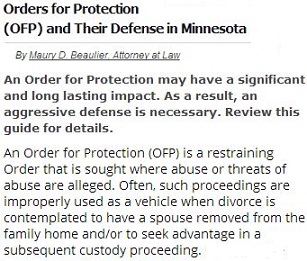
Attorneys acknowledge procedural abuses are common.

Many critiques of men’s, father’s, and children’s rights groups fail to even recognize that motives for lying exist. What presupposition underlies this? That everyone’s an angel? If everyone were an angel, we wouldn’t need laws at all. Or is the presupposition that women are angels? A woman should know better.

A casual Google query will turn up any number of licensed, practicing attorneys all over the country who acknowledge restraining orders and domestic violence laws are abused and offer their services to the falsely accused. Surely the professor wouldn’t allege that these attorneys are fishing for clients who don’t exist—and pretending there’s a problem that doesn’t exist—because they, too, are part of the “anti-battered-women conspiracy.”

The professor’s evidentiary pastiche is at points compelling—it’s only natural that a lot of rage will have been ventilated by people who’ve had their lives torn apart—but her paper’s arguments are finally, exactly like those they criticize, tendentious.

It’s obvious what the professor’s “side” is.

(She accordingly identifies her opposition indiscriminately. For example, the blog you’re right now reading was labeled the product of a father’s rights group or “FRG” in the footnotes of the professor’s paper. This blog is authored by one person only, and he’s not a father. Wronged dads have this writer’s sympathies, but this blog has no affiliation with any groups.)
The professor carefully prefaces her points with phrases like “Researchers have noted,” which gives them the veneer of plausibility but ignores this obvious question: where do the loyalties of those “researchers” lie? The professor cites, for example, the Southern Poverty Law Center’s equation of SAVE Services with a hate group. An attentive survey of SAVE’s reportage, however, would suggest little correspondence. The professor doesn’t quote any of SAVE’s reports; she simply quotes an opposing group’s denunciation of them as being on a par with white supremacist propaganda.

(What the professor does quote are some statistics generated by SAVE that she contends are dubious, like estimates of the number and costs of false and frivolous prosecutions. Such estimates must necessarily be speculative, because there are no means of conclusively determining the degree or extent of false allegations. Lies are seldom if ever acknowledged by the courts even if they’re detected. This fact, again, is one that’s corroborated by any number of attorneys who practice in the trenches. Perjury is rarely recognized or punished, so there are no ironclad statistics on its prevalence for advocacy groups to adduce.)

Besides plainly lacking neutrality, insofar as no comparative critical analysis of feminist rhetoric is performed, the professor’s logocentric orientation wants compassion. How much of what she perceives (or at least represents) as bigoted or even crazy would seem all too human if she were to ask herself, for instance, how would I feel if my children were ripped from me by the state in response to lies from someone I trusted, and I were falsely labeled a monster and kicked shoeless to the curb? Were she to ask herself this question and answer it honestly, most of the outraged and inflammatory language she finds offensively “vitriolic” and incendiary would quite suddenly seem understandable, if not sympathetic.

The professor’s approach is instead coolly legalistic, which is exactly the approach that has spawned the heated actions and language she finds objectionable.

Copyright © 2014 RestrainingOrderAbuse.com
Connecticut Lawmakers Conclude Getting a Restraining Order Isn’t Easy Enough Already

Those victimized by liars who abuse restraining order and domestic violence laws often blame their judges. It’s natural. They’re the ones who deprive the wrongly accused of dignity, liberty, property, and family—and theirs are the words that echo in the memory and grate on the nerves during the empty hours.

Lawmakers it must be remembered, though, are the enablers.

Judges may be careless. They may even be cruel. But legislators are clueless.

To give an example, consider this story reported today in Hartford, Connecticut’s The Courant (August 25, 2014):

Domestic violence victims need to have a simpler process of applying for restraining orders and better communication with the agencies that handle them, a legislative subcommittee said Monday.

To that end, the subcommittee of the task force on restraining orders agreed to recommend a streamlined version of restraining order applications and an accompanying checklist to pave the way for better communication among victims, marshals and courts.

The Connecticut legislature purposes to make simpler yet a process that’s already so “streamlined” that accusers don’t have to prove anything.

CONN. GEN. STAT. ANN. § 46b-15(b): “The court, in its discretion, may make such orders as it deems appropriate for the protection of the applicant and such dependent children or other persons as the court sees fit.… If an applicant alleges an immediate and present physical danger to the applicant, the court may issue an ex parte order granting such relief as it deems appropriate.”

This literally means that if a domestic partner merely alleges s/he feels in danger, which only takes a few seconds to do, the court is authorized to order the accused to be forcibly ejected from his or her home by armed agents of the state—even if the accused owns that home and has lived in it all of his or her life. In other words (again, for example), it’s entirely possibly for someone who has no home to move in with someone else, falsely accuse him or her of abuse, and for all intents and purposes seize possession of his or her home. Other obvious motives for lying are malice or gaining custody of kids.

No evidence of anything is required by the law, which is a blank check that authorizes accusers to say whatever they feel like and judges to do whatever they feel like.

Members of the legislative subcommittee referenced in The Courant article reportedly expect to improve their understanding of the flaws inherent in the restraining order process by taking a field trip. They plan “a ‘ride along’ with the representative of the state marshals on the panel…to learn more about how restraining orders are served.”

The urgent problem with restraining orders as they see it is ensuring that more of them are successfully delivered.

The article cites concerns expressed by the executive director of the Connecticut Coalition Against Domestic Violence “about the complicated process domestic violence victims face when they apply for restraining orders.”

The “complicated process” to have someone evicted shoeless from his or her home in the Connecticut winter and prohibited access to his or kids based on an allegation is filling out a form.

The Connecticut legislators “decided to remove the instructions in small print at the top of the form, which start with the outdated suggestion that the applicant ‘use a typewriter.’ Applicants will have access to a separate sheet of paper that has step-by-step instructions.”

Authorizing the court “in its discretion” to fill out orders “as it deems appropriate” would seem more expeditious and economical to this writer.

Copyright © 2014 RestrainingOrderAbuse.com

Further Reflections on MSNBC’s Coverage of the First Annual International Conference on Men’s Issues

Rereading MSNBC’s article on the first annual International Conference on Men’s Issues, I have to marvel that so firmly has feminism taken hold that even reporters (whose watchword is objectivity) may respond with Pavlovian menace to an act of civil disobedience—which challenging feminism is.

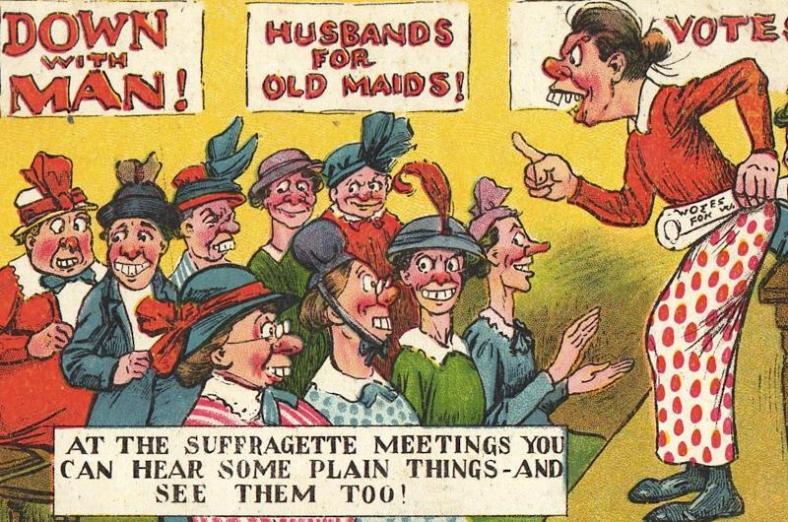
Consider that feminism originates with the 19th-century suffrage movement, that is, with some ragtag groups of women banding together to oppose second-class citizenship and demand the right to vote. Consider, too, that reactions to their early rallies to assert their rights presaged those of the MSNBC reporter who wrote about last month’s men’s conference.

His rhetorical strategies (which, like an apt pupil—or myrmidon—he lifts straight from the feminist playbook) were these:

  • Underrepresent the opposition. The MSNBC piece is surmounted by a photograph (snapped and cropped by the writer) showing a sparsely populated conference room. Some 16 people are visible if you count the odd pair of hands or feet poking into the frame. Though in a passing nod to journalistic accuracy the writer later reports attendees numbered “more than 100,” the first impression the reader is clearly meant to draw is “handful of nutters.”
  • Distort and caricature. Quotations featured in the piece were plainly culled for sensationalist impact. Commentary—for example on the phrase equity feminists, coined by a female feminist philosopher whose acumen is redoubtable—was confidently careless and pandering.
  • Distract. “The conference comes amid increased focus on women’s rights,” the writer observes saliently. Later he quotes a feminist post-grad as saying, “[D]ue to concerns for physical safety, we have decided the best way to oppose the conference that is now going on…is to keep our distance.” The source of fear was unspecified.
  • Ridicule. Pick a paragraph, any paragraph.

Attacks on the efforts of the early suffragists to have their grievances answered were…right, exactly the same.

Copyright © 2014 RestrainingOrderAbuse.com
Confusing Women’s Rights with Feminism: Some Observations on MSNBC’s Coverage of the First Annual International Conference on Men’s Issues

Apparently the first annual International Conference on Men’s Issues was held in Michigan recently. I read this fact on the MSNBC website in an article that disdained even to capitalize the title of the conference and which, for more reasons than just that one, reminded me of the days when I edited my high school paper.

My journalism adviser would’ve given the piece a C, among other reasons because it seems uncertain whether it wants to be a news story or an editorial—or an advertisement for its writer’s Twitter feed.

Its introduction, at least, was gripping to read: “At what was billed as the first annual international conference on men’s issues, feminists were ruining everything.” I was keen to hear about how the meeting was disrupted by a mob of angry women swinging truncheons.

I’ve come to expect disappointment, which expectation the reporter continued to cement over an ensuing two dozen paragraphs.

Not having attended the conference, I can’t say whether the reporter’s characterization of its presenters’ arguments as cranky is fair or not. Remarking that he failed to probe any of the topics he glosses in the article, however, does seem fair. A reporter’s job is to ask questions, not assemble a boa of plucked horsefeathers and hyperlinks.

I’m sympathetic to men’s plaints about legal mockeries that trash lives, including those of children, so I found the MSNBC coverage offensively yellow-tinged in more senses than one, but I’m not what feminists call an MRA or “men’s rights activist.” I don’t think men need any rights the Constitution doesn’t already promise them. What they need is for their government to recognize and honor those rights. The objection to feminism is that it has induced the state to act in wanton violation of citizens’ civil entitlements—not just men’s, but women’s, too.

On this subject, something useful the referenced MSNBC article does accomplish is reveal its writer’s unexamined presupposition that women’s rights and what feminists advocate for are the same thing. Probably many women are under the same illusion.

It’s understandable. Feminism still waves the same banner its pioneers sewed decades ago on which is blazoned that rainbow word EQUALITY. Today’s mainstream feminists, however, have redefined that word to mean “whatever’s best for us,” which doesn’t always mean what’s best for women.

To illustrate, take the 60-year-old woman who wrote last year to relate that she was expelled from the home she’d shared for 10 years with her invalid mother and terminally ill brother, whom she nursed, by her sister. The latter spitefully lied about her to the court—possibly because she was the executor of her mother’s will—and then destroyed her belongings, including her clothes and family memorabilia (photos, videos, etc.—a lifetime’s worth) when it was mandated that she vacate her residence. Her sister’s malicious testimony was rendered in a few minutes without the woman’s even being present. Though the fraudulent restraining order it succeeded in having issued was tossed on appeal, the woman’s record was sufficiently corrupted to cost her her job at a bank and the income and medical benefits it provided. When I last heard from her, she was living out of her car and trying to stay warm.

Or take the naïve girl who was lured away from her family, knocked up, and deserted by a twice-divorced pastor’s son. When the girl appealed to him to take an interest nine months later and moved to Virginia with her newborn on assurances from him that he’d found Jesus and wanted to do right by her, he and his family represented her as a hysteric to the court and, when last I got a status update, were in the process of seeking custody of her baby (cf. Charlotte Perkins Gilman’s “The Yellow Wallpaper”).

These aren’t merely people who “believe” they’ve been treated unfairly; these are women who’ve been used viciously and rolled into the gutter.

Women I’ve corresponded with in the three years I’ve maintained this blog have reported being stripped of their dignity and good repute, their livelihoods, their homes and possessions, and even their children according to prejudicial laws and court processes that are feminist handiworks. These laws and processes favor plaintiffs, who are typically women, so their prejudices are favored by feminists. Feminists decry inequality when it’s non-advantageous. They’re otherwise cool with it. What’s more, when victims of the cause’s interests are women, those victims are just as indifferently shrugged off—as “casualties of war,” perhaps.

I don’t know that feminists are “ruining everything,” but I do know that among the fruits of their industry has been ruining a lot of people’s lives.

Copyright © 2014 RestrainingOrderAbuse.com

Mocking the Constitution for 35 Years: A Summary of Defendants’ Due Process Rights under the American Charter and How Restraining Orders Treat Them Contemptuously

taped_mouth_cropI’ve written before about “due process,” a constitutional privilege that’s universally denied to restraining order defendants. Recently I was contacted by an intelligent 17-year-old girl who wanted to know what her rights were under the law. She didn’t stand accused of anything. Rather her adult boyfriend had been issued a mandatory (criminal) restraining order in California “on her behalf” that she didn’t seek, and she wanted to know what she could do about it.

She has a tough row to hoe, and I couldn’t provide her with much solace.

In hunting around for resources to direct her attention to, though, I came across a page prepared by the Virginia Office of the Attorney General titled, “Legal Rights of Juveniles.”

Its summation of defendants’ due process entitlements under the Constitution is worthy of the attention of anyone who’s being or who’s been put through the restraining order ringer, as well as of anyone who’s paid to craft laws that honor civil rights. Past posts on this blog have focused on the Fourteenth Amendment. This synopsis covers the Fifth and Sixth Amendments, also.

Contrast:

  • Restraining orders are issued ex parte, which means penalty is imposed upon a defendant without the court’s even knowing a thing about him or her other than his or her name—and in some jurisdictions, s/he’s not granted even the opportunity to be heard unless s/he applies for that opportunity (and the window to apply may be brief) = Sixth Amendment.
  • A defendant is deprived of liberty and often property, besides, without compensation and in accordance with manifestly unfair procedures concluded in minutes = Fifth Amendment.
  • A defendant is subject to criminal sanctions, including incarceration, without benefit of a trial by jury and consequent to a hasty civil adjudication (half an hour) that requires him or her to hire private counsel if s/he’s to be represented at all, that may not allow him or her to face his or her accuser in court, and whose pretrial preparation period affords too little time for witnesses to be gathered (two to 10 days) = Sixth Amendment.
  • Defendants are discriminated against generically, and male defendants are discriminated against specifically to mollify the special interest groups that motivated enactment of restraining orders in the first place = Fourteenth Amendment.

The restraining order process isn’t merely abusive on an epidemic scale; it treats the Constitution with contempt.

Copyright © 2014 RestrainingOrderAbuse.com
False Restraining Orders That Allege Emotional Abuse ARE Emotional Abuse

A theme that emerges upon consideration of restraining order abuse is lack of empathy—from impulsive or false accusers and from those who abet them. Plaintiffs who act either spitefully or viciously seldom appreciate the ramifications of their actions. They may possess what we call a normal conscience but either don’t think or, in the heat of the moment, don’t care.

The horror is that this same indifference extends not only to authorities and officers of the court but to feminist advocates for restraining orders and the public at large, who are persuaded that the gravity of violence against women trivializes all other considerations. Their indifference may in fact be unconsciousness, but when people’s livelihoods and lives are at stake, unconsciousness is no more pardonable.

It’s ironic that the focus of those who should be most sensitized to injustice is so narrow. Ironic, moreover, is that “emotional abuse” is frequently a component of state definitions of domestic violence. The state recognizes the harm of emotional violence done in the home but conveniently regards the same conduct as harmless when it uses the state as its instrument.

From “Are You a Victim of Emotional Abuse?” by Cathy Meyer:

Emotional abuse is used to control, degrade, humiliate, and punish a spouse. While emotional abuse differs from physical abuse, the end result is the same….

Note the writer’s conclusion that emotional abuse is equivalent to violence in its effects.

Her orientation, of course, is toward victims of domestic violence, but her judgment is just as applicable to false allegations, whose intent is to “control, degrade, humiliate, and punish.”

Plainly the motive of most reasonable feminist arguments and appeals, at least as that motive is understood by those making them, is to induce empathic understanding. They want people to care.

Here’s yet another irony. Too often the perspectives of those who decry injustices are partisan. Feminists themselves are liable to see only one side.

“But my side’s more important” isn’t a rebuttal but a confirmation of chauvinism.

In the explication quoted above, the writer compares the conduct of emotional abusers to that of prison guards toward prisoners of war, who use psychological torment to achieve compliance from their wards. Consider that victims of false allegations may literally be imprisoned.

Consider further some of the tactics that Ms. Meyer identifies as emotionally abusive:

  • Isolating a spouse from friends and family.
  • Discourag[ing] any independent activities such as work; taking classes or activities with friends.
  • If the spouse does not give into the control, they are threatened, harassed, punished, and intimidated by the abuser.
  • Us[ing] the children to gain control by undermining the other parent’s authority or threatening to leave and take the children.
  • Control[ling] all the financial decisions, refus[ing] to listen to their partner’s opinion, withhold[ing] important financial information and mak[ing] their spouse live on limited resources.
  • Mak[ing] all major decisions such as where to live, how to furnish the home, and what type of automobile to drive.

Now consider the motives of false allegations and their certain and potential effects: isolation, termination of employment and impediment to or negation of employability, inaccessibility to children (who are used as leverage), and being forced to live on limited means (while possibly being required under threat of punishment to provide spousal and child support) and perhaps being left with no home to furnish or automobile to drive at all.

The correspondence is obvious…if you’re looking for it. Opponents of emotional abuse need to recognize it in all of its manifestations, because the expectation of empathy is only justified if it’s reciprocated.

Copyright © 2014 RestrainingOrderAbuse.com
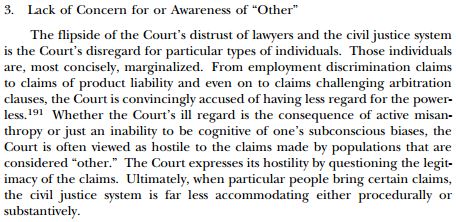
Ungoverned: Restraining Order Laws in Arkansas

not-governed

I’ve combed the Internet in recent weeks for motion-to-dismiss forms applicable to restraining orders issued in the 50 states. For Arkansas, there’s nothing to be found. Zip. If that weren’t suggestive enough that the process is a lock, consider the above entry excerpted from a 2011 Arkansas Court Bulletin.

This means an accuser may be awarded exclusive entitlement to the family residence; sole custody of children; a monthly stipend from the former breadwinner, who may find himself out of a job subsequent to being issued a “domestic abuse” restraining order; and reimbursement of costs. Filing for a protection order, in other words, may gain a plaintiff everything and cost her (or sometimes him) nothing—whether the allegations it’s based on are true, hyped, or lies.

The case commentary (which you’ll observe publicly discloses the names of the parties to the action) concerns a man who was served with a notice to appear in court to answer allegations of “domestic abuse” six days thence.

Rough translation: “Dear sir, you’re expected in a courtroom next week to respond to allegations that you beat your wife.”

For people who know nothing about restraining order processes, appreciate that this man was given less than a week’s time to prepare a defense against obviously serious charges with obviously serious repercussions. In six days, he was supposed to come to grips with public allegations that may have horrified him, procure an attorney’s services, gather relevant evidence and testimony, etc.

Six days.

The bulletin reports that the man “sought a continuance [postponement], which was denied.” He didn’t attend the hearing. The commentary doesn’t indicate a reason. His request to have the order set aside, because the expectation of an immediate response didn’t conform to the Arkansas Rules of Civil Procedure, was also denied. Why? Because the Arkansas Domestic Abuse Act trumps the rules of civil procedure.

This case exemplifies why restraining order adjudications strike so many people as Kafkaesque: “I move—.” “No.” “Then—.” “No.” “But—.” “The rules don’t apply in your case, sir, and we don’t negotiate our decisions.”

Defendants’ being railroaded, of course, is nothing extraordinary. “Emergency” restraining orders may allow respondents only a weekend to prepare before having to appear in court to answer allegations—very possibly false allegations—that have the potential to permanently alter the course of their lives.

Extraordinary is the Arkansas courts’ openly and nonchalantly recognizing in a bulletin that their protective order process is “not governed by the rules.”

Its proceedings are “special.”

Copyright © 2014 RestrainingOrderAbuse.com

No False Motives: On WHY Judges Refuse to Acknowledge Restraining Order Fraud

In the last post, I stressed that the courts refuse to acknowledge false allegations made by restraining order plaintiffs as lies, perjury, or fraud. It’s unlikely courts will call them “true.” Rather they’ll just accept them as given.

This shouldn’t be too surprising considering that the legitimacy and worthiness of the restraining order process is itself unquestioned. Why? Because it’s favored by the feminist establishment, which has gained so much political sway in recent decades that society, particularly its liberal constituency, is inclined to feel that what feminists want is what women want, and what women want is what everyone should want. Even women may not question whether what feminists want is what’s in their best interests. Restraining orders are promoted as positive and empowering for women. Also, they’re there to bring bad guys to bay and advance the causes of peace, justice, and the American way. So what possible grounds could exist for criticizing them? No harm, no foul, right?

The answer to these questions is of course known to (besides men) any number of women who’ve been victimized by the restraining order process. They’re not politicians, though. Or members of the ivory-tower club that determines the course of what we call mainstream feminism. They’re just the people who actually know what they’re talking about, because they’ve been broken by the state like butterflies pinned to a board and slowly vivisected with a nickel by a sadistic child.

And the value of their lives is deemed negligible. They’re what feminist jihadists would likely refer to as casualties of war.

The perpetuation of the restraining order process and the preservation of its appearance of propriety is the product of prejudice and perception mutually reinforcing each other. Public perception is that restraining orders are “good,” because they answer a social need. Judicial perception of restraining order applicants’ motives is accordingly prejudiced by pressures both political and social. If that weren’t enough, it’s also programmed. Courts receive massive federal grants under the Violence Against Women Act (VAWA) in return for having their judges submit to indoctrination.

Thus judges not only ignore whether allegations made on restraining orders are false; they may well assume the position that restraining orders are never sought maliciously (or frivolously).

They do what people expect of them, what the state wants of them, and what accordingly feels righteous and noble. That it’s also in their professional interests is a bonus (as is the possible gratification they derive from making “miscreants” cavil and quail). All of these motives are wrong and are furthermore contrary to judicial ethics (due process, Constitutional privilege, social justice, etc.), but the only people who care about principle are this travesty’s sacrificial lambs.

And they’re mostly silent.

Copyright © 2013 RestrainingOrderAbuse.com

“I Want My Life Back”: On the Unacknowledged Toll of Restraining Order Abuse

“I want my life back. Restraining orders have stolen everything from me, and I’d give anything to have it back.”

—From “End Restraining Order Abuses”

Here’s what no one on the outside of the restraining order process can possibly grasp: that it can strip from someone, possibly based on nothing but maliciously false allegations, everything that s/he held dear.

That everything may have been what we conventionally regard as the worthiest values in life: home, family, and children. Or that everything may have been a career, an ambition, or sanity, peace of mind, and well-being. It may have been faith in government…or God. Or it may have been good repute.

All of these values are sacred ones and ones protected by our Constitution, and all of these values are vulnerable to casual violation by a state process engineered, intentionally or not, to abet casual violations. Restraining orders not only enable but legitimate attacks that wouldn’t otherwise be possible, let alone legal.

The source of the gnawing outrage so evident in complaints about restraining order abuse isn’t simply false allegations but the eagerness with which they’re accepted as fact by the court and effectively sublimated into fact by application of a judicial signature.

Consider: If someone falsely circulates that you’re a sexual harasser, stalker, and/or violent threat—possibly endangering your employment, to say nothing of savaging you psychologically—you can report that person to the police, seek a restraining order against that person for harassment, and/or sue that person for defamation and intentional infliction of emotional distress. If, however, that person first obtains a restraining order against you based on the same false allegations—which is simply a matter of filling out a form and lying to a judge for five or 10 minutes—s/he can then circulate those allegations, which have been officially recognized as legitimate on an order of the court, with impunity. Your credibility, both among colleagues, perhaps, as well as with authorities and the courts, is instantly shot. You may, besides, be subject to police interference based on further false allegations, or even jailed (arrest for violation of a restraining order doesn’t require that the arresting officer actually witness or have incontrovertible proof of anything). And if you are arrested, your credibility is so hopelessly compromised that a false accuser can successfully continue a campaign of harassment indefinitely. Not only that, s/he can expect to do so with the solicitous support and approval of all those who recognize him or her as a “victim” (which may be practically everyone).

Can a completely innocent person be completely destroyed like this in gratification of a sick impulse by someone with a yen for vengeance or an attention-seeking personality disorder? Totally. The allegations, files, and records (public records) gradually accrete to mock, humiliate, and destabilize that person indefinitely, denying him or her a sense of security and any reasonable expectation of receiving just treatment from his or her own government.

It works this way: police officers and judges have only brief exposure(s) to the matter and, having no investment in it, couldn’t care less either way; people who are on the fence are liable to maintain their perch, being disinclined to get involved; those who know better will express their sympathies, which are kind but powerless to work any sort of remedial or regenerative effect; and those who don’t know any better will swallow a liar’s frauds, because their reactions have been socially conditioned and they have, besides, no reason to doubt the merits of a court’s (or multiple courts’) findings.

It’s a piece of cake.

Liars typically don’t expect to have their frauds challenged, but if they are, those frauds are more likely than not to continue to succeed (the courts are averse to backpedaling, and there’s no oversight). Lies don’t even have to be consistent or particularly cunning, just sensational and dramatically delivered (bigger, more lurid lies are actually easier sells than small ones). The rewards of attention, social sympathy and encouragement, recognition by authority figures, and the sense of power that comes from prevailing over an opponent are furthermore heady and addictive, and easily eclipse any twinge of conscience or fear that a liar may feel.

Victims of abuse are left eating their hearts out while those who’ve abused them can expect to be surrounded by consoling arms. In work settings, those abusers may even end up with promotions.

Copyright © 2013 RestrainingOrderAbuse.com
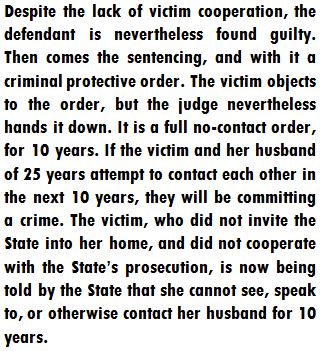
Presumed Guilty: On How Restraining Order Laws Enable and Promote Abuse

I’ve had occasion in the last few months to scrutinize my own state’s (Arizona’s) restraining order statutes, which are a study in prejudice, civil rights compromises, and politically coerced naïvety. Their outdated perspective fails even to acknowledge the possibility of misuse let alone recognize the need for remedial actions to undo it.

Restraining orders are issued upon presumptive conclusions (conclusions made without judges ever even knowing who recipients are—to the judges, recipients are just names inked on boilerplate forms), and the laws that authorize these presumptive conclusions likewise presume that restraining order applicants’ motives and allegations are legitimate, that is, that they’re not lying or otherwise acting with malicious intent.

That, you might note, is a lot of presuming.

In criminal law, the state must presume that defendants are innocent; in civil law (restraining orders are civil instruments), defendants may be presumed guilty. What’s outrageous about this with respect to restraining orders is that public allegations made on them may be criminal or criminal in nature, and violations of restraining orders—real or falsely alleged—have criminal consequences. Due process and the presumption of innocence are circumvented entirely; and with these safeguards out of the way, a defendant may be jailed on no valid evidence or for doing something that’s only illegal because a judge issued a restraining order on false grounds that made it so. (A parent who’s under a court-ordered injunction may be jailed, for example, for sending his child a birthday present.)

One of my motives for consulting my state’s restraining order statutes is having absorbed a broad array of stories of restraining order abuse over the past two years. Common themes among these stories are judicial bias; lying and fraud by plaintiffs (applicants); restraining order plaintiffs’ calling, emailing, or texting the people they’ve petitioned restraining orders against (or showing up at their homes or places of work—or following them); and restraining orders’ being serially applied for by plaintiffs whose past orders have been repeatedly dismissed (that is, restraining orders’ being used to harass and torment with impunity).

Those who’ve shared their stories want to know how these abuses are possible and what, if anything, they can do to gain relief from them. The answer to the question of how lies within the laws themselves, which are flawed; the answer to the question of what to do about it may well lie outside of legal bounds entirely, which fact loudly declaims just how terribly flawed those laws are.

Arizona restraining orders are of two sorts, called respectively “injunctions against harassment” and “orders of protection.” They’re defined differently, but the same allegations may be used to obtain either. Most of the excerpted clauses below are drawn directly from Arizona’s protection order statute. Overlap with its sister statute is significant, however, and which order is entered simply depends on whether the plaintiff and defendant are relatives or cohabitants or not.

“[If a court issues an order of protection, the court may do any of the following:] Grant one party the use and exclusive possession of the parties’ residence on a showing that there is reasonable cause to believe that physical harm may otherwise result.”

This means that if your wife/husband or girlfriend/boyfriend alleges you’re dangerous, you may be forcibly evicted from your home (even if you’re the owner of that home). The latitude for satisfying the “reasonable cause” provision is broad and purely discretionary. “Reasonable cause” may be found on nothing more real than the plaintiff’s being persuasive (or having filled out the application right).

“If the other party is accompanied by a law enforcement officer, the other party may return to the residence on one occasion to retrieve belongings.”

This means you can slink back to your house once, with a police officer hovering over your shoulder, to collect a change of socks. Even this opportunity to recover some basic essentials may be denied defendants in other jurisdictions.

“[If a court issues an order of protection, the court may do any of the following:] Restrain the defendant from contacting the plaintiff or other specifically designated persons and from coming near the residence, place of employment or school of the plaintiff or other specifically designated locations or persons on a showing that there is reasonable cause to believe that physical harm may otherwise result.”

This means defendants can be denied access to their children (so-called “specifically designated persons”) based on allegations of danger that may be false.

“[If a court issues an order of protection, the court may do any of the following:] Grant the petitioner the exclusive care, custody or control of any animal that is owned, possessed, leased, kept or held by the petitioner, the respondent or a minor child residing in the residence or household of the petitioner or the respondent, and order the respondent to stay away from the animal and forbid the respondent from taking, transferring, encumbering, concealing, committing an act of cruelty or neglect in violation of section 13-2910 or otherwise disposing of the animal.”

This means defendants can be denied access to the family pet(s), besides.

Note that the linguistic presumption in all of these clauses is that recipients of restraining orders are wife-batterers, child-beaters, and torturers of puppies, and recall that restraining orders are issued without  judges’ even knowing what defendants look like. This is because restraining orders were originally conceived as a deterrent to domestic violence (which, relative to the vast numbers of restraining orders issued each year, is only rarely alleged on them today at all). It’s no wonder then that judicial presumption of defendants’ guilt may be correspondently harsh. Nor is it any wonder that in any number of jurisdictions, an order of protection can be had by a plaintiff’s alleging nothing more substantive than “I’m afraid” (on which basis a judge is authorized to conclude that a defendant is a “credible threat”).

“A peace officer, with or without a warrant, may arrest a person if the peace officer has probable cause to believe that the person has violated section 13-2810 by disobeying or resisting an order that is issued in any jurisdiction in this state pursuant to this section, whether or not such violation occurred in the presence of the officer.”

This means you can be arrested and jailed based on nothing more certain than the plaintiff’s word that a violation of a court order was committed. More than one respondent to this blog has reported being arrested and jailed for a lengthy period on fraudulent allegations. Some, unsurprisingly, have lost their jobs as a consequence (on top of being denied home, money, and property).

“There is no statutory limit on the number of petitions for protective orders that a plaintiff may file.”

This observation, drawn from Arizona’s Domestic Violence Civil Benchbook, means there’s no restriction on the number of restraining orders a single plaintiff may petition, which means a single plaintiff may continuously reapply for restraining orders even upon previous applications’ having been denied.

Renewing already granted orders (which may have been false to begin with) requires no new evidence at all. Reapplying after prior applications have been denied just requires that the grounds for the latest application be different, which is of course no impediment if those grounds are made up. As search terms like this one reveal, the same sort of harassment can be accomplished by false allegations to the police: “boyfriends ex keeps calling police with false allegations.” Unscrupulous plaintiffs can perpetually harass targets of their wrath this way—and do.

No restrictions whatever are placed upon plaintiffs’ actions, which means that they’re free to bait, taunt, entrap, or stalk defendants on restraining orders they’ve successfully petitioned with impunity. And neither false allegations to the police nor false allegations to the courts (felony perjury) are ever prosecuted.

“A fee shall not be charged for filing a petition under this section or for service of process.”

This means the process is entirely free of charge.

Copyright © 2013 RestrainingOrderAbuse.com

A Safety Seal: What Restraining Orders and Tic Tacs Should Have in Common but Don’t

I’ve written recently about restraining orders’ circumvention of due process and remarked that at the time of their advent—the 1970s—this may have seemed to lawmakers like an urgently necessary evil.

The phrase due process, to recap, refers to granting defendants (like recipients of restraining orders) the opportunity to defend themselves before a judgment is entered on allegations made against them. Restraining orders deny defendants due process, because their guilt is conclusively presumed without judges’ knowing who they are (even so-called “appeals hearings” may afford a defendant no more than a 15-minute audience with a judge who already supposes him or her to be guilty).

To put it baldly, defendants are issued orders from the court that manifestly identify them as creeps and that may summarily (and indefinitely) deprive them access to home, children, money, and property based on the court’s knowing nothing more about them than their names and what someone alleged against them, which the Fourteenth Amendment was drafted to guarantee can’t happen.

The motive for denying restraining order defendants due process—for which legislators are to blame, not judges—was satisfying feminist outrage by ensuring female victims of domestic violence didn’t have to worry about their allegations being discounted or criticized by the police, as they well might have been in the ’70s (imagine being knocked around and terrorized at home then publicly ridiculed or excoriated by authorities—all men—for complaining about it). Restraining orders authorized battered women to take their allegations directly to a judge and thereby be granted immediate relief from unbearable circumstances.

Though social attitudes toward women’s rights and domestic abuse have shifted radically in 30 years (to a vulgar extreme, many might argue), no one, however, has looked back. Restraining orders continue to follow the same policies they did from the start (or laxer ones) and have only become more widely applied and sprouted more and sharper teeth.

The last commentary noted that at the time restraining orders were enacted, legislators assuredly never gave a thought to the possibility that they would be abused.

At that time, no one had considered that somebody might intentionally sabotage foodstuffs or over-the-counter medications, either. It never occurred to manufacturers or government overseers of product safety standards that somebody might poison others just for the fun of doing them harm—or just because they could.

Following Tylenol’s being tampered with in 1981, everything from diced onions to multivitamins requires a safety seal. Naive trust was violated, and legislators responded.

Legal lions, scholars, and journalists have denounced the injustice of restraining orders for 20 years now at least, and any number of lives fractured by wrongfully issued restraining orders have been publicly chronicled. Even government studies have concluded that a majority of restraining orders are sought unnecessarily or falsely and that only a small minority ever even allege violence.

How many more people have to be poisoned by a widely abused judicial process before the same cautionary measures applied to Tic Tacs are applied to it?

Time for a manufacturer recall.

Copyright © 2013 RestrainingOrderAbuse.com

Circumventing Due Process Isn’t Just What Restraining Orders Do—It’s What They Were Designed to Do

detour
“Due process of law implies the right of the person affected thereby to be present before the tribunal which pronounces judgment upon the question of life, liberty, or property, in its most comprehensive sense; to be heard, by testimony or otherwise, and to have the right of controverting, by proof, every material fact which bears on the question of right in the matter involved. If any question of fact or liability be conclusively presumed against him, this is not due process of law.”

Black’s Law Dictionary

The phrase due process (or due process of law) names those most fundamental legal entitlements that ensure an individual is provided the means and opportunity to defend him- or herself and his or her interests in court.

In the previous post, I observed that restraining orders skirt due process entirely—which I’m hardly the first person to remark.

As this post’s epigraph explains, whenever the court presumes that a person is liable for or guilty of some alleged transgression and enters a judgment against that person without first granting that person the opportunity to challenge the allegations against him or her, that person is denied due process.

Not kinda-sorta but flatly.

Since restraining orders (by legislative mandate) are issued ex parte, which means that the only parties judges hear from prior to entering rulings are restraining order applicants, every restraining order recipient is denied due process. Every one of them. Always. Restraining order defendants are just inked names on paper forms; judges have no idea whom they’re entering judgments against, and defendants have no idea judgments have been entered against them until a constable comes knocking.

Restated using legalese from this post’s epigraph, when a defendant’s guilt is “conclusively presumed,” as it is when a judge approves a restraining order, “this is not due process of law.” Restated simply, when rulings are made prior to defendants’ being given a chance to defend themselves, there’s no due process. Restated simplest, restraining orders = no due process = no adherence to the most basic principles of law = dirty pool.

This is an obvious and indisputable fact, and as I stated earlier, I’m hardly the first person to have noted it.

What’s more rarely observed is that denying defendants due process was the purpose of restraining orders’ being enacted. Restraining order legislation, by design, authorizes a plaintiff to communicate his or her allegations directly to a judge, without having to convince any legal authorities of the merits of those allegations, and requires that a judge enter a ruling on those allegations without a plaintiff’s having to face the person s/he’s accused. (Due process is a constitutional guarantee under the Fourteenth Amendment—except when lawmakers say otherwise.)

The motive for this circumvention of due process is now a very dusty one.

Restraining orders were born three decades ago in response to a pressing demand from female advocates for a process that allowed at-risk women, particularly victims of domestic violence, to avoid the pain and humiliation of having to take their claims to the police (who may have discounted those claims or even criticized women for making them) and go straight to a judge, that is, to have the opportunity to quickly and quietly explain their hardships in a situation of security and minimal scrutiny.

In the social climate that predominated in the 1970s, this made sense. Wives were still expected, by and large, to stay home, tend to their kids and kitchens, and mind their husbands. If husbands sometimes got a little free with their hands, that wasn’t something you broadcast to the world.

Restraining orders, which were legal finesses from the outset, were meant to arrest domestic violence and provide abused women with a discreet and minimally agonizing way to communicate abuse to the court and gain immediate relief from it. It certainly wasn’t on the minds of lawmakers at the time (or anyone else) that restraining orders would one day be applied to routine annoyances or that applicants might fabricate allegations or manipulate a free and convenient process for malicious or selfish ends.

Legislators bowed to social pressures for very sympathetic reasons. The problem is they’ve gone right on bowing for 30 years without consideration to how far restraining orders have drifted from their original intent or to whether their denial of due process to defendants is still justifiable.

Today, relative to the millions of restraining orders that are issued every year, it’s only seldom that allegations of violence are made on restraining orders at all.

Which doesn’t at all mean that the presumption of violence (stalking, sex offenses, etc.) isn’t applied to restraining order recipients universally.

Warrant for the continuation of a process whose nuclear cloud has gusted so far from its target demands a retrofit. This isn’t 1979, and there no longer exists any conscionable excuse for denying defendants due process of law. This is 2013, and violating defendants’ civil rights and burdening them thereby with criminal imputations for the rest of their lives is cruel and unusual punishment.

It’s vicious.

The restraining order process either needs to be dusted off and revisited or relegated to the dustbin of history.

Copyright © 2013 RestrainingOrderAbuse.com

Restraining Order Laws Hold Nothing Sacred

I’ve been in correspondence with a woman who was recently forced to abandon her home to make herself unavailable to further allegations of abuse from her neighbor, allegations that she reports aren’t just false but nuts (and that have continued to escalate and compound over weeks and months).

This woman, a solitary 65-year-old with no nearby family to turn to for support, has had to relinquish her independence and move in with a friend at great sacrifice to both her comfort and pride.

She has also, of course, had to retain the services of an attorney.

And chances are that no matter how the controversy resolves in court, she’ll never again feel safe and easy in her own house and will have to uproot.

Her situation emphasizes a number of the horrors that attend restraining orders and the policies that inform their administration:

  • Confounding the constitutional guarantees to life, liberty, and the pursuit of happiness, restraining orders may deny defendants all rights to property, children, and home—or, as in this woman’s case, the right to feel secure in that home—based on unverified (and possibly unverifiable) accusations leveled by plaintiffs in a span of a few minutes. Aptly applying a quotation from Woody Allen to how easily restraining orders are obtained: “Eighty percent of success is showing up.”
  • The standard of proof is so meager that a lone defendant has little hope of defusing allegations by an aggressive and insistent plaintiff. (And it’s almost always the case that had the defendant been the first party in a dispute to seek a restraining order, the court would as likely have found the defendant’s representation to be the more urgent “truth of the matter.” Especially when, as in this case, both the plaintiff and defendant are women. Certainly the first party before a judge has the competitive edge—not least of all because the opposing party is never interviewed.)
  • Once an unscrupulous plaintiff gets a taste of what s/he can get away with, s/he may repeatedly up the ante. Harsher allegations, counterintuitively, are no more likely to be closely scrutinized by the court and all the more likely to be accepted. I say “accepted,” because their accuracy is irrelevant. Restraining orders aren’t approved based on the truth of a plaintiff’s individual allegations so much as on the forcefulness of their totality (even if some or all are bogus). Basically, the harder allegations are for a judge to ignore, the more likely they are to work. A person succeeds in getting a restraining order; s/he doesn’t get one because everything s/he alleges is true (though all allegations remain on public record, true or false—which of course means false ones become “true” by virtue of a judge’s signature).

The woman whose story prompts this post has been left with seeking solace from her faith, because there are no other sources. That a citizen of the United States of America must sooner trust in prayer than in the justice of her own government tells you everything you need to know about the iniquities of this process.

Copyright © 2013 RestrainingOrderAbuse.com