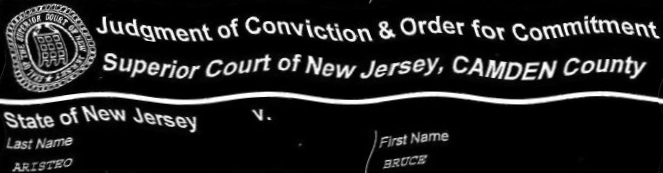
“PERMANENTLY PROHIBITED”: Camden County, New Jersey’s Idea of a Just Order of the Court

NOTE TO THE COURT: Facts in this post were gleaned by its author and do not originate from its subject, Bruce Aristeo, who had no influence on its composition. Commentary, likewise, is solely that of its writer.

Camden County, NJ, New Jersey, unlawful orders of the court, civil rights violations, constitutional rights violations, prior restraint, indefinite temporary restraining order

A recent post on this blog highlighted the case of Raines v. Aristeo, out of Camden County, New Jersey.

You can find the post on Google. You won’t, however, find an association between that post and the name of the plaintiff, Jody Raines, if you use that name as your search term (or the name of her business, WebMarCom). That’s because the judge returned a verdict on April 26, 2016, against defendant Bruce Aristeo requiring that any such association be severed.

I got a chance to look at the judge’s order this week. To call it an offense against free speech (and some other constitutional guarantees) would be like calling public defecation impolite.

Bear in mind that Mr. Aristeo was prosecuted for posting satirical videos ABOUT Ms. Raines on YouTube. That’s the basis for his being nominated a “criminal stalker”—also that he’d previously been issued something called an “indefinite temporary restraining order” (unique to Camden County, New Jersey). Mr. Aristeo’s videos purportedly violated this “indefinite temporary” whatchamacallit and were represented as “harassing” and therefore evidence of “stalking” and “domestic violence.” (Don’t strain to find logical connections. You’ll give yourself a nosebleed.)

This is actually how the order, issued by Judge Frederick J. Schuck, reads:

  1. The Defendant shall be PERMANENTLY PROHIBITED from entering the residence or place of employment of Jody Raines and shall be further prohibited from being present upon the grounds or property surrounding said locations whether in the State of New Jersey or another jurisdiction as specified below.
  2. The Defendant shall be PERMANENTLY PROHIBITED from any future acts of domestic violence against Jody Raines enumerated in J.S. 2C:25-19a and specifically from following, monitoring, surveilling, stalking, harassing and/or threatening Jody Raines.
  3. The Defendant shall be PERMANENTLY PROHIBITED from any and all personal contact with Jody Raines.
  4. The Defendant shall be PERMANENTLY PROHIBITED from any and all communication to or about Jody Raines and her business (see paragraph 8).
  5. The Defendant shall be PERMANENTLY PROHIBITED from causing any communication to or about Jody Raines and her business and any contact to be made with Jody Raines directly or indirectly, or through any third parties, mediums or agents.
  6. The Defendant shall be PERMANENTLY PROHIBITED from any and all communication or personal contact with any family members, friends, employers and co-workers of Jody Raines or other persons with whom communication would be likely to cause annoyance or alarm to Jody Raines.
  7. The Defendant shall be PERMANENTLY PROHIBITED from utilizing any internet and/or social media postings, directly or indirectly, or through any third parties, mediums, or agents regarding, referring to, or simulating, characterizing or alluding to Jody Raines, her family, her friends, her business, or her pets in any form, including but not limited to YouTube, Facebook, LinkedIn, and Twitter.
  8. Prohibited contact or communication in Paragraphs 3, 4, 5, 6, and 7 above shall include any form of communication made by any means, including but not limited to, any verbal or written communication, communications conveyed by any electronic communication device or medium, including but not limited to, a telephone, including a cordless, cellular or digital telephone, computer, or any other means of transmitting voice or data, including but not limited to text message, email, social media, social networking sites, internet or other communication via computer or electronic device, including but not limited to the posting or publication of images or audio recordings of Jody Raines, and communication made by sign or gesture and the physical presence of the Defendant in proximity to Jody Raines or at the specified prohibited locations.
  9. The Defendant shall further be PERMANENTLY PROHIBITED from communicating, sharing, disclosing, or disseminating to any third party, medium or agent any information referencing Jody Raines, her business, her family, or her pets via any method described [above].
  10. The Defendant shall cause to take down and remove from the Internet any and all publications or postings over which he has control that mention the name of Jody Raines or any business owned or operated by her, exhibit her image, or contain audio recordings of her voice.
  11. A violation of this Order shall be governed by J.S. 29-9a; however, nothing in this paragraph shall preclude the filing of additional criminal complaints based upon the act(s) constituting a violation of this Order.

Remember that Mr. Aristeo, a former schoolteacher, was found guilty of “stalking” (in contempt of a “temporary indefinite” restraining order) for publishing some one-to-many satirical videos.

(Ironic of that is how the judge’s order reads like satire: “including but not limited to, any verbal or written communication, communications conveyed by any electronic communication device or medium, including but not limited to, a telephone, including a cordless, cellular or digital telephone, computer, or any other means of transmitting voice or data, including but not limited to text message, email, social media, social networking sites, internet or other communication via computer or electronic device, including but not limited to….” How can you not hear that in the voice of John Cleese?)

Mr. Aristeo is now PERMANENTLY PROHIBITED from publicly referencing (“including but not limited to”) a goldfish Ms. Raines might own—and congratulations to county prosecutor Tracy Cogan for that snot blob on the Constitution.

Mr. Aristeo, whom Ms. Raines has had jailed before, was sentenced to 364 days behind bars (less 190 previously served). There’s more, too:

  • Four (4) years’ probation, subject to standard conditions.
  • Defendant shall undergo a psychological evaluation and treatment if necessary.
  • Defendant shall abide by all of the terms of the Permanent Restraining Order entered separately this date.
  • Defendant shall provide a DNA sample.
  • The Court separately shall enter a permanent stalking restraining order pursuant to N.J.S.A. 2C:12-10.01.
  • The State’s request for forfeiture of the Defendant’s Mac Pro Laptop Computer, and Apple Desktop Computer is denied. The State shall return to the Defendant any property seized from him immediately upon his release from incarceration, unless the State otherwise has initiated an appropriate civil action pursuant to N.J.S.A. 2C 64-3.

He was also fined: VCCA Assessment, $50; Law Enforcement Officers Training and Equipment Fund Penalty, $30; Safe Neighborhood Services Fund, $75; Probation Supervision Fee, $5; Domestic Violence Offender Surcharge, $100.

VAWA_order

Fittingly, the judge’s name, Schuck, is just one letter shy of an earthy Yiddish slang word that means dick.

Copyright © 2016 RestrainingOrderAbuse.com

*The arrests and prosecutions of Bruce Aristeo have cost taxpayers tens of thousands of dollars, for which they stand to be refunded $260 (if the judge corrects his math) by a man the state has left indigent (with a corrupted public record). If Mr. Aristeo now has grounds to sue the state for obscene abuses of power and false imprisonment, that may mean tens of thousands of dollars more drained from the public till, from which the costs of Mr. Aristeo’s housing, as well as the filing fees for his appeal, will also be drawn—all because he published some satirical material online representing his accuser as a toy monkey.


Jody Raines, Bruce Aristeo, WebMarCom

A Man’s “Tasty Little Balls…What a Treat!”: On RAINES v. ARISTEO, Free Speech, and Censorship


Typical of cases stemming from court injunctions, the case that occasions this post, Raines v. Aristeo, is a he-said/she-said quagmire. Not disputed is that the woman and the man had a four-month relationship in 2010. He says he ended the relationship after learning “disturbing…information” from her ex-husband about her. She says she ended the relationship because he became “strident,” “demanding,” and “threatening.” Both acknowledge they had a business relationship outside of their personal relationship. He says she owed him money and brought criminal complaints against him to get out of paying. This post doesn’t belabor the backstory but instead raises some questions: Is this, as in so many similar instances, a tempest in a teapot? Has a public interest been served by a man’s serial arrest and prosecution, or has it only sated a single woman’s rancor? Should this be countenanced? And, finally, is it lawful? The only pointed observation this post makes is that a woman has been annoyed, and a man is in jail.

NOTE TO THE COURT: Facts in this post were gleaned by its author and do not originate from its subject, Bruce Aristeo, who had no influence on its composition. Commentary, likewise, is solely that of its writer.


Jody Raines, WebMarCom, Raines v. Aristeo, Bruce Aristeo

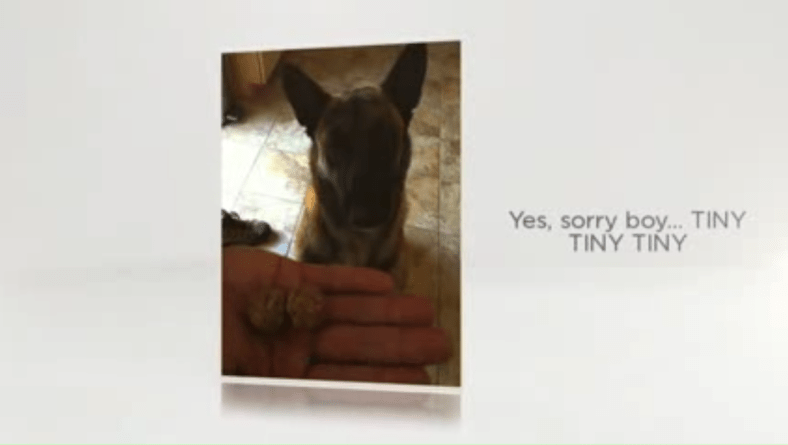
In her YouTube video “Smiles for Ruger,” Internet marketing adviser Jody Raines imitates feeding a man’s “TINY, TINY, TINY” testicles to her dog.

“Agitator” Matthew Chan, who introduced me to how restraining orders are used to squelch protected speech, brought this search engine return to my attention on Friday:

This notice greets the person who queries Google either about Jody Raines, a woman who describes herself as a “recognized expert with Social Media, Internet Marketing and Website Development,” or Bruce Aristeo, a former schoolteacher she has prosecuted, not for the first time, and had sentenced to three months in jail.

Bruce Aristeo, Jody Raines, Raines v. Aristeo

Bruce Aristeo

The two dated in 2010, besides having a business relationship at the same time. Beyond these details, accounts predictably differ. Beyond question, however, is that Mr. Aristeo has been jailed for expression protected by the First Amendment.

His “crime” was posting satirical videos on YouTube ABOUT Ms. Rainesand even asserting that much is subject to interpretation. The basis for Mr. Aristeo’s arrest and subsequent incarceration was his being issued something called an “indefinite temporary restraining order” (unique to Camden County, New Jersey) in 2012. This bizarre instrument (issued in a state long-known for its harsh judicial treatment of male defendants) exposes Mr. Aristeo to warrantless arrest anytime for the rest of his life.

Prior to the most recent prosecution, Ms. Raines has had Mr. Aristeo arrested multiple times and jailed for over half a year. (Whatever Ms. Raines’ talents as a marketer outside of court may be, inside of one she’s proven herself to be highly effective.)

The conflict between the two inspired a YouTube “cold war” that went preemptively nuclear in 2015. Ms. Raines’ latest prosecution concerned Mr. Aristeo’s videos. This post examines one of his and one of hers.

Among Ms. Raines’ reported passions are motorcycles and Belgian Malinois dogs. One of her personal pets is called Ruger (also the name of a gun manufacturer). Mr. Aristeo waggishly produced a video “promoting” a brand of breakfast meats called “RU Burger Farms” (RUger).

Jody Raines, WebMarCom, Raines v. Aristeo, Bruce Aristeo

The vid’s “production company,” “MonkeyCom Banana Strategies,” both identifies the work as satire (which is protected speech) as well as takes a poke as Ms. Raines’ company, WebMarCom, which advertises marketing strategy advice. In the video, Mr. Aristeo (clad in a scarf and a fuchsia sweater) lustily tucks into some “Malinois sausage patties,” and his narration includes tongue-in-cheek patter like this: “I love to prepare my Malinois like the Amish do, where they put a little syrup on top after….”

Jody Raines, WebMarCom, Raines v. Aristeo, Bruce Aristeo

This apparently is supposed to represent a “true threat” to either Ms. Raines or her dog, neither of whom is explicitly identified. The video wasn’t brought to Ms. Raines’ attention by Mr. Aristeo—that is, he didn’t contact her—which means to have seen it, she had to have sought it out.

Ms. Raines responded to Mr. Aristeo’s homemade flick with a satirical video of her own. It suggests she has castrated Mr. Aristeo and is feeding his testicles to her dog. It’s called, “Smiles for Ruger.”

Here’s a still from it:

Jody Raines, WebMarCom, Raines v. Aristeo, Bruce Aristeo

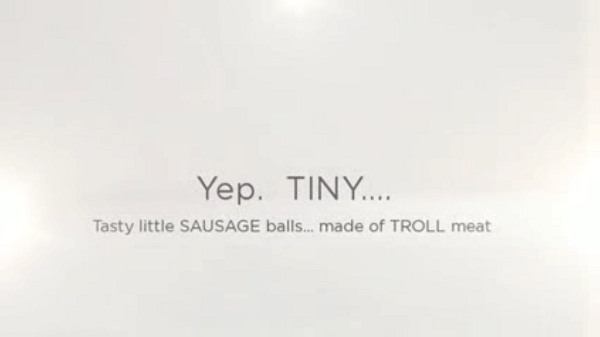
The word troll in the frame that follows is Internet slang for a person who lurks in forums and sows discord on the Internet for self-amusement. Its application here is an ill fit, because Mr. Aristeo didn’t plant his video anyplace with the intent to provoke: Ms. Raines had to know where to look.

Jody Raines, WebMarCom, Raines v. Aristeo, Bruce Aristeo

The frame below intimates that Ms. Raines’ video was inspired by Mr. Aristeo’s “picking on” Ruger (who’s an intelligent dog but doesn’t speak English) with his video.

Jody Raines, WebMarCom, Raines v. Aristeo, Bruce Aristeo

Ironic is that the video documents Ms. Raines’ taunting Ruger before finally letting him devour the “TINY balls.” The video also taunts Mr. Aristeo. It doesn’t just mock his genital size and virility but concludes with Ruger’s “saying”: “Yes, they taste like CHICKEN.”

Jody Raines, WebMarCom, Raines v. Aristeo, Bruce Aristeo

Ms. Raines plainly means Mr. Aristeo is a chicken. She taunts a man whom she had already had arrested several times and jailed.

A question the court might have considered during sentencing this year, if not before that, is whether this is the act of a woman who’s “afraid.” Another question it might have considered is whether a sophisticated online spat justifies interference by the state at taxpayer expense. Finally, it might have considered whether it was constitutionally sanctioned to stick its nose in, which it wasn’t.

Ms. Raines meanwhile is performing a post-trial mop-up for “image maintenance.” Her video “castration” of Mr. Aristeo remains online, however, and has not been targeted for censorship by Google or age-restricted by YouTube.

Copyright © 2016 RestrainingOrderAbuse.com

*How many tens of thousands of dollars of public funds have been chewed through to sate what is arguably one woman’s yen for vengeance is anyone’s guess. Besides the costs of the trials, arrests, and incarcerations, Mr. Aristeo was jobless and homeless while prosecuting his defense, and living on the state’s dime in government-subsidized housing. Worthy of reflection, too, is the setback to citizens’ constitutional entitlement to free speech:

Introducing the “Indefinite Temporary Restraining Order”

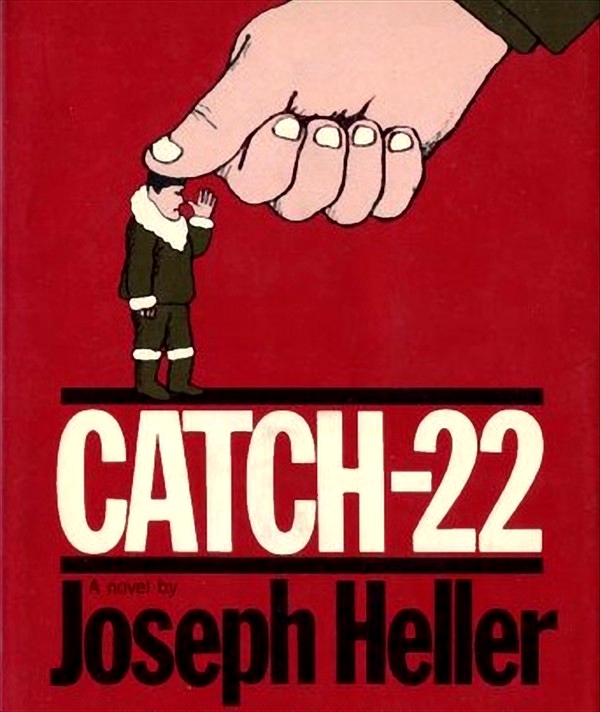
No, this isn’t satire, and Joseph Heller, author of Catch-22, didn’t coin the phrase “indefinite temporary.” It’s a capsular commentary on the state of our courts, however, that actual judges can actually use a phrase like this in actual rulings that affect actual people.

That these judges can actually get away with it says a lot about the state of our press, too.

The injunctive process is rife with oxymorons. Among this writer’s favorites is “speedy justice” (a phrase used by his own most recent judge to excuse carelessness). Restraining order courts are home to findings like “vegetarian stalker” and “handicapped batterer.” Trials in this arena operate in a vacuum (as law professor and former ACLU staff attorney Aaron Caplan observes); there is no oversight or accountability, and “meritorious” grounds for appeal are few, so judgments seldom receive scrutiny by the higher courts at all, and published rulings are scant. (Appellate courts don’t rehear cases; they only rule on the conduct of judges. Patent absurdities and abject fraud may be winked at…and legally.)
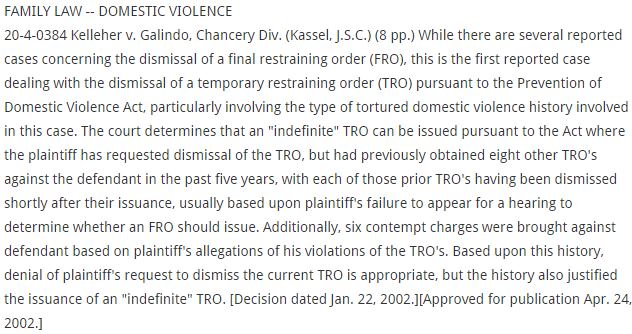
This post concerns a New Jersey family court ruling in the case of Kelleher v. Galindo. The case is 13 years old. That’s how asleep at the wheel our popular press is.

Follow the link to the case above, and the first sentence you’ll see in the ruling is this: “No appearance by Plaintiff. No appearance by Defendant.” That’s right, no one actually appeared in court, but a restraining order was issued anyway…an “indefinite temporary” one.

The plaintiff in the case petitioned nine restraining orders against the defendant between the years of 1996 and 2002, and in each and every instance, the order was dismissed, in most cases because “plaintiff [the person who petitioned the order] failed to appear at the hearing”; in a couple of cases, because she requested a dismissal.

The reasoning of the latest judge’s ruling runs thus (emphases added) and should be heard in the voice of a character from Alice in Wonderland:

This court has no doubt that if it were to grant plaintiff’s request to dismiss this most recent TRO [temporary restraining order], it would not be very long before plaintiff was back in the Cherry Hill Municipal Court seeking a tenth TRO against defendant.

[…]

It is this court’s opinion that, despite plaintiff’s telephonic request to dismiss this most recent TRO, the plaintiff’s past history of obtaining eight TROs against defendant in a five year period, all of which were dismissed prior to an FRO hearing [final restraining order hearing], along with six prior contempt charges filed against defendant based upon plaintiff’s allegation of violations of those TROs, all of which were likewise dismissed prior to an adjudication, justifies this court’s denial of plaintiff’s request to dismiss the TRO and instead justifies the issuance of an indefinite TRO.

There was no determined basis for an order and no basis for a ruling (in the absence of the litigants in the case). “Therefore” the judge, Michael J. Kassel, ruled that the latest temporary order be indefinitely sustained.

In the interest of economy, that is, the court determined itself justified in issuing an order contrary to the plaintiff’s express wishes and without any trial at all.

Copyright © 2015 RestrainingOrderAbuse.com

*The judge’s legal contortionism is illuminating. Because the judge couldn’t “justify” entering a “final ruling” in the absence of the parties but plainly wanted to, he circumvented the rules of civil procedure and made a “temporary” order permanent (instead of, for example, sanctioning the petitioner of the nine orders for “squandering judicial and law enforcement resources and diverting attention from urgent and meritorious domestic violence matters”). This provides other judges with a precedent to cite to justify violating other defendants’ due process rights, limited as they already are in this process.