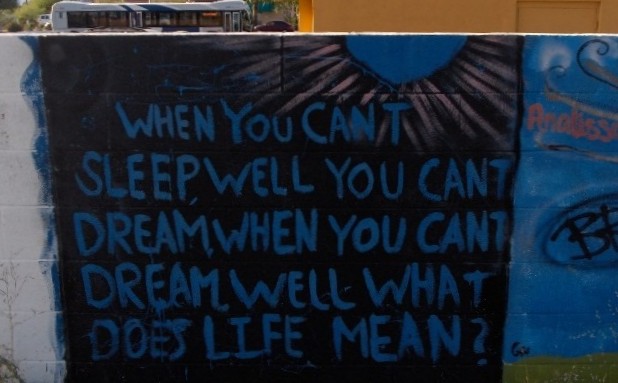
“When You Can’t Dream Well, What Does Life Mean?”: Revisiting Legal Abuse Syndrome

A past series of posts on this blog introduced Legal Abuse Syndrome (LAS). Two of the posts detailed its effects: “Courthouse Violations and PTSD: What Is ‘Legal Abuse Syndrome’?” and “Abandon All Hope Ye Who Enter Here: The Hell of Legal Abuse Syndrome.”

This panel of a mural I encountered recently while walking aimlessly with my dog, who has grown aged since our lives were derailed by legal frauds beginning nine years ago, sums up those effects succinctly.

Copyright © 2015 RestrainingOrderAbuse.com

ManBoobz and Subreddits: Why Your Abuse by the Justice System Is Less Important than a Communal Toilet


“Man Boobz has a contingent of MRA commentors, but he has never (to his knowledge) changed any of their minds.”

Kate Donovan, TeenSkepchick.org

Even at the risk of giving the impression that what the epigraph means is worth understanding, I’ll interpret: ManBoobz.com is the domain name of a website that mocks “MRAs” or “Men’s Rights activists.” (The grammar of the quoted writer, Kate Donovan, also humorously suggests “Man Boobz” is a nickname of the website’s author, David Futrelle—which, admittedly, is why I lifted the sentence.)

If you’re like me, you’ll be filing this information under the mental tab WHATEVER. So why do I bring this up?

In recent weeks, I’ve corresponded with and written about

This is besides digesting copious nauseating and desolate reports of abuse compounded by legal fraud submitted by both men and women. A respondent the other day, for example, reported she’d been chronically forced to have sex and was then issued a restraining order petitioned by her rapist, who endeavors to expel her from the life of an older woman she nurses, an older woman she loves and thinks of as her “grandmother.” The man has also cost the girl work by telling people she’s crazy. He’s apparently concerned she might pose a risk to his inheriting the older woman’s estate…besides concerned she might expose him as a rapist.

Dilettante demagogue Dave Futrelle has “document[ed] and mock[ed]” male complaints of injustice since 2010. Today a fulltime heckler, he supports himself and his cats with advertising revenues and online donations from feminist fans.

In writing about the black dad who now has an “18%” share in the lives of his two infant boys (“who go insane when I have to drop them back to their mother”), I was moved to criticize the rhetoric of the Southern Poverty Law Center, which represents itself as a civil rights advocacy group. The SPLC publishes a page called, “Misogyny: The Sites,” that suggests opposition to feminist-inspired legal travesties (for instance, the restraining order) is motivated by hatred of women, and on this page it refers approvingly to ManBoobz.com, the site introduced above.

The domain name ManBoobz.com leads to the blog We Hunted the Mammoth, whose title is apparently a lampoon of the titles of “MRM” (Men’s Rights Movement) blogs like Return of Kings. “We Hunted the Mammoth” is meant to suggest the Men’s Rights people are Neanderthals. Yuk-yuk.

If you’re a parent who’s missing his or her children, an abused (former) spouse or boy- or girlfriend who’s now homeless or living “like a hamster” consequent to misapplications of the law, or a senior who’s been bullied into cowering behind his or her blinds, this post is to make you aware of the trash talk that has cost you what you valued most; that talk is what informs pop culture sentiment and diverts awareness from your torment.

The anti-MRM crowd—of whom David Futrelle, author of We Hunted the Mammoth, is apparently a bellwether—represents the complaints of men/fathers to be unprovoked hate rhetoric (and anyone, man or woman, whose complaints are identified as corresponding to MRM complaints is simply lumped in). Calling complaints of state-sanctioned abuses “misogynist” makes them easy to dismiss. The conclusion that complaints are “misogynist” is plainly superficial but not unpredictably embraced by feminist partisans.

Here’s a snippet from a recent post on We Hunted the Mammoth (selected because I don’t have the stomach to stick my hand all the way into the bowl):

Men’s Rights Redditors agree: it’s tough to be a man. Well, a cis man, in any case. And those silly trans people are making it worse.

On the Men’s Rights subreddit, one concerned fellow has discovered a possibly insurmountable obstacle standing in the way of true gender equality: A “Women’s Room” at the University of Queensland that, as a sign on its door notes, is open to “trans*, intersex and genderqueer people as well as cis-females.” The horror!

The post concerns a sign on the door of a University of Queensland toilet. That’s right: a toilet.

(Apparently chemical prefixes are now used to distinguish different “gender types.” A “cis” is what most of us would naïvely call a heterosexual man or woman.)

Here’s an excerpt from another post:

Yep, I reported the 100% true fact that a Youtube bloviater named Aaron Clarey had written a post on Return of Kings urging men, in his words, to “not only REFUSE to see the movie, but spread the word to as many men as possible.” I described his readers on Return of Kings as misogynists, not MRAs, though clearly there is a massive overlap between those two groups.

The idea that this was specifically a Men’s Rights crusade was, to be sure, a bit of sloppiness on the part of the journalists writing about it, who are not quite as familiar as some of us are with all the different varieties of woman-hating shitheads there are in the “manosphere”—especially since their belief systems overlap considerably. As I noted in a previous post on this subject, writing about Esmay’s accusations against a writer for the Huffington Post,

It’s true that the HuffPo writer, in the original version of her piece, wrongly described the MRA-adjacent Return of Kings—which has urged a boymancott of Mad Max Fury Road—as a Men’s Rights site proper. There are in fact some differences between ROK and AVFM. For example, while AVFM writers have declared women to be “obnoxious cunts,” who control men with their vaginas, ROK writers have suggested that women are actually depraved, disloyal sheep.

You can almost forgive journalists for getting a bit mixed up.

The post has something to do with a recent movie (Mad Max: Fury Road). As of this composition, it’s been tweeted 27 times and circulated on Facebook 98 times. It was more popular than the toilet post…maybe because it has dirty words in it.

The writing is virtually indecipherable to outsiders but communicates the nature and maturity of the “discourse” (i.e., teenage). This sniping has “evolved” (or escalated unchecked by the reproofs of grownups) to the stage that it has its own jargon and insider acronyms.

Noteworthy is that Mr. Futrelle’s tirades are in each instance against a single person: “one concerned fellow” and “a YouTube bloviator.” Whether these two men represent the “Men’s Rights Movement” is clearly questionable. Here, incidentally, is a clipping that shows topics surveyed on the Men’s Rights “subreddit” (r/MensRights) that Mr. Futrelle criticizes, topics that paint a different picture from the one his writing does.

Among the members of this so-called collective of haters who posted yesterday are a “self-reflective feminist,” a defender of an elderly man with dementia who was reportedly assaulted, and a father who alleges he was falsely accused of child abuse.

Issues these posts purport to concern seem no less worthy than those feminists raise. Mr. Futrelle nevertheless categorically calls contributors a “hate group,” as does the Southern Poverty Law Center. Ms. Donovan, the girl or woman quoted in the epigraph, offers this interpretation:

MRA stands (loosely, and inaccurately) for the Men’s Rights Activists. More correctly, the MRA movement has enveloped a terrifying sector of the population that feels women and particularly feminists are devoted to squashing the given rights of men in every way. This ranges from belief that women deserve abuse to abusing evolutionary psychology to claim that women are just genetically inferior and will remain that way.

While you, the reader of this post, perhaps sit huddled in a dark corner wondering at the maliciousness of Fate, wondering whether your estranged child or children are safe, wondering if you’ll ever vigorously embrace life again—this is how your pain is perceived (or at least represented) by the feminist “smart set,” which celebrates specialized toilets and mocks you as a “misogynist” and a crybaby.

Copyright © 2015 RestrainingOrderAbuse.com

*Consider this woman’s post to the “subreddit” r/AskFeminists: “Why do Feminists hate ‘MRAs’ and portray them poorly?

You Don’t Want to “Be a Part of It”: Commentary on New York’s Protection Order Biz

I corresponded with a man last year, a man in a homosexual relationship, who was assaulted by his partner severely enough to require the ministrations of a surgeon. His boyfriend was issued a restraining order coincident to his being charged with assault. That’s how it typically works in New York: A protection order is issued following a criminal complaint.

The man who wrote reported that he contacted the violent partner while the order was in effect to impress upon him how badly he had been hurt. The boyfriend used the contact to have the assault charge reduced and to obtain a protection order of his own, which he then abused serially to drive the man he had assaulted from his job and eventually from the state. This only required that he repeatedly claim he felt threatened, which is what he did. (According to the man, “The DA did not even try to substantiate my ex’s allegations and pursued the case to the utmost of his ability.”) The law licenses “mandatory arrest” under such circumstances. Arresting officers told the man all they needed was his accuser’s statement. (It didn’t matter who the actual victim was.)

The man was badly traumatized, at least as much by the lies and legal abuse as by the violence. Though he can’t look in the mirror without being reminded of it—one of its mementos is a scar under his eye—the effects of the violence subsided; the lies and legal abuse eventuated in his public disgrace, alienation from his friends, his being arrested at his place of work, and his being asked to leave by his employer after his business dried up and he had accrued massive debts, including from legal fees and medical treatment for PTSD and depression. He says he developed “terrible agoraphobia” (“afraid I would inadvertently run into my ex and have him accuse me of anything just to have me arrested yet again”) and continues to suffer nightmares (“that cause great daily despair”) even now—in another state where he fled to the safety of his family and where he gets by on disability insurance while he plots a reemergence secure from the risk of further legal assaults.

His story, which has here been stripped of detail to preserve his confidentiality, should serve to inject some color into the black-and-white tutorial on New York protection orders that’s examined below.


I digested a page on protection orders recently that was prepped for the New York Court System by the very earnest Judge Penelope D. Clute. It obliquely highlights absurdities in the system that merit some remark.

According to the judge, there are two types of protection orders: “stay away” orders and “refrain from” orders.

The former are pretty straightforward in their prohibitions:

  • No physical contact of any kind.
  • Stay away from the home, school, business or place of employment of the person named in the Order.
  • No phone calls.
  • No letters, emails, or faxes.
  • No messages through other people.
  • No presents.
  • No contacting the person in any way at all, even if you are invited to talk or meet by that person.

Note the last line—and note that it is the last line.

It acknowledges that people who are nominated “victims” on protection orders may entice their “abusers” to contact them. The quotation marks around the words victims and abusers in the previous sentence are there to stress that the language used by the courts and inscribed in the law is suspect. The court itself recognizes that there are cases when “victims” invite “abusers” to chat or hang out (or move in). As the story that introduces this post shows, besides, there are instances when actual victims seek the understanding of abusers, and this may come with its own host of complications and horrors.

Attorneys like these know very well that allegations of abuse may be hyped or fraudulent.

Unstated in Judge Clute’s bullet list is that the burden of blame falls on the accused even if s/he’s invited to violate the court’s order. Unstated but implicit is that “victims” may not be victims, and “abusers” may not be abusers. Entirely unconscious is that telling people whom they are or are not “permitted” to send a message or gift to contravenes the basic principles of liberty we define ourselves by and pride ourselves on. Restraining orders obviate the chance of reconciliation between parties in conflict by criminalizing contact and making what may be strained relations wholly and possibly virulently antagonistic.

(But, I hear you counter, you sacrifice your freedom when you violate the law. The issuance of a restraining order may be in conjunction with a criminal case, as it commonly is in New York, or it may not bedoesn’t necessarily require proof conclusive of anything; isn’t itself a criminal judgment but an admonitory one; and may be grounded on cranky interpretations of perfectly lawful acts, on lies constituting fraud, or on mere finger-pointing and a few moments of the court’s attention only. The issuance of a restraining order is, however, regarded as a criminal judgment, even in the absence of a criminal charge, and a finding that the order was violated is a criminal judgment. Appreciate that a violation could be the “abuser’s” calling the “victim” and reporting, “Your dad phoned and says your mom’s been in an accident.” A restraining order makes that act criminal, and the court’s prohibitions aren’t negotiable. Restraining orders make perfectly lawful acts, even morally imperative acts, criminal ones, ones you may be arrested for, denied jobs and housing for, and/or deported for.)

These contradictions will likely be familiar to the repeat reader.

Fascinating to learn of was New York’s “refrain from” order. Its contradictions are less likely to be familiar. According to Judge Clute, if you’re issued a “refrain from” order, “you can live together and have contact, but you’re prohibited from harassing, intimidating, threatening, or otherwise interfering with the person protected by the Order.”

This means, evidently and bizarrely, that there are people dwelling under the same roof as their accusers who may be cited for criminal contempt if an accuser calls and reports them for “harassment” that occurred, for example, in the hallway or the kitchen. The implications, which are fairly stunning, bring to mind the phrase “sleeping with the enemy.” The law invests its complete faith in the virtuousness of accusers’ motives. What will be plain to anyone who’s been falsely accused is that an accuser who’s been granted a “refrain from” order and resides with his or her “abuser” holds the life of the accused in the palm of his or her hand.

A writer for the feminist house organ Jezebel might ask, “Why would anyone make a false accusation of harassment, intimidation, or threat? What could be gained by that?”

Since feminists aren’t actually obtuse, the question doesn’t require an answer. Pretending, though, that they are obtuse, here is one: A residence could be gained by making a false accusation. Property could be. Children could be. Revenge could be (see the introduction above). Attention could be. The list goes on.

Judge Clute wraps up her tutorial on protection orders with this advice on “How Defendants Can Avoid Problems,” which reinforces the earlier observations that “victims” may call their “abusers” or otherwise attempt to reconcile, and which notes, besides, how a court order may stir conflict and confrontation with “family or friends.”

  • Do not go to places where you know the other person goes.
  • Leave a building, restaurant, store, or other place if you realize that the other person is there.
  • Hang up the phone immediately if the person calls you. Record the call on your answering machine, if possible. Tell your lawyer about the call.
  • Do not send letters, emails, or faxes to the other person and do not respond if that person sends one to you. Give your lawyer any message you receive from the other person.
  • Do not get into arguments or confrontations with the person’s family or friends. Walk away. Try to avoid them completely.
  • Do not get together with the other person, even to apologize or to try to work things out unless the Judge has dropped the Order of Protection.

Everything that makes these bureaucratic intrusions and impositions ridiculous is right there on the page.

Remember: If you spot your accuser, run away and hide! If s/he calls, hang up immediately (and call your lawyer posthaste)! Alsono sending presents!

Should such a debasing and debased statutory process really be one embraced by an enlightened citizenry?

Copyright © 2015 RestrainingOrderAbuse.com

*The author of this post has listened to National Public Radio for about 20 years (and done The New York Times crossword for at least as long). If a cosmopolitan New York doyen(ne) of the art world, someone with the right background and the right associations, were saddled with a protection order based on false accusations (which are easily staged or concocted and may be heinous or a foot in the door for the commission of years of legal abuse), it might be treated on an NPR program (or in The Times) like a rare and inexplicable bird sighting, and the torments, indignities, and privations of the sensitive, cultivated victim of this “anomalous” miscarriage of justice likened to those suffered by a detainee in a Siberian gulag. It’s estimated that millions of restraining orders are issued in this country each year, and it’s posited that a majority are based on hyped or false claims. It’s further speculated by this author that only a tiny minority of the country’s privileged class are victims of such frauds.

The Question of “Angry White Men” and Complaints of Procedural Abuse

I started to include the contents of this post in the last one, “Why More Falsely Accused Don’t Speak Out.” Then I thought the topic of angry white men might be due some room of its own.

The previous post outlined reasons why men and women who’ve been victimized by false accusations and procedural abuse are subdued from voicing their outrage publicly. This post criticizes how victims who have expressed their pain and fury have been perceived and treated.

What complaints have emerged in the past couple of decades have been derogated as the rants of “angry white men” (Google this phrase, and you’ll see what I mean; it’s even the title of a 2014 book). Complaints have been dismissed, that is, as nothing worthier of consideration than the cranky kvetches of the disenfranchised “patriarchy,” yesterday’s top dogs said to resent their loss of dominion.

What members of angry white men’s and fathers’ groups are said to object to really is not their being unjustly vilified, kicked to the curb, impoverished, and stripped of roles in their children’s lives (pfft) but their loss of power and status.

It’s an attractively tidy idea and syncs up with feminist dogma nicely, but it’s critically shallow, besides ethically and empathically vacuous.

One thing the conclusion ignores is culture. Consider the Jews you may know, or the Koreans or the Pakistanis. Do you reckon restraining orders, for example, or domestic abuse allegations are as commonly brought against Jews or East Asians as they are against whites? Would the action be as countenanced in these ethnic communities, whose members may be more accountable to the judgment of other members and whose community conscience may forbid the public airing of familial discord?

Now it could be true that entitled white men, as members of the patriarchy or former patriarchy, are meaner and feel freer to be abusive than Jews and East Asians. Certainly that’s arguable, but it’s not necessarily arguable on the basis of reports of abuse, because it could also be true that entitled white women, as the usurpers of patriarchy (and as white women), feel freer to exploit feminine advantage and cry wolf than Jews and East Asians do.

Consider that feminism—the origin of the characterization angry white men—is criticized even within its ranks as ethnocentric, i.e., Whitey McWhite. If white women are those who are preponderantly pro-litigation, thanks to white feminist indoctrination into the culture of victimhood and “empowerment,” then who would you expect to be a majority of the targets of procedural abuse?

Those who posit that complainants of courthouse dirty dealings are predominately angry white men aren’t necessarily wrong, but they may be right for reasons they haven’t considered.

Another one of these reasons is entitlement.

Has it occurred to them, I wonder, that only white people may feel entitled to complain publicly? Do they really imagine that certain minorities aren’t that much more vulnerable to legal abuse, or that they’re not invisible and mute because of their self-perceived or actual lack of entitlement? People who’ve traditionally been the system’s goats aren’t people eager to stick their necks out. They never had faith in social justice.

If you allow that a majority of entitled victims of procedural abuses are white men, then it stands to reason that a majority of complainants of procedural abuses will be white men.

It further stands to reason that these white men, who had been conditioned to the expectation of justice, should feel disappointed…and angry.

Copyright © 2015 RestrainingOrderAbuse.com

*The book Angry White Men: American Masculinity at the End of an Era (2014) is by sociologist Michael Kimmel. Dr. Kimmel is a New York Jew with a Ph.D. from Berkeley. His book was reviewed in The New York Times by Hanna Rosin, a Stanford grad, a senior editor at The Atlantic, and the author of The End of Men and the Rise of Women. Ms. Rosin is also Kimmel-Rosina New York Jew. While neither one’s conclusions can be dismissed offhand, their cultural and class remove from the subjects of Dr. Kimmel’s book makes their identification with those subjects suspect, and Ms. Rosin’s objectivity and access are plainly dubious. From Ms. Rosin’s review: “Kimmel’s balance of critical distance and empathy works best in his chapter on the fathers’ rights movement, a subset of the men’s rights movement. Members of this group are generally men coming out of bitter divorce proceedings who believe the courts cheated them out of the chance to be close to their children.” Contrast this confidently categorical interpretation of men’s and fathers’ complaints to this firsthand account by a father who was ruined by “bitter divorce proceedings”: “The ‘Nightmare’ Neil Shelton Has Lived for Three Years and Is Still Living: A Father’s Story of Restraining Order Abuse.” A comment on Amazon.com credits Ms. Rosin with being sensitive to “real women’s experience.” The story highlighted in the previous sentence chronicles a real (angry white) man’s—whose telephone number is provided in a comment beneath the post.

Why More Falsely Accused Don’t Speak Out

If procedural abuses are epidemic (and they are), why do so few vociferously complain? Why isn’t the Internet inundated with personal horror stories (and why aren’t state representatives’ in-boxes choked with them)? We purportedly enjoy the privilege of free speech, so why isn’t it exercised more?

The absence of rampant complaints of procedural abuse is misleading. Limitation of complaints to sketchy e-petitions and forum comments, often anonymous, makes them suspect and easily discounted by those with a political interest in discrediting them.

The dearth of forthright exclamations of abuse and injustice, however, is easily understood.

Rather than consider who isn’t talking back, consider who does. What distinguishes these men and women from what may be hundreds of thousands or millions of victims of false, exaggerated, or misleading accusations to the court?

For one, most of them are childless or without young children. They don’t face being further deprived access to their kids if they buck the system. Those with minor children who do speak out have often been denied all rights to their kids, anyway; they have nothing left to lose.

Too, most of them work for themselves. It’s a fact that restraining orders influence employers. Furthermore, studies have shown that employers are influenced even by Internet disclosures by employees or potential hires that may be negatively perceived by the public. Human Resources personnel are paid to snoop around. Mere injudicious comments on Facebook may be hazardous to job opportunities and careers. Declaring that you’ve been judged to be a stalker, for example, or a domestic or child abuser has obvious and grave drawbacks, never mind if you’re also construed as a wacko because you vehemently insist online that your accuser’s psychopathic. This is an express train to sleeping in a refrigerator box.

Women aren’t immune to false accusation. They’re a minority among its victims, and that status is itself isolating (from a community peopled mainly by men who resent women and the favored political status they enjoy). Many respondents to this blog are female—maybe most. By and large, however, women may feel like interlopers in male-dominated discussions, and women’s advocates, whom they should be able to turn to, don’t want to bring scrutiny to bear on the question of procedural abuse (which is mostly by women).

People who may be foully wronged and branded with accusations that may daily tear at them are coerced into silence by the feared repercussions of ventilating their rage and anguish. Their false accusers, moreover, may be violent people or, for example, extremely vindictive ones, and the accused may fear for their safety and their children’s safety, or fear further legal abuse, which can be endlessly renewed, particularly after false accusations have once stuck, and which can result in incarceration—possibly meaning loss of a single parent’s child(ren) to the state—or financial hardship or ruin. The falsely accused are squeezed between a rock and a hard place.

As you might imagine—and it’s okay to try imagining even if it goes against your partisan loyalties—this creates a hell within a hell.

Probably most of the falsely accused, besides, are not trained writers (like the loudest voices that discredit people in their shoes are) nor among the politically privileged class, whose members are typically the most able to free themselves from false accusations in the first place. They’re not suave, and they don’t possess the kinds of credentials that make people think twice.

(Also, ironically, the people who do possess the kinds of credentials that make people think twice but who fail to deflect a false finger of blame are often sensitive to “social decorum” and may be loath to air dirty laundry.)

Public outcry, finally, is discomforting to family and friends (and their family and friends). It compounds the alienation and isolation of false accusation with alienation from those who believe in you; they sidle away.

In a nutshell, it’s not merely coincidental that those few who do elect to talk back are mainly single, independently employed, without small children, white…and male. Men don’t fear violent retaliation from their false accusers, usually, and they may have nothing left to be stripped of except the lingering expectation of justice.

Copyright © 2015 RestrainingOrderAbuse.com

*Bearing the foregoing in mind, it should be no surprise that the preponderance of publicized outrage originates from “just folks” who aren’t distinguished and who are easily dismissed (and mocked) as “rabble.” What should be a surprise is that their detractors are often those who are supposed to be looking out for them, for example, civil rights advocates like the ACL(where R)U and agents of the popular press.

If You Doubt the Grief Caused by False Accusation, Consider the Whimpers of False Accusers When THEY’RE Exposed

Forthcoming posts on this blog will consider character assassination, and they will critique one of the many execrable ironies of the civil restraining order process. It is possible to falsely accuse a person of anything—literally anything (mooning the neighbors, groping children, chewing the ears off of puppies, rape, you name it)—and the act of false accusation, which is universally deemed a statutory crime (perjury), is not sanctioned by the court. The falsely accused, what’s more, cannot litigate the crime of perjury him- or herself nor apply to the court for relief from the falsehoods or an award for the damages they do, which may include PTSD, loss of home, and financial ruin. But…but if the falsely accused exercises his or her constitutionally protected right to free speech and exposes his or her false accuser, which is his or her only lawful defense (and a feeble one at that), this act may paradoxically be construed as “character assassination” by state prosecutors and judges. This post will ease into the topic of character assassination gently.

An alternative way of understanding the pains inflicted by false accusation, if you’re among the compassionately challenged, is to consider the complaints of those accused of falsely accusing.

They don’t like it much when the table is turned.

A woman I’m in correspondence with and have written about was accused of abuse on a petition for a protection order last year by a scheming long-term domestic partner, a man who’d seemingly been thrilled by the prospect of publicly ruining her and having her tossed to the curb with nothing but the clothes on her back. He probably woke up each morning to find his pillow saturated with drool.

The woman he accused, meanwhile, probably didn’t sleep at all during the weeks of purgatory between the accusation and her hearing. For a while, she had to worry about where she’d be able to sleep.

She successfully had the protection order dismissed and has since publicly exposed her false accuser. She’s also filed a lawsuit and endeavors to have the laws in her state amended so people like her ex face consequences for defrauding the court (which at present they never do…anywhere). After her exoneration in court, she says her ex starting circulating it around town that she tried to kill him.

Now her former boyfriend complains that the stir she’s caused by expressing her outrage in public media is affecting his business, and he reportedly wants to obtain a restraining order to shut her up…for exposing his last attempt to get a restraining order…which was based on fraud.

He feels defamed, you see.

Public exposure is not the same thing as being put on the legal rack, but, oh, how those outed for lying will snivel and pule. They expected their testimony would be neatly kept under wraps, and it’s just…not…fair!

Anyone who doubts or misconceives the torments of legal abuse need only look to the whiners who object to being revealed as its perpetrators to be disabused of illusion.

Copyright © 2015 RestrainingOrderAbuse.com

*First Amendment advocate Matthew Chan, who recently prevailed in a protection order appeal before the Georgia Supreme Court, keeps a constant vigil over what’s said about him by his own accuser, who reportedly began a social media campaign to reboot the conflict after the court ruled against her. Larry Smith, who authors BuncyBlawg.com, was ordered to show cause in 2014 why he shouldn’t be censured for writing about his false accuser, a disturbed woman who complained of grave emotional distress. A sometime commenter here, Sean Heeger, has had a restraining order against him extended, has been jailed, and has had his character and sanity impugned for talking publicly about legal abuse. Neil Shelton, who was jailed for a year, alleges his (now ex-)wife’s divorce attorney, a state congresswoman, conspired to frame him as a terrorist to shut him up after he ridiculed her on Facebook for her efforts to frame him for various violations of a restraining order obtained on false grounds (Neil represented himself in six hearings and each time won). Though Neil’s case is extreme, cases like these are exceptional only insofar as the victims of legal abuse have elected to speak out.

“Asia’s Law”: A Bereaved Father’s Proposal to End Parental Alienation

“Parental Alienation is an act of child abuse, and an attempt by one parent to sever [a] child’s ties with the other parent.”

Steven Foxworth, DaddysHeart.com

Steven Foxworth had a beautiful daughter, a beautiful daughter whose life he had been excluded from for 12 years, and a beautiful daughter he will never see again.

Nor will anyone else.

Asia Danielle was killed in a car accident in 2011 at the age of 16, and Mr. Foxworth didn’t learn of his daughter’s death until eight months later. Even if he had chanced to see the headline of his daughter’s obituary, published in another state, he may not have recognized it as hers, because his daughter’s name had been changed, which is why his attempts to find her over the years proved fruitless.

Asia Danielle Foxworth a.k.a. Danielle Westbrook was tragically killed in a car accident in 2011. Her father, Steven Foxworth, was informed of his daughter’s death by a mailed notice asserting that he had no entitlement to her estate. Mr. Foxworth was unlawfully denied any contact with his daughter for 12 years and wasn’t told her name had been changed.

For most of her brief life, the girl Mr. Foxworth had known as Asia Danielle Foxworth was Danielle (“Danni”) Westbrook.

After Mr. Foxworth separated from Asia’s mother in 1998, he was “threatened to stay away from his own child’s daycare that he enrolled her in.” Mr. Foxworth petitioned the court and succeeded in having his parental rights acknowledged “concerning phone/standard physical visitation, and full access to all pertinent info, i.e., school and medical records,” but Asia’s mother, Rusty Dawn Skipper, was granted full custody, and she moved to North Carolina and, according to Mr. Foxworth, declined to observe the court’s order that Asia be brought to Georgia for visitation with her father. She furthermore provided Mr. Foxworth no contact information and in 2000 changed Asia’s surname to Westbrook, that of her then fiancé, without Mr. Foxworth’s consent.

Though he paid child support, never knowing if it reached its intended recipient, the only communication Mr. Foxworth received from Asia’s mother concerning his daughter in 12 years was a legal notice, sent after his daughter’s death, apprising him that he had no claim to her estate.

That’s how the mother of his daughter informed Mr. Foxworth that his daughter was gone.

Mr. Foxworth reports that even seven months after Asia was killed, her maternal grandparents represented her as living when he contacted them, which he had faithfully done for years, even annually singing “Happy Birthday” on their answering machine, hoping the song would be shared with his estranged daughter.

Mr. Foxworth’s is a poignant story of a father’s alienation from his child that includes collusion by family members and the state. A more detailed version can be found on Mr. Foxworth’s tribute to Asia, DaddysHeart.com, under the tab “Asia’s Law.”

“Asia’s Law” is Mr. Foxworth’s proposal to stop parental alienation.

“Asia’s Law” will stand on the principle that no one parent has the right to infringe upon the legal parental rights of another parent.

“Asia’s Law” will promote the enforcement of standard child visitation for noncustodial parents as rigorously as child support is enforced for custodial parents. There will be a governmental arm that works with Child Support Enforcement Services that regards court-ordered visitation as seriously as child support arrearage. In the current construct, the message is sent that the value of money to take care of a child is more important than the value of a child’s having the love, affection, and guidance of his or her other parent.

“Asia’s Law” will also make it illegal for a custodial parent to change the name of a minor without the other natural parent’s consent—in any state.

Additionally, “Asia’s Law” will mandate that a non-custodial parent give blood (except in cases of religious exemption) so that if a child needs blood for any medical reason, it will be there for him or her.

“Asia’s Law” will save lives—emotionally and physically. We need this law passed to protect families.

My daughter, Asia Danielle Foxworth (“Danielle Westbrook”), is no longer here, but if there had been a law like this in place while she was living, she could not have been kept from me—under the radar for 12 years. Further, her “name change”—save legal adoption (which I would not have consented to)—could never have been permitted. Lastly, if my daughter would have survived her fatal car accident and needed blood, she could have had mine, providing it was stored for her. There are also children who have natural ailments; blood donation from a natural parent could save their lives, even if that other parent lived in another state. Too many are suffering. We need “Asia’s Law” passed. I have my story, but there are countless others. Parental Alienation is an age-old phenomenon and stereotypes typecast parents, especially fathers. The bottom line is no child should be kept from a loving parent—illegally and/or out of spite. If through “Asia’s Law” families are reunited, the rights of noncustodial parents respected, and lives saved, my daughter’s transition will not have been in vain.

~Steven Foxworth

Copyright © 2015 RestrainingOrderAbuse.com

*Compare Mr. Foxworth’s story of parental alienation to that of estranged father Neil Shelton: “The ‘Nightmare’ Neil Shelton Has Lived for Three Years and Is Still Living: A Father’s Story of Restraining Order Abuse.” Attention to Steven Foxworth’s story was brought to the author of this blog by the Georgia-based Kayden Jayce Foundation, a nonprofit devoted to remedying parental alienation and legal abuse.

In Its Condemnation of the Men’s and Fathers’ Rights Movements, the Southern Poverty Law Center Has Institutionalized Bigotry and Hate (Including Racial Bigotry and Hate)—Here’s How

There are prominent voices on the Internet, in the ivory tower, and in the press that disparage the plaints of fathers who are alienated from their children by lies and legal abuse, and denied roles in their kids’ lives. They call these fathers’ ventilations of despair and anger “misogynist,” and they look no further.

This post criticizes one such voice, possibly the loudest among them.

The Southern Poverty Law Center equates complainants of legal abuse—male ones, that is—with racists, and it’s taken seriously. It commands social prestige based on its illustrious history of combatting racial hate and violence.

I hope the outraged title of this piece reaches its attention, because the story below exemplifies a modern manifestation of racial bigotry and violence, and it’s one the Southern Poverty Law Center scoffs at and ridicules.

It’s one the Southern Poverty Law Center vociferously fortifies.

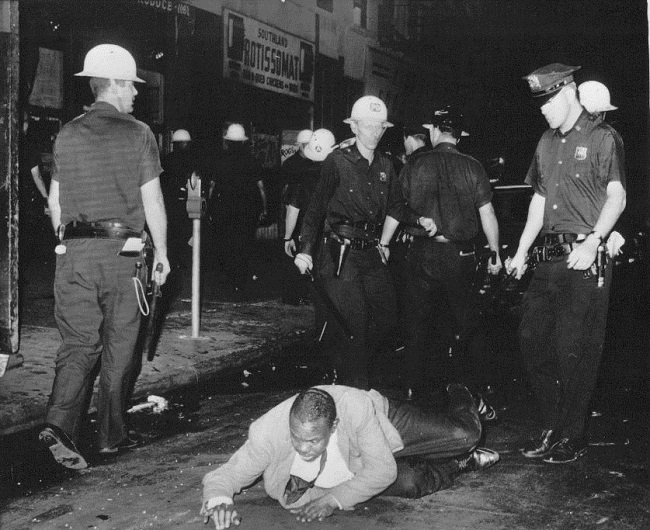
The following account, which echoes others and which includes a casual assault of a black man by police based on false allegations by his white wife, was submitted to this blog on April 27, 2015, by a father of two young children who is not a violent man; he just misses his kids and is in perdition. (What this man will be five years from now—or whether he will be five years from now—is another question all together. A man may be taunted like a dog chained to a post. Then when he snaps, there are those content to judge him mad and urge that he be put down.)

Advocacy groups like the Southern Poverty Law Center presume to blame without listening to the details. This is what the details sound like (trigger alert: real life):

Hello. Anyone out there who can help a man who is at the saddest hour of his life? For I feel life is not even worth living at this point due to the evil and malicious acts of my wife.

We had been talking about a divorce for the last year and a half as we have been married for four years and been together since we were 22—for 16 long years. We have a two-year-old and seven-month-old, both baby boys. My wife has rage issues and extreme hormone issues…and she’s clearly depressed, and I cannot help her anymore.

When our marriage became a sexless one, we agreed we were just roommates taking care of the children until we started our divorce. My wife was contacted by a jealous woman who wanted to destroy my life because I would not leave my wife to be with her. She told my wife all sorts of lies. The next day, my wife filed for divorce but also filed a fake restraining order to ensure I burn in hell, and it’s working.

My wife didn’t come home with the kids on Friday evening after picking them up from daycare. No calls, no answer, nothing. I called daycare, and I was advised that my wife picked the kids up with her mother around 4 p.m. We live in L.A., and her mother lives in Ohio, so I was like, “Her mother? I didn’t know she was in town.” It’s now about 11:30 p.m., so I call the hotel her mother usually stays at around the corner on Sunset Blvd. My wife answers and says, “My mother came in town to help us. She’s concerned about us.”

I told her to bring the kids home because she didn’t pack any Pampers or a change of clothes for them. She said, “I’ll be home in the morning.” The next day, they still were missing. I left to run errands, and my wife called about 6 p.m. saying she was back home. When I got back home, the locks to my front door were changed. I banged on the door demanding to be let into my own house and see my boys. Her mother, who was visiting, said, “Go away. She doesn’t want you here.”

I called the cops and went downstairs to wait.

When they arrived, a cop instantly started attacking me and beating me. I screamed, “I called you to help me get in my house!” He was rude, beat me and cuffed me, then put me in the back of a patrol car. I was in there for about 20 minutes.

Finally, I was let go—un-cuffed, bleeding, stepping out of the police car—and her mother is outside the police car and says you’ve been served, and hands me a packet of paperwork. I thought WTF? a divorce, cool, no problem, but it was a restraining order claiming I had done physical violence to my wife for years and years. I never ever breathed too hard on my wife, so how could she make such claims? I lost my breath for a few seconds in disbelief.

I had to leave my house as was, no money, in flip-flops and shorts, no credit cards, no suits for work, no children, no food, nothing. I was threatened with jail if I even tried to call her or stopped at my boys’ daycare. My hearing wasn’t for another 25 days.

I thought, what can I do? This is hell being homeless, but most of all I am the full-time dad and mom to our boys. I do all the cooking, cleaning, dishes, shopping, putting to bed, baths, everything. My wife has given the boys a bath maybe three times in their entire lives. She wakes up at 6 a.m. and leaves out the door while I wake up and bath the children, change Pampers, fix breakfast, dress them, dress myself in a three-piece suit , take them to daycare, and then work 11 hours at the office. My wife picks them up at 6 p.m. from daycare, then I’m home at 7 to fix dinner, put the children to bed, clean, and finally sit down about 11 when my day is complete.

I survived the 25 days of being homeless, living in hotels and racking up around $12,000 in debt, including the cost of an attorney for the hearing. The hearing was going great, my wife getting caught up in lies, backtracking, bringing up events where I might have pushed her on the bed in 2012 or dropped a cup that she stepped on in 2013…or told her I’m going to kill her every day. Yeah, right! No proof, no police reports, no police calls, no telling a friend, no nothing, just her words against my words and phone records.

I thought about all the women getting punched in the head, slapped in the mouth, and living in total fear of their husbands and how it must really suck to live like that. Then I stared at my wife on the stand lying about getting pushed on the bed years ago and saying that she was afraid for her life but still having stayed in the house every night and eaten my cooking and commanded me to be her slave.

The judge still sided with her and issued a permanent restraining order allowing me 18% visitation rights to my kids, my flesh and blood. My boys were dying to see Daddy. It’s been a month. She’s getting child support, too. I have 18% visitation, and I can’t even call my wife. I got a move-out order, but my wife and her mom made moving out hell and even called the cops because they thought I was taking some money secretly stashed in the house. I didn’t even collect my things before I was blocked in the driveway by my wife and her angry mother.

I am a black man, and my wife is white. It doesn’t go well for black men in my position.

[…]

I just had a chance to see my boys this last weekend on Saturday and Sunday from 6 a.m. to 9 p.m. I cried like the world had given me the moon when my two-year-old held onto my neck for 10 minutes and said, “I miss you so much, Dada.”

I now feel so much anger and helplessness. It was heart-wrenching that a woman could be this evil to take the boys away from a man like me. All the deadbeat dads, and my kids are my only focus in life. I’m a CPA for a corporation. My wife lied, lie after lie after lie on the stand, and then even cried after lying that she was not a professionally trained actress three times until my attorney asked, “Are you a paying member of the SAG organization [Screen Actors Guild]?” Then she finally said, “Why, yes, I am, ha-ha.”

It’s killing me not to have any rights. I feel like my world has been turned upside down without my boys with me every day. I’m struggling, still living in hotels, blowing money left and right just to sleep. My car is full of clothes, and legal costs are mounting. I feel like jumping off a bridge as this woman’s evil portrayals of me are irreversible.

Now what do I do? I can’t take it. I’m going to lose my mind and snap.

I’d rather she put a gun to my head and pull the trigger than put me through lies and manipulation of the court and hurt my boys, who go insane when I have to drop them back to their mother. It’s most disconcerting to listen to a 65-year-old white judge tell me that I have 18% of my flesh and blood over he-said-she-said and not one ounce of proof at all. The judge was Judge B. Scott Silverman, Los Angeles Superior Court. Please help me, God. Please Please Please.

Thank you for reading.

The Man Who’s Dying Slowly

Contrast the impassioned story above with this antiseptic one: “Claims and activities associated with the men’s rights movement have been criticized by scholars, the Southern Poverty Law Center, and commentators. Some sectors of the movement have been described as misogynist” (Wikipedia).

The Southern Poverty Law Center doesn’t lynch people; its advocacy inspires a social and legal atmosphere of intolerance and civil rights violations that urges people to lynch themselves. The difference is instead of bedsheets’ being worn by a mob, they’re knotted into nooses by lonely, isolated individuals forlorn of hope.

The result is the same.

Copyright © 2015 RestrainingOrderAbuse.com

*As of this writing, the top tier members of the senior program staff of the Southern Poverty Law Center are eight affluent whites/Jews (most of them female) and one black woman, Lecia Brooks. Ms. Brooks is the “outreach director,” i.e., the group’s public face.

The “Nightmare” Neil Shelton Has Lived for Three Years and Is Still Living: A Father’s Story of Restraining Order Abuse

The following account is reported by North Carolinian Neil Shelton, a father denied access to his son and daughter for “three years now and counting.”

In his account, Mr. Shelton alleges that his sister, in collusion with his ex-wife, lied to have him involuntarily committed, and that one or more partners in the law firm of his ex-wife’s attorney fabricated evidence to have him incarcerated. He alleges, in short, some very dirty divorce tactics.

Mr. Shelton’s allegations are abhorrent yet all too believable. Significantly, none of the criminal allegations introduced against him have held up in court.

Because, however, its author has no means of corroborating Mr. Shelton’s allegations of fraud, it is not the position of this blog that Mr. Shelton’s sister lied to the court or that either the attorney in question or his associates engaged in forgery. The blog author’s investigative wherewithal is limited, and he has no way of determining the allegations’ accuracy. Rebuttal responses from the accused are accordingly welcomed.

Neil’s story, then, as he tells it:

I am the victim of false allegations and restraining order abuse resulting from my divorce.

I’ve been wrongfully incarcerated for almost a year and falsely arrested numerous times for nothing I’ve done. To get a better idea, look at my page on Facebook, Growing UP Mayberry, and that will give you most of the full story. For this website, I want to share the restraining order abuse, as well as the ex parte abuse, and several things resulting from the restraining order and false allegations.

On May 29, 2012, which was shortly after I was kicked out of my house by my now ex-wife, I was arrested three times in one day.

This was the start of a campaign by my ex-wife’s divorce attorney, who is also my state representative, Sarah Stevens of Surry County and Mayberry (Mt. Airy), North Carolina. Yes, Mayberry, home of Andy Griffith and the inspiration for The Andy Griffith Show. My only reason for pointing that out is that no matter where you live, you are not immune to this unnecessary attack and, ultimately, bullying.

My ex-wife had my sister, Joan Shelton Phillips, a family nurse practitioner and my primary care physician, lie on two Involuntary Commitment forms saying I was bipolar, refused medication, and was riding around in a limousine threatening myself and others. At the top of the commitment papers, it says clearly: “wife wants husband committed.” The interviewing physicians were able to get my medical records, which showed I had never been seen or medicated for bipolar disorder. After some questioning, I was released from the first commitment attempt.

The Surry County Sheriff’s Dept. had arrested me at 10 a.m. the first time. I was released at 2:30 p.m. and rearrested by the MAPD at 3 p.m. for the second commitment attempt. When I arrived back at the hospital, the head physician asked, “What the hell are you doing back? I just released you!” Again, after a shorter session with the doctors, my ex-wife was made aware they were going to release me. On the commitment forms, the doctor even wrote that the one needing commitment was my soon-to-be ex-wife, not me.

When my now ex-wife was made aware of my impending release, she took her sister-in-law, who was the director of Surry’s Stop Child Abuse Now (SCAN), and they went to the Surry County Sheriff’s Dept. and had me charged with criminal trespassing.

I went straight from the hospital into police custody. Even though I was charged with criminal trespassing, my now ex-wife would later admit that I’d never been physically violent toward her. Using the criminal trespassing charge, of which I would later be found not guilty, my soon-to-be ex-wife was able to get a restraining order against me. Because I was never physically violent toward her, her divorce lawyer got creative. I had called my ex-wife a bitch and said, “You are not going to keep me from my kids.” This was used as the reason for the restraining order. Three years later, I’m still subject to the same restraining order.

The first day I met the divorce lawyer, Sarah Stevens, she asked to talk with me out in the hallway before the trial, saying maybe we could reach an agreement before being heard. I turned on my audio recorder and placed it in my shirt pocket, and proceeded to go speak with her. Once in the hallway, she said: “Now two things can happen today. One, you can be found guilty, which I promise you will be, and leave here with a restraining order against you from not only your ex-wife but your kids. Two, you can take a $5,000 settlement with no child support and agree to supervised visitation with your children, and the restraining order will disappear.”

I told her my children were not mentioned on the restraining order, and all I did was call my wife a bitch and tell her she wasn’t going to keep my kids from me, and that’s not domestic violence. She said yes your kids are mentioned in it, at which point I said then if you believe that, you need to go back to law school, because I haven’t been and know better than that.

“I’m dangerous broke, as y’all have shut down all my businesses, but I’m not dangerous with $5,000 and no restraining order against me?” With that, I told her I was finished. She said, “Yes, you are,” and we proceeded into the courtroom. I called her a few choice words, and her reply was, “Boy, am I gonna have fun playing with you.”

This is the nightmare I’ve lived for three years and am still living. I was arrested every time I turned down a settlement offer for an alleged restraining order violation. I began trashing Sarah Stevens on Facebook by posting what she was doing to me in court. I got warned to shut up and stop, but I didn’t and, again, everything I was doing was legal.

A total of five restraining order violations were alleged, leading up to a sixth, before they got tired of my winning in court without representation and got tired, also, of my political Facebook posts, and did something borderline genius, instead…only they executed it wrong.

They sat down with Zach Brintle, Stevens’s law partner, and penned a letter posing as me. In it, “I” threatened to kill all the lawyers, including him and his law partner/aunt, Sarah Stevens. It also threatened that all the district attorneys, the police, my entire family, and others would be killed, and ended, “Boston is nothing compared to what I’m planning.” This letter was purportedly mailed to my now ex-wife, and I was arrested for making terroristic threats.

During my almost yearlong incarceration, I was found not guilty on all counts of violating the restraining order, but I lost everything in my divorce. That’s because I was only allowed to work on my criminal trial while in jail, and my incarceration just happened to end two days after the deadline to appeal my divorce decree passed, and the decree gave my now ex-wife everything. The incarceration continued, because the district attorney claimed the FBI was doing an analysis of the letter. But after I was released, the FBI told me it had never received this letter for analysis. When I took the letter to my own handwriting expert, he concluded it was 98% likely that Brintle, not I, wrote it.
Upon my release, I showed the judge the two failed commitment attempts, the six not-guilty verdicts for allegedly violating the restraining order, the dismissal of the letter charges, the phone number of the FBI agent who told me the FBI had never been involved and had never investigated the letter—which supposed investigation the other side had used to hold me in jail—and the handwriting analysis proving the lawyer, Zach Brintle, wrote the letter. But the judge still extended the restraining order for yet another year.

I met Michael Volpe, the author of the upcoming book Bullied to Death: The Chris Mackney Story, who told me that these tactics are quite common in family court. I also met Raquel Okyay, who knows a lot and has helped raise my awareness that there are others going through this, too. She has also helped me tremendously in getting my story out.

My story is bizarre and extreme, but there are a many with stories like mine out there. I have not been allowed to see or speak with my children for three years now and counting. I’m sure I’ve left some things out, but there’s not enough room to tell my tale in this forum.

Since you’re reading this, chances are you’ve either experienced the same or are experiencing it, as most people don’t care until it happens to them. Honestly, I didn’t either, but that has changed. When reading this and all articles like it, remember you are not alone.

GOD BLESS.

Copyright © 2015 RestrainingOrderAbuse.com
If It’s Okay to Tell the Falsely Accused How They Should Feel, Then It’s Cool to Tell Victims of Rape How They Should Feel, Right?

That’s a rhetorical question.

Plainly it’s not cool to tell victims of rape how they should feel, particularly if you’re not one yourself. I don’t say that because it’s un-PC to criticize rape victims; I say that because it’s wrong.

Yet goddamn if there’s no shortage of people who have no context to relate either to rape victims or victims of false accusations who presume to defend the former’s right to be basket cases and deny the latter any right to complain.

The previous post examined the vehement rhetoric of one of these self-appointed arbiters of anguish (whose argument seems to run: “I’ll tell you how you’re entitled to feel”).

Pause here for a point of clarification: False accusations can be of a great many acts besides sexual assault, and the phrase false accusation in this post refers to any false accusation.

There’s nothing, of course, to reproach about someone’s sympathizing with victims of sexual assault, as the writer scrutinized in the last post does; it’s compassionate. Presuming to “relate” to the pain of women who’ve been raped, however, is presuming a lot.

Presuming to deny others’ pain, furthermore, because you believe you can quantify it or “imagine” what it “should” be like—that’s stepping way over the line.

Look at enough feminist rhetoric, though, and something becomes starkly clear: The basic contention is that “our” pain is worse than yours. (One gets the distinct impression that all feminist writers consider themselves rape victims by association or genital identification.)

I don’t discount rape victims’ torment, but I do believe this pain “rating scale” is due to be dispassionately tested.

The approach of those who presume to criticize complainants of false accusation is to reduce their trials to something like this: generally speaking, (1) you’re accused, and (2) maybe you lose some friends and your job. Also, (3) if you’re exonerated, you don’t have anything to bitch about, so shut up and go away.

Now here’s what you get when you apply to rape victims the same obscenely reductive analysis: generally speaking, (1) your body is penetrated without your consent or against your express objection, and (2) you’re possibly, if not probably, left with some tissue damage.

Both of these sketchy assessments are about equivalent in their insensitivity (and according to them, the privations of the falsely accused may well be more enduring than the injuries of the victim of rape).

So why is the former assessment popularly conceived to be “fair” while the latter would be denounced as “cruel”?

Is it because false accusation inflicts a psychic trauma and that rape has a physical component? I’ve been run down in the road by a 4 x 4 while on foot. Bones were splintered and crushed. I spent five days in an intensive care ward, and my skeleton and joints will never be the same. I almost lost an eye, and the hemorrhaging came with its own host of consequences. Entire swaths of my body were without sensation. Some months later, I had a cerebral episode and was aphasic for a day (I couldn’t remember, for example, the word October or repeat “no ifs, ands, or buts”). I’d wager the physical trauma I sustained exceeds that of an overwhelming majority of rape victims. Does that make me “more worthy” of sympathy?

Apples and oranges, right? Why? Because the affront to my body was impersonal.

It makes a difference, then, when our dignity and humanity are violated, and we’re treated with intimate disregard.

I don’t know what it is to be raped. I do know, though, what complainants of rape report, and reported sources of pain are shame, outrage, fear, betrayal, a lingering and possibly insurmountable distrust, and ambivalence about reporting the violation based on the expectation of suspicion and reproach from authorities (as well as others) and having to relive the horror, possibly without hope of realizing any form of justice.

gavels-gavelsI do know what it is to be falsely accused, and the sources of pain are the same, only the suspicion and reproach aren’t an “expectation.” When you’re the target of damning fingers, suspicion and reproach inevitably ensue; they’re a given.

There’s a misconception about accusation that isn’t really a misconception at all; it’s an empathic dereliction. Facile commentators say people are “accused” as if that’s all there is to it. (I’ve been falsely accused by the same person in multiple court procedures spanning seven years, and I’ve lived with the accusations daily for nine. A man I know has been summoned to court dozens of times; a woman I recently heard from, over 100 times—in both cases, by a single vexatious litigant.)

To be accused is to have the state knocking on your door. It’s to be sent menacing notices in the mail or to have them tacked to your residence (endure this long enough, and you stop looking in the mailbox or even answering the phone). It’s to be hauled into a police precinct—if not arrested and jailed—and to be subjected to invasive questioning, if not physically invasive, involuntary examinations. It’s to be treated with hostility and contempt, like a thing of disgust. It’s to become the fodder of gossip and the target of threats. Judgment is a palpable thing, and it’s far worse than a body blow (or even being steamrolled by an onrushing vehicle).

The outrage, moreover, of being blamed falsely isn’t something that can be “intuited.” Here’s how one woman I’ve corresponded with puts it, a woman who was accused by a man who had abused her both physically and otherwise (yes, sometimes the accuser simply reverses roles with his or her victim—and, yes, if you missed it in the parenthetical remark above, sometimes the falsely accused isn’t a man):

There is no “coming out the other side” of a public, on-the-legal-record character assassination. It gnaws at me on a near-daily basis like one of those worms that lives inside those Mexican jumping beans for sale to tourists on the counters of countless cheesy gift shops in Tijuana.

I have sort of moved on; I mean, what else can one do, particularly when one has young children? But the horror, outrage, shame, and, yes, fury engendered by being wrongly accused by a perpetrator, and then having that perpetrator be believed, chafes at me constantly. Some things born of irritation and pressure are ones of beauty, like a pearl, or a diamond, but not this. This is a stoma on one’s soul—it never heals, it’s always chapped and raw, and if you’re not careful, it can leak and soil everything around it.

Would a feminist sympathize with this person? Probably…grudgingly and without making a to-do about it.

Why? If the answer is because she’s a woman, then we’re getting somewhere. The blindness to the damages of legal abuse has a great deal to do with sex. Most of the vehement objectors to legal violations are men—they being the majority of the victims—and they’ve been demonized…because they’re men. This has led to the dim formulation that “falsely accused” equals “male” equals f* ’em.

Absurd, besides, is that arguments like those scrutinized in the last post on the one hand posit that men shouldn’t feel their own pain but on the other hand should show sympathy to women’s. Men are oxymoronically supposed to be stoic and insensitive, er, “empaths.”

Yeah, but not really. Really the conclusion is their pain doesn’t matter. It’s “insignificant” because (tum-tum-tum-TUMMM)…

To whom? Society? It certainly isn’t a bigger problem to its falsely accused constituents. This is a democracy, not an ant colony, and pain isn’t a competition or a zero-sum game. No one’s pain is more “valid” or “virtuous” than the next’s. What the sentiment in headlines like this really means is that the lives of the falsely accused are (politically) insignificant—and the sentiment is a sick one.

Abuse of people is abuse of people, and life-wrecking torment is life-wrecking torment.

Copyright © 2015 RestrainingOrderAbuse.com
*Though its psychic fallout may be indelible, rape ends. False accusation and legal abuse may be continually renewed. People report being in legal contests for years, even many, many years. They report running through tens or hundreds of thousands of dollars. They report being left penniless and in cases homeless. They report living “like a hamster.” They report being in therapy, on meds, and sometimes being unable to work even if their careers haven’t been ruined, and often they have been. They report losing their children, and they report losing the right to work with or be around children. Accusation isn’t an “inconvenience.”

Misperception of the Damages of False Accusation Isn’t a Girls-Only Fault

“What the fuck is wrong with these people? I keep seeing the same argument again and again and again and again—the idea that being accused of rape is not simply as bad as being raped but often worse. I honestly can’t believe how people can be so fucking dense so as to think this is true.

“Note that I am not saying that being falsely accused of rape is not bad and can utterly damage your life, but it just does not even compare to the experience of being raped. […]

“A person falsely accused of rape (and convicted, of course) may, at the worst case scenario, lose friends and family and have their career ruined, but given time they can find new friends who will believe them and repair their social circle, even while hindered by the state. Many times they even clear their names eventually (otherwise we wouldn’t have such a nice influx of False Rape Accusation news stories for the Men’s Right crowd to cheer around). But apparently for some, even the short-term damage of a false rape accusation that a male was eventually cleared from, compares to being actually raped.”

A Division by Zer0

No, the blog A Division by Zer0 isn’t authored by Zerlina Maxwell, the attorney and social critic who gained notoriety a few months ago for voicing identical sentiments in The Washington Post (and being widely panned for it).

The post the epigraph is drawn from was authored by a man. He doesn’t identify himself…and I don’t blame him.

The quoted post is emphatically titled, “For fuck’s sake, No! Being falsely accused of rape is not not NOT as bad as being actually raped!”

People’s gender and political allegiances don’t interest me. People are people, and to each his own. Ill-reasoning, however, offends me regardless of the contours of the body that emits it, especially when it’s emitted loudly. Ill-reasoning is particularly offensive when it mocks human suffering, as this man’s perspectives do.

His sympathy for victims of sexual violation would be commendable if only it weren’t countervailed by callousness.

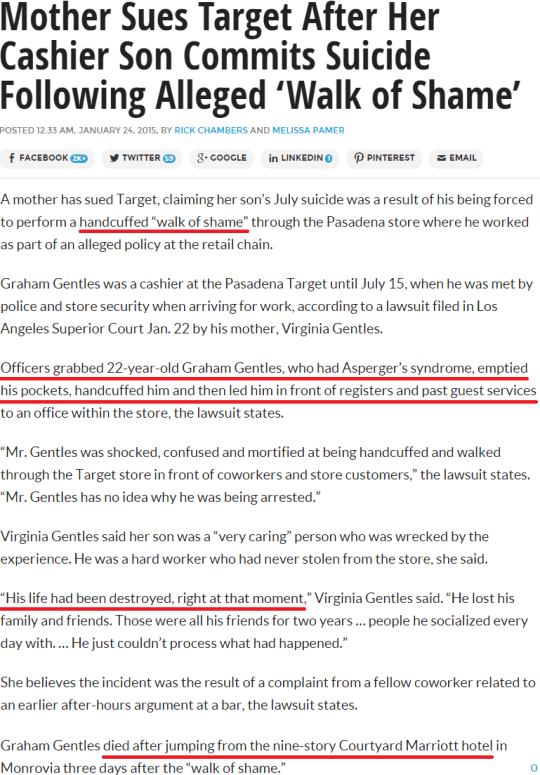
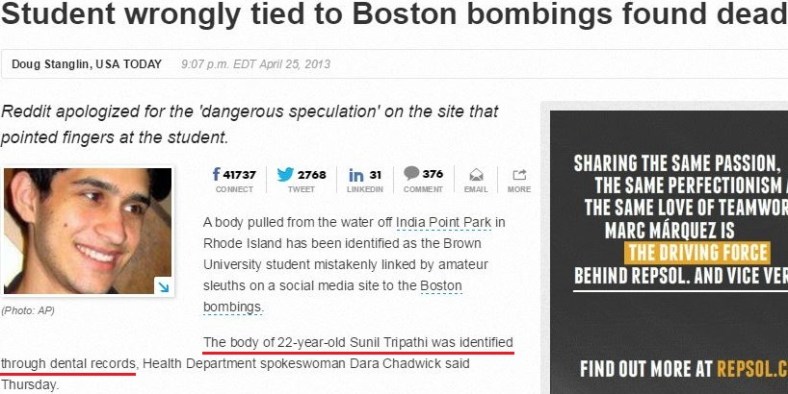
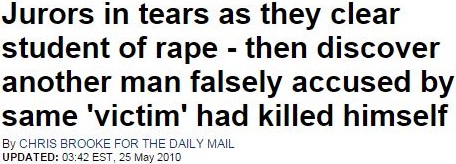
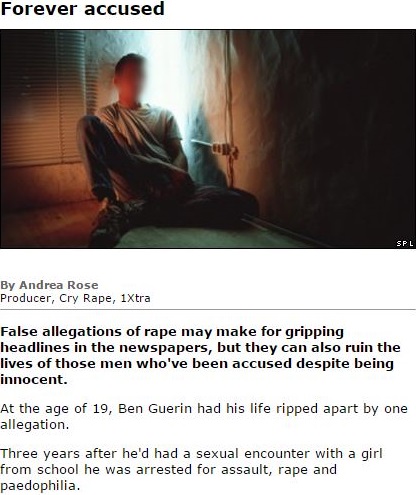
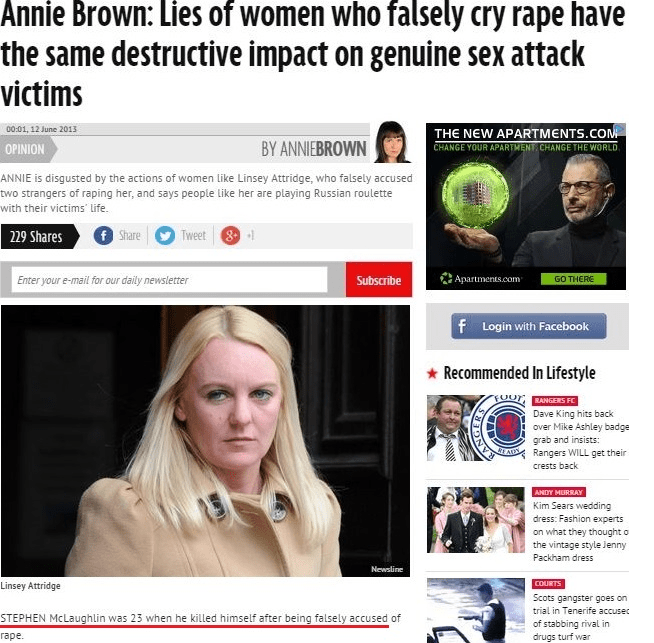
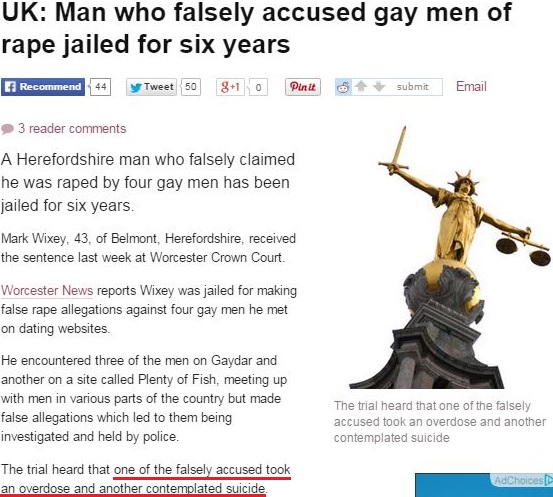
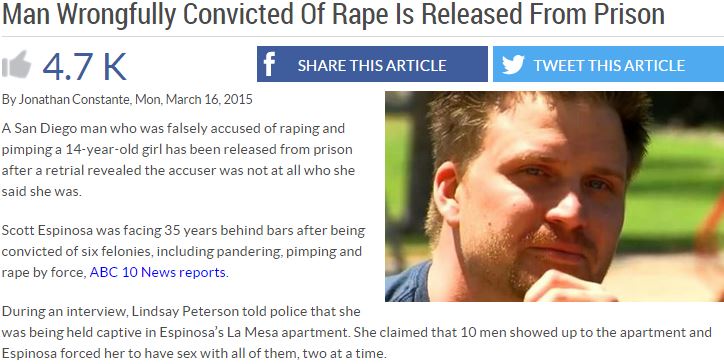
A recent post on the blog you’re reading highlighted the case of a young British man who was detained by authorities for two days, based on a false accusation of rape. Then the charges were thrown out, that is, they were almost immediately dismissed. He nevertheless killed himself after struggling with depression pursuant to the violation. He was 23. Another featured case concerned an adolescent who was falsely accused of rape by some hoodlums at school. He hanged himself. He was 16. A third was about a man who was falsely convicted for rape (and five other felonies) and served a year and a half of a 35-year sentence. He was exonerated when it was belatedly discovered that his “14-year-old” accuser was an adult in her 20s and that her identity wasn’t all she’d lied about. While the man was in prison, his mother committed suicide. She died believing her son was a pimp and a rapist.

Introducing cases of false accusation that have consequences of this magnitude is illustrative, but it shouldn’t be necessary. The author of A Division by Zer0, like most feminist writers, betrays he understands the aftermath of trauma very well.

Here’s the difference though, a rape victim most likely will never escape the damage of the event. Once the deed has been done, the scar will stay forever, no matter if the perpetrator is punished. You cannot undo the [violation]. You cannot restore the lost trust. You cannot wipe the memory triggers.

In a moment of dramatic irony, the writer acknowledges the root of his own indifference: “Much of it, I believe, comes from lack of empathy.”

The man behind A Division by Zer0 is a member of the “Men’s Rights crowd”—or more aptly the People’s Rights crowd. He just doesn’t know it.

Copyright © 2015 RestrainingOrderAbuse.com

False Accusations and Murder: More Headlines about the Effects of Finger-Pointing and Legal Abuse

“[W]hy would someone lie about being sexually assaulted? What could be gained from that? Nothing, really.”

Tracie Egan Morrissey, Jezebel (Feb. 28, 2014)

The quotation above derives from a piece titled, “Rape, Lies and the Internet: The Story of Conor Oberst and His Accuser.” It’s spotlighted because it echoes the sentiment expressed by the writer of the prior post’s epigraph, who’s also a feminist and who betrays the same blindness.

What’s disturbing to the author of the blog you’re reading is that feminists who ask questions like Ms. Morrissey’s make a strong case for rape denial, because it might just as unreasonably be asked, “Why would someone sexually assault anyone? What could be gained from that?”

What could be “gained” from raping someone is the same thing that could be “gained” from lying about being raped—or lying about any number of other offenses: the exultation of control (i.e., power, dominance).

Other reasons for lying suggested by Ms. Morrisey’s own reportage are attention-seeking, self-aggrandizement, and mythomania. There have also been a number of publicized cases about false rape accusations’ being used for concealment of sexual infidelity. Two hyperlinks in this post lead to stories exemplifying this motive. Of course (and significantly), none of these motives applies exclusively to false rape claims. Besides avarice and malice, they’re common motives among false accusers (of all types). People hurt people…to hurt people. Appetites, least of all vicious ones, don’t answer to sense.

The previous post emphasized the emotional trauma of accusation, particularly false accusation, by highlighting a number of suicides reported in the news.

Suicide is a recognized consequence of bullying; name-calling and public humiliation are recognized as among the forms that bullying takes; and falsely branding someone a stalker, rapist, child abuser, or killer, for example, certainly qualifies as publicly humiliating name-calling.

Whether someone is disparaged on the playground, on Facebook, in a courtroom, or in the headlines makes absolutely no difference; the effect is the same, and it may be unbearable.

This stuff shouldn’t need to be pointed out to grown-ups. But since the fatal consequences of false accusation don’t support any dominant political agendas—and may undermine them—they’re ignored. That people are harried and hectored by lies, sometimes to death, is an inconvenient truth.

At least it is here. Many of the news clippings featured in the last post notably originate from the U.K., as do two of the clippings below. Journalism is far more balanced there, and it’s less taboo to call a jade a jade. A Jezebel reporter might denounce this as “misogynistic,”  but truth isn’t misogynistic; it’s just the truth, and it doesn’t play favorites (nor should its purveyors).

This post looks at the other lethal upshot of false accusation: murder. The stories that follow are about people who existed and now do not.

The point of introducing these stories isn’t to assert incidents like these are common; the point is to reveal the emotions that are inspired by false accusations, whether by women, by men, or by mobs. It’s also to reveal their consequences…writ large and lurid. These same emotions are aroused in cops and judges no less than they are in anyone else. False accusers know what reactions they can expect, and they know how to manipulate their audience—and bending others to do their will is thrilling.

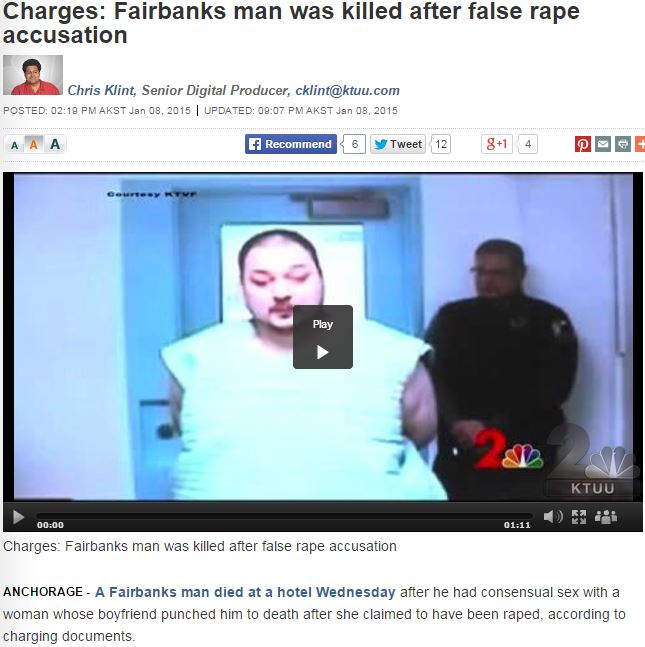
Nothing makes the emotions provoked by accusation more manifest than when accusation inspires others to beat someone to death—or set him ablaze.

This is nevertheless typically lost on reporters and their viewers and readers. The details that are stressed and eagerly sought are who got it, and how. Why, which is always the more speculative aspect, is in its broader implications the most important one, however.

Gore is sexy. It’s what gets airplay and column space. It’s an attention-grabber and a ratings booster. Nothing draws the eye like the color red.

What sensation eclipses, though, is that for every false accusation that ends in red, thousands or hundreds of thousands end in gray, an interminable state of disquiet, disease, and dolor.

Copyright © 2015 RestrainingOrderAbuse.com

*Jezebel, if I’m remembering my Bible stories right, was a mass murderer who was condemned for promoting a false dogma. (Among her victims was a man she had judicially executed.)

False Accusations and Suicide: Some Headlines about the Effects of Finger-Pointing and Legal Abuse (Culled for the Empathically Challenged)

Since the publication of this post, the one quoted above has been deleted.

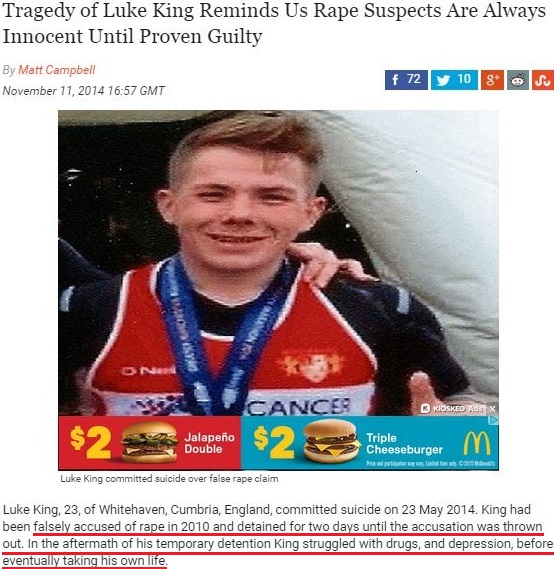
One of the stories highlighted below concerns a young man who was falsely labeled a rapist by some bullies at school. He hanged himself. He was 16. Another concerns a man who spent a year and a half in prison based on a false accusation of sexual assault (among other false accusations). While the man was behind bars, his mother killed herself, believing her son was a pimp and a rapist.

A word to the wise: Only ask a rhetorical question if you know the answer…and it favors your position.

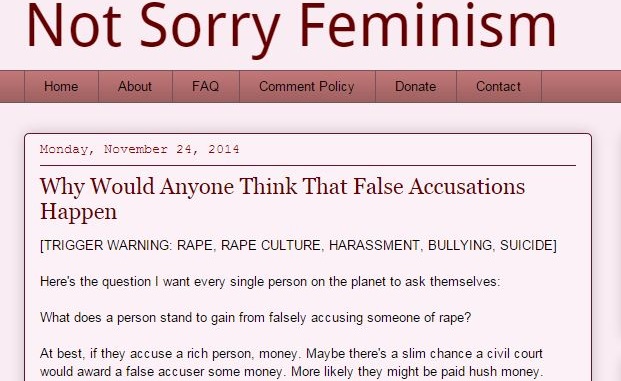
The question posed above by the zealous, young author of Not Sorry Feminism isn’t, of course, a question at all; it’s an indictment. She means how dare anyone think false accusations happen. What problematizes the writer’s rhetorical-question-cum-admonition is that it has a very obvious answer: The reason people think false accusations “happen” (so to speak) is that they do.

(It might alternatively be asserted that no one does believe false accusations “happen,” the same way no one believes rapes “happen.” Both are acts, and both have agents. If rape happens isn’t a construction a feminist could get behind, false accusations happen shouldn’t be, either. You’re a proponent of accountability, or you’re not.)

Worse than her question’s being problematic, because answerable, is that its answer isn’t one the writer wants to hear. Motives for false accusations, including of rape, are greed, malice, bullying, vengeance, jealousy, possessiveness, attention-seeking, mental illness, and cover-up, to name a few. They’re ugly, often petty, always destructive…and they can kill.

This post surveys examples of false allegations or deadly allegations or false and deadly allegations drawn from news stories. Here’s one such:

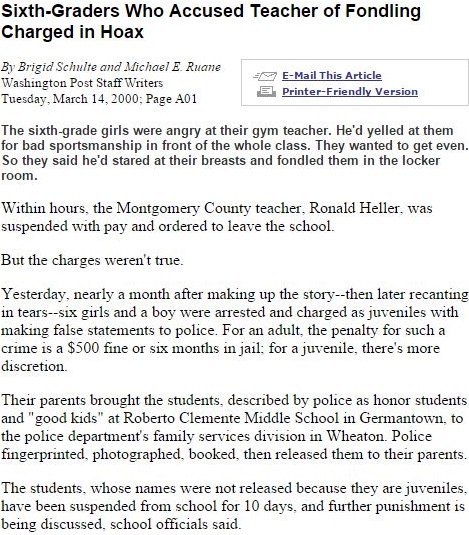
Unlike most of the rest, the first story glossed in this hastily cobbled digital scrapbook doesn’t include a suicide or references to suicide. It’s nevertheless a good starting point, because it’s old news.

The article’s from 15 years ago. Fifteen. Significantly, though, no half-hearted sleuth would find it a challenge today to turn up commentaries on the Internet, mostly from feminist writers like the one who introduces this post, that either (1) deny such a thing ever happens or (2) deny it’s a big deal when it does happen—and deny it’s a sign that a culture of false accusation exists and has for some time. (A story so uncannily similar as to be almost identical can be found here. It appeared in The Huffington Post less than 24 months ago.)

Consider: Where would six elementary school girls and a boy get the idea of framing their gym teacher as a molester, and where would they get the impression this conduct was okay (or “cool”) or that they’d get away with it and not face dire consequences? Should we believe the notion had no cultural influences and was purely a product of these honors students’ collective wicked imagination?

For accusing their teacher of groping them, the kids were suspended for 10 days. It’s likely the most traumatic part of their punishment was being detained by police and “fingerprinted, photographed, [and] booked.” Keep this thought in mind.

Keep this quotation in mind, too: “‘When they made the charge, that’s about 80 percent of the damage to your reputation right there,’ [attorney Paul F.] Kemp said. ‘Because even if you’re found innocent, people will assume you got off on a technicality. Or that there’s something there when there’s not.’”

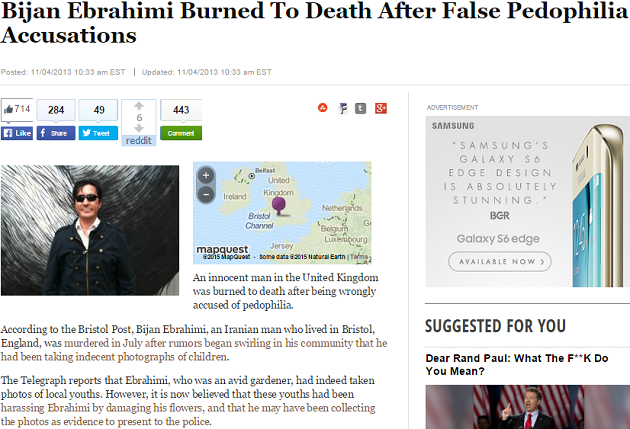
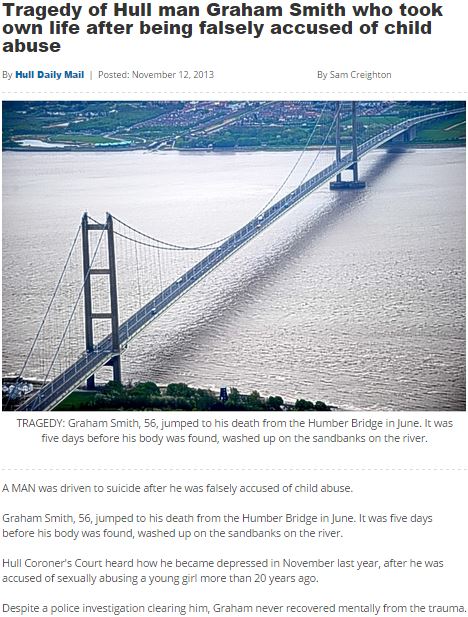
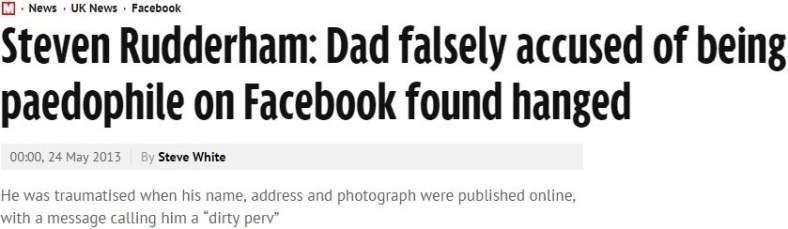
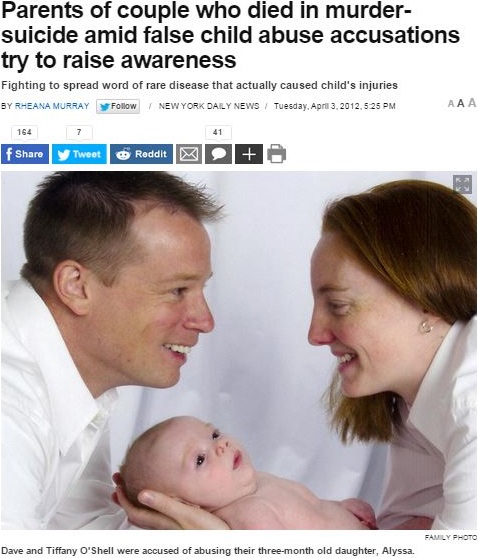
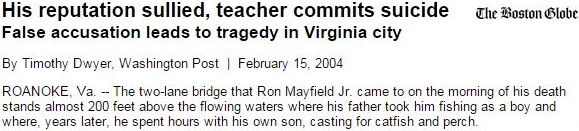
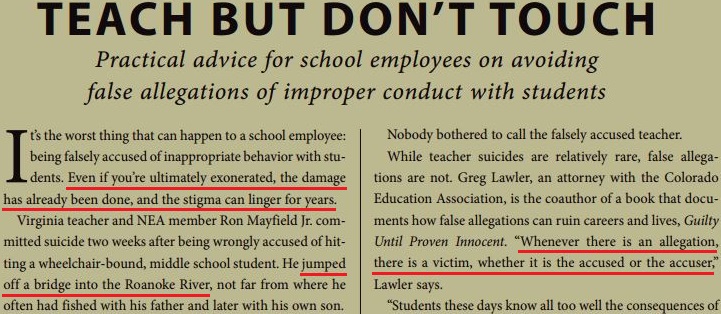
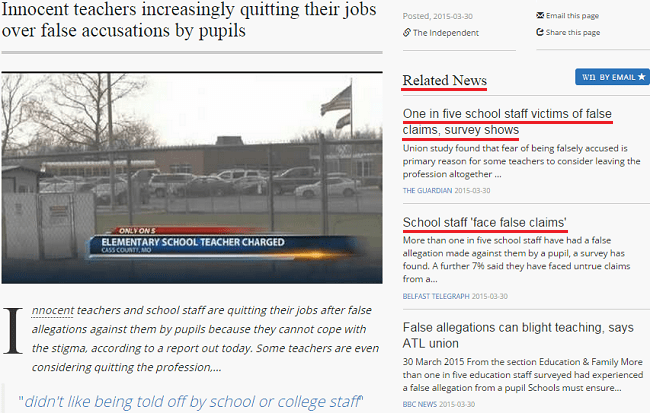
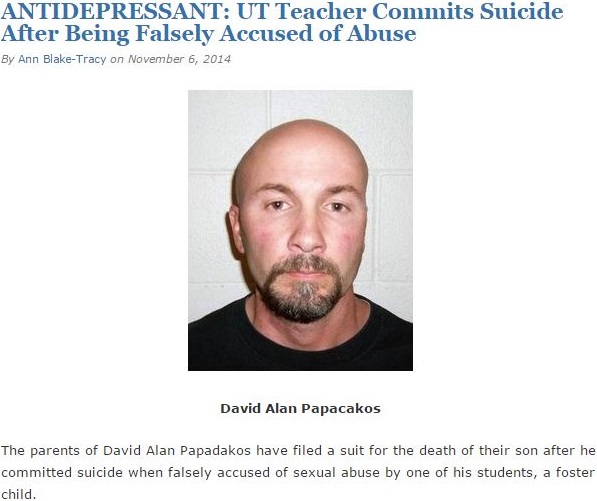
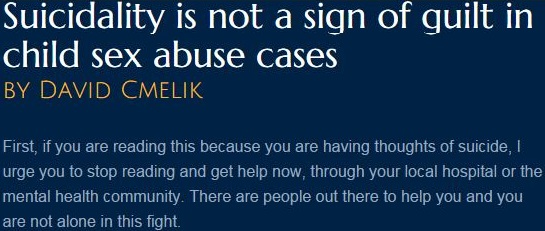
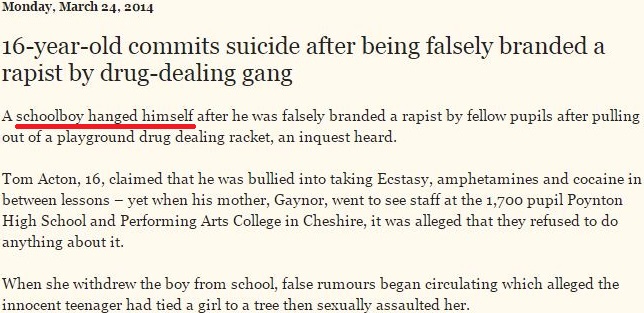
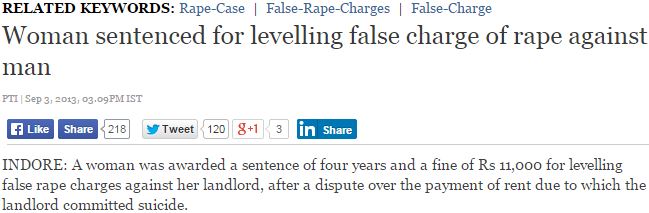
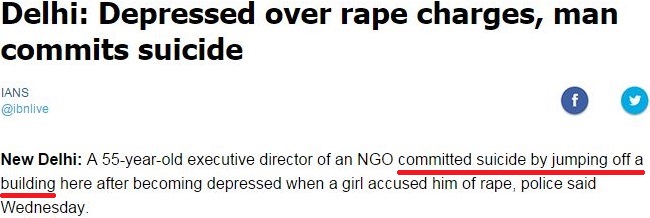
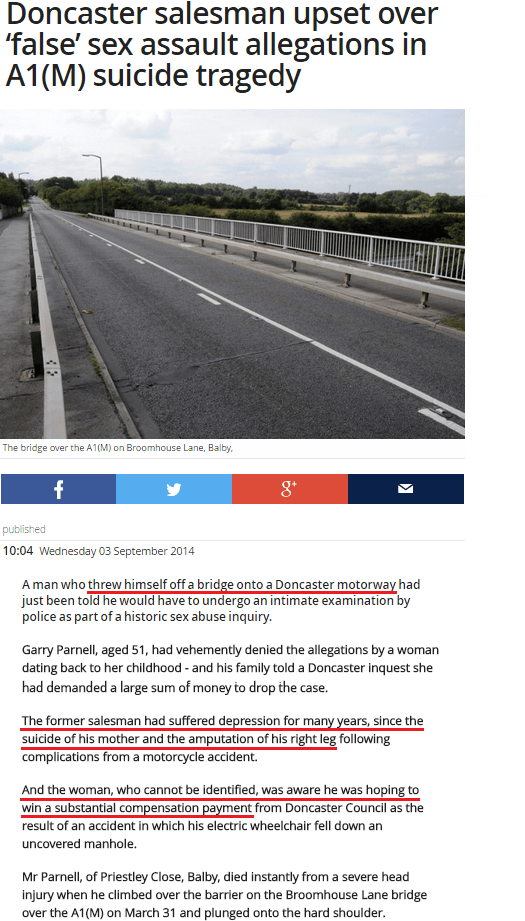
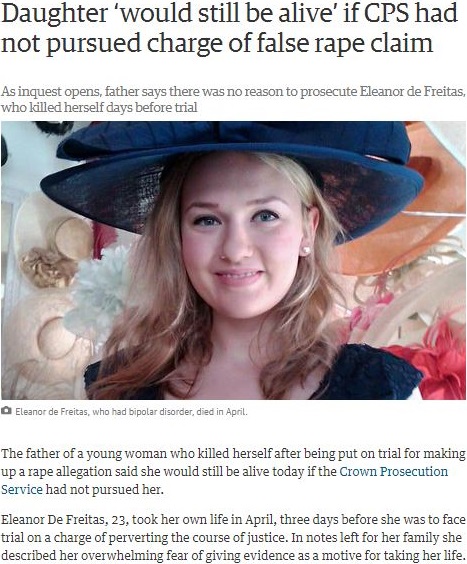
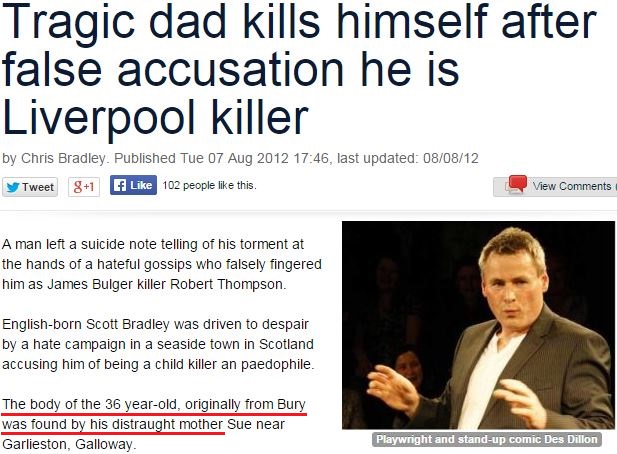
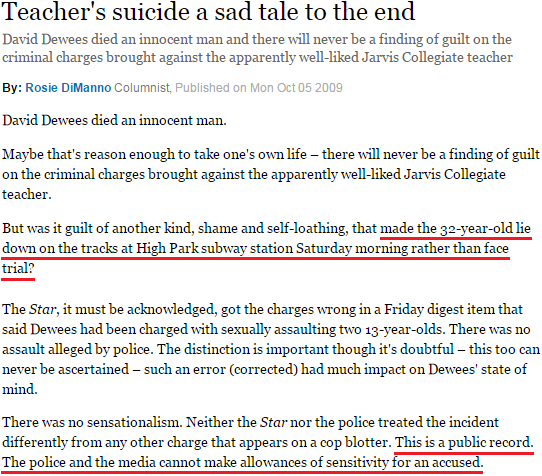
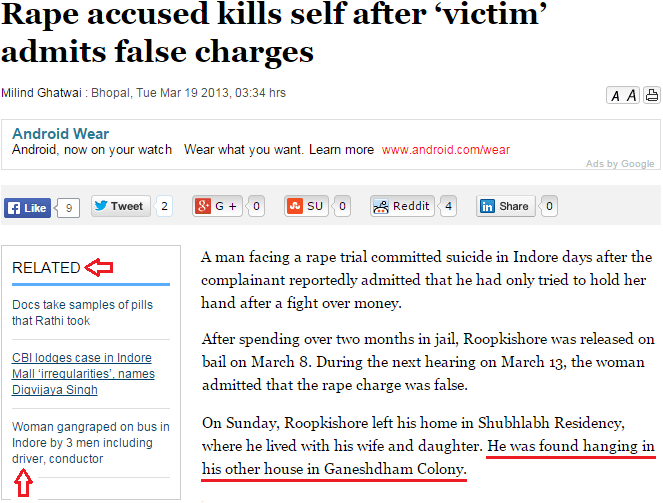
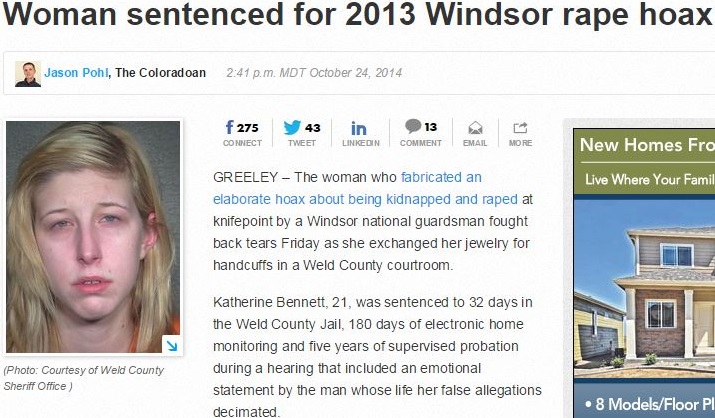
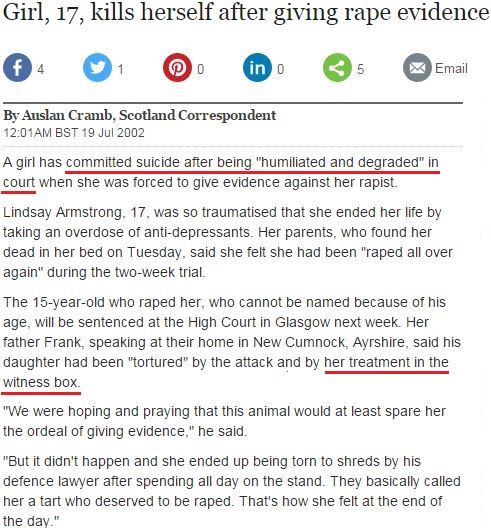
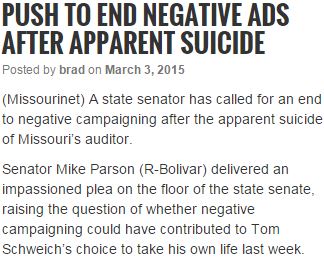
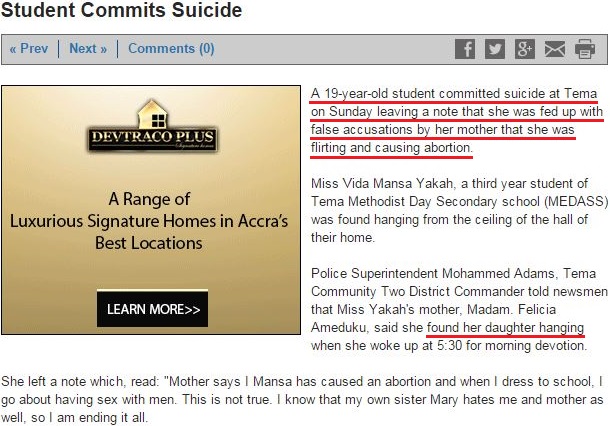
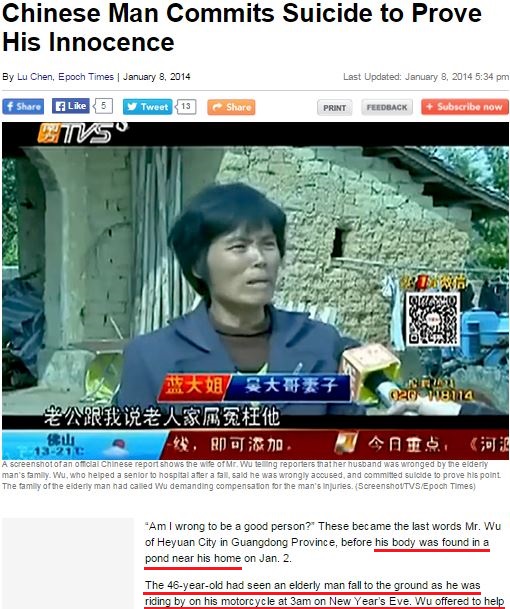
Editorial intrusions end here; the remainder of this post is a series of Internet clippings (linked to the “complete stories”) from which readers may draw their own conclusions about the motives and effects of accusation, bullying, and legal abuse. The author of this post would only point out before absenting himself that an accusation that may induce someone to kill him- or herself need not be of rape and that one of the suicides chronicled below is of a woman who faced being tried for falsely alleging she was sexually assaulted (“In notes left for her family, she described her overwhelming fear of giving evidence…”).

The common denominator is accusation and public scrutiny and judgment, not being accused of a particular act, per se. Zerlina Maxwell and her ilk are categorically wrong.

fale_accusations_destroy

nancy_grace_suit

dad_falsely_accused

murder_suicide

jurors_in_tears_full

reputation_sullied_full

suicidality

forever_accused

Sheffield_hairdresser

Chinese_man_commits_suicide

Copyright © 2015 RestrainingOrderAbuse.com

Report Family Court Fraud to the Federal Trade Commission, Says FCLU

The Family Civil Liberties Union (FCLU) has taken a novel approach to attacking legal abuse and the ineptitude and corruption of the courts: reporting it as consumer fraud. The FCLU invites complainants of legal violations to join its campaign.

FCLU has opened a formal Federal Trade Commission (FTC) case for investigation into Family Court Fraud, Deception, and Racketeering. Send your complaints to crcmessages@ftc.gov or fax 202-326-2012.  Please reference Case Number 58748109 in the email subject line. State all judges, lawyers, “experts,” laws broken, duration, and cost of your case. Make sure you include your contact information, docket number, and jurisdictional information. Your document can be as little as one page or numerous pages. We need volumes of complaints to support our formal legal filings. FTC’s charter is “Protecting America’s Consumer,” and Family Court needs to be abolished or strongly regulated federally. Let’s make it do its job.

The FCLU has also reportedly developed a Judicial Investigative Program—whose felicitous acronym, JIP, sounds like gyp (as in ripoff)—and it urges participation in its Violations Research Program (VRP).

Registering complaint is vital, and here may be a way to do it constructively and “legitimately.” (Complainants who chose to email the FTC might, furthermore, choose to send copies of their emails to their local political representatives, along with a prompt that they take independent action.)

FYI.

Copyright © 2015 RestrainingOrderAbuse.com

*The preceding three posts have concerned Legal Abuse Syndrome, a term coined by marriage and family therapist Karin P. Huffer. Dr. Huffer numbers among the FCLU’s board of advisors (as does civil litigation attorney David Heleniak, an ardent proponent of reform).

Abandon All Hope Ye Who Enter Here: The Hell of Legal Abuse Syndrome

This is the third sequential post on this blog about Legal Abuse Syndrome (LAS), a condition proposed by marriage and family therapist Karin P. Huffer “that develops in individuals assaulted by ethical violations, legal abuses, betrayals, and fraud” and that’s exacerbated by “abuse of power and authority and a profound lack of accountability in our courts.” This post surveys accounts of affliction (and its sources) drawn from various websites.

abandon all hope
Editorial intrusions and commentary in this post have been kept to a minimum, but some grammatical polishing is acknowledged.

You May Be Suffering from Legal Abuse Syndrome if You Have Been a Victim of DCF”:

I have been doing some reading on LAS (Legal Abuse Syndrome) and PTSD since I have begun to fear my own shadow. I hate the doorbell to ring. I run to the window to try to see who it might be, and rarely answer. If someone knocks on the door with any force, I am paralyzed. I do not like to answer the phone and thank God for caller ID. When I go out of the house, heaven help me if I see a child who reminds me of what we have lost. I cannot tell you the number of times I have vomited in public toilets. A police car in the rearview mirror leads to deep breathing and panic attacks. The thought of walking into a courtroom is enough to reduce me to a shaking mess. Certain names…can cause me to feel a sense of violation like no other. Sleep rarely happens and is often interrupted by nightmares, or even worse, waking and screaming for my child. No one cares; all of those I thought would protect us have not only failed us but willingly allowed misconduct and lies. Those I held in high regard due to their positions of trust and power I have found to have let their power corrupt their values and morals. Do I think I am ill? Yes, I know I am. I have a good doctor who is trying to help, a church to support me, and my husband and children who have stood by me, but I also know I will never be the same person I was. I will never trust in the “system” and have been totally disillusioned by what I always thought were my constitutional rights as an American citizen not only being disregarded but willfully being trampled on by those sworn to protect them.

Sufferer Legal Abuse Syndrome” (MyPTSD.com):

I was just diagnosed with PTSD from a prolonged and nasty legal battle (10 years). It was my understanding that PTSD was only for vets coming back from war. I guess there are other ways to fight wars. Mine was in the courtroom trying to fight off the onslaught of unethical attorneys and judges. I believe I fought for a good cause, but it has taken its toll on me. My nerves are shot; I have anxiety from the minute I wake up until I go to bed. Thoughts of what they did and the power they had over me and my children are with me always. I want to have a life, but I still deal with the consequences every day. I feel guilty for feeling this way as there are so many other people who have been through much worse. I think the feeling of being powerless and abused by a system I had faith in has shaken my foundation. My feelings about people and the world have changed forever, and my trust level is very low. A psychologist involved in the battle betrayed me and my family with lies, along with two other professionals in this field, all my attorneys, and the judges. You might discount my viewpoint as overboard. It took a long time to see it myself, but my investigations proved correct.

Legal Abuse Syndrome” (Caught.net):

I became depressed, physically ill, and seriously suicidal after experiencing the insanity of litigation. I lost my home and was sent to the street with nothing but the clothes on my back. Literally everything I owned was gone for several years. I fought my fight to points of exhaustion where all I could do was stare into space. Friends had left; I was emotionally isolated, and normal living activities were no longer normal. Rage doesn’t come close to describing the feelings I lived with for years. Even this is not the full story of how bad it got.

Posttraumatic Stress Disorder Legal Abuse Syndrome”:

I was diagnosed about two years ago with LAS [Legal Abuse Syndrome]. Protracted litigation and corrupt court decisions not only exacerbated my fibromyalgia but caused me to begin a whole new set of debilitating symptoms which have rendered me unable to sleep properly, hold a job, succeed in relationships, enjoy life, maintain goals, dreams, and hope. I suffer from what I call “spinal cord attacks,” which feel like rushes of adrenaline or cortisol permeating my spine, making me feel paralyzed, causing severe pain, lasting for 30 seconds to two minutes, and resulting in complete exhaustion and distress.

My once beautiful life as a drama and music teacher, writer and producer of children’s musicals, and fledgling writer has all but vanished. I am so debilitated from extensive legal research, useless and destructive attorneys and judges, horrendous living conditions imposed upon me by corrupt judges who denied me due process, the loss of my beautiful family home to my ex (which I had been paying for but couldn’t qualify for), the purging of all my earthly belongings, a now transient lifestyle, and increasing medical problems like high blood pressure, anxiety attacks, and hopelessness.

Massachusetts Mother Calling for Family Court Justice in Domestic Abuse Cases”:

I have missed all of my three daughters’ birthdays, first days of school, first dances, holidays, vacations, and school volunteering since 2007. My youngest daughter, Kelly, is nine. That means I have already missed out on half her life. I am not a drug addict. I am not an alcoholic.  I was and still am an upstanding citizen in the community despite Attorney Arabasz and his clients’ attempts to cause deliberate and malicious harm to me. I do my best to volunteer in the community, including hospice and domestic abuse, and have won numerous awards for my volunteerism over the years, which tends to bring me a renewed sense of healing from my own traumas. My children and I cannot get back those formative years we have missed. They are gone forever, never to return.  I am speechless in my ability to describe the pain and anguish I feel over this injustice alone.

Over that time, as documented through the courts, I have endured numerous, repeated, serious abuses that I have come to the court pleading for help with to no avail.  I am a human being who can take being abused only for so long.  I have suffered serious, repeated, unrelenting, undue stresses, many of which are criminal in nature, that have caused health issues. When the trial arrived, I prayed and hoped for justice to finally prevail for the sake of my children.

I have been severed from my children’s lives with little to no contact since August 3, 2011, and even longer since September 2007. The verdict of August 2012 from the trial was devastating to me and I worried about the long-term negative impact it would have on my children….

As a result, I am currently being treated for ADHD, Legal Abuse Syndrome, and trauma-related stress, and my treatment since trial has increased. Symptoms of trauma-related stress include gastrointestinal issues; anxiety and fear, especially when exposed to situations reminding me of the many repeated traumatic events; trouble sleeping; trouble eating; low energy; memory problems, including difficulty remembering aspects of the trauma; a “scattered” feeling and inability to focus on work or daily activities;  emotional “numbness,” which causes me to feel withdrawn, disconnected, or different from others; and protectiveness of loved ones or fear for their safety.

I did not suffer any of these symptoms until after I married an abusive partner and endured years of abuse. I was a victim that the system failed to protect, and now I suffer greatly. I was a fantastic mother, and even the father never questioned my ability to care for or mother these children until he got what he wanted and stole financially through the divorce.  However, the system has stripped away all my ability to love, nurture, and parent my three daughters who need me greatly.

The foregoing first-person accounts are hardly comprehensive; they were culled because they’re evocative. Notably, they echo numerous comments submitted by visitors to this blog, who have reported everything from homelessness and hopelessness to living “like a hamster” to contemplating suicide. Many respondents to the e-petition “Stop False Allegations of Domestic Violence” have reported the same.

The third-person account below, though it leaves the victim’s torment to the reader’s imagination, is certainly no less sympathetic than those above. It speaks, particularly, to how blind or indifferent others may be to the effects of legal abuse.

How academia betrayed and continues to betray Aaron Swartz”:

As news spread last week that digital rights activist Aaron Swartz had killed himself ahead of a federal trial on charges that he illegally downloaded a large database of scholarly articles with the intent to freely disseminate its contents, thousands of academics began posting free copies of their work online, coalescing around the Twitter hashtag #pdftribute.

This was a touching tribute: a collective effort to complete the task Swartz had tried—and many people felt died trying—to accomplish himself. But it is a tragic irony that the only reason Swartz had to break the law to fulfill his quest to liberate human knowledge was that the same academic community that rose up to support his cause after he died had routinely betrayed it while he was alive.

This survey concludes with an impersonal commentary from a woman who’s still embroiled in legal strife and fears the consequences of speaking about it too candidly in a public medium. She has removed herself to another state to escape a malicious accuser’s clutches but remains in the crosshairs, despite having been deprived of everything she once took for granted—including her sense of self.

‘White Collar’ Domestic Violence Sanctioned by the State”:

The fraudulently obtained protective order is the new tool of abuse for abusers to obtain total power and control over their victims. The protective order is obtained using false allegations of domestic violence and abuse against the victim in an open court of law without due process or an evidentiary hearing. The protective order is then used as a state-sanctioned license to stalk, harass, intimidate, and continue to abuse the victim. The victim lives in constant fear that s/he will be arrested and incarcerated any time the abuser chooses to place him or her in jail. The accuser plays the victim of his or her own crime [cf. Dr. Tara Palmatier’s “Presto, Change-o, DARVO: Deny, Attack, and Reverse Victim and Offender”].

This is the new “white collar” form of domestic violence and abuse. It is a tactic used by both men and women to gain the upper hand in a divorce or custody battle, or to have a domestic partner simply removed from a lease and ejected from his or her own home. In the case of a victim’s terrible misfortune of coupling with a psychopath or sociopath suffering from a narcissistic or borderline personality disorder, the protective order is fraudulently obtained by means of false accusations of domestic abuse simply to gain total power and control over him or her while simultaneously inflicting emotional distress to hurt and humiliate him or her and publicly harm his or her reputation. This in and of itself allows the abuser to compromise the integrity of his or her victim with a permanent public record, thereby impugning the victim’s character. This not only serves to satisfy the malicious intent of the abuser; it also renders the victim helpless in any and all attempts to plead innocence and defend him- or herself to law enforcement and the courts.

Acts of malicious intent by way of falsifying police reports, manufacturing evidence, and committing perjury in a court of law—all crimes at a felony offense level—go criminally unprosecuted because restraining order courts are of a civil nature, held by low level officials with no due process. Any attempts by the victim to file complaints or police reports of his or her own are useless and futile attempts at self-protection, because probable cause cannot be proven; a victim simply cannot prove with tangible evidence the intent or motive of the abuser. All attempts by the victim to file complaints or police reports to protect him- or herself do is embolden and provoke the abuser to escalate the abusive behavior toward the victim to the point that the victim cannot attend school, go to work, or even leave his or her own home out of living in a constant state of fear that the abuser will have him or her arrested on a whim.

Without due process and without protection, the victim is ultimately under the total power and control of the abuser. Law enforcement and the legal system (the courts, the judges, the attorneys) are all simply pawns in the sociopath’s sick game of abuse of process. A carefully constructed web of lies is in itself so complex that the victim is powerless to prove s/he is the victim of abuse, not its perpetrator. Over time, after the victim is professionally and academically destroyed, publicly humiliated, and ultimately alienated and completely isolated from his or her community, from friends, and even from family, s/he begins to doubt him- or herself and eventually loses all sense of human identity. Many victims commit suicide as a result of the abuse.

Copyright © 2015 RestrainingOrderAbuse.com

*See also this post about the death of Christopher Mackney, which contains links to his suicide note: “First Amendment Rights from Beyond the Grave: Defense of a Suicide’s Publication of His Final Words by the Randazza Legal Group.” The circumstances that conduced to Mr. Mackney’s taking his life are chronicled in a forthcoming book by investigative journalist Michael Volpe, which is titled, Bullied to Death: The Chris Mackney Story.

Kangaroo Court: The Australian Government Acknowledges “Abuse of Process,” so Why Doesn’t Ours?

The previous post introduced Legal Abuse Syndrome (LAS), a condition posited by marriage and family therapist Karin P. Huffer and defined as a form of posttraumatic stress disorder (PTSD). “It is a personal injury that develops in individuals assaulted by ethical violations, legal abuses, betrayals, and fraud,” Dr. Huffer explains. “Abuse of power and authority and a profound lack of accountability in our courts have become rampant, compounding an already stressful experience.” This post catalogs types of legal abuse that exemplify the “ethical violations…betrayals, and fraud” to which Dr. Huffer refers.


Australians aren’t distinguished for their refinement. I like them, though.

Plenty have plainly spent too much time with the sheep—I think we have an Aussie to thank for the Creation Museum, which features dinosaurs cavorting in the Garden of Eden—but Australians tend to tell it straighter than Americans do; they’re frank.

Maybe it comes of living in an equatorial zone that forbids the Puritan dress code.

I learned last week that they have a “Law Reform Commission.” The Australian government, like governments everywhere else, may be slow to acknowledge abusive laws, but at least it acknowledges laws are abused.

In America, feminism (not the equity-for-all kind but the men-suck kind) holds sway. There’s no shortage of conscientious objectors who feel abuses of statutory processes that were conceived to curb violence against women are out of control, but their voices are effectively subdued. To express a quibble is to be immediately beset by frenzied piranha.

So I was pleasantly surprised to discover that the Australian Law Reform Commission openly acknowledges “false or misleading evidence about family violence” and “vexatious applications in protection order proceedings”—which it wouldn’t do if these violations weren’t a lot more common than Americans like to pretend they are.

(Vexatious, incidentally, means “intended to harass.” It’s a warm-and-fuzzy euphemism for intended to destroy.)

The commission predictably wimps out and concludes that “existing measures [in Australia] to sanction persons who give false evidence of family violence are sufficient,” but it does indicate that it finds “merit in allowing courts to order that a person who has brought several vexatious applications or cross applications for protection orders against the same person without reasonable grounds may not make further applications except with the leave of the court.”

This absurdly says that even if a person is repeatedly found to abuse process, the worst consequence s/he should face is having to ask special permission before doing it again. What makes the commission’s comments significant, however, is that they actually own that there are people who exploit court process to hurt others and that they may do it over and over.

In America, you’re not allowed to acknowledge this—or even to allege process is abused to any degree worthy of note. To criticize legal processes instituted to protect women means you think women are “disposable.” The indictment is a non sequitur, but it works. It shuts most politicians up. It shuts most professors and journalists up, too. Never mind that each of “several vexatious applications” for restraining orders or assertions of “false or misleading evidence about family violence” may (permanently) associate the accused with “stalking,” “violent threat,” “assault,” “child abuse,” “molestation,” or even “rape.” Remarkably, there are influential people who briskly opine in venerable media that being accused of these acts, including rape, is no big deal.

(What do you wanna bet it hasn’t happened to them?)

It’s a big enough deal that some people never recover, and some kill themselves (or others). Most survive and persist, but this isn’t the same thing as recovering; they may never be “whole” again. One false accusation that sticks can unravel a life…and the accusation doesn’t even have to stick.

Victims of legal abuse are said to be negligible by the political powers that be, however, because there are women who are battered or raped who never receive justice. Victims of legal abuse are called a “drop in the bucket” in contrast. This argument—ye olde non sequitur again—ignores (among a great many other considerations) that there are women who are battered and/or raped who are also then falsely accused by their batterers or rapists to compound the violation and conceal their crimes. In some cases, at least, feminists who deny legal abuse and its horrors abet batterers and rapists of women.

Completely lost on flatulent opinion-mongers, besides, is that falsely accusing someone of violence or one or more “violence-related” acts is an acutely personal attack that’s often committed by a trusted intimate or former intimate (a friend, for example, or a spouse, family member, or lover), and that judicial process is punishing even when no punishment is meted out. It’s dehumanizing. People’s dignity is violated, their credibility is compromised, their names are tarnished, and their trust is savaged. The scrutiny alone is traumatic—just the anticipation of it is. Regardless of the court’s judgment, an entire network of relationships may be trashed. Members become invested in one side or the other, and no one backs down. Even if the truth emerges and frauds are exposed, apologies and reconciliations may be rare and grudging.

It’s not called “adversarial process” for nothing.

Legal gamesmanship, what’s more, runs the gamut, and this, too, is significant among the Australian Law Reform Commission’s observations. It includes false or misleading accusations of violence, false petitions for state protection, false cross-petitions for protection, false claims made to have restraining orders changed or revoked, etc. (fraud here, fraud there, fraud everywhere). What no one in authority wants to concede is that if the laws make it easy and attractive to lie impulsively and hurtfully, people will lie impulsively and hurtfully.

One of my favorite phrases in the English language is shit for brains when it’s pronounced in an Australian accent. It never fails to make me smile.

What the Australian Law Reform Commission’s remarks make clear is that any shit for brains should recognize that a whole lot of fraud is committed in these volatile yet superficial court procedures that are often started and finished in minutes but whose consequences, irrespective of rulings, are nevertheless extensive, lasting, and crushing.

Copyright © 2015 RestrainingOrderAbuse.com
Courthouse Violations and PTSD: What Is “Legal Abuse Syndrome”?

This is the first post on this blog to introduce Legal Abuse Syndrome (LAS), a condition proposed by marriage and family therapist Karin P. Huffer, whose books on the subject of posttraumatic stress stemming from court-mediated violations are Overcoming the Devastation of Legal Abuse Syndrome (1995) and Legal Abuse Syndrome: 8 Steps for Avoiding the Traumatic Stress Caused by the Justice System (2013), and Legal Abuse Syndrome: A Preventable Public Health Problem (2018).


“Anyone who has ever worked in a legal aid office or law library has met people whose lives have come unhinged after a bad contact with the legal system. The details vary—they may have lost a business or inheritance or the custody of a child—but the common theme of feeling violated by the legal system does not. Even 20 years after losing a lawsuit, some people who suffer from Legal Abuse Syndrome still carry a suitcase of old legal papers around, desperately hoping someone will help them find justice.”

—Ralph Warner, quoted in the San Francisco Chronicle (1997)

I’ve encountered the ghostly men and women described by Mr. Warner in the epigraph. They haunt law libraries the way some exiles haunt coffeehouses or used to haunt bookstores. They carry sheaves of papers, foxed file folders, and weathered satchels, just as Mr. Warner describes. They’re known to one another and exchange muted greetings and tinny words of encouragement.

They desultorily pore over computerized case law and weighty reference tomes—whether pursuing a lead or just out of habit, it’s impossible to tell—and they propound among themselves novel approaches to revisiting one or another of the dusty judgments that have plainly come to consume their lives.

The eager young law students who mill and toil never cast a glance in the direction of these damned souls, who palpably emanate doom.

Maybe I’m a fatalist, or maybe I was smart enough to recognize a fix when I saw one. A few self-navigated trips through the legal ringer were enough to cement in me a sense of futility. Otherwise, I suppose I might have found myself among this skeleton crew.

After my most recent pelting in that burlesque show advertised as process of law (2013), I resolved to stick with what I know: writing. I have no illusions that this makes me any more a master of my fate than if I clung to a corner and allayed my outrage by rocking back and forth and muttering imprecations, but the activity provides a sense of purpose, however lackluster, and bestows a semblance of order to my inner world (my outer world is a hopeless shambles from which the writing blessedly distracts).

I surface now and again to discover people I knew have aged, have entered puberty or college, have married or divorced, or have died.

Elucidating the trauma that forces a person to exchange living for some deranged form of solace like prating in a blog in defiance of a juggernaut is all this initial post on Legal Abuse Syndrome aspires to. For this, I defer to Dr. Huffer (though anyone who has tracked posts and comments here will find significant correspondences between their positions and hers):

LEGAL ABUSE SYNDROME (LAS) is a form of posttraumatic stress disorder (PTSD). It is a psychic injury, not a mental illness. It is a personal injury that develops in individuals assaulted by ethical violations, legal abuses, betrayals, and fraud. Abuse of power and authority and a profound lack of accountability in our courts have become rampant, compounding an already stressful experience.

This stress can and does lead to physical illness. AMA statistics show that around 85% of all physical illness is directly attributable to stress. Legal Abuse Syndrome is a public health menace in this country. It leads to massive medical intervention costs, burdens insurance companies, and adds to Medicare and Social Security costs. Most painfully, it crushes the brilliance and creativity of its sufferers. Legal Abuse Syndrome is detrimental to all of society, and nobody is immune.

Whatever the court setting, whether it is regarding divorce, child custody, parental support, probate matters, personal injury, property disputes, legal or medical malpractice, criminal charges, or other deeply personal issues, the frauds put forth in our courts add greatly to the trauma. When litigants are unable to get fair resolution to their issues, when the court dysfunction further adds to the litigant’s burden, when no amount of actual case law compels an equitable outcome, litigants suffer often disabling levels of stress. When further attempts to achieve redress fail, litigants display the hallmark signs of Legal Abuse Syndrome (LAS).

I’ll conclude with a refrain that has become trite with repetition: The thesis Dr. Huffer’s statements delineate was put forward decades ago, like so many arguments from journalists, jurists, and other social critics against a heedless and unyielding status quo that has prevailed for far too long.

Copyright © 2015 RestrainingOrderAbuse.com

*The concept of Legal Abuse Syndrome was brought to the attention of this writer by investigative journalist Michael Volpe, coauthor of Bullied to Death: The Chris Mackney Story.

“Shame and Stigma” and the “Mean-Spirited Cultural Response” That Efforts to Cast Them Off Provoke: Procedural Abuse and Parental Alienation

“Parental alienation is the ‘programming’ of a child by one parent to denigrate the other (targeted) parent, in an effort to undermine and interfere with the child’s relationship with that parent, and most often occurs within the context of a child custody conflict. This includes the ‘legal abuse’ of parents who have been disenfranchised from their children’s lives subsequent to sole custody and primary residence judgments. Within an adversarial legal process, non-custodial parents are often subjected to shame and stigma, lack of access to their children, and devaluation of their role as parents. And those who speak about the pain and woundedness in their lives are subjected to a mean-spirited cultural response, where their talk of woundedness is mocked.”

Edward Kruk, Ph.D.

Here’s child and family social worker Edward Kruk corroborating that parents may be the targets of “legal abuse”; that they’re subjected to shame and stigma, and to alienation from their children; and that they’re ridiculed and regarded with contempt for complaining about it: “The Impact of Parental Alienation on Parents: Post-traumatic Stress in the Rupture of Parent-Child Relationships” (2013). There are mothers who endure this, make no mistake, but as Dr. Kruk observes, “Most alienated parents are non-custodial fathers.”

Members of both genders (parents and non-parents alike) have reported on this blog that they’ve experienced (or are in the throes of) PTSD consequent to abusive legal contests, and it’s not the intent of this post to discount the plaints of mothers who face this torment. It must be emphasized, however, that the “mean-spirited cultural response” Dr. Kruk notes is predominately, if not exclusively, directed at men, and it’s because fathers’/men’s plaints are so roundly and effectively denounced and dismissed that mothers’/women’s plaints also lack a sympathetic audience.

(Feminists would prefer that female victims of legal abuse quietly recede into obscurity and accept the role of martyr for “the cause.”)

The “mean-spirited cultural response” is broad but includes highly influential voices, including law professors and esteemed advocacy groups like the Southern Poverty Law Center, which has equated men’s and fathers’ rights representatives with hate groups, asserting that they’re on a par with the Ku Klux Klan.

No kidding.

To vehemently complain about being treated prejudicially by the courts and alienated from your kids is to be caricatured as a racist wearing a bedsheet and brandishing a torch. (Few in the mainstream press, moreover, scoff at this rhetoric.) For moms (and women in general) who’ve been victimized by legal abuse to be heeded, the demonization of men’s and fathers’ advocates as mere “misogynists” must first be controverted.

Last year, a post on this blog reported the award of a $500,000 grant to a female law professor to “debunk” the claim that court procedures are abused to alienate parents from their children, and it’s this sort of (government-funded) social science research that marginalizes voices like Dr. Kruk’s.

It provides fodder to bloggers and other commentators, and it’s used to “train” judges how to rule.

The selective orientation of feminist social science ignores competing (and compelling) findings like these Dr. Kruk cites:

Suicide rates are reported to be of epidemic proportions among parents, fathers in particular, who are struggling to maintain a parenting relationship with their children (Kposowa, 2000; Kposowa, 2003); and legal abuse has been noted as a key factor in these cases.

A recent post on this blog referenced the suicide of a father who’d undergone years of legal hell and couldn’t face any more. He bled out—emotionally, morally, and financially. Feminist advocates stress the consequences and “rampancy” of domestic violence—focusing narrowly on female victims—while denying that the effects of legal abuses are grave. They trivialize those effects and often deny legal abuses occur to any extent worthy of attention or redress.

The devaluation of family and the curtailment of lives aren’t trivial.

Copyright © 2015 RestrainingOrderAbuse.com

A Victory for Free Speech: Matthew Chan Prevails in His First Amendment Appeal of a Lifetime Restraining Order

Several posts on this blog in the past year have concerned the case of Matthew Chan, a Georgia entrepreneur who blogs and administers a forum for victims of “copyright extortion” (i.e., people who’ve been threatened with lawsuits for unsanctioned use of a copyright holder’s original material and may be intimidated into paying thousands to avoid being taken to court—this for posting a photo online, for example, or using a snippet of text without proper acknowledgment or without having paid a fee or otherwise obtained the author’s consent).

Matthew S. Chan

The blog has also featured a guest post by Mr. Chan.

This post reports that the Georgia Supreme Court returned a virtually unanimous ruling in his favor Friday, after many months of deliberation, that lifted a lifetime protection order prohibiting Mr. Chan from criticizing a woman he characterized as a “copyright troll.”

The basis of Mr. Chan’s appeal, prosecuted by New York attorney Oscar Michelen, was that the trial court that issued the order misconstrued and misapplied the law. Forcing a procrustean interpretation onto the facts, it determined Mr. Chan had harassed, intimidated, and “stalked” the plaintiff in the case, Linda Ellis. Accordingly, it imposed a “prior restraint” on Mr. Chan’s freedom of expression, barring him indefinitely from writing about her.

First Amendment authorities, Profs. Eugene Volokh and Aaron Caplan, submitted an amicus brief to the court in Mr. Chan’s favor, arguing that the First Amendment—with some exceptions—authorizes speech about a person, even if that speech isn’t polite or flattering.

Justice Keith Blackwell, writing for the Georgia Supreme Court, summarized the case in the court’s March 27 ruling:

Matthew Chan has a website on which he and others publish commentary critical of copyright enforcement practices that they consider predatory. Linda Ellis is a poet, and her efforts to enforce the copyright in her poetry have drawn the ire of Chan and his fellow commentators. On his website, they have published nearly 2,000 posts about Ellis, many of which are mean-spirited, some of which are distasteful and crude, and some of which publicize information about Ellis that she would prefer not to be so public. […] It is undisputed that Chan never caused any of these posts to be delivered to Ellis or otherwise brought to her attention. But it also is undisputed that Chan anticipated that Ellis might see the commentary on his website, and he may have even intended that she see certain of the posts, including the open letter to her.

Ellis eventually did learn of the posts, and she sued Chan for injunctive relief under the Georgia stalking law, OCGA § 16-5-90 et seq., alleging that the electronic publication of the posts was a violation of OCGA § 16-5-90 (a) (1), which forbids one to “contact” another for certain purposes without the consent of the other. Following an evidentiary hearing, the trial court agreed that the electronic publication of posts about Ellis amounted to stalking, and it entered a permanent injunction against Chan, directing him to, among other things, delete “all posts relating to Ms. Ellis” from his website. Chan appeals, contending that the evidence simply does not show that the publication of posts about Ellis on his website amounts to the sort of “contact” that is forbidden by OCGA § 16-5-90 (a) (1). With that contention, we agree, and we reverse the judgment of the trial court.

New York entertainment and intellectual property attorney Oscar Michelen, who represented Matthew Chan before the Georgia Supreme Court

To summarize the summary, Mr. Chan and members of his forum ventilated outrage toward what they perceived as legal terrorism (letters from Ms. Ellis’s attorney threatening civil prosecution for “copyright infringement” and reportedly offering to settle out of court for $7,500), and Ms. Ellis successfully represented the online remarks to the trial judge as tantamount to “stalking.” The statute, however, requires that an alleged “stalker” have actually contacted the “victim,” and no such contact was ever made.

For purposes of the statute, one “contacts another person” when he “communicates with another person” through any medium, including an electronic medium. See OCGA § 16-5-90 (a) (1).4 See also Johnson v. State, 264 Ga. 590, 591 (1) (449 SE2d 94) (1994) (as used in OCGA § 16-5-90, “[t]o ‘contact’ is readily understood by people of ordinary intelligence as meaning ‘to get in touch with; communicate with” (citation and punctuation omitted)). Although one may “contact” another for the purposes of the statute by communicating with the other person through any medium, it nevertheless is essential that the communication be directed specifically to that other person, as opposed to a communication that is only directed generally to the public.

There was no contact to satisfy the statutory definition of stalking.

Similarly, allegations of harassment and intimidation were deemed insufficient in the Georgia Supreme Court’s ruling, because no contact had been made with the plaintiff, so no contact had been made against her wishes.

The evidence shows that Ellis visited the website herself—it appears, in fact, that she registered herself as an authorized commentator on the website—and that she had others visit the website and report back to her about the commentary published there. Generally speaking, our stalking law forbids speech only to the extent that it is directed to an unwilling listener, and even if Ellis did not like what she heard, she cannot be fairly characterized as an unwilling listener. Ellis failed to prove that Chan “contacted” her without her consent, and the trial court erred when it concluded that Chan had stalked Ellis. See OCGA § 16-5-90 (a)(1).

Other commenters on this blog, who hadn’t the wherewithal to appeal their cases to the high courts, report having had similar judgments entered against them, typically subsequent to an earlier restraining order. This blog’s author is among them. He was issued a restraining order based on false claims in 2006 and was sued for libel and harassment fully seven years later by its petitioner, who had since moved to another state, after he criticized her publicly, this despite his having had no contact with the woman in the intervening period. The court imposed a lifetime restraining order upon him barring him from exposing the woman (a professional scientist) in anything he publishes.

Mr. Chan’s case highlights that lower-tier judges, presiding over abbreviated procedures spanning mere minutes and according to their personal lights, arbitrarily exercise the broad latitude they’ve been granted by lawmakers. It’s the rare restraining order case like Mr. Chan’s, one that ascends through the courts, that exposes the degree to which bottom-rung judges do what they want without regard to the letter of the law.

Mr. Chan’s victory is shared by all of those who’ve been wronged by the court—and if I know my friend Matthew, his advocacy is going to be all the louder for it.

Copyright © 2015 RestrainingOrderAbuse.com

STINKIEST: Most Restraining Orders Are Sought Impulsively, if Not Maliciously

stinkiest“The first question for a legislature is whether to enact a civil harassment law at all. One thing is certain: If a civil harassment statute is enacted, it will be used—a lot. In 2003, Oklahoma reimposed a relationship requirement on its civil harassment statute because metropolitan counties were ‘being overrun with requests for protective orders.’”

—Prof. Aaron Caplan, “Free Speech and Civil Harassment Orders” (2013)

“The measure [House Bill 1667]:

  • Limits VPOs [“victim protective orders”] for harassment to situations in which the victim is being harassed by a family or household member or a person with whom the victim has been involved in a dating relationship. This provision is meant to reduce the number of frivolous applications for VPOs;
  • Requires victims of stalking who are not family or household members or in a dating relationship with the alleged stalker to file a complaint against the defendant with the proper law enforcement agency prior to filing for a VPO. The victim must provide a copy of the complaint with the petition for the VPO. This is also being done in an effort to reduce the number of frivolous applications for VPOs […].”

Highlights of Legislation (49th Oklahoma Legislature, 2003)

As law professor and former ACLU staff attorney Aaron Caplan all but says, restraining orders are exploited. The 49th Oklahoma Legislature cited in Mr. Caplan’s law monograph explicitly implies the same thing. The purpose of its 2003 HB 1667 was to “reduce the number of frivolous applications.” This clearly wouldn’t have been a concern if there weren’t a great number of frivolous applications.

Frivolous means “having no sound basis.” Its vernacular synonym is bullshit.

The preceding two posts on this blog examine how many restraining orders are either rejected by the court (“tossed”) or withdrawn by petitioners after they succeed in securing them. Available news reports indicate most restraining orders are rejected outright or dismissed upon a “full hearing.” Most. Indications, too, are that a lot that aren’t rejected are later withdrawn by the people who petitioned them. A lot.

This alone is reason to suspect the motives of complainants and the merits of their complaints. Certainly it says judges do. As the epigraph reveals, legislators do, too.

Consternating to people whose lives have been derailed by false accusations is that the problem has been vigorously exposed and criticized for decades, and judges, lawmakers, and attorneys know those criticisms are more than hot air.

Yet little changes…including rhetoric that legislators know is misleading (stinky).

Look at the second quotation in the epigraph. First, note that the civil harassment orders that were repealed by HB 1667 were called “victim protective orders” (i.e., reflect on the absurdity of the phrase victim protective orders for harassment). Also note the acknowledgment that a significant proportion of petitions for “victim protective orders” are “frivolous.” Orders that may have nothing to do with violence are called “victim protective orders” and—and—they’re acknowledged to be used falsely, or at least wrongly (and to such an extent that legislative revision was urged).

stink6Applicants for orders that are acknowledged to be used frivolously, however, are nevertheless called “victims.” (As the previous post shows, journalists collude in this misrepresentation.)

Recognized non-victims who clog court dockets with illegitimate claims are still called victims. Cases recognized as non-violent are still characterized as violent. When bias is this manifestly rooted, is it really that hard to believe that many or most orders that are approved and finalized may be malicious? The “fix” is obvious—it’s obvious—so how hard can “frames” or “set-ups” be to pull off?

Much ink has been spilled by opponents of the restraining order process desperate to arouse awareness to false allegations and prejudiced practices. People are issued restraining orders with fraudulent accusations that stick. They lose their jobs, homes, money, property, and good names. They lose access to their kids, who may come to hate them based on lies. Some may end up on the streets; some may even kill themselves in despair after being bullied and ground down, possibly for years.

False allegations that are rejected by the courts aren’t called false, yet false accusations that aren’t rejected by the courts are invariably called true (or “true enough”). The entire system reeks to high heaven.
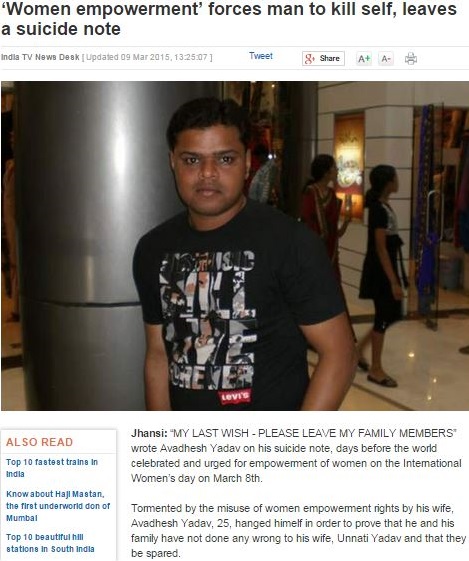
How often false allegations succeed can’t be statistically established. Victims are left with having to lay out their cases in blogs and YouTube vids, or voicing four-letter epithets in Internet forums—or just quietly going mad.

This has inspired a great deal of rage and arguably more than a few deaths (suicides and murders), and that rage has inspired vehement denunciations from legions of special interest groups.

What all of this distracts from, though, is that explicitly manifest in judicial rulings and legislative reforms is that the court itself recognizes that false—or at least “frivolous” or “baseless”—claims are made more often than not.

Most restraining order petitions are rejected. Put more emphatically, theirs are considered to be bullshit claims.

What must be appreciated, finally, is that the restraining order process is a highly “accelerated” one (as Prof. Caplan, quoted in the epigraph, notes in his study). The conceptual justifications are that (1) applicants are “in danger” and need immediate relief, and (2) restraining orders are “no big deal.” The latter is refuted by rates of depression and suicide (or would be if they were they known), and the former is refuted by a preponderance of court rulings.

Unanticipated by lawmakers (apparently though inexplicably) is that an accelerated process rewards impulse, including malicious impulse. It’s exploited in heat, completed in moments, and usually free (and there’s no statutory limit imposed upon the number of times a single petitioner may exploit it).

Why do judges determine most restraining order petitioners’ claims are bullshit? That’s why.

Copyright © 2015 RestrainingOrderAbuse.com

STINKIER: Not Only Do the Courts Toss Most Restraining Order Petitions, a Lot of the Ones That Are Finalized Are Later Withdrawn by Their Petitioners

stinkier
A couple available rejection rates for restraining order petitions filed with the courts were scrutinized in the last post. Those rates, based on news reports out of Colorado (1998) and Connecticut (2014) were high: roughly 82% (lowball calculation) and 72%, respectively. That’s how many restraining order petitions may be denied or dismissed by our courts. They’re either rejected at first glance, or they’re preliminarily approved and then vacated on review.

They’re judged to be stinky.

Yesterday, I came across this: “Many abuse victims request protection orders then have them dismissed” (March 26, 2015). How many? Almost half (in the cited county, anyhow).

The headline and slant of the story pain me, and I’m compelled to comment on them before broaching the meat of the article.

Note that the typical journalistic bias is in evidence: accusers are termed “abuse victims.” This bias accounts significantly for why the bad odor of the restraining order process is obscured. It stinks, too—of Glade aerosol.

My criticism may seem cold—many accusers assuredly are abuse victims—but a journalist’s brief is to report what he’s investigated, and it’s a safe bet that the “many abuse victims” referenced in the headline aren’t people whose cases the writer looked into. At all. He assumes they’re “abuse victims,” apparently because why else would they have claimed to be?

This is smelly news reporting, and Journalism 101 urges a revision: “Many who are granted protection orders then have them dismissed.” There’s a difference, and the journalist who doesn’t discern that difference is in the wrong line of work.

The writer also begins his story with an account of a woman who’d obtained a protection order against her husband only to be subsequently shot to death by that husband. Then the reader is informed:

Though [the homicide victim] had not asked for her protection order to be dismissed, many other victims do and some of them end up coming back and asking for additional protection orders.

In other words, the reported tragedy has absolutely nothing to do with people who “request protection orders then have them dismissed.” I studied journalism in high school under the tutelage of a man who was the real deal, so lurid and careless journalism offends me.

What do we know from what’s related by Matt Elofson, the crime and courts reporter for Alabama’s Dothan Eagle? We know people apply for restraining orders, get them, and then reconsider (and sometimes re-reconsider). And we know that one person, who never reconsidered the restraining order she was granted, was fatally shot (possibly as a consequence of seeking the state’s protection). These are facts; the rest is rhetoric and specious connections, which are journalistic no-nos.

The reportage of Mr. Elofson’s that isn’t corrupt, however, is telling.

Roughly 40 percent of the petitions for protection from abuse filed in Houston County over the past year were dismissed upon request of the victim.

Houston County Circuit Clerk Carla Woodall said 223 petitions for protection from abuse were filed in Houston County from March 2014 to March of this year. She said 90 of the 223 petitions were later dismissed upon request by the victim.

For “victim,” substitute “petitioner” (pretend, in other words, that it’s a news story that’s been quoted) and then note that it says nearly half of orders that are approved and finalized are afterwards withdrawn by their petitioners.

Nearly half.

Here’s what a journalist (somewhere, someday) should observe: Most restraining orders are denied or dismissed by our courts, and an arresting proportion of those that aren’t denied or dismissed are withdrawn. That’s a whole lot of “sound and fury signifying nothing” except a whole lot of misery for a whole lot of accused people.

This, furthermore, ignores that a majority of orders that are approved and not withdrawn may be false.

We’re not allowed to call the restraining order process a farce, because—as Mr. Elofson reminds us—sometimes people who procure restraining orders are legitimately at risk.

How, though, does Mr. Elofson remind us that restraining orders are necessary and vital to the protection of women? He reminds us by citing an instance in which a restraining order may have gotten its petitioner killed.

Copyright © 2015 RestrainingOrderAbuse.com

STINKY: Most Restraining Order Petitions Are Rejected by the Courts

deposit refuse here
Fact: The false allegation rate, as it’s commonly represented, is 2 to 8%.

Contradictory fact: A majority of restraining order petitions are rejected by the courts. They may be rejected outright, or they may be dismissed on review.

What the precise figures are is up for debate. That’s because (1) those who report false criminal allegation rates are typically people motivated to minimize them (which may include government spokespeople), and (2) comprehensive (i.e., nationwide) stats for civil restraining orders aren’t reported at all. Even state figures for brief periods like these are difficult to winnow:

“In fiscal 1998, about 18,000 temporary and 3,300 permanent domestic-violence-related restraining orders were issued in Colorado counties” (The Denver Post, 1999). At least 14,700 TPOs were dismissed—82% of the approximately 18,000. How many petitions were rejected on sight isn’t reported but might boost the 82% rejection rate significantly. For example, if there were an additional 6,000 petitions that were summarily tossed out (a judge looked at them and said no cigar), the rejection rate would be close to 90%. Appreciate, also, that the defendants in the 14,700-plus cases that were green-lighted and then dismissed doubtless lived in hell meanwhile (possibly on a bench in the park), and it’s unlikely dismissal of the order brought a close to the turmoil. Reward a plaintiff once (in a five-minute procedure) and then withdraw the reward, and a motive is kindled to seek the reward again.

“According to the [Connecticut] Judicial Branch, in 2014 there were 8,669 applications for restraining orders, which resulted in 4,409 approvals. After full hearings, 2,445 permanent restraining orders resulted” (The Connecticut Post, 2015). Of 8,669 applications, almost half were rejected outright, and almost half of those that were approved (ex parte) were rejected on review. Less than 30% were finalized. Rejection rate: about 72%.

The catch that lets promoters of the 2-to-8% false allegation rate go on promoting it is that restraining orders rejected by the courts aren’t rejected as “false,” per se.

Maybe they’re just deemed “insufficiently founded” or “baseless.” This may mean the same thing as “false,” but the word false (cagily) isn’t applied (and there’s typically no way of ascertaining the truth one way or the other, which is the case even when orders are approved and then finalized).

Slick, huh?

Criminal complaints may only be (exposed as) “false” a small minority of the time. Civil complaints that amount to criminal complaints (restraining order petitions) are predominately chucked out (which doesn’t mean records of dismissed TPOs aren’t preserved—and some defendants remain enrolled in domestic violence databases, anyway). Even when the grounds for restraining order petitions are deemed bad, they’re not necessarily called “false.”

Significant to take away from all of this is that the court recognizes that most restraining order petitioners ab-use the process. We know that because most petitions for restraining orders are denied/dismissed.

Never mind how many finalized (“legitimated”) restraining orders may themselves be false (which may also be a majority). That speculation aside, how is it a process that inspires claims that are predominantly rejected by the court not widely considered putrid (and putrefactive)?

That’s a rhetorical question, but this isn’t rhetorical: People are bullied by a procedure that’s acknowledged by a preponderance of court rulings to be more commonly misused than not. In instances, people are bullied beyond depression and ruin; they’re bullied to death.

Copyright © 2015 RestrainingOrderAbuse.com

*Compounding the indeterminacy of verifiable facts, it should be noted that in the period between 1998 and 2014 (the years that the two news-source-derived stats cited in this post concern), the conditioning of judicial priorities may explain why the restraining order rejection rate in Colorado in 1998 (just four years post-VAWA) was much higher than that of Connecticut in 2014. A restraining order advocate might say judges have become more discerning over the years; an opponent might say they’ve grown more servile and compliant.

Invoking the Fifth Amendment Protection against Self-Incrimination in “Domestic Violence” Cases

In “How the Fifth Amendment Impacts Family Court in Domestic Violence Cases” (2013), family attorney Tracy Duell-Cazes offers the following counsel against self-incrimination (it’s directed to Californians but may be applicable generally):

To make this easier to read, I will use Respondent when referring to the person who is accused of committing a domestic violence offense and Petitioner for the person against whom the violence was alleged to have been committed.

The Respondent has the right not to make [self-]incriminating statements in any proceeding. This includes discovery, hearings, and any other place where statements may be made. The general rule is that the Respondent cannot be required to testify at the restraining order hearing. The Respondent does not have to produce any discovery regarding the domestic violence issue if the Respondent timely claims the privilege against self-incrimination in response to the discovery request.

Courts usually grant a continuance until the criminal action is concluded. The temporary restraining orders stay in effect. Once the criminal action is concluded, then the hearing in Family Court can go forward. Usually the criminal case is dispositive of whether or not permanent restraining orders in Family Court are issued. If there is a conviction, the permanent restraining orders will almost always be ordered.

The Respondent must make sure that s/he doesn’t say anything to anyone but his/her attorney. (It is usually a good idea in these kinds of cases to have an attorney who practices family law and knows something about criminal law.) If any discovery is sent to you to answer, you need to assert your privilege against self-incrimination in a timely fashion. If you do not, you will lose this right and be required to testify against yourself and be required to respond to the discovery request. This means that the court can compel you to answer the questions, or sanctions will be imposed. Sanctions can be anything from your paying money to the other side to the issue being decided with only the other person’s information.

In order for [the] Respondent to give up his/her right to remain silent, s/he must knowingly and intelligently waive that right. This means that s/he has to know the consequences if s/he talks about the facts and that s/he understands that whatever s/he says can (read will) be used against her/him in the criminal case. If you are ever unsure of whether or not you have a “right to remain silent,” you should immediately consult with an attorney. It is best to consult with an attorney who practices both family law and criminal law or who handles domestic violence cases.

Copyright © 2013, 2015 Tracy Duell-Cazes and RestrainingOrderAbuse.com

*The Fifth Amendment guarantees you don’t have to say anything against yourself. To enjoy this privilege, however, you have to say you don’t intend to say anything against yourself (e.g., “I decline to answer on the grounds that it may tend to incriminate me”). You can’t, in other words, be completely silent. (See Ms. Duell-Cazes’s next to last paragraph above.)

A Word on Restraining Order Statistics and the Rate of False Restraining Orders

I responded to a paper published last year by law professor Kelly Behre, who took umbrage that so-called FRGs (father’s rights groups) were promulgating the statistic that 80% of restraining orders were frivolous or false. This conjectural statistic (60 to 80%) was, I believe, postulated by Save Services based on its studying available information, which is scant. I don’t know that the estimate is unimpeachable, but I don’t believe its authors ever asserted it was conclusive.

Speaking conclusively about figures like this is impossible. Even estimates of how many restraining orders are issued every year in the United States is speculative (and informed guesses I’ve read range from 900,000 to two or three million).

The posited “80%” statistic was seized upon by critics of the restraining order process and bruited broadly on the Internet. I published it myself, and this blog, accordingly, was cited in Prof. Behre’s paper as the product of an “FRG.” It’s actually the product of a single tired and uninspired man who knows that false accusations are made.

Is the statistic wrong? Who knows. Who can say, even, what such a statistic purports to refer to? Does it mean most restraining order petitions are false? Does it mean most temporary restraining orders are dismissed as insufficiently founded? Or does it mean most restraining orders that are finalized have bogus grounds?

There are three phases to the process. A petitioner files an application, which may be approved by a judge or may not be. If it’s approved (ex parte), a temporary order is issued. This order is then supposed to be subjected to review by another judge before being affirmed and made “permanent.” (The word permanent is misleading. A “permanent” order typically has a duration of one year—though, to compound the confusion, some orders may actually be permanent and never expire. What isn’t misleading is that the public record of a restraining order is permanent.)

Three phases: application, temporary order, “permanent” order—got that?

What people invested in exposing this travesty of justice must understand is that it’s possible an unknown (and significant) number of applications for restraining orders are rejected at the outset. Their petitioners are refused. Is this number recorded someplace? Maybe, maybe not. We’re a federation of states, and every one of those states has its own budget, recordkeeping practices, and priorities.

Perhaps even its individual courthouses do.

Putting aside the fact that the number of applications that are rejected may not be recorded, there’s also the question of how many orders are preliminarily approved by the court and then dismissed on review.

I recently quoted a statistic reported in The Denver Post: “In fiscal 1998, about 18,000 temporary and 3,300 permanent domestic-violence-related restraining orders were issued in Colorado counties.” This statistic itself suggests that over 80% of restraining orders are determined to be frivolous, flimsy, or false. It says that of some 18,000 initially approved (i.e., temporary) restraining orders, only a fractional 3,300 were found meritorious on review.

It says the “80%” statistic is, in one sense at least, right on the money, if not conservative.

If comprehensive statistics for all courts were available that showed how many restraining orders were petitioned, how many of those petitions were rejected outright, and how many of those petitions were rejected on review, the proper statistic for restraining orders determined to be unfounded or indefensible by the court might prove to be in the 90th-percentile range.

And that’s ignoring that a goodly number (and maybe a majority) of the restraining order petitions that “pass muster” and are affirmed by judges may themselves be based partly or wholly on BS claims.

Even what “false” may mean in respect to restraining order allegations is ambiguous. Does “false” mean misrepresentative of the truth, i.e., misleading? Does it mean inclusive of true and falsified allegations? Or does it mean fabricated wholesale, i.e., purely and maliciously untrue?

James Thurber: “It is better to know some of the questions than all of the answers.”

Copyright © 2015 RestrainingOrderAbuse.com

First Amendment Rights from Beyond the Grave: Defense of a Suicide’s Publication of His Final Words by the Randazza Legal Group

“I couldn’t flee and I could not fight. I was never going to be allowed to heal or recover. I wish I were better at articulating the psychological and emotional trauma I experienced. I could fill a book with all the lies and mysterious rulings of the Court. Never have I experienced this kind of pain. I asked for help, but good men did nothing and evil prevailed.”

—Chris Mackney (1968–2013)

An emailed riposte from Las Vegas attorney Marc Randazza was introduced to my attention this week. It was an answer to a move by the “estranged wife” of a man who committed suicide in 2013 to have the man’s suicide note removed from the blog A Voice for Men.
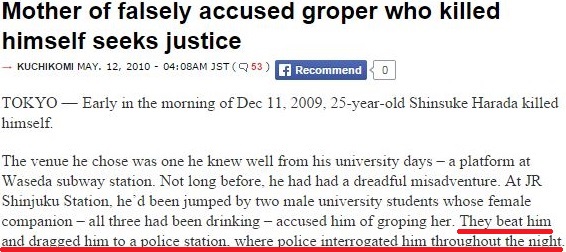
The genesis of this dispute appears to be that Mr. Christopher Hines Machnij a/k/a Christopher Hines Mackney and his estranged wife were in an acrimonious relationship. Due to the strains of that relationship, Mr. Mackney started a blog in order to express his thoughts about his treatment in the family law system. This culminated in a suicide note, which he published to his blog from Washington, D.C., on December 29, 2013, and then he committed suicide on December 29, 2013. His writing and his suicide note were admittedly unflattering to your client. Your client then petitioned a Virginia state court to grant her some ambiguous (and questionable) intellectual property rights to the blog’s contents, which she is using to attempt to purge Mr. Mackney’s expression from every corner possible. One of those corners is my client’s blog.

[…]

It is our position that A Voice for Men’s republication of the suicide note is not copyright infringement, pursuant to 17 U.S.C. § 107. Accordingly, even if Mr. Mackney were to rise from the dead and insist upon the depublication of the suicide note, it is my client’s position that it has a right to continue publication of the letter.

Perusal of Mr. Randazza’s email, which is masterfully composed, is recommended to anyone invested in the right to redress perceived injustices by the public exercise of his or her voice.

Christopher Mackney

I’ve read Mr. Mackney’s “suicide note,” which is neither a manifesto of hate nor a farewell-cruel-world. It’s a supremely calm and sincere apology that’s all the more haunting for its quiet lucidity and resignation.
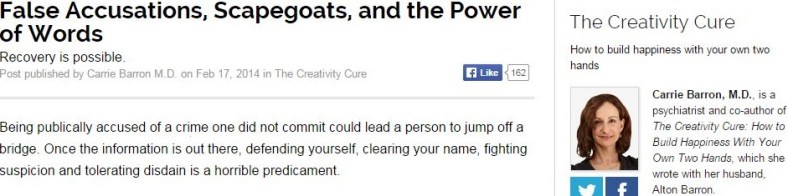
What Mr. Mackney describes in his final statement (dated four days after Christmas) will be familiar to anyone who’s endured something similar: the isolation, alienation, and paralysis; the mute indifference from anyone who could have intervened; the loss of identity, emotional decay, and financial ruin; and the hopelessness that comes from repeated confirmations that resistance is futile.
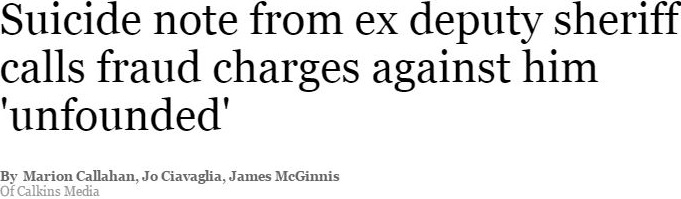
The consequences of the court’s intrusion into family and interpersonal matters—and the imposition of its judgment—are seldom viewed with the gravity they deserve.

Much of the debate of issues orbital to the events that prompted Mr. Mackney’s suicide occurs in the abstract. Commentators’ opinions (and they are legion) can rarely be seen to acknowledge the real-life strains and torments that real, live accused people suffer.

What is animating fodder for conversation to some, however, leads others to kill themselves.

Copyright © 2015 RestrainingOrderAbuse.com

*Among Mr. Mackney’s final words are an adjuration to stand up and speak out in defense of the abused (his blog resided at GoodMenDidNothing.com).