Pointers for Contesting a Restraining Order

One of the earliest posts on this blog (from 2011) offers some procedural orientation to the falsely accused. The author hasn’t revisited the post except to update a link to attorney Gregory Hession’s blog, MassOutrage, which is recommended reading.

Much of the author’s early advice is important: show up early, dress well, be polite, organize your defense and rehearse it ahead of time, make three sets of whatever evidence and exhibits you intend to present, etc. It can also be boiled down to (1) mind your p’s and q’s, and (2) don’t “wing it.”

This post offers some more seasoned counsel to the defendant who can’t afford representation:

  1. Be direct. If something alleged against you is false, say it’s “false.” Be explicit. Don’t “defend yourself” by explaining how the accusations against you couldn’t be true. Say they aren’t true (and then offer what proofs you can). If allegations are “mostly” not true, if they’re hyped or skewed or exaggerated, they’re “false.” Say so right off the bat.
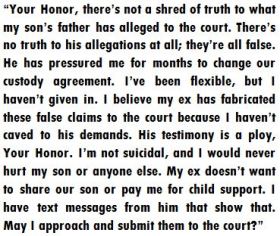
  2. The author suggested this statement as a “for example” to a recent commenter who wanted to know how to defend herself against false allegations. She reported her ex falsely alleged on a temporary restraining order petition that she had threatened to kill herself and her son. She said her ex took their son, refused to return him, and filed for a restraining order on bogus grounds so that he’d never have to return the boy or pay child support. Consider how a statement like this is much more effective than a long rehash of a relationship history that might only distract the judge from hearing what’s important.

    You’re the bad guy, so present an argument instead of an explanation. You won’t win over the judge by appealing to his or her sympathy.

  3. Be humble. Judges are vain, proud, and self-important, and some resent it if you sound like a smarty-pants. (Yes, a judge is capable of finding against you just because s/he thinks you’re haughty. The rules are whatever s/he wants them to be.)
  4. Keep it simple. These procedures are in-and-out. If your story is long and convoluted, change it. CHANGE IT. The truth that serves you is what’s important, not “facts.” Facts may not tell the truth. In these procedures, what counts are impressions.
  5. Be straightforward. Use brief, declarative sentences. Don’t backpedal. Some qualifiers are okay, like these: “I believe,” “I think,” or “Plain to me, Your Honor, is that….” Prefacing remarks like this expresses humility and honesty. Some qualifiers aren’t okay: “Well…,” “What I meant was…,” “Then again…,” “Perhaps….” They sound wimpy and uncertain, and they inspire suspicion; they say you’re guilty.
  6. Don’t leave anything up to a judge’s interpretation. Don’t submit an exhibit and expect the judge to see what you want him or her to see. Tell the judge what s/he should see (“What this shows, Your Honor, is…”). The judge doesn’t know anything, and s/he’s not on your side.
  7. Don’t mince. Use loaded words. Instead of saying something was “untoward,” for instance, say it was “sexual.” Graphic words make an impression. Careful ones don’t.
  8. Cross-examine (question) your accuser. Put him or her on the defensive. Some accusers are vehement fraudsters and will deny the truth and lie freely. If you can trip your accuser up, however, possibly by getting him or her to commit to a lie that you can disprove with evidence, this can be a winning move, as can be forcing your accuser to own an inconvenient truth because s/he knows you have proof of it.
  9. These procedures are contests between personalities, not just competing facts. The person who looks and sounds best, fares best. Aggressive defenses make an impression. Limp ones do, too, but not a favorable one.
  10. Expose lies to make an impression, but don’t depend on it that proving the plaintiff lied about something will impact the judge’s ruling. No one in these procedures is ever sanctioned or prosecuted for perjury. Presenting proof of lying can mean absolutely nothing; a restraining order petition will not be dismissed simply because a plaintiff demonstrably told a lie. Your accuser’s behavior is not what the judge is there to form an opinion on; yours is.
  11. You’re right; your accuser is wrong—that’s the impression you need to make. To win, you must convince the judge that the accusations against you are without merit.

Copyright © 2015 RestrainingOrderAbuse.com

Who Lies about Whom on Restraining Order Petitions?

Feminists would have the public believe that complaints of procedural abuse and courthouse fraud come from a single source: ex-husbands who’ve been left high and dry after a contentious divorce. The impression they promote is that criticism of feminist-inspired procedures of law is nothing more than the misogynistic ravings of bitter men who got what they deserved.

(The Southern Poverty Law Center and some leftist dweeb collective styling itself “RationalWiki” maintain lists of what they pejoratively term “MRA” websites, which they lavish with contempt, and the blog We Hunted the Mammoth is dedicated to mocking the men’s rights movement.)

No allowance is made that the claims of husbands and fathers could be true or even understated, claims, for example, of vicious frauds by false accusers and institutionalized discrimination. Obviously, no allowance can be made by the profiteers of the that discrimination; it would discredit their “cause.” Accordingly, the array of relationships accusers and the accused have is also concealed. That array is ugly to contemplate, and it ridicules the restraining order and domestic violence processes themselves.

Here are some of the scenarios the author of this blog has heard firsthand, all of them reportedly based on false or hyped allegations to the court:

This list is by no means comprehensive. Asterisks indicate how repeatedly the scenario has been reported here.

Copyright © 2015 RestrainingOrderAbuse.com

What Do People Accused in Civil Court Have to Complain About?: Civil Prosecutions and PTSD

“Contemplating, undergoing, or having undergone a lawsuit is disruptive. The experience saps energy and distracts the litigant from the normal daily preoccupations that we call ‘life.’ Litigants, who commonly feel alone, isolated, and helpless, are challenged to confront and manage the emotional burden of the legal process. The distress of litigation can be expressed in multiple symptoms: sleeplessness, anger, frustration, humiliation, headaches, difficulty concentrating, loss of self-confidence, indecision, anxiety, despondency: the picture has much in common with the symptoms of posttraumatic stress disorder (PTSD).”

—Dr. Larry H. Strasburger (1999)

Prior posts on this blog have considered Legal Abuse Syndrome (LAS), a concept proposed by marriage and family therapist Karin Huffer that has been discounted by the courts as a “novel theory.” This post spotlights a journal monograph published almost 20 years ago by psychiatrist Larry H. Strasburger that unequivocally states Dr. Huffer isn’t wrong and the courts are.

Dr. Strasburger’s comments in “The Litigant-Patient: Mental Health Consequences of Civil Litigation” are based on his having treated the legally abused (who may include anyone who’s been exposed to litigation).

The therapist of a litigant will encounter not only the trauma that produced the lawsuit, but the distress and disruption of litigation as well, including the delays, rehashing and reliving the original trauma, and challenges to honesty and integrity. The patient may come after years of feeling frustrated and thwarted by a system that moves at a snail’s pace, preventing the litigant from putting the issue of the litigation behind him [or her] and “moving on” with life. Gutheil et al. have recently coined the term “critogenic harm” to describe these emotional harms resulting from the legal process itself.

The term “critogenic harm,” by its etymology, refers to the psychic damages that arise from judgment, i.e., the pain and humiliation of being verbally attacked and publicly disparaged.

This, the reader will note, is a blaring clinical denunciation of those self-appointed, armchair authorities who would deny the damages of false prosecution. Nearly two decades after the publication of the journal article this post examines, such deniers are everywhere, including in the mainstream press.

The deniers, according to the experts, are talking out of their blowholes. Mere accusation, ignoring the effects of protracted legal battles, drives some to suicide and multitudes more into agoraphobic withdrawal.

The adversarial system is also a threat to the maintenance of personal boundaries. Formal complaints, interrogatories, depositions, public testimony, and cross-examination are intrusive procedures that aggravate feelings previously caused by trauma. Such procedures amplify feelings that the world is an unsafe place, redoubling the litigant’s need to regain a sense of control—often in any way he or she can, including exhibiting characteristic symptoms or defenses. It is not unusual to find entries such as the following in the medical records of litigants: “Janet is hearing voices to cut herself again after talking to her lawyer today.” Similarly, a male plaintiff in a sexual harassment suit threatened violence when he was informed that he was to be deposed, and he required hospitalization.

Exposure to civil process can very literally drive people nuts, and inspire in them urges to commit violence, whether to themselves or others.

Consider Dr. Strasburger’s remarks in the context of restraining order abuse and appreciate that the strains they describe can be compounded by loss of residence (some defendants are left homeless), loss of family, loss of income, loss of employment/career, loss of property, etc. Those so deprived may accordingly become estranged from friends and relations, if not socially ostracized. (They must also live with the consciousness that they’re vulnerable to warrantless arrest at any time.)

Litigants are often further distressed as various members of their support systems “burn out.” Their need for human connection and their need to talk about their experience often exceed the tolerance of family members and friends. Embarrassment and humiliation shrink their social world.

That’s besides the discord and isolation caused by a damning accusation, which may be accepted as fact even by kith and kin. Loyalties may become divided, and the accused may be spurned based on allegations that aren’t true. The sources of outrage to the mind and emotions multiply like cancer cells.

It should come as no surprise then that many who complain of procedural abuse report they’re in therapy. If the costs weren’t prohibitive to most, they might all be. Desolating, as Dr. Strasburger points out, is that even if this were the case, the promise of “healing” isn’t necessarily good. The therapist’s role may be little more than cheerleader.

Psychotherapy for a patient involved in ongoing litigation can take on the aspects of managing a continuing crisis. The therapist, facing this need for crisis management, may be providing support more than insight.

Litigation (or its aftermath) may become consuming; normal, healthy activities are suspended. (One woman this author has corresponded with laments she hasn’t known intimate contact in years; a recent female commenter, alienated from her child, refers to herself as a living homicide.) People may become stuck in a tape loop perpetuated by interminable indeterminacy, insurmountable loss, and a galling sense of injustice.

The legal battle enables people to put their lives on “hold,” thereby avoiding other aspects of their lives (e.g., “How can I be intimate with you when I’m involved in this lawsuit?”). The patient may be so attuned to psycholegal issues and hypotheses that she focuses thereupon in resistance to dealing with significant personal conflict. As a result, she is continually “pleading her case” in the therapy hour.

This cognitive rut exemplifies Legal Abuse Syndrome, and the state may be unending.

Copyright © 2015 RestrainingOrderAbuse.com

*The journal article cited in this post may be introduced to the court by litigants in need of an authoritative voice to validate complaints of pain and suffering induced by fraudulent or vexatious prosecution.

The Civil/No-Contact Agreement: An Alternative to the Protection Order That Won’t Spell the End of a Military, Police, Civil Service, or Other Career

  • A permanent protection order can have serious and potentially career-ending consequences.
  • In most cases, a permanent protection order may show up on a background check and may affect your ability to obtain a passport and travel or even get a job in certain lines of work.
  • It can even cause you to lose your job and affect your ability to obtain housing.

—The Drexler Law Group

The Colorado-based Drexler Law Group outlines some hazards of protection orders not previously known to this writer. Besides those enumerated above, it identifies these:

In some situations, the protected party realizes that if the restrained party loses his or her job as a result of the restraining order, the protected party is in jeopardy of losing household income or other benefits enjoyed by the family unit as a whole. Military members face the realization that a military retirement may no longer be available if the service member is discharged.

The law firm alternatively proposes consideration of a no-contact or civil agreement.

The benefits are obvious in that the restrained party can usually maintain employment free from the normal impacts of a full protection order. And, if the protected party feels comfortable moving forward with the enforceable No Contact Agreement, he or she can enjoy the other benefits provided such as reliable income.

In divorce or custody cases, it may be possible to dismiss the restraining order or protection orders proceedings in favor of entering a civil agreement, similar to a No Contact Agreement, which can be enforced by contempt proceedings in the civil court system. With particular language, some no contact agreements may be construed as being criminal enforceable.

Particularly emphasized is that a protection order can mean the loss of a career (and attendant benefits) to members of the military, and police officers and other civil servants.

Copyright © 2015 RestrainingOrderAbuse.com

A New York Judge Rules That Emailing Someone at Work Doesn’t Meet the Criterion of “Stalking”

Sending emails to someone at his or her place of employment—even a whole bunch of them—doesn’t constitute “stalking” according to a July 14 ruling by a New York judge.

The ruling was reported Monday on the blog of attorney Oscar Michelen, who successfully represented writer, legal reform advocate, and entrepreneur Matthew Chan before the Georgia Supreme Court last year in his appeal of a draconian protection order (verdict returned March 27, 2015). It also concerned digital speech. Mr. Chan’s remarks weren’t transmitted to anyone; they were merely published online. But some common ground exists between the cases, in particular the question of what substantiates an allegation of “threat.”

Mr. Michelen summarizes the New York case (People v. Marian) thus:

The defendant sent over 200 different forms of communication including many emails to her former girlfriend’s work email address. She was then arrested and charged with three stalking misdemeanors.

Significantly, the judge ruled that “a section of the NY Stalking Law requiring that the stalking conduct occur at the complainant’s ‘place of business or employment’ is not satisfied by the sending of repeated emails [to] the complainant’s business email address.”

The gist of the quibble, as Mr. Michelen explains, was that the electronic “space” occupied by email isn’t a real one; email isn’t sent to a “place,” nor must someone be at their “place of business or employment” to receive email. Email can’t be considered “stalking conduct” as defined by the referenced New York statute, because it doesn’t “occur” anywhere definite.

Also significant, as Mr. Michelen points out, is that the ruling places a check on prosecutorial encroachments that seek to broaden the definition of stalking “so that fear of physical injury is not necessary.”

The emails weren’t threatening. According to Judge Steven M. Statsinger’s ruling: “Between January and April of 2015, defendant bombarded the complainant with text messages, Instagram messages, and emails, both to the complainant’s personal and work email addresses, all asserting her desire to be with the complainant.”

The female defendant was still found guilty of two additional counts of stalking her ex-girlfriend under different sections of New York’s criminal code based on alleged conduct that was physically confrontational.

As Mr. Michelen concludes, however:

The distinction could be important to prosecutors and defense counsel in cases where there was no fear of imminent physical injury and the work emails had some stated legitimate purpose as that behavior would not meet the language of any other part of the stalking law. The case also serves as an example of how law is shaped and made by litigators fighting over the definition and application of terms and phrases in the statutes. I am sure that this was not the first time anyone was charged for similar conduct under the same statute; it was just the first time anyone challenged it.

Copyright © 2015 RestrainingOrderAbuse.com

Common Practices in Restraining Order Trials That the D.C. Court of Appeals Rejected Almost 20 Years Ago

“Rejecting the trial court’s concentration solely on the most recent event, we held it to be ‘essential that the court avoid an unduly narrow focus. One cannot determine whether [a CPO is appropriate] by simply examining the most recent episode. Rather, the judge must be apprised of the entire mosaic.’”

—District of Columbia Court of Appeals

The acronym CPO in the epigraph stands for “civil protection order.” Consider what the epigraph says. If it surprises you, that’s probably because you’ve been a restraining order defendant or known someone who was. Almost 20 years after the publication of this opinion by the court, judges continue to take little or no interest in the history of relationship conflict. “The most recent episode” (i.e., whatever a complainant happens to be complaining about) is all judges typically concern themselves with. (Allegations from the accused of chronic abuse by the complainant may be completely disregarded; trial judges prefer their facts in black-and-white.)

Bloggers and columnists like Jonathan Turley and Eugene Volokh, both of them legal scholars, are Johnny-on-the-spot when it comes to reporting groundbreaking court rulings.

Yet so occult are restraining order trials (i.e., hidden from view) that there’s no one who’s aware of merely significant findings in this arena of law. Nor is there anyone who monitors whether significant or even groundbreaking findings exercise any actual influence on everyday trial practice.

The restraining order process is unpoliced.

Law Prof. Aaron Caplan has remarked (2013):

As with family law, civil harassment law has a way of encouraging some judges to dispense freewheeling, Solomonic justice according to their visions of proper behavior and the best interests of the parties. Judges’ legal instincts are not helped by the accelerated and abbreviated procedures required by the statutes. The parties are rarely represented by counsel, and ex parte orders are encouraged, which means courts may not hear the necessary facts and legal arguments. Very few civil harassment cases lead to appeals, let alone appeals with published opinions. As a result, civil harassment law tends to operate with a shortage of two things we ordinarily rely upon to ensure accurate decision-making by trial courts: the adversary system and appellate review.

The areas of law in which rulings are commonly complained of as outrageous—domestic violence law, family law, and restraining order law—are essentially “backroom.” They’re unregulated.

The author of BuncyBlawg.com, a former trial attorney who is the best monitor this writer knows of, yesterday shared a link to a 1999 ruling out of the Capitol that underscores the disconnect between how the higher courts say restraining order trials should be conducted and how they’re actually conducted.

In Tyree v. Evans, the appellate judges rejected practices that are still common today, if not universally standard. Not only is it the case, as Prof. Caplan has asserted, that appellate review of restraining order rulings is lacking; the few appellate rulings that emerge may be ignored.

Here’s a summary of Tyree v. Evans:

In this case of alleged domestic violence involving an unmarried couple, the trial judge issued a one-year civil protection order (CPO) against the defendant, Bernard Tyree, without permitting Tyree’s attorney to cross-examine the complainant, Juanita Evans. Observing that unlike Mr. Tyree, Ms. Evans was not represented by counsel, the judge stated that Tyree “has no right to confront or cross-examine her. This is a civil proceeding.”

The District of Columbia Court of Appeals ruled to vacate the order (i.e., to “toss” it) on these bases: “Under American practice…adversarial cross-examination is a right of the party against whom a witness is offered”; “the judge may not preclude the opposing party from exercising the basic rights of a litigant.”

The defendant on the restraining order was denied the right to cross-examine the prosecuting witness (i.e., the plaintiff). The court judged this to be inconsistent with basic civil procedure, and it made this determination almost 20 years ago.

Nevertheless, it’s still common (if not standard) practice today to deny a defendant the right to cross-examine his or her accuser. Instead, the court may (may) allow a defendant to ask questions of the judge who may (may) relay those questions to the plaintiff.

Alternatively, a judge may simply refuse to listen to a defense that s/he feels is unworthy. There is no oversight of this arena of law; what trial judges say goes.

In Tyree v. Evans, the court determined that “interrogation by the judge is not a sufficient substitute for cross-examination….” Seven years after this ruling, when the writer of this post was in court, he was informed that he could not question his accuser but could only pose questions through the judge.

Even when bad practice is denounced by the court, nothing changes.

Copyright © 2015 RestrainingOrderAbuse.com

*Restraining order appellants who were denied the opportunity to cross-examine their accusers may cite conclusions of the court like those introduced in this post as grounds for dismissal of the orders against them.

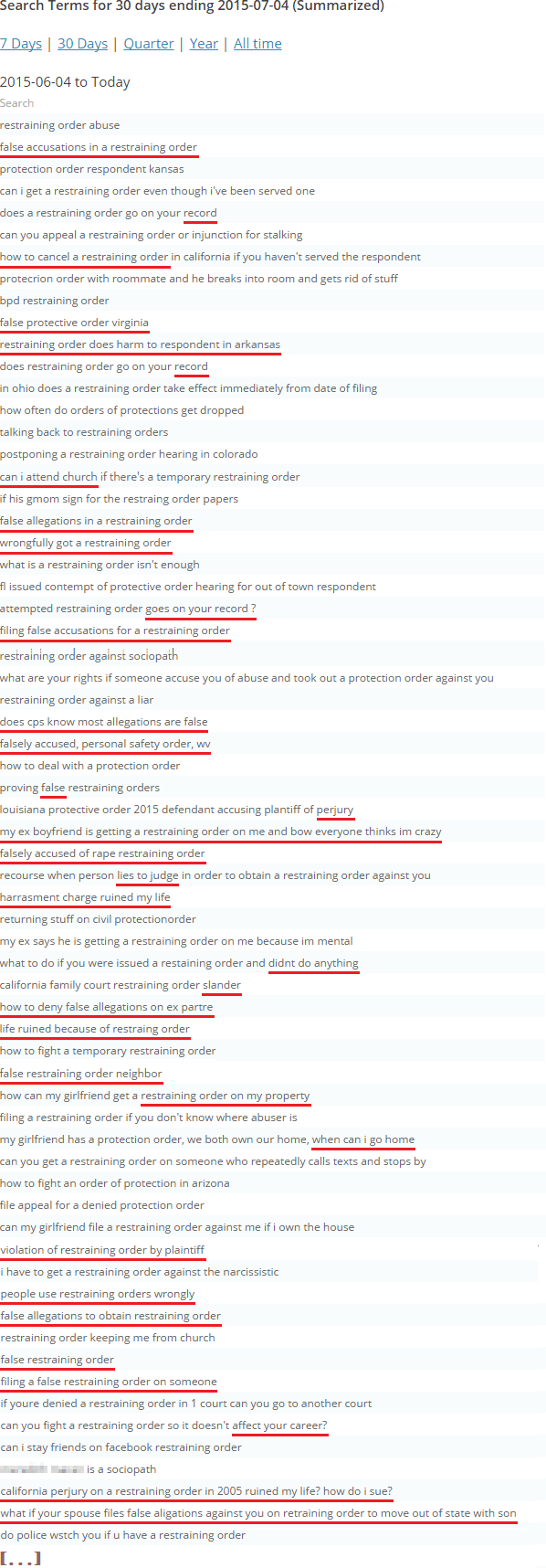
Precautions to Take (Immediately) if You’ve Been Issued a Restraining Order

  • “TRO violation for inadvertent butt calls”
  • “I have a protective order against my husband to protect my children and myself. Can my children send a card to him?”
  • “Protection order—does it apply to her as well?”
  • “Can you say hello to someone with a restraining order?”
  • “Back with my wife, and she has an order of protection”
  • “My husband has a $50,000 bond for violating a restraining order twice. What can I do?”
  • “Can he come to my daughter’s game if there is a restraining order in place?”
  • “If someone has a restraining order but keeps talking”

—Search terms that recently led visitors to this blog

Violation of a restraining order is a crime: contempt of court. In some jurisdictions, this is a misdemeanor offense; in others, it can carry graver significance. Whatever your state’s laws, it can land you in jail.

With cell phones, accidentally calling someone is simple. It happens all the time. If you accidentally call someone you’ve been prohibited by an order of the court from contacting, this can be a big deal.

Email is also a problem. The plaintiff on the order may one of a number of correspondents you’re accustomed to emailing as a group. Service providers, like Google, may also automatically email regular correspondents of yours.

So may Facebook and related sites send messages automatically.

If you’ve been prohibited by court injunction from contacting someone, make sure that person and any minors covered by the order are deleted from your phone and email accounts, as well as your social media groups and any automated lists that would make you responsible for an inadvertent “contact.” Even some service that automatically sent an e-card or a fruit basket on a holiday or birthday could occasion your being dragged back into court. (If you pay for the plaintiff to get a “cigar of the month,” cancel the subscription.)

Perform a purge, and make sure the firewall has no holes.

You must also be wary of enticement, whether intentional or not. Typical advice is if the plaintiff on the order calls you, hang up immediately, log the contact, and if you have an attorney, let him or her know about it.

Any contact, no matter how harmless, can be grounds for further (possibly serious) legal consequences. Even a brief stint in jail can mean the loss of a job and/or a residence (if not a pet, a child, or a career).

Unless the order you’re under is a mutual no-contact order, the plaintiff’s actions are not restrained. S/he is not the one who will be held to blame for a violation of the order. You are. (Yes, that’s even if s/he calls and says, “I feel really terrible about all of this. Please come by and have a beer. I need to talk.”)

You can protest until you’re blue in the face that you were baited into violating the order, and chances are the prosecutor or judge is going to pronounce that you’re a big boy or girl and knew the consequences of your actions. Don’t expect an ounce of compassion. (If the plaintiff wants to renew relations with you, s/he can move the court to dismiss the order.)

Finally, for a thorough introduction to avoiding snares, see “A Temporary Restraining Order Has Been Filed Against Me. What Should I Do?” and “Restraining Order Abuse and Vexatious Litigation” on the blog Breaking the Glasses.

Copyright © 2015 RestrainingOrderAbuse.com

*Appearing among recent search terms surveyed for this post was this one: “Sex after a restraining order.” This writer’s thought? Dicey.

If a Man Who Complains of Procedural Abuse is an “MRA,” What Do You Call a Woman Who Complains of Procedural Abuse?

It isn’t just the men disparaged as “MRAs” (men’s rights activists) who denounce the injustice of feminist-inspired “women’s law.” Women also lose their homes, their families, their dignity, and their lives to misapplications of restraining order and domestic violence statutes. Unlike the men whose lot they share, these women aren’t distinguished with a label.

I propose the acronym “BRA,” which could stand for any of the following:

  • Beleaguered rights activist;
  • Baffled, boggled, buffaloed, or bewildered rights activist; or
  • Buggered rights activist.

The latter of these, especially, would evoke the same mockery shown the men’s rights activist to whom “MRA” is applied like a markdown sticker.

Make no mistake: Women who complain of procedural abuses are no less ignored than the men who do. They’re not saying anything anyone wants to hear—not the ACLU nor the Southern Poverty Law Center nor battered women’s advocates nor feminists in general. They’re misfits, and they’re accordingly denied status. No one dares contradict them, because that might sound misogynist. So they’re just disregarded.

Here are some different proposals for what BRA might represent: bypassed rights activist, betrayed rights activist…or balanced rights activist.

You want the straight dope about false accusation and the need for procedural reform? Ask the ex-wife who’s had her child taken from her, ask the disabled girl who’s been accused of domestic violence and cries herself to sleep every night, ask the mom who can’t attend her child’s school functions or keep a job, ask the ex-girlfriend who was nearly parked on the curb, or ask the professional woman who’s been denied protection against a brute and then framed.

But only ask if you can tolerate an inconvenient truth.

Copyright © 2015 RestrainingOrderAbuse.com

*A woman is the best rights activist, and more women’s voices should be heard in coordinated public protest.

What Makes Someone an “MRA”? Why Are Those Guys So ANGRY?

Both questions in the title have a common answer, which I’ll illustrate by allegory.

When I was about 20, I worked next to the residence of an aged woman who kept a Rottweiler on a chain in her yard. The dog lived on the tie-out all hours of the day and probably had all of his life.

After I’d observed his situation for months and saw it never changed, I determined to offer to fence in the woman’s property for her. Our business had some unused rolls of chain link that wouldn’t be missed.

I knocked on the woman’s door and explained my interest. She said she’d come out and talk to me. While I waited, the dog approached. I knelt down to greet him. He lunged at my face, tore my nose, and then clamped down on the arm I raised protectively, crushing my radial nerve. I kicked him off and drove myself to the emergency room. If he hadn’t been on a chain, it would have been an ambulance transporting me there. It would still be eight or 10 months before I recovered the use of my left hand, brief as the attack was.

The dog had been mistreated, and he was insane. When I returned to Tucson after leaving for a time to rehabilitate, I learned he’d mauled two little girls and was destroyed. (I passed the woman on the road not long after. She smiled and waggled her fingers at me, and then scowled when I stared at her coldly.)

Question: Who was to blame?

People are no different from dogs. If you force them to live with undeserved privations, whether cruelly or just irrationally, they lose it. This is the answer to the questions in the title.

Calling male victims of abuse, abuse that has its roots in gender dogma, “crazy”—as the man does whose writings I panned in the last post—isn’t necessarily wrong. But driving people crazy and then blaming them for it does kind of make you a monster.

If I then call you a monster, does that mean I’m insensitive? The conclusion is ridiculous.

Consider this story of female violence that was submitted to the blog yesterday:

Hi, I just wanted to share my story for all the other guys who have been victims of vengeful women. I have had two restraining orders placed on me now. The second one is pending…. The first one was dismissed because it was a lie. The girl used it to kick me out of our apartment and to punish me. That was in 2004.

It has caught up with me since then.

In 2010, a guy who was jealous and wanted my girl used his private investigator credentials to pull my records. He found the [dismissed] restraining order and told my girl, who promptly left me.

I am currently married to a woman who has been hitting me, shoving me, knocking me over, and physically keeping me trapped in my own apartment. After having enough, I told her that I wanted a divorce and to go live her life (but really I love her and don’t want to leave her).

She left the next day and then called me a few days later and said she was going to come home. We argued and I yelled that if she attacked me again, I’d call the police immediately. That night when I came home, there were three police cruisers there (mind you, this is three days after the incident). The police escorted her along with my parents to help her get her stuff from the apartment. […]

My mother is a drama queen and always has been. She gets in fights with people in public and was kicked out of her family for spreading lies about them. When my wife asked to be taken home (she was staying with my parents whom she promised never to talk to), my mother told her about the restraining order I had over 10 years ago. I’m sure my mother embellished as she always does. She frightened Diana, and my mother called the cops.

That Monday, my mother brought her to the courthouse to file the restraining order. Diana did not stop her, and Diana even called me, and I heard this new tone in her voice, a tone of righteousness, like she was talking to a child she was about to punish. […] The next day, the police were beating down my door and served me the notice (that’s today).

I have no doubt that I will win this case, but just as the last case caught up with me…how do I explain two cases? This may ruin my reputation for life. I mean surely if you’ve had two cases brought against you, you did something wrong. You must be guilty, right? But I’m not. The first case actually brought on the second case, and in both cases it was the women who were hitting me, not me hitting them or even threatening them. […]

This man says he was battered by two women who petitioned restraining orders against him as a further form of assault (a power play). “They do it because they’re emotional disasters and want to punish,” he offers. He’s right. The system panders to impulse (and often rewards it).

Now consider that the blogger, Tom Boggioni a.k.a.“TBOGG,” criticized in the last post for a 2014 commentary on “MRAs” published on RawStory.com, popped out a piece two days ago telling men they should never strike a woman—as if anyone who would strike a woman will have some sort of moral awakening because Tom pronounced he shouldn’t. Please. (If pieces like his do more than make their male authors look good to their female audience members, it’s lost on me. They pander, and feminists eat it up.)

A man like the one in the account above, who has tolerated violence from women without raising his hand even in self-defense, has been punished for his tolerance by having cops pound on his door and being dragged into court to stand accused. He’s been represented as an abuser—to compound the indignities of being battered—and the implications of the representation are alone enough to damage him…indefinitely. (The first order against the man, which cost him a relationship, was thrown out of court. Note: Even when the court acknowledges allegations are groundless…it doesn’t matter, because the damning implications are preserved. Only one state in the nation, Tennessee, has a law on the books that enables a dismissed restraining order to be expunged.)

Will the guy in the story become the “embittered, divorced white man with anger issues” that TBOGG and his fellows mock? Who knows?

But would you blame him if he did? More significantly, if you did blame him, who would the real monster be?

Copyright © 2015 RestrainingOrderAbuse.com

*What writers who contemn MRA rhetoric seem to miss is that it’s not violent. It may be unsavory—it may be downright nasty—but its aggressiveness is passive. If the authors of MRA rhetoric (or what’s held up as exemplifying MRA rhetoric) were actually the violent bullies that many of them have probably been represented to be in courtrooms, is this the form their anger would assume…words? Put another way, what form would their anger take if they weren’t the violent bullies that many of them have probably been represented to be? That’s right…words.

Why I Think TBOGG Is a DBAG: A Few Words in Defense of “Restraining-Order-Americans” (and PETA)

I’ve developed a keen loathing for pandering, puddle duck critics of men’s rights activists who can inspire half a million “likes” with a spatchcocked propaganda piece that features a misspelling in its first sentence and refers to John Donne as “a wanker.”

A quasi-intelligible graffito like Tom Boggioni’s “You too can talk like an embittered divorced white man with anger issues. Learn how now!” confirms what another literary giant once wrote: If you want to persuade, don’t invest your faith in the right argument, but in the right word, because the power of noise will always trump the power of sense.

Tom (a.k.a. TBOGG) could probably have just typed “wanker” over and over and earned the same number of plaudits from his audience of clapping seals.

His commentary, constituted of a few scurrilous lines of his own intermingled with some scurrilous quotations from others, is apparently meant to be a conclusive refutation of men’s complaints of institutionalized discrimination and abuse.

North Carolinian Neil Shelton has been denied contact with his children for over three years. He has also been jailed based on a hoax apparently concocted by his (now ex-)wife’s divorce lawyer, who is also a (female) member of the state House of Representatives.

This rhetorical sparring between chauvinists on either “side” (of what exactly, I’m not sure) is nothing more than a flaming oil slick on a sea of torment. State-sponsored abuses of men (and women) are widespread, and most victims are not hip to the pop-culture pidgin of Tom’s crowd and their opposite numbers. They’re missing their lives, their kids, and their peace of mind. The homeless guy who used to be a businessman and father couldn’t give a rip about cutesy coinages.

If polemics like Tom’s can be said to have an argument, it’s this: Manifestations of masculine anger and contempt must be unjust, because if men had a just reason to be angry and contemptuous, they wouldn’t be angry and contemptuous.

You can call the argument absurd, or you can call it stupid. Absurd or stupid, however, are the only alternatives. (A corollary of the argument seems to be that if mistreated men coolly and reasonably stated their objections, they should have every expectation that injustice would be righted—promptly and with ardent protestations of apology. It’s also absurd…or stupid. Take your pick.)

The beef against PETA—another of Tom’s targets—like the beef against “restraining-order-Americans,” seems to run like this: If you want to register your moral outrage, you should be polite about it. Like, we can totally see how it might suck to be deprived of liberty, stuck in a cage, and made the plaything of some creatures with clipboards instead of souls, but if you want us to take an urgent interest, you should make the problem easier for us to ignore.

Copyright © 2015 RestrainingOrderAbuse.com

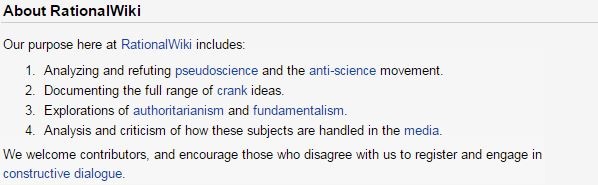
An Anagram of RationalWiki Is “A Liar—I Know It”: Talking Back to Little Sisters Who Play Big Brother

They have a network of informants. They target dissenters, lump them, and apply a label. They maintain lists. They coerce lockstep conformity with their perspectives by ridicule and censure….

No, I don’t mean the former East German secret police; I mean those liberal/feminist pretenders to enlightenment and humanism whose robotic pronouncements are so clotted with jargon they actually read like computer code: YEC, ID, MRAs, MGTOWs, PUAs, Nice Guys/Incels/AFCs, TERFs, radfems, Randroids, etc.

RationalWiki’s logo, fittingly, is a disembodied brain.

Don’t underestimate the potency of nerds, though. They have Twitter accounts…and they’re not afraid to use them.

I learned the other day that this blog had been put on one of their blacklists. If my motive for writing about reprehensible acts like fraud, corruption, perjury, betrayal, parental alienation, discrimination, legal abuse, judicial dereliction, and bullying people to suicidal despair were self-promotion instead of firsthand knowledge of the ruin they cause, I might be flattered that my desultory musings had achieved the notice of (dotdotdotDAAAAAA)…

RationalWiki.org. (Enter Chihuahua, stage left, in a tutu,)

No, I didn’t know there was a RationalWiki.org, either—and after visiting the site, I’m still not sure there is. If “rational” is meant to imply “having reason and understanding,” then this is to report the domain name lacks qualification. The word rational can also mean “involving division,” however. Maybe that’s what the editors meant.

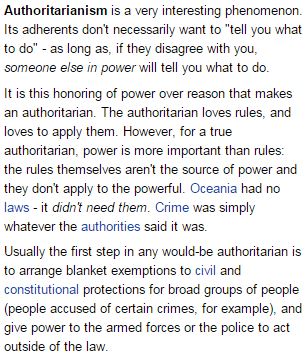
RationalWiki, “Authoritarianism”

The rhetoric of sites like this isn’t without its amusements. For example, RationalWiki invites its audience to “Check Our Entitlement.” In other words, it doesn’t want to exclude the less advantaged, or seem to talk down to them.

Considering there’s nothing on RationalWiki that doesn’t smack of pop-culture-poxed, pseudo-intellectual, East Coast establishment condescension, and that the educationally impoverished victims of racism and classism that RationalWiki purports to defend probably couldn’t track a fraction of what’s published there, the invitation to “Check Our Entitlement” deserves to be met with chorus of raspberries or a barrage of moldy tomatoes.

The page on RationalWiki that pans the blog you’re reading is charmingly titled, “Webshites.” The word is a pun that will only be understood by fans of the BBC or the novels, say, of Graham Swift—and there’s nothing elitist or alienating about that. (Shite is Anglo-Irish for shit.)

RationalWiki accuses this site of being “sexist.” Since RationalWiki is plainly a stalking-horse for feminist and otherwise PC propagandists, this site proposes it’s projecting. Since RationalWiki is blind to the wealth of pain its derelict dogma produces, this site further proposes it’s vicious.

Finally, this site’s editor dismisses RationalWiki’s editors as a collective of dorks.

Copyright © 2015 RestrainingOrderAbuse.com

*Propaganda is “the spreading of ideas, information, or rumor for the purpose of helping or injuring an institution, a cause, or a person” (Merriam-Webster’s Collegiate Dictionary). This is how information control is disguised:

This is reality:

Restraining Orders Don’t Empower Anyone but Police Officers, Prosecutors, and Judges; “Victims” Are Relieved of Their Rights, Also

“I don’t know of any other provision in law in which people go to court and take out a civil action with the goal of handing over some of their power to a judge. When you get a restraining order, you relinquish your power to unilaterally consent to being contacted by the restrained party. As the ‘Notice to Restrained Person’ that the court gave me says, ‘If you violate this Order thinking that the Protected Person or anyone else has given you permission, you are wrong, and can be arrested and prosecuted. The terms of this Order cannot be changed by agreement of the parties. Only the court can change the order.’ The ‘Notice to Protected Person’ says ‘You cannot give the Restrained Person permission to change or ignore this Order in any way. Only the Court can change this Order.’”

—Blog respondent (July 2, 2015)

There’s an unexamined assumption that restraining orders “empower” those to whom they’re granted. Ask a feminist, and there’s a good chance this is exactly what she’ll say restraining orders do.

They don’t.

Restraining orders don’t empower anyone but police officers, judges, and prosecutors; they only take rights away. They prohibit normal, lawful conduct under penalty of punishment.

Those on the receiving end of an order are perceived to be the ones who are deprived of rights. But so, too, are those to whom orders are granted denied freedoms. Restraining order petitioners concede their power of choice, often unknowingly. Some petitioners of orders assume the value of an order is to give them the power of consent so they can choose or decline to associate with the defendant on the order according to their preference.

Petitioners have no discretionary rights. They forfeit their freedom of choice when they file allegations, and they do it voluntarily.

It isn’t “If I say yes, it’s yes; if I say no, it’s no.” It’s just no. A restraining order doesn’t bestow any entitlements; it erects a barrier.

An order of the court is an order, and that order can only be modified or revoked by the court. Observance of its prohibitions is never optional. Plaintiffs surrendered their say when they invited the state to play parent.

Returning to our imagined (straw) feminist, she might remark that restraining order plaintiffs don’t want anything to do with the people they petitioned orders against, so they haven’t been denied anything they cared about. But real life is seldom as black-and-white as a feminist’s imagination.

Some plaintiffs say they felt they were coerced into getting restraining orders and express resentment when they discover the consequences; others say they were ignorant of the import of orders. Some of the latter report that they renewed relations with the people they petitioned orders against and even moved in with them or had a child with them, assuming consent was theirs to give.

They desperately want to know what they can do when the people they petitioned orders against and then invited back into their lives are arrested and face jail time for contempt of court.

Similarly, domestic partners want to know how to communicate with the spouse or boy- or girlfriend they obtained an order against. They’re at a loss for how to deal with daily exigencies like home repairs and bills. They thought getting a court injunction was a measure to pacify conflict, not a complete severance of relations. They didn’t realize they were signing over their autonomy to the state.

Predictably, a significant proportion of petitioners (reportedly as many as half) subsequently return to court to request that orders be withdrawn. A judge may agree, or s/he may not, according to his or her legislated prerogative. Some petitioners know to ask; some don’t know moving the court to dismiss an order is an option and instead act in violation of a judicial ruling that only exists because they requested it in the first place.

In “Protecting Victims from Themselves, but not Necessarily from Abusers: Issuing a No-Contact Order over the Objection of the Victim-Spouse” (2010), attorney Robert F. Friedman considers the constitutional right to autonomy that the advent of restraining orders has legislated away.

It gets worse.

Orders may also be issued by judges on their own initiative (sua sponte) if someone in a household reports a domestic altercation. They can even be issued if a third party (like a bystander or a neighbor) reports what s/he thinks is an altercation.

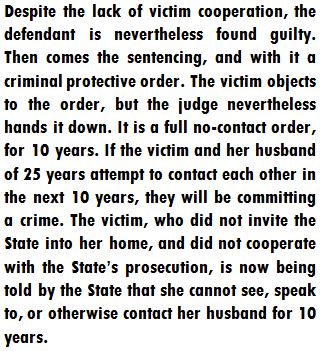
It’s not about who “presses charges.” That’s a misconception derived from TV. The state “presses charges.” The apparent “victim” has nothing to do with it. S/he can refuse to cooperate. S/he can even protest…and it doesn’t matter.

An order that’s imposed by the court, called a criminal or mandatory order, isn’t electively petitioned, so the person who’s named “the victim” can’t just go to a judge later on and ask that the order be canceled. Typically only the district prosecutor’s office can do this, and it has no compelling reason to.

Once the state is invited to be the arbiter of conflict, the rights of the parties involved become its to dictate. The only one “empowered” is Uncle Sam.

Copyright © 2015 RestrainingOrderAbuse.com

Women’s Use of Restraining Orders to Commit Rape

In the wake of several purported cases that gained widespread attention and then unraveled, free range feminist representations of rape, including how prevalent it is, have fallen under scrutiny and skepticism. Press response to the excesses of anti-rape rhetoric has been persistent—and in instances remonstrative, if not scathing.

A significant source of backlash has been claims of rampant sexual coercion and violation on college campuses.

Eden Strong of Bustle.com poses and responds to the question, “Is It Rape If You Say Yes?” (April 16, 2015).

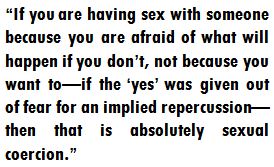
One reason these claims have met with challenge is that the standard for qualifying what is and isn’t rape is wide open. It’s argued that in the absence of ongoing and deliberate tokens of consent, a sex act may be called rape. Accordingly, some have advocated that participants in intercourse repeatedly express to each other (in media res) that everything’s still okay. (One draws the impression that lovers are supposed to continually pause and inquire, “Are we good here?”)

The word rape, then, doesn’t exclusively mean what it did when I was a kid: some guy snatching a woman unawares and having his way with her in the bushes with a hand over her mouth. Today, rape means any nonconsensual act of sex, any act of sex, that is, in which one party is there without full, voluntary, and enthusiastic eagerness.

This post is to report that by this definition, women use restraining orders to rape.

A previous post considered this in the context of coercion generally: “BLACKMAIL: Using Restraining Orders to Extort and Punish.” It quotes a respondent to this blog:

My son’s girlfriend…filed a domestic abuse CPO [civil protection order] against my son, again telling him that he shouldn’t have left her. He hasn’t been served yet—they keep missing him. She calls my son constantly, stringing him along with the idea that she “might” let it go. He’s taking her out to eat, giving her money, staying the night with her. Hoping that she’ll let it go. All that and yet two hearing dates for him have come and gone with her showing up at both his hearings asking for a continuance because he hasn’t been served.

According to prevailing standards, the man referenced in this account is a victim of sexual coercion (of a particularly fiendish nature); he was induced to have sex with a woman he rejected. She made him fear the consequences if he didn’t comply, meanwhile continually refreshing the threat (and, no, this isn’t an isolated scenario, and why should it be?).

The ironies, if they need elucidation, are that a process of law that’s vehemently defended as a rape deterrent can be (and is) used to coerce sex, and advocates of the process who vociferously decry “rape enablement,” “rape denial,” and “victim-blaming” consequently may be said to practice the very things they denounce. The official victim in the story above is the rapist, and the rapist is a woman. (It’s these sorts of ironies that inspired the writer to characterize restraining order advocates as residents of la-la land in a recent post: They’re loyal to pet ideas—not principles, ideas—and they deny infelicitous realities.)

Arm-twisting doesn’t require a stronger arm, folks, just superior leverage.

Copyright © 2015 RestrainingOrderAbuse.com

*Eden Strong, quoted in this post, concludes her piece “Is It Rape If You Say Yes?” with this assistance to victims of sexual extortion: “If you’ve been pressured or coerced into sex, you can speak with a counselor at the Rape, Abuse, and Incest National Network at 1-800-656-HOPE.” One wonders how such a counselor would respond to the story of restraining order abuse cited above and whom s/he would recommend the man in the story turn to for relief.

“Rapist by Default”: Is This a Court Ruling That Should Be Possible in the Civilized World?

The question in the title of this post isn’t a hypothetical one.

People are nominated rapists by default (as well as “domestic abusers,” “stalkers,” or what have you). They’re accused by restraining order petitioners in civil court (sometimes without their knowledge) and don’t or can’t respond. So they’re found guilty…without a trial.

Let’s say you live in Rhode Island, and someone persuasively accuses you of rape in California in a five-minute recitation before a judge. Now, you either drop everything, hustle your butt to the opposite coast, and convince a judge otherwise…or, presto, you’re a rapist; a default ruling will be entered against you automatically. The ruling will be preserved, too, on your permanent public record.

No cop will have investigated the accusation, no prosecutor will have vetted it, no counsel will be appointed to defend you, and no special allowances will necessarily be made to ensure you have a practicable opportunity to defend yourself. If you fail to appear in court at the appointed time, tough luck.

This is how, whether you’re a man or a woman, you can be deemed a rapist without the court’s knowing a thing about you other than your name. (Yes, women, too, are accused of rape in civil court, that is, of having coerced an unwilling partner to have sex.)

While a default restraining order judgment just means you’re prohibited from contacting or approaching the petitioner of the order, your presumed guilt can be used as “factual evidence” against you in other governmental procedures. You may be represented as having a “history” of domestic or sexual violence (based on a default judgement on what may have been a completely false accusation).

A case that has inspired several recent posts, that of a Virginia man accused in Colorado of “domestic abuse, stalking, sexual assault, and physical assault,” exemplifies this horror.

This man, whose markedly troubled wife filed a string of unsubstantiated allegations against him before months later being institutionalized, taking her own life, and leaving behind a child she had told him she had miscarried, must respond to a “dependency and neglect petition” that represents him as an unfit parent.

This item appears among its arguments to the court:

[Mother] and Father have a history of domestic violence that includes, but may not be limited to, the issuance of temporary restraining orders in cases […] and the issuance of a permanent restraining order in case […] which was entered by default on January 16, 2015, placing the welfare of the Child at risk.

What this categorically states is that a “history of domestic violence” exists. Then it casually notes that this alleged history is based on a default ruling. The temporary orders mentioned were also ex parte, i.e., issued offhandedly in 10-minute procedures performed in the absence of the accused. In other words, no probative investigation of the claimed violence was made by a judge or anyone else. The so-called history is a handful of accusations rendered to various judges in minutes by a woman who would subsequently be committed for allegedly hearing voices prompting her to “hurt or kill” her child. The couple’s domestic relationship had “lasted 75 days total,” making the word history that much more inapt. The claimed violence and the judicial ruling validating it were made seven months after the man’s wife had moved out, and he didn’t travel from Virginia to Colorado to dispute the claim in court. There was no evidence, and there was no trial.

Based on a default judgment, he is represented as a “violent abuser” who’s a risk to the child he didn’t know he had, and consequently he may be denied any role in her life. If it serves the interest of the state, he can also be characterized as a rapist based on the same ruling, one entered automatically.

He is a “rapist by default.”

Copyright © 2015 RestrainingOrderAbuse.com

What Restraining Order Defendants Need to Know That No One Ever Tells Them: The Truth Doesn’t Matter

The ambition of this post, an intermission between considerations of graver subjects, is to dispel restraining order defendants’ faith in the value of “truth.” Defendants are led to believe that if they’re truthful in the defiance of lies or hyped allegations, all will turn out as it should. But truth is a false idol that answers no prayers.


If you haven’t yet had to swear this oath, you’ve heard it before on TV: “Do you swear to tell the truth, the whole truth, and nothing but the truth?” (Sometimes God and the word solemnly are thrown in for emphasis…maybe to suggest you’ll be struck by lightning if you distort the facts or omit any.)

The significance of this courtroom ritual is none, and taking it literally is for chumps.

Civil trials, especially the kind this blog concerns, do not weigh “truth”; they weigh testimony, along with evidence as it’s represented (in procedures that may span minutes only). The savvy defendant will think in terms of economics and marketing. “Truth” has no inherent value to a defense. Unless it conclusively proves something you want to prove, it’s totally worthless. Worse, it may distract and dilute the potency of what you’re trying to sell. Facts, besides, may not tell the truth. The word truth is a trap for the naïve.

What wins cases are successful representations, ones that work the desired effect (i.e., what wins is salesmanship not scrupulous reporting).

While the court asks for honesty, it doesn’t reward it. It’s what you say and how you say it that counts, not “the truth.” God isn’t the judge; a man or woman is, and his or her favor goes to the person who gives the most compelling presentation (i.e., sales pitch).

Why do lying plaintiffs win? They win because their representations were persuasive. Did they tell “the whole truth and nothing but”? They may have told none at all. (Restraining orders have reportedly been obtained by people using assumed names; they didn’t even tell the truth of who they were.)

What do cunning attorneys who represent lying clients (or any clients) do? They tell only those truths that support their stories…and no others. (They may lie, also—and vigorously.)

The fastidious defendant who finicks over every detail, who backpedals and carefully qualifies his statements (in the interest of complete and accurate disclosure), and who otherwise invests his or her trust in “the truth” grossly misperceives the nature of process.

Representations win court contests, not “the truth.” The truth doesn’t matter.

~ EPILOG ~

A few months ago, the writer spoke for an hour or so with a 30-something man who said he was an obsessive-compulsive. He had written that he was “starting to go downhill really fast” and needed help. “I will try to eventually explain,” he began, “but there’s such a long history of what happened.”

What he explained was that he’d been bullied by a woman many years prior, while they were in high school, and had been haunted and galled by the abuse ever since. He said she had tried to coerce him to have sex with a friend of hers, that he had refused, and that she had spitefully urged some guys to rough him up (one of them would later be convicted of murder, so this wasn’t bush league bullying). She had also greeted him with a sneer whenever they met after that, and flipped him the bird and yelled “Fuck you!” at him as he passed by. He had tried to reach an accord but had only been mocked. He said he never used to stand up for himself and was sick of turning the other cheek.

He impulsively ventilated rage that he had bottled for 20 years by calling the cell of the woman’s husband and leaving her a voicemail that called her a “rude, mean bitch” and that ended with a string of “Fuck you!”s. That was pretty much the extent of it, but he was handily represented as a stalker.

He wanted to know what pointers I could offer that might aid him in his defense against a restraining order petitioned by a woman who claimed to have no memory of the events he described and whose stepmother, he said, was a former lawyer who had prosecuted cases before the state supreme court and was, besides, the director of a “domestic abuse and physical violence organization.”

Yeah.

I repeatedly impressed upon him that reciting a history that spanned decades wasn’t likely to move a judge to anything but a yawn (or a rebuke) and that he should consider how to frame his story to put himself in the most favorable light, for example, by updating the context (and abandoning a rigidly chronological narrative).

Each time I interrupted, he said he understood and then recommenced his story, which stretched back to his anguished childhood. He was very earnest and conscientious, and continually paused and qualified his remarks with “Granted, I….” It was important to him, he said, to tell his “heart’s truth” (i.e., the “whole truth”). He wanted someone to sympathize, and I did. But I knew a judge would not.

I never heard from him again.

Copyright © 2015 RestrainingOrderAbuse.com

Borderline Personality Disorder, Procedural Abuse, and Feminism: A Victim’s Reckoning of Their Tolls

YY_mural

“I hate this world and almost everybody in it. People use each other. I find most of you disgusting. My brothers are disgusting. The people I used to work with are disgusting. You’re shallow, you’re two-faced and hypocritical, you’re judgmental, you cause me more pain than you could ever possibly know. You don’t want me around? Guess what? I don’t want to be around you ugly motherf[—]ers, either. You cause all of your own problems, heap them onto other people, and then blame those people for your problems. You bitch about the amount of pain you’re in, then tell other people to get over their pain.

“I am done with all of you. I am done with your lies and your shitty society, and most of all, I am done kissing your ass.”

—Mrs. Nathan Larson (May 9, 2014)

Virginian Nathan Larson has had a tumultuous year.

He married a woman he met online (April 23, 2014); then she moved out (June 21, 2014) and accused him, among other things, of rape (August 2014 through January 2015); then they divorced; then he learned he was a father when the news reached him that his ex-wife had committed suicide.

The quotation above is from an online post of his former wife’s published between their marriage and their separation. Below is an excerpt from a digital diary entry of hers written when she was a teen (which included a “hit list”):

I hate the students at […]. They are arrogant and foolish. My one dream, my passion is to achieve a machine gun or something and shoot every f[—]er in the school. I want to pump them full of metal, their blood splattered on the tiles. I want to make a massacre that becomes the worst in American history. There are only a few people who I would spare. Everyone else…I would love to see them writhing on the ground in pain, blood oozing out of a million holes in their body.

Nathan’s wife, who was an arguably troubled woman, abruptly terminated their relationship of “75 days total” and then informed him she had miscarried their child. In August 2014, she accused him of rape to the police, but he declined to talk with them and was never charged. In November 2014, she began to accuse him to the courts.

This wasn’t a trial run, either. The accusations brought against Nathan by his wife mirrored charges she had made against a previous partner, also to damning effect.

She petitioned three ex parte (temporary) restraining orders before successfully obtaining a permanent order against Nathan in January of this year (by default). Its alleged bases were “domestic abuse, stalking, sexual assault, and physical assault.” The order was petitioned in Colorado, and Nathan would have had to travel a significant distance to be heard in his defense. “Not wanting to invest money and emotional energy in fighting it, and knowing it would be hard for me to successfully contest it, I didn’t show up to the hearing,” he says. He elected to “move on.”

The two were divorced in April 2015, and that seemed to be an end on it.

Two months later, Nathan was told his (then) wife had given birth to a child in February, presumably the one she had told him she had miscarried. This information reached him along with the news that his former wife had killed herself following her commitment for “suicidal depression” and allegedly hearing voices compelling her “to hurt or kill the Child.”

Nathan must now contest a “dependency and neglect petition” in Colorado asserting he’s an unfit parent.

What follows are his reflections on his marriage to a woman who he alleges had untreated borderline personality disorder, on feminism, and on “abuse culture” and its damages.

Nathan Larson (with his new fiancée’s infant cousin)

Having the benefit of distance from the situation and more calmness about it (especially now that she’s dead), I would say that we both made a lot of mistakes during and after the relationship. There are some people who say that it’s a mistake to enter into a relationship with someone with untreated borderline personality, because it simply won’t work, no matter what you do. Unfortunately, once you get into a relationship like that, your sense of reality can get distorted because you’re so in love, and they’re so convincing, and they get so many other people to agree with them, that you too start to believe it if you don’t have enough of an understanding of BPD to realize what’s happening and why.

For example, suppose you used to argue with your BPD partner, and occasionally lost your temper and had to apologize for saying something unkind. Because they’re so sensitive to minor betrayals, they might claim that you horribly emotionally abused and bullied them to get your way, and then tried to be sweet to them and make up, just like in the classic model we’ve been taught of the cycle of abuse. If you’re still thinking this person is the most wonderful person in the world, then logically you might think that you really did emotionally abuse them, because why would such a wonderful person say it if it weren’t true? Plus, they are clearly very upset over how you treated them, and they broke up the relationship over it, and now they’ve told everyone in your circle of friends and family about it, and many of them are telling you they agree that the breakup was your fault because of your emotional abuse.

These are people you respect and trust, and therefore this could not possibly be happening unless you really were abusive!

You start to blame yourself and even tell people, “She left me because I was emotionally abusive” (which of course attracts more criticism, because who would admit that if it weren’t true?). Eventually, you run into someone who hears your account of what was actually said and done, and challenges your interpretation, saying you’re being too hard on yourself, and that this chick is not as great as you seem to think she is. (To which, of course, you may think, “He just doesn’t know and understand her and our deep and beautiful relationship! We were soulmates! What are the chances I will ever find another woman like that? I searched my whole life, and she was the only one like that I’ve ever met who loved and appreciated me so much.”)

If you have good friends, they’ll awaken you to the fact that someone who truly loved you that much would be willing to forgive and come back to you, or at least treat you decently, rather than holding a grudge and trying to make you suffer.

Also, there’s the fact to consider that people with borderline personality disorder idealize and devalue, and they view people as either completely good or completely bad. This means that once they’re faced with the inescapable reality that you’re not perfect, they have to view you as completely evil. They also have to deny any blame at all for the end of the relationship, lest they have to conclude that they too are flawed, which would cause them to view themselves as completely evil. They can’t handle any feelings of guilt; they have to deflect all blame, including the blame for their own emotionality.

Feminists, of course, are not thinking about all this psychology going on behind the scenes.

They’re busy calculating whether being skeptical of the claims of someone like that will make the public more likely to be skeptical of the claims of someone with legitimate, serious complaints, and make those victims more reluctant to come forward. So the innocent who was accused gets sacrificed for the greater good.

Some women with borderline personality disorder are attracted to the feminist movement and voraciously read all of their materials about abuse, patriarchy, rape culture, etc. because it helps them view themselves as a helpless victim of powerful sociopaths, and thus deflect blame.

They can find a community of people who will give them the benefit of the doubt by believing their stories, and confirm their interpretation of what happened. Borderlines also sometimes struggle to find a sense of identity, and the feminist movement can provide that as well. Their victimhood actually makes them useful to someone, since it’s a story they can tell and retell to those who need to be persuaded that political change is necessary to stop these abuses. (Feminists, like advocates for most other political movements, would bristle at any suggestion that their ideology attracts mentally ill people, since that would tend to discredit them.)

Yet what the feminist movement can never satisfactorily explain to them is why, despite all this training in recognizing red flags of abusers, and despite all the tools the system has provided for punishing abusers (e.g., restraining orders, prison sentences, etc.), they keep getting “abused” by partner after partner, while many other women seem to have successful, happy relationships.

The only possible answer is that it’s a combination of sociopaths’ finding them particularly attractive for some reason (maybe they sense they’ve been abused and think it’ll be easy to re-victimize them) combined with the fact that the patriarchy is still strong, abused women are still not being believed, and therefore we need to punish abusers more harshly and give the accusers even more benefit of the doubt.

Then, finally, when we have a world where all you need to do to get a man locked away for life is cry rape without any supporting evidence, rational men will finally stop raping. Except, even if such a system were put in place, these insecure women would still feel victimized by their partners, and they would attribute the “abuse” to these guys’ acting impulsively without regard to the certain punishment.

Copyright © 2015 RestrainingOrderAbuse.com

*An excellent explication of procedural abuse by “high-conflict” people (who are associated with personality disorders like BPD) and why court procedure is attractive to them is here.
There Is Nothing about Restraining Order Law, Its Abuse, or Its Application That ISN’T Political

According to a critic of the last post, restraining order abuse is apolitical, and he rejects the writer for not striving “to build a broad, non-ideological [base?] for real restraining order reform.”

This is not—or it shouldn’t be—an ideological issue. It’s an issue that affects liberals and conservatives alike, and a problem in liberal and conservative courts. The idea that only liberals and liberal judges abuse restraining orders and that conservative women and conservative courts in conservative jurisdictions never do has zero basis in fact.

The latter point is true enough: No one is immune to procedural abuse (and that point has been made at least once or twice on this blog).

The “idea” the commenter purports to be responding to is his own. There was no mention in the post of “liberal judges” or “conservative women.” The idea appears to be an imposition on the text provoked by the writer’s pejorative use of the phrase liberal/feminist perspectives, which evidently affronted the commenter.

Note: It’s the hazards of cranky interpretations that most posts on this blog concern. Maybe the critic will detect the irony; maybe he won’t.

His former point, that this “is not…an ideological issue,” is puzzling. Is the issue fraud (i.e., false allegations)? Is it bad law? Lack of accountability? Judicial corruption?

Whatever the perceived “issue” is, the perception itself is superficial. Laws are products of politicking. They’re a response to a social demand. Where did the demand for restraining orders come from, and where the demands that have influenced restraining orders’ legal evolution and application?

This 2012 rally was held to “pan [the] GOP’s Violence Against Women bill.”

To deny women as the source would be silly when the most comprehensive database on restraining order statutes constitutes a website called WomensLaw.org. More pointedly, we might suggest “feminism” as the source, though what that word meant 40 years ago and what it means today are inarguably very different.

Can we be more specific yet? Consideration of who specifically advocates for “women’s law” will overwhelmingly recommend the characterization “liberals.” There may be exceptions, sure…but let’s not be coy.

What if we look to critics of restraining orders? Will we find that they’re typically characterized as “conservative”? Whether the characterization is accurate or not…yeah.

It’s not so much that the “issue” divides along party lines; it’s that those who weigh in on either side identify the opposition as “other.” Feminists, for example, may identify Dr. Christina Hoff Sommers (who herself identifies as a feminist philosopher) as “conservative,” and that’s if they’re being polite (here, for instance, is what they call her when they’re not). No one would refer to her as a “liberal”…because we know what liberals are supposed to stand for. (See also, for example, Wendy McElroy, who may be invited on Fox News but not on NPR.)

Clearly, at the nexus of the conflict, there is “party” division.

Denying that the issue is “ideological” or that laws, policies, and practices are influenced by dogma—that’s a different story. It’s starkly wrong.

The critic quoted in this post is right that party identification doesn’t mean a person will be sensitive or callous to procedural abuse, per se, or immunized against it. Purportedly, only about one in five people identifies him- or herself as a feminist (and probably most of the young women of Women Against Feminism broadly identify with liberal values). On the populist level, the “issue” isn’t necessarily a partisan one. Feminists, however, who hold political sway, are predominantly “liberals”; and they do coerce loyalty from others who identify themselves the same way, and rightly or wrongly their values have come to represent their party’s values.

What the previous post highlighted was that liberal ideology (as it manifests in government) ignores reality, and the consequences are reprehensible. Change isn’t motivated by telling people what they’re doing right.

Copyright © 2015 RestrainingOrderAbuse.com

*The previous post was about a real person who was really killed. That policy failed her and that the oversights and indifference of politically motivated policy injure lives on an epic scale—these are also realities.

Restraining Orders Are Not Solutions People Should Be Told They Can Stake Their Lives On

A couple of weeks ago, a correspondent of mine, whose brother is in the service, brought my attention to a National Review story that underlines the sort of political contradictions that are bound to drive any thinking person up the wall.

It’s about a 39-year-old hairdresser, Carol Browne, who “had become increasingly nervous about her ex-boyfriend. Convinced that he intended to do her physical harm, she took out a restraining order, had security cameras installed at her home, and purchased an alarm system.”

She also applied for a permit to buy a gun, which she should have received (or at least had some word about) within a month. About six weeks after her application, she was stabbed to death in her driveway.

Defending his tardiness, the local police chief explained that the application process usually takes more than two months, and that when Bowne died, his team was still waiting for her fingerprints to be processed. Perhaps so. But this should serve as no acceptable excuse. By state law, New Jersey is required to get back to permit petitioners within 30 days. It didn’t.

It almost never does. Instead, would-be gun owners report waiting for three, four, six, and even nine months for permission to exercise what the Second Amendment makes clear is an unalienable individual right. The rules do not apply to the government.

Sure, the story makes a good case for easing restrictive firearm policies (or at least making them no more restrictive than the law prescribes), but what it saliently stresses is that liberal/feminist perspectives and the public safety policies they coerce are incoherent. Easy access to restraining orders is fiercely defended, and domestic and sexual violence are promoted as “epidemic.” Complainants of “whatever” are emboldened to represent their situations as dire and seek state protections. It’s estimated that millions of these orders are dispensed every year, and violence is the justification—and violence is always implicit in judicial rulings in this arena of law.

At the same time, the most obvious deterrents to violence, guns, are denounced—also in accordance with party positions. Okay, but which is it? Are multitudes of people in immediate danger…or aren’t they? Are their needs desperately important…or aren’t they?

(What wonder if police officers exhibit a degree of cynicism?)

Corollary to millions of restraining orders’ being granted to people is that millions of restraining orders are issued to people, and those people are publicly represented as threats. If they’re not really regarded as threats, then this is wrong. If they are regarded as threats, then there are a lot of people at risk, and denying them the means to defend themselves is wrong.

What the story in this post emphasizes above all is that restraining orders aren’t armor; they can’t live up to their promises and may enrage violent aggressors to extremity.

The perspectives outlined above persist in spite of obvious and outrageous contradictions because the leftist ideologues who hold them don’t get falsely accused…or stabbed to death in their driveways on their way to restock their larders with croissants and cat litter.

Copyright © 2015 RestrainingOrderAbuse.com

It All Starts with the “Rape Question”: Before Society Can Be Expected to Redress the Harms of False Accusation, It Must First Be Led to Acknowledge That False Accusation Destroys

“Having demonstrated that the percentage of false sexual assault reports is not as high as many people think, this does not deny their terrible reality. We all know that false reports do really exist, and they are incredibly damaging both to criminal justice personnel and to the countless victims of sexual assault whose credibility they undermine.”

Dr. Kimberly A. Lonsway, et al. (2009)

Everyone “thinks” that male invocations and criticisms of false rape claims are really the misogynist yowls of the disentitled patriarchy…or something like that. They aren’t. Rape is the tinderbox issue. If complainants of false accusation and unjust demonization, who are typically men, seem to focus on false rape claims, it’s because that’s where everyone else’s focus is directed.

Rape overrules all other concerns and trivializes them.

Read the epigraph by Dr. Lonsway again and ask yourself what’s missing from her brief catalog of “incredibly damaging” consequences of false rape reports.

Her statement owns that “false reports [of rape] do really exist.” It also owns that they’re “incredibly damaging.” But it completely discounts the damage to the people falsely accused by those reports.
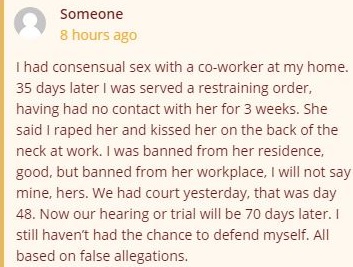

They’re not even mentioned as victims; they don’t count at all.

If victims of false rape claims aren’t acknowledged to be victims of anything, then how can victims of false accusations of other sorts expect to be afforded a sympathetic ear? Societal regard has been coerced to the extent that acknowledgment of false accusation (any act of false accusation) is equated with rape denial. To own false accusation is a significant problem is to commit an act of moral treason.

What those who haven’t been abused by process will never appreciate, so long as false accusation is dismissed as inconsequential, is that any foothold a false accuser can obtain can spell the end of someone’s life as s/he knew it.

People can be hounded to the end of time, particularly through civil procedures (like restraining orders), which generate records that gnaw, humiliate, and limit life options, and that open the door (gapingly wide) for further false accusations. The falsely accused can lose everything. They can find themselves felons and exiles, homeless and jobless, and possibly suicidal or homicidal…based on nothing real or true: a layered sandwich of lies.

What’s more, the dismissal of false accusation as an urgent societal concern is contagious. It influences judicial policy and practice; it influences the law. Thus is the problem compounded: False accusation is encouraged, because it’s effective. There are no risks, so there’s no downside.

Denial of the problem worsens it.

Our civil rights advocates vociferously decry violations of women’s rights, children’s rights, minority rights, gay and lesbian (GLBTQ) rights, animal rights, and on and on, and there aren’t any of these rights that aren’t violated by false accusers. None. Children are scarred (voicelessly); women are stigmatized and stripped of all resource; minorities, who may have the least access to legal representation, are railroaded or sidelined; gays and lesbians are handily represented as “creepy queers”; and pets are abandoned (possibly to be killed).

They might as well be living in 1956…and that’s significantly because of the “rape question.”

Look, how widespread false accusations of rape are is irrelevant. It’s irrelevant. What’s relevant is that they hurt and they kill, as do false accusations of all varieties. Rape also hurts and kills…but only also. What hurts and kills must be censured categorically, not selectively.

Dogma must be rebuked. Those who haven’t been falsely accused have no place at the table. They’re due to listen for a change.

The reason so many energies are concentrated on the “rape question” is that until the harm of being falsely accused of society’s “worst” crime is acknowledged, there can be no expectation that the harm of being falsely accused of any other will even register.

Copyright © 2015 RestrainingOrderAbuse.com

*Rape has been used to chasten society’s conscience, which means anti-rape advocates have determined society’s conscience. Their priorities have become “our” priorities and to gainsay them is to be ridiculed and vilified. A reason news stories of false rape claims are bruited by those denounced as “MRAs” (men’s rights activists) is because they often reveal deeply warped motives and methods, and these deeply warped motives and methods aren’t exclusive to false rape claimants.

That They’re Made in Civil Court, Too: A Response to Megan McArdle’s “What We Don’t Know about False Claims of Rape”

“Could the number be between 3 and 8 percent? Absolutely. But it could be substantially higher than 8 percent; it could even be that 40 percent of rape accusations or more are false, though I’d bet against that. It’s possible that less than 3 percent of rape accusations are false, though again, I would offer good odds against that. The point is that we don’t know, and the groups that claim to know are wrong together.”

—Columnist Megan McArdle (June 4, 2015)

Megan McArdle is one of a handful of professional journalists (preeminent among them Cathy Young) who objectively negotiate the chasmal discrepancy between statistics that say false claims of rape are almost none and those that say they’re abundant.

In her Bloomberg View column “What We Don’t Know about False Claims of Rape,” Ms. McArdle surveys complications that foil attempts to arrive at a hard-and-fast figure. Issues like consent, culpability, what qualifies as rape and what doesn’t, and who gets to adjudicate and how—these muddy estimations that are already suspect, because purveyors and proponents of statistics are typically biased by one ideological or political perspective or another. They promote numbers that support their views; they opine.

This writer agrees with Ms. McArdle’s conclusions quoted above, and he finds especially agreeable her honest assessment of the ambiguities and her willingness to acknowledge them in the first place, because this willingness is rare.

False claims of rape made in civil court are not registered anywhere or by anyone.

I’m not a journalist; I’m an analyst. I don’t know what the truth is. I can criticize interpretations that betray flaws, but I don’t find anything in Ms. McArdle’s “findings” to fault. I do, though, detect a blind spot, and it’s a blind spot that’s universal.

What no one appears to know about false claims of rape is that they can be made in civil court. There are no incidence rates for how often this occurs…and there can’t be. Civil rulings, e.g., in restraining order cases, are based on a “preponderance of the evidence” and not on the certainty of individual accusations. The dismissal of a restraining order petition that alleges rape is not recorded anywhere as a “false rape claim”—it’s just rejected—and a verdict in favor of a plaintiff who alleges rape signifies only that a judge was convinced that the heft of his or her claims, possibly numerous, more likely than not indicated a sound basis for the award of a restraining order—and it may not signify that. Orders are also granted if defendants simply default by not appearing to contest the accusations.

False rape claims in civil court may never be accompanied by criminal investigations nor ever conclusively adjudicated. They’re invisible. They are, however, made, and though they may be completely unsubstantiated, they exert a material influence on judicial rulings that have binding legal consequences, consequences that can be extreme.

My wife moved out of my Virginia home in June 2014, and then about a week later announced that she’d had a miscarriage. In August 2014, I got a visit from police detectives wanting to question me about a rape report she’d filed against me, but I declined to speak with them, and was never charged. Beginning in November 2014, she obtained three temporary restraining orders against me, and finally got a permanent restraining order imposed against me in Colorado in January 2015, based on a claim of domestic abuse, stalking, sexual assault, and physical assault. Not wanting to invest money and emotional energy in fighting it, and knowing it would be hard for me to successfully contest it, I didn’t show up to the hearing.

The man quoted above obtained a divorce from his wife, who he alleges had a history of mental illness, in April 2015. Two months later, he learned she had given birth to a daughter in February, who was “presumptively” his. His ex-wife had apparently lied about having a miscarriage.

The information that he was a father reached the man when he was told his ex-wife had killed herself following her commitment for “suicidal depression, and because someone had reported that she had been hearing voices telling her to hurt or kill the child.”

The man was also told there was a “dependency and neglect petition pending” against him for his abandonment of a child he hadn’t known existed.

In the petition, the county attorney notes, “Respondent […] and Father have a history of domestic violence that includes, but may not be limited to, the issuance of temporary restraining orders in cases […], and the issuance of a permanent restraining order in case […], which was entered by default on January 16, 2015, placing the welfare of the child at risk.” The Colorado Children’s Code says that the court shall consider a parent’s “History of violent behavior” in determining whether he’s an unfit parent.

The purported “history of domestic violence” was not established in court and was based solely on his late ex-wife’s restraining order allegations, which started five months after she had moved out, which were made in minutes in another state, which the man denies, and which he never traveled cross-country to attempt to controvert. He hadn’t known his (then) wife was pregnant with his child when her serial accusations to the court began and despaired of his chances of successfully challenging them. He had ignorantly opted to “move on.”

Now his daughter is in the custody of her maternal grandparents, and the likelihood of her father’s ever realizing a role in her life is scant.

This man’s case is highlighted because it was brought to my attention only last week and is still fresh in my mind. Instances of false claims of rape accompanying restraining order petitions, however—including claims against women—have been reported repeatedly here, in comments and in search terms that draw visitors to the blog.

Not even a tentative estimate could be formulated on how often false rape claims are asserted in civil court, but this source of false claims should at least be recognized as inclusive among the unnavigable uncertainties.

Copyright © 2015 RestrainingOrderAbuse.com

*An alternative means of falsely alleging rape in civil court is exemplified here. An extreme case of a fraudulent rape claim’s being alleged on a restraining order petition is here.

Courtroom Fraud and Smear Campaigns: The Full Machiavelli

Cheryl Lyn Walker PhD, Dr. Cheryl Lyn Walker, Dr. Cheryl L. Walker PhD, M.D. Anderson Cancer Center, Michael Honeycutt PhD, Michael Honeycutt TCEQ

“False Accusations, Distortion Campaigns, and Smear Campaigns can all be used with or without a grain of truth, and have the potential to cause enormous emotional hurt to the victim or even impact [his or her] professional or personal reputation and character.”

—“False Accusations and Distortion Campaigns

There are several fine explications on the Internet about the smear campaigns of false accusers. Some sketch method and motive generally; some catalog specific damages that ensue when lies are fed to the police and courts.

This survey of “adverse impacts” is credited to lies told by people with borderline personality disorder. Conducting “distortion campaigns” isn’t exclusive to BPDs, however, and the “adverse impacts” are the same, irrespective of campaigners’ particular cognitive kinks.

The valuable role of the police and courts in the prosecution of campaigns to slander, libel, and otherwise bully and defame can’t be overstated. They’re instrumental to a well-orchestrated character assassination.

Lies can be told to anyone, of course, and lies told to anyone can have toxic effects. The right lie told in a workplace, for example, can cost someone a job and impair or imperil a career.

Lies told to police and judges—especially judges—they’re the real wrecking balls, though. False allegations of threat or abuse are handily put over in restraining order or domestic violence procedures, and they endure indefinitely (and embolden accusers to tell further lies, which are that much more persuasive).

Among the motives of false accusation are blame-shifting (cover-up), attention, profit, and revenge (all corroborated by the FBI). Lying, however, may become its own motive, particularly when the target of lies resists. The appetite for malice, once rewarded, may persist long after an initial (possibly impulsive) goal is realized. Smear campaigns that employ legal abuse may go on for years, or indefinitely (usually depending on the stamina of the falsely accused to fight back).

Legitimation of lies by the court both encourages lying and reinforces lies told to others. Consider the implications of this pronouncement: “I had to take out a restraining order on her.” Who’s going to question whether the grounds were real or the testimony was true? Moreover, who’s going to question anything said about the accused once that claim has been made? It’s open season.

In the accuser’s circle, at least—which may be broad and influential—no one may even entertain a doubt, and the falsely accused can’t know who’s been told what and often can’t safely inquire.

Judgments enable smear and distortion campaigners to slander, libel, and otherwise bully with impunity, because their targets have been discredited and left defenseless (judges may even punish them for lawfully exercising their First Amendment rights and effectively gag them). The courts, besides, may rule that specific lies are “true,” target_of_blamethereby making the slanders and libels impervious to legal relief. Statements that are “true” aren’t defamatory. The man or woman, for instance, who’s wrongly found guilty of domestic violence (and entered into a police database) may be called a domestic abuser completely on the up and up (to friends, family, or neighbors, for example, or to staff at a child’s school).

Lies become facts that may be shared with anybody and publicly (court rulings are public records). Smear campaigners don’t limit themselves to court-validated lies, either, but it seldom comes back to bite them once a solid foundation has been laid.

Some so-called high-conflict people, the sorts described in the epigraph, conduct their smear or distortion campaigns brazenly and confrontationally. Some poison insidiously, spreading rumors behind closed doors, in conversation and private correspondence. As Dr. Tara Palmatier has remarked, social media also present them with attractive and potent platforms (and many respondents to this blog report being tarred on Facebook or even mobbed, i.e., bullied by multiple parties, including strangers).

Even when false accusers’ claims are outlandish and over the top, like these posted on Facebook by North Carolinian Marty Tackitt-Grist, they’re rarely viewed with suspicion—and almost never if a court ruling (or rulings) in the accusers’ favor can be asserted. The man accused in this comment to ABC’s 20/20 is a retiree with three toy poodles and a passion for aviation who couldn’t “hack” firewood without pain, because his spine is deformed. He is a retired lawyer, but he wasn’t “disbarred” and hasn’t “embezzled” (or, for that matter, “mooned” anyone). He has, however, been jailed consequent to insistent and serial falsehoods from his patently disturbed neighbor…who’s a schoolteacher.

For Crazy, social media websites are an endless source of attention, self-promotion, self-aggrandizement, and a sophisticated weapon. Many narcissists, histrionics, borderlines, and other self-obsessed, abusive personality types use Facebook, Twitter, and the like to run smear campaigns, to make false allegations, to perpetrate parental alienation, and to stalk and harass their targets while simultaneously portraying themselves as the much maligned victim, superwoman, and/or mother of the year.

(A respondent to this blog who’s been relentlessly harried by lies for two years, who’s consequently homeless and penniless, and who’s taken flight to another state, recently reported that a woman who’d offered her aid suddenly and inexplicably defriended her on Facebook and shut her out without a word. Her “friend” had evidently been gotten to.)

(An advocate for legal reform who was falsely accused in court last year by her husband and succeeded in having the allegations against her dismissed reports that he afterwards circulated it around town that she tried to kill him.)

I was falsely accused in 2006 by a woman who had nightly hung around outside of my house for a season. She was married and concealed the fact. Then she lied to conceal the concealment and the behavior that motivated the concealment. She has sustained her fictions (and honed them) for nearly 10 years. People like this build tissues of lies, aptly and commonly called webs.

Their infrastructures are visible, but many strands may not be…and the spinners never stop spinning.

The personality types associated with chronic lying are often represented as serpentine, arachnoid, or vampiric. This ironically feeds into some false accusers’ delusions of potency. Instead of shaming them, it turns them on.

I know from corresponding with many others who’ve endured the same traumas I have that they’ve been induced to do the same thing I did: write to others to defend the truth and hope to gain an advocate to help them unsnarl a skein of falsehoods that propelled them face-first into a slough of despond. (Why people write, if clarification is needed, is because there is no other way to articulate what are often layered and “bizarre” frauds.)

I know with heart-wrenching certainty, also, that these others’ honest and plaintive missives have probably been received with exactly the same suspicion, contempt, and apprehension that mine were. It’s a hideous irony that attempts to dispel false accusations are typically perceived as confirmations of them, including by the court. To complain of being called a stalker, for example, is interpreted as an act of stalking. There’s a kind of awful beauty to the synergy of procedural abuse and lies. (Judges pat bullies on the head and send them home with smiles on their faces.)

Smear campaigns wrap up false accusations authorized by the court with a ribbon and a bow.

Copyright © 2015 RestrainingOrderAbuse.com

*The name Machiavelli, referenced in the title of this post, is associated with the use of any means necessary to obtain political dominion (i.e., power and control). Psychologists have adapted the name to characterize one aspect of a syzygy of virulent character traits called “The Dark Triad.”

Low and Outside: An Umpire’s Story of Restraining Order Abuse (by an Underhand Screwball)

As the story in this post shows, the phrase “America’s Game” has taken on a new meaning.

The common assumption—one that’s been vigorously enforced by advocates of the “abuse industry”—is that restraining orders are used to protect “victims” from “abusers.” So-called abusers are represented as violent husbands or boyfriends, or as stalkers, representations that account for the ubiquity of restraining orders and the ease of their procurement.

The man whose story of restraining order abuse appears below reports that restraining orders can be obtained by drive-thru in his state (California), like milkshakes and onion rings.

The restraining order against this father and family man was petitioned by his sister-in-law on behalf of her son, his nephew. The man affronted his sister-in-law by umpiring two of her son’s games (his job), contrary to her wishes. That’s the basis of her complaint to the court.

Fighting that complaint has now cost the man and his family some $15,000 (besides money he would have earned as an umpire), and his life’s on hold while he awaits an appellate court ruling that won’t emerge for six to 24 months.

Here’s his story, as he tells it:

I am a victim of restraining order abuse.

At the age of 37, I married the love of my life. It wasn’t until after we were engaged that I found out that most of my wife’s family didn’t like me. This is the foundation of my story.

I am a little league, travel ball, and high school umpire. I umpire because I love the game and to make some additional money on the side. I have been umpiring baseball for close to 25 years without any incident whatsoever, and most reviews of my performance have been complimentary.

When my wife and I were married, we resided in Orange County, California. Our residence was far from the rest of her family, which limited our exposure to her parents and her sisters. My wife has two sisters, one older and one younger. Her elder sister is a lawyer, and her younger sister is a stay-at-home mom.

The eldest sister and her family and I have a great relationship. The problem is with the youngest sister, who is a control freak. She likes to control everything, including how many cups of coffee her husband has a day, and if she’s denied control, she will go to whatever lengths she has to to get it.

Two years or so ago, my wife was offered a job that would move us nearer to the younger sister. This was something that excited my wife, because she loves her family very much and wanted to be closer to her nieces and nephews. When she decided to take the job, she contacted her sister and told her the good news. Her sister was excited and worked with my wife to find a house that was near hers, and she found us a great one.

After moving in, we were visited quite frequently by my wife’s little sister and her family. Every time she visited, however, she pointedly let my wife know about her displeasure with the way we parented our eight-year-old little girl. As a stay-at-home mom whose entire existence revolves around her four kids, she has read every book on parenting and considers herself an expert in child-rearing. I had even caught her entering my house and administering medication to my daughter without our consent, which I firmly put a stop to.
Back to baseball.

After we moved, I enlisted with the local little league to umpire. I worked for a local umpire company that was very pleased with the service I provided to them. It considered me one of its better umpires. One day, I was assigned to umpire one of my wife’s younger sister’s kids’ games. I checked with the league to see if there was an issue and was told no and that it had people umpiring their relatives’ games all the time. Just be neutral, I was told, which I always am.

My wife’s younger sister found out that I was going to be umpiring her son’s game and called my wife to tell her to have me remove myself from the game. When asked why, she stated she just wanted to keep things separate. My wife didn’t understand why and told her to not worry, that I would not show any bias toward her kids and everything would be great. He sister repeated that she just wanted to keep things separate. My wife still didn’t understand why, because her son and I had a great relationship, with no problems at all. At this point, the woman became hysterical and said, “Keep your husband away from my son.” My wife got very upset and hung up on her. After that, we found out that the younger sister called the older sister and asked what she should do to repair things with my wife because she had upset her.

Well, because there was no good reason for my sister-in-law to be upset, and because the umpire company needed me to cover the game, I did. There was no issue with the game, and I received many compliments afterwards. I ended up working another one of my nephew’s games a couple of weeks later, again with no issues. The next week, I got a call from my umpire assignor reporting that my sister-in-law filed a complaint with the league saying her son was “uncomfortable” with my working behind the plate.

At that point, I banned her and her son from visiting my house. This really angered her and inspired her to get back at me.

Meanwhile, my assignor and I got together and agreed I should no longer work any of her kids’ games because she was clearly sick. So I was assigned to other games at the park that didn’t involve her kids.

This wasn’t acceptable to her. She didn’t want me at the fields at all. So she took pictures of me there on the days I was scheduled to work and created a story that involved my hunting and stalking her kids, and affecting their mental well-being.

She went to court and was granted an ex parte restraining order.

When I was served the restraining order, the deputy sheriff told me that he had read it and thought it was the funniest thing he had ever seen. He said he had no idea why it was issued and told me to just stay away from my sister-in-law.

When the time came for me to appear in court to fight the order, I had an attorney and she did not. The judge clearly stated that he would not give her preferential treatment, even so.

This turned out to be completely false.

My attorney laid out a solid case to have the order dismissed, presenting facts that showed there was no proof of any stalking or harassment, and that up until the time of my sister-in-law’s going crazy, her kids and I had had a great relationship.

After about a two-hour hearing, the judge ruled against me. He stated that because my wife informed me that her younger sister had told her to keep me away from her kid that I was put on notice…yet persisted in showing up at the fields to work. Never mind that I was told two months after their conversation (my wife didn’t tell me right away because she thought it was just her sister acting crazy). The judge then went on to say that a mother had the right to determine who got to be around her kids and didn’t need a good reason.

Now since the restraining order was made permanent, my sister-in-law has been using it to harass me and my family.

She went to the elementary school and instructed staff there that I was only to be allowed to pick up and drop off my daughter, and she warned them that if I dared to attend any of my child’s awards ceremonies, school performances, science fairs, or other school functions, she would call the police and have me arrested. She has also been sending letters with false claims about police reports and bullying to the little league administration that regulates all of the local little leagues, and has effectively had me removed from umpiring any games at any of the area little leagues, even ones in which her kids don’t participate.

Her family has been following me and my daughter to public parks and then approaching me to tell me I am in violation of the restraining order. Also, they have changed their walking routes to school so they walk by me and my daughter, or by me as I walk home after taking my daughter to school, to accuse me of “pushing the envelope.” They constantly photograph me when I am waiting at school, and make up stories about me doing things to harass them or their kids.

We have filed a motion for a new trial with compelling evidence. It was denied by the same judge. We have also filed a motion to modify the order to allow me to attend my daughter’s school events since I am her primary caregiver while my wife is at work (I own my own business), and this too was denied, because the judge thought it would be too hard for the school and the police to enforce.

We have filed an appeal, and briefs have been submitted. We are currently waiting for the appellate court to consider the briefs and issue a ruling. We were informed that it can take anywhere from six months to two years for this to happen. Now we are investigating whether we have proper grounds to file a motion asking for expedition to move our case closer to the front of the queue.

To show you just how crazy this restraining order is, the local police department asked, when we dropped off our guns, what clown would sign such a stupid restraining order? They said they would hold our guns for as long as needed to get this thing appealed.

This is my story, which has been my life for a year…and counting.

Copyright © 2015 RestrainingOrderAbuse.com

*From “High Conflict Family Law Matters and Personality Disorders” by attorneys Beth E. Maultsby and Kathryn Flowers Samler:

high_conflict_indicators

False Accusations and Procedural Abuse Hurt Pets…and May Be the Death of Them

This post is the first of a projected series that will explore the rollback of advances in women’s rights, civil rights, minority rights, gay and lesbian (GLBTQ) rights, children’s rights, and animal rights by bad procedural policy, bad procedural practice, and procedural abuse. The detriment to animal rights begins the series because dogs are dear to the blog’s author and many of its friends, including fraud victims and blog authors Betty Krachey (who maintains a Facebook page dedicated to Dobermans) and Larry Smith (who dotes on three toy poodles).

Consequences of legal abuse are often invisible, and its victims may die invisibly…whether by slow deterioration or in terror.

“Pets, mostly dogs and cats, can be used as pawns to threaten and coerce people to stay in abusive situations or keep quiet about them. Women are told if they leave the relationship, their beloved pet will be harmed or killed. Abused children may be threatened into silence because they fear their pet will be hurt, too.”

—Cathy M. Rosenthal, “Preventing pets from being used as pawns” (2013)

This is the scenario the public hears about, and it’s a reality, certainly, and a horrific one.

Consequently, protection order statutes to safeguard pets from domestic abusers exist in many states. (See this 2012 survey prepared by Phil Arkow of the National Link Coalition: “Pets in Protection Orders by State.”)

A reality that’s not publicized is that pets, no less so and possibly much more so than adults and children, may be victims of false accusations and procedural abuse, which aren’t uncommon when relationships stagnate or couples’ conflict reaches a crescendo. Procedural abusers are also hostage-takers…or may relish the prospect of a pet’s demise as the decisive blow in a malicious attack based on lies.

Millions of pets are abandoned each year and subsequently killed.

Legal abuse often aims for the heart. (The author of this blog was contacted by a friend of his false accuser in 2012, while his dog was crippled and in need of a surgery. His and his dog’s lives were daily a misery. The woman strung him along for months, insisting she was an ally and promising aid as his dog’s condition worsened. She then testified against him the following year in the fifth of a series of prosecutions over a seven-year span, all based on a hoax begun in 2006. The blog author’s dog has lived her entire life in the shadow of lies.)

Naval officer Theresa Donnelly, who calls her three boxers her “fur kids,” was inspired to write about “What to do with pets when getting divorced,” because she recognizes that the stresses of separation can lead to companion animals’ being abandoned. “If you’re facing a family separation, please explore every possible option before dropping the animal off at a shelter,” she urges.

How much more likely pet abandonment is in instances of bitter and vicious legal abuse is easily imagined. Some falsely accused are left homeless and unable to provide for themselves. Shelters, besides, may not admit pets. Victims of a malicious restraining order or false allegations of domestic violence can find themselves instantly on the curb and stripped of all resource.

The flipside to the scenario sketched in the epigraph is the misapplication of protection order statutes designed to protect pets from abusers. Nancy Peterson, an issues specialist with the Humane Society of the United States, has been quoted as saying, “[T]he pet may become a symbol of power and control.” Since “power and control” are common motives of procedural abusers, possession of pets may be part of the grand f*-you.

Also unacknowledged by earnest dogmatists who never consider the misuse of the laws they celebrate is that domestic abusers may also abuse process—to compound the abuse and to conceal it. The protection order process, which is handily manipulated by liars and usually costs them nothing to exploit, is perfectly suited to this purpose. Accordingly pets, like children, may be awarded to abusers by the court. “Protection” orders can be instrumental in child and pet abuse.

Then there are the cases when one person in a stagnant relationship rides it out, because s/he’s concerned for the welfare of his or her animal friend(s). Betty Krachey, whose legal ordeal has been chronicled on this blog, exemplifies such a person. Betty postponed calling it quits with her long-term boyfriend, concerned for her dogs, only to be falsely accused and nearly left indigent. She faced the choice of living on the streets until her court date or seeking residency in a shelter that didn’t admit pets.

Only about one in 10 dogs in this country ever finds a home in the first place, according to “11 Facts about Animal Homelessness,” which also approximates that 7.6 million dogs and cats are abandoned to shelters every year and that 2.7 million dogs and cats are killed.

How pets are killed is by lethal injection, suffocation in a decompression or gas chamber, or electrocution—among other methods. Their bodies are then cremated (atypically), rendered into reusable products, or buried in a landfill.

Do formerly cherished, exuberantly joyful, trusting members of families meet such an end because of impulsive lies and petty vindictiveness?

Unquestionably they do…every day.

Copyright © 2015 RestrainingOrderAbuse.com

*Government and agents of the press are more concerned with “service dog fraud” than they are with legal fraud and its consequences.

What “the Law” Means in the Restraining Order Arena and Why All Reasonable Expectations Defendants Have Are Wrong, Wrong, Wrong

  • “I put a restraining order on my ex-husband. Now he’s depressed and staying in his truck.”
  • “Can a restraining order result in suicide?”
  • “Get [a] restraining order lifted for job.”
  • “Can a restraining order be appealed if there isn’t evidence?”
  • “How will it affect my child custody if I filed a false order for protection?”
  • “What if my abuser files [a] restraining order against me?”
  • “My daughter falsely accused her stepmother of civil stalking.”
  • “Falsely accused of breaking a protection order.”
  • “A crazy person filed a restraining order on me.”
  • “Teacher falsely accused [in] Ohio.”
  • “Girlfriend filed a frivolous, retaliatory protection order against me.”
  • “I’m falsely accused. I need help. My ex has [a] protective order on me. I’m the victim, not him.”
  • “Suicide [and] false accusations.”
  • “I was served a domestic violence restraining order, but I don’t see any evidence.”

—Some recent search terms that led visitors here (punctuation added)

Victims of restraining order fraud often voice the conviction that restraining orders require evidence, because trials, we’ve been led to believe, must have an ascertainable basis; you can’t just summon a person to court for whatever. They also express the conviction that plaintiffs “can’t” lie. After all, accusers are made to swear an oath to tell “nothing but the truth.” They should be in trouble if they lie. They should go to jail.

These expectations are all reasonable ones…but they’re wrong.

Q: To get a restraining order, you have to have proof, right?

A: No. “Proof” is not the standard by which civil restraining order allegations are judged. Also, a person can’t “prove” s/he’s afraid; all s/he can do is say so, and his or her say-so is all that’s required.

Q: But if you have proof your accuser is lying, the restraining order has to be dismissed…doesn’t it?

A: No. This is the expectation of everyone summoned before a judge, for obvious reasons: Allegations aren’t facts, and only facts can mean someone is “guilty” of something. Restraining orders, however, don’t require evidence of anything or a determination of “guilt” of anything. What “provable” facts may exist are only as relevant as a judge elects to make them.

Q: A restraining order can be finalized even if a judge knows the plaintiff is lying?

A: Yes. Oath-swearing is just a ritual; lying doesn’t invalidate a petition. Restraining order statutes don’t have a “truth” standard. A person files a petition. If the alleged grounds satisfy the law according to a judge’s personal standards—and a judge’s personal standards are the legal standard—s/he’s authorized to approve the petition. In a subsequent hearing, even if the veracity of the plaintiff is controverted, the law doesn’t require that the order be dismissed. That’s up to the judge. Often if a judge can find a reason to “believe” the plaintiff has a reason to feel harassed or afraid, based on nothing but what the plaintiff says s/he feels, that’s sufficient (even if s/he has given false testimony). Glaringly false allegations may rile a judge, but the law doesn’t require him or her to dismiss a petition on those grounds (or on any others).

Q: So a judge can do whatever s/he wants on no grounds or even on bad ones?

A: Right (a judge who may not be a lawyer or even have a college degree). The only grounds necessary are that someone submitted an application.

Q: And if a plaintiff lies to get a restraining order, s/he can also lie to have someone arrested?

A: S/he can call the police every day if s/he wants to, and allege anything. There’s also no statutory ceiling on the number of restraining orders someone can petition (for free, usually), and subsequent allegations are that much more easily put over, and subsequent orders that much more easily obtained, once one has been approved. Some people are dragged into court relentlessly.

Q: So it’s like that story by Kafka?

A: Exactly like it (with some Lewis Carroll mixed in).

Copyright © 2015 RestrainingOrderAbuse.com

*On this basis, people are removed from their homes, stripped of all possessions, denied a role in their children’s lives, incarcerated, and left broke(n) and homeless. Some kill themselves.

Women Are Bigmouths: Why This Has Been Bad for People Who’ve Been Abused by the Court…but COULD Be Good

I grudgingly constructed a page this week on Facebook, which confirmed to me two things I already knew: (1) I really hate Facebook, and (2) women are more socially networked than men.
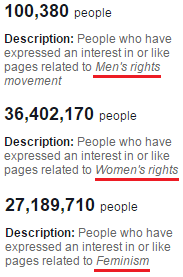
Calling women “bigmouths” isn’t strictly right, and people affronted by the assertion will insist women and men talk about the same amount, or that men talk more than women do.

Uh-huh.

Not impolite to observe is that women “collaborate” more than men do, that is, they sooner work in tandem, which is what statistics I gleaned from Facebook corroborate.

“Tell us about the people you’d most like to connect with,” Facebook urges when you piece together a page on its site. My entries under “Interests” brought up terms like Men’s rights movement, Feminism, and Women’s rights. Accompanying these topics were figures about how many others had expressed an interest in connecting with people who shared those interests.

See for yourself.

Notice that 200 to 400 times greater interest in bonding with people concerned with women’s rights has been shown than interest in bonding with people concerned with men’s rights. That’s a lot…A LOT a lot.

I don’t think there’s anyone who would deny that the fruits of feminism owe to social networking. Some of these fruits have been great; some really horrible. This blog concerns the rotten ones: a culture of victimhood and false accusation combined with the legislation of accelerated and derelict legal procedures presided over by judges bigoted by politics, bad practices (including engineered social science), and money.

Men have been the majority of victims, and they’ve been the only source of concentrated complaint, concentrated complaint that’s been mocked and muted. If we can assume the 200 to 400 times greater interest shown in women’s rights translates more or less proportionally to the number of people disinterested in or opposed to men’s beefs, then no wonder. Female influence, which is significantly feminist influence, is vastly predominant. The sympathy market has been cornered.

Men aren’t the only victims of procedural abuse, however.

Many if not most of the victims who comment on this blog are women, and they’re often desolate. Some live like hermits, some like refugees. They feel exiled and isolated.

The irony is this is exactly how women felt before the rise of feminism, and there’s a lesson to be taken from that.

Men’s struggles for a market share of sympathy face a phalanx of resistance and the priority of conditioned sentiment (prejudice); they’re also troubled by men’s lesser inclination to work collaboratively (the maverick mentality is a losing one). Women, however, can work from behind the lines. They can tap into the women’s rights network and harness its power.

And they should.

Copyright © 2015 RestrainingOrderAbuse.com