My previous two posts have been directed at the character and conduct of officers of the court (that is, attorneys and judges), and the one immediately preceding this one looked specifically at a number of cases of extreme judicial misconduct.
I sketched some of the implications of this misconduct, which ranged from debauchery to violence, in the conclusion to that post. What I’d like to consider in this one is this: in what professional office that you can think of besides judge would it not only be possible to engage in these kinds of activities—for example, propositioning coworkers, masturbating in a roomful of people, or brandishing firearms (in buildings where they’re prohibited)—but possible for the kind of person who’s brazen enough to engage in them to occupy?
I can’t think of one in which such a person would be tolerated or one that such a perpetrator wouldn’t immediately be ousted and escorted to a cell from. Not one. Not that long ago, a President of the United States was impeached for privately dropping trou.
The obvious answer to how this is possible is that (1) courtrooms are insular spaces where judges literally reign, and (2) everyone, including members of their staff, is intimidated into (sycophantic) submissiveness. A judge can literally masturbate himself in front of a crowd of people, and no one will stand up and recognize the behavior openly, let alone challenge its seemliness (this is the phenomenon satirized in the story, “The Emperor’s New Clothes”).
 I’ve recently observed that several jobs in the legal and government spheres are ones people with so-called psychopathic traits are said to gravitate toward: lawyer, police officer, and civil servant (judges are both lawyers and civil servants). Other “top jobs for psychopaths” are said to be CEO and surgeon. These are all occupations whose practitioners you have assuredly heard someone remark “think they’re God.”
What does it mean to think you’re God?
What’s usually meant is that people like this have been invested with authority and expect it to be recognized; presume to dictate to others what’s best for them (that is, they presume to know best); never doubt or second-guess themselves, their judgments, or their worthiness; relish being the center of others’ attention; and are resistant to stress and immune to shame.
They’re excellent survivors, clearly, which is what the title of Oxford professor Kevin Dutton’s book, The Wisdom of Psychopaths, implies. They’re rewarded by exerting their will on others and, despite whatever consequences may ensue as a result, sleep well.
Over the course of writing dozens of editorials on restraining order abuse and the issues around which it orbits and from which it devolves, I’ve found myself over and over coming back to psychology. Both wanton abusers of the law and practitioners of the law (who may likewise be wanton abusers of it) display qualities that are directly contradictory to the conceits of civil process. Civil, along with its cognates civilization and civility, implies sensitivity to others and the value of their feelings and lives. These words are meant to embody the values espoused by our Constitution, principal among them being the recognition that all people are created equal and are thus equally entitled to earnest regard by others.
The values espoused by our Constitution are social values. What you see in conflict here are competing social systems: the authoritarian and the democratic. The law is a system that has “evolved” from ancient times to feudal times (times when the citizenry was ruled by the dictates of a single person) to modern times, and it hasn’t really kept up (just consider the word court: what does a king preside over?). What keeps government and the courts honest is social scrutiny, mediated typically by the so-called fourth estate, journalism: word gets out, and people respond.
Change and reform begin with sensitization (that is, awareness).
The counteragent to corruption, in other words, is you and I (collectively). People are dominated by the law and intimidated into submissiveness, restraining order victims doubly so, because they’ve been traumatized. What being traumatized means is having had your power taken from you (not surprisingly, more than one female victim of restraining order abuse I’ve spoken with has referred to her treatment in court and by the court as “rape”: the ultimate trauma of rape is being disregarded, dominated, and left feeling impotent.)
Take your power back. Not a single one of the judges nominated “crazy” that I mentioned in my previous post went down without a fight.
And they probably still sleep like babies.
Copyright © 2013 RestrainingOrderAbuse.com
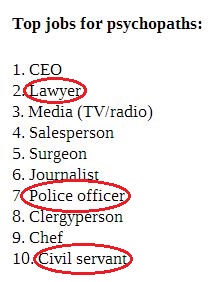 The reason I’m revisiting Dr. Dutton’s book in this post is that several of the jobs it identifies as most likely to draw psychopaths are ones in the legal profession and government.
 That’s why I’m particularly impressed when I encounter writers whose literary protests are not only controlled but very lucid and balanced. One such writer maintains a blog titled
  Casual charlatanism, though, is hardly an accomplishment for people without consciences to answer to. And rubes and tools are ten cents a dozen.
 A principle of law that everyone ensnarled in any sort of legal shenanigan should be aware of is stare decisis. This Latin phrase means “to abide by, or adhere to, decided things” (Black’s Law Dictionary). Law proceeds and “evolves” in accordance with stare decisis.
 This means defendants can be denied access to the family pet(s), besides.
 I had an exceptional encounter with an exceptional woman this week who was raped as a child (by a child) and later violently raped as a young adult, and whose assailants were never held accountable for their actions. It’s her firm conviction—and one supported by her own experiences and those of women she’s counseled—that allegations of rape and violence in criminal court can too easily be dismissed when, for example, a woman has voluntarily entered a man’s living quarters and an expectation of consent to intercourse has been aroused.
 Lapses by the courts have piqued the outrage of victims of both genders against the opposite gender, because most victims of rape are female, and most victims of false allegations are male.
 As many people who’ve responded to this blog have been, this woman was used and abused then publicly condemned and humiliated to compound the torment. She’s shelled out thousands in legal fees, lost a job, is in therapy to try to maintain her sanity, and is due back in court next week. And she has three kids who depend on her.
 The
The  Not many years ago, philosopher Harry Frankfurt published a treatise that I was amused to discover called
  The logical extension of there being no consequences for lying is there being no consequences for lying back. Bigger and better.
 The sad and disgusting fact is that success in the courts, particularly in the drive-thru arena of restraining order prosecution, is largely about impressions. Ask yourself who’s likelier to make the more impressive showing: the liar who’s free to let his or her imagination run wickedly rampant or the honest person who’s constrained by ethics to be faithful to the facts?
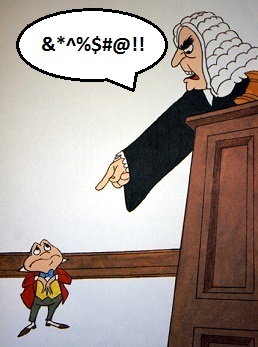 Judicial misbehavior is often complained of by defendants who’ve been abused by the restraining order process. Cited instances include gross dereliction, judge-attorney cronyism, gender bias, open contempt, and warrantless verbal cruelty. Avenues for seeking the censure of a judge who has engaged in negligent or vicious misconduct vary from state to state. In my own state of Arizona, complaints may be filed with the Commission on Judicial Conduct. Similar boards, panels, and tribunals exist in most other states.
 Restraining orders occupy an exceptional status among complaints made to our courts, because their defendants (recipients) are denied
 Those most dramatically impacted by restraining order abuse, its victims, are typically only heard to peep and grumble here and there.
 Following Tylenol’s being tampered with in 1981, everything from diced onions to multivitamins requires a safety seal. Naive trust was violated, and legislators responded.


 Dr. Charles Corry, president of the

 So how is it so many men are railroaded through a process that may be initiated on no evidence at all, may strip them of their most valued investments and every bit of social and financial equity they’ve built in their lives—kids, home, money, property, business, and reputation—and may ensure that they’re never able to recover what they’ve been deprived of?
 It shouldn’t be any mystery why with millions of restraining orders being issued each year in the Internet age complaints of abuses aren’t louder and more numerous: stigma.
 This question pops up a lot.
 TALKING BACK to restraining orders