Legal Abuse and “Learned Helplessness” (Including Commentary on the Mythical Value of “Taking the High Road”)

“Learned helplessness is behavior typical of an organism (human or animal) that has endured repeated painful or otherwise aversive stimuli which it was unable to escape or avoid. After such experience, the organism often fails to learn escape or avoidance in new situations where such behavior would be effective. In other words, the organism seems to have learned that it is helpless in aversive situations, that it has lost control, and so it gives up trying. Such an organism is said to have acquired learned helplessness. Learned helplessness theory is the view that clinical depression and related mental illnesses may result from such real or perceived absence of control over the outcome of a situation.”

Wikipedia

I introduced this psychological theory to a judge in 2010 when I filed a lawsuit against a woman who falsely accused me to the police and multiple courts in 2006. The accusations began in March, and before the close of July, she had defrauded at least four judges.

To be falsely accused is bewildering; it savages the mind. To then learn that efforts to expose the truth are met by judges not with keen interest and probing questions but variably with mute indifference, scornful derision, and offhand dismissal—that’s to have it firmly impressed upon you that resistance is futile. Worse, it’s to learn that resistance compounds the frustration and pain.

The system isn’t on your side, and bucking it for many is just an invitation to be scourged afresh.

After attempting some direct appeals to people who, I reasoned, might care more about the truth than the court did (2007), then writing about the business online (2008), then employing an attorney to mediate a resolution (2009), all of which efforts were met with stony silence, I filed a lawsuit (on my own).

That was in 2010. By then, unknown to me, the statutes of limitation on the civil torts I alleged—fraud, false light, defamation, and intentional infliction of emotional distress—had flown. My accuser’s attorney, with mock ingenuousness, wondered to the court why I hadn’t filed my suit in 2006, right after having had the court twice swat down my appeals.
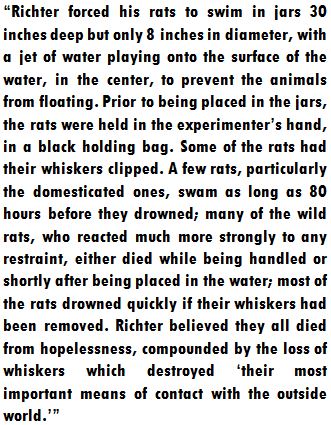
learned_helplessnessI offered the explanation to the judge that people who go through this become conditioned to helplessness (or hopelessness), because process militates against the proposition that a claimant of abuse has engaged in deception. The righteous indignation and outrage of the wronged defendant gradually succumb to the inevitable conclusion that facts, truth, and reason are impotent against fraud and judicial bias. (The defendant lives besides under the constant menace of unwarranted arrest.)

I didn’t know I could prosecute a lawsuit on my own until a legal assistant told me so in 2009, which I also told the judge. I might have been motivated to find out sooner if I’d had the least faith that a judge would heed my testimony.

My accuser’s attorney disdained the explanation for my tardy filing as “self-diagnosis,” and the judge eagerly echoed his assessment and dismissed the case (the court’s interest is in economy, not truth or justice). What was another six months of my life? (Letters from a physician and a therapist, along with witness affidavits, including one from a former cop, made no difference.)

I wasn’t wrong, though. People who defy a rigged system—whether restraining order defendants, domestic violence defendants, or family court defendants—can be conditioned to helplessness, and many accordingly report experiencing posttraumatic stress (which fortifies their distrust and their aversion to further rude scrutiny and contemptuous treatment from the court).

A lesson to take from this is that the “high road” (i.e., trusting in facts, truth, and reason) is a detour to hell. If I had known in 2006 what I know today, I could have extricated myself from my accuser’s false accusations in five minutes by playing the game according to her rules, which were “whatever works.”

The studies from which the term “learned helplessness” emerged were studies of drowned rats and tortured dogs. Playing fair (or aspiring to saintliness by never uttering an ill word against your accuser) is noble, but nobly drowned is still drowned. If an accuser lies about you, denounce him or her as a liar. Similarly, if a process of law is bullshit, call it what it is.

Some respondents to this blog, even after they’ve been through the courthouse ringer, retain a beleaguered faith in ethics. They believe that if injustice is laid bare to a discerning audience by rhetorical appeals to reason and decency, this will spur change. “Our objective is to fix the problem, not the blame” was quoted in a recent comment.
The abstract and impersonal may be informative, but they don’t arouse curiosity, because they don’t inflame the passions; controversy does. Advocates of the “high road” eschew naming names, for example, because it’s aggressive. Avoidance of confrontation, however, accomplishes little and exemplifies “learned helplessness.” The “high road” is safe and tame, and it leads to a dead-end.

The reason restraining order abuse endures is that the abused are paralyzed by indecisiveness. They won’t knuckle down and demand that a flawed process be repealed.
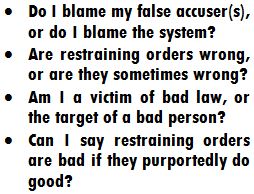
Among people who’ve been damaged by fraudulent abuse of restraining orders and related civil court procedures that are supposed to protect the defenseless, you’ve got, for instance, your liberals who’ll defend the process on principle, because they insist it must be preserved to protect the vulnerable, and they’ll fence-sit just to spite conservatives who flatly denounce the process as a governmental intrusion that undermines family.

Liberals and women who identify with legitimately victimized women feel obligated to “negotiate the gray space” and acknowledge the pros and cons of “women’s law.”

Then you have people (of whatever political allegiance or none) who believe that if you eliminated procedural inequities and ensured that defendants’ due process rights were observed, the system would work fine.

Maybe they believe a process that allows a person in Nevada to mosey into a courthouse, fill out some forms, and accuse a person in Wyoming of “stalking” or “domestic violence,” necessitating that the person in Wyoming hustle him- or herself to Nevada to present a defense within the week, can be made fair, and maybe they don’t know that the same Nevadan can prosecute the same claim over and over against the same Wyomingite (three times, six times, a dozen times, or more).

Maybe they believe that appeals to public conscience will urge the passage of laws that require free legal counsel be provided to defendants.

This would mean that if, say, a million restraining orders are petitioned a year, and legal representation for each defendant in each case could be capped at $2,000 (which might translate to a feeble defense, anyway), state governments would be required to shell out $2,000,000,000 to make everything “fair and square.” But that’s not all. If government gave free representation to “abusers,” advocates for “victims” would demand the same for them. So your $2,000,000,000 would become $4,000,000,000.

That’s per annum. (Also, the hypothetical Wyomingite would still need to travel to Nevada, and who’s paying for that?)

Others believe that if lying (perjury) were prosecuted, that would straighten things out. The costs to prosecute what may be hundreds of thousands of liars a year might be less than $4,000,000,000…or it might not be. Too, how do you prove someone is lying about an emotional state, like “fear”? How do you prove an alleged event didn’t happen?

You can’t, not conclusively, which is what a criminal prosecution requires.

More say appeal to your senator, to the president, to the press…nicely and cogently. They follow a utopian faith that basic decency will prevail if “the problem” is exposed.

As a rhetorical stance, the position has its merits. It suggests calmness and rationality, and calmness and rationality should recommend attention from others. “We’re calm and rational,” proponents of the position imply, “so when we say there’s a problem in need of fixing, it’s calmness and rationality speaking, not anger.”

The limitation is that no one who needs to be convinced has a motive to listen. No one can be made to care about abstractions like equity and due process when in the other ear they’re being cited statistics about epidemic violence.

Everything to do with the law is adversarial. If you seek to revise it without being personal or confrontational, the soonest you can expect a just reward is in the afterlife.

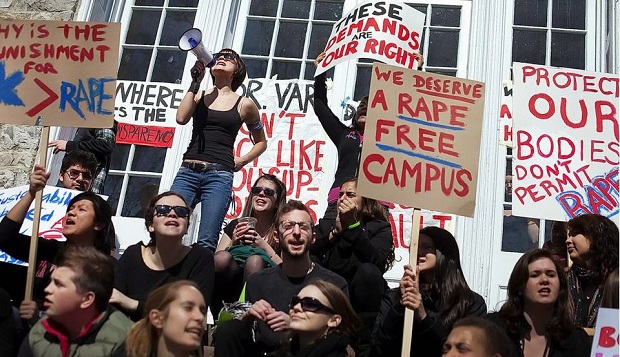
Protesters march on a SlutWalk in Newcastle

Copyright © 2015 RestrainingOrderAbuse.com

*Splendid writers, particularly Cathy Young, have responsibly and lucidly exposed “the problem” for 20 years in major news outlets. The system has responded with statutes that are broader, laxer, and more punishing.
Another Way False Testimony Is Concealed: The Unconstitutional “Prior Restraint”

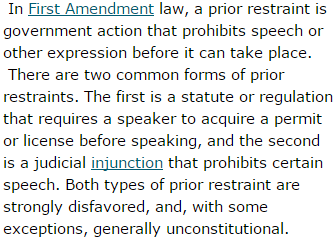
Courts are properly authorized to sanction acts of defamation—publicly lying about someone—but they’re not authorized to prohibit truthful speech or opinion (even if it’s negative), and they’re not authorized to prohibit speech acts before they’ve even been committed. An order of the court that prohibits future speech is called a prior restraint, and it’s unconstitutional (see the First Amendment).

With civil harassment orders, things get knotty. A prior restraint may not be expressed; it may be implicit.

Cornell, prior restraintWhen a “protective order” is in effect, it prohibits speech to someone but not speech about that person, per se, as law professors Aaron Caplan and Eugene Volokh have emphasized. A court, however, may conclude that speech about someone (any speech about that person) is “harassment,” and it may label that speech a violation of the “protective order,” and rule that a defendant be remanded to jail.

Several people have reported on this site that they were jailed or had orders of the court extended because of publications online or, in one case, for posting flyers about an accuser’s conduct. Many have reported, too, that the basis of the “protective order” against them was speech about a person (in one recently shared account, a woman complained on a county bulletin board about her neighbors’ shabby treatment of their dog).

So you have instances where people are issued restraining orders for lawfully exercising their First Amendment privilege to free speech, and you have instances where people who’ve been issued restraining orders are sanctioned for lawfully exercising their First Amendment privilege to free speech.

Trial judges aren’t First Amendment authorities and may not have graduated from college, let alone have law degrees. Furthermore, protecting the free speech of people they’ve labeled abusers is hardly an urgent concern of theirs.

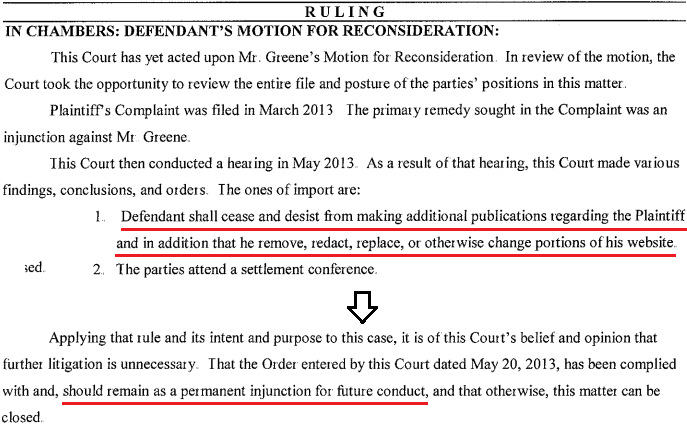
Here’s what a prior restraint looks like:

Arizona prior restraint order, First Amendment law

Orders like this don’t expressly forbid criticism of the government. They forbid criticism of people who exploited a process of government. This, by extension, forbids criticism of the government.

This order was issued against me in 2013 when I was sued for libel and harassment in the Superior Court of Arizona by a married woman who had falsely accused me to the police and several judges years prior. She was someone I scarcely knew who had hung around outside of my house at night (what that might suggest to you is what it should suggest to you). Her original claims to the court (2006) were to obtain an injunction to prohibit me from communicating her conduct to anyone, and her claims to the court in 2013 were to obtain an injunction to prohibit me from communicating her conduct to anyone.

The motive for both prosecutions was the same: cover-up. (Try to imagine what it is to fight false accusations for seven years, daily, while everything around you erodes, and then have some trial judge offhandedly tell you you’re lying and should be gagged. The judge had plainly made up his mind how he would rule before ever setting foot in court. The trial nevertheless dragged out from March to October. Today I avoid using the road where I rented the private mailbox to which the judge’s arbitrary conclusions and fiats were mailed, so nauseous is the association.)

Some of my accuser’s testimony is here, and the contradictoriness of her claims, as well as the motive for them, will be evident from no words other than her own. Does it matter that her misrepresentations are self-evident? No. Does it matter that they ridicule process of law and mock the court? No.

All that matters is that those who’ve been misrepresented are silenced to preserve the image of propriety.

Copyright © 2015 RestrainingOrderAbuse.com

Introducing the “Indefinite Temporary Restraining Order”

No, this isn’t satire, and Joseph Heller, author of Catch-22, didn’t coin the phrase “indefinite temporary.” It’s a capsular commentary on the state of our courts, however, that actual judges can actually use a phrase like this in actual rulings that affect actual people.

That these judges can actually get away with it says a lot about the state of our press, too.

The injunctive process is rife with oxymorons. Among this writer’s favorites is “speedy justice” (a phrase used by his own most recent judge to excuse carelessness). Restraining order courts are home to findings like “vegetarian stalker” and “handicapped batterer.” Trials in this arena operate in a vacuum (as law professor and former ACLU staff attorney Aaron Caplan observes); there is no oversight or accountability, and “meritorious” grounds for appeal are few, so judgments seldom receive scrutiny by the higher courts at all, and published rulings are scant. (Appellate courts don’t rehear cases; they only rule on the conduct of judges. Patent absurdities and abject fraud may be winked at…and legally.)
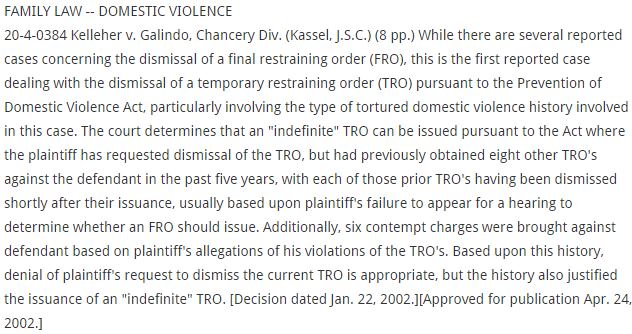
This post concerns a New Jersey family court ruling in the case of Kelleher v. Galindo. The case is 13 years old. That’s how asleep at the wheel our popular press is.

Follow the link to the case above, and the first sentence you’ll see in the ruling is this: “No appearance by Plaintiff. No appearance by Defendant.” That’s right, no one actually appeared in court, but a restraining order was issued anyway…an “indefinite temporary” one.

The plaintiff in the case petitioned nine restraining orders against the defendant between the years of 1996 and 2002, and in each and every instance, the order was dismissed, in most cases because “plaintiff [the person who petitioned the order] failed to appear at the hearing”; in a couple of cases, because she requested a dismissal.

The reasoning of the latest judge’s ruling runs thus (emphases added) and should be heard in the voice of a character from Alice in Wonderland:

This court has no doubt that if it were to grant plaintiff’s request to dismiss this most recent TRO [temporary restraining order], it would not be very long before plaintiff was back in the Cherry Hill Municipal Court seeking a tenth TRO against defendant.

[…]

It is this court’s opinion that, despite plaintiff’s telephonic request to dismiss this most recent TRO, the plaintiff’s past history of obtaining eight TROs against defendant in a five year period, all of which were dismissed prior to an FRO hearing [final restraining order hearing], along with six prior contempt charges filed against defendant based upon plaintiff’s allegation of violations of those TROs, all of which were likewise dismissed prior to an adjudication, justifies this court’s denial of plaintiff’s request to dismiss the TRO and instead justifies the issuance of an indefinite TRO.

There was no determined basis for an order and no basis for a ruling (in the absence of the litigants in the case). “Therefore” the judge, Michael J. Kassel, ruled that the latest temporary order be indefinitely sustained.

In the interest of economy, that is, the court determined itself justified in issuing an order contrary to the plaintiff’s express wishes and without any trial at all.

Copyright © 2015 RestrainingOrderAbuse.com

*The judge’s legal contortionism is illuminating. Because the judge couldn’t “justify” entering a “final ruling” in the absence of the parties but plainly wanted to, he circumvented the rules of civil procedure and made a “temporary” order permanent (instead of, for example, sanctioning the petitioner of the nine orders for “squandering judicial and law enforcement resources and diverting attention from urgent and meritorious domestic violence matters”). This provides other judges with a precedent to cite to justify violating other defendants’ due process rights, limited as they already are in this process.

Court-Abetted Trespassing, Burglary, Larceny, and Embezzlement:  A Terminally Ill Man’s Story of Restraining Order Abuse

“I know the purpose of the site is to decry the injustice of being falsely accused. Just have some sense of proportion, please. It’s terrible to be falsely accused. It can have many horrible consequences. It’s still light years away from being raped.”

—Comment submitted Friday

I believe the man who gives the account that follows would agree with the commenter quoted above. The blog’s author, however, rejects the commenter’s absolutist stance, because the categorical privilege granted to female claimants of violence is what enables wanton violations like the one detailed below, a violation that is denied its due by a dismissive word like “terrible.” The man whose story ensues is living what may be his final days in penury, alone in an empty house. The responses he’s received from the court, from the police, and from attorneys have been conditioned by the conviction expressed above, namely, that psychological violation and vicious privation are “light years away” from physical violation.

The man has, in short, been stripped of everything based on a false allegation of violence, and he’s been told, “That’s tough.” Because of the prejudicial nature of the court order that was fraudulently obtained against him, his bank has refused his request for reimbursement of his savings. Although he was fully exonerated, he has no credibility and no recourse except to quietly die.

William Batson, who says he has been informed by his doctors that he may have only months to live, was barred from his home and then robbed of all of his money and personal property consequent to the issuance of an ex parte restraining order against him petitioned by a person he had never met who represented him to be a batterer.

All the court required to legally authorize the theft of all he owned was a fake narrative of violence.

William’s story (edited for readability):

The difference between other crimes that people are falsely accused of and false DV [domestic violence] accusations is this: All of your rights—to be heard, to face your accuser, and others—are completely circumvented, and the mob that is Rome will get its loaf of bread and its quart of blood whether it’s right or wrong.

I never even met the person who accused me. My DV charge had a special attachment: ex parte election order with all property and financials given to the accuser instantly with nothing more than an accusation.

By the time I made bond, I was not allowed in my own home. I finally convinced the magistrate with witnesses that I lived alone, etc., and upon entry into my home 15 days later all the contents were gone, all bank accounts were drained, and $13,800-plus in forged checks is still owed.

I got an immediate dismissal with prejudice from the court and a too-bad and angry attitude from law enforcement. They helped this person rob me. I can’t sue the police, and no lawyer will even get near it. Before, I had a 814 credit score, $49,000-plus in possessions, $25,000-plus in savings and checking, and they would not even write a letter to the bank so I could get the money returned.

[…]

I will never recover financially or physically. I had cancer that was in a nine-year remission. The last time I bothered to listen, I was told I was stage four and might make it to Christmas. I’m not bitter, and I wish no ill upon any. There was a reason our country was founded and its constitution was written the way they were. This is merely one example of why. There will always be someone who changes something for a stated good cause merely to devour others with its use.

Amen, good luck, and I wish you all well.

Copyright © 2015 RestrainingOrderAbuse.com

The Rape Victim’s Trauma in Court Is the SAME Trauma Experienced by the Falsely Accused

“[Tina] Renton still has nightmares about her time in the witness box. ‘During the day I can cope with it. In my sleep…. You can’t control your subconscious.’ She dreams of ‘running and never being able to find anyone able to help you’ and of ‘standing in court, people laughing at you, but you don’t know why.’”

Amelia Gentleman, the Guardian (April 13, 2013)

Above are the words of a woman who was the prosecuting witness in the rape trial of her stepfather.

Below are the words of a man who was repeatedly accused by a prosecuting witness (his estranged wife and the mother of his children):

I couldn’t flee and I could not fight. I was never going to be allowed to heal or recover. I wish I were better at articulating the psychological and emotional trauma I experienced.

I could fill a book with all the lies and mysterious rulings of the Court. Never have I experienced this kind of pain. I asked for help, but good men did nothing and evil prevailed.

Correspondences between the man’s and woman’s statements are obvious, as are contrasts between the man’s and woman’s treatment under the law.

The woman prevailed in criminal court. She also authored a book. The man was hectored in family court until he killed himself, and his wife obtained a court order granting her the intellectual property rights to his final words, which she attempted to expunge from every nook and cranny of the Internet.

Tina Renton, quoted in the epigraph, accused her stepfather of “raping and assaulting her multiple times during her childhood,” and a jury found him guilty. The trauma Ms. Renton describes, however, isn’t the residue of being physically violated by a parental figure years before; it’s the aftereffect of being psychologically violated in court.

She defended herself and was taunted and denounced as a liar.

“It is hard being accused of being a liar,” she says. “I would never have put myself through the trauma of a court case if it wasn’t true.”

Her stepfather was sentenced to 14 years. Still Ms. Renton reports having nightmares about her experiences in court, and certainly no feminist is going to contradict her claim of trauma.

Why, then, are feminists the most adamant critics of those who allege they’ve been falsely vilified or persecuted in civil and family court (where there is no standard of proof)? Is it reasonable to argue that being falsely called a “liar” is more traumatic than being falsely called a “stalker,” “wife batterer,” “child abuser,” or worse? If feminists understand the trauma described by Tina Renton and sympathize with it, why are they the most unyielding obstacle to reform of restraining order and domestic violence laws that make false accusation easy and rewarding? Ms. Renton, a woman, very plausibly says she was caused lasting injury by being falsely accused of lying. Yet some feminists assert that a man’s being falsely accused of rape is insignificant. How is this not only hypocritical but heinous?

When it’s asserted that rape victims face “being raped all over again” in court, what’s meant is that they face being lied about, misrepresented, defamed, badgered, and shamed. They face, in sum, being falsely accused.

This is compared to being raped.

It must be appreciated that those falsely accused in civil or family court (women among them) are traumatized by exactly the same treatment (including by their judges), and many of them may also have been abused by their accusers, including violently. Moreover, the abuse they receive in and from the court may be aggravated (exorbitantly) by having their children taken from them, being cast out of their homes, and/or being forced to pay their false accusers’ living expenses.

Feminists seem to have no difficulty imagining the psychic scars caused to rape victims by being denounced and disparaged in criminal court.

For feminists to identify with complainants of false accusation in civil and family court, then, they need only imagine what it would feel like for those rape victims to be forced to surrender all they value to their abusers and pay them for the privilege of being lied about and publicly humiliated.

Copyright © 2015 RestrainingOrderAbuse.com

*The quoted Guardian story includes a case of a woman who prevailed in court but nevertheless committed suicide. “Her son, Oliver, told a newspaper how profoundly the cross-examination had affected her.”