How Restraining Orders Make American Civil Procedure Contemptible (Russian Teacake, Anyone?)

  1. Accusers are presumed to be truthful, so it falls to the accused to prove they’re innocent. Accusers are charged nothing to file a complaint, which requires only a few moments of time, and face no risk of prosecution if the complaint is false. Preliminary rulings are formed in backroom meetings between judges and accusers alone.
  2. If an accuser is represented by a lawyer, who is an “officer of the court,” the presumption that whatever is alleged is trustworthy doubles, because lawyers are honest, scrupulous, and would never represent a false claimant to turn a buck.
  3. Accusations may be filed in any jurisdiction in the country, and answering accusations made in a county or state other than the one s/he resides in requires that the accused appear in that county or state, possibly within days. If s/he fails to appear, a default judgment against him or her will be entered (possibly signifying, for example, that s/he’s a stalker or child molester).
  4. Once a ruling is formed, whether by default or in what may be a 10-minute hearing, it’s final and immune from collateral attack. Allegations are deemed “decided” (res judicata) and may not be controverted in a further prosecution, even if it can be plainly shown that they were criminally perjured.
  5. A judge is entitled to rule according to what s/he “deems best,” irrespective of the truth, is insulated him- or herself from prosecution, and may award to an accuser sole use of a residence and vehicle, permanent custody of children and pets, a monthly stipend, and complete remuneration of attorney fees (to be paid by the accused).
  6. This is deemed equitable and just, and further warrants the permanent entry of the accused’s name in state and federal police registries and, in cases, a publicly accessible database.

Copyright © 2015 RestrainingOrderAbuse.com

“Somebody Do Something to End This Madness!”: One Commenter’s Appeal for Restraining Order Reform

A comment Wednesday resonated with the author’s experiences of legal abuse and many others’. It said its writer’s life was trashed because he showed compassion for another. He exhausted his savings to help his ex-wife out of a fix, flying out to California from Colorado on a day’s notice. Five years later, having lived with the aftereffects of legal madness every day of the interim—which included appeals in another state, postponements, and a five-year restraining order extension—he says he feels his life is “over.” Of particular note is that the apparent instigator of the fraudulent restraining order petitioned against him was his ex-wife’s son; the son allegedly threatened to turn his back on his mother and evict her from his home if she didn’t comply with his wishes.

The commenter’s account:

[In] 2010, she calls me in Denver [Colorado], where I had a two-bedroom apartment, crying the blues that she had a big fight with her boyfriend, and requested to stay with me for a little while. I gave in as we were married for 23 years and had remained friends.

I fly out to San Jose [California] the next day, and we drive directly from the airport to U-Haul, pick up a truck, and are on the road in a couple of hours. Five days later, I move her into her own bedroom and put her furniture in storage.

Things went fine until she wanted this dog up in Wyoming that had some issues.

We drive up to get the dog and then after getting it home, I find out the issues—the dog would just pee on the carpet at random. I told her the dog had to go. She’s not happy, but we surrendered it to the local shelter.

Next thing I know, there is a knock on the door with her son ready to drive her back to San Jose.

Not a problem until two weeks later when the sheriff delivered the TRO [temporary restraining order] that stated I had to give up my guns and appear in San Jose at a hearing in seven days. “Why?” I asked. “Don’t we have laws in Colorado? Shouldn’t the case be tried in Denver?” Apparently not. I lost that argument.

I went to San Jose, had a 10-minute hearing in front of—what else?—a woman judge. My ex had a lawyer [thanks to] the good old folks at VAWA providing the funding. I [checked with] over 30 attorneys, and no one would touch the case pro bono (she took any spare money I had moving her).

Then we found out that she can talk to me; I just can’t talk to her (great system).

We found a way to communicate…through the Internet on one of those game shows. We would pass notes back and forth. She did not have a problem with that. The son found out and over his IPhone requested an extension on the court order.

Turns out, truth be told, that the son was the one who wanted her to get the RO. She never had any intention of doing such a thing. The son apparently was angry because he asked me what happened between his mother and me. I responded by asking him if he was sure that he really wanted to know the truth about his mom. Well, I told him the truth. I told him that his mother was screwing around on me every chance that she had.

That did not sit well with him. So here we are…RO. Every lie in that first and second complaint was written by him. He forced his mother to go along with it by threatening that he would not want her to be around him anymore and that she would have to move out of his house.

With all the postponements, when we finally got a ruling on the attempt to continue the first RO, which only had two weeks left on it, the judge, a new woman judge, ruled against me. She would not even let me speak.

So, long story short, after all the delays in between the appearances, I now received an additional five-year RO causing my total RO to be about 7 years.

I don’t give a shit whether I ever see her again, but I thought that this was a country of laws. There was never any violence between us. Yet this judge violated my Second Amendment rights once again.

So…lesson learned: Never even raise your voice to your significant (???) other. When she finds out how much money she can get out of all the federal funding, inclusive of cars, a place to stay, educational programs, etc., etc., she will come after you without a second thought.

The entire law is wrong. It violates [the First, Second, and Sixth Amendments, and probably others]. And the worse part of it is that any woman you want to date is going to plug your name into the Internet before she considers going out with you. Or her son or daughter or girlfriend will…just because they want to make sure she’s not going out with a “bum.”

My life is over. I have no social life [and] no place to turn. Not one lawyer will help. Not one congressman or senator will go against all the women who started all of this in 1994. And why? The only reason that I can come up with is that they don’t want to get “cut off.” They have no balls and couldn’t care less about what is right or wrong.

This is a bad law. I think if I remember the VAWA statute correctly, the phrase man or men is mentioned one time. I am for anyone who has any ideas on how to overturn this law and at least give us our “rights” back. I can understand it if you are a wife-beater or something like that, but the word harassment is so ambiguous. How can any judge make an honest decision?

Please, everyone, chime in. This could happen to you! If your wife gets an RO on you, you are in “the system.” You no longer will have a job, friends will shy away from you, and even your own family will distance themselves from you.

SOMEBODY DO SOMETHING TO END THIS MADNESS!

Please.

Copyright © 2015 RestrainingOrderAbuse.com

*The anonymous commenter’s remarks began: “I will be more than happy to pay any attorney to get my Santa Clara County, California RO taken off of the Internet!”


Litigation Privilege: Why Restraining Order Fraud Is Pandered to and Why the Falsely Accused Are Denied Recourse to the Law for Vindication, Relief, and Recovery of Damages

“Fraud is deliberately deceiving someone else [including a judge] with the intent of causing damage.”

Cornell Legal Information Institute

“Generally, lying during trial (or any other part of litigation) is expected to come out at the time of trial. This means an action against someone for lying during a prior proceeding would fail because even lies are protected by the litigation privilege. You have to catch them at the time; you cannot attack them collaterally (in a different proceeding).”

Attorney Catherine Elizabeth Bennett

Here are examples of restraining order fraud and repeated abuse of process (others are here and here, and comments and posts on this site are replete with them).

Here is the obstacle to obtaining relief from fraud committed by restraining order petitioners that the falsely accused face no matter how high up the judicial chain they muster the fortitude to climb:

  1. So-called protective orders were designed to allow battered women to apply directly to a judge for relief from household violence and intimidation. Their origin harks back to the late ’70s/early ’80s. When these orders were conceived 30 or 40 years ago, domestic violence was hush-hush, and (actual) victims faced alienation from their families for airing dirty laundry in public and rocking the boat. They faced, as well, the possibility of their claims’ being discounted by police or even ridiculed (compounding their misery and humiliation). So the middlemen (i.e., cops and prosecutors) were cut out of the process. Thus could allegations be made and ruled upon in the absence of any investigation. It seemed a reasonable stopgap at the time. Over the decades since, despite radical changes in how claims of domestic violence are received by the public and law enforcement (due in no small part to the investment of billions of federal tax dollars), the standards for substantiating an assertion of victimhood remain lenient, while what qualifies as grounds for a court injunction has steadily broadened. People now get orders against their friends, lovers, neighbors, moms, dads, kids, etc., and violence need not even be alleged; some claim of apprehension usually suffices. The process has morphed from a life-preserver for battered women with no other way out of a hellish situation to a sop to satisfy any complainant who fills out an application. Court policy pretends that anybody who walks into a courthouse with a beef (real or not) deserves a private audience with a judge to shield him or her from the terrors of public scorn or disapproval from the cops. Anyone with an ax to grind, that is, is treated like a battered woman circa 1979. So institutionalized has the process become, and so profitable to so many (both financially and politically), that no one questions whether this is ethical. So the restraining order process has become a game, a game played according to anachronistic rules. Maximum latitude is given to anyone (no fee or i.d. required) to litigate any claims s/he wants in a backroom conference with a judge, and rulings are issued ex parte, which means the person who’s accused is prejudged sight unseen. The due process rights of the accused are scotched. Grants under the Violence Against Women Act will explicitly forbid the use of lie detectors. The dictate is purely rhetorical; it’s meant to stress that what a complainant alleges shouldn’t be doubted. This expectation extends to any petitioner. Hence judicial scrutiny is minimal, and judges may actually bristle when the falsely accused allege that petitioners are lying. This is called fair and just.
  2. The idea behind “litigation privilege,” which basically ensures that whatever a litigant or his or her attorney alleges is protected from liability (from charges of defamation, for example), is the same: Accusers need to feel secure to air “the facts” without fear of prosecution.

The protections sketched above were not put in place to defend the right of any fraudster to falsely allege anything off the top of his or her head against a target of malice in a court of law. Perjury, after all, is a statutory crime. Lying isn’t condoned by the law, but it is swallowed by cops and defended by judges.

They’ve had their priorities impressed upon them in no uncertain terms.

So emphatic is the priority to give accusers the benefit of the doubt that people who’ve been wrongly accused have little or no credibility with judges and absolutely no recourse to sue for damages caused by false allegations (to reputation, employment, enjoyment of life, and health). The court doesn’t recognize there are any damages to being falsely accused of stalking, for instance, or violent threat, sexual harassment, assault, or even rape. False accusations that are dismissed as baseless are harmful enough (the stresses they cause are beyond quantification). When false allegations stick, the guilt of the accused is presumed, and subsequent legal actions they may venture to undertake (lawsuits and appeals) may be summarily tossed for lacking merit. In contrast, the merit of rulings that are typically the products of procedures lasting mere minutes isn’t questioned. Some judges will even hold that accusations litigated in court can’t constitute perjury because of the “litigation privilege” (i.e., because they were uttered in court instead of on, say, Facebook or the radio, they can’t be lies).

Accusers (all of them identified with battered women of 1979) must be free to claim whatever they want without fear of risk or blame—that’s the overriding precept. Translated, this means the court’s position is that people must be allowed to lie and snooker the court as they choose…and anyone who’s lied about be damned.

Copyright © 2015 RestrainingOrderAbuse.com

*From “‘Out of Left Field’: The Litigation Privilege Defense to Adverse Party Suits” by attorney Keith A. Call (emphases added):

Despite some authority characterizing the litigation privilege as “absolute,” it is certainly not without limits. There are some claims for which the litigation privilege is usually not a defense. Such claims may include malicious prosecution, fraud, criminal perjury, suborning perjury, and professional discipline. See, e.g., Hagberg v. Cal. Fed. Bank FSB, 81 P.3d 244, 259 (Cal. 2004) (the litigation privilege “operates to bar civil liability for any tort claim based upon a privileged communication, with the exception of malicious prosecution”); Bushell v. Caterpillar, Inc., 683 N.E.2d 1286, 1289 (Ill. Ct. App. 1997) (litigation privilege does not provide immunity from criminal perjury); Hawkins v. Harris, 661 A.2d 284, 288 (N.J. 1995) (litigation privilege is not bar to professional discipline or criminal perjury); Dello Russo v. Nagel, 817 A.2d 426, 433 (N.J. Super. Ct. App. Div. 2003) (litigation privilege does not insulate against malicious prosecution or professional discipline); N.Y. Cooling Towers, Inc. v. Goidel, 805 N.Y.S.2d 779, 783 (N.Y. Sup. Ct. 2005) (refusing to dismiss claims against adverse party’s attorney based on fraud and collusion); Clark v. Druckman, 624 S.E.2d 864, 870-72 (W. Va. Ct. App. 2005) (litigation privilege does not immunize attorney from claims of fraud or malicious conduct).

Naked Wrestling for a Cassette Recorder: What Does a Protection Order Affidavit Look Like?

“Finally, we asked the men about other behaviors that their women partners might have used that could be considered psychologically aggressive. Specifically, 67.2% reported that their partner falsely accused them of hitting or beating her; 38.7% reported that she filed a restraining order against him under false pretenses; 48.9% of the men with children reported that their partners falsely accused them of physically abusing the children, and 15.4% reported that they were falsely accused by their partners of sexually abusing the children.”

—“A Closer Look at Men Who Sustain Intimate Terrorism by Women” (2010)

Incident rates of false allegations of family violence, it’s often casually reported, are no higher than incident rates of false allegations of other types of crimes. Figures are put somewhere between 2 and 8%. These figures are promulgated by parties who deny that lying about violence in civil and family court is significant.

The claimed correspondence between the frequency of false allegations of family violence and the frequency of false allegations of other crimes isn’t just wrong; it’s make-believe. False allegations of other types of crimes are litigated in criminal court. Often accusations of family violence (besides harassment, stalking, sexual harassment, and violent threat, among others) are not, and there are no “false allegations” in civil court. Rulings aren’t based on the truth or non-truth of allegations. They’re based on what the judges believe is probable. Allegations may be determined “baseless,” but they’re not called “false.”

Whoever says the rate of false allegations in civil court is X has just invented a convenient statistic that can’t be confirmed or confuted. Accusers aren’t going to admit it if they’d lied, so they’re not a reliable source of data, and court rulings are never stamped FALSELY ACCUSED.

The only way to estimate how much lying goes on is to ask people who’ve been accused if they’ve were lied about.

That’s what the researchers in the cited National Institutes of Health (NIH) study, Denise A. Hines and Emily M. Douglas did: They asked, and the answers they received place the figure at 67.2%, dramatically higher than 2 to 8%.

Those interviewed for the study were men in heterosexual relationships who reported being battered (i.e., men whose female partners were reportedly violent), and science forbids application of this statistic to other contexts. But it’s certainly suggestive. It could be that women who are violent lie more readily than women who abuse in other ways, but to contend that only violent women lie about fear and violence would be to beggar (or bugger) credibility.

(Men also lie about fear and violence, of course, but among complainants to the court, women outnumber men by a factor of four—80% to 20%, roughly. Also, domestic violence acts—from which restraining order laws originate—are “women’s law,” not men’s, and women’s advocates and feminist sympathizers are the political force behind it.)

We’re told that protection orders rescue women and children from environments of chronic violence. We hear that allegations of chronic violence may be false. What do allegations actually look like, and how does the process for litigating them work?

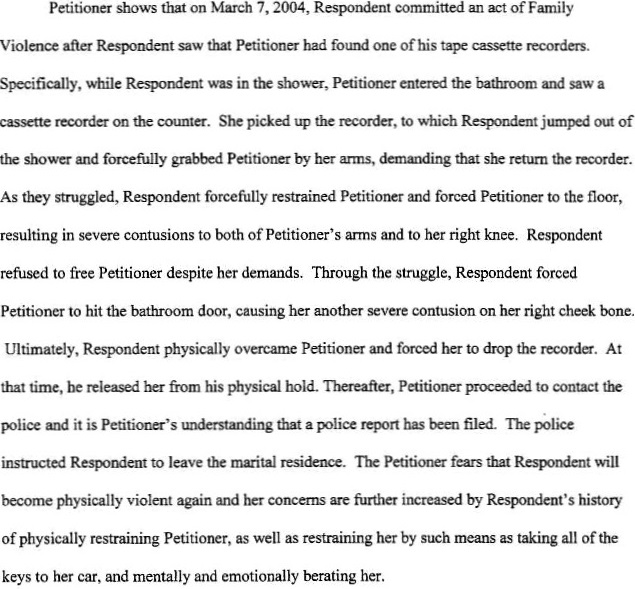
A commenter, Mark Shumate, recently reported that he was removed from his home based on this affidavit (i.e., narrative to the court), which he says was “perjured”:

protection order affidavit

According to this bizarre story, the man had “one of his cassette recorders” with him in the bathroom (maybe he was a collector of vintage tech and never went anywhere without it). His wife “found” the recorder—apparently by entering the bathroom while the man was showering. She then “picked up” the recorder her husband had in the bathroom with him. This inspired the husband to “jump” from the shower and wrestle her for it (rather than just pull it from her grasp), and the alleged tussle resulted in the wife’s sustaining “severe contusions” to both arms, her knee, and her cheek. In lay terms, that’s four bruises (contusions are bruises). What made them “severe” bruises isn’t clarified, nor is there an indication that the bruises were documented.

This is the wife’s account of something that may or may not have actually occurred.

The language is important: The wife is said to passively intrude on a private bathroom moment, while the actions of the man (who, according to the story, is presumably naked with shampoo in his eyes) are described in maximally inflammatory terms: “jumped,” “forcefully grabbed,” “struggled,” “forcefully restrained,” “forced,” “refused,” and finally “physically overcame.”

Naturally, none of what’s described was witnessed. The details are asserted; they’re not facts. The words are sufficiently gripping, however, to distract attention from the implausibility of the story they’re purported to recall (namely, that of a wrestling match in the john between a naked man and his wife over a tape recorder).

Based on this squidgy tale of an uncorroborated bathroom incident recounted in an ex parte petition for a family violence protection order prepared by a law firm, the wife was able to:

  1. have her husband removed from his home and ordered to not to come with 500 yards of it, his children, or his wife;
  2. gain “temporary and permanent” custody of the children;
  3. be granted “exclusive use and control of the marital residence”;
  4. be “awarded temporary sole possession” of the family car;
  5. request to have her husband ordered to pay alimony and child support; and
  6. request to have her husband ordered to pay her attorney fees (for having the protection order petition drafted).

On the basis of the same sketchy story, the wife was able to plausibly allege fear of “further violence,” as well as allege a “prior history” of physical restraint, withholding of car keys, and verbal abuse that caused her “mental and emotional” pain.

The number of people who know whether any of this is true are two: the woman with the house, the kids, the car, and the cash…and the man without them.

Copyright © 2015 RestrainingOrderAbuse.com

The Words Get in the Way: Reconceiving Arguments against Restraining Order Fraud

block
Traffickers of this blog will sometimes advise that complainants of abuse of so-called “protective orders” consider “the bigger picture.” They feel the matter is less about personal loss than about statutory and procedural derelictions (bad law and judicial bias, carelessness, and tyranny). They emphasize principle over individual privation.

For some, the bigger picture that’s stressed is denial of constitutional rights to due process (for example, the right to be heard before a judgment is entered, the right to court-appointed legal counsel, or the right to a trial by jury); for others, the bigger picture is the right to freedom of speech. Some underscore gender and race inequities; some the undermining of the family.

The obstacle to making whatever “bigger picture” is emphasized perceptible to the public at large is the phrase “restraining order” or “protection order,” which comes with a host of conditioned prejudices. It arouses images of violence against those helpless to defend themselves. Accordingly, even many who acknowledge the process is flawed nevertheless say they recognize it to be necessary…in cases.

So even those against the process may not actually be against the process. This has created a disjointed community of complainants, namely, a marginalized extreme labeled “misogynist cranks,” “angry white men,” or “restraining-order-Americans” and a fence-sitting majority who against all evidence and experience retains the faith that reason will prevail against unreason if we just talk it out long enough: “All around the mulberry bush, the monkey chased the weasel….”

The monkey never catches the weasel, so there’s nothing to recommend monkeying around.

What needs to be stressed and comprehended, to this writer’s way of thinking, is that civil court is no place for the litigation of accusations that explicitly or implicitly allege violence, violent threat, or other criminal acts, and that in civil court, which applies no standard of evidence, fraud is too easily perpetrated. The exposure of falsehood or exaggerated claims of fear will not necessarily discredit a plaintiff’s claims, and findings in favor of a plaintiff who’s a proven liar are possible and acceptable to the court.

Therefore the procedure is vexed; it’s wrongly engineered. The concept is corrupt.

Instead of denouncing “restraining order fraud,” it’s civil court rulings that exact an unconscionable toll that should be denounced. It’s all about the words. Civil procedures should not result, ever, in people’s being placed in police databases. Civil rulings should not criminalize people or make them vulnerable to warrantless arrest (for alleged behavior that may not violate any laws). It should not be possible to have a person evicted from a residence he or she owns by a civil ex parte decision, nor should such a decision predispose a court to find against that person when s/he’s permitted to address the court in his or her defense (if such an opportunity is even practicable to the accused, who may preposterously be required to travel to another county or state to be heard).

Against policies of law and process so manifestly unjust, even improved due process rights would promise to be a shabby deterrent against abuse and miscarriages.

Not only have we become habituated to the reality of “restraining orders” to the extent that we believe they must be here to stay; procedural process has become rote (adjudication by rubber stamp). Yes, new “safety catches” could be installed, but what guarantee would there be that the conditioned habits of those who administrate the process would change? Economy would require that there continue to be minimal oversight and accountability, and the trial judge would still have the final (and absolute) discretion to make a determination, according to his or her own personal lights. So long as the process were conducted in civil court, rulings could still be arbitrary (anything goes), because the standard of evidence would remain whatever the trial judge chose.

Social and judicial impression cannot be overhauled—what’s etched on the brain stays there—and the preconceptions attached to the phrase restraining order will never be dispelled. Judgment by a single man or woman who has had his or her priorities conditioned by rhetoric and social and political expectations (possibly for decades) cannot be impartial. The implications of the process and dictates about how it’s supposed to be administered are too deeply ingrained. The phrase restraining order is by itself damning (right from the get-go). It stirs presuppositions of guilt, and this is inimical to fair and just process. Accordingly, the phrase must be abolished and the process reconceived from the ground up.

Copyright © 2015 RestrainingOrderAbuse.com

Mixed Loyalties: Why the Only One Looking Out for the Victim of Restraining Order Abuse is the Victim of Restraining Order Abuse, or, Why You’re on Your Own

A recent commenter observed that the “abuse industry” is a goldmine that no one who benefits from it has any motive to oppose, including judges and lawyers.

There are exceptions—attorneys Gregory Hession and David Heleniak are examples—but in general the commenter is right. Civil rights groups like the ACLU and the Southern Poverty Law Center have a defining investment in women’s rights, and restraining orders are “women’s law.” So their sensitivity to procedural abuse is profoundly limited, also.

The Academy is feminist-dominated. You’ll find no open sympathy there. Feminists hold political sway, whatever their numbers actually are and regardless of whether theirs are majority positions or minority ones. Higher education is a political milieu. Professors who publicly voice qualms with feminist doctrine are few. (Not that long ago, a Harvard president was driven out of office for candidly proposing that men and women were different.) Mainstream media are pressured into conformity with the favored views of the “intelligentsia” (or what’s sometimes called the “East Coast establishment”), and these favored views are feminist views.

Outspoken female critics who represent your side—and there are several stellar ones—may have personal motives, like affiliation with a set of political/family values, cornering a market demographic to enhance sales of books they’ve authored or services they offer,  or carving out a literary niche for themselves in the popular press. Alternatively, they may be intellectually offended by the direction feminism has taken; they may feel betrayed by a cause they formerly championed. They oppose the source of your injury, and they’re to be esteemed for that, but they can’t afford to make an investment in you.

Finally, even forums on the Internet that address restraining order and other types of prosecutorial abuses may be jealous of “competing” voices; they have a brand that they’ve invested in and a particular ideology they espouse.

These are among the reasons why there is no common front.

None of this means that any or all of the aforementioned couldn’t be moved to take up your cause, but to attract their interest, you would need to make a splash. This requires loud action that attains a measure of legitimacy, and this is probably only possible if individuals unify—in a campaign, for example, or a class action.

The solitary complainant who can’t brandish a court judgment that exonerates him or her of foul accusations is an iffy investment. Nobody knows you. Too, the person who understands where you’re coming from but is mired in his or her own hell will only have a modicum of attention to spare you. Alliance toward a common goal that raises the hopes of all those involved could reward the individual, but to realize such an alliance requires action, and it requires action that aims to attract power to itself.

There is value in registering your complaint, anywhere and in any way, because more stories translate to greater awareness (which also encourages others to step forward and share their travails). To break the chokehold of ambivalence and resignation, though, requires the kind of action that grabs headlines, and that requires community and a concerted effort.

Only success attracts popular support.

Copyright © 2015 RestrainingOrderAbuse.com

*Here is an example of a campaign that resonated.