 I grudgingly constructed a page this week on Facebook, which confirmed to me two things I already knew: (1) I really hate Facebook, and (2) women are more socially networked than men.
Calling women “bigmouths” isn’t strictly right, and people affronted by the assertion will insist women and men talk about the same amount, or that men talk more than women do.
Uh-huh.
Not impolite to observe is that women “collaborate” more than men do, that is, they sooner work in tandem, which is what statistics I gleaned from Facebook corroborate.
“Tell us about the people you’d most like to connect with,” Facebook urges when you piece together a page on its site. My entries under “Interests” brought up terms like Men’s rights movement, Feminism, and Women’s rights. Accompanying these topics were figures about how many others had expressed an interest in connecting with people who shared those interests.
See for yourself.
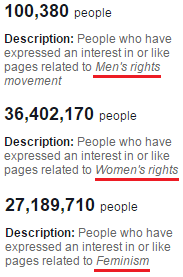 Notice that 200 to 400 times greater interest in bonding with people concerned with women’s rights has been shown than interest in bonding with people concerned with men’s rights. That’s a lot…A LOT a lot.
I don’t think there’s anyone who would deny that the fruits of feminism owe to social networking. Some of these fruits have been great; some really horrible. This blog concerns the rotten ones: a culture of victimhood and false accusation combined with the legislation of accelerated and derelict legal procedures presided over by judges bigoted by politics, bad practices (including engineered social science), and money.
Men have been the majority of victims, and they’ve been the only source of concentrated complaint, concentrated complaint that’s been mocked and muted. If we can assume the 200 to 400 times greater interest shown in women’s rights translates more or less proportionally to the number of people disinterested in or opposed to men’s beefs, then no wonder. Female influence, which is significantly feminist influence, is vastly predominant. The sympathy market has been cornered.
Men aren’t the only victims of procedural abuse, however.
Many if not most of the victims who comment on this blog are women, and they’re often desolate. Some live like hermits, some like refugees. They feel exiled and isolated.
The irony is this is exactly how women felt before the rise of feminism, and there’s a lesson to be taken from that.
Men’s struggles for a market share of sympathy face a phalanx of resistance and the priority of conditioned sentiment (prejudice); they’re also troubled by men’s lesser inclination to work collaboratively (the maverick mentality is a losing one). Women, however, can work from behind the lines. They can tap into the women’s rights network and harness its power.
And they should.
Copyright © 2015 RestrainingOrderAbuse.com



Reblogged this on Falsely Accused.
LikeLike