READ THIS: Extremely Practical Advice and Navigational Tools for Anyone Targeted by the Restraining Order Racket

“Don’t touch the lava, or you will get burned.”

—From Breaking the Glasses

The author of the blog Breaking the Glasses, which concerns itself with the malicious abuse of restraining orders (among other injustices), is a very keen, very honest, and very brave woman. I mentioned her blog in a recent post, but I’d like to revisit it not only to double the likelihood that someone in need of information or advice will find his or her way there from here but to praise its merits at greater length.

Few writers I’ve read offer any but diffuse and reportorial criticisms of restraining order abuse, possibly because only a few have direct or proximal familiarity with it. They understand the facts but may not feel them or their implications. Consequently they may not have enough invested in them to warrant their meditating on them long enough to approach enlightenment.

The critical perspectives on how restraining order frauds and injustices are perpetrated and perpetuated presented by the author of Breaking the Glasses are those of a savvy insider who has intimate knowledge of restraining orders’ effects and their collective toll. Her writing is concentrated, direct, and practical, rather than academic.

I trained for several years to be an academic. I trained longer to be a verse writer. Both concern thinking abstractly. Years later, I’m still prone to see the endoskeleton of something sooner than its pores and follicles. Also, I’m male. It’s a biological fact that women tend to perceive the “big picture” more naturally than men.

Read this and see if you don’t agree that its author couldn’t be any more thorough, concrete, or specific: “A Temporary Restraining Order Has Been Filed Against Me. What Should I Do?” The virtues of this brief tutorial are the same ones evident in all of this blogger’s treatments: awareness, astuteness, moxie, and both passionate and compassionate regard for those affected by the injustices she confronts.

Read this.

Copyright © 2013 RestrainingOrderAbuse.com

Playing God: A Further Consideration of the Character and Conduct of Officers of the Court

My previous two posts have been directed at the character and conduct of officers of the court (that is, attorneys and judges), and the one immediately preceding this one looked specifically at a number of cases of extreme judicial misconduct.

I sketched some of the implications of this misconduct, which ranged from debauchery to violence, in the conclusion to that post. What I’d like to consider in this one is this: in what professional office that you can think of besides judge would it not only be possible to engage in these kinds of activities—for example, propositioning coworkers, masturbating in a roomful of people, or brandishing firearms (in buildings where they’re prohibited)—but possible for the kind of person who’s brazen enough to engage in them to occupy?

I can’t think of one in which such a person would be tolerated or one that such a perpetrator wouldn’t immediately be ousted and escorted to a cell from. Not one. Not that long ago, a President of the United States was impeached for privately dropping trou.

The obvious answer to how this is possible is that (1) courtrooms are insular spaces where judges literally reign, and (2) everyone, including members of their staff, is intimidated into (sycophantic) submissiveness. A judge can literally masturbate himself in front of a crowd of people, and no one will stand up and recognize the behavior openly, let alone challenge its seemliness (this is the phenomenon satirized in the story, “The Emperor’s New Clothes”).

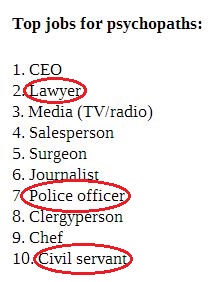
I’ve recently observed that several jobs in the legal and government spheres are ones people with so-called psychopathic traits are said to gravitate toward: lawyer, police officer, and civil servant (judges are both lawyers and civil servants). Other “top jobs for psychopaths” are said to be CEO and surgeon. These are all occupations whose practitioners you have assuredly heard someone remark “think they’re God.”

What does it mean to think you’re God?

What’s usually meant is that people like this have been invested with authority and expect it to be recognized; presume to dictate to others what’s best for them (that is, they presume to know best); never doubt or second-guess themselves, their judgments, or their worthiness; relish being the center of others’ attention; and are resistant to stress and immune to shame.

They’re excellent survivors, clearly, which is what the title of Oxford professor Kevin Dutton’s book, The Wisdom of Psychopaths, implies. They’re rewarded by exerting their will on others and, despite whatever consequences may ensue as a result, sleep well.

Over the course of writing dozens of editorials on restraining order abuse and the issues around which it orbits and from which it devolves, I’ve found myself over and over coming back to psychology. Both wanton abusers of the law and practitioners of the law (who may likewise be wanton abusers of it) display qualities that are directly contradictory to the conceits of civil process. Civil, along with its cognates civilization and civility, implies sensitivity to others and the value of their feelings and lives. These words are meant to embody the values espoused by our Constitution, principal among them being the recognition that all people are created equal and are thus equally entitled to earnest regard by others.

The values espoused by our Constitution are social values. What you see in conflict here are competing social systems: the authoritarian and the democratic. The law is a system that has “evolved” from ancient times to feudal times (times when the citizenry was ruled by the dictates of a single person) to modern times, and it hasn’t really kept up (just consider the word court: what does a king preside over?). What keeps government and the courts honest is social scrutiny, mediated typically by the so-called fourth estate, journalism: word gets out, and people respond.

Change and reform begin with sensitization (that is, awareness).

The counteragent to corruption, in other words, is you and I (collectively). People are dominated by the law and intimidated into submissiveness, restraining order victims doubly so, because they’ve been traumatized. What being traumatized means is having had your power taken from you (not surprisingly, more than one female victim of restraining order abuse I’ve spoken with has referred to her treatment in court and by the court as “rape”: the ultimate trauma of rape is being disregarded, dominated, and left feeling impotent.)

Take your power back. Not a single one of the judges nominated “crazy” that I mentioned in my previous post went down without a fight.

And they probably still sleep like babies.

Copyright © 2013 RestrainingOrderAbuse.com

Turnabout is Fair Play: Scrutinizing the Character and Conduct of Officers of the Court

Fair is a word that appears prominently in ethical canons drafted to define the methodologies and behaviors expected of judges (which canons are consolidated into states’ codes of judicial conduct, compendia of rules and principles that in the administration of restraining orders are more often paid lip service than scrupulous attention). An obligation of using the word fair is tolerating having done to you what you do to others.

Among the unfair aspects of how restraining orders are administered is the judicial application of a generic standard to defendants (that is, recipients of restraining orders). Positive matches are facilely constructed (sight unseen) between any John or Jane Doe who’s had a finger pointed at him or her—very possibly by a malicious accuser—and some paradigmatic caricature bad guy, the “Grim Creeper,” the original template for whose debauched and demonic dimensions was the much-hyped domestic batterer of 30 years ago.

Anyone targeted by this process, based on real allegations as innocuous as texting too much or on completely false allegations, is treated like the Grim Creeper.

By this standard, the scorn and ignominy earned by some judges should be borne by all of them, that is, if judicial logic is that because some restraining order defendants are bad eggs, all restraining order defendants should be regarded as bad eggs and publicly vilified, it only follows that if some judges are rotten egg omelets, all judges should be suspect. Fair is fair.

This is all a very circumspect introduction to my sharing that in randomly Googling “crazy judge,” I stumbled upon a page on “5 Shockingly Crazy Judges Who Presided Over Modern Courts.” It answered my query with the following case studies:

  • A Michigan judge, who reportedly handled sexual misconduct cases and was married, is distinguished for having texted a shirtless photo of himself to one of his female bailiffs and later responding to the alleged impropriety, “Yep, that’s me. No shame in my game.” He went on to sleep with a defendant who appeared before him to settle a child support dispute (and, she says, knock her up), allegedly repaying her sexual favors with preferential treatment.
  • An Oklahoma judge attained infamy by repeatedly exposing himself in his courtroom over a period of years and using a penis pump on a number of occasions during jury trials. Semen stains were turned up not only on his robes but on the carpet and the chair behind his bench.
  • A Florida judge responded to a threatening comment made by a defendant by producing a .38-caliber revolver and declaring, “There’s one bullet in the cylinder. Do you want to take your best shot? If you’re going to take a shot, you had better score, because I don’t miss.” He then rested the gun on his bench for the remainder of the proceeding.
  • A Georgia judge pulled a firearm during a trial and prompted a witness, the alleged victim of a sexual assault whose attacker had held a gun to her head, to shoot her attorney.
  • An Illinois judge whose tenure on the bench had already spanned 18 years, 18 years marked by allegations of mental illness, was reelected in 2012 despite being found “legally insane” by a psychiatrist. She was in court the next day on charges of shoving a court deputy (following her being ejected from her courtroom for engaging in a 45-minute rant and followed by her throwing a set of keys at a security checkpoint). Her annual salary: $182,000.

And the list goes on.

Consider that all restraining order defendants may feel treated like sex offenders, violent menaces, and nuts irrespective of what they have or haven’t done, and consider it in light of these judges’ actual conduct.

Two of these judges were suspended (only one without pay), one was transferred, and one resigned. Only one of these judges was sentenced to prison. And none were issued restraining orders, which make millions of people vulnerable to incarceration every year based merely on finger-pointing.

Aside from this quibble, do these cases really signify anything but that no occupation is immune from attracting the odd screwball?

Yes, in fact they do. Significant is that in more than one of these cases, the behaviors that eventually drew censure were allowed to continue for a period of many years (and were obviously known to members of their staff). This fact highlights the laxity of judicial oversight. A more significant implication of these cases is that only extreme judicial misconduct really gets zeroed in on. Practitioners of rhetoric (essay writers, for example) will use extreme or even wildly fictional scenarios (hyperbole) to emphasize implications, because we perceive best what’s writ large and luridly, and seeing the big implications allows us to grasp the smaller ones. If judges are capable of engaging in and getting away with the extreme misbehaviors exemplified in the cases enumerated above, possibly for years, it follows that less sensational infractions and lapses occur all the time and are winked at. This is not only significant but significant to hundreds or thousands of peoples’ lives every day.

Get it?

Having now concluded this excursion, let us return, shall we, to that never-never land we’re supposed to occupy where defendants have black mustachios they twist between their fingers, and judges, properly tasked with corralling the bad guys, have gleaming teeth, flaxen motives, and minds as white and wide as the Lone Ranger’s Stetson.

Copyright © 2013 RestrainingOrderAbuse.com

Psychopaths at Law: On the Likelihood That the Psychopath in the Courtroom ISN’T the Defendant

“In the courtroom, I have literally rubbed people out, crucified them in the witness box. I have absolutely no problem at all reducing an alleged rape victim to tears on the stand. You know why? Because that’s my job. That’s what my client pays me to do. At the end of the day, I can hang up my wig and gown, go out to a restaurant with my wife, and not give a damn. Even though I know that what happened earlier might possibly have ruined her life.”

—From The Wisdom of Psychopaths

Last year on NPR I heard about a book titled, The Wisdom of Psychopaths. I also heard an interview with its author, Kevin Dutton, an Oxford don who’s the most implausibly professorial person I’ve ever listened to. He was cool. And funny.

The quotation above is from a British barrister (attorney) questioned for the book that appears on its interactive website.

I mentioned Professor Dutton’s book in a page on this blog titled, “What Is a Sociopath (or Psychopath)?” The reason I mentioned it is because in it Dr. Dutton identifies the proportion of the population who qualify as psychopaths as being much broader than most people reckon. Dr. Dutton also differentiates psychopathy from homicidal mania. Psychopaths do like exerting power over others, but it’s only the rare psychopath who’s violent and only the statistical freak of nature who keeps human organs in his icebox.

I took a test on the webpage for the book that assesses how psychopathic visitors are (“The Psychopath Challenge”). It’s highly unlikely that I’ll end my days in a straitjacket and a hockey mask. In fact several of the jobs I’ve had or plied myself at are ones said to be least attractive to psychopaths: teacher, craftsman, and creative artist (I earn my crust today as an arborist and gardener).

The reason I’m revisiting Dr. Dutton’s book in this post is that several of the jobs it identifies as most likely to draw psychopaths are ones in the legal profession and government.

Everyone’s quick to quip that lawyers are psychopaths. What’s useful for anyone to know who’s contesting restraining order injustice, or government or legal abuses in general, is that lawyers are psychopaths. To qualify that, understand that there are clinical psychopaths (individuals who might be diagnosed as psychopaths under rigorous examination by psychologists), and there are those with psychopathic qualities. There’s no perfect paradigm: “psychopathy” is defined according to particular traits and tendencies like ruthlessness, fearlessness, single-mindedness, confidence, a lack of conscience and empathy, and mental toughness, any number or all of these combined with charisma. (Dr. Dutton opens his book by identifying his own father, a huckster who was immune to the slings and arrows of outrageous fortune, as a psychopath.)

I’ve never read a book about how to succeed as a lawyer, but it would surprise me if these traits weren’t ones such a book urged baby attorneys to cultivate.

Besides lawyer, police officer and civil servant are listed among the top jobs for psychopaths.

Judges are at least two of these and may seem like all three rolled into one. I’ve known a retired judge who was a very kindly man who doted on his grandkids and their poodle. And I’ve met some exceptionally decent cops. I even know a couple extremely humane attorneys (both of whom left the law for academic posts). Clearly there can be dramatic departures from any attempt at categorization.

My encounters with judges generally, though, tells me that they do tend to esteem themselves exorbitantly, do lack empathy (or resist it unjustly), are prone to consider themselves above the rules, and do evince more than a little gratification from talking down to those who stand before them and even from making those parties blanch and cower (justly or not). Even judges I’ve met in casual encounters have come across to me as alpha types. (If you reach out to shake the hand of one, check twice that it’s his hand that’s being extended to you—this warning goes double for attorneys.)

Ted Bundy: psychopath, serial killer, and law student.

Law is a very political arena, that is, one that’s all about power and jockeying for position. Its daily practitioners—even the ones who aren’t immune to human feeling—lose perspective on the consequences of their actions on real lives. Or don’t give a damn (an attorney’s favorite word is prevail). There’s a lot of gamesmanship present and rarely any fellowship at all (except among one another).

Since I’ve never met a practitioner of law who was particularly gifted at critical reasoning, anyway, I think less emphasis on this aptitude on qualifying tests for admission to law school and more attention to psychological screening would be worthy of consideration. If officers of the court can’t relate to plaintiffs and defendants, and if power holds more appeal for them than serving the cause of justice, they’re not only in the wrong job; they’re dangerous.

Legal decisions have real and lasting consequences on real and lasting lives. And lives aren’t things that should be toyed with.

Copyright © 2013 RestrainingOrderAbuse.com

“Breaking the Glasses”: One Blog Writer’s Metaphor for Exposing Restraining Order Abuse

A highly intelligent and sensitive woman I’ve been in correspondence with in recent months, one who’s been put through the legal crucible and left badly scalded by it, remarked to me that despite what may be their best intentions, a lot of those on the Internet who protest abuses committed through the courts and by the courts sound like nut jobs. I’m personally in awe of anyone who’s weathered court travails and emerged even reasonably sane. I’m not sure I qualify myself. But I take her point.

That’s why I’m particularly impressed when I encounter writers whose literary protests are not only controlled but very lucid and balanced. One such writer maintains a blog titled Breaking the Glasses, and anyone with a stake in the issues this blog concerns may appreciate a female writer’s perspective on them. See her posts on “Restraining Order Abuse and Vexatious Litigation.” She really gets it. Her section on “Mantrapment” (marvelous for its title alone) is dead on in its analyses, and she does a stellar job breaking down how the restraining order game works by the sedimentary accretion of lies.

Here’s an excerpt from an article of this writer’s that chronicles one man’s “Seven years in hell” (published on AVoiceforMen.com). It summarizes the horrors of restraining order injustice and may resonate with the experiences of visitors to this blog:

“After these first accusations failed to get Amy what she wanted, she changed tactics. She would go to the county courthouse first, using false claims of stalking and assault to obtain another emergency Civil Protection Order. A hearing would be set for a date within 30 days to determine whether the order was merited. This hearing would carry two possibilities: either the order would be dropped, or it would be upheld. If the order was dropped, the charge of violating it would also be dropped. If upheld, it would be in effect for 5 years, and Rodger would face limitations and penalties, including the permanent loss of his legal right to keep and bear arms. Any contact he had with Amy after that, even if it was accidental, could result in his being sent to jail.

“After requesting the order, Amy would wait until she was informed that the order had been served, and within a day or two, she would accuse Rodger of violating it. Each time, officers would arrive at Rodger’s home and take him into custody without reading him his rights. They informed him that they could do this because he was not under arrest – merely ‘going in for questioning.’

“However, despite not being under arrest, he would be transported to the station in handcuffs, riding in the back of a cruiser rather than on his own. Officers would place him in a holding cell before and after questioning him. He would be held for hours. The department would not release him without bail. Officers told Rodger’s family that they were permitted to do all of this under a combination of the Patriot Act and the Violence Against Women Act, explaining that the Patriot Act allows police to detain citizens suspected of domestic terrorism, and VAWA treats domestic abuse as a form of terrorism. However, VAWA does not treat domestic abuse as a form of ‘domestic terrorism’ as described in the Patriot Act. That assertion was an incorrect interpretation of the two laws, one which is being fed to local departments by the advocacy group from which Amy was receiving assistance, but the fact that it’s incorrect has not stopped local police departments from acting on the advocacy group’s advice when detaining area men accused of domestic violence.”

It digests much of what’s most defective and destructive about the restraining order process and underscores how easily and extremely this process can be abused.

Besides this writer’s blog, I want to direct interested parties to Restraining Order Blog, maintained by Chris Tucker, whose own treatments are reasoned and conscientious. Many detailed and revealing firsthand accounts of restraining order abuse can be found here.

It’s said that knowledge is power. This isn’t particularly true when applied to the state legal apparatus, because all the know-how in the world can fall victim to base lies. In the legal arena, the only sure power is political pull (which usually equates to money). And the only virtue in knowing this is knowing to steer clear of the legal arena. There is much to be said for speaking truth to power, however, because information is influential. And the tides of change will only be roused by that information’s spreading.

And this finally is contingent upon those in the know feeling secure enough to pronounce what they know. This is how the power of knowledge is realized. Fortune doesn’t in fact always favor the brave, but in the fullness of time it may dependably respond to their summons.

Copyright © 2013 RestrainingOrderAbuse.com

Not Evil Geniuses but Brats in Slacks: On Narcissists and Restraining Order Abuse

Pathological narcissism is apparently a titillating topic.

A growing number of visitors to this blog are brought here by search terms that include words and phrases like narcissism, narcissistic personality disorder, and NPD. More commenters, too, have lately reported abuses by narcissists through the courts, typically restraining order abuse. This surge is less likely due to an uptick in abuses by narcissists than to a dawning awareness of the psychological motives that underlie many vicious legal assaults. More Internet support groups and websites devoted exclusively to exposing abuses by narcissists are emerging, and the same words and phrases glossed above are now appearing in headlines, such as those on The Huffington Post and Salon.com.

My own opinion, on reflection, is that narcissists are banal. Evil, as Hannah Arendt famously noted, usually is (Arendt was a teacher and writer who fled Nazi Germany). The truth is the sorts of legal mischief narcissists get up to only work because our courts are accustomed to crediting lies (however painfully transparent they might be to a disinterested party). Narcissists assuredly congratulate themselves on their courtroom triumphs (congratulating themselves is among narcissists’ principal preoccupations). Yet any precocious child would see through their counterfeit dramatics.

Narcissists aren’t, in fact, epic anything; they’re pathetic. You may perceive narcissists’ pathological lies as devious; you’d more usefully perceive them as compulsive. (A compulsion is an irresistible urge.) What gives their frauds that aura of grandeur is the astonishing ease with which they’re committed, particularly on authorities and judges, and the facility with which narcissists enlist others in those frauds or convince others that they’re true. (Narcissists’ allies and pawns are more often than not morally normal people, that is, “neurotypicals.” Sometimes they’re even seemingly intelligent and discerning ones.)

Casual charlatanism, though, is hardly an accomplishment for people without consciences to answer to. And rubes and tools are ten cents a dozen.

There probably are some narcissistic masterminds out there. None of the narcissists whose conduct I know of, however—and I’ve had dozens of stories shared with me and read scores of other accounts, besides—has ever impressed me as more than a child in big-boy pants or a big-girl skirt. Narcissists succeed by virtue of soulless inveiglement and outward plausibility, neither of which bears up under close scrutiny. (Courtroom decisions made in restraining order cases are the products of a few minutes.)

I’ve read many people differentiate between narcissism and “mental illness.” Narcissists aren’t crazy, they’ll write. I’m unconvinced. I think it’s more accurately pronounced that narcissists don’t seem crazy and that most people are taken in by narcissists not because there isn’t something about them that alerts the antennae of others that there’s something off about them than that what’s off about them doesn’t match any of the familiar paradigms of craziness.

I’m not a psychologist, but my personal opinion is that narcissists are mentally ill and, when their frauds and ploys are resisted to any significant extent, that that mental illness becomes more prominent and perceptible, particularly to those whom they’ve abused. Normal people won’t run themselves ragged defending such frauds and ploys. A narcissist will.

Narcissism is about surface. And surface, despite the warning of that adage about book covers, is what we judge by. Narcissists are good with audiences. They’re also good with stress. They don’t slide into that state of neglected personal hygiene that we associate with “madness” even when pushed to an extremity. This isn’t a reflection of their interior hygiene, however.

Scratch beneath the surface, and you will find disorder.

Contrary to what many online writers counsel, people in legal contests with narcissists shouldn’t think of their opponents as reasoning beings in possession of highly developed albeit wicked minds; they should reckon themselves to be in struggles against recalcitrant children. Much ado is made of the cunning of narcissists. That apparent cunning is really just a manifestation of obsessive-compulsive self-justification combined with infantile rage provoked by the narcissist’s not getting his or her way.

Narcissists aren’t Hannibal Lecters; they’re brats in permanent temper tantrums who recognize no moral boundaries or authority.

Copyright © 2013 RestrainingOrderAbuse.com

What HE Said: On Why Once a Restraining Order Fraud Has Been Put Over on the Courts, It Sticks like Pigeon Scat on a Car Hood

A principle of law that everyone ensnarled in any sort of legal shenanigan should be aware of is stare decisis. This Latin phrase means “to abide by, or adhere to, decided things” (Black’s Law Dictionary). Law proceeds and “evolves” in accordance with stare decisis.

Anybody who’s read a Grisham novel or seen its screen adaptation knows that precedents are evoked to establish the merits of legal arguments. Precedents are cases whose judicial opinions imposed some novel tweak, limit, or elaboration on previous opinions. Law “advances” by means of this sort of accretion and seldom backpedals. Lawyers inform judges of precedents to persuade them that such-and-such was agreed upon by another judge, so you guys need to form your rulings correspondently.

The orientation of the courts is toward accepting that what’s previously been found to be the case must remain the case (or “the truth”).

Victims of restraining order fraud express amazement at the courts’ unwillingness to acknowledge obvious lies by designing plaintiffs (applicants). The fact is that once a restraining order has been successfully petitioned, and this is simply a matter of a plaintiff plaintively persuading a judge of his or her need in a 10-minute interview, it becomes a (presumptively) decided matter. Court rhetoric would have it believed that no final conclusion is made until the defendant can be heard in opposition, but all things judicial lean toward the notion exemplified by stare decisis, that is, what’s decided is decided.

Translation: “It’s true, because we said it was.” This is called a tautology (the assertion that a fact is its own reason) and would get a practitioner tossed out of Critical Thinking 101.

Defendants who opt to contest false allegations on restraining orders only to have judges belittle their efforts in the brief, half-hour hearings afforded them often report being horrified by judicial bias, laziness, or indifference, and leave courtrooms feeling like the outcomes were preordained.

That’s because in a very real sense they were.

Ex parte rulings may well be done deals, because judges, consciously or not, follow the precept that they should adhere to precedents and not unsettle things previously established (“stare decisis et non quieta movere”). And all restraining orders are approved ex parte, that is, without judges even knowing who defendants are, so what has previously been established has been established unilaterally (that is, prejudicially or one-sidedly) and in the absence of due process of law.

Restraining order appeals, which may climb successive rungs of the court ladder if defendants possess the financial means and moral fortitude to keep resisting, face this prejudice all the way up. So too do lawsuits seeking damages for restraining order abuse (especially if litigants are self-represented).

If you ever receive an apology from a judge, frame it.

Truth may literally be irrelevant. Procedural rules trump it and incline and authorize judges not merely to discount contradictory evidence provided by defendants but to ignore it entirely. Some disturbed person’s incriminatory fantasy, therefore, can drain the quality of years of a restraining order defendant’s life. This is the grotesque reality of the restraining order process and underscores its inherent corruption.

Government studies have concluded that a majority of restraining orders (80% by at least one reckoning) are issued unnecessarily or on false grounds.

It’s clear then that unless due process is retrofitted into the system, and defendants are granted the opportunity to be heard prior to restraining orders’ being issued so that they’re not forced to enter the process having to clear the hurdle of an unfair prejudgment (on top of feeling betrayed and menaced by the state), restraining orders will necessarily continue to do more harm than they arrest.

It would also be nice if the statutory consequence of prison time for those who lie to the courts were once and while enforced.

Copyright © 2013 RestrainingOrderAbuse.com

Presumed Guilty: On How Restraining Order Laws Enable and Promote Abuse

I’ve had occasion in the last few months to scrutinize my own state’s (Arizona’s) restraining order statutes, which are a study in prejudice, civil rights compromises, and politically coerced naïvety. Their outdated perspective fails even to acknowledge the possibility of misuse let alone recognize the need for remedial actions to undo it.

Restraining orders are issued upon presumptive conclusions (conclusions made without judges ever even knowing who recipients are—to the judges, recipients are just names inked on boilerplate forms), and the laws that authorize these presumptive conclusions likewise presume that restraining order applicants’ motives and allegations are legitimate, that is, that they’re not lying or otherwise acting with malicious intent.

That, you might note, is a lot of presuming.

In criminal law, the state must presume that defendants are innocent; in civil law (restraining orders are civil instruments), defendants may be presumed guilty. What’s outrageous about this with respect to restraining orders is that public allegations made on them may be criminal or criminal in nature, and violations of restraining orders—real or falsely alleged—have criminal consequences. Due process and the presumption of innocence are circumvented entirely; and with these safeguards out of the way, a defendant may be jailed on no valid evidence or for doing something that’s only illegal because a judge issued a restraining order on false grounds that made it so. (A parent who’s under a court-ordered injunction may be jailed, for example, for sending his child a birthday present.)

One of my motives for consulting my state’s restraining order statutes is having absorbed a broad array of stories of restraining order abuse over the past two years. Common themes among these stories are judicial bias; lying and fraud by plaintiffs (applicants); restraining order plaintiffs’ calling, emailing, or texting the people they’ve petitioned restraining orders against (or showing up at their homes or places of work—or following them); and restraining orders’ being serially applied for by plaintiffs whose past orders have been repeatedly dismissed (that is, restraining orders’ being used to harass and torment with impunity).

Those who’ve shared their stories want to know how these abuses are possible and what, if anything, they can do to gain relief from them. The answer to the question of how lies within the laws themselves, which are flawed; the answer to the question of what to do about it may well lie outside of legal bounds entirely, which fact loudly declaims just how terribly flawed those laws are.

Arizona restraining orders are of two sorts, called respectively “injunctions against harassment” and “orders of protection.” They’re defined differently, but the same allegations may be used to obtain either. Most of the excerpted clauses below are drawn directly from Arizona’s protection order statute. Overlap with its sister statute is significant, however, and which order is entered simply depends on whether the plaintiff and defendant are relatives or cohabitants or not.

“[If a court issues an order of protection, the court may do any of the following:] Grant one party the use and exclusive possession of the parties’ residence on a showing that there is reasonable cause to believe that physical harm may otherwise result.”

This means that if your wife/husband or girlfriend/boyfriend alleges you’re dangerous, you may be forcibly evicted from your home (even if you’re the owner of that home). The latitude for satisfying the “reasonable cause” provision is broad and purely discretionary. “Reasonable cause” may be found on nothing more real than the plaintiff’s being persuasive (or having filled out the application right).

“If the other party is accompanied by a law enforcement officer, the other party may return to the residence on one occasion to retrieve belongings.”

This means you can slink back to your house once, with a police officer hovering over your shoulder, to collect a change of socks. Even this opportunity to recover some basic essentials may be denied defendants in other jurisdictions.

“[If a court issues an order of protection, the court may do any of the following:] Restrain the defendant from contacting the plaintiff or other specifically designated persons and from coming near the residence, place of employment or school of the plaintiff or other specifically designated locations or persons on a showing that there is reasonable cause to believe that physical harm may otherwise result.”

This means defendants can be denied access to their children (so-called “specifically designated persons”) based on allegations of danger that may be false.

“[If a court issues an order of protection, the court may do any of the following:] Grant the petitioner the exclusive care, custody or control of any animal that is owned, possessed, leased, kept or held by the petitioner, the respondent or a minor child residing in the residence or household of the petitioner or the respondent, and order the respondent to stay away from the animal and forbid the respondent from taking, transferring, encumbering, concealing, committing an act of cruelty or neglect in violation of section 13-2910 or otherwise disposing of the animal.”

This means defendants can be denied access to the family pet(s), besides.

Note that the linguistic presumption in all of these clauses is that recipients of restraining orders are wife-batterers, child-beaters, and torturers of puppies, and recall that restraining orders are issued without  judges’ even knowing what defendants look like. This is because restraining orders were originally conceived as a deterrent to domestic violence (which, relative to the vast numbers of restraining orders issued each year, is only rarely alleged on them today at all). It’s no wonder then that judicial presumption of defendants’ guilt may be correspondently harsh. Nor is it any wonder that in any number of jurisdictions, an order of protection can be had by a plaintiff’s alleging nothing more substantive than “I’m afraid” (on which basis a judge is authorized to conclude that a defendant is a “credible threat”).

“A peace officer, with or without a warrant, may arrest a person if the peace officer has probable cause to believe that the person has violated section 13-2810 by disobeying or resisting an order that is issued in any jurisdiction in this state pursuant to this section, whether or not such violation occurred in the presence of the officer.”

This means you can be arrested and jailed based on nothing more certain than the plaintiff’s word that a violation of a court order was committed. More than one respondent to this blog has reported being arrested and jailed for a lengthy period on fraudulent allegations. Some, unsurprisingly, have lost their jobs as a consequence (on top of being denied home, money, and property).

“There is no statutory limit on the number of petitions for protective orders that a plaintiff may file.”

This observation, drawn from Arizona’s Domestic Violence Civil Benchbook, means there’s no restriction on the number of restraining orders a single plaintiff may petition, which means a single plaintiff may continuously reapply for restraining orders even upon previous applications’ having been denied.

Renewing already granted orders (which may have been false to begin with) requires no new evidence at all. Reapplying after prior applications have been denied just requires that the grounds for the latest application be different, which is of course no impediment if those grounds are made up. As search terms like this one reveal, the same sort of harassment can be accomplished by false allegations to the police: “boyfriends ex keeps calling police with false allegations.” Unscrupulous plaintiffs can perpetually harass targets of their wrath this way—and do.

No restrictions whatever are placed upon plaintiffs’ actions, which means that they’re free to bait, taunt, entrap, or stalk defendants on restraining orders they’ve successfully petitioned with impunity. And neither false allegations to the police nor false allegations to the courts (felony perjury) are ever prosecuted.

“A fee shall not be charged for filing a petition under this section or for service of process.”

This means the process is entirely free of charge.

Copyright © 2013 RestrainingOrderAbuse.com

Rape and Restraining Order Fraud: On How Men Betray Women, How Women Betray Men, and How the Courts and the Feminist Establishment Betray Them Both

I had an exceptional encounter with an exceptional woman this week who was raped as a child (by a child) and later violently raped as a young adult, and whose assailants were never held accountable for their actions. It’s her firm conviction—and one supported by her own experiences and those of women she’s counseled—that allegations of rape and violence in criminal court can too easily be dismissed when, for example, a woman has voluntarily entered a man’s living quarters and an expectation of consent to intercourse has been aroused.

Her perception of judicial bias against criminal plaintiffs is one shared by many and not without cause.

By contrast, I’ve heard from hundreds of people (of both genders) who’ve been violated by false accusers in civil court and who know that frauds are readily and indifferently accepted by judges. (Correspondingly, more than one female victim of civil restraining order abuse has characterized her treatment in court and by the courts as “rape.”)

Their perception of judicial bias against civil defendants is equally validated.

Lapses by the courts have piqued the outrage of victims of both genders against the opposite gender, because most victims of rape are female, and most victims of false allegations are male.

The failures of the court in the prosecution of crimes against women, which arouse feminist ire like nothing else, are largely responsible for the potency of restraining order laws, which are the product of dogged feminist politicking, and which are easily abused to do malice (or psychological “rape”).

In ruminating on sexual politics and the justice system, I’m inexorably reminded of the title of a book by psychologist R. D. Laing that I read years ago: Knots.

In the first title I conceived for this piece, I used the phrase “can’t see eye to eye.” The fact is these issues are so incendiary and prejudicial that no one can see clearly period. Everyone just sees red.

Under the Violence Against Women Act (VAWA), federal funds are doled out to police precincts and courts in the form of grants purportedly intended to educate police officers and judges and sensitize them to violations against women, which may have the positive effect of ensuring that more female victims of violent crimes see justice but simultaneously ensures that standards applied to the issuance of civil restraining orders slacken still further, allowing casual abuse of a free process to run rampant and destroy lives. The victim toll of false restraining orders negates strides made toward achieving justice for female victims in criminal prosecutions. What is more, though restraining orders are four times more often applied for by women than men, making women their predominant abusers, the laxity of restraining order administration allows women to be violated by men, too.

Not only was a woman I’ve recently been in correspondence with repeatedly assaulted by her short-term boyfriend, a charming and very cunning guy; he also succeeded in petitioning a false restraining order against her, alleging, among other things, violence. She had even applied for a restraining order against him first, which was dismissed:

There are no words for how I felt as I walked to my car that afternoon. To experience someone I had cared deeply about lying viciously in open court, to have a lawyer infer that I’m a liar, and to be told by a judge that, basically, he didn’t believe me (i.e., again, that I’m a liar), filled me with a despair so intense that I could hardly live with it. You know how, in trauma medicine, doctors will sometimes put grossly brain-injured patients into medically-induced comas so as to facilitate healing? That afternoon, I needed and longed for a medically-induced emotional coma to keep my skull from popping off the top of my head. I don’t know how else to describe it. It was that day that I learned that the justice system is rotten, that the truth doesn’t mean shit, and that to the most depraved liar go the spoils.

As many people who’ve responded to this blog have been, this woman was used and abused then publicly condemned and humiliated to compound the torment. She’s shelled out thousands in legal fees, lost a job, is in therapy to try to maintain her sanity, and is due back in court next week. And she has three kids who depend on her.

The perception that consequences of civil frauds are no big deal is wrong and makes possible the kind of scenario illustrated by this woman’s case: the agony and injury of physical assault being exacerbated by the agony and injury of public shame and humiliation, a psychological assault abetted and intensified by the justice system itself.

The consequences of the haywire circumstance under discussion are that victims multiply, and bureaucrats and those who feed at the bureaucratic trough (or on what spills over the side) thrive. The more victims there are and the more people there are who can be represented as victims, the busier and more prosperous grow courts, the police, attorneys, advocacy groups, therapists, etc.

What’s glaringly absent in all of this is oversight and accountability. Expecting diligence and rigor from any government apparatus is a pipedream. So is expecting people to be honest when they have everything to gain from lying and nothing to lose from getting caught at it, because false allegations to civil courts are never prosecuted.

Expecting that judges will be diligent, rigorous, and fair if failing to do so hazards their job security, and expecting civil plaintiffs to be honest if being caught in a lie means doing a stint in prison for felony perjury—that, at least, is reasonable.

The obstacle is that those who hold political sway object to this change. The feminist establishment, whose concern for women’s welfare is far more dogmatic than conscientious, has a strong handhold and no intention of loosening its grip.

Typically both criminal allegations of assault or rape and civil allegations in restraining order cases (which may be of the same or a similar nature) boil down to he-said-she-said. In criminal cases, the standard of guilt is proof beyond a reasonable doubt, a criterion that may be impossible to establish when one person is saying one thing and the other person another, evidence is uncertain, and there are no witnesses. In civil cases, no proof is necessary. So though feminist outrage is never going to be fully satisfied, for example, with the criminal prosecution of rapists, because some rapists will always get off, feminists can always boast success in the restraining order arena, because the issuance of restraining orders is based on judicial discretion and requires no proof at all; and the courts have been socially, politically, and monetarily influenced to favor female plaintiffs. However thwarted female and feminist interests may be on the criminal front, feminists own the civil front.

And baby hasn’t come a long way only to start checking her rearview mirror for smears on the tarmac now.

Copyright © 2013 RestrainingOrderAbuse.com

“restraining order is bullsh*t”: A Lesson in Lying

The previous post concerned lying to get restraining orders, how easily frauds are put over, and the possible value to recipients of false restraining orders of lying better than their accusers.

The quoted phrase in this post’s title, slightly censored, represents an actual search term that has brought several such recipients to this blog.

Among those with no firsthand knowledge of how restraining orders are abused or why, there’s an assumption that by lying, complainants of restraining order fraud mean exaggeration, inflation of allegations that at least bear some correspondence to fact.

This assumption is mistakenly based on the belief that courts only act on proof. Proof is not the standard by which civil matters are judged or the criterion upon which civil restraining orders are approved. Restraining order interviews between applicants and judges are five- or 10-minute screen tests, nothing more; proof is unnecessary.

“But surely you can’t just make things up!” You surely can. Anything. There are no consequences to lying to the police, lying under oath to a judge, or lying on a sworn document unless the district attorney’s office opts to prosecute you, and this seldom happens in civil matters and never in those as low on its list of priorities as restraining order fraud. Statutes that threaten penalties for false reporting or committing perjury are like padlocks: they’re only meant to keep honest people honest.

Not only can people lie to the courts—and with impunity—they can lie BIG.

Not many years ago, philosopher Harry Frankfurt published a treatise that I was amused to discover called On Bullshit (which predictably mounted the bestseller list on the allure of its title alone).

In his book—which is brilliant, in fact, and well-deserving of acclaim—Dr. Frankfurt distinguishes “lies” from “bullshit.” Lies, he explains, have a basic or tangential relationship with the truth, that is, they’re not purely imaginative; they fandango the truth. Bullshit, in contrast to lies, lacks even a passing acquaintance with truth. It’s wholly improvisational. The bullshitter doesn’t “reject the authority of the truth, as the liar does, and oppose himself to it. He pays no attention to it at all.”

False allegations on restraining orders may not be lies simply; they may be bullshit, fabrications that are utterly divorced from reality. A number of respondents to this blog who have been accused of violence, for example, are vegetarian or vegan women who scruple about the welfare of insects and regard violence as unthinkable. Their accusers haven’t merely misrepresented them but reinvented them. The motive? Sheer malice. What correspondence restraining order applicants’ bullshit may have with the truth is antithetical: they allege falsehoods—ones completely estranged from the truth—that they know will most searingly damage their victims.

Success in leading anyone who hasn’t been abused in this way toward realizing that accusers can and do lie is tricky enough; getting them to perceive that allegations may be out-and-out bullshit requires forceful eye-opening.

I can’t responsibly advocate lying. I do, however, acknowledge that since opportunities afforded restraining order defendants to expose the bullshit of unscrupulous accusers may permit them all of 15 minutes to work a miracle, defendants’ following the dictum “if you can’t beat ‘em, join ‘em” has something to recommend it.

The logical extension of there being no consequences for lying is there being no consequences for lying back. Bigger and better.

It could be advantageous, speaking practically not morally, for defendants of false restraining orders to embrace this premise and—instead of trying to deflect turds flung at them—to respond in kind (and even less kindly). Fairness, one of our courts’ fundamental procedural principles, dictates that if judicators are willing to tolerate monkey-cage antics from one side (and moreover reward those antics), they can hardly be averse to bilateral flingfests.

Maybe the only way to prompt this process to evolve is to expose it to its own degeneracy: Monkey see, monkey doo-doo.

Copyright © 2013 RestrainingOrderAbuse.com