How It Serves Political Interests to Issue Restraining Orders Falsely

Under the Violence Against Women Act (VAWA), some $10 billion has been invested over the past 20 years in procedures meant to redress violence against women, and restraining orders are the centerpiece of a host of related legislative measures.

The truth is restraining orders can’t prevent violence; they’re just pieces of paper. Their only value is rhetorical (they influence). They put defendants on notice, and they make it look like the government is protecting people.

When defendants are falsely blamed, their (isolated) protests are seldom registered or credited by others. Because their complaints are discounted or disregarded, they don’t tarnish the court’s image or inspire the press to investigate.

At the same time, it serves the court’s interests when defendants are falsely blamed. The greatest likelihood that an order of the court will appear to have averted violence is realized when that order is issued to someone who was never a threat at all.

Put another way, if the court only issued restraining orders to volatile people, it’s a fair bet that a discomforting percentage of orders would be violated, and the negative statistics would urgently disclose their ineffectiveness as deterrents.

Issuing a majority of restraining orders to people who pose little or no violent threat, contrariwise, ensures violations will be fewer and less consequential by and large. Negative figures, like murders, are thereby minimized, and the process appears to live up to its promise of insulation.

All of this is to say that if you issue 60 restraining orders against nonviolent people to every one issued against a violent aggressor, violations of restraining orders resulting in injuries or death will be comparatively few respective to the total number of people “restrained.” It skews the odds in favor of positive perception.

It’s good PR.

More restraining orders, besides, guarantees greater job security for those who administer them. It means there’s more “work” to get (handsomely) paid for doing.

More restraining orders also means greater substantiation of claims of “epidemic” this and that, which keeps dominant political interests happy and thriving (cha-ching!)…and justifies ramping up the process even further.

Copyright © 2014 RestrainingOrderAbuse.com

No Proof Necessary: Why Restraining Orders Are Abused and Why Restraining Orders Exist

Advocates of restraining orders consider this standard too demanding.

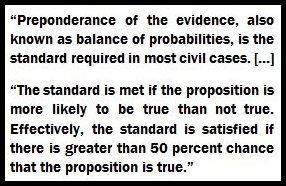
The previous post addressed American standards of evidence and observed that with a single exception, the standard that’s applied to restraining order adjudications, “preponderance of the evidence,” is the least demanding.

Both the award of restraining orders and their being made “permanent” are at a judge’s discretion. (One of the meanings of discretion is “freedom to choose.”)

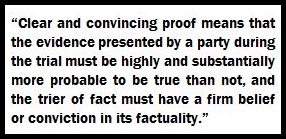
Even in Maryland, the exception to the rule, where final decisions to approve restraining orders must meet the intermediate standard of “clear and convincing evidence,” issuance of restraining orders is discretionary.

In other words, it’s pretty much up to whether judges feel plaintiffs’ allegations are more probably true than not. (Some states call this “good cause” or “reasonable grounds.”)

As previously remarked, this means the legitimacy of restraining order claims is always iffy. This is beside the fact that issuance of restraining orders proceeds from brief, one-sided interviews between plaintiffs and judges, and hearings to finalize them, which may be held mere days later, may themselves be nearly as cursory. Prejudice in favor of complainants, furthermore, has been conditioned if not explicitly mandated, and is all but universal.

What must be emphasized is that in a significant number of cases, despite their bearing criminal imputations or implications, the word evidence isn’t actually applicable.

This is the standard according to which restraining order allegations are “vetted.”

The phrase standard of evidence is misleading, because we’re accustomed to equating the word evidence with proof.

A restraining order may be approved on no more ascertainable a basis than an accuser’s alleged emotional state, that is, the claim of fear may be sufficient. Even when “evidence” is adduced, it may of course be misrepresented—and easily. Doctoral candidates’ oral exams are far more rigorous than restraining order hearings.

Worthy of note is that their tolerance of an absence of proof is both the reason why restraining orders are criticized and the reason why restraining orders are defended.

The only “justification” for restraining orders is the absence of proof.

This isn’t as counterintuitive as it sounds. Crimes alleged on restraining orders are prohibited by criminal statute. Assault, for example, may of course be tried in criminal court.

In that case, however, satisfaction of the standard “proof beyond a reasonable doubt” is necessary.

Restraining orders are stopgaps. What do you do if someone’s threatening you or knocking you around, but you can’t prove it? You apply for a restraining order. It takes an hour—or at most an afternoon—and gratification is immediate. The provision of instant relief was one of the germinal motives of restraining order laws.

All well and good, and there’s no question that people are abused all the time in ways they could never prove in criminal court. But what if an accuser is neurotic, mentally ill, or maliciously lying to gratify an ulterior motive?

There’s no failsafe built into the system. Recognize this, and the limitless potential restraining orders have for abuse becomes obvious.

What restraining orders do is make it easy for the system to dispense with a great number of complaints in short order that would otherwise gum up the works. They also keep a number of special interests happy and a lot of people busy and flush.

This wouldn’t be a big deal if their consequences were minor and restraining orders left no traces once their terms expired. This, however, isn’t the case. Restraining orders, which are prejudicially presumed by the public to be issued to stalkers and batterers, are public records that are not only preserved in the databases of the courts that issued them but in those of state and federal police.

Maryland

This assertion, which originates from the Maryland governor’s office and which presumes only genuine victims apply for restraining orders, argues that allegations ranging from “serious bodily harm” to “rape or sexual offense” should be adjudicated according to the same standard as contract or insurance disputes (as they are in every other state).

Direct consequences to their recipients, besides harassment and public humiliation, may include eviction from their homes and denial of access to kids, money, and property; and proximal consequences may include loss of employment and employability—along with all of the psychological effects that ensue from such losses, among which may be loss of enjoyment of life. Victims of delusional or malicious accusers may moreover be subject to arrest and incarceration if additional allegations are filed.

Pretty big deals, all of them, especially when the precipitating allegations are trumped up. Lives are undone by less.

Few suggest that restraining orders should be abolished, because no one wants to be accused of indifference to victims of domestic violence. The justification for restraining orders, finally, is coercive (and maybe always was).

Restraining orders should be abolished—or radically reconceived.

It’s true that restraining orders help victims out of abusive situations, and this is huge; but in a nation founded on the principle that all people are equal, no group’s interests excuse injury to other people. Aid to those in abusive situations, including children, must not come at the expense of others whose entitlement under the law is the same.

This doesn’t mean those in abusive situations should be written off; it means the present “solution” needs to be revised, because it’s unconscionable.

Coercive influences on law related to violence against women have generated wild imbalances in how allegations of stalking and domestic violence are treated, and have besides promoted unreasonable expansions of statutory definitions (“domestic violence,” for example, can mean a single act, which may not even qualify as violent). Our laws have become rattletraps.

Adjudication of restraining orders, catchalls that bear the stigma of stalking and violence and which may include these allegations among an assortment of others, is particularly problematic, because criminal allegations as severe as rape may escape being answerable either to a jury or to the standard to which they should properly be subject.

That standard is “proof beyond a reasonable doubt.”

Copyright © 2014 RestrainingOrderAbuse.com

Rhetoric and Restraining Order Rampancy

“Rape culture exists because we don’t believe it does. From tacit acceptance of misogyny in everything from casual conversations with our peers to the media we consume, we accept the degradation of women and posit uncontrollable hyper-sexuality of men as the norm. But rape is endemic to our culture because there’s no widely accepted cultural definition of what it actually is.”

The Nation Magazine (February 4, 2013)

I’m not certain I even know what this means. Rhetorically, though, it’s impressive. In a single sentence, its writers “establish” that we are all of their party and that something exists, because we don’t believe it does.

I won’t pretend to know anything about The Nation, but does a position like this pass for responsible journalism? I’ve surveyed a lot of this kind of writing recently, and it alarms me for more than just the reasons that I (1) don’t believe we do “accept the degradation of women,” (2) don’t believe that rape is “endemic to our culture” any more than it is endemic to the animal kingdom, and (3) do believe the definition of rape is pretty clearly and universally understood.

What the writers mean, I guess, is that rape culture, which they haven’t established exists in the first place, continues to exist, because we unknowingly contribute to its perpetuation by saying and doing things that we are not aware reveal our unconscious hatred of women. You didn’t know you hated women? Well, you do.

We all do, apparently. And shame on us for it.

You see how this rhetoric works. It’s more than just assertive; it’s coercive. A lot of it also betrays patently false reasoning that masks what’s actually propagandist badgering. The source of its outrage is sympathetic; how it expresses that outrage is significantly less so.

Consider this line of argument: “When an instance of sexual assault makes the news and the first questions the media asks [sic]are about the victim’s sobriety, or clothes, or sexuality, we should all be prepared to pivot to ask, instead, what messages the perpetrators received over their lifetime about rape and about ‘being a man.’ Here’s a tip: the right question is not, ‘What was she doing/wearing/saying when she was raped?’ The right question is, ‘What made him think this is acceptable?’”

“During the postwar period of Radical Reconstruction (1867-1877), many white writers argued that without slavery—which supposedly contained their animalistic tendencies—blacks were reverting to criminal savagery. The brute caricature portrayed black men as threatening menaces, fiends, and sociopaths, and as hideous, terrifying predators who targeted helpless victims, especially white women.”

(Note the Freudian slip: “an instance” has “perpetrators,” plural. It’s not for nothing that some have perceived in writing like this the tacit belief that all men are rapists.)

First, how has the postulated “instance of sexual assault” been qualified as such? These writers presume that an incident is an “assault” with a “victim.” The overwhelming likelihood in a case like this is that it is what it appears to be, but it’s not the job of investigators, including journalists, to equate appearances with facts. There are no “right” questions. Some questions may be tactful, some rude or insensitive, some effective at exposing the truth, some less so. The value or “rightness” of a question can only be judged in hindsight, as writers for a news magazine should know.

If all journalists shared these writers’ jaundiced perspective or felt constrained to only ask “appropriate” questions, how many instances of false allegations should we imagine would ever be recognized, let alone sanctioned? I have an interest in false allegations, and the answer to this question disturbs me.

I’ve surveyed studies of the incidence rate of false allegations of rape, and I have no reluctance allowing for argument’s sake that rape is rarely alleged falsely. What I have a problem with is the non-recognition of the harm that’s wrought when rape is alleged falsely—and no one argues that this never happens. The life of an innocent may be destroyed. And we will have destroyed it.

A rape is a fait accompli. Before we know about it, it’s done. Falsely prosecuting someone for rape (or anything else), however, isn’t a case of a bad person doing a bad thing. It’s a case of bringing the full weight and menace of the state to bear on an innocent person. Prosecution is a choice that we are all answerable for.

Although the writers would argue the contrary (and do), society isn’t accountable for the actions of individuals. It is, however, accountable for the actions of its elected officials, agents, and representatives. We are accountable, and we collectively must be guided by a higher moral standard than any one individual. We craft laws and policy, and we have an ethical responsibility to ensure laws and policy are fair and scrupulously applied.

This blog isn’t about rape. But what it is about, restraining order abuse, is a product of the rhetoric exemplified by the article I’ve criticized. Propagandist writing about harassment isn’t what keeps eyes diverted from restraining order injustice, and it isn’t what has spawned the “abuse industry.” Writing about violence against women has.

I could argue that restraining order abuse exists because we don’t believe it does. But it’s more clearly said that it exists because we believe the propaganda—or are too intimidated to scrutinize or take exception to it.

Copyright © 2014 RestrainingOrderAbuse.com

Also, Restraining Orders Don’t Work

“Few lives, if any, have been saved, but much harm, and possibly loss of lives, has come from the issuance of restraining orders.”

—Justice Milton Raphaelson (upon his retirement)

There’s no denying that the restraining order is a forceful instrument and a nasty one to be on the receiving end of, especially when the behaviors alleged against you are trumped up. The question is, what good are restraining orders when they’re used legitimately?

Dr. Charles Corry, president of the Equal Justice Foundation, has compiled a horror-show list of examples in support of his thesis that court orders that purport to protect women only exacerbate the male rage they promise to defuse or avert.

In The Gift of Fear, Gavin de Becker cites two government investigations that support Corry’s conclusions: “In a study of 179 stalking cases sponsored by the San Diego District Attorney’s Office, about half of the victims who had sought restraining orders felt their cases were worsened by them. In a study done for the U.S. Department of Justice, researchers concluded that restraining orders were ‘ineffective in stopping physical violence.’” De Becker, whose book was published 16 years ago, offers this perspective: “Lawyers, police, TV newspeople, counselors, psychologists, and even some victims’ advocates recommend restraining orders wholesale. They are a growth industry in this country. We should, perhaps, consider putting them on the New York Stock Exchange, but we should stop telling people that a piece of paper will automatically protect them, because…it may do the opposite.”

How many women who trusted in the protection of restraining orders, I wonder, have been maimed, lamed, scarred, or killed since de Becker’s book was printed?

The restraining order’s advent arose in response to feminist outcry for legislative redress of domestic violence. It has since become a judicial quick fix for any complaint involving an allegation of harassment or even vague apprehension. Its original purpose, one for which it has never adequately served, has been obscured; and the ends to which it’s often wielded today are starkly less sympathetic.

Feminist scholars Camille Paglia, Christina Hoff Sommers, and Daphne Patai have publicly criticized the feminist influence that squelches a reasoned consideration of these issues; and conservative commentator Phyllis Schlafly  has published columns openly deriding the value and validity of restraining orders and the judicial processes from which they originate.

(I was unsurprised to find a page on Wikipedia entitled, “Restraining order abuse,” that had been deleted. The explanation for its removal reads, “No indication that this article…covers a notable and/or neutral topic.” A related article, “Restraining order,” did acknowledge that abuse of restraining orders “is claimed to be widespread.” That verbiage has been redacted. When I began this blog in 2011, it included these stats, also, which have since been edited out: “A 1995 study conducted by the Massachusetts Trial Court that reviewed domestic restraining orders issued in the state found that less than half of the orders involved even an allegation of violence [note that over 15 years have gone by since then]. Similarly a West Virginia study found eight out of 10 orders were unnecessary or false.” Once you could find an eHow article explaining, “How to Avoid Becoming a Victim of Restraining Order Abuse.” Its URL now redirects to “How to Get a Harassment Restraining Order in Chicago.”)

My own contempt for restraining order laws and how they’re applied couldn’t be keener. But I’m also angry for women legitimately at risk. Not only are restraining orders prone to casual abuse—making them a mockery—they don’t answer the problem for which they were enacted.

The dominant political influence in the perpetuation of the status quo in all matters related to restraining order legislation is that exerted by dogmatic feminists (a.k.a. “gender feminists”). And money talks. Feminism’s representatives have received billions in federal funding under the Violence Against Women Act (VAWA). A cynic might propose that the interests of the cause are being protected over the welfare of the victims of restraining orders, male and female.

If vengeance for past injustices and leverage over men are feminists’ intent, then defense of current restraining order policies certainly has a lot to recommend it (just ask any attorney who practices family law). Here’s where honest self-examination of motives by feminists, specifically those of the academic stripe (a.k.a. “The Sorority”), is due.

Feminists should realize, being in the main acutely intelligent women, that sexual discrimination and role reversals—however spitefully gratifying they may be—don’t signify an advance toward gender equality but rather a resignation to its unattainability that parades as social progress. Encouraging women to crouch behind the legs of parental policies, policies both biased and in some cases dangerously or even fatally ineffectual, isn’t encouraging them to stand on their own two feet. Feminist used to mean brassy and independent.

Let’s be clear here: assault is already a crime. The answer to it is a barred cage.

Let’s be honest, too. The common function of restraining orders is tactical terrorism. They don’t empower women; they just diminish men (and feminist and judicial credibility). They’re exploited as expedients—and often for ends ulterior to the ones their petitioners profess.

Turnabout may be fair play, but it’s still just gamesmanship that we’re talking about, not equity. If feminists are sincere when they say they want to be taken seriously, their aim should be nobler than dominance of the sandbox by baseball bat.

You know something’s gone very wrong when the question becomes, who’s battering whom?

Copyright © 2013 RestrainingOrderAbuse.com

Restraining Order Administration and Money, Money, Money, Money, Money

“The restraining order law is perhaps the second most unconstitutional abomination in our legal system, after our so-called child protection (DSS) laws. The restraining order process is designed to allow an order to be issued very easily, and to be appealed, stopped, or vacated only with the utmost difficulty….

“The motives for this law are legion. First, it makes the Commonwealth a bunch of money by allowing it to leverage massive Federal grants. It makes feminist victim groups a lot of money by providing millions in state and federal grants to stop ‘domestic violence.’ It makes lawyers and court personnel a lot money as they administer the Godzilla-sized system they have built to deal with these orders. It makes police a lot of money, as they are able to leverage huge grants for arrests of violators. It makes mental health professionals a lot of money dealing with the mandatory therapy always required in these situations. It makes thousands of social workers a lot of money providing social services for all the families that the law destroys. It makes dozens of men’s batterers programs a lot of money providing anger management treatment ordered by courts in these proceedings.”

Attorney Gregory Hession

The aggregation of money is not only the dirty little secret behind the perpetuation of constitutionally insupportable restraining order laws that are a firmly rooted institution in this country and in many others across the globe; money is also what ensures that very few mainstream public figures ever voice dissenting views on the legitimacy and justice of restraining orders.

Lawyers and judges I’ve talked to readily own their disenchantment with restraining order policy and don’t hesitate to acknowledge its malodor. It’s very rare, though, to find a quotation in print from an officer of the court that says as much. Job security is as important to them as it is to the next guy, and restraining orders are a political hot potato, because the feminist lobby is a powerful one and one that’s not distinguished for its temperateness or receptiveness to compromise or criticism.

I’m not employed as an investigative journalist. I’m a would-be kids’ humorist who earns his crust as a manual laborer and sometime editor of student essays and flier copy. My available research tools are a beater laptop and Google.

What a casual search engine query returned to me in terms of numbers and government rhetoric that substantiate the arguments made in this post’s epigraph is this (emphases in the excerpts below are added):

Grants to Encourage Arrest Policies and Enforcement of Protection Orders Program

Number: 16.590
Agency: Department of Justice
Office: Violence Against Women Office

Program Information

Authorization:

Violence Against Women and Department of Justice Reauthorization Act of 2005, Title I, Section 102, Public Law 109-162; Violence Against Women Act of 2000, Public Law 106-386; Violent Crime Control and Law Enforcement Act of 1994, 42 U.S.C. 3796hh, as amended.

Objectives:

To encourage States, Indian tribal governments, State and local courts (including juvenile courts), tribal courts, and units of local government to treat domestic violence, dating violence, sexual assault, and stalking as serious violations of criminal law.

Types of Assistance:

PROJECT GRANTS

Uses and Use Restrictions:

Grants may be used for the following statutory program purposes: (1) To implement proarrest programs and policies in police departments, including policies for protection order violations. (2) To develop policies, educational programs, protection order registries, and training in police departments to improve tracking of cases involving domestic violence, dating violence, sexual assault, and stalking. Policies, educational programs, protection order registries, and training described in this paragraph shall incorporate confidentiality, and privacy protections for victims of domestic violence, dating violence, sexual assault, and stalking. (3) To centralize and coordinate police enforcement, prosecution, or judicial responsibility for domestic violence, dating violence, sexual assault, and stalking cases in teams or units of police officers, prosecutors, parole and probation officers, or judges. (4) To coordinate computer tracking systems to ensure communication between police, prosecutors, parole and probation officers, and both criminal and family courts. (5) To strengthen legal advocacy service programs for victims of domestic violence, dating violence, sexual assault, and stalking, including strengthening assistance to such victims in immigration matters. (6) To educate judges in criminal and civil courts (including juvenile courts) about domestic violence, dating violence, sexual assault, and stalking and to improve judicial handling of such cases. (7) To provide technical assistance and computer and other equipment to police departments, prosecutors, courts, and tribal jurisdictions to facilitate the widespread enforcement of protection orders, including interstate enforcement, enforcement between States and tribal jurisdictions, and enforcement between tribal jurisdictions. (8) To develop or strengthen policies and training for police, prosecutors, and the judiciary in recognizing, investigating, and prosecuting instances of domestic violence and sexual assault against older individuals (as defined in section 3002 of this title) and individuals with disabilities (as defined in section 12102(2) of this title). (9) To develop State, tribal, territorial, or local policies, procedures, and protocols for preventing dual arrests and prosecutions in cases of domestic violence, dating violence, sexual assault, and stalking, and to develop effective methods for identifying the pattern and history of abuse that indicates which party is the actual perpetrator of abuse. (10) To plan, develop and establish comprehensive victim service and support centers, such as family justice centers, designed to bring together victim advocates from non-profit, non-governmental victim services organizations, law enforcement officers, prosecutors, probation officers, governmental victim assistants, forensic medical professionals, civil legal attorneys, chaplains, legal advocates, representatives from community-based organizations and other relevant public or private agencies or organizations into one centralized location, in order to improve safety, access to services, and confidentiality for victims and families. Although funds may be used to support the colocation of project partners under this paragraph, funds may not support construction or major renovation expenses or activities that fall outside of the scope of the other statutory purpose areas. (11) To develop and implement policies and training for police, prosecutors, probation and parole officers, and the judiciary in recognizing, investigating, and prosecuting instances of sexual assault, with an emphasis on recognizing the threat to the community for repeat crime perpetration by such individuals. (12) To develop, enhance, and maintain protection order registries. (13) To develop human immunodeficiency virus (HIV) testing programs for sexual assault perpetrators and notification and counseling protocols.

Applicant Eligibility:

Grants are available to States, Indian tribal governments, units of local government, and State, tribal, territorial, and local courts.

Beneficiary Eligibility:

Beneficiaries include criminal and tribal justice practitioners, domestic violence, dating violence, sexual assault and stalking victim advocates, and other service providers who respond to victims of domestic violence, dating violence, sexual assault, and stalking.

Credentials/Documentation:

According to 42 U.S.C. § 3796hh(c), to be eligible to receive funding through this Program, applicants must:
(1) certify that their laws or official policies
(A) encourage or mandate arrests of domestic violence offenders based on probable cause that an offense has been committed; and
(B) encourage or mandate arrest of domestic violence offenders who violate the terms of a valid and outstanding protection order;
(2) demonstrate that their laws, policies, or practices and their training programs
discourage dual arrests of offender and victim;
(3) certify that their laws, policies, or practices prohibit issuance of mutual restraining orders of protection except in cases where both spouses file a claim and the court makes detailed findings of fact indicating that both spouses acted primarily as aggressors and that neither spouse acted primarily in self-defense; and
(4) certify that their laws, policies, and practices do not require, in connection with the prosecution of any misdemeanor or felony domestic violence offense, or in connection with the filing, issuance, registration, or service of a protection order, or a petition for a protection order, to protect a victim of sexual assault, domestic violence, or stalking, that the victim bear the costs associated with the filing of criminal charges against the offender, or the costs associated with the filing, issuance, registration, or service of a warrant, protection order, petition for a protection order, or witness subpoena, whether issued inside or outside the State, Tribal or local jurisdiction; and
(5) certify that their laws, policies, or practices ensure that
(A) no law enforcement officer, prosecuting officer or other government official shall ask or require an adult, youth, or child victim of a sex offense as defined under Federal, Tribal, State, Territorial, or local law to submit to a polygraph examination or other truth telling device as a condition for proceeding with the investigation of such an offense; and
(B) the refusal of a victim to submit to an examination described in subparagraph (A) shall not prevent the investigation of the offense.

Range and Average of Financial Assistance:

Range: $176,735–$1,167,713
Average: $571,816.

That’s a pretty fair lump of dough, and what it’s for—among other things as you’ll notice if you read between the lines—is to “educate” our police officers and judges about what their priorities should be.

Note that eligibility requirements for receiving grants through this program include (1) the prohibition of counter-injunctions, that is, restraining orders counter-filed by people who have had restraining orders issued against them; (2) the issuance of restraining orders at no cost to their applicants; and (3) the acceptance of plaintiffs’ allegations on faith. Note, also, that one of the objectives of this program is to promote the establishment of registries that make the names of restraining order recipients conveniently available to the general public.

The legitimacy of these grants (“grants” having a more benevolent resonance to it than “inducements”) goes largely uncontested, because who’s going to say they’re “for” crimes against women and children?

The rhetorical design of all things related to the administration of restraining orders and the laws that authorize them is ingenious and, on its surface, unimpeachable.

By everyone, that is, except the victims of a process that is as manifestly and multifariously crooked as a papier-mâché flagpole.

Paying authorities and the judiciary to assume a preferential disposition toward restraining order applicants completely undermines the principles of impartiality and fair and equal treatment that our system of laws was established upon.

It isn’t cash this process needs. It’s change.

Copyright © 2013 RestrainingOrderAbuse.com