Restraining Order Fraud Needs to Be Recognized for What It Is: CRIME

“Emotional distress as the result of crime is a recurring theme for all victims of crime. The most common problem[s], affecting three quarters of victims, [include] fear, anxiety, nervousness, self-blame, anger, shame, and difficulty sleeping. These problems often result in the development of chronic post-traumatic stress disorder (PTSD).”

—Wikipedia, “Victimology

Restraining orders are governmentally advertised and popularly perceived as deterrents to crime, particularly stalking/harassment and domestic violence. In other words, they’re supposed to do good.

It’s no wonder, then, that the idea that restraining orders may be used to commit crime and do grievous harm is regarded with indifference if not hostility.

The very real if inconvenient truth remains that victims of false allegations made to authorities and the courts present with the same symptoms highlighted in the epigraph: “fear, anxiety, nervousness, self-blame, anger, shame, and difficulty sleeping”—among a host of others. And that’s just the ones who aren’t robbed of everything that made their lives meaningful, including home, property, and family. In the latter case, post-traumatic stress disorder may be the least of their torments. They may be left homeless, penniless, childless, and emotionally scarred.

It’s time for a much overdue reality check: victims are victims, and it doesn’t matter one iota whether a victim is injured by a recognized crime or one that society prefers to pretend doesn’t occur because it’s complicit in its commission. Treating victims like fiends, in fact, compounds victimization manifold, as any zealous bandier of the phrase victim-blaming should eagerly corroborate.

The quoted Wikipedia entry observes that we (among other countries) have a National Crime Victimization Survey (“a tool to measure the existence of actual, rather than reported, crimes”) to determine our country’s victimization rate. “This survey enables the government to estimate the likelihood of victimization by rape, sexual assault, robbery, assault, theft, household burglary, and motor vehicle theft for the population as a whole as well as for segments of the population such as women….”

False allegations, predictably, aren’t recognized as criminal, which of course both false reporting to the police (a statutory misdemeanor) and perjury (a statutory felony) most certainly are. Moreover, and significantly, all of the crimes enumerated in the quotation immediately above may be abetted or excused by the state’s endorsement of restraining order fraud—and at the same time. Victims of restraining order abuse may not only be victims of assault (or even conceivably rape) by their false accusers; by virtue of the state’s validating false accusers’ allegations, the accused may literally be stripped (robbed) of their belongings (i.e., property, vehicles, and money), and ousted from their homes, besides, and forced to forfeit entitlement to them (along with access to their own children): grand theft everything.

E-v-e-r-y-t-h-i-n-g. We’re talking not only about trivializing suffering or “blaming the victim” but of punishing the victim to a cruel and unusual extreme—and congratulating ourselves for doing it. (Feminist) rights advocates make much ado about society’s discounting or trivializing the suffering of victims, ignoring that the state may, for example, yank victims of domestic violence from their homes and kick them sobbing to the curb if their abusers finger them on restraining orders first.
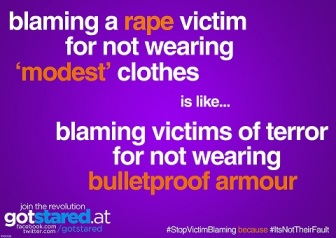
Blaming victims of false allegations made on restraining orders IS “blaming victims of terror for not wearing bulletproof armour,” and why false allegations on restraining orders are so effective (and devastating) is because of the basic message of posters like this: When victimhood is asserted, it’s not to be questioned.

The perceptual blind that preserves these crimes from being exposed and redressed is the “unspoken, politically correct rule that the role of the victim…is NOT to be explored” acknowledged by Dr. Ofer Zur in “Rethinking ‘Don’t Blame the Victim’: The Psychology of Victimhood.” The presiding prejudice that procurers of restraining orders are victims not only enables false accusers to commit theft and abuse on a grand scale (in cases effacing the lives of their male and female victims entirely); it enables them to do so with authorization and impunity, and on top of it all to be rewarded with sympathy. This is victim-blaming with a megaphone.

Victims—victims—may be incarcerated (locked in cages) and serially persecuted (in cases, for years) after having been tossed in the street and having had everything they owned and cared about taken from them. A survey of the accounts on the e-petition “Stop False Allegations of Domestic Violence” will make the horror plain to any reader with a soul (or even just an ounce of honesty).

Denial of this horror by agents of the abuse industry underscores that rights advocacy has become corrupted by dogma, politics, and cash. If it was ever truly about justice, any claim that its mainstream manifestations still are is beyond disingenuous. It’s criminal.

Copyright © 2014 RestrainingOrderAbuse.com
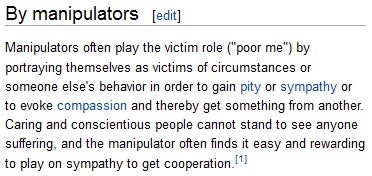
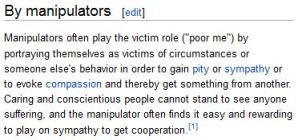
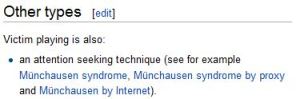
Victim-Playing and Restraining Order Fraud

“Victim playing (also known as playing the victim or self-victimization) is the fabrication of victimhood for a variety of reasons such as to justify abuse of others, to manipulate others, a coping strategy, or attention seeking.”

—Wikipedia, “Victim playing

Once again I’m prompted to note that Wikipedia is all over motives for restraining order abuse but squeamishly avoids confronting the subject directly.

Restraining orders cater to and reward victim-playing like nothing else, because hyped or fabricated allegations made to judges aren’t subject to scrutiny or contradiction by anyone who knows the plaintiff (accuser) or defendant (accused). Procurement of a restraining order authorizes a victim-player (whether a bully, manipulator, or attention-seeker) to concoct any story s/he wants for third parties, including colleagues/coworkers, friends, and family. To the fraudster, it’s a golden ticket.

Allegations made on restraining orders are answerable to no standard of proof, are ruled on in the absence of any controverting evidence or testimony from the accused, and are made at no risk to a victim-player and at no cost beyond a few minutes of his or her time. Because lying to obtain a restraining order is child’s play for an unscrupulous accuser, and because this fact is known only to those who are lied about, a victim-player’s audience is easily convinced of his or her falsehoods, which may be extravagant. Gulled employers, for instance, may be induced to institute special security protocols to “protect” a victim-player from his or her victim. S/he doesn’t even have to be a particularly good actor. A restraining order sells itself.

In “Rethinking ‘Don’t Blame the Victim’: The Psychology of Victimhood,” psychologist Ofer Zur observes, “The victim stance is a powerful one. The victim is always morally right, neither responsible nor accountable, and forever entitled to sympathy.” The appeal, whether to a bully or attention-seeker (or attention-seeking bully), is transparent.

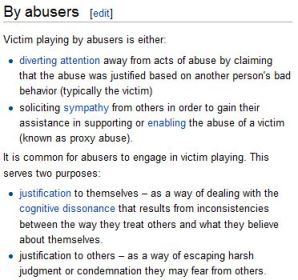
Excellent explications of victim-playing to “justify abuse of others” are presented by psychologist Tara Palmatier in her “Presto, Change-o, DARVO: Deny, Attack, and Reverse Victim and Offender” and “To the Victim Go the Spoils: False Allegations, Men as Default Scapegoats, and Why Some Women Get Away with Murder.”

Vis-à-vis victim-playing as a means of manipulation or as a coping strategy, this diagnosis by Dr. Palmatier is revealing: “People who abuse others maintain their power by keeping the truth of what they do secret. When you speak the truth, they begin to lose power and control. That’s what abusive personality types are after—power and control over you.” Restraining orders are unparalleled as tools for reengineering truth and dominating and silencing resistant victims. In fact, they may be the most effective instruments of coercion and revenge we’ve come up with yet. “Emotional abuse and bullying behaviors,” Dr. Palmatier elucidates, “are typical of those who have Borderline, Narcissistic, and/or Antisocial personality traits,” and victims of restraining order fraud by victim-players are urged to investigate the traits of the personality-disordered for correspondence with their own abusers and clues to their psychological motives.

The ambition of this post isn’t to say anything new but to connect a(nother) recognized human behavior to an unrecognized and commonly exploited method of abuse: restraining order fraud. As Dr. Zur observes, there’s an “unspoken, politically correct rule [in our culture] that the role of the victim…is NOT to be explored.” In other words—following the unexamined mantra, “Don’t blame the victim”—we’re not supposed to question “victimhood”; we’re supposed to sympathize and direct opprobrium toward the “offender.” The irony, of course, is that when victimhood is shammed, the actual victim is the mislabeled “offender.” And the unwillingness of society to acknowledge the sham is the agent of the victimization. Lies don’t victimize so much as our eagerness to credit them does. Victims of false allegations are victims of the state, not victims of liars. When restraining orders are abused, victims of that abuse may be stripped of home, children, property, career/livelihood, and (consequently) identity. And the beneficiaries of these losses, which are ones that may never be recovered from, are the victim-players. The “unspoken, politically correct rule” that Dr. Zur remarks not only rewards fraud and rapine; it ensures fraudsters are treated as objects of pity.

Copyright © 2014 RestrainingOrderAbuse.com
Restraining Orders and the Culture of Victimhood

It’s been posited, and I believe this is true, that women who are genuinely in fear only obtain restraining orders in dire extremity. Ironically, who posits this are deniers of high rates of false allegations.

If they’re right about the reluctance of abused women to seek intervention—and as I’ve said, I believe they are—what accounts for the fact that millions of restraining orders are obtained each year?

The obvious answer is that the majority of them are sought by people (predominately women but also men) who aren’t sincerely afraid for their safety at all.

Put another way, the woman who knows she has legitimate cause to fear for her safety (or her life and/or the lives of her children) may think twice, or many more times than that, before taking a step that she realizes could turn a bad situation into a much worse one. The paradigmatic female victim of domestic violence, for example, is often emotionally conflicted and cowed into submission, and it requires the summoning of a heroic burst of will to act in defiance of her abuser. By contrast, the woman who knows she has nothing to fear may not think at all before running to a judge, because she has no (real) concern for consequence.

Appreciating this, consider which of the two is going to more commonly be a restraining order applicant.

Right, the faker (opportunist, easy-outer, buck-passer, hysteric, bully, vengeance- or attention-seeker, crank, sociopath, neurotic, disordered personality, etc.).

Having read many accounts of male victims of domestic violence, what’s more, who to a man have taken the abuse sooner than applied to authorities or the courts for relief (or who’ve done so only to be treated with open disdain), I would venture to say that as with women, most men who apply for restraining orders have motives ulterior to “fear.”

They hype the extremity of their apprehension if not outright lie.

No one who hasn’t had firsthand experience with lies told to judges would believe how complacent the court is toward fraud. It’s embarrassing in fact to see how excited a judge may get when a witness is clearly and straightforwardly telling (admitting) the truth—as long, that is, as the truth s/he’s telling doesn’t conflict with how the judge wants to perceive the case. That judge may become positively giddy.

Contrariwise, judicial contempt toward inconvenient truths may be scalding, while obvious lies that jibe with the story the judge prefers may be slyly ignored and are never censured, let alone sanctioned.

It’s a game. More horrifying yet is that fraudsters will evince surprise if things don’t go entirely their way. Just as the child today who shouts “F* you!” in a public library and defies an adult to do anything about it knows he’s untouchable, so too do his degenerate adult counterparts know our basic moral formulas have been reversed in recent decades.

Witness the moral anomie exemplified by the coincidental ascendency of (“fair and balanced”) tabloid news channels. Impression has eclipsed fact as a critical standard. It’s okay to believe something because it suits us to.

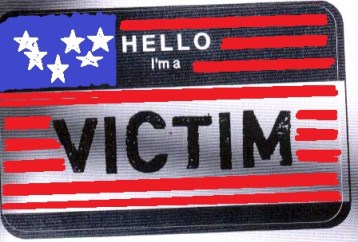
It suits us, for instance, to exalt ourselves as “America the Brave” despite the fact that the approval of millions of restraining orders each year plainly signifies we’re a nation of victims.

Copyright © 2014 RestrainingOrderAbuse.com