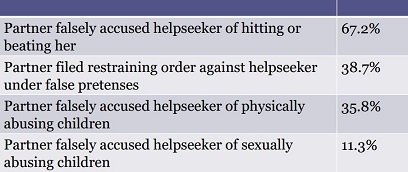
Victims Are Important, but They’re Not More Important than Anyone Else: Amending Priorities and Reconceiving Restraining Order Policy According to the Principle of Equality

“While some municipal court judges acknowledge that the domestic violence law can create injustices—one calls it ‘probably the most abused piece of legislation that comes to my mind’—there are counterpoints. Melanie Griffin, executive director of the Commission to Study Sex Discrimination in the Statutes, a legislative commission that drafted much of the 1991 law, says that for every individual who files a false report, ‘there are 100 women who don’t come in at all and stay there and get beaten.’”

—“N.J. Judges Told to Ignore Rights in Abuse TROs

This quotation comes from a nearly 20-year-old journalistic exposé, yet you’ll find the same starkly meretricious apology for restraining order abuse routinely voiced today.

This quotation from the proposed Equal Rights Amendment (ERA) means that all people should be treated equally under the law, not that women should be privileged. Anyone who’s for women’s being afforded special treatment by the authorities and the courts, as proponents of the Violence Against Women Act (VAWA) are, opposes the ERA.

This quotation from the proposed Equal Rights Amendment (ERA) means that all people should be treated equally under the law, not that women should be privileged. Anyone who’s for women’s being afforded special treatment by the authorities and the courts opposes the message of the ERA, as do proponents of the Violence Against Women Act (VAWA).

The argument, basically, is that it doesn’t matter if restraining order defendants’ rights are ignored, and it doesn’t matter if defendants are falsely accused, because there are many more victims of abuse who suffer in silence than there are false accusers.

The argument equates apples with orangutans. Its reasoning is partisan and purely emotion-based—and betrays ignorance of the fact that women, too, are falsely accused of domestic violence. Its thesis is that since there may be multitudes of unacknowledged victims of domestic violence, the state’s creating victims by abetting false prosecutions is of no statistical significance.

While everyone should feel for women who are “beaten” at home, no one should be forced by the state to endure “sympathy pains.” The falsely accused man or woman whose life is upturned or undone by hyped allegations or gross lies credited by careless judges is absolutely blameless for the suffering of strangers.

Life, liberty, and the pursuit of happiness are inalienable rights guaranteed to all citizens under the Constitution, and equality and fair treatment under the law are among its mandates that brook no compromise. Denying the latter to anyone, ever—even if the motive is a sympathetic one—is categorically wrong.

The statement in the epigraph says: It’s okay if you, Mr. or Ms. Doe, are falsely accused and battered by the system, and it’s okay if it deprives you of your kids and home and livelihood and dignity and sanity, because some people you don’t know and never will know are reportedly “beaten” by some other people you don’t know and never will know.

It says there are women who suffer unjustly, so never mind if we make you suffer unjustly, too.

Copyright © 2014 RestrainingOrderAbuse.com

“N.J. Judges Told to Ignore Rights in Abuse TROs”: A Retrospective Look at Vicious Restraining Order Policies 20 Years Later

Among the challenges of exposing crookedness in the adjudication of restraining orders is credibility. Power rules, and the people who’ve been abused typically have none. Their plaints are discounted or dismissed.

Influential and creditworthy commentators have denounced restraining order injustice, including systemic judicial misconduct, and they’ve in fact done it for decades. But they aren’t saying what the politically entitled want to hear, so the odd peep and quibble are easily drowned in the maelstrom.

Below is a exquisite journalistic exposé that I can’t simply provide a link to because the nearly 20-year-old reportage is only preserved on the Internet by proxy hosts (for example, here).

The article, “N.J. Judges Told to Ignore Rights in Abuse TROs,” is by Russ Bleemer and was published in the April 24, 1995 edition of the New Jersey Law Journal.

New Jersey attorneys corroborate that the rigid policy it scrutinizes still obtains today. What’s more, the general prescriptions of the New Jersey training judge on whom the articles focuses arguably inform restraining order policy nationwide. The only things dated about the article are (1) judges’ being “trained on the issue of domestic violence” is no longer “unique” to New Jersey but is contractually mandated everywhere in return for courts’ receiving hefty federal grants under the Violence Against Women Act (VAWA), which grants average out at over $500,000 per; and (2) the resultant policy now injures not only men who are fingered as abusers in five-minute procedures that are often merely perfunctory.

According to the same complacently biased “standards,” it also trashes the lives of accused women, who are not infrequently prosecuted by other women (including their mothers, daughters, and sisters).

______________



Text of “N.J. Judges Told to Ignore Rights in Abuse TROs” by Russ Bleemer (Copyright © 1995 American Lawyer Newspapers Group, Inc.):

On Friday, at a training session at the Hughes Justice Complex in Trenton, novitiate municipal judged were given the “scared straight” version of dealing with requests for temporary restraining orders in domestic violence cases.

The recommendation: Issue the order, or else.

Failing to issue temporary restraining orders in domestic violence cases, the judges are told, will turn them into fodder for headlines.

They’re also instructed not to worry about the constitution.

The state law carries a strong presumption in favor of granting emergency TROs for alleged domestic violence victims, the new judges were told at the seminar run by the Administrative Office of the Courts. Public sentiment, mostly due to the O.J. Simpson case, runs even stronger.
The judges’ training is rife with hyperbole apparently designed to shock the newcomers. It sets down a rigid procedure, one that the trainers say is the judges’ only choice under a tough 1991 domestic violence law and its decade-old predecessor.

Since the Legislature has made domestic violence a top priority, municipal court judges are instructed that they can do their part by issuing temporary restraining orders pronto.

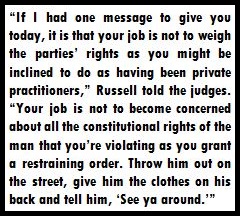
“Throw him out on the street,” said trainer and municipal court judge Richard Russell at a similar seminar a year ago, “give him the clothes on his back, and tell him, ‘See ya around.’”

This napalm approach to implementing the domestic violence statute has some state judges talking. No one disputes the presumption in the law of granting a TRO, and there have been no serious court challenges to the statute’s ex parte provisions.

The strident teaching, however, doesn’t always sit well with some judges, even those who characterize the instruction as deliberate verbal flares directed at a worthy goal.

“[It’s] one of the most inflammatory things I have ever heard,” says one municipal court judge, who asked not to be identified, about a presentation held last year. “We’re supposed to have the courage to make the right decisions, not do what is ‘safe.’”

At the same time, even former and current municipal and Superior Court judges who are critical of the seminar have words of admiration for the candor of trainers Russell, Somerset County Superior Court Judge Graham Ross and Nancy Kessler, chief of juvenile and family services for the AOC. One municipal court judge says that while the statements reflect an incorrect approach, “I wouldn’t be real keen to inhibit the trainers at these sessions from exhibiting their honest opinions.”

For their part, Russell and Kessler say they are doing what the law says they should do—protecting victims, which in turn can save lives. Ross didn’t return telephone calls about the training. He, Russell and Kessler were scheduled to conduct Friday’s program for new judges, a program Kessler says the trio has conducted for judges at least five times since the law was passed.
The law, N.J.S.A. 2C:25-17 et seq., requires judges to be trained on the issue of domestic violence, a requirement that women’s rights advocates say is unique. The TRO provisions also were reemphasized three years ago, encouraging the use of such orders after a municipal court judge hears from one complainant.

Under N.J.S.A. 2C:25-28, municipal court judges assigned to cover for their Superior Court counterparts at nights and on weekends and holidays can issue an ex parte TRO, which is subject to a hearing within 10 days in the Superior Court’s family part “when necessary to protect the life, health or well-being of a victim on whose behalf the relief is sought.”

The TRO may prohibit the defendant from returning to the scene of the alleged act, strip the defendant of firearms or weapons, and provide “any other appropriate relief.” The law also says that the emergency relief “shall be granted for good cause shown.”

Dating Relationships Included

The training, however, stresses the Legislature’s urgency in passing the law, which last year was amended again to extend possible domestic violence situations to dating relationships. The trainers encourage the judges to focus on the legislative findings, which, in emphasizing rapid law enforcement response, state “that there are thousands of persons in this State who are regularly beaten, tortured and in some cases even killed by their spouses or cohabitants.”
This, said Kessler at a training session last year, is justification for an approach advocated by Russell: Talk to the complainant, talk to the reporting officer, issue the TRO, and let the family court sort it out later.

On a tape of the April 1994 session obtained by the Law Journal, Kessler told the judges that “in that legislative findings section, people are told to interpret this law broadly in order to maximize protection for the victim. So if anybody ever came back at you and said, ‘Gee, that’s a real reach in terms of probable cause,’ you have a legislatively mandated response which is, ‘I erred on the side of caution for the victim.’”

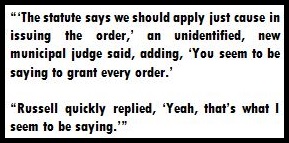
Kessler was reacting to a question that arose during Russell’s presentation. “The statute says we should apply just cause in issuing the order,” an unidentified, new municipal judge said, adding, “You seem to be saying to grant every order.”

Russell quickly replied, “Yeah, that’s what I seem to be saying.”

Russell, a municipal court judge in Ocean City and Woodbine, as well as a partner in Ocean City’s Loveland, Garrett, Russell & Young, answered the question at last year’s seminar after he had spoken for some time on the middle-of-the-night procedures the new judges would have to follow.

At the outset, Russell said that he was on the bench when the original domestic violence act was enacted in 1982 “and that just blew up all of my learning, all my understanding, all my concept of constitutional protections and I had to acclimate myself to a whole new ball game.

“If I had one message to give you today, it is that your job is not to weigh the parties’ rights as you might be inclined to do as having been private practitioners,” Russell told the judges. “Your job is not to become concerned about all the constitutional rights of the man that you’re violating as you grant a restraining order. Throw him out on the street, give him the clothes on his back and tell him, ‘See ya around.’ Your job is to be a wall that is thrown between the two people that are fighting each other and that’s how you can rationalize it. Because that’s what the statute says. The statute says that there is something called domestic violence and it says that it is an evil in our society.”

Not all judges agree with Russell’s approach. Philip Gruccio, a former trial and Appellate Division judge, says that even orders based on ex parte requests require hearings, to a certain extent. “It involves a certain amount of judicial discretion,” he says.

Robert Penza, who retired last year after serving as a family court judge in Morris County for two years, agrees. “I could just never rubber stamp a complaint,” says Penza. “A judge has got to judge.”

Gruccio, who says he is familiar with the work of Russell and Ross on the bench and that both are top notch judges, strongly disagrees with the approach. “My view is that you just can’t say, ‘Forget about the defendant’s rights.’ You can’t say that. It is wrong to say that. It is wrong to train people that constitutional rights aren’t important.”

Gruccio, a professor at Widener University Law School in Wilmington, Del., and director of its judicial administration program, concludes, “I think what has happened is, for emphasis purposes, somebody has lost their way.”

Catering to Popular Objectives

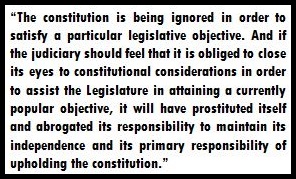
Sitting judges interviewed for this article readily agree with Gruccio. Says one: “The constitution is being ignored in order to satisfy a particular legislative objective. And if the judiciary should feel that it is obliged to close its eyes to constitutional considerations in order to assist the Legislature in attaining a currently popular objective, it will have prostituted itself and abrogated its responsibility to maintain its independence and its primary responsibility of upholding the constitution.”
One municipal court judge who has heard the AOC lecture says, “This is throwing people out of their homes in the middle of the night,” adding, “We have an obligation under our oath of office to be fair, not to be safe.”

A problem that arises by such wholesale approvals of TROs, judges say, is that word spreads, and litigants can try to use them as a club. Kessler couldn’t provide statistics on the number of TROs that are later dismissed by the family court, but she says that the number is “significant.” She adds that more than 58,000 TROs and amended TROs were issued by New Jersey courts last year, with about 60 percent of the complaints originating in municipal courts.

While some municipal court judges acknowledge that the domestic violence law can create injustices—one calls it “probably the most abused piece of legislation that comes to my mind”—there are counterpoints. Melanie Griffin, executive director of the Commission to Study Sex Discrimination in the Statutes, a legislative commission that drafted much of the 1991 law, says that for every individual who files a false report, “there are 100 women who don’t come in at all and stay there and get beaten.”

Judges who have seen the training presentation say that if anyone objects, they keep it to themselves. Russell says that sometimes “those with no background express disbelief, until we explain the intent of the legislation.”

Moreover, Russell says there is nothing wrong with the teaching approach. Abuse victims, he says, may apply and relinquish TROs repeatedly before they finally do something about breaking away. Once they do so, he says, the Legislature’s prevention goal has been met.

Russell continues: “So when you say to me, am I doing something wrong telling these judges they have to ignore the constitutional protections most people have, I don’t think so. The Legislature described the problem and how to address it, [and] I am doing my job properly by teaching other judges to follow the legislative mandate.”

Russell disputes that the TRO training removes judicial discretion where it is needed. On the tape, Russell and Kessler emphasize that first, the judge must decide whether the domestic violence statute grants jurisdiction over the complainant and the defendant. Russell said last week that he was updating Friday’s lecture to include the 1994 expansion of the domestic violence statute to situations in which the complainant was dating the accused or alleges that the accused is a stalker. The judge also has to speak to the party or review the written material and make a decision whether to proceed. “The judge has to be guided by instinct,” Russell explains, before he or she can go ahead with the TRO.

Says one municipal court judge who also has conducted training and asked not to be named: “I would say, ‘If there is any doubt in your mind about want to do, you should issue the restraining order.’” The judge adds, “I would never approach the topic by saying, ‘Look, these people are stripped of their constitutional rights.’”

Making Headlines

Much of the seminar’s rhetoric alludes to actions that keep the judges out of the headlines, which are mentioned in the taped seminar repeatedly. Near the beginning of his presentation, Judge Graham Ross, reacting to Russell, says that dealing with domestic violence “is not something that we can take a shortcut on. Forgetting about reading your name in the paper—and that certainly is very troubling, I don’t want to read my name—but that’s really secondary.

“The bottom line is we’re trying to protect the victim,” Ross continues. “We don’t want the victim hurt. We don’t want the victim killed. So yes, you don’t want your name in the paper, but you’d feel worse than that if the victim was dead. So yeah, your name will be in the paper…if you’ve done something wrong. And I’ve said that to my municipal court judges. If you don’t follow the law after I told you what to do, I will guarantee that you will be headlines. That’s not a threat. That’s an absolute promise on my part. This is serious stuff.”

The AOC’s Kessler says the media references are a training technique, and judges aren’t influenced by public opinion polls. The focus, she says, follows the statute’s emphasis on protecting victims by dealing with the dynamics of domestic violence and the importance of intervention. “When there is a discussion about headlines,” she says, “it tends to be more in recognition of what they already are aware of and concerned about.”
One former judge agrees that judges don’t work wearing blinders, but says that if worries about bad publicity affect their work, “it defrauds the system.” A current municipal court judge who has been through the training on domestic violence says, “We have to stand back from the hysteria and the newspapers and all and do what’s right.”

But most others disagreed. The “approach isn’t bad because it’s got a shock value,” says retired judge Robert Penza.

A current municipal court judge liked the realism of the media references. “A newspaper headline can be death to a municipal court judge’s career,” says the long-time jurist, “and the prospect of an unfavorable newspaper headline is a frightening one.” The judge added, however, that attention-getting devices must not be confused with legal principles.

And the judge paid the overall approach a backhanded compliment frequently repeated in some form among the former and current judges contacted for this article. Referring to Russell, the judge declared: “What he said is valuable because he is expressing the state of affairs. He should be commended for his candor, although I must say I find his viewpoint to be anathema.”

Copyright © 2014 RestrainingOrderAbuse.com

How Men Lie on Restraining Orders: A Tutorial for Feminists

The topic of this discussion is vicious men—not real men but the kind who’d make false allegations against a woman and ruin her for self-gratification or -gain.

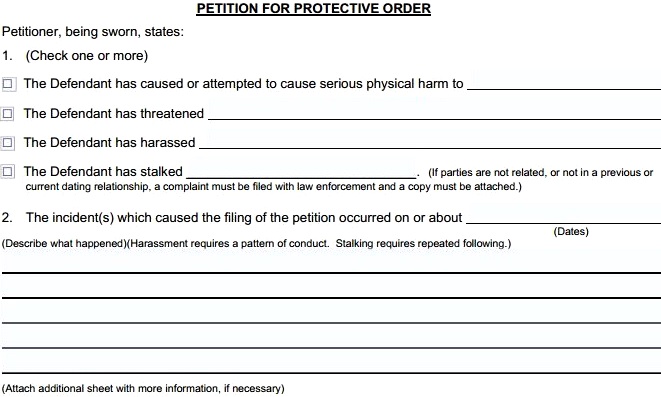
Below is an excerpt from a standard restraining order form. Apply your imagination and consider how a man might exploit the opportunity it affords to trash a woman’s life. I’ll guide you. See the tick boxes and blanks? What he’d do is flick the cap off his Bic and write lies in the spaces provided. It only takes a few minutes.

A false complainant might allege, for example, that his girlfriend stalked him, coerced him into having sex, threatened to kill him, beat his daughter or made her smoke crack, etc. His motive might be revenge, or his motive might be to deflect blame from himself for actually engaging in the same or worse activities. Restraining order petitioners may be the real offenders, and the courts graciously provide them with the chance to compound their victims’ torment and walk away scot free. The first one up the courthouse steps is the “good guy.”

Besides a pen and a few minutes to kill, the only requisite for upending a woman’s life this way is a malicious will. For men to apply for false restraining orders against women is usually free (that is, the cost is covered by the taxpayer), as the Violence Against Women Act (VAWA) mandates it be.

All there is to making allegations on restraining orders is tick boxes and blanks, and there are no bounds imposed upon what allegations can be made. A false applicant merely writes whatever he wants in the spaces provided—and he can use additional pages if he’s feeling inspired. The basis for a woman’s being alleged to be a domestic abuser or even “armed and dangerous” is the unsubstantiated say-so of the petitioner. Can the defendant be a vegetarian single mom or an arthritic, 80-year-old great-grandmother? Sure. The judge who rules on the application won’t have met her and may never even learn what she looks like. She’s just a name.

The worst that happens is a fraudulently accused woman appears for a hearing after a week or two of sleepless nights (possibly spent living out of her car) and manages to persuade a judge that she’s not a stalker, child-beater, or whatever. Although even this won’t ensure the judge finds in her favor and dismisses the order, let’s say the judge does dismiss the order.

The false accuser is subject to no sanctions from the court and is at no risk of prosecution from the state, and it isn’t guaranteed that the dismissed restraining order will be expunged from the woman’s public record, which may be the public record of a kindergarten teacher, a therapist, or a police officer (even dismissed orders are stigmatizing and cost people jobs).

The man’s just out a little time and may still have cause to smirk.

And, anyway, he can always file for another restraining order later on. There’s no statutory ceiling on how many times he’s authorized by the state to do this. The sky’s the limit. He could even reapply for multiple restraining orders from different jurisdictions to up the fun.

High-conflict litigants can consume years of their targets’ lives like this. Between rounds of false allegations, their targets may languish in a personal hell, unable to reconcile themselves to betrayals and lies, unable to work in chosen professions because unable to rinse those lies from their public faces, and never knowing what to expect next or when. Whatever familial and social infrastructures depend on them may obviously crumble, besides.

How men lie on restraining orders and make wrecks of women’s lives—and how easily—should be clearer now.

How women lie on restraining orders and make wrecks of men’s and other women’s lives is exactly the same way.

Copyright © 2014 RestrainingOrderAbuse.com
How VAWA Has Turned Our Courts into Restraining Order Vending Machines

Under the Violence Against Women Act (VAWA), our courts and police districts are awarded hefty federal grants (averaging $500,000) in return for having their officers (judges and cops) “educated” about how to respond to allegations of fear or violence.

Allegations made pursuant to the procurement of a restraining order, per the terms of these grants, aren’t to be questioned.

It’s a little known fact that qualification training for police officers is about a quarter of that required for certification to cut hair. It’s bad enough, then, that cops are licensed to act on impulse. Far worse is that judges are licensed to do so.

That’s because the belief that judges base rulings on facts is mistaken. Judges avoid this whenever possible. If principles of law (rules) authorize officers of the court to dodge making “judgment calls,” they will be dodged. Typically what a “just” ruling means is a ruling that can be justified according to the rules.

To give an example, imagine a bewildered restraining order defendant who’s been falsely accused. If s/he misses or blows his or her opportunity to defend, “claim preclusion” rules forbid him or her from having the case heard or reheard later. The facts don’t matter. The court is authorized to ignore them—and it will.

Remedial legislation has been proposed, such as Oregon House Bill 2966 (“Allows respondent against whom restraining order has been issued to request withdrawal of order based on false allegations of abuse”):

At any time after a restraining order has been issued under ORS 107.095 (1)(c) or (d), 107.716 or 107.718, and after the restraining order has been entered into the Law Enforcement Data System maintained by the Department of State Police and into the databases of the National Crime Information Center of the United States Department of Justice as required under ORS 107.720, and into any other manual or computerized database maintained by the Department of State Police for purposes of tracking restraining orders issued under ORS 107.095 (1)(c) or (d), 107.716 or 107.718, the respondent may request that the court withdraw the order on the grounds that the petition and order were based upon false allegations of abuse. The request may be made at a hearing requested under ORS 107.718 (10) or by a separate motion filed with the court by the respondent.

But as things stand, if false allegations are put over on the court, they’re put over for good.

Judicial process proceeds from rules first and facts second. Our entire system of law is based upon the principle of stare decisis, which says that what has previously been decided must be adhered to.

A restraining order, which is issued without a defendant’s even knowing about it and based on a few-minute interview between a judge and plaintiff, already represents a preliminary decision. If, on top of this influential fact, the rule impressed upon judges is that allegations aren’t to be questioned, then “decisions” to confirm restraining orders aren’t really decisions at all.

Copyright © 2014 RestrainingOrderAbuse.com

Victim-Blaming: The “Patriarchal Paradigm,” Discrimination against Male Victims of Domestic Violence, the Frequency of False Allegations, and Abuses of Men and Women by Restraining Order Fraud

“Accounting for the discrepancy between the empirical data and current public policy has been the gender paradigm (Dutton and Nicholls 2005), also known as the patriarchal paradigm (Hamel 2007b), a set of assumptions and beliefs about domestic violence that has shaped domestic violence policy on arrest, treatment, and victim services at all levels for the past several decades. A product of feminist sociopolitical theory, the paradigm posits that the causes of domestic violence can be found in patriarchy and male dominance…. Despite data that are inconsistent with the feminist perspective…it remains a dominant influence….”

Journal of Family Violence (2009)

In a recent post, I wrote about false allegations of domestic violence and quoted a male victim who was arrested when he reported to police that he was being assaulted. The ensuing ordeal cost him his “career, [his] name, and three years of income” before the police department copped to wrongdoing and settled with him out of court.

DV1Deplorably, this is what comes of asking for help from a system that’s been conditioned to perceive men as stalkers, batterers, and rapists (despite the fact that best population-based studies reveal as many as half of victims of partner violence are men).

According to findings by Dr. Denise Hines, more than a quarter of male victims of domestic violence who call the police are themselves arrested as a result (26%). Half of the time, responding police officers do nothing, and in less than one in five cases (17%) is a reported female abuser arrested.

Imagine the outrage of the National Organization of Women if half the women who reported being battered were blown off by authorities, or if one in every four women who reported being battered was herself arrested and prosecuted for assault.

This isn’t to say, of course, that the “patriarchal paradigm” promoted by feminist advocates and the Violence against Women Act (VAWA) doesn’t also brutally injure women.

Alternative to filing criminal complaints is the filing of civil protection orders—and this knife cuts both ways. Diminished standards of verification applied to allegations made in connection with restraining orders ensure that women, too, are abused by the state according to false allegations leveled against them by conniving men. The frequency of female victimization by men is lesser; the damages of that victimization are not.

Returning to the journal article quoted in the epigraph (Muller, Desmarais, and Hamel), consider:

Every state in the United States now authorizes its courts to issue civil orders of protection against domestic violence. Typically, a temporary domestic violence restraining order (TRO) is issued ex parte at the request of any plaintiff who expresses an “objectively reasonable subjective fear of being injured” (Miller 2005, p. 74), without the respondent (i.e., the alleged perpetrator) having to be present in court. TROs are granted for two- to four-week periods, at which point a hearing is held to determine if a permanent order is warranted, valid in most states for a period of one to four years. In California, as of June 6, 2003, there were 227,941 active restraining orders (including temporary and permanent) issued against adults, almost all of them for domestic violence. Of the domestic violence orders, approximately 72% restrained a man from a protected woman, 19% restrained a same-sex partner, and 9% restrained a woman from a protected man (Sorenson and Shen 2005). Of particular significance to family court cases, the protected parent almost automatically obtains custody of the children, without a custody hearing or a custody decision being made (Kanuha and Ross 2004; Sorenson and Shen 2005).

Various motives for lying to the court are both obvious and confirmed.

“Many TROs and POs [protection orders],” concludes a Hawaiian task force on restraining orders, “are obtained by one party to a dispute to try to gain advantage over another party in future or ongoing divorce proceedings or a custody dispute” (Murdoch 2005, p. 17). In California, the Family Law section of the state bar expressed concern that domestic violence restraining orders “are increasingly being used in family law cases to help one side jockey for an advantage in child custody and/or property litigation and in cases involving the right to receive spousal support” (Robe and Ross 2005, p. 26). A retired Massachusetts judge revealed to the press that, in his experience, one-third of restraining orders are strategic ploys used for leverage in divorce cases (“Retiring Judge” 2001). Attorneys Sheara Friend and Dorothy Wright, the latter also a former board member of a battered women’s shelter, estimate that 40 to 50% of restraining orders are used to manipulate the system (Young 1999). In some cases, mothers secure custody despite a history of abuse against the father or the children (Cook 1997; Pearson 1997).

As I prefaced these quotations by remarking, they shouldn’t be interpreted to mean that men don’t also lie to inculpate women (who may be the actual victims of domestic violence), because they do, as the study these quotations are drawn from suggests. The rate of false allegations between the sexes may in fact be equivalent (and as high as 50%).

The difference is that women far more often make allegations (and thus false allegations) against men than vice-versa.

Absent from all analytic studies and contemplations is the toll of false allegations and victim-blaming on those devastated by them, which can’t be quantified.

Copyright © 2014 RestrainingOrderAbuse.com
No False Motives: On WHY Judges Refuse to Acknowledge Restraining Order Fraud

In the last post, I stressed that the courts refuse to acknowledge false allegations made by restraining order plaintiffs as lies, perjury, or fraud. It’s unlikely courts will call them “true.” Rather they’ll just accept them as given.

This shouldn’t be too surprising considering that the legitimacy and worthiness of the restraining order process is itself unquestioned. Why? Because it’s favored by the feminist establishment, which has gained so much political sway in recent decades that society, particularly its liberal constituency, is inclined to feel that what feminists want is what women want, and what women want is what everyone should want. Even women may not question whether what feminists want is what’s in their best interests. Restraining orders are promoted as positive and empowering for women. Also, they’re there to bring bad guys to bay and advance the causes of peace, justice, and the American way. So what possible grounds could exist for criticizing them? No harm, no foul, right?

The answer to these questions is of course known to (besides men) any number of women who’ve been victimized by the restraining order process. They’re not politicians, though. Or members of the ivory-tower club that determines the course of what we call mainstream feminism. They’re just the people who actually know what they’re talking about, because they’ve been broken by the state like butterflies pinned to a board and slowly vivisected with a nickel by a sadistic child.

And the value of their lives is deemed negligible. They’re what feminist jihadists would likely refer to as casualties of war.

The perpetuation of the restraining order process and the preservation of its appearance of propriety is the product of prejudice and perception mutually reinforcing each other. Public perception is that restraining orders are “good,” because they answer a social need. Judicial perception of restraining order applicants’ motives is accordingly prejudiced by pressures both political and social. If that weren’t enough, it’s also programmed. Courts receive massive federal grants under the Violence Against Women Act (VAWA) in return for having their judges submit to indoctrination.

Thus judges not only ignore whether allegations made on restraining orders are false; they may well assume the position that restraining orders are never sought maliciously (or frivolously).

They do what people expect of them, what the state wants of them, and what accordingly feels righteous and noble. That it’s also in their professional interests is a bonus (as is the possible gratification they derive from making “miscreants” cavil and quail). All of these motives are wrong and are furthermore contrary to judicial ethics (due process, Constitutional privilege, social justice, etc.), but the only people who care about principle are this travesty’s sacrificial lambs.

And they’re mostly silent.

Copyright © 2013 RestrainingOrderAbuse.com

“Breaking the Glasses”: One Blog Writer’s Metaphor for Exposing Restraining Order Abuse

A highly intelligent and sensitive woman I’ve been in correspondence with in recent months, one who’s been put through the legal crucible and left badly scalded by it, remarked to me that despite what may be their best intentions, a lot of those on the Internet who protest abuses committed through the courts and by the courts sound like nut jobs. I’m personally in awe of anyone who’s weathered court travails and emerged even reasonably sane. I’m not sure I qualify myself. But I take her point.

That’s why I’m particularly impressed when I encounter writers whose literary protests are not only controlled but very lucid and balanced. One such writer maintains a blog titled Breaking the Glasses, and anyone with a stake in the issues this blog concerns may appreciate a female writer’s perspective on them. See her posts on “Restraining Order Abuse and Vexatious Litigation.” She really gets it. Her section on “Mantrapment” (marvelous for its title alone) is dead on in its analyses, and she does a stellar job breaking down how the restraining order game works by the sedimentary accretion of lies.

Here’s an excerpt from an article of this writer’s that chronicles one man’s “Seven years in hell” (published on AVoiceforMen.com). It summarizes the horrors of restraining order injustice and may resonate with the experiences of visitors to this blog:

“After these first accusations failed to get Amy what she wanted, she changed tactics. She would go to the county courthouse first, using false claims of stalking and assault to obtain another emergency Civil Protection Order. A hearing would be set for a date within 30 days to determine whether the order was merited. This hearing would carry two possibilities: either the order would be dropped, or it would be upheld. If the order was dropped, the charge of violating it would also be dropped. If upheld, it would be in effect for 5 years, and Rodger would face limitations and penalties, including the permanent loss of his legal right to keep and bear arms. Any contact he had with Amy after that, even if it was accidental, could result in his being sent to jail.

“After requesting the order, Amy would wait until she was informed that the order had been served, and within a day or two, she would accuse Rodger of violating it. Each time, officers would arrive at Rodger’s home and take him into custody without reading him his rights. They informed him that they could do this because he was not under arrest – merely ‘going in for questioning.’

“However, despite not being under arrest, he would be transported to the station in handcuffs, riding in the back of a cruiser rather than on his own. Officers would place him in a holding cell before and after questioning him. He would be held for hours. The department would not release him without bail. Officers told Rodger’s family that they were permitted to do all of this under a combination of the Patriot Act and the Violence Against Women Act, explaining that the Patriot Act allows police to detain citizens suspected of domestic terrorism, and VAWA treats domestic abuse as a form of terrorism. However, VAWA does not treat domestic abuse as a form of ‘domestic terrorism’ as described in the Patriot Act. That assertion was an incorrect interpretation of the two laws, one which is being fed to local departments by the advocacy group from which Amy was receiving assistance, but the fact that it’s incorrect has not stopped local police departments from acting on the advocacy group’s advice when detaining area men accused of domestic violence.”

It digests much of what’s most defective and destructive about the restraining order process and underscores how easily and extremely this process can be abused.

Besides this writer’s blog, I want to direct interested parties to Restraining Order Blog, maintained by Chris Tucker, whose own treatments are reasoned and conscientious. Many detailed and revealing firsthand accounts of restraining order abuse can be found here.

It’s said that knowledge is power. This isn’t particularly true when applied to the state legal apparatus, because all the know-how in the world can fall victim to base lies. In the legal arena, the only sure power is political pull (which usually equates to money). And the only virtue in knowing this is knowing to steer clear of the legal arena. There is much to be said for speaking truth to power, however, because information is influential. And the tides of change will only be roused by that information’s spreading.

And this finally is contingent upon those in the know feeling secure enough to pronounce what they know. This is how the power of knowledge is realized. Fortune doesn’t in fact always favor the brave, but in the fullness of time it may dependably respond to their summons.

Copyright © 2013 RestrainingOrderAbuse.com

Rape and Restraining Order Fraud: On How Men Betray Women, How Women Betray Men, and How the Courts and the Feminist Establishment Betray Them Both

I had an exceptional encounter with an exceptional woman this week who was raped as a child (by a child) and later violently raped as a young adult, and whose assailants were never held accountable for their actions. It’s her firm conviction—and one supported by her own experiences and those of women she’s counseled—that allegations of rape and violence in criminal court can too easily be dismissed when, for example, a woman has voluntarily entered a man’s living quarters and an expectation of consent to intercourse has been aroused.

Her perception of judicial bias against criminal plaintiffs is one shared by many and not without cause.

By contrast, I’ve heard from hundreds of people (of both genders) who’ve been violated by false accusers in civil court and who know that frauds are readily and indifferently accepted by judges. (Correspondingly, more than one female victim of civil restraining order abuse has characterized her treatment in court and by the courts as “rape.”)

Their perception of judicial bias against civil defendants is equally validated.

Lapses by the courts have piqued the outrage of victims of both genders against the opposite gender, because most victims of rape are female, and most victims of false allegations are male.

The failures of the court in the prosecution of crimes against women, which arouse feminist ire like nothing else, are largely responsible for the potency of restraining order laws, which are the product of dogged feminist politicking, and which are easily abused to do malice (or psychological “rape”).

In ruminating on sexual politics and the justice system, I’m inexorably reminded of the title of a book by psychologist R. D. Laing that I read years ago: Knots.

In the first title I conceived for this piece, I used the phrase “can’t see eye to eye.” The fact is these issues are so incendiary and prejudicial that no one can see clearly period. Everyone just sees red.

Under the Violence Against Women Act (VAWA), federal funds are doled out to police precincts and courts in the form of grants purportedly intended to educate police officers and judges and sensitize them to violations against women, which may have the positive effect of ensuring that more female victims of violent crimes see justice but simultaneously ensures that standards applied to the issuance of civil restraining orders slacken still further, allowing casual abuse of a free process to run rampant and destroy lives. The victim toll of false restraining orders negates strides made toward achieving justice for female victims in criminal prosecutions. What is more, though restraining orders are four times more often applied for by women than men, making women their predominant abusers, the laxity of restraining order administration allows women to be violated by men, too.

Not only was a woman I’ve recently been in correspondence with repeatedly assaulted by her short-term boyfriend, a charming and very cunning guy; he also succeeded in petitioning a false restraining order against her, alleging, among other things, violence. She had even applied for a restraining order against him first, which was dismissed:

There are no words for how I felt as I walked to my car that afternoon. To experience someone I had cared deeply about lying viciously in open court, to have a lawyer infer that I’m a liar, and to be told by a judge that, basically, he didn’t believe me (i.e., again, that I’m a liar), filled me with a despair so intense that I could hardly live with it. You know how, in trauma medicine, doctors will sometimes put grossly brain-injured patients into medically-induced comas so as to facilitate healing? That afternoon, I needed and longed for a medically-induced emotional coma to keep my skull from popping off the top of my head. I don’t know how else to describe it. It was that day that I learned that the justice system is rotten, that the truth doesn’t mean shit, and that to the most depraved liar go the spoils.

As many people who’ve responded to this blog have been, this woman was used and abused then publicly condemned and humiliated to compound the torment. She’s shelled out thousands in legal fees, lost a job, is in therapy to try to maintain her sanity, and is due back in court next week. And she has three kids who depend on her.


The perception that consequences of civil frauds are no big deal is wrong and makes possible the kind of scenario illustrated by this woman’s case: the agony and injury of physical assault being exacerbated by the agony and injury of public shame and humiliation, a psychological assault abetted and intensified by the justice system itself.

The consequences of the haywire circumstance under discussion are that victims multiply, and bureaucrats and those who feed at the bureaucratic trough (or on what spills over the side) thrive. The more victims there are and the more people there are who can be represented as victims, the busier and more prosperous grow courts, the police, attorneys, advocacy groups, therapists, etc.

What’s glaringly absent in all of this is oversight and accountability. Expecting diligence and rigor from any government apparatus is a pipedream. So is expecting people to be honest when they have everything to gain from lying and nothing to lose from getting caught at it, because false allegations to civil courts are never prosecuted.

Expecting that judges will be diligent, rigorous, and fair if failing to do so hazards their job security, and expecting civil plaintiffs to be honest if being caught in a lie means doing a stint in prison for felony perjury—that, at least, is reasonable.

The obstacle is that those who hold political sway object to this change. The feminist establishment, whose concern for women’s welfare is far more dogmatic than conscientious, has a strong handhold and no intention of loosening its grip.

Typically both criminal allegations of assault or rape and civil allegations in restraining order cases (which may be of the same or a similar nature) boil down to he-said-she-said. In criminal cases, the standard of guilt is proof beyond a reasonable doubt, a criterion that may be impossible to establish when one person is saying one thing and the other person another, evidence is uncertain, and there are no witnesses. In civil cases, no proof is necessary. So though feminist outrage is never going to be fully satisfied, for example, with the criminal prosecution of rapists, because some rapists will always get off, feminists can always boast success in the restraining order arena, because the issuance of restraining orders is based on judicial discretion and requires no proof at all; and the courts have been socially, politically, and monetarily influenced to favor female plaintiffs. However thwarted female and feminist interests may be on the criminal front, feminists own the civil front.

And baby hasn’t come a long way only to start checking her rearview mirror for smears on the tarmac now.

Copyright © 2013 RestrainingOrderAbuse.com

Also, Restraining Orders Don’t Work

“Few lives, if any, have been saved, but much harm, and possibly loss of lives, has come from the issuance of restraining orders.”

—Justice Milton Raphaelson (upon his retirement)

There’s no denying that the restraining order is a forceful instrument and a nasty one to be on the receiving end of, especially when the behaviors alleged against you are trumped up. The question is, what good are restraining orders when they’re used legitimately?

Dr. Charles Corry, president of the Equal Justice Foundation, has compiled a horror-show list of examples in support of his thesis that court orders that purport to protect women only exacerbate the male rage they promise to defuse or avert.

In The Gift of Fear, Gavin de Becker cites two government investigations that support Corry’s conclusions: “In a study of 179 stalking cases sponsored by the San Diego District Attorney’s Office, about half of the victims who had sought restraining orders felt their cases were worsened by them. In a study done for the U.S. Department of Justice, researchers concluded that restraining orders were ‘ineffective in stopping physical violence.’” De Becker, whose book was published 16 years ago, offers this perspective: “Lawyers, police, TV newspeople, counselors, psychologists, and even some victims’ advocates recommend restraining orders wholesale. They are a growth industry in this country. We should, perhaps, consider putting them on the New York Stock Exchange, but we should stop telling people that a piece of paper will automatically protect them, because…it may do the opposite.”

How many women who trusted in the protection of restraining orders, I wonder, have been maimed, lamed, scarred, or killed since de Becker’s book was printed?

The restraining order’s advent arose in response to feminist outcry for legislative redress of domestic violence. It has since become a judicial quick fix for any complaint involving an allegation of harassment or even vague apprehension. Its original purpose, one for which it has never adequately served, has been obscured; and the ends to which it’s often wielded today are starkly less sympathetic.

Feminist scholars Camille Paglia, Christina Hoff Sommers, and Daphne Patai have publicly criticized the feminist influence that squelches a reasoned consideration of these issues; and conservative commentator Phyllis Schlafly  has published columns openly deriding the value and validity of restraining orders and the judicial processes from which they originate.

(I was unsurprised to find a page on Wikipedia entitled, “Restraining order abuse,” that had been deleted. The explanation for its removal reads, “No indication that this article…covers a notable and/or neutral topic.” A related article, “Restraining order,” did acknowledge that abuse of restraining orders “is claimed to be widespread.” That verbiage has been redacted. When I began this blog in 2011, it included these stats, also, which have since been edited out: “A 1995 study conducted by the Massachusetts Trial Court that reviewed domestic restraining orders issued in the state found that less than half of the orders involved even an allegation of violence [note that over 15 years have gone by since then]. Similarly a West Virginia study found eight out of 10 orders were unnecessary or false.” Once you could find an eHow article explaining, “How to Avoid Becoming a Victim of Restraining Order Abuse.” Its URL now redirects to “How to Get a Harassment Restraining Order in Chicago.”)

My own contempt for restraining order laws and how they’re applied couldn’t be keener. But I’m also angry for women legitimately at risk. Not only are restraining orders prone to casual abuse—making them a mockery—they don’t answer the problem for which they were enacted.

The dominant political influence in the perpetuation of the status quo in all matters related to restraining order legislation is that exerted by dogmatic feminists (a.k.a. “gender feminists”). And money talks. Feminism’s representatives have received billions in federal funding under the Violence Against Women Act (VAWA). A cynic might propose that the interests of the cause are being protected over the welfare of the victims of restraining orders, male and female.

If vengeance for past injustices and leverage over men are feminists’ intent, then defense of current restraining order policies certainly has a lot to recommend it (just ask any attorney who practices family law). Here’s where honest self-examination of motives by feminists, specifically those of the academic stripe (a.k.a. “The Sorority”), is due.

Feminists should realize, being in the main acutely intelligent women, that sexual discrimination and role reversals—however spitefully gratifying they may be—don’t signify an advance toward gender equality but rather a resignation to its unattainability that parades as social progress. Encouraging women to crouch behind the legs of parental policies, policies both biased and in some cases dangerously or even fatally ineffectual, isn’t encouraging them to stand on their own two feet. Feminist used to mean brassy and independent.

Let’s be clear here: assault is already a crime. The answer to it is a barred cage.

Let’s be honest, too. The common function of restraining orders is tactical terrorism. They don’t empower women; they just diminish men (and feminist and judicial credibility). They’re exploited as expedients—and often for ends ulterior to the ones their petitioners profess.

Turnabout may be fair play, but it’s still just gamesmanship that we’re talking about, not equity. If feminists are sincere when they say they want to be taken seriously, their aim should be nobler than dominance of the sandbox by baseball bat.

You know something’s gone very wrong when the question becomes, who’s battering whom?

Copyright © 2013 RestrainingOrderAbuse.com

Restraining Order Administration and Money, Money, Money, Money, Money

“The restraining order law is perhaps the second most unconstitutional abomination in our legal system, after our so-called child protection (DSS) laws. The restraining order process is designed to allow an order to be issued very easily, and to be appealed, stopped, or vacated only with the utmost difficulty….

“The motives for this law are legion. First, it makes the Commonwealth a bunch of money by allowing it to leverage massive Federal grants. It makes feminist victim groups a lot of money by providing millions in state and federal grants to stop ‘domestic violence.’ It makes lawyers and court personnel a lot money as they administer the Godzilla-sized system they have built to deal with these orders. It makes police a lot of money, as they are able to leverage huge grants for arrests of violators. It makes mental health professionals a lot of money dealing with the mandatory therapy always required in these situations. It makes thousands of social workers a lot of money providing social services for all the families that the law destroys. It makes dozens of men’s batterers programs a lot of money providing anger management treatment ordered by courts in these proceedings.”

Attorney Gregory Hession

The aggregation of money is not only the dirty little secret behind the perpetuation of constitutionally insupportable restraining order laws that are a firmly rooted institution in this country and in many others across the globe; money is also what ensures that very few mainstream public figures ever voice dissenting views on the legitimacy and justice of restraining orders.

Lawyers and judges I’ve talked to readily own their disenchantment with restraining order policy and don’t hesitate to acknowledge its malodor. It’s very rare, though, to find a quotation in print from an officer of the court that says as much. Job security is as important to them as it is to the next guy, and restraining orders are a political hot potato, because the feminist lobby is a powerful one and one that’s not distinguished for its temperateness or receptiveness to compromise or criticism.

I’m not employed as an investigative journalist. I’m a would-be kids’ humorist who earns his crust as a manual laborer and sometime editor of student essays and flier copy. My available research tools are a beater laptop and Google.

What a casual search engine query returned to me in terms of numbers and government rhetoric that substantiate the arguments made in this post’s epigraph is this (emphases in the excerpts below are added):

Grants to Encourage Arrest Policies and Enforcement of Protection Orders Program

Number: 16.590
Agency: Department of Justice
Office: Violence Against Women Office

Program Information

Authorization:

Violence Against Women and Department of Justice Reauthorization Act of 2005, Title I, Section 102, Public Law 109-162; Violence Against Women Act of 2000, Public Law 106-386; Violent Crime Control and Law Enforcement Act of 1994, 42 U.S.C. 3796hh, as amended.

Objectives:

To encourage States, Indian tribal governments, State and local courts (including juvenile courts), tribal courts, and units of local government to treat domestic violence, dating violence, sexual assault, and stalking as serious violations of criminal law.

Types of Assistance:

PROJECT GRANTS

Uses and Use Restrictions:

Grants may be used for the following statutory program purposes: (1) To implement proarrest programs and policies in police departments, including policies for protection order violations. (2) To develop policies, educational programs, protection order registries, and training in police departments to improve tracking of cases involving domestic violence, dating violence, sexual assault, and stalking. Policies, educational programs, protection order registries, and training described in this paragraph shall incorporate confidentiality, and privacy protections for victims of domestic violence, dating violence, sexual assault, and stalking. (3) To centralize and coordinate police enforcement, prosecution, or judicial responsibility for domestic violence, dating violence, sexual assault, and stalking cases in teams or units of police officers, prosecutors, parole and probation officers, or judges. (4) To coordinate computer tracking systems to ensure communication between police, prosecutors, parole and probation officers, and both criminal and family courts. (5) To strengthen legal advocacy service programs for victims of domestic violence, dating violence, sexual assault, and stalking, including strengthening assistance to such victims in immigration matters. (6) To educate judges in criminal and civil courts (including juvenile courts) about domestic violence, dating violence, sexual assault, and stalking and to improve judicial handling of such cases. (7) To provide technical assistance and computer and other equipment to police departments, prosecutors, courts, and tribal jurisdictions to facilitate the widespread enforcement of protection orders, including interstate enforcement, enforcement between States and tribal jurisdictions, and enforcement between tribal jurisdictions. (8) To develop or strengthen policies and training for police, prosecutors, and the judiciary in recognizing, investigating, and prosecuting instances of domestic violence and sexual assault against older individuals (as defined in section 3002 of this title) and individuals with disabilities (as defined in section 12102(2) of this title). (9) To develop State, tribal, territorial, or local policies, procedures, and protocols for preventing dual arrests and prosecutions in cases of domestic violence, dating violence, sexual assault, and stalking, and to develop effective methods for identifying the pattern and history of abuse that indicates which party is the actual perpetrator of abuse. (10) To plan, develop and establish comprehensive victim service and support centers, such as family justice centers, designed to bring together victim advocates from non-profit, non-governmental victim services organizations, law enforcement officers, prosecutors, probation officers, governmental victim assistants, forensic medical professionals, civil legal attorneys, chaplains, legal advocates, representatives from community-based organizations and other relevant public or private agencies or organizations into one centralized location, in order to improve safety, access to services, and confidentiality for victims and families. Although funds may be used to support the colocation of project partners under this paragraph, funds may not support construction or major renovation expenses or activities that fall outside of the scope of the other statutory purpose areas. (11) To develop and implement policies and training for police, prosecutors, probation and parole officers, and the judiciary in recognizing, investigating, and prosecuting instances of sexual assault, with an emphasis on recognizing the threat to the community for repeat crime perpetration by such individuals. (12) To develop, enhance, and maintain protection order registries. (13) To develop human immunodeficiency virus (HIV) testing programs for sexual assault perpetrators and notification and counseling protocols.

Applicant Eligibility:

Grants are available to States, Indian tribal governments, units of local government, and State, tribal, territorial, and local courts.

Beneficiary Eligibility:

Beneficiaries include criminal and tribal justice practitioners, domestic violence, dating violence, sexual assault and stalking victim advocates, and other service providers who respond to victims of domestic violence, dating violence, sexual assault, and stalking.

Credentials/Documentation:

According to 42 U.S.C. § 3796hh(c), to be eligible to receive funding through this Program, applicants must:
(1) certify that their laws or official policies
(A) encourage or mandate arrests of domestic violence offenders based on probable cause that an offense has been committed; and
(B) encourage or mandate arrest of domestic violence offenders who violate the terms of a valid and outstanding protection order;
(2) demonstrate that their laws, policies, or practices and their training programs
discourage dual arrests of offender and victim;
(3) certify that their laws, policies, or practices prohibit issuance of mutual restraining orders of protection except in cases where both spouses file a claim and the court makes detailed findings of fact indicating that both spouses acted primarily as aggressors and that neither spouse acted primarily in self-defense; and
(4) certify that their laws, policies, and practices do not require, in connection with the prosecution of any misdemeanor or felony domestic violence offense, or in connection with the filing, issuance, registration, or service of a protection order, or a petition for a protection order, to protect a victim of sexual assault, domestic violence, or stalking, that the victim bear the costs associated with the filing of criminal charges against the offender, or the costs associated with the filing, issuance, registration, or service of a warrant, protection order, petition for a protection order, or witness subpoena, whether issued inside or outside the State, Tribal or local jurisdiction; and
(5) certify that their laws, policies, or practices ensure that
(A) no law enforcement officer, prosecuting officer or other government official shall ask or require an adult, youth, or child victim of a sex offense as defined under Federal, Tribal, State, Territorial, or local law to submit to a polygraph examination or other truth telling device as a condition for proceeding with the investigation of such an offense; and
(B) the refusal of a victim to submit to an examination described in subparagraph (A) shall not prevent the investigation of the offense.

Range and Average of Financial Assistance:

Range: $176,735–$1,167,713
Average: $571,816.

That’s a pretty fair lump of dough, and what it’s for—among other things as you’ll notice if you read between the lines—is to “educate” our police officers and judges about what their priorities should be.

Note that eligibility requirements for receiving grants through this program include (1) the prohibition of counter-injunctions, that is, restraining orders counter-filed by people who have had restraining orders issued against them; (2) the issuance of restraining orders at no cost to their applicants; and (3) the acceptance of plaintiffs’ allegations on faith. Note, also, that one of the objectives of this program is to promote the establishment of registries that make the names of restraining order recipients conveniently available to the general public.

The legitimacy of these grants (“grants” having a more benevolent resonance to it than “inducements”) goes largely uncontested, because who’s going to say they’re “for” crimes against women and children?

The rhetorical design of all things related to the administration of restraining orders and the laws that authorize them is ingenious and, on its surface, unimpeachable.

By everyone, that is, except the victims of a process that is as manifestly and multifariously crooked as a papier-mâché flagpole.

Paying authorities and the judiciary to assume a preferential disposition toward restraining order applicants completely undermines the principles of impartiality and fair and equal treatment that our system of laws was established upon.

It isn’t cash this process needs. It’s change.

Copyright © 2013 RestrainingOrderAbuse.com